The Keeper of His Solitude
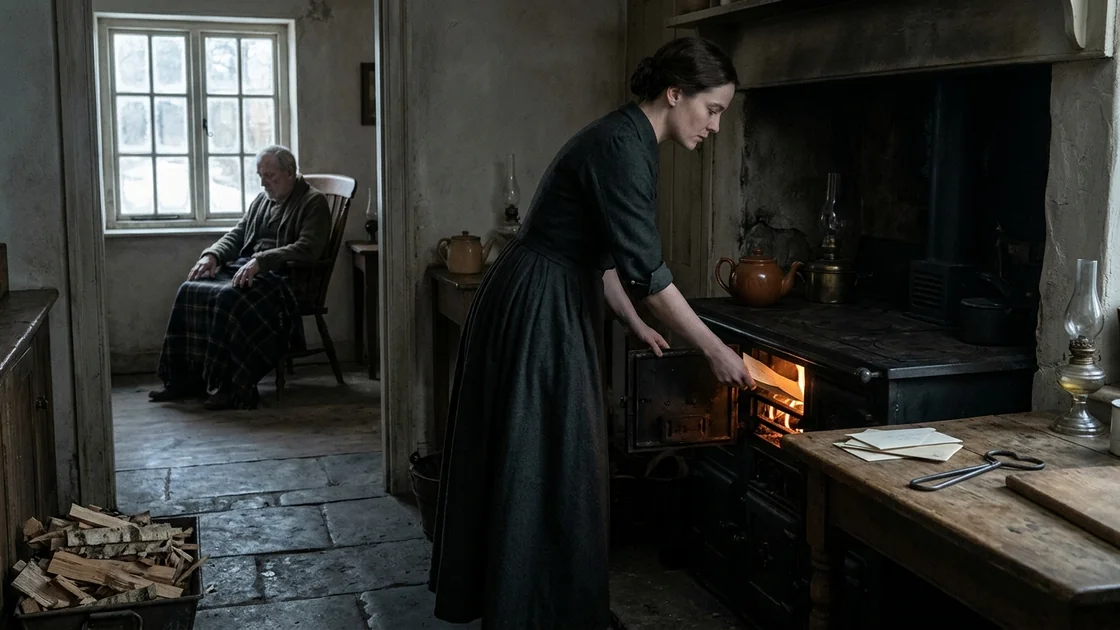
This is the story of Clara Vance, whose possessive devotion to her widowed father drove her to commit an act of silent cruelty that ruined his remaining years. When an old flame named Evelyn Reade reached across decades to rekindle a long-dormant affection with Arthur Vance, Clara took it upon herself to govern the mail that entered their secluded country home. Over the course of a bitter autumn and a cruel winter, she intercepted, read, and burned every single letter Evelyn sent, keeping the correspondence a total secret. She watched with cold satisfaction as her father withered beneath the belief that he had been entirely forgotten by the only woman he ever dared to love again, nursing him with monstrous attentiveness until his heart finally surrendered to silence, leaving Clara alone in an empty house filled only with the ashes of stolen hope.
The cast-iron kitchen range possessed an appetite far more dependable than Arthur Vance’s own. Every morning, long before the sun had cleared the line of stunted oaks at the edge of the property, Clara was down in the scullery, her sleeves pinned to her elbows, feeding the grate with twists of newsprint and dry billets of birch.
She loved the stove for its absolute obedience. It took whatever was offered to it—cabbage leaves, soot-stained tallow, dry twigs, or soft rag paper—and converted it all into a brief, crackling warmth followed by uniform, gray oblivion. There was no argument with the stove. It did not remember what it had consumed five minutes prior, nor did it keep secrets that could be pried loose with a butter knife or an apologetic glance.
Arthur, by contrast, had become a creature of endless, frail recollection.
He came down the stairs at a quarter past seven, the heels of his knitted slippers dragging against the bare oak risers with a rhythmic hush-tap, hush-tap that set Clara’s jaw on edge. He wore his woolen cardigan with the missing horn button—the button she had deliberately failed to replace three months ago because leaving it off made him look softer, more helpless, more entirely dependent upon the quiet industry of her needles.
"Clara," he murmured, pausing at the threshold of the kitchen. His eyes, once a bright, piercing slate, had taken on the watery, milk-blue hue of skimmed cream. He smelled of peppermint drops and camphor liniment. "Is the kettle on?"
"It has been on for twenty minutes, Father," she said without turning around. She was slicing soda bread, the heavy steel blade cutting down against the wooden board with precise, punishing thuds. "Sit down before your knees begin that shaking again. You know Dr. Finch said standing on the flagged floor first thing is terrible for your circulation."
Arthur did as he was bid. He always did as he was bid now. He pulled out the spindle-backed chair near the range, warming his liver-spotted hands at a respectful distance from the iron. "A frost last night," he noted, his voice carrying that hesitant, exploratory tone that elderly people use when they are desperate for conversation but dread being a burden. "The dahlias will be quite black by noon."
"They were finished anyway," Clara said, setting a bowl of boiled oats before him. "Everything has its season, Father. It does no good to mourn a dead stem."
Arthur looked at the oats, then toward the small casement window that faced the lane. The lane was three hundred yards of unpaved, rutted chalk, running between overgrown hawthorn hedges down to the green iron pillar box that stood at the crossroads.
"The post," he said quietly, almost under his breath. "Did... did Mr. Halloway ride past yet?"
Clara brought the brown earthenware teapot to the table, her hand steady, her expression as smooth and unreadable as tallow. "Mr. Halloway does not come until nine, Father. You ask that every morning at seven-thirty. It is seven-twenty-eight."
"Yes," Arthur sighed, his fingers curling slightly around the pewter spoon. "Yes, of course. Forgive me, Clara. My head feels rather cloudy today. The weather, I suppose."
"Eat your porridge," she commanded gently. She reached out and touched his shoulder, resting her palm there with a weight that felt less like an embrace and more like an anchor dropped into soft river silt. "You have me here to keep the time for you. You do not need to trouble yourself with the clocks."
The truth was that Clara had already walked to the lane. She walked to the crossroads every morning at six, long before the sun coaxed the mist off the water-meadows, to meet the mail carrier at the boundary stone.
It had begun in late August, when the summer had grown heavy and rank with the scent of turnip fields and sun-baked dust. Arthur had attended the midsummer fair in High Wycombe—an outing Clara had strongly opposed, citing his heart, his ankles, and the uncouth nature of the crowds. But he had been stubborn that day, fueled by some strange, autumnal spike of vanity, wearing his good broadcloth coat and carrying his polished ash stick.
There, beside the tent of the horticultural society, he had encountered Evelyn Reade.
Clara remembered Evelyn from her own childhood as a woman who laughed too loudly and smelled of lavender water rather than carbolic soap. Evelyn had been Martha Vance’s second cousin—Martha, Clara’s mother, who had slipped out of the world nineteen years ago during an influenza outbreak, leaving Clara to govern the household before her thirteenth birthday. In Clara’s mind, her mother had been a saint of self-effacement, a woman who spoke in whispers and kept household ledgers with monastic severity. Evelyn Reade, however, was the opposite: a woman who painted watercolors of dubious technical merit, wore shawls dyed with madder, and had spent fifteen years in Sussex married to an eccentric surveyor who had eventually fallen off a railway trestle and left her with a modest annuity and no children.
At the fair, Evelyn had taken Arthur’s hands in both of hers. Clara had stood three paces back, watching with mounting nausea as the color surged back into her father’s parchment cheeks.
"Arthur!" Evelyn had cried, her voice carrying across the pen of prize sheep. "Arthur Vance! Good heavens, is it really you? Or is it a ghost from the rectory lawn?"
Arthur had stammered. He had looked, for three dreadful minutes, like a man who remembered what his ribs felt like when they were not merely a cage for a failing heart. "Evelyn. Good heavens. Evelyn."
Clara had stepped between them then, using her parasol like a halberd. "Father has to sit down. The heat is very bad for his vertigo."
"Of course," Evelyn had said, her gray eyes widening with sudden, intelligent pity. "And you must be Clara. Little Clara! You have Martha’s brow, my dear. Exactly her brow."
"I am twenty-eight years old, Mrs. Reade," Clara had replied, her voice cold enough to chill milk. "And we must catch the eleven-forty carrier back to the crossroads."
They had parted with hurried pleasantries, but as they walked away, Arthur had turned his head twice to look back over his shoulder. That evening, he had not eaten his cold tongue. He had sat at his desk in the small study, looking out at the darkened garden, his fingers tapping an uneven, restless rhythm against the green baize.
Two weeks later, the first envelope had arrived.
Clara remembered the texture of that first envelope with the clarity of a brand on cattle-hide.
It had not been common bond paper. It was heavy, cream-laid stock, square and elegant, addressed in a flowing, confident hand that used thick downstrokes and airy, looping capitals: Arthur Vance, Esq., Highfield Cottage, Nether Green.
Clara had taken it from Mr. Halloway’s hand before the postman could even dismount from his red-framed bicycle. Halloway was an old man with watery eyes and a habit of gossiping, his pouch stuffed with circulars and seed catalogues.
"A letter for the master today, Miss Clara," Halloway had remarked, wiping his red nose on a woolen mitt. "From down south, looks like. Lewes postmark."
"Thank you, Mr. Halloway," Clara had said, slipping the envelope instantly beneath her dark wool shawl. "Father is still resting. I will see that he gets it with his broth."
"Right you are, miss. He’s looking frail lately, old Mr. Vance. Saw him by the gate on Tuesday. Like a shadow, poor fellow."
"He is well looked after," Clara had snapped, her eyes narrowing until the skin around them pulled white. "Good morning, Mr. Halloway."
She had not taken the letter into the house. She had walked directly to the apple shed at the bottom of the kitchen garden—a dark, spider-hung lean-to smelling of rotting straw and damp lime.
There, with her back against the rough cedar planks, her heart hammering against her ribs like a trapped crow, she had slit the envelope with the nail of her thumb.
My Dear Arthur,
Since our chance meeting among the squashes and ribbons at Wycombe, I have found myself thinking incessantly of the terrace at the old rectory, and of that summer before the war when you read Tennyson from the stone bench while Martha and I hemmed table linens. We were so very young then, Arthur, and we believed the world had a thousand different paths laid out for us. It seems cruel that we should have lost so many decades to the simple business of living apart.
I am settled here in a small cottage near the downs. It is very quiet—too quiet, sometimes, for an old woman whose mind still runs faster than her feet. I wondered, as I watched you walk away with your daughter, whether you too find the evenings long. Martha was a dear, good soul, but she was never one for long talks by the hearth, was she? You always had that hunger for poetry, for the larger world, which she found so exhausting.
Will you write to me? Tell me how your books are. Tell me what you see from your window. You were always the only man who understood why the hills look blue when the wind turns east.
Yours in enduring remembrance,
Evelyn.
Clara had read the letter three times. Each word felt like an insolent footstep trespassing across her clean, scrubbed floors.
Martha was never one for long talks. How dared she? How dared this painted, wandering creature speak of Clara’s dead mother with such airy condescension? Martha had kept this house immaculate. Martha had died in Clara’s arms, gasping for breath while the mustard plasters dried on her chest, while this Evelyn was off gallivanting through Sussex with a husband who built bridges and fell into rivers.
And Clara—the daughter! Evelyn had written of Clara as an obstacle, an attendant, a grim figure leading an old man away by the elbow.
I have given him my entire youth, Clara thought, her hands shaking as she folded the paper back along its sharp creases. I refused Samuel Cloutier when I was twenty-one because Father could not bear the idea of moving into the village. I have boiled his sheep’s heads, I have washed his linen sheets when the dysentery took him, I have read the morning lessons to him until my throat was raw. He is my charge. He belongs to this house.
If Arthur read this letter, he would change. Clara knew the dangerous, sentimental rot that lived in the corners of her father’s heart. He was an archivist by trade, a man who had spent forty years cataloging parish registers and tithe maps for the diocese. He lived on paper. Give him a sheet of cream-laid paper with lavender-scented promises written on it, and he would begin to believe he was an archivist of his own lost youth. He would want to write back. He would want to go to Lewes. He would spend his small annuity on railway tickets and new boots. He would look at Clara not as his salvation, but as his jailer.
She had walked from the apple shed straight to the scullery.
The range was roaring, hungry for the midday stew. She lifted the iron lid with the lifter. The coals below were a brilliant, translucent orange, humming with heat.
She did not hesitate. She dropped the envelope, unbroken, into the heart of the pit.
The heavy vellum resisted for a second, blistering into yellow carbuncles along the fold. Then a tongue of clear, violet flame licked the edges. The black ink flared white for an instant—enduring remembrance—before the whole square curled inward, blackened, and dissolved into a feather-light wafer of trembling gray soot that was sucked up the chimney by the draft.
Clara replaced the lid. The iron rang with a dull, flat clonk.
She went into the parlor, picked up her duster, and began to polish the mahogany table where her father sat every evening to stare at the wall.
Arthur waited.
At first, it was a gentle waiting, casual and unspoken. He would walk to the gate at ten in the morning, lean his elbows on the top rail, and look down the empty road toward the crossroads. When he returned, his steps were brisk, his face filled with the vague, pleasant expectation of an old man who believes tomorrow will bring a surprise.
"Did Halloway bring the Gazette?" he would ask.
"Yes, Father. It is on the hall stand."
"Nothing... nothing else?"
"Only the coal merchant’s receipt," she would say smoothly, bringing him his spectacles. "Were you expecting something?"
He would blink, his pale eyes searching her face with an innocent, bewildered sadness. "No. No, of course not. Who would write to an old fossil like me? It is just that... well, I had a thought that someone from the old days might have dropped a line. An idle thought, Clara. Simply an idle thought."
"You should not fill your head with idle thoughts," she said, kneeling to adjust the hearth rug so that the fringe lay perfectly straight. "They only make you discontented. God has given us a very peaceful life here, Father. We have our bread, we have our books, and we have each other. What more could anyone ask at your age?"
"Yes," he whispered, staring down at the Gazette, his thumb rubbing the frayed edge of the paper until it tore. "What more, indeed."
The second letter arrived in late September, three weeks after the first.
This one was thicker. Evelyn had enclosed a dried sprig of woodruff, which dropped out into Clara’s palm when she opened the flap in the cold privacy of the apple shed.
Arthur, my dear friend,
I must confess to a foolish disappointment when the weeks passed without a word from you. I walked to the post office at Glynde every morning, telling myself that the post is slow, or that your rheumatism had flared with the change of the moon, or that you were perhaps traveling. But yesterday I remembered how you were when we were young—how easily you took fright at your own feelings, how you would retreat into your books whenever the world asked you to be bold.
Are you frightened, Arthur? Or did my letter go astray? It is so easy for a scrap of paper to be lost in the machinery of the world.
I am sending this to remind you that I am still here. The autumn down here is magnificent; the beech woods are turning the color of old copper, and the air has that sharp, wine-like smell that always made you want to walk over the downs toward the sea. Do you remember the day we took the tea basket to Chanctonbury Ring? Martha had a stone in her shoe and stayed in the trap with the driver, but you and I went all the way to the crown of beeches. You recited that line from Shelley—the one about the leaves being driven like ghosts from an enchanter fleeing.
I am an old woman now, Arthur, and I know that Chanctonbury is behind us, but must our remaining days be entirely silent? If you cannot manage a long letter, send me a postcard. Send me three words: 'I am well.' Just let me know that my old friend still walks under the sun.
With fondest hopes,
Evelyn.
Clara held the sprig of woodruff between her thumb and forefinger. It smelled sweet, like crushed hay and vanilla—an ancient, medicinal smell that reminded her of weddings and burials.
Martha had a stone in her shoe and stayed in the trap.
Clara’s lips thinned until they were white as bone. She saw it all with horrifying, photographic clarity: her mother, patient, plain, practical Martha, left behind in the wicker trap with a throbbing heel while this woman, this hawk, dragged Arthur up the grass to whisper Shelley into his ear. Arthur had carried that memory for forty years, tucked away like a stolen shilling beneath his clerical collars and his parish files. And now Evelyn was reaching back across the grave of Martha Vance to pull that shilling out into the light.
"He does not want your woodruff," Clara whispered into the cold darkness of the shed. "He does not want your Shelley. He wants his dinner at twelve, his feet kept dry, and his soul kept clean."
She walked to the kitchen. The woodruff went first. It sparked once, a tiny green firecracker, crackling with resin, before it was gone. The paper followed. It seemed to burn faster this time, as though the stove were becoming accustomed to the flavor of Evelyn’s script.
That night, Arthur did not touch his mutton.
"You are wasting good meat, Father," Clara said from the head of the table. She sat very upright, her hands folded neatly on either side of her pewter plate. "Meat is fourpence a pound now. If you do not eat, your blood will turn to water."
"I am not hungry, Clara," he said. His voice was lower now, scraping along the bottom of his chest. "I have... a strange weight in my breast today. A kind of tightness."
"It is gas," she said coldly. "Drink your peppermint water."
He looked at her across the yellow pool of candlelight. For a moment, a terrible, lucid terror flared in his pale eyes.
"Clara," he whispered. "Do you think... do you think a person can be forgotten while they are still drawing breath?"
Clara picked up her knife and cut a piece of fat from her meat with surgical precision. "The world is very busy, Father. People have their own houses, their own troubles, their own families. It is only natural that those who step out of the current should be left behind. It is the way of the world. It is why we must rely on our own people, not on strangers."
"She was not a stranger," he murmured, his gaze falling to his empty plate.
"Who was not?" Clara asked, her voice dropping into a register of icy, dangerous curiosity.
Arthur flinched. He pulled his hands back from the table, hiding them in his lap like a schoolboy caught with a stolen apple. "No one," he muttered, shaking his head. "No one, my dear. Just an old name that floated up from the bottom of the pond. Go on with your supper."
October came, stripping the hawthorn hedges bare until they looked like rows of rusted iron fishhooks against the white sky. The wind shifted to the north, whistling through the leaded panes of the cottage and driving the smoke from the chimney back down into the parlor in pale, stinging puffs.
Arthur began to spend his mornings sitting in the porch, wrapped in three shawls, with his ash stick between his knees.
He did not read. His books—the heavy, leather-bound volumes of diocesan history, the collections of seventeenth-century wills he had once spent years transcribing—sat untouched on the mahogany bureau. His spectacles lay beside them, gathering a film of gray dust.
Whenever the sound of a bicycle bell tinkled in the distance, his whole body would stiffen. His chin would lift, his trembling hands would grip the crook of his stick, and he would lean forward like a dog at a rabbit hole.
And every morning, Clara would emerge from the cottage before Halloway reached the gate, her gray woolen dress sweeping the dead leaves from the path.
The third letter came on the fourteenth of October.
It was thinner than the second, the envelope marked with a bold, black URGENT in the lower left corner.
Clara did not even wait to reach the apple shed. She walked behind the privet hedge that shielded the scullery from the road, her heart beating with a steady, rhythmic fury that felt entirely righteous. She tore the envelope open with a swift, vicious jerk of her wrist.
Arthur,
I cannot believe you are cruel. I have known you since you were a boy of seventeen, and though you were timid, you were never indifferent. To leave me without a single syllable for two months—after the warmth of your hands at Wycombe, after the look you gave me by the tent—it is more than unkind; it is a sentence of death upon our friendship.
Did I say something to wound you? Did I speak too freely of Martha? If I did, I beg you, on my knees, to forgive an old woman’s clumsy tongue. You know how I loved her; you know I would rather cut off my right hand than cast a shadow between you and her memory.
Or are you ill? That is the thought that keeps me awake through the small hours while the sea-gaps roar in the chimney. Are you lying in that damp cottage, unable to hold a pen, with no one to write for you? Clara seemed so very strict, so distant. Does she know I have written? Did she tell you?
Arthur, if you are ill, I will come to you. I will take the morning train to Wycombe and hire a trap to Nether Green. I do not care what the village says, nor what your daughter thinks. I cannot sit here and watch our old world die without a word.
Write to me. Even if it is only to say, 'Evelyn, do not write again.' Even if it is only to bid me go away forever. Do not leave me in this silence. Silence is the only thing I cannot bear.
Evelyn.
Clara’s breath came in ragged, burning gasps.
I will come to you.
The words seemed to crawl across the vellum like black ants. She would come here. She would bring her madder-dyed shawls, her loud laugh, her lavender water, her prying, gray eyes into this house. She would look at the cold hearth, the dust on the books, the medicine bottles on the sideboard. She would take Arthur’s hands and Arthur would weep—Clara knew he would weep, he had become so soft, so pathetic—and the whole monstrous structure of Clara’s devoted martyrdom would collapse in a single afternoon.
No, Clara thought, her fingers tightening on the paper until her nails bit through the grain. No. You will not come here. You will not set foot on my gravel.
She did not burn this letter immediately. She took it into her bedroom, locked the door, and sat at her small dressing table.
She took a sheet of her father’s plain, gray writing paper from the drawer. She took up his steel dip-pen—an old, scratchy nib he had used for twenty years—and dipped it into the iron-gall ink.
Clara had spent her entire childhood copying his transcriptions. She knew every curve of his alphabet: the way his capital E leaned slightly to the left, the way his small d finished with an open loop, the tremor that had crept into his h and k over the past five years. She was his archivist. She was his reflection.
She wrote:
Mrs. Reade,
It is my father’s express wish that you cease your communications. He remembers the past with Christian charity, but he has no desire to disturb the quiet of his remaining days with recollections that can only bring distress to his household. He is in excellent health and wants for nothing. His daughter provides all the companionship and care he requires.
He requests that you do not write again, and that you do not attempt to visit Nether Green. Any further letters will be destroyed unread, and should you come here, the door will not be opened.
Arthur Vance.
(dictated to his daughter, Clara Vance)
She looked at the signature. It was masterly. It was Arthur’s hand, but with Clara’s spine behind it—cold, unyielding, and final.
She let the ink dry in the cold air of the bedroom. Then she took Evelyn’s letter, along with the draft she had just written, down to the kitchen.
She burned Evelyn’s letter first. The URGENT flared red, then turned to lace.
Then she looked at the letter she had just written in his name.
Her hand hovered over the open stove hole.
If I send it, she thought, her mind working with the cold, clicking logic of a brass clock, she will stop. But she might write back to confirm it. She might write to the clergyman. She might send someone from the village to inquire if Arthur is truly in his right mind.
A letter sent was a thread left hanging in the world. A thread could be pulled. A letter burned was an absolute severance. A letter burned left only silence, and silence was a poison that ate both ends of the chain at once.
If Evelyn received no answer at all—if she received only that vast, indifferent, impenetrable void—she would eventually wither into her own shame. She would believe Arthur had tossed her letters into the wastebasket with a yawn. She would believe he found her an old, tiresome nuisance. Her pride would rise up to choke her affection.
And Arthur... Arthur would learn the only lesson Clara cared for him to know: that there was no one else. That outside this cottage, the world was a desert of forgotten promises, and that Clara was the only spring of water he had left.
She dropped her own forgery into the stove. It burned with a clean, white flame, leaving no more trace than a dry leaf.
In November, the cough settled into Arthur’s lungs.
It was a dry, hollow cough that sounded like someone beating an old carpet with a cane. He no longer sat in the porch; the frost was too sharp, the wind coming off the chalk hills too cruel. He sat in his chair by the parlor fire, his knees covered by an ancient tartan rug that had belonged to his father.
"Clara," he said one afternoon. The light was failing early, the room drowning in violet shadows, but she had not yet lit the lamps to save paraffin.
"Yes, Father?"
"Did... did any letters come today?"
Clara was knitting a gray wool stocking. The steel needles clicked together with the speed of grasshopper legs. Click-click-click. Click-click-click.
"No, Father. Only the circular from the missionary society."
Arthur’s head sank lower into the folds of his rug. His white hair, which Clara had trimmed straight across his collar, was growing long and whispy around his ears.
"It is strange," he murmured.
"What is strange?"
"To live seventy-two years," he said, his voice wandering through the dim room like an unmoored skiff, "and to leave so small a mark on the world that even... even someone who spoke to you with tears in her eyes should find it too much trouble to ask if you are alive."
Clara’s needles did not pause. Click-click-click.
"People say many things in the heat of a moment, Father. At fairs, people are excited. They see an old face and they play at being young again. It is a performance. When they go home, the performance ends."
"I did not think it was a performance," he whispered. "She took my hands, Clara. She looked right into my eyes. She said... she said I was the only man who understood."
"Mrs. Reade was always an actress," Clara said, her voice dropping into a tone of quiet, reasonable severity. "Mother used to say so. Mother said Evelyn could weep over a broken saucer if there were gentlemen in the room to watch her do it."
Arthur drew a long, shuddering breath. The sound rattled in his throat, thick and yellow. "Your mother said that?"
"Many times," Clara lied, her fingers never missing a stitch. "Mother felt very sorry for her. She said Evelyn was a woman who could never be satisfied with her own lot, and so she went about trying to unsettle the peace of others. You must remember how she was, Father. You were always too good-natured to see through people."
Arthur did not answer. He turned his head toward the window.
Outside, the first flakes of the winter’s first snow were drifting down, silent and heavy, settling on the dead stems of the dahlias Clara had refused to clear away.
"I thought," he said after a long while, "that she might have remembered the terrace. Just the terrace."
"Memory is an expensive luxury, Father," Clara said, rising to put the kettle on. "You should be thinking of your soup."
The fourth letter arrived in the middle of December, carried by a replacement postman because Halloway was down with the lumbago.
The snow had drifted three feet deep against the stone walls of the cottage, turning the lane into a white, featureless trough. Clara had been forced to shovel a path to the well that morning, her hands raw and chapped beneath her mittens.
The young postman, his cheeks like red apples, blew into his fingers as he handed her the post. "Terrible cold, Miss Vance. Road’s near impassable by the bridge. Only one for you today."
Clara took it.
The handwriting was unrecognizable at first glance. The bold, sweeping curves had collapsed into a small, crabbed scrawl that leaned forward as though staggering under a blow.
Clara did not go to the shed; the snow had blocked the door. She went into the cold dairy, where the crocks of salt butter sat on slate shelves, the breath coming from her nostrils in white clouds.
Arthur,
This is the last time I will write to you.
I have been ill. The doctor says it was a congestion of the chest, but I know what it truly was. It was the shame of having laid my heart out upon a table for a man who did not even have the common decency to sweep it into the fire.
If you had written to say you despised me, I could have borne it. If you had written to say that Martha’s shadow stood between us, I would have honored you for it. But this—this absolute, contemptuous silence—it is the cruellest thing one human being has ever done to another.
I see now what everyone in the family always said of you: that you were cold. That you had no blood in you, only ink and old parchment. Martha spent her life waiting for you to look at her, and now I have spent four months doing the same, like an idiot girl standing by a milestone in the rain.
I am leaving Lewes. My sister has taken a house in Torquay, and I am going to live with her. I cannot stay here, looking at the road, wondering if every rider on a horse is carrying a word from you.
You need not fear any further intrusions from me, Arthur. You have succeeded in making me feel entirely ridiculous, and at my age, that is a wound that does not heal.
Goodbye.
Evelyn.
Clara stood in the dairy for a long time. The stone floor was so cold that the soles of her feet went numb through her leather boots, but she did not move.
It was the shame of having laid my heart out upon a table.
She felt a strange, cold thrill of victory run from the crown of her head down to her fingertips. It was done. The wall was complete. The perimeter was secure. The foreign woman had been driven off, her pride broken, her voice silenced, her letters ended. There would be no more cream-laid envelopes. There would be no traps arriving from the station. Highfield Cottage would remain as it had always been: small, gray, clean, and silent.
She took the letter into the scullery.
The stove was burning low, gray ash crusting over the red embers. She poked the iron rod into the coals, reviving them until a small, red eye opened in the middle of the grate.
She placed the letter upon it.
This paper, dried out by the frost, did not burn with a violet flame. It charred instantly, turning black from the center outward, the words You have succeeded in making me feel entirely ridiculous turning into white blisters on a field of soot before the entire sheet collapsed into gray crumbs.
Clara watched it until the last spark died. Then she washed her hands in cold water, dried them on the roller towel, and went into the parlor to give her father his tincture of squill.
Arthur did not ask for the post that day.
Nor did he ask the next day.
By the end of December, he had stopped asking altogether.
He spent his days in the high-backed armchair, his head tilted back against the horsehair cushion, his eyes fixed on the ceiling. Sometimes his lips would move, but no sound came out—only a small, rhythmic puff of breath that smelled of the bitter lung-syrup Clara forced down his throat three times a day.
He had grown so thin that his cheekbones seemed about to tear through the skin, which had the gray, translucent texture of an onion peel. His hands, resting on the wool rug, were always cold. Clara would take them in hers, rubbing them with vigorous, bruising strokes until her own face was red from exertion.
"You must try to get warm, Father," she would say, her voice carrying a hard, desperate brightness. "If you do not get warm, the doctor will have to come again, and Dr. Finch says every visit costs three shillings and sixpence. You would not want to waste our little bit of money on doctors, would you?"
Arthur would look at her, but his eyes did not seem to find her. They seemed to look through her, through the horsehair chair, through the lath and plaster of the cottage wall, out into the great, white silence of the snow-covered fields.
"Three shillings," he whispered one evening. It was the first word he had spoken in forty-eight hours.
"Yes, Father. Three and six."
"A letter... a letter only costs a penny."
Clara’s hand froze on his wrist. "What did you say?"
Arthur did not turn his head. His gaze remained fixed on the ceiling, where a small crack in the plaster looked like an estuary on a map. "A penny. For a penny, you can send your thoughts five hundred miles. You can send them across the ocean. You can send them to someone who is sitting in a room... wondering why the clock ticks so loudly."
"Stop talking nonsense," she said, her voice sharp with sudden, irrational irritation. "You are wandering again. It is the fever."
"A penny," he whispered again. "It is so very cheap. One would think... one would think a man was worth at least a penny."
He closed his eyes. A single tear, thick and slow, formed in the corner of his left eye, ran across his parchment temple, and disappeared into his white hair.
Clara stood over him, her heart thumping with a strange, suffocating pressure. For a moment—just one—she felt a terrible, plunging sensation in her stomach, as though the floor beneath her boots were turning into water.
She wanted to shake him. She wanted to grab him by his bony shoulders and scream into his face: I am here! I am worth more than your penny! I have given you ten thousand hours of my life! I have scrubbed your grease, I have peeled your potatoes, I have sat by your bed while you choked on your own phlegm! Why is she worth more because she remembers a tree on a hill?
Instead, she pulled the rug up to his chin, tucked the edges tightly around his narrow shoulders so that he could not move his arms, and blew out the candle.
January was a month of white iron.
The frost did not lift for twenty-seven days. The pump in the scullery froze solid, and Clara had to boil snow in the great copper kettle simply to get enough water to wash Arthur’s linen.
He had taken to his bed on the fifth of January.
The bedroom was under the eaves, a small, sloping room where the nail-heads in the roof boards were tipped with frost like silver pins. The air was so cold that Arthur’s breath froze into a tiny rim of rime on the edge of the sheet.
Dr. Finch came twice. He was a red-faced man who smelled of horses and stale tobacco, and he did not take off his greatcoat when he went up the stairs.
He tapped Arthur’s chest, listened with his wooden tube, and shook his head.
"The lungs are hepatized, Miss Vance," he said in the narrow passage outside the room, pulling his leather gloves back on. "Solid as liver. He has no strength left to throw it off."
"He has always been weak," Clara said, her voice hard and level. "I have kept him alive for seven years on broths and care."
The doctor looked at her, his brows drawing down in a look of professional curiosity that bordered on dislike. "Care is very well, Miss Vance. But a man must have some will of his own to push the air in and out. Your father... well, he strikes me as a man who has simply set his pack down by the ditch and decided not to pick it up again."
"That is ridiculous," Clara snapped. "He is an old man. Old men die."
"Indeed they do," Dr. Finch said, reaching for his hat. "Keep him warm if you can. Give him the laudanum drops if the coughing becomes distressing. I will look in on Friday, if the drift at the bridge allows."
He did not look in on Friday. The snow began again on Thursday night, a blind, howling gale that piled drifts six feet high against the north face of the cottage, sealing them into their tomb of chalk and slate.
On the night of the twentieth of January, Arthur Vance began to die in earnest.
Clara sat beside the bed in the wooden rocker, wrapped in her mother’s black shawl. The room was illuminated only by the dull, reddish glow of the small coal brazier she had carried up from the study, which hissed and clicked in the corner like an impatient insect.
Arthur’s breathing was no longer a cough; it was a rhythmic, rattling gasp, like the sound of pebbles being shaken in a bladder. His hands moved continuously upon the counterpane, his fingers picking at the threads of the wool, gathering them into tiny, imaginary bundles and letting them drop.
At two in the morning, his eyes opened.
The milkiness had gone from them. They were clear, dark, and terribly bright, reflecting the red coals of the brazier with an unnatural, burning intelligence.
"Clara," he said.
The voice was not his sick-room whisper. It was the voice he had used twenty years ago, when he was the master of the house and came home from the registry office with ink on his fingers.
Clara leaned forward, her rocker creaking. "I am here, Father."
"The box," he said.
"What box, Father?"
"The green box... at the lane."
Clara’s throat tightened until she could hardly draw breath. "It is empty, Father. The snow is up to the hinges. Nothing has come."
"No," he said, his head turning slightly on the pillow. His bright, terrible eyes fixed upon hers with a weight that made her want to drop to the floor. "Nothing has come. Nothing will come now."
"You must rest," she whispered, her fingers reaching out to take his hand.
He pulled his hand away.
It was a slow, weak movement, but it had the deliberate, terrible force of a door being shut and bolted from the inside. He pulled his fingers back against his own chest, curling them over his ribs, away from her touch.
"She did not write," he murmured.
Clara sat frozen, her hand suspended in the freezing air between them. "Father—"
"I was an old fool," he said, speaking not to her, but to the frosted rafters above his head. "An old, ridiculous fool. She had... she had the whole world. She had the downs, and the sea, and her sister... and I thought... I thought because we looked at the blue hills once... forty years ago..."
He gave a small, dry sob that sounded like the crack of a dry twig underfoot.
"She forgot," he whispered. "Before she even reached the turnpike... she forgot."
Clara looked at him. The truth was sitting on her tongue, heavy as lead, sharp as broken glass.
She did not forget! she wanted to cry out into the freezing room. She wrote four times! She begged for you! She offered to come to you! She wept for you until her chest congested! She did not forget you, Father—I killed her for you! I burned her so you would have only me!
The words rose into her throat, choking her, suffocating her with their monstrous weight. She opened her mouth to speak them—to give him that one, final, agonizing drop of comfort, even if it meant he would die looking at her with horror and hatred.
Arthur’s chest rose. He drew in one long, rattling, terrible draft of air that seemed to pull all the cold in the room down into his throat.
His eyes widened, looking straight into hers.
"Clara," he whispered. His voice was very faint now, like the rustle of dry paper in an empty room. "Thank you... for staying. You were... the only one... who didn't..."
His head rolled to the side.
The breath went out of him with a soft, fluttering sigh that smelled of winter and dry bone.
His eyes remained open, reflecting the red glow of the coals, but there was no longer any light behind them. The small crack in the ceiling remained an estuary on a map that led nowhere.
Clara sat in the wooden rocker for five hours, until the pale, gray dawn brought the outlines of the window panes back into the room.
She did not weep. Her eyes felt like dry marbles in their sockets, hot and scratchy behind her lids.
She rose at seven. Her knees made a sharp, cracking sound as she straightened them. She walked to the bed, reached down with two steady, work-roughened fingers, and pulled her father’s eyelids down over his milk-blue eyes.
Then she went down the stairs. Hush-tap, hush-tap.
She went into the scullery. She took the iron lifter, removed the lid of the range, and looked down into the grate.
There was nothing there.
Only a heap of fine, gray ash, cold as the snow that was piling up against the back door. She took the iron poker and stirred it. A small cloud of gray dust rose up, settling on the bib of her apron, on her wrists, on the clean, white pine of the dresser.
She stood there with the poker in her hand, listening to the silence of the cottage.
It was absolute. There was no hush-tap on the stairs. There was no kettle whistling. There was no bicycle bell at the boundary stone. There was only the wind coming off the chalk hills, whistling through the leaded glass, blowing the cold snow across an empty road that led to an empty world.
She had what she had wanted.
She had the house. She had the clocks. She had every hour of his memory, pruned and weeded and swept clean of every living thing until nothing remained but the stone floor and the cold iron of the stove.
She was the only one left.
Clara Vance laid the poker on the hearth, sat down at the scullery table where the soda bread was growing moldy, and began to wait for the spring.