The Iron Tomb of the Cochise
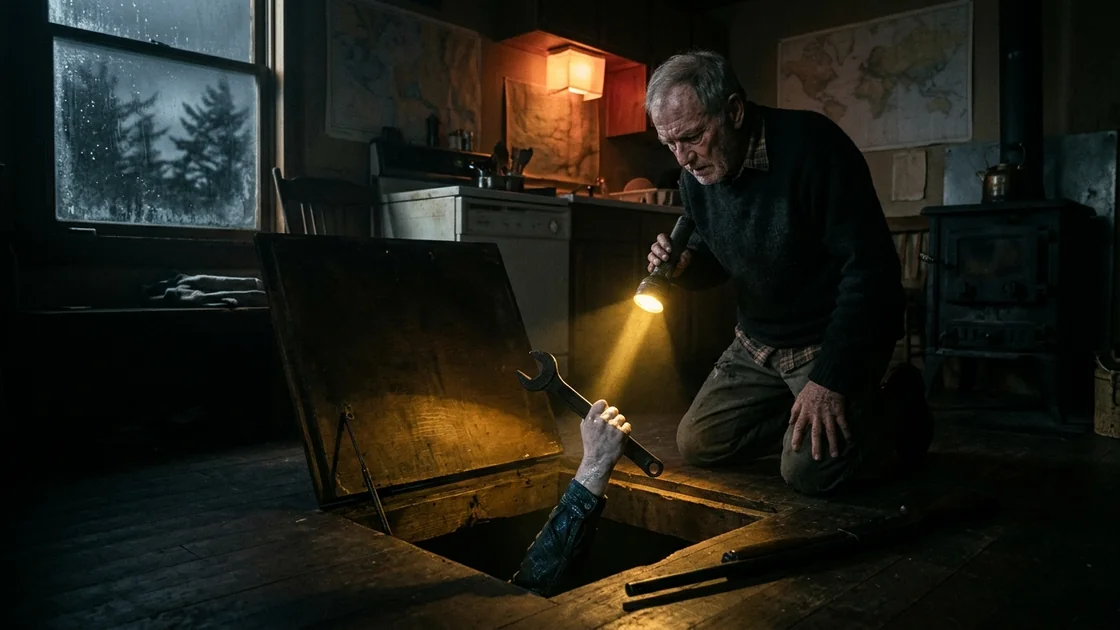
Captain Thomas Hale spent twelve years pretending the sea was just water, but in the damp quiet of his cliffside cottage on the Oregon coast, he knew it was a graveyard made of compressed iron and salt. Twelve years had passed since he stood on the command deck of the hunter-killer submarine USS Cochise, six hundred feet down in the freezing black of the North Pacific, and gave the order to dog the watertight hatch on Compartment Four while seawater tore through a ruptured main ballast manifold. Trapped behind that three-inch slab of cold-rolled HY-80 steel were three young machinists who fought, screamed, and finally took up steel wrenches to hammer on the bulkhead in a slow, rhythmic plea that lasted thirty-eight hours until the sea took their air. Now, an old man stripped of his uniform and sanity, Hale spends his days counting the beats in the plumbing, in the ticks of the old brass clock, and in the relentless surf breaking on the rocks below, waiting for the three ghosts whose cadence never stopped.
The salt had a way of creeping through the weatherstripping, no matter how much silicone Thomas Hale jammed into the frames of the west-facing windows. It crusted in milky crescents on the corners of the glass, blurring the horizon into a smeared horizon of gunmetal gray and spit-white foam.
Every morning began at 0400. Not because he had a watch to relieve, but because 0400 was the hour the hull had groaned. It was the hour the sea had found its teeth.
Thomas sat at the narrow deal table in his kitchen, his hands wrapped around a mug of chicory coffee that had gone lukewarm twenty minutes ago. His fingers were thick, bent at the second knuckles from thirty years of gripping brass handrails, ladders, and toggle valves. He did not look at the ocean through the window. He listened to the house.
Houses built on the edge of Tillamook Head were never silent. The timber settled; the cedar shingles chattered against the tarpaper under the lash of the westerlies; the copper pipes in the crawlspace expanded and contracted with the erratic heat of the woodstove.
Clink.
Thomas didn’t move. His breath hitched in his throat, dry and sour with the taste of old tobacco.
Clink.
A beat. Four seconds. Exactly four seconds.
Clink.
"It’s the stovepipe," he whispered to the empty room. His voice was like stones rolled in a surf drum. "The draft is open. The iron is cooling."
He closed his eyes, but darkness offered no sanctuary; in the dark, the scale of things was lost. In the dark, a room twelve feet square could be ninety feet down, thirty feet across, painted in lead-gray primer and lit only by the amber emergency lanterns of a boat dying on the shelf of the Aleutian Trench.
He waited for the fourth beat.
It never came as four. It was always three.
One. Two. Three.
A pause, measured by the frantic thrumming of his own pulse against his carotid artery. Then:
One. Two. Three.
"Belay that," Thomas said aloud, his voice hardening into the flat, clipped cadence of command. "Belay that racket down there."
The kitchen clock, an old Seth Thomas regulator he had bought in an antique shop in Bremerton because its pendulum was dead silent, ticked once. The brass hand moved a fraction of an inch toward five.
The silence returned, heavy, thick, and smelling of brine. But Thomas Hale remained seated, his knuckles white against the glazed stoneware of his mug, waiting for the watch to change.
In the spring of his forty-second year, Commander Thomas Hale had been considered by the Bureau of Naval Personnel to be the steadiest hand in the Pacific submarine fleet. He was not a romantic; he did not look at the sea as an adversary or an mistress. To him, the ocean was simply a high-pressure hydraulic environment with a specific gravity of 1.025 and an absolute refusal to negotiate.
The USS Cochise was a modified Sturgeon-class boat, two hundred and ninety-two feet of nuclear-powered menace designed to lurk under the thermoclines of the Sea of Okhotsk and listen for the deep-throated rumble of Soviet missile boats. She had a crew of one hundred and twelve men, two steam turbines, and a single S5W reactor that hummed with a quiet, terrifying vitality.
They were seventy miles south of the Rat Islands, running deep at eight hundred feet, rigged for ultra-quiet.
Hale remembered the air on the boat better than he remembered the face of his first wife. Submarine air was a cocktail of distilled human sweat, burned cooking oil, amine from the carbon dioxide scrubbers, and the faint, sweet ozone smell that leaked from the electrical buses. It was dry, cold, and recycled through the lungs of sixty men before it ever reached the bridge.
"Rig for dive," he had told the Executive Officer, Lieutenant Commander Paul Danvers, eleven days into the patrol. "We’re going down under the layer. The drift ice is chewing up the surface sonar."
"Aye, Captain," Danvers had replied. Danvers was twenty-eight, sharp-featured, with teeth too straight for a boy from South Boston and eyes that looked through bulkheads toward his own eventual command. "Blowing safety. Diving to eight-five-zero."
The boat had angled down, her bow diving planes cutting into the black water like shovels into rich, wet earth. Everything had been by the book. The boat had groaned—that normal, comforting compression of three thousand tons of steel yielding fractions of an inch to the immense weight of the Pacific.
In Compartment Four, the auxiliary machinery space aft of the reactor tunnel, three men were on watch.
Chief Machinist’s Mate Walter Orlov was forty-four, an old diesel-boat sailor who had stayed on because he didn't know what to do with his hands when they weren't slick with turbine lube. He had four daughters in Poulsbo and a tattoo of an anchor on his forearm that had blurred into a blue knot of veins.
Under him were two third-class petty officers: Michael Graves, twenty-one, a farm boy from Iowa who could tune a high-pressure air compressor by the smell of its exhaust, and Bobby Tydings, nineteen, whose mother had sent him a tin of gingerbread cookies at Dutch Harbor that he had hidden beneath his bunk so he wouldn’t have to share them with the torpedomen.
At 0348, the Cochise hit a submerged density shear—a wall of hyper-saline water dropping off the edge of the shelf like an underwater waterfall. The depth gauge didn't roll; it plunged.
"Eight-nine-zero," the helmsman called out, his voice tightening by half an octave. "Nine-hundred. Nine-twenty."
"Full rise on the fairwater planes," Hale ordered. "All ahead two-thirds. Catch her."
"Planes are hard rise, sir. She’s not answering. We’re trimming down by the stern."
Then came the sound.
It was not an explosion. Explosions were clean; they had a beginning and an end. This was the scream of metal torn against its grain, followed by the dull, hollow thump of a hydraulic line parting under three thousand pounds of pressure.
The ship lurched as if a giant hand had swiped it from behind. Hale was thrown against the periscope standard, his hip taking the brass fitting with a dull crack that left him breathless. The battle lanterns flickered, went dark, and clicked on again in their dull, amber misery.
"Flooding," the squawk-box barked, the sound distorted by water already splashing against the interior microphone. It was Orlov’s voice. Not panic—not yet—but the harsh, barking urgency of a man who sees the sky falling in a room nine feet wide. "Flooding in Auxiliary Machine Room! Sea chest flange on the low-pressure blower has sheared! We’ve got a six-inch solid stream! We can’t get the stop-valve down!"
Hale was on his feet before his ribs could register the pain. "Danvers, blow the forward groups. Give us an up-angle."
"Blowing forward main ballast," Danvers shouted. The roar of high-pressure air screaming into the tanks shook the deck plates, a sound like a locomotive passing through a tunnel.
The boat did not rise. The stern was heavy, dragging them down into the trench.
Nine-hundred and eighty feet.
The Cochise was tested to thirteen hundred feet. Her crush depth was calculated at nineteen hundred, but calculations were made by men with slide rules in air-conditioned offices in Groton, not men standing on deck plates that were beginning to shudder with the hydraulic hammer of a ruptured sea connection.
"Captain," Orlov’s voice came again over the 7MC circuit. There was a roar behind him now, the deafening, white-noise shriek of water entering under three hundred and eighty pounds per square inch. At that pressure, a stream of water would cut a man’s arm off like a butcher’s saw. "The valve stem is stripped! We’re taking it across the switchboards! Graves is down—he took a chunk of the casing in the thigh! We can’t hold the deck!"
Hale stepped to the bulkhead station, snatched the heavy sound-powered telephone handset from its cradle, and keyed the mic. "Orlov. Get out of there. Evacuate to Compartment Three. Seal the forward hatch behind you."
"Can't move Graves," Orlov shouted over the hiss and thunder. "Water’s up to the deck plates! Tydings is trying to get him onto the ladder, but the hatch is wedged by the lower manifold line! It’s warped, Captain! The frame is warped!"
Hale looked at the depth gauge.
One thousand and forty feet.
The needle was moving with a smooth, terrifying momentum. Once a boat passed twelve hundred with a negative trim of twenty degrees, there was no air bank in the fleet that could push the water out fast enough to overcome the down-angle. The weight of the water would pull the stern into the abyss, and the hull would fold like a tin can under a boot heel.
"Danvers," Hale whispered.
The Exec turned. His face was gray in the amber light. "Sir?"
"Compartment Four watertight door. Who is on the forward side of the dogging wheel?"
"Petty Officer Keller, sir. He’s standing by the bulkhead."
Hale clicked the handset. "Orlov. Leave Graves. You and Tydings get up the ladder. You have thirty seconds."
A beat. Through the sound-powered phone, Hale heard the freezing water roaring against the iron, a terrible, gluttonous sound. He heard a young man screaming—not words, just a high, sharp sound that was swallowed by the froth.
"We ain't leaving him, Captain," Orlov said. His voice was suddenly very close to the transmitter, quiet against the roar. "He’s twenty-one years old. We can’t leave him in the bilge."
"Orlov, that is a direct order. Clear the compartment."
"Can't do it, sir."
"Hale to Keller," the captain barked into the main intercom. "Keller, dog that door."
The speaker spat static. Then Keller’s voice came back, thin, vibrating with horror: "Captain... the Chief is still on the other side. Tydings is on the ladder. I can see them through the scuttle."
"Dog the door, Petty Officer."
"Captain, please—"
"Dog the door and spin the wheel until the markers align, or by God I will come back there and shoot you off the dogs myself! Dog it now!"
Hale dropped the handset. It swung by its coiled black cord, clicking against the bulkhead panel like a metronome.
Click. Clack. Click.
Across the control room, twenty men were watching him. The helmsman, his hands frozen on the yoke; the planesman, staring with wide, white-rimmed eyes; Danvers, whose mouth was half-open as if he had forgotten how to close it.
From far aft, through the double-thick steel hulls, through the deadening insulation and the piping runs, came the heavy, leaden thud of the dogging dogs dropping into their wedges.
Clang.
Then the squeal of the brass bevel gears as Keller threw his weight against the central operating wheel, drawing the neoprene gasket tight against the knife-edge rim.
One thousand one hundred and ten feet.
The boat leveled. The horrific downward plunge slowed, shuddered, and hung suspended in the black water.
"Emergency blow all main ballast," Hale said. His voice did not sound like his own. It sounded like something dried out and preserved in vinegar. "All ahead flank. Get us off the shelf."
The Cochise hung between life and extinction for six seconds that felt like six centuries. The high-pressure air screamed into the ballast tanks, fighting the tremendous hydrostatic pressure of the depths. The hull groaned, plates shifting against rivets with sounds like rifle shots.
And then, slowly, sickeningly, her bow tilted toward the distant, unseen sky.
They were rising.
And then the knocking began.
The first knock came at 0415, while the Cochise was still passing through four hundred feet on her emergency ascent.
It was not loud, but underwater, sound travels through steel four times faster than through air. It traveled along the longitudinal framing of the hull, through the stiffeners, through the deck beams, directly into the soles of the shoes of every man standing in the control space.
Tock.
A beat.
Tock.
A beat.
Tock.
Hale was standing by the chart table, his pencil poised over the dead-reckoning sheet. The graphite point snapped under his thumb.
"What was that?" Danvers whispered, looking at the deck.
"Acoustic feedback from the main circulation pump," Hale said without looking up. "Check the bearing temperatures on shaft line two."
"Captain," the sonarman called from his darkened booth behind the acoustic curtain. His headset was cocked off one ear. "Sonar has... sonar has mechanical transients on the hull, aft. Bearing one-eight-zero."
"Dismissed, Sonar. It’s an unsecured wrench in the bilge."
"Sir, it's—"
"I said dismissed, Petty Officer!"
The boat breached the surface twenty minutes later like an iron whale leaping for air, the bow rising fifty feet out of the swell before crashing down into the gray northern waves. The diesel generators coughed to life, sucking in cold, salt-heavy northern air through the induction mast, flushing the cabin of the stench of burned insulation and the coppery tang of terror.
They were safe. The hull was intact. Eighty-nine men were breathing the wind from the Bering Sea.
And from Compartment Four, three feet below the waterline, the tapping continued.
One. Two. Three.
Hale stayed on the bridge for the next six hours, his face lashed raw by freezing sleet, his fingers glued to the teak grating of the bridge coaming. He would not go below. He could not.
Down below, the report had come up through the speaking tube: the water in Compartment Four had stabilized at four feet above the lower deck plates before the trapped air inside the compartment had compressed enough to match the sea pressure outside. The compartment was what they called an "air-pocket coffin."
There was water, six feet of it, freezing cold and black with grease. But above the water, there was eighteen inches of foul, compressed air.
And in that eighteen inches, Walter Orlov and Bobby Tydings were alive.
Graves had died, Keller thought. When Keller had peered through the thick quartz glass of the viewing scuttle before the emergency lights in Four died, he had seen Graves floating face down between two valve wheels, his denim trousers dark with blood. But the other two were on the high rack, huddled near the overhead ventilation ducts, where the air was trapped against the steel ceiling.
And they had a dogging wrench.
It was a standard-issue twelve-inch steel spanner, used to manually cycle the secondary seawater valves.
Tap. Tap. Tap.
It came every sixty seconds. Not sixty-one. Not fifty-nine. Walter Orlov had been the ship’s timekeeper for seven years; he could calculate shaft revolutions to within half a turn by the rattle of his coffee spoon against his saucer. He was tapping at one-minute intervals.
He was telling them: We are here. We are breathing. We are waiting.
At noon, Danvers came up the ladder to the bridge, his yellow oilskins dripping with ocean spray. His eyes were red-rimmed and his lip was cracked.
"The salvage tug from Adak is forty-eight hours out, Captain," Danvers said against the roar of the wind.
Hale did not look at him. "The weather?"
"Storm system coming off the Siberian coast. Sea state seven. We can’t open the weather hatch on Compartment Four while we’re in these troughs, sir. The seas would swamp the compartment in three seconds flat. We’d founder."
"I know."
"The men..." Danvers choked, swallowed, and spat a mouthful of salt over the side. "The off-duty watch has moved their mattresses into the forward torpedo room. They’re trying to sleep under the sound-dampening blankets. But you can hear it through the piping, Captain. You can hear it in the mess hall. You can hear it in the head."
"Tell them to put in their sound-attenuation plugs."
"They don't help, sir. The plugs keep out the high frequencies. The knocking... it comes through your bones. You sit on a bunk and you feel it in your pelvis. You lay your head down and it hits your jaw."
"Then tell them not to lie down," Hale said.
Danvers looked at his commanding officer with an expression that Thomas would carry with him to the grave—a look that stripped away fifteen years of professional deference, of shared coffee in the wardroom, of naval academy fraternity, leaving only the raw, naked disgust of a man looking at an executioner who has mislaid his mask.
"They're singing down there, sir," Danvers said quietly.
"Who?"
"Tydings and Orlov. When they stop tapping, every four or five hours, they sing. You can hear them through the sound-powered line Keller left off the hook. They're singing 'The Old Rugged Cross.' Bobby Tydings was a choirboy in Altoona. He has a very high, clear tenor."
"Cut the line," Hale said.
"Sir?"
"Cut the sound-powered telephone line at the bulkheads. Cut it and tape the ends."
Danvers stood still for a moment, the wind whipping the cords of his hood against his cheek. "Aye, Captain," he said, and he dropped down the ladder into the dark belly of the boat.
Thomas Hale did not cut the line himself, but he walked down the centerline passageway at 0200 on the second night.
The boat was riding the heavy swells, rolling fifteen degrees to port, then fifteen to starboard, a rhythmic, nauseating sway that made the hull plates groan like old trees.
The passageway was empty. The lights had been red-line rigged to preserve night vision, casting the green linoleum deck in a blood-colored sheen. Most doors were closed. The men who were not on watch were hiding beneath their wool blankets, their fingers jammed into their ears, their teeth clenched against their own jaws.
At Bulkhead 42, Petty Officer Keller was sitting on the deck with his back against the opposite frame, his knees pulled up to his chest. He was nineteen years old. His dungarees were smeared with grease and his cheeks were stained with salt tracks that had dried into white crusts.
He held an unlit cigarette in his mouth, the paper soggy from his lips.
He looked up as Hale approached. He did not stand. He did not salute. In the US Navy in 1968, that was mutiny. Hale didn't care. The Navy had ended forty miles back, when the dogs were set.
"They haven't used the wrench in forty minutes, Captain," Keller said. His voice was cracked, like a schoolboy’s.
Hale stopped three feet from the heavy circular door. The wheel was lashed with three turns of half-inch manila line—Keller’s doing, or perhaps Danvers’s, to keep the dogs from creeping under the pressure.
"The air is foul," Hale said. His voice was a rasp.
"No, sir," Keller said, shaking his head slowly. "They’re conserving it. They’re sitting on top of the reduction gear casing. Walter’s feet are in the water. He told me his socks were ruined before the phone went dead."
"I ordered that line cut."
"The wire was tough, sir. My knife was dull."
Hale stepped toward the door. The steel was cold. Even through the heavy sole of his service shoes, he could feel the dead chill of the ocean on the other side. This door was the only thing between ninety men and the dark water of the trench.
He put his bare palm against the steel.
It was vibrating. Very faintly, like the rim of a crystal glass after someone has run a wet finger around it.
Tock.
The impact traveled straight into the bones of Hale's wrist, up the radius and ulna, through the humerus, and lodged itself in the base of his skull.
Tock.
A long pause. He could imagine Orlov’s arm. Walter had large, hairy forearms with blue veins that stood out like rope. His arm would be heavy now, leaden from the cold, his fingers stiffened into claws by the four-degree water lapping at his thighs. The air would be thin, hot, and reeking of sulfur and dead steam. He would have to lift the wrench using his shoulder, his back braced against the dripping titanium overhead.
Tock.
"Captain?" Keller whispered from the deck.
"Yes, Petty Officer."
"Why didn't you let them use the escape trunk?"
"The trunk was warped by the blast, Keller. You know that. It would have flooded Compartment Three if we cracked the lower hatch."
"Bobby had his bible in his breast pocket," Keller said, staring at his own boots. "He told me before we left Dutch. He said his mother had written his name in it with gold ink. You think the water got to the pocket, Captain?"
"No," Hale said. "He’s sitting on the gear casing. It's high enough."
"The water’s rising, though. Isn't it?"
"The air is dissolving into the sea," Hale said. He couldn't help himself; the engineer in him had calculated it eight hours ago on the back of a navigational chart. "Under pressure, the water absorbs the nitrogen and oxygen. The pocket shrinks six inches every eight hours. Even without a leak."
Keller put his head down on his knees and began to shake. He didn't make a sound. His shoulders just hitched, up and down, in time with the swaying of the ship.
Hale kept his hand on the cold steel until his fingers went numb. He waited for the next three beats.
They came twenty minutes later.
Weak. Faint as a fingernail tapping against a window pane.
Tap.
Tap.
Tap.
Then, nothing.
The Navy buried them in water they were already in.
When the salvage tug Tuscarora finally brought them into the lee of Adak Island, the sea had flattened into an oily, zinc-colored sheet. Fleet officers with gold braid on their caps and faces carved from slate boarded the Cochise before the lines were even secured to the pier.
Hale was relieved of command on the deck plates of his own control room. It was not a disciplinary measure; it was "administrative detachment pending inquiry."
They didn't open the door at Adak. The smell, they said, would have been intolerable for the yard workers. They towed the boat to Puget Sound, into the covered drydock at Bremerton, where men in rubber suits and charcoal respirators worked through the night with oxygen lances and hydraulic jacks to ease the dogs that Hale had ordered driven home.
Hale had stood on the edge of the granite drydock, three hundred yards away, watching the blue sparks from the cutting torches reflect off the wet dock floor.
His wife, Eleanor, had come down from Seattle. She had stood beside him in her gray wool coat, her gloved hand resting on his arm. She had tried to talk to him about the lawn, about their mortgage, about his sister’s wedding in Boise.
"Thomas," she had said, her voice small against the clatter of the shipwrights' hammers across the basin. "The Admiral said it was the right decision. He said you saved eighty-nine men. He said they're going to give you the Legion of Merit."
Hale had looked down at the hull of the Cochise, sitting upright on the keel blocks like a dead whale stripped of its blubber.
"They were nineteen and twenty-one," he had said.
"You had a duty to the whole ship, Thomas."
"Orlov was forty-four. His wife has a shop in Poulsbo. She sells lace."
"You did what you had to do."
Hale had pulled his arm away from her hand. It wasn't cruelty; it was that her touch felt like warm grease on his coat. Everything felt greasy. Everything smelled like amine and wet rust.
"They tapped for thirty-eight hours, Eleanor," he said.
"Stop it," she whispered.
"Thirty-eight hours. That’s two thousand two hundred and eighty minutes. They hit that bulkhead at least one thousand five hundred times. I counted the rhythm on the bridge. Sometimes Walter missed a beat. He’d wait eight seconds instead of four. Then Bobby would take the wrench. You could tell when Bobby had it—it sounded lighter. Like a child with a toy."
"Thomas, please," she had sobbed.
He had left her there on the concrete apron of Drydock 4. He had walked out through the main gate, past the Marine guards who snapped salutes that he did not return, and he had not gone back to the house in Silverdale.
The Navy gave him his medal in a wood-paneled room in San Diego with five people present. No photographers. The citation praised his "extraordinary coolness under conditions of extreme maritime peril."
The check for his retirement arrived every month on the third. It was three thousand two hundred dollars. Exactly enough to buy kerosene, salt cod, coffee, and silence.
Except there was no silence.
The storm hit Tillamook Head at 1600 on a Tuesday in November.
The weather service had been warning about it for two days: an Alaskan low with a central pressure of nine-hundred and sixty millibars, dragging a front of hurricane-force winds across the Pacific.
Thomas Hale sat in his living room, watching the spruce trees at the edge of the headland bend like grass. The ocean was no longer gray; it was white, a boiling cauldron of foam that sent spray two hundred feet up the cliffs to splatter against his windows like handfuls of wet gravel.
The house was taking the blow badly. Built in the twenties by a lumberman who had since died in an asylum, it had tall, unbraced walls that flexed under the gusts. Every fifteen minutes, a particularly violent blast would hit the southern gable, and the entire structure would lean, the studs groaning in their sill plates.
Creak.
Whine.
Thomas sat in his leather armchair—the only piece of furniture he had kept from his former life—with a wool blanket over his knees. A twelve-gauge Remington shotgun leaned against the wall beside him. It was not for intruders; there were no intruders on the Head, only the occasional black bear or a lost elk from the state park.
It was for the stovepipe.
The pipe had begun to chatter at three o’clock. The wind blowing across the top of the chimney created a low-pressure zone that sucked the damper open and shut with a dull, rhythmic clatter.
Tink.
Tink.
Tink.
"It's the damper," Thomas said to the dark room. He had not lit the lamps. He liked the red light better; it felt like the control room running under battle lanterns. He had covered the kitchen bulbs with red cellophane three years ago, after the nightmares had become physical things that waited for him in the hallway.
He reached down and picked up his glass. It was empty. The bottle of cheap rye sat on the floor beside his boots, three fingers of dark amber fluid remaining at the bottom.
Tink.
Tink.
Tink.
He stood up, the blanket slipping from his knees to the floor. His hip, the one that had slammed into the periscope standard forty years ago, gave a sharp, hot twinge that made him drag his left foot as he walked.
He went to the woodstove. The cast-iron handle was cold; he hadn't lit the fire today because the draft was too wild. He took the steel poker from its stand and jammed it into the damper hinge, wedging it tight against the brickwork.
"There," he muttered. "Now shut up."
He turned back toward the armchair.
Thump.
It did not come from the stove.
It came from the floorboards beneath his feet.
Thomas stopped. His boots remained glued to the pine tongue-and-groove.
The cottage had no basement. It sat on eight-by-eight cedar posts set into the basalt ledge of the cliff. Between the floor and the rock was a crawlspace eighteen inches high, home to field mice, spiders, and thirty feet of insulated copper water pipe.
Thump.
A beat. Four seconds.
Thump.
A beat.
Thump.
"No," Thomas whispered. "No. The boat was cut up at Puget Sound. They put her through the shears. They melted the steel in Portland. It’s rebar now. It’s in bridges. It’s under the highway."
Thump. Thump. Thump.
The cadence was faster now. It wasn't the slow, dying tap of sixty-year-old Walter Orlov on his thirty-sixth hour. It was the sharp, frantic hammer of Bobby Tydings when the water had first reached his hips.
Thomas dropped to his knees. The wood was cold through the denim of his trousers. He pressed his ear against the knotty pine, right above the center beam.
Down in the black space between the timber and the rock, the wind was howling through the ventilation grates. But beneath the wind, through the granite, through the foundation, came the clear, metallic ring of HY-80 steel being struck by an eight-pound dogging spanner.
Clang.
Clang.
Clang.
"Orlov?" Thomas croaked, his mouth against the dust of the floorboards.
The knocking stopped.
The silence that followed was worse than the wind. It was the silence of a flooded compartment—that heavy, absolute quiet where the water has reached the ceiling and the bubbles have all found their way to the corners and burst.
Then, through the floorboards, came the voice.
It didn't come through the air; it came through his jawbone, the way the sound had come through his bunk on the Cochise.
“We’re getting cold, Captain.”
Thomas didn't scream. He hadn't screamed when the dive planes failed, and he didn't scream now. His lungs were empty, flat, like collapsed bladders.
"You had thirty seconds," Thomas told the floor. "I gave you thirty seconds. It was the book. The manual says thirty seconds for manual dogging under high-inflow conditions."
“The water’s in the breadbox, Captain,” the voice said. It wasn't Orlov’s. It was Tydings. The boy from Altoona. The choirboy. “The ginger cookies are wet. They taste like diesel.”
"Tydings, you should have dropped the wrench," Hale wept, pressing his forehead against the floorboards. The rough grain of the wood bit into his brow. "If you had dropped the wrench, you could have climbed the ladder with both hands. Why didn't you drop the goddamned wrench?"
“Chief said we might need it to turn the valve,” Bobby whispered. The voice was getting smaller, fading into the noise of the surf crashing at the base of the headland three hundred feet below. “Chief said the Captain wouldn't leave us. He said the Captain was a Navy man.”
"I was a Navy man," Thomas choked. "I had eighty-nine others! Eighty-nine! Danvers had a boy on the way! Keller had his whole life!"
There was no answer from the crawlspace.
Only the three knocks.
One.
Two.
Three.
Thomas Hale scrambled to his feet, his hands scrabbling against the rough plaster of the wall. He caught the barrel of the Remington, his thumb slipping over the cold knurling of the safety catch. He didn't check the magazine; he knew there were four rounds of double-ought buck in the tube.
He racked the slide. The sound—shck-shck—was the loudest thing that had ever been in the room.
He went to the corner by the kitchen pantry, where the crawlspace access hatch was cut into the floor—a two-foot square of plywood with a recessed brass pull-ring.
He grabbed the ring.
"Come up then," he snarled, his teeth bared, saliva spraying from his lips onto the linoleum. "Come on up and relieve the watch! Come on, Walter! Show me what four hundred pounds of water does to a Chief Machinist!"
He yanked the hatch open.
A gust of freezing, salt-laden air hit him in the chest, smelling of damp earth, rotten kelp, and something else—something sharp and oily, like 2190-TEP turbine oil that had been burned on an overheated bearing.
It was pitch black down there. The beam of the flashlight he had left on the counter shook in his hand as he clicked it on and directed it down into the hole.
The yellow circle of light cut through the cobwebs and found the gray, basalt rock.
There was nothing there.
Just the red clay, the foundation posts, and the copper line running from the well to the kitchen sink.
Hale knelt at the edge of the square hole, his shotgun held across his knees, the flashlight beam fixed on the corner where the ledger board met the stone.
The copper pipe was dry. It was not expanding. It was not cooling.
And then, out of the darkness beyond the reach of the light, from the wet dirt beneath the northwest corner of the house, a hand reached into the yellow beam.
It was not a skeleton’s hand. It was the hand of a man who had been in the sea for forty-eight hours—puffy, dead-white, the skin of the fingers wrinkled like soaked parchment, the nails black with grease from a low-pressure air blower.
In its palm, slick with bilge and sea slime, it held an eight-pound steel dogging spanner.
The spanner rose.
The wrist moved with a terrible, mechanical jerkiness, like a machine being turned by a stripped gear.
It struck the bottom of the kitchen floor joist.
Tock.
Thomas Hale looked down into the square opening, his eyes wide, his pupils dilated until there was no blue left in them, only black.
He didn't fire the gun.
He let the heavy Remington slip from his fingers. It fell down into the crawlspace, its stock thudding into the soft, wet earth below.
The hand disappeared into the dark.
Tock.
The sound was right under his knee now.
Tock.
Thomas slowly sat down on the edge of the open hatch, letting his legs dangle into the cold air of the crawlspace. The wind came through the perimeter vents, freezing his ankles, rustling the hems of his trousers.
He looked down into the dark.
"Is the water cold, Walter?" he asked softly.
The answer didn't come in words. It came in three distinct, even strokes against the underside of the floorboards, rhythmic as a pulse, steady as an anchor chain running through a hawsepipe, measured by the clock that only men who die in iron ever learn to hear.
One.
Two.
Three.
Thomas Hale leaned forward, rested his elbows on his knees, and put his face in his hands.
"Very well," he said to the dark. "Very well. I relieve you, sir."
He waited for the next beat, but it did not come. Instead, the sea came up the cliff, rising through the spruce trees, filling the room with the smell of amine and cold salt, until the air was eighteen inches from the plaster ceiling and there was nowhere left to go but down.