The Iron Frost
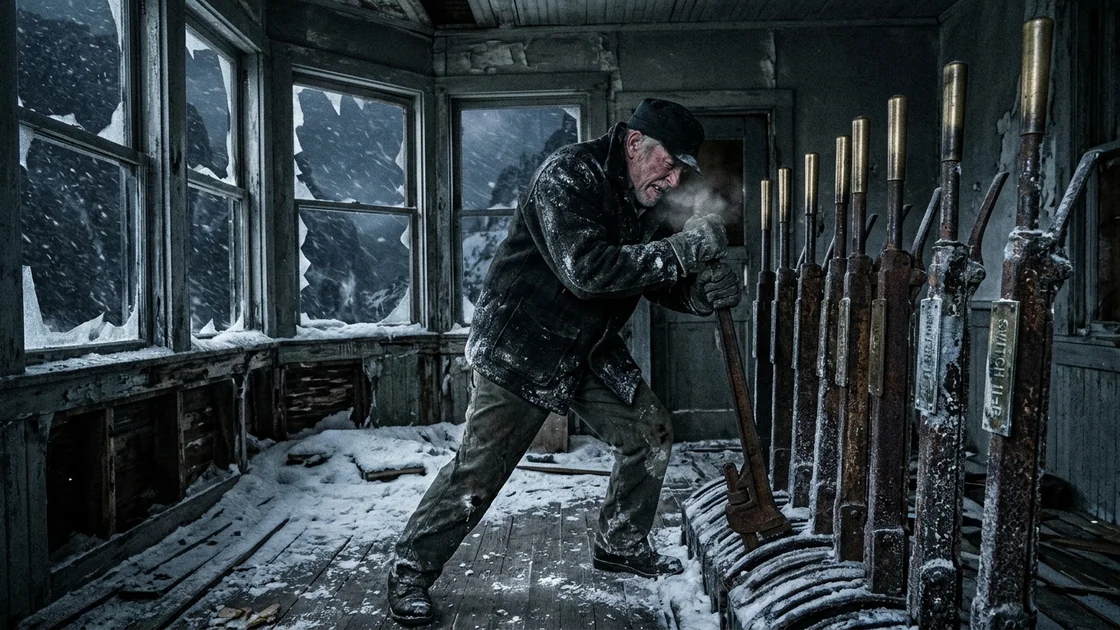
This is the story of Arthur Finch, a switch operator at a remote mountain junction whose single moment of exhaustion during an unforgiving winter storm led to the catastrophic derailment of an overnight passenger express. Spared legal damnation by the storm itself, which masked his negligence beneath frozen iron and howling wind, Finch spends the subsequent decades trapped in a self-imposed purgatory of memory, manual labor, and acoustic haunting. In his solitary life beside the abandoned tracks, every scrape of metal, sudden whistle of wind, and ticking clock serves as a perpetual indictment of the night he closed his eyes and let forty-two lives slip into the abyss.
Chapter I: The Architecture of Cold
The junction at High Divide sat at an elevation where the trees stopped growing tall and began instead to crouch, twisted and gray, against the granite ribs of the pass. It was not a town, nor even a hamlet, but an operational necessity conceived by the Northern & Continental Railway in an era when steam still demanded constant tribute of water, coal, and vigil. By the winter of 1974, the steam was gone, replaced by the sullen, rumbling thrum of six-axle diesel locomotives, but the geometry of the mountains remained entirely unchanged. Two main lines converged upon the narrow shelf of rock above the Blackwater Gorge: the descending freight line from the timber districts, and the graded passenger line that carried the Saint Jude Express eastward toward the coast. Between them lay Switch 11-B, a massive assembly of forged steel, counterweights, and pneumatic linkages that determined whether a train held the banked curve of the shelf or was diverted onto the secondary bypass line cut into the cliffside.
Arthur Finch had worked Tower 44 for eleven years. Before that, he had been a track-walker, carrying a three-pound maul and a gauge stick across twenty miles of frost-heaved ballast every day from November to April. He knew the peculiar voice of cold iron. He knew that when the temperature dropped below zero, steel contracted with a sound like a distant pistol shot, and that ice could pack into the throat of a switch point until the points stood open just an eighth of an inch—enough to catch the leading flange of a sixty-inch driver wheel and tear eighty tons of machinery into the ravine.
The tower was a two-story timber structure with an overhanging bay window that jutted out over the tracks like the bridge of a stranded ship. Inside, the air smelled perpetually of kerosene, dried tobacco, scorched iron from the potbelly stove, and the damp wool of Arthur’s heavy mackinaw. Along the eastern wall ran the interlocking frame: eight brass-handled levers, tall as a boy’s shoulder, their grips polished to a gleaming, mirror-bright silver by decades of calloused palms.
On the night of January fourteenth, the barometer hanging beside the telegraph sounder had fallen lower than Arthur had ever seen it.
The wind had begun at midday, not as a gale, but as a thin, whistling draft that crept through the sash frames and fluttered the carbon-paper manifests pinned to the dispatch board. By six in the evening, the valley below was blotted out by a curtain of horizontal white. The snow did not fall; it drove across the pass in hard, crystalline pellets that sounded like sand flung against the glass. The telegraph wire hummed with a taut, high-pitched vibration that made Arthur’s teeth ache.
Arthur had shoveled the catwalk at seven, fighting for breath against a wind that threatened to peel the lips back from his teeth. Down below, Switch 11-B was fitted with propane burners—hollow iron tubes that ran along the web of the rail, spitting blue tongues of flame against the steel to keep the points clear of drifting slush. But the storm was breathing hard enough to snuff a furnace. Twice already, Arthur had had to descend the exterior wooden stairs, clinging to the salt-crusted railing with both mittened hands, to relight the pilot jets with a long brass torch.
By ten o'clock, the storm had achieved a terrifying uniformity. There was no sky, no ground, no horizon—only the furious, illuminated swirl within the beam of the tower’s searchlight and the black void beyond it. Inside the small room, the cast-iron stove was red-bellied, radiating a fierce, dry heat that scorched the knees of Arthur’s trousers while his back, turned toward the drafty bay window, remained stiff with cold.
The dispatcher’s bell clattered. Three sharp rings, a pause, then two more.
Arthur moved to the brass desk set, lifting the heavy Bakelite receiver to his ear. The line was crackling with static, the voice of Walter Miller in the division office at Grand Crossing sounding thin and distant, as if spoken through a long pipe buried in the earth.
"Finch? You still on the mountain?"
"I’m here, Walter," Arthur said. His voice was naturally hoarse, a product of decades spent inhaling coal dust and kerosene vapor. "Burners went out on the north frog an hour ago. Had to clear it with the bar."
"Saint Jude left the plateau twenty minutes late," Miller said, his words dipping beneath a surge of atmospheric whine. "Engine 4082, seven coaches, two sleepers. The freight behind her is running slow out of Boundary, but she’s heavy—ninety cars of green hemlock. You’ve got to hold the freight on the siding at the Divide until the passenger clears the gorge. Do you read me?"
"Hold the timber on the siding," Arthur repeated. "Let the Saint Jude have the high line."
"Right. Throw eleven-B for the main as soon as you get the advance signal from the whistle post. The freight’s still forty minutes out. Don't let her freeze to the rail while she waits."
"Understood."
"Wind’s clocking seventy miles at the summit, Arthur. Keep your head down."
The connection died with a dry pop. Arthur hung up the earpiece. The silence that rushed back into the room was not true quiet, but the heavy, rhythmic thrum of the storm, punctuated by the steady, hypnotic ticking of the Seth Thomas wall clock. Its pendulum swung inside its varnished oak case with a measured, metallic clack that seemed to dictate the rate at which the blood moved through Arthur’s temples.
Tick. Tock. Tick. Tock.
Arthur sat on his high wooden stool, leaning his elbows on the broad mahogany desk. His eyelids felt as though they had been dusted with fine volcanic ash. He had been awake for thirty hours. His relief, young Danny Vance, had phoned at noon from the lower settlement to say his truck was buried to the axles in a drift on the pass road and no plow was moving until morning. Arthur had told him not to be a fool, to stay by the fire. He had thought himself capable; he was fifty-two years old, seasoned, hardened by thirty winters on the high iron. He had survived the ice storm of ’62 and the slide at Milepost 88.
He reached into his pocket for his tin of Prince Albert, but his fingers were clumsy, numb at the tips. He pinched a shred of dark, damp tobacco into his pipe, but the matches were cold, and the sulfur flared once before dying in the draft that leaked through the window sill.
He did not strike another. He simply rested his forehead against the heel of his hand, watching the snow lash the outer panes.
The potbelly stove purred. It was an old iron animal, full of birch splits and anthracite, breathing out an intoxicating, suffocating warmth. The transition was not an event; it was a dissolution. The roaring of the wind softened into the low, rushing sound of a summer river. The pendulum of the clock slowed its swing, its sharp brass voice mellowing into the dull rhythm of horse hooves on dry dirt.
Arthur’s hand slipped from his forehead, his knuckles settling against the smooth, cold wood of the dispatch ledger. His chin dropped toward his chest. In the iron stove, a log collapsed into embers with a soft, settling sigh, and the room seemed to contract around him, folding him into a warm, airless pocket where there were no schedules, no tonnage ratings, and no cold.
He was dreaming of his father’s orchard in the lower valley, where the apples lay rotting in the long grass under an October rain, when the glass in the bay window began to rattle with a violence that did not belong to the wind.
Chapter II: The Shattered Iron
It was not the sound that woke him, but the vibration.
A heavy train does not merely move along the rails; it sends a wave of seismic compression through the ballast, into the subgrade, through the bedrock, and up through the foundation timbers of anything built within fifty yards of the right-of-way. It was a sensation Arthur had registered in his sleep for twenty years—a low, rhythmic shudder that signaled the approach of tonnage.
His eyes snapped open.
The room was dark save for the dull orange eye of the stove’s draft door and the pale, ghostly rectangle of the bay window. The wall clock read four minutes past eleven.
Four minutes past eleven.
The Saint Jude was due at the Divide at 11:02.
A bolt of cold adrenaline struck Arthur behind the breastbone, violent and sickening. He sprang from the stool with such force that it overturned, its legs clattering against the pine floorboards. He lunged toward the interlocking frame.
Through the snow-blind glass, two hundred yards down the track, a brilliant, terrible eye of white light was boring through the blizzard. The high, twin-beam headlight of an EMD diesel unit was carving a tunnel through the driving flakes, growing larger with an impossible, sickening velocity.
Arthur reached for Lever 11-B. His hand closed around the cold brass grip, his thumb depressing the spring-latch.
He had not thrown it.
The lever stood fully forward, locked in the reverse position—the position that lined the track into the siding, the dead-end shelf where three dozen empty ballast gondolas had been spotted since November, their brakes set hard, buried under five feet of hard-packed drift.
He hauled back on the lever with all the weight of his body.
Nothing happened.
The lever did not budge. The interlocking dog dropped into its notch with a hollow thunk, but the rod refused to travel. Down on the ground, two hundred yards away in the freezing dark, the switch points had frozen during the forty minutes he had slept. The blowing snow, no longer countered by Arthur’s hand-lever or the extinguished burners, had packed like cement between the switch rail and the stock rail.
He threw himself against the handle again, his boots slipping on the oiled floor. A tendon in his shoulder tore with a hot, sharp pull. He groaned, planting his heels against the baseboard, hauling with his arms, his spine, his teeth bared in an animal snarl.
"Move," he whispered into the empty tower. "Move, you bastard, move."
The lever remained dead. Rigid as granite.
Down on the line, the Saint Jude hit the advance circuit. The air horn sounded—not the regular, rhythmic grade-crossing sequence, but a single, continuous, frantic blast that tore through the storm like a serrated knife. The engineer had seen the dwarf signal at the switch. The dwarf signal was showing red.
From the tower window, Arthur saw the fire bloom.
When an engineer throws an eighty-mile-an-hour passenger train into emergency, the brake shoes do not merely grip the wheels; they bite into the steel tires with such savage friction that the shoes melt, sending ribbons of white-hot slag spraying into the snowbanks like fountain fireworks. The sound reached the tower through the double glass: a high, screaming, mechanical shriek of steel being planed away by steel, a sound that bypassed the ears and set every nerve in the teeth to vibrating.
The diesel did not stop. It was eighty tons of iron carrying twelve hundred tons of rolling steel behind it down a two-percent grade on rails coated with frost.
Arthur watched, paralyzed, his hand still frozen to the immovable brass lever.
The lead unit struck the points at Switch 11-B. Because the switch was half-thrown, packed with snow, the leading truck climbed the rail. It did not simply derail; it launched itself. The great locomotive rose up like a horse rearing in terror, its nose tilting toward the storm, its headlight beam sweeping across the ceiling of the tower, illuminating Arthur Finch’s pale, sweat-sheened face for a single fraction of a second.
Then the iron met the iron of the gondolas.
The collision was not a single crash. It was a prolonged, rhythmic demolition that sounded like an artillery barrage inside a cavern. The lead locomotive cleaved through the first three gondolas, crushing them into accordions of scrap, before its frame snapped. The second diesel unit telescoped into the first, and behind them, the lightweight, stainless-steel passenger coaches began to fold.
They did not stay on the ledge. The momentum of the train carried the middle coaches outward, over the cribbing of the retaining wall.
Arthur saw Coach Three—a Pullman sleeper—jackknife into the air. Through the square, lit windows, he saw silhouettes: an arm raised against a pane, the yellow interior lamps, the dark forms of passengers thrown from their berths like dolls from a tossed basket. Then the coach broke in half across the masonry parapet and dropped into the Blackwater Gorge.
The sound of the cars falling into the abyss was lost beneath the continuous, concussive roar of tearing sheet metal and the explosive rupture of the locomotive’s fuel tanks. A pillar of diesel-fueled flame leaped sixty feet into the blizzard, turning the white world an unnatural, greasy yellow. The shockwave rattled the tower windows, cracking one diagonal pane from frame to frame. A wave of heat, smelling of scorched lubricating oil, ozone, and vaporized paint, washed through the gap, melting the frost on the sill instantly.
Then came the silence.
It did not come all at once. For several seconds, there was the hissing of steam from cracked radiator lines, the dry patter of falling cinders upon the snow, and the low, guttering roar of the fire at the switch. But the horn had stopped. The mechanical scream had stopped.
The blizzard, indifferent and ancient, resumed its steady, rushing whisper. Flakes fell through the column of black smoke, turning gray before they vanished into the flames.
Arthur Finch stood alone in the dark tower. His hand had dropped away from Lever 11-B. His shoulder was screaming with pain, but he did not feel it. He smelled the diesel smoke. He smelled the wet wool of his sleeve. He looked down at the floor, where his pipe lay in the dust, its cold bowl cracked in two.
Down in the gorge, four hundred feet below the shelf of the track, there was no light at all.
Chapter III: The Inquest of the Frost
The investigation lasted three weeks and was held in the drafty basement of the county courthouse in Grand Crossing, beneath two flickering fluorescent tubes that hummed at sixty cycles.
The room was furnished with golden-oak tables that had been scarred by cigarette burns and water rings from paper cups. A three-man panel from the Interstate Commerce Commission sat on a raised platform, flanked by two attorneys from the Northern & Continental and a representative from the Brotherhood of Locomotive Engineers. At the back of the room sat eight men from the mountain division, their caps held between their knees, their faces solemn and dark as cured bacon.
Arthur sat in the center of the room on a straight-backed chair that had one leg shorter than the others, causing him to rock slightly whenever he shifted his weight.
"Mr. Finch," said the chairman, a gray-haired man named Garroway who wore steel-rimmed spectacles and had a habit of cleaning his fingernails with the corner of a cardboard file folder. "We have the transcript of your transmission with Dispatcher Miller at 10:24 PM. You were instructed to hold the freight on the siding and clear the main for the Saint Jude. Is that correct?"
"Yes, sir," Arthur said. His voice was flat, dry as dried hay.
"You stated to the field inspector that you went downstairs at approximately 10:40 to inspect the switch heaters. Is that correct?"
"Yes, sir."
"And what did you find?"
Arthur looked at the table. He did not look at Garroway’s spectacles. He looked at a knot in the oak, dark and shaped like a tear.
"The burners were out," Arthur lied.
The lie had not been planned. It had simply presented itself to him on the night of the fourteen, when the search crews had finally reached the Divide at four in the morning, their lanterns swinging like yellow fireflies against the wreckage. The fire from the ruptured tanks had burned away everything near the switch—the linkages, the air lines, the propane hoses. The snow had covered the platform. The physical evidence of his failure was a mass of fused, twisted slag buried under two feet of drift.
"The burners were out," Arthur repeated, his tongue feeling thick, like a dry sponge in his mouth. "The gas line had frozen back at the regulator. I tried to clear the points with the hand bar. The snow was packed hard. It was blowing seventy miles an hour, Mr. Garroway. You couldn't keep your feet."
"And when did you return to the tower?"
"Five minutes before eleven. Maybe six."
"And you attempted to line the switch for the main?"
"I took the lever," Arthur said. "I dropped the latch. The rod wouldn't travel. The points were blocked with ice."
Garroway looked up from his fingernails. His eyes were small, watery, and neutral. "The engineer, Mr. Kroll, did not survive the derailment. His fireman, Mr. Henderson, lived long enough to make a statement to the emergency crew at the base of the trestle. He stated that the distant signal at Milepost 91 was showing green when they passed it."
The railroad’s attorney, a man with teeth like small white tiles named Braithwaite, cleared his throat. "The electrical circuitry was thoroughly grounded by the storm, Mr. Chairman. The divisional engineer has already testified that a cross-connection caused by sleet on the open lines between Milepost 90 and the Divide could have produced a false clear indication on the cab signal. It is an established phenomenon in sub-zero conditions."
Arthur stared at his boots. One of the leather laces was broken, knotted together with a clumsy square knot.
I was asleep, he thought. The words were right behind his teeth, hammering against his palate like birds against wire. I was asleep on the high stool with my head on the ledger. I had forty minutes. I could have cleared the points. I could have thrown the lever before the sleet took the rail. I had forty minutes and I let the fire go out.
"Mr. Finch?" Garroway asked.
"Yes, sir."
"Did you hear the whistle at the advance board?"
"No, sir," Arthur said. "The wind was coming out of the north. It blew the sound back down the draw."
Braithwaite stood up, smoothing the front of his vest. "Mr. Chairman, the company submits that Tower 44 was maintained in accordance with standard winter operating procedure. Mr. Finch is an operator with twenty-two years of unblemished service. The meteorological records from the summit station indicate conditions that exceeded any recorded since the winter of 1888. The mechanical failure of the switch burners due to line freeze was beyond human intervention under those wind loads."
Arthur looked across the room. In the third row of spectator benches sat a woman in a black wool coat that was missing its top button. She was young, perhaps twenty-five, but her face was pinched and dry, the skin around her eyes swollen and violet. She was holding a small child’s mitten in her lap—a blue mitten with red reindeer knitted into the cuff. Her husband had been the Pullman porter on Coach Three.
She was not looking at the ICC commissioners. She was not looking at the railroad’s attorney.
She was looking directly at Arthur.
Her eyes were not angry. They were empty. They had the flat, unblinking quality of windows in an abandoned house. She did not know that he had been asleep; she knew only that he was the man who had been in the tower, the man whose hands were supposed to have kept the world from coming apart on the shelf of the mountain.
Arthur tried to look away, but his neck felt locked, as if the brass pin of an interlocking dog had dropped into the base of his skull. He wanted her to stand up. He wanted her to scream at him. He wanted her to take the water pitcher from the counsel table and break it across his mouth.
Instead, she simply pulled the child's mitten through her fingers, once, twice, three times, until the small woolen thumb was turned inside out.
"The findings of this panel," Garroway said two days later, his voice droning against the hum of the light fixtures, "will reflect that the derailment of Train No. 9, the Saint Jude Express, was the result of an Act of God, to wit: catastrophic icing of the mechanical switch points compounded by electrical fault in the wayside signaling apparatus during conditions of extreme weather. The operator, Arthur Finch, is cleared of operational negligence."
The gavel fell once. A dry, wooden rap that sounded like an axe striking frozen hemlock.
Braithwaite shook Arthur’s hand in the hallway. The attorney's palm was smooth, warm, and dry. "You’re a lucky man, Finch. The company’s retiring that tower anyway. Putting in Centralized Traffic Control out of Omaha. You can take your pension early, or they’ll find you a watchman’s spot at the yards in Minot."
Arthur did not answer. He pulled his hand free of Braithwaite’s grip, walked out of the courthouse, and did not stop until he reached the freight yard where the tracks curved away into the north.
Chapter IV: The Room on Shunting Lane
The town of Oakhaven was not in the mountains, but it was not far enough from them to escape their shadows. It was a place built of cinderblock, corrugated iron, and red-clay mud that dried into a powdery dust in July and turned into greasy grease in November. It sat at the mouth of the valley, where the long coal drags coming down from the Divide were broken up and rearranged for the flatland run to the lake ports.
Arthur Finch lived at the dead end of Shunting Lane, in the half-story attic room of a house owned by a widow named Mrs. Gidley.
The house was eighty yards from the lead track of the western classification yard. Day and night, the room was filled with the sound of iron. The hum of the idling six-axle diesels was a continuous, low-frequency pressure that lived in the floorboards and made the water in Arthur’s washbasin shiver in concentric rings. Every fifteen minutes, there would come the sharp, echoing wham-clack of two forty-ton boxcars colliding in the gravity bowl as a cut was made, followed by the dry, metallic groan of the handbrakes being set.
Arthur liked the room because it was never quiet. Silence was where the sound began.
If the room was quiet for more than two minutes, his ears would supply what was missing: the particular, wet tearing sound of nineteen-gauge steel sheet buckling against granite; the dry, splintering pop of seasoned ash timbers; and the shrill, rising whistle of escaping steam that had no natural stop, that went on and on until it became a needle driven through his eardrum into the brain.
He had furnished the attic with four items: an iron cot with a thin horsehair mattress, a three-legged stool he had leveled with an offcut of two-by-four, a pine chest for his two shirts and extra trousers, and a kerosene lantern that he never filled. He did not use the lantern because he did not want light. He preferred the yellow glare from the yard towers that fell through the dormer window in sharp, diagonal slats, barred by the cross-members of the telephone poles outside.
His days had a rigid, military simplicity.
He rose at five, before the yard shift changed. He did not own an alarm clock; he could not bear the sound of a mechanical escapement. He had thrown his pocket watch—a twenty-one-jewel Hamilton that the brotherhood had given him for his twentieth year—into the Blackwater River three days after the inquest. He had stood on the highway bridge and watched the gold case flash once in the gray air before the cold, brown water took it.
Instead, he timed his life by the trains.
The 5:15 was the manifest from Duluth, carrying iron ore and grain. When its lead horn sounded at the yard limit, he swung his legs out from under the gray army blanket.
He washed his face in cold water from the pitcher. He did not use soap on his cheeks because the scent of soap reminded him of the little guest cakes they put in the lavatories of the Pullman cars—small, pink squares stamped with the company crest that he had seen scattered in the snow down in the gorge, half-melted by the burning oil.
He worked at the grain elevator two miles down the spur.
It was not railroad work. The railroad had offered him his pension—a check for two hundred and twelve dollars that arrived every month in a manila envelope with a cellophane window—but Arthur never cashed them. He kept them in the bottom of his pine chest, flat and unendorsed, beneath his spare woolen socks. He earned his bread with a wooden shovel, clearing the spillage from the boot pit beneath the dump tracks where the hopper cars unloaded.
It was hard, mindless work that blackened his lungs with oat dust and made his bad shoulder throb with a dull, sickening ache that was the only thing he found comforting. The boot pit was sixty feet below the ground, a concrete vault reached by a vertical iron ladder. It was cold down there, even in August, and the only light came from a single bulb in an iron cage that hung from the ceiling on a grease-blackened cord.
Arthur would shovel the grain—four tons, five tons a day—scooping the pale, yellow husks back into the bucket elevator while the machinery roared and clattered above him. The grain dust smelled of dry earth and mold, a dead, vegetable smell that had nothing to do with oil, coal, or burnt hair.
"You don't talk much, Artie," the foreman, a fat man named Hoadley who had lost two fingers to a cable winch, said to him one noon. Hoadley was sitting on an upturned grease tub, eating a hard-boiled egg from a piece of wax paper.
Arthur was leaning against the concrete wall, his shovel between his knees. His shirt was gray with sweat and chaff.
"Nothing to say," Arthur said.
"Man works like you do usually wants something," Hoadley said, squinting through the blue smoke of his cigar. "More hours. A spot on the night maintenance. You don't never ask for nothing. Don't even go to the tavern on Friday."
"I don't drink," Arthur said.
"Well, that’s your business," Hoadley said, tossing an eggshell into the pit. "Just don't drop dead down there. The company don't like the paperwork."
Arthur looked down at the shell. A white flake resting on a mountain of yellow barley.
The company don't like the paperwork.
He thought of the three ICC men with their cardboard files. He thought of Garroway’s spectacles. He thought of the way the ink on the death certificates had looked—forty-two names written in a neat, clerkish copperplate hand that had not wavered once, not even on the name of the eight-year-old girl from Carbondale who had been traveling with her grandmother in Berth 4.
"I won't drop dead," Arthur said.
"Good," said Hoadley.
Chapter V: The Acoustic Season
Winter in the valley did not come with the sudden, theatrical fury of the Divide; it settled like a cold grease over the switchyards.
By November, the ruts in Shunting Lane had frozen into iron ridges that caught the heels of Arthur’s work boots. The clouds hung low and yellow, stained by the smoke from the roundhouse stacks, and the river ran slow, gray, and greasy with industrial waste between its mud banks.
For Arthur, November was the beginning of what he called the acoustic season.
In the summer, the sound was muffled by the thick, humid air and the heavy weeds that grew between the ties—the knotweed, the chicory, the wild mustard. But when the frost killed the brush and the ground froze solid, the world became a vast sounding board of chilled iron.
Every coupling in the yard traveled through the earth into his small attic room. He could tell by the pitch of the impact which tracks were being worked. Track 4 was light rail—seventy-pound iron laid during the first war; it rang with a high, clear, bell-like tone when an empty boxcar hit. Track 9 was heavy manganese steel; it took the impact with a dry, flat thud that felt like a fist striking the small of the back.
On the third of December, the first true blizzard of the year came down from the peaks.
It was not a mountain storm, but it had the same north-northwest trajectory. Arthur lay on his cot, fully dressed in his mackinaw and boots, his hands folded across his chest. He did not sleep. He had not slept more than two consecutive hours since that night in January. When he did sleep, his mind returned instantly to the same room: the smell of the potbelly stove, the warmth creeping through his wool trousers, the heavy, sweet descent of oblivion, and then the sudden, sickening lurch of the floorboards beneath his feet.
The wind rose at midnight.
It came through the gaps in the sash of his dormer window with a sound that was familiar to him down to the tenth of a decibel. It was the whistle of the guy-wires on Tower 44.
Arthur sat up.
His eyes were wide, the pupils dilated until they were thin rings of gray around the black centers. He listened.
Beneath the sound of the wind, there was another sound—a high, rhythmic clack-clack, clack-clack. It was the sound of a four-wheel truck moving over a rail joint with an eight-inch flat spot.
Clack-clack. Clack-clack.
It was coming from the tracks outside.
Arthur stood. His boots made no sound on the floorboards; he had walked on his toes for so long that his calves were knotted into hard, permanent cords of muscle. He went to the window and pressed his forehead against the cold pane.
The yard was nearly invisible through the gray squall. The tall floodlight towers were only fuzzy, yellow halos suspended in the dark. The switch engines had tied up in the house; nothing was moving on the classification leads.
Yet the sound continued.
Clack-clack. Clack-clack.
It was not in the yard. It was in the room with him.
Arthur turned his back to the window.
The room was cold—cold enough that his breath formed a gray plume that hung before his face before drifting toward the ceiling. In the corner by the cold chimney stood a man.
He was wearing the blue serge uniform of a conductor on the Northern & Continental. His brass buttons were dull, coated with a thin film of what looked like white salt. His cap was pulled down low over his brow, but beneath the peak, where his eyes should have been, there were only two dark, hollow sockets that leaked a slow, gray trickle of muddy water.
His uniform was soaked through. His coat was torn from the shoulder to the cuff, exposing a pale, fish-white arm that ended in fingers that had been mashed flat, like lead weights that had been beaten with a hammer.
"The heater’s out, Artie," the man said.
The voice did not come through the air. It came from the base of Arthur’s neck, from the place where the spinal cord entered the skull. It sounded like Walter Miller’s voice through the grounded dispatch wire—thin, crackling with dry static, stripped of all human moisture.
"The heater’s out," the conductor repeated. "We’re forty minutes late at the Divide."
Arthur did not back away. He did not cross himself. He had waited for this man for five years. He had looked for him in the boot pit; he had looked for him in the dark spaces between the grain hoppers; he had looked for him behind the oil tanks down by the river.
"I know," Arthur whispered.
"They're cold down there, Artie," the man said. He raised his crushed hand. The fingers did not move; they were stiff as shingles. "The snow’s four feet deep in the creek bed. The little girl’s mitten came off when we hit the retaining wall. We can't find it in the dark."
"It was blue," Arthur said. His chest felt so tight he could barely draw the freezing air into his throat. "It had red deer on it."
"She’s cold without it," the conductor said. He did not step forward; he simply seemed to grow more substantial in the shadow of the chimney, his salt-crusted buttons catching the faint, greasy light from the yard window. "Why didn't you pull the lever, Artie? The latch was off. We saw you in the window. We saw your lantern."
"I was asleep," Arthur said. He spoke the words clearly, pronouncing each syllable with a deliberate, agonizing precision. He had never said them aloud to another human being. He had not said them to the ICC; he had not said them to Walter Miller; he had not said them to the priest who had come to his boarding house three days after the disaster and whom Arthur had driven from the stoop with an axe handle.
"I was asleep," he said again. "My head was on the desk."
The figure did not move. It did not rage. The water continued to drip from its frayed sleeve onto the pine floorboards, but when Arthur looked down, there was no wetness on the wood—only the gray dust of the grain elevator and the dried wings of dead moths that had died there in August.
"We know," the figure said.
The wind outside hit the house with a sudden, broadside fury, shaking the dormer until the latch groaned in its keeper.
When Arthur looked up, the corner by the chimney was empty. There was only the rough, unpainted pine, the yellow stain from an old roof leak, and the faint, sulfurous smell of cold coal smoke that lived permanently in the plaster.
Chapter VI: The Siding at Milepost 94
The closure did not begin with a vision; it began with a notice in the Grand Crossing Herald that Arthur found wrapped around a head of cabbage he had bought at the company store.
The paper was two weeks old, yellowed at the margins and greasy where the lard had soaked through the newsprint. On page six, between an advertisement for International Harvester tractors and the obituary of a retired blacksmith, was a two-paragraph item:
DIVISION TO ABANDON HIGH DIVIDE RIGHT-OF-WAY
The Interstate Commerce Commission has granted permission to the Northern & Continental Railway to formally abandon thirty-two miles of mountain trackage between Milepost 80 and the Blackwater Gorge. Following the completion of the Flathead Tunnel project, all transcontinental traffic has been rerouted through the lower pass. Track-removal operations will commence in the spring. Tower 44, which has stood vacant since the fatal disaster of 1974, is scheduled for demolition by company work crews early next month.
Arthur folded the paper into a small, tight square. He did not finish his cabbage.
He went to his pine chest, took out his extra pair of wool socks, and pulled them over the ones he was wearing. He took his mackinaw from the hook behind the door. From beneath the mattress, he retrieved a heavy, sixteen-inch iron monkey wrench that he had found in the grain pit two years before—a tool forged from drop-forged carbon steel, heavy enough to split an ox’s skull, its jaw marked with the initials of a long-dead roadmaster.
He walked out of the room and did not shut the door.
He did not take the highway. He followed the right-of-way.
It was twenty-four miles from the Oakhaven yards to the shelf at the Divide. In the lower valley, the tracks were still active, the rails polished to a greasy, silver brightness by the daily coal drags. Arthur walked in the ditch beside the ballast, his head down, his hands shoved deep into the pockets of his coat, the wrench tucked securely into the waistband of his trousers against his hip.
Whenever a train approached, he stepped into the brush, turning his face away from the engineer’s cab until the diesel had passed, its air horn screaming at the road crossings like a living thing in pain.
By nightfall, he had reached the abandoned section.
Here, the world was different. The rails had not seen a wheel in three years. The steel had oxidized into a deep, velvety orange, covered with a scab of lichen and pine needles. In places, the spring washouts had cut under the ties, leaving the rails suspended in the air like the rungs of a ladder over a dry ditch. The dwarf signals were dark, their round glass lenses shot out by boys with twenty-two rifles or cracked by the frost.
The snow began as he passed Milepost 90.
It was the same snow. It had the same dry, pellet-like weight; it fell with the same horizontal fury that stripped the breath from his mouth.
Arthur did not hurry. His boots were old, the soles worn thin as birch bark, and he could feel every sharp edge of the trap rock ballast through his arches. His left knee, ruined by forty years of jumping from moving cabooses and climbing signal masts, made a dry, clicking sound with every second step—a rhythmic, internal metronome that replaced the Seth Thomas clock.
Click. Step. Click. Step.
He reached the shelf at High Divide at three o'clock in the morning.
The tower was still there.
In the darkness, it looked like a great, black bird roosting on the edge of the granite cliff. The windows of the upper floor had all been broken out; the searchlight was gone, torn from its bracket by the wind, leaving only three rusty bolts protruding from the siding. The catwalk had partially collapsed, its cedar planks hanging down like the ribs of an old canoe.
Below it, Switch 11-B was invisible beneath a four-foot drift.
Arthur climbed the exterior stairs. The treads were rotten, spongy under his weight, coated with an inch of hard, wind-glazed ice. Twice his foot slipped through the risers, the splintered wood tearing at the wool of his trousers, but he did not stop. He held the railing with fingers that had lost all sensation, pulling himself up by the strength of his forearms alone.
He reached the landing and stepped through the door frame. The door had long since blown off its hinges; it lay in three pieces across the floor, covered in snow and squirrel droppings.
The tower room was a shell.
The potbelly stove was gone—dragged away by scavengers or road crews for scrap—leaving only a circular hole in the floorboards through which the wind whistled like a flute. The desk was gone. The dispatch ledger was gone.
Only the interlocking frame remained.
It stood against the eastern wall, an iron monument that had resisted the rot and the wind. Seven of the levers were thrown forward, their brass grips tarnished to a dull, greenish brown, covered in bird lime and frozen pine needles.
Only Lever 11-B stood back. It was in the reverse position—the position into which Arthur had failed to throw it; the position that lined the track into the dead-end siding; the position that had torn the Saint Jude from the mountain.
Arthur stood before the frame.
The wind blew through the broken bay window, carrying with it the smell of the gorge—a smell of wet stone, dead spruce, and cold, running water four hundred feet below.
He took the sixteen-inch monkey wrench from his belt.
His fingers were white, the nails blue. He could not feel the steel of the tool, but his palm closed around it with the memory of forty years of grip.
He did not strike the lever.
He leaned against it, his chest pressed against the cold brass grip, his cheek resting against the tarnished silver plate that read: SWITCH 11-B - SIDING.
The wind hit the tower, and the structure swayed—a long, slow, sickening lean toward the abyss. From down in the gorge came that sound again: the high, thin, rhythmic clack-clack of an eight-inch flat spot.
It was not one train now. It was many.
He heard the voices from the berths. He heard them clearly through the broken window.
They were not screaming. They were talking about ordinary things: about the price of eggs in Spokane; about a cousin who had gone to California to work in the shipyards; about the heat in the smoking car; about a blue mitten that had been lost under the seat and couldn't be found because the light was so poor.
"I’m here," Arthur said.
His voice was small, no louder than the dry rustle of the snow against the cedar shingles.
He hooked the jaw of the monkey wrench into the quadrant notch of Lever 11-B. He braced his feet against the sill of the window—the same sill he had looked through when he was fifty-two, when the world was whole, when the forty-two people were still breathing the warm, stale air of their wool blankets.
"I have it now," he said.
He threw his weight against the iron.
The rusted dog did not want to move. It had been seated in that notch for five years; the rust had welded the pin to the quadrant with an orange, crystalline bond that was stronger than the steel itself.
Arthur did not slacken. He felt something give behind his breastbone—a deep, hot, tearing sensation that was not his shoulder, not his muscles, but the central stay of his life snapping like an over-taut telegraph wire in an eighty-mile gale.
A mouthful of warm, salty copper rose into his throat. He did not spit it out. He swallowed it, planted his heels deeper into the rotten wood of the sill, and hauled.
Crack.
The sound was not loud. It was the sound of a pistol shot across an empty pond.
The rust gave way. The quadrant dog cleared the notch.
The long brass lever, five years late, traveled forward. It moved through the slot with a slow, heavy dignity, the counterweights below the floor groaning in their grease, the linkages under the snow down on the ballast creaking as they dragged forty feet of frozen steel across the slide plates.
Thunk.
The lever struck the forward stop. The latch dropped into the normal position.
The track was lined for the main.
Arthur Finch fell forward over the frame. His forehead rested against the cold, smooth curve of the brass grip. His hands remained locked around the monkey wrench, his fingers stiffening into the iron as the frost found them.
Outside, the blizzard continued its work. It drifted through the broken bay window, settling softly upon the shoulders of his mackinaw, filling the hollows between his collar and his neck with small, white crystals that did not melt. It covered his boots; it covered the tarnished plates of the interlocking frame; it smoothed away the footprints he had made upon the rotting stairs.
Down in the gorge, the Blackwater River ran between its shelves of ice, dark and silent, carrying its burden of pine needles and old iron out toward the flatland where the cities were, where the lights were yellow and warm, where nobody was listening for the whistle of the Saint Jude in the storm.