The Iron and the Milk
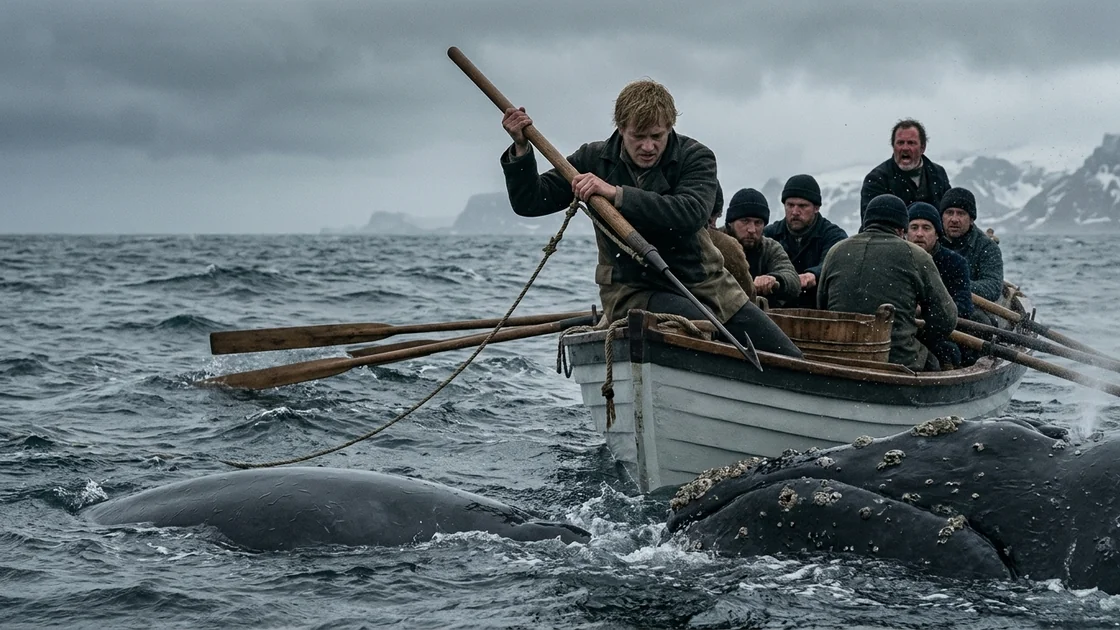
This is the history of Thomas Cloutier, who sailed out of New Bedford in the summer of 1843 upon the bark Arcturus and committed an act of ruinous cunning off the coast of the Crozet Islands. To fill an empty hold and appease an unforgiving master, he drove his harpoon through the soft back of a nursing right whale calf, knowing the mother would not abandon the dying young and could thereby be slaughtered in her devotion. For fifty-four years following that bloody afternoon, through voyages ended, wives buried, and the slow unraveling of his mind in a solitary shanty upon the Maine rocks, Cloutier was never permitted the sanctuary of silence. Until his final breath, every rising gale, every singing tea-kettle, and every vibration of the timber beneath his feet carried the low, mammalian wail of the mother mourning her calf across the desolate fathoms of the sea.
Part I: The Shanty at the Gut
The stove was cast iron, three-legged, and belly-cracked along its left seam where the salt air of Cobscook Bay had eaten into the slag. When the draft pulled hard from the east, as it did every Tuesday that November, the chimney-pipe would shiver in its collar of pounded zinc and utter a sound that drove the dogs in Lubec into fits of frantic baying.
Thomas Cloutier did not own a dog. A dog had ears that were too honest; it would sit upon its haunches by the wood-box, tilt its wet snout toward the floorboards, and whimper at what was rising through the hemlock joists. Thomas preferred the spiders, which kept their legs tucked into the dry knots of the cedar shakes, and the mice, which died quietly in the stone traps he set behind the meal-chest.
He was seventy-seven years old, though his knees had forgotten sixty and his knuckles were swollen like the root-burls of swamp alders. His left ear was entirely dead—broken thirty winters before by the kick of an iron winch-pawl aboard a brigantine in the sheep-trade—but his right ear was an instrument of terrible, exquisite precision. It could hear the difference between a high-tide fog and a low-tide drizzle by the weight of the droplets striking the window glass. It could hear the scrape of a skate-egg case tumbling along the gravel spit four rods down the bank.
And it heard, always, beneath the hiss of his tallow candle and through the dull thud of his own pulse, the cow.
He sat that evening upon a bench he had hewn from a hemlock balk dragged out of the salt marsh in the spring of ’82. In his hands he held an old clasp-knife with a bone handle, scraping down the edge of an ash spoon. He did not need another spoon; seven of them already lay in a basket of sweetgrass upon the shelf, yellowed from grease and scrubbed with sand until their bowls were thin as eggshells. But his fingers demanded work. If they stopped, they would curve into the shape of a pine-pole oar, or worse, they would curl against his breast as though bracing the socket of a toggle-iron against the greasy shoulder of his old monkey-jacket.
"Let be," he whispered to the kettle.
The kettle sat cold upon the iron hearth, dry as a skull, but it sang nonetheless. It began with an octave like the drone of a bumblebee trapped between double sashes, then slid downward, thick and viscous, into a frequency that set the spoons in the basket trembling against one another. It was not a whistle. Steam had no part in it. It was the noise a great pump makes when its leather washers are rotted and the water column slips backward into the dark cistern.
He laid the ash billet upon his thighs. His hands were shaking, not with the dry palsy of old men, but with the cold, galvanic terror that had found him first in the forty-fourth degree of south latitude and had followed him across two oceans, three marriages, and fifty years of dry dirt.
"You’re dead, old girl," he said aloud, his voice like stones dragged across dry kelp. "Your blubber was boiled down into two hundred and ten casks of head-matter and brown strainings. The cooper hammered the bung-staves home with hickory mallets. Your bones are down among the crabs off the Crozets, gray as slate, with the kelp-tendrils growing out of your blowholes. You ain't here."
The timber beneath his wool-socked heels answered him. It was a faint, subterranean vibration, a thrumming that came up through the four-inch cedar sills, through the granite rubble he had laid with his own spade, through the damp slate ledge that sloped into the gray water of the Reach. It was the sound of a lung three times the size of a hay-wain, filling itself with the gray brine of the Southern Ocean and emptying itself in one long, broken trumpet-blast of grief.
He closed his eyes and leaned his forehead against the cold edge of the spruce table.
"You ain't here," he whimpered. But he knew she was nowhere else.
Part II: The Bark Arcturus
In June of 1843, New Bedford smelled of horses, wet pine sawdust, and the stale grease of sixty years of boiling. The harbor was an uncombed forest of topmasts, spruce yards, and black rigging that creaked in the salt wind like a vast wicker cage.
Thomas Cloutier was twenty-three. His shoulders had the breadth of a double-bitted ax and his hair was the color of uncarded hemp. He had two debts: five dollars to a boarding-house mistress who fed her men salt-pork rind and chicory, and three dollars to a slop-seller on Water Street for a pair of duck trousers that split at the groin the first time he hauled a mooring-hawser. To clear both, and to escape the narrow fields of his father’s farm in Dartmouth where the stones grew faster than the rye, he walked up the stairs of Messrs. Rotch & Sons and put his cross upon the articles of the bark Arcturus.
The Arcturus was three hundred and twenty tons of round-bowed, wall-sided live oak, green-built and copper-fastened, smelling of rotten bilgewater and the vinegar used by the cook to scrub down the steerage. Her master was Captain Peleg Vane, a man whose spine had been set crooked by a falling block in his boyhood and whose eyes were the color of stagnant harbor ice. Vane was a Nantucket man of the old, hard breed, who wore a broad-brimmed beaver hat even in a gale and carried no books aboard save a calf-bound volume of Bowditch’s Navigator and a small ledger with brass clasps, wherein he entered the cost of every biscuit and ounce of tobacco issued to his people.
"You’ve pulled an oar, boy?" Vane had asked him, looking past his shoulder at the slate roofs of the oil-sheds.
"Two seasons in the Vineyard Sound, sir. Cod and mackerel."
"The whale is no cod," Vane said, his tongue clicking against a row of loose, tobacco-stained teeth. "A cod has no more will than a turnip. A whale is the prince of the power of the air, cast out into the great wash, full of gall and craftiness. You strike when the boat-steerer tells you to strike, and you don’t drop your iron because the sea gets white. If you spill a boat, your lay goes to the cooper and the smith to pay for the staves. Do you sign?"
Thomas made his mark—a crude anchor with a broken fluke.
They cleared Clark’s Point with a northwest breeze that flattened the smoke of the town against the bay. By sunset the land was only a low, purple smudge like an old contusion on the water, and Thomas was leaning over the leeward rail, heaving up his grease-biscuit into the foaming wake while the older hands laughed from the foretop.
The vessel was divided into two tribes: the afterguard, who lived in the cabin on beef, hard bread, and rum, and the foremast jacks, twenty-four men stuffed into the triangular blackness of the forecastle, where the bunks were narrow as coffins and the air was thick with the reek of damp wool, wet boots, and the smoke of cheap Virginia leaf. Thomas was assigned to the waist-boat, pulled by five men under the command of Mr. Starbuck, the second mate—a man with ears like dried apricots and a voice like a gravel slide.
For six months they saw nothing that yielded grease. They rounded the Horn in an August gale that coated the stays with three inches of rime and froze the salt pork into pink cobblestones that the cook had to chop with a broadaxe. They chased a school of finbacks off the Falklands—long, lean, swift devils that ran seventy miles an hour and left the boats bobbing in their suds like chips of pine. They took three small blackfish whose oil barely filled twelve tierces and left the deck covered in a slick of green slime that sent three men sliding into the scuppers with bruised ribs.
Captain Vane grew blacker with every turn of the glass. He would pace the weather quarterdeck for six hours together, his beaver hat pulled down to his brows, his hands knotted behind his crooked spine, watching the horizon with an eye that seemed to demand of God why the ocean had been emptied of its riches for his particular ruin.
"Two hundred barrels," he snarled one evening at the cabin table, while Thomas was clearing away the tea-mugs. "The owners have ten thousand dollars in this bottom, and we haven't enough grease to fry a dough-nut. We’ll be four years out. We’ll eat the leather off the pumps before I take her into port with empty casks."
He looked up at Thomas, his gray eyes narrowing until they were like slits in an ox-hide.
"You," he said. "You're the harpooneer’s boy now. Enoch died of the flux off the Plate. You take his thwart. You think you can stand up in the head of a twenty-eight-foot cedar boat and plant six feet of Swedish iron through four inches of horse-pieces?"
Thomas felt his throat tighten. "I can strike what I'm pointed at, sir."
"Then see you point straight," Vane said, returning to his ledger. "A boat-header buys his ship with blood; a boat-steerer buys his bread with iron. Don't bring me back an empty pole."
Part III: The Leeward Shore
In December they were skirting the Crozet Islands, a cluster of volcanic fangs thrusting out of the Southern Ocean where the gales are born in the ice-wastes of the Pole and sweep northward without a tree to break their back. The sky was rarely blue; it was a gray ceiling of scud that drove low over water the color of bruised pewter. The air was filled with the screaming of Cape pigeons and wandering albatrosses—great, greasy-winged monsters that sat upon the gray swells and stared at the ship with round, unblinking yellow eyes.
On the fourteenth of that month, the wind fell into a rare, glassy calm. The sea did not flatten; it remained a vast, heave-shouldered swell that rolled up from the southwest, oily and long, lifting the Arcturus forty feet into the gray air and dropping her again into troughs where the sails flapped against the masts like wet carpets.
From the foretop came the cry that every man’s belly had been waiting for through two thousand leagues of salted misery:
"There she blows! Right ahead! A long spout—thick and low! There she breaches!"
Thomas dropped his grease-pot and ran to the waist-tackles. Mr. Starbuck was already on the rail, his stocking-cap shoved back from his forehead, his nostrils flaring like those of a horse at an open barn-door.
"Lower!" he roared. "Lower away, you Dutch hounds! Clear the falls! Thomas, take your box! Keep the lashing clear of the thole-pins!"
The boat struck the swell with a slap that set Thomas’s teeth rattling. In twenty seconds the six men were on their thwarts, their oars out, their bodies swinging together like parts of an engine. In the head of the boat, Thomas stood with his thighs wedged into the clumsy-cleat, his hands resting on the rough ash shaft of his first iron. The iron was five feet long, made of soft, tough metal that would bend without breaking inside the blubber, with a toggle-head ground to the sharpness of an English razor and wrapped in greasy flannel to preserve its edge from the salt spray.
"Pull, boys!" Starbuck hissed from the stern, his steering-oar bent double as he rounded the stern of the bark. "A mother and her sucker! Look at 'em! A right whale, big as a meeting-house, and her little calf alongside of her, fat as a butter-tub! Pull, you lazy scoundrels! There’s four hundred barrels of bone and oil if we take the pair!"
Thomas saw them then, three hundred yards off on the crest of a gray roller.
She was sixty feet of black, barnacled skin, her jaw curved like the bottom of an iron scow, her nostrils set far back on the summit of her round head, through which she drove two low, forward-slanting spouts that drifted in the moist air like plumes of gray steam. Beside her—scarcely fourteen feet from snout to flukes—was the calf. It was an infant thing, not four weeks old, its skin not yet scarred by the ice or the parasites of the south, smooth and gray as an oiled boot. It swam close against her flank, sometimes diving beneath her great belly to find the milk-teats that lay tucked in the folds of her skin, then rising again to blow its little puff of spray, which was no larger than the breath of a horse on a frosty morning.
The cow swam slowly, matching her vast bulk to the weak stroke of the calf’s tail. She rolled slightly as she moved, exposing the vast, pale expanse of her belly, guiding the smaller creature with her broad, spatula-shaped flippers, nudging it toward the smooth slick of her wake where the swimming was easier.
"Softly now," Starbuck murmured, his voice dropping an octave as they closed the distance. "Don't gallied 'em. She's got her eye on the young un. She don't see us. Pull, Cloutier. Pull your stroke."
The wind had died entirely. The only sound was the click of the cedar thole-pins, carefully muffled with greased rags, and the steady, lunging whisper of the six ash blades dipping into the swell.
At fifty fathoms, the cow seemed to feel the weight of the boat’s displacement upon the water. She stopped. Her huge head rose three feet above the surface, the water cascading from her bonnet—a ragged crown of gray crustaceans and whale-lice—in a hundred white gutters. She blew—a harsh, whistling whoof that smelled of fermented shrimp and wet rocks.
The calf drew closer, pressing its nose against her left flipper.
"She’s gallied!" Starbuck hissed. "She’ll sound! Cloutier, stand up!"
Thomas braced his knee against the notched pine board. His hands were wet with sweat despite the salt chill. He caught the iron, threw the flannel covering into the bottom of the boat, and lifted the sixty-pound pole to his shoulder.
"She’s too far!" Thomas yelled back over his shoulder. "Thirty feet yet, sir! She’s going down!"
The great tail, twenty feet across from tip to tip, rose into the air like a black sail, dripping with silver threads of brine. The calf was trailing, its small flukes beating furiously to follow the descending bulk of its mother.
"The sucker!" Starbuck screamed, his eyes wide and bloodshot in his red face. "Strike the sucker, damn you! Strike the calf!"
Thomas hesitated for half a heart-beat. It was an old trick, an ugly trick, one that the older men in the forecastle spoke of with lowered voices over their pipe-bowls—a trick forbidden by the old Nantucket customs save when a ship was clean-casked and desperate. To strike the calf was not to gain oil; a calf’s blubber was soft, watery stuff that would yield only a few gallons of thin, rancid grease that boiled away into white scum in the try-pots. But a cow will leave her life in the deep before she will leave her stricken calf.
"Strike, you son of a dog!" Starbuck roared, reaching down to seize the boat-hatchet as though he would heave it at Thomas’s head. "Strike, or I'll drown you!"
The calf’s smooth, dark back was four feet off the starboard bow, wallowing in the heave of the sea as it tried to sound after the mother. It had no fear; it had never seen anything above the water save the gulls and the clouds. It rolled toward the boat, its tiny, dark eye—no larger than the eye of an ox—turning upward through the green water to look at the ash blades.
Thomas did not look at the eye. He looked at the gray skin over its shoulder blades, drew back his right arm until his knuckles touched his ear, and drove the iron down with all the weight of his twenty-three years and his hatred of Captain Peleg Vane.
Part IV: The Iron in the Milk
The iron entered the calf with a sound that Thomas would remember when his teeth were all gone and his knees were water—a soft, wet chock, like a spade driven into greasy clay.
The little creature did not leap. It had neither the bulk nor the muscle to sound like a bull. It shuddered from its nostrils to its flukes, its small tail thrashing once against the cedar planking of the bow with a light, hollow tap, like a mother knocking on a bedroom door with her knuckle.
Then it made its sound.
It was not a roar, for a whale has no vocal cords in its throat. It was a noise forced out through the spiracle and through the internal chambers of its great head—a high, thin, piping reed-note, like an infant child crying through a pewter horn. It had the tone of milk in it, of things that have known only warmth and darkness, suddenly cast into cold salt and iron.
The line in the tub did not hum. It ran out five fathoms, six, then stopped. The calf lay upon the surface, three feet from the boat, its small head tilted, its flank bubbling with a thin, scarlet foam that was not dark like the blood of a grown bull, but pale, mixed with the curd of the milk it had drawn from its mother’s breast not five minutes before.
"Fast!" Starbuck shouted, though there was no joy in his mouth. "Fast, by God. Hold your line, Thomas. Don't give him an inch. Let him lie."
"He’s dying," Thomas said. His hands were burning where the line had run across his palms.
"Let him die," said Starbuck, his eyes fixed on the black depths beneath the boat. "Hold the line. She's coming."
The sea beneath the boat went from green to dark olive, and from olive to the black of midnight.
Thomas looked down between his boots. Through four fathoms of crystal water, he saw the mother rising. She was coming up not with the blind fury of the sperm whale, which batters ships with its forehead, but with an awful, slow majesty that displaced the water in vast, dome-like boils that lifted the whaleboat two feet without a wave.
She did not touch the boat. She rose until her long, black snout was level with the calf.
She blew. The spray from her nostrils struck Thomas full in the face. It was hot, thick with the stench of the deep sea, and flecked with gray phlegm. She nudged the calf with her upper lip—that great, arched lip that carried three tons of whalebone. She pushed it gently, upward toward the air, as though she thought the little thing had forgotten how to breathe.
The calf did not move. Its head was submerged; its little flukes hung limp in the swell.
The cow swam around it in a circle so tight that her great dorsal ridge scraped the bottom of the boat, making the cedar ribs groan like an old floor. As she circled, she began to sing.
It was not the high whistle of the porpoise, nor the sharp click of the sperm. It was a sound that had no name in the English tongue. It was a low, undulating groan that began so deep in her vast chest that the men in the boat did not hear it with their ears; they felt it in their bellies, in their testicles, in the iron nails that held their boots together. It rose slowly through the octave, gathering to itself the weight of three thousand fathoms of cold water, until it became a long, shattering lament that shook the oar-blades in the water and made the copper sheathing on the bark, half a mile off, ring like a muffled chime.
"God," whispered the midship-oarsman, a Portuguese named Manuel who wore a leaden crucifix about his neck. He dropped his oar and caught the beads. "Mother of God, hear that."
"Pick up that oar!" Starbuck barked, but his own face was the color of a wet turnip. "Cloutier, get your second iron! Get it ready!"
The cow had ceased her circling. She had come up beneath the calf, her vast flipper extended, trying to balance the dead body of her child upon her broad, black paddle. She lifted it clear of the water. The blood from the calf’s back ran down her side in long, pink ribbons, curdling in the white barnacles on her knuckles.
She looked at the boat.
Her eye was set low, near the corner of her cavernous mouth. It was larger than that of the calf—the size of a six-pound shot—black, wet, fringed with wrinkled skin that looked like the skin around the eye of an old elephant. There was no rage in it. That was the thing that broke Thomas’s heart sixty years later; there was no fury, no red glare of the wounded beast. There was only a cold, bottomless wonder—a vast, mammalian astonishment that the world contained an animal that would do this thing.
"Now!" Starbuck hissed. "Drive it into her neck! Drive it deep!"
Thomas seized the second iron. His boots slipped on the oily thwart. The cow was not five feet from him; he could have reached down with his bare hand and touched the gray, rubbery skin of her bonnet. He smelled her breath—the hot, sweet, fishy breath of her sorrow.
He did not want to throw. He wanted to drop the iron into the sea and cover his ears with his hands until the world went black. But the habit of three years of blows and hard bread was stronger than his soul. He lifted the pole, looked for the white spot behind her flipper where the life lay nearest the skin, and threw.
The iron struck. It went home to the socket.
The cow did not breach. She did not strike the boat with her flukes, though one blow would have made kindling of the cedar and dead men of the six who sat within it. She merely closed her eye, sank slowly down into the dark water, carrying the second iron and forty fathoms of line with her, while her dead calf drifted against the oars, bumping softly against the wood like a bloated water-skin.
And as she sank, her cry came back to them through the line. It vibrated up the hemp, through the bronze chocks, through the cedar timbers, into the soles of Thomas’s feet—a long, descending rattle of grief that died away only when the line went slack and they knew she had turned upon her side in the deep to die of an empty breast.
Part V: The Try-Works
They worked until midnight by the light of the try-works.
The Arcturus lay hove-to in the dead calm, her two great brick furnaces blazing amidships between the fore and main masts. The smoke from the scrap-iron fires rolled black and greasy across the sails, depositing a soot that clung to the skin like wet wool.
The cow had been brought alongside by three boats, towed head-down with her great flukes lashed to the starboard bow by three-inch chains. She was vast; her carcass stretched half the length of the bark, a black island of flesh that surged up and down with the swell, bumping against the oak hull with a hollow boom that shook the cook’s pots in the galley.
They did not cut in the calf.
"No fat on it," Captain Vane had said, leaning over the rail with his pipe in his mouth, watching the little gray carcass as it hung from the waist-tackle. "Nothing but blubber-milk and water. Cut it adrift. Let the birds have it."
Thomas had stood by the gangway with a boat-hook. It had fallen to him to clear the iron from its back. He had cut the socket out with his sheath-knife, his fingers slipping in the soft, pink fat that smelled not like the oil of the mother, but like the cream in his mother’s dairy at Dartmouth when the milk had stood two days in the pans.
When he severed the toggle, the little creature slid down into the gray swell. It did not sink at once; it floated high, its pale belly turned up to the stars, while forty giant petrels and cape-hens fell upon it with screams that sounded like rusty hinges, tearing at the eyes and the soft skin of its lips until the water was white with feathers and foam.
On the staging hung over the side, Mr. Starbuck and the chief mate, Mr. Coffin, worked with long-handled cutting-spades, their bare arms red to the shoulder. They were peeling the cow as an old woman peels an apple, paring away the blanket-piece—a strip of blubber four feet wide and a foot thick—which rose slowly toward the main-yard through the blubber-tackle with a greasy, tearing sound like canvas ripped in a gale.
Thomas was in the blubber-room—a dark, foul hold beneath the main hatch, where the blubber was lowered in great horse-pieces to be sliced by his short-handled spade into thin slices, called "bible-leaves," that the mincers could pitch into the pots.
The air in the hold was fifty degrees hotter than the air on deck, thick with the steam of the fresh-killed meat and the stink of the bilge. He was knee-deep in the fat. Every time the bark rolled, the slippery yellow blocks shifted against his shins, knocking him against the stanchions.
Beneath him, through the live-oak planking and the copper sheathing, the sea was alive with sharks. Hundreds of blue dogs and hammerheads had gathered from thirty miles round, tearing at the carcass as it was stripped, their rough hides rasping against the oak planks with a sound like sandpaper drawn over dry pine.
Every time a spade struck into the bone, every time the chain-slings creaked at the yard-arm, Thomas heard the moan.
It did not come from the deck. It did not come from the men, who were singing a salt-song about a girl in Liverpool and three bottles of gin.
It came from the water against the ship’s ribs.
It was the same tone—the low, five-note lamentation that had shaken the whaleboat. It came through the five-inch white-oak ceiling; it came through the bilge-water that sloshed in the limbers; it rose through the iron handle of his mincing-knife into his wrist-bones.
"Manuel," Thomas called out, his voice cracking with the smoke. "Manuel, you hear that?"
The Portuguese boy was sitting on a half-cask, his face gray with fatigue, his hands wrapped in greasy rags to protect his blistered palms.
"I hear the sharks," Manuel said, without looking up. "I hear the spade hitting the jaw-bone. I hear Peleg Vane counting his dollars."
"No," Thomas said, stepping across a heap of blubber. "Not the sharks. The cow. Listen."
Manuel looked at him with dull, dead eyes. "A dead whale don't sing, Thomas. A dead whale just rots. You got the oil-fever. Go up and get a breath of grease-smoke. It clears the head."
Thomas did not go up. He stood in the dark hold, his spade hanging from his hand, listening as the song rose and fell. It was not steady; it had the cadence of a breath—twenty seconds of sound, forty seconds of silence, then the long, shivering moan that died away into a rattle like pea-gravel poured down a lead shoot.
He knew then—not with the logic of a scholar, but with the cold, animal knowledge of a dog that has been beaten with a specific stick—that the sound was not in the sea. The sea was only the drum-head. The sound was in his own ears, hammered into the bone of his head by the toggle-iron he had driven into the calf’s back.
He laid his hand against the ship’s side. The live-oak was cold, but the wood seemed to pulse beneath his fingers, not with the stroke of the sea, but with the regular, mechanical throb of a vast, broken heart that refused to turn into bone and tallow.
Part VI: The Long Way Home
They were three years more in the Pacific and the Indian seas.
They took forty sperm whales off the coast of New Zealand; they boiled down forty-five hundred barrels of oil until the bark smelled like an open frying-pan from her trucks to her kelson. They traded with the tattooed savages of the Marquesas for breadfruit and green hogs; they put three men ashore at Tahuata with the scurvy, their legs black as coal and their gums growing over their teeth; they buried the carpenter in forty fathoms off the Kermadecs with an old iron hoop lashed to his feet to keep him down.
Through it all, Thomas Cloutier became the best harpooneer in the fleet.
He never missed. When Captain Vane pointed his crooked finger at a pod of cows off the Line, Thomas would stand in the head of the waist-boat, his feet steady on the slick boards, his arm rising like an engine of brass and sinew. He killed without haste and without fury; he drove his irons through blubber, through meat, through life, with a cold, terrifying efficiency that made even Starbuck look at him sideways.
"The lad don't shout," Starbuck said to the mate one night over their grog. "A man ought to shout when he strikes. It clears the bile out of the liver. Cloutier just looks at 'em like he was an undertaker measuring 'em for four-inch pine. He’s too quiet by half."
Thomas was quiet because he was listening.
If he spoke, he might miss the tone. If he laughed, the sound would catch him unawares and drive him into the scuppers with his hands over his ears.
It was no longer only the sound of the right whale cow off the Crozets. It had gathered to itself every death he had made. The six-foot calves of the sperm whales that had floated in the suds while their mothers were dragged to the ship; the old bulls that had rolled in their death-agony, spouting clotted blood into the sails; the porpoises that had died on the foredeck with their little, human-like eyes looking at the butcher’s knife—they had all joined their breath to that one great, central organ-pipe of woe.
He heard it in the trades, when the wind blew seventy days from the southeast without a shift, humming through the topgallant rigging like a thousand tuned harps.
He heard it in the calm, when the sea was a mirror of molten tin and the Arcturus hung between two skies, her sails limp as the ears of a hound, while the heat brought the old whale-oil bubbling out of the deck-seams until the soles of his shoes were yellow with it.
He heard it in the grog-shops of Talcahuano, where the girls with silver combs in their hair danced the fandango on the dirt floors to the scraping of two-string fiddles. In the middle of their turning, while the wine was sour in his mouth and the smell of roasting goat came from the courtyard, the floorboards would begin to shiver, and that low, wet, mammalian horn would blow beneath the dust, drowning out the music, the laughter, and the clicking of the castanets until he had to stumble out into the street and vomit into the horse-gutters.
"What ails you, Yankee?" a woman had asked him once, catching his sleeve with her brown fingers. She was young; she had a baby wrapped in a red rebozo across her breast, its little dark head nodding against her collar-bone as she walked.
Thomas had looked at the child. He had seen the blue veins on its tiny temple, the soft, fluttering skin over its fontanelle, and the white drop of milk that hung upon its lower lip.
He had torn his sleeve from her grip and run through the mud to the boat-slip, throwing himself down upon the cold stone until the oarsmen found him at dawn, shivering like a wet dog.
They returned to New Bedford in the autumn of 1847.
The Arcturus came up the river with her flags flying and her grease-casks full, three thousand barrels of bone and oil that smelled like gold to the men on the wharves. Captain Peleg Vane went ashore in his beaver hat, his brass-clasped ledger tucked under his crooked arm, his face set in a hard, pale grin that meant he had cleared forty thousand dollars after paying his owners and his crew their seventy-seventh lays.
Thomas received four hundred and twelve dollars and sixteen cents.
He went to the slop-seller on Water Street, paid his three dollars for the duck trousers he had split three years before, bought a sea-chest of camphor-wood, two woolen shirts, and a ticket on the packet-sloop that ran north to Portland.
"You ain't shipping again, Tom?" asked Manuel, who was standing by the door of the tavern with a blue ribbon in his hat and two girls from the cotton-mills on his arms. "The Crescent is fitting out for the Japan Ground. Good ship. Plenty biscuit. Starbuck’s got the mate’s berth."
"No," Thomas said.
"What you going to do with your hands?" Manuel asked, laughing. "You don't know nothing but iron and blubber."
"I can ditch," Thomas said. "I can dig dirt. Dirt don't sing."
Part VII: The Dirt and the Slate
He learned that dirt was not quiet.
He went into the interior, twelve miles from the salt water, behind the town of Yarmouth, where the hills were round and green and covered with thick stands of sugar maple and white birch. He bought forty acres of hillside land that had more granite in it than grass, built a two-room house of split logs with a chimney of river-stones, and married a girl named Sarah True, whose father was a deacon in the Christian Church and had three daughters with no dowry.
Sarah was a silent girl with gray eyes and hair that smelled of the birch-bark she used to start the morning fire. She looked at his thick hands, his crooked knuckles, and the way he would sit upon the well-curb for an hour without drawing a bucket, his head cocked to one side as though he were listening for a coach on the turnpike.
"You was three years on the water, Thomas," she said to him one evening, while she was carding wool by the hearth. "My brother John was two years on a brig to the West Indies. He came back full of talk about the black folk and the pineapples and the great birds with bills like shovels. You don't never talk of nothing you seen."
"I seen water," Thomas said. He was oiling a harness with neatsfoot grease. The smell of the fat made his throat close; it was cow-grease, dry and thin, but his brain turned it into the oil of the Arcturus’s try-works. "Water and salt. There ain't nothing in it to make talk about."
"Did you take whales?"
He dropped the rag into the grease-pot. The iron handle clicked against the rim—chock.
"We took 'em," he said.
"Was it brave work?" she asked, her fingers moving among the wire teeth of the cards. "The deacon says the whalemen are like the old kings in the Book of Job, searching out the deep places of the Almighty, bringing light into the dark habitations of the earth."
Thomas stood up. He walked to the window. Outside, the summer wind was moving through the maples, making their broad leaves turn their silver bellies upward to the moon with a dry, rustling hiss like the foam running off a whale’s back.
And beneath the rustle, five rods down in the gray subsoil where the maple roots went hunting for the wet clay, it was waiting.
It was fainter here, through twelve miles of stone and gravel, but it was clearer for being faint. It had lost the noise of the surf and the screaming of the albatrosses. It was the naked voice of the thing itself: the five-note cry, rising and falling, an octave below the lowest note of the church bass-viol, crying for the milk that had been poured out upon the Crozet grounds five summers ago.
"Thomas?" Sarah said, her hands stopping on the fleece. "What is that?"
He turned on his heel, his face white as tallow. "What do you hear?"
"I don't hear nothing," she said, her eyes widening with that fear women have of things they cannot see in their men. "Only the wind in the orchard. But you look like you seen a spirit."
"I ain't seen nothing," he said.
They lived together seven years. She bore him two sons who died of the black diphtheria in the second week of an October freeze, and in the eighth year she died herself of a slow, cold consumption that turned her skin the color of skimmed milk and made her voice so thin Thomas had to lean his good ear to her mouth to hear her ask for water.
When they lowered her into the red dirt of the churchyard at North Yarmouth, the sexton used two lengths of three-inch hemp rope to let the pine box down into the shale.
The rope ran through the sexton’s dry hands with a rhythmic, whistling hiss: hish-hish-hish.
Thomas stood by the open hole in his black Sunday coat, his beaver hat in his hands. As the box settled onto the wet gravel at the bottom, he looked down. The rope had left a white smear of hemp-dust across the black lid.
From the bottom of the grave, through the four feet of air that remained between his wife’s face and the gray November sky, the sound came up.
It was not Sarah’s voice. Sarah’s voice had been small, sweet, and dry like dried lavender. This was the voice of thirty tons of meat, rotting in the cold fathoms of the south, calling across forty degrees of latitude to the man who had planted the Swedish iron in her calf’s back.
He did not wait for the deacon to finish the prayer. He turned his back on his father-in-law, on his two dead boys under their slate headstones, on the forty acres of maple and stone, and walked down the turnpike toward the sea.
Part VIII: The Coastwise Years
A man who has the whale-sound in his ears cannot live inland. The silence of the woods is too thick; it has no bottom. In the woods, a man can hear the sap moving in the hemlocks, he can hear the beetles boring in the bark, and beneath both he hears the great cow crying.
On the shore, there is at least the noise of the water to cover it. The water is an engine that never stops; it pounds the ledges, it rattles the shingles, it drags the dead kelp back and forth across the rocks with a great, roaring scrub that gives an old man’s brain something to lean against.
For thirty years Thomas Cloutier was a creature of the tideline.
He did not go back to the deep-water ships. He would not set his foot upon a vessel that carried an iron or a lance. He worked the small, dirty coasters that carried lime from Rockland to Boston—hulks that were so old and leaky the lime would sometimes take fire from the water in the bilge, burning the vessel down to her water-lines while the crew rowed away in a cedar skiff smelling of burnt stone.
He worked as a rigger in the yards at Bath, his fingers black with pine-tar, splicing five-inch hemp stays and setting up the dead-eyes for ships he would never see come home. He worked on the mackerel-traps off Monhegan, pulling the great nets in the gray dawn while the dogfish thrashed through the twine and the gulls screamed like children over the offal.
He married a widow in Boothbay—a woman named Martha who had four children by a drowned fisherman and a voice that could be heard across the harbor above a westerly gale. She was a good woman, hard-faced and scrubbed with yellow soap, who thought Thomas was merely stupid because he would sit by the cook-stove with his head between his knees for hours at a time, humming a five-note tune that had no beginning and no end.
"Stop that drumming, Tom," she would say, hitting the table with her rolling-pin. "You sound like a dead-march. A man your age ought to know some tunes with words to 'em. Sing 'Old Hundred' or sing nothing."
"It ain't 'Old Hundred,'" he would say.
"What is it then?"
"It's just a piece of an old song I heard down south."
"Well, leave it down south," she snapped. "We got enough noise here with the baby teething and the chimney drawing soot every time the wind comes off the Gut."
She died of a mortification of the bowels when Thomas was fifty-nine. The children, who were none of his blood, took her furniture, her pewter spoons, and her two feather beds, and sold them at auction on the town wharf. They offered Thomas a corner of the kitchen in the eldest boy’s house at Damariscotta, but he looked at the boy’s wife, who had three little ones clinging to her skirts, and he saw the milk-stains on her apron.
"No," he said. "I’m going down to Cobscook."
"There ain't nothing at Cobscook," the boy told him, pocketing the silver dollars from the feather beds. "Nothing but fog and Indians and stone ledges that'll rip the bottom out of a dory. A man can't make a living there."
"I don't need no living," Thomas said. "I got four dollars a month from the Marine Hospital fund for my broken ear. I can eat clams."
Part IX: The Great Winter
He built the shanty on a ledge of dark slate that ran into the Gut like a broken tooth.
It was eight feet wide and twelve feet long, framed from the driftwood timbers of an old lime-schooner that had broken her back on the Wolves forty years before. The studs were hacked with the broadaxe and studded with rusty trunnels; the floor was made of three-inch hemlock planks he had carried on his shoulder one by one from the mill at Pembroke, two miles through the alders.
Below his door, the tide ran six knots through the Gut—a great, swollen river of green salt that rose twenty-four feet every twelve hours and fell again with a sucking roar that left the kelp hanging from the slate like the hair of drowned women.
In the summer it was bearable. The gulls nested on the outer rocks, five thousand of them, and their screams filled the air from four in the morning until the sun went down behind the spruce hills. The mackerel came through the reach in July, millions of little, silver needles that set the water boiling, pursued by schools of fat harbor porpoises that puffed and blew like blacksmiths' bellows in the twilight.
Thomas would sit on his bench, his ash spoon in his hand, watching the porpoises. He did not hate them. He did not hate anything now—not even Peleg Vane, who had died forty years before in a Nantucket madhouse, eating his own fingers and screaming that the Arcturus was sinking in forty fathoms of whale-oil.
He only pitied them. He pitied their thick, warm fat; he pitied the milk that came from their bellies into the cold brine; he pitied the way they stayed together in the channels, mother and young, moving with their ribs almost touching, as though they believed the water was a home instead of an open grave.
In the winter of 1897, the cold came early and stayed until the world seemed to have turned to salt and iron.
By mid-December, the Gut was running with slob-ice—great, round pans of frozen slush that ground against the ledge with a continuous, dry chur-chur-chur that sounded like the teeth of a thousand horses chewing grain. The spruce trees on the hills cracked in the nights with reports like pistol-shots as their hearts froze through.
Thomas could no longer dig clams; the flats were frozen three inches deep, hard as slate. He lived on dry yellow-eyed beans he boiled with a scrap of salt pork in his iron pot, and the tea he made from hemlock needles he gathered from the drifts behind his shed.
His wood was almost gone.
He had burned his dry birch; he had burned his old lobster-traps; he had burned the spruce fence he had set up to keep the sea-drift from his door. There remained only three logs of old white oak—pieces of the lime-schooner’s floor-timbers, four feet long and thick as a fat man’s thigh, black with age and heavy as lead with the salt they had drunk through fifty years of immersion.
On the night of the eighteenth of January, the wind came around to the southeast—the storm-quarter.
It was not a snowy gale; it was a black, dry blizzard that brought no white cover, only a cold that was three degrees below zero and a sea that rose six feet above the ordinary spring-tide. The rollers came in from the Grand Manan Channel, forty feet from trough to crest, gray and dirty under the low stars, bursting against the slate ledge with concussions that blew the spray fifty feet over Thomas’s roof, where it froze instantly into a crust of salt ice that thickened the cedar shakes until the rafters groaned under the weight.
Thomas sat by his stove. He had put the last oak timber into the fire-box.
The wood would not blaze; it was too full of salt. It smoldered with a dull, blue, chemical flame that smelled of sulfur, copper, and rotten fat. The chimney-pipe was glowing a faint, cherry red where it left the stove, but two feet away the frost was half an inch thick on the cedar walls.
He had wrapped his feet in two old wool blankets and a piece of discarded oilcloth he had found on the fish-wharf. On his head he wore his old watch-cap—the same he had worn forty years before on the waist-boat of the Arcturus, greasy, stiff with salt, its crown mended with a piece of sail-twine.
The kettle began to sing.
He looked down at it. There was no water in the pot; he had forgotten to bring in a bucket of snow before the gale broke, and the spout was dry as a dead bone.
Yet it sang.
It was not the five-note song now. It was no longer the broken, fragmentary reed-note of the infant calf or the deep, vibrating lamentation of the mother.
The gale had gathered all the years together into one single, magnificent chord.
It came from the stones beneath his sills. It came from the iron stove-plates. It came from the camphor-wood sea-chest in the corner, where his old monkey-jacket lay rotting under three old Bibles he had never learned to read.
It was the voice of the whole, vast, mammalian sea—the millions of tons of hot blood that had been poured out upon the waters since the first wild Nantucket man drove an iron into a gray snout off Siasconset.
The sound rose through the ash-billet table. It lifted his ash spoons in their sweetgrass basket, setting them dancing like the ivory dice in an old sailor’s box.
Whooo-ahhh-ooo.
It was the mother. She had found him.
She had been fifty-four years swimming up through the Atlantic; she had doubled the Horn in the gray gales; she had passed the Falklands where the kelp-tendrils reach for the keel; she had followed the warm current of the Gulf Stream north to the Banks; she had turned into the gray rocks of the Maine Gut, hunting for the piece of her heart that had been left in the head-matter of the Arcturus.
"You're old," Thomas said to the stove. His voice had no breath behind it; it was only the click of his dry tongue against his palate. "You're too old to be swimming in this ice, mother. The ice'll take your flukes. It'll pinch your nostrils shut."
The house shook.
A great sea, three fathoms of solid, black brine, struck the slate ledge below the door. The spray did not fly over the roof this time; the water struck the heavy hemlock door with a dull, flat thud, like the head of a sperm whale taking the side of an old ship.
A thin line of salt water, green and clear as oil, squirted through the door-crack, spreading across the floorboards until it reached the edge of his wool-wrapped boots.
In the green water, tumbling over the rough hemlock, was a piece of kelp—a long, brown, rubbery ribbon with two round, air-filled pods at its tip, like the two small eyes of an infant thing that had never seen the sun.
Thomas stood up.
His knees did not hurt him now. The swelling in his joints had gone cold, hard and painless as the granite stones on his Dartmouth farm. He dropped his ash spoon upon the table. He did not take his coat; he did not take his hat.
He walked to the door.
The latch was frozen. The salt spray had run into the iron socket and turned to glass. He did not use the handle; he put his shoulder—his harpooneer’s shoulder, forty-four inches around the breast, the shoulder that had driven the Swedish iron through four inches of horse-pieces—against the white-oak planking and leaned his weight against it.
The door burst outward with a sound like a rifle-shot.
The gale took him in the mouth. It was not air; it was an ocean of frozen needles that tore the skin of his lips and filled his nostrils with the reek of dead kelp and wet snow.
The Gut was white.
As far as his good eye could see through the black twilight of the gale, the water was one continuous boiling sheet of milk. The slob-ice had been smashed by the rollers into a gray porridge that rose and fell in twenty-foot swells, tumbling against the slate cliffs with a noise that drowned the wind.
And there, six rods off the ledge, in the middle of the froth, she was waiting.
She was not dead. The twenty-four casks of oil that had been burned in the lamps of Boston and London had been restored to her; her blubber was whole again, black and shining like polished slate; her great bonnet was white with the barnacles of fifty winters.
She held the calf upon her flipper.
It was not dead either. Its small back was smooth and gray, without an iron-hole, without the pink foam that had curdled in the sea off the Crozets. It looked at him with its little dark eye—the eye that was no larger than the eye of an ox—and its little spiracle blew a small, white plume of breath that the gale caught and tore into silver threads against the black spruce hills.
She did not sing now.
She was silent. She looked at him with that same, cold, bottomless wonder, waiting to see what the man would do with his iron.
Thomas looked down at his hands.
He had no iron. He had only his two old palms, yellowed by neatsfoot oil and curled by the ash-pole into the shape of two dried leaves.
"I ain't got it," he said to the gale. "I thrown it away forty years ago, mother. I left it down in the blubber-room."
He stepped down off the sill.
The first step took him into the drift, four feet of dry, powdery salt-snow that rose to his waist like the blubber-leaves in the hold of the Arcturus.
The second step took him onto the ledge. The slate was covered with a glaze of salt-ice, slick as the greasy deck of a try-ship when the oil has been spilt in a squall.
He did not slide. He walked with the heavy, balanced tread of a man who has stood three years in the head of a twenty-eight-foot cedar boat in the forty-fourth degree of south latitude.
He reached the edge of the rock.
The water was beneath him, ten fathoms of cold green salt that smelled of life, of milk, and of the great depths where the light never comes.
The mother rolled toward him. Her broad, spatulate paddle rose three feet above the froth, flat and black, offering him a thwart that was wide enough for twenty men.
"Wait," Thomas said. His voice was no longer like stones on the kelp; it was clear and high, like the reed-note of a boy who has never left the harbor. "Wait for me. I'm coming to the stroke."
He did not jump. He merely leaned forward, as though he were following the iron down into the whale’s white wake, his arms reaching out toward the gray snout that was rising to meet him through the suds.
The sea closed over his watch-cap without a splash.
The ice-pans ground together over his head with a dry, rhythmic click, like the sound of six cedar thole-pins muffled with greased rags, swinging together toward the leeward shore.
Part X: The Inventory
On the twenty-third of January, when the gale had broken and the sun came out over Cobscook Bay—clear, yellow, and cold as a brass watch-case—Captain Ephraim Small walked down from Lubec with an iron shovel to see if the old whaleman had frozen in his shanty.
The door of the hut was gone, torn from its hinges by the wind and carried forty rods down the spit, where it lay half-buried in the salt-wrack.
Inside, the stove was cold, full of gray oak-ash that had drifted across the hemlock floorboards like a dusting of fine lime.
Upon the table lay seven ash spoons in a sweetgrass basket, three old Bibles with their covers curled by the frost, and a piece of paper upon which an old man had practiced his mark—an anchor with a broken fluke, drawn thirty or forty times with a dry pencil until the lead had cut through the cheap rag-sheet into the wood.
Of Thomas Cloutier there was no sign, save for his two wool blankets and his piece of fish-wharf oilcloth, which lay in a heap upon the lower ledge where the tide had left them.
The constable came down from Pembroke on a red sled to make an inventory of the estate, for the old man had owed twelve dollars to the store-keeper for meal and salt pork.
"He was an odd one," the constable said, warming his red hands over a fire he had built of Thomas’s hemlock bed-frame. "My father was with him on the Arcturus. Said Tom was the best harpooneer that ever sailed out of the Acushnet, but he went soft in the head after they took a right whale cow off the Crozets. Said he wouldn't never strike another."
"Did he leave any silver?" asked the store-keeper, who was looking into the corners of the camphor-wood chest with a lantern.
"Not a copper," the constable said. "Only them ash spoons and an old pair of boots with the heels worn down."
He picked up one of the spoons from the basket, turned it over in his mittens, and held it to his ear.
"What you doing that for?" the store-keeper asked. "A wooden spoon don't tell no stories."
The constable listened for a moment, his eyes squinting against the yellow glare of the ice on the Reach.
From the hole in the floor where the tide-water was rising through the hemlock joists, there was only the sound of the Gut—the six-knot river of green brine, dragging the dead kelp back and forth across the slate ledge with a slow, heavy pulse like the breathing of a great beast asleep in the frost.
"Nothing," the constable said, dropping the spoon back into the basket. "Just the wind in the chimney-pipe. It's got an ugly sound when the breeze comes off the water. It sounds like an infant crying."
"Well, kick the snow over it," said the store-keeper. "The tide’s coming up, and I don't want to be caught on the spit when the salt covers the road."
They went up the bank together, their red sled creaking behind them in the dry snow, leaving the shanty to the spiders, the mice, and the great green sea that came up every twelve hours to scrub the slate clean of everything that had lived upon it.