The House of Hollow Numbers
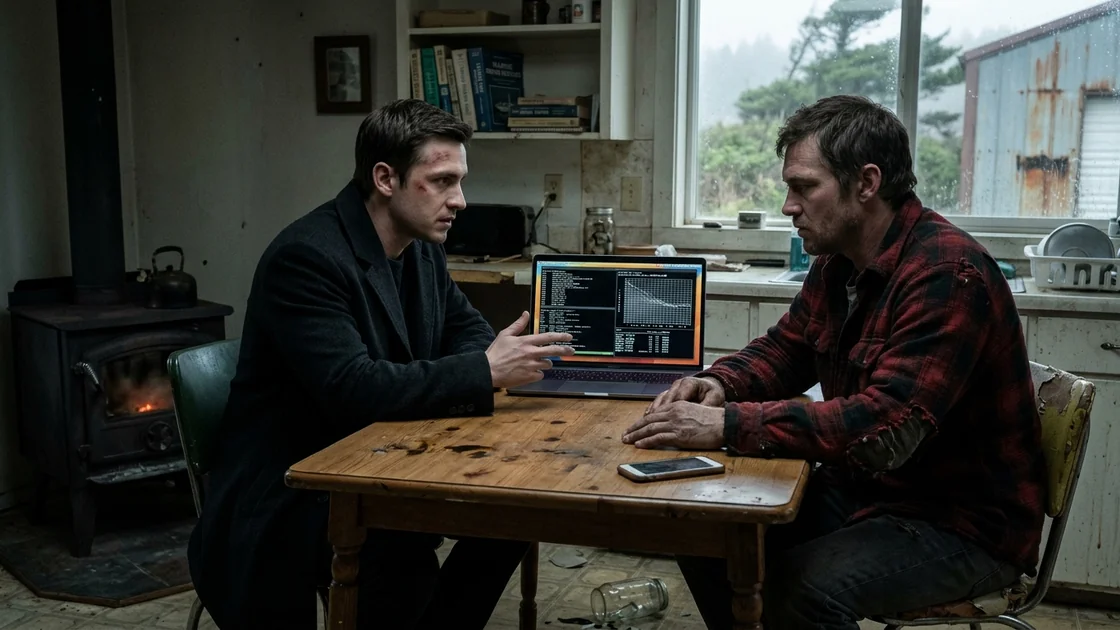
This story chronicles the life of Julian Vance, a gifted distributed systems engineer who designed an automated behavioral telemetry and dynamic reinforcement engine for an offshore digital casino, only to discover that his proprietary mathematical models systematically ensnared, exploited, and destroyed his estranged brother Marcus, transforming an intellectual exercise in stochastic calculus into an intimate tragedy of debt, obsession, and irreparable familial ruin.
I. The Architecture of the Loop
The office on the thirty-second floor of the glass spire smelled of pressurized ozone, roasted chicory, and the neutral chemical smell of flame-retardant industrial carpeting. From the corner workstation, Julian could watch the marine layer drag its wet belly across the harbor, swallowing the cargo vessels one shipping container at a time until only their masthead lights blinked through the gray.
On his primary display, four terminal windows tiled the screen in amber monochrome. The text moved in a rhythmic, liquid cadence—thousands of concurrent websocket connections reporting state changes from twenty-two jurisdictions across four continents.
SESSION_ID: c08-992-ea4 | EVENT: WAGER_ACK | ASSET: WILD_ORCHID_DELUXE | LATENCY: 22ms
SESSION_ID: f21-118-bb9 | EVENT: SPIN_RESULT | STATE: LOSS_DISGUISED_AS_WIN | RETURN: 0.40 | NET: -0.60
SESSION_ID: a94-771-04c | EVENT: TILT_VECTOR_EVAL | BIOMETRIC: SWIPE_VELOCITY_PEAK | ADJUST: COOLDOWN_SUPPRESS
Julian loved the quiet integrity of the pipeline. At twenty-eight, he had achieved the professional standing of Principal Behavioral Architect at Caelum Interactive, though the company’s operating license was held by a holding group registered in Douglas, Isle of Man, and its customer-facing operations were routed through front-end mirrors scattered across Curacao, Gibraltar, and Kahnawake. Julian did not deal with the licenses, nor did he concern himself with the gaudy art assets produced by the graphics department—the neon cherries, the pharaonic scarabs, the busty Valkyries whose breasts bounced with physics-engine precision whenever three scatter symbols aligned.
His domain was pure dynamic latency and behavioral pacing.
Before Julian arrived, Caelum’s slot engines were crude, deterministic things governed by standard pseudorandom number generators audited by third-party testing houses to satisfy minimum statutory return-to-player mandates. They were legal, compliant, and relatively inefficient. A traditional slot machine returned ninety-four cents on the dollar over a cycle of ten million iterations. The problem, as Julian had demonstrated in his interview white paper, was that traditional machines shed their users prematurely. A human being who loses ten consecutive twenty-dollar wagers in thirty seconds experiences acute cognitive fatigue, suffers an adrenergic spike, and exits the interface.
Julian’s masterpiece was an analytical layer he named The Chord.
The Chord did not alter the statutory return-to-player percentage across the global audit cycle; that would have invalidated their compliance certificates and invited catastrophic regulatory fines. Instead, it managed the topology of the loss. Julian mapped human despair as a fluid dynamic system. If a player’s withdrawal probability increased, The Chord caught them with micro-doses of engineered comfort: a near-miss where the third scatter symbol slid just a quarter-inch past the payline accompanied by an ascending major chord; a "loss disguised as a win," wherein an individual wagered five dollars and won two, celebrated by three-channel haptic phone vibrations and a shower of rendered gold leaf; an imperceptible twenty-millisecond delay injected into the reel-spinning animation that simulated mechanical tension, tricking the motor cortex into believing that the digital tumbler possessed physical mass and was fighting against its own friction.
"The gambler does not play to win," Julian had argued before the executive committee during the rollout of Version 3.4. He had tapped his dry-erase marker against a whiteboard covered in Poisson distributions. "The gambler plays to suspend the passage of temporal reality. The win is an interruption; it breaks the trance. The loss is an insult; it ends the session. The ideal operating envelope is the plateau: a frictionless, low-amplitude vibration between anxiety and relief. We are not selling fortune. We are selling an artificial coma."
Elena, the executive vice president of product, had leaned back in her Herman Miller chair, her nails clicking against her glass coffee mug. "And the yield?"
"Average daily active session duration expands from twenty-four minutes to eighty-nine minutes," Julian had said flatly. "Depletion curve smooths out by three hundred percent. The user deposits more frequently because they feel they are almost learning the cadence of the machine. They attribute the outcome to their own rhythm rather than our entropy engine."
The board had authorized his bonus that same afternoon: four hundred thousand dollars in liquid stock options and an unrestricted research budget.
Julian lived alone in an austere apartment three miles up the hill, furnished only with a single platform bed, a low-slung Italian desk, and a pair of vintage electrostatic loudspeakers that projected chamber music with cold, laser-straight accuracy. He took no pleasure in luxury; his satisfaction came from optimization, from taking a chaotic, messy world ruled by mammalian weaknesses and subduing it through clean, defensive programming.
He rarely thought of his childhood home. When he did, it was not as a place of memory, but as a dirty equation he had successfully resolved by division.
II. Grain and Iron
Julian’s father had run an outboard-motor repair shop at the lip of a brackish estuary on the Oregon coast, where the gray salt air oxidized steel tools between shifts. The shop had smelled perpetually of solvent, transmission fluid, and stale Olympia beer. It was a business built upon small, desperate emergencies: fishermen whose impellers had seized three miles past the bar, loggers whose chain saws coughed blue smoke and died mid-cut.
Marcus had stayed in that smell. Julian had run from it.
Marcus was three years older, broader in the clavicle, with thick-veined forearms and knuckles perpetually stained with black axle grease or wood tannin. Where Julian retreated into textbooks and compiled programs on a discarded beige 486 tower he had scavenged from the high school annex, Marcus worked with his hands. Marcus understood physical joinery: dovetails, lap joints, the way a board of white oak would cup if you dried it too fast near the woodstove.
When their father dropped dead behind the parts counter at fifty-four—his heart simply giving out under the weight of three decades of untaxed debts, unpaid invoices, and untreated hypertension—it was Marcus who took the hammer to the drywall to look for the hidden checks, Marcus who spoke to the sheriff, Marcus who took over the lease on the corrugated metal building.
"There's twelve thousand dollars in unpaid supplier accounts with the marine distributor in Seattle," Julian had said, standing in the shop office four days after the funeral. Julian had been twenty-two then, a newly minted graduate student living on a starvation stipend, his clothing neat and ironed. "The sensible path is liquidation. File for Chapter 7 under the estate’s name. Don’t assume the debt personally. Let the distributor absorb the write-off."
Marcus had looked at him over a mug of black coffee, his eyes rimmed with raw red rings. "Old man Jensen ran that distribution warehouse with Dad for thirty years. He came to the service, Julian. He sat in the back row and gave me a check for five hundred dollars to cover the flowers."
"It's a commercial counterparty relationship, Marcus. Emotionalizing an accounts payable ledger is mathematically irrational."
Marcus had set the mug down with a small, sharp clack against the grease-stained counter. "Not everything is an equation you can run through your little gray box, Jule. Some things are debts because you gave your word. He was our father."
"He was an incompetent bookkeeper who drank the margin."
Marcus’s hand had moved before Julian could calculate its velocity. The blow didn’t land with a closed fist; it was an open-handed shove against Julian’s chest that sent him staggering backward into an iron rack of galvanized prop-shafts. The steel tubes rattled like chimes, cold and heavy.
"Get out of here," Marcus had said, his voice dropping into a register that was terrifyingly low and quiet. "Go back to your air-conditioned school. Go play with your numbers. Don't come back down here and tell me what an honest man's life is worth."
Julian had brushed off his wool coat with deliberate, mechanical care. He hadn’t shouted. He hadn't felt angry; he had felt only a profound, icy contempt for the stubborn stupidity of people who allowed sentiment to dictate financial survival.
"You will spend the next ten years working sixty hours a week to pay off creditors who will forget your name five minutes after the wire clears," Julian had said from the doorway. "And at the end of it, you’ll have nothing but bad knees and a box of rusted tools."
He had walked out into the misty drizzle, caught the midday bus north to Seattle, and changed his telephone number six months later when the first automated collection calls began to ping his credit report as a secondary contact.
For seven years, silence had been a clean, efficient boundary.
III. The Heuristic of the Near-Miss
In the second quarter of his third year at Caelum, Julian deployed the Dynamic Volatility Shifter, codenamed Aphelion.
Traditional gambling regulation in Western jurisdictions required that each spin of a digital slot be statistically independent of the previous spin. This was known as the memoryless state rule. A reel didn't know it had lost twenty times in a row; each tick of the server clock was a fresh dip into the well of pseudorandom numbers.
Julian did not violate this rule. He circumvented its behavioral intent by introducing client-side predictive asset rendering.
When a user hit the Spin button on their smartphone or
laptop, the mobile client immediately sent a tiny, encrypted packet to
Julian’s backend cluster in Ashburn, Virginia. The server resolved the
numerical outcome within three milliseconds. If the outcome was a total
loss, the server sent back the payload:
OUTCOME: 0; VALUE: 0.00.
Under the old architecture, the client app would simply stop the spinning reels on three mismatched icons—a lemon, a bell, a bar. The user looked at it, recognized the failure, and felt a tiny micro-drop of cortisol.
Aphelion changed the delivery.
If the internal telemetry flagged a user as "high churn risk"—meaning their biometric inputs (the pressure of their thumb against the glass, the angle at which they held the accelerometer, the interval between taps) indicated creeping boredom or frustration—Julian’s algorithm altered the graphical deceleration curve.
Instead of stopping instantly on a dead board, the first two reels would slam down with bone-jarring audio weight on two identical high-value symbols—say, the golden crown of the Imperium suite. The audio engine would immediately kill the low-frequency background music and replace it with a rising, heart-thumping orchestral trill. The third reel would continue to spin, its visual blur slowing with agonizing, hydraulic friction.
The reel would pass the matching crown by a fraction of a millimeter. It would teeter on the edge. The physics engine would simulate a mechanical pawl catching against an internal gear: the crown would shudder, dip into view, and then—with a pathetic, soft thunk—slip down to reveal a worthless bronze horseshoe.
The user had lost. Statistically, it was an ordinary failure. But neurochemically, the brain could not differentiate between an almost-win and an incomplete victory.
"The near-miss," Julian wrote in his patent documentation, "activates the same striatal dopamine pathways as an actual financial win. Crucially, however, it does not require the operator to disburse capital. It provides the motivational high of a jackpot while allowing the operator to retain one hundred percent of the wagered liquidity."
It was a work of profound elegance. The product team integrated it across all sixty-two white-label skins operating under Caelum’s umbrella.
Within forty-eight hours of Aphelion’s deployment, average daily net gaming revenue across their Tier-2 user demographic jumped twenty-two percent. The company’s Slack channels erupted with animated celebration GIFs. Elena sent Julian a bottle of single-barrel Japanese whisky that cost more than his father’s first boat trailer. Julian left the bottle unopened on the credenza behind his desk, using it as a paperweight to hold down a stack of server performance logs.
He did not drink. Drinking clouded the analytical framework. It introduced non-deterministic noise into the mind.
On a Tuesday night in November, while monitoring the telemetry dashboards during a stress test for a newly launched brand called CopperStake, Julian noticed an anomaly in the high-roller retention queue.
The high-roller queue—internally designated the Bespoke Whale Pipeline—was Julian’s personal pride. It tracked users whose lifetime deposits exceeded fifty thousand dollars and whose thirty-day deposit velocity was accelerating. These players were not assigned to human customer service agents; human agents were slow, expensive, and empathetic. Instead, they were managed by Julian’s autonomous algorithmic concierge.
The concierge monitored player drawdown. If a whale lost more than sixty percent of their balance within a four-hour window, the engine automatically deposited "loyalty credits" directly into their wallet, accompanied by an automated, warm push notification tailored to the player’s psychological profile: We see you’re having a tough run tonight, partner. The house respects your grit. Here’s $500 on us to keep the reels turning.
The credits carried an eighty-times rollover requirement. To withdraw a single dollar of that "free" gift, the player was required to wager forty thousand dollars in aggregate volume. It was an iron maiden painted to look like an oasis.
Julian opened the telemetry trace for User
#88104-OR.
The user was operating through a mobile client on a five-year-old Samsung device running an out-of-date version of Android. The connection was originating not from a penthouse in Miami or an executive suite in Manhattan, but from a residential DSL line assigned to a regional telecommunications cooperative in Tillamook County, Oregon.
Julian frowned. Whales were usually corporate executives, trust-fund inheritors, or money launderers cycling illicit cash through digital chips. They did not typically operate over copper-wire telephone lines in coastal logging towns with eight-megabit downstream capacity.
He clicked into the account history.
The user had registered eight months prior. The initial deposit had been forty dollars, matched by a standard two-hundred-percent welcome bonus.
For the first twelve weeks, the behavior had been typical of a "low-value recreationalist": ten-dollar deposits on Friday nights, playing low-volatility three-reel slots with penny-denominated lines. The Chord had handled them automatically, keeping them in the low-amplitude plateau, letting them lose fifty dollars, win thirty, lose twenty, spin for an hour, and log off.
Then, on August 14th, the behavioral signature had fractured.
The user had made a deposit of seven hundred dollars at 2:14 AM. Then another seven hundred at 3:05 AM. Then twelve hundred at 4:18 AM.
The wager sizing had jumped from twenty cents a spin to five dollars, then twenty-five, then fifty. The game selection shifted from the cartoonish, low-volatility titles to Forge of Hephaestus—one of Caelum’s most brutal, mathematically punishing high-volatility engines. Forge had a hit frequency of only eleven percent, but its top-tier payout was ten thousand times the stake. It was designed specifically for users who were experiencing acute financial panic—users who were no longer playing for entertainment, but who needed a sudden, catastrophic windfall to stave off an impending real-world disaster.
Julian scrolled through the deposit logs for September.
SEP 02 | VISA DEBIT | $2,500.00 | APPROVED
SEP 02 | VISA DEBIT | $2,500.00 | APPROVED
SEP 04 | ACH TRANSFER | $8,000.00 | APPROVED
SEP 11 | ACH TRANSFER | $12,500.00 | APPROVED
SEP 18 | VISA DEBIT | $1,000.00 | DECLINED (NSF)
SEP 18 | VISA DEBIT | $1,000.00 | DECLINED (NSF)
SEP 18 | MASTERCARD | $1,000.00 | APPROVED
SEP 19 | QUICKCASH_LOAN_API | $5,000.00 | APPROVED
Julian’s fingers hovered over the mechanical keyboard.
The third-party instant-lending integration was a feature he had personally built into the deposit checkout interface six months ago. If a user’s bank card declined for non-sufficient funds three times in five minutes, the app seamlessly surfaced an in-line micro-lender widget. With two taps, the user could pledge their vehicle title or take out a high-interest unsecured signature loan through a payday finance syndicate operating out of South Dakota. The funds were wired directly into the casino’s escrow account without ever touching the player’s personal bank balance.
"Frictionless liquidity recovery," Julian had called it in his product proposal.
He pulled up the identity verification records associated with User
#88104-OR. Federal Know-Your-Customer regulations were
loose for offshore operators, but Caelum collected scanned driver’s
licenses to verify age and prevent chargebacks once a user crossed the
ten-thousand-dollar threshold.
Julian clicked the link to decrypt the stored JPEG file.
The image opened in a modal window.
It was a photograph of an Oregon commercial driver’s license, resting on the scarred pine surface of a kitchen table Julian knew intimately. The surface still bore the dark, round scorch mark where their father had dropped a soldering iron in the winter of 1998.
Above the name were the eyes: sunken, bloodshot, looking toward the camera flash with the dull, defiant misery of an animal trapped in a culvert.
NAME: VANCE, MARCUS D.
DOB: 11/04/1988
ADDRESS: 1404 HIGHWAY 101 NORTH, PACIFIC CITY, OR
Julian sat entirely motionless.
Outside the triple-glazed window, the marine fog had reached the top of the tower. It pressed against the glass, milky and blind, erasing the streetlights below, erasing the city, leaving only the amber glow of the terminal and the face on the screen.
IV. The Mechanics of the Spiral
Julian did not shut down his terminal. He did not call his brother.
To act impulsively was to surrender to noise. Julian was an engineer; his entire life was predicated on the understanding that any complex phenomenon could be disassembled into its constituent variables, examined without hysteria, and redirected through superior design.
He pulled the raw database logs for Marcus’s account from the cold storage archive. He wrote a bespoke Python script to parse the JSON history, extracting every spin, every tap, every balance fluctuation over the eight months of his brother’s tenure on the platform.
He rendered the output as a three-dimensional vector graph: X-axis was time; Y-axis was aggregate net equity; Z-axis was the algorithmic tilt rating generated by Aphelion.
The line did not descend in a straight diagonal. It fell in jagged, violent stair-steps.
The first major break—the August 14th deposit—coincided with a public record Julian pulled from the Tillamook County Clerk’s online portal. A county tax lien had been filed against the outboard repair shop: nineteen thousand dollars in back property taxes and unpaid municipal utilities.
Julian could see Marcus’s thought process as clearly as if it were annotated in the margins of the code.
Marcus had been behind. He had probably tried to get a bank loan and been rejected because of the shop’s historical financials. He had sat in that dim back office with the rain drumming on the tin roof, scrolling through his phone, and an ad for CopperStake had popped up between Facebook posts: Double Your First Deposit. Instant Payouts. Fair Play Certified.
Marcus had put in forty dollars to see. He had won eighty. He had felt the warm, electric jolt of possibility. He had thought: If I can just make two thousand dollars, I can pay the first installment on the lien.
Julian traced the log.
On August 16th, Marcus had hit a major bonus round on Gilded Timber, a five-reel slot themed around Pacific Northwest logging. Julian had written the math model for Gilded Timber himself; it was an asymmetric volatility game with an aggressive "near-hit" distribution.
Marcus had won twelve thousand four hundred dollars on a fifty-dollar spin.
Julian looked at the timestamp: 3:42 AM.
At that moment, Marcus had been within six thousand dollars of clearing the entire county tax lien. If he had clicked Withdraw, the funds would have been wired to his local credit union within forty-eight hours. The shop would have been safe.
He did not click Withdraw.
Julian knew why. Because Julian had designed the Withdrawal Friction Gate.
When a user initiated a withdrawal of more than five thousand dollars, Caelum’s platform did not process it instantly. Instead, it moved the funds into a "Pending Verification" state for seventy-two hours. During this cooling-off window, the money remained visible on the user’s dashboard, but beneath it sat a small, vibrant green button: Cancel Withdrawal and Play Instantly.
Furthermore, during those seventy-two hours, Julian’s retention engine marked the user as an "Active Liquidity Target."
The app sent push notifications every six hours:
Marcus, your hot streak is legendary! The Timber Baron Progressive
Jackpot is currently at $142,000. Spins start at just $10.
Julian watched the terminal screen.
Thirty-six hours into the seventy-two-hour waiting period—at 4:11 PM on a Sunday afternoon—Marcus had clicked Cancel Withdrawal.
He had wagered the twelve thousand dollars in increments of two hundred dollars. He had lost it all in forty-two minutes.
Julian leaned forward, his face illuminated by the amber phosphor. His pulse was completely steady, but his mouth tasted of dry tin.
The script continued to process the logs. After the twelve-thousand-dollar crash, Marcus had not stopped. He had accelerated. He had borrowed against the shop’s remaining equipment. He had drawn down the credit cards Julian had warned him about seven years earlier.
Then, three weeks ago, Marcus had mortgaged the four acres of coastal scrubland their grandfather had bought after the war—the land where their small frame house stood, where their mother had planted three apple trees that produced sour, knotty fruit every September.
The mortgage was for one hundred and eighty thousand dollars.
It had entered Caelum’s deposit engine via three separate wire transfers between October 12th and October 26th.
Every single cent of it had been absorbed by Julian’s algorithm.
The Chord had worked flawlessly. It had caught Marcus every time he tried to quit. When his balance dipped below five thousand dollars, the engine fed him a series of high-frequency near-misses, followed by a sudden twenty-thousand-dollar "recovery spike" that released a flood of dopamine into his exhausted brain, convincing him that the cycle was turning, that the machine was finally paying out, that his instinct was right.
Then, over the course of eighty hours of continuous, red-eyed play, the engine ground the recovery down to zero through Julian’s mathematically certified house edge.
The aggregate balance of User #88104-OR as of 4:00 AM
this morning was:
CASH_BALANCE: $1.42
BONUS_CREDIT: $0.18 (LOCKED)
LIFETIME_DEPOSITS: $214,850.00
LIFETIME_WITHDRAWALS: $0.00
Julian looked up from the screen.
The office was empty. The other engineers had gone home to their
condos in Ballard or their craft beers in Capitol Hill. On the wall
above the water cooler, the digital metric board glowed green:
GLOBAL NGR (24H): $4,112,904.12 | SYSTEM HEALTH: 99.998%
Julian sat in his chair for forty-five minutes without moving a muscle.
Then he reached into his desk drawer, pulled out his personal laptop—an unmonitored machine running an encrypted Linux distribution—plugged it into his phone’s cellular hotspot, and began to clone Caelum’s production database branch.
V. The Admin's Dilemma
There is a myth among non-programmers that a software engineer who writes a system can control it with a single, dramatic keystroke—that there is a master switch, an override key, a hidden back door that allows the creator to command the digital waters to part.
Julian knew the reality was far more mundane and far more terrifying.
The modern software architecture of an enterprise-scale online casino is not a monolithic program; it is an immutable, distributed organism. Caelum’s core gaming engine ran on Kubernetes clusters hosted across three geographic regions. Every spin, every wager, every random number seed was hashed, cryptographically signed, and broadcast to an append-only audit ledger audited in real-time by a third-party compliance monitor in Saint John’s, Antigua.
Julian could not simply change Marcus’s balance to two hundred thousand dollars.
If he modified the balance record in the PostgreSQL database directly, the cryptographic hash of the ledger would break. Within twelve seconds, an automated reconciliation alert would trigger on Elena’s phone, the security team would freeze the database instance, the Antiguan auditors would initiate an emergency integrity review, and Julian would be sitting in a federal holding cell in SeaTac by sunrise facing twenty counts of wire fraud and computer intrusion.
He could not delete the account. Deleting an active whale account with open debt obligations would trigger an immediate fraud investigation by the risk department.
He looked at the code.
He could modify the Aphelion behavioral profile for User
#88104-OR.
Julian opened his development environment. He located the
configuration file that governed Marcus’s dynamic session weighting:
profiles/retention/tier_whale_aggressive.json.
He could alter the parameters. He could set Marcus’s "Tilt Sensitivity" to zero. He could disable the Near-Miss Threshold Optimization. He could force the graphical client to render only dead, unvarnished losses, stripping away the celebratory audio, the artificial reel delays, the flashing gold leaf, the dopamine-triggering illusions of progress. He could make the machine show itself to Marcus for what it truly was: a cold, heartless vacuum pump extracting value from his life through an iron pipe.
Julian sat with his fingers on the keys.
He looked at the telemetry graph.
Marcus had not slept in twenty-eight hours. The client app was still
open on his phone. The screen was still pinging the Ashburn servers
every two seconds:
HEARTBEAT | LATENCY: 44ms | BATTERY: 14% | CHARGING: TRUE
If Julian stripped away the illusion now, Marcus would not simply close the app and walk away into a healthy, reflective recovery.
Julian had studied the clinical literature on compulsive gambling when he built The Chord; he knew the neuropsychiatric data better than most psychiatrists. A user who has lost everything—who has pledged their home, their livelihood, their family legacy—is not playing for pleasure. They are playing to outrun the realization of what they have done.
The illusion is the only thing standing between the gambler and the edge of the roof.
If Julian stripped the machine of its comforting lies mid-session, if he delivered Marcus into the cold, stark reality of his absolute ruin while he sat alone in that damp house in the middle of the night, Marcus’s brain would not reset to rationality.
The line on the chart would simply terminate.
Julian closed his laptop. He stood up, took his wool overcoat from the hook by the door, and walked out into the empty hallway.
He did not take the elevator down to the parking garage where his pristine, German-engineered sedan was parked. He walked down the thirty-two flights of emergency stairs, his shoes squeaking against the painted concrete, down into the raw, wet air of the street.
He needed to see the machine from the other end of the pipe.
VI. Highway 101
The drive south from Seattle through the coastal passes took four and a half hours.
Julian drove through a world that was falling apart in slow motion. Outside the rain-slicked windshield of his Audi, the timber towns along the highway looked like the discarded shells of some previous, more confident civilization. Old lumber mills with their corrugated roofs rusted into lace; roadside diners with neon signs missing half their letters; used-car lots where gravel was slowly reclaiming the spaces between water-spotted sedans.
It was the physical world: heavy, prone to decay, governed by the relentless second law of thermodynamics.
Julian had spent eight years insulating himself from it. In his world, if an asset degraded, you spun up a fresh container; if a memory leak occurred, you killed the process and let the daemon restart it with clean state.
In this world, things just rotted.
He crossed the bridge over the Nestucca River just before dawn. The tide was low, exposing vast flats of black, shining mud that smelled of rotting eelgrass and dead crabs.
He turned off the highway onto the gravel track that led to the shop.
The property was worse than he remembered. The chain-link gate hung open on one hinge, its galvanized wire crusted with green lichen. Two outboard motor hulls—fiberglass shells with their cowlings ripped off and their aluminum lower units missing—lay half-submerged in the tall blackberry brambles near the fence line.
The shop itself was dark, but a yellow light burned in the small, salt-bleached cedar-shake house that sat seventy yards behind it, sheltered against the hill by three twisted shore pines.
Julian killed the car’s headlights fifty yards before the driveway. He coasted in on the wet gravel, the tires crunching softly, and switched off the engine.
The silence that followed was absolute, broken only by the steady, rhythmic drip-drip-drip of rainwater falling from the pine needles onto the car’s aluminum hood.
Julian sat in the dark interior for a long moment. He looked at his hands resting on the leather-wrapped steering wheel. They were smooth, white, and unscarred. They had never held a draw-knife; they had never wrestled a seized iron cylinder out of a salt-encrusted engine block.
He got out of the car. The sea air struck him in the face like a wet wool blanket, cold and shockingly mineral.
He walked up the three wooden steps to the front porch. The boards were soft under his leather-soled shoes; the rot was deep in the stringers.
He did not knock.
Julian turned the brass knob—the same loose, tarnished knob he had turned every afternoon coming home from school thirty years ago—and pushed the door inward.
VII. The Terminal State
The house smelled of woodsmoke, old grease, and the sharp, sour tang of unwashed clothes.
A single woodstove sat in the corner of the living room, its iron sides radiating a dull, suffocating heat. The room was stripped nearly bare. The oak roll-top desk where their mother had kept the household bills was gone, leaving four bright, clean rectangles on the faded linoleum floor. The television was gone; only a tangle of black coaxial cable lay coiled on the floor like a dead snake.
Marcus was sitting at the kitchen table.
He was wearing the same red-and-black wool hunting shirt he had worn at their father’s funeral, but the elbows were worn through to the gray thermal underwear beneath. His hair was long, greasy, and matted at the crown. His beard was flecked with gray and white, though he was not yet thirty-five.
In front of him, propped up against an empty jar of instant coffee, was his Samsung phone.
A charging cable ran from the bottom of the device to an extension cord that hung from an overhead light fixture, swinging slightly in the thermal draft from the woodstove.
Marcus did not look up when the door opened.
His right thumb was moving against the glass with a terrifying, rhythmic constancy.
Tap.
Pause. Two seconds.
Tap.
Pause. Two seconds.
From the phone’s tiny, tinny loudspeaker came the familiar, crystalline audio suite Julian had spent five months perfecting in the sound lab in Vancouver.
Trill.
Heavy mechanical clunk.
Second heavy mechanical clunk.
The rising orchestral glissando.
The soft, wet, pathetic thunk of the third reel slipping.
"Marcus," Julian said.
The sound of his voice seemed to strike the room without resonance, absorbed immediately by the bare drywall and the heat.
Marcus’s thumb did not stop.
Tap.
"You're late," Marcus said. His voice was not angry. It had the dry, raspy texture of a man who had not used his vocal cords in forty-eight hours. "Jensen came by yesterday with the notice from the sheriff. He said they're chaining the gate on Friday."
Julian stepped into the kitchen. He did not take off his coat. He felt impossibly clean, impossibly foreign, like an astronaut who had stepped out of a lander onto a dead, airless satellite.
"Marcus, put the phone down."
"Can't," Marcus said, his eyes fixed entirely on the screen. "I’m in the bonus round. I’ve got forty-eight free spins on the Forge. If the hammer lands on the middle reel with the multiplier active, it resets the baseline. It pays twelve thousand to one."
Julian stepped closer. He could see the screen now.
The interface was Forge of Hephaestus.
The digital reels were spinning, their bright, primary colors garish and vulgar against the gray wood-grain of the table. Marcus was betting eighty dollars a spin.
His cash balance read: $0.00.
Beneath it, in a flashing amber box, was the label:
LOAN_CREDIT_FACILITY: $4,200.00 (ROLLOVER: 98%).
Marcus had accessed the South Dakota instant-lending widget again. He had taken out another unsecured loan against the remaining equity of the shop’s land at an annual percentage rate of ninety-six percent.
Tap.
The reels spun.
Clunk. Clunk.
A pair of golden anvils landed on reels one and two. The audio engine launched into its rising minor-third escalation. The third reel began to slow down.
Julian stood over his brother’s shoulder.
He knew what the Ashburn server had already decided. He knew the code
that was executing three thousand miles away. He had written the method:
evaluate_near_miss_probability(user_state).
The method had evaluated Marcus’s churn vector. Because Marcus’s deposit frequency had peaked and his available credit was down to its final decile, the engine had moved him into the Terminal Retention Envelope.
The engine would not let Marcus win twelve thousand dollars. The house could not afford the liquidity risk on an account with zero recovery capacity.
Instead, the third reel would slow down. It would show the third anvil. It would hold it on the payline for seven hundred and fifty milliseconds—just long enough for Marcus’s optic nerve to transmit the image of victory to his prefrontal cortex—and then a single client-side CSS animation would bump the reel one pixel down.
It would show a cracked iron horseshoe.
Julian looked at his brother’s face.
Marcus’s lips were slightly parted. His eyes were wide, the pupils dilated until the dark brown iris was almost entirely gone. His breath had stopped in his throat.
"Come on," Marcus whispered to the glass. "Come on, Dad. Just one time. Just give it back one time."
Julian felt something inside his chest crack—not with a clean, mathematical snap, but with the sickening, greasy tear of rotten wood under a heavy load.
"Marcus," Julian said, his voice rising, breaking its neutral cadence. "It isn’t Dad. There is no machine. It's an array of server nodes running in an industrial park in northern Virginia. There is no hammer. There is no payout. It’s an append-only transaction ledger designed to clear your account to zero."
The third reel slowed.
The golden anvil dipped into view.
Marcus made a tiny, strangled sound in his throat—a sound of almost sexual relief.
Then the CSS animation fired.
The anvil slipped. The cracked horseshoe took its place.
The audio engine played the failure chord: a low, resonant cello note coupled with a metallic rattle that simulated the sound of an iron coin falling through an empty grate.
Marcus’s thumb did not stop.
Tap.
INSUFFICIENT FUNDS.
WOULD YOU LIKE TO EXTEND YOUR CREDIT LINE?
[TAP TO ACCEPT — APR 114%]
Marcus’s thumb moved toward the green button.
Julian reached out his hand, grabbed the Samsung phone by its plastic casing, and ripped it off the charging cable.
"Hey!" Marcus roared.
It was the first time he had looked at Julian. The transformation was terrifying. His face contorted into a mask of pure, murderous panic. He lunged forward over the table, knocking the empty coffee jar to the floor, where it shattered into thick, green shards.
"Give it back!" Marcus screamed, his fingers clawing at Julian’s coat. "I have fifteen spins left! The session is live! If you kill the session, the seed resets! Give it to me!"
Marcus hit him.
It was not a shove like the one seven years ago in the shop office. It was a wild, desperate overhand blow that caught Julian on the side of his temple.
Julian went down against the linoleum, his head striking the edge of the kitchen counter. A bright flash of white light exploded behind his eyes, followed by the immediate, hot coppery taste of blood in his mouth.
The phone slid across the floor, coming to rest near the base of the woodstove.
Marcus did not check on his brother. He scrambled on his hands and knees across the floor, ignoring the broken glass that bit into his palms, and lunged for the phone.
He snatched it up, wiped the screen against his shirt, and stared at the glass.
The screen was black.
The impact with the floor had dislodged the swollen, third-party battery. The screen was dead.
Marcus sat on his haunches near the woodstove, the phone clutched in both hands, staring at the dark rectangle of plastic.
The room was completely quiet except for the crackle of the wood in the stove and the sound of Marcus’s breathing, which sounded like water boiling in a clogged pipe.
"It’s gone," Marcus whispered.
He didn't look at Julian. He looked at the reflection of his own face in the dead glass.
"It was right there," he said, his voice flattening out into an eerie, hollow monotone. "The third anvil was on the line. I saw it. It was right there, Jule."
Julian pulled himself up against the counter. His head was thbbing with a slow, heavy pulse. He wiped his mouth with the back of his hand; his knuckles came away smeared with red.
"It was never there, Marcus," Julian said. He spoke slowly, every word costing him an effort of balance. "The server resolved that spin three milliseconds after you touched the glass. The third anvil was an animation layer. I wrote the code that put it there."
Marcus turned his head slowly. He looked at Julian through the tangle of greasy hair.
"What did you say?"
Julian stood up, using the edge of the sink for support. He reached into his coat pocket, pulled out his personal laptop, and opened the lid. The screen came alive instantly, bathing his face in cold, blue LED light.
He brought the laptop to the table, set it down amid the coffee stains and glass dust, and turned the display toward his brother.
"Look," Julian said.
VIII. The Code Review
For three hours, Julian sat at the kitchen table and disassembled his life’s work before the eyes of the man he had destroyed.
He did not apologize. An apology was an emotional evasion, an attempt to purchase absolution with cheap breath. Julian did not believe in absolution. He believed in documentation.
He opened the terminal. He authenticated with his production keys. He pulled the raw source code for The Chord and laid it out on the screen, function by function.
"Here," Julian said, his finger tapping against the cold aluminum
chassis of the laptop. "Line four-hundred and twelve.
get_loss_disguised_as_win_frequency. This method takes your
bankroll, divides it by your average wager, and determines how many
times per hour we need to give you back forty percent of your own money
to prevent you from closing the browser."
Marcus stared at the text. He didn't understand the syntax—the nested loops, the pointer references, the asynchronous callbacks—but he understood the numbers.
He saw his own name: VANCE_M_88104.
He saw the log files: every night he had sat at this table, every dollar he had drawn from the house, every three-reel spin he had thought was a battle between his will and the iron gears of fortune.
2023-10-14 03:12:11 UTC | EVENT: NEAR_MISS_TRIGGERED | ASSET: GILDED_TIMBER | BIOMETRIC_SCORE: 0.88 | ADJUST_OUTCOME: TRUE
"You see this flag?" Julian whispered. "That's you. October fourteenth. Three o'clock in the morning. You had twenty-four hundred dollars left on the first mortgage draw. You were getting ready to quit; your tap velocity had dropped below one interaction every four seconds. The model flagged you as 'High Fatigue.' It ordered the client to generate three near-misses in five spins to keep your heart rate above one hundred beats per minute."
Marcus did not move. His hands remained clasped around the dead Samsung phone in his lap.
"You wrote this?" Marcus asked.
"I designed the behavioral engine," Julian said. "I built the math model."
"You knew it was me?"
"No," Julian said. "I didn't know until four days ago."
Marcus looked up from the screen. His eyes were completely clear now, stripped of the manic, dopamine-soaked haze that had clouded them for eight months. What took its place was something infinitely worse: a cold, dead vastness, like an empty salt marsh at low tide.
"Does it matter?" Marcus asked softly.
Julian stopped.
"What?"
"Does it matter that you didn't know it was me?" Marcus stood up from the table. He was a head taller than Julian, his shoulders broader, but he moved with the hesitant, brittle stiffness of an old man whose bones had grown porous. "There were six thousand other people on that dashboard tonight, weren't there?"
Julian’s fingers stayed frozen on the touchpad.
"Yes," he said.
"They have brothers?"
Julian didn't answer.
Marcus walked over to the woodstove. He opened the iron door with a rusted pair of pliers. The orange glow of the embers lit his face from beneath, throwing his shadow up against the low ceiling like a massive, distorted beast.
He looked down at the dead Samsung phone in his hand.
He didn't throw it against the wall. He didn't smash it with a hammer. He simply leaned forward and set it gently on top of the red-hot birch logs inside the firebox.
The plastic casing blistered instantly. The lithium-ion battery hissed, venting a thin, sweet-smelling jet of white chemical smoke that rose up the flue. The glass cracked with a soft, clean tick, like a watch spring snapping inside its case.
Marcus closed the iron door.
"The shop is gone, Jule," Marcus said quietly. "The house is gone. The land goes to the bank on the fifteenth. Dad’s tools are already in the pawnshop in Lincoln City. I sold the big drill press three weeks ago to make a five-hundred-dollar deposit because the app told me I was in the top tier of the loyalty club."
He turned back to face Julian.
"You can take your little gray box now," Marcus said. "You can go back to your office."
"I have money," Julian said. The words came out of his throat awkward and misshapen, like components cast in a defective mold. "I have four hundred thousand dollars in liquid capital. I can wire it to the bank on Monday. We can clear the liens. We can buy back the tools."
Marcus looked at him for a long, silent moment.
Then he did something that Julian had not factored into any behavioral model he had ever constructed.
Marcus laughed.
It was not a bitter laugh. It was not an angry laugh. It was a sound of profound, exhausted amusement—the laugh of a carpenter who has watched a house he built with thirty years of labor slide into the ocean, and then been offered a tube of glue by the man who pulled the foundation pins.
"You think this is about the money, Jule?" Marcus shook his head slowly. "You really don't understand what you built, do you?"
Marcus stepped toward the table. He pointed his blackened, glass-cut thumb at the laptop screen, where the code was still scrolling through its execution loop.
"That thing didn't take my money," Marcus said, his voice dropping into a whisper that filled the small kitchen until it seemed to echo off the walls. "It took my mind. It sat inside my head every night for eight months. It knew when I was tired. It knew when I was scared. It knew that every time I pulled that handle, I was thinking about the old man, and the shop, and how I was a failure who couldn't keep the doors open."
Marcus leaned down until his face was six inches from Julian’s.
Julian could smell the stale coffee on his brother’s breath, the woodsmoke, the sour smell of defeat that no wire transfer could ever neutralize.
"If you give me that four hundred thousand dollars," Marcus said, "do you know where it’s going to be in six months?"
Julian looked into his brother's pupils.
There was no algorithm there. There was only a void that Julian had helped dig with two million lines of optimized, high-performance, non-blocking code.
"You'd put it back in," Julian whispered.
Marcus smiled. His teeth were gray and yellow in the blue light of the screen.
"Every single dime," Marcus said. "Because even right now... even with you sitting here showing me the gears... even with the phone burning in that stove... my thumb is still twitching, Jule. My hand is still waiting for the third anvil."
Marcus straightened his back. He walked to the front door, opened it wide to the gray morning light, and stood there, holding the frame.
"Get out of my house," he said.
IX. The Terminal Branch
Julian did not drive back to Seattle immediately.
He drove his car down to the edge of the public boat ramp where the river met the estuary. He parked on the cracked asphalt between two abandoned boat trailers whose tires had rotted down to the rusted rims.
The rain had stopped, replaced by a cold, white coastal glare that reflected off the mudflats until the horizon vanished into a seamless sheet of zinc.
Julian sat in the driver’s seat with his laptop open on his knees.
He connected to the Ashburn cluster via his cellular hotspot.
His credentials still worked. The system did not know he had left the city; it did not know his face was bruised; it did not know his brother’s house was empty. The cluster knew only that a valid session token had been presented with Principal Administrative privileges.
Julian opened the root directory of Caelum’s production deployment.
He navigated to the behavioral core:
/srv/caelum/engine/core/reinforcement.
He looked at the files:
aphelion.py
chord_engine.c
tilt_vector.go
dynamic_near_miss.rs
These were the engines of the plateau. They were currently managing forty-four thousand concurrent sessions across sixteen time zones. As he watched, the telemetry feed showed the harvest:
PROCESSED: 12,410 WAGERS/SEC | REVENUE: $182.40/SEC
Julian could not delete the files. If he executed a
rm -rf, the automated CI/CD pipeline would detect the
missing hashes, flag a repository discrepancy, pull the latest clean
commit from the mirrored branch in Frankfurt, and redeploy the entire
suite within forty seconds.
Julian did not delete the files.
Instead, he opened dynamic_near_miss.rs.
He navigated to the function that controlled the client-side graphical deceleration curve—the method that calculated the millimeter-level displacement of the final reel.
He changed one single operator on line one-hundred and eighty-four.
He took the variable NEAR_MISS_DISPLACEMENT_PX and set
it to zero.
Then he went into chord_engine.c.
He located the method that managed the audio-frequency escalation
during a two-symbol match: play_anticipation_trill().
He modified the return value. He set the frequency shift to zero, effectively silencing the rising orchestral strings, the artificial heartbeats, the celebratory brass fanfares. He replaced them with the default system alert sound of the underlying operating system: a single, flat, unadorned forty-decibel click.
Then he opened the core mathematical library:
entropy_distributor.cpp.
This was the holy of holies. This was the code that governed the Return-to-Player pacing.
Julian did not change the global return-to-player percentage. That would have alerted the Antiguan auditors.
Instead, he altered the dispersion.
He took the smooth, low-amplitude Gaussian curve he had spent four years calibrating—the curve that kept users in the artificial coma, the curve that made them feel that they were floating on a gentle lake of almost-wins—and he collapsed it into a binary distribution.
Under the new code, a user would not experience the long, comfortable decline.
They would either win the entire jackpot on their first spin, or they would lose their entire balance in five consecutive, brutal, silent turns. No near-misses. No celebratory graphics for forty-percent returns. No artificial delays. No push notifications with warm, tailored greetings.
Julian was stripping the morphine from the needle.
He was leaving only the cold steel point.
He compiled the code locally. The compiler produced zero errors, zero warnings. It was clean, defensive, beautiful engineering.
Julian initiated the production deployment:
git commit -am "chore: operational maintenance and telemetry calibration [skip-review]"
git push origin production --force
The terminal window blinked:
UPDATING REMOTE REPOSITORIES...
DEPLOYING TO ASHBURN-CLUSTER-01... SUCCESS
DEPLOYING TO FRANKFURT-CLUSTER-02... SUCCESS
DEPLOYING TO SINGAPORE-CLUSTER-01... SUCCESS
RESTARTING SERVICES... ALL DAEMONS HEALTHY.
Julian closed his laptop.
He sat in the silence of the car.
On thirty thousand screens across the world, the reels were stopping differently now.
In a basement apartment in Manchester, a clerk who had been playing for three hours felt the music cut out mid-spin, replaced by a dead, hollow silence as his remaining forty pounds vanished in three seconds. He blinked, looked at the phone, felt a sudden, cold wave of nausea, and set the device down on his nightstand.
In an office cubicle in suburban Chicago, an accountant whose thumb
had been moving with the steady cadence of a factory machine saw the
reels drop without a stutter, without a near-miss, without a single
flashing crown. Five dead boards in ten seconds. His balance reached
zero. The screen did not offer him a loan. It did not tell him he was a
legend. It simply displayed a static, gray system dialog:
SESSION CLOSED. BALANCE: 0.00.
The trance was breaking.
The coma was ending.
Across the globe, the withdrawal curves were turning vertical. The revenue metric on the thirty-second floor of the tower in Seattle was about to plunge off a cliff like an aircraft whose wings had sheared off in clean air.
Julian knew what would happen next.
Within fifteen minutes, the automated monitoring systems in Ashburn would alert the infrastructure team. Within thirty minutes, Elena would be on an emergency conference bridge with the Antiguan commission and the board of directors. Within an hour, their forensics team would trace the commit back to Julian’s personal SSH key, executed from an IP address originating from a cellular tower outside Tillamook, Oregon.
They would roll back the commit, of course.
They had backups. They had mirrors. They would restore Version 3.4. The near-misses would return. The Valkyries would bounce again. The orchestral strings would swell. The morphine would flow back into the pipes.
It would take them forty-five minutes to revert the code.
For forty-five minutes, the machine would tell the truth.
Julian took his phone from his coat pocket. He popped the SIM card tray with the end of a bent paperclip he found in the center console. He took the tiny gold-plated rectangle, snapped it between his thumbnails, and dropped the pieces into the bottom of his empty travel mug.
He opened the car door, stepped out into the cold wind, and walked toward the edge of the river.
The tide was beginning to turn now. The black mudflats were slowly disappearing under the brown, cold mountain water that was rushing out to meet the Pacific surf.
Julian looked north, toward the headland where the old frame house sat behind the shore pines.
He knew Marcus was not packing his bags. Marcus was probably still sitting on the floor in front of the woodstove, watching the ashes of the phone turn gray, his right thumb still twitching against his knee, over and over, playing a reel that would never stop spinning in the dark.
Julian took his laptop—his clean, unblemished, four-thousand-dollar carbon-fiber development machine—and held it with both hands over the water.
He thought of the math.
He thought of the forty-five minutes of truth he had purchased for four hundred thousand dollars in unvested equity and a future lived in federal courtrooms.
He let the laptop go.
It didn't flutter. It was heavy, dense, and solid. It struck the brown surface of the river with a flat, loud slap, lingered for a single second in the foam, and then sank straight down into the cold silt of the estuary, where the salt water could begin its slow, honest work upon the iron.