The Hours We Owe
This is the story of Corinne Vane, who made a solemn vow to stay beside her dying grandmother in a quiet hospice room on a rainy October night, but chose instead to chase the ephemeral laughter of an off-campus house party. What followed was not an immediate lightning strike of divine retribution, but the slow, agonizing erosion of her youth under the weight of an empty plastic chair, a voicemail left unheard until dawn, and the lifelong reckoning that takes place when someone discovers that the final hour of a person's life cannot be rescheduled, refunded, or forgiven.
Part I: The Rhythm of Saline
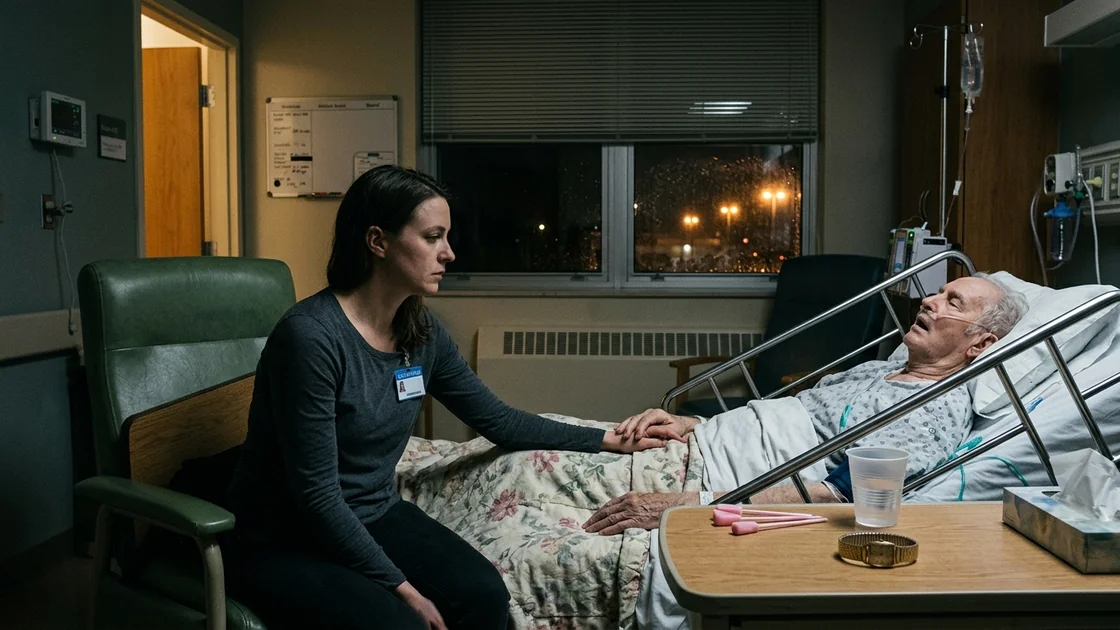
The hospice room smelled of artificial vanilla floor wax and the faint, sweet decay of cut chrysanthemums whose water had not been changed in three days. It was a corner room on the fourth floor of St. Jude’s Palliative Wing, where the radiators clanked in irregular, iron spasms and the double-paned glass kept out the roar of city traffic, reducing it to a dull, underwater hum.
Corinne sat in the vinyl recliner, her heels hooked over the lower metal rung, her knees pressed hard against the underside of her chin. She was nineteen, dressed in a black oversized sweater that had begun to pill around the cuffs and ribbed denim that felt stiff against her skin. On the laminate bedside table rested a plastic cup of ginger ale, its bubbles long surrendered, a half-eaten sleeve of saltines, and Evelyn’s watch—a small, square-faced Hamilton with an expandable gold-mesh band, taken off two mornings prior when the skin around her grandmother's wrist had turned translucent and swollen.
Evelyn was breathing through an open mouth. The sound was not peaceful; it was mechanical, wet, and rhythmic, like a small, stubborn pump operating in an abandoned cellar. Her hair, which for sixty years had been set in neat, silver-blue roller curls every Thursday morning at nine, was now flattened against the coarse cotton of the pillowcase, exposing the pale, freckled dome of her skull.
"Corrie?"
The voice was barely a rasp, a dry scrape of leaf across concrete.
Corinne looked up from the glowing screen of her phone. She dropped her thumbs immediately, guilty at the sudden intrusion of bright light in the dim room. "I’m here, Gram. Still here."
Evelyn did not turn her head. She couldn’t. The stroke three weeks earlier had taken the right side of her body, leaving her left hand to curl inward like a dried leaf against the floral quilt her sister had sewn in 1974. "Is it raining?"
Corinne glanced toward the window. Droplets were fat and heavy, sliding diagonally across the dark pane under the orange sodium lights of the parking lot below. "A little bit. Just October weather."
"Your mother... went home?"
"She was exhausted, Gram. She was here for thirty-six hours straight. I told her I’d take the night shift. I’m off tomorrow anyway—no classes on Friday." Corinne reached out and took Evelyn’s left hand. It felt cool, dry, and shockingly light, like a bundle of hollow bird bones wrapped in parchment. "I promised her I wouldn’t leave your side. Not tonight."
Evelyn’s fingers gave a faint, reflexive twitch. Her milky eyes, clouded with cataracts and the thick fog of sublingual morphine, stared at the ceiling tiles where someone had stuck a small, glowing star that had long since lost its luminescence. "You always were... a good girl, Corrie. Don’t let them tell you... you’re selfish. Your cousin... she had a sharp tongue. But you... you stayed."
A cold spike of unease drove between Corinne’s ribs. She swallowed, adjusting the rough wool of her sweater against her neck. "I’m here, Gram. Try to rest."
The room slipped back into its heavy, humid quiet, punctuated only by the rise and fall of the oxygen concentrator in the corner—a soft hiss-shuck, hiss-shuck that measured the remaining fractions of Evelyn Vane’s life.
Corinne looked back down at her lap.
The screen of her phone was dark, but beneath the glass lay an entire parallel world that was violently, brilliantly awake. She unlocked it with her thumb, dimming the brightness to the lowest notch so the glow wouldn't reflect on the wall.
Group Chat: The Grotto (7 unread)
Julian [8:14 PM]: The kegs just tapped. House is already packed. Where the hell are you, Vane?
Sarah B. [8:16 PM]: Marcus brought the sound system from his studio. If you aren't here by ten you’re literally not getting past the porch. The line is out to Elm Street.
Julian [8:18 PM]: Corinne. Seriously. Sam is here. He asked if you were coming. He literally drove down from Ann Arbor just for this weekend.
Corinne’s breath caught. She stared at Sam’s name on the screen.
Sam had been the boy she followed through two semesters of introductory art history—a senior with messy brown hair, a dented Volvo wagon, and a quiet, deliberate way of speaking that made every room feel smaller when he entered it. He had graduated in May and moved two hundred miles north for an apprenticeship at an architectural firm. For four months, he had been an abstraction of late-night Instagram stories and cryptic text messages sent at two in the morning. Now he was on Elm Street. On the porch of a decaying Victorian house with six bedrooms, peeling paint, and a basement floor that vibrated with cheap bass.
She looked from the screen to the bed.
Evelyn’s chest rose. Paused. Stayed suspended for three long, terrifying seconds, then collapsed with a rattling sigh.
It’s just breathing, the nurse, Helen, had told Corinne when her mother left at six that evening. The pauses are normal. It’s called Cheyne-Stokes. She’s comfortable, Corinne. She isn't in pain. Her body is just letting go of the work.
"Will it happen tonight?" Corinne had asked, her voice cracking in the doorway of the fourth-floor corridor.
Helen had looked at her with the gentle, exhausted neutrality common to nurses who worked the night turn in hospice units. "Nobody has a calendar for this, honey. Could be tonight. Could be Sunday. Sometimes they wait for everyone to leave the room. Sometimes they hang on until a specific person arrives. You just keep her lips moist with the foam swabs, and if she gets restless, press the call button."
Could be Sunday.
The phrase echoed in Corinne’s ears, bouncing against the rhythmic clack-hiss of the concentrator. Sunday was three days away. Seventy-two hours. Her mother was due back at seven in the morning, carrying a fresh thermos of black coffee and a canvas bag containing two clean nightgowns for Evelyn that Evelyn would never wear. If her grandmother was going to linger until Sunday, then Corinne was sitting in a dark room watching an old woman sleep while Sam stood three miles away in a kitchen smelling of stale beer and rain, laughing with people who were moving forward into their lives.
She typed quickly, her fingers fluttering across the keyboard:
Corinne [8:24 PM]: I can’t. My grandmother is in hospice. I told my mom I’d stay the night.
She waited. The three dots appeared immediately, danced for a second, disappeared, then returned.
Julian [8:26 PM]: Corinne, I’m so sorry. Truly. But honestly, is she awake? Is she talking?
Corinne looked at the bed. Evelyn’s mouth was slack. Her jaw had dropped open in that strange, hollow posture of deep unconsciousness that looks so terrifyingly like a skull. A thin line of dried saliva crusted the corner of her lips.
Corinne [8:27 PM]: No. She’s asleep. Morphine.
Julian [8:28 PM]: Look, I’m not trying to be an asshole, but if she’s out cold, she doesn’t even know who’s in the chair. Sam leaves for Chicago on Sunday afternoon. He’s literally asking Marcus where you live so he can drop off a record he found for you. Just come for an hour. Have one drink. See him. If she wakes up, the nurses are literally ten feet away down the hall. That’s what they get paid for.
Corinne’s heart thudded in her throat. The heat rose into her ears, prickling like wool against raw skin.
She doesn’t even know who’s in the chair.
It was a terrible sentence. It was cruel, efficient, and horrifyingly practical. For two weeks, Corinne had sat in that chair. She had listened to her grandmother reminisce about the grocery store on 4th Street that had been demolished in 1982; she had listened to her confuse Corinne with her sister Clara, who had died of scarlet fever in the Truman administration; she had wiped pudding from the soft folds of Evelyn’s chin and turned the little dial on the radio to the classical station that only played static after midnight.
Hadn't she paid her dues? Hadn't she been the grandchild who lived closest, the one who didn't run off to school in California like her brother Lucas? Lucas was in San Diego, surfing, sending text messages that read Thinking of you Gram! with two heart emojis, while Corinne’s fingernails smelled permanently of hospital soap and chlorhexidine.
She stood up. The vinyl recliner groaned, the sound absurdly loud in the muffled room.
Evelyn did not stir. Her hand, resting on the faded calico quilt, remained motionless.
"Gram?" Corinne whispered.
Nothing. Just the dry, rhythmic rasp of air sliding over tongue and teeth.
Corinne picked up the small foam swab from the plastic tray, dipped it into the cup of tap water, and gently touched it to Evelyn’s lower lip. The old woman’s mouth twitched, her tongue making a faint, instinctive search for moisture before settling back into stillness.
"I’ll be back," Corinne whispered into the dimness. "Just... an hour. Just two hours. Mom won’t be here until seven. I’ll be back by two. You won't even know."
The words felt greasy in her mouth. They were words spoken to an empty room, to an altar that had ceased answering prayers.
She reached for her denim jacket hanging from the hook behind the heavy wooden door. Her hands were shaking slightly, not with horror, but with an electric, illicit adrenaline. She slipped the phone into her back pocket, grabbed her car keys from the side table, and hesitated.
On the table lay Evelyn’s watch.
The little gold-mesh band caught the yellow glow from the hall through the crack in the door. Evelyn had worn that watch every single day since Corinne’s grandfather had given it to her for their twentieth anniversary in 1968. It had a scratch on the acrylic crystal, running from the three to the seven, shaped like a lightning bolt.
Corinne reached out, picked up the watch, and slipped it into her pocket alongside her keys. She didn't know why she did it. Perhaps to carry a piece of the room with her, like a talisman to ward off the catastrophic weight of what she was doing. Or perhaps simply because she was afraid an orderly would steal it while the room was unattended.
She looked back once more.
The bed was high, the metal side rails pulled up like the bars of a crib. In the center of the white linen, Evelyn looked like an effigy carved from tallow, tiny and discarded, drowning in cotton.
Corinne closed the door until it clicked shut, leaving only an inch of yellow light slicing through the gap, and walked quickly down the carpeted hall toward the elevator, her sneakers squeaking softly on the linoleum.
Part II: The Noise of the Living
The air outside hit Corinne like a bucket of icy water.
The rain had turned from a steady drizzle into a fine, stinging mist that swirled around the streetlamps in halos of amber and smoke. She sprinted across the dark asphalt of the hospital parking lot, her shoulders hunched against the chill, her breath pluming white in front of her. When she climbed into her eight-year-old Civic, the cold vinyl of the bucket seat felt nothing like the vinyl of the hospice recliner; it was sharper, harder, smelling of wet floor mats and pine air freshener.
She turned the key. The engine sputtered, caught, and the radio blasted to life—an abrasive burst of indie rock that made her flinch. She snatched at the volume knob, turning it down until it was a faint mumble, then sat there for a moment with the windshield wipers thumping rhythmically back and forth, clearing arcs of black glass.
You can still turn it off, she thought. You can take the key out, walk back through the sliding glass doors, take the elevator to the fourth floor, and sit down.
Her phone buzzed in the cupholder.
Sam [8:41 PM]: Julian said you might come by. It’d be really good to see you, Corinne.
She stared at the message. The font was clean, neutral, yet laden with four months of adolescent longing. She remembered his apartment in May: the floor littered with tracing paper and charcoal, the smell of burnt espresso, the way he had leaned against the kitchen counter and looked at her over the rim of a chipped mug as if she were a complicated drawing he hadn't quite figured out how to finish.
She put the car in reverse, backed out of the space, and drove toward the university district.
Elm Street was a bottleneck of rusted hatchbacks and oversized SUVs parked with their wheels half-mounted on the muddy curbs. The rain had not deterred anyone; it had merely compressed the party inward, forcing fifty people onto a wraparound porch that groaned beneath their boots and another hundred into the low-ceilinged living rooms of the Victorian house.
The front yard was a swamp of dead leaves and crushed blue aluminum cans. Through the tall, uncurtained windows, Corinne could see bodies moving in silhouettes against red and orange party lights strung from the molding. The bass was a physical force, vibrating through the wet earth, through the soles of her shoes, settling into the cavity of her chest where her grandmother’s breathing had lived an hour before.
She stepped onto the porch. The smell hit her immediately: warm vaporized alcohol, damp wool, sweet vape smoke, and the faint, unmistakable funk of spilled beer drying on old floorboards.
"Corinne!"
A hand grabbed her wrist. It was Julian, his cheeks flushed scarlet, his hair damp from the rain, holding a red plastic cup that was tilted precariously toward his knuckles.
"You made it! I told Marcus you’d make it!" He pulled her into an aggressive, one-armed hug that smelled of lime seltzer and cigarettes. "Look at you. You look like you just escaped from a library. Get inside, take off that jacket."
"Is Sam here?" she asked, her voice sounding strange to her own ears—thin, hurried, defensive.
"In the back. By the kitchen island. He’s talking to some people from the design school." Julian leaned in, his eyes bright with alcohol and mischief. "He asked about you twice. Go on. Don’t stand out here in the wet."
The house was suffocatingly warm. The furnace was running full blast to counteract the doors that kept opening and closing, and the collective body heat of eighty nineteen- and twenty-year-olds had turned the interior into a humid terrarium. Corinne squeezed past people she had known for three semesters—acquaintances from lecture halls, girls from her freshman dorm who nodded at her with glassy, friendly eyes—yet she felt an uncanny, glass-like barrier between herself and the noise.
She was here. She had made the choice. She was among the living.
"Corinne."
She turned.
Sam was standing by the archway that led to the dining room. He wore a heavy fisherman’s sweater with the sleeves pushed up to his elbows, his hands shoved into the pockets of his corduroy trousers. He had a slight, uneven smile that made the skin around his eyes crinkle.
"Hey," she said, her throat tight.
"You came," he said. He took two steps toward her, stepping over a discarded pizza box without looking down. "Julian said you were dealing with family stuff. I thought you wouldn't make it."
"It’s... it’s okay," she lied. The lie came out with terrifying smoothness, sliding on the grease of her own desperation. "My grandmother. She’s sick, but she was sleeping. My mom took over for a few hours."
Another lie. She had not just broken the promise; she had begun to construct a scaffolding of falsehoods to support the weight of it.
"I’m sorry," Sam said softly. His face was entirely earnest, his brown eyes searching hers with a gentle, patient sympathy that made her want to vomit. "It’s hard, isn't it? Watching them get old. My grandfather died when I was twelve. I still remember the way his house smelled after he was gone. Like mints and old newspapers."
"Yeah," she said. "Like old newspapers."
"Come here," he said, reaching out. He didn't pull her into a sloppy party hug like Julian. He stepped close, took her hand, and led her out of the main traffic flow, into the small, narrow pantry behind the kitchen where cases of generic soda and dusty mason jars were stacked on wire shelves. It was cooler in the pantry, smelling of dry onions and stale cardboard, but the bass from the living room still vibrated the jars, making the lids chatter faintly against their metal rings.
He looked down at her. "I brought you that record. The one with the live recording of the Monk quartet in Paris. The one we talked about before I left."
"You remembered that?"
"Of course I remembered. I’ve had it in the back of the Volvo for two weeks waiting until I came down." He smiled, his thumb brushing the knuckle of her index finger. "I really missed you, Corinne."
Her heart performed a wild, sickening leap. This was the moment she had rehearsed for four months—the quiet alcove, the lowered voice, the touch of his hand, the promise of something beginning that had nothing to do with lecture halls or grade point averages or the small, decaying houses of the Midwest.
Yet when she looked at his face, all she could see, superimposed over the neat line of his jaw and his clear, healthy skin, was the gray, slack mouth of Evelyn Vane, waiting for a drop of water from a sponge that wasn't coming.
"Let’s get a drink," she said suddenly, pulling her hand back under the guise of tucking her hair behind her ear. "I need... I just need a drink, Sam."
"Sure," he said, slightly surprised by her abruptness, but nodding easily. "Red cup or cheap wine? Marcus has some bourbon hidden in the bread box, but you have to be fast before he sees."
"Bourbon," she said. "The bourbon."
They moved into the kitchen. The counter was sticky with spilled tonic. Someone had set up a game of quarters at the small breakfast table, the metal pinging against the laminate surface followed by collective groans and shrieks of laughter. Corinne accepted the plastic tumbler Sam poured for her—two fingers of dark amber liquid that burned her tongue and smelled of scorched wood.
She drank it down like water.
The heat hit her stomach, spreading outward in a dull, numbing wave. She let the noise of the house wash over her: the arguments about whether some indie band had sold out on their third album, the rhythmic chanting from the basement stairs, the sound of glass breaking somewhere out on the gravel drive followed by a chorus of “Ooooh!” from the porch.
She checked her pocket.
The phone was there. Silent. Cold.
If Helen calls, it will vibrate, she told herself. If anything changes, she’ll call. The hospital has my number. My mom has my number. I’m only eight minutes away by car. If they call, I can be in the parking lot in ten minutes.
Ten minutes was nothing. Ten minutes was the time it took to boil an egg. Ten minutes was the length of two songs on the radio.
"Hey," Sam said, leaning in so his shoulder touched hers. "Dance with me. They’re playing that Talking Heads song you had on your tape in May."
Corinne looked toward the living room. The red and yellow string lights had been turned off, replaced by a single, rotating blue bulb that cast long, oceanic shadows across the ceiling. A dozen couples were swaying in the center of the rug, their feet kicking aside empty plastic cups, their arms draped over each other’s shoulders in the easy, thoughtless intimacy of people who believe they have endless time.
"Okay," she said, her voice swallowed by the music. "Okay."
Part III: The Blue Hour
She stayed for three hours.
The first hour was an act of defiance, a frantic attempt to convince herself that she was young, that she was entitled to this, that the world of the dying had no right to colonize the world of the living. She drank another cup of bourbon. She danced with Sam, her forehead pressed against the coarse wool of his fisherman’s sweater, breathing in the scent of his skin—a combination of cold rain, cedarwood, and tobacco—trying to drown out the memory of artificial vanilla floor wax.
The second hour was an exercise in dissociation. The alcohol had reached that heavy, thick phase where the edges of rooms seem rounded and conversations trail off before they reach a conclusion. She sat on the stairs with Sam, listening to him describe the firm in Chicago, the drafting tables that overlooked the river, the older architects who drank gin at lunch and argued about cantilevered roofs. She nodded, smiled at the right intervals, and laughed when he laughed, but she felt as if she were watching herself from five feet above, hovering like a ghost among the water-stained wallpaper of the Elm Street house.
By the third hour—one in the morning—the party had begun to rot.
The energy had curdled, as it always did after midnight. The music was too loud for the few people still trying to talk, and too slow for the few people still trying to dance. A girl was crying in the half-bath downstairs, her friends gathered outside the locked door whispering furiously about some boy named Tyler. Someone had vomited on the welcome mat by the back door, and Marcus had turned off the rotating blue light, leaving the room illuminated only by the harsh, yellow overhead bulb of the kitchen, which revealed every grease stain, every crushed cigarette, every smear of mud tracked in from the lawn.
Corinne stood in the foyer, her jacket half-zipped.
"You really have to go?" Sam asked. He was sitting on the second step of the stairs, looking up at her with an expression that had shifted from romantic interest to the vague, drowsy disappointment of someone whose night had not quite reached its promised crescendo.
"I have to," she said. Her mouth felt thick, her teeth coated in sugar and grain alcohol. "I told... I told my mom I’d relieve her early. So she can sleep."
Another lie. A lie to explain why she was leaving, just as she had lied to explain why she had arrived.
"I’ll walk you to your car," Sam said, starting to stand.
"No," Corinne said, more sharply than she intended. "No, stay here. You’re not wearing shoes. The ground is just mud."
He looked down at his wool socks, then back up at her, offering that small, crooked smile that had seemed so important five hours ago and now looked infinitely small, like an artifact from an excavation she had already abandoned. "Call me tomorrow? Before I drive back?"
"Yeah," she said, turning toward the heavy oak door. "I’ll call you."
She stepped out onto the porch.
The rain had finally stopped, leaving the night utterly still, stripped of wind, cold enough that her breath came out in short, ragged puffs. The world smelled of wet asphalt and rotting maple leaves. She walked down the steps, her boots sinking half an inch into the soaked lawn, making a wet squelch-squelch sound that reminded her, with horrifying clarity, of the sound of Evelyn’s lungs.
She reached into her pocket.
Her fingers closed around the cold metal of her phone. She pulled it out.
The battery was at twelve percent.
There were four missed calls.
Two from Mom.
Two from St. Jude’s Palliative – Wing 4.
There was one voicemail, received at 11:42 PM.
Corinne stopped dead on the sidewalk, twenty feet from her car. The sodium streetlamp overhead buzzed with a low, continuous electrical hum that seemed to bore directly into the center of her skull. Her thumb hovered over the screen, shaking so violently that she dropped the phone onto the wet grass.
She dropped to her knees, clawing through the cold, dead leaves until her fingers found the glass. She wiped the mud from the screen with the sleeve of her jacket, her heart hammering against her ribs like a trapped bird beating itself to death against wire.
She pressed the voicemail icon and held the phone to her ear.
The robotic voice of the automated system spoke with terrible, unhurried precision: “Message received at eleven... forty-two... P-M.”
Then a click. The sound of background noise—a distant intercom chiming three tones, the murmur of someone asking for clean linens.
Then Helen’s voice. It was soft, strained, stripped of its earlier professional cheerfulness.
"Corinne, honey? It’s Helen from the fourth floor. Your grandmother’s breathing has changed significantly. Her pulse is very weak. You need to come back into the room if you’re down in the cafeteria. If you stepped out, please come right away. She’s... she’s very close now."
A pause. Then a small rustle, as if Helen were turning her head away from the receiver.
"Corrie? If you're on your way back up, hurry."
The call ended.
Corinne did not scream. She did not cry. The reaction was entirely visceral, an icy paralysis that dropped her body temperature until her fingers went numb inside her pockets.
11:42 PM.
At 11:42 PM, she had been standing in the dining room with Sam, laughing as he showed her a photograph of a chair designed by an architect she had never heard of, while the Talking Heads played on a cheap stereo that rattled the floorboards beneath their boots.
She scrambled to her feet, wrenching open the door of her Civic. The interior smelled of her own perfume, cheap bourbon, and wet denim. She started the car, threw it into drive without waiting for the engine to warm, and slammed her foot onto the accelerator.
The tires spun in the mud, spraying black wet earth across the curb before biting into the asphalt.
Part IV: The Empty Recliner
The drive back to St. Jude’s took seven minutes.
She ran two red lights on Oak Avenue, the intersections vast, empty expanses of wet black pavement reflecting the traffic signals like pools of oil. She drove with one hand clutched around the steering wheel and the other pressed against her mouth, biting the flesh of her thumb until she tasted salt and iron, muttering the same four words over and over into the dark of the cabin:
"Please don't. Please don't. Please don't."
It was not a prayer to God; she had not prayed in six years. It was a desperate, childish attempt to renegotiate the laws of physics and time. If she drove fast enough, she could outrun the clock. If she arrived before the sky began to gray, the message on her phone would have been a mistake, an overreaction by a tired nurse who had misread a pulse.
She pulled into the hospital parking lot at 1:56 AM, leaving the car crooked across two spaces in the visitor section, the front tire touching the concrete curb. She didn't bother to lock the doors. She ran through the automatic sliding doors of the main entrance, her boots squeaking wildly on the terrazzo floor.
The ground floor was silent. The receptionist’s desk was empty, a small plastic sign reading Security on Patrol – Use Red Phone for Assistance sitting beside a box of surgical masks.
She didn't wait for the elevator. She pushed through the heavy fire doors into the stairwell, taking the concrete steps two at a time, her denim jacket flapping against her sides, her breath coming in burning, jagged gasps that tasted of vomit and bourbon.
Floor Two: Rehabilitation.
Floor Three: Oncology.
Floor Four: Palliative Care.
She shoved the door open. The fourth floor smelled, as it always did, of artificial vanilla, floor wax, and the dry, paper-like scent of sterile gowns.
The hallway was quiet, lit by the pale green emergency bulbs that cast long, flat shadows across the carpet. Helen was sitting at the nurses’ station, writing in a thick binder with a blue plastic pen.
When Helen looked up and saw Corinne standing in the archway—hair plastered to her forehead with sweat and mist, eyes wide, sweater covered in dried grass and mud—the nurse didn't speak. She didn't scold. She simply set the pen down in the groove of the binder with a small, plastic click.
The expression on her face was not anger. It was something far worse: an infinite, heavy pity.
"Where were you, Corinne?" Helen asked softly.
Corinne’s throat closed. The words died before they reached her tongue. She took two steps backward, toward the door of Room 412.
"Corinne," Helen said, standing up from her swivel chair, her rubber-soled clogs making a soft, whispery sound against the floor. "Wait. Don't go in there like that."
Corinne didn't wait. She turned and pushed the door of Room 412 open.
The room was dark, save for the orange sodium light from the parking lot slicing through the blinds.
The oxygen concentrator was off.
The silence in the room was not the silence of sleep. Sleep has a texture; it has the tiny, rhythmic friction of cloth moving over a chest, the warmth of breath hitting air, the microscopic vibration of life maintaining its perimeter against the cold.
This silence was absolute. It was the silence of a piece of furniture, of a rock on a hillside, of a room that had ceased to be an interior and had become merely space.
The bed was flat.
Evelyn was there, but she was no longer a person. She was a form beneath the sheet, her face covered by the white cotton up to her forehead, revealing only the neat, silver-blue curls of her hair that had been brushed back by someone’s careful, professional hands.
Beside the bed, sitting in the green vinyl recliner Corinne had abandoned five hours before, was her mother.
Marianne was still wearing her beige trench coat, soaked through at the shoulders, her hands clasped tightly around a paper cup from the lobby vending machine that had gone cold hours ago. Her face was gray, lined with a fatigue so deep it looked like soot smeared into the creases around her mouth.
She didn't look up when the door opened. She already knew who it was.
"She died at twelve-ten, Corinne," Marianne said. Her voice was flat, level, entirely devoid of inflection, like a judge reading a verdict that had been determined weeks before the trial began.
Corinne stood in the doorway, her arms hanging limp at her sides, her fingers brushing the hem of her mud-splattered jeans.
"I... Mom, I..."
"Helen called me at eleven-forty," Marianne continued, staring at the white sheet that covered her mother’s chin. "She said she couldn't find you. She looked in the cafeteria. She looked in the chapel. She looked in the family lounge. Your car wasn't in the lot."
Corinne’s stomach lurched violently. She reached out to steady herself against the doorframe, her fingers digging into the painted wood until her nails turned white. "I just... I stepped out. I had to get some air. I had a headache, and I went to get some fresh air, and my phone—"
"You smell like whiskey, Corinne."
The sentence dropped between them like an iron anvil.
Corinne stopped. The air left her lungs in a long, shuddering wheeze.
Marianne finally turned her head. Her eyes were red-rimmed, swollen from crying, but there were no tears in them now. There was only a dry, terrible clarity. She looked at Corinne’s jacket, at the grass stains on the denim, at the smear of mud across her knuckles, and finally at her eyes—bloodshot, terrified, and guilty.
"Your grandmother waited," Marianne said. Her voice didn't rise. It remained at that horrifying, conversational pitch, like someone reading the weather report. "Helen said she was restless from ten o'clock on. She kept reaching with her left hand. The good hand. She kept pawing at the sheets, looking for someone’s fingers. Helen thought she was looking for you. Because you were the last person she spoke to. Because you told her you’d stay."
"Mom, please," Corinne choked out, falling to her knees on the linoleum beside the door. "Please, I didn't mean to—I thought she had until Sunday—Helen said she might have until Sunday—"
"Helen doesn't know," Marianne whispered. "Nobody knows. That’s why you stay. That’s why you sit in the chair. You sit in the chair so they don't have to die looking at a stranger with a clipboard."
Marianne stood up. She was not a tall woman, but in the dim, amber-lit room, she seemed to tower over Corinne, an ancient, monolithic figure of grief and judgment. She walked toward the door, stopping two feet from where Corinne knelt on the floor.
"I called you four times," Marianne said. "I thought maybe you’d been in an accident. I thought maybe my mother was dying in one room and my daughter was dying in an emergency room across town. That was what I was thinking while I drove down the interstate in the rain, Corinne. That was what I had in my head."
She looked down at her daughter with an expression that was neither rage nor hatred. It was worse. It was the complete, irrevocable withdrawal of respect.
"Get up," Marianne said softly.
"Mom—"
"Get up off the floor. The funeral home will be here in twenty minutes to take her out the service elevator. You don't get to make a scene now. You missed your turn."
Part V: The Weight of Objects
The funeral took place on a Tuesday morning under a sky the color of zinc.
It was held at the small Presbyterian church on 8th Street where Evelyn had sung alto in the choir for forty years until her hips had made standing for three hymns impossible. The congregation was small—a gathering of eighty-year-old women in black wool coats, two retired postmen who had known Corinne’s grandfather, and a handful of cousins who had driven down from Grand Rapids with Tupperware containers of potato salad and glazed ham.
Corinne sat in the front pew between her mother and her brother Lucas, who had arrived from California the night before wearing a dark suit that was slightly too short in the sleeves and smelling of airline cabin air. Lucas cried quietly through the eulogy, his shoulders shaking, his hand occasionally reaching over to pat Marianne’s knee.
Marianne did not cry. She sat erect, her eyes fixed on the bronze handles of the casket, her gloved hands resting in her lap like two stones. She did not touch Corinne. She did not look at Corinne. When the pastor asked the family to stand for the benediction, Marianne rose with a fluid, mechanical grace, leaving a gap between herself and her daughter wide enough for a casket to pass through.
Sam did not attend. Corinne had never called him back.
She had received three text messages from him on Sunday afternoon:
Sam [1:15 PM]: Hey, hope you’re doing okay. Leaving for Chicago now.
Sam [4:30 PM]: Julian told me about your grandmother. Corinne, I’m so sorry. I wouldn't have asked you to come if I knew.
Sam [9:02 PM]: Please let me know you're alright.
She had deleted the thread on Sunday night, standing over the kitchen sink in her shared apartment, her thumb pressing Delete Conversation with a violent, shuddering finality. Then she had blocked his number. It was not that she blamed him; she was not so cowardly as to pretend that Sam had dragged her down Elm Street by the hair. She hated him because he was the mirror that reflected her own vanity, her own grotesque, adolescent hunger for a boy’s attention that had weighed more to her than an old woman’s final breath.
After the burial at Oakridge Cemetery, where the wet dirt clung to the heels of their dress shoes like paste, the family returned to Evelyn’s small bungalow on Maple Street to divide her belongings.
The house was cold. Evelyn had kept the thermostat at sixty-two to save on gas, and the rooms retained the faint, sweet smell of peppermint candies, lavender drawer liners, and damp carpets.
Lucas walked through the living room with a roll of blue painter's tape, sticking small squares onto the furniture he wanted shipped to San Diego: the mid-century credenza, the framed lithograph of the Michigan dunes, the brass floor lamp.
"What do you want, Corrie?" Lucas asked, his voice subdued, respectful of the quiet. He held out the roll of tape. "Mom said we should each take something small today, and then we’ll hire the estate liquidators for the rest next month."
Corinne stood in the doorway of Evelyn’s bedroom.
The room had already been stripped of its linens. The mattress, bare and covered in blue-and-white ticking, looked thin, exposed, like an anatomy drawing without the skin. On the dresser sat Evelyn’s jewelry box—a three-tiered wooden chest with brass corners that Corinne had played with when she was seven years old, dressing herself in strings of fake pearls and clip-on earrings that pinched her lobes until they turned purple.
"I don't need anything," Corinne whispered.
Marianne walked into the room carrying a cardboard box filled with old tax returns and utility receipts. She stopped, looking at Corinne over the edge of the box.
"There is an envelope on the bedside table," Marianne said. Her voice had the same flat, dry parchment texture it had possessed since that night in Room 412. "It has your name on it. Your grandmother asked me to write it out two weeks ago, before she lost the use of her hand. She put something inside."
Corinne’s heart seized. She looked toward the small mahogany table beside the empty mattress.
There was a white business envelope, sealed, with For Corinne written on the front in her mother’s sharp, slanted cursive.
"Take it," Marianne said. "She wanted you to have it on the night she died. She told me she was going to give it to you herself when you sat with her."
The words were not delivered with cruelty; they were delivered as an inventory of facts, which made them infinitely more devastating. Marianne turned and walked back toward the kitchen, the cardboard box rustling against her wool coat.
Corinne walked slowly to the table. Her legs felt weak, the joints loose, as if she were wading through cold grease. She picked up the envelope.
It was light, but there was a distinct, rectangular weight at the bottom.
She slid her thumb under the flap, tearing the paper with a small, ragged sound that echoed in the empty bedroom. Inside was a piece of folded stationery—pale blue, with a tiny embossed daisy in the top left corner—and a small key on a brass ring.
The letter was written in Evelyn’s handwriting from a month earlier, before the stroke, the letters slightly wavering but unmistakable in their round, Palmer-method loops:
My darling Corrie,
If you are reading this, it means the quiet has come. I am writing this while my hand still behaves itself, because your mother tells me you have promised to take the nights when the time comes. That is like you. You were always the child who stayed behind to help dry the dishes while the others ran outside to catch fireflies.
The key is for the cedar chest in the attic. Inside you will find the blue quilt—the one with the velvet patches that you loved when you were five. I finished binding the edges last winter. It is for your first apartment, or your wedding bed, or whatever comes next for you. You don’t have to keep it if it smells too much of mothballs, but I wanted you to have something that took a long time to make, so you would remember that some things are worth waiting for.
Thank you for staying with me, Corrie. It is a frightening thing to close your eyes when you don't know who will be there when you open them. Knowing you are in the chair makes the dark seem smaller.
Your loving Grandmother,
Evelyn
Corinne did not drop the letter. She did not crumple it.
She stood in the middle of Evelyn’s empty bedroom, surrounded by the smell of lavender and cold plaster, and folded the blue paper back into thirds along its original creases with absolute, geometric precision. She placed it back inside the envelope. She put the envelope into her coat pocket, next to the small Hamilton watch with the cracked crystal that she had never returned to the bedside table.
Then she sat down on the edge of the bare mattress, her hands folded in her lap, and stared at the empty wall until the gray October light faded through the window, leaving the room entirely in the dark.
Part VI: The Years of Salt
Grief that is mixed with disgrace does not soften with the passage of seasons; it does not turn into the warm, sepia-toned melancholy that poets write about in anthologies. It hardens. It crystallizes into a dense, mineral core that sits behind the breastbone, altering the taste of food, the cadence of speech, and the architecture of every human relationship that follows.
Corinne did not return to the university for the spring semester.
She told her advisor that she was taking a medical leave for bereavement, which was technically permitted by the registrar's office. She moved out of the apartment she shared with the two girls who had been on the porch on Elm Street, packing her books, her clothes, and the blue velvet quilt from Evelyn’s attic into four cardboard boxes.
She took a job forty miles away, in the basement archives of the state historical library in Lansing—a vast, subterranean labyrinth of climate-controlled rooms where the air was kept at sixty-five degrees and forty percent humidity to prevent the rot of nineteenth-century county registers and land deeds.
The work was quiet, repetitive, and entirely devoid of life.
Her days were measured in acid-free folders, white cotton gloves, and the low, continuous drone of industrial dehumidifiers that sounded, with agonizing fidelity, like the oxygen concentrators of St. Jude’s Palliative Wing. She spent eight hours a day flat-filing maps of townships that had been swallowed by reservoirs in the 1930s, indexing the names of farmers who had died of the croup, and repairing the torn bindings of church hymnals with wheat-starch paste and Japanese tissue.
She lived in a third-floor efficiency apartment above a dry cleaner’s on Shiawassee Street. The apartment had one window that overlooked an alleyway of gravel and gray garbage bins.
She did not make friends. She did not date.
When a young archivist named David—a man with kind, round spectacles and a hesitant smile who brought her extra plums from his tree in August—asked if she wanted to go for coffee at the diner across the street, she looked at him with an expression so dead, so utterly vacant of curiosity or desire, that he backed away from her desk with an apology on his lips and never asked again.
She could not afford the luxury of intimacy. Intimacy required an accounting of oneself; it required an answer to the question: Who are you, and what have you loved, and how did you become this?
And her answer was always the same, unspoken, locked behind her teeth: I am the girl who let an old woman die looking at an empty vinyl chair because she wanted to see a boy’s sweater in a pantry.
Her relationship with her mother did not explode into open war; it simply withered, like a limb deprived of blood.
They spoke on the first Sunday of every month at two in the afternoon. The calls were seven minutes long.
"Hello, Corinne."
"Hello, Mom."
"How is the work at the library?"
"It’s fine. We’re finishing the catalog for the 1890 census."
"Lucas called from San Diego. He’s engaged to that girl from the dental school."
"That’s nice. Tell him I’m happy for him."
"I will. Are you eating enough? Your voice sounds thin."
"I’m eating, Mom."
"All right. I have to go to the store before it rains."
"Okay. Bye, Mom."
"Goodbye."
There was never any mention of Room 412. There was never any mention of Evelyn’s watch, which Corinne kept in the shallow drawer of her nightstand alongside the white envelope and the small brass key. There was no forgiveness, because Marianne never offered an accusation to which Corinne could plead guilty. The punishment was the absence of the mother she had known before the rain—the mother who used to laugh into her tea and leave clippings from garden magazines on the kitchen counter. That woman had died in the corridor of St. Jude’s at twelve-ten on an October morning, replaced by an efficient stranger who lived in the same house and possessed the same telephone number.
When Corinne was twenty-six, her mother had a minor heart episode—a brief, terrifying flutter of atrial fibrillation that put her in the regional hospital for forty-eight hours.
Corinne took three days of leave from the library, drove the forty miles south through an early winter sleet, and walked into the hospital room at six in the morning.
Marianne was sitting up in bed, her hair gray now, looking small against the institutional pillows, reading a paperback mystery. When Corinne entered, Marianne looked up over her reading glasses.
Corinne did not take off her coat. She stood at the foot of the bed, her knuckles white against the metal rail.
"I’m here," Corinne said.
Marianne looked at her for a long, quiet moment. Her eyes were not cruel; they were simply tired, filled with the flat, grey light of an overcast Tuesday.
"You don't have to stay, Corinne," Marianne said gently.
The words were an execution.
They were not spoken in anger. They were spoken out of an absolute, practical understanding: You are not the person who stays.
Corinne walked to the vinyl chair beside the window—the same green vinyl, manufactured by the same medical supply company in Toledo, that had lived on the fourth floor of St. Jude’s—and sat down.
"I’m staying," she said.
She sat there for forty-eight hours. She did not look at her phone. She did not leave to buy a sandwich. She drank water from the tap in the small bathroom and ate the graham crackers the aide left on the plastic tray. When Marianne slept, Corinne stared at the small green light on the telemetry monitor that tracked her mother’s pulse, her eyes wide, refusing to blink, as if the force of her sight alone could keep the muscle contracting.
When Marianne was discharged on Thursday afternoon, her heart rhythm restored by medication, Lucas arrived in an Uber from the airport to drive her home.
"You look awful, Corrie," Lucas said in the hospital lobby, clapping a heavy, sun-tanned hand on her shoulder. "Go back to Lansing and sleep. I’ve got her from here."
Corinne looked at her brother—healthy, cheerful, completely untouched by the room on the fourth floor, loved by his mother because he had been three thousand miles away and had therefore never broken a promise he had never been asked to make.
"Yeah," Corinne said. "I’ll go home."
She drove back to Lansing in the sleet, her hands locked to the wheel, the windshield wipers thumping rhythmically back and forth across the glass.
Hiss-shuck. Hiss-shuck.
Part VII: The Conservation of Paper
At twenty-nine, Corinne was promoted to Head of Special Collections Conservation.
It was a title that sounded important to people who did not understand libraries, but in practice, it meant that she was given a larger workspace in the deepest corner of the basement, behind the fireproof vault that held the territorial governors’ papers.
She had become extraordinarily skilled with her hands.
Grief, when it has no outlet in human speech, often retreats into the fingertips. She learned the chemistry of eighteenth-century inks; she learned how to wash water-damaged vellum with distilled alcohol without causing the skin to cockle; she learned how to use a micro-spatula to lift individual fibers of mold from the margins of family bibles without disturbing the graphite notes left by women who had been dead for two hundred years.
She liked the dead.
The dead did not ask for coffee. The dead did not expect you to stay until morning. The dead had already suffered the worst thing that could possibly happen to them, and their remains—letters written from Civil War trenches, diaries kept by farmwives during the influenza of 1918—were stable, predictable, and could be mended with wheat paste and a heated weight.
One rainy Friday in November—a day that smelled so intensely of wet asphalt and dead leaves that Corinne had felt a dull ache behind her temples since seven in the morning—an elderly man came into the conservation office.
He was wearing an old tweed overcoat that smelled of wet dog and tobacco, carrying a flat wooden cigar box tied with a piece of butcher’s twine.
"They told me upstairs you were the one who fixes things," he said. His voice was thin, slightly tremulous, the voice of an eighty-year-old whose lungs had spent forty years working in an engine plant.
"It depends on what they are," Corinne said, standing behind the high zinc-topped table, her cotton gloves resting on a clean blotter.
The man untied the twine with stiff, swollen fingers. "My wife passed in August. We were married fifty-two years. She kept this... this notebook. From when we were first courting in 1968. It fell behind the radiator in the back bedroom thirty years ago. I only found it when the movers came to clear the house for the auction."
He lifted the lid of the box.
Inside lay a small, spiral-bound memorandum book. The paper had been cooked by decades of dry radiator heat; the margins were brown and crumbly, the blue ruled lines faded to pale gray, the cover scorched and split along the wire binding.
Corinne looked at it. She did not touch it immediately. She knew what it was: an artifact that had been neglected until it was almost too late, preserved only by the accidental shelter of a floorboard and an iron pipe.
"The pages are very brittle," she said softly.
"Can you make it so my daughter can read it?" the man asked. He was not crying, but his lower lip had that tiny, uncontrollable tremor that Corinne recognized from the hallway outside Room 412. "She wants to know what her mother was like when she was twenty. Before the house. Before the children. Before she got sick."
Corinne looked from the book to the man’s eyes.
For ten years, she had worked on the papers of governors, judges, and land barons—men who had built towns and named streets after themselves. She had treated their documents with the dry, sterile respect of a technician.
"Leave it with me," she said.
"How much will it cost?"
"There’s no charge," she said. "We have a discretionary fund for local history."
Another lie. There was no discretionary fund for sixty-year-old grocery-store notebooks. She would pay for the materials out of her own pocket, and the hours would come from the time she owed the world.
She worked on the notebook for three weeks.
She dismantled the wire binding with jewelry pliers, saving each loop. She placed every leaf into a bath of calcium hydroxide to neutralize the acid that was eating the fibers from within, then resized the sheets with gelatin to give them back their snap and body. Where the paper had crumbled along the edges, she applied strips of lens tissue so thin they were invisible to the naked eye, pressing them under plate glass with lead weights until the fibers knit together.
On the final page, written in faded blue ballpoint ink, was an entry dated October 14, 1968:
Arthur came by with the truck. We sat by the river until it started to rain. He asked me if I would be afraid to live in a house that wasn't finished yet. I told him I wasn't afraid of the work, as long as he promised to come home before dark.
Corinne stared at the blue ink through her magnifying lamp.
She had spent ten years believing that her crime was that she had chosen a party over a deathbed. But looking at the faded script through the lens, she saw the truth with the cold, surgical clarity of her trade:
The crime was not that she had wanted the boy, or the music, or the beer. The crime was that she had believed the living could wait.
She had believed that the world was an infinite resource, that people were like books on a library shelf that could be returned to whenever one had finished with the more entertaining volumes. She had believed that Evelyn’s final evening was merely an administrative detail in a life that would continue to provide mothers, grandmothers, and clean kitchens forever.
She rebound the memorandum book in goatskin—a dark, honey-colored leather that felt warm to the touch. She boxed it in archival board, tied it with a cotton ribbon, and called the old man to tell him it was ready.
When he came to collect it, he held the small leather volume in his two hands, his thumbs running over the blind tooling on the spine, and he did not speak for a long time.
"Thank you," he said finally, his voice barely louder than the hum of the dehumidifier. "You gave her back to me."
"No," Corinne said, her voice steady, clear, stripped of its old defense. "She was already yours. I just fixed the paper."
Part VIII: The Room on the Fourth Floor
In the spring of her thirty-first year, Corinne Vane returned to St. Jude’s Palliative Wing.
She did not go because she was summoned. Her mother was still living in the house on Maple Street, her heart quieted by beta-blockers, her garden planted with the same yellow marigolds that had grown there since Corinne was six.
Corinne went because the hospital had placed an advertisement in the local paper for volunteer sitters.
The program was called No One Dies Alone. It was designed for patients who had no family, or whose families lived across the country, or whose relatives were simply too exhausted, too terrified, or too broken to sit in the vinyl recliner when the breathing changed from the rhythm of sleep to the rhythm of departure.
The volunteer coordinator, a brisk woman named Mrs. Gable who smelled of mint tea, looked at Corinne’s application across a metal desk on the second floor.
"You’re an archivist?" Mrs. Gable asked, adjusting her bifocals.
"Yes."
"It’s difficult work, Corinne. Most people want to volunteer with the babies in the nursery, or read books to the children in pediatrics. This is... well, it’s mostly just sitting in the dark. Listening to people breathe. Sometimes for six hours at a time. Sometimes they never wake up to thank you."
"I know," Corinne said.
"Have you had experience with the dying?"
"Yes," Corinne said.
Mrs. Gable waited for her to elaborate. When Corinne remained silent, her hands resting quietly in her lap, her eyes level and clear, the older woman signed her name on the bottom of the badge application.
"Training is on Thursday. You’ll be on call for the night shifts. Most of the deaths happen between two and five in the morning. That’s when the body’s temperature drops."
"I know," Corinne said.
Her first assignment came on a Tuesday in late May.
A man named Joseph. Seventy-four years old. Former crane operator at the rail yards. No known relatives. A sister who had died in Cleveland in 1999.
Corinne arrived at eleven o'clock at night. She wore a simple gray cotton dress and flat shoes that made no sound on the fourth-floor linoleum.
She walked past the nurses’ station. Helen was no longer there; she had retired three years earlier, her place taken by a young man with a shaved head and tattoos of nautical stars on his forearms who didn't look up from his computer monitor when Corinne showed her blue volunteer badge.
Room 418 was two doors down from Room 412.
The room was identical: the same clanking radiator, the same double-paned window looking out over the orange sodium lights of the parking lot, the same high bed with the metal safety rails, the same green vinyl recliner in the corner.
Joseph was unconscious.
His mouth was open, his breathing heavy, wet, and irregular. His skin had that distinct, yellow-gray cast of liver failure, his knuckles swollen from decades of wrenching steel bolts.
Corinne did not look at her phone. She had left it in the glove compartment of her car, switched off, cold beneath the registration papers.
She took off her coat and hung it on the hook behind the door.
She walked to the bedside table. On the tray sat a small plastic cup of tap water and six foam swabs on plastic sticks.
She picked up a swab, dipped it into the water, and gently touched the wet sponge to Joseph’s cracked, parched lower lip. His jaw twitched faintly. A soft, dry sigh escaped his throat.
"I’m here, Joseph," she said softly.
Her voice did not shake. It was neither cheerful nor tragic; it was simply present, a small, human weight in a room that was emptying out.
She sat down in the green vinyl recliner.
She took Evelyn’s watch from her pocket—the little Hamilton with the scratch shaped like a lightning bolt across the crystal. She had wound it before she came up the stairs; it ticked with a tiny, sharp tink-tink-tink that was completely inaudible unless she held it against her ear. She laid it flat on the bedside table, beside the plastic cup.
Then she reached out and took Joseph’s hand.
His skin was cold, rough as roof shingles, the hair on the back of his wrist gray and stiff. His fingers were curled inward, stiffening into the claw shape that the body assumes when it is preparing to let go of its work.
Corinne did not think about Elm Street. She did not think about the boy in the fisherman’s sweater, or the sound of bass vibrating through the floorboards, or the cold blue bulb that had swung from the ceiling while Evelyn was dying alone three miles away.
Those things were done. They could not be mended with Japanese tissue or wheat paste. They were part of the grain of the paper now, fixed and permanent, until the fire came for the building.
She tightened her fingers around Joseph’s thumb.
His breathing slowed.
Pause.
One. Two. Three. Four.
A rattling, liquid intake of air that shook the thin cotton of his hospital gown.
Pause.
One. Two. Three. Four. Five. Six.
Corinne did not look away. She kept her eyes on his face, watching every micro-twitch of the muscle around his cheek, every shallow flutter of his eyelids beneath their yellowed skin.
"Still here," she whispered into the dim room, her voice blending with the soft hiss-shuck of the wall unit. "Still here, Joseph. Don't be afraid. The dark is small."
Outside, the first light of dawn began to dilute the orange sodium glare of the parking lot, turning the glass from black to a pale, cold violet. A delivery truck rattled down 8th Street, its brakes squealing faintly through the insulation of the wall.
Joseph’s hand gave a single, distinct squeeze—a sudden, electric contraction of muscle that pressed Corinne’s knuckles against the steel rail of the bed.
Then his chest rose.
It stayed there, suspended in the quiet room for three long seconds.
Then it sank, and it did not rise again.
Corinne did not let go of his hand.
She sat in the green vinyl recliner, her heels hooked over the lower metal rung, her knees pressed together, holding the cold fingers of a man she had never met, while the clock on the bedside table ticked through the sixth minute of the morning.
She stayed until the door opened at seven o'clock and the nurse came in with the clipboard to write down the time.