The Heartwood of Thaddeus Vance
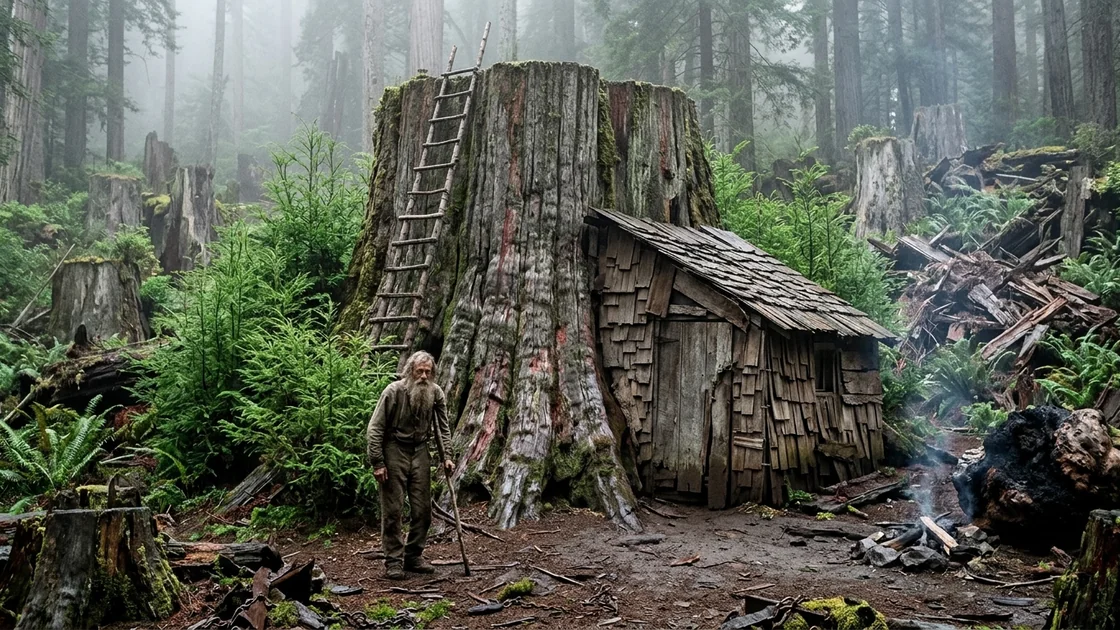
This is the account of Thaddeus Vance, an ambitious timber magnate who laid waste to the ancient and revered redwood grove known as the Emerald Chancel to satisfy the timber markets of a growing empire, only to find that gold could not quiet the ruin in his mind. Stripped of his pride by the silence that followed the massacre, Vance abandoned his fortune, his family, and his enterprise to return to the leveled basin. There, amid the dripping fog and the monumental, bleeding stumps of the giants he brought down, he constructed a solitary hovel from the scrap of his own slaughter, choosing to spend the remainder of his days enduring the crushing weight of his transgression and listening to the slow, accusatory rot of the forest he murdered.
Part I: The Iron Line
The ledger books of the Vance Lumber Syndicate were bound in dark calfskin, their corners reinforced with stamped brass that had grown dull from the sweat of Thaddeus Vance’s thumbs. Within those pages, the world was orderly, obedient, and strictly rectilinear. A forest was not a breathing assembly of ancient lives; it was a sum of cords, a calculation of Scribner board feet, a ledger balance awaiting conversion into the masonry foundations of banks in San Francisco and railroad ties stretching toward the Pacific.
In the autumn of his forty-seventh year, Vance stood upon the eastern rim of the Lost Creek drainage, four days by pack train north of Cape Mendocino. Below him lay a basin that had eluded the maps of the General Land Office for three generations. The Indians of the lower Mattole avoided the breach; they called it the House of Old Shadows, or the Place Where the Sky Rests, and even the half-breed guides hired out of Eureka would go no farther than the shale ridge. They had turned back at dawn, leaving Vance and his head cruiser, an illiterate Scotsman named Gilchrist whose eye could gauge the usable lumber of a hemlock to within forty feet, standing alone upon the promontory.
The mist had begun its slow, oceanic withdrawal. What it unveiled was not merely a grove, but an unbroken roof of antiquity so dense that the sun reached the creek bottom only as a diffused, greenish twilight. The trees were Sequoia sempervirens, but they were specimens unlike anything Vance had felled along the Eel or the Mad rivers. They rose two hundred, three hundred, three hundred and fifty feet into the cloud shelf, their trunks straight as plumb lines, ten to twenty feet through at the butt, fluted like the columns of an empire that had flourished before the Mediterranean had known a sail. Their bark was a foot thick, fibrous and furrowed like the skin of pre-Adamite beasts.
"Christ in the heather," Gilchrist whispered, his jaw slack beneath his matted beard. He took off his beaver-felt hat and held it against his chest, not out of piety, but out of a sudden, involuntary instinct of smallness. "There’s millions here, Mr. Vance. Millions upon millions. A man could build a city out of this hollow alone."
"A city," Vance echoed. His voice was dry, clipped by the crisp coastal air. He lifted his brass surveying glass to his eye. Through the round lens, the majesty resolved into geometry: five-foot crosscuts, springboard holes, donkey engines anchored to the granite outcrops, skid roads greased with dogfish oil, flumes running down to the tide-gut where the lumber schooners rolled in the swell.
"They're old, sir," Gilchrist muttered, his squint narrowing. "Look at the burls on that lead cow. She was sapling-high when the Romans were walking."
"The dead don't pay wages, Donald," Vance said, closing the glass with a brass click that sounded like the cocking of a pistol. "And trees have no souls to save. Mark the section lines. We bring the bull-teams in by spring."
The campaign had been ferocious. Vance had mortgaged his wharves in Oakland and his shares in the North Shore Railroad to finance the road through the shale cliffs. He bought thirty teams of oxen, their broad horns tipped with brass, and two portable upright boilers—the great smoking steam donkeys designed by Dolbeer—which were dragged across the divide by block and tackle, their whistles screaming through the valleys like wounded hogs.
For eight months, the chasm was an abattoir of timber. The sound of it carried for twelve miles: the hollow, rhythmic chunk-chunk of the double-bitted axes bite by bite through four-foot sapwood; the raspy, rhythmic breathing of the twelve-foot saws, their teeth raking out long red curls of heartwood that smelled of well-water, old cellars, and distilled rain; the deep, resonant iron crack as the wedge took; and then the groan.
It was the groan that men remembered. A sound like an iron bridge twisting in a gale, a shriek of interior fibers snapping one by one, until the massive trunk tipped beyond its center of gravity. Then came the whistling rush—a displacement of air so violent it tore the hats from the axemen’s heads and flattened the sword ferns fifty yards away—followed by the dull, seismic thunder of the impact. The earth shook so hard that the tea in the camp tin-cups leaped an inch into the air. Sometimes a falling giant would strike an outcropping of graywacke and shatter into ten thousand useless cords of matchwood with a sound like artillery, but Vance did not care. For every tree that shattered, three stayed true.
They peeled them like slaughtered steers. The barking crews went in with crowbars and peeling irons, stripping the thick, spongy coats while the logs lay naked and wet in the fern beds. The steam donkeys hauled them across the earth on skid roads carved through the loam, grooving the black earth down to the bedrock, until the drainage ran red with iron-colored silt and the trout floated belly-up in the pools.
The timber baron did not leave the basin during the felling. He lived in a plank shack at the mouth of the draw, his boots caked with the sour, tannic grease that leaked from the wounded burls. In the evenings, by the light of a sperm-oil lamp, he calculated the yield. Three million feet in the first cut. Six million in the second. By late July, the Emerald Chancel was gone.
Where the great canopy had once intercepted the coastal fog, turning it into a perpetual, soft-falling rain that nourished an understory of maidenhair, trillium, and pale oxalis, there was now only an enormous, blinding scar. The sun, which had not touched that earth in three thousand years, beat down upon the damp floor with a hard, white fury. The slash lay piled twenty feet deep in places—shattered limbs, broken crowns, bark strips dried to the tinder-point under the August heat. And rising out of the debris, like the gravestones of a race of giants whose names had been expunged from the book of life, stood the stumps.
They were vast, flat platforms of deep, purple-red wood. Some were twenty-two feet across. On the stump of the patriarch—the one Gilchrist had called the lead cow—the camp carpenters had smoothed the flat with an adze and the crew had held a square dance upon it, twelve couples turning and stamping their boots while the fiddler sat upon the spring-board notch. Vance had stood on the edge of the circle, smoking a cigar, his waistcoat pockets heavy with double-eagles, feeling the absolute triumph of human industry over the archaic wilderness.
The collapse came with the suddenness of a broken cable.
The market in San Francisco had been glutted by shipments from Oregon and Puget Sound; three banks failed in New York on an afternoon in September, their paper reverberating through the Western houses of trade. Vance’s lumber schooner, the Cynthia Vance, laden with half a million feet of green heartwood, foundered in a gale off Point Arena, her cargo shifting until she turned her keel to the sky and drowned seven men. Within six weeks, the price of clear redwood dropped below the cost of the towage from the cove. Creditors appeared at the mill in Arcata with court orders; they seized the planing machines, the donkey engines, the oxen, and the iron rails.
Vance had gone to his house on Rincon Hill in San Francisco, expecting to find the refuge of a man who had built solidly. Instead, he found the cold silence of rooms from which the rugs were already being inventoried by the sheriff’s deputies. His wife, Clara, a woman whose beauty had always required the lubricating grace of unlimited credit, looked at him across their walnut table with an expression that was neither anger nor sorrow, but an intolerable, flat disgust.
"You smell of that grease," she had told him, her lace cuffs held carefully away from the mahogany. "You brought the grease into the carpets, Thaddeus. And now you have nothing else to show for it."
She was gone within a month, taking the carriage, the silver, and their two daughters south to her brother’s vineyard in the Santa Clara Valley.
Vance was left in the empty rooms with his ledgers. He drank rye whiskey from a tumbler that bore the seal of a defunct steamship line. In the dead of night, when the city was quiet save for the clang of the cable-car bells on the lower hills, the silence began to ring in his ears. It was not the silence of an empty house; it was the specific, unnatural silence that had followed the felling of the Emerald Chancel—the dead, unresonant air that hung over the white-hot stumps after the whistle had blown for the last time and the oxen had been driven over the hill.
He had tried to sleep, but whenever his eyes closed, the floor beneath his bed seemed to tremble with that dull, rhythmic seismic thud. He would feel the displacement of air; he would smell the bitter, ancient tannin rising like steam from a severed vein. He was fifty-one years old, his hair was the color of wood-ash, and his hands, once so certain when holding the brass transit or signing a bank draft, had developed a small, rhythmic tremor that matched the strokes of a crosscut saw.
In the spring of 1883, he sold the last of his personal effects—his gold pocket watch, his surveying instruments, his library of treatises on hydraulics and forest economics—retaining only a team of two aging mules, a heavy spring wagon, and three wooden chests filled with salt pork, dried beans, hand axes, saws, and several cases of kerosene. He did not say goodbye to his partners or his lawyers. He turned his face northward once more, toward the coast where the gray fog crept through the dead spires like the breath of a tomb.
Part II: The Architecture of Rot
The skid road had long since begun to die. Alder scrub and salmonberry briars, opportunistic and rank, had choked the ditches where the skidding chains had gouged the earth. Winter storms had brought down slides of blue shale, blocking the cut Vance had blasted with black powder five years before. He had to clear the way yard by yard, his hands blistering through his buckskin gloves, his chest laboring under the cool, humid air that drifted in from the reef.
When the wagon finally crested the gap and dropped into the basin, the mules stopped of their own accord. Their ears flattened against their skulls; their nostrils quivered, catching the scent of the hollow.
The Emerald Chancel had not grown back. It had decayed.
The redwood does not rot like pine or fir; its heartwood is saturated with tannic acid, a natural poison to beetles, grubs, and the dry-rot fungi that turn ordinary forests to mulch within a decade. The slaughter was preserved in its own bitterness. The great stumps, hundreds of them, stood exactly where they had fallen, their edges grayed by the weather, their centers black with old rainwater that could not drain through the solid grain. The slash piles, stripped of their needles, were gray tangles of bleached bone, a petrified wreckage twenty feet high in the creek bed. The sun, which should have been mercifully cloaked by the coastal clouds, broke through a high rift, casting sharp, horizontal shadows that made the basin look like an abandoned stone quarry where an army had been put to the sword.
Vance did not set up his camp near the old bunkhouse; the camp had been burned by hunters or tramps two winters prior, leaving only the iron skeletons of the cast-iron stoves and a litter of rusted lard cans. Instead, he led the mules toward the center of the slaughter, toward the platform of the patriarch.
The stump rose fourteen feet above the ground level, a red-gray bastion that had measured twenty-four feet across the cut. Vance unhitched the mules, tethered them to a root that was as thick as an oak’s torso, and sat down on an overturned grease tub.
His bones ached with a deep, mineral cold. For three days he did nothing. He did not build a fire; he ate cold salt pork sliced with a pocketknife and chewed hardtack until his gums bled. He sat upon the slash and looked at the stump.
The thing was too vast to be called a dead plant. It was a foundation. Its roots, he knew, reached out two hundred feet in every direction, intertwining with the roots of the stumps around it, forming a subterranean web that had held this hillside against the winter deluges since the Bronze Age. Now that the top was gone, the roots were drowning in their own sap. Long, viscous tears of amber resin had dried along the flutings, mixed with the soot of the old donkey engines.
"This is the place," Vance said aloud. His voice sounded thin, like the scraping of two shingles together. The basin did not return an echo; the rough surfaces of the slash and the porous grain of the stumps absorbed the sound instantly, deadening it, burying it.
He began to build his cabin not near the stump, but directly against it, using the flat vertical face of the undercut as his western wall.
He did not use milled lumber. There was plenty of it rotting down at the old landing, but he refused it. He used the scrap—the spurn, the trimmings, the twisted slabs of heartwood that the crosscutters had discarded because the grain was wavy or knotted. He worked with a single-bitted ax, an adze, and an old five-foot crosscut saw he had adapted for one man by moving the handle to the center hole.
Every blow of the ax sent a jar through his shoulders that rattled his teeth. The redwood was stubborn; even in death it resisted the steel, its fibers springy and damp, clogging the saw teeth with a wet, reddish wool that smelled like iron fillings. He split shakes from the straight-grained bolts of slash, three feet long and an inch thick, driving the froe through the wood with a hardwood mallet until his right arm was swollen to twice the size of his left.
The cabin was twelve feet square, a miserable lean-to that clung to the giant stump like a lichen. The floor was the ground itself, cleared of fern roots down to the yellow clay, then packed with fine hemlock gravel from the creek. The roof had a single pitch, sloping away from the stump’s flat top, shingled with the rough shakes he had split with his own shaking hands. There was no glass for a window; he left only an eight-inch slot facing east, toward the rim where he had first stood with Gilchrist, through which the morning light entered like an accusing finger.
For a hearth, he did not build a stone chimney—there was no lime for mortar within thirty miles, and the mud would wash out in the first November gale. Instead, he cleared a circle down to the shale, five feet out from his doorway, and built his fire against an eight-ton chunk of green burl that had split off when the patriarch fell. The burl was unburnable; it would smolder for days, charred and black, radiating a dull, smoky heat back through the low door.
He moved his three chests inside. He built a bunk out of two split alder poles and laced it with rope, stuffing a canvas tick with the dry moss that hung from the dead limbs of the slash. When he lay down that first night beneath his shake roof, he could put his hand through the gap in the inner wall and touch the cambium of the stump.
It was cold. Not the cold of winter, but the cold of deep earth, the cold of a cellar that had been sealed for a thousand years and opened only to receive a corpse. He lay with his eyes open in the dark. Above him, through the gaps where the shakes did not meet, he could see the gray drift of the clouds. There was no wind down in the basin; the hills protected it from the sea gale. There was only the dripping.
The fog condensed on the flat table of the stump above his head, collected in the low spots left by the adze marks of the dancers, and then, finding a seam, began to drip. Plip. Plip. Plip. It hit the roof above his ear with the regularity of an iron clock. It was not rain; it had no sky-borne freedom. It was the condensation of the gray sea, filtered through the dead wood, falling upon the bed of the man who had ordered its death.
Part III: The Ledger of Rings
A man who lives alone in a ruin must find a work, or his mind will invent monsters to inhabit the empty rooms. Thaddeus Vance was an engineer by training, a man of mathematics and force-vectors, and so he turned his punishment into a task of quantification.
He resolved to count the rings of the patriarch.
The stump was thirteen feet from the ground at the highest lip of the cut, eleven feet at the lowest, where the axemen had cleared away the buttress roots to set their springboards. To reach the surface, Vance constructed a rough ladder of alder rungs lashed with wire to two fir saplings. Every morning, after his bowl of cornmeal mush and his tin of chicory coffee, he would climb the ladder with a stiff wire brush, a bottle of linseed oil, a straight-edge rule of boxwood, and an iron awl.
The surface of the stump had been blackened by the soot from the donkeys and the weather of five years. He had to scrape it down to the raw grain, inch by inch, using the wire brush and a draw-knife until the purple-red rings were revealed, thin as paper near the bark, broader toward the center where the sapling had reached for the light in some forgotten epoch of the world.
He began at the outer rim, where the cambium had died in the summer of 1878.
"One," he said. He pressed the tip of the awl into the wood, making a small, round puncture. He dipped his thumb in lampblack mixed with bacon grease and rubbed it over the hole so it would not be lost in the graying of the grain.
"Two. Three. Four. Five."
The wood here was compressed, the growth of the tree’s old age, when it had already reached three hundred feet and was spending all its energy merely to hold its place against the storms of the Pacific. A quarter-inch of wood might contain forty years of life. He had to use a linen-tester’s magnifying glass, holding it close to the damp wood, his breath fogging the small glass until he had to wipe it with his wool sleeve.
"Forty. Forty-one. Forty-two."
He calculated that at his current rate—if his eyes held out against the strain and the damp did not rot the boxwood rule—he could mark twenty rings an hour. There were feet of wood to cover. Ten feet from the edge to the pith.
By the end of the first month, he had reached the year of his own birth: 1831. It was marked by a narrow ring, pinched between two seasons of drought that had dried the coastal creeks. He stared at it through the lens. When this ring was forming, his mother had been a girl in Vermont, churn-dashing in a cool pantry, and he had been nothing—a seed not yet conceived in the mind of the race. But the tree had been there, complete, colossal, its crown high in the sea-mist, already older than the nation that would spawn him.
He moved inward.
He passed the year the British burned Washington; he passed the winter at Valley Forge, which appeared in the wood as a dense, dark line where the frost had checked the summer growth. The awl went in with a tiny snick, the lampblack marked the spot, and Vance moved his knees forward across the rough grain, his trousers sodden with the fog-water that never dried from the wood.
In the second year of his counting, his provisions began to fail. His money was nearly gone—he had only a few silver dollars sewn into the lining of his waistcoat—and the storekeeper at Petrolia, twenty-four miles over the hogback ridge, looked at him with the guarded hostility that small-town merchants reserve for the ruined and the mad.
Vance did not look like the magnate who had once arrived at the Humboldt Bay hotel with three leather trunks and a gold-headed cane. His coat was held together at the throat with a piece of telegraph wire; his beard had grown down to his breast, white and stiff with dried pitch; his eyes, sunken beneath the bony eaves of his brows, were bloodshot from the magnifying glass and the perpetual smoke of the green burl fire.
He traded his second mule for two sacks of flour, fifty pounds of salt, and a box of crosscut saw files. He led the remaining mule—an old, hollow-flanked mare named Jenny—back over the ridge in a driving rain that turned the skid road into a red sluice.
The work on the stump became his only measurement of time. The seasons ceased to have names; they were merely the wet season, when the fog became a solid, horizontal drift that soaked his clothes through in five minutes, and the dry season, when the slash cracked under the sun like rifle shots and the smell of dead pine-resin made him dizzy as he knelt upon his platform.
"Seven hundred," he whispered. It was an afternoon in July. The sun was hot on his neck, and the flies—the little black gnats that breed in the rotting sapwood—buzzed around his ears in a greasy cloud.
Seven hundred rings from the bark was the year 1178. He took his boxwood rule and checked his distance. He was less than four feet into the heartwood. There were still seven feet to the center.
"Frederick Barbarossa," he murmured. He had read history once, in the academy at Albany, when he had intended to become a scholar of ancient languages before his father had put him into the lumber trade. "Barbarossa was drowning in the Saleph. And you were already twelve feet thick. You were already old."
The wood beneath his knees felt different now. In the center of the tree, the heartwood was darker, almost black, dense as lignum vitae and bitter with the accumulated tannins of two millennia. It did not take the awl easily; he had to tap the wooden handle with his palm, leaving his right hand permanently bruised, the skin yellow and callous like an old horn.
He began to hear things while he knelt there.
The basin had no birds—or so he had thought for the first two years. The great flocks of grosbeaks and marbled murrelets that had nested in the high canopy had vanished when the roof fell. But now, as he sat in the center of the thirteen-foot circle, he began to hear them again. Not above him, where the empty sky was pale and thin, but below him.
It was an illusion of the ear, he told himself. A trick of the acoustic hollow formed by his cabin and the surrounding slash. But as he pressed his cheek to the wood to blow away the red sawdust from the awl-hole, he would hear it: the faint, infinitely distant murmur of wind in needles that were no longer there; the creak of limbs fifty yards long swinging in a gale that had blown itself out eight hundred years ago; the low, hydraulic suck of sixty thousand gallons of water rising through the sapwood from the deep aquifers of the shale.
He would freeze, his ear pressed to the damp, cold grain, his breath stopped in his throat.
"You are dead," he would say to the wood. "I had you down. The mill cut twelve thousand feet of clears from your second log alone. I have the receipts. I have the manifests."
The wood did not answer, except with that low, internal friction—the settling of millions of pounds of dead fiber under its own immense, inert gravity.
Part IV: The Encroachment of the Small
By the third winter, the old mule Jenny died. She did not die of any disease Vance could name; she simply lay down in the mud between two springboard stumps, her legs tucked under her belly, and refused to get up when he brought her her measure of oats. By the second morning, the frost was thick on her eyelashes, and Vance had to drag her carcass away with his own hands, using an iron come-along anchored to a root, inch by inch, until he could tumble her into one of the old skid-ditches and cover her with slabs of bark.
Now he was truly alone. He had no beast to speak to, no creature whose breath was warmer than his own.
It was then that the small things began to enter his cabin.
The redwoods had held the floor for centuries by an act of absolute tyranny. Their shade was so complete, their litter so acidic, that nothing could grow beneath them except the specialized ferns and the pale, ghost-like saprophytes that lived on the fungal threads in the duff. But now that the tyrants were carcasses, the opportunists were marching in.
First came the blackberry—not the sweet, small native berry, but the fierce, thick-caned brambles that the loggers had brought in their hay-bales. They threw out long, green arches armed with curved talons that caught at Vance’s sleeves as he walked to the spring. They grew four inches in a night, creeping over the slash piles like an army of green spiders, binding the dead wood in a thorny mesh.
Then came the wood-rats—the bushy-tailed packrats whose ancestors had lived in the hollow hollows of the living trunks. They invaded his cabin. They took his small things: his brass buttons, the iron awl-points, the tallow candles he had dipped from the mule’s fat, the dried beans from his sack. In their place, they left twigs, rabbit bones, and dry, gray pellets of dung.
One night he woke to find one sitting on his chest. It was as large as a small cat, its round black eyes reflecting the smolder of the green burl outside the door. Vance did not move; he could feel the cold prick of its whiskers against his chin, the light, sharp balance of its claws through his wool shirt.
"Take it," Vance whispered to the rat. "Take the whole thing. There’s nothing here but scrap."
The rat twitched its nose, grabbed the bone collar-stud from his shirtband with its yellow incisors, and leaped into the darkness between the cabin wall and the stump.
The most terrible thing, however, was the fungus.
In the fourth year, the rains did not cease from October until May. The basin became a bowl of red-brown water; the creek, choked with logs, backed up until the floor of Vance’s cabin was a swamp of liquid clay. He had to lay down corduroy—split shakes laid across hemlock branches—to keep his feet from sinking to the ankles.
With the water came the molds. They did not appear as ordinary white mildew; they were monstrous, gelatinous organisms that blossomed out of the cut faces of the stumps. Some were sulfur-yellow, forming shelves three feet wide that smelled like rotting fish; others were liver-colored, soft and wet, bleeding a clear, amber juice when he struck them with his boot.
They grew upon the very stump he was counting. They covered his awl-marks. In a single week of warm, fog-bound rain, forty years of his labor would be obliterated by a coat of pale, furry mycelium that ate the lampblack and softened the heartwood until his thumb could sink an inch into the grain.
He fought them with an old cook-stove shovel and a bucket of salt brine. He would scrape the slime from the wood, his teeth set, his breath coming in hoarse gasps, cursing the rot with the legalistic fury of a man who believed he had a right to his penance.
"You will stay clear," he would scream at the shelves of yellow jelly, his voice cracking into a falsetto that frightened the ravens from the slash. "I have not reached the Conquest yet! I am only at the ninth century! I have five hundred years yet to mark!"
He spent two sacks of salt—his winter supply—to pickle the surface of the stump, rubbing the white crystals into the grain until the fungi shriveled and blackened. But the salt drew the moisture from the air; the stump became greasy, slick as an ice-pond, and when he climbed down his alder ladder in the dusk, his boots slipped on the first rung.
He fell twelve feet onto the pile of graywacke stones he had gathered for his hearth.
He lay there through the night, his left leg twisted beneath him, the rain falling straight down into his open face. He did not lose consciousness; the cold was too sharp for that, the pain in his hip too absolute. He lay and looked up at the platform he had spent four years scraping.
Seen from below, in the gray light of a coastal dawn, the stump did not look like a monument to his industry, nor did it look like the victim of his crime. It looked like an altar upon which a sacrifice had been made so monstrous that the god to whom it was offered had refused the carcass and left it to stink in the field.
"You old bastard," Vance said to the wood, his teeth clicking together with the ague. "You cold, old bastard."
He dragged himself into the cabin on his elbows, leaving a red furrow in the clay like a wounded dog.
Part V: The Ghost Cruiser
He did not die of the hip, though he walked thereafter with a crab-like hitch, his left foot dragging behind him as if he were tethered to the ground by an invisible chain. He made himself a crutch from an ash branch he found in the drift, padding the crook with a piece of his old saddle-blanket.
In the sixth year of his solitude, the first human being entered the basin since his arrival.
It was an afternoon in October, when the air was clear and dry—a rare, treacherous clarity that brought the scent of inland smoke from the fires in the Douglas fir forests fifty miles to the east. Vance was sitting on his low bench outside the cabin, skinning a gray squirrel he had caught in a wire deadfall.
He heard the horse before he saw it—the iron of a shoe clicking against the blue shale of the old road. His first instinct was not curiosity, but a blind, territorial terror. He reached for his double-bitted ax, which leaned against the door-jamb, its handle polished to a dark ivory by his palms.
The rider was a young man, not more than twenty-five, wearing the corduroy coat, high-laced cruisers' boots, and flat-crowned Stetson of the new generation of forest engineers. Behind him on a lead horse was a pair of pack-boxes made of painted tin, and across his pommel lay a leather case containing a modern three-legged transit with brass leveling screws that caught the low sun like diamonds.
The young man pulled up his horse at the edge of the clearing, twenty yards from Vance’s hovel. He looked at the vast stump field with the professional, detached eye of a doctor examining a healed scar, then his gaze fell upon the cabin, the smoke curling from the green burl, and finally upon the wild, bearded apparition holding an ax with one hand and leaning upon an ash crutch with the other.
"Afternoon, friend," the young man called out. His voice had the brisk, nasal cadence of the Midwestern timber schools.
Vance did not answer. He shifted the ax-head an inch higher. His knuckles were gray.
The young man dismounted with the easy, athletic swing of a man whose joints had never been crushed by falling hemlock. He let the reins fall to the gravel and walked forward three paces, his thumbs hooked in his belt.
"My name is Albright," he said. "Representing the Pacific Redwood and Land Company. We bought the residual titles from the bank in Eureka."
The words were foreign to Vance. They belonged to the world of calfskin ledgers, of clean paper that smelled of rags and starch, of men who washed their faces with almond soap and had their hair trimmed with scissors once a fortnight.
"Titles," Vance spat. The word came out like a dry seed from his beard.
"The mineral rights and the second-growth survey," Albright said. He took off his Stetson and wiped his forehead with a clean blue handkerchief. He looked up at the stump of the patriarch, then down at the cabin that clung to its side. "Jesus. This was the Vance cut, wasn't it? The old '78 clearance."
"It was," Vance said.
The surveyor took three steps closer, his boots crunching on the dried shakes. He looked at Vance with a sudden, sharp curiosity—not unkind, but the cold interest of a naturalist who has found an unusual beetle under a stone.
"You're him, aren't you? Thaddeus Vance."
Vance’s hand tightened on the ax until the ash crutch creaked under his armpit. "Vance is dead. He died in San Francisco. In a room with no carpets."
The young man gave a short, dry laugh that died in the vastness of the hollow. "He might as well have. He left twenty thousand acres of tax liens behind him. But he took the cream. My God, he took the cream. There's not a log in here now that’s worth the steam to haul it out. The whole section is junk."
"Junk," Vance repeated.
"Second-growth," Albright said, gesturing with his handkerchief toward the base of the stumps. "Look at it. It's coming up in brush. White fir, tan-oak, madrona. It'll be eighty years before there’s a stick of clear lumber in this basin, and even then, it won't be like the old stuff. The old stuff was five hundred years in the making. A man can't wait on that kind of capital."
"A man cannot," Vance said.
Albright walked over to the patriarch. He reached out and touched the cut edge of the wood, three feet above his head, where Vance’s wire brush had exposed the dark, purplish grain. He noticed the tiny, blackened awl-marks, marching in straight, measured ranks across the radius.
He squinted. "What's this? A scale?"
"It is a record," Vance said, his voice dropping into a register that made the horse lift its head and snort.
"A record of what?"
"Of the time before you were born. Of the time before this country was an itch in the groin of a European king."
Albright stepped back. He looked at the old man's eyes, at the wild, untrimmed tangle of his gray hair, at the rags wrapped around his left foot where the boot had rotted away. A flicker of something like disgust or pity crossed his clean-shaven face.
"You've been out here a long time, Mr. Vance."
"Not long enough," Vance said. "I am only to the year eight hundred and fourteen. The winter Charlemagne died. There was a drought in this basin that year. The wood is very thin. It takes a whole day to find three rings."
The surveyor backed toward his horse. He did not ask to water his beasts; he did not offer the old man tobacco or bacon from his pack-boxes. He saw the madness, not as an eccentricity, but as an infection that lived in the red earth itself—a sickness born of the colossal waste that lay around them.
"I have to reach the coast by nightfall," Albright said, his hand already on the leather holster of his saddle-scabbard. "The road through the draw... is it open?"
"The slides have taken it," Vance said. "You'll have to lead the horse through the creek. Watch the pools. The old wire from the donkey drums is under the gravel. If your mare catches a shoe in it, she'll break her leg."
The young man swung into the saddle. He looked down at Vance once more, his lips parted as if he wanted to say something—some word of warning, or perhaps an apology for having disturbed the sepulcher. But he said nothing. He turned the horse's head toward the creek, spurred it down the gravel bank, and was gone.
Vance watched the dust settle in the dry notch of the trail. The sound of the hooves died quickly, swallowed by the gray slash and the silence that Albright had called junk.
"Eight hundred and fourteen," Vance said to the empty air. "A dry winter. A very dry winter."
He laid his ax against the log, hitched his crutch under his shoulder, and climbed his ladder to the dead king.
Part VI: The Fairy Rings
It was in the eighth spring that the trees began their revenge.
It was not a violent thing; there were no falling limbs, no slides of rock to crush his shanty. It was the revenge of life itself—the slow, terrifying obstinacy of the genus Sequoia.
A redwood does not die when it is felled. Its heart may be made into shingles, its bark into insulation, its limbs into firewood, but the great root system, which has been established for two thousand years, remains alive in the dark earth. It waits. It gathers the subterranean waters; it breathes through the root-grafts with its dead neighbors; and then, along the outer rim of the stump, just beneath the dead cambium, it awakens the dormant buds.
Vance first noticed them in the month of May, after a three-week fog that had kept him prisoner inside his cabin.
He climbed the ladder to resume his work—he was now entering the sixth century, the era of Justinian and the great plagues of the East—when he found his path blocked.
Along the outer circumference of the stump, at the point where the living bark had been severed from the sapwood, a ring of green shoots had burst through the wood. They were bright, lime-green, soft as asparagus tips, but they were growing with an obscene, explosive vigor. There were fifty of them, eighty of them, a hundred of them, encircling the flat executioner's block like a crown of thorns.
He touched one with his finger. It was cool, moist, and stiff with a ferocious hydraulic pressure. It was not an alder or a salmonberry; it was the patriarch itself, rising from its own butchered base.
"No," Vance whispered.
He took his pocketknife and cut the shoot away. A drop of clear, bitter sap welled from the wound, smelling of lemons and crushed needles.
He cut another. And another. He worked for two hours until he had cleared a foot of the perimeter, the little green corpses falling to the slash below. But as he looked out across the basin, he saw what he had been blind to for eight years.
Every stump was doing it.
The Emerald Chancel was not a cemetery; it was an incubator.
Around every twelve-foot, sixteen-foot, twenty-foot stump he had made with his crosscuts, a circle of sprouts was rising. The loggers called them fairy rings—the circle of children that rise from the root-collar of the dead mother. Some of them, which had started five years before during his sickness, were already twenty feet high, their slender, red-barked stems as thick as a man's thigh, their feathery branches meeting in the air to form a new, miniature canopy five yards above the old ground.
They were growing faster than any tree had a right to grow. In the deep light of the basin, clear of the great shade that had once kept them down, they were drinking the sun with an insatiable hunger.
They were surrounding him.
His cabin, tucked against the base of the patriarch, was being engulfed. Three shoots had found the gap between his shake wall and the stump; their green tips had entered his sleeping space, reaching toward the small hole where his smoke escaped. They had already twined around his spare ax-handle, their tendrils pale and thin in the gloom, seeking the light with a blind, vegetable purpose.
He sat upon his bench, his ash crutch between his knees, and watched the green ring grow.
The horror of it was greater than the horror of the clearing. The clearing was an act of human will—monstrous, yes, but understandable within the small, greedy grammar of commerce. It had an end; it produced a void; it left a silence in which a man might at least listen to his own guilt.
This was something else. This was a complete, indifferent disregard for his crime.
The tree did not care that he had wept. It did not care that he had counted its rings, that he had salted its wood, that he had ruined his hip and his lungs and his mind to mark the years of its long breathing. It did not recognize his guilt any more than it had recognized his saws. It was simply continuing its life, using his ruined body and his rotting cabin as nothing more than a few ounces of phosphorus and nitrogen to feed the new shoots.
"I cut you down," he said to the green crown above him, his voice rising to a shriek that had no echo. "I brought the iron! I burned your slash! You are dead, damn you! You are dead!"
He struck one of the young shoots with his crutch, breaking it in two. The green tip dangled by a thread of fiber, weeping its clear, aromatic blood upon his sleeve. But even as he stood there panting, he saw that beneath the break, two new bud-eyes were already swelling in the axil of the needles.
They would have him.
In thirty years, fifty years, the shoots would be trees three feet thick. They would fuse together at the base, as redwoods do, swallowing the stump between them. They would grow over his shakes; they would crush his cast-iron stove into the blue clay; their roots would reach through his rib-cage and find the calcium of his teeth. The patriarch would not die; it would merely exchange its single, colossal center for a circle of ten thousand limbs, and in the dark heart of that new grove, the memory of Thaddeus Vance would not even be a knot in the grain.
Part VII: The Sinking of the Needle
By the tenth winter, Vance could no longer climb the ladder.
His hip had frozen into a solid, aching hinge of bone that would not bend, and his right eye was entirely blind from a cataract that looked like a drop of milky quartz set into his skull. He lived entirely within the cabin, which had become a grotto of living wood and rotting shakes.
The young trees—the sprout-circle of the patriarch—were now thirty feet tall. Their limbs interlaced over his roof, shutting out the sun he had let in with his axes. The green twilight had returned to the basin, but it was not the majestic, high-roofed church of the old grove; it was a dense, airless, tangled jungle of young needles that caught the fog and dropped it perpetually upon his hearth.
He had abandoned his counting.
He had reached the year 410. He had marked the year the Goths entered Rome; he had found the narrow, pinched ring of the great volcanic dust-veil that had darkened the sun over the whole earth in the time of the Byzantine emperors. His awl was still stuck in that ring, four feet from the pith, its iron handle red with rust, its boxwood rule rotted into three soft pieces that lay in the moss upon the platform.
He did not need the awl now. He had the rings in his head.
When he lay on his bunk, the fever—the old coastal malaria that lives in the blue shale and the wet fern—would take him by the throat, and he would travel the rings inward without his eyes.
He would feel the wood: 300 AD, 200 AD, 100 AD.
He was reaching the core. The core was small—a sapling no thicker than his thumb that had sprouted on this hillside when the hills were unnamed, when the ice was still melting from the northern valleys, when the ancestors of the men he had swindled were running through the beech-woods of Germany with flint tipped on their spears.
He had killed that too.
He had killed not only the three thousand years that had lived, but the three thousand years that were to come.
One night in January, the great gale came in from the southwest.
It was the storm that old men on the coast still remember as the "Crescent City Blow." It tore the roofs from the warehouses in Eureka; it drove three lumber schooners onto the bar at the mouth of the Eel, beating their hulls to kindling in two hours; it leveled forty miles of telegraph wire along the stage road.
Down in the basin, the wind did not strike the floor directly; the surrounding ridges broke its force. But the crowns of the young trees—the dense, flexible ring of sprouts—caught the gale like the sails of a ship. They thrashed and groaned, their wood young and green, bending double under the gusts, their needles whistling with a high, thin pipe that was entirely unlike the deep, organ-bass of the ancient forest.
Vance lay in his bunk. He was cold. His fire had been drowned by the water pouring down the sprout-chimney an hour after the sun went down. He had no more dry wood; the shakes he had split were sodden through, and his fingers were too stiff to hold the steel and flint.
He heard a sound like an iron bolt snapping.
It was not the young trees. It was the stump itself.
The patriarch, dead for ten years, its roots rotted through at last by the acidity of the swamp that had formed in the clear-cut, was giving way under the leverage of its own sprout-ring. The young trees, thirty of them, each weighing three tons, were acting as great wooden crowbars, their roots prying at the dead foundation with every blast of the Pacific wind.
The cabin began to buckle.
The wall formed by the flat face of the undercut groaned—a deep, wooden complaint that Vance felt through his spine rather than heard with his ears. The shakes began to pop from the rafters, their iron nails screeching as they drew from the soft wood.
Vance did not move. He lay under his blanket of damp moss and rotten canvas, his hands crossed over his chest, his good eye fixed on the ceiling.
"Come on, then," he said. His voice was no louder than the hiss of the rain on his cold hearth. "Come on down."
The flat face of the stump moved.
It did not fall inward; it settled. It sank four feet into the soft, waterlogged loam, crushing his corner-posts like dried reeds. The roof collapsed upon him—not with a killing blow, for the shakes were light and the alder poles bent into an arch above his bunk—but with a heavy, enveloping weight of sodden bark, moss, and green branches that sealed him into the earth like a seed in a furrow.
The air became thick with the smell of old heartwood—the deep, cold, iron-tannic scent that had followed him from the ledgers of San Francisco to the mud of the Mattole. It filled his mouth; it filled his nostrils; it settled into his eyes like fine, red sand.
Above him, the gale raged across the rim of the basin, tearing at the shale, screaming through the dead slash that was now three-quarters rotted into the brush. But down under the stump, in the hollow between the root-buttresses where the axemen had stood to dance their reels, it was warm.
The earth was warm.
It was the warmth of fermentation—the slow, chemical heat of millions of tons of wood returning to the soil, the quiet fever of the fungi that had beaten his salt and were now turning the patriarch into black mold.
Vance felt the pressure of the root against his side. It was not hard, like iron; it was yielding, damp, and alive. Through the torn wool of his shirt, he could feel the faint, rhythmic pulse of the sap.
It was rising.
Even now, in the middle of the tempest, in the black center of the night, the root was drawing the cold rain through the shale, pumping it upward into the thirty young spires that were dancing in the gale. It passed through his clothes; it passed through the skin of his flank; it seemed to enter the marrow of his ruined hip with a sharp, cleansing sting that was neither life nor death, but simply the passage of water through an obstruction.
He closed his eye.
The awl was in the center now. He did not need to tap it with his palm. It was sinking into the first ring—the little circle of wood that had formed when the world was silent, when there were no axes, no ledgers, no cities of white pine to be burned in great fires and rebuilt with the bones of giants.
"Zero," he whispered.
The word was instantly filled with red mud.
The storm passed by dawn. The sun came up over the eastern rim, clear and cold, lighting the basin with a pale, yellow brilliance that made every drop of rain on the young needles shine like an oil-lamp.
Where the cabin had stood against the patriarch, there was only a low mound of red-gray debris, covered with the fresh green fronds of the sword ferns that had already begun to re-seed the ditch. The stump itself had tilted three feet to the west, its great cut surface cracked from circumference to core by the frost and the weight of the new grove.
The sprout-ring stood straight. They were thirty feet high, fifty feet high, their slender red spires pointing toward the cloud shelf with the absolute, terrifying confidence of things that have three thousand years to wait.
The wind moved through their tops with a sound like a distant surf. It did not speak of Thaddeus Vance. It did not speak of the Emerald Chancel. It spoke only of the rain that was falling on the sea, and the long, slow work of turning the stone into wood, and the wood into earth, and the earth into nothing at all.