The Ghost of the White Pass
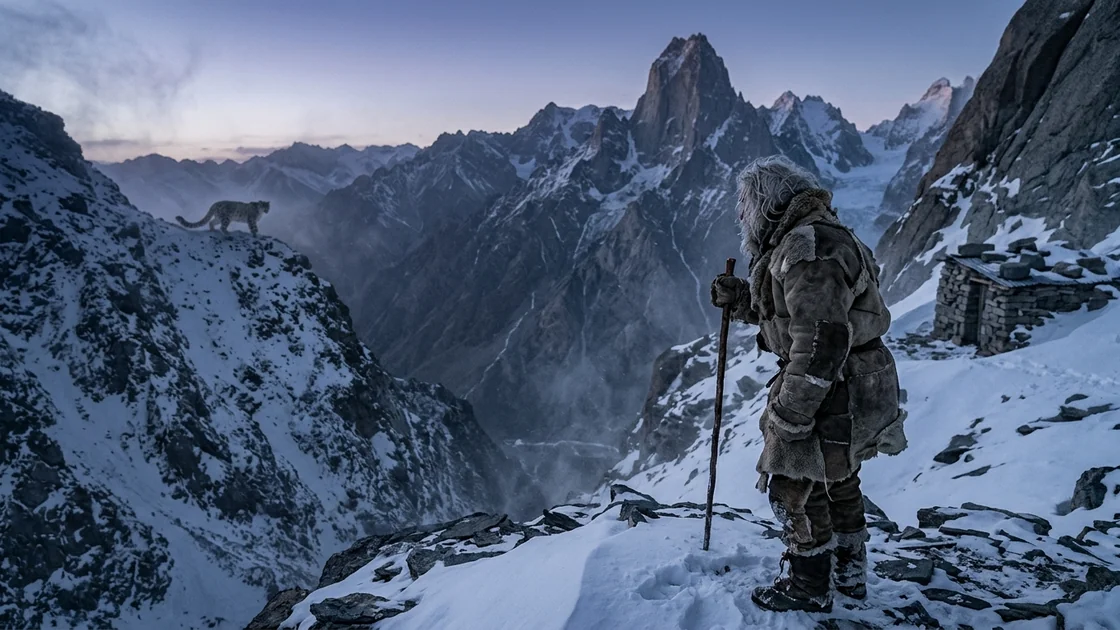
Julian Graves was once an acclaimed trophy hunter who chased rare quarry across the most forbidding terrain on earth, culminating in an expedition to the desolate Karasul Range where he tracked and killed the last surviving snow leopard of that wilderness. The immediate triumph curdled into an inescapable horror when he realized the finality of what he had destroyed, prompting him to abandon his wealth, his reputation, and his homeland. He returned to the frozen altitude of the beast he slew, building a solitary stone shelter beneath the jagged cirques to spend his remaining decades turning away poachers, enduring the brutal seasons, and guarding the silent mountain whose crown he had stolen.
Part I: The Terminal Ridge
The cartridge was a custom-loaded .300 Weatherby Magnum, necked and polished until the brass gleamed like clean butter under the oil-lamp in the base camp at Daban-Bel. Julian Graves had loaded it himself at a workbench in Surrey three months prior, seating a hundred and eighty grains of boat-tailed copper with the manicured precision of a watchmaker. He had believed then, as he had believed for twenty years across four continents, that the world was an inventory of magnificent shapes waiting to be stilled, cataloged, and mounted beneath the vaulted plaster ceilings of private estates.
The Karasul did not feel like a place that tolerated inventories. It rose out of the Central Asian steppes not as a gentle rampart of hills, but as an abrupt, shattered jawbone of slate, gneiss, and blue ice that caught the northern storms and ground them into needle-fine drift. The maps provided by the regional ministry in Bishkek were thirty years out of date, filled with speculative contour lines and pale gray washes labeled simply as Glacier Untraversed.
Beside him crouched Khamat, a man whose skin had the dark, fissured texture of cured sheep leather. Khamat did not carry a modern rifle; he carried an ancient, smooth-bored Russian carbine slung across a greasy quilted chapan with baling wire, and he did not look through high-index German glass. He looked through eyes narrowed against fifty winters of windburn, reading the mountain the way an archivist reads a deteriorating codex.
"No more after this one, sahib," Khamat had whispered three days earlier, when they found the scrape on the juniper branch near the mouth of the gorge. It was an old mark, the wood oxidized to silver, but clinging to the dried sap was a tuft of underfur the color of salted tallow. "Since the winter the snow did not melt from the passes, twenty years back, the shepherds see none. The traps in the south took the mothers. The poison for the wolves took the cubs. Only the Old One of the High Slate is left. My grandfather said he was not an animal, but a stone that learned to walk so it could watch the sheep die."
Julian had smiled then, the thin, confident curl of the lip that had charmed sponsors and hunting clubs in London, Nairobi, and Dallas. "Every valley has a legend about the last one, Khamat. It’s what makes the permit cost what it costs."
"The paper you bought from the ministry," Khamat said, his voice flat as a frozen pond, "does not tell the rock what to bear."
Now, on the fifth morning, they lay prone on a shelf of shattered shale at five thousand two hundred meters. The temperature was twenty-two degrees below zero, though the wind made the measurement meaningless; it stripped the heat from Julian’s wool and gore-tex layers with the systematic efficiency of an autopsy. His toes had lost sensation two hours before sunrise, but he ignored them with the practiced asceticism of a man whose vanity was far stronger than his physical discomfort.
Julian held his eye against the rubber cup of the optic. The world within the reticle was a circle of stark, violent geometry: scree fields tilted at fifty degrees, gullies packed with wind-crusted slab, and the sheer granite face of the peak they called the Finger of God.
Then, the shale moved.
It did not run. It did not emerge from behind a boulder. It simply differentiated itself from the gray-and-cream matrix of the slope. One moment there was a cluster of lichen-stained boulders, and the next, a shoulder muscle shifted, three feet long and four inches deep, rolling beneath a coat so thick it seemed to swallow the morning light without reflection.
The cat was moving down the ridge with a slow, liquid inevitability. It was massive—far larger than the specimens Julian had examined in the natural history collections of Munich and Saint Petersburg. Its tail, thick as a man’s bicep and tipped with dark rings, trailed behind it like a counterweight, dipping and swaying to balance footsteps that made no sound upon the scree. Its head was broad, the ears rounded and low against the skull to preserve heat, and its eyes, even at six hundred yards through forty-power glass, were pale discs of glacial water that took in the valley without haste or fear.
It had no fear because there had been nothing above it in this sky for three million years.
"Look," Khamat murmured behind him, his breath catching. It was not the whisper of a guide spotting a trophy for a client; it was the involuntary groan of a man watching a monument topple. "The King of the Slate."
Julian felt the old, familiar chemical rush—the sudden narrowing of the peripheral world until nothing existed in the universe except the junction of the animal’s foreleg and chest. The crosshairs drifted across the flank, settling just behind the elbow, where the ribs tucked thin over the heart.
"Six hundred and twenty yards," Julian muttered, calculating the angle. "Inclination negative twelve degrees. Wind coming off the saddle at eight knots."
He adjusted the elevation turret with gloved fingers. Two clicks. A soft, mechanical snap that sounded to him as loud as an axe striking cedar.
The leopard stopped. It did not bolt. It raised its broad muzzle, tasting the cold air that was tumbling down from the peaks. It looked directly up the fall line, toward the shelf where Julian lay. There was no terror in the gaze; there was only an ancient, haughty curiosity. It had never seen a man at this altitude that did not smell of greasy sheep-fat and woodsmoke, and Julian smelled only of cold steel and petroleum solvent.
"Do not," Khamat whispered suddenly.
Julian did not look at him. His finger, curved inside the trigger guard, had already taken up the first stage of the pull. "Quiet."
"Graves sahib—listen to the mountain. There is no other track. We have walked the range for three weeks from the river to the sky. There is no track of a mate. There is no cub. If you take this coat, the ridge is only bone."
"I have the tag," Julian said, his voice entirely detached from his humanity.
He exhaled. The breath plume rose before him, momentarily silvering the lens, and in the fraction of a second before the glass cleared, he squeezed the remaining three pounds of resistance from the match-grade sear.
The rifle did not roar so much as it split the morning. The sound was flat and dry, instantly stolen by the thin air and hurled down into the gorges where it echoed from wall to wall like a series of slamming iron gates.
Through the scope, Julian watched the bullet strike. The impact was visible as a sudden, violent puff of white dust from the leopard’s coat, followed by an unnatural, staggering hitch in the animal’s stride. The leopard did not leap or scream. It simply folded at the shoulders, its hind legs churning once against the loose scree, sending a spray of gray pebbles skittering down the face of the drop.
It slid twelve feet, arrested by a clump of alpine thrift, and then lay still. Its great ringed tail twitched once, a slow, involuntary curling toward the belly, and then relaxed into the stones.
Julian rose to his knees, his breath coming in ragged gasps through his dry lips. A wild, electric exultation surged through his chest—the conquest of the inaccessible, the acquisition of the impossible.
"Did you see that?" he shouted, turning to Khamat. "Dead in the shadow of the heart. Six hundred yards in a cross-draft!"
Khamat had not risen. He sat on his haunches, his hands buried deep within the sleeves of his sheepskin coat, his chin resting against his collarbone. He was looking not at the fallen shape on the scree, but down into the black chasm of the river valley miles below, where the morning shadows still pooled like ink.
"I saw," Khamat said. He did not look up. "The sky is empty now. Go take your skin."
Part II: The Autopsy of an Obsession
They reached the body forty minutes later, scrambling down a treacherous chute of rotten slate that threatened to give way under every boot-heel.
When Julian laid his hand upon the fur, the heat was already fleeing it. The coat was astonishing—dense, oily, smelling faintly of dry earth, wild goat musk, and the ozone that clings to rocks after a lightning strike. The rosettes were not black, but a deep charcoal that faded into pale cream along the belly. Julian took out his steel tape measure with fingers that trembled slightly, recording the dimensions: eight feet and two inches from the tip of the black nose to the end of the caudal vertebrae. A giant. A world record. The greatest mountain trophy taken by an Englishman since the fall of the Raj.
He reached for his skinning knife—a broad-bellied drop-point forged from Swedish tool steel.
"You do not touch the meat," Khamat said, standing five paces away on the ledge, his carbine resting across his arms like a barrier.
"I have no use for the meat," Julian replied, kneeling over the shoulder. "The skull and the cape. That’s what the permit stipulates."
"The skin is yours," Khamat said. "The flesh stays for the ravens. But you look at the mouth first."
Julian frowned, pausing with the blade poised above the brisket. With his thumb and forefinger, he pried open the heavy, black-pigmented lips.
The canines were enormous, three inches long, but they were yellowed and worn down at the tips, chipped by years of gnawing frozen bones through high-altitude winters. The incisors were ground down nearly to the gums. Around the neck, beneath the thick ruff, were the deep, white scars of old battles—territorial disputes fought decades ago when there had been rivals to contest these saddles.
Julian worked for three hours. The cold was an enemy to the work; the blood thickened into black grease upon the stones, and the fat congealed into waxy white flakes that clogged the teeth of his saw as he separated the skull from the atlas vertebra. He worked with professional detachment, but as the hide came away from the blue-white fascia of the muscle, an odd, heavy silence settled over the cirque.
There were no birds. No choughs wheeled overhead; no bearded vultures cruised the thermals above the arête. The wind, which had shrieked through the col since dawn, died down to a flat, dead calm that left Julian’s ears ringing with the sound of his own pulse.
When the skin was salted, rolled, and lashed with hemp cord to Julian’s external-frame pack, it weighed forty pounds. It felt heavier. It felt like an anchor dragging against his spine as they made their way down the moraine toward the base camp.
They reached the lower camp at dusk. The horses—three shaggy mountain ponies—stood with their heads down, their breath steaming in the blue light. The pony-boy, a nephew of Khamat named Aslan, was not sitting by the dung-fire. He was standing on a boulder at the edge of the camp, staring up at the darkening peaks.
When he saw the bundle on Julian’s pack frame, he did not cheer or ask for tobacco, as he had after Julian had taken an argali ram two weeks before. He spit into the dust, turned his back, and walked into the yurt.
That night, Julian lay in his sub-zero sleeping bag with the skull resting in a wooden crate beside his head. Outside, the mountains stood in the moonlight like rows of white teeth. He could not sleep. His eyes would shut, and in the dark behind his eyelids, the circle of the reticle would burn into his vision—the gray shape among the stones, the sudden puff of hair, the tail curling in the dirt.
In the morning, Khamat came to his tent. He laid the advance money Julian had paid him upon the lid of the specimen chest.
"What is this?" Julian asked, his voice hoarse from the dry air. "We still have the trek out to Osh. You haven't earned the remainder."
"I do not go back to Osh with this," Khamat said. He spoke without anger, with a quiet, terrible finality. "The horses are yours. The saddles are yours. We go south, through the pass to my brother’s camp in the lower valley."
"You’re breaking the contract," Julian said, his instincts as a London solicitor flaring up through his exhaustion. "You agreed to see the specimen through customs."
Khamat looked down at the crate. "There is no customs for what you took. A man from the academy in Moscow came ten years ago. He had books and glasses. He told the council in the village: If this one dies, there is no seed. The valley is blind. We did not believe him. We thought the mountain would always make them, out of the frost and the sheep-shadows. But I have walked every gorge from the river to the sky since I was a boy. I know the marks. I know where the scat is fresh and where it is old."
Khamat stepped back from the tent flap.
"There is no other, Graves sahib. You have killed the father of the snow. When you sit in your city, look at the wall. The wall will be very quiet."
The two men left before noon, taking only their blankets and one pack-mule. Julian watched them descend the switchbacks until their gray coats dissolved into the gray stones of the alluvial fan. He was alone with three horses, a mountain of supplies, and forty pounds of salted skin that smelled increasingly of iron and rotting grease.
Part III: The Return of the Relic
It took Julian six years to discover that Khamat had been right about the silence.
At first, there was the vulgar noise of success. The trophy had been mounted by the finest taxidermist in Paris—a man who spent four months sculpting a polyurethane manikin that captured every sinew, every furrow of the brow, setting the glass eyes into beds of custom resin tinted to match the greenish-gold of the Karasul ice. The skin had taken well to the pickle; the hair remained bright and dense, each rosette distinct against the pale flank.
The specimen stood on a pedestal of walnut in the two-story library of Julian’s manor house in Hampshire. Beneath it, an engraved brass plaque recorded the details:
PANTHERA UNCIA
Karasul Range, Alai-Tian Shan Transition
October 14, 1974
Taken by Julian Graves, Esq.
Altitude: 5,210m
Collectors came from across Europe to see it. Men with names found in the registers of the Shikar Club and the Boone and Crockett Club stood before the pedestal with glasses of single malt in their hands, leaning close to examine the skull, which had been cleaned, bleached, and mounted on an oak shield beneath the cat's belly.
"The head is extraordinary, Julian," an elderly baronet remarked one rainy evening in the winter of 1977. "Look at the width between the orbits. You won't see another like that coming out of the East. The Soviets have closed the entire district to foreign hunting parties. Ecological reserve, they’re calling it."
"Not a reserve," Julian said quietly from the leather wingback chair by the fireplace. He had not touched his drink. "A graveyard."
"What’s that?"
"Nothing," Julian said.
He had begun to lose weight. The practice in the city—specializing in maritime commercial contracts—seemed to him an absurd exercise in paper shuffling. He spent his afternoons sitting in the library, not reading, but staring at the mount.
In 1979, a paper was published in an international zoological journal by a field team from Leningrad that had spent three summers in the Karasul with camera traps, hair snares, and local trackers. The report was concise: No signs of Panthera uncia were detected in the western or central Karasul sectors. The local population is presumed extirpated. Local accounts indicate the last known specimen was removed by a Western sport hunter in the autumn of 1974.
Julian bought twelve copies of the journal. He kept one on his desk and burned the other eleven in the grate.
The dreams had begun in his fourth year back. They were not violent dreams; there were no lunging claws or snapping jaws. There was only the sound of shale shifting under cold air. He would find himself lying on a shelf of rock, his finger hooked into an invisible trigger, looking down a crosshair that held nothing but empty stone. He would wait for hours in the dream for something to move, but the stones remained stones. The gray stayed gray. The entire mountain was dead, petrified under a sky the color of zinc, and he knew that if he stayed there until his blood froze, nothing would ever cross that ridge again.
He woke one morning in October 1980—six years to the day after the shot—with a strange, sharp lucidity. He went down to the library in his dressing gown. The mount stood in the morning light, its synthetic whiskers stiff and motionless in the central heating draft.
He touched the fur of the flank. It was dry. The salt and the tanning liquors had killed the wild goat smell; it smelled now only of naphthalene and old wool. It was no longer the King of the Slate. It was an arrangement of chemicals and dried hair over an oil-based mannequin, a hollow effigy constructed to flatter his own pathetic hunger for permanence.
He sold his shares in the firm that month.
His partners thought he had suffered a breakdown brought on by overwork. His sister in Sussex tried to have him evaluated by a physician in Harley Street when he began liquidating his real estate holdings, selling the Hampshire house, the furniture, the carriage clocks, and the library.
He kept only his mountain gear, his reloading presses, four crates of non-perishable supplies, and a bank draft drawn on a Swiss institution that could be converted to hard currency in Tashkent or Alma-Ata.
The mount he did not sell. He had a carpenter build a heavy crate of tongue-and-groove pine, lined with zinc and lead foil to keep out moisture and insects. He placed the leopard inside, packing it with cedar shavings and linen shrouds, and sealed the lid with two-inch brass screws.
When the shipping agent in Southampton asked for the manifest description, Julian wrote: Returned property. Value: Nil.
Part IV: The Sanctuary of Slate
The Soviet Union was coming apart at the edges when Julian returned to the Karasul in the summer of 1982. The border guards at the checkpoints were young, frightened conscripts from Ukraine who looked at his papers, his gray hair, and his heavy wooden crates with dull, uncomprehending indifference. A few crisp twenty-dollar bills tucked into the pages of a battered British passport were enough to clear checkpoints that should have been impassable.
He did not hire Khamat. He knew Khamat would not come, and besides, he did not want a guide. He did not want a witness.
In the village of Sary-Tash, he bought four pack-horses from an old Kyrgyz man who remembered the Englishman with the high-powered rifle from eight years before. The old man took Julian’s money, but he spat on the ground after the horses were led away.
"You go to look for another?" the old man asked in broken Russian. "There are none. You killed the grandfather. The wolves come down to the corrals now. Every winter, the wolves take more sheep because the gray cat is not there to keep them in the high gorges."
"I am not looking for another," Julian said.
He led the horses up the valley alone.
He was fifty-one years old, but his body had been tempered by decades of climbing; the muscle memory of the high altitude returned to him after a week of choking on thin air and spitting gray mucus into the shale. He did not go to the old base camp in the meadows. He went higher, two days past the tree line, to the high cirque beneath the Finger of God, where the shale fell in frozen rivers toward the moraine.
There, at four thousand six hundred meters, tucked into the lee of a granite rib that protected against the northern gales, Julian began to build his house.
It was not a house for living; it was a cairn large enough to hold a man. He worked with the stone of the mountain—slabs of blue slate and dense blocks of gray granite that he moved with a spruce pry-bar and a hand-cranked come-along winch. He used no mortar, for mortar would crack and powder in the minus-forty-degree winters; he dry-stacked the stones two feet thick, chinking the gaps with moss gathered from the glacial seeps and dried mud hauled up from the creek-beds in leather buckets.
The roof was made of low-pitched timber joists he had hauled up on the horses, covered with corrugated tin sheets he had bought from an abandoned geological station down the valley, and weighed down with three tons of river-boulders so the katabatic winds would not peel them away like paper.
Inside, the hut was six paces long and four paces wide. There was a hearth of river stones with a flue made of oil drums welded end-to-end; a plank bench covered with sheepskins for a bed; a rough deal table; and, against the back wall where the granite bedrock formed the natural foundation, the pine crate.
He did not unpack the mount. He could not bring himself to look at the glass eyes. The crate sat there like a sarcophagus, its brass screws catching the yellow light of the tallow lamp.
On the third week, the horses broke their hobbles and drifted down toward the lower valleys. Julian did not go after them. He stood on the edge of the terrace and watched their small, dark forms diminish across the gravel flats of the river until they were gone.
Now he was completely alone.
The silence of the Karasul was different from the silence he had remembered in England. It was not a void; it was an enormous, physical presence that pressed against his eardrums with the weight of deep water. When the wind stopped, the world was so still that he could hear the click of pebbles expanding and contracting in the sun, and the thin, dry hiss of dusting snow sliding down the glacial ice three miles away.
He had brought books—Milton, Marcus Aurelius, the notebooks of Leonardo—but within six months he had stopped reading them. The printed word seemed an insult to the scale of the rock.
Instead, he established his patrol.
Every morning, before the sun cleared the eastern arête of the Karasul, Julian Graves would lace his heavy double-leather boots, pull on his grease-stiffened windbreaker, take his binoculars and his walking staff—an iron-shod ash pole five feet long—and climb.
He did not carry a rifle. The Weatherby had been sold in London, along with his shotguns and his double-barreled express guns. In its place, tucked into the leather belt around his waist, he carried an old Russian flare pistol and a heavy, weighted skinning knife that he used only for cutting dried mutton and splitting hearth-kindling.
He walked the ridges. He walked the south face where the argali sheep gathered in the sparse patches of winter-fescue; he walked the knife-edge saddles where the ibex climbed to escape the wolves; he walked the long, desolate couloirs where forty years of snow leopard generations had once marked their territory with spray and claw-scratches.
He searched for signs. Not because he believed any remained, but because the act of searching was the only penance that did not reek of self-pity.
He inspected every overhanging ledge. He knelt before every dry rock-chimney, peering into the dust for the five-lobed footprint that never appeared. He found only the triangular slots of ibex, the sprawling dog-tracks of gray wolves, and the tiny, frantic scribbles of snow-voles.
Whenever he found a wolf-kill—a half-eaten sheep carcass frozen into the gravel—he would sit beside it for hours, watching the ravens drop from the crags to peck at the vitreous humor of the eyes.
"You have it all now," he would say to the wolves, though they were never there to hear him. "There is no one to push you back to the flats."
Part V: The Watchman and the Wolves
By 1989, the hair on Julian’s head was long, bleached to the color of sheep’s wool by the ultraviolet glare of the high altitude, and his beard reached his breastbone in a tangled, matted spade. His skin had taken on the same dark, fractured quality he had once seen in Khamat—the leather of a man who had lived outside the atmosphere of common humanity for so long that his blood had thickened into grease.
The valley below him had changed. The Soviet Union was dead; the collective farms in the lowlands had collapsed into chaotic privatized holdings, and the game wardens who had once patrolled the borders on state gasoline had vanished entirely.
In their place came the new men.
Julian saw them first in the late autumn of 1991, through his brass field glasses. They were three men riding mountain ponies, dressed in mismatched surplus camouflage, carrying modern Kalashnikov rifles slung across their chests. They were not looking for meat; they were looking for whatever could be turned into dollars at the Chinese border, twenty miles to the south through the high passes.
They were setting snares.
Julian watched them through the glass from a mile away, perched on an outcrop like an old bearded vulture. He saw them anchor loops of aircraft cable to steel pitons driven into the crevices of an ibex path—vicious, unyielding wire that would catch an animal by the lower leg or the windpipe and hold it through three days of agony until the poachers returned to club it to death.
That night, under a moonless sky that glittered with cold, hard stars, Julian came down from his heights.
He moved through the boulder fields without a lantern, his feet finding the path by the deep, instinctual memory of ten years of solitary pacing. He knew every loose stone, every patch of treacherous verglas, every drop-off where the shale had sheared away into space.
He found the first snare by the smell of the machine oil the poachers had used to keep the cable from rusting in the rime. He knelt in the dark. With a hardened steel file and a pair of heavy wire cutters he had carried from the hut, he snapped the cable at the eyelet.
He did not throw the wire away. He coiled it, hung it over his shoulder, and moved to the next.
He cleared seven snares from the high traverse before the eastern sky began to pale into the pale, cold green of dawn. As he was unscrewing the piton of the eighth, he heard the click of a bolt behind him.
"Old ghost," a voice said in Kyrgyz.
Julian did not turn around immediately. He finished twisting the piton from the fissure, stood up slowly, and turned.
A young man, barely twenty, was standing ten paces away on the trail. His face was wrapped in a woolen scarf against the frost, his eyes wide and uncertain behind the iron sights of an AK-74. He looked at Julian’s wild white hair, his matted beard, his sheepskin tunic that had been patched with rawhide until it looked like an animal’s hide itself.
"The sheep are not yours," the young man said, shifting to Russian, his voice trembling slightly. "The ministry gives no permits now. The mountain is free."
"The mountain is not free," Julian said. His voice was cracked and hollow, like the sound of dry boards rubbing together. He had not spoken aloud to another human being in fourteen months. "It belongs to the dead."
"You are the crazy Englishman," the boy said, lowering the muzzle an inch. "My uncle said you lived up here like a dog. He said you have a chest of gold in your hut."
"I have no gold," Julian said. He took a slow step forward. The coils of aircraft cable clanked against the iron-shod head of his ash staff. "I have only what I stole."
"Stay back," the boy spat, raising the rifle again. "We are hunting the ibex. A Chinese merchant in Kashgar pays two hundred dollars for the horns of a big buck. If you touch the wires again, my cousins will come up and burn your house."
Julian looked through the boy. It was the same look the leopard had given him thirty years before—a gaze that did not recognize the legitimacy of the intruder.
"There are twelve ibex left on this ridge," Julian said. He spoke with the quiet, terrifying authority of a man who had counted them one by one every sunrise for ten thousand days. "There were forty when I came. If you take the horns, there will be none by next spring. Then you will have your two hundred dollars, and you will eat grass."
"It is none of your business, old man! You killed your share!"
"Yes," Julian said, taking another step. The distance was eight paces now. "I killed my share. I killed the crown. That is why I am the one who stays."
He raised his right hand from his side. In it was the heavy Russian flare pistol, its flared brass muzzle pointed not at the boy’s chest, but directly into the scree between his feet.
Julian pulled the trigger.
The flare went off with a concussive, deafening whump. A magnesium projectile the size of an egg struck the slate three feet in front of the young poacher, bursting into an eye-searing, two-thousand-degree fury of scarlet and white fire that hissed and spat against the frozen rock, filling the narrow corridor with choking white chemical smoke.
The boy screamed, dropping the rifle into the dirt as he stumbled backward, clutching at his eyes, blinded by the sudden glare. His pony, tethered thirty yards down the trail, reared against its rope with a shrill whistle of terror, snapped the leather halter, and went clattering down the rocky ridge toward the valley.
Julian did not shoot again. He walked through the smoke, picked up the AK-74 from the shale, levered the magazine out of the receiver, and hurled the curved steel box over the lip of the precipice. He listened for twelve seconds until he heard the faint, distant tink-tink of the cartridges discharging against the floor of the abyss.
Then he took the rifle by the barrel and slammed the wooden buttstock against a granite boulder until the birch-plywood split into splinters and the stamped-steel receiver was bent beyond any possibility of cycling.
He laid the ruined weapon at the boy’s feet.
"Tell your cousins to come," Julian whispered, the smoke curling from the hem of his tunic. "I have enough fire for the whole valley."
The boy did not answer. He was on his hands and knees, weeping from the smoke and the terror, crawling blindly down the switchback trail toward the lower pastures.
Julian stood on the ledge until the scarlet phosphorus had burned itself out, leaving only a blackened, glassy scar upon the ancient stone. He gathered the broken pieces of snare-wire, slung them over his shoulder, and began the long climb back to his hut.
Part VI: The Penitent’s Winter
The years ceased to have names. They were distinguished only by the character of their snow: the year of the dry drift that blew through the chinks in the slate like flour; the year of the wet slab that broke three rafters of his roof and had to be shoveled out with a split cedar board while the gale screamed through the gaps; the year of the gray fog that hung over the peaks for forty days, so thick that Julian could not see his own feet as he paced the limits of the terrace.
His joints began to betray him. The cartilage in his right knee had worn to nothing; every step down the scree sent a bright, lancinating spike of agony up his femur into his pelvis. His fingers, repeatedly frostbitten during the maintenance of the chimney, were thick, blunt clubs that could barely manage the brass buttons of his coat.
He stopped eating grain. The supplies he had hauled up in the eighties were long gone, their tins rusted into orange powder behind the hut. He lived now like the old ascetics of the high Pamirs: on tea brewed from wild juniper tips, on dried curd traded from the Wakhi nomads who passed through the lowest gaps in midsummer, and on the meat of old sheep that he found dead at the foot of the cliffs after an avalanche.
The nomads no longer called him the crazy Englishman. They called him the Mazar-Murda—the Guardian of the Grave.
They left small offerings for him at the foot of the big moraine two miles below his dwelling: a sack of coarse barley flour, a brick of black Georgian tea, a pair of raw-wool stockings knitted from the undercoat of their camels. They did not wait to see him. They would leave the goods on a flat rock, strike an iron nail into a nearby juniper post to avert the evil eye, and turn their caravans south toward the Afghan border.
They believed that if the old man died, the mountain would slip from its roots and slide into the river.
One night, in the depths of a winter so fierce that the rocks split with sounds like artillery fire as the frost reached their deep water-veins, Julian sat by his hearth.
His wood was almost gone. He had burned the packing crates, then the spare rafters, then the bench he had built for guests that never came. All that remained was his bedding, his tools, and the long zinc-lined box against the bedrock wall.
He looked at the box for three hours while the wind hammered the corrugated tin above his head, making the iron sheets groan and drum against their stone anchors.
The cold was creeping into the room from the floor, a solid, liquid pool of black frost that had already frozen his water-bucket to the center. His breath hung before him in dense, motionless clouds that fell toward the floor instead of rising. He knew the signs. He had seen men die of hypothermia in the Yukon and the Karakoram; he knew the pleasant, heavy lethargy that was settling behind his eyes, the gentle whisper that told him it was no longer necessary to rise and poke the dying embers.
He rose. His knees screamed, the bone grinding against bone with a dry, clicking crunch.
He took his crowbar from the hearth-side.
He went to the pine crate. The wood, protected from the rain by the tin roof and preserved by the desert-dry cold of the altitude, was as pale and clean as the day he had driven the screws in Hampshire thirty years before.
He drove the wedge of the crowbar beneath the lid.
The brass screws groaned, their threads tearing free of the wood with sharp, splintering snaps. Julian worked with a savage, desperate energy, his breath whistling through his broken teeth, until the lid gave way with a loud report and fell back against the granite wall.
The linen shroud was still dry. It smelled of cedar shavings and forty-year-old camphor.
Julian reached his gloved hands into the packing and peeled back the cloth.
The leopard lay on its side, exactly as the French taxidermist had arranged it. Its glass eyes, catching the pale, dying flicker of the hearth-fire, were bright and clear, undisturbed by the passage of four decades. Its whiskers were still straight; its rosettes still held their velvet depth; its great paws were tucked beneath its brisket with an artificial grace that seemed to mock the twisted, arthritic claws of the man who looked down upon it.
Julian fell to his knees beside the crate.
He laid his bare forehead against the cold fur of the flank.
There was no heat in it. There had never been any heat in it. It was a doll. A toy made by men to preserve their own violence against the erosion of time.
"I am sorry," he said.
The words were small. They did not fill the hut. They did not reach the chimney. They were the smallest things he had ever spoken.
"I took you out of the light," he whispered into the fur. "I took you out of the wind. And there was nothing behind you. There was nothing to take your place."
He wept then—not with the dramatic, sobbing grief of a young man who believes his sorrow has meaning, but with the dry, shallow rattles of an old animal whose tears freeze before they can reach the gray hairs of its beard.
He did not burn the crate. He could not.
Instead, he climbed into the box.
The pine was narrow, but he had lost so much flesh that he fit easily into the space beside the mount. He pulled the linen shrouds over himself, tucked the cedar shavings around his shoulders to keep out the drafting air, and laid his head upon the leopard’s shoulder, his face buried deep within the thick, dry ruff that had once smelled of wild goat and lightning.
"Watch the pass," he murmured, his eyes closing as the cold settled over his heart like an iron plate. "Watch the pass. There is no one else."
Part VII: The White Mirage
He did not die that night.
The human body is an obstinate, miserable engine that often refuses to stop even when its owner has abandoned the ignition. He woke at midday with the sun beating down through the gaps in the tin roof, his beard frozen to the flank of the mount by his own condensed breath.
He dragged himself out of the box, his limbs numb and clumsy, and went to the door.
The storm had passed. The Karasul was blinding. Three feet of fresh powder had fallen across the cirques, smoothing the jagged angles of the shale into soft, curving drifts that swept up to the bases of the granite walls like white silk.
Julian took his staff. He could not put on his boots; his feet were too swollen with frost-stiffened blood, so he wrapped them in pieces of sheepskin lashed with rawhide strips, creating enormous, clumsy pads that kept him from sinking into the crust.
He walked out onto the ridge.
The air was fifty below zero, but there was no wind. The world was so brilliant that he had to squint until his eyes were only slits between his encrusted lashes.
He walked toward the Finger of God.
It was the path he had taken on the morning of October 14, 1974. He knew every turn, though the snow had erased the landmarks. He climbed slowly, his heart hammering against his ribs like a bird caught in a chimney, his iron-shod staff sinking eighteen inches into the drift before finding the purchase of the rock below.
It took him six hours to climb eight hundred vertical feet.
When he reached the shelf where he had lain with the Weatherby forty-five years before, the sun was beginning to drop toward the western ranges. The sky was turning that terrifying, magnificent violet that belongs only to the high desert winter—a color so deep and cold that it seems to exist outside of nature.
He stood on the ledge.
Below him, the great amphitheater of the Karasul lay in unbroken, virgin white. There were no tracks. No wolves had crossed the valley; the shepherds had long since fled to their winter villages in the lowlands; the poachers were sitting by their coal stoves in Osh and Sary-Tash, drinking bad vodka and waiting for the spring.
Julian stood with his hands resting on the top of his ash pole, his chest heaving with the thin, sharp air that smelled of nothing—not even stone.
Then, six hundred yards away, on the opposite ridge where the shadow of the Finger of God was creeping across the talus, a puff of snow rose into the air.
Julian did not move. He did not blink. His eyes, weeping from the glare, fixed upon the blue shadow beneath the rock-face.
A shape stepped out from behind the buttress.
It was long and low, moving with a liquid, rhythmic rolling of the shoulders that seemed to mock the steepness of the fifty-degree slope. Its tail, thick as a man's bicep and tipped with dark rings, trailed behind it like a balance, dipping and swaying to rhythm of its pads.
It was not gray. It was not white. It was the color of the evening shadow on the slate—that pale, blue-tinted lilac that exists only for ten minutes between the sunset and the dark.
It stopped on the crest of the arête.
It raised its broad head, its small, rounded ears turned toward the north, tasting the cold air that was tumbling down from the glaciers. Then, slowly, with the ancient, unhurried curiosity that Julian remembered across half a century, it turned its face toward the shelf where the old man stood.
Julian felt his knees give way. He did not fall in agony; he simply descended into the snow, his hands still clutching the ash pole, his breath leaving him in one long, thin feather of white steam that rose toward the first stars.
The cat did not run. It stood on the high slate, its eyes catching the last sliver of the sun, burning like two lanterns of green-gold ice above the empty valley.
"You are not there," Julian whispered into his beard.
The cat lifted one forepaw, placed it upon the crest of the drift, and lowered its head to smell the stones.
"You are not there," the old man said again, but his voice was laughing now—a dry, rattling chuckle that rose through the cold air until it mingled with the first breath of the night wind. "I killed you. I scraped your skull. I salted your skin."
The cat looked up once more. Then it turned, its great tail describing a lazy, arrogant arc against the violet sky, and stepped down the far side of the col, descending into the untraversed glacier where no man had ever set a foot, where no map had ever drawn a line, where no rifle had ever broken the great and necessary silence of the earth.
Julian did not get up from the snow.
He sat on his haunches on the terminal ledge, his back braced against the granite slab, his hands resting quietly upon his knees.
The shadow of the Finger of God crossed the cirque, reached the shelf, and climbed his body, turning the white sheepskins of his coat to the color of the mountain, then to gray, then to the deep, impenetrable blue of the night.
The stars came out over the Karasul—millions of them, hard and cold as diamond dust thrown against black velvet. The temperature dropped through forty below, then fifty, until the slate beneath the drifts groaned with the contraction of its stones.
The old man did not move. His eyes remained open, watching the opposite saddle where the track had disappeared, his face set in a hard, frozen mask of absolute attention.
By midnight, the wind began to rise from the north, blowing the dry, needle-fine powder from the high ridges, carrying it across the gaps in long, smoking plumes that drifted down into the cirque like veils. It gathered around the old man’s boots; it filled the folds of his sheepskin tunic; it settled gently into the matted gray curls of his beard.
By dawn, the shelf was smooth.
There was no hunter on the mountain. There was no gun. There was only the great, unbroken jaw of slate and blue ice rising out of the snow, guarded by nothing, watching nothing, magnificent and completely empty beneath the high, indifferent sky.