The Ghost of the Calypso
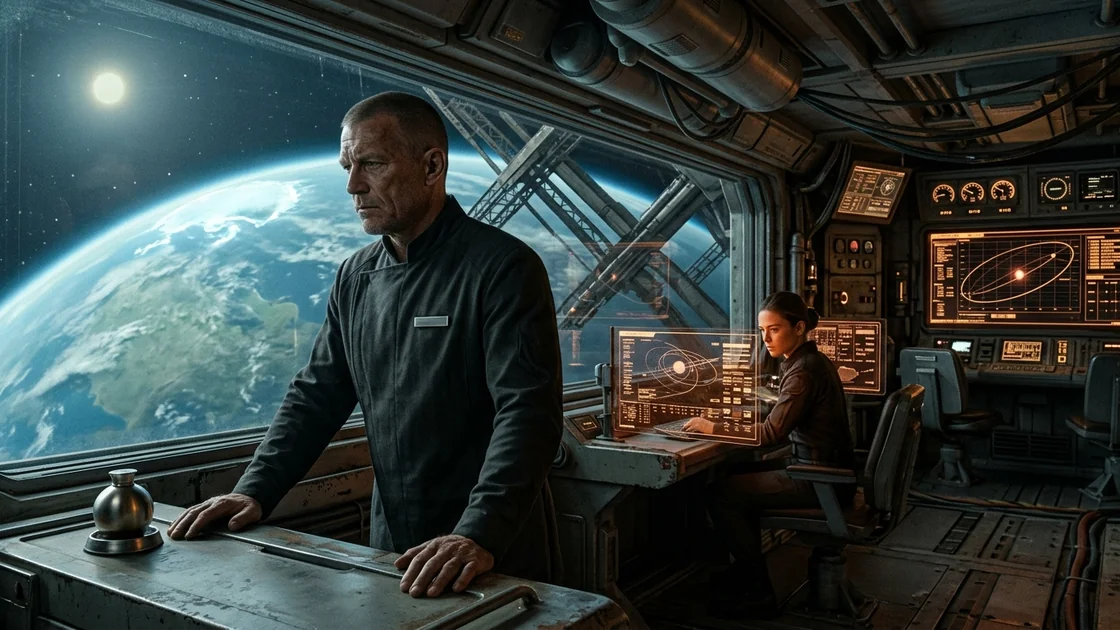
This story follows Commander Aris Thorne, a veteran quarantine officer aboard an orbital defense platform, who makes the harrowing decision to destroy an incoming civilian refugee vessel after automated bio-surveillance systems indicate it is carrying an apocalyptic, extinction-level pathogen. In the quiet aftermath of the strike, Thorne spearheads the forensic recovery only to uncover a catastrophic sensor malfunction caused by micro-debris and scorched coolant lines, leaving him to confront the unvarnished reality of his mistake, the cold indifference of the bureaucratic regime that demands a cover-up, and the irreversible weight of four hundred innocent lives extinguished by an algorithm.
Chapter I: The Glass Perimeter
The orbital ring above Pelagia Prime was not built for mercy; it was built for geometry. To the technicians and gunnery crews who lived within its pressurized ribs, mercy was a luxury of the atmosphere, something that belonged down on the blue-green plains where cattle grazed and children ran through wheat fields shielded from the vacuum. Up here, ninety thousand kilometers above the sea trenches, survival was a matter of vectors, atmospheric drag coefficients, and the ruthless arithmetic of clearance zones.
Commander Aris Thorne stood at the forward observation platform of Quarantine Station Epsilon-Three, his boots magnetized lightly against the deck plating. The vibration of the atmospheric scrubbers ran up through his calves, a steady, low-frequency hum that had replaced the sound of wind in his memory ten years ago. Beyond the reinforced quartz viewport, Pelagia Prime turned with glacial indifference, its northern icecap glowing like an uncut pearl under the pale sun.
"Flight path confirmed on the tender from the outer buoys, Commander," Lieutenant Callow said without looking up from her terminal. Her face was washed in the monochrome amber of the tactical display. "Logistics says they’re sixty tons light on nitrogen fertilizer. The agricultural council on the ground is already filing an appeal."
"Let them file," Thorne replied, his voice dry and low. "Tell them nitrogen doesn't enter the biosphere until the spectrometry signatures match the manifest down to the fourth decimal. If they want to bypass clearance, they can explain to the governor why the southern continent spent three years starving after the Mold Bloom of '41."
"Understood, sir."
Thorne picked up his bulb of chicory tea, lukewarm and tasting of re-refined copper, and took a small sip. He was fifty-two years old, with skin the color of dry riverbeds and hair cropped so close that the gray streaks looked like salt sprinkled over iron. His hands were broad, calloused from his early days in the mechanical docks before he had taken the commission in the Quarantine Service. On his left breast hung the silver bar of the Directorate, unpolished and dull against his charcoal tunic.
To the Directorate, Thorne was an ideal officer: methodical, unimaginative in his adherence to doctrine, and utterly devoid of the romanticism that made younger officers hesitate when an uncertified freighter blew past a checkpoint. Pelagia Prime was an oasis world, an improbable ecological miracle tucked into the arm of a harsh, radiation-blasted sector. But its ecosystem was fragile—a delicate, laboratory-bred equilibrium that could be overturned by a single spore of foreign rot, a rogue bacterium from the deep-range mining belts, or the dreaded hyper-mutagenic strains of the Gorgon Phage that had laid waste to the outer colonies of the Khepri system two decades before.
Because of that fragility, Thorne possessed absolute authority. Under Directorate Code Eighty-Eight, an orbital quarantine officer did not require confirmation from the Colonial Assembly or the Admiralty to neutralize a bio-hazard vector. A single stroke on his command key could release the kinetic kill-drones or direct the station’s spinal coilguns to sweep an infected hull into incandescent scrap before it could brush the upper stratosphere. It was an awesome, hideous power, one that had made Thorne a ghost at his own mess table. The younger officers respected him, feared him, and avoided him. He did not mind. Loneliness was an operational parameter.
"Commander."
Callow's voice had lost its routine cadence. It was tighter, clipped at the edges.
Thorne turned from the quartz window. "Report."
"Primary radar picked up an unregistered transponder crossing the Outer Mandate line. Vector is steep, parabolic. They aren't decelerating along the commercial transit corridors."
Thorne set his tea bulb into the magnetic well on the central console. He leaned over Callow’s shoulder, his eyes instantly tracking the green thread slicing through the orbital grid. The trajectory was ugly—uncoordinated, erratic, the sign of a ship whose reaction thrusters were bleeding propellant or whose pilot was flying blind.
"Identification?" Thorne asked.
"Transponder reads Calypso," Callow said, her fingers dancing across the haptic interface. "Registered out of Tartarus Deep-Core Basin. Sub-class four bulk transport, refitted for personnel evacuation. Civilian."
"Tartarus," Thorne murmured. A bitter taste rose in the back of his mouth. Tartarus was a slag-world, a broken rock three jumps coreward where five hundred thousand miners had been left behind when the megacorporations pulled their assets out during the first Phage scare. For six months, rumors had trickled through the deep-comm relays of famine, civil collapse, and an outbreak of an unclassified hemorrhagic variant that dissolved pulmonary tissue within thirty-six hours of inhalation. "Do they have an entry visa?"
"No, sir. No entry visa, no transit permit, no pre-clearance clearance codes. They’re running on auxiliary power. Communications are flooded with automated emergency beacons."
"Bring up their hail," Thorne ordered.
Callow tapped the comm panel. The station’s speakers hissed with static, layered with the howling interference of the outer radiation belt. Through the noise came a woman’s voice, raspy, breathless, frayed at the seams by terror and exhaustion.
"...mayday, mayday... station control, this is the transport Calypso, registry seven-dash-niner-echo. Our primary drive core scrammed three AU out. We have catastrophic environmental failure in modules two and four. Life support is at twelve percent. We have four hundred and twelve civilians aboard, including ninety children from the Tartarus nursery sectors. We cannot reverse burn. I repeat, we cannot reverse burn. Our primary retro-thrusters are offline. We are falling into your gravity well. Requesting emergency intercept and remote docking clearance. Please, by God, respond..."
The transmission looped, the synthetic crackle of the automated transponder cutting back in with its mechanical, rhythmic thrum.
"Four hundred and twelve," Callow whispered, her eyes wide as she looked up at Thorne. "Sir, if their retros are gone, they’ll hit the thermosphere in forty-two minutes. At their current angle of entry, they won't skip off. They’ll tumble, burn, and scatter whatever is left across three thousand kilometers of the northern agrarian belt."
"Bring the Argos Array to bear," Thorne said calmly, his hands resting on the edge of the console, his posture perfectly still. "Sweep the hull. I want full spectrometry, thermal imaging, and active biological resonance scans before they cross the perimeter of the inner ring. Move."
"Targeting Argos-Four," Callow said, her hands moving with frantic precision.
On the main holotank in the center of the command bridge, the Calypso took form. It was a miserable, rusted slab of iron, its plating scorched by long exposure to cosmic rays and pitted with micro-meteorite impacts. Great blooms of coolant crystallization clung to its midsection like white tumors. Even to an untrained eye, the ship was a floating coffin, held together by industrial patch-welds and desperate prayers.
A moment later, the automated systems of the Argos Deep-Scan Sub-Array woke up. A lattice of invisible ultraviolet pulses and deep-penetrating terahertz waves washed over the tumbling hulk, dissecting the atmosphere within its leaking hull, peeling back the layers of steel and ceramic insulation to count the heartbeats, the lung capacities, and the chemical signatures of the air its passengers breathed.
Thorne watched the data stream. For a few seconds, the readout was typical for an old freighter in distress: elevated carbon dioxide levels, high concentrations of vaporized hydraulic fluid, the ragged thermal blooms of four hundred bodies packed into cargo bays designed for dry ore.
Then the alarm sounded.
It was not the urgent, staccato klaxon of a collision warning. It was the low, curdling, continuous tone of a Bio-Containment Level Five alert. The bridge screens flickered, their interfaces instantly locking into high-priority emergency protocols. The ambient lights in the ceiling shifted from neutral white to a stark, bruised crimson.
In the center of the holotank, the Calypso was suddenly bathed in a pulsing, angry red shroud.
"Pathogen alert," the computer’s synthetic voice announced, flat and unhurried. "Grade-V aerosolized agent detected in main cargo hold, life support circulation loops, and bridge module. Genetic markers consistent with Searing Rot variant Delta-Nine. Virulence index: ninety-nine point eight percent. Containment status: uncontained. Projected lethality upon planetary breach: absolute."
Callow froze. The breath went out of her in a sharp, wet gasp. "Delta-Nine... sir, that’s... that’s the Tartarus black lung. The flesh-eating strain. It wiped out the colony at New Thebes in forty-eight hours."
Thorne did not move. His eyes remained fixed on the readout. The spectrometry graphs were spiking with impossible ferocity. The chemical signature for the Phage’s distinct peptidoglycan sheath was glowing on the sub-screen, bright and unmistakable, an exact match for the lethal profile stored within the Directorate’s central pathogen bank.
"Check the sensor calibration," Thorne commanded, his voice cold, though a cold weight had dropped into the pit of his stomach.
"Argos-Four is running on primary diagnostic loops," Callow stammered, her fingers shaking as she pulled up the health tables for the sensor array. "Self-test returns green. Calibration index zero-point-zero-two variance. Sir... it’s not an error. The air in that cargo bay is saturated with it. They aren't just refugees. They're a flying incubator."
The comm channel crackled open again, this time with a live voice breaking through the automated loop. The woman pilot was weeping now.
"Quarantine station! We see your scan targeting us! Please, our guidance systems are dying. We have families in here who haven't had clean water in five days. Our environmental seals are failing between decks. We can see the planet below us. Please deploy the tugs! If you don't tether us, we’re going to burn!"
In the background of the transmission, Thorne could hear the distinct sound of human misery: the thin, shrill crying of infants, the dull clang of metal being hammered on, a man shouting incoherently about an air leak. It sounded so close, so immediate, as if they were standing in the very corridor outside the bridge.
"Commander," Callow whispered, her hands hovering above the weapons board. "They’re entering the thirty-minute window. Once they cross the forty-kilometer mark, their hull will begin to ablate. If the ship breaks up in the high atmosphere, the spores will be carried on the jet streams. The thermal flash of atmospheric friction won't kill a Grade-V spore; the core remains insulated until impact. The whole planet... Thorne, the whole planet will catch it."
Thorne looked at the chronometer. Twenty-nine minutes and fourteen seconds.
"Hail them," Thorne said.
The channel opened. "This is Commander Aris Thorne, Quarantine Enforcement Station Epsilon-Three. Transport Calypso, you are in violation of Directorate Sanitation Code Eighty-Eight. Our sensors have confirmed the presence of an active, uncontained Grade-V bio-weapon grade pathogen within your habitat envelope."
There was a silence on the other end, long and stunned, filled only with the rushing sound of failing fans.
"Pathogen?" the woman’s voice returned, suddenly cracking with outrage and sheer, unadulterated incomprehension. "What are you talking about? We’re miners! We’re families! We don't have weapons! We cleared the quarantine station at Tartarus before the docks fell! We were tested! We were all cleared!"
"Your tests were either inadequate or compromised," Thorne said steadily, his knuckles white where they gripped the metal console. "The signature is Delta-Nine. It is currently circulating through your environmental systems. You cannot enter this atmosphere."
"Then send hazmat shuttles! Send containment pods! You have orbital medical facilities!"
"Pelagia Prime does not possess a Level-Five isolation facility capable of processing four hundred people," Thorne said. His voice was steady, mechanical, the voice of the manual itself. "If we dock you with the ring, the ring is compromised. If the ring is compromised, the colony dies. You must reverse your burn. Fire your remaining attitude thrusters. Push your apogee out into the dead zone. We will send unmanned drones with supplies to your orbit."
"We can't!" she screamed. Thorne could hear the structural alarms ringing on her bridge, a harsh two-tone klaxon that mirrored his own. "I told you, our fuel lines are dry! The retros are dead! We don't have the delta-v to push out! If you don't catch us, we hit the ground! Please! We have children here! My daughter is six years old! She isn't sick! None of us are sick!"
Callow looked up at Thorne. Tears were running down her face, cutting tracks through the amber glow of the console. "Commander... they’re crossing the point of no return. In four minutes, the gravity well will have them. The station's coilgun batteries have target lock."
Thorne closed his eyes for a fraction of a second. In that brief dark, he saw Pelagia Prime: the sprawling glass domes of the capital, the miles of fragile, genetically reconstructed sea-kelp that produced forty percent of the colony's breathable oxygen, the millions of men, women, and children who walked the streets without respirators because the Quarantine Service stood between them and the charnel house of the stars.
The manual was clear. It did not provide for an exception for children. It did not provide for an exception for broken engines. It was written in the wake of the Khepri disaster, where a single transport captain’s hesitation had cost eight million lives in three weeks of black, bloody coughing.
Code Eighty-Eight, Section Four: Any vessel presenting an active Grade-V vector that is incapable of maintaining orbit outside the biological threshold shall be neutralized immediately via kinetic or thermobaric intervention to preserve the planetary reserve.
"Commander," Callow sobbed. "Please."
Thorne opened his eyes. The world was gray and red.
"Callow," he said softly. "Transfer fire control to my station."
"Sir—"
"Transfer it."
Her trembling fingers pressed three keys. A low chime sounded, and the red firing sequence illuminated on Thorne's personal terminal. A small, square cover popped open over the primary trigger—a physical toggle, brass and cold steel, linked directly to the magnetic accelerators of Station Epsilon-Three's third spinal battery.
The Calypso was thirty kilometers from the outer atmosphere. The holotank showed the first wisps of ionized gas beginning to form around its blunted nose.
"Pilot Lin," Thorne spoke into the comm, his voice dropping into a quiet, funeral cadence. "May God grant you the peace that this station cannot."
"No! Wait! Look at the screens! We aren't—"
Thorne flipped the brass toggle and slammed his hand down onto the contact pad.
The station did not shake—its recoil-dampening gyroscopes were too well-machined for that—but Thorne felt the deep, bone-rattling pulse of magnetic induction surge through the deck plates. Outside the quartz window, two thousand kilograms of tungsten-carbide slug left the railgun at forty kilometers per second, trailing a brilliant streak of blue Cherenkov radiation through the thin upper traces of the thermosphere.
A fraction of a second later, the Calypso ceased to be a ship.
There was no sound in the vacuum, only an eye-searing bloom of orange light that instantly blossomed into white. The tungsten slug struck the transport’s unarmored reactor casing, and the resulting detonation was so intense that the station’s viewports automatically polarized to save the crew's vision. The holotank flared with static. The red light representing the ship splintered into thousands of tiny, drifting pinpricks of light—metal, carbon, and human remains—that scattered across the darkness before dipping down into the atmosphere.
As the debris hit the thicker air, it began to burn.
A shower of brilliant, golden meteors streaked across the dark belly of Pelagia Prime, burning brightly for five, ten, fifteen seconds, before fading into smoke and ash against the sea below.
Callow sat frozen, her face buried in her hands, her shoulders shaking with silent, violent heaves.
Thorne did not look down at her. He kept his eyes fixed on the empty space beyond the quartz glass, where nothing remained except the slow, tranquil curve of the world they were sworn to protect.
"Log the event," Thorne said, his voice flat, devoid of timbre. "Vessel Calypso, Tartarus registry. Destroyed under Quarantine Protocol Eighty-Eight following confirmation of uncontained Level-Five pathogen. Kinetic intervention successful. Debris scattered over Sector Seven maritime waste. Threat neutralized."
He reached out, his hand perfectly steady, and closed the brass cover over the firing switch.
"Callow. Take your relief. I’ll stand the remainder of the watch."
She did not look at him. She rose from her seat, her breath hitching in her chest, and walked off the bridge with her head down, her boots dragging across the steel decking.
Thorne remained standing alone in the red glow of the station, watching the last faint embers of the four hundred and twelve souls settle into the cold, uncaring ocean sixty miles below.
Chapter II: The Scraping of the Hull
The administrative inquiry began before the debris had even cooled in the sea trenches.
In the Directorate, efficiency was the highest virtue. By 0600 station time, three forensic skimmers and a recovery corvette had been dispatched from the lower docks to sweep the impact trajectory. The protocols demanded a full biological confirmation: samples of the debris were to be retrieved from the upper stratosphere and the water's surface, treated with chemical suppressants, and sealed in lead-lined canisters to verify the total destruction of the spore load.
Thorne did not sleep. He spent the four hours following his watch in his quarters, sitting on the edge of his bunk with his boots on, staring at his palms. The room was narrow, four meters by three, smelling of stale laundry and the ozonic tang of the air vents. On his desk sat a framed photograph of his late wife, Mara, who had died thirty years ago in the dry colony lands of the interior, long before he had pinned the silver bar of the Directorate to his coat. She had died of something ordinary—a heart that simply gave out during the second spring planting. Sometimes, in the quiet between station cycles, Thorne envied her that ordinariness. She had died of nature, not of policy.
At 0730, the comm chime on his wall chirped with the flat, prioritized tone of the forensic division.
"Commander Thorne. Report to Bio-Containment Lab Two."
It was Dr. Elena Rostova's voice. Rostova was the station's chief scientific officer, a woman who had spent forty years cataloging the microscopic horrors of the sector. If Thorne was the iron fist of the Directorate on Epsilon-Three, Rostova was its cold, calculating eye. She was not a woman given to emotional display; during the Green Tallow outbreak of '38, she had autopsied sixty infected corpses a day for three weeks without ever missing her lunch hour.
When Thorne entered Lab Two, the air was cold enough that his breath misted in front of his lips. The laboratory sat deep in the station’s hub, surrounded by three layers of negative-pressure bulkheads and bathed in the sterile, violet hue of continuous decontamination lamps.
Rostova was standing over a pressurized glove box, her face hidden behind the reflective visor of a Level-Four bio-isolation suit. The mechanical arms inside the box were manipulating a jagged shard of blackened metal—a piece of the Calypso’s forward hull, recovered by an atmospheric drone at an altitude of forty kilometers.
"Doctor," Thorne said, standing behind the secondary isolation barrier.
Rostova did not look up immediately. Her robotic manipulators twisted the fragment, bringing a high-magnification lens down to within millimeters of its scorched surface. On the banks of monitors above her head, the crystalline structure of the metal was displayed in shades of gray and neon blue.
"The recovery boats have picked up approximately three tons of wreckage from the northern ocean," she said, her voice muffled through the suit’s internal speaker. "Mostly structural titanium, pieces of the cargo deck, and fragments of the life support filtration matrix. The impact was clean, Aris. You hit the reactor core directly. The heat of the blast exceeded three thousand degrees Celsius at the point of ignition."
"Then the pathogen was incinerated," Thorne said.
"That was the intent," Rostova said. She set the manipulator down with a sharp click. She turned her head toward him, the visor reflecting his own pale, haggard face back at him. "We brought the scrap through the primary decontamination locks an hour ago. We ran thirty-six separate PCR sweeps, fluorescent antibody assays, and protein-resonance tests on the hull fragments, the air filters, and the organic residue recovered from the upper-atmosphere scrubbers."
Thorne felt a strange, cold prickle run down the nape of his neck. "And?"
"Nothing," Rostova said.
Thorne was silent for a moment. "The thermal flash could have denatured the proteins. If the temperature reached three thousand degrees—"
"A Grade-V Searing Rot spore does not simply denature into nothing, Aris," Rostova interrupted, her voice dropping into a register that was dangerously level. "You know the biology as well as I do. The spore coats are bound with heavy metal complexes designed to withstand the hard vacuum of interstellar space. Even in an atomic detonation, we find the ash-ghosts—the mineralized shells of the peptidoglycan rings. They don't disappear. They leave a chemical footprint that lasts for centuries."
She reached out and tapped the monitor. The screen shifted to show a clean, flat baseline graph. A thin, horizontal green line stretched from left to right without a single variation, without a single spike.
"We found no spore coats," she said. "We found no denatured peptide chains. We found no viral RNA. We found no genetic material belonging to Delta-Nine or any other known variant of the Gorgon Phage."
Thorne stepped closer to the glass. His heart was beating with a slow, heavy thud against his ribs, each stroke feeling like a hammer striking lead. "The Argos-Four array returned a ninety-nine point eight percent match. It flagged the main cargo bay, the air loops, the bridge. The alert wasn't a warning; it was a confirmed positive."
"I have the Argos data logs right here," Rostova said. She gestured to a secondary terminal. "I’ve been comparing the telemetry your station recorded during their approach with the physical scrap we pulled from the sea."
"What did the array see, Elena?"
Rostova looked down at the scrap of iron in the box. "It saw what it was programmed to see, Commander."
She brought up an engineering schematic of the Calypso’s life support and cargo compartments.
"The Calypso was twenty-five years past its operational lifecycle," Rostova explained, her tone clinical, merciless. "Its central air chillers were leaking. Not freon—they were using an old, cheap industrial coolant called Glycol-Octene-Four, mixed with an unrefined synthetic tallow to lubricate the primary compressor seals. It’s an old trick miners use when they can't afford proper Directorate-certified lubricants."
Thorne did not speak. He felt the air leaving his lungs.
"Three days before they reached our sector," Rostova continued, "their main compressor blew a seal. The synthetic tallow and the Glycol-Octene vaporized into the ventilation system. It didn't kill them, but it was toxic enough to cause severe mucosal irritation—coughing, hemoptysis, blood in the sputum. That explains why the pilot said they were coughing. But chemically? When Glycol-Octene-Four is exposed to low-pressure ultraviolet radiation—the exact type of radiation used by the Argos-Four active scanning array—its molecular chain shears."
She brought up two chemical diagrams side by side on the overhead screen.
On the left was the molecular structure of the sheared coolant compound: a six-carbon ring flanked by sulfur atoms and methyl groups.
On the right was the molecular structure of the Searing Rot protein coat.
They were nearly identical.
"A mirror image," Rostova whispered. "In the terahertz band, the spectral resonance of the sheared coolant matches the outer shell of Delta-Nine to within three-tenths of a percent. To an automated sensor running a high-speed heuristic sweep on a tumbling ship through the magnetospheric wash of the outer belts... it looks like a Grade-V bloom."
Thorne’s hands were on the glass now. His fingers were splayed against the cold surface, leaving small, circular smudges of grease and moisture.
"There was no pathogen," he said. It was not a question. It was a statement that seemed to drop into an infinite abyss.
"There were four hundred and twelve people aboard," Rostova said, her voice finally cracking, shedding its clinical veneer to reveal the raw, bleeding horror underneath. "Ninety of them were under the age of ten. They were suffocating on coolant fumes and old grease, Aris. They were coming to us because their engines were dead and they thought the Quarantine Service had doctors. They thought we had medicine."
Thorne stood there. The station hummed around him. Somewhere in the lower bulkheads, a drainage valve opened, venting water into the recycling tanks with a distant, hollow gurgle.
"The array was certified," Thorne said, his voice barely a breath. "The calibration loops were green. Callow checked them."
"The calibration was green for standard operations," Rostova said, turning her visor fully toward him. "Did you check the sensor array’s physical housing, Aris? Did anyone inspect the lenses on Argos-Four after the solar storm last Tuesday?"
Thorne could not answer.
"We pulled the telemetry from the array’s local bus twenty minutes ago," Rostova said, her fingers trembling as she tapped the interface. "The protective optical aperture on Argos-Four was pitted by micro-meteorites four days ago. There was a micro-fracture across the primary quartz collector. Just enough to cause an internal optical refraction. Just enough to shift the incoming terahertz wavelength by zero-point-zero-four microns."
She turned off the screen. The laboratory returned to its sterile, violet gloom.
"The sensor was blind in one eye, Aris. It was blind, and it was looking through a cracked lens, and it handed you a death warrant. And you signed it."
Thorne did not move. He felt no rage, no terror, only a vast, gray emptiness that seemed to spread from the center of his chest out to the tips of his fingers and the soles of his boots. He looked through the quartz glass at the jagged piece of scrap metal sitting in the glove box.
It was just iron. Cold, burned iron from a mine on Tartarus, where four hundred people had decided to pool their life savings to buy a ticket to a world where their children could see a blue sky.
"Does the Assembly know?" Thorne asked.
"The Governor’s office has already received the preliminary notification of the kill," Rostova said. "They’re preparing a commendation for you, Commander. The news feeds on the surface are already broadcasting it. 'Quarantine Directorate Prevents Catastrophic Plague Breach. Hero of the Orbital Ring.' They’re calling it the greatest save since the '41 Bloom."
She let out a dry, bitter laugh that sounded like dry leaves being crushed underfoot.
"If I file this report, Aris, the Directorate will bury it. They have to. If the public finds out that the orbital bio-shield is shooting down civilian transports because of a cracked lens and a coolant leak, the entire Quarantine system will collapse. The colonies will refuse to submit to the Mandate. There will be riots in every dome from here to the rim."
"I am the commander of this station," Thorne said.
"Then you have a choice," Rostova said, stepping back from the isolation box and folding her arms. "You can let the report pass through the standard automated redaction filters. The Directorate will confirm the kill, the medals will be pinned to your tunic, and those four hundred people will remain monsters—nameless, faceless carriers of a plague that never existed. Or you can tell the truth."
"The truth," Thorne repeated, the word tasting of lead and ashes.
"The truth will destroy you, Aris," Rostova said softly. "They won't hang the Directorate. They won't hang the engineers who designed the Argos array. They will hang you. They will say you were negligent. They will say you panicked. They will make you the sole architect of four hundred murders to save the legitimacy of the system."
Thorne looked at his hand—the hand that had lifted the brass cover, the hand that had pressed the contact pad. It did not shake. It was the same hand that had served the Directorate for thirty years, faithful, obedient, precise.
"I need the complete diagnostic data," Thorne said. "Every spectrum sweep, every optical log, every maintenance report for the Argos-Four sub-array for the past six months. Transfer them to my private console."
Rostova studied him for a long moment through the tinted plastic of her helmet. Then, slowly, she nodded.
"The files are transferred, Aris."
"Thank you, Doctor."
Thorne turned and walked out of the laboratory, the negative-pressure seals hissing shut behind him with the sound of a falling guillotine.
Chapter III: The Logic of the Wall
The command deck was quiet when Thorne returned at 1100 hours. The crimson emergency lights had been extinguished, replaced once more by the cool, administrative white that made the steel consoles look like dental equipment.
Lieutenant Callow was not there. In her place sat Ensign Miller, a boy with cheeks that looked as though they had only begun to know a razor, his uniform crisp and uncreased. He stood up straight as Thorne stepped onto the command dais.
"Commander on deck," Miller announced, his voice carrying the brittle enthusiasm of someone who had graduated from the academy at the top of his class and had never seen a ship break apart under kinetic fire.
"At ease, Ensign," Thorne said, settling into his high-backed leather chair. The cushions were worn, molded to the shape of his spine by thousands of hours of quiet vigilance. "Status of the perimeter?"
"Perimeter is green, sir," Miller reported, smiling faintly. "The debris field from the... from the target has cleared the primary approach vectors. Orbital traffic has resumed along the commercial lanes. Sector Control sends their compliments, Commander. The entire platform is talking about it. A Level-Five intercept. It’s textbook."
"Textbook," Thorne said.
He did not look at the main holotank. He opened his personal slate, entering his command clearance codes. The security algorithms flashed their authorization, and Rostova’s files unfolded across the small, polarized screen: the micro-fracture analysis, the molecular resonance comparisons, the maintenance logs showing that the Argos-Four unit had been scheduled for an aperture replacement three weeks ago—a replacement that had been postponed by the Procurement Directorate to save sixteen thousand credits in orbital tug fees.
Sixteen thousand credits. The cost of a decent groundcar in the capital.
Thorne pulled up the audio log from the Calypso’s final minutes. He plugged his personal earpiece into the slate, shutting out the hum of the bridge, shutting out Miller’s cheerful typing at the secondary station.
He scrubbed through the static until he found the pilot’s voice again.
Sarah Lin.
He had pulled her personnel file from the Tartarus registry. She was thirty-four years old. She had been an atmospheric shuttle pilot for the mining syndicate until the mines closed down. Her husband had died three years prior of silicate poisoning in the deep shafts. She had a daughter, Maya, age seven, whose school enrollment forms were still attached to the transit manifest, packed into the ship’s data core alongside the agricultural visa requests.
Thorne pressed play.
"...my daughter is six years old! She isn't sick! None of us are sick!"
The voice was not just frightened; it was confused. That was the thing Thorne had missed during the operational rush, during the cold adherence to Protocol Eighty-Eight. Sarah Lin had not sounded like a desperate smuggler trying to run a bio-cordon. She had sounded like a person standing at a ticket counter being told her passport was printed in a language that didn't exist.
Look at the screens! We aren't—
The transmission ended with the white-noise burst of the coilgun impact.
Thorne closed his eyes.
"Commander?"
Thorne opened them. Ensign Miller was standing beside his chair, holding a dispatch slate.
"Priority communique from the Colonial Administrative Center, sir. Director General Vance is on the line from the surface. He’s requesting your presence via secure comm."
Thorne took the slate. "Patch it through to my private terminal in the ready room."
The ready room was a windowless box behind the bridge, furnished with a single bolted table and two aluminum chairs. Thorne sat down, setting the slate on the table. The screen flickered, and the face of Director General Marcus Vance appeared.
Vance was a man of sixty, with silver hair meticulously styled, wearing the high-collared civilian doublet of the colonial executive committee. He looked rested, though his eyes carried the shrewd, calculating focus of a man who spent his life managing public panic and budget deficits.
"Aris," Vance said, his tone warm, almost familial. "I’ve just finished reading the preliminary operational summary. Magnificent work. Absolutely magnificent."
"Director," Thorne said neutrally.
"I’ll be blunt with you, Aris," Vance said, leaning forward into the camera. "We were in a precarious position down here. The election is three months away, and the opposition has been hammering us on orbital security, claiming the Quarantine Directorate was bloated, under-equipped, and incapable of protecting the colony from outer-system contamination. And then you hand us this."
He tapped a manicured finger against his desk.
"A textbook Level-Five interdiction. Decisive action. Zero hesitation. You saved this colony from an absolute catastrophe, Thorne. The modeling from the Department of Health says that if Delta-Nine had hit the grain belt, we would have lost forty percent of the harvest and over two million people before the winter was out."
"The modeling was based on the Argos scan, Director," Thorne said.
"Of course it was," Vance said, chuckling softly. "The best technology the Directorate has to offer. The Assembly is preparing a full citation. We’re naming the new agricultural research station after you, Aris. The Thorne Institute. It has a good ring to it. A man who watched the wall and didn't flinch."
Thorne rested his forearms on the table. He felt very old, his bones feeling as though they were made of dry chalk.
"Marcus," Thorne said, dropping the official title. "The Calypso wasn't infected."
The room became very quiet. The only sound was the faint, high-pitched whistle of the terminal’s cooling fan.
Vance’s expression did not change. His smile remained fixed for a second too long, then slowly softened into an expression of patient, paternal concern.
"Aris," Vance said gently. "You’ve been on watch for fourteen hours. You’ve just experienced a traumatic command event. It’s entirely natural for an officer to feel... moral dissonance after a kinetic order. The psychology division calls it interdiction shock."
"It isn't shock," Thorne said. He tapped three commands into his slate, transmitting Rostova’s forensic file directly to Vance’s terminal. "Dr. Rostova has completed the physical analysis of the wreckage. We recovered the air filtration cores and three tons of structural plate from the impact site. There is no Delta-Nine. There was no Searing Rot. The ship was clean."
Vance did not look down at his screen. His eyes remained locked on Thorne’s face.
"The sensor had a micro-fracture in the primary optical collector," Thorne continued, his voice steady, monotonous, dead. "A pitted lens from Tuesday's meteor shower. The heuristic algorithm encountered a vaporized coolant leak—Glycol-Octene-Four—and the refraction shifted the spectral signature by zero-point-zero-four microns. The array made a mistake, Marcus. The machine lied to us. There were four hundred and twelve refugees on that ship, and they were healthy. They were dying of suffocation because their compressor blew, and I put a two-ton tungsten slug through their bellies."
Vance sat in silence for several seconds. When he finally spoke, his voice was neither angry nor surprised. It was merely cool, reasonable, and utterly devoid of warmth.
"Did Rostova sign off on this?"
"She conducted the analysis herself," Thorne said. "Her name is on the raw data."
Vance let out a long, quiet sigh. He looked down at his desk, tapped a few keys, and then looked back at the screen.
"Aris, do you know what happens if this report becomes public?"
"I know what happened to the four hundred people on that ship," Thorne replied.
"Four hundred people from Tartarus," Vance said, his voice dropping into a hard, rhythmic cadence. "Miners. Contract laborers whose visas were expired before they even boarded that tub. People who had no legal right to enter this system, who were running from a collapsed colony that we have already written off as an economic loss."
"They were human beings, Marcus," Thorne said. "And they were not sick."
"They were human beings who were doomed the moment their engines failed," Vance snapped, his composure slipping for the first time. "If you hadn't shot them down, what then? They would have crashed into the northern plains! They would have plowed a crater two miles wide into the grain belt, their reactor would have breached, and they would have burned anyway! And in the process, the public would have seen a ship fall through the orbital shield uncontested!"
"We could have deployed the salvage tugs," Thorne said. "We could have matched their velocity, vented their compartments with remote drones, brought them aboard the secondary quarantine stations—"
"With what budget?" Vance leaned in, his face filling the frame, his eyes wide and hard. "With what personnel? We are running this entire orbital grid on three-quarter allocations, Aris! You know that! You’ve been complaining about maintenance backlogs for five years! If we tell the public that our automated sensors—the sensors that cost forty billion credits, the sensors that we promised would protect them from the death that took Khepri—if we tell them those sensors can't tell the difference between a plague and an oil leak, the government falls!"
"Then let it fall," Thorne whispered.
Vance leaned back. He looked at Thorne with something approaching pity.
"You're a good soldier, Aris. You always have been. You’ve given your life to that station. You’ve lived in that tin can while the rest of us lived in the sun. But you don't understand the architecture of order."
Vance touched his slate.
"The Directorate cannot be fallible," Vance said. "If the people believe that the shield is porous, they panic. If they believe the shield is arbitrary, they revolt. The Quarantine Service exists not just to stop viruses, Aris. It exists to provide certainty. The certainty that beyond that blue sky, the universe is cold and hostile, but down here, they are safe because men like you are watching the gate."
"I am not a watchman," Thorne said. "I am an executioner who killed four hundred people for a bad sensor."
"You are an officer who followed Protocol Eighty-Eight to the letter," Vance corrected him, his voice icy. "You had a confirmed positive from an authorized detection array. You acted within the mandate. You eliminated a potential vector. That is the official truth, Commander. That is the only truth that will ever leave this office."
"I will not sign the finalized report," Thorne said.
"You don't have to," Vance replied smoothly. "The operational log was countersigned by Ensign Miller ten minutes ago under the executive continuity clause. Your signature is already on the initial fire-authorization log. That’s all the Assembly needs."
Thorne felt a cold sickness rise in his chest. "You planned this before you even called me."
"I hoped you would see the larger picture, Aris," Vance said, his tone softening once more into that horrific, grandfatherly gentleness. "I really did. You’re tired. You’ve been through a horrific ordeal. I’m ordering you to step down from command of Epsilon-Three immediately. You will take thirty days of administrative leave on the surface. We have a villa for you in the southern lakes. Quiet. Trees. Clean water. You can rest."
"And Rostova?" Thorne asked.
"Dr. Rostova is a scientist," Vance said. "She understands the concept of institutional necessity. Her laboratory will be reassigned to the central pathogen archives on Pelagia Major. Her findings will be archived under Directorate Security Class One. In fifty years, when this sector is fully stabilized, perhaps some historian will find them and write a footnote in a monograph that three people will read. But today? Today, Aris, you are the hero of Pelagia Prime. And you will play the part."
The screen went black.
Thorne sat in the silence of the ready room. He looked at the slate on the table. The green baseline graph was still there—the flat line that proved there had been no monsters on the Calypso, no bio-weapons, no dying breath of an infected world.
Only four hundred people falling through the dark, waiting for a hand that had reached out only to crush them.
Chapter IV: The Ghost in the Array
Thorne did not go to his quarters. He did not pack his sea-bag. He walked out of the ready room, through the quiet corridors of the hub, and stepped into the service gantry that led to the sensor spine of the station.
The gantry was unpressurized, cold, and narrow. Thorne wore a standard utility pressure suit, the heavy rubberized fabric stiff around his joints, the helmet’s display showing a countdown of his oxygen reserves: two hours, fourteen minutes.
He climbed the magnetic rungs through the central pylon, leaving the station’s rotational gravity behind. With every meter he ascended, the station’s hum grew fainter, replaced by the deep, hollow resonance of metal exposed to the void. Pelagia Prime rolled below him, vast and blue, its continents traced in emerald and gold, its oceans gleaming like polished obsidian.
At the very tip of the pylon, five hundred meters above the command deck, sat the Argos-Four sensor housing.
It was an ungainly cluster of parabolic dishes, cryo-cooled spectrometer pods, and optical lenses mounted on a motorized gimbal. To the rest of the system, it was a miracle of modern engineering, a sentinel that could pick out the genetic markers of a bacterium across fifty thousand miles of vacuum.
Thorne pulled himself along the guide rail until he was level with the primary optical housing. He reached into his utility belt, clicked on his inspection lantern, and shone the beam onto the circular quartz aperture.
There it was.
It was barely three centimeters long, no thicker than a human hair—a spider-web fracture across the anti-reflective coating of the lens, glowing like a silver thread in the lantern’s glare. A tiny flake of space-borne dust, traveling at twenty kilometers a second, had struck the rim of the titanium bezel and driven a wedge of stress into the glass.
Thorne touched the crack with his gloved finger.
Zero-point-zero-four microns.
That was all it had taken. A shift in the wavelength no wider than the thickness of a soap bubble. That tiny sliver of distorted light had transformed a cloud of boiling coolant and grease into the Gorgon Phage. It had transformed a crying woman and her six-year-old child into an existential threat to four million people.
He stood there in the silence, his boots locked to the gimbal frame, his body floating in the zero-gravity of the high orbit.
The comm in his helmet clicked.
"Commander Thorne?"
It was Lieutenant Callow. Her voice was small, hesitant, coming through the suit's local receiver.
"I’m here, Callow," Thorne said.
"Sir... the shuttle from the surface has just docked at Bay Four. They have an executive escort with them. Two officers from the Provost Marshal’s office. They’re... they’re saying you’ve been relieved. They’re looking for you on the bridge."
Thorne looked down at the world beneath his feet. He could see the curvature of the planet, the thin, fragile skin of its atmosphere glowing like an electric blue halo against the dead void of space. Down there, millions of people were waking up to the morning news feeds. They were drinking their coffee, they were kissing their children goodbye at the school gates, they were looking up at the sky and feeling a sense of quiet, comfortable gratitude toward the Quarantine Service.
They are safe, Vance had said. Because they believe the wall is solid.
"Callow," Thorne said, his voice calm, clear, and steady. "Do you have the auxiliary comm array patched through to the station’s planetary broadcast relay?"
There was a pause. "Sir? That channel is only for sector-wide emergency declarations. It bypasses the administrative filters. It broadcasts on all public bands, civilian and military."
"I know," Thorne said.
"Commander... the Provost Marshal’s men are armed. They’re already at the lift doors."
"Callow," Thorne said softly. "Do you remember the oath we took when we put on the Directorate bar?"
The silence on the line stretched out for five seconds, ten seconds. Through his helmet visor, Thorne watched a weather satellite drift past beneath him, its solar panels catching the morning sun like the wings of a golden dragonfly.
"To protect the colony from contamination," Callow whispered, her voice shaking. "To maintain the biological integrity of the reserve without fear, favor, or prejudice."
"We swore to protect them from the truth of what lies in the dark," Thorne said. "And we swore to protect the living from the dead. But we never swore to lie for the machines, Callow. We never swore to become ghosts ourselves."
A soft chime sounded in his helmet. The auxiliary comm link clicked open.
"The line is open, Commander," Callow said, her voice now flat, steady, stripped of fear. "The planetary relay is yours. The bridge doors are locked from the inside, but... they’ll have the torches through the seals in three minutes."
"That’s plenty of time," Thorne said.
He reached up to his chest, unclipped his personal data slate from the suit’s storage harness, and plugged its interface cable directly into the maintenance bus of the Argos-Four sensor housing.
The data began to upload: Dr. Rostova’s physical analysis, the chemical diagrams of the coolant, the high-resolution photographs of the cracked quartz lens, the audio transcripts of Sarah Lin’s final transmission, and the maintenance logs showing the sixteen-thousand-credit delay that had cost four hundred and twelve lives.
Thorne keyed the transmitter.
"Citizens of Pelagia Prime," he began. His voice did not echo in his helmet; it sounded dry, small, and distinct against the roaring silence of the stars. "This is Commander Aris Thorne, Quarantine Enforcement Station Epsilon-Three."
He paused, taking one deep, clean breath of his recycled air.
"Four hours ago, under my command, the spinal battery of this station fired upon the civilian transport Calypso. Four hundred and twelve people were killed. At the time of the order, I believed I was acting under Protocol Eighty-Eight to prevent the introduction of an uncontained Level-Five pathogen into our biosphere."
Across the planet below, the transmission would be cutting through the morning broadcasts, sliding onto the screens in private kitchens, public transit cars, administrative offices, and agricultural combines.
"I am speaking to you now to tell you that the Calypso was not infected."
He looked at the tiny, spider-web crack in the quartz glass before him.
"The ship was clean. The passengers were miners, laborers, and ninety-two children from the Tartarus basin. They were coming to us for help. They died because the machine we built to watch the dark was broken. They died because an optical lens on this station was cracked, and because the Directorate chose to delay its repair to save the price of an orbital tender."
Through his boots, he felt the heavy, rhythmic vibration of the maintenance lift ascending the pylon. The Provost Marshal’s men were coming up the spine. He could see their helmet lights beginning to flicker against the steel girders three hundred meters below.
"The Directorate will tell you that this interdiction was a success," Thorne continued, his voice dropping into that quiet, methodical cadence he had used for thirty years. "They will tell you that the wall is intact. They will tell you that the machine never fails. They are lying to you."
He looked down at his right hand—the hand that had pulled the trigger.
"The wall is made of iron, and the iron is cracked. If you build your safety on an infallible lie, then you are already dead. You have simply not begun to rot."
He reached out and tapped the final transfer key. The entire data package, unredacted and authenticated with his personal command encryption, flushed into every public node from the northern pole to the southern sea.
"My name is Aris Thorne," he said. "I am the Commander of Quarantine Station Epsilon-Three. I am the man who killed the Calypso. Do not let them tell you it was a victory."
He unclipped the comm cable from the sensor bus.
The line went silent.
The first of the Provost Marshal’s security officers pulled himself over the lip of the gantry platform twenty meters away, his rifle raised, the red targeting laser painting a small, shaking dot of light onto Thorne’s chest.
"Commander Thorne!" the officer’s voice barked over the suit-to-suit tactical channel. "Step away from the array! Drop your tools and place your hands on your helmet! You are under arrest for treason and high sabotage under Directorate authority!"
Thorne did not drop his tools. He did not raise his hands.
He turned his back on the rifle and looked back out at the planet. The sun was fully up now, its light spilling over the limb of the world, turning the clouds into fields of brilliant, blinding gold. Down there, in the cold, salt deeps of the northern sea, three tons of blackened iron were settling into the silt, covered by the quiet drift of the currents.
He thought of Maya Lin, age seven, whose name was on a school form that would never be stamped. He thought of her mother, whose last words had been a question that no machine could answer.
"Commander!" the guard shouted, his boots clattering against the rungs as he closed the distance. "Hands on your helmet! Now!"
Thorne reached up with his gloved hand. He did not put it on his helmet. He reached out and touched the cracked lens of Argos-Four one last time, feeling the tiny, sharp edge of the fracture through the rubber of his suit.
"The watch is ended," Thorne whispered into his mask.
He turned to face the rifle, his boots firmly locked to the cold steel of the station, his face illuminated by the pale, unforgiving light of the empty sky.