The Ghost of Platform Four
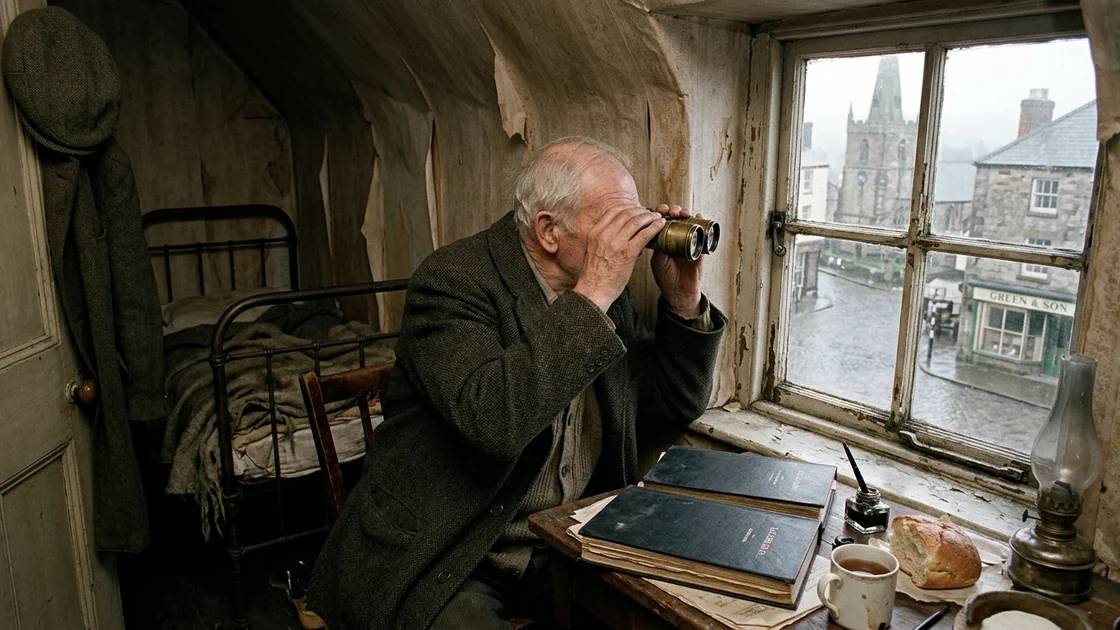
This is the account of Arthur Pendelton, who on an overcast Tuesday in October of 1968 left his young, pregnant fiancée standing beneath the iron girders of Saint Jude Station with two cardboard valises and a paper sack of butter biscuits, turning his back on fatherhood and devotion out of an unnamable, paralyzing terror. For half a century, Arthur wandered through the margins of the world, never touching another life with any permanence, before returning as an old man to the coastal market town where she had salvaged her life, married an honest tradesman, and raised the boy Arthur had abandoned. From a drafty garret above an apothecary, Arthur spent his remaining years maintaining an invisible, sorrowful vigil over the family that was never his, measuring out his repentance in cold tea, stained binoculars, and the unbearable luxury of an exile he had chosen for himself.
I. The Steam and the Salt
The memory was not a knife; it was a damp wool coat that refused to dry. For fifty-three years, Arthur could call up the precise pressure of the air inside Saint Jude Station on that Tuesday afternoon. It had tasted of sulphur, damp cinders, and the sour yeast of the bakery cart wheeled beside the newsstand. The clock suspended over Platform Four was a black-faced dial with copper roman numerals, its minute hand lunging forward every sixty seconds with a sharp, iron clatter that sounded like a cleaver hitting a butcher’s block.
Clara had been twenty-one. She had worn her fawn-coloured cloth coat, the one with the brown velvet collar she had sewn on herself to hide the fraying hem. Her hair had been pinned up in the practical way of girls who worked long shifts at the telephone exchange, though several soft curls had escaped in the drizzle, clinging to the curve of her jaw like ink strokes. Underneath that wool coat, her body was already changing. Arthur had laid his palm against the small, hard swelling of her lower belly three nights before in the furnished room on Great Percy Street. She had taken his wrist, her skin warm and smelling of rosewater soap, and had pressed his fingers firmly against her flesh.
"He kicks when the tram goes by," she had murmured, her eyes wide, frightened, yet lit with a terrible, fierce optimism that had made the room feel suddenly devoid of air. "Or she does. A girl might be quieter, Mrs. Higgins says, but this one has no manners at all."
Arthur had nodded, smiling the weak, obliging smile that had served as his primary disguise since boyhood. He had been twenty-three, employed as a clerk at an insurance brokerage where he spent eight hours a day cross-referencing shipping manifests with actuarial tables of loss. He knew the statistical likelihood of fire, of shipwreck, of early death from consumption, of bankruptcy. He knew how easily a vessel sank beneath the weight of ordinary cargo. When Clara spoke of tea sets, of rent for a two-room flat in Finchley, of flannel swaddling and crib slats, Arthur had felt an icy current moving behind his ribs. It was not hatred for her, nor was it the desire for another woman. It was a sheer, dizzying vertigo, the animal conviction that if he took the three steps required to board the 2:15 to Carlisle, where Clara’s aunt had offered them an attic bedroom until the child was born, his life would close over his head like green water.
"I’ll fetch the afternoon paper," he had told her at 2:03.
Clara had stood between their luggage. Two cardboard valises, bound with twine because the brass catches were loose. In her gloved hands she held the greaseproof paper sack of butter biscuits her mother had given her at the kitchen door with red eyes and an averted face.
"Don’t be long, Artie," she had said, stamping her boots against the platform flags to keep the chill away. "They’re already loading the post bags."
"Two minutes," he said.
He remembered the feel of her glove against his fingers—rough yarn, wet from the mist. He remembered the faint crinkle of the biscuit sack. Then he had turned.
He did not run. That was the detail that poisoned him through all the decades that followed: he had not panicked in a way that offered an excuse of madness. He had simply walked toward the newsstand, looked at the black-and-white photographs of ministers on the front pages, and then continued walking toward the south archway. He had walked through the turnstiles, past the hansom cabs idling in the slurry, down the stone steps into the subterranean tube station, and purchased a ticket for the end of the line.
He had fifty-eight shillings in his pocket. He had his spare socks in his overcoat. He left Clara Vance standing beneath the copper clock with two pounds of sugar biscuits and their child beneath her heart, waiting for a man who had already dissolved into the grey London afternoon like a pinch of salt dropped into a puddle.
II. The Currencies of Flight
A man who runs from nothing cannot stop running, because the thing he is fleeing moves inside his own boots.
For thirty years Arthur Pendelton lived without a ledger. He worked on the cargo lighters in Bristol, hauling bags of grain until his palms tore and formed again in grey, calloused ridges. He worked in a timber yard near Newcastle, where the smell of resin and freshly sawn pine stayed in his nostrils so thoroughly he could taste it in his bread. He lived in boarding houses where no one asked for a family name, rooms where the wallpaper peeled in long, yellow ribbons that whispered whenever the door opened.
He never touched a woman. If a barmaid smiled at him or leaned across a counter with the easy familiarity of the lonely, Arthur felt the same sick, drop-floor terror he had felt under the clock at Saint Jude. To be known was to be claimed; to be claimed was to be weighed; and he had already proved that when weighed, he was nothing more than chaff.
He did not drink heavily. Drunkenness brought with it the danger of speech, and Arthur was terrified of hearing Clara’s name spoken aloud in his own voice. Instead, he cultivated an absolute, monk-like silence. He became the man who worked the third shift, the man who stayed behind to sweep the shavings, the man who ate his boiled herring out of a tin on the breakwater while the other men argued about football or the dock strikes.
Yet he could not stop the arithmetic.
In 1975, the child would be seven. In a schoolyard somewhere, running in knee socks, falling on gravel. Was it a boy? Had she kept him? In 1982, fourteen. A voice cracking, long wrists emerging from the cuffs of a school blazer. In 1989, twenty-one—the age Clara had been when she stood on the platform.
He did not search for her. To search for her would have required courage, and Arthur was not a reformed man; he was merely an old coward whose cowardice had settled into the bone like rheumatism. He believed, with the dogmatic certainty of the damned, that to appear before her would be an act of violence greater than the abandonment had been. She had surely cursed him, wept for him, hated him, and then, with the stubborn decency that had always distinguished her from him, buried his memory in an unmarked pit.
It was entirely by accident that he found her.
It happened in the spring of 1999, in the central library in Leeds. Arthur, then fifty-four and working as a night watchman at an ironworks, had taken to spending his afternoons among the local history files. He liked old directories, county registers, records of things that had already been concluded and could no longer change.
He was looking through a commemorative volume published by the Guild of Master Joiners for the North Riding, turning pages of group photographs from the late 1980s. A face caught him—not Clara’s, but his own.
He pulled the volume closer to his rheumy eyes, his heart giving a sudden, ugly flutter against his ribs. The photograph showed three men standing outside a restoration workshop in Highbridge, a market town twelve miles from the sea. The man in the center was sixty, perhaps, with thick grey hair and the square, heavy shoulders of an artisan. But the young man on the left—he was twenty, twenty-one. He had Arthur’s long, slightly hooked nose, Arthur’s thin upper lip, Arthur’s narrow shoulders. But his eyes were wide and level, set deep under dark brows, and he smiled with an open, uncalculating generosity that Arthur had never seen in any mirror.
The caption read: Thomas Green, Master Joiner, with apprentice and son, Julian Green, Highbridge Workshop, 1988.
Arthur sat in the drafty library for four hours, his thumb resting beside the name Julian. He did not need an actuarial chart to calculate the months. Julian had been born in May of 1969.
Clara had not been ruined. Or, if she had been ruined, she had pulled the wreckage together with her own hands and found a man named Green—a man with heavy shoulders who built things out of timber, a man who gave the boy his name and taught him how to plane a piece of oak flat.
That night, Arthur returned to his room, packed his two shirts, his kettle, his razor, and his four notebooks into his canvas duffel bag, and gave his notice to the foundry master. He did not go to Highbridge to speak. He did not go to be forgiven. He went because an animal, when it grows old and senses the coming of the frost, creeps toward the only hedge it ever knew, even if the hedge is made of thorns.
III. The Room Above the Square
Highbridge was an ancient town built on a limestone ridge where an estuary widened into the North Sea. The wind there smelled of cold salt and woodsmoke. Its center was an irregular cobbled square dominated by a fifteenth-century church with a square Norman tower and a row of narrow-fronted Georgian houses whose ground floors had been turned into shops.
Arthur found his garret on the third floor of number 14 Market Square, above an apothecary that smelled permanently of dried chamomile, paraffin, and menthol crystals. The apothecary was an elderly widow named Mrs. Cleary, who was too deaf to care that her tenant made no sound, had no visitors, and paid his rent four weeks in advance in clean, crisp notes.
The room had a single dormer window that looked directly down upon the western side of the square.
From that window, through a pair of second-hand brass field glasses he had purchased from a junk shop in Hull, Arthur could see the entrance to Green & Son, Cabinetmakers and Joiners. He could see the bench outside where offcuts of pine and walnut were set in baskets for the townspeople to take for kindling. He could see the butcher’s shop, the tea merchant, the stone trough where the carriage horses had once drank, and the iron gates that led to the churchyard of Saint Jude-in-the-Fens—a name that had made him lean against the damp masonry of the window frame and weep the first time he saw it carved into the gatepost.
He lived on tea, porridge, and salted cabbage. He bought his bread from a baker three streets away so as not to cross paths with anyone who might recognize a family resemblance in his wretched, weathered face. He kept his coat buttoned to the chin and his flat cap pulled low over his forehead.
He was fifty-five when he arrived. He was fifty-six when he first saw Clara again.
It was a Saturday morning in November. A thin, grey sleet was falling, making the cobbles gleam like wet slate. A woman emerged from the workshop door, wiping flour from her apron onto a tea towel.
Arthur’s hands trembled so violently that the field glasses struck the windowpane with a dry clack. He lowered them, held his breath, and raised them again.
The fawn-coloured coat was gone, replaced by a dark blue woollen cloak with pewter clasps. Her hair was entirely silver, wound into a thick braid at the back of her neck and pinned with horn combs. She had grown heavier; her frame had the comfortable, rooted density of an oak tree that had weathered fifty seasons of salt gales. But her walk was the same. She still stepped with that slight, deliberate tilt of her chin, as though she were always anticipating a gust of wind from around the next corner.
A man came out behind her—Thomas Green. He was as wide as the photograph had suggested, his sleeves rolled to his forearms despite the sleet, a joiner’s pencil tucked behind his ear. He said something that Arthur could not hear through the glass, and Clara turned to him.
Arthur watched her face through the lenses.
She did not look like a woman who had spent thirty years wondering why a clerk had left her at a railway station. She smiled—a quick, bright, familiar flash that crinkled the skin around her eyes—and reached out to brush a curl of wood shavings from the collar of her husband’s shirt. Her fingers lingered on the man’s shoulder, natural and unthinking, with the easy ownership of a woman who has shared three thousand breakfasts with the same pair of hands.
Arthur lowered the binoculars.
He sat down on the edge of his iron cot, his knees drawn up, his forehead pressed against his knuckles. The silence of the room was immense. It was the silence he had purchased in 1968 for fifty-eight shillings and the price of his soul, and it was now so vast that he felt like an ant crawling across an infinite sheet of blank paper.
She was happy. The man who had stayed had made her happy.
A better man would have packed his canvas duffel that afternoon and caught a bus to an anonymous suburb of Manchester or Newcastle, leaving her to her peace. But Arthur was not a better man; he was still the same man who had turned away at the newsstand. He was weak enough to abandon her, and he was weak enough to stay. He decided that his punishment would be to look. He would be the witness to the life he had thrown away, a gargoyle perched upon the roof, watching the warm rooms below while the soot collected in the hollows of his eyes.
IV. The Boy Who Looked Like Him
Julian Green was thirty-one when Arthur took up his post above the apothecary. He was already a master craftsman in his own right. In the mornings, Arthur would watch the young man roll up the corrugated iron shutter of the workshop, carry out the trestles, and begin the work of squaring up the boards.
He had Arthur’s hands.
Arthur had looked at his own fingers for half a century—long, thin, slightly knotty at the joints, with narrow, almond-shaped nails. They were the hands of an insurance clerk who had never learned to play the piano, hands that had dropped their responsibilities as easily as a wet towel. But on Julian, those same hands were instruments of precision. Through the field glasses, Arthur watched those fingers trace the grain of cherrywood, test the sharpness of a chisel with the thumb, fit a dovetail joint together with a single, firm blow from the palm that looked like a benediction.
Julian did not have Arthur’s gait. He walked like Green—heavily, his boots coming down flat upon the stone, his weight balanced between his hips. When he spoke to the delivery drivers or the customers who came to inquire about sash windows or corner cupboards, he looked them straight between the eyes. He had the calm, untroubled gaze of a boy who had grown up in a house where the doors were never locked against creditors and the father sat at the head of the table every evening at six.
He thinks Green is his father, Arthur thought with a mixture of terror and an odd, agonizing gratitude. Or does he know?
That question kept Arthur awake through the wet Northumbrian winters. Did Clara tell him? Did she tell him on his sixteenth birthday, or his eighteenth, or his twenty-first? Did she say, Your father was a clerk named Pendelton who lacked the spine to be a man, and he vanished into the fog before you were an inch long? Or had Thomas Green simply taken her into his house, taken the baby into his arms, and signed the parish registry with his own heavy, honest name, burying the ghost under seven layers of silence?
Arthur found out three years later, in the summer of 2002.
Julian was married that July. The bride was the daughter of a stationer from the lower town—a girl named Margaret, with red hair and freckles that spread across her shoulders like cinnamon. The wedding took place at Saint Jude-in-the-Fens.
Arthur did not enter the church. He could not bring himself to cross the threshold, convinced that the bells would cease ringing and the stone font would crack if his shadow fell upon the aisle. Instead, he stood among the crowd of townspeople who had gathered by the churchyard wall to watch the party emerge.
He wore his only dark jacket, an old tweed thing he had brushed until the nap was thin, and stood three rows back behind the baker’s wife and two schoolgirls with ribbons in their hair.
The church doors swung wide. The bells—eight heavy bronze bells that had hung in the tower since the days of the Stuarts—tumbled into a wild, deafening peel that shook the pigeons from the ivy.
Julian came first, Margaret’s arm hooked through his. He looked magnificent. His suit was dark wool, cut well, and he wore a white rose in his lapel. He was laughing, his head thrown back, catching the handfuls of rice that the boys from the grammar school were throwing at his collar.
Behind them came Clara and Thomas Green.
Clara wore lavender silk, with a wide hat that cast a soft blue shadow across her eyes. She looked magnificent—not young, not preserved, but complete. Her arm was tucked securely into the crook of Thomas Green’s elbow. Green’s face was the color of a scrubbed brick, shining with sweat and pride, his stiff collar biting into his neck.
As they reached the lychgate, the crowd pressed in to shake their hands. Julian stopped. He turned to Thomas Green, took the older man by both shoulders, and pulled him into an embrace so fierce, so unreserved, that Green’s hat was knocked askew against the lychgate post.
"Thank you, Dad," Arthur heard the boy say.
The words carried across the heads of the crowd, clear and bright above the sound of the bronze bells.
"Go on with you," Green said, his voice thick, his big hand thumping Julian’s back twice. "Don't keep the carriage waiting. Your mother will have an attack if the ham gets cold."
Arthur stood behind the baker’s wife, his hands buried deep in the pockets of his tweed coat. His nails bit into the palms until he felt the skin part.
Dad.
The word did not belong to him. It had never belonged to him. It had been earned with twenty years of grazed knees, of geometry homework done at the kitchen table, of wood shavings swept from the hall runner, of measles and croup and the quiet, boring, unglamorous courage of remaining in the room when the light went out.
Arthur turned and walked back toward the apothecary’s staircase, his feet making no sound among the gravel, just as they had made no sound on the platform fifty years before.
V. The Little Girl in the Green Wellies
Time did not move in Highbridge; it accumulated like silt in the bend of the river.
By 2008, Arthur’s hair was as white as sheep’s wool and his back had developed the permanent curve of a man who spends sixteen hours a day leaning toward a window. His eyes were failing him slightly; the field glasses had grown heavy in his arthritic hands, and he had to steady his elbows on the sill to prevent the square below from swimming in a blue-grey haze.
Thomas Green died that autumn.
A stroke, they said in the apothecary shop below. It happened quickly, between the tea mug and the plane-bench, his head falling onto a baulk of seasoned ash he had been truing for a church rail.
Arthur watched the funeral from his garret. It was the largest the town had seen since the old doctor died in the seventies. The shops closed their shutters; even the butcher pulled down his blind. The joiners from three parishes marched before the hearse, carrying their small brass rules in their waistcoat pockets as a mark of the trade.
Clara walked behind the coffin, supported on one side by Julian and on the other by a little girl of five or six, who wore yellow ribbons in her hair and small green Wellington boots that looked absurdly bright against the black broadcloth of the mourners.
Arthur watched the child through the glass.
Julian’s daughter. His own blood, twice removed, dilute and distant as a drop of wine in a cistern of well water.
Her name was Lily. Arthur learned it from the square below, where her voice would rise on clear afternoons—sharp, shrill, and full of that strange, imperious curiosity that belongs only to the young.
"Grandma, look! The water’s gone down in the horse trough!"
"Grandma, why does the man at the chemist have no teeth?"
"Grandma, can I have the shavings that look like pig-tails?"
And Clara’s voice, lower now, dry and rhythmic as dry leaves rustling in an orchard:
"Leave the shavings, Lily. They’re full of resin; they’ll ruin your socks. Come along, your father’s waiting to lock the doors."
Arthur began to leave his room more often. He had to be careful; he knew the danger. An old man who hangs about the edges of a schoolyard or a workshop is an object of disgust and suspicion. But Highbridge was full of old men—retired fishermen who sat on the benches by the harbor, former quarrymen with gravel in their lungs who leaned against the market cross to smoke their pipes. Arthur became one of them, though he never sat with them, never took a pipe, and never spoke.
He would sit on the low stone wall that separated the churchyard from the butcher’s lane, a loaf of dry bread in his pocket, pretending to tear off crumbs for the jackdaws.
From there, he was fifty feet from the workshop door.
He could see Clara when she came to bring Julian his midday pasty. She had aged considerably after Green’s death; the braid was thinner now, the blue cloak replaced by a quilted cardigan of brown wool that she pulled tight across her chest as though she were permanently cold. But her eyes were still clear. She looked at her son with that same fierce, protective calculation she had worn in the room on Great Percy Street when she had pressed Arthur’s hand against her side.
One afternoon in October—it was a Tuesday, the sky the identical grey of the sky above Saint Jude forty-one years before—Lily came running around the corner of the market wall, chasing a paper windmill that had slipped from her stick.
The wind carried the little paper wheel along the gutter, rolling it like a hoop, until it struck Arthur’s boot and stopped.
The child stopped five feet away. She wore her green boots, splattered with mud from the lane, and an oversized yellow woollen hat that had slipped down over one eyebrow. She looked at the paper toy, then looked up at Arthur.
Arthur did not move. He stopped breathing. He felt as though the limestone flags beneath his feet had suddenly turned to grease. If he spoke, if he moved his hand, if he looked at her too long, the thread that held his invisible world together would snap.
"That’s mine," the girl said.
She had Clara’s mouth—the small, bow-shaped upper lip that dipped slightly in the center.
Arthur slowly leaned down. His hip gave a dry, grinding crack that sounded loud in the quiet lane. His fingers, knotty and brown-spotted with age, reached for the paper windmill. They were shaking. He could not stop them.
He held the stick out toward her.
"Here," he whispered.
His voice was a dry croak, like a hinge that had not moved in twenty years.
The girl did not take it immediately. She looked at his hand, then up at his face, her head tilted with that merciless, assessing gravity that only children possess.
"You’ve got dirt on your nose," she said.
Arthur touched his face with his free hand, confused. "So I have."
She took the stick from his fingers. Her skin was cold and slightly sticky from pear-drops. For a fraction of a second, the tips of her small, soft fingers brushed against the calloused skin of his palm.
It was the first human touch Arthur Pendelton had received since the yarn glove on Platform Four in 1968.
A sensation like hot oil poured down his throat. His vision blurred; the market square, the church wall, the red brick of the apothecary seemed to dissolve into a smear of wet grey and yellow.
"Lily!"
The voice came from the lychgate. Clara.
The girl turned immediately, forgetting Arthur as completely as if he had been a mossy boulder, and ran toward the gate. "Grandma! I found it! It was by the old man’s boot!"
Arthur did not run. He could not run. He sat on the stone wall, his head down, his hand still held open in the empty air where the stick had been.
Through the gaps in the yew trees, he saw Clara appear at the gate. She took Lily’s hand, kneeling down on the damp gravel to straighten the yellow hat. Then she looked up.
Her gaze moved across the churchyard, past the headstones, past the iron railings, and settled upon Arthur.
Arthur’s heart ceased its work. He felt the cold North Sea wind strike the back of his neck like a wet towel. He did not look away; he had no power to look away. He was an insect pinned to a cork board.
Clara looked at him for five seconds. Ten seconds.
Her face was thirty yards away, partially shadowed by the hood of her cardigan. He could not see her eyes clearly, but he saw her head tilt—just that slight, fraction-of-an-inch lift of the chin that he had known when they were twenty.
Did she see him? Did she see the clerk who had gone for an evening paper and never returned? Did she see the boy who had promised to buy a cradle in Finchley? Or did she see only another derelict old pensioner resting his bad legs against the parish wall before the rain came down?
She did not cry out. She did not point. She simply stood up, took Lily by the wrist, and turned her back toward the square.
"Come inside, Lily," Arthur heard her say, her voice flattened by the distance and the wind. "The kettle’s on the boil."
VI. The Notebooks of the Unseen
In the long evenings of his seventy-sixth year, Arthur took to writing.
He had four thick ledgers with black oilcloth covers, bought from the stationer in the lower town. He sat at the small deal table by the dormer window, with a paraffin lamp turned low to save the wick, and filled the pages with an inventory of what he had seen.
He did not write about himself. He did not record his regret, for regret seemed to him too grand a word, too noble an ornament for a life that had been ruined by pure, unadulterated smallness. Instead, he recorded them.
May 14, 2011. Julian has taken on an apprentice from the council houses. A boy named Peter, who has three earrings in his left ear and does not know how to hold a mortise chisel. Julian did not strike him when he ruined the stile of the oak gate; he took the piece, marked it with blue chalk to show where the cut had wandered, and set him to practice on offcuts of deal. Clara came by at four with three bottles of ginger beer. She walks with a blackthorn stick now, Thomas’s old stick. She uses her left hand for the handle, because the right thumb is swollen with the salt-rheum.
September 28, 2013. Lily has won a prize for drawing at the county school. I saw her bring the paper across the cobbles to the shop. It was framed in blue cardboard. Julian hung it on the wall beside the lathe, where the dust from the cedar will turn it grey in six months, but he would not be persuaded to put it anywhere else. Clara came to the door to look. She laughed—a high, dry sound that carried up to the roof. She had her spectacles on a black ribbon around her neck. She looked toward my window three times while she was standing on the step. I pulled the curtain back, but I do not think she can see through the reflection of the clouds.
November 4, 2016. A frost last night that killed the nasturtiums in the window boxes of the butcher’s. Julian was on the roof of the shed, replacing four slates that had shifted in the gale. His hair is grey at the temples now. Not white like mine, but the color of lead shot. He moves more slowly when he gets down from the ladder. He stopped at the bottom and rubbed his hip with the flat of his hand. It is the same hip that troubled me when I was forty-five. It comes from the wet flagstones in the shop.
Arthur wrote these things not because they were remarkable, but because he was the only creature in the world whose sole duty it was to preserve them. The Greens did not preserve them; they were too busy living them. They had dinners to cook, accounts to balance, timber to season, arguments about parish rates and the cost of diesel. They were inside the warm room of life, where the glass steams up and you cannot see the dark outside.
Arthur was the dark outside.
He had become reconciled to his invisibility. He understood now that this was his actual function: not to be a father, not to be a lover, not even to be a memory, but to be the cold space against which the warmth of their reality could be measured. If he had stayed, he would have brought his smallness into their house. He would have been a clerk who grumbled about his boots, who feared the bailiff, who looked at his son with the resentment of a man who feels himself trapped by his own blood.
Thomas Green had been the real man. Green had possessed the simple, magnificent stupidity to take on another man’s debt and pay it every day for forty years without asking for a receipt.
Arthur was merely the clerk who had made the mistake in the ledger.
VII. The Winter of the Estuary
In January of 2021, the estuary froze.
It was an event that happened only once every thirty or forty years, when a great high-pressure system sat over Scandinavia and pumped air from the Siberian tundra across the grey surface of the North Sea. The salt flats turned to iron; the reeds in the drainage ditches snapped like glass when the cattle pushed against them; the fishing smacks in the lower harbour were locked in grey, ridged ice that groaned with the turn of the tide.
Arthur’s garret was cold enough to freeze the water in his enamel basin.
He was seventy-seven. His lungs felt like paper bags that had been soaked in grease and dried too quickly. Every breath was a long, rattling struggle that left him leaning against the chimney-breast with his mouth open and his skin the colour of skimmed milk.
Mrs. Cleary, the apothecary’s widow, had died three years before. The shop below had been taken over by an energetic young woman from Leeds who sold scented candles, herbal tea in brown paper packets, and imported soaps that smelled of grapefruit. She did not know who lived in the garret; she knew only that an envelope containing six five-pound notes appeared in her till on the first of every month, dropped through the mail slot before dawn.
One Tuesday afternoon—it was always Tuesday, the day had a malice that Arthur could not help but admire—the market square was deserted. The wind had dropped, leaving the town under a dome of sky so clear and pale it looked like an overturned tin bowl.
Julian had not opened the workshop that morning. There was a sign hung on the iron handle of the door, written in a bold, feminine hand that Arthur recognized as Lily’s:
CLOSED UNTIL MONDAY ON ACCOUNT OF BEREAVEMENT.
Arthur stood by the window, his fingers hooked into the peeling paint of the sash.
He did not need to ask.
He had seen the doctor’s small green Morris parked outside the house behind the workshop on Sunday night. He had seen the rector from Saint Jude-in-the-Fens walk across the square at dawn on Monday, carrying his small leather case with the oil and the wafers.
Clara was gone.
Arthur did not weep. He had no tears left; they had all been dried up by fifty years of salt winds and paraffin smoke. He simply stood, feeling his feet go numb inside his thin woollen socks, watching the chimney of the joiner’s house.
No smoke came from the chimney. They would be at the chapel of rest in the lower town, or sitting in the kitchen of Julian’s cottage near the common, drinking that terrible, scalded tea that people drink when the mother of the house has ceased to breathe.
Arthur sat down at his table. He pulled the oilcloth notebook toward him, dipped his steel-nibbed pen into the inkpot, and wrote:
January 19, 2021. The square is clear of snow, but the ruts are frozen hard. The joiner’s shop is shut. The sign was written by Lily. She uses the long 's' that her mother taught her, the old-fashioned way. Clara died yesterday morning, likely before the light came up. The sky was very red over the salt marsh at seven. I saw it from the dormer.
He stopped. The pen trembled above the paper, a drop of blue-black ink gathering at the point like a tear at the corner of an eye. It fell, making a star-shaped blot beside the date.
Arthur looked at the blot.
"I stayed," he whispered into the empty room. "Clara. I stayed."
It was the most pathetic defense a man had ever offered to the silence of the universe. He had stayed in the same town; he had stayed fifty feet away; he had stayed behind a pane of dirty glass while another man loved her, another man buried her, another man held her hand while her heart stopped its beating.
He closed the ledger.
He stood up, his joints protesting with a long, dull ache that reached from his heels to his collarbone. He went to the iron bedstead, pulled his tweed coat from the hook, and put it on. He took his flat cap, brushed the dust from the brim with his sleeve, and went down the narrow, creaking staircase into the cold afternoon.
VIII. The Stone on the Hill
The cemetery of Saint Jude-in-the-Fens was not around the church; it lay half a mile up the limestone ridge, where the soil was thin and the wind came straight off the water with nothing to break its teeth.
Arthur walked slowly. It took him forty minutes to climb the lane between the hawthorn hedges, his boots slipping on the frozen horse manure that had turned to grey flint in the frost. Every ten paces he had to stop, leaning his chest against the drystone wall, waiting for the iron band around his ribs to loosen enough to allow half a cup of air into his lungs.
The cemetery gates were cast iron, painted black, with two weeping willows worked into the scrollwork.
The funeral was over.
The mourners had already departed; he had seen the two black cars crawl down the lane while he was still struggling past the quarry cottages. Only the gravediggers remained, two lads in greasy donkey jackets who were leaning on their shovels at the edge of the pit, sharing a cigarette and blowing into their palms to keep their fingers from going dead.
Arthur waited behind a cedar of Lebanon until the lads had finished their smoke, thrown their shovels into the back of their small yellow truck, and driven away, the tires crackling on the frozen gravel.
Then he went forward.
The grave was next to Thomas Green’s. The headstone for the joiner was already grey with lichen, its letters filled with black soot: THOMAS GREEN, MASTER JOINER, A TRUE WORKMAN AND A LOVING HUSBAND.
Beside it, the raw earth was piled high, frozen on the surface into hard, brown clods that looked like broken loaves of bread. A dozen wreaths lay upon the dirt—chrysanthemums, white lilies that had already begun to turn brown at the edges from the frost, and a wreath of pine boughs set with dried seed-pods from the marshes.
Arthur stood at the foot of the mound.
His shadow, long and thin and broken by the clods of earth, fell directly across the brass plate on the coffin lid, ten feet down in the dark.
CLARA GREEN. 1947 – 2021. RESTING.
"Clara," he said.
The word was instantly snatched away by the gale, carried out over the low stone wall toward the grey, ridged wastes of the frozen estuary.
He had fifty years of speeches prepared. He had rehearsed them on cargo boats in Bristol, in timber yards in Newcastle, in the dark room above the apothecary while the paraffin burned low. He had prepared explanations: the fear of the cage, the madness of youth, the shame that grew larger with every mile he put between them until it became a mountain he could not climb. He had prepared apologies: long, rhythmic litanies of sorrow that would have taken three hours to recite.
Now that he was there, with his boot resting against the frozen spoil-heap of her grave, he found that he had nothing to say.
The explanations were lies. The apologies were vanity.
He had left her because he was a coward. That was the beginning of it, and that was the end. He had wanted the pleasure of her without the weight of her; he had wanted the child without the bread it would eat; he had wanted the morning without the night that followed.
And she had survived it.
She had survived it so thoroughly that his abandonment was not even a scar upon her life; it was merely the ditch from which she had climbed into the real world. If he had stayed, she would have had an insurance clerk with cold hands and a hollow heart. Because he had fled, she had had Thomas Green. She had had thirty years of a master joiner’s devotion, she had had a son who could square an oak beam with a single stroke of an adze, she had had a granddaughter with red hair who was not afraid of the dark.
Arthur took off his flat cap. The wind lifted his thin white hair, blowing it across his eyes.
He looked down into the rectangular hole.
"You were right," he murmured. "About the biscuits. They were too sweet."
It was a nonsense—the only thing his brain could find in the rubbish heap of fifty years. The greaseproof paper sack. The two pounds of butter biscuits her mother had packed. He had eaten one while walking toward the tube station, and it had been so sweet, so heavy with lard and sugar, that it had stuck to the roof of his mouth like glue.
He reached into his pocket.
He had brought nothing with him—no flowers, no card, no brass rule like the joiners carried. He had only the return half of a railway ticket from Saint Jude to Carlisle, dated October 14, 1968.
He had kept it in the lining of his wallet through all the boarding houses, all the timber yards, all the night shifts at the foundry. The card was yellow now, soft as flannel at the edges, the purple ink of the date-stamp faded until it looked like a bruise that was almost healed.
He held it between his thumb and his forefinger.
The wind tried to take it, but he held it tight for one second more, looking at the number printed on the margin: 4012.
Then he let it go.
The ticket did not flutter down into the grave. The draft that swept across the ridge caught it, lifted it into the air, spun it twice like a dead leaf, and carried it over the churchyard wall, out toward the marshes and the frozen sea, where the gannets were wheeling in the pale, indifferent sky.
IX. The Vigil’s End
Arthur did not return to the room above the apothecary.
He walked down the hill as far as the market cross. The wind was rising now, bringing with it that low, whistling roar that meant the ice on the estuary was beginning to break under the pressure of the spring tide. The streetlights had come on—orange sodium lamps that cast long, sickly pools of light across the cobbles.
The workshop door of Green & Son was still locked, but there was a light in the back office.
Arthur stood by the horse trough, his cap in his hands, his coat buttoned to the chin.
Through the uncurtained window of the office, he could see Julian. The son was sitting at his father’s desk, with a ledger open before him and an electric kettle steaming on a bracket behind his head. Lily was there too. She was eighteen now, her hair tied in a loose knot, wearing an oversized green woollen jersey that had probably belonged to her father. She was leaning over his shoulder, pointing at something in the book with the end of a pencil.
Julian looked up. He smiled—that same slow, level, patient smile that Arthur had first seen in the Leeds library twenty-two years before. He reached up, took his daughter’s hand, and patted it twice with his broad, dust-whitened fingers.
Then he reached for his mug of tea.
Arthur watched them for five minutes. He watched until Julian closed the ledger, clicked off the desk lamp, and the office went dark.
He heard the heavy iron bolt shoot home inside the shop door. He heard their boots on the gravel of the back lane, their voices low and muffled by their scarves as they walked toward the cottage on the common.
"Did you check the oil in the heater, Dad?"
"I did, Lil. It’ll hold till morning."
"It’s going to freeze hard again tonight."
"Aye," Julian said. "It will. But the wind’s coming round from the west. It won't last."
Arthur Pendelton stood by the dry stone trough until their footsteps had died away completely, until the only sound left in the town of Highbridge was the distant, iron groaning of the ice out on the salt flats, tearing itself to pieces in the dark.
He did not feel cold anymore. The numbness had moved up from his feet into his thighs, into his belly, into his chest. His heart was beating with a slow, heavy, indifferent thud, like a grandfather clock whose weights had reached the bottom of the case.
He did not go back up the narrow stairs to the room with the four notebooks.
Let the girl with the grapefruit soap find them. Let her wonder who the old man was who had written down the dates of another family's weddings, their slating of roofs, their measles, their jars of ginger beer. She would throw them into the council dustbin behind the chemist’s shop, and within a week they would be pulp, rotting under the winter rain in a landfill by the estuary.
That was correct. That was justice.
A man who leaves his life on a platform has no right to leave a memorial behind him.
Arthur sat down on the bench beside the market cross, where the old quarrymen sat in summer. He leaned his head back against the cold, pitted limestone of the pillar.
Above him, the Norman tower of the church rose into the clear, starry sky. The copper hands of the clock were invisible in the dark, but he heard the mechanism gather itself—the dry, heavy clatter of the levers falling into place, the iron teeth engaging with the wheel.
One.
Two.
Three.
Arthur closed his eyes.
He did not see Clara as she had been that morning on the ridge, cold and silent under the frozen clods. He saw her as she had been at 2:02 on the platform at Saint Jude.
The fawn-coloured coat with the velvet collar. The bag of butter biscuits in her hand. The way she had stamped her boots against the stone flags to drive the cold from her toes.
"Don't be long, Artie," she was saying.
Her voice was not angry. It was not sorrowful. It was simply the voice of a girl who believed that when a man said he was going to buy an evening paper, he would return with the paper in his hand.
"I won't," Arthur whispered to the empty square. "I'm coming now."
He let his chin drop onto his chest.
The frost, which was falling thickly now from the clear, salt sky, began to settle upon the shoulders of his tweed coat, upon the crown of his cap, and upon his open, upturned hands, whitening them slowly, grain by grain, until they were indistinguishable from the limestone around them.