The Geometry of Water and Bone
Arthur Vance was once a celebrated civil architect, but after secretly altering the structural specifications of the Silt River Bridge to pocket the surplus capital, the catastrophe that followed claimed thirty-one lives and hollowed out the valley town of Lows Ferry. Instead of fleeing the fury and the wreckage, Vance remained behind in his hilltop stone house, enduring years of bitter silence, public contempt, and the unbearable ghost of his own mathematical betrayal as the town struggled to survive on the severed banks of the river.
I. The Masonry of Silence
The frost arrived in Lows Ferry not as a blanket, but as a crust of gray rime that clung to the split cedar fence posts and the teeth of the abandoned harrow behind the livery. Arthur Vance smelled it before he saw it—an odor like iron shavings and wet slate rising from the gorge. It was six o’clock in the morning, the hour when the valley was drained of all color save the pewter of the river below.
Arthur stepped onto his porch with his hands sunk deep into the pockets of his mackinaw. The coat was too large for him now; its heavy wool smelled of old woodsmoke and the linseed oil he used to rub into his drafting tables to keep the walnut from checking. When he breathed, the air burned his nostrils with the distinct, alkaline bite of cold limestone.
From the porch of the house on High Spur, he could see the entirety of the split.
The river was called the Silt, though it was neither sluggish nor muddy. It was a gouging, mountain-fed artery that cut through the dolomite hills like a circular saw through green hemlock, three hundred feet wide and sixty feet deep in the gut of the narrows. For sixty years, the crossing had been served by a wooden trestle that groaned under the log wagons, and then, for fifteen glorious, arrogant months, it had been bridged by three hundred and twenty yards of cantilevered Warren-truss steel.
Now, it was bridged by nothing.
On the eastern abutment, the concrete seat sat bare, scarred with orange streaks where the lower chord anchor bolts had been sheared off as cleanly as carrot tops. On the western bank—the town side, where the main street dead-ended into a barricade of rotted railroad ties—two jagged piers of reinforced aggregate rose out of the boiling gray froth like the stumps of ancient, rotted teeth. Between them, nothing existed except the cold wind that blew up from the southern gaps, carrying the faint, rhythmic chug of the cable ferry Arthur could not see from this angle.
He did not look away. He never allowed himself to look away. That was the primary rule of the life he had constructed in the aftermath: you do not turn your head, because turning your head is the beginning of the excuse.
Behind him, inside the house, the tea kettle began to whistle on the cast-iron range. It was a high, thin pitch that wavered as the draft from the flue caught it. Arthur turned slowly, his boots scuffing over the floorboards. The house was enormous, drafty, and mostly empty. He had designed it himself twenty-two years ago, back when the state commission was still writing him commendations and his name on a set of blueprints was considered a guarantee of permanence. He had built it with high ceilings, triple-hung sashes, and native stone foundations that went down five feet to solid bedrock. It was a house meant for a man who expected his children to die in the same rooms where they were born.
He had no children. His wife, Martha, had died of an intestinal complaint four years before the crossing was even put out to bid, leaving him with three thousand square feet of polished white pine, a library of French textbooks on graphic statics, and a silence so dense it felt like a material substance he had to cut his way through every morning.
Arthur poured the boiling water over a tin strainer filled with cheap black tea leaves. He took no milk and no sugar. He carried the mug to the center room—the former drawing room, which he had converted into his winter kitchen because it had the only hearth with an intact damper.
On the long table where he had once laid out linen-backed vellum prints, there was now only a bowl of salt, a half-loaf of rye bread with a blue margin of mold beginning along the bottom crust, and a ledger bound in split cowhide.
He did not open the ledger today. He knew what was in it.
Page 44: Specification 104-B. High-strength structural bolts; ASTM A325, heat-treated. Line 12: Revised to ASTM A307, low-carbon steel. Savings per gross: $4.18. Total realized surplus: $2,840.
Page 61: Gusset plates, nodes 4 through 9 on the southern windward truss. Specified thickness: 5/8-inch rolled carbon plate. Line 8: Approved substitution: 3/8-inch standard gauge plate. Savings: $11,200.
Page 88: Pier concrete core mix. Specified: 4,000 PSI at 28 days with 6% air entrainment for frost-thaw cycles. Line 3: Job-site modification by Chief Engineer A. Vance: Reduced Portland cement ratio by 14%; increased local river-gravel aggregate. Savings: $18,650.
Total diverted into the personal operating account of Vance & Sons Engineering, Northern Division: $32,690.
Thirty-two thousand, six hundred and ninety dollars.
In the year of our Lord nineteen hundred and thirty-eight, thirty-two thousand dollars was enough to keep a private engineering firm from bankruptcy during the long tail of the depression; it was enough to settle the notes on two hundred acres of timberland in the upper valley; it was enough to purchase sixty tons of imported drafting equipment that now sat under canvas covers in his cellar, greased against a rust that had long since entered the soul of the draftsman instead.
Arthur broke off the dry end of the rye bread, dipped it into the black tea until the starch softened, and chewed without tasting.
He had forty minutes before the mercantile opened. It was Tuesday. Tuesday was the only day he went down. If he went on Saturday, the farmers were in from the creek bottoms, their wagons lined up along the mud tracks, and the young men would be drinking corn liquor behind the blacksmith’s shed. On Tuesdays, there was only the postmistress, old Mrs. Cleary who was blind in her left eye, and Noah Higgins, who ran the dry goods store with a ledger that Arthur Vance had paid off in full three years ago without Noah’s knowledge.
Arthur put on his hat—an ordinary felt fedora with the brim pulled straight, not tilted—and took his walking stick from the iron stand by the door. The stick was shaved hickory, unvarnished, with an iron ferrule at the base that struck the stone steps with a dull tock-tock-tock as he went down toward the road.
II. The Descent
The road from High Spur was not maintained by the township. Since the collapse, the road commissioner, Harlan Pettigrew, had simply stopped sending the grader up the hill. Over eight winters, the water had cut deep ruts into the yellow clay, exposing the sharp ribs of the limestone shelf beneath. Alders and sumac crowded the shoulders, their red seed-cones leaning over the path like rows of withered torches.
Arthur walked with his chin down, watching his boots. His left hip had begun to stiffen two years ago, a grinding ache that flared whenever the river fog rose high enough to wrap around the ridge. He did not use the cane to lean on; he used it to feel the road ahead, testing the stones before he put his weight on them. An engineer’s habit. Even now, he could not cross an expanse of earth without calculating the bearing capacity of the soil, the slope stability, the hydrostatic pressure behind the cuts.
Halfway down the slope, the road curved past the old quarry. It was here that the aggregate for the piers had been hauled. The limestone in this valley was full of shale stringers—soft, greasy veins of compressed silt that dissolved when exposed to water and pressure. He had known that. When he looked at the test cores on the table in his office in March of 1937, he had seen the brown ribbons running through the gray cylinders. He had taken his thumbnail and gouged out a half-inch of wet clay from the very center of Core No. 4.
It’ll hold the dead load, he had told young Martin, his draftsman, who had drowned three years later in an entirely unrelated storm on Lake Erie. The dead load is ninety percent of the problem, Martin. The live load is just an occasional visitor. The safety factors are written for idiots who don’t know how to balance a moment.
The quarry was silent now, its floor covered in six feet of stagnant, pea-green water where gray tree frogs laid their eggs in the spring. A rusted steam-shovel boom stuck up out of the pool like the skeletal arm of a drowned derrick.
At the bottom of the hill, the road joined the river track. Here, the noise of the Silt River changed from a low, ambient rumble to a concrete presence—a wet, slapping percussion as the current hit the gravel bar at the mouth of Mill Creek.
Across the water, the town of Lows Ferry looked like an engraving that had been left out in the rain until the ink ran.
Before the bridge, Lows Ferry had been a depot town for the lumber lines and the apple orchards of the northern plateau. The bridge had brought two dry-goods wholesalers, an automobile showroom with three plate-glass windows, and four hundred new families who built bungalows on the flat ground behind the depot.
When the span fell on the fourteenth of November, nineteen-thirty-eight, it took the town’s neck with it. The state did not rebuild. The war had begun in Europe by the time the investigation was formally closed; the steel was needed for the shipyards at Newport News; the war department said the valley route was non-essential when the railway ran through the Gap fifteen miles west.
They had brought in the cable ferry—a wooden scow hitched to an overhead steel rope, powered by a two-cylinder diesel engine that coughed like a dying mule. It could take two cars at a time, or one wagon and four mules, provided the river wasn’t in spate. When the river rose more than four feet above summer low, the ferry sat tied to a willow stump on the western bank, and the people of Lows Ferry were forty miles from a doctor and twenty miles from the nearest flour mill.
Arthur reached the ferry landing. The scow was on the town side, tied up in the eddy.
On the wooden bench beside the cable anchor sat Jesse Miller.
Jesse had been the town constable before the disaster; now he was seventy, with cataracts that made his eyes look like boiled onions, and his only official function was to sit on the riverbank with a brass stopwatch and record the arrival of the mail truck, which came three days a week from the county seat.
Jesse did not look up when Arthur’s iron-shod stick clicked against the shale.
"Current’s running six knots," Jesse said to the water. His voice was cracked, like two shingles being rubbed together. "Old man Clough won’t bring the scow across for forty minutes yet. He’s drinking coffee in the barber shop."
Arthur stopped five paces behind Jesse’s right shoulder. He did not move closer. He never crossed the five-pace line with anyone in Lows Ferry unless money had to change hands.
"I can wait," Arthur said.
"Mail’s late," Jesse continued, as if speaking to the current. "Axle broke on the hill down from the turnpike. Everything’s late. Everything’s behind time since thirty-eight."
Arthur said nothing.
"My boy’s boy," Jesse said, "would’ve been twenty-one this August. He had a letter come for him three months after the water took him. From the university down in Lexington. A scholarship for bookkeeping. I keep it in my Bible. The paper’s got spots on it now. Looks like grease, but it ain’t grease. It’s just the damp from the cellar."
Arthur stared at the gray timber of the ferry scow across the river. The water between them was gray-green, patterned with white slicks where the current sheared against the submerged wreckage of the center pier. He knew precisely where that pier lay under the surface. It was twenty-two feet upstream from the ferry cable, a mass of five hundred tons of fractured concrete and twisted half-inch rebar that the state engineers had tried twice to dynamite and then abandoned because the shock waves cracked the cellar walls of the houses along the river road.
"He would’ve been good with figures," Jesse said. "Not like you. He was honest with his pencil."
"Jesse," Arthur said, his voice flat and thin.
"Don’t you 'Jesse' me, Vance. I’m just telling the river. You’re just standing there listening to the river. Ain’t nobody talking to you. Nobody’s talked to you since the grand jury went home."
That was not strictly true. The grand jury had not gone home; they had been dismissed by Judge Calloway for lack of actionable physical evidence after the county clerk’s basement flooded and the original signed modification orders were reduced to papier-mâché in an unlabelled lard tub. The contractor, an Italian named Barbi who had since died in a federal penitentiary for tax fraud, had testified that the modifications were "verbally directed by the engineering authority on site."
Arthur had taken the stand, raised his right hand, and testified that all modifications were within the tolerance limits allowed by the 1932 Standard Specifications for Highway Bridges. He had used the phrase secondary torsional stress seven times in twenty minutes. He had brought a small wooden model of a king-post truss and demonstrated the distribution of loads with an ivory-handled letter opener until the jurors—six farmers, two store clerks, and a retired blacksmith—looked at their boots and wanted only to be let out into the sunlight to milk their cows.
He had not been indicted. He had merely been destroyed.
The engine on the other side gave a wet, spitting cough, followed by a heavy thump-thump-thump that settled into a steady rattle. The wooden scow pulled away from the mud bank, sliding along the grease-blackened overhead cable, its flat bow pushing a wedge of yellow foam ahead of it.
Arthur reached into his pocket and drew out his coin purse. A nickel for the crossing. He held it between his thumb and forefinger, the metal cold against his skin, waiting for the ferryman who would not take it from his hand, but would point with a calloused thumb to the cigar box nailed to the gunwale.
III. The Architecture of the Disaster
Every house has its blueprint, and every catastrophe has its genealogy.
In the winter of Arthur Vance’s fifty-first year, he had been convinced of his own immortality. It was a common disease among men who worked with concrete and steel during the late nineteen-thirties. They had seen the Hoover Dam plug the Colorado; they had seen the Golden Gate stretch its orange webs across the fog of the Pacific; they believed that the earth was a malleable, stupid beast that could be broken to harness with three-place logarithms and pneumatic rivets.
The Lows Ferry crossing had been his design from the first contour survey. The state had offered twelve thousand dollars for the complete engineering package, including construction oversight.
Arthur had needed forty thousand.
The firm’s ledger was red from top to bottom. His younger brother, Julian, who had managed the Louisville office, had spent six years speculating in Florida citrus groves before shooting himself in the bathroom of the Brown Hotel in the summer of thirty-four. Julian had left behind three mistresses, four hundred thousand dollars in uncollectible notes, and seven boxes of forged corporate bonds that Arthur had spent four years buying back from men who came to his house at night carrying lead pipes wrapped in sporting sections.
If Vance & Sons went into liquidation, Arthur would not merely lose his practice; he would lose his license, his house, and the name his grandfather had carved over the door of the Louisville Exchange.
He remembered the night the decision was made. It was October. A cold rain had been falling on the skylight of his drafting room—a room that occupied the entire second floor of his home.
Martin had gone home to his boarding house. The drawings were pinned to the double-wide trestle tables with brass tacks.
Sheet No. 12: Detail of Main Cantilever Shoes and Rocker Bearings.
The original design called for nickel-steel pins, four inches in diameter, turned from solid forged billets. The price from the mill in Bethlehem was seventy-two dollars a pin, and there were twenty-four of them.
Arthur had sat under the green-shaded incandescent lamp with his slide rule—a ten-inch mahogany Faber-Castell with worn celluloid edges.
If he changed the steel from nickel alloy to standard cold-rolled carbon, the yield point dropped from sixty thousand pounds per square inch to thirty-three thousand. But the maximum calculated dead load on the pin was only fourteen thousand pounds.
Fourteen thousand, he had whispered to the empty room.
The safety factor was four point two. That was what the textbooks required: a four-fold cushion for the unknown, for the wind, for the heavy truck that didn't exist yet, for the ice that might cling to the diagonal members in a once-in-a-century blizzard.
Why four? he had thought, his thumb sliding the glass cursor back and forth, the fine black hairline splitting the logarithmic scale into microscopic intervals. Four is for cowards. Four is for men who don't know the exact weight of their iron. Three point two is sufficient. Three point two gives twenty-two thousand pounds of reserve. Nothing in this county weighs twenty-two thousand pounds.
He had taken his razor blade and scraped away the ink on the vellum—ASTM A-8—until the paper was thin enough to show the grain of the white pine beneath it. Then, with a 00 drafting pen and Higgins India ink, he had lettered in the new designation: ASTM A-7.
It took six minutes. He saved four hundred and eighty dollars on that sheet alone.
Over the next three weeks, he scraped forty-one sheets. He narrowed the flange of the floor beams from twelve inches to ten. He reduced the gusset plate thickness on the upper tension chords. He eliminated the lateral sway bracing between panels five and six, telling himself that the deck itself, if poured with three-inch tongue-and-groove white oak instead of five-inch concrete slab, would act as a horizontal diaphragm and carry the wind shear to the piers.
It was an exquisite exercise in balance. It was like watching a man remove every fourth brick from a wall, marveling that the wall still stood, convincing himself that the remaining three bricks had simply agreed to work a little harder.
The state inspectors were old men who had begun their careers surveying drainage ditches for the WPA. They looked at the stamps, they looked at Arthur Vance’s signature—the grand, looped V that looked like the prow of a dreadnought—and they signed the vouchers.
The bridge opened on a Friday in September.
There was a band from the high school. The girls wore blue wool capes with white frogs across the chest. The governor was not there, but he sent a telegram that was read aloud by Harlan Pettigrew, who was then forty and had two daughters who played the clarinet.
Arthur had stood on the eastern abutment, his back to the sun, his hand resting on the top chord of the end post. When the first convoy of six gravel trucks had driven across to test the deflection, he had laid his palm flat against the cold green enamel of the steel.
The bridge had shuddered. Not the slow, majestic heave of a heavy structure settling into its shoes, but a quick, nervous twitch—a high-frequency vibration that ran up through his wrist and into the bone of his forearm. It felt like the plucked string of a cello.
It’s stiff, Martin had said, standing beside him with his notebook. Look at that, Mr. Vance. Less than a quarter-inch deflection at the center pin.
Yes, Arthur had said. It’s stiff.
He had walked away from the celebration before the speeches were finished. He went home, climbed the stairs to the drafting room, took the revised prints out of the flat drawer, and locked them in the iron safe behind the bust of Vitruvius. Then he sat in the dark until midnight, listening to the wind through the eaves, wondering why his skin felt cold even though the range was full of hickory logs.
IV. The Town
Noah Higgins did not look at Arthur when Arthur entered the store.
The bell above the door—an old brass sheep bell attached to a strip of spring steel—gave its single, cracked clink. The air in the mercantile smelled of green coffee, salted fatback, kerosene, and the red dust that rose from the flour barrels whenever someone dropped a scoop into them.
"Two pounds of salt," Arthur said. He stood at the counter, three feet back from the zinc-covered edge. "A sack of cornmeal. Five pounds of white sugar. A half-dozen tallow candles."
Noah Higgins was sixty-two, but his shoulders were curled inward like dried leather, and he wore a black cotton apron that reached his shins. His youngest son, Robert, had been driving the milk truck from the north valley on the morning of the fourteenth. The truck had been halfway across the second panel when the western rocker bearing had frozen, seized, and torn the anchor bolts out of the concrete seat.
The truck had gone down with the deck. They had found Robert three weeks later, five miles downstream, his hand still wedged between the steering wheel and the dash, his lungs full of the gray gravel that the Silt River rolled along its bed.
Noah did not move for five seconds. He had his back turned, adjusting a row of brown medicine bottles on a shelf that was already straight.
Then, without turning his head, he reached down under the counter and brought up the brown paper sacks. He worked with an economy of motion that was terrible to watch—his fingers broad and dry, knotting the hemp string with two quick jerks of his wrists. He did not ask if Arthur wanted the five-cent meal or the eight-cent meal. He gave him the meal that had sat in the bin behind the stove where the weevils had begun to work the corners.
Arthur knew it had weevils. He took it anyway. He had eaten weevil-meal for seven years.
"Total's eighty-two cents," Noah said. His voice was like grease in a cold pan.
Arthur placed a silver dollar on the clean zinc of the counter.
Noah did not pick it up. He reached into his apron pocket, drew out a dime, a nickel, and three copper pennies, and dropped them onto the counter so they bounced and scattered toward Arthur’s hand. One penny rolled off the edge and clicked against the floorboards.
Arthur did not stoop to pick it up. He gathered the eighteen cents from the counter, slid them into his purse, and took his three paper sacks under his arm.
"The ferry’s engine is missing on the starboard stroke," Arthur said.
He hadn't intended to say it. The words simply fell out of him, the involuntary twitch of an engineer who could not stop diagnosing the world’s machinery even when the world had forbidden him to speak of it.
Noah Higgins finally looked at him. His eyes were small, watery, and surrounded by red rings where the eyelashes had fallen out from some old inflammation of the lids.
"What did you say?" Noah asked.
"The ferry," Arthur said, his voice dropping an octave, becoming hollow. "The bearing on the drive pulley is running hot. You can smell the babbitt metal from the landing. If Clough doesn't take the slack out of the belt, it'll throw it before the week is out. The river’s coming up two feet by Thursday."
Noah leaned forward, his hands flat on the zinc. His fingernails were black from coal oil.
"Old man Clough’s been running boats on this river since you was in short pants stealing apples in Louisville," Noah said. "If he wants his engine to miss, he’ll let it miss. If he wants his scow to go to the bottom, he’ll take it there himself, and there won't be no arithmetic to help him do it."
"I am only saying—"
"We don't need your load-limits here, Arthur Vance." Noah’s voice did not rise; it became smaller, tighter, like a knot being drawn until the hemp fibers broke. "We had your load-limits. We had them on paper with red seals on the corners. My boy had your load-limits on top of him for twenty-one days while the catfish ate his eyes out."
A woman standing by the dry-goods table—Clara Pettigrew, Harlan’s sister—did not turn around, but her fingers froze on a bolt of blue calico. She held the fabric between her two hands like someone about to tear a shroud.
Arthur Vance stood very still. His mackinaw felt heavier, as if the damp wool were soaking up the gray light from the street outside.
"I have eighteen cents in change," Arthur said. "You dropped a copper on the floor."
"Leave it," Noah said. "The rats can have it. They’ve got more right to it than you do."
Arthur turned and walked out of the store. The sheep bell gave its single, dry rattle as the door closed behind him.
On the street, the wind was rising from the south. That meant rain by nightfall. The clouds were low, dragging their gray bellies across the pine tops on High Spur.
He did not walk back toward the ferry landing. Instead, he turned down Church Alley, a narrow track between two rows of saltbox cottages where the widows lived. He walked with his eyes on the dirt, his walking stick striking the frozen ground with that regular, uncompromising tock-tock-tock.
From behind a lace curtain in the third cottage, he heard a piano begin to play. It was an old upright, hopelessly out of tune, the upper keys clicking like dry bones. Someone was practicing a hymn—"Shall We Gather at the River"—over and over, stumbling every time the melody reached the third measure, the left hand hitting a sour, flattened fifth that hung in the cold air like the smell of rotten cabbage.
He knew whose house it was. It was Mrs. Gidley’s. Her two sons had been on the road crew that was resurfacing the deck with cold-patch asphalt on that November morning. They had been standing right above Node 7 when the gusset plate failed.
When the state police divers finally went down into sixty feet of black water four months later, they found the roller—a ten-ton Huber steam machine—sitting upright on the river bottom with both Gidley boys pinned beneath the rear drums. The current had kept their hair moving back and forth, the divers said, like water-grass in a mill-tail.
Arthur passed the house. He did not hurry. To hurry would be an act of cowardice, and Arthur Vance had forbidden himself cowardice. He had allowed himself greed, vanity, intellectual pride, and criminal neglect, but he had sworn to his God—or to whatever mathematical abstraction occupied that empty throne in his skull—that he would never run from the people who had paid for his partnership with their marrow.
V. The Mechanics of Failure
In the literature of civil engineering, failure is treated as an anomaly.
Textbooks devote chapters to the elastic limit, the modulus of rupture, the Euler column formula. They print photographs of neat, clean laboratory specimens sheared at forty-five-degree angles under hydraulic presses that smell of clean mineral oil.
The books do not show the sound.
The sound is what Arthur remembered when he woke at three in the morning with his sheets soaked in sweat that smelled like vinegar.
It had begun at 9:14 AM.
The weather was thirty-four degrees. There was a light sleet—not enough to freeze on the roads, but enough to form a greasy film on the steel members.
Arthur had been sitting in his office on the western bank, two hundred yards from the toll gate. He was checking the payroll receipts for the maintenance crew.
The first sound was not a snap. A snap is small. A snap belongs to wood.
The first sound was a boink—a deep, resonant, bronze note that shook the inkwell on his desk so that the black liquid formed concentric rings like a pond struck by a stone. It was the sound of a two-inch carbon steel pin at Node 4 undergoing catastrophic shear failure.
When the pin went, the load on Node 4 did not disappear; it was instantly transferred to the lateral bracing of Panel 5.
Those were the gussets he had shaved from five-eighths to three-eighths.
Arthur had stood up. He did not run to the window. His mind, working with that cold, terrifying velocity that had made him the first in his class at Troy, had calculated the entire sequence before his hand even left the desk blotter.
The lower chord will buckle toward the north, he had thought. The sway braces can't take thirty thousand pounds in compression. They’ll crimp like sardine tins. Then the center span will lose its tension ring.
He had reached the door of the office just as the second sound came.
This was not a note. It was a roar like three freight trains colliding inside a tunnel. It was the sound of two hundred tons of structural iron ripping through five thousand rivets simultaneously.
He came out onto the porch in his shirtsleeves.
The bridge was still there, but it was no longer straight. It had developed a sickening, undulating S-curve along its top chord. The school bus—the yellow International belonging to the consolidated district—was three-quarters of the way across, heading west toward the town. The driver, old Silas Thorne, had seen the deck buckle ahead of him and had slammed on his brakes. The yellow bus was skidding, its rear wheels sliding on the wet asphalt, its chrome bumper striking the railing with a shower of blue sparks.
Behind the bus was Noah Higgins’ milk truck.
Behind the milk truck were four passenger cars and the Gidley boys on their steam roller.
Arthur had shouted. He did not know what he shouted. It was not a word. It was the noise an animal makes when a beam falls across its loins.
He saw Silas Thorne stand up in the bus door. Silas had kicked the emergency release; the door was flapping open like a broken wing. Two children—little girls in red coats—had tumbled out onto the wooden deck.
Then Node 7 had exploded.
The gusset did not tear along the rivet lines. Because it was too thin, it had suffered from what engineers call secondary buckling under combined axial and eccentric loading. The plate had folded like a piece of tin foil.
The southern truss simply vanished into the river. It did not fall; it was pulled down by its own dead weight, dragging the deck with it in a single, rolling corkscrew motion.
The bus did not drop straight down. It slid down the tilted deck as if it were a toboggan slide, its tires screaming against the wet wood, until it struck the bottom flange of the north truss. Then the north truss, deprived of its counterweight, snapped at the western pier.
Arthur had watched the whole thing through the clear, winter air. He had seen the school bus hang for one-tenth of a second on the concrete lip of the pier before it went over backward, the heavy rear axle pulling the chassis down into the gray froth of the gorge.
The whole collapse took seven seconds.
Seven seconds is less time than it takes to address an envelope.
When it was over, there was no sound except the river. The Silt did not stop. It did not slow down. It swept over the wreckage with a hollow, sucking roar, throwing up brown spray where the diesel fuel from the roller was already forming rainbow skins on the water.
Thirty-one people.
Eleven children from the bottom farms. Silas Thorne. The Gidley boys. Robert Higgins. Two salesmen from the shoe company in Cincinnati. A farmer named MacNair who had three hogs in the back of his pickup.
Arthur Vance had walked down the gravel bank to the water’s edge. His slippers were soaked through with ice-water. He had stood there until two in the afternoon, his hands hanging by his sides, while the men from the sawmill ran out with ropes and boat-hooks that were useless, utterly useless, against seventy feet of boiling current.
They hadn't looked at him then. They were too busy screaming. They didn't know yet.
They thought it was an Act of God. They thought the river had reached up its cold hand and pulled the iron down because the town had grown too proud.
It was only two weeks later, when the state engineers from Columbus arrived with their slide rules and their calipers, that the town learned God had nothing to do with it.
God had not changed A-8 to A-7.
God had not saved thirty-two thousand dollars to pay off Julian’s mistresses and keep a limestone house on High Spur from being sold at the courthouse steps.
VI. The River Road
Arthur walked back through the town toward the southern spit.
He did not go back to his house. If he went back now, he would have to sit in the kitchen until dark, and the dark was when the floorboards began to speak. They had a way of contracting in the November cold that sounded precisely like the rivet-heads shearing off the lower chord at Node 4.
He followed the track that led along the eastern bank toward the cemetery.
The cemetery at Lows Ferry was not on high ground. The old settlers had put it on the second terrace above the river because the soil there was deep loam, easy to dig, unlike the hard rock of the hills.
It was called Cedar Grove, though the cedars were all dying now, choked by the wild grapevines that came down from the bluffs every summer.
Arthur stopped at the low dry-stone wall that separated the road from the graves.
There was a new section. Everyone in Lows Ferry called it "The Span."
It was a long, curved row of thirty-one gray granite markers, all cut from the same light-colored Barre stone, all provided by the state relief commission because the families had spent their savings on the funerals before the grand jury finished its work.
The markers were small, no larger than shoeboxes, set flush with the sod so the mower could pass over them.
Arthur did not enter the gate. That was another rule. He had never set foot inside the enclosure of Cedar Grove since the day they buried Martha in thirty-four. If he stepped onto that grass, he knew someone would see him from the river road—someone with a shotgun or a horsewhip or simply a mouth full of that gray river mud they would be glad to spit into his face.
He stood by the corner post, his fingers hooked into the rough dolomite stones.
The markers were arranged chronologically by recovery date.
Silas Thorne, aged 64. Rest in the Lord. Mary Ellen Higgins, aged 8. Safe in the Arms of Jesus. Robert Noah Higgins, aged 19. The Waters Compass Me About. Donald Gidley, aged 22. In the Midst of Life We Are in Death.
The rain began then.
It did not come down in drops; it came as a fine, stinging drift that grayed the hills across the water and made the limestone wall turn from ash-color to the color of wet lead.
A man was working in the third row, near the Gidley plot.
He wore a yellow oilskin coat and a slouch hat that hid his face. He had a round-pointed spade and was clearing the leaves out of the drainage ditch that ran along the lower wall to keep the river from scouring the graves when the spring freshet came.
It was Harlan Pettigrew.
Harlan had lost his two girls—the clarinet players. They had been eleven and thirteen. He had found one of their instrument cases four miles down, washed up on a drift-pile with the cork joint still greased and the silver keys bright against the brown mud.
Harlan stopped digging. He did not look at Arthur, but he shifted his grip on the ash handle of the spade until his knuckles were white through the split leather of his gloves.
"Wind’s coming round from the west," Harlan said.
He spoke to the wet ground between two markers.
"Yes," Arthur said from behind the wall.
"Ferry’s stopped," Harlan said. "Clough had to tie her up. The cable’s slacking off because the deadman on the other bank is pulling out. The rain’s softened the mud around the cedar log."
Arthur felt his throat tighten.
"The deadman?" Arthur asked. "The cable anchor?"
"Aye," Harlan said, turning a spadeful of black leaf-mold and throwing it over the ditch bank. "The state put it in with two hemlock ties and four iron pins back in thirty-nine. The hemlock’s rotted through. Clough says it’ll hold three ton if the water don't get no higher. If it gets higher, the pull’ll lift the whole works right out of the gravel."
"He shouldn't run the scow," Arthur said. His voice was too loud; it sounded cracked and sharp against the hiss of the rain. "The tension on that cable increases as the square of the sag. If the deadman yields two inches, the catenary drops and the current will catch the side of the scow. It’ll flip her."
Harlan slowly leaned the spade against his thigh. He wiped his nose on the sleeve of his yellow oilskin.
Then he turned and looked Arthur Vance full in the face.
His eyes were not watery like Noah’s. They were clear, pale blue, like the surface of a frozen puddle, and completely empty of anything that resembled humanity.
"The doctor’s on the other side, Vance."
Arthur said nothing.
"My boy Tommy," Harlan continued, "has got the croup. His throat's swelled up like a bullfrog’s. His mother’s sitting by his bed with a kerosene lamp and a kettle of vinegar, but he can't get his breath through the gray phlegm. The doctor’s down at the landing now with his black bag in his hand, looking at the water."
Arthur took his hands off the wall. The rough limestone had left gray chalk on his palms.
"The ferry will not make it across," Arthur said. "Not in this current. Not with that deadman."
"He’s got to try," Harlan said. "There ain't no bridge, you see. Some son of a bitch took the bridge down eight years back to buy himself some fine shirts."
Harlan picked up his spade, turned his back, and drove the iron edge four inches into the black earth with the sole of his boot.
VII. The Law of the Lever
Arthur Vance ran.
He did not run well. His left hip gave a sharp, grinding stab with every stride, and his long mackinaw flapped against his shins like wet sailcloth, but he ran down the river road toward the ferry landing, his walking stick striking the mud with irregular, frantic thuds.
The rain was heavier now, drumming against the brim of his fedora, running down his neck in cold, greasy rivulets.
When he reached the landing, the scene was already set for the next disaster.
On the western bank—the town side—a half-dozen men were standing in the gravel, their coat collars turned up, their hats pulled down against the squall. Among them was old man Clough, holding the lever of the ferry engine with one hand and a gallon jug of kerosene with the other.
Across three hundred feet of gray, foaming water, on the narrow slip of the eastern bank, Arthur could see the country doctor’s buggy. The horse was unhitched, tied to the rear of the carriage with a feed bag over its muzzle, and Dr. Morris was standing on the temporary timber ramp, his black overcoat held shut with one hand, his medical bag held high in the other like an offering.
The river was up eighteen inches since nine o'clock.
It had that brown, curdled look that came when the clay cuts above the gap were washing out. Trees were coming down—long, bare hemlock trunks stripped of their bark by the boulders, tumbling end over end in the main channel with dull, heavy booms that sounded like siege guns.
The cable—a one-and-a-quarter-inch wire rope—was humming.
It was stretched across the gorge like a bowstring. At the center of the span, the scow was tied up, bucking against the current, its timber nose pointing upstream at a thirty-degree angle to keep the water from washing over the deck.
Arthur stumbled down the bank, his boots sliding in the yellow shale.
"Clough!" he shouted.
The men turned. None of them moved toward him, but they shifted their bodies into a line, an ancient, instinctual wall of flesh between the intruder and their machine.
"Clough, don't throw that clutch!" Arthur was gasping, his chest burning with the raw air. He reached the cable anchor—the deadman.
It was worse than Harlan had described.
The anchor was set into the steep bank thirty feet above the water. A heavy iron eye-bolt was hitched through two rotted railroad ties buried four feet in the gravel. The ground around the ties had already cracked in a wide, semicircular crescent—the classic tension crack of a slope failure.
Every time the scow surged against the cable, the entire mass of earth moved forward a fraction of an inch, spurting gray water from the fissure like a squeezed sponge.
"The anchor’s failing!" Arthur cried, pointing with his hickory stick. "Look at the rift! It’s in shear! It hasn't got three tons of resistance left!"
Old man Clough did not look at the anchor. He spat a dark stream of tobacco juice onto the ferry deck.
"Dr. Morris has got to get across, Vance," Clough said. "Harlan’s boy’s choking to death."
"Then send a skiff!" Arthur yelled, his voice cracking into a shrill falsetto. "A skiff can run the eddy! The scow has got too much beam! The cross-sectional resistance is eight thousand pounds in this current! The cable will snap at the eye-bolt!"
"Ain't no skiff," said a young man in a blue denim jacket—one of the Miller boys, Jesse’s nephew. "Skiff was stove in by a drift-log two weeks ago. The scow’s what we got."
"You don't understand the statics!" Arthur caught the young man’s sleeve. "It’s a simple resolution of forces! The drag coefficient—"
The young Miller boy did not argue. He simply brought his right forearm up in a short, vicious arc that struck Arthur Vance across the mouth.
Arthur fell backward into the wet shale.
The taste of copper was instant and familiar. His lower lip had split against his teeth. His hat had rolled away into the weeds, and the rain struck his bare gray hair with a sound like peas dropped into a bladder.
The young man looked down at him, his face dark with that same cold, impersonal rage Arthur had seen in Noah Higgins, in Harlan Pettigrew, in Jesse Miller.
"Don't you talk to us about what things can bear," the boy said. "You’re the one who didn't know what things could bear."
Clough pulled the lever.
The two-cylinder engine gave its wet, spitting cough, then roared into life. The drive belt slapped against the wooden pulley, squealing as the water on the leather boiled off into steam.
The scow surged out into the main current.
Arthur sat in the mud, his hand pressed to his bleeding mouth.
He watched the wire rope.
To an ordinary man, the cable was just a gray line against the gray sky.
To Arthur Vance, it was a line of fire. He could see the vectors. He could see the numbers hanging in the cold air as clearly as if they were inked in red Higgins on linen vellum.
\(T = \frac{wL^2}{8d}\)
The tension \(T\) was approaching forty-five thousand pounds. The ultimate strength of one-and-a-quarter-inch plow steel rope was sixty tons, but that was for a clean, new cable under axial load. This rope had been kinked twice when it was hauled off the rail car; it had four broken strands at the western clamp; the eye-bolt was rusted through forty percent of its root diameter.
The scow reached the middle of the river.
The current hit it with a sound like a gravel slide. The flat bow went down six inches, and a sheet of brown water swept over the deck, swirling around Clough’s boots. Clough threw his weight against the rudder sweep, his face black with soot and strain.
On the bank, the deadman groaned.
It was not a metaphor. The rotted oak ties under the gravel actually groaned—a low, fibrous squeal as the wood crushed against the iron washer. A shower of small stones trickled down the bank into the river.
The tension crack widened from one inch to three.
"Come back!" Arthur shouted, scrambling to his knees in the mud. He wasn't speaking to the men on the bank; he was speaking to the cable, to the iron, to the dead laws of physics that had never forgiven a single man since the world was framed. "Clough! Slack the line! Slack the line!"
No one heard him. The roar of the engine and the thunder of the Silt River over the center pier drowned everything.
On the other side, Dr. Morris had stepped onto the bow of the scow as it touched the timber ramp. He was sixty-eight years old, his black bag held between his teeth by the leather handle so he could use both hands to grip the gunwale.
The scow began its return journey.
It carried two hundred pounds of doctor, eighty pounds of medicine and tools, and thirty tons of cold water that was piling up against its windward side like a wall of green glass.
Ten feet from the eastern bank.
Twenty feet.
Thirty feet.
The deadman yielded another inch. The earth above it slumped down four inches, exposing the orange, rotten heart of the lower hemlock tie.
Arthur Vance stood up. He did not look for his hat. He did not look for his stick.
He ran to the cable anchor.
There was a heavy crowbar lying in the mud—an eight-foot steel lever used for clearing logs from the slip. It weighed fifty pounds.
Arthur seized it.
He jammed the chisel point of the bar down behind the remaining solid rock of the bank—a spur of dolomite that had not moved—and leaned his entire weight against the iron shaft, trying to wedge it against the shifting eye-bolt, trying to create a counter-moment, a brace, anything to absorb the three thousand pounds of horizontal thrust that was tearing the deadman out of the shale.
The cold steel of the bar bit into his shoulder through the wet mackinaw.
His feet slipped in the yellow clay. His boots had no purchase; he had to dig his knees into the gravel, his trousers soaking through, his skin tearing against the sharp edges of the broken aggregate.
"Heave!" he screamed at himself. "Heave, you fool! Balance the moment!"
The iron bar vibrated against his clavicle with that same sickening, high-frequency hum he had felt on the deck of the bridge in September of thirty-seven.
It was the frequency of metal that had passed its yield point.
Through the rain, he saw the scow. It was forty feet from the western shore. He could see Dr. Morris’s gray beard, his spectacles covered in mist, his fingers white where he clung to the iron stanchion. He could see Clough, his arm jerking the engine throttle, trying to force the flat bow through the standing wave created by the submerged center pier.
Five seconds, Arthur calculated. His ribs were creaking. He felt a sharp, tearing sensation in his groin—a hernia blowing through the muscle wall like a rotten gasket. Five seconds and the scow will be in the slack water of the western eddy. The tension will drop by sixty percent. Just five seconds.
"One," he spat into the mud.
The eye-bolt groaned. The crack in the earth opened another half-inch. A clod of clay the size of a bushel basket fell into the river with a heavy plop.
"Two."
The iron bar was bending. He could see the curvature—a three-degree deflection along the shaft. The cold-rolled steel was taking a permanent set.
"Three."
Dr. Morris was looking at him now. The old doctor, who had set Arthur’s collarbone when he was twelve years old after he fell out of his father’s hay-loft, was staring up at the bank with his mouth open, seeing the architect pinned between the iron bar and the stone spur like an insect transfixed by a needle.
"Four."
The scow’s nose cut through the shear line. The standing wave dropped behind it. The engine note changed from a laboring groan to a high, light rattle as the screw caught the calm water of the eddy.
The tension on the cable did not drop.
A drift-log—a sixty-foot white pine with its root-wad intact—had come down the main channel, invisible under the gray swell of the flood. Its roots caught the overhead cable where it sagged into the center of the river.
The shock was instantaneous.
It was not a load that could be calculated. It was seventy tons of green timber moving at eight miles an hour against an anchored line.
The crowbar did not bend further.
It was wrenched out of Arthur’s hands with a violence that tore the skin off his palms and threw him six feet down the bank into the shale.
Above him, the deadman failed.
The two rotten ties burst out of the gravel like a pair of diving whales, throwing two tons of yellow mud into the air. The eye-bolt snapped at the thread, the sound like a rifle shot that echoed back and forth between the limestone bluffs of the gorge.
The cable, released from its thirty-ton strain, whipped across the river with a terrifying, sibilant hiss.
It cleared the deck of the scow by four feet. It did not hit Clough. It did not hit Dr. Morris. It struck the wooden wheelhouse, shearing the two-by-four uprights as if they were soda straws, and vanished into the gray water with a white splash that rose thirty feet into the rain.
The scow, its engine dead, drifted into the willows on the western bank, its nose sliding softly into the thick yellow mud.
Dr. Morris fell forward onto his knees, his black bag still held in his teeth, his hands clawing at the wet grass of the shore.
Arthur Vance lay in the river gravel.
His left shoulder was dislocated; he could tell by the way the arm lay at an impossible, turned-out angle in the stones, the head of the humerus bulging against the wet wool of his mackinaw like a walnut under a carpet. His mouth was full of grit and his own salt blood.
The rain fell on his face, steady, cold, and clean.
Above him, on the bank, the Miller boy and Noah Higgins were helping Dr. Morris out of the mud. They were shouting, their voices high and excited, the terror of the moment turning into that loud, boasting relief that men feel when they have looked into an open grave and seen someone else fall into it.
"Get him up to Harlan’s!" someone was yelling. "Take my team! The boy's down to his last gasp!"
No one looked down into the gravel where Arthur lay.
The river rose three more inches while he was lying there. The gray, icy water reached the heels of his boots, then his calves, soaking through the heavy denim of his trousers, numbing the skin until he could no longer feel his toes.
He did not call out.
He had eighteen cents in his purse. His house on High Spur had seventy tons of cured hickory in the wood-shed and three hundred books on the theory of structures that had not saved a single child from thirty feet of mountain water.
VIII. The Calculus of Solitude
He did not die.
A man who wishes to die rarely has his prayers answered by a river as cold and indifferent as the Silt.
It was old Jesse Miller who found him forty minutes later, after the team had gone galloping up the road toward Harlan’s house with the doctor in the bed of the wagon.
Jesse had walked down to the water with his brass stopwatch to record the end of the ferry service. He had seen Arthur’s gray hair among the drift-logs like a bundle of wet jute.
Jesse had not been gentle. He had hooked his iron-handled cane into the collar of Arthur’s mackinaw and hauled him six feet up the bank, out of reach of the rising water, as if he were hauling a dead calf out of a ditch.
"You ain't going to drown here," Jesse had said. "The water’s too good for you. You go on home and die in your own bed where you can hear the rain on your own shingles."
Arthur had walked up the hill.
It took him three hours. He had to stop every six paces to lean his forehead against the trunk of an alder until the gray sickness passed and the black spots cleared from his eyes. His left arm hung useless, the shoulder cold and swollen to the size of a ham.
When he reached the house on High Spur, the door was standing open. The wind had blown the rain through the hall, soaking the runner of red Brussels carpet that Martha had bought in Louisville for their wedding anniversary.
He did not close the door. He could not. His right hand was too weak to turn the heavy brass knob.
He went into the kitchen. He did not light the lamp.
He stood before the cold range, his teeth chattering with such force that he could hear them clicking against his tongue like dominoes in a leather cup.
To reduce a dislocated shoulder without an assistant requires a certain knowledge of anatomy and an absolute disregard for the human nervous system.
Arthur Vance possessed both.
He found the iron ring in the floor near the hearth—an old ring that had been used fifty years ago to haul the cured pork up from the root cellar.
He knelt down in the dark. He slipped his left wrist through the ring, looped his belt around his forearm, and buckled it tight with his right hand and his teeth.
Then he sat back on his heels, placed his stockinged feet against the stone hearth-curb, and threw his entire weight backward into the dark.
The pain was not a color. It was an absence.
It was a white, blinding flash that erased the kitchen, the house, the valley, the river, and the thirty-one names cut into the Barre granite at Cedar Grove. He heard the head of the bone slip back into its glenoid fossa with a wet, heavy clunk that sounded like an apple dropping into a water bucket.
He lay on the cold floorboards for a long time.
He could smell the mold in the pine boards. He could smell the linseed oil from the drafting tables upstairs. He could smell the iron shavings from the quarry that had come in on the soles of his boots thirty years ago and had never been swept out because there had been no woman in this house to sweep them.
Outside, the rain had turned to sleet again.
It clicked against the window-panes like fine sand thrown against a wall.
Across the valley, three miles away through the fog, a single yellow light appeared.
It was Harlan Pettigrew’s light.
Arthur watched it through the gap in the lace curtains.
It burned steadily. It did not flicker. It was the light of a kerosene lamp set on a bedside table where an old doctor was boiling a silver tube on an iron stove, preparing to cut into the windpipe of a four-year-old boy who had never seen a Warren-truss bridge and did not know that a thirty-two-thousand-dollar dividend could be transformed into forty square inches of gray diphtheric membrane.
Arthur Vance pulled himself up to his knees.
His shoulder was throbbing with a dull, heavy rhythm that matched the ticking of the grandfather clock in the corner. His arm was his own again, though it felt twice its normal weight and cold as a turnip.
He did not light a candle.
He climbed the stairs to the second floor, his boots making no sound on the wet carpet.
The drafting room was cold. A window had been left open a quarter of an inch at the top, and a drift of fine white rime had formed along the sill of the southern sash.
The models were still there.
They stood on the long tables like the skeletons of prehistoric lizards—the cantilevers, the suspension links, the little wooden towers made of shaved spruce and joined with copper pins that he had built when he was thirty, when he believed that there was no problem on God’s earth that could not be solved by an honest triangle.
He walked to the iron safe behind the bust of Vitruvius.
He did not need a lamp to work the combination. He knew the numbers better than he knew the date of his mother’s birth or the day Martha’s heart had stopped.
Four turns to the right: 38. The year of the fall. Three turns to the left: 14. The day of the month. Two turns to the right: 31. The number of the dead. One turn to the left: 0.
The heavy door swung open on its greased hinges without a sound.
Inside were the flat sheets.
They were not paper. They were imperial linen, three feet by four, the ink as black and sharp as the day he had laid the pens down in October of thirty-seven.
Sheet No. 1: General Elevation and Pier Layout. Sheet No. 7: Stress Diagrams and Moments of Inertia. Sheet No. 12: Modifications to Main Cantilever Bearings.
Arthur took them out.
They were heavy. Linen-backed drawings have a weight that paper never achieves; they feel like cloth, like the stiff, starched linen that people lay over the faces of the dead before the undertaker screws the lid down.
He carried them downstairs to the drawing room.
He did not put them on the table. He laid them on the floor before the cold hearth, spreading them out one by one until the stone was covered with his geometry.
The lines were beautiful.
Even now, even after the world had ended, the lines were exquisite. He had been one of the great draftsmen of his generation. His lettering was like the type of an Italian printer—upright, slightly condensed, perfectly balanced between the black stroke and the white field.
There was no smudge on the vellum. There was no hesitation in the hatching of the concrete piers.
He sat in his chair with his mackinaw wrapped around his broken shoulder.
He took his knife from his pocket—the little two-bladed pocket knife with the bone handle that he used for sharpening his drafting pencils.
He opened the small blade.
He did not cut his throat. That would have been a solution, and Arthur Vance had lost the right to solutions. A dead man does not have to walk past Noah Higgins’ store on Tuesdays. A dead man does not have to hear the out-of-tune piano through Mrs. Gidley’s lace curtains. A dead man does not have to sit on High Spur and watch the river run through the space where his bridge should have been.
He knelt on the floor.
With the small, sharp blade, he began to scrape.
He did not scrape the ink. He scraped the linen where he had altered the specifications eight years ago.
He scraped the letters ASTM A-7.
He worked slowly, his hand shaking from the cold, his thumb guiding the point of the blade with microscopic precision. The dry ink came off in a fine black dandruff that fell into the grain of the floorboards.
Then, with his drafting pen—the old 00 Gillott that he had dipped into the dried crust of the inkwell—he wrote them back.
He had no ink. He used the blood that was still oozing from his lower lip, mixing it on his thumbnail with a drop of vinegar from the jar on the table.
He lettered the old numbers:
ASTM A-8. Nickel alloy. Four-inch forged billets. Gussets: 5/8-inch rolled carbon plate. Core mix: 4,000 PSI at 28 days.
It took him until four in the morning.
When he was finished, the drawings were correct. They were safe. If a man built a bridge from these sheets, thirty-one children could dance on the center panel during a seventy-mile gale and the steel would not twitch an eighth of an inch.
The bridge would stand for five hundred years. It would stand until the dolomite hills were washed into the Gulf of Mexico.
It was an absolute, flawless, useless truth.
He rolled the drawings up, tied them with a piece of tarred twine from his pocket, and stood them in the corner by the cold range.
IX. The Ferryman
At dawn, the rain stopped.
The sky was not blue; it was that thin, milky white that comes before a hard freeze. The wind had died completely, leaving the valley in an immense, terrifying silence that was broken only by the sound of the Silt River.
The river had peaked.
It was five feet above its banks, a wide, boiling lake of brown water that had submerged the willows, the ferry slip, and the lower three rows of graves at Cedar Grove.
Arthur Vance came down the road.
He had no cane. His walking stick was gone, lost in the mud of the landing. He walked with his hands down by his sides, his left arm held stiffly against his ribs, his face gray as a slate shingle.
He did not carry his paper sacks. He carried nothing.
When he reached the landing, the men were already there.
There were twelve of them now. They had brought axes, two cross-cut saws, and four teams of heavy oxen with logging chains wrapped around their yokes.
They were working on the ferry.
They had hauled the scow three feet out of the mud with the oxen, and two men—Harlan Pettigrew and Noah Higgins—were cutting down a two-foot white oak on the bank to make a new deadman.
The rhythmic tchunk-tchunk-tchunk of the double-bitted axes against the green wood was the only sound in the valley.
Arthur stopped at the five-pace line.
No one looked at him. They knew he was there. They had seen his shadow fall across the wood chips forty feet back, but they swung the axes with the same steady, terrible indifference that the river showed to the piers.
Arthur waited until the axemen stopped to spit on their hands.
"The oak won't hold," Arthur said.
His voice was not loud, but it had that old clarity—the tone of a man who had stood on the floor of the legislature and explained why the Ohio could not be bridged with wire alone.
Noah Higgins lowered his axe. He did not turn around. His back was dark with sweat between his shoulder blades.
"The root-system of a white oak on a gravel bench is tap-rooted," Arthur said. "It has no lateral spread. If you bury it four feet, the shear cone will pull out toward the face within forty-eight hours. You need a red cedar, or you need to tie back to the dolomite ledge behind the road."
Silence fell on the bank.
The oxen breathed through their wide, pink nostrils, their breath rising in gray plumes into the freezing air. A bluejay gave a single, harsh scream from the dead sumac on the ridge.
Harlan Pettigrew turned.
He looked older than he had yesterday. His eyes were red from watching the candle by Tommy’s bed, and his mouth was set in a crooked, bitter line that looked as if it had been stitched with black thread.
"Tommy lived," Harlan said.
Arthur closed his eyes for one second. The red rime inside his lids seemed to clear, just a fraction.
"I am glad of it," Arthur said.
"He lived," Harlan repeated, "because the doctor had a silver tube in his pocket and he used a pair of tin shears to cut it down to fit the boy's pipe. Not because of no deadman. Not because of no bridge."
"I know," Arthur said.
"We don't want your red cedar," Noah Higgins said, still staring at the white wood of the oak stump. "We don't want your dolomite ledge. We’re going to bury this tree three feet deep, and we’re going to hitch this cable to it, and if it pulls out, we’ll bury another one."
Arthur looked at the men.
They were not engineers. They were men who had lived in this valley for four generations, burying their children in the mud, cutting their timber with saws that had three teeth missing, eating meal with weevils in it because they had no way to get their grain across three hundred yards of water.
They were stupid, stubborn, and indestructible.
They were the live load.
They were the weight that he had forgotten to put into his slide rule when he was sitting under the green lamp in October of thirty-seven. They were the four-fold safety factor that had nothing to do with logarithms and everything to do with the fact that a man will continue to dig a hole in the mud long after the shovels are broken and his boots are full of blood.
"There is another way," Arthur said.
The men did not move.
Arthur stepped across the five-pace line.
He walked to the gravel bank where the cable lay in the mud—that five-hundred-pound snake of rusted steel that had torn the skin from his hands yesterday.
He knelt down.
With his right hand—his good hand—he took the end of the cable. It was cold as an icicle, covered in that yellow, greasy slime that the Silt River deposited on everything it touched.
"If you don't take it to the rock," Arthur said, his fingers closing around the cold iron strands, "the catenary will fail at the first frost. The ground will freeze eighteen inches down. When the frost heaves, it’ll lift your oak log like a cork."
He stood up, hauling the cable six inches out of the silt. His shoulder gave that terrible, grinding click, but he did not drop the iron.
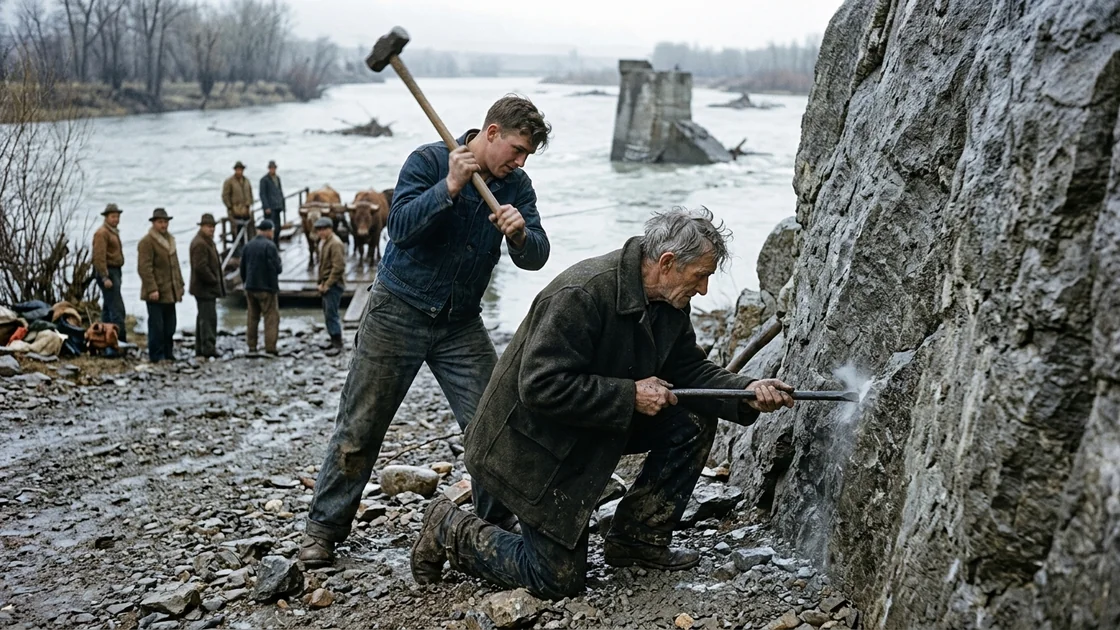
"Show me the drill," Arthur said.
Harlan Pettigrew looked at Noah Higgins.
Noah did not move. His hands were still on the hickory handle of the double-bitted axe, his thumbs hooked over the leather guard.
A young man—the Miller boy who had struck Arthur yesterday—walked to the wagon bed. He reached under a canvas tarp and brought out a three-foot star drill and a sixteen-pound sledge.
He did not offer them to Arthur.
He walked past him, three feet to his left, and dropped them into the mud at the base of the dolomite ledge that rose behind the road.
The ledge was gray, solid, and five hundred million years old. It did not have any shale stringers. It had no brown ribbons of silt running through its heart. It was the bone of the earth, the thing that sat beneath the river and waited for the iron and the timber and the men to be finished with their shouting.
"The hole has got to be two inches wide," Arthur said. He did not look at the Miller boy. He spoke to the rock. "It has got to be eighteen inches deep. If it’s sixteen, the wedge won't expand the lead sleeve. If it’s twenty, you’ll split the lower bedding plane."
He walked to the rock.
His boots were heavy with the yellow mud. He did not have his fedora, and the cold wind from the south lifted his thin gray hair, exposing the white, liver-spotted skin of his scalp.
He picked up the star drill.
He held it with his right hand, setting the four-pointed chisel head against the clean, gray face of the stone.
"Hit it," Arthur said.
The Miller boy stood behind him. He looked at Arthur’s back—at the torn mackinaw, at the shoulder that sat two inches lower than the other, at the red blood that had dried in the gray hair behind his left ear.
The boy spat on his palms.
He lifted the sixteen-pound sledge. He did not swing it with the wild, furious hatred he had used yesterday at the ferry slip. He swung it with the slow, rhythmic, terrible precision of a man driving a spike into an oak tie.
The iron hammer struck the head of the star drill with a clear, ringing clink.
The sound did not die in the valley. It traveled out across the water, bouncing off the eastern abutment where the orange bolts still stuck out of the concrete, echoing against the limestone bluffs of the gorge, until it seemed to fill the entire three hundred yards of empty space between the town and the world.
Arthur Vance turned the drill an eighth of a turn.
The stone dust—white, alkaline, and dry as flour—puffed out of the shallow cut and settled on the sleeves of his coat.
"Again," Arthur said.
The hammer rose. The hammer fell.
Clink.
Arthur turned the iron. His knuckles were gray with the dust. He could feel the shock of the blow travel through the steel, through his fingers, through the broken bone of his shoulder, down into the bedrock beneath his boots.
It was solid.
It would hold forty tons. It would hold eighty.
It would hold everything they had left to lose.
Across the river, the sun was finally breaking through the white floor of the sky. It struck the water not with warmth, but with a hard, brassy glare that showed every eddy, every log, every rolling ripple of the Silt River as it went down toward the Ohio, carrying the gray gravel and the dead leaves of the valley toward the sea.
Arthur did not look at the sun. He did not look at the town.
He watched the point where the iron met the dolomite. He watched the white circle widen, a sixteenth of an inch at a time, calculating the depth, the shear, the friction, and the long, bitter resistance of the stone.
"Again," he whispered into the rock.
And behind him, the hammer came down.