The Gavel and the Ghost
Arthur Vance was once the youngest presiding judge in the county, an ambitious jurist who sacrificed the life of a nineteen-year-old first-time offender named Marcus Ward by imposing a crushing thirty-year sentence to secure an election to the state appellate bench. Decades later, retired, widowed, and dying of pulmonary fibrosis, Arthur realizes that the prestige he bought was paid for in stolen human life. The story follows Arthur during his final three years as he alienates his former allies, burns through his wealth, and battles the very procedural machinery he helped construct in a desperate, unsparing effort to secure Marcus Ward's freedom before his own breath runs out.
Part One: The Autumn of the Career
The gavel that Arthur Vance used in the autumn of 1994 was turned from a piece of live oak taken from the lawn of the old statehouse. It was dense, heavy-headed, and made a sound when struck against the sound block that resembled a single, sharp rifle crack inside a small room. Courtroom 4B had tall, leaded windows that looked east toward the river, but by late October the light was already cold and thin, dying against the green felt of the defense table before four in the afternoon.
Arthur had been forty-two years old that year. He wore shirts with stiff English collars and kept his hair cut short enough that the gray at his temples looked deliberate, like frost applied with a brush. Outside the courthouse, down on the plaza where the television vans kept their engines idling to power the transmitters, banners hung between the lampposts for the statewide judicial elections. His own face looked back at him from the posters tacked to the construction scaffolding on Fourth Street: Arthur Vance. Restoring Order to Our Courts.
It had been an ugly year in the city. Two liquor store robberies had turned into homicides during the heat of July; a city councilman had been carjacked in his own driveway; the evening news ran a nightly segment called "Streets Under Siege." The governor had signed the Omnibus Sentencing Reform Act in August, creating statutory enhancements for crimes committed within five hundred feet of a municipal park, school, or transit facility. The law was a patchwork of panic and ambition, designed to give trial judges the power to warehouse young men for the duration of their fertile years.
Marcus Ward had sat at the far end of the defense table in a navy blue blazer his mother had purchased two days earlier from a Sears clearance rack. The sleeves were an inch too short, exposing bony wrists and the white cuffs of a cheap poly-cotton shirt. He was nineteen. He had no juvenile adjudications. He had been an apprentice mechanic at an auto body shop on the canal, earning four dollars and eighty cents an hour.
The facts of the case were neither grand nor complicated. On a Friday night in September, Marcus had driven a car—an eighty-two Buick LeSabre with a rusted quarter panel—into the alley behind a commercial shipping depot on Tenth Street. His cousin, a twenty-four-year-old named Darrell who had already served twenty months at the state farm in Mercer, had forced open the padlock on a side door with a pry bar. Inside were twenty-eight crates of branded athletic shoes and four cartons of wholesale consumer electronics. Darrell had loaded six crates into the trunk. Marcus had stood by the open rear door of the Buick, his hands shoved into the pockets of his jacket, watching the entrance of the alley.
A private security officer had driven his patrol wagon down Tenth Street, seen the trunk open, and blocked the mouth of the alley. Darrell had bolted over a chain-link fence topped with razor wire, leaving his jacket behind on the barbs. Marcus had not run. When the guard drew a service revolver and shouted, Marcus had raised his hands and dropped to his knees in the grease and crushed gravel of the lane.
Under the old code, it was a burglary in the third degree—a property offense, a class D felony. A plea to grand larceny would have yielded three years of supervised probation, perhaps six months in the county restitution center, and five hundred hours of community service clearing ditches along the county trunk roads.
But Tenth Street ran along the perimeter of the municipal recreation basin. The depot was four hundred and ten feet from the children’s wading pool. And Darrell, when he fled, had left an unloaded .32 caliber revolver under the passenger seat of the Buick—a weapon Marcus claimed, without contradiction from the prosecution’s witnesses, he did not know existed.
The district attorney, himself facing a primary challenge from a hardline suburban prosecutor, charged Marcus Ward with first-degree commercial burglary with a firearm enhancement in a designated safe-school zone, alongside criminal conspiracy and possession of stolen property. The enhancement transformed the charge from an ordinary property offense into an aggravated violent felony with a mandatory minimum of twenty years, and a statutory ceiling of life.
The public defender, an exhausted woman named Rita Solis who smelled constantly of menthol cigarettes and had seventy open files stacked in wire baskets on her floor, had begged Arthur in chambers for an in-court diversion or a downward departure based on Marcus’s lack of history.
"He’s a boy, Arthur," Rita had said, sitting in the leather armchair across from his mahogany desk, her briefcase resting against her shins like an iron weight. "He was the wheelman for a cousin who’s been using him as a mule since he was twelve. He didn't touch the gun. He didn't even run when the guard pulled the piece. If you apply the school-zone rider to a warehouse burglary at two o’clock in the morning on a Saturday, you’re burying him."
Arthur had leaned back in his high-backed chair, looking past Rita to the framed certificate of his nomination to the State Court of Appeals, which was sitting on the credenza awaiting confirmation by the voters the following Tuesday. The polls showed him three points down in the southern districts, where the blue-collar suburbs wanted blood every time a pane of glass was broken.
"The statute doesn't specify daylight hours, Rita," Arthur had said, his voice even, reasonable, and cold as clean steel. "The legislature did not include a temporal limitation on the safe-schools boundary. The depot is four hundred feet from the basin. The weapon was in the vehicle he operated. I don’t draft the enactments. I give them the force the public demands."
"You have the discretion to deviate on a first-time class D," she said, her voice dropping into a register that was almost disgust. "The deviation findings are right there in subsection four. You just have to find that a twenty-year sentence would be disproportionate to the harm caused."
"And what message does that send to the people living on Tenth Street?" Arthur asked. "That as long as you steal after dark, the children’s park doesn’t count? That you can bring a Saturday night special into the alleyway as long as it stays under the upholstery?"
"There were no children in the park at two-fifteen in the morning, Arthur," she said. "The wading pool was drained for the winter."
"The law doesn't drain," he said.
At sentencing, the television cameras were permitted on the side gallery—a concession Arthur had granted over the defense’s strenuous objection. Marcus’s mother, a woman who worked the night shift in the laundry at Saint Jude’s Hospital, sat in the second row wearing her white uniform under a brown winter coat. Her name was Evelyn. She had fingers that were raw and swollen at the knuckles from the commercial bleach, and she held a small wooden cross against the lapel of her coat with both hands.
Arthur had not looked at her. He looked at the lenses of the cameras, then at the reporters from the Herald and the Tribune seated in the jury box with their pads on their knees.
He spoke for twenty-two minutes. He spoke of the decay of civic trust, of the plague of youth violence that threatened to reduce the commonwealth to a state of nature, and of the duty of the judiciary to serve not as a sponge for sentimental pity, but as the flint against which the steel of the law was struck to create deterrence.
"The defendant chose his company," Arthur had read from his prepared notes, the prose polished to a hard sheen by his campaign consultant. "He chose his hour. He brought an instrument of lethal force to the threshold of our public spaces. Those who treat our communities as hunting grounds cannot complain when the cage they constructed for others closes upon themselves. It is the judgment of this court that Marcus Ward be committed to the Department of Corrections for a period of not less than thirty years, without eligibility for early administrative release under the statutory rider."
The sound of the gavel had been sharp. Evelyn Ward had not screamed. She had made a small, wet sound, like a bird crushed beneath a boot in high grass, and her head had fallen forward against the polished oak rail behind the defense table. Marcus had looked up at the bench, his jaw slightly slack, not yet understanding what thirty years meant. He had turned nineteen ninety-four into nineteen ninety-five in the county jail; he would be forty-nine years old when the gate opened. He had looked at Arthur not with fury, but with the flat, uncomprehending bewilderment of an animal caught in an irrigation culvert.
The following Tuesday, Arthur Vance won his seat on the State Court of Appeals by forty-one thousand votes.
Part Two: The High Country
For twenty-two years, Arthur lived in the high, clean country of the appellate division.
There were no witnesses in the appellate court. There were no mothers with bleach-burned fingers; no young men smelling of sweat and iron-heavy jail soap; no evidence bags containing cheap sneakers or greasy tools. The work was performed in library rooms lined with calfskin-bound reporters, on heavy paper that smelled of vanilla and acid-free cotton. The disputes were disputes of punctuation, of the placement of the word "shall" versus the word "may," of the doctrines of waiver, harmless error, and procedural default.
Arthur was good at it. He was a master of the procedural default. If an attorney had failed to lodge a contemporaneous objection at trial, Arthur wrote the opinion holding that the error, however egregious, had been forfeited. If a prisoner filed a post-conviction petition four days beyond the statutory limitation because the prison mailroom was locked down during a flu outbreak, Arthur cited the jurisdictional bar with dry satisfaction. The law was an architecture, and like any grand cathedral, it was more important that the lines remained plumb and the buttresses stayed true than that the people shivering in the aisles were warm.
His wife, Eleanor, died during his eleventh year on the bench. Her death was quiet, slow, and expensive, taking place in a hospice room where the blinds were always kept half-tilted to shade her from the glare off the reservoir. She had known him since they were students at the university, back when he had carried a volume of Cardozo in his coat pocket and talked about the law as a secular gospel.
In the weeks before the morphine took her completely, she had looked at him while he sat by her bed reading a brief on municipal bonding limits.
"You became very small, Arthur," she said. Her voice was thin, like greaseproof paper.
He had lowered the brief. "What do you mean, Eleanor? I’m the senior associate judge of the second division."
"You turned yourself into a pair of scissors," she said, looking toward the window. "You cut everything so close to the line that there’s nothing left to hold onto."
He had not answered her. He thought she was wandering. When she died, he took three days of personal leave, attended her service at the Episcopal church, received the condolences of two former governors and the president of the state bar, and was back in his chambers on Thursday morning to hear oral arguments on an environmental permit appeal.
His daughter, Clara, moved to Seattle when she was twenty-two and rarely called. She was a landscape architect, a profession Arthur found slightly absurd—spending seven years at university to learn how to plant ferns in corporate courtyards. When she did call, her conversations with him were like conversations held through a thick pane of plate glass. She did not ask about his cases. He did not ask about her clients. They traded reports on the weather and the health of her engine, and then they hung up, leaving the silence in his large brick house in the north hills slightly thicker than it had been before the phone rang.
The change came not as a moral awakening, but as an ache in the left shoulder that he mistook for bursitis from his weekly games of doubles tennis.
By the time he was seventy-one, the ache had moved into his sternum, and climbing the twenty-two marble steps from the courthouse portico to his chambers left him light-headed, his lips faintly blue. His physician, a man who had known him for thirty years and still addressed him as "Judge," sent him to a specialist in the medical center across the river.
The specialist had a small office that smelled of ozone and carpet cleaner. He placed a series of scans on a light board. The lungs were not pink and clear; they were webbed with gray, dense strands that looked like wet cotton batting pulled apart and stuffed into the lower lobes.
"Idiopathic pulmonary fibrosis," the specialist said. "The tissue is becoming fibrotic. It’s stiffening. Like leather that’s been left out in the sun."
"What is the progression?" Arthur asked. His voice had the same flat, neutral tone he used when questioning an attorney about the standard of review on an interlocutory appeal.
"Variable," the doctor said. "With medication, we might slow the loss of vital capacity. Without a transplant—and at your age, with your cardiovascular indices, a transplant is not an indicated pathway—we are looking at three to five years. The last eighteen months will require supplemental oxygen. Eventually, the mechanical effort of moving air through the scarred tissue becomes greater than the body can sustain."
Arthur had nodded. He took his pen from his pocket, wrote the name of the disease in his pocket diary, thanked the doctor, and drove himself home in the late afternoon traffic.
That evening, he sat in his study with a glass of club soda and two crackers. The house was enormous. There were four bedrooms on the second floor that had not been opened in nine months; the dust on the rugs had settled into gray drifts that smelled of horsehair and dead lavender.
He went to the basement. In the corner, behind the seasonal tires for the car he no longer drove in winter, were thirty-four banker’s boxes containing his notebooks and minute sheets from his eight years as a trial judge in Courtroom 4B.
He didn't know why he went looking for Marcus Ward.
Perhaps it was because of what Eleanor had said about the scissors. Perhaps it was because, during the long ride up the elevator in the medical center, he had realized that within thirty-six months he would be dead, and that no one in the city—neither the lawyers who bowed to him from the well of the court, nor the clerks who competed for his recommendations, nor the judicial colleagues who traded pedantic footnotes with him in the state law journal—would remember a single syllable of his opinions. They were citations; they were bricks in a wall that someone else would tear down or rebuild when the next legislative majority took the bench.
He found the box marked 1994: CR-94-1100 through CR-94-1850.
The cardboard was brittle, the flaps yellowed by the dampness of the concrete floor. He pulled out the file for State v. Marcus A. Ward.
There were the arrest logs. There was the inventory of the Buick: one spare tire, one jack, two greasy rags, one pair of work gloves, one .32 caliber revolver, serial number filed, unloaded. There was the deposition of the night watchman: The boy didn't move. He stood there by the trunk with his hands up. He told me, 'Don't shoot, mister, I'm just waiting on Darrell.'
And there was his own sentencing memorandum, typed by his clerk on the old heavy-bond county stationery. At the bottom, in the space reserved for the judge’s signature, was his own handwriting: Arthur Vance, Presiding. The stroke of the capital A was tall, sharp, and confident; it ended in an aggressive downward sweep that had cut through the grain of the paper.
Thirty years.
Arthur took his gold watch from his vest pocket. It was seven o’clock.
If Marcus Ward had served thirty years from October of 1994 without administrative relief, without clemency, without an appellate miracle, he was still there. He would be forty-five years old. He would have lived more than half his life behind the wire at the maximum-security unit at Mercer or the quarry camp at Black River.
Arthur closed the file, carried it upstairs to his study, and laid it on the clean green leather of his writing table. He did not turn on the television. He sat in his chair and watched the headlights of cars moving along the parkway two miles away, their beams sweeping through the trees like the lanterns of searchers who were looking for something they would never find.
Part Three: The Visitor at Mercer
The State Penitentiary at Mercer sat on three hundred acres of drained muckland forty miles south of the capital. The land was so flat that the water towers of the facility could be seen from six miles away across the soy fields, standing up against the horizon like two gray iron fists.
Arthur Vance drove there on a Tuesday morning in November. He had retired from the bench six months earlier, his departure marked by a dry ceremony in the supreme court library where he was presented with a silver tray he had immediately placed in a cupboard above his refrigerator.
He had not worn a suit. He wore a heavy wool sweater and an old trench coat that smelled of mothballs. He felt the thinness in his chest now with every breath; it was like drawing air through a woolen sock that had been dipped in cold grease. In his pocket was an oxygen saturation monitor he had bought at a pharmacy. When he pressed it onto his index finger, the little red diode read 91%.
The warden was a man named Miller, whose father had been the county sheriff during Arthur’s first campaign. Miller met Arthur in the administrative foyer, his boots clicking on the terrazzo floor.
"We could have done this in the conference room, Judge," Miller said, looking with some discomfort at the way Arthur leaned against the counter to catch his breath. "You didn't need to come down through the sally port. If you’re doing research for the bar association foundation, we could have had the records sent up to the city."
"I don't want the records, Warden," Arthur said. "I want twenty minutes with the inmate."
"Ward," Miller said, looking down at a slip of yellow paper. "Marcus Ward. He’s in Unit C. That’s long-term medium now. He was down in maximum at Black River until ninety-nine, then they transferred him here when the quarry closed. He’s had three infractions in twenty-two years. Two for contraband tobacco, one for refusing an order during the laundry strike in ninety-seven. Other than that, he doesn't exist. He’s a ghost."
"A ghost," Arthur said.
"The best kind we have," Miller said. "He works in the small-engine repair shop behind the maintenance shed. He fixes the mowers. We have three hundred acres to cut every five days in the summer. He keeps the Briggs & Strattons running."
The visitation room for Unit C was not the glass-partitioned booth of the old movies. It was a long, low room with fluorescent lights that buzzed at a pitch just above the threshold of pain. The walls were painted a color called seafoam, which looked like cabbage water dried on concrete. Six laminate tables were bolted to the floor.
Arthur sat at table three. His lungs felt heavy, as though someone had laid two small sandbags across his clavicles. He kept his hands flat on the laminate to keep them from trembling.
The door at the far end opened. Marcus Ward came through it followed by a guard who held a clipboard and did not look up from a crossword puzzle.
Marcus had not grown much taller, but his shoulders had thickened and then settled, the muscle turning stringy and dense like cured meat. His hair was cropped so close to the scalp that the scars were visible—two pale lines above the left ear from some long-forgotten dispute in a Mercer shower twenty years ago. He wore the standard orange twill trousers and a white shirt with his Department of Corrections number stenciled across the pocket in faded ink: DOC #88412.
He walked with a slight limp, his right boot dragging half an inch on the linoleum.
He sat down across from Arthur. He did not reach across the table. His hands—large, the skin around the nails stained with black engine grease that no soap could ever fully lift—rested on his knees beneath the table edge.
He looked at Arthur for ten seconds without speaking. His eyes were small, brown, and entirely dry. There was no anger in them. There was no curiosity. There was only the dull, flat patience of a man who has looked at cinder blocks for eight thousand consecutive mornings.
"You're the judge," Marcus said. His voice was lower than Arthur remembered, hoarse from years of speaking over the roar of ventilation fans and industrial extractors.
"I am," Arthur said. "Arthur Vance."
"You got old," Marcus said.
"I did. We both did."
"No," Marcus said, his voice flat as an oil slick. "You got old out there. That's different. Out there, your teeth fall out, you buy some more. Out there, your hair turns gray, you sit in the sun. I got old in Unit B and Unit C. My mother died in ninety-eight, Judge. You know that?"
"I didn't know," Arthur said.
"Saint Jude’s laundry," Marcus said. "She was lifting thirty-pound bags of wet sheets into the spin dryer. Her heart stopped. She fell against the drum. They didn't find her for forty minutes because the extractors make so much noise. I had to ask the warden for three hundred dollars from my institutional account to pay for the cremation. They wouldn't let me go to the service. The lieutenant said I was an aggravated felon. Safe-school zone. Said I was an escape risk."
Arthur felt a sudden, sharp coldness in the back of his throat. He reached into his coat pocket, took out a linen handkerchief, and pressed it to his mouth. When he pulled it away, there was a small smear of gray mucus.
"Marcus," he said.
"Don't call me that," the man said. "The guards call me Ward. The people who know me call me Luke. That was my middle name. My mother called me Luke. You don't know me well enough to use my Christian name."
"Mr. Ward," Arthur said. "The sentence was wrong."
Marcus laughed. It was a short, barking sound that had no humor in it; it sounded like an axe striking a dead pine.
"You came down here in your car to tell me that? Twenty-two years after you dropped that piece of wood on the table? You think I didn't know it was wrong? The guys in the holding cell knew it was wrong. Darrell got four years because he took the state's deal and told them I was the one who planned it. He was out in ninety-seven. He lives down in Georgia now. He’s got an air-conditioning business."
"I am going to get you out," Arthur said.
Marcus leaned forward. For the first time, his hands came up from beneath the table and rested on the laminate. The knuckles were enlarged, the skin split and scarred from cold iron and socket wrenches.
"Get me out?" Marcus whispered. "You think this is a faucet? You turn it on when you want to look like a big man for the newspapers, and then when you're done and you feel like you might go to hell, you turn it back off?"
"I don't care about the newspapers," Arthur said.
"I do," Marcus said. "I cared about them when my mother showed me the clipping. Vance Slams the Door on Safe-School Bandits. She had it folded up in her Bible. She thought if she prayed on it, the words might change. They didn't change."
Marcus stood up. He looked down at Arthur, his face completely expressionless.
"You stay away from me, Judge," Marcus said. "I got seven years left before my first parole review under the old law. If you come around here stirring the water, the board will kick my file down the road another five years just to show the governor they don't take orders from old men who have bad dreams. You go home and die in your bed. Leave me to my mowers."
He turned and tapped on the inner security door with the edge of his hand. The guard didn't even look up from his crossword puzzle; he reached beneath the counter, hit the magnetic release, and let Marcus Ward back into the gray throat of the prison.
Part Four: The Broken Tools
Arthur Vance did not go home to die in his bed.
The following morning, he drove down to the old county legal complex. The neighborhood had decayed since his days in Courtroom 4B; the bail bondsmen’s storefronts with their neon signs had been replaced by empty lots surrounded by chain link, and the diner where the prosecutors used to eat their eggs had burned out three years ago, leaving only a soot-blackened sign that said TOM’S STEAKS.
He climbed the granite steps to the district attorney’s office. His breath was short, a wet rasp that he tried to suppress with menthol lozenges.
The district attorney was now Derek Miller—the son of the old sheriff, and the younger brother of the warden at Mercer. Derek was forty-four, had sleek, parted hair, and wore tailored Italian suits with small brass lapel pins in the shape of the state flag. He had been a law clerk in Arthur’s court during Arthur’s third year on the appellate bench.
"Judge," Derek said, rising from behind a desk that was completely clear of paper except for an iPad in a leather sleeve. "This is an honor. I saw the notice of your retirement dinner. I was in Washington for the National Association of Attorneys General, or I would have been there."
"Derek," Arthur said, sinking into the leather armchair before he was invited. He felt his ribs aching from the climb. "I need you to look at a conviction from ninety-four. State v. Marcus Ward."
Derek blinked. He reached for his iPad, tapped the screen twice with a manicured finger, and then looked up.
"Ninety-four? That’s before my time, Judge. Was it one of yours?"
"It was," Arthur said. "Burglary first. School-zone enhancement. He was nineteen. Unarmed. First offense. Thirty years."
"That’s a heavy hit," Derek said neutrally. "Must have been some bad aggravating factors."
"There were none," Arthur said. "The aggravation was my campaign for the Court of Appeals. I needed thirty seconds on the six o'clock news that didn't make me look like an academic from the university."
Derek’s smile did not vanish, but it stiffened, like wax cooling under cold water. He set the tablet down.
"Judge Vance. We don't say things like that in this office. Not even in jest."
"It isn't in jest," Arthur said. "I want you to join in an extraordinary motion for a new trial under Rule 60, or file a joint petition with me for an executive pardon based on judicial overreach."
Derek laughed, but his eyes were hard. "Judge, are you feeling all right? I heard you’ve had some health challenges."
"My lungs are failing, Derek. My brain is functioning with the same precision it has possessed for forty-five years. The sentence was disproportionate under any rational application of the Eighth Amendment. It was a perversion of the safe-schools statute. The depot was an industrial facility; it wasn't a playground. The child-welfare purpose of the act wasn't engaged."
"Judge," Derek said, leaning forward and resting his forearms on the desk. "Let's assume everything you're saying is true. Let's assume you gave him thirty years because you wanted to beat Tom Hennessey in the southern suburbs. The conviction was affirmed by your own court in ninety-six. You didn't sit on the panel, but Judge Grodin wrote it. Grodin called it a textbook application of legislative intent."
"Grodin was an idiot who never tried a case without an instruction manual," Arthur snapped.
"Grodin is the Chief Justice of the Supreme Court right now," Derek said softly. "And if I walk into his courtroom with a motion saying that the former senior judge of the second division committed a fraud upon the public for political gain twenty-two years ago, do you know what happens to this office? Do you know what happens to the seventy-four other safe-school cases we’ve prosecuted under that precedent since nineteen ninety-five?"
"They should be looked at too," Arthur said.
"This conversation is over, Judge," Derek said. He stood up. He did not extend his hand. "I have seven homicides on the docket for next month. I have a legislature that’s cutting my budget by eight percent. I am not going to dig up a closed file from the previous century because you’ve decided to make peace with your maker at the expense of the district attorney’s office. If you want to file something, file it as a private citizen. But if you name this office, I will move for sanctions, and I will ask the bar to revoke your emeritus license on grounds of mental incompetence."
Arthur stood up. His knees shook. He had to reach out and catch the edge of the mahogany desk to keep from pitching forward onto the carpet.
"I know what the bar does, Derek," Arthur said. "I helped write the disciplinary rules. You won't find a doctor who will swear I'm incompetent. They'll only swear that I'm dying. And dying men don't care about sanctions."
He walked out of the office, down the marble corridor, his boots dragging on the tile just as Marcus Ward’s boots had dragged across the floor at Mercer.
Part Five: The Penitent’s Ledger
He hired Elena Ramos three days later.
Elena was thirty-four, worked out of a shared office space above a dry cleaner on Eleventh Street, and had spent seven years as a staff attorney with the Innocence Project before setting up her own post-conviction practice. Her desk was an old door laid across two steel sawhorses, and she drove a ten-year-old Civic that had a dent in the passenger door the size of a laundry tub.
She looked at Arthur Vance as he sat in her only folding chair, his portable oxygen concentrator resting on the floor between his feet, humming like a small refrigerator.
"You're Arthur Vance," she said. She didn't offer him water.
"I am."
"You wrote the State v. DeWitt opinion," she said. "The one that held that a three-day delay in filing an alibi notice was an absolute bar to presenting third-party defense witnesses in a capital rape case."
"I did," Arthur said. "The statute was unambiguous."
"DeWitt died at Black River two years ago," she said. "From hepatitis. His sister had the DNA tested last winter at her own expense. It wasn't his hair. It was her boyfriend’s."
Arthur looked at the floor between his boots. The plastic cannula ran up his neck and hooked over his ears, the prongs blowing dry, cold gas into his nostrils.
"I cannot help DeWitt," Arthur said. "I can help Marcus Ward. If you will take the case."
"I don't work for judges," she said. "I work for people who have been run over by judges."
"Then work for Marcus Ward," Arthur said. "Here is a certified check for twenty-five thousand dollars from my pension account. It is a retainer. If you use it up, there is another fifty thousand in my money market fund. I don't need it. The county health plan pays for the oxygen. The grave is already paid for; it’s next to Eleanor’s at Oak Hill."
Elena looked at the blue slip of paper on the desk. She didn't touch it.
"Why him?" she asked.
"Because he was the one," Arthur said. "The others... there was always some ambiguity. A witness who might have been lying, a record that wasn't clean, a second count that had some merit. Ward was clean. He was nineteen years old. I used him like a piece of timber to build a bridge to the appellate court. I took thirty years of his life and I traded it for an office with three clerks and a leather chair."
"The legal obstacles are almost insurmountable," Elena said. She picked up a yellow pencil and began tapping it against her thumb. "The direct appeal is done. The state habeas was denied in ninety-nine. The federal petition was dismissed on procedural default in two thousand one—because his lawyer, that drunken hack the court appointed, missed the AEDPA deadline by eighteen days."
"I know," Arthur said. "I checked the docket."
"The only door left is an executive commutation from the governor, or an extraordinary writ of coram nobis based on judicial misconduct."
"Then we file for both," Arthur said.
"You can't be the lawyer on the petition," she said. "You're the judge who did it. You’re the evidence. You're the witness."
"I will be the witness," Arthur said. "I will sign an affidavit stating that I deliberately misapplied the safe-school enhancement to secure a political benefit in an active election cycle. I will testify that I knew the deviation standards were met, that the depot was not within the intended scope of the statute, and that I suppressed my own legal conclusions to satisfy the media coverage."
Elena leaned back in her chair. The sawhorses creaked.
"Do you know what they’ll do to you?" she asked. "The conservative press will tear you to pieces. They’ll say you’re senile. They’ll say you’re a traitor to the bench. The Court of Appeals will strike your portrait from the rotunda. Derek Miller will file a complaint with the judicial conduct board to have your pension stripped so your daughter gets nothing."
"Clara doesn't want my money," Arthur said. "She told me three years ago that everything I earned smelled of iron. And as for the portrait—the frame is cheap pine with gold leaf that’s already peeling at the corners. They can burn it in the courtyard for all I care."
Elena picked up the check. She looked at it for a long time, then slipped it into the top drawer of the file cabinet behind her.
"I need Marcus Ward’s signature on the representation agreement," she said. "He told you to stay away from him."
"He did," Arthur said.
"Then you’re going to have to go back to Mercer," she said. "And this time, you better bring something better than an apology."
Part Six: The Sister’s Kitchen
Arthur did not go back to Mercer immediately. He knew that an old man with an oxygen bottle was an object of contempt to a man who had lived twenty-two years in a cage. Marcus Ward did not want his tears; he wanted nothing that came from the hand that had held the oak gavel.
He found Teresa Ward living in a narrow frame house on the city’s south side, three blocks from the freight tracks. The house was painted the color of wet sand, and the porch steps sagged in the middle where the stringers had rotted out.
Arthur walked up the steps slowly, carrying the small green oxygen tank in a shoulder harness like a hunter carrying a carbine. Every six steps he had to stop and let the grayness clear from the edges of his vision.
A woman with gray-streaked hair pulled back into a tight bun opened the door. She wore an apron that had grease stains from cooking scrapple. She was forty-eight, but she had her mother’s hands—the large, square fingers, the skin dry and scarred from work.
"Teresa Ward?" Arthur asked.
"Yes. Who are you?"
"My name is Arthur Vance."
She looked at him for five seconds. Her face did not change. It was the same look Marcus had given him—that terrible, ancient look of the poor who have seen the sheriff, the landlord, and the judge so many times that they no longer distinguish between them.
"The man who killed my mother," she said.
"I didn't kill her, Teresa," Arthur said, though the words felt like dust in his mouth.
"She died in the laundry because she had to work seventy hours a week to pay the lawyers for Luke's appeal," Teresa said. She didn't shout. Her voice had the quiet, rhythmic weight of a flatiron being pushed across a board. "The lawyers took nine thousand dollars from her. They took the title to the house. They took the little bit of insurance my daddy left. And then they told her the judge said the time was up. That was you."
"May I come in?" Arthur asked. "I cannot stand much longer."
She looked at the plastic tubes running into his nose, at the way his fingers clutched the porch railing until the knuckles were white as bone.
"You can sit on the porch," she said. "You aren't coming into my mother's kitchen."
Arthur sat on a green wooden bench that had one leg propped up with a brick. The air smelled of coal smoke from the train yards and dying marigolds from the small patch of dirt by the fence.
"I have hired an attorney," Arthur said. "A good one. Her name is Elena Ramos."
"We don't have no money for attorneys," Teresa said, standing with her back against the screen door, her arms folded across her apron.
"It’s paid," Arthur said. "Everything is paid. I am filing an application for executive clemency with the governor. I am also filing an affidavit in the county court confessing to judicial misconduct during the nineteen ninety-four trial."
Teresa frowned. She looked at him with genuine suspicion, her eyes narrowing against the afternoon light.
"Why would you do that?"
"Because it’s the only way the court will listen," Arthur said. "They won't listen to Marcus. They don't care about a fifty-year-old prisoner who fixed mowers. They care about their own dignity. If I go into that court and tell them that the system was used to commit a fraud, they will have to open the file to protect themselves."
"Luke won't sign," she said. "He hates you. He’s hated you since he was nineteen. He had a picture of you he cut out of the newspaper after you won that election. He kept it in his tobacco tin until the guards took it during a shakedown in two thousand two. He told me he was going to outlive you. That was the only thing he cared about. Just living one day longer than the man who put him in there."
"He will outlive me," Arthur said. "By a great deal. The doctors give me six months. Perhaps eight if the winter is mild."
Teresa looked down at him. The wind came off the tracks, lifting a strand of gray hair from her forehead.
"You're doing this for you," she said. "You're doing this so you don't go into the fire with that boy's life on your hands."
"Yes," Arthur said. He did not lie. He had spent forty years listening to men lie on the witness stand, and he knew that the only thing that could cut through thirty years of cinder-block silence was the raw, unpolished iron of the truth. "I am doing it because I cannot bear the thought of dying while he is still in Unit C."
Teresa looked toward the freight yard. A long train of black tank cars was rolling slowly toward the river, its metal couplings clanking with a sound like chains being dragged across an iron deck.
"He likes peach preserves," she said softly. "Our mother used to make them from the tree in the alley before the city cut it down to put the light pole in. They don't let you bring preserves into Mercer. They think you can make mash out of it."
"Elena Ramos can get them in as legal materials if she has an order," Arthur said.
Teresa turned, went inside the house, and returned two minutes later with a small, lined sheet of paper torn from a spiral notebook. She had written three lines on it with a ballpoint pen.
Luke. This old man is dying. He’s trying to pay some of what he took. Let the girl lawyer help you. If you don't, you're just dying with him.
She handed the paper to Arthur. She didn't touch his fingers.
"You tell him I said to sign," she said. "And then you don't ever come back to this street, Judge Vance."
"Thank you, Teresa," Arthur said.
"Don't thank me," she said, her hand already on the latch of the screen door. "I’m doing it for my mother. She never did get to see him wear a suit that fit him."
Part Seven: The Scaffolding of the Law
The petition for executive clemency was eighty-four pages long.
Attached to it as Exhibit A was the sworn affidavit of Arthur Vance, formerly Senior Associate Judge of the State Court of Appeals.
The affidavit was not written in the polite, ambiguous language of judicial retrospection. It was written with the savage, forensic clarity that had made Arthur the most feared legal technician in the state for a quarter of a century.
I, Arthur Vance, being first duly sworn, depose and state as follows:
1. In October of 1994, I presided over the trial and sentencing of Marcus A. Ward in the District Court for the Second Judicial District.
2. At the time of said trial, I was an active candidate for election to the State Court of Appeals in a contested statewide race wherein my principal campaign theme was judicial severity and the enforcement of the newly enacted safe-schools statutory enhancements.
3. The evidence at trial established that the defendant, then nineteen years of age, was a passive participant in a commercial burglary; that he was unarmed; that he had no prior criminal record; and that the offense occurred at an hour when no children or members of the public were present in the adjacent municipal park.
4. In imposing a sentence of thirty years without the possibility of early administrative release, I deliberately ignored the statutory criteria for downward deviation set forth in Section 4(b) of the Act, which criteria were fully satisfied by the record.
5. I imposed said sentence not to serve the interests of justice, nor to effectuate the intent of the legislature, but to manufacture a political artifact suitable for dissemination by media outlets supporting my candidacy.
6. The incarceration of Marcus Ward for the past twenty-two years is the direct result of my violation of my judicial oath, and constitutes an ongoing miscarriage of justice that the state has an affirmative moral and legal duty to terminate.
Elena Ramos filed the petition on a Monday morning at nine o’clock. By noon, a copy had been leaked to the capital bureau of the Herald.
By three o’clock, Arthur’s telephone was ringing every ninety seconds. He had disconnected the landline in the hall, but the mobile phone Elena had given him continued to buzz against the green leather of his desk like an angry hornet.
At five, the television crews arrived. They did not have the heavy vans of 1994; they had small, sharp little cars with satellite saucers mounted on the roof. They set up their tripods on the sidewalk outside his brick house in the north hills, their lights illuminating the dying hydrangea bushes by his gate.
The evening anchor on Channel 4 was a woman who had not been born when Marcus Ward was sent to Mercer.
"A stunning development in the state’s legal community tonight," she said, her voice bright with professional astonishment. "Former appellate judge Arthur Vance, long considered an icon of the conservative law-and-order movement, has filed a sworn statement claiming he sent a man to prison for thirty years just to win an election. Legal experts are calling the move unprecedented—and possibly the result of deteriorating health."
They brought on Derek Miller, who stood on the steps of the courthouse with his coat open, the wind fluttering his tie.
"It’s a tragedy," Derek said, his face a study in sorrowful reluctance. "Judge Vance served this state with distinction for decades. But it’s clear to anyone who has spoken with him recently that his current physical decline has affected his judgment. The findings in the Ward case were affirmed by the full appellate court twenty years ago. The law was applied correctly. For the judge to now cast these kinds of baseless aspersions upon his own legacy and the integrity of our judicial system is deeply sad. We will oppose the clemency petition."
The Chief Justice, Grodin, issued an administrative statement from his chambers the following morning:
The courts speak only through their records. An individual jurist, having laid down the responsibilities of the bench, has no power to alter, amend, or impeach the final judgments of the court through post-judicial remorse. The integrity of our processes depends upon the finality of verdicts, which cannot be made hostage to the shifting sentiments of retired judges.
Arthur read the statement while sitting in his kitchen with his portable tank humming between his knees.
"Finality," he whispered to the empty room. "They love the word. It sounds like stone. It sounds like an altar."
He looked at his hands. The skin was paper-thin now, the veins standing up like blue mountain ranges across the back of the knuckles. His oxygen level had dropped to eighty-seven percent that morning, even with the cannula turned up to three liters. Every breath was a small, conscious labor; he had to think about lifting his ribs, think about pulling the air down past the scarred, leathery bronchi, think about expelling the carbon that felt like warm soot gathering in his throat.
Elena came at eleven. She had three boxes of transcripts in the back of her Civic.
"They're going to hold a hearing," she said, sitting at the kitchen table.
Arthur looked up. "The governor?"
"The Board of Pardons and Paroles," she said. "The governor doesn't want the stink on him. If he grants it alone, the police union will run ads against him in the spring primary. If he denies it, the editorial boards will call him a coward. So he’s kicking it to the board for a public recommendation. Five members. Three former prosecutors, one retired highway patrol captain, and a minister from a megachurch in the suburbs."
"When?" Arthur asked.
"Three weeks," she said. "December twelfth. At the state administration building."
"Will Marcus be there?"
"They don't bring the inmate for clemency hearings," she said. "They use the closed-circuit camera from the prison. He’ll be on a screen, twenty inches wide, sitting in an empty room at Mercer."
"No," Arthur said. "He has to be in the room."
"Arthur, they don't do that. The transport costs alone—"
"I will pay the transport," Arthur said. "File a motion for a writ of habeas corpus ad testificandum. Tell them the credibility of the applicant cannot be assessed through an eight-bit video monitor. Tell them the sentencing judge demands the right to be confronted by the man he sentenced."
"They'll say no," Elena said.
"Then go to Judge Martinez in the federal district," Arthur said. "Martinez was my first clerk. He hates Grodin. He hates the state board. He’ll sign the writ just to make the Department of Corrections spend four hundred dollars on diesel."
Elena looked at him with something that was almost admiration. "You really are a bastard when you want to be, aren't you, Judge?"
"I was a bastard for thirty years for the wrong people, Elena," Arthur said. "It would be a pity not to use the training before the lungs close up entirely."
Part Eight: The Cold Room
December twelfth was the coldest day the capital had seen in eleven years. A skin of gray ice covered the river, and the wind off the northern plains cut through the limestone canyons of the government center like a drawknife.
Arthur arrived in a wheelchair.
He had resisted it until that morning, but when he had tried to stand up from his bed, his legs had felt like hollow paper tubes, and the room had spun into a gray darkness that smelled of scorched wire. Elena had rented the chair from a medical supply house on Fourth Street; it was made of chrome-plated steel with black vinyl seats that were cold as iron through his trousers.
His daughter, Clara, was there.
She had flown in from Seattle the night before without telling him. She met them on the ramp of the administration building, wearing a long green down coat and a woolen cap pulled down over her ears. Her face was Eleanor’s face—the same sharp chin, the same wide, skeptical gray eyes that saw through every piece of pomposity Arthur had ever brought home from the court.
She walked behind the wheelchair, took the rubber grips from Elena, and pushed him through the double glass doors into the security lobby.
"Why are you here, Clara?" Arthur asked. His voice was little more than a dry whistle now. The oxygen concentrator sat on a shelf between the rear wheels of the chair, chattering like a small machine gun.
"Because you're making a fool of yourself on the six o'clock news," she said, her voice flat, though she reached down and smoothed the wool lapel of his overcoat. "And because mother told me before she died that if you ever did anything that wasn't written down in a book, I had to come and see it."
"It's written down," Arthur said. "In the penal code."
"Shut up, Arthur," she said gently. "Save your air."
The hearing was held in Room 102 of the Department of Public Safety—a low-ceilinged basement room with acoustic tiles that were stained with water rings from an old plumbing leak. The five members of the board sat behind a long laminate counter that had been raised on wooden blocks to resemble a judicial bench.
In the center of the room, behind the petitioner’s table, was Marcus Ward.
He was not in orange. Elena had bought him a charcoal gray suit from a department store in the city—forty-four regular, the pants hemmed with iron-on tape the night before in her office. The jacket was slightly too broad in the shoulders, but it covered the DOC numbers, and he wore a clean white shirt with a gray silk tie.
He was handcuffed to a belly chain, the steel links clicking against the brass buttons of his waistcoat every time he breathed. Two correctional officers in gray uniforms with black sidearms stood three feet behind his chair, their arms folded across their chests.
Marcus did not look at Arthur when Clara wheeled him into the space beside Elena. He looked at the five people behind the laminate bench. His face was set like concrete, but Arthur could see the tension in his neck—the tendons standing out like cords of hemp beneath the clean white collar.
The chairman of the board was a man named Horace Caldwell, a former prosecutor from the oil counties in the west. He had white hair that was combed over a pink scalp and wore gold-rimmed bifocals that he perched on the end of his nose.
"This is an extraordinary application," Caldwell said, looking down at the eighty-four-page document. "The Board has received three hundred and forty letters from members of the public concerning this case, as well as an amicus submission from the District Attorney’s Association urging summary dismissal."
He looked at Elena. "Ms. Ramos, you have thirty minutes. The Board has read your brief. We do not need a recitation of the facts. We want to know why the executive should interfere with a final judgment that has stood for nearly a quarter of a century."
Elena stood up. She spoke with a clean, unhurried precision. She walked the board through the history of the safe-schools act; she showed that in the twenty-two years since Marcus Ward’s sentencing, the legislature had amended the statute three times, specifically adding the requirement that the facility be in actual use by minors at the time of the offense, and capping the enhancement for first-time offenders at five years.
"If Marcus Ward were sentenced today under the laws of this state," Elena said, "he would have been released in nineteen ninety-eight. He has served five times the current maximum for this offense. He has served it without violence, without disciplinary segregation, and with the consistent recommendation of his institutional supervisors."
Caldwell grunted. He looked past Elena, his eyes settling on Arthur Vance.
"Judge Vance," Caldwell said. His voice was dry, laden with the specific professional malice that small-town prosecutors keep for retired appellate judges. "I understand you wish to be heard."
Clara leaned down. "Do you want me to roll you up to the microphone?"
"No," Arthur said. "Lock the wheels."
He reached down, turned the regulator on the oxygen tank from three liters to six—a setting the specialist had warned him would cause dizziness and carbon dioxide retention within twenty minutes—and placed both hands on the arms of the chair.
He stood up.
His knees snapped like dead kindling. The room swam in a red mist for three seconds; he saw the five members of the board waver like reflections in a ditch during a heavy rain. He held the edge of the laminate table with his left hand, his fingers digging into the veneer until the nails turned purple.
Marcus Ward did not turn his head, but his shoulder muscles bunched under the gray wool of his jacket.
"Mr. Chairman," Arthur said. His voice was thin, but in the low-ceilinged room, it had the old, carrying timbre of the second division. "I am not here to ask for mercy for Marcus Ward."
Caldwell raised an eyebrow. "You're not?"
"No," Arthur said. "Mercy is a gift given to the guilty when their punishment exceeds their desert. Marcus Ward does not require your gift. He is your creditor."
The room was completely silent except for the rhythmic, mechanical hiss of the oxygen concentrator behind the chair.
"For eight thousand and seventy-two days," Arthur said, "the State has held this man in a steel box because I required thirty seconds of film for the evening news in the autumn of nineteen ninety-four. I was not stupid. I was not ignorant of the law. I knew that the safe-schools enhancement was intended to protect children from drug sales on the perimeter of playgrounds. I knew that Tenth Street was an industrial corridor. I knew that the defendant was an accessory after the fact who had not entered the building, had not possessed the weapon, and had no knowledge of the weapon."
He took a breath. It was a terrible sound—the sound of an iron grate being dragged over wet gravel.
"I gave him thirty years because I wanted to be an appellate judge," Arthur said. "I wanted the room with the walnut panels. I wanted the clerks to stand up when I came through the door. I wanted to sit in the high country and write opinions about the doctrines of waiver and default while other men rotted in the ditch I had dug for them."
Derek Miller stood up from the gallery behind the press row. "Mr. Chairman, I must object. This is a pathetic display by an individual who is clearly non compos mentis—"
"Sit down, Derek," Arthur said. He didn't shout. He spoke with the absolute, cold authority of a man who had held the gavel when Derek Miller was still failing his second-year torts exam.
Derek hesitated, his mouth open, then slowly sat back down on the wooden bench.
Arthur looked back at Caldwell.
"You speak of finality, Mr. Chairman," Arthur whispered. "You think that if you open this gate, the walls of the temple will fall down. You think that if the public discovers that a judge can be a scoundrel, they will no longer believe in the law. But they already know the judge can be a scoundrel. They know it every time they look at their sons who are sent away for five years for half an ounce of weed, while the men who steal five million from a pension fund get six months in a camp with a swimming pool."
He let go of the table. He stood on his own two feet for three seconds, his body swaying like a dead spruce in a high gale.
"The law is not an altar," Arthur said. "It is a machine. We built it. We put the wheels on it, and we put the knives on it, and when it catches a nineteen-year-old boy by the sleeve, it doesn't stop until it has ground him into meal—unless someone has the courage to reach into the gears and pull the lever."
He turned his head. For the first time in twenty-two years, he looked directly into the face of Marcus Ward.
Marcus was looking up at him. The flat, dead look was gone. In its place was something raw, terrible, and bewildered—the look of a man who has watched a mountain that has blocked the sun for his entire life suddenly begin to tear itself apart from the inside, its stones falling down into the valley like hail.
"I took your life, Marcus," Arthur said. His voice was barely a thread now, a soft, dry rasp against the silence of the basement. "I cannot give it back. I have nothing left to give you but the truth of what was done to you. And that truth is this: you did not belong in Mercer. You belonged in the sun."
Arthur’s knees gave way.
Clara caught him before he hit the linoleum. Her strong, young arms came under his shoulders, lifting him, pulling him back into the vinyl seat of the chair. He fell against the cushions, his chest heaving with great, ragged, useless gasps, his lips the color of a wet slate shingle.
The oxygen concentrator hissed and clicked.
Caldwell looked down from the bench. He took off his gold-rimmed glasses, laid them on his notes, and looked at the other four members of the board. None of them looked back at him. They were looking at Marcus Ward’s belly chain, which was shaking with a light, metallic sound against his gray waistcoat.
"The Board will take a recess," Caldwell said. His voice was no longer dry. It was small. "Twenty minutes."
Part Nine: The Threshold
The order came down at four o'clock on the twenty-first of December.
The Board of Pardons and Paroles had voted four to one to recommend immediate executive commutation to time served. The governor, seeing the way the wind had turned in the editorial pages after Arthur’s collapse was reported with all its clinical details, signed the clemency warrant thirty minutes later with a pen he did not keep for a souvenir.
Arthur did not hear the news in Courtroom 4B. He did not hear it in his chambers.
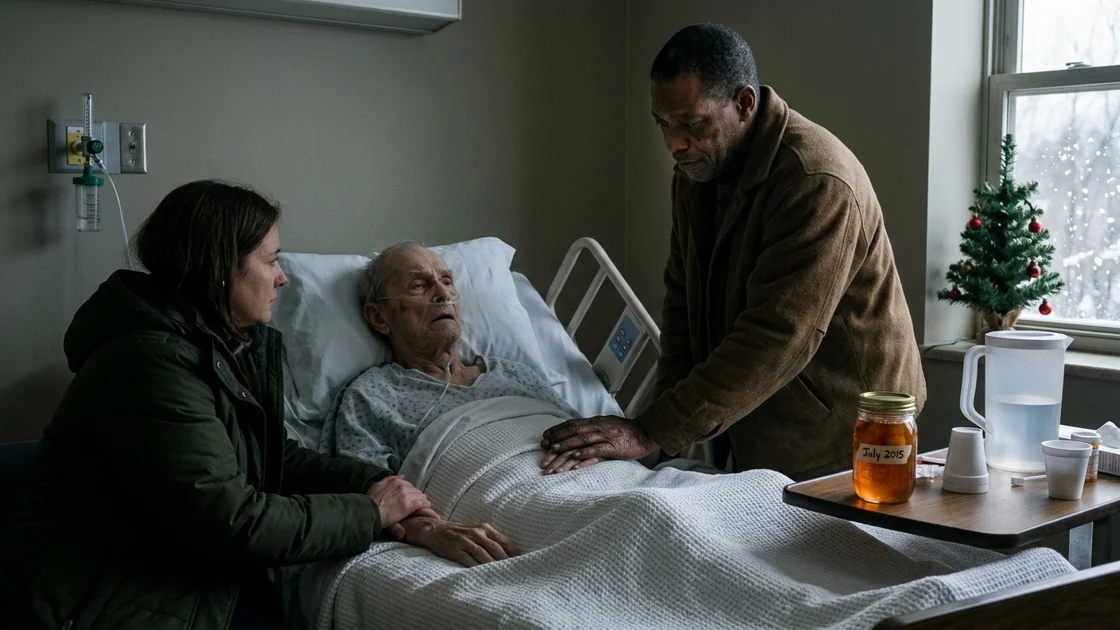
He was in Room 314 of the Saint Jude’s Hospice Center—the same brick hospital where Marcus Ward’s mother had died twenty-four years earlier in the basement laundry.
The room was quiet. A small artificial pine tree with three red bulbs sat on the window ledge, its green plastic needles reflecting the gray light that came off the frozen canal. The oxygen concentrator had been replaced by a large, wall-mounted flow meter that bubbled continuously through a bottle of sterile water, making a sound like a small brook running under ice.
He could no longer sit up. His hands lay on the white waffle-weave blanket like dried roots.
Clara sat by the bed. She had not spoken for two hours; she held his left wrist between her thumb and forefinger, monitoring the pulse that had become light, irregular, and fast, like the fluttering of a moth trapped inside a paper lantern.
The door opened with a soft click.
Elena Ramos came in first. She wore her winter coat, her scarf still wet with melted snow.
Behind her was Marcus Ward.
He was alone. He wore an ordinary brown wool jacket that Elena had bought him from a thrift store, and dark blue trousers that were clean and straight. He did not have the belly chain. He did not have the two officers in gray. He carried a small brown paper bag in his left hand, the top folded over twice and creased with his thumbnail.
He stood at the foot of the bed.
He looked at Arthur Vance. Arthur’s face had collapsed into the bone; the skin across his forehead was tight and shiny, yellow as old parchment, and his eyes were sunken so deep into their sockets that they looked like two small pools of dark water at the bottom of a well.
Arthur saw him. He tried to lift his chin, tried to find the voice he had used for forty years to rule on motions and dismiss appeals, but there was nothing left in his throat but the dry hiss of the hospital gas.
Marcus walked around the side of the bed, opposite Clara.
He set the brown paper bag on the nightstand, next to the plastic water pitcher and the tray of paper medicine cups.
"My sister sent these," Marcus said. His hoarse voice sounded very loud in the small room.
He reached into the bag and pulled out a glass jar with a gold-lacquered lid. Inside were peach preserves—dark, amber-colored fruit suspended in thick syrup, with a handwritten label that said July 2015.
Arthur looked at the jar. A single, tiny tear leaked from the corner of his right eye, running down through the deep crevice beside his nose until it lost itself in the gray stubble on his lip.
Marcus looked down at the old man’s hands. He reached out—hesitated for three seconds, his greasy, scarred fingers hovering in the air above the white cotton—and then laid his hand across Arthur’s knuckles.
The skin was cold. It was like touching a piece of dry wood that had been left on the riverbank in December.
"You look like hell, Judge," Marcus said.
Arthur made a small sound in his throat—a sound that might have been a laugh, or might have been the mechanical catch of his trachea trying to clear the fluid that was rising from the bottom of his lungs like tide in a salt marsh.
"I got twenty-two years to make up," Marcus said, looking toward the window where the snow had begun to fall again, large, wet flakes sticking to the glass and sliding down like melted grease. "Teresa’s got a room for me. There's a shop down on Twelfth Street that needs a man who can turn a wrench on diesel generators. They don't care about the safe-schools act. They just care if the timing’s right."
He looked back down at Arthur.
"I ain't going to forgive you," Marcus said. His voice was steady. It was neither cruel nor kind; it was simply the statement of an account that could never be settled because the currency had been destroyed. "You don't get that. That ain't something you can buy with an affidavit."
Arthur closed his eyes. He nodded—half an inch, a tiny movement of the skull against the hollowed pillow.
"But I’m out," Marcus whispered. He leaned down, his face twelve inches from Arthur’s ear. "I’m out in the snow, Arthur. And you’re the one who’s in the cage now."
Marcus lifted his hand from the old man’s knuckles. He turned, nodded once to Clara, and walked out of the room.
The door did not click when it closed; it swung shut on its hydraulic arm with a soft, long sigh that sounded like an exhalation.
Clara leaned over the bed. "Arthur?"
The old man did not answer. He was looking at the jar of peach preserves on the nightstand. The late afternoon light came through the leaded glass of the hospice window, hitting the amber syrup, turning it into a small, bright flame of orange and gold that burned against the white plastic of the hospital wall.
It was the only light in the room.
Arthur Vance watched it. He watched the small bubbles trapped in the syrup, rising toward the surface one millimeter at a time, so slow that they seemed not to move at all, but moving nonetheless, climbing out of the dark toward the lid, until the snow outside covered the streetlamps and the room was entirely blue, and the sound of the water bubbling through the plastic tube became the only law left in the world.