The Frozen Ledger
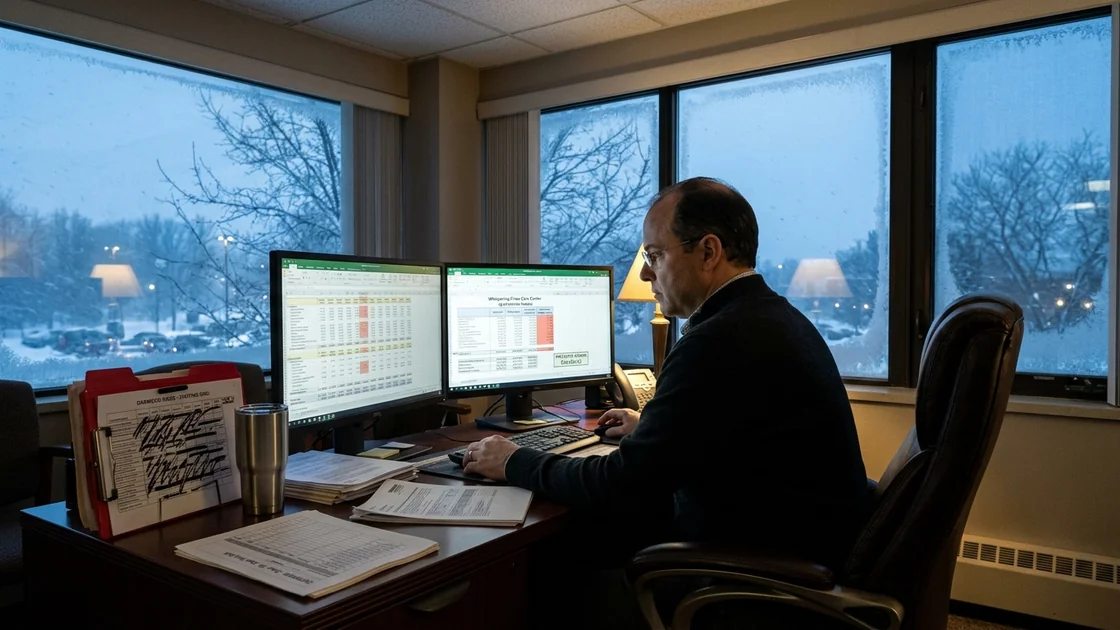
Arthur Vance believed that human frailty could be entirely accounted for within the gridlines of a Microsoft Excel spreadsheet, provided one had the stomach to balance the human cost against corporate dividend targets. As the executive director of Whispering Pines Care Center in St. Cloud, Minnesota, Arthur was driven by a single-minded ambition to secure a regional vice presidency and the forty-five thousand dollar annual performance bonus tied to operating margins. To hit his financial benchmarks before the close of the fourth fiscal quarter, he systematically dismantled the facility night-shift staffing, overriding the desperate pleas of the nursing staff and ignoring deferred maintenance reports on perimeter security systems. On a brutal mid-January night when an arctic cold front drove windchill values down to thirty degrees below zero, his calculated reductions collided with the wandering impulses of Clara Miller, an eighty-two-year-old resident suffering from advanced dementia. The subsequent catastrophic chain of events dismantled Arthur's polished corporate facade, exposing the fatal reality of transforming vulnerable human lives into clean statistical profit.
Chapter I: The Architecture of Margin
The numbers on Arthur Vance’s dual-monitor workstation did not bleed. They did not soil themselves, they did not wander aimlessly down linoleum corridors seeking long-dead mothers, and they never pressed call lights with trembling, arthritic thumbs. On a spreadsheet, forty hours of certified nursing assistant time looked clean: forty cells shaded in light vermilion, representing two thousand four hundred dollars in base pay, overtime loading, and payroll taxes.
Arthur dragged his cursor across the cells, selected them, and hit the delete key.
The sum at the bottom of Column F recalculated instantaneously, shifting from a deficit of three thousand two hundred dollars to an operational surplus of eight hundred dollars for the pay period ending January twentieth. Arthur leaned back in his high-backed ergonomic leather chair, interlaced his fingers behind his head, and exhaled a long, measured breath of climate-controlled air.
Outside his corner office on the second floor of Whispering Pines Care Center, the Minnesota afternoon was dying a pale, anemic death. A bank of low, bruised-iron clouds was rolling south from the Canadian border, pushing ahead of it a Canadian polar vortex that local meteorologists had been warning about for forty-eight hours. The forecast called for a daytime high of four degrees below zero, dropping to an overnight ambient low of minus eighteen, with gusts producing wind chills approaching thirty-five below.
Arthur did not look out the window. His focus remained fixed on the lower right-hand corner of the display, where cell J48 held the master projection for his quarterly management incentive.
Forty-five thousand dollars.
It was not merely money, though the money was desperately needed to satisfy the monthly payments on his lakeside home in Sartell and his wife’s lease on the Audi Q7. It was an affirmation. It was the metric by which Aegis Healthcare Solutions evaluated the worth of its facility administrators. Administrators who maintained staffing ratios at state minimums received commemorative plaques and gentle encouragement to improve efficiency. Administrators who beat baseline targets by four percent were invited to the corporate summit in Scottsdale. They were fast-tracked for regional vice presidencies.
A sharp knock broke the hum of the baseboard heaters.
"Come," Arthur said without looking away from the monitor.
The door swung inward, and Rachel Kelly, the facility’s Director of Nursing, stepped into the office. She was forty-four years old, but her posture carried the compressed weariness of someone who had spent twenty-two of those years lifting dead weight, mediating disputes between burned-out staff, and watching chronic illness win every protracted battle. She held a red plastic clipboard against her chest like a breastplate. Her scrubs, patterned with faded blue cornflowers, were wrinkled at the elbows.
"Arthur, you pulled the revised night schedule for Oakwood Ridge," Rachel said. Her voice was flat, dried out by too much industrial heating and lukewarm breakroom coffee. "Tell me it’s an error in the Kronos software."
Arthur rotated his chair smoothly, offering the temperate, managerial smile he had practiced in seminar workshops. "Have a seat, Rachel. Please."
"I don't have time to sit. The state survey team could walk in any day next week, and we are already drowning in mandatory inservices." She dropped the clipboard onto his desk. Underneath the clear plastic clip, the staffing grid for Oakwood Ridge—the facility’s sixty-bed locked memory care wing—was marked up with thick strokes of black permanent marker. "You eliminated the third floater CNA on third shift. And you crossed off the supplemental LPN."
"I didn't eliminate them, Rachel. I reallocated their hours to optimize the direct-care matrix based on our current patient acuity index," Arthur said, his voice measured, smooth, and deliberately calm.
"Acuity index? Arthur, it's sixty residents with cognitive decline. Half of them are sundowners. Mrs. Henderson tries to crawl out of bed every forty minutes because she thinks she hears her babies crying. Mr. Geller is combative during toileting. And Clara Miller—" Rachel stopped, taking a short, ragged breath. "Clara has had three exit-seeking attempts this week alone. You cannot staff sixty dementia residents with one floor nurse and two aides. If one aide is tied up on a two-person mechanical transfer and the nurse is running a med pass for three hours, there is exactly one person watching sixty doors."
Arthur tapped his desk pen against a pristine notepad. "The state minimum mandate for a specialized memory care unit in Minnesota requires an average of two point zero hours of direct nursing care per resident day. Even with this adjusted schedule, our rolling aggregate sits at two point zero four. We are fully compliant with the Department of Health."
"Compliant on paper is not safe in reality, and you know it!" Rachel’s voice cracked slightly, losing its professional reserve. "Aggregate means you’re counting daytime hours—when therapy and activities are here—to disguise the fact that between eleven at night and seven in the morning, that floor is a ghost ship. It takes two aides thirty minutes just to clean and reposition a bariatric resident. What happens to the other fifty-nine people while that’s happening?"
"What happens," Arthur said, standing up to assert his height, "is that staff use the call-bell telemetry system, monitor the motion detectors, and prioritize interventions. Aegis has rolled this exact staffing matrix out across twelve sister facilities in Wisconsin and Iowa. Their labor expense variances fell by seven point two percent in the first quarter."
"This isn't Wisconsin, Arthur. Look outside. It’s fifteen below zero right now, and the wind is picking up."
"The residents do not sleep outside, Rachel." Arthur picked up the clipboard, tapped the pages flush against the wood grain of his mahogany-veneer desk, and held it out to her. "The corporate budget for the fourth quarter is closed. We missed our target on commercial insurances because census in short-term rehab fell off in November. If we do not make up that delta on variable labor costs in memory care and long-term care, Whispering Pines will miss its operational margin by sixteen thousand dollars."
Rachel stared at the offered clipboard, but she did not reach for it. Her eyes moved from the paper to Arthur’s eyes, searching for something behind the rimless designer spectacles.
"You get your bonus if that margin hits three percent, don't you?" she asked softly.
Arthur felt a small, prickling heat rise along the back of his neck, but his expression did not alter. "My compensation package is tied to the fiscal health of this facility. When this facility fails its operating metrics, corporate replaces leadership. If they replace me, they bring in a transition specialist who will lay off twelve full-time staff members instead of adjusting PRN float hours. I am protecting this building’s long-term viability. Now take the schedule, Rachel. Post it."
Rachel’s mouth tightened until her lips were a pale, bloodless line. She took the clipboard from his hand. "If someone falls tonight, Arthur—if someone gets hurt because there wasn't a body in the hall to catch them—it isn't going on my license. I’m sending an email to corporate compliance tonight stating that this adjustment was made over clinical objections."
"Document whatever you feel is appropriate for your professional records," Arthur said coolly. "Just make sure the shift is covered."
When the door clicked shut behind her, Arthur sat down again. He took a sip of water from a stainless-steel tumbler. His pulse was beating a little faster than usual against his collar, but he dismissed the sensation. Pushback was inevitable whenever administrative discipline was imposed on clinical staff. Nurses were sentimental by nature; they operated from a perspective of unlimited resources and zero liability tolerance, completely divorced from the macroeconomic realities of private-equity-backed healthcare.
He moved his mouse to reopen the maintenance ledger.
There was an open work order from six weeks ago: Door 7B – East Wing Emergency Exit. Magnetic latch loose; secondary alarm reed switch intermittently failing to trip annunciator panel at nurses' station.
Arthur looked at the estimated cost: $1,420 for an external low-voltage contractor to pull new wire and replace the magnetic lock housing. He glanced at the maintenance budget line. It was currently twenty-two dollars under the monthly ceiling.
He clicked the drop-down menu on the work order, changed the status from Scheduled to Deferred – Awaiting FYQ1 Allocation, and closed his browser window.
He packed his leather briefcase, pulled on his cashmere-lined wool overcoat, and stepped out into the carpeted executive hallway.
Chapter II: The Sunset Ward
At 9:45 PM, the Oakwood Ridge memory care wing smelled of stewed green beans, chlorhexidine wash, and the stale, sweetish odor of urinary incontinence that had soaked into vinyl baseboards over three decades.
The corridor was illuminated by every third fluorescent fixture, an energy-saving protocol Arthur had mandated two years prior. The half-light cast long, rib-like shadows across the pale yellow walls. Every twenty feet, a framed watercolor print of a rural barn or a basket of kittens hung behind non-glare plexiglass, bolted to the drywall with tamper-proof security screws to prevent confused residents from taking them to bed.
At the nurses' station—a semicircular island of faux-granite laminate surrounded by high counters—Jerome Washington was trying to log four electronic vitals charts simultaneously while balancing a plastic medicine cup full of crushed pills in applesauce. Jerome was twenty-nine years old, a certified nursing assistant who had worked at Whispering Pines for five years. He was six-foot-two, with broad shoulders that were currently hunched forward over the keyboard like a defensive tackle bracing for a hit.
"Where is Miller's evening Seroquel?" he asked, not looking up. "She’s pacing the fire lane again."
Across the desk, Nurse Donna Gable was staring at the blinking cursor of the electronic medication administration record. Donna was sixty-one, an LPN who had come out of retirement eighteen months ago when her husband’s pension was cut in an airline restructuring. She wore thick bifocals that slid down her nose whenever she leaned over the blister packs of narcotics.
"I haven't gotten to the 9:00 PM pass for the north wing yet, Jerome," Donna said, her voice shaking with brittle exhaustion. "Arthur Vance cut the float aide, which means I spent forty-five minutes in Room 114 helping Maria clean up Mr. Henderson after his catheter blew out. I am two hours behind on charting, and the pharmacy delivery was missing three residents' cardiovascular meds."
"Clara’s agitated," Jerome said, clicking Submit on a vital sign log. "Her baseline is bad tonight. She’s looking for the kitchen."
"Give her two graham crackers and put the Lawrence Welk tape in the dayroom VCR."
"She don't want Lawrence Welk, Donna. She thinks she’s late for her shift at the telephone exchange. She has her winter boots on."
Jerome pushed himself away from the desk and walked down the north corridor toward Room 108. The floor beneath his rubber-soled sneakers was sticky from a mop job that had used too much detergent and too little warm water.
Outside Room 108, Clara Miller stood motionless, staring with profound concentration at the fire extinguisher box recessed into the wall.
She was eighty-two years old, barely five feet tall, and weighed ninety-six pounds. Her white hair, fine as raw silk, was gathered into an uneven barrette at the nape of her neck. Over a pair of flannel pajamas printed with faded lavender sprigs, she had pulled on a heavy, hand-knitted cable-knit cardigan with mismatched plastic buttons. On her feet were not the non-skid hospital socks required by facility safety policy, but an old pair of black shearling-lined winter booties with worn rubber treads, secured with salt-stained Velcro straps.
"Miss Clara," Jerome said gently, slowing his stride so as not to startle her. "What are we doing out here in the draft, honey?"
Clara turned her head. Her eyes were a pale, watery slate gray, framed by deep orbital hollows that made them look unnaturally large. In the clear light of youth, she had been a botanical draftsman for the University of Minnesota, spending forty years illustrating the microscopic cell structures of coniferous flora with microscopic ink pens. Now, those delicate pathways in her temporal lobes were choked with neurofibrillary tangles and amyloid plaques, leaving only scattered, bright fragments of an interior landscape that made no sense to anyone living in the present.
"The bus isn't coming down Fourth Street," she said. Her voice was remarkably firm, though thin, carrying the clipped cadence of an older generation of Scandinavian-American midwesterners. "The driver told my sister Martha that the snowdrifts through the cut were four feet high. If I don't get the cold frames covered, the winter cabbage will turn black by morning."
"There aren't any cabbages tonight, Clara," Jerome said softly, taking her thin elbow in his broad hand. Her arm felt like a bundle of dry birch twigs wrapped in wool. "It’s nearly ten o'clock at night. It’s bedtime. Let’s go back into your room and get your boots off."
"No," she said, pulling back with surprising leverage. She looked down at her hands, which were curled into fists. "The draft is coming under the sill. Can’t you feel it? The frost is right there on the baseboards. Martha left the greenhouse sash unhooked."
Jerome felt a cold pang behind his ribs. He looked toward the end of the hall. Door 7B, the emergency exit that led out to the small, fenced courtyard and the secondary staff parking lot, was twenty yards away. Even from here, he could feel the cold radiating off the concrete floor near the threshold. The commercial door seal was cracked, and the arctic air outside was pressing against the steel fire door like a physical weight.
"I know it’s cold, Miss Clara," Jerome said. "The wind is blowing hard outside. But we’re warm in here. Come on. I have some vanilla pudding down at the station."
She looked at him, her brow furrowed in deep, searching confusion. For a second, the fog in her brain parted enough for her to recognize his face. "Jerome? Is that you, Jerome?"
"Yes, ma'am. It’s me."
"My feet are so cold," she whispered, her voice dropping into a childlike register. "The floor is like iron."
"Let’s get those heavy socks on you, then," he said. He guided her gently by the shoulder, steering her three steps backward into Room 108.
The room was clean, sparse, and devoid of sharp edges. On her bedside table sat an old black-and-white photograph of a young woman standing beside a wooden greenhouse in Grand Rapids, holding a trowel and smiling into a summer sun that had set sixty years ago. Next to the photograph was her red call-light pendant, coiled around the bed rail like a plastic snake.
Jerome sat Clara on the edge of the twin bed. He knelt down to unfasten the Velcro of her shearling booties, but just as his fingers touched the straps, a piercing two-tone electronic warble erupted from the corridor outside.
Beep-boop. Beep-boop. Beep-boop.
The corridor display board lit up with red LED letters: ROOM 122 – BED OCCUPANCY SENSOR.
"Jerome!" Donna’s voice screamed from the nurses' station, stripped of all clinical composure. "It’s Geller! He’s trying to climb over the half-rail! He’s going to break his hip!"
Jerome froze for a split second, looking at Clara’s feet, then up at her face. Clara was staring blankly at the wall again, her attention already lost to the middle distance.
"Clara, stay right here on this mattress. Do not get up. You hear me? Do not stand up until I get back."
"The sash is banging," she murmured, her gaze fixed on the baseboard. "It’s going to shatter the glass."
Jerome jumped up and ran out into the hall, his sneakers squeaking sharply on the wax as he sprinted toward the south corridor to keep eighty-nine-year-old Leonard Geller from shattering his femur on the uncarpeted floor.
In Room 108, Clara Miller sat alone in the dimness.
The heat register beneath the window clicked, shuddered, and blew a sudden gust of lukewarm, dusty air into the room. Across the hall, the draft from the cracked seal of Door 7B whistled softly through the gap, a high, thin note like a distant bird call.
Clara stood up. Her boots remained securely fastened to her feet.
Chapter III: The Ledger and the Cold
At 11:30 PM, Arthur Vance was sitting in the finished basement of his two-story craftsman house in Sartell, ten miles northwest of Whispering Pines.
The basement was heated by a radiant natural gas fireplace that flickered behind tempered glass with a hypnotic, ceramic-log flame. Arthur was wearing a thick merino wool sweater and flannel-lined slippers. On the low coffee table rested a glass containing two fingers of single-barrel bourbon and his personal MacBook Pro.
He was looking at the regional performance dashboard for Aegis Senior Living.
The dashboard updated every night at midnight, pulling raw data from Kronos payroll servers and point-of-care charting terminals across thirty-four facilities in four states. Arthur’s facility was highlighted in green on the summary list. Whispering Pines was currently ranked number three in the Midwest division for Direct Care Expense Optimization.
His eyes tracked across the performance variables:
- Whispering Pines - Census: 94.2%
- Operating Margin: +3.12% (Target: 3.00%)
- Overtime Ratio: 1.1% (Target: < 2.0%)
- Projected Admin Q4 Incentive: $45,000.00
He took a slow sip of the bourbon, letting the oak and caramel warmth settle in his throat.
If he maintained this margin for the remaining eleven days of the fiscal month, the bonus was locked. More importantly, Marcus Caldwell, the Senior Vice President of Operations, was scheduled to visit the St. Cloud cluster in mid-February. Rumor had it that the current Regional Director for Northern Minnesota was stepping down to take a corporate consulting gig in Chicago. The candidate pool was small, and Caldwell was notorious for caring about only one thing: operational discipline. He had no patience for administrators who cried about staffing shortages or pushed back against corporate productivity formulas.
Arthur’s phone buzzed on the coaster.
It was an automated push notification from the St. Cloud National Weather Service station:
EXTREME COLD WARNING REMAINS IN EFFECT UNTIL 10 AM CST SUNDAY. WIND CHILL VALUES BETWEEN 30 BELOW AND 40 BELOW ZERO EXPECTED OVERNIGHT. FROSTBITE CAN OCCUR ON EXPOSED SKIN IN UNDER TEN MINUTES.
Arthur dismissed the alert with a flick of his thumb. He had lived in Minnesota for twelve years; cold was merely an operational variable. It meant checking that the rooftop HVAC units didn't freeze their intake valves, ensuring the backup diesel generator had its block heaters plugged in, and reminding facilities maintenance to lay down rock salt on the entrance walkways so visiting families didn't slip and generate a worker’s comp or premises liability claim.
His thoughts drifted momentarily to Rachel Kelly’s combative expression in his office that afternoon.
If someone falls tonight, Arthur... it isn't going on my license.
Nurses were dramatic. They saw every budget cut through the lens of individual bedside tragedy, unable to grasp the macroscopic reality that without fiscal viability, the entire facility would shutter, leaving all one hundred and twenty residents with nowhere to go. Whispering Pines was a business. It sold a service—elderly residential maintenance—and like any business with high fixed plant costs, its only elastic lever was labor. If you didn't pull the labor lever, the machinery broke down.
He opened his email. There was an internal memo from corporate legal regarding "Perimeter Security Protocols During Extreme Weather Events." He glanced at the first two bullet points: Ensure all secondary exits are physically inspected per shift logs. Verify annunciator chimes are functional.
He remembered the deferred work order for Door 7B.
A faint, uneasy itch scratched at the back of his conscience. The secondary alarm reed switch. The maintenance director had noted that the door still closed and latched physically, but the magnetic contact sensor was loose in its housing. Sometimes, if the wind slammed against the outside casing hard enough, the contact separated, or conversely, if the door was opened slowly, the failing switch didn't drop the circuit that triggered the master alarm buzzer at the nursing desk.
Arthur minimized the window.
The door had been like that for two months without incident. The residents on Oakwood Ridge were cognitively impaired, not escape artists; they rarely went near the fire doors unless they were wandering in groups during the daytime. Besides, there were two CNAs and a nurse on that floor tonight. It was impossible for someone to walk twenty yards down a lighted corridor, open a heavy commercial steel exterior door, and walk out into a blizzard without being observed.
He closed the laptop lid, drained the last of his bourbon, and turned off the gas fireplace.
The basement plunged into darkness, leaving only the blue standby LED of his high-efficiency furnace glowing against the wall as the unit fired up, its burner humming steadily against the encroaching cold outside.
Chapter IV: The Thinning Line
At 1:15 AM, the Oakwood Ridge unit was descending into the specific, suffocating chaos unique to understaffed geriatric care.
In Room 118, Mrs. Arbuthnot had ripped off her colostomy bag, smearing effluent across her sheets, the side rails, and the emergency call cord. CNA Maria Santos was in the bathroom with her, gagging softly behind an N95 mask as she tried to clean the resident with a basin of tepid water and disposable washcloths.
"Jerome!" Maria yelled through the closed bathroom door. "I need clean linens! The whole bottom sheet is soaked! And bring a new barrier cream!"
Jerome did not answer because he was forty feet away in Room 122, physically restraining Leonard Geller from throwing a bedside commode through the double-pane window.
"Let go of me, you son of a bitch!" Geller snarled. The eighty-nine-year-old possessed the wiry, frenzied strength that sometimes surfaces in late-stage dementia when adrenaline overrides arthritic pain. He had pinned Jerome against the nightstand, his gnarled fingers digging into Jerome’s forearms with bruising force. "The Germans are at the wire! They're coming up the ditch!"
"Mr. Geller, it’s Jerome. You’re at Whispering Pines. You’re safe, man," Jerome grunted, trying to peel the old man’s fingers back without causing skin tears on his paper-thin forearms. "Donna! I need some help in here! He’s pulling the curtain rod down!"
Down at the nurses' station, Donna Gable did not hear him.
Donna was on hold with the regional pharmacy depot in Minneapolis, sixty miles away. Her ear was pressed to a plastic receiver, listening to synthetic flute music while her free hand frantically paged through an eight-hundred-page three-ring binder of physician orders.
"Whispering Pines, LPN Gable," she barked into the receiver as a voice finally clicked on the line. "Listen to me, I have three residents on the north wing who did not receive their scheduled nighttime cardiac meds because your courier missed our depot box. I have Mrs. Chen with a systolic of one-ninety over one-ten, and I don't have her hydralazine. What do you mean you can’t dispatch a special courier until 6:00 AM? We have an arctic warning! The roads are closed!"
Behind her, the central telemetry console was flashing three simultaneous amber lights:
- ROOM 108 – UNATTENDED BED SENSOR (OFFLINE)
- ROOM 114 – CALL LIGHT ACTIVE (6 MINS)
- ROOM 129 – BATHROOM WATER RUNNING DETECTED
Because Arthur Vance had eliminated the float aide who normally acted as the unit's "eyes in the hall," the corridor itself was empty.
No one was walking the floor. No one was glancing into the doorways every fifteen minutes as mandated by the clinical care plans. The only movement in the long, half-lit hallway was the flicker of the emergency exit signs and the slow, rhythmic sweep of the shadows cast by the whipping trees outside the clerestory windows.
At 1:28 AM, Clara Miller walked out of Room 108.
She had her handbag over her left forearm. It was an ancient, black faux-leather pocketbook that her daughter had brought her three years ago, containing three dry cough drops, a plastic pocket comb with missing teeth, and six empty seed packets for heirloom beefsteak tomatoes.
Her gait was slow, uneven, but purposeful. Her winter booties made no sound against the waxed floor.
She reached the intersection where the north corridor branched toward the central nursing station. To the left, forty feet away, Donna Gable was screaming into the telephone receiver about blood pressure medication. To the right, twenty feet away, the corridor ended at Door 7B.
A sustained gust of wind hit the northeast corner of the building.
Outside, the temperature had fallen to twenty-one degrees below zero. The wind speed was clocked at thirty-four miles per hour, generating a windchill equivalent of minus forty-two. The force of the gust struck the exterior face of Door 7B with hundreds of pounds of atmospheric pressure, causing the loose steel frame to shudder in its concrete casing.
The bottom latch slipped two millimeters.
A thin, razor-sharp ribbon of freezing air cut through the gap, carrying with it a fine drift of dry, granulated snow that settled like powdered sugar on the gray commercial carpet runner just inside the door.
Clara stopped.
She did not turn toward the sound of Donna’s voice. In the deteriorated architecture of her mind, the noise from the nurses' station was merely the meaningless static of the world—the chaotic chatter of cars, machinery, and strangers that had frightened and confused her for years.
But the cold draft was different.
The cold draft was real. It had meaning. It was the specific, mineral-heavy chill of early spring in the north woods, the smell of snow melting against frozen leaf mulch, the urgent call of the garden beds before the ground froze hard.
"Martha?" she called softly into the empty corridor.
The only reply was the whistling hum of the wind through the cracked rubber gasket.
"I’m coming, Martha," she whispered. "I have the seeds."
She walked past the framed watercolor of the red barn. She walked past the linen closet with its padlocked door. She reached the panic bar of Door 7B.
Above the door, a red plastic sign read: EMERGENCY EXIT ONLY – ALARM WILL SOUND.
Clara could not read the words. To her eyes, the letters were simply black geometric shapes, no more significant than the veins on an oak leaf or the cracks in a dry garden stone.
She placed both hands against the horizontal aluminum push-bar.
She leaned her ninety-six pounds forward.
The latch clicked. Because the magnetic reed switch had drifted half an inch out of alignment with its contact housing—the repair Arthur Vance had deferred to save fourteen hundred dollars—the internal micro-switch failed to break the supervisory loop.
At the nurses' station, the master annunciator panel remained dark. No siren shrieked. No strobe flashed.
The steel door swung outward into the roaring, pitch-black maw of the Minnesota night.
Chapter V: The Ice Threshold
The cold did not hit Clara Miller as pain. At eighty-two, her peripheral nervous system was muted by age and vascular changes, and the shock of forty-two-below windchill was so instantaneous, so immense, that it paralyzed the sensory receptors before they could register acute suffering.
It felt, instead, like an enormous, heavy hand pressing flat against her breastbone, knocking the breath from her lungs in a short, white gasp that vanished immediately into the storm.
The heavy steel fire door, caught by the howling northwest gale, slammed backward against the exterior brick wall with a dull thud that was swallowed completely by the wind. Then, swung by its heavy pneumatic return arm, it crept slowly shut again.
Click.
The latch engaged. The exterior handle was a flush, key-operated plate with no thumb-turn. Whispering Pines was a secure facility; once an exterior door closed from the outside, it could only be reopened with an electronic proximity card or an emergency master key.
Clara was standing on a four-foot concrete stoop.
Three steps led down to a sidewalk that wound through the residents' therapeutic sensory garden—a fifty-foot enclosed courtyard surrounded by a six-foot decorative cedar fence. In June, the garden was filled with raised planter beds of lavender, sage, and sweet peas, designed so that wheelchair-bound residents could touch the leaves without bending over.
Now, the garden was a graveyard of white dunes.
The snow was not soft or powdery; at these temperatures, ice crystals lose their cohesion and turn into microscopic glass shards that drift like desert sand, packing into hard, wind-carved ridges called sastrugi. The drifts across the concrete path were three feet deep, burying the steps entirely.
Clara took a step forward into the void.
Her right boot sank through the crusted snow. Her foot did not find the solid surface of the stair; it slipped off the icy concrete edge, and her knee buckled. She tumbled forward into the drift, her black pocketbook flying from her arm and landing four feet away, where the tomato seed packets spilled out into the swirling white gloom.
She lay still for a long moment, face down in the snow.
The air three inches above the snowbank was twenty-five below zero. Within thirty seconds, the fine hair around her temples was coated in white rime from her respiration. The hand-knitted cable-knit cardigan offered no resistance to a thirty-four-mile-per-hour wind; the gale blew through the yarn loops as if they were cheesecloth, stripping the thermal boundary layer from her skin and driving her core body temperature down at a rate of one degree every four minutes.
"Martha?" she muttered into the snow.
The cold was confusing. It didn't feel like Grand Rapids. It felt like the big freezer at the back of the creamery where her father used to store the butter tubs in July. She remembered the smell of the pine tubs and the ice blocks covered in sawdust.
Get up, Clara. You have to get the cabbage in.
Driven by the ancient, mechanical instinct that keeps animals moving even as their cerebral cortexes begin to freeze, Clara pushed her hands into the snow. The shearling booties kicked against the drift. Her fingers, unshielded by gloves, were already turning an ivory, waxy white at the distal joints, the capillary beds constricting completely to preserve blood for the failing heart.
She dragged herself to her knees.
The wind struck her in the face, driving ice crystals into her open eyes. Blinded, gasping, she turned away from the building.
She did not look back at the red brick facade of Whispering Pines. Even if she had, the brick was invisible through the blizzard haze, and Door 7B was indistinguishable from the rest of the dark, frozen wall.
She saw only the low, dark shadow of the cedar fence fifty feet away. In the dim, ambient sodium glare from the distant municipal water tower, the fence posts looked like the arbor behind her family’s house on Pokegama Avenue.
She began to crawl through the snowbank, her thin knees dragging through the drift, leaving a shallow, wavering furrow that the wind began to erase three seconds after she passed.
Chapter VI: The Alarm
At 2:40 AM, seventy-two minutes after Clara Miller stepped into the courtyard, Jerome Washington walked into Room 108.
He was carrying a clean yellow hospital gown, two washcloths, and a small plastic cup of vanilla pudding that he had taken from the nourishment station refrigerator as an apology for leaving her alone so long. His scrub top was soaked with sweat between his shoulder blades, and he had a red scratch mark across his left wrist where Leonard Geller’s fingernails had caught him.
"Miss Clara," he said, speaking in the quiet, melodic singsong he used for night checks. "I got that sweet stuff for you. Let’s get these wet booties off and—"
He stopped in the middle of the room.
The bed was empty. The blankets were turned down in a neat triangle, just as he had left them. The indentation of her small body was still visible on the mattress foam, but the sheet was cold.
Jerome’s heart did not drop immediately; residents wandered constantly. They traded rooms, they crawled into closets, they fell asleep in the lounge chairs behind the linen carts.
"Clara?" he called, stepping into the tiny attached bathroom.
The light was off. The toilet seat was down. The small laminate wardrobe was closed. He jerked the wardrobe door open; only three cotton dresses hung on the plastic hangers.
He walked quickly out into the hall. "Donna! Have you seen Miller down at the desk?"
Donna was still typing, her eyes bloodshot and glassy behind her bifocals. "No. Isn't she in her room?"
"She’s not in her bed."
"Did you check the lounge?"
Jerome didn't answer. He ran down the south corridor toward the dayroom. The dayroom was pitch-black except for the glowing blue screen of the wall-mounted television, which was playing the menu loop of an old Dean Martin DVD. The four armchairs were empty.
He checked the public restrooms. Empty.
He checked the clean utility room, the soiled utility room, the nourishment pantry.
"Maria!" Jerome yelled, his voice echoing sharply down the hall, abandoning all pretense of night-shift quiet. "Maria, drop the linen! Miller is missing!"
Maria came out of Room 118, her face pale, holding an armful of dirty draw-sheets. "What? I saw her with you before Geller went off."
"That was an hour ago, Maria! Over an hour!"
Donna Gable stood up from the nurses' station, the color draining from her face until her aged skin looked like parchment. "Don't panic. She’s in the building. Oakwood is locked. She can’t get past the magnetic doors to the main lobby without a code."
"The doors," Jerome whispered.
He turned slowly and looked down the long north corridor.
At the far end, beneath the single fluorescent bulb, Door 7B stood closed and silent. But as Jerome stared at it, he noticed something that made his stomach drop into a bottomless, cold void.
On the pale blue vinyl flooring directly in front of Door 7B, there was a dark, wet smudge.
A water stain.
Jerome walked toward the door. With every step, the air grew noticeably colder. Five feet from the threshold, his breath bloomed in a faint, misty plume.
He looked down at the threshold.
Caught in the lower right-hand corner of the steel frame, pinched between the weatherstripping and the jamb, was a tiny tuft of lavender yarn.
"Oh, Jesus," Jerome breathed. "Oh, Jesus Christ."
He hit the panic bar with both hands.
The door flew open against the howling gale, and the arctic night burst into the corridor like a physical explosion. Donna Gable screamed as loose charting papers were swept off the nurses' station desk forty feet away, swirling through the air like frantic white moths.
Jerome stepped out onto the stoop into the thirty-degree-below wind. The cold punched into his lungs, seizing his trachea, blinding him instantly.
"Clara!" he roared against the wind. "Clara!"
He squinted down into the courtyard.
The security floodlight mounted to the eaves had burned out three weeks ago—another open work order that had sat on Arthur Vance’s desk waiting for the new fiscal quarter. In the dim, diffuse gray light filtering over the cedar fence from the highway lamps, the sensory garden was an undulating expanse of white drifts.
Then he saw it.
Ten feet from the steps, half-submerged in a drift that had formed against the raised planter box, was a small black rectangular object.
Her pocketbook.
Leading away from the pocketbook toward the far corner of the fence was a ragged, shallow trench in the snow, already two-thirds filled with fresh drifts, like the track of an animal that had dragged itself through the brush to die.
"Donna!" Jerome screamed into the open door, his voice cracking into a high, hysterical sob. "Call 911! Call 911 right now! She’s outside!"
Chapter VII: The Midnight Executive
Arthur Vance was awakened at 3:12 AM by the harsh, vibrating chime of his iPhone on the mahogany nightstand.
He rolled over, groggy with sleep, his mouth dry from the bourbon. For a brief second, he thought it was his morning alarm set for 6:00 AM. Then he saw the caller ID glowing in the dark room:
WHISPERING PINES – MAIN DESK
A cold needle of dread pierced through the haze of sleep. Facility administrators rarely received calls after midnight unless a boiler had failed or someone had died. Even then, standard protocol was for the Director of Nursing to handle initial notifications unless there was institutional exposure.
He cleared his throat and swiped the screen. "This is Arthur."
"Arthur." It wasn't Donna Gable. It was Rachel Kelly. Her voice was terrifyingly calm, devoid of the anger from that afternoon, carrying only the hollow, dead weight of catastrophic shock. "You need to get to the building immediately."
Arthur sat up, swinging his bare feet onto the cold hardwood floor. "Rachel? What happened? Is the heat down?"
"Clara Miller is gone."
Arthur’s mind rejected the sentence. "What do you mean, gone? She eloped from the unit? Did she get into the main lobby?"
"She went out Door 7B," Rachel said. "The fire door that had the broken alarm sensor you deferred on the work order list."
Arthur’s hand tightened on the phone until his knuckles went white. "When? When did she go out?"
"We don't know," Rachel said, her voice dropping into a flat, terrifying whisper. "The staff didn't realize she was missing until 2:40. Jerome found her pocketbook in the courtyard drift. The police are here. The paramedics are here. They are searching the grounds right now."
"Is she—did they find her?"
"Just get here, Arthur."
The line went dead.
Arthur sat in the darkness of his bedroom for five seconds, listening to the wind hammer against his double-hung bedroom windows. Outside, the pine trees along the driveway were whipping violently, their frozen branches clattering against the cedar siding like skeletal fingers.
Minus eighteen, he thought with sudden, paralyzing clarity. Minus eighteen, wind chill forty below.
He leaped out of bed. He did not shower. He pulled on a pair of heavy corduroy trousers, a wool turtleneck, his heavy goose-down parka, and his insulated winter boots. His hands were shaking so violently that he dropped his car keys twice on the entryway rug.
His wife, Sarah, appeared at the top of the stairs, wrapped in a white fleece robe, squinting into the light. "Arthur? What is it? What’s wrong?"
"There’s an issue at the facility," he said, not looking at her. "An operational issue."
"In this storm?"
"Go back to bed," he barked, his voice sharper than he intended.
He stepped out into the garage, hit the door opener, and backed his Audi Q7 into the howling blizzard.
The ten-mile drive from Sartell to Whispering Pines was a waking nightmare. Highway 15 was completely deserted; the Minnesota Department of Transportation had pulled their plows off secondary highways two hours ago due to zero visibility. The snow swept across the asphalt in blinding white sheets—ground blizzards that obliterated the road edges and the center lines. Arthur gripped the heated leather steering wheel with both hands, his knuckles aching, his chest so tight he could barely draw breath.
It was an accident, he told himself, the managerial voice in his head scrambling desperately to construct an interpretive defense. The door must have been propped open by a staff member. Jerome Washington had a disciplinary write-up six months ago for taking an unauthorized smoke break. If the door was propped, it’s a staff compliance failure, not a plant maintenance failure. The state will look at the policy manual. The policy manual clearly states that all perimeter exits must be visually checked every two hours.
He glanced at the digital clock on the dashboard: 3:34 AM.
She can’t have been out long. She probably crawled under the gazebo. An old woman in a heavy coat can survive an hour if she’s sheltered from the wind. They’ll find her, bring her in, treat her for hypothermia at St. Cloud Hospital. We’ll file a self-report with the Department of Health. Class B deficiency at worst. A plan of correction. A fine of maybe five thousand dollars. Aegis carries insurance for operational fines.
He repeated the words like a litany, trying to drown out the memory of the red font in the work order queue: Deferred – Awaiting FYQ1 Allocation.
He turned off the highway onto the frontage road that led to Whispering Pines.
Through the swirling blizzard, the facility looked like an offshore drilling platform in a gale. Red and blue emergency strobe lights cut through the falling snow, painting the white drifts in rhythmic, violent flashes of crimson and cobalt. Three St. Cloud Police Department cruisers, a fire department rescue truck, and an all-wheel-drive ambulance from Mayo Clinic Medical Transport were parked haphazardly across the snow-drifted entrance apron, their diesel engines idling with a deep, vibrating roar.
Arthur parked his SUV in a snowbank near the dumpster, killed the engine, and stepped out into the freeze.
The cold hit him like an iron bar across the throat. Even through his eight-hundred-dollar goose-down parka, the wind found every seam, turning his clothes into stiff cardboard in three seconds. He pulled his hood up, lowered his head, and ran through the knee-deep drifts toward Door 7B.
Chapter VIII: The White Courtyard
The sensory garden was illuminated by two high-intensity halogen floodlights mounted to the telescoping mast of the fire department rescue truck. The harsh, surgical white glare stripped away all shadows, exposing every drift, every dead twig, every inch of the trampled snow.
Four firefighters in heavy yellow turnout gear and two police officers were huddled in the far northwest corner of the courtyard, where the six-foot cedar fence met the brick exterior wall of the physical therapy wing.
Jerome Washington was sitting on the bottom step of the concrete stoop, wearing only his blue scrubs and Donna Gable’s fleece cardigan, which was far too small for him. He was rocking back and forth, his hands clamped between his knees, his broad shoulders shaking violently with silent, dry heaves.
Arthur pushed his way through the drifts, his boots sinking into the crust. "What’s happening? Where is she?"
Rachel Kelly was standing near the stoop, wearing a high-visibility winter coat over her scrubs. Her face was smeared with soot from the diesel exhaust and streaks of frozen tears. She turned her head slowly as Arthur approached.
She didn't speak. She simply pointed toward the corner of the fence.
Arthur stumbled through the snow, the wind catching his parka and spinning him off balance. "Officer! I’m Arthur Vance, the Executive Director! What is her condition?"
A St. Cloud police sergeant, his mustache crusted with yellow ice, turned around. His eyes were cold, hard, and utterly devoid of professional deference. He looked at Arthur’s clean, expensive parka, his designer boots, his smooth, unweathered face.
"Get back by the building, sir," the sergeant said flatly.
"I have a right to know the status of my resident," Arthur said, his administrative authority asserting itself automatically. "We need to coordinate with the medical director and prepare—"
"Step back!" the sergeant barked, stepping into Arthur’s path and shoving him backward with a heavy, mitten-clad forearm. "There is nothing to coordinate."
The firefighters shifted their positions, clearing the line of sight for a single, terrible fraction of a second.
Arthur looked.
Clara Miller was wedged into the eighteen-inch gap between the cedar fence and the commercial air-intake housing for the therapy gym.
She was not lying down; she was sitting on her knees, her torso slumped forward over a frozen mound of snow like a supplicant at an altar. She was wearing only her flannel pajamas and the cable-knit sweater.
Her shearling booties were gone; they had been pulled off by the suction of the heavy drifts thirty feet back, and her bare feet—waxy, yellow-white, and as hard as marble—were curled underneath her shins. Her hands were buried deep in the snow beneath her chest, clutching her tomato seed packets against her heart.
She was completely encased in a thin, translucent glaze of hoarfrost. Her white hair, blown back from her forehead by the gale, had frozen into rigid, delicate needles that glittered under the halogen floodlights like spun glass. Her eyes were partially open, staring down at the ice between her knees with an expression of profound, infinite stillness.
Two paramedics were kneeling beside her. One of them had a cardiac monitor open in the snow, its yellow screen glowing against the white drifts.
The paramedic reached down, pressed two gloved fingers against Clara’s carotid artery, held them there for twenty seconds, and then looked up at the other medic.
He didn't shake his head. He didn't start CPR.
In extreme hypothermia, standard emergency protocols dictate that a patient is not declared dead until they are warm and dead, but there are physical limits: when the chest wall is frozen solid, when the joints are completely ankylosed by ice, when the airway is obstructed by frozen pulmonary edema, resuscitation is impossible.
The paramedic reached out, took the red corner of a heavy wool disaster blanket, and pulled it over Clara Miller’s head.
The blanket caught the wind, flapping wildly, until the other medic weighted the corners down with two shovels of hard-packed snow.
Arthur stood in the drift, five feet away.
The air in his throat felt like broken glass. The cold seemed to have passed through his skin, his muscles, and his ribs, settling directly into the marrow of his bones. He could not feel his fingers. He could not feel his toes.
She sat there, he thought, a wild, disconnected realization spinning through his mind. She crawled into the corner to get out of the wind. She thought the air intake was a radiator.
"Mr. Vance?"
Arthur turned his head.
The police sergeant was standing beside him now, holding a small spiral notebook with weather-resistant yellow paper. A young patrol officer stood behind him, his hand resting on the grip of his utility belt.
"The charge nurse states that this door—Door 7B—was supposed to be tied into the master alarm system," the sergeant said. The wind was whipping his words away, forcing him to shout. "She states the alarm never went off at the desk. Is that correct?"
Arthur’s tongue felt thick, heavy, like a piece of frozen meat in his mouth. "The... the system is inspected annually by an outside low-voltage vendor."
"Did this door have an open maintenance order on the alarm contact?" the sergeant asked.
Arthur looked toward the building.
Through the open doorway of Door 7B, the warm, yellow light of the interior corridor spilled out onto the snow stoop. Inside, framed by the steel jamb, Rachel Kelly was standing with her arms crossed over her chest, staring directly at him. In her right hand, held high against her chest so he could see it clearly, was a printed sheaf of white paper.
The Kronos staffing schedule.
And underneath it, the red maintenance requisition log Arthur had deferred at 4:30 PM.
"Sir?" the sergeant repeated, his voice dropping into the low, ominous register of a formal criminal investigation. "Did you have knowledge that this safety device was non-functional?"
Arthur opened his mouth to speak.
He wanted to explain the acuity matrix. He wanted to explain the 2.04 aggregate direct-care nursing hours mandate. He wanted to explain the sixteen-thousand-dollar delta in the fourth-quarter operating budget, the Scottsdale leadership summit, the regional vice presidency, and the corporate formulas that calculated how many minutes an eighty-two-year-old woman was allowed to exist between room checks.
He wanted to tell them about the spreadsheet.
He wanted to say that on the screen, in the clean, light-vermilion cells, forty hours of CNA time did not look like an old woman freezing to death in a ninety-six-pound block of ice against a cedar fence.
Nothing came out.
The wind howled through the narrow courtyard, sweeping a fresh cloud of white, crystalline snow over the wool blanket, over the frozen garden beds, and over the toes of Arthur Vance’s designer boots, burying the tracks he had made coming in, until the ledger was completely clean, balanced, and white.
Chapter IX: The Corporate Response
At 8:30 AM, five hours after Clara Miller was cut from the drift behind the physical therapy wing, Arthur Vance sat in the Whispering Pines executive conference room.
The sun had risen, but it was a cold, mock sun—a pale white disc flanked by two brilliant, spectral sundogs that flared against the cobalt sky like optical flares in a dead lens. The ambient temperature was twenty-four degrees below zero, the coldest morning recorded in Central Minnesota in thirty-six years.
Arthur had not taken off his overcoat. He sat at the head of the long oak veneer table, his hands folded on the polished wood. His knuckles were gray-blue and swollen from the twenty minutes he had spent outside in the drifts; when he tried to bend his fingers, the joints felt as if they were packed with ground glass.
Across from him sat Marcus Caldwell, Senior Vice President of Operations for Aegis Senior Living.
Caldwell had arrived by private chartered turboprop from Minneapolis, landing on an icy runway at St. Cloud Regional Airport forty minutes ago. He was fifty-two, impeccably groomed, wearing an Italian charcoal-wool suit with a silk necktie that showed no sign of an emergency morning departure. Next to him was Victoria Briggs, the lead risk-mitigation counsel for Aegis’s upper-Midwest corporate umbrella. She had two thick leather folders open in front of her, their contents illuminated by the harsh winter glare bouncing off the snow outside the floor-to-ceiling windows.
Neither of them had touched the carafe of dark coffee Arthur had ordered from the kitchen.
"The St. Cloud Police Department executed an evidentiary search warrant thirty minutes ago, Arthur," Victoria Briggs said. Her voice was thin, quiet, and carried the neutral, metronomic cadence of a professional who spent her life managing catastrophic institutional negligence. "They imaged the facility’s hard drives. Specifically, they imaged the maintenance ticketing queue and the Kronos timekeeping logs from the last ninety days."
Arthur cleared his throat. The tissue in his throat was raw, scorched by the cold air he had breathed in the courtyard. "The... the maintenance ticket for 7B was categorized as a non-critical low-voltage service request. The door’s mechanical latch was functional. The policy manual clearly states that secondary ingress/egress points—"
"Arthur," Marcus Caldwell said.
The word was quiet, but it stopped Arthur as effectively as a hand across the mouth.
Caldwell did not look angry. That was the most terrifying thing about him. His face was an expanse of smooth, tanned corporate control, the product of decades spent managing nursing home chains through class-action wrongful death suits, union drives, and state regulatory crackdowns.
"The Minnesota Department of Health has already issued an immediate jeopardy citation," Caldwell said, looking down at his Montblanc pen. "The survey team is arriving at noon. By five o'clock today, Whispering Pines will be placed on state monitoring. That means a complete freeze on new admissions. That means short-term rehab is dead in the water. We are looking at an estimated sixty-day operational loss of roughly four hundred and fifty thousand dollars."
Arthur felt his ribs contract. "Marcus, the margin for Q4 was—"
"There is no Q4 margin," Caldwell said, his tone as flat as the horizon. "There is no bonus pool. There is no regional vice presidency. The board of directors held an emergency executive session while my plane was on the tarmac in Minneapolis. Do you know what the board asked me, Arthur?"
Arthur could not shake his head. He could only stare at the gold nib of Caldwell’s pen.
"They asked me why an administrator on an incentive contract was managing life-safety maintenance items through variable operational expense lines," Caldwell said. "They wanted to know why an exterior door with a documented sensor failure on a locked dementia unit was deferred for forty-five days to save fourteen hundred dollars."
"You told us to hit three percent," Arthur whispered, the words slipping out before his administrative instincts could stop them. His voice broke, revealing the raw, childlike panic beneath his corporate veneer. "You sent the memo in October, Marcus. You said direct care labor and plant operations were the only controllable variances left. You said administrators who couldn't protect the baseline would be replaced by transition specialists. I did what the regional matrix instructed us to do."
Marcus Caldwell looked up from his pen. His eyes were pale blue, cold, and entirely devoid of recognition.
"Aegis Healthcare Solutions does not instruct its administrators to violate state staffing mandates, Arthur."
"I didn't violate the mandate!" Arthur’s voice rose, cracking in the quiet room. "The aggregate was two point zero four! On paper, we were compliant!"
"Clara Miller did not freeze to death on paper," Victoria Briggs said softly.
She pulled a single sheet of paper from her folder and slid it across the table toward Arthur.
It was a printout of the email Rachel Kelly had sent to the Aegis Corporate Compliance Hotline at 5:15 PM the previous evening—six hours before Clara Miller pushed through Door 7B.
Arthur’s eyes scanned the text:
...I have formally objected to the elimination of the third-shift memory care float aide. The current staffing pattern (1 LPN, 2 CNAs for 60 high-acuity dementia residents) represents an immediate and unacceptable threat to resident life safety, particularly in light of ongoing, unaddressed perimeter security failures on Door 7B... Mr. Vance has explicitly linked these labor reductions to quarterly operating margin targets...
Beneath the signature line was an automated electronic receipt timestamp: Received – Aegis Legal Compliance Archive – 5:17 PM.
"Rachel documented the warning," Briggs said. "She documented the link between the labor reductions and your management incentive. The county prosecutor has already requested this document under subpoena. Along with the work order you deferred forty-eight minutes before her email arrived."
Arthur looked from the paper to Caldwell’s face. "You’re making this an administrative rogue-action defense."
"This is not a defense, Arthur," Caldwell said, closing his leather folder with a soft, final click. "This is a separation. Your employment with Aegis Senior Living is terminated effective immediately, for cause. Under Section 14 of your executive contract, termination for gross negligence or willful disregard of corporate life-safety standards completely nullifies all accrued incentive compensation, severance entitlements, and indemnification coverage for personal legal liability."
Caldwell stood up. He smoothed the lapels of his charcoal suit, picked up his leather coat, and walked toward the conference room door.
"Marcus," Arthur choked out, rising halfway out of his chair. His knees buckled slightly, the gray-blue pain in his frozen feet flaring like fire. "Marcus, I have worked for this company for eight years. I ran your turnaround facility in Duluth. I saved you four hundred thousand dollars in labor costs in three quarters!"
Caldwell stopped at the threshold. He did not turn around.
"You should call an attorney, Arthur. The County Sheriff’s department isn't looking at this as a Department of Health deficiency. They are looking at it as second-degree manslaughter."
The door clicked shut.
Chapter X: The Empty Corridor
Victoria Briggs left five minutes later, her heels clicking briskly down the tiled entryway toward the waiting corporate town car.
Arthur was left alone in the conference room.
The sun had climbed higher, casting a hard, blinding square of light across the oak conference table. In that light, every speck of dust hanging in the dry, heated air was visible, floating aimlessly like microscopic embers over the mahogany grain.
Arthur stood up. His feet were numb, heavy, feeling like two blocks of dead spruce inside his boots.
He walked out of the conference room and down the carpeted executive corridor. His office door was locked; a St. Cloud Police Department evidence seal—a strip of bright red vinyl tape with black lettering—was pasted across the seam between the door and the frame.
He turned toward the fire doors that separated the administrative wing from Oakwood Ridge.
He pressed his proximity card against the reader. The lock clicked, and he stepped through into the memory care corridor.
The unit was silent.
It was not the peaceful silence of a well-run hospital floor; it was the heavy, suffocating silence that follows an explosion. The daytime activities had been cancelled. The residents had been confined to their rooms by order of the interim clinical director who had arrived with the state survey team.
At the nurses' station, two investigators from the Minnesota Department of Health were sitting at Donna Gable’s desk, their heads bent over the master chart logs, writing methodically in long, yellow legal pads. They did not look up as Arthur walked past.
Arthur walked down the north corridor.
The water stain on the pale blue vinyl flooring in front of Door 7B had dried, leaving behind an irregular, chalky ring of dried rock salt and road brine that had blown in with the blizzard.
The door itself was now secured by a heavy steel chain wrapped through the panic bar and padlocked to an eye-bolt that maintenance had drilled directly into the concrete wall three hours ago. A brand-new battery-operated perimeter alarm, temporary and loud, was mounted to the lintel with two drywall screws, its green LED blinking like an accusing eye.
Arthur stopped three feet from the door.
He looked at the baseboard where the lavender yarn had been caught. It was gone, collected in a brown paper evidence bag now sitting in the trunk of a sheriff’s cruiser.
Across the hall, the door to Room 108 was wide open.
Arthur turned his head and looked inside.
The bed had been stripped down to the bare, blue-striped vinyl mattress. Clara Miller’s bedside table was empty. The photograph of the young woman in the Grand Rapids greenhouse was gone; her daughter had arrived at 6:00 AM, screaming at the staff until she collapsed in the entryway, and had taken the photograph, the dresses, and the small porcelain music box with her in a cardboard box.
The room smelled of nothing.
No green beans. No chlorhexidine. No perfume. Just the cold, sterile draft from the window register that was still struggling to blow warmth against the twenty-four-below air outside.
Arthur walked into the center of the room.
He looked at the wall where the framed photograph had hung. There was a small, clean rectangle on the pale yellow paint, surrounded by a thin outline of dust—the only mark left behind by eighty-two years of life, botanical illustration, gardening, forgetting, and dying.
He reached into his pocket and pulled out his phone.
The screen lit up with sixty-four unread notifications: missed calls from his wife, voice messages from local news reporters, text alerts from the Aegis regional email system notifying him that his credentials had been revoked.
He opened his banking app.
He looked at his personal checking account balance: $1,412.80.
His mortgage payment of three thousand two hundred dollars was due on February first. His wife’s lease payment was due on the fifth. His retainer for a criminal defense attorney with experience in corporate healthcare manslaughter would be twenty-five thousand dollars before the end of the week.
He looked down at cell J48 on the mental spreadsheet that had occupied his mind every waking hour for four months.
Target: $45,000.00.
The cell was empty.
Behind him, out in the courtyard, the wind began to rise again, howling across the frozen drifts of the sensory garden, picking up the dry, powdered ice from Clara Miller’s crawl track and hurling it against the double-pane glass of the window with a faint, dry rattle like handfuls of salt thrown against a tombstone.
Arthur stood in the center of the empty room, his overcoat wrapped tightly around his shivering frame, listening to the glass rattle in the frame, waiting for the police officers in the hallway to come and take his hands.