The Fracture on Mirror Lake
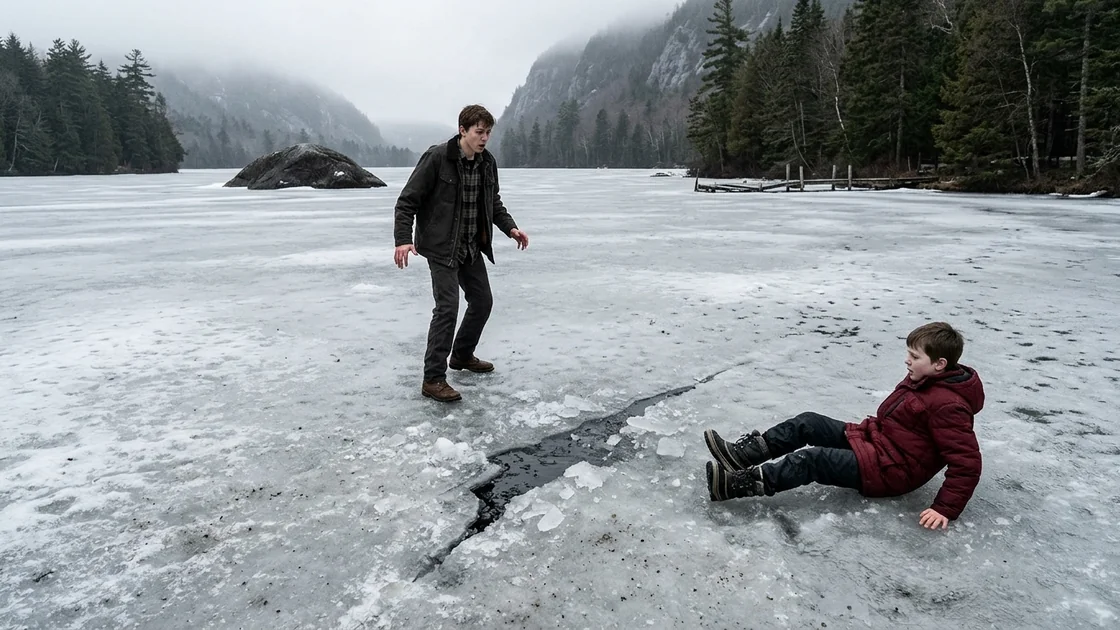
This is the story of Nathan, a restless sixteen-year-old spending an unseasonably warm March weekend at his family secluded mountain cabin, and his eleven-year-old cousin Julian, whom he inadvertently leads into catastrophe. Driven by adolescent pride and the suffocating boredom of a lingering winter, Nathan challenges Julian to cross the rotting, honeycombed surface of a vast mountain lake to reach a rocky island. When the fragile ice gives way and plunges Julian into the freezing black depths, Nathan is seized by a sudden and total psychological paralysis, an involuntary freeze response that leaves him rooted to the shoreline while his cousin fights for life beneath the shelf. What follows is a harrowing struggle against cold, guilt, and terror, detailing the physical mechanics of hypothermia, the excruciating reality of panic, and the enduring scars that settle over a family when childhood arrogance collides with the indifferent cruelty of the natural world.
Part I: The Rotting Season
The transition between seasons in the High Divide did not arrive with the gentle blooming of wildflowers or the sudden, radiant singing of migratory birds. It arrived as an illness. It came as a grey, sodden rot that stripped the spruce forests of their dignity and turned the packed snowbanks along fire roads into granular, soot-speckled ridges resembling discarded pumice.
Nathan sat on the warped railing of the wraparound porch, his boots resting on the second tier of the cedar balustrade, carving away at a strip of dead pine with a carbon-steel pocketknife. He was sixteen, an age where the limbs felt permanently bolted to an engine running at high idle, an age where stillness did not bring peace but an itch under the ribs that felt dangerously like contempt. The wood curled beneath his thumb, pale and aromatic, falling to join a small heap of shavings on the damp deck boards.
Inside the cabin, the voices of the adults rose and fell with the rhythmic, clinking domesticity of late morning. His father, Thomas, was arguing with Uncle Marcus about the water pump. It was the same argument they had indulged in every March since Nathan could remember: whether the ground had thawed sufficiently along the southern bedrock spine to risk opening the exterior valves, or whether another hard frost would descend from the pass and burst the copper pipework. Aunt Clara was running the tap in the kitchen, her voice chiming in with gentle, periodic rebukes that served only to keep the brothers talking in circles.
Beside Nathan, perched on an overturned plastic milk crate with his knees drawn up inside an oversized, hand-me-down down parka, was Julian.
Julian was eleven. He was at that delicate, bird-boned threshold of boyhood where the body seems to consist entirely of sharp elbows, bruised shins, and oversized ears. His face was pale, dotted across the bridge of his narrow nose with light brown freckles that looked like flicked nutmeg, and his eyes—large, slate-gray, and unblinking—followed every stroke of Nathan’s knife with an intensity that Nathan found both intoxicating and utterly suffocating.
"Is that going to be a spear point or a whistle?" Julian asked. His voice was still high, possessing that breathy, eager cadence of a younger boy who believed that every action taken by an older male relative was part of an unbroken, heroic continuity.
Nathan didn’t look up. He sheared off an uneven knot of pine with a sharp, resentful flick of his wrist. "It’s a wedge. For the shed door. If I wanted to make a whistle, I wouldn't use dead pine, Julian. You use green willow. I told you that last June."
"I forgot," Julian said softly. He didn't sound defensive; he sounded apologetic, as if his failure to retain the woodland lore handed down to him eight months prior was a personal moral failing. He pulled his sleeves down over his wrists, burying his hands inside the red quilted nylon. "Uncle Marcus said we might take the canoe out if the ice clears the bay."
Nathan let out a short, nasal bark that could have been a laugh if there were any humor in it. He looked past the cedar railing, past the cleared perimeter of the cabin yard, toward the vast, silent expanse of Mirror Lake.
From this elevation, three hundred feet above the waterline, the lake did not look like water. It looked like an abandoned quarry floor. In the dead of January, Mirror Lake was a clean, blinding sheet of marble, four feet thick, capable of supporting the weight of a logging truck. Snowmobilers cut crisscrossing tracks across its spine, their two-stroke engines buzzing like hornets in the hollows. But it was not January. It was the third week of March. A week of warm, southerly winds had blown through the valley, accompanied by a relentless, tepid drizzle that had eaten away at the winter crust.
The lake had turned from brilliant white to a sickly, bruised slate-grey. Along the eastern margins, where the runoff from the granite cliffs poured into the basin, the ice had already detached from the shoreline, leaving a moat of ink-black water five to ten feet wide. Further out, the surface was honeycombed—what the old timber cruisers called candled ice. It was a treacherous state of limnological decay where the horizontal structural integrity of the sheet dissolved, leaving millions of long, vertical hexagonal needles that remained upright only by the pressure of their neighbors. It looked solid from a distance, but it had no shear strength. It was a floor made of upright dry spaghetti.
"Your dad’s an idiot if he thinks that canoe is touching the water this week," Nathan said, folding the knife with a definitive, metallic snap. "The bay is choked with pack ice. And even if you pushed through the slush, the main body is completely jammed. It won't clear until mid-April."
Julian peered out through the hemlock branches toward the gray floor. "It looks hard enough to walk on out in the middle."
Nathan turned his head, his dark eyes narrowing slightly. A peculiar, sour boredom was churning in his gut. The weekend had been endless. The cabin smelled of fried bacon, damp wool, woodsmoke, and the low-level tension of family members who loved one another primarily out of duty rather than affinity. His smartphone had died eighteen hours ago, its lithium battery depleted by the cold and the total absence of a cellular tower within twenty miles. He felt caged, small, and ignored.
"You think so?" Nathan asked. His voice was lower now, shedding the sharp irritation and taking on a slick, conspiratorial edge.
Julian hesitated. He recognized the shift in Nathan’s tone; it was the tone that usually preceded an order to go retrieve something from the spider-infested crawlspace beneath the woodpile, or a command to hold the wire fence while Nathan tested whether the pasture battery was still live. Yet, Julian leaned into it. The desire to remain within the orbit of his older cousin’s attention was a gravitational pull he could not resist.
"I mean... it isn't moving," Julian ventured, pointing a red-nylon arm toward Heron Rock.
Heron Rock was a dome of pink granite that rose out of the deepest section of Mirror Lake, roughly four hundred yards from the cabin's private dock. In the summer, it was a diving platform, its submerged shelves dropping precipitously into seventy feet of clear, trout-filled water. In the winter, the ice piled against its northern flank in magnificent, shattered pressure ridges that looked like miniature glacial moraines. Right now, it sat isolated in the grey plateau, an island of stone surrounded by a desert of rotten crystal.
"It doesn't have to move to be dead," Nathan said, standing up from the rail and stretching his long, lanky frame. He was taller than his father now, a fact he wielded around the cabin like a cudgel, though his shoulders were still narrow and his wrists protruded awkwardly from the cuffs of his flannel jacket. "Ice dies from the bottom up when the springs warm up, Julian. But out by the Rock? That’s where the deep shelf is. The sun doesn't warm the bottom there. The ice is twice as thick over the deep water."
This was an utter fabrication. Nathan had overheard his father and Uncle Marcus discussing the lake two nights prior by the woodstove; Marcus had explicitly noted that the currents around Heron Rock were treacherous in the spring thaw because the submerged thermal upwellings from the deep fault lines eroded the sheet from below long before the shore ice gave way. But the lie came easily to Nathan’s lips, smooth and weighted with unearned authority. It made him feel like an instructor, like a man of the woods, like someone who understood the secret, hostile machinery of the landscape.
Julian stood up too, his small boots clumping heavily on the decking. "We’re not supposed to go down to the shore without someone watching. Aunt Clara said the mud on the trail is like grease."
Nathan rolled his eyes, a theatrical, heavy sigh that filled the cold space between them. "Jesus, Julian. You’re eleven, not four. What, do you need Clara to hold your dick when you pee in the woods, too?"
Julian’s pale cheeks flared with sudden, bright crimson. He looked down at the toes of his boots, his jaw tightening. "No."
"Then stop acting like a toddler," Nathan said. He stepped off the porch onto the packed, gravelly mud of the driveway. The earth was soft, giving way beneath his heels with a wet, sucking sound. "I’m going down to the spit to look at the beaver dam. You can either come or you can sit here on your milk crate and listen to your dad explain how a foot-valve works for the six-thousandth time."
Nathan didn’t wait for an answer. He turned his back, shoved his hands deep into the pockets of his canvas jacket, and began the descent along the zigzag trail that cut through the hemlocks down to the lake basin. He didn't have to look behind him to know that Julian was coming. Within three seconds, the hurried, scrambling patter of the boy's boots followed him into the shadows of the trees.
Part II: The Edge of the Mirror
The trail down to Mirror Lake was a steep, gouged trench through granite outcroppings and dense stands of eastern hemlock. In the summer, the needles formed a soft, rust-colored carpet that muffled every step, but today the path was an obstacle course of half-thawed mud, black roots slick as eels, and lingering patches of hard-packed blue ice hidden in the switchbacks where the sun never penetrated.
Nathan moved with the aggressive, careless agility of youth. He slid down the steep sections on the heels of his leather work boots, catching himself on birch saplings with a slap of his palms, showering Julian with bits of bark and cold drops of snowmelt shaken from the branches.
Behind him, Julian struggled. His winter boots were cheap, bought from a department store in the suburbs where Julian’s family lived, designed more for keeping toes warm between a heated minivan and an elementary school entrance than for navigating the Appalachian back-country. Twice, Nathan heard a wet thud and a sharp, muffled intake of breath.
"Keep your center of gravity low," Nathan called back over his shoulder without stopping. "If you fall, don't reach out with your wrists. Roll onto your hip."
"I didn't fall," Julian panted, his voice trembling slightly with the exertion of keeping pace. His knee was smeared with gray clay, and pine needles were stuck to the wool collar of his sweater. "I just slipped a little."
"Whatever. Hurry up. It’s almost noon. The fog's going to burn off and then the glare will be brutal."
When they broke through the final screen of alders at the base of the bluff, the lake opened before them, and the atmosphere shifted entirely. The air at the shoreline was distinctly colder than it had been up on the porch, a heavy, mineral-scented refrigeration that smelled of dead aquatic weeds, iron, and ancient wet stone.
The dock was an old wooden structure built on cribs of river rock. Every winter, the ice seized the pilings and wrenched them out of alignment; every spring, Uncle Marcus and Nathan’s father spent a weekend with come-alongs and sledgehammers trying to true them up. Right now, the dock was tilted drunkenly to the north, its cedar stringers warped and frosted with a thin, slimy layer of green algae. At the landward end, where the dock met the shore, a trench of open water—black and perfectly still—lapped against the gravel. It was perhaps seven feet wide, deep enough to reach a boy's waist, clear enough to see the pale, skeletal ribcages of sunken drift logs resting on the bottom.
Beyond this moat of open water lay the ice sheet.
Up close, the ice did not look like the surface of a frozen pond. It had no shine. It was a vast, matte-grey carpet riddled with billions of microscopic vertical air channels. In some places, it was the color of a bruised fingernail; in others, where rain had collected in shallow, wind-scoured hollows, it was an opaque, curdled white.
Nathan walked to the end of the tilted dock, his boots thumping hollowly on the loosened boards. He stopped at the edge, looking across the moat to where the ice sheet began. A fallen spruce trunk, blown down during the November gales, spanned the open water like a bridge, its gray, barkless trunk resting one end on the gravel bank and the other wedged firmly into the frozen crust of the lake.
"Look at that," Nathan said, gesturing toward the spruce log. "Natural gangplank."
Julian approached the edge of the cribbing cautiously. He kept both hands shoved into his parka pockets, his shoulders hunched against the damp wind that had begun to creep across the basin from the north. "The ice looks weird, Nathan. It doesn't look like it did at Christmas."
"It’s March, genius. It’s candled." Nathan stepped onto the fallen log, testing its give with his weight. The wood was solid, case-hardened by rain and wind. He walked across it with casual balance, his arms extended slightly, until he reached the other side. He hopped off the log and landed on the ice sheet.
Thump.
The sound was dull, heavy, and dead. It did not produce the bright, pinging resonance of three-inch black ice on a zero-degree morning—that singing, laser-like acoustic crack that skips across a new lake like a rifle shot. It sounded like landing on a mound of wet salt.
Nathan jumped once, twice, his boots coming down hard on the grey surface. A few loose crystals shattered beneath his soles, but the sheet did not move. It held.
"See?" Nathan looked back at Julian, a broad, mocking grin splitting his face. He planted his hands on his hips. "Solid as a church floor. It’s at least twenty inches thick here. You could park Marcus’s truck on it."
Julian remained on the dock, his eyes darting between Nathan’s boots and the dark, abyssal water visible through the gap beneath the spruce trunk. "My dad said when the ice turns gray, it’s rotten. He said you can't tell how thick it is because the crystals don't hold together."
Nathan’s jaw tightened. The mention of Julian’s father—that soft-spoken, suburban accountant who hired people to clean his gutters and wore brand-new hiking boots that never had mud on them—sparked an instinctive, ugly defiance in Nathan’s chest.
"Your dad is terrified of his own shadow," Nathan sneered. "He thinks you can drown in a bathtub if you don't wear water wings. If you want to listen to him, why don't you run back up the hill? Go on. Go help Clara cut up celery for the soup. That’s about your speed, isn't it?"
The insult struck with surgical precision. Julian’s mouth twitched. He pulled his hands out of his pockets, his small fingers curling into fists within his sleeves. "I’m not a baby, Nathan."
"You act like one. You talk like one." Nathan turned his back on the boy and took three long, deliberate strides out onto the lake, heading away from the shore. "I’m going out to Heron Rock to see if the bald eagle nest is still in the dead white pine. You can stay there and wet your pants, or you can come."
Nathan took another ten steps. Beneath his boots, the ice felt strangely spongy, like walking on several layers of thick corrugated cardboard laid over a soft mattress. Every few feet, his heels sank a quarter of an inch into the slushy surface layer, producing a squelching, wet hiss. But there were no cracks. There was no water pooling around his feet. The sheer mass of the winter’s accumulation was still there, a sullen, inert barrier between him and the cold oblivion of the basin.
He stopped, forty feet from the log, and turned around.
Julian was standing on the fallen spruce trunk. He had crossed halfway over the moat, his arms held out wide for balance, his eyes locked onto his own feet. His lower lip was caught between his teeth, his pale face set with a grim, pathetic determination that Nathan found both amusing and faintly irritating.
"Don't look down," Nathan commanded, crossing his arms. "Look at me. Walk straight."
Julian reached the end of the log. He hesitated for a long, agonizing second, his front foot hovering three inches above the gray ice.
"Come on," Nathan barked. "Don't think about it. Just step."
Julian stepped.
His boot touched down. The ice took his weight. He brought his other foot off the spruce log and stood on the lake surface, his small body rigid, his eyes wide and round as silver dollars. He looked up at Nathan, waiting for the world to collapse.
Nothing happened. The lake remained silent, vast, and still. A raven croaked from the crown of a dead hemlock on the high bluff behind them, the sound dry and abrasive in the quiet air.
A hesitant, triumphant smile broke across Julian’s face. "I did it."
"Yeah, you managed to walk on the ground," Nathan mocked, though a flicker of relief he hadn't known he was waiting for passed through his own stomach. He turned again and began walking toward Heron Rock, which loomed three hundred yards ahead—a humped, dark mass of rock rising fifteen feet out of the ice like the back of a surfacing whale. "Don't throw a parade yet. We’re not even out to the drop-off."
"How far is the drop-off?" Julian asked, his footsteps quickening behind Nathan. He was trotting to keep up, his small boots making a frantic, wet pat-pat-pat on the rotten crust.
"About halfway," Nathan lied again. In truth, the shelf dropped off barely eighty feet from the dock; beyond that line, the lake bottom plunged from a gentle gravel slope into a seventy-foot glacial trench where the water remained near freezing year-round. Nathan didn't know the exact topography, but he knew the water out here was deep enough to swallow their cabin whole without showing the chimney.
The air grew colder as they moved further from the shelter of the timbered hills. The wind, coming down the long north-south axis of the lake, was uninterrupted now. It caught the edges of Nathan’s unzipped jacket, billowing it behind him, cutting through his flannel shirt with an icy, damp knife. He shivered, though he kept his posture rigid and casual.
"Nathan?"
"What?"
"The ice is making a sound."
Nathan stopped. "Shut up a second."
They stood motionless in the middle of the gray expanse. At first, Nathan heard only the low, rushing sibilance of the wind in the hemlocks along the distant shoreline. Then, from beneath their feet, he heard it.
It was not a crack. It was a groan. It was a low, resonant, almost sub-audible vibration, like the sound of an iron freight train moving slowly over a bridge miles away. It rose in pitch, sliding from a bass hum into a glassy, clicking moan that traveled across the entire width of the lake, passing directly beneath them before fading into the granite cliffs on the far western shore.
Julian gasped and grabbed the back of Nathan’s jacket with both hands, his fingers digging into the heavy canvas with the frantic strength of a drowning man. "Nathan! It’s breaking!"
Nathan’s own heart gave a sudden, violent thump against his ribs, but the habit of dominance was too ingrained to surrender to the shock. He jerked his shoulder away, wrenching his coat out of Julian’s grip.
"Don't touch me! You almost knocked me over!" Nathan snapped, his voice harsher than he intended, colored by the sudden spike of adrenaline in his throat. "It’s not breaking, you moron. It’s making ice. Or shifting. It does that all the time. The sun warms it up, it expands, it groans. Haven't you ever been on a frozen lake before?"
"Not when it sounds like that," Julian whispered. He was trembling now, his knees slightly bent, his hands hovering near his chest like a small mammal preparing to flee. "Let’s go back, Nathan. Please. I don't care about the eagle’s nest. I want to go back."
Nathan looked at the boy. Julian’s eyes were glassy with actual, rising tears. The sight of that weakness—that raw, undisguised terror—ignited something ugly and defensive in Nathan. If they went back now, Julian would run to his mother. He would tell Clara that Nathan had taken him out onto the ice. Marcus would look at Nathan with that quiet, disappointed condescension that made Nathan want to put his fist through a wall. His father would bark at him about responsibility and judgment. He would be the screw-up again. The sixteen-year-old child who couldn't be trusted with an eleven-year-old.
"You are such a coward," Nathan hissed, leaning down into Julian’s face. "Look at the Rock. It’s right there. It’s barely a hundred yards. You’re going to walk all the way back because the ice made a noise? A noise?"
"It’s not safe," Julian choked out, a single tear escaping his eye and cutting a clean path through the dirt on his cheek. "I’m going back."
Julian took a step backward, away from Nathan, turning his body toward the shore they had left behind.
"Julian, stop!" Nathan barked.
Julian didn't stop. He took another step, his eyes fixed on the distant fallen spruce log.
A sudden, red wave of adolescent fury and wounded ego surged through Nathan. Without thinking, without calculating the weight, the momentum, or the fragile, rotting equilibrium of the world beneath their soles, Nathan lunged forward, grabbed Julian by the quilted shoulder of his parka, and spun him back around toward the center of the lake.
"I said stay here, you little shit!" Nathan shouted. "You don't run away when I’m talking to you!"
Julian stumbled, his boots losing purchase on the slick, honeycombed slush. He fell backward, his small weight coming down hard on his tailbone, his hands slapping the grey surface to break his fall.
CRACK.
It was not the subterranean hum of expanding ice. It was a sharp, explosive detonation, precisely like the report of a high-powered deer rifle fired in an enclosed room.
The sound did not come from beneath them. It came from between them.
Between Julian’s splayed boots and Nathan’s feet, a dark, jagged line snapped into existence. It was not a hair-thin fracture; it was an open tear, an inch wide, and through it, the ink-black water of Mirror Lake welled instantly to the surface, bubbling like oil from a pierced pipe.
Part III: The Paralyzed Shore
Time did not slow down; it shattered into discrete, disconnected sensory impressions that Nathan’s brain refused to integrate into a coherent whole.
Julian didn't scream immediately. His eyes dropped to the black crack between his legs. He saw the water rise. He saw the gray ice beneath his thighs turn translucent, then dark, as the vertical candles lost their friction against one another and dissolved into loose gravel of slush.
"Nathan?" Julian whispered.
Nathan did not move. He could not move.
A biological mechanism as ancient as the reptilian brain stem—older than thought, older than courage, older than love—slammed shut inside Nathan’s nervous system. It was not the cold calculus of fear; it was tonic immobility. The freeze. His muscles locked with such sudden, absolute force that his calves cramped inside his boots. His breath was caught somewhere behind his sternum, a hard, dry knot of air that refused to move up into his throat or down into his lungs. His eyes were wide, the pupils dilated until the gray world turned into a flat, high-contrast monochrome plane.
Move, a voice inside his skull screamed. It was a faint, tinny sound, like a voice heard through an old telephone receiver buried under three feet of earth. Move your feet. Reach down. Grab his collar. Pull him.
His fingers remained curled into half-clenched claws at his sides. His boots felt as though they had been set into five tons of quick-drying industrial concrete. He was a statue of salt. He was wood. He was stone.
Julian tried to scramble to his feet.
That was the fatal error. Had he remained prone, distributing his eighty-five pounds across the surface area of his back and thighs, the shelf might have held him for another ten seconds—long enough for the panic to clear, long enough for him to roll onto his stomach. But the child’s instinct was to stand, to bring all of his mass down upon the two narrow platforms of his rubber-soled boots.
He pushed his heels into the ice.
The section beneath him did not break into large, floatable pans. It simply disintegrated. The vertical columns of candled ice, already rotten to the core by three days of fifty-degree rain, sheared away under the localized pressure. With a wet, sucking sound that resembled a shovel plunging into heavy wet mortar, the lake floor opened beneath Julian.
He dropped.
It happened with terrifying, mechanical speed. There was no theatrical thrashing, no long, cinematic descent. One instant the boy was kneeling on the surface; the next, he was submerged to his armpits, his chest jammed against the jagged, crumbling perimeter of the hole he had punched through the sheet.
Then came the scream.
It was a sound Nathan had never heard from a human being. It was not a cry of pain; it was the involuntary, high-pitched vocalization of cold water shock. When seventy-degree air meets thirty-four-degree water, the skin’s thermoreceptors trigger an uncontrollable gasp reflex, forcing the lungs to expand violently regardless of whether the mouth is above or below the surface.
Julian’s head snapped back. His mouth was an open, jagged square. He drew in a massive, ragged lungful of air, spraying white vapor into the cold wind, his eyes rolling back in his head until only the whites were visible.
"NATHAN! NATHAN! NATHAN!"
His hands—his small, soft hands, bare now because he had left his wool mittens in his jacket pockets—clawed at the edge of the ice. But there was nothing to grip. The edge was not solid stone; it was a crumbling rim of frozen slush that sheared away beneath his fingers like wet sugar. Every time Julian tried to pull his chest up onto the ice, the shelf broke off in dinner-plate-sized chunks, widening the black hole and plunging him an inch deeper.
Nathan was standing six feet away.
Six feet. Two long strides. A single lunge.
His body did not belong to him. The paralysis was absolute. It was a physical horror beyond anything he had ever conceived: his mind was fully conscious, witnessing every frame of the unfolding slaughter, while his motor cortex remained completely severed from his limbs. The guilt was not something that arrived after the fact; it arrived simultaneously with the event, an unbearable, suffocating weight that told him he had killed his cousin, that the execution was already finished, that there was nothing to be done because the world had already ended.
Lunge, the tinny voice cried. Drop to your stomach! Throw him your jacket!
He couldn't even unbutton his jacket. His fingers were dead sticks. His jaw was clenched so hard that his back molars ground against one another with an audible, gritty squeak. His vision began to tunnel, the edges of his sight darkening with gray static, until the only thing in the universe was Julian’s pale, water-slicked face and the red nylon of his parka, which was rapidly darkening to the color of clotted blood as the down filling soaked up the lake water.
The water was thirty-four degrees.
At that temperature, the physiological clock does not run in hours or minutes; it runs in seconds. Within sixty seconds of immersion, cold shock gives way to swimming failure. The blood vessels in the extremities constrict violently, shunting all warm blood to the core to protect the heart and brain. The muscles in the arms and legs, starved of oxygen and warm blood, stiffen into useless, uncoordinated paddles. The fingers become numb within thirty seconds, losing their grip strength entirely.
"I can't... I can't feel my legs!" Julian shrieked. The scream was no longer high and clear; it was becoming gargled, thick with the water he was splashing into his own face as his arms beat the surface into a white foam. "Nathan! It’s pulling me! Nathan, please! PLEASE!"
The down parka, which had initially provided a few seconds of buoyancy by trapping air within its baffles, was now turning into a lead weight. Down feathers, once saturated, lose all loft and trap gallons of water, creating an anchor that dragged Julian’s small frame down toward the mud seventy feet below.
His chin dipped below the waterline.
He swallowed water, choked, coughed violently, his head thrashing from side to side. His small fingers, now a sickly, translucent grayish-blue, slipped off the rotten rim again.
"Nathan..."
It wasn't a scream this time. It was a gurgling, whispered sob. The sound of an eleven-year-old boy who has realized, with the terrifying clarity of the dying, that the person who brought him here is not going to save him.
The sight of Julian’s eyes—not angry, not accusing, but utterly betrayed and empty—did not break the paralysis. It deepened it. Nathan felt a sensation like cold grease sliding down his throat. His knees buckled slightly, but his boots remained glued to the ice. He was watching a murder through a glass window. He was an observer from another dimension, cursed to watch the inevitable without the power to touch the physical world.
Julian’s mouth went under.
Only his nose, his wild, rolling eyes, and his blue fingers remained above the black surface. The water was smooth between them now, undisturbed except for the rhythmic, dying ripples of the boy's failing legs.
The spruce trees on the shore seemed a million miles away. The cabin was a fairy tale that had happened three lifetimes ago. There was only the ice, the black water, and the boy disappearing into it.
Part IV: The Mechanics of Survival
The break in the paralysis came not from courage, nor from an act of conscious will, but from a biological circuit breaker.
Julian’s fingers slipped from the ice entirely. His head dipped below the surface, the dark water closing over his brown hair, leaving only a few rising bubbles of trapped air that broke against the slush with tiny, wet pops.
The boy was gone.
The visual cue of Julian’s complete disappearance severed the tonic immobility like a severed wire. The circuit broke. Nathan’s lungs released their trapped air in a violent, animal roar—a sound that was half-vomit, half-scream, tearing his vocal cords with its savagery.
"NO!"
Nathan didn't run forward; his survival instinct, finally functioning again, recognized that if he stepped on that rotten fringe, he would simply fall in on top of the boy and both would drown together in the dark.
He dropped.
He didn't ease himself down; he threw himself horizontally onto his belly, knocking the wind out of himself as his chest hit the wet, freezing slush. The impact cracked the ice beneath his ribs, a sickening spiderweb of gray lines radiating out from his sternum, but the horizontal distribution of his hundred and forty pounds held.
He dragged himself forward with his elbows, worming across the candled crust like an infantryman under fire. The slush soaked instantly through his canvas pants, through his flannel shirt, chilling his skin to an agonizing ache, but he didn't feel the cold. His brain was flooded with a toxic surge of noradrenaline and cortisol that dialed his sensory focus to a razor’s edge.
He reached the edge of the hole.
The ice here was terrifyingly thin, no thicker than a pane of glass over a slurry of crushed crystals. He couldn't get closer without plunging his own face into the abyss.
Nathan thrust his right arm into the black water.
The cold was not a temperature; it was a physical blow. It felt as if a heavy steel vice had clamped around his forearm and crushed the bone into splinters. The pain was so sharp, so blinding, that he nearly pulled his hand back by reflex. The water was so cold it burned like boiling grease.
He swept his arm through the darkness, blind, his face pressed against the wet ice.
Nothing.
Only the terrifying, silent emptiness of seventy feet of mountain runoff.
"Julian!" Nathan screamed into the hole, his voice breaking into a jagged sob. "JULIAN!"
He lunged further, risking the shelf, sliding his entire right shoulder into the water. His face was an inch above the surface; the smell of the black bottom mud—ancient, anaerobic, and cold—filled his nostrils. His fingers swept through the current.
They brushed against something smooth. Nylon.
Nathan’s hand snapped shut with every ounce of strength remaining in his forearms. His fingers hooked into the fabric of Julian’s parka hood.
Got him.
"I’ve got you!" Nathan yelled, but the words were choked off as he tried to pull.
Julian was impossibly heavy. The waterlogged parka, the soaked boots, the limp, dead weight of an unconscious child—it felt like trying to pull an engine block out of an oil sump with one hand. Nathan’s boots scrambled behind him on the wet surface, finding no purchase on the rotten ice. He was sliding. Instead of pulling Julian up, Nathan was being pulled down.
The edge of the hole crumbled beneath Nathan’s armpit. His chin hit the water. A mouthful of the icy, peat-stained liquid entered his mouth, bitter and so cold it made his sinuses throb with a vicious ice-cream headache.
I’m going in, he thought. We’re both going in.
The thought of death was not what terrified him; it was the thought of being trapped beneath that gray ceiling in the dark, looking up through the candled needles at the pale sky, unable to find the hole.
"Help!" Nathan screamed, his face turned toward the distant shoreline. "DAD! MARCUS! HELP!"
The wind carried his voice out across the empty lake, scattering it against the vast, indifferent hemlocks. No one was coming. They were three hundred yards away, behind two sets of double-paned windows and a roaring woodstove, arguing about plumbing.
Nathan ground his teeth together until he felt the enamel chip. He rolled his body to the left, throwing his entire weight onto his hip, using his torso as a counterweight against the lip of the ice. He reached down with his left hand, plunging it into the freezing slush to join his right, and grabbed a fistful of Julian’s wool sweater beneath the parka.
With a ragged, screeching heave that tore the muscles along his ribcage, Nathan jerked backward.
Julian’s head broke the surface.
The boy was not breathing. His face was a terrifying, waxy blue-gray, his lips purple as plums, his eyes closed. Thick, clear lake water poured from his nostrils and his open mouth.
"Julian! Breathe! God damn it, Julian, breathe!"
Nathan didn't know CPR. He had seen it on television; he knew you pushed on the chest, but he was lying prone on a surface that was disintegrating beneath him. If he tried to kneel over the boy to compress his chest, the ice would give way entirely and dump them both back into the trench.
He had to get the boy onto the solid sheet.
Using the last reserves of his adrenaline, Nathan backed up on his belly, kicking his legs like a salamander, dragging Julian’s upper body across the crumbling rim. The boy’s chest came out of the water, then his waist. His boots remained submerged, acting as a sea anchor, but Nathan kept pulling, his own hands now completely numb, his fingers locked into the fabric like frozen meat-hooks that could not be opened even if he wanted to.
With a final, desperate kick that sent a spray of gray slush into the air, Nathan hauled Julian’s entire body onto the ice.
They lay there together, three feet from the gaping black hole, both prone, both soaked in thirty-four-degree water, the north wind blowing over them with murderous efficiency.
Julian remained motionless.
Nathan scrambled onto his knees, ignoring the dangerous, sickening groan of the ice beneath his kneecaps. He leaned over his cousin. Julian’s skin felt like a refrigerated trout—clammy, stiff, and utterly devoid of warmth.
"Julian," Nathan sobbed, his voice cracking into a high, hysterical whimper. He slapped the boy's cheek with an open, numb palm. The sound was flat and wet. "Julian, wake up. Wake up! Don't do this. Please don't do this. I’m sorry. I’m sorry, Julian!"
He hit him again, harder.
Julian’s chest remained flat. There was no breath. No pulse that Nathan could detect with his own frozen, deadened fingertips.
Panic—a different kind now, not the freezing immobility of before, but a frantic, thrashing, wild madness—seized Nathan. He balled his fist and struck Julian squarely in the center of his small chest, right over the sternum, with a hammer-blow born of utter desperation.
"BREATHE!"
Julian’s body convulsed.
A violent, rattling spasm tore through the small boy’s frame. His back arched off the ice, his mouth opened wide, and a fountain of gray water and bile erupted from his throat, splashing across Nathan’s jacket. Julian drew in a long, whistling, crowing gasp—the sound of air scraping through a throat constricted by laryngospasm.
He began to cough. It was a weak, wet, rattling cough that sounded like a wet rag being beaten against a stone floor.
"Julian," Nathan wept, falling forward, wrapping his arms around the boy’s soaking wet down coat, pressing his own wet forehead against Julian’s cold temple. "Julian, Julian, Julian."
Julian’s eyes fluttered open. They were glassy, unfocused, the pupils unequal in size. He looked through Nathan, seeing nothing, his jaw chattering with a rapid, mechanical violence that caused his teeth to click together like dice in a cup.
"C... c... c..." Julian couldn't form the word cold. He could only shudder, his whole body shaking with such violent, uncontrollable rigors that Nathan could barely hold him.
The rigors were a sign of life, but they were also a warning of imminent heart failure. Severe hypothermia was setting in. In a boy Julian’s size, with zero body fat and soaked in freezing water under a ten-knot wind, the core temperature was dropping by a degree every three to four minutes. If Nathan kept him here on the ice, the shivering would stop within ten minutes, replaced by the fatal stupor of cardiac arrhythmia.
"We have to walk," Nathan said, his voice trembling so hard he could barely pronounce the syllables. "Julian, you have to get up. You have to stand."
Julian couldn't stand. When Nathan tried to haul him upright, the boy's legs folded like wet paper beneath him. His peripheral nerves had shut down; he had no motor control over his feet.
Nathan looked back toward the dock.
Three hundred yards.
Between them and the shoreline lay the honeycombed sheet, rotten and groaning, and the seven-foot trench of black water by the dock crossed only by that single fallen spruce log. Nathan could not carry the boy across that log. If he tried to walk upright while carrying eighty pounds of dead weight on this candled ice, they would both break through within twenty steps.
They had to crawl.
Part V: The Long Shore
The journey back across Mirror Lake was measured not in feet or yards, but in individual breaths and the slow, grinding abrasion of wet denim against ice.
Nathan could not carry Julian, so he became a sled.
He lay on his back, pulled Julian onto his chest—the boy’s soaked, shivering form pressed tightly against his own wet body—and began to push backward with his heels and elbows. Every yard was an agony of physical effort. The ice beneath Nathan’s shoulder blades was like a rasp, tearing through his flannel shirt, leaving a trail of crushed gray slush behind them.
"Keep your eyes open, Julian," Nathan chanted through chattering teeth. He couldn't feel his own feet anymore; they were two blocks of wood at the ends of his shins. His fingers were locked around the waistband of Julian’s trousers, holding the boy securely on top of him to keep him from rolling off onto the fragile sheet. "Look at the trees. Look at the cabin chimney. You see the smoke? Uncle Marcus is making soup. He’s making potato soup, Julian. With the little bacon bits you like. You smell that?"
There was no smoke. The fire in the woodstove had burned down to embers an hour ago. There was only the cold, grey sky, the indifferent mountains, and the smell of their own wet, freezing clothing.
Julian did not answer. His violent shivering had begun to diminish—a terrifying clinical development that Nathan did not understand, but which filled him with an instinctive, screaming dread. When a hypothermic patient stops shivering while still exposed to the cold, it means the body’s metabolic reserves are exhausted. The thermostat has failed. The core temperature has dropped below ninety degrees.
"Julian! Don't you sleep!" Nathan screamed, using the back of his head to strike the boy’s shoulder. "Julian! Sing with me! Sing that stupid song from the radio!"
Nathan tried to sing. What came out of his throat was a cracked, strangled howl, a series of rhythmic barks that were lost instantly to the wind.
Push. Dig with the left heel. Dig with the right elbow. Slide six inches.
The ice groaned beneath them, a continuous, running protest that followed their slow, tortuous retreat. Twice, Nathan felt the surface give beneath his buttocks, a cold wave of slush pooling around his waist, but he didn't stop to check. He couldn't stop. If they stopped moving, they would freeze into the lake like two drowned branches.
Ten yards. Twenty yards.
His elbows were bleeding now. The coarse crystals of the candled ice had chewed through the fabric of his flannel sleeves, scouring the skin of his forearms down to the red dermis. The pain was distant, muted by the cold, but the warm stickiness of his own blood was a strange, alien sensation against the numb frost of his arms.
Fifty yards.
Nathan’s heel struck something hard and unyielding.
He stopped, his breath coming in ragged, whistling sobs that burned his throat. He turned his head to the side, his cheek resting directly in the freezing slush.
It was the spruce log.
They had reached the edge of the moat.
Before them lay the trench of open water—seven feet of still, black depths, clear and cold, separating the ice sheet from the gravel shore where the cabin trail began. The fallen spruce trunk lay across the gap, its gray wood slick with moisture.
To Nathan, lying in the slush with his cousin dying on his chest, that seven-foot span of open water looked as impassable as the Atlantic Ocean.
He could not walk across the log. His feet were useless stubs; he couldn't even stand up. He could not throw Julian across; the boy would strike the granite rocks on the shore and break his skull.
There was only one way.
"Julian," Nathan whispered, his mouth pressed against the boy’s cold, blue ear. "I’m going to drop us in. But I’m going to hold you. I’m going to hold you up, and I’m going to push you onto the gravel. You have to grab the bushes. You hear me? You have to grab the alders and pull yourself out. Because I don't know if I can get out after you."
Julian’s eyes were half-open, clouded with a milky, bovine haze. He did not blink. He made a faint, whuffling sound in the back of his throat, like a sleeping dog dreaming of a hunt.
Nathan didn't wait for comprehension. If he waited, he would lose the courage, and the cold would finish what his arrogance had started.
He rolled Julian off his chest onto the edge of the ice, grabbed him by the scruff of his parka collar with both hands, and rolled himself off the sheet into the open water of the moat.
The immersion was worse than he had imagined.
On the open lake, the water had been thirty-four degrees. Here, in the shadows of the shoreline alders, fed by the deep mountain springs, it felt even colder. The shock punched all the air out of Nathan’s lungs in a single, explosive gasp. He went completely under, his boots finding no bottom in the deep silt of the shore trench.
The dark closed over his head.
For one terrifying second, beneath the water, everything was quiet. The wind ceased. The groaning of the ice was silenced. It was peaceful, soft, and infinitely heavy. It would be so easy to let go. To let the silt take him. To sleep here in the gray roots where no one would ever yell at him again, where Marcus could not look at him with disappointment, where the guilt could not reach him.
No.
His feet found a submerged rock. He kicked off with every shred of remaining strength in his quadriceps, driving his head above the surface.
He broke the water, coughing violently, blind with cold lake water.
Julian was still in his grip. The boy’s face was above water, his head bobbing against Nathan’s chest like a cork.
Nathan lunged forward toward the gravel bank. The shore was three feet away. The tilted pilings of the dock rose beside them, covered in slimy green weeds.
Nathan threw his upper body against the shore. The sharp, crushed gravel bit into his bare, bloody elbows. He lunged upward, driving Julian ahead of him, lifting the eighty-pound boy out of the water with a heave that ripped the tendon in his left bicep with an audible, sickening pop.
Julian landed on the gravel bank, his upper half sprawled in the dead ferns and alders, his legs dragging in the shallows.
Nathan tried to pull himself out behind him.
His legs would not respond. They were dead. The weight of his soaked clothes, his saturated leather boots, the utter depletion of his glycogen reserves—he was pinned to the water’s edge like an insect stuck in amber. His chin rested on the freezing gravel, three inches from Julian’s motionless boots.
The world was growing dark. The gray static at the edges of his vision was no longer gray; it was black, rimmed with a dull, pulsing violet.
He had failed. They were on the shore, but they were thirty yards from the trail, three hundred yards from the cabin, and no one knew they were here. They would be found together when Marcus came down with the canoe on Tuesday: two frozen carcasses lying among the dead leaves like roadkill.
Nathan drew in a breath of mountain air. It was cold, sharp, scented with hemlock and the coming rain.
He did not call Julian’s name. He did not cry for help.
He opened his mouth and let out an ear-splitting, jagged shriek—a pure, unfiltered blast of primal terror and hatred against the cold that echoed off the granite bluffs behind the dock, bouncing from rock to rock, cutting through the trees with the volume of an air-raid siren.
He screamed until his lungs were completely empty, until his vision went black, until his forehead fell forward into the freezing mud between Julian’s boots.
Then, the world went away.
Part VI: The Vigil of Salt and Cedar
The sound of the screen door slamming was a dull, rhythmic thwap-thwap that Nathan heard through three layers of thick wool blankets.
He did not wake up quickly. He surfaced through layers of grey sediment, his consciousness dragging itself up from the bottom of Mirror Lake through seventy feet of ink-black water, through the rotten candled ice, through the silt and the alder roots.
His hands were on fire.
That was the first sensation: not cold, but an agonizing, pulsing heat that felt as though someone had stripped the skin from his fingers and dipped them into molten lead. He groaned, a dry, rasping sound that rattled in his throat like gravel in a tin can.
"Don't move them, Nate. Keep them under the towels."
The voice was low, thick with a tremor Nathan had never heard in it before. It was his father.
Nathan opened his eyes.
The ceiling was the cedar tongue-and-groove of the cabin's great room. The yellow light of three kerosene lamps cast long, wavering shadows across the peeled-log rafters. A fire was roaring in the stone hearth—not the small, efficient fire his father usually kept to conserve wood, but a massive, crackling blaze that filled the room with an almost suffocating heat, the resin popping like small-caliber ammunition.
Nathan was lying on the floor in front of the hearth, wrapped in a cocoon of wool blankets, sleeping bags, and thick bath towels. Beside him sat two large galvanized metal washbasins filled with lukewarm water, steam rising from their surfaces in pale ribbons.
He tried to turn his head. His neck was stiff, the muscles locked in painful knots.
Across the room, on the long chintz sofa, lay Julian.
The boy was surrounded by three adults. Uncle Marcus was on his knees on the braided rug, his back to Nathan, his broad shoulders heaving with a rhythmic, jerky motion that Nathan slowly realized was weeping. Aunt Clara was sitting on the edge of the cushions, holding Julian’s bare, mottled blue-white feet against her own bare stomach beneath her wool cardigan, her face pressed against the boy’s shin, her eyes closed, her lips moving in a silent, frantic litany of prayer.
Thomas—Nathan’s father—was kneeling beside Nathan’s head. His face was gray, lined with deep, harsh grooves that made him look twenty years older than he had that morning. His flannel shirt was soaked with mud and lake water around the chest; he had carried both boys up the three-hundred-foot cliff face alone, carrying Julian in his arms and dragging Nathan by his wrists up the muddy switchbacks like a man possessed.
"Julian..." Nathan croaked, his tongue thick and dry as salt-pork against the roof of his mouth. "Is he..."
Thomas did not look at Nathan. He kept his eyes fixed on his brother Marcus and the small, still form on the sofa.
"He’s breathing," Thomas said. His voice was completely flat, devoid of anger, devoid of relief, carrying only that hollow, hollow exhaustion that settles over men after the catastrophe has passed and the wreckage is being counted. "He was in the water for nearly two minutes, Nate. His core was eighty-four when we got him through the door. If we hadn't heard you scream..."
Thomas stopped. He reached out with a heavy, calloused hand and pressed it against Nathan’s forehead. His hand was trembling so violently that his fingers rattled against Nathan’s temples.
"You screamed like an animal," Thomas whispered. "I thought a mountain lion had gotten into the clearing. I came out with the twelve-gauge. And there you were. Both of you. In the dirt."
Nathan looked past his father’s shoulder toward the sofa.
Julian’s chest was rising and falling, but the movement was shallow and rapid, accompanied by a wet, bubbling click at the bottom of every inhalation. He had water in his lungs—aspiration pneumonia, the doctors would call it later, when the orange paramedics finally arrived in their four-wheel-drive ambulances after two hours of navigating the washouts on the county road. He would spend four days in the pediatric intensive care unit in Burlington, hooked to a mechanical ventilator, his small body kept in a state of medically induced paralytic rest while antibiotics fought the black bacterial soup of Mirror Lake out of his bronchial tubes.
He would live. But he would not be the same.
Julian’s face was turned toward the fire now. His eyes were open, staring at the flames with an unblinking, glassy fixity that Nathan recognized with a sickening lurch of his stomach.
It was the freeze.
The boy was still there. He was still beneath the candled ice. He had not come out of the hole; his body was lying on the chintz sofa in the mountain cabin with his mother warming his feet against her ribs, but his mind was seventy feet down in the silt, looking up at the gray light through the vertical needles, watching the cousin who had dared him to walk into the dark.
Nathan tried to sit up.
"Stay down," Thomas said, his hand pressing down hard on Nathan’s shoulder with enough force to pin him to the floorboards. "The paramedics are at the gate. Marcus went down to unlock the chain. Your heart isn't stable yet, Nate. If you stand up, you can throw a clot. You stay on your back."
"Dad," Nathan wept. The tears were hot, burning his cracked, cold cheeks, flowing into his ears. He couldn't stop them; he didn't have the strength to put up the sneering, teenage wall of indifference that had protected him all winter. "Dad, I... I told him it was thick. I told him he was a coward."
Thomas did not look down at him. He kept his eyes on Julian, whose small jaw was working soundlessly in the firelight, his fingers twitching against the wool of his mother’s sweater.
"I know," Thomas said softly.
"I didn't... I froze, Dad. I stood there. I watched him go under. I couldn't move."
Thomas finally looked at his son. His eyes were not angry. They were worse than angry. They were heavy with the terrible, pitying recognition of an older man who knows that some failures cannot be repaired, that some moments cannot be undone by apologies or tears or long years of good behavior.
"You’re sixteen, Nathan," Thomas said, his voice dropping so low that Clara could not hear it over the sound of her own prayers. "You think you’re a man because you can carve a wedge and talk tough to a child. But you’re not a man. A man knows what the world can do to something soft. You gave that lake a life today, and you only got half of it back."
Thomas stood up. He did not touch Nathan’s hair; he did not squeeze his shoulder. He walked over to the sofa to stand beside his brother Marcus as the red and white lights of the emergency vehicles began to flash through the high, bare hemlocks outside the window, painting the room in silent, rotating strokes of blood and bone.
Part VII: The Thaw
Spring finally arrived in the valley three weeks later, not with a roar, but with the quiet, indifferent efficiency of the sun.
The ice on Mirror Lake did not break up in a dramatic, shattered spectacle. It simply dissolved. One morning, the grey floor was there, full of holes and rotten trenches; by late afternoon, a steady fifty-five-degree wind from the southwest had churned the surface into thousands of small, choppy whitecaps, and the ice was gone. The lake returned to what it had always been: a deep, cold, blue basin of clear mountain water, mirroring the pines, the granite cliffs, and the high, white cirrus clouds that drifted over the High Divide.
Nathan stood on the edge of the wooden dock.
His hands were still scarred. The frostbite had taken the skin from the pads of his middle three fingers on both hands; it had regrown in thin, shiny, purplish-pink sheets that were hypersensitive to the slightest draft. Whenever the temperature dropped below fifty, his fingers ached with a deep, throbbing bone-pain that reminded him, with every beat of his heart, of the sixty seconds he had spent with his arm submerged in the black trench.
He was alone.
Julian was at home in the suburbs, three hundred miles south. The family had not spoken of the incident since the afternoon the ambulance had pulled out of the driveway. Aunt Clara had not looked at Nathan when they packed their bags; she had simply moved around him as if he were an awkward piece of furniture, a hat rack or a floor lamp that had been placed in the middle of a hallway. Marcus had shaken his brother’s hand at the door, but when Nathan had stepped forward, his mouth open to speak, Marcus had simply turned away, his eyes sliding past Nathan toward the gravel driveway, his silence more absolute and crushing than any blow could have been.
Nathan took a deep breath. The air smelled of mud, pine needles, and the clean, mineral scent of open water.
He reached into his pocket and pulled out the small piece of pine he had been whittling on the porch that morning three weeks ago. He had finished it. It was not a wedge; it was a rough, crude, misshapen whistle, carved out of the dry, dead wood he had claimed was useless.
He held it in his palm for a long moment, feeling the jagged edges where his knife had slipped when his fingers were still whole.
Then, he drew back his arm and threw it as far as he could out into the center of the lake.
The small piece of wood sailed through the cold, bright air, tumbling end over end, catching the morning sunlight. It landed with a tiny, distant plip in the deep water eighty yards from the dock, near the drop-off where the pink granite shelf vanished into the seventy-foot abyss.
The ripples moved out in perfect, concentric circles across the blue mirror, widening, flattening, until the surface was smooth again, unbroken, giving back nothing but the reflection of the sky.