The Four Hours at Redoubt Eleven
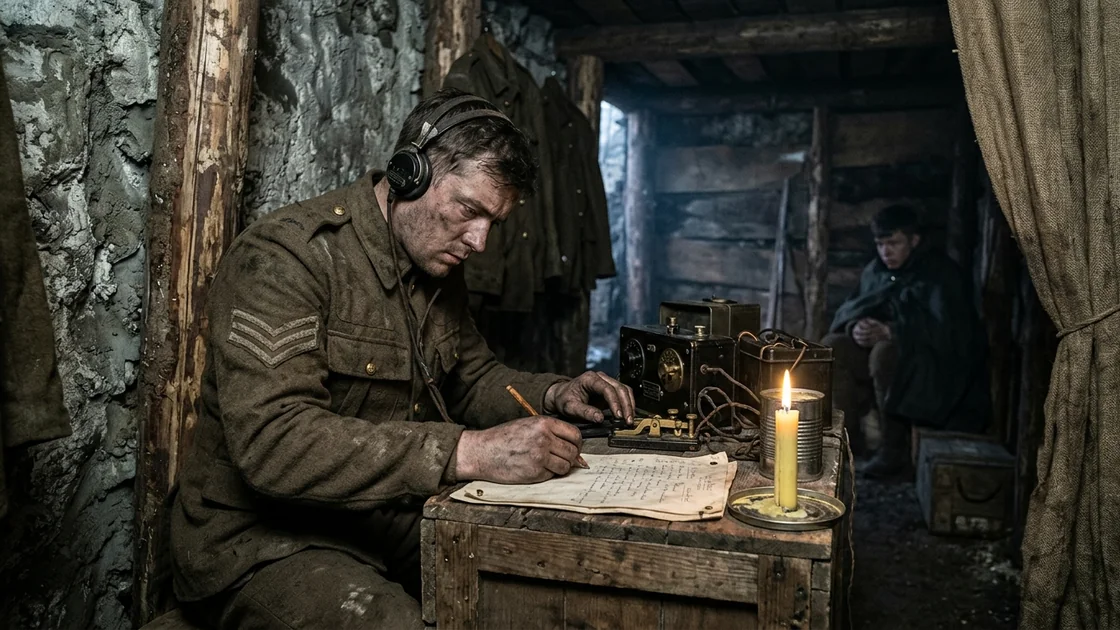
Corporal Arthur Finch spent the final autumn of the war inside a chalk-walled dugout near the village of Saint-Vaast, operating a buzzing Fullerphone and logging movements for the Fourth Battalion of the Royal Berkshire Regiment. During the damp pre-dawn hours of an impending sector truce, Finch allowed bone-deep exhaustion and careless haste to overtake his duties, misreading a garbled cipher string and recording an order for an immediate assault rather than a total suspension of hostilities. Because he refused to spend the extra minutes calling for a verification on a failing line, the frontline company went over the top into heavy machine-gun fire at dawn. For four unnecessary hours, wave after wave of soldiers threw themselves against unbroken wire while Finch sat in his warm subterranean post, drinking tea and ignoring discrepancies until an officer from brigade headquarters arrived to demand why men were dying for ground that had already been conceded.
The dugout smelled of three distinct varieties of damp: the sour wool of seven uniforms drying around an unvented coke brazier, the sweetish grease of lard used to pack the telephone connections against line corrosion, and the chalk mud that sloughed continuously from the timber revetments whenever the heavy siege batteries behind Acheville fired their morning registration salvos.
Corporal Arthur Finch sat with his back wedged against an upright pit prop that had split two inches along its grain under the weight of eighteen feet of Artois clay. His right hand was curled like a dry leaf around a stub of cedar pencil. His thumb, permanently blackened by copying-ink lead and the soot of tallow candles, rubbed rhythmic circles against the knurled brass tension screw of his Morse sounder.
The device was a Mark III Fullerphone, an instrument devised specifically to defeat German earth-current listening stations by translating telegraph pulses into a tiny, vibrating reed note that hummed in the operator's twin ebonite earpieces like a trapped horsefly. It did not click. It did not spark. It kept the line safe from the trench-listening sets the Bavarians had driven eighty feet into the chalk beneath Redoubt 11, but it demanded an ear so finely tuned that six hours at the terminals left an operator with a thrumming headache that settled behind the bridge of his nose and made his eyes leak watery mucus.
Finch had been on the key for fourteen hours.
His shift was supposed to have terminated at midnight, when Lance Corporal Davies was slated to stumble down the greasy duckboards from the communication trench at Hulluch Alley. But Davies had taken a piece of high-explosive shrapnel through the fleshy part of his calf while helping a ration party haul insulated D3 wire drums through the mud outside Brigade Forward. Davies had been hauled rearward to the Advanced Dressing Station at Lapugnoy, swearing in Welsh and leaving Finch alone in the signal hole with Private Tooley, an eighteen-year-old conscript from Nottingham who could not read Morse faster than eight words a minute and who wept quietly into his mess tin whenever an eight-inch shell landed within fifty yards of the entrance.
"Is the wire alive, Corp?" Tooley asked from the corner. He was curled atop two empty ammunition boxes, his knees pulled up inside a gas cape stiffened with paraffin.
"The wire is always alive," Finch said without looking at him. His voice sounded like gravel being kicked across an iron plate. "Even when the guns cut it, it picks up the damp. It talks nonsense until you ground it."
"Sounds like church bells in my tin hat," Tooley muttered, closing his eyes. "Every time them howitzers go off, the brim rings against my skull."
"Put your puttees over your ears and shut your mouth," Finch said. "You're fogging up the log sheets."
Finch hated the log sheets. They were printed on cheap, gray-tinted paper that absorbed grease from the fingertips and turned to mush if a drop of rain caught them on the run between dugouts. On his pad, pinned flat with two brass map tacks to a salvaged crate of corned beef, the day's record was already dense with scribbled code groups, grid coordinates, and the dull, administrative machinery of slaughter: battery expenditures, trench-mortar ammunition allotments, rum rations delayed by shellfire at the crossroads, and demands for replacement shovels.
It was 05:12 on the morning of October 14.
To the west, twenty miles behind them, the great brass clocks of the general staff ticked inside dry châteaux where fires were fed with birch logs and breakfast was served on linen. Here, in the sap beneath the support trenches of the Fourth Battalion, the world had shrunk to the yellow circle cast by a single candle stuck to a tin bully-beef lid. The candle was guttering; its wick had drown once in tallow and now leaned crookedly, spitting fat every few seconds with a tiny hiss that mimicked the incoming sound of a whizz-bang.
In the headphones, the reed hummed: dit-dit-dah-dit, dit-dah, dah-dah-dit.
It was only the brigade test-call. A clerk named Prosser down at Divisional Signals in Nœux-les-Mines was clearing his morning circuit, testing the line resistance before the general staff woke up and began demanding their typed summaries of night skirmishes.
Finch tapped his response with his index and middle fingers, an offhand, contemptuous rhythm: line clear, battery forty volts, stop bothering me.
His tea had gone cold three hours ago. A gray scum of condensed milk floated on its surface like grease on a scullery sink. His canteen was empty, and his mouth tasted of stale tobacco and the sulfurous bread they had baked three days before in Bethune. Every muscle in his right shoulder had locked into a single knotted spasm from leaning forward over the key to keep the instrument from picking up the mechanical shudder of the bombardment.
Behind him, through the sacking curtain that kept the candle-glow from leaking into the entry trench, came the dull, rhythmic thwack-crump of German 77s working over the frontline wire at the apex of the salient. The Berkshires held a position there known as the Scythe: three hundred yards of shallow, waterlogged ditch that curved out into the German lines like the blade of a grass-hook, exposed on both flanks to machine-gun fire from the concrete nests at Redoubt 11.
It was an impossible position. Everyone knew it. The battalion had lost ninety men taking it on Tuesday, and they had spent Wednesday through Saturday burying their own dead in the parapet because there was nowhere else to put them. The mud was so thick that if a man fell off the duckboards with a full pack, three of his mates had to haul him out with rifle slings before the black slime pulled him under.
The key buzzed again.
BZZZZ-BZZ-BZZZT.
It was not the lazy test-click of Prosser. The sending was rapid, jerky, and stamped with the unmistakable signature of Captain MacNair, the brigade signal officer. MacNair was a former post office engineer from Aberdeen who hit his Morse key as though he were driving six-inch spikes into dry oak.
Finch picked up his pencil. The lead point was broken; he had to twirl it against the grain of the rough pine table to scrape a fresh wedge of graphite against the wood.
"Wake up, Tooley," Finch barked, not turning around. "Get your coat on. Message coming through for the Colonel. You'll have to run it up Hulluch Alley to Battalion HQ."
Tooley groaned, his joints cracking like dry sticks as he untangled himself from his gas cape. "The alley's blowing full of dirt, Corp. The Jerry trench-mortars have been lobbing minenwerfers into the traverse since four."
"I don't care if they're lobbing their grandmother’s commodes," Finch said. "Put your helmet on."
The reed in his ear was already chattering:
PRIORITY. ALL STATIONS FOURTH DIV. MSG NO 441/B.
Finch’s hand moved across the paper, writing the header with the mechanical smoothness of six years behind the counter at the Swindon railway clearing house. He had joined the Great Western Railway at fourteen, spending ten hours a day logging goods wagons—coal from Tredegar, pig iron from Newport, timber from the Forest of Dean. He had been proud of his hand then; his clerk’s script had possessed a clean, upright flourish that won praise from the district superintendent. Now, his letters were pinched, crooked things, slanted violently by the trembling of his fingers and the constant tremor of the ground.
SECRET AND IMMEDIATE, the reed buzzed. TO OC 4TH BN ROYAL BERKSHIRE REGT.
Finch’s eyelids drooped. A heavy, sickening wave of sleep rolled through his skull, so thick that for three seconds his pencil stopped, hovering half an inch above the pulp paper while his brain simply went dark. It was the treacherous sleep of forty-eight hours without a bunk; it felt like warm oil poured over the nape of his neck.
A violent detonation—a heavy mortar striking the sap twenty yards down the line—jerked his head upward. A shower of fine, powdery chalk rained from the timbers, dusting his hair, his wool tunic, and the log pad with a faint white film.
He spat chalk out of his mouth and cursed. The headphones were still buzzing. He had missed two cipher groups.
...DAH-DIT-DAH-DIT... DIT-DIT... DAH-DIT-DIT...
He should have tapped the break key. The standard procedure, drummed into every signal recruit at the depot in Bedford until they could recite it in their sleep, was absolute: If a group is lost or garbled by line-shake, interference, or shelling, the receiving operator shall immediately transmit the signal ‘MQ’—Wait, repeat from last acknowledged word.
Finch’s finger hovered over the brass key to send the request.
If he asked for a repeat, MacNair would come back with his furious, rhythmic Aberdeen scolding. MacNair would make him re-verify the whole preamble. It would take ten minutes. The line was deteriorating rapidly; he could hear the wet, mushy dragging sound that meant water was seeping through a cracked rubber sleeve somewhere in the communication trench. If the line went out entirely while they were squabbling over a repeated group, Finch would have to crawl out through the sap with a test set strapped to his belly to find the break, wallowing through the liquid mud under the dawn snipers.
Besides, Finch thought he knew what the message was.
Rumors had been drifting down through the supply echelons since Thursday. The French on the right had broken through toward Cambrai; the Germans were pulling their artillery back to the Drocourt-Quéant switch line; there was talk of a general retirement across the whole Lens sector. At three o'clock that morning, the battalion adjutant had stopped by the signal pit on his way to the latrines and told Finch that Corps was negotiating a four-hour local suspension of arms to clear the two hundred wounded rotting between the Scythe and Redoubt 11 before the autumn rains drowned them in their shell holes.
The cipher group he had partially missed ended with ...AH-DIT.
Then came the operational text in clear:
SUSPEND OFFENSIVE ACTIONS.
The reed hissed with static, then delivered four sharp, rapid bursts:
CEASE FIRE.
Finch's pencil wrote: SUSPEND OFFENSIVE ACTIONS.
Then came the time group. 0-6-0-0.
Six in the morning. That was forty minutes from now. It all made sense. A local armistice. The Berkshires would hold their parapets, the stretcher-bearers would go out with white rags tied to entrenching tool handles, and Finch would be able to lie down on the dry chalk floor behind the battery boxes and sleep until noon.
The reed buzzed again, but it was weak now. The line voltage was dropping from forty to twenty-five. The buzz was becoming a wet, ragged rattle, like the breath of a man whose lungs were full of mustard gas.
COMMENCE...
Finch frowned. His pencil paused.
The Morse had become erratic. The battery at brigade was dying, or a shell splinter had clipped the copper strand without parting the rubber insulation, causing the signal to leak into the wet chalk.
The transmission read: DIT-DAH-DIT-DIT... DAH-DAH-DAH... DIT-DAH-DAH-DIT...
In his exhaustion, the letters swam together on the paper. Did MacNair mean that they were to commence the suspension at 06:00? Or was it an order confirming the alternative brigade scheme that had been discussed two days ago—the diversionary raid to pin the reserves of the German 16th Bavarian Division?
The proper procedure was clear: BREAK. REPEAT FROM WORD 'ACTIONS'.
Finch looked at the candle. It had guttered down to the tin rim; the blue flame was swimming in a transparent pool of wax. If it went out, he would have to find a match in the dark, and his matches were damp from his tunic pocket. His head throbbed with a rhythmic, sickening ache that matched the beating of his pulse. He wanted to be done. He wanted to drink the dregs of the cold tea, throw the grease-spotted gas cape over his head, and let the war run itself without him until noon.
He looked at the torn edge of the pad.
A more conscientious man—a man whose nerves had not been frayed down to the bare copper by five months of continuous trench service—would have pounded his key until brigade answered. He would have held the circuit open until every letter was as legible as an inscription on a headstone.
Finch did not do that. He made an assumption. It was an assumption born of that peculiar, fatal arrogance that takes root in tired men who believe that because they have survived two hundred artillery barrages, they can predict the minds of the staff officers three miles behind them.
"It’s the raid," he muttered to himself.
"What's that, Corp?" Tooley asked, buckling his webbing with clumsy, cold-stiffened thumbs.
"Nothing," Finch snapped.
He looked at the half-transcribed phrase: SUSPEND OFFENSIVE ACTIONS CEASE FIRE 0600.
Then his eye caught the following group, which he had logged as COMMENCE. But the group before it had not been CEASE FIRE. In his sleep-sodden haze, he had misread the dots.
The Morse for CEASE FIRE is:
-.-. . .- ... . (CEASE)
..-. .. .-. . (FIRE)
The Morse for CLEAR LINE—a standard instruction to clear the
channel for an operational priority—is nearly identical if the key
operator drops a space and the line has earth-leakage:
-.-. .-.. . .- .-. (CLEAR)
.-.. .. -. . (LINE)
MacNair had not sent SUSPEND OFFENSIVE ACTIONS CEASE FIRE.
He had sent: SUSPENDED OPERATION NOW CONFIRMED. CANCEL PREVIOUS ORDER FOR CEASE FIRE. COMMENCE ASSAULT 0600.
Or had he?
The paper was a blur of gray graphite. Finch looked down at what he had written. He had written three words, scratched them out with two furious strokes of his blunt pencil, and then, in his desperate hurry to send Tooley out before the communication trench became impassable, he set down the version that his sleep-poisoned brain insisted was the only logical one:
ORDER CONFIRMED. CANCEL SUSPENSION. ASSAULT REDOUBT ELEVEN AT 0600 AFTER PREPARATION. CONCENTRATE FIRE.
"Here," Finch said, ripping the sheet off the pad with a violent, tearing pull that left two jagged teeth of gray paper under the brass tacks. "Take this to Captain Miller at Company HQ in the reserve traverse. Don't go by the alley; the parapet's down at the sap-head. Run across the rear communication ditch. If you get hit, keep your belly over the paper so the mud doesn't take the writing off."
Tooley took the folded paper. His face was gray in the dying candle-light. "Is it the push, Corp?"
"It's what's written on the bloody sheet," Finch said, his voice rising into a sharp, thin crack. "Get out of here. And tell the cook-sergeant if he doesn't send two tins of condensed milk down with the relief, I'll report his ration store to the provost marshal."
Tooley ducked under the wet burlap curtain. A gust of cold, sour air swept into the dugout, smelling of decomposing vegetation, cordite, and the stagnant water of the support sumps.
Finch reached out with his left hand, lifted the tin lid of his mess kit, and blew out the candle.
The darkness came down like a wool blanket soaked in brine. It was absolute, thick, and cold. He laid his head on his arms, right across the smooth brass of the Morse key, feeling the cold metal bite into his cheekbone.
"Forty minutes," he whispered to the timbers. "Just forty minutes of quiet."
In the forward fire trench at the Scythe, Captain Lawrence Miller was shaving by the light of a tiny trench mirror hooked into the hazel-wicker revetment.
The mirror was silvered glass, two inches wide by three inches tall, and it was cracked diagonally from bottom left to top right where a stray sniper bullet had clipped the sandbag it was hanging from three mornings ago. Miller used cold, greasy tea from his canteen for lather. His brush was down to half its bristles; every time he drew it across his chin, it left stiff boar-hairs stuck in the dried soap on his skin.
He had not washed his body since the battalion had relieved the 8th Suffolks at the railhead twelve days before. His skin felt like an old boot that had been dropped in a pond and then dried too near an oven: stiff, itching, and stretched tight over the bones of his cheek and jaw.
"Watch your elbow, sir," whispered Sergeant Major Gape.
Gape was kneeling on a wooden biscuit box at the bottom of the fire-step, carefully cleaning the feed-blocks of two Lewis guns with an oily rag torn from a flannelette rifle pull-through. Gape was forty-two years old, an old regular soldier who had served in the Tirah with the 1st Battalion in '97 and who treated the European war not as an apocalyptic crisis of civilization, but as an exceptionally poorly managed deployment of the Wiltshire militia.
"The mud's coming over the second traverse again, Lawrence," Gape said softly. He was one of the few non-commissioned officers who permitted himself the use of the Captain's Christian name when they were alone in an advanced post. "If we don't get six dozen corrugated sheets up here before nightfall, the fire-step's going to slide into the sump. We won't even need the Bavarians to kill us; the Berkshire clay will choke us like puppies in a bucket."
Miller wiped his razor on the sleeve of his greasy trench coat.
"The wire's quiet, Gape," Miller said.
"It is, sir. Unnaturally so."
Miller looked up at the slit of gray sky visible between the low sandbags of the parapet. Dawn was coming, but it was not the clean, pink-edged dawn of England; it was a slow, yellowing bruise that spread upward through the low scud of cloud from behind the German positions at Acheville.
Out in front of them—seventy yards across a waste of cratered loam that looked like a field of black porridge that had boiled and then frozen into still lumps—lay the wire of Redoubt 11.
It was not the thin, rusty coils of the training camps on Salisbury Plain. The Germans had used five-gauge steel wire with four-point barbs as thick as an index finger, woven into three interlocking belts twenty feet deep, held up by corkscrew iron pickets that were driven four feet into the chalk. The battalion’s three-inch Stokes mortars had been firing at those belts for two days, but the three-inch bombs did not cut wire; they merely threw it into the air, tangled it into tighter knots, and dropped it back into the mud like great bunches of iron briers.
Between the belts lay the bodies of B Company. They had gone out on Wednesday night during the preliminary reconnaissance: twenty-four men under Lieutenant Cross, who had been caught by two traversing Maxim guns firing on fixed lines from concrete pillboxes set flush with the ground. Cross was still there, thirty yards out, his body suspended horizontally across an iron picket like an apron hung out to dry on a hedge.
"Corps said there’d be an armistice at six," Miller murmured, rinsing his razor in the cold tea. "The brigade major told me yesterday that both sides had agreed. Four hours to clear the hollow. God knows we need it. Cross is beginning to smell, and the boys in Number Three bay won't eat their rations with him hanging there."
"Never trust a staff officer who wears yellow boots, sir," Gape said without looking up from his Lewis gun drums. "If Corps said six o'clock, they probably meant six o'clock next month, or six o'clock in their club in Pall Mall."
The sound of footsteps splashing through water came from the communication sap behind them.
It was not the slow, rhythmic wade of an old soldier who knew how to save his boots, but the violent, gasping thrash of a boy who was panicking. Water sprayed against the revetment timbers with every stride.
Tooley tumbled around the angle of the traverse, his helmet knocked sideways over his left ear, his canvas gas-mask satchel dripping black muck. He caught himself on the timber frame of the fire-step, his lungs heaving with a high, whistling noise like a foundered horse.
"Message... Captain," the boy wheezed, thrusting a sodden, crumpled piece of gray paper toward Miller. "From... from Signal Pit... Finch said... immediate."
Miller took the paper. His fingers were stiff with cold, and he had to use both hands to unfold the damp pulp without tearing it along the creases.
He read it once.
His face did not change, but his razor—still held in his left hand—clicked against the brass button of his tunic pocket.
"Where did this come from, boy?" Miller's voice was very flat, very quiet.
"Corporal Finch, sir," Tooley gasped, leaning his forehead against the chalk wall. "Fullerphone... just come through from brigade. Captain MacNair himself was sending, Finch said. He told me to run like bloody hell across the gap."
Miller read the words again:
ORDER CONFIRMED. CANCEL SUSPENSION. ASSAULT REDOUBT ELEVEN AT 0600 AFTER PREPARATION. CONCENTRATE FIRE.
"Gape," Miller said.
The sergeant major stopped his rag mid-stroke. He looked at Miller’s eyes, then slowly stood up from the biscuit box, his large, flat hands hanging motionless at his sides.
"Sir?"
"Read that."
Miller handed him the scrap. Gape held it close to his nose, his eyes squinting in the dim, tallow-colored light that was now filtering down into the trench. He read it three times, his lips moving over the words with the slow, painful concentration of an old soldier who had learned to read in an army schoolroom in Poona.
"This is madness, sir," Gape whispered. "The artillery stopped their registration twenty minutes ago. There hasn't been an eighteen-pounder shell into their wire since four o'clock. The guns aren't even warm."
"It says 'after preparation,'" Miller said. He pulled out his pocket watch—a heavy silver hunter his father had given him when he went up to Oxford in 1912.
The hands stood at 05:28.
"Thirty-two minutes," Miller said. "If there's an artillery preparation, the batteries should be opening up now. This second."
They both stood motionless in the two-foot-wide fire trench, their heads tilted back, their ears straining against the gray air.
There was no sound.
None.
Across the whole four-mile front from Loos to the Hulluch road, the guns were silent. It was that terrible, unnatural silence that sometimes descended on the Western Front before dawn, when the morning mist clung to the ground and the gunners were waiting for their spotter planes to go up from the grass aerodromes at Lozinghem. The only sound was the drip of water from the sandbags into the duckboard sumps, and the faint, dry clicking of a tin sign swinging from an abandoned sap eighty yards to the north.
"They haven't got the orders," Gape said fiercely, his hand closing over Miller's sleeve. "The gunner liaisons haven't received it. Look at the paper, Lawrence! Look at the handwriting. It’s Finch’s scrawl, but it’s crossed out twice. The boy’s half-dead from lack of sleep. He’s made a hash of it."
"It has the brigade serial number," Miller said. His voice had gone very thin. "441/B. Priority clear. If I refuse an order to attack Redoubt 11 because I don't like the look of a telegraph slip, they'll have me in front of a field general court-martial at Lapugnoy by nightfall. They’ll shoot me against the brick wall of the sugar refinery, Gape, and you know it."
"Let me run back to the sap," Gape pleaded, his face dark with sudden blood. "Give me ten minutes. I’ll kick Finch off his stool, grab the key myself, and get Captain MacNair on the buzzer. I know MacNair’s clerk. We were in the 3rd Battalion together at Aldershot. I can find out in five minutes if this is real."
Miller looked at his watch again.
05:31.
"The communication trench is blocked at the fourth traverse," Miller said. "A five-nine came down into it twenty minutes ago. It took this runner twenty minutes to get here from the signal pit, and he was running for his life across the open. You wouldn't make it back before zero."
"Sir—"
"Gape, look at the boys."
Miller pointed down the fire trench.
In bays five, six, and seven, thirty young men were sitting on the fire-steps. Most of them were eighteen or nineteen, replacements who had arrived from the training depot at Catterick three weeks ago. Their uniforms were still the stiff, greenish-khaki of the home service issues, though now stained black with the grease of trench stew and the white chalk of the dugouts. Some of them were cleaning their teeth with their fingers; some were re-rolling their puttees; two were asleep with their heads resting against each other’s shoulders, their mouths open like dead sheep.
They thought they were going to have breakfast at six.
They had been told that there was an armistice until ten. They had already gathered their letters—pencils-scrawled postcards to mothers in Reading, Newbury, and Maidenhead—to give to the stretcher-bearers who were going out into the wire.
"Pass the word," Miller said. He felt a strange, cold detachment settling into his chest, the way he had felt once when he was nine years old and had fallen out of an apple tree at his grandfather’s rectory—that split-second of perfect, crystal-clear awareness between the snap of the branch and the impact with the turf. "Number One and Number Two Platoons will form the first wave. Fixed bayonets. We take no packs; entrenching tools in the webbing only. Two bombs per man. The Lewis guns will cover the flanks from the high shoulder of the traverse."
Gape stood motionless for two seconds, his eyes boring into Miller's with an expression that was almost hatred.
Then his back stiffened into the rigid vertical of thirty years of drill.
"Very good, sir," the sergeant major said. His voice was loud enough to carry down three fire-bays. "Number One Platoon! Stand to! Check your magazines. Five rounds in the charger, one in the breach. Bayonets... fix."
The sound that followed was the most terrible sound Miller had ever heard: the dry, metallic click-clack of thirty-four bayonet bosses sliding over rifle muzzles, thirty-four locking-springs snapping into place with small, clean clicks that sounded like teeth meeting in a dry crust.
Down in bay six, a boy named Taylor—a boy who had been a groom at an estate near Hungerford—looked around the traverse with wide, white eyes.
"Captain?" he asked, his voice shaking. "Captain, is it the armistice?"
Miller could not look at him. He pulled his Webley revolver from its canvas holster, thumbed open the cylinder, and checked that the six lead-nosed .455 cartridges were seated flush in the chambers.
"Check your oil-bottles, Taylor," Miller said. "And keep your head below the timber until you hear my whistle."
In the signal pit, the dark had grown cold and dense.
Finch had not slept; he had merely drifted into that gray, hallucinatory borderland where every creak of the roof timbers sounded like an artillery fuse and every drop of water from the ceiling felt like an insect landing on his skin.
The candle was out. The smell of the burnt wick hung in the stagnant air, mingling with the alkaline reek of the wet accumulator batteries under the bench.
His head was still resting on the table, six inches from the brass key.
Tick.
It was not the sounder. It was a watch.
In his left tunic pocket, his silver pocket watch was ticking with an irritating, tinny persistence. He pulled it out, brought it two inches from his eyes, and struck a match with his thumbnail.
The flame flared yellow, sulfurous and sharp.
05:54.
Six minutes to six.
Finch shook his head, trying to clear the thick, sour fog that had settled behind his eyes. His throat was parched; it felt as though someone had scraped it with a dry spoon.
He looked at the Fullerphone.
The little black box sat there, silent, its vulcanite dials reflecting the dying flare of the match. The headphones lay on the bench beside it, the two earpieces turned upward like blind eyes.
From one of the earpieces, a sound was coming.
It was very faint, no louder than the scratch of a mouse behind a wainscot, but it was there:
BZZZZ-DIT... BZZZZ-DIT... BZZZZ-DIT...
Finch dropped the match. It hissed and went out in the puddle of tea on the table.
He reached through the dark, found the headphones, and clamped them over his ears.
The signal was faint, but it was not MacNair. It was the operator at Fourth Division Signals, three miles back at Ranchicourt.
...ALL UNITS... CONFIRMATION OF SECTOR SUSPENSION... MSG 440/A... AMENDING 441/B... SUSPENSION REMAINS IN EFFECT UNTIL 1000 HOURS... ENEMY FORCES HAVE AGREED TO WITHDRAW EMBRACED PATROLS... REPEAT... NO SHOTS WILL BE FIRED AFTER 0600... ENSURE ALL FORWARD UNITS FULLY APPRISED... ACKNOWLEDGE IMMEDIATELY...
Finch’s heart seemed to stop.
It did not skip a beat; it simply ceased its motion, hanging suspended in the center of his chest like a lead plumb-bob.
A cold, wet sweat broke out across his forehead, running down his eyebrows and stinging his tired eyes.
"No," he whispered.
The word sounded ridiculous in the little chalk hole.
"No."
He grabbed his key with fingers that were suddenly shaking so hard he could not keep them on the vulcanite knob. He tapped with frantic, irregular haste:
ACKNOWLEDGE 440/A... WHAT OF MSG 441/B... ASSAULT ORDER... WHAT OF ASSAULT ORDER...
The reed at Division answered immediately, its tone crisp, professional, and horrifyingly indifferent:
MSG 441/B WAS CANCELLATION OF PREVIOUS PREPARATORY INSTRUCTION. CORPS ORDERED ASSAULT COMPLETELY SCRAPPED AT 0400. TRUCE SIGNED AT NOEUX-LES-MINES MIDNIGHT. ALL FORWARD COMPANIES MUST HOLD GROUND AND NOT DISPLAY WEAPONS. WHY HAVE YOU NOT LOGGED THIS. CONFIRM.
Finch sat frozen. The vulcanite knob slipped from his thumb.
The match-end on the table was still smoking, a thin gray thread of vapor rising toward the dark ceiling timbers.
Assault completely scrapped at 0400.
He had read CANCEL SUSPENSION.
He had not read CANCEL PREVIOUS ORDER FOR CEASE FIRE.
He had read three words out of ten, filled in the blanks with the murderous arrogance of his exhaustion, and sent an order to storm Redoubt 11 into a trench where eighty men were waiting with bayonets fixed.
He looked at his watch.
05:58.
Two minutes.
"Tooley!" Finch screamed, lunging up from the bench.
His hip struck the corner of the table, knocking the heavy Fullerphone to the floor. The accumulator battery tipped; thirty percent sulfuric acid splashed across the legs of his trousers, but he did not feel the burn. He lunged through the wet burlap curtain into the sap.
"Tooley!"
There was no one there. The communication sap was empty. The morning light was gray and thin, revealing the greasy chalk walls, the broken duckboards floating in six inches of yellow mud, and the distant, crooked silhouette of a destroyed trench mortar carriage fifty yards down the alley.
Tooley was not there. Tooley was with Miller in the forward ditch.
Finch scrambled up the three slippery steps cut into the chalk wall of the entry sap. His boots had no grip; he fell forward on his knees, his hands plunging wrist-deep into the cold, sticky paste of the parapet. He pulled himself up by an iron corkscrew picket, his breath coming in jagged, hysterical sobs that tasted of blood and rotten teeth.
"Miller!" he shouted toward the front line. "Don't go! Don't go over! It's a mistake!"
His voice was a tiny, pathetic pipe, instantly swallowed by the vast, indifferent dampness of the Artois plain.
The time was 06:00.
From seventy yards away, across the low, foggy swell of the Scythe, came the sound:
TWEET.
It was a single, long blast of a brass metropolitan whistle. It was followed instantly by two more—high, shrill, and urgent.
Then came the silence.
For three seconds, nothing moved. The morning was so quiet that Finch, standing three feet above the support line with his face smeared with chalk, could hear the low, wet rustle of thirty men’s trousers rubbing against each other as they hauled themselves over the sandbags.
Then, from the concrete slits of Redoubt 11, came the reply.
It was not the slow, rhythmic pop-pop-pop of an isolated rifle. It was the synchronized, mechanical roar of five Maxim 08 machine guns firing on calibrated intersecting arcs.
TRA-TRA-TRA-TRA-TRA-TRA-TRA-TRA.
The sound was not loud; it was flat, tearing, and monstrous, like the sound of fifty yards of heavy sailcloth being ripped down the middle by a single pull of an iron hook.
Through the mist, across the black, stagnant puddles of the crater field, Finch saw them.
They were not running. A man cannot run through Artois clay; the mud takes his boots at the third step and leaves him staggering on his socks. They were leaning forward, their heads tucked down against their chests as if they were walking into a violent winter squall off the North Sea. Their rifles were held across their breasts at the high port.
In the center of the line, Lawrence Miller was walking with his walking stick in his left hand and his Webley in his right. He was wearing his trench cap instead of his steel helmet; it sat straight on his head, clean and dark against the gray cloud.
He took four steps.
The five Maxims converged on the gap in the wire.
Miller did not fall forward. The impact of seven heavy 7.92mm bullets striking his chest simultaneously stopped him dead in his tracks, lifted him four inches out of the mud, and tossed him backward into a three-foot shell hole filled with yellow water. His walking stick remained upright for a second, stuck fast in the clay, before it tipped slowly sideways and sank into the scum.
Behind him, Number One Platoon disappeared.
They did not go down in order; they simply vanished, as though an enormous scythe had swept along the crest of the parapet three feet above the clay and cut everything that possessed form or movement. Men dropped without shouting; the air was so thick with lead that the bullets hitting flesh made a dull, wet tuck-tuck-tuck sound, like an axe being driven into a side of rotten beef.
Down in the communication trench, Finch fell to his knees in the slime.
He pressed his hands over his ears, but he could not shut out the sound. The Maxims did not stop. They were firing two hundred and fifty rounds every thirty seconds from water-cooled barrels, sweeping the wire from left to right, then right to left, chewing through the wooden pickets, cutting the bodies that were already dead, driving the lead into the chalk until the mud at the edge of the parapet was boiling with flying splinters and gray dirt.
"Stop," Finch whispered. His face was in the mud. "Please. Stop. The truce... the truce was at six."
The guns did not stop.
By 07:15, the sun had risen high enough to turn the morning fog into a greasy, yellow-white haze that smelled of sulfur, burnt oil, and the dead of three years of fighting.
In the signal pit, Finch was working the key with a rhythm so violent that the brass finger-rest had snapped off, leaving only the threaded iron shank that tore the skin of his thumb with every stroke.
His face was unrecognizable. He had rubbed his eyes with his muddy knuckles until the lids were swollen and purple. A thin line of blood ran from his nose where he had struck it against the pit prop during his frenzy to reach the trench.
BRIGADE... BRIGADE... FOR GOD'S SAKE BRIGADE... LINE DOWN... SEND RUNNERS TO ARTILLERY... TELL GERMANS TO SUSPEND... IT WAS AN ERROR...
The line was dead.
A German 105mm battery, provoked by the sudden, inexplicable rifle fire from the Berkshire parapets, had opened up on the British communication lines forty minutes ago. Three heavy shells had landed squarely in the sap at the third traverse, burying seventy yards of cable under twenty tons of shattered chalk and splintered A-frames.
The Fullerphone reed gave only a dull, mechanical click when he depressed the key.
No answer.
No circuit.
No wire.
Finch stood up. He picked up his log pad.
The jagged paper edge where he had torn out the message was still there, white and clean against the filthy, tea-stained cardboard backing. He looked at the carbon ribbon beneath it.
On the blue carbon, the trace was clear:
MSG 441/B... ASSAULT REDOUBT ELEVEN AT 0600...
He had written it. It was his pencil. His hand. His murder.
He stepped out of the dugout into the alley.
The trench was filled with wounded men who had crawled back from the sap before the German counter-barrage had boxed them in. They were lying along the duckboards, their legs curled up to let others pass, their wool tunics cut open to expose the gray-yellow dressings that were already blackening with seepage.
A boy from Reading—he could not have been more than seventeen—was sitting on an empty ration crate, holding his left hand against his chest with his right. His thumb and two middle fingers were gone; the raw stumps were oozing dark, sluggish blood that dripped between his knees into the chalk slurry.
"They was waiting for us, Corp," the boy whispered to Finch as he passed. His eyes were wide, glassy, and completely vacant, the eyes of an animal that had been struck on the head with a slaughterman's mallet. "We got over the top, and they was standing up on their fire-steps, looking at their watches. They had the covers off the guns. They was just waiting for Captain Miller to blow his whistle."
Finch could not speak. He pushed past the boy, his boots slipping on the bloody duckboards.
He reached Company HQ in the reserve traverse.
The dugout was three feet deep in water. A kerosene heater was smoking in the corner, throwing off a rank, oily soot that coated the map table and the faces of the three officers who were standing around it.
One of them was Captain MacNair.
The brigade signal officer had come up from the rear in a steel helmet that had lost its chin-strap; it sat crookedly on his gray hair, held in place only by his large, red ears. His uniform was torn at the shoulder where he had scrambled through the blown-in traverse, and he was holding a heavy trench telephone under his arm like an accordion.
Beside him stood Major Henderson, the second-in-command of the Fourth Battalion. Henderson’s face was the color of skimmed milk. His tunic was unbuttoned at the neck, and his hand was shaking so violently that the ashes from his cigarette were falling into the tin of ham on the table.
"...don't understand it," Henderson was saying, his voice cracking into a high, hysterical whimper. "The order came from brigade. It had your serial, MacNair. 441/B. Miller took two companies over. Two companies! There's nothing left of them! They're hanging on the wire like old rags! Why did you send it? In the name of Christ, why did you send it?"
MacNair looked at him with eyes that were cold, hard, and terrifyingly clear.
"We did not send it, Henderson," MacNair said. His Scottish accent was thick, precise, and flat as a slab of Aberdeen granite. "Message 441/B was the formal cancellation of the October raid scheme. It was sent to all battalions at 04:15. It confirmed the armistice. It ordered all lines cleared for the medical parties."
"Then why did Miller have a written order?" Henderson screamed, slamming his fist onto the map table. The tin of ham jumped three inches. "He had it! Signed by Finch! The signal corporal!"
MacNair turned his head.
His eyes found Finch standing in the dark doorway of the sap, his uniform covered in chalk, his hands smeared with dried lead and blood, his face twitching with an irregular, rhythmic tic that pulled the left corner of his mouth up toward his ear every four seconds.
"Corporal," MacNair said.
The word was very quiet. It stopped Henderson’s shouting as though a hand had been clapped over his mouth.
Finch stepped into the water. It rose over his ankles, cold and heavy, soaking through his puttees and chilling his shins.
"Sir," Finch said.
"Where is your signal log?"
Finch did not offer the pad. He could not. His fingers had locked around the cardboard backing so tightly that the nails were blue under the grime.
MacNair reached out and took it from him. He did not snatch it; he pulled it from Finch’s fingers with a slow, deliberate strength that peeled the corporal's dead hand away from the paper.
The signal officer turned the pad to the gray light from the entrance.
He looked at the carbon paper.
He looked at the torn edge where the sheet had been ripped away.
He reached into his breast pocket, pulled out his own signal book—a neat, black-bound ledger with a pencil loop—and laid the two side by side on the grease-stained map.
MacNair’s log read: 04:15. TO OC 4TH BERKS. MSG 441/B. SUSPEND OFFENSIVE ACTIONS. CANCEL PREVIOUS RAID SCHEME. CEASE FIRE 0600 TO 1000 HOURS FOR COLLECTION OF CASUALTIES. ACKNOWLEDGE.
Finch’s carbon read: ...ORDER CONFIRMED... CANCEL SUSPENSION... ASSAULT REDOUBT ELEVEN AT 0600... CONCENTRATE FIRE...
MacNair did not shout. He did not swear.
He looked up from the paper, his gray eyes fixing on Finch’s face with an expression of such cold, absolute horror that Finch felt his knees begin to yield beneath him.
"You dropped the spaces," MacNair said.
The words were so quiet they were nearly drowned by the distant, rhythmic thud-thud-thud of the German Maxims still working over the dead men in the Scythe.
"You didn't ask for a repeat," MacNair said. "The line was dropping voltage, and you didn't ask for a repeat."
"The... the battery, sir," Finch whispered. His voice was a dry rattle in his teeth. "The battery was twenty-five volts. The buzzer was faint. I thought... I thought you were sending the raid order from Tuesday. I thought the armistice was a staff rumor."
"You thought," MacNair said.
He stepped forward. For a fraction of a second, Finch thought the officer was going to draw his revolver and shoot him through the center of his forehead, right there in the foot of water between the map table and the revetment. Finch wished he would. He leaned his head forward slightly, his eyes half-closed, waiting for the heavy iron barrel to rise from the canvas holster.
Instead, MacNair turned to Major Henderson.
"The time is now 07:40," MacNair said, his voice entirely devoid of inflection. "The Germans have been shooting at our wounded for an hour and forty minutes because they believe we attempted an infantry assault under cover of their truce. They think we used the white flag to get two companies into their wire."
Henderson covered his face with his muddy hands. He began to weep, his shoulders heaving under his khaki tunic with ugly, jagged gasps.
"How do we stop it?" Henderson choked. "The line’s cut. The runners can't get through the barrage. The Germans have their guns sighted on every traverse from here to the canal."
"We use the lamp," MacNair said.
"The lamp?"
"The Lucas daylight lamp," MacNair said, turning his cold gaze back to Finch. "We set it up on the parapet at Sap 4. We call the German signal station at Redoubt 11. They have an optical station on their observation tower behind the brick stacks."
"They'll shoot it off the sandbags in three seconds," Henderson said. "A daylight lamp needs twenty seconds of steady alignment to bring their receiver into the mirror."
"Yes," MacNair said. "It does."
He looked at Finch.
"Get the Lucas lamp, Corporal," MacNair said. "And the tripod. You are going to take it up to the sap-head."
Sap 4 was not a trench; it was a shallow gutter, two feet deep and eighteen inches wide, that had been scratched out toward the German lines through the rubble of an old communication ditch destroyed during the summer fighting.
The mud in the sap was not liquid; it was a thick, greasy paste the color of lead, filled with broken timber, twisted telephone wire, and the fragments of bodies that had been churned into the clay by four months of shellfire.
Finch crawled on his belly.
He pushed the Lucas lamp ahead of him with his left arm. The lamp was a heavy, cylindrical brass casing containing an intense acetylene burner and a parabolic mirror, with three louvers on the front operated by a brass trigger-key. It weighed fourteen pounds. Every time he dragged it forward three inches, the iron foot of the tripod caught in the torn wire beneath the mud, jerking his shoulder with a sharp, sickening wrench.
Behind him came MacNair.
The captain was crawling with a pair of German Zeiss binoculars held in his left fist, his red face pressed flat against the muddy duckboards whenever a burst of machine-gun fire passed over their heads.
The air two feet above the sap was not air; it was an iron storm.
The Maxims at Redoubt 11 were no longer firing in short, tactical bursts. They were executing traversing fire along the entire parapet, their bullets snapping through the cold wind with a high, whipping crack-crack-crack like the lashes of fifty four-horse whips. The lead striking the chalk threw up a continuous spray of fine white grit that settled into Finch’s eyes, his nostrils, and the open pores of his skin.
"Further," MacNair’s voice came from behind his boots, flat and remorseless. "The sap-head has the only angle on their observation tower. Another twenty yards."
Finch’s knees were raw. His trousers had torn away at the kneecaps an hour ago; the cold chalk was grinding directly into the flesh of his joints, leaving a pink trail in the mud behind him.
He reached the sap-head.
It was a dead-end—a six-foot crater where a heavy mortar had smashed the parapet into a sloping ramp of loose earth. Beyond it, thirty yards across the open mud, lay the first belt of the German wire.
And between the sap-head and the wire lay the men of the Fourth Battalion.
They were not heroic figures from the illustrated papers. They were lumps of wet khaki lying face-down in the black water, their packs high on their shoulders like humps, their rifles half-buried beside them.
Ten yards out, Private Tooley was lying on his side.
He was alive.
His left leg had been torn away at the thigh by a burst of armor-piercing machine-gun bullets; he had tried to stop the bleeding by twisting his canvas rifle sling around the stump with an entrenching tool handle, but the tourniquet had slipped in the grease. His face was the color of lard, his lips were drawn back from his yellow teeth in a silent, permanent grimace, and his right hand was scratching rhythmic circles in the mud, over and over, like a dog trying to find a dry place to lie down.
"Corp..." the boy whispered.
The sound was tiny, no louder than the rustle of a dead leaf across concrete.
"Corp... it’s cold."
Finch looked at him.
Their eyes met for one second through the yellow mist.
Finch did not look away. He could not. The boy’s eyes were not filled with anger; they were filled with that terrible, vacant incomprehension that Finch had seen in the eyes of horses that had been hit by shrapnel on the Menin Road—a dull, quiet wonder that the world could be so large, so cold, and so completely full of pain.
"Set the lamp," MacNair whispered from the lip of the crater. His hand reached forward and gripped Finch’s ankle with fingers like iron calipers. "On the sandbag. Align the sights with the square brick chimney behind their third wire belt."
Finch hauled the brass cylinder up onto the loose earth.
He did not use the tripod. There was no time, and the earth was too soft to hold the iron legs. He laid his chest against the wet sandbag, wedged the heavy brass body between his elbows, and brought his face down against the cold metal sighting tube.
Through the tube, the world was small, circular, and inverted.
He saw the chimney. It was a shattered stump of red brick, five hundred yards back, standing alone among the splintered willows of the Lens road.
Just below the rim of the chimney, a small square aperture showed black against the masonry.
The German optical station.
"Are you on?" MacNair asked.
"I am on, sir," Finch said. His voice was no longer shaking. It had become steady, cold, and dead, like the voice of a man who had already been buried.
"Send the international signal," MacNair said. "The call-up. ALL... ALL... ALL. Then: MISTAKE. CEASE FIRE. PARLIAMENTARY."
Finch’s right thumb found the brass shutter key on the side of the lamp.
CLACK.
A six-inch beam of brilliant, white acetylene light stabbed through the yellow mist, striking across the crater field toward the brick chimney.
CLACK-CLACK-CLACK.
DIT-DIT-DIT... DAH-DAH-DAH... DIT-DIT-DIT.
The response was instantaneous.
The machine guns at Redoubt 11 did not shift their fire; they were already laid on the sap-head. But three snipers—men using high-velocity Mausers with 4x Goerz scopes from the concrete shelters behind the second wire—saw the white flash immediately.
WHIP-CRACK.
A bullet passed half an inch above Finch’s helmet, the supersonic shockwave ringing against the steel like a hammer striking an anvil.
Finch did not duck. He could not. If he shifted his chest two inches, the narrow beam of the Lucas lamp would drift off the brick aperture, and the German operator in the tower would see only a diffuse white flicker against the mud instead of the sharp, rhythmic dots and dashes of the code.
CLACK-DIT... CLACK-DAH...
T-O... O-C... G-E-R-M-A-N... F-O-R-C-E-S...
WHIP-CRACK.
A bullet struck the sandbag four inches below Finch’s chin. A spray of chalk and icy mud slapped into his mouth and eyes, blinding him in his left eye and filling his throat with grit.
He spat the dirt onto his wrists and kept his thumb moving on the shutter.
M-I-S-T-A-K-E...
He spelled it out, letter by letter, using the old, slow railway clerk’s spacing he had learned in Wiltshire twelve years ago.
M... DAH-DAH. I... DIT-DIT. S... DIT-DIT-DIT. T... DAH. A... DIT-DAH. K... DAH-DIT-DAH. E... DIT.
Ten yards out, Private Tooley stopped scratching the mud. His head rolled slowly to the left, his cheek coming to rest in the yellow water of a shell hole, his eyes staring straight up into the blank, indifferent sky where two spotter planes were circling like hawks above a plowed field.
WHIP-CRACK.
The third bullet struck the front lens of the Lucas lamp.
The thick, bevelled glass shattered into fifty pieces with a sharp, singing ring. A sliver of glass two inches long drove into the fleshy meat of Finch’s right hand, pinning his thumb to the brass housing of the shutter.
Finch did not move his hand.
The blood—thick, dark, and hot—ran down over the brass louver mechanism, coating the cold metal with a greasy, smoking film. He pressed the shutter down with the meat of his palm, using his whole forearm to force the broken key through its stroke.
C-E-A-S-E... F-I-R-E...
"They're seeing it," MacNair whispered from the dirt behind him. The officer's voice was hoarse, trembling for the first time with an emotion that was not rage. "Arthur... they're seeing it. The chimney. Look at the chimney."
Finch squinted through his one clear eye.
On the dark, square face of the brick aperture five hundred yards away, a tiny, pinpoint spark of red light had appeared.
It was not a sniper’s muzzle-flash. It was a lamp—a German signaling mirror, answering with the slow, deliberate rhythm of a professional soldier:
V... V... V...
W-I-R... H-A-B-E-N... V-E-R-S-T-A-N-D-E-N.
We have understood.
Across the four hundred yards of the Scythe, the machine guns began to fall silent.
They did not stop all at once; they died away like dogs barking at night when a gate clicks shut. First the gun on the left flank, at the old windmill; then the two concrete nests at the apex; then, finally, the heavy water-cooled Maxim in the center of Redoubt 11 that had been firing on the bodies of Number One Platoon for two hours.
The gun fired one last, ragged burst of three rounds: thump-thump-thump.
Then it stopped.
The silence that followed was not the quiet of a summer morning. It was an enormous, suffocating weight that dropped across the torn ground like a heavy wool blanket dropped over a cage of dying birds.
The time was 09:58.
Four hours.
Four hours since Finch had blown out his candle in the signal pit.
Four hours since Lawrence Miller had checked the chambers of his Webley.
Four hours of metal, mud, and torn flesh, bought and paid for because an exhausted railway clerk had wanted twenty minutes of quiet behind an empty corned beef crate.
By noon, the Artois plain was crawling with men who did not carry rifles.
They came up out of the chalk trenches on both sides like insects emerging from a rotten log that had been split by an axe: British stretcher-bearers in gray-stained tunics with white brassards on their sleeves; German medics in field-gray coats with red crosses painted on their round canvas caps.
They did not speak to each other.
They moved across the black porridge of the Scythe with their heads down, their breath rising in pale, steaming plumes into the damp autumn air. Whenever two groups met at the edge of a shell hole, they stepped aside into the mud with a silent, awkward nod, their eyes avoiding each other's faces as they reached down to lift the wet, heavy corners of the canvas stretchers.
Of the seventy-two men who had gone over the top with Miller at six o'clock, eleven were alive.
Four of them would die before the ration carts reached the dressing station at Lapugnoy; three more would lose their legs to the gangrene that was already turning the Artois chalk green in the deep wounds.
Captain Lawrence Miller lay on a rubber groundsheet beside the sap-head, his face covered by his own pocket handkerchief. The handkerchief was white linen with a small blue initial M embroidered in the corner by his sister in Berkshire; a single round spot of black, dried blood the size of a five-shilling piece showed through the center of the weave, directly over his nose.
Beside him sat Finch.
His right hand was wrapped in a field dressing that was stiff with dried blood and chalk dust. The glass sliver was still inside the wound; every time he moved his fingers, the shard ground against the metacarpal bone with a sharp, dry sensation that made his shoulder jump.
He did not want it taken out.
He sat on an empty petrol tin at the edge of the trench, his head hanging between his knees, his eyes fixed on the puddle of water that had collected in the hollow of Miller's dead stomach.
"Finch," said a voice.
It was MacNair.
The captain was standing in the trench below him, his uniform cleaned of the worst of the mud, his steel helmet carried under his arm. He looked older; the two hours in the sap had settled deep, purple bags beneath his gray eyes, and his Aberdeen voice had lost its dry, metallic edge.
"Get your kit together, Corporal," MacNair said.
Finch looked up slowly. His eyes were dull, yellow, and completely dry. He had not cried; he would not cry for twenty years, until an autumn morning in Swindon when the shunting engine outside his office window let off a long blast of steam that sounded like a metropolitan whistle.
"Is it the court-martial, sir?" Finch asked.
MacNair looked down at his own boots. The leather was ruined; the black hide had cracked along the welt from three days of contact with the salty, alkaline chalk of the support lines.
"No," MacNair said softly.
Finch stared at him. "No?"
"The brigade major has reviewed the signal logs," MacNair said. He spoke into the middle distance, his eyes fixed on the broken brick chimney five hundred yards away. "The log pad at Division was destroyed by the counter-battery fire that hit Ranchicourt at eight o'clock. The carbon sheet you had... the one with your transcription... has been lost."
"Lost?" Finch whispered.
"I burned it, Arthur," MacNair said.
The officer turned his face toward the corporal. His expression was not one of mercy; it was one of such profound, crushing disgust that Finch felt his stomach turn over within him.
"Do you think the Fourth Division can admit that an entire company was destroyed because a corporal from Swindon was too tired to tap the break key?" MacNair asked, his voice sinking to a whisper that barely reached Finch’s ears. "Do you think the Brigadier can tell the Corps Commander that seventy men were left on the wire at Redoubt 11 because of a pencil slip in an unvented sap?"
Finch sat motionless on the petrol tin.
"The report has already been signed," MacNair said. "It was an operational reconnaissance in force. An unexpected concentration of enemy machine-gun strength was encountered at the Scythe. The company performed with great gallantry under Captain Miller, who has been recommended for a posthumous mention in dispatches."
"And Tooley?" Finch asked, his voice shaking. "What about Tooley?"
"Tooley died of wounds received in action," MacNair said. "His mother will receive seven shillings a week and a scroll signed by the King stating that he died for the freedom of Europe."
MacNair reached into his pocket, pulled out a railway warrant printed on cheap green paper, and laid it on the edge of the sandbag beside Finch’s knee.
"You have been transferred to the Signal Depot at Bedford," the captain said. "Instructional staff. You will teach Morse transmission to the conscripts. You will report to the railhead at Nœux-les-Mines by six o'clock tonight."
MacNair turned to walk down the trench.
He took two steps, then stopped, his hand resting on the greasy hazel hurdle that held up the revetment.
"One more thing, Finch," he said without looking back.
"Sir?"
"Never touch a Morse key again as long as you live," MacNair said. "Because if I ever hear of you sitting at a circuit in any station in France, I will find the duplicate carbon that I kept in my own ledger, and I will have you hanged from the rafters of the sugar refinery at Lapugnoy."
The captain walked away, his boots splashing through the water until the sound died around the corner of the traverse.
Arthur Finch lived to be seventy-one years old.
He returned to the Great Western Railway after the armistice, but he did not take his old place behind the ledger desk at the Swindon clearing house. He could not sit at a wooden table with a pencil in his hand; whenever he smelled the dry cedar shavings of a fresh-sharpened pencil, his mouth filled with the taste of sulfur and chalk dust, and his right shoulder began to twitch with a violent, rhythmic spasm that knocked his coffee cup off the desk.
Instead, he took a job as a gate-keeper at a level crossing three miles outside of town, where the branch line to Highworth crossed the old turnpike road.
He lived alone in a red-brick cottage with four rooms and an untended vegetable patch where the bindweed grew six feet high over the broken iron pickets of the garden fence. He never married. He had no dog. He had no wireless set; when the BBC began its regular transmissions in the late twenties, he told the curate that the hum of the valves made his teeth ache.
In his small sitting room, on the mantelpiece above the cold grate, sat a small brass clock.
It was an ordinary clock, with a round enamel face and a brass pendulum that swung back and forth behind a glass pane with a slow, dry tick-tock-tick-tock.
Every morning at five o'clock, Finch would come down the stairs in his stockinged feet, light his oil lamp, and sit in the armchair facing the mantelpiece.
He would not read. He would not drink his tea.
He would sit with his hands resting flat on his knees, his right thumb—crooked and stiff where the glass had set into the bone—rubbing rhythmic circles against the wool of his trousers.
He would wait for the hands to reach six.
And when the brass mechanism clicked, and the little hammer began to strike the coil inside the casing—one, two, three, four, five, six—he would close his eyes, bow his head into his palms, and listen to the silence that followed.
It was always the same silence.
It was forty minutes long. It smelled of wet chalk, cold tallow, and Artois clay. And through the middle of it, faint and clear as a church bell across a marsh, came the sound of five water-cooled Maxims, firing on fixed lines through the yellow fog of a morning that had ended forty years before.