The Empty Passenger Seat
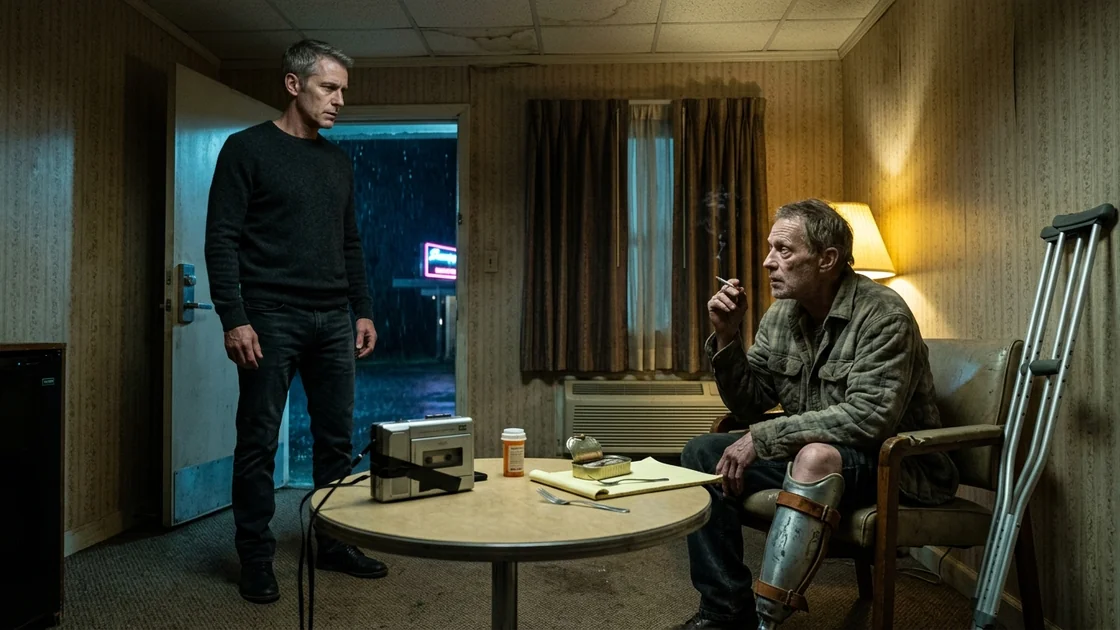
This is the story of Julian Vance, a man who built an untouchable fortune along the rugged coast of Northern California after vanishing from the scene of a catastrophic midnight robbery twenty-four years earlier. In his youth, Julian was Rory Callahan, a gifted street driver who panicked when an armored exchange in an industrial harbor went bloody, throwing his transmission into reverse and accelerating into the dark while his lifelong best friend, Leo Mercer, pounded desperately against the locked security glass. Rory remade himself into a phantom of pristine wealth, surrounded by architectural concrete, curated silence, and rare vintage automobiles he could never bear to drive at full throttle. When a single weathered token from their shared childhood arrives at his gated estate, the fortress of Julian's borrowed life cracks wide open, drawing the aged, ruined driver into a final, inescapable reckoning with the man he left behind to rot in prison.
I. The Architecture of Forgetting
The house at Point Saint George had been designed by an architect who believed that human comfort was an insult to the landscape. It rose from the sea-battered headland like a slab of gray slate cast up by an ancient upheaval, all board-formed concrete, cantilevered cedar, and sheets of low-iron glass four fingers thick. When the Pacific gales charged in from the Aleutians, the ocean did not merely break against the cliff eighty feet below; it vaporized into a salt fog that coated the western windows in a greasy, translucent film.
Julian Vance liked the salt film. It softened the edges of things. It blurred the horizons so that on certain winter mornings, standing in his kitchen with a porcelain cup of black coffee cooling between his palms, he could pretend there was nothing beyond the glass except gray suspension—no shipping lanes, no continent behind him, no world where calendars turned or ledgers kept balance.
He was fifty-one years old, though his driver’s license—a flawless specimen of bureaucratic artistry issued by the State of Oregon—declared him to be forty-seven. He had the lean, slightly hunched frame of a man who had spent his formative decades bent over the engine bays of carbureted sedans, though his hands had long since lost the black crescents of used motor oil beneath the fingernails. His skin was pale from coastal overcast, his silver-threaded hair kept clipped to a severe military taper. He wore cashmere sweaters in charcoal and unbranded Japanese denim, the uniform of men whose money worked quietly in offshore logistics holding companies and municipal bonds.
Beneath the main floor, cut directly into the bedrock of the bluff, was a four-bay garage that remained perpetually climate-controlled at sixty-four degrees Fahrenheit and forty-five percent relative humidity. It smelled of vulcanized rubber, high-octane racing fuel, and dry concrete.
Three vehicles occupied the bays. The first was an understated German estate car he used for weekly grocery trips into Crescent City. The second was a 1967 Porsche 911S, finished in Irish Green, its panels aligned to within a fraction of a millimeter, its flat-six engine rebuilt with titanium connecting rods and triple-throat Webers. The third was a rolling chassis: a 1986 Buick Regal Grand National, stripped down to its bare satin-black shell, resting on four heavy-duty jack stands.
Julian spent three hours every evening in that garage. He did not listen to music. He did not drink. He would take a microfiber cloth and wipe down the immaculate fender flares of the Buick, tracing the line where the rear quarter panel met the C-pillar. The metal was cold. The Buick had no engine, no transmission, no wiring harness. It was an empty husk, a sculpture of an apex predator with its internal organs scooped out.
He had bought it five years ago from an estate auction in Reno, paying three times its market value via a cashier's check drawn on an account in Vaduz. He had never intended to restore it. He had bought it because looking at its silhouette made his left shoulder blade twitch—a phantom ache, the residual memory of an impact harness locking against his collarbone while his foot stomped an aluminum throttle pedal through the firewall.
Upstairs, the house was silent save for the mechanical hum of the air handlers. Julian returned to the kitchen, rinsed his cup, and dried it with a linen cloth. He placed the cup precisely where it belonged, in the third cupboard to the left of the range.
On the soapstone island lay the morning mail, which his estate caretaker, an incurious man named Hatcher who lived four miles inland, deposited every Tuesday and Friday in the locked zinc drop box at the highway gate.
There were three prospectuses for private equity placements in Singapore, an invoice for the seismic monitoring system installed in the cliffside foundations, and a heavy manila envelope, eight inches square, sealed with gummed brown paper tape.
Julian did not touch the envelope immediately. He stood over the island, his thumbs hooked in his belt loops, observing it.
There was no postage meter stamp. There was no barcode. In the center, written in purple indelible pencil—the kind used by institutional clerks to tally commissary goods—was his name:
Julian Vance, Esq.
14000 Shoreline Spur
Del Norte County, CA
The handwriting was small, deliberate, and entirely lacking in flourish. The capital J had a crossbar that curled slightly downward at the left, like a rusted fishhook.
Julian felt the room lose three degrees of temperature in a single breath. The hum of the air handlers seemed to drop an octave, resonating in the marrow of his shinbones.
He reached into his pocket, took out an antique bone-handled folding knife, and slit the top edge of the envelope. He did not dump the contents onto the counter. He parted the paper jaws with two fingers and peered inside.
There was no letter. There was only a single object wrapped in several layers of coarse, unbleached paper towel: a brass key, roughly three inches long, stamped with the numeral 44, its barrel hollowed at the tip for an old-fashioned cabinet tumbler. Adhered to the key with a brittle strip of yellowed Scotch tape was a spark plug insulator—a cylinder of white ceramic, cracked down the center and reassembled with clear epoxy.
Julian picked up the insulator. He did not need to hold it under the task lighting to see the faint blue lettering stamped into the porcelain: AC DELCO R45TS.
Below the stamp, etched into the ceramic with the sharp point of a hardened scriber twenty-four years ago, were three initials:
R. C. + L. M.
Julian sat down on the leather stool. The leather creaked beneath his weight, the sound loud as a gunshot in the sterile white room. He closed his fingers around the key until the brass edges bit into the meat of his palm, hard enough to blanch the skin, hard enough to prove that he was fifty-one years old, that he was sitting in a nine-million-dollar house above the Pacific, that he was not nineteen years old, sitting in an idling car in the rain, smelling unburned hydrocarbons and watching the world end through a cracked rearview mirror.
II. The Valley of Slag
Before he was Julian Vance, he was Rory Callahan, and the world had smelled of sulfur and damp coal dust.
The town was called West Elizabeth, pinned between a loop of the Monongahela River and a high, crumbling wall of shale that wept orange mine water down into the street gutters. In the late 1980s, the valley was an open grave of heavy industry. The blast furnaces at the Clairton Works still belched yellow plumes into the inversion layers on winter mornings, but the mills downriver were already being pulled apart by salvage crews with cutting torches, leaving acres of concrete floor slabs that sprouted sumac and pokeberry.
Rory’s father had been an open-hearth melter who lost three fingers to a slag splash in seventy-eight and spent the rest of his life sitting on a vinyl recliner in a house that shook every time a coal drag rattled along the riverside tracks. Rory had avoided that house from the age of fourteen. He lived in the service bay behind Miller’s Spring & Axle, a three-bay garage where an uncle let him sleep on an army cot behind the tire-balancing machine in exchange for swinging a twelve-pound sledge against frozen leaf-spring pins.
Leo Mercer lived three streets uphill, in a house with asphalt siding that peeled off in strips during the August heat.
Leo was six months older than Rory, broader across the shoulders, and possessed of a ferocious, sunny carelessness that Rory lacked entirely. Where Rory was quiet, watchful, and chronically suspicious of good fortune, Leo walked through the decaying mill town as if he had already bought it and was simply waiting for the deed to clear probate.
"Look at this river, Callahan," Leo had said one July afternoon, sitting on the rusted stringer of the railroad trestle with a warm iron-city beer dangling between his sneakers. "They pulled six million tons of structural steel out of this mud to build the navy that won the war. Every battleship in the Pacific came out of that dirt. You think this place is dead? Place isn't dead. It’s just sleeping off a bender. Soon as it wakes up, you and me are gonna be running the haulage."
"Haulage requires trucks, Leo," Rory had replied, using a pocket stone to put a fresh edge on his pocketknife. "Trucks cost paper. You got thirty-two dollars in your sneaker."
"Paper's easy," Leo said, grinning with teeth that were slightly crowded in the front. "Paper just moves around from one pocket to another. You just gotta be standing there when the pocket gets turned inside out."
Rory had the gift that mattered. He understood internal combustion engines the way church organists understood pipes. He could listen to a small-block Chevy idling at six hundred RPM and tell you if the wrist pin in the number seven cylinder was five thousandths of an inch out of round. He could balance a clutch disc on an arbor by eye.
More than that, Rory could drive.
It was not a flashy skill; he did not drift through intersections or smoke the rear tires to impress the girls who hung around the Sunoco station on Route 51. Rory’s driving was eerie in its economy. He sat upright, his hands loose at the nine and three positions, his eyes constantly scanning two hundred yards ahead, reading the pavement for diesel spills, frost heaves, and the subtle changes in crown that could unload a rear suspension under hard braking. He knew how to transfer weight over an axle with a brush of the left foot against the brake pedal while the right foot kept the manifold vacuum steady. In his hands, an otherwise wallowing, leaf-sprung Detroit boat became an instrument of lethal precision.
Leo had recognized that gift before anyone else.
"You don't think about the turn until you're already through it," Leo told him once, watching Rory ease an old Dodge Coronet down the twisting gravel run of Coal Valley Road in the middle of a November blizzard, never touching the guardrails, never breaking traction. "Everybody else is fighting the car. You’re just driving where the road’s gonna be ten seconds from now."
"Shut up, Leo," Rory had said. "The defroster's broken. Keep wiping the windshield."
They started with small things. Joyriding stripped cars down to the Ohio border for a chop shop behind an East Liverpool bowling alley. Delivering unregistered parcels across county lines for a bail bondsman in McKeesport who carried a nickel-plated .38 in his boot.
By the time Rory was twenty-six and Leo was twenty-seven, they had graduated to what Leo called "the institutional circuit."
Leo did the planning. He had an uncle who worked as a night maintenance supervisor for the regional commercial banks that dotted the industrial corridors between Pittsburgh and Wheeling. He knew which vaults were reinforced concrete and which were simply drywall with heavy wire lath behind the plaster. He knew that the guards who manned the night transfer depots along the river were mostly retired union boilermakers who carried revolvers they hadn’t fired since the Johnson administration.
They pulled three clean scores in eighteen months. Two regional armored car staging docks and a vault in an abandoned rail terminal that was being used to hold cash receipts from three county racinos.
Rory never carried a gun. That was the rule he insisted upon.
"If I gotta shoot," Rory told Leo in the dim grease-pit of the garage, "I’m already dead. My job is thirty seconds of asphalt. I put you on the corner, I keep the temps down, I pick you up, and I disappear into the valley. If you need me to throw lead, you fucked up the plan."
Leo had laughed, that wide, easy laugh that made everything seem like an elaborate high school prank. "Callahan, if I ever let somebody shoot at you, you have my personal permission to run me down in the driveway."
Then came the transfer depot at the Mon-Valley Tube Works.
III. The Fourth of November
The depot was a single-story cinderblock bunker tucked behind the ruins of the seamless pipe mill in McKeesport. Once a week, on Thursday evenings, an unmarked private carrier brought in the cash payroll for three non-union metallurgical contractors who were dismantling the riverfront coke batteries. It was three hundred and eighty thousand dollars in untraceable, sequential twenties and fifties, held for less than forty minutes in a heavy-gauge steel strongbox inside an office with an iron security grate.
Leo had the key to the perimeter gate. He had obtained it from an electrician who owed eight grand to a bookmaker in Swissvale.
The car was a 1987 Buick Regal Grand National. Rory had spent three weeks prepping it in an abandoned coal loader outside Clairton. He had pulled the factory turbocharger and replaced it with a larger Garrett unit, plumbed in an alcohol injection kit, and fitted an auxiliary oil cooler behind the front air dam. He had welded an additional leaf into the rear springs to compensate for torque-twist and swapped the rear drums for heavy vented discs taken from a police-package pursuit cruiser. It was painted satin black with rattle-can lacquer so it wouldn't reflect the orange mercury-vapor streetlamps along the river road.
The night of November fourth was wet, with a freezing rain that turned the slag heaps into slick, reflective mounds that looked like obsidian.
Rory sat in the Buick, two hundred yards down the river access road, tucked beneath the overhang of a conveyor gantry that had once carried crushed limestone. The engine was up to operating temperature, the electric cooling fans purring on low speed, the digital dashboard displaying eighty-five degrees Celsius on the water temp and forty-eight pounds of oil pressure.
He had the window cracked a half-inch. The air smelled of rotten cabbage and freezing river.
Leo had gone in through the side pedestrian wicket forty-two seconds earlier. He wore a gray canvas mechanics' jacket with an embroidered patch that read Wayne on the pocket, an old fiberglass welding helmet with a tinted lens, and carried a thirty-inch wrecking bar and an army-surplus duffel bag.
The plan was two minutes. At two minutes, Rory would roll the Buick forward to the loading bay door, Leo would toss the bag into the footwell, and they would take the haul road behind the slag dump—a road the local borough police didn't even have on their maps—crossing into Westmoreland County within seven minutes.
Rory looked at the dashboard clock. The green vacuum-fluorescent numerals clicked from 11:41 to 11:42.
A siren did not sound. There was no klaxon.
Instead, Rory heard a sound like two flat boards being slapped together hard over water.
Crack.
Then another: Crack-crack.
Rory’s hands tightened on the leather-wrapped steering wheel until the seam stitching pressed into his palms. His heart did not hammer; it hitched, then settled into a fast, rhythmic drone that made the skin between his shoulder blades turn numb.
"Stay," he whispered to the glass. "That's the iron door. He dropped the bar."
Then came the muzzle flashes—bright, stroboscopic orange blooms that illuminated the grease-stained windows of the depot's second-floor clerestory. Small arms fire. High-velocity. Not the dull thump of a guard's .38, but the sharp, ripping report of a nine-millimeter semi-automatic.
Rory shoved the transmission into drive. He didn't drop the hammer; he feathered the throttle, letting the Grand National's wide rear radials bite into the crushed slag without spinning. The black coupe surged forward from beneath the gantry, its headlights off, running on parking lamps that cast an amber slit across the puddles.
He rounded the corner of the loading bay just as the metal emergency exit blew open.
Leo tumbled down the three concrete steps, not running, but rolling, his welding helmet gone, his face smeared with black soot and something darker that ran down from his ear into his collar. He did not have the duffel bag. In his right hand, he was dragging the wrecking bar, using it like a cane to pull his right leg, which trailed behind him at an unnatural angle.
Behind him in the doorway stood an older man in a blue security windbreaker. The guard was leaning against the doorframe, his left hand clutching his abdomen, his right hand extended, holding a heavy stainless-steel automatic that looked huge in the sodium lights.
The guard fired again. The round starred the Buick's windshield three inches to the left of Rory’s rearview mirror. The sound inside the cabin was like an anvil being struck with a hammer.
Rory did not think. He swung the car sideways, using the Buick's heavy rear quarter to shield Leo, the back tires throwing a rooster tail of gray water and stone.
"Get in!" Rory shouted, throwing the passenger door open from the inside. "Leo! In the car!"
Leo reached the door. He caught the top frame with his left hand, his face white as lard, his pupils blown wide. He was babbling—not words, but a rapid, rhythmic wheezing that sounded like a dry pump sucking silt.
"He was... he wasn't supposed to be... there was two of 'em, Rory," Leo gasped. He tried to heave his ruined leg over the sill, but his heel caught the carpet trim.
The guard fired another round. This one struck the Buick’s radiator core with a hollow thung, followed instantly by the sweet, sickening reek of vaporized ethylene glycol billowing through the hood louvers.
Rory looked past Leo.
Through the rain, at the far end of the access road where it joined the state route, two sets of headlights turned into the lane. Not standard headlights—they were paired with red-and-blue strobes that cut the fog like rotary knives. Four hundred yards away and closing fast. The local cops hadn't waited for the state boys; they were already on the haul road.
"Rory," Leo choked. He had both hands on the passenger headrest now, his knuckles split, blood dripping from his nose onto the gray velour seat. "My foot's hung. My foot's hung on the door stay. Pull me."
Rory reached across the console. He grabbed Leo by the collar of the canvas jacket.
He meant to pull. He knew he meant to pull.
Then a round hit the A-pillar four inches from Rory's knuckles, sending a spray of lead fragments and blue paint into his forearm.
The headlights at the end of the road were three hundred yards away.
Rory looked at Leo's eyes. Leo was looking back at him, not with terror, but with a sudden, dreadful clarity. He saw the red strobes reflecting in the Buick's rearview mirror. He saw the steam rising from the punctured radiator. He saw the speedometer needle resting on zero.
"Rory," Leo whispered.
Rory’s hand did not pull.
His fingers uncurled from the rough canvas of Leo’s collar.
It was not a decision. It was an animal spasm—the instinctive, shameful reflex of a creature caught in a brushfire that smells the wind turning. Rory’s right foot, independent of his brain, jumped from the brake to the accelerator.
He threw the shift lever into reverse.
The Grand National's rear tires screamed on the wet slag. The car jerked backward five feet with the passenger door still swung wide.
The momentum ripped the door frame out of Leo's slick grip. Leo lost his purchase, his boots slipping out from the sill, and he fell heavily onto his back into the pool of radiator runoff and grease.
"Rory!"
The scream didn't sound human. It sounded like an animal crushed under a hay rake.
Rory hit the brakes, slued the wheel hard to the right, and slammed the lever into drive. The car leaped forward, the open passenger door slamming shut with a violent clack against its latch as the car accelerated down the narrow alley between the pipe racks.
In the rearview mirror—the mirror starred by the guard’s first shot—Rory saw Leo drag himself up onto one elbow in the sodium glare.
The cruisers were already entering the yard, their searchlights sweeping across the concrete. Leo sat there in the rain, his arms raised above his head, illuminated in the bright, cruel beam of thirty-thousand-candlepower spotlights, his face turned toward the darkness where the Buick was already disappearing into the river mist.
Rory did not look back again.
He drove three miles down the old coal track, the engine temp gauge climbing through the red, the cylinder heads warping, until the Grand National finally seized with a metallic shudder in a dead-end gully behind an abandoned strip mine in Forward Township.
He left the car where it sat. He took his jacket, wiped the steering wheel with his shirt hem, and began walking south through the brambles in the freezing rain.
He was twenty-six years old. He had sixty-two dollars in his pocket, a forearm speckled with lead, and the sound of his own name echoing off a cinderblock wall like an iron bolt being driven home.
IV. The Paper Skin
The man who became Julian Vance was born in an attic apartment above a dry cleaner's in Portland, Maine, nineteen months later.
He had spent those nineteen months like a rat living in the hollow walls of a barn. He had worked as a deckhand on a sand barge in the Chesapeake; he had scraped rust off the tanks of a chemical scow in Bayonne; he had washed dishes in a twenty-four-hour diner outside of Bangor where the cook was deaf and nobody asked why he spoke with an Ohio Valley drawl.
The paper came from a specialist in Montreal named Chenier, who cost twenty-two thousand dollars—money Rory earned by driving a succession of unregistered, heavily modified fuel tankers across the Canadian border through the logging trails of northern Aroostook County for a syndicate of bootleg diesel wholesalers.
Julian Vance was an actual person: a child born in 1948 in a timber hamlet called Shin Pond who had died of scarlet fever at the age of three, before the state began issuing digital death cross-references.
Chenier provided the birth certificate, a baptismal record from a church that had burned down in sixty-three, and a Social Security card printed on forty-year-old rag paper using an authentic flatbed press.
"From this day," Chenier told him across a table covered in greaseproof paper and cigarette ash, "you have no memories of iron. You have no friends who are not dead. If you see your mother walking across the street with her groceries falling out of the bag, you turn around and walk into the nearest pharmacy and buy a pack of mints. Do you understand this?"
"I don't have a mother," Rory said.
"Good," Chenier replied. "Now you have a father who was an independent lumber surveyor. He died when you were twelve. You were raised by an aunt who died in Halifax. You are quiet because your family was Presbyterian and didn't believe in chatter. Speak forty percent slower than you do now. Drop the 'y'uns.' It's not 'y'uns,' Vance. It’s 'you all,' or better yet, say nothing at all."
Julian Vance took the paper and went west.
He did not go back to cars—not immediately. He went to Seattle, where the port was beginning to choke on cargo containers from Taiwan and South Korea. He understood freight. He understood weight, distance, and the arithmetic of worn bearings.
He started an independent drayage brokerage with two leased Peterbilts. He worked eighteen hours a day, sleeping in a fiberglass camper shell in the corner of an industrial yard on the Duwamish River. While other operators drank their margins at the taverns on Alaskan Way, Julian lived on tinned sardines and tea, saving every nickel to buy dry-van chassis and long-haul rights.
He was lucky, but it was the cold, ruthless luck of a man who has nothing else to occupy his mind except the prevention of errors.
In 1996, an eccentric computer software executive whose company was preparing for an initial public offering needed eight thousand square feet of temperature-controlled warehousing to store high-density server racks away from the damp air of the docks. Julian gave up his own office, slept on a cot in the boiler room, and delivered the contract two weeks ahead of schedule.
The executive paid him partly in cash and partly in founders' shares of a company that developed data-caching protocols for the nascent internet.
When the company went public in the autumn of nineteen ninety-eight, Julian Vance walked into a branch of the Bank of California on 4th Avenue and watched an assistant vice president's hands tremble as he verified a wire transfer for eleven million, four hundred and twenty thousand dollars.
He did not celebrate. He went to a hardware store, bought a steel lockbox, placed his original Social Security card—the one with Rory Callahan written in blue ink—inside it, and threw the key off the Bainbridge ferry into eighty fathoms of salt water.
Then he bought the land at Point Saint George.
He built the concrete house. He had the soil tested for heavy metals. He planted native fescue and shore pine. He bought the vintage Porsche because it was an engineering problem to be solved with feeler gauges and micrometer stops, not an automobile meant to run from anything.
And once a year, on the fifth of November, he would sit in his study with a bottle of twelve-year-old bourbon that he never uncorked, looking at the gray sea until the light went purple, then black.
He never checked the newspapers. He never bought an internet modem for the house. He had no telephone line; he used an encrypted satellite terminal in his garage that connected only to his brokerage account in Zurich once every twenty-four hours to check margins and treasury yield curves.
He believed he had erased the world.
He believed that forty feet of concrete anchored to granite, two million dollars in Swiss gold sovereigns stored in an underground vault beneath the garage, and twenty-four years of silence were sufficient to keep the past from crossing the state line.
V. The Box in the Floor
The key was brass. It smelled of stale grease and machine coolant.
Julian sat in his garage. The hood of the stripped Grand National was raised, standing open like the jaw of an alligator.
He knew where the key belonged.
When they were twenty-one, Leo had found an old steel payroll locker inside the crawlspace of an abandoned pump house near the river terminal in Monessen. They had hauled it out, cleaned the rust off with wire brushes, and carried it up to the head of a limestone ravine called Dead Man’s Hollow.
They had buried it three feet deep under a flat stone marked with an X chiseled into the sandstone.
"That's the iron box, Callahan," Leo had said, leaning on the shovel with the sweat running through the soot on his cheeks. "Anything we get that we can’t spend right away, anything we need to keep cold until the world forgets who we are, it goes in the box. Two keys. I got one, you got one. We don’t open it alone. That’s the rule."
Julian had lost his key in the woods behind Forward Township the night he ran. He had dropped it somewhere in the laurel slicks while his boots filled with water and the sirens were still bouncing off the river hills.
Now, the key was sitting on the workbench next to a snap-on torque wrench.
He picked up the key and the cracked spark plug insulator.
The insulator was the piece that had broken off the number six cylinder of Leo’s 1970 Chevelle the first night they had ever pulled an engine together. Rory had kept it as a joke; Leo had drilled a hole through the ceramic with a carbide bit and used it as a fob on his ignition ring.
AC DELCO R45TS.
Julian walked to the garage’s side door, opened it, and stepped out onto the gravel apron.
The wind had shifted from the northwest to the southwest, bringing the smell of cold kelp and woodsmoke from the chimney of some distant beach cabin down by Castle Rock.
He walked down the winding stone stairs cut into the bluff, his deck shoes gripping the mossy treads. Halfway down, there was a small cedar observation platform that hung out over the surge channel.
Sitting on the bench was a cardboard mailing carton, roughly twelve inches on a side, held shut with heavy fiber-reinforced tape.
It had not been there two hours ago when Hatcher had dropped the mail.
Julian stood five feet from the carton. His heart had resumed that terrible, low-frequency hum—the drone of an alternator spinning at seven thousand RPM.
There was no name on the box. Only an address written in the same purple pencil:
The Driver.
Julian knelt on the cedar decking. The salt spray drifted up through the floorboards, dampening his trousers. He used the bone-handled knife to slit the tape.
Inside the box was an old green canvas duffel bag.
The canvas was stiff with age, bleached in places to a sickly yellow-white, but around the brass grommets at the throat were the dark, stiffened rings of old iron stains—the unmistakable rust-brown of dry blood.
Julian reached down. His hand was steady, though his breath came in short, dry gasps that burned his sinuses.
He pulled the bag open.
Inside was a single shoe: a right work boot, size ten-and-a-half, with a steel toe and a Vibram sole. The leather of the heel had been sheared off cleanly by something heavy and sharp—the downward stroke of an iron door frame hitting a running board.
Tucked into the boot was a folded sheet of yellow legal pad paper.
Julian unfolded it.
The pencil lead was soft, the strokes broad and faint:
You always took the curves too wide when the pavement was wet, Rory. You were scared of the ditch. You were so scared of the ditch you didn't see the truck coming the other way.
I’m at the Harbor Motel in Crescent City. Room six.
Bring the car.
VI. The Harbor Motel
The Harbor Motel sat between a fish-processing plant and an RV storage yard on the industrial edge of Crescent City. Its neon sign was missing the H and the R, so it announced itself to the highway as T E A B O M O T E L in buzzing tubes of faded pink.
It was nine o'clock at night. The rain had turned into a steady, spiteful drizzle that blurred the sodium lamps of the boat basins into greasy puddles of yellow light.
Julian did not bring the Porsche. He did not bring the Buick shell.
He drove the German estate car. He parked it three bays away from Room 6, under the dripping eaves of an ice-machine shed that shuddered every time the compressor kicked in.
He sat in the car for ten minutes with the engine running.
He had not looked at his face in the rearview mirror before he left the house. He did not want to see whether he was Rory Callahan or Julian Vance. He knew that if he looked too closely, the gray hair and the cashmere sweater would look like a costume he had stolen from a dry cleaner’s rack.
He got out of the car. He did not carry a weapon. In twenty-four years, he had never purchased a firearm. He had plenty of money to buy a dozen men who carried them, but he had never touched an iron frame since the night at the Mon-Valley Tube Works.
He walked to Room 6 and knocked twice with the heel of his palm.
The door did not open immediately.
There was a long scrape from inside—the sound of wood sliding against cheap nylon carpet, followed by the dry, uneven click of an aluminum crutch.
The latch turned.
The door swung back three inches.
The man standing in the opening did not look like Leo Mercer.
Leo had been six feet tall, with a chest like a beer keg and hair the color of copper slag that he wore combed straight back with butch wax.
This man was shrunken. His shoulders were curved forward like the staves of a broken barrel, his neck thin and stringy inside the collar of a quilted flannel shirt that was two sizes too large for him. His hair was gone except for a fringe of white fuzz that ringed his ears, and his skin was the color of skim milk that had sat three days in the sun.
His right leg was absent from the knee down; in its place was an old-fashioned aluminum pylon with a scuffed rubber foot, held to his thigh with a harness of cracked leather straps and duct tape.
Only the eyes were the same.
They were small, set deep under heavy brow ridges, pale blue and watery, but they fixed on Julian with an intensity that made the hair on Julian's arms stand upright.
"You're late, Callahan," the man said.
His voice was a gravel slide. One of his vocal cords had been paralyzed, leaving him with a breathy, double-toned rasp that sounded like wind whistling through an open spark plug hole.
Julian stood on the concrete walkway. The rain was running down his neck, soaking the collar of his sweater.
"Leo," he said.
Leo leaned heavily on his right crutch, stepped back from the door, and swung his good leg inward.
"Come inside," Leo said. "The fog's getting in the joint. My hip feels like somebody’s turning a three-eighths tap into the socket."
The room smelled of menthol cigarettes, fried clams, and the wet dog smell of an electric baseboard heater that had been cranked to ninety degrees.
On the round laminate table sat a plastic bottle of generic aspirin, a box of saltines, and an open can of sardines with an aluminum fork sticking out of the oil.
Beside the sardines was an old portable tape player—a silver Panasonic from the late eighties, its plastic case held together with black electrical tape.
Leo hobbled over to the table and dropped into one of the vinyl armchairs. He leaned his crutches against the wall; one of them slipped and hit the carpet with a dull thump. He didn't pick it up.
"Sit down," Leo said.
Julian remained standing near the door. His back was against the thin plywood panel.
"How did you find me?" Julian asked. His voice was too quiet, the cultured, slow cadence of Julian Vance cracking at the edges.
Leo reached for a cigarette from an open pack of Kools. His fingers were crooked, the knuckles swollen into hard, shiny knots by arthritis or old fractures that had set without a doctor's help.
"The Buick," Leo said. He struck a match with his thumbnail, lit the cigarette, and let the smoke trail out through his nose. "You bought that shell at an auction in Reno five years back. You used a lawyer in Carson City, but the lawyer used a broker who specialized in high-performance GM A-bodies. You remember Tommy Shales?"
Julian said nothing.
"Tommy was in the joint with me," Leo continued, his watery eyes narrowing through the blue haze. "Houtzdale. Cell block D. Tommy remembered that you and me used to talk about that 1986 Grand National with the alcohol kit. You told everybody you met in the valley that there were only three of 'em with that specific intercooler setup between Cleveland and Philadelphia. You were proud of that car, Rory. You were so damn proud of that machine."
"Tommy Shales died in ninety-nine," Julian said.
"His brother didn't," Leo croaked. "His brother runs a salvage clearinghouse in Sacramento. When that shell came up from Reno, the brother dropped a postcard to a guy in Pittsburgh who dropped a letter to me at the halfway house in Erie."
Leo took a long pull on the Kool. The paper sizzled.
"Twenty-three years, Rory. Seven months. Eleven days."
Julian felt the room tilting. The carpet seemed to have the same greasy sheen as the wet slag at McKeesport.
"The guard," Julian whispered.
"The guard lived," Leo said. He laughed—a rattling, wet cough that ended in a spit into an empty styrofoam cup. "Old Frank. Frank had two feet of his colon removed, but he lived long enough to sit in the witness chair at the county courthouse and tell twelve Presbyterian church ladies that I was the one who pulled the trigger. Even though Frank knew it was the other guard—his own partner—who shot him through the office wall because he was shaking so bad he couldn't see the sights."
"You didn't have a gun," Julian said.
"They didn't find a gun," Leo replied. "So they decided I threw it in the river before Frank tagged me. Felony murder charge dropped to aggravated assault on an officer, armed robbery, conspiracy, commercial burglary. The judge was an old Scotchman whose father had been an auditor for the tube works. He gave me twenty-five to forty. He said I was an incorrigible parasite on the industrial commonwealth of Pennsylvania."
Leo tapped the ash into the sardine tin.
"They don't have good surgeons in Camp Hill, Rory. When the door frame hit that leg, it crushed the tibia like an eggshell. The state doctor took one look at it and said, 'We can spend ten hours pinning that together, or we can take it off below the knee and have him back in his cell by lunch.' Guess which one he picked?"
Julian closed his eyes.
Behind his lids, the scene ran again, frame by frame, with the merciless fidelity of an engine timer: the green glow of the digital clock (11:42), the steam blowing from the hood louvers, the sound of the door frame slipping out of Leo’s bloody fingers, the red strobes cutting the river mist.
"I didn't plan to leave you," Julian said.
The words sounded ridiculous as soon as they left his mouth. They were thin, paper-dry, the excuses of an eight-year-old who had broken a neighbor's window with a stone.
Leo didn't get angry. He didn't raise his voice. He just looked at Julian with an expression that was almost tender in its curiosity.
"I know," Leo said. "That’s what I told myself for the first five years. I laid on that iron bunk with the grease-drain weeping into my stump and I told myself: Rory’s coming back. Rory’s getting the money from the hollow. Rory’s hiring a lawyer from Philadelphia with the long shoes and the gold watch."
Leo leaned forward, resting his forearms on his knees.
"Then year six came, Rory. Year seven. Year eight. My mother died in ninety-four. She was buried in the potter's field behind the state hospital because there wasn't eighty dollars to dig a hole next to my old man. I wrote twelve letters to your uncle's garage. They all came back: Moved, Left No Forwarding."
"I had to change my name," Julian said. "They had my description."
"They didn't have shit," Leo whispered. "They had a satin-black Buick that burnt its main bearings three miles out of town. They had five drops of Rory Callahan’s blood on the steering wheel where you clipped yourself on the glass. If you’d come back the next morning with a bondsman and three grand from the locker, you could've told 'em you were in Wheeling with a girl. You could've stood up for me."
"I panicked," Julian said.
The word hung in the hot, mentholated air between them.
It was the first time he had spoken it aloud in twenty-four years. Not I made a tactical error. Not The situation was non-viable.
I panicked.
Leo nodded slowly. He picked up the Panasonic tape player, turned it over in his hand, and set it down again.
"I know you did," Leo said. "That's why I'm here."
Julian looked at him. "You want the money."
Leo tilted his head. "The money? You mean the three hundred and eighty grand that was in that duffel bag? Frank’s partner took that, Rory. He took it and bought an RV and a trailer park in Fort Myers. We didn't get a nickel of that."
"I have money," Julian said, his voice rising, gaining that rapid, mechanical edge he used in negotiations. "I have eleven million dollars in prime securities. I have two hundred and fifty thousand in cash in a safe at the house. I can have a hundred thousand in small bills here in two hours. You can go anywhere. Mexico. Hawaii. You can buy a clinic. You can get a modern prosthesis with hydraulic joints. You can live in a house with eight rooms and people to cook for you."
Leo looked at him for a long time. The Kool burned down to the orange filter. He dropped it into the sardine tin, where it hissed once and went out.
"Julian," Leo said, savoring the name, rolling it across his tongue like an unfamiliar liquor. "Julian Vance. Sounds like an undertaker from Rhode Island."
Leo reached into his flannel pocket and took out a cassette tape. It was a ninety-minute Maxell cassette, its paper label yellowed and smudged with purple pencil.
"I don't want your eleven million dollars, Rory," Leo said. "What am I gonna do with eleven million dollars? Look at me. I got eighteen months before this cough turns into something that doesn't stop. My liver's the size of an eggplant from prison rotgut. I don't want a house in Hawaii. I don't know anybody in Hawaii."
"Then what do you want?"
Leo pointed one crooked finger toward the door.
"I want you to take me for a drive."
VII. The Old Coast Road
They left Crescent City at ten-fifteen.
Leo sat in the passenger seat of the German estate car. He had refused to let Julian put his crutches in the luggage compartment; he insisted on holding them between his knees, the aluminum shafts rattling against the dashboard every time the tires crossed a tar strip.
"Nice car," Leo said, running his hand over the stitched leather of the passenger door. "Quiet. Sounds like a refrigerator."
"It's safe," Julian said.
"That's what you like now, huh? Safe."
"It has traction control," Julian said. "Active yaw sensors. It corrects if the rear steps out."
Leo turned his head to look at him through the dark cabin.
"Turn off the radio."
"The radio isn't on."
"Then turn off whatever that screen is," Leo said, nodding toward the navigation display in the center console. "It's shining on your face. You look like a ghost."
Julian reached over and hit the display toggle. The cabin plunged into darkness, save for the faint red glow of the instrument needles.
They drove south on Highway 101, through the redwoods where the trees rose like the pillars of an abandoned cathedral, their trunks wet and black in the sweep of the xenon lamps.
"Take the old road," Leo said suddenly.
"The old road is closed," Julian replied. "The county stopped maintaining it three winters ago after the slide at False Klamath. The asphalt's broken up."
"Take it anyway," Leo said. "You’ve got active yaw sensors. You’ve got all those German computers working for you. Show me how they work."
Julian tightened his hands on the wheel. For three miles, he considered refusing. He considered turning the car around in the middle of the empty highway, driving Leo back to the motel, throwing twenty thousand dollars on the bed, and walking away.
What could Leo do?
Leo was an old man with one leg and a bad cough. He had no weapon. He had no friends. If Julian left him in that motel, Leo would sit there until his money ran out, then drift into a state hospital in Eureka and die under an assumed name. The world was built for men like Julian Vance—men who understood paperwork, accounts, and perimeter security.
Julian glanced at the passenger seat.
Leo was not looking at the road. He was looking at Julian’s hands on the wheel.
"You still hold it at nine and three," Leo murmured. "Like you were driving a school bus."
Julian didn't answer. He hit the turn signal, slowed the heavy wagon, and swung off the wide, banked curve of the federal highway onto the cracked, weed-choked asphalt of the old coastal cutoff.
The road descended immediately toward the sea, twisting through dense stands of Sitka spruce and elderberry. The asphalt was scarred by frost heaves, the centerline completely erased by moss, the shoulder falling away into gullies that dropped straight down into the Pacific breakers.
Julian felt the car's suspension working. The hydraulic dampers hissed over the ruts; the steering wheel tugged slightly in his palms as the front tires sought grip on the greasy aggregate.
"Faster," Leo said.
Julian did not accelerate.
"I said faster, Rory."
"The road isn't clear, Leo. If we hit a washout at forty, we go over the cliff."
Leo reached over with his left hand. He didn't grab the steering wheel.
He clicked the Panasonic tape player that sat on his lap.
A mechanical clack echoed through the car, followed by the hiss of magnetic tape running across an old playback head.
From the tiny speaker came the sound of an engine idling.
It was not a modern engine. It was an uneven, loping thrum—the heavy, mechanical pulse of a turbocharged V6 with a long-duration camshaft and an exhaust system that had no catalytic converters.
Thump-thump-thump-thump.
Beneath the engine sound, there was the drum of rain on a steel roof.
Then a voice:
"Clock’s at one-forty, Rory."
It was Leo’s voice. Not the ruined, gravelly rasp of the old man in the passenger seat, but the bright, arrogant baritone of a twenty-seven-year-old who believed he was made of structural steel.
"Two minutes, buddy. He's inside with the thermos. I’m going through the wicket."
Then Rory’s voice—young, flat, cold as grease:
"The fan's on low. Don't touch the iron door with your hands. Use the bar. If the light goes out in the office, I'm coming to the apron."
"You worry too much, Callahan. You’re gonna have gray hair before you're thirty."
Julian’s breath stopped in his throat.
His fingers locked on the leather rim.
"Where did you get that?" Julian whispered.
Leo leaned his head back against the headrest, looking up at the gray headliner.
"You had a cassette recorder in the glove box," Leo said softly. "You used it to log your fuel pressures and your vacuum readings after every run. You left it in the car when you ran, Rory."
"The police—"
"The police didn't care about a cassette of an engine idling," Leo croaked. "It was in my personal property envelope at the county jail. It sat in an evidence box in Greensburg for twenty-two years. When they gave me my cardboard box at the gate in two thousand and nineteen, there it was. My belt. My high school ring with the glass ruby gone. And that tape."
Leo turned his face toward Julian. In the faint red glow of the instrument cluster, his teeth looked long, separated by dark gaps.
"I listened to that tape every night on my headphones at the halfway house," Leo said. "I wanted to hear the part where you said you were coming to the apron. I wanted to hear that part about eight thousand times."
The tape hissed.
On the recording, the engine sound suddenly revved—the distinct, high-pitched whistle of a Garrett turbocharger spooling up against the brake torque.
Then came the crack-crack of the small arms fire.
Then Rory’s recorded voice, small and cracked with panic:
"Stay. That's the iron door. He dropped the bar."
Then the sound of tires spinning on wet slag—that high, screaming peel of hot rubber across river gravel—and the sudden, violent clack of the passenger door slamming shut.
And then, through the speaker, so loud it distorted the cheap paper cone:
"Rory!"
Leo clicked the stop button.
The silence that followed was heavier than the sea fog. The only sound was the rhythmic slap of the German wagon’s wipers clearing the salt spray from the windshield.
"You didn't look," Leo said.
Julian’s foot was trembling on the throttle. He felt the active suspension stiffen as the car entered a decreasing-radius hairpin that swung out over the open water.
"I looked," Julian said, his voice dropping to a whisper. "I looked in the mirror."
"No," Leo said. "You looked at the glass. You looked at the crack where Frank's bullet hit. If you’d looked at me, Rory, you would've seen that I was already halfway in. I had my hip on the seat. If you’d given me one second—not ten seconds, just one—I would've pulled that leg in with my hands. We would've made the haul road."
"The cops were at the gate," Julian cried out. The cultured reserve of Julian Vance was gone, peeled back like rotten bark from a pine log. "They were three hundred yards away, Leo! They had red strobes! The radiator was shot! The water was gone!"
"Then we would've gone together," Leo said.
He said it so simply, with such total lack of rancor, that it hit Julian like an iron bar across the shins.
"We would've gone together," Leo repeated. "Like we did from the fifth grade. Like we did when the guys from the coke ovens tried to throw you into the settling pond. Like we did when your old man took the belt to you behind Miller’s shop. We would've sat in that ditch together, Rory, and we would've taken the twenty years together, and we would've come out together, and we would've been fifty years old, and we wouldn't be two ghosts living in a hotel and an empty house."
Julian didn't speak.
He couldn't. His chest felt as if it were being compressed by an eight-hundred-pound torque plate.
The road was narrowing now, descending toward the rocky beach at False Klamath. Ahead, the pavement simply ceased, replaced by a barrier of red-and-white striped saw-horses that had been tossed aside by winter storms, leaving a gap just wide enough for an axle.
Beyond the saw-horses was the slide: forty yards of shale and ocean clay that had sloughed off the mountain and plunged straight down into the black surf fifty feet below.
"Don't lift," Leo whispered.
Julian looked at the saw-horses. They were eighty yards away.
"You were always good with weight transfer," Leo said. His hand was resting on the crutches between his knees. "Show me how you transfer the weight, Callahan. Let’s see if that German car knows where the road’s gonna be ten seconds from now."
Julian looked at the speedometer.
Forty-five miles per hour.
Fifty.
The twin xenon beams illuminated the warning signs: ROAD CLOSED. SLIDE AREA. NO VEHICULAR TRAFFIC.
Julian’s foot moved.
For twenty-four years, his foot had been the instrument of his salvation. It had known when to feather the clutch; it had known how to balance the brake against the manifold vacuum; it had known when to press downward into the floorboard to leave a dying friend in the rain.
His foot touched the brake pedal.
The carbon-ceramic pads kissed the vented discs. The anti-lock system pulsed once, twice—a tiny, synthetic vibration that signaled the presence of safety, of engineering, of eleven million dollars and an architect who understood concrete.
"Rory," Leo said.
Julian took his foot off the brake.
He didn't stomp the throttle. He did what he had done forty years ago on the icy run of Coal Valley Road: he sat upright, his hands loose at the nine and three positions, his eyes scanning the darkness beyond the saw-horses, looking for the shelf of rock that remained beneath the mud.
He aimed the car for the gap.
The wagon smashed through the first saw-horse, the plastic splintering with a sound like dry bones breaking under a boot.
The tires hit the mud.
Instantly, the steering went light—that sickening, weightless sensation when four patches of rubber leave the aggregate and begin to plane across a layer of wet clay. The German computers went insane: yellow warning lights strobed on the dashboard, the throttle was cut by an algorithm that didn't know how to drive on river shale, and the rear end began to rotate toward the edge of the cliff.
Julian didn't fight the wheel.
He did not touch the brake. He reached down with his right hand, caught the electronic stability control toggle, and held it down for three seconds until the display flashed: SYSTEMS DEACTIVATED.
Then he dropped his left foot onto the emergency brake pedal and yanked the steering wheel hard into the skid.
The car did not roll.
It slued sideways, sixty feet from the salt breakers, the undercarriage scraping across the buried spine of the headland with a shriek of tearing aluminum that sounded like an iron door slamming shut in McKeesport.
The left rear wheel hung out over empty air for half a second—Julian could feel the suspension drop to full extension, the tire searching for something that wasn't there—and then the front tires caught the shelf of dry sandstone on the far side of the slide.
The car jerked forward with a violent, spine-snapping heave and came to a rest in the tall beach grass on the shoulder of the abandoned highway, twenty feet above the tide line.
The engine died.
The air handlers did not hum. There was only the sound of steam hissing from the ruptured steering rack, the smell of burnt synthetic transmission fluid, and the endless, indifferent roar of the Pacific surf dragging gravel across the bar.
VIII. The Ledger
They sat in the dark for five minutes.
Neither man moved. Julian’s hands were still on the wheel, his knuckles white, his breath coming in long, shuddering drafts that rattled in his throat.
Beside him, Leo began to chuckle.
It started as a wheeze—a low, bubbling rattle in the base of his ruined lungs—and then it broke into a full, dry laugh that shook his shoulders until his forehead struck the dashboard.
"Look at you," Leo gasped, coughing into his hand until he wiped his mouth with his sleeve. "Look at you, Callahan. You haven't lost it. You still drive like you're trying to outrun your own shadow."
Julian turned his head.
The salt spray was already coating the side windows, blurring the lights of Crescent City three miles to the north into a dull pink smudge.
"Why didn't you let me hit the brake?" Julian asked. His voice was cracked, raw, the voice of a man who had swallowed sand.
Leo leaned his head back against the headrest. The laugh was gone now, leaving his face looking more tired than Julian had ever seen a human face look.
"Because I wanted to see if you still had it in your feet," Leo said. "I wanted to see if the guy who left me was an animal that just wanted to live, or if you were just some rich bastard who bought a set of papers from a French guy in Maine."
Leo looked down at his lap. The Panasonic tape player had slid off his knees during the slide; it lay upside down in the footwell, its cassette door popped open, the ribbon of brown tape spilled out into a tangled loop on the rubber mat.
"You're an animal that wanted to live," Leo said. "I can’t hate an animal for that. My old man had a hound that got its paw caught in a beaver set. That hound bit its own toes off to get back to the porch. It lived six years after that. Walked with a limp, but it was still a dog."
Leo reached over, found the door handle, and pulled it.
The passenger door opened with a mechanical click. The cold, wet salt air rushed into the cabin, blowing away the menthol, the fried clams, and the smell of hot transmission fluid.
Leo swung his good leg out into the beach grass. He reached down, retrieved his crutches, and planted them into the gravel.
"Where are you going?" Julian asked.
Leo pulled himself upright, his pylon sinking two inches into the wet sand. He leaned against the car's B-pillar, looking out over the surf where the white foam of the breakers rolled in like rows of teeth in the dark.
"I’m going to walk down to the bar," Leo said. "There’s a fish camp about a mile down. Guy I met on the bus said they have a room behind the bait shop for twenty dollars a night."
Julian reached for his wallet.
His hands were shaking so hard he could barely open the leather billfold. He pulled out a wad of hundred-dollar bills—thirty, maybe forty of them—and held them out through the open door.
"Take it," Julian said. "Leo. Take the money."
Leo looked at the bills. The green paper was dry, crisp, smelling of nothing at all.
"Keep it, Rory," Leo said. "Use it to get that radiator fixed. You’re leaking again."
Leo turned his back.
He swung his crutches forward, his artificial leg dragging slightly through the coarse coastal grass, the aluminum shafts clicking in the rhythm Julian had heard twenty-four years ago on the concrete steps of the Mon-Valley Tube Works.
Julian got out of the car.
He stood by the front fender, his deck shoes sinking into the mud, his cashmere sweater turning black in the drizzle.
"Leo!" he shouted.
The wind from the ocean took the sound and carried it inland, up through the redwoods toward the empty highway.
Leo did not turn around. He did not look back. He kept moving south along the shelf of sandstone, his silhouette small and lumpy against the white line of the surf, until the salt mist closed over him and he was gone.
Julian stood by the car.
He looked down at his shoes. He looked at his hands—those clean, soft hands that had not touched used motor oil in two decades.
He reached into his pocket and found the bone-handled knife.
He opened the small blade.
He walked to the rear of the German estate car, knelt by the rear quarter panel, and pressed the tip of the blade into the paint.
He did not carve a name. He did not carve a date.
He simply dragged the hardened steel across the clear-coat, through the gray metallic base, down to the cold, bare sheet metal beneath, cutting a straight, deep furrow eight inches long—the kind of mark an iron door makes when a car accelerates into the dark while somebody is still holding the frame.
Then he closed the knife, walked back to the driver’s seat, and sat down.
The engine would not start. The starter solenoid clicked once, then fell silent; the German computers had decided that the vehicle was no longer in an authorized operational state.
Julian Vance sat in the dark.
He took the tape player from the footwell. He wound the spilled ribbon of brown tape around his finger, inch by inch, until it was seated back in the plastic shell.
He placed the cassette on the passenger seat.
Then he leaned his head back against the headrest, closed his eyes, and listened to the ocean. It sounded like an iron drag rolling down the river tracks—heavy, slow, and never stopping, all the way to the end of the valley.