The Empty Ampoule
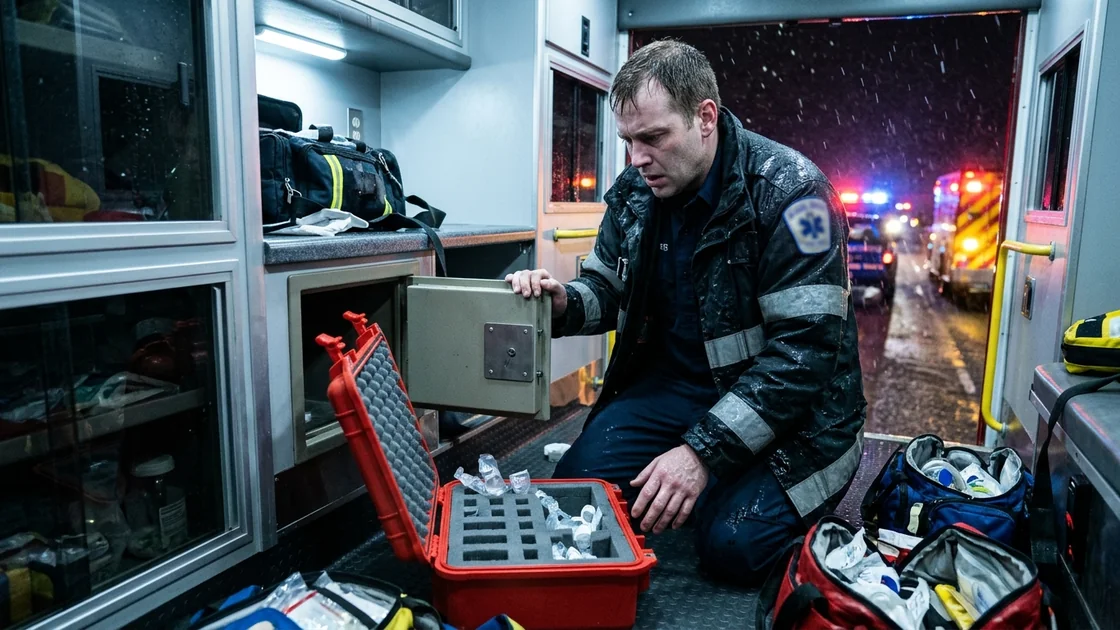
A seasoned paramedic struggling with an escalating opioid addiction steals the last vials of morphine from his ambulance emergency kit, only to face the ultimate horror when he is dispatched to a brutal highway collision where a trapped, dying victim suffers unimaginable agony that he is powerless to relieve.
The locker room of Station 4 always smelled of damp cotton, industrial floor wax, and the metallic tang of diesel exhaust that seeped up through the floorboards from the bay below. It was an honest smell, or at least it had been to Nathan Clarke for the first nine years of his career. Lately, it smelled like an interrogation room.
Nathan sat on the bench in front of locker twenty-two, his elbows resting on his knees, his head hanging between his shoulders. The station clock on the cinderblock wall ticked with a heavy, mechanical clatter. Six minutes past five in the afternoon. The B-shift was rolling out, their boots thumping against the concrete, voices trading dark jokes and sports scores as they handed off their radios. The A-shift—Nathan’s shift—was trickling in.
His right knee twitched uncontrollably. Down his spine, a cold, greasy sheen of perspiration bloomed, soaking through the navy-blue fabric of his uniform shirt. His stomach felt as though it had been scrubbed raw with steel wool.
Just forty-eight hours, he told himself, closing his eyes against the sting of the fluorescent tubes overhead. Just forty-eight hours until payday. Then I can clear the debt with Marcus. Then I can get my own.
It was a lie, and he knew it before the thought even fully formed. Marcus didn't do credit anymore, not after Nathan had shorted him two weeks ago. And forty-eight hours in opioid withdrawal was an eternity. The clock wasn't measuring seconds; it was measuring nerve endings being flayed alive. His back—the L4-L5 herniation from lifting a four-hundred-pound bariatric patient down three flights of stairs in a tenement four years ago—throbbed like an exposed wire dipped in salt water. That was how it had started. A legitimate prescription from an orthopedic surgeon. Two weeks of relief. Then three weeks. Then the doctor cut him off, but the phantom pain remained, blooming into a physiological hunger that had nothing to do with vertebrae and everything to do with the quiet, black lake of silence the pills offered.
"Nate? You good, man?"
Nathan jerked his head up, his neck muscles popping.
Mateo Rivera stood in the doorway, an ironed spare shirt slung over his shoulder, holding a paper cup of station coffee. Mateo was twenty-four, barely two years out of the academy, with sharp, earnest eyes and the kind of unblemished optimism that made Nathan want to either protect him or push him into traffic.
"Fine," Nathan croaked. He cleared his throat, forcing his shoulders back, pulling the mask of the veteran medic over his face. "Just didn't sleep. The heat in my apartment went out again."
Mateo laughed, shaking his head. "Landlord still avoiding your calls? Man, you gotta report that guy to the city board." He set his coffee down on the laminate table by the dry-erase board. "Rig 7 is washed and restocked. B-shift had a quiet one. A couple of chest pains, a psych transport, and a fall. We’ve got a clean slate."
"Clean slate," Nathan repeated. The words felt thick on his tongue.
"I’ll do the truck check," Mateo offered, pulling his duty belt tight. "You finish getting dressed. Take your time, Nate. You look like you went twelve rounds with a meat grinder."
"No," Nathan said, a little too sharply.
Mateo paused, his hand on the locker room door handle, his brows knitting slightly.
Nathan forced a self-deprecating smile, smoothing his palms over his knees to hide the tremor in his fingers. "I mean, don't worry about it, kid. You did the primary rig check yesterday. Protocols say the lead medic audits the narcotics box at the start of the rotation. Let's do it right. Captain Miller’s already got his eye on the paperwork after that billing audit last month."
Mateo shrugged, easily yielding. "Suit yourself. I’ll make a fresh pot of coffee. The stuff out there tastes like crankcase oil."
"Thanks," Nathan said.
The door swung shut. The latch clicked into the strike plate with a definitive, hollow sound.
Nathan didn't move for thirty seconds. He sat listening to Mateo’s boots move down the hallway toward the kitchen, listening to the muffled television in the dayroom where someone was watching an evening news broadcast.
Then he stood up.
His vision grayed around the edges. The postural drop made his heart stutter in his chest. He reached out, steadying himself against the cold green locker door until the grayness receded into a buzzing, high-frequency static behind his eyes.
He walked out of the locker room and turned toward the apparatus bay.
The bay was cavernous, drafty, and shadowed in the corners where the high-pressure sodium lights didn't quite reach. Rig 7—a box-style Ford F-450 ambulance—sat squarely in the center stall, its red and white paint gleaming under the overhead lights, exhaust pipe hooked up to the yellow rubber snorkel hanging from the ceiling.
Nathan walked around to the side passenger door, opened it, and stepped up into the patient compartment.
The interior of an ambulance had been his sanctuary for nearly a decade. The smell here was different: isopropyl alcohol, sterile packaging, bleach, and the rubbery scent of oxygen tubing. Everything had its place. The defibrillator sat strapped to the bracket above the captain’s chair. The airway roll was tucked into the upper cabinet. Below the counter, secured behind a heavy steel plate with a dual-key tumbler and a digital combination lock, was the narcotics safe.
Nathan’s mouth went dry.
Under Blackwood County EMS protocol, the narcotics safe required two paramedics to log access. Two signatures. One key held by the senior paramedic on shift, one digital code held by the department supervisor or verified via a secure token. But in practice, out in the field, when seconds counted on a bad trauma, the protocols had soft edges. The keys were kept on a heavy brass ring in the vehicle’s center console. The digital lock had an override latch that was supposed to be sealed with a numbered plastic tamper-tag.
Except Nathan had tampered with that tag three shifts ago.
He reached into his pocket and produced a thin piece of bent spring steel—a tool he had shaped from a street-sweeper bristle he’d found on the asphalt outside the bay. He crouched by the steel box, his knees crackling.
His hands were shaking so violently that he dropped the metal pick twice against the rubberized floor mat.
Stop it, he hissed to himself, pressing his forehead against the cool steel door of the cabinet. Get it together. Just one. Just one to stop the shaking. You’ll figure out the log tomorrow. You’ll say it was dropped. You’ll claim an ampoule broke in the field pouch.
He inserted the pick, felt for the release spring behind the plastic seal that he had carefully split with a razor blade days before, and twisted.
The latch gave a dull, internal thunk.
Nathan opened the door.
Inside sat the red hard-plastic Pelican case containing the shift's controlled substances. He popped the latches of the case.
There they were. Nestled into high-density gray foam cutouts. Two Carpuject pre-filled glass syringes of fentanyl, two vials of midazolam, and four clear glass ampoules of morphine sulfate—ten milligrams per milliliter, stamped with blue pharmaceutical lettering.
Nathan stared at them.
Last week, there had been six. He had already siphoned two, replacing the fluid with sterile bacteriostatic water, resealing the crimped aluminum caps with microscopic precision, using a gauge-30 needle so fine it left no visible puncture in the rubber diaphragm. But the morphine wasn't in rubber-stoppered vials; it was in snap-top glass ampoules.
You couldn't core an ampoule with a needle and leave it full of water without breaking the glass neck.
Three days ago, he had stolen one ampoule and simply logged it as administered to a palliative care cancer patient whose daughter had been too overwhelmed by her mother’s death to notice what the paramedics were charting. The logbook bore a forged signature of an emergency room nurse who Nathan knew had been off-duty that night. He was already balanced on the razor's edge of an audit. If anyone pulled the electronic chart against the pharmacy dispensation records, he was finished. His license, his pension, his freedom—all gone.
He knew this. The logical part of his brain, the part that had run successful codes and resuscitated drowning toddlers and diagnosed subtle inferior wall myocardial infarctions from a messy twelve-lead ECG, spelled it out in plain, glaring logic.
If you take them, there is nothing left. If you take them, the box is short.
His stomach convulsed. A hot surge of bile rose into his throat, and he had to swallow twice to keep from vomiting onto the floor. His teeth clicked together in a sudden, violent shiver. The craving was no longer a desire for euphoria; it was an absolute, suffocating terror of his own nervous system collapsing in on itself.
He reached into the foam.
He didn't take one. He took the remaining two glass ampoules of morphine sulfate.
Both of them. Twenty milligrams total.
He slipped them into the deep cargo pocket of his EMS trousers, where they clicked softly against his penlight. Then he took two empty, unbroken saline flushes from the jump bag on the floor, cracked their plungers to make them look discarded, and shoved the red Pelican case back into the safe. He shut the steel door, clicked the tumbler into place, and pressed the split tamper-tag back into its slot with a tiny drop of cyanoacrylate glue he kept tucked in his watch pocket.
To an untrained eye—to Mateo’s eye—the red plastic tab looked intact.
Nathan backed out of the side door of Rig 7, his boots hitting the cold concrete of the apparatus bay. His breath came in ragged, shallow gasps.
He moved quickly, keeping his head down, slipping past the turnout gear racks toward the single-occupancy bathroom at the far corner of the bay, the one beneath the stairs that led to the hose tower.
He entered, locked the deadbolt, and flipped on the flickering fluorescent fixture.
The mirror above the sink was pitted with age, silver peeling away at the corners. The face staring back at him was thirty-six years old, but the skin beneath the eyes was bruised with exhaustion, the stubble along his jaw patchy and graying, the pupils wide and dark despite the stark glare of the light.
"You're okay," he whispered to the glass. "You just need to get through tonight. Twelve hours. That's all. Twelve hours."
His hands were still trembling, but the anticipation of the fix brought a strange, synthetic steadiness to his fingers. He pulled the two ampoules from his pocket. He held them up to the light. The clear liquid was cold, pure, and quiet.
He had a three-milliliter syringe and an eighteen-gauge filter needle stashed in his sock. He snapped the neck of the first ampoule with the hem of his uniform shirt; the glass broke cleanly with a muffled ping. He drew the fluid up through the filter, watching the level rise. He repeated the motion with the second ampoule.
Twenty milligrams. A massive dose for someone without a tolerance. For Nathan, it was merely the baseline required to stop his hands from shaking and allow him to speak in complete sentences without his teeth chattering.
He replaced the filter needle with a twenty-five gauge butterfly needle. He didn't use his arms anymore; the antecubital veins were scarred, crosshatched with collapsed vessels and faint track marks that would be impossible to explain if a colleague happened to look at him while he rolled up his sleeves to wash his hands.
He sat on the closed lid of the toilet, unbuckled his duty belt, kicked off his left boot, and pulled down his sock.
The vein on the top of his foot, right between the first and second metatarsal, was thin and blue.
He tied off his ankle with a strip of latex tubing he kept tucked in his wallet. He tapped the vein. It rose, sluggish and stubborn.
"Come on," he muttered. "Come on."
He slid the needle into the skin at a shallow angle. A dark, sluggish plume of crimson blood flagged back into the clear plastic tubing of the butterfly.
Nathan closed his eyes and let out a long, shuddering breath.
He pushed the plunger.
The coldness entered his bloodstream first, creeping up his calf, past his knee, settling into the junction of his thigh. And then, like a warm velvet blanket dropped over a bed of broken glass, the relief spread.
The throbbing in his lower back didn't disappear—it simply stopped mattering. The greasy chill on his skin dried up. The nausea melted away, replaced by a deep, heavy warmth that settled behind his breastbone. His pulse, which had been racing at a frantic one-hundred-and-ten beats a minute, slowed to a steady, rhythmic crawl.
He opened his eyes. The bathroom seemed wider, the fluorescent light softer, less hostile.
He pulled the needle out, pressed a wad of toilet paper against the tiny red puncture on his foot, released the latex tourniquet, and sat still for three minutes, letting the chemical peace wash over him.
He was a paramedic again. He was in control. He was the senior man on the truck.
He gathered the glass shards of the ampoules, wrapped them carefully in several layers of brown paper towels, and dropped them into the sanitary disposal bin mounted beside the toilet. He capped the needle, tucked it into the bottom of his pocket to dispose of in a sharps container later, pulled his sock and boot back on, and retied the laces.
He washed his hands with freezing water, dried them thoroughly, and checked his reflection once more.
His pupils were small now, pinpricks in the center of pale green irises. But his color was back. The tremor was gone.
"Twelve hours," he said to the mirror, and this time, he believed it.
The dayroom was warm and smelled of roasted coffee beans. Mateo was sitting at the oak table, a clipboard spread out before him, scribbling down the inventory checklist for the secondary airway kit.
Nathan walked in, his stride long and fluid, all trace of the earlier hitch in his hip vanished.
"Coffee's fresh," Mateo said without looking up. "I left two mugs on the counter. Did you check the narcs?"
The question was casual, completely devoid of suspicion, but it struck the air between them like a hammer hitting an anvil.
Nathan didn't hesitate. "Done. All accounted for. Seal 4081 is still intact."
He named a seal number at random, knowing Mateo wouldn't check the log until morning, knowing that by morning, he would have to come up with another lie, another diversion, another solution. But that was twelve hours away. Twelve hours was a lifetime.
"Cool," Mateo said, flipping a page on the clipboard. "You hear about that storm coming off the ridge? Dispatch says we’re supposed to get freezing rain around nine. Roads are gonna be pure sheet ice up through the cut."
"Route 19?" Nathan asked, pouring coffee into a thick ceramic mug.
"Yeah. The county road crews are spread thin down south because of that culvert washout this morning. If it freezes up on the ridge before they get the salt trucks out, that whole five-mile stretch through the gorge is gonna be a bowling alley."
Nathan took a sip of the coffee. It was bitter, scalding, and perfect. "Then let’s hope folks have the sense to stay home."
"You know they won't," Mateo grinned, spinning his pen on the table. "Friday night. High school basketball game over at St. Jude’s. Half the valley’s gonna be driving back over that mountain around ten o'clock."
Nathan leaned against the kitchen counter, crossing his ankles. The morphine was humming through him now, an impenetrable barrier between his consciousness and the grinding dread that had occupied his mind for the last three months. He felt benevolent. He felt like a mentor.
"If it gets bad, we drive slow, Matty," Nathan said softly. "The patient doesn't get to the hospital any faster if we end up in the ditch with them. Remember that. Smooth is fast."
Mateo looked up, his expression earnest, nodding as if receiving scripture. "Smooth is fast. Got it."
For the next two hours, the shift was uneventful.
They took a low-priority run at seven-fifteen: an eighty-two-year-old woman in a ground-floor apartment whose supplemental oxygen concentrator had tripped a circuit breaker. Nathan handled the call with consummate, effortless professional grace. He reset the breaker, checked the woman's lung sounds, held her frail, spotted hand while Mateo checked her vitals, and spent ten minutes chatting with her about her late husband’s garden before having her sign a non-transport refusal.
On the way back to the truck, Mateo shook his head in quiet admiration. "Man, I would’ve just had her sign the paper and cleared in five minutes. You're good with them, Nate. Patient care isn't just the meds, right?"
"It’s mostly not the meds," Nathan said, sliding into the driver’s seat of Rig 7. He felt a fleeting, hollow ache in his ribs at his own words, but he pushed it down beneath the warm, chemical tide. "It’s presence. You make them feel safe, their blood pressure drops, their heart rate stabilizes. That's half the battle."
"Presence," Mateo repeated thoughtfully.
They drove back to the station through the falling dark. Outside, the rain had begun. It wasn't a soft, cleansing shower; it was a cold, spiteful drizzle that hit the windshield and smeared into greasy streaks under the wiper blades. The ambient temperature display on the ambulance dashboard read thirty-three degrees.
By eight-thirty, the rain had turned to sleet. Tiny, hard beads of ice rattled against the plate glass windows of the station dayroom like handfuls of sand thrown against the panes.
Captain Miller, a barrel-chested man with thirty years of fire service behind him, walked through the dayroom in his stocking feet, holding a clipboard of weather bulletins.
"Freezing rain warning is official," Miller barked, not looking up from his papers. "Blackwood Ridge is already icing over. State police have had three slide-offs near Mile Marker 14. Keep your gear dry and stay near the radio. It's gonna be a long night."
Nathan sat in the recliner in the corner, a paperback novel open on his lap, though he hadn't turned a page in forty-five minutes.
The initial surge of the morphine had leveled off into a steady, narcotic plateau. The pain in his back was gone, but beneath the comfort, a familiar, cold prickle of anxiety was beginning to sprout. Twenty milligrams was a good dose, but his liver was efficient, weathered by two years of daily abuse. By midnight, the plateau would begin to dip. By two in the morning, the edges would fray. By four, the nausea and the tremors would start scratching at the door again.
You shouldn't have taken both, the small voice whispered from the dark basement of his mind. You should have saved one for three in the morning. You were greedy.
He closed his eyes and pressed his knuckles into the armrest. Shut up. You'll make it to morning. You'll go home, you'll call Marcus, you'll find the cash. You'll make it.
At nine-forty-two, the klaxon sounded.
It was not the gentle chime for a medical transfer, nor the intermittent pulse for a residential fire alarm. It was the harsh, continuous, three-tone blast that meant only one thing: severe motor vehicle collision with entrapment.
The automated dispatch voice broke through the overhead speakers, flat and robotic:
Station 4. Engine 4, Medic 7. Respond to State Route 19 at the ridge pass, Mile Marker 12. Reported multi-vehicle collision with heavy entrapment. Multiple injuries reported. State Police on scene requesting expedited medical response. Time out: twenty-one forty-two.
Mateo was on his feet instantly, knocking his pen off the table. "That's the gorge," he said, his voice tightening. "That's Mile Marker 12."
Nathan stood up. His limbs felt heavy, slightly disconnected from his intent, but the adrenaline cut through the opiate fog with the precision of a scalpel. "Move," he said.
They ran through the double doors into the apparatus bay.
Engine 4’s diesel roared to life with a deafening, echoing rumble, sending a plume of pale exhaust billowing against the concrete ceiling. Nathan climbed into the passenger side of Rig 7, pulling his bunker coat over his uniform shirt, while Mateo scrambled into the driver's seat and hit the overhead bay door switch.
The steel door rolled upward, revealing the black, frozen night.
Mateo threw the rig into drive, hit the master emergency switch, and the ambulance lunged forward into the sleet, its red and white warning lights painting the wet asphalt in frantic, oscillating strokes.
The drive up Route 19 was an exercise in terror.
The road was a two-lane ribbon of asphalt that carved through the sheer rock faces of the Blackwood Ridge. On the left side, the mountain rose straight up, weeping sheets of freezing runoff that coated the pavement in invisible black ice. On the right side, beyond a low, battered steel guardrail, the gorge dropped four hundred feet into a rocky riverbed choked with hemlocks and jagged boulders.
Mateo drove with both hands clamped to the steering wheel at ten and two, his knuckles white, his jaw set so tight the tendons stood out like cords on his neck. The rear tires slipped twice on the ascent, the heavy box of the ambulance fishtailing slightly before the traction control caught and dragged them forward.
"Take it easy," Nathan muttered, staring through the sweep of the wipers. "Don't fight the skid. Just keep us on the asphalt."
Up ahead, through the swirling curtain of sleet and fog, the darkness was shattered by a strobe of blue and red lights.
Two State Police cruisers were parked at an angle across the southbound lane, their flashers illuminating a scene of absolute devastation.
A commercial logging truck—an eighteen-wheeler carrying fifty thousand pounds of raw, unbarked timber—had jackknifed across both lanes. Its massive steel trailer lay on its side, the heavy retention chains snapped like thread, sending dozens of massive spruce and pine logs bowling down the roadway.
Crushed beneath the trailer and three of the largest logs was a small, silver four-door sedan.
The car was barely recognizable. The entire roof had been sheared off from the A-pillars back, collapsed down into the passenger compartment like a stepped-on soda can. The front end had been driven beneath the undercarriage of the logging trailer, wedged between the dual axles. Smoke was rising from the shattered radiator, mingling with the steam from the freezing rain that hissed against the hot engine block.
"Jesus Christ," Mateo whispered, bringing the ambulance to a sliding halt thirty yards back. "Oh, Jesus Christ."
"Grab the jump bag," Nathan ordered, his voice flat, professional, stripping away every ounce of fear. "Oxygen, cervical collars, suction, and the primary trauma roll. Bring the backboard and the basket stretcher."
Nathan grabbed the heavy red airway bag and jumped out into the freezing mud.
The cold hit him like a physical blow. The sleet stung his eyes, blinding him for a second until he pulled his wool watch cap down over his forehead. His boots found no purchase on the asphalt; he had to dig his heels into the frozen gravel of the shoulder to keep from sliding down the camber of the road toward the guardrail.
A State Trooper, his yellow reflective jacket slick with ice, ran toward them, his face pale beneath the brim of his campaign hat.
"Medic!" the trooper yelled over the wind and the hiss of the ruptured air lines on the truck. "We got one inside the sedan! Single occupant! Driver!"
"Entrapped?" Nathan shouted.
"Pinned!" the trooper yelled. "Her lower half is crushed under the dash. The B-pillar collapsed across her lap. Engine 4's setting up the spreaders now, but it's gonna take twenty minutes to cut her out! She's alive, man. She's screaming."
Nathan felt a cold stone drop into his stomach.
Entrapped. Crushed.
He pushed past the trooper, sliding along the slick pavement toward the mangled silver sedan.
The firefighters from Engine 4 were already working. Captain Miller was barking orders through the rain, his crew hauling the hydraulic rescue tools—the Jaws of Life—off the engine's side compartment. The generator on the engine roared to life with a high-pitched, screaming whine, sending high-pressure hydraulic fluid through long, twin hoses that snaked across the ice like black eels.
Nathan dropped to his knees in the slush beside the driver's side of the car.
The metal was jagged, razor-sharp where the roof had been ripped away. The interior of the car was a nightmare of compressed steel, shattered safety glass, and deploying airbags that had deflated into limp, white shrouds.
Sitting in the driver's seat was a young woman.
She couldn't have been more than nineteen or twenty years old. She wore a green collegiate sweatshirt, soaked through with rain and dark, spreading patches of blood. Her left arm was bent at an unnatural angle between the door frame and the steering column, the bone of the forearm tenting the purplish skin.
But it was her lower body that made Nathan's chest contract.
The dashboard had been shoved entirely backward into the seat. The steering wheel was pressed flat against her sternum. Her thighs were pinned beneath the crushed wreckage of the firewall and the transmission tunnel, compressed with such immense hydraulic force that the metal had actually folded around her legs. Blood was pooling on the floorboards, mixing with windshield wiper fluid and antifreeze that dripped from beneath the dash.
And she was awake.
Her head was thrown back against the torn fabric of the headrest, her dark hair plastered to her skull by rain and blood that ran from a deep, ragged scalp laceration across her forehead. Her face was gray—the terrible, ashen gray of profound hypoperfusion.
"Help me," she gasped.
The sound wasn't a scream; it was a dry, ragged tear in the wind, the sound of a lung that could only expand two inches against the crushed steering wheel.
"Please... please... it hurts... oh god, please make it stop..."
"Hold still, honey," Nathan said, sliding his gloved hand behind her neck to maintain in-line stabilization, his knees sinking into the freezing puddle beside the car door. "Don't move your head. I’m Nathan. I'm a paramedic. We're going to get you out."
She turned her eyes toward him. They were dilated, wild with an animal panic that made Nathan's breath catch in his throat.
"My legs," she sobbed, her voice breaking into a wet, choking cough. "My legs are burning... they're on fire... please cut them off... please, god, just cut them off..."
Mateo dropped down beside Nathan, his face white as paper under his helmet. "Nate, the firewall’s pinned across both femurs. I can't feel a pedal pulse on the right. Left foot is trapped under the brake pedal assembly."
Nathan reached beneath the collapsed dashboard, his fingers navigating the sharp edges of twisted steel, feeling for the femoral triangle.
He found it. The femoral pulse was weak, thready, racing at nearly one-hundred-and-sixty beats per minute. Her skin was freezing, clammy, slick with sweat despite the thirty-two-degree rain falling directly onto her exposed face and chest.
"She’s in decompensated shock," Nathan said to Mateo, his voice tight. "Massive pelvic crush, bilateral femur fractures, probable internal hemorrhage. Her blood pressure’s gotta be in the seventies. If we don't get her out of this compression, she’s going to code."
Captain Miller leaned over the open chassis, the rain dripping from the brim of his leather helmet. "Nathan! We can't use the heavy ram on the dash until we stabilize this logging trailer. If we push the dash forward, the log resting on the hood might shift and crush the entire footwell down on her! We gotta crib the trailer first. It's gonna take at least fifteen minutes."
"She doesn't have fifteen minutes, Miller!" Nathan yelled back over the scream of the hydraulic pump.
"Then work around us!" Miller shouted, his face grim. "Because if that log drops, she's dead instantly!"
The woman let out a scream that rose above the sound of the engines, above the wind, above the rain. It was a high, thin, whistling sound that seemed to come from the very center of her bones—the raw, unmediated agony of living tissue being crushed beneath two tons of cold steel.
"Please!" she wailed, her fingers clawing at the vinyl of the seat, her fingernails tearing off against the fabric. "Please, make it stop! I can't breathe! It hurts! Somebody kill me! Please, just kill me!"
"Mateo!" Nathan barked, his heart hammering against his ribs like a trapped bird. "Start an eighteen-gauge IV in the right antecubital! Hang a bag of warm saline, run it wide open with the pressure infuser! Get a collar on her!"
"On it!" Mateo scrambled, tearing open IV packs with his teeth, his hands shaking in the freezing air.
Nathan looked down into the girl's face. Her lips were turning blue. The pain was driving her into neurogenic shock; her heart was beating itself to pieces trying to compensate for the catastrophic trauma, her brain drowning in a torrent of pain signals that were destroying what little physiologic reserve she had left.
"Hang on," Nathan told her, his hand gripping her shoulder through the soaked sweatshirt. "Look at me. Look at my eyes. I'm going to give you something for the pain. It's going to stop, okay? It's going to stop in just a second."
Her eyes locked onto his, wide, weeping, clutching at his words like a drowning person grabbing a frayed rope. "Promise?" she whispered, her teeth clattering so hard blood seeped from her bitten tongue. "Promise me?"
"I promise," Nathan said.
He turned to Mateo, who was taping the IV catheter down on the girl's forearm.
"Mateo, give her five hundred ccs of fluid bolus. I’m going to the truck for the narcotics."
"Go!" Mateo yelled over the crash of a hydraulic spreader biting into the car's door frame. "Ten of morphine, right? Or do we hit her with fentanyl?"
"Morphine," Nathan said, the word tasting like ashes in his mouth. "Prolonged transport. She needs the duration."
He turned and ran back toward Rig 7.
His boots slipped on the black ice. He went down hard on one knee, the impact sending a dull, sickening jolt through his repaired disc, but he barely felt it. The adrenaline was screaming through his veins, burning away the last residue of the high, leaving him raw, exposed, and terrified.
He scrambled up, threw open the side door of the ambulance, and climbed inside.
The patient compartment was quiet, illuminated by the steady white glow of the ceiling LEDs.
Nathan dropped to his knees in front of the narcotics cabinet.
He pulled the brass key from his pocket. He jammed it into the tumbler. He turned it.
He reached for the red Pelican case.
He popped the latches.
He flipped open the lid.
The high-density gray foam stared back at him.
In the cutouts on the left, the two Carpuject syringes of fentanyl sat in their clear plastic tubes.
Nathan’s hand shot out to grab them.
Then his hand froze.
Above the fentanyl syringes, the pharmacy label was printed in red ink: FENTANYL CITRATE - 100mcg/2ml. LOT: 9942-B. EXP: 11/24.
Beside them lay the four cutouts for the morphine sulfate.
Two were completely empty.
The other two held the empty, discarded plastic saline flushes he had jammed into the cutouts during his frantic theft three hours ago.
Nathan stared at the empty foam.
His brain, moving with the sluggish, horrifying clarity of an impending train derailment, ground to a halt.
Where is the backup kit?
The backup narcotics box. The secondary reserve.
He tore open the lower drawer beneath the bench seat, throwing rolls of gauze, Kling bandages, and abdominal pads across the floor. He pulled out the blue reserve trauma kit. He ripped open the heavy zipper.
There was no secondary narcotic kit. Blackwood County had discontinued the dual-box protocol six months ago to reduce inventory liabilities. Everything was consolidated into the primary safe.
Two vials of midazolam. A sedative. An amnestic. Not an analgesic.
Two Carpujects of fentanyl.
Nathan reached for the fentanyl, his fingers trembling with such violent intensity that he could barely grip the glass barrels.
He picked up the first tube.
The glass barrel was cloudy.
Nathan’s heart stopped.
He held the tube up to the LED light. Inside the Carpuject, the fluid was not clear. It was milky, contaminated with tiny, suspended flakes of crystallized rubber.
Three weeks ago.
The shift after his supplier had vanished for five days.
He had taken the fentanyl. He had drawn the drug out with an insulin syringe, replaced it with tap water from the station sink, and shoved it back into the holder, intending to replace it when he scored his next batch of oxycodone.
The tap water had reacted with the trace preservatives in the barrel. The fluid had gone bad. Bacteria. Particulate matter. Sepsis in a syringe.
If he pushed that into her vein, the endotoxins alone could trigger septic shock within twenty minutes, killing her before the trauma surgeons even cracked her chest.
He dropped the tube. It shattered against the steel edge of the bench seat.
He grabbed the second fentanyl Carpuject.
It was empty. He had completely drained it on Tuesday night during a twelve-hour shift when the pain in his back had become so unbearable he had vomited in the bay. He had put the empty glass tube back into the box, rotated it so the volume markings faced downward, praying nobody would notice until the monthly pharmacy audit.
There was no fentanyl.
There was no morphine.
There was nothing.
The safe was empty. He had cleaned it out. Over three weeks of slow, methodical, desperate theft, he had stripped the ambulance of every microgram of pain relief, hiding his tracks with water, with lies, with forged signatures, with split plastic seals.
He had eaten his own lifeboats.
And now, thirty yards away, trapped beneath fifty thousand pounds of spruce logs and crushed Detroit steel, a nineteen-year-old girl was having her femurs slowly sheared apart by the weight of an engine block.
"Nate!"
Mateo’s voice cut through the rain, frantic, carrying an edge of sheer panic.
"Nate! Where are you?! Her pressure’s dropping! Sixty over forty! She’s posturing! Get the meds!"
Nathan fell back against the counter, his mouth open, gasping for air that felt as thin and cold as mountain nitrogen.
His chest seized. The world seemed to contract into a narrow, blinding tunnel of red light and screaming sirens.
What did you do? the silence inside his head screamed at him. What did you do? What did you do?
He had fifteen seconds.
He could go back out there. He could tell Mateo the truth. He could tell Captain Miller that the safe was empty, that he was a junkie, that he had stolen the medication, that they needed to call for a second medic unit from Station 12—twenty-two miles away over a mountain road coated in sheet ice.
Station 12 would take forty-five minutes to arrive.
The girl would be dead in twenty.
She would die in agony, screaming into the freezing sleet, while he stood there with his badge on his chest and his clean navy-blue uniform.
Nathan’s hands moved on their own.
He reached into the cabinet above the sink. He grabbed a twenty-milliliter plastic syringe. He grabbed a three-way stopcock. He grabbed two hundred-milliliter bags of normal saline.
He pulled thirty milliliters of pure, sterile salt water into the syringe.
He capped it.
He labeled it with a strip of white medical tape.
With a black Sharpie, his hand shaking so badly the letters looked like seismic readings, he wrote:
MORPHINE SULFATE - 20mg / 20ml
He shoved the syringe into his breast pocket, grabbed a bag of saline, and jumped out of the ambulance into the freezing mud.
The scene at the car had devolved into pure, chaotic horror.
The firefighters had managed to wedge a high-pressure lifting bag beneath the undercarriage of the logging trailer, but the ice beneath the bag was slick; every time they pumped air into the bladder, the trailer shifted an inch to the left, groaning like a dying animal, threatening to slide down the embankment.
The girl was no longer screaming words.
She was making a low, rhythmic grunting sound, her chin pinned against her chest, her eyes rolled back into her head so that only the whites showed beneath her blood-caked lashes. Her right arm was thrashing weakly against the broken glass of the window frame, her fingers bloody and torn.
"Nate!" Mateo screamed, looking up from the mud. "She’s bradying down! Heart rate’s sixty! Her pressure’s fifty over palp! The pain is killing her, man! Her sympathetic system is crashing!"
Nathan dropped into the slush beside Mateo.
The water soaked through his trousers, freezing his knees, but his face was burning with a terrible, suffocating heat.
"I’ve got it," Nathan choked out. "I’ve got the morphine."
"Push it!" Captain Miller roared from across the hood, where he was bracing a heavy steel cribbing block against the fender. "Push it and let's get these jaws in there! If she keeps thrashing, she's gonna sever her own femoral artery on that ragged floorboard!"
Nathan pulled the syringe from his pocket.
The white tape, with its black Sharpie letters, looked like a death warrant.
Mateo reached out to wipe the port of the IV line with an alcohol prep pad. "How much are you giving her?"
"All of it," Nathan whispered. "Twenty milligrams. Slow push."
Mateo’s eyes widened slightly. "Twenty? Her pressure’s already sixty, Nate! That much morphine might tank her respiratory drive completely!"
"She's dying of neurogenic shock from the pain!" Nathan screamed, his voice cracking with a wild, feral intensity that made Mateo flinch. "If we don't blunt the pain, her heart is going to arrest from the vagal surge! Clear the line!"
Mateo swallowed hard, stepped back, and held the IV bag high against the dark sky. "Line’s clear."
Nathan took the syringe.
He looked down at the girl.
Her face was inches from his. He could smell the metallic sweetness of her blood, the sourness of her vomit, the cold rain that was washing the dirt from her cheeks.
She opened her eyes. Just for a second.
A flicker of human consciousness struggled up through the black sea of agony.
"Please," she whispered. Her lips barely moved. Her breath was shallow, cold, rattling in her chest. "Make it... stop."
Nathan looked her in the eyes.
"It’s going to stop now," he said.
He connected the syringe to the stopcock on the IV line.
He pushed the plunger.
One milliliter. Five milliliters. Ten milliliters.
Cold, sterile, useless salt water flowed through the clear plastic tubing, down into the catheter in her cephalic vein, and into her circulatory system.
It carried no relief.
It carried no analgesia.
It had no power to block the millions of screaming electrical signals racing from her crushed pelvis up her spinal cord to her brain.
It was nothing. It was water. It was his addiction, made physical, flowing into the veins of a dying girl.
Nathan pushed the entire twenty milliliters into the line.
"There," he whispered, his hands clamped to the plastic barrel. "There. It's in."
He waited.
Mateo watched the cardiac monitor perched on the hood of the car. "Come on," Mateo muttered. "Come on, let the rate stabilize. Pick it up."
The girl didn't stop thrashing.
Instead, as the firefighters engaged the hydraulic ram against the B-pillar with a deafening metallic screech, the metal of the seat frame sheared through the muscle of her left thigh.
A sound came out of the girl’s mouth that Nathan would hear every night for the rest of his life.
It was not a human sound. It was the shriek of an animal being torn apart in a trap. Her back arched with such violent, convulsive force that the IV catheter tore partially free from the tape on her arm, blood spraying across Nathan’s face, warm and sticky in the freezing rain.
"It's not working!" Mateo screamed, his voice cracking into panic. "Nate! It's not working! Her heart rate's jumping back to one-seventy! Her rhythm is turning into ventricular tachycardia! Nate, she's feeling everything!"
"I gave her twenty!" Nathan yelled, his fingernails digging into the palms of his hands through his latex gloves until the rubber split. "I gave her twenty milligrams!"
"Give her more!" Mateo cried, tears of frustration and horror welling in his eyes, mixing with the rain on his cheeks. "Give her the fentanyl! Get the backup! Nate, look at her! She’s going into V-tach!"
The girl’s eyes were locked onto Nathan's.
She knew.
Through the fog of her dying brain, through the blinding, unimaginable torment that was tearing her soul from her flesh, she looked at the man who had promised her relief. She looked at him with an expression of betrayal so pure, so absolute, that Nathan felt his ribs cave in under the weight of it.
"You lied," her eyes said.
She didn't speak the words. She couldn't. Her lungs were filling with blood from a ruptured pulmonary contusion.
She opened her mouth, and a dark, frothy crimson bubble rose from her lips, burst against the cold air, and ran down her chin.
"Ram is set!" Miller roared. "Spread it! PULL HER OUT!"
The hydraulic tool groaned. The steel of the car door buckled, tore, and gave way with a sound like a gunshot.
The pressure was released from her legs.
The sudden release of the crush syndrome—the flood of potassium, myoglobin, and lactic acid from her dying lower limbs rushing back into her central circulation—hit her right atrium like a hammer.
On the monitor, the fast, narrow-complex tachycardia suddenly widened.
The peaks flattened. The valleys deepened.
The rhythmic beep-beep-beep of the monitor dissolved into a solid, unbroken, high-pitched whine.
VENTRICULAR FIBRILLATION.
"She's coding!" Mateo screamed. "She's in V-fib! Get her on the board! Move! MOVE!"
Four pairs of hands reached into the twisted wreckage.
They hauled her out through the jagged gap where the roof had been. Her legs, freed from the compression, were limp, twisted, shattered beyond recognition, trailing through the slush like broken branches.
They dropped her onto the long spine board on the frozen asphalt.
Mateo immediately dropped to his knees, locked his elbows, and began rhythmic chest compressions, his boots slipping in the mud as he drove his weight down into her sternum.
One and two and three and four...
Cracked ribs crunched beneath his hands.
Nathan stood over her.
He held the defibrillator pads in his hands. The cables trailed back to the monitor on the ground.
The rain was falling in sheets now, sleet turning to heavy, wet snow that settled on her open, unblinking eyes.
"Charge the monitor," Nathan said.
His voice was dead. Completely hollowed out. A voice coming from the bottom of an abandoned dry well.
"Charging!" Mateo shouted between compressions. "Two hundred joules! Nate, get the pads on! Nate!"
Nathan peeled the protective plastic from the adhesive pads.
He looked at her chest. The collegiate sweatshirt had been cut away by Mateo’s shears. Her skin was white, marbled with dark purple patches where the crushed pelvis had pooled blood beneath the surface.
He placed the sternum pad below her right collarbone.
He placed the apex pad along her left ribcage.
"Clear!" Nathan said.
Mateo pulled his hands back, breathing hard, steam billowing from his mouth like smoke. "Clear!"
Nathan hit the orange shock button.
Her body jumped two inches off the backboard as two hundred joules of direct current surged through her heart.
Her arms twitched. Her head fell back against the ice.
The monitor beeped once. Twice.
Then the green line fell flat across the screen.
ASYSTOLE.
"Continue CPR," Nathan whispered.
Mateo dropped back down, his hands slamming into her chest again, his breath coming in ragged, sobbing gasps. "Come on, girl. Come on. Don't do this. Don't die on this road. Come on!"
"Mateo," Nathan said softly.
"Get the epi!" Mateo yelled, not stopping. "Epinephrine, one milligram! Nate, get the tube! We gotta intubate!"
Nathan looked down at his own hands.
They were clean. The blood had been washed away by the freezing rain.
His fingers were perfectly still. No tremor. No shakes.
The morphine he had stolen—the twenty milligrams of pharmaceutical-grade poison he had injected into his own foot in the station bathroom forty-five minutes ago—was doing its job. It was keeping him calm. It was keeping his back from aching. It was keeping his pulse at a smooth, professional seventy beats per minute.
He felt nothing.
And she had felt everything.
Every millimeter of steel that had crushed her bones. Every nerve fiber that had been stretched, torn, and compressed. Every single second of the absolute, unendurable agony that had preceded her heart stopping.
She had endured the full, raw, unmitigated weight of a violent death, because he had needed to stop his hands from shaking.
"Mateo," Nathan said again, louder this time.
Mateo stopped compressing. He looked up, his face wild, his eyes pleading. "What? What are you doing? Tube her!"
Nathan reached down, pressed two fingers against the girl's carotid artery, and looked at the flat, green line on the monitor.
There was no pulse.
Her pupils were fixed, dilated to the margins, black and unresponsive to the flashing blue lights of the police cruisers.
"Call it," Nathan said.
"No!" Mateo shouted, slamming his fist against the backboard beside her head. "We haven't even run a full round of ACLS! We haven't pushed epi! We haven't tubed her! She’s nineteen years old, Nate! She's a kid!"
"Look at her, Mateo," Nathan said.
His voice didn't shake. It was terrifyingly, monstrously calm.
"Her pelvis is crushed. Her abdomen is rigid. She's been down in asystole for three minutes in freezing rain. She bled out internally fifteen minutes ago. We’re pumping water through an empty pipe."
Mateo stared at her.
The young medic's shoulders slowly slumped. His chest heaved. He sat back on his heels in the slush, his hands dropping limp onto his thighs, his head sinking toward his chest.
Around them, the scene grew horribly quiet.
The firefighters had shut off the hydraulic pump. The only sound left was the steady, rhythmic rattle of the sleet hitting the metal of the logging trailer, and the low, distant rumble of Engine 4's diesel engine.
Captain Miller walked over, his helmet in his hands, wiping the water from his brow with the back of his forearm. He looked down at the girl on the board.
"She gone?" Miller asked softly.
"She's gone, Cap," Nathan said.
Miller let out a long breath that turned to mist in the freezing air. He looked at the mangled sedan, then down at the girl again. "God almighty. I've never heard anyone scream like that. Not in thirty years. I thought you gave her the good stuff, Nate."
Nathan didn't look at Miller.
He reached down, pulled the wool blanket from the basket stretcher, and drew it up over her face, covering the dark hair, the lacerated forehead, and the wide, staring eyes that had looked through his soul and found nothing inside.
"It didn't take," Nathan said.
They cleared the scene at two in the morning.
The State Police accident reconstruction team took over the highway, setting up their floodlights on tripods that cast long, stark shadows across the black ice and the splintered spruce logs. The coroner's van arrived, its tires chained, slipping as it backed down the grade to receive the backboard.
Nathan drove the ambulance back to Station 4.
The cab was silent.
Mateo sat in the passenger seat, his forehead pressed against the cold glass of the side window, staring out into the dark trees that lined the highway. He hadn't said a word since they had folded the basket stretcher into the rear of the rig. His uniform was soaked through with mud and melting sleet, but he didn't turn on the passenger-side heater.
Nathan drove with both hands on the wheel, his speed exactly forty miles an hour.
The morphine was beginning to withdraw its gentle embrace.
The coldness was creeping back in, starting at the tips of his toes, crawling up his ankles, settling into the small of his back. A faint, sickening rhythm began to beat behind his temples—the first drums of the coming rebound headache.
His hands remained steady on the wheel, but inside, the structure of his mind was fracturing, hairline cracks spreading across every memory, every rationalization, every defense he had built over the last two years.
It was an accident, the voice whispered, weaker now, like paper burning to ash. The kit was misstocked. The pharmacy made a mistake. It wasn't your fault she was pinned. She would have died anyway. The injuries were fatal.
You gave her salt water, the other voice answered.
The voice didn't shout. It didn't need to.
She asked you to make it stop. You looked her in the eyes, you took twenty milliliters of salt water, and you pushed it into her arm while she was being torn apart. You listened to her scream until her heart exploded from the pain.
And you have twenty milligrams of her peace inside your own liver right now.
Nathan swallowed. His mouth tasted of pennies and ash.
They reached the station at two-forty-five.
The apparatus bay was warm, dry, and smelled of diesel exhaust and clean laundry. The overhead doors rolled shut behind them, cutting off the sound of the freezing rain outside.
Mateo stepped down from the cab, his movements stiff, like an old man. He didn't look at Nathan. He walked straight toward the locker room, his wet boots leaving dark, smeared footprints on the yellow epoxy floor.
"Mateo," Nathan called out.
Mateo stopped at the threshold of the hallway. He didn't turn around.
"Go home," Nathan said. "Take the rest of the shift. I'll finish the charting. I'll clean the rig."
Mateo stood there for five seconds, his back rigid. "I don't understand," he said, his voice flat and dead.
"What?"
Mateo turned around. His eyes were red-rimmed, his young face hollowed out by the six hours he had spent on that mountain.
"Twenty of morphine," Mateo said. "I've seen you give five to a guy with a dislocated shoulder, and he was out cold in three minutes. We gave her twenty. Her pupils didn't even constrict, Nate. Not a millimeter. She felt every single tooth of those jaws."
Nathan's heart slammed against his ribs, but his face remained a mask of stone. "She was in profound hemorrhagic shock, Mateo. Her peripheral perfusion was shut down. The drug didn't circulate. By the time it hit her core, her heart was already in V-fib."
Mateo looked at him.
It was a long, terrible look. It wasn't the look of a student seeking wisdom from a veteran. It was the look of a man staring across a deep, impassable canyon at a stranger he no longer recognized.
"Maybe," Mateo said softly. "Or maybe God just wasn't on that mountain tonight."
He turned and walked down the hallway. A moment later, the shower in the locker room hissed to life.
Nathan was alone in the apparatus bay.
The fluorescent lights hummed overhead, a high-pitched, steady vibration that seemed to match the frequency of the pain returning to his lower back.
He walked around to the passenger side of Rig 7, opened the door, and climbed into the patient compartment.
The floor was a disaster. Mud, bloody footprint impressions, discarded plastic wrappers from IV catheters, strips of torn medical tape, and a crumpled bag of normal saline with a needle still sticking out of the injection port.
He sat on the squad bench.
His eyes fell on the narcotics safe beneath the counter.
The steel door was slightly ajar. He hadn't even locked it when he ran back out into the rain.
Nathan leaned forward, his elbows on his knees, and pulled the red Pelican case out onto the floor between his boots.
He opened the lid.
The foam cutouts were empty.
The shattered glass of the contaminated fentanyl Carpuject lay in a glittering little heap in the corner of the safe, where he had dropped it.
He picked up the black Sharpie from the counter.
He reached for the narcotics logbook—the heavy, leather-bound binder with the numbered pages that recorded every single milligram of controlled substances that entered or left the box.
He opened it to page 114.
Date: November 17. Time: 21:42. Run Number: 24-8819. Patient Name: Jane Doe (Unidentified Female). Medication Administered: Morphine Sulfate. Dose: 20mg IV. Wasted: 0mg. Administering Medic: N. Clarke, PM-4109. Witnessing Medic: M. Rivera, PM-6221.
Nathan held the pen over the line for Mateo’s signature.
He could forge it. He had done it before. Mateo’s signature was simple—a quick, looping M followed by a jagged line and his four-digit certification number. It would pass a casual glance. It would pass the shift captain.
Then the pharmacy would audit the empty ampoules.
Under the state protocol, the empty glass ampoules had to be returned to the hospital pharmacy in a sealed, clear plastic bag, with the lot numbers intact, matching the run sheet.
Nathan didn't have the ampoules.
The ampoules from tonight were wrapped in paper towels at the bottom of the sanitary disposal bin in the downstairs bathroom, crushed into dust beneath his own boot.
The ampoules from last week were in a municipal landfill twenty miles away.
There was no bag. There were no lot numbers. There was no paper trail that could bridge the massive, yawning chasm between what was written in the book and what was missing from the box.
The lie had reached its terminal velocity.
The wall had arrived.
Nathan dropped the pen. It rolled across the linoleum, hit the leg of the stretcher bracket, and stopped.
He sat there in the silence of the empty ambulance.
The morphine was almost gone from his blood now. The cold had reached his chest, settling around his lungs like a iron band. His spine throbbed with a dull, sickening ache that pulsed with every beat of his heart. His stomach churned. A drop of sweat gathered on the tip of his nose and fell, splashing against the empty gray foam of the Pelican case.
He closed his eyes.
In the dark behind his eyelids, she was still there.
She wasn't screaming now. She was just looking at him.
Her green sweatshirt soaked with blood, her hair plastered to her forehead, her eyes wide, clear, and unblinking beneath the falling snow.
You promised, the memory whispered through the humming of the lights. You promised me.
Nathan covered his face with his gloved hands.
He didn't weep. His eyes were dry, burning with the harsh, sterile glare of the fluorescent tubes. The guilt was too heavy for tears; it was an anchor that had caught him by the throat and was dragging him down into the black water where no light could reach, where no pill could dissolve the truth, where no dose could make the screaming stop.
He took off his gloves, peeling them back from his wrists with a wet, snapping sound, and dropped them into the biohazard trash.
He stood up.
His legs were shaking—not with the artificial tremor of withdrawal, but with the profound, structural failure of a man who could no longer support the weight of his own existence.
He walked out of the back of the ambulance.
He didn't clean the blood from the floorboards. He didn't restock the IV kits. He didn't close the steel door of the narcotics safe.
He walked past the turnout gear racks, past the gleaming red flanks of Engine 4, down the quiet hallway toward the administrative offices at the front of the station.
The door to Captain Miller’s office was cracked open.
A warm, yellow light spilled out onto the linoleum hallway. Inside, the radio was softly playing an old country song, and the sound of Miller's keyboard clattered as the captain began typing the preliminary collision report for the district chief.
Nathan stopped outside the door.
He looked down at his right hand. The fingers were trembling again, a fine, violent vibration that shook the brass buckle of his duty belt.
He raised his hand.
He knocked on the wood.
"Cap?" Nathan’s voice was barely louder than the hum of the heater in the wall.
The keyboard stopped clattering.
Captain Miller looked up from his screen, his reading glasses perched on the bridge of his nose, his eyes tired and lined with the gray dust of thirty years of other people's tragedies.
"Yeah, Nate?" Miller said, leaning back in his swivel chair. "You finish the run sheet on the ridge call?"
Nathan stepped into the office.
He reached to his collar, unpinned his brass paramedic badge—the one with the blue Star of Life in the center, the one his father had pinned to his chest nine years ago—and set it down on the edge of the captain's desk.
Beside it, he placed the brass key to the narcotics safe.
"No, Cap," Nathan said, and for the first time in three years, his voice was completely steady. "I didn't finish it. You'd better call the chief. And you'd better call the state police."