The Echo of the Heavy Door
Julian Callahan spent twenty years in state prison for an armed robbery that turned into an accidental manslaughter when he locked an elderly night guard with a severe heart condition inside a bank vault over an unyielding three-day holiday weekend. Haunted by the mechanical thud of that sealed door and the knowledge of the guard's slow and lonely demise, Callahan steps back into a changed world with a single purpose. He travels to the quiet industrial town of Millfield to seek out the guard's surviving daughter, determined to offer restitution in secret labor and quiet servitude, only to discover that true penance cannot hide behind silence and that atonement demands facing the very grief he created.
Part I: The Mechanism of a Mistake
In the late summer of 1998, Julian Callahan believed that locks were merely polite suggestions made by metal to men who lacked patience. He was thirty-two years old, thin-shouldered, with fingers that had been calloused by piano wire, tension wrenches, and the fine brass tumblers of safe-deposit boxes. He did not think of himself as a violent man. He carried an unloaded Colt .38 inside the waistband of his twill trousers not to fire it, but because the weight of it kept his spine straight and gave him an authority he did not naturally possess.
The target was the Tri-County Trust & Savings in the river town of Millfield. It was an old-line institution, built in 1912 with limestone pediments, fluted Ionic columns, and an arched terrazzo floor that smelled perpetually of damp umbrellas and lemon wax. Julian had studied the bank for four months. He knew that on the Friday before Labor Day, the regional payrolls for two foundries and a textile mill were deposited into the auxiliary safe inside the main vault. He knew that the local police force ran a skeleton crew over the holiday weekend, alternating patrols between the river road and the interstate bypass.
Most importantly, he knew the schedule of the Mosler mechanical time lock.
The vault door was a magnificent monster of cast steel and nickel-plated bolts, sixteen inches thick, hung upon a crane hinge so perfectly balanced that a child could swing its six-ton mass with the flat of a palm. Once the time lock’s three mechanical clocks were wound and the triple-movement case was snapped shut, no key, no combination, and no human hand could withdraw the locking bolts until the chronometer ran its course. Over Labor Day weekend, that meant seventy-six hours of unyielding, hermetic silence.
Julian had planned his entry for 11:30 PM, precisely twenty minutes after the cleaning crew departed and forty minutes before the night watchman was scheduled to make his first exterior clock-punch. What Julian did not know—what no newspaper or casual observation could have told him—was that the regular night watchman had come down with acute pleurisy that morning, and the agency had scrambled to find a substitute.
The substitute was Arthur Finch.
Arthur was sixty-six years old. He had retired three years earlier from thirty-four years of operating a milling machine at the drop-forge plant down by the rail yard. He had a pension that was five hundred dollars short of covering his wife’s nursing-home care, a heart scarred by two previous myocardial infarctions, and a small glass bottle of nitroglycerin tablets tucked into the left breast pocket of his gray cotton work shirt.
When Julian dropped through the skylight above the teller cages, suspended by a nylon harness that made no more sound than a falling leaf, the bank was an ocean of green shadows. The street lamps outside cast the barred windows onto the marble floor like the ribcage of a whale. Julian moved quickly, his canvas duffel bag slung across his chest. He slipped through the bronze gate into the vault anteroom, his flashlight hooded with red cellophane.
The heavy steel grille was unlocked, as the cleaning crew had left it to air out the musty air of the safety deposit boxes. Inside the vault itself, behind the great circular door, the auxiliary cash drawers stood waiting for the morning delivery to the branches.
Julian began his work. His fingers moved with rhythmic efficiency, raking the bundled currency into the sack. Tens, twenties, bundles of fifty-dollar bills secured with blue paper bands. The money smelled of copper, dry cellulose, and the sweat of thousands of working hands. He was three minutes ahead of schedule.
Then, a floorboard creaked out in the lobby.
Julian froze. His heart hammered against his ribs like an iron bell. He killed the red beam. In the darkness, the faint scrape of rubber-soled shoes against marble echoed off the high ceiling. It was not the brisk, heavy stomp of the patrolman he had timed for weeks; it was a slow, shuffling gait, accompanied by a dry, rattling cough.
Julian stepped behind the open door of the vault, pressing himself against the cool, oiled steel. His hand went to the Colt, his thumb resting instinctively on the cold spur of the hammer.
The flashlight beam entered first—a yellow, unsteady circle that trembled across the brass-plated safety boxes. Then came the man. Arthur Finch stepped into the doorway of the vault. He was small, his uniform shirt hanging loosely from his stooped shoulders, his eyes squinting through thick, silver-rimmed bifocals. He did not have his gun drawn; his revolver remained snapped into a cracked leather holster that looked as though it had not been unbuttoned since the Korean War.
"Hello?" Arthur called out. His voice was thin, reedy, ruined by years of coal dust and factory oil. "Who's in here? Frank, that you playing the fool?"
Julian intended only to incapacitate him. He planned to step out, display the gun, force the old man onto his belly, tie his hands with zip-ties, and leave him in the breakroom with a glass of water. That was the script. That was the unwritten rule of men who considered themselves tradesmen rather than killers.
Julian lunged from the shadow of the door, his arm outstretched to catch the watchman by the shoulder.
He had not anticipated the old man’s terror. When Julian’s glove made contact with the wool jacket, Arthur gasped—a wet, suffocated sound—and stumbled backward. His boots lost traction on the slick floor of the vault threshold. He fell heavily, his head striking the brass sill with a sickening, hollow thud.
Julian dropped to his knees beside him. "Hey. Hey, old man. Don't move. Don't fight me."
Arthur was gasping, his eyes rolled back until only the yellowed whites showed beneath his lids. His hands clawed desperately at his chest, his fingernails tearing through the gray fabric of his pocket. A tiny amber glass bottle slipped from his fingers, rolled across the threshold, and dropped into the three-inch recess between the vault floor and the outer jamb.
Julian did not see the bottle. He saw only the old man’s flailing boots and heard the sound of the exterior bank door clicking open—the unmistakable chime of the magnetic security contact on the alley entrance.
A second patrol? The police?
Panic—sudden, blinding, and vile—flooded Julian’s throat. It was the animal terror that dismantles twenty years of calculated precision in four seconds. He grabbed his duffel bag. Arthur was thrashing on the floor inside the vault, his breath coming in dry, whistling shrieks that sounded like a tea kettle coming to a boil.
Julian stepped outside the vault threshold. He needed to secure the man. He needed to keep him quiet while he found the rear fire escape. He reached for the massive hand-wheel of the vault door, intending to pull it shut to the latch-point—just enough to keep the old man from wandering into the line of fire if shooting started.
He did not calculate the momentum of six tons of balanced steel.
The door moved silently. Julian pulled, his boots skidding on the marble. The heavy door caught the air, a vast pneumatic sigh escaping from the compression seals.
Clack.
The sound was not loud, but it was absolute. It was the sound of four mechanical relockers dropping into their hardened steel seats. It was the sound of the four-movement chronometer, set at five o'clock that evening, engaging its escapement wheels.
Tick-tick-tick-tick.
Julian stared at the chrome wheel. His breath stopped. He grabbed the spokes and hauled back with all his strength.
The wheel did not budge an eighth of an inch.
"No," Julian whispered. He dropped his bag. He threw his weight against the wheel, his veins bulging against the skin of his neck. "No, no, no!"
Behind the sixteen inches of steel and copper-alloy plates, there was no sound. There was no air vent large enough to pass a razor blade. The emergency ventilation port was an automated valve controlled by the same electrical circuit that tied into the time lock.
Outside in the alley, a stray dog knocked over a trash can. There was no second patrol. There was no police raid. There was only the alley wind and the silence of three hundred thousand dollars lying in a green duffel bag on the floor.
Julian beat his palms against the door until his skin split and smeared dark red ribbons across the polished chrome. He screamed Arthur’s name. He screamed until his voice cracked into a hoarse, bloody whistle. He took his Colt, reversed it, and battered the dials of the mechanical locks until the handles broke off in his hands, leaving only the flush, unyielding steel faces.
Seventy-six hours.
The time lock was set for Tuesday morning at eight o’clock. It was now Friday night at eleven-forty-five.
The air inside the vault, calculated for three people for six hours, held perhaps forty hours of breathable atmosphere for a resting man. For a man undergoing an acute coronary occlusion, hyperventilating, clawing at walls of case-hardened steel without his medicine, the air would not matter for long.
Julian sat on the floor, his back against the cold belly of the Mosler door, and began to vomit.
Part II: The Iron Years
They caught Julian Callahan eight hours later, not because of fine detective work, but because he was sitting on the front steps of the Millfield police station when the morning sergeant arrived with a box of crullers.
Julian had not taken the money. The green duffel bag sat on the pavement beside his feet, untouched. His hands were wrapped in bloody rags. When the sergeant drew his sidearm, Julian did not raise his arms; he merely looked up with hollow, dead eyes and said, "Bring an acetylene lance to the bank. Bring four of them. You have sixty-seven hours."
They did not believe him at first. Then they went to the bank.
The Millfield Volunteer Fire Department brought their cutting torches, but the vault door was made of torch-resistant ferro-manganese alloy interlaced with copper plates that dissipated heat faster than an oxy-acetylene flame could generate it. They called specialists from Chicago; they called safe technicians from the Mosler headquarters in Hamilton, Ohio.
A crew of five men drilled for twenty-four hours using diamond-core bits, trying to punch a hole through the four-inch side wall to feed an oxygen line through. They hit a secondary relocking trigger at hour forty, which dropped three dead-bolts directly into the sill.
Julian sat in an interrogation room three blocks away, listening to the church bells strike the hours. Saturday morning. Saturday night. Sunday noon. Every time the bell struck, he felt a cold spike driven between his vertebrae. He knew the physiological progression of suffocation. He had read about it in manuals. The headache first; then the confusion, the hallucinations, the desperate, clawing thirst as the humidity rises to one hundred percent, the cold sweat condensing on the steel walls, dripping down like oil.
When the time locks finally clicked open at 8:01 AM on Tuesday morning, Julian was still sitting in the chair.
They found Arthur Finch three feet from the door. He was lying on his side, his hands curled against his ribs like dried leaves. He had not died of suffocation. The coroner's report was mercifully clear on that point, though it offered Julian no absolution: the old man’s heart had ruptured within forty-five minutes of the door closing, brought on by extreme emotional trauma and the lack of sublingual nitroglycerin.
The amber bottle was found during the crime scene processing. It was sitting in the track of the door, crushed into yellow powder and curved slivers of glass by the six-ton leaf as it had settled into its frame.
At the sentencing, the judge—a man with skin like parchment and the voice of a hanging magistrate—looked over his spectacles at Julian.
"You did not fire a shot, Mr. Callahan," the judge noted, his voice flat with cold disgust. "You did not use an axe or an iron bar. But you buried a decent man alive in a tomb of your own making, and you left him there to die in the dark while you considered your escape. The law calls this felony murder. I call it an act of monstrous carelessness that borders on the demonic."
Twenty-five years. Stateville Correctional Center.
Prison has a way of turning some men into animals and others into stones. Julian became a stone. He did not join the gangs; he did not buy protection; he did not lift weights in the yard or trade in tobacco and crushed pills.
He worked in the prison library, repairing books.
It was work that suited his fingers. He took volumes that had been split down the spine by angry men, books whose pages had been torn out or soaked in sour grease, and he rebuilt them. He learned the chemistry of paste, the grain of linen thread, the balance of the bookbinder's needle. He worked eight hours a day in a basement room that smelled of bone glue and dry paper, never speaking unless spoken to.
In the fourth year of his sentence, he received a letter. It had no return address, only the postmark of Millfield.
Inside was a single photograph clipped from the local paper. It showed a young woman of about twenty-four, standing on the steps of a small frame house with a high, peaked porch. She had dark hair pulled back in a severe bun and eyes that looked through the camera with an expression of dry, unyielding anger. She was holding the hand of a boy who could not have been more than three years old.
Beneath the photograph, written in blue ballpoint ink that had bitten deep into the newsprint, were four words:
We are still here.
Julian did not pin the photograph to his cell wall. He took an ancient, leather-bound copy of the Confessions of Saint Augustine—a book no one in Stateville had checked out since 1962—cut a precise, razor-thin slit into the inside of the thick cardboard back cover, slipped the newsprint inside, and pasted the endpapers back down with hide glue.
Every night for twenty years, before he lay down on his iron bunk, Julian would lay his palm flat against the back cover of that book. He did not pray. He did not know who to pray to; any god who would listen to Julian Callahan was a god not worth having. He simply held the weight of the paper against his skin, feeling the faint, microscopic ridge where the girl's ink had embossed the fibers.
Her name was Clara Finch. The boy was named Leo.
Arthur Finch’s wife, Martha, had died fourteen months after her husband, her mind having retreated into a gray mist where Arthur was still working the night shift at the drop-forge, always about to come home with half a ham sandwich in his tin lunchbox.
Julian kept count of the days by the notches he filed into the handle of his bone folder—the smooth, white tool he used to crease paper. Five thousand days. Six thousand. Seven thousand three hundred.
He was fifty-two when the parole board finally decided that he was no longer a danger to the commerce of the state of Illinois. His hair had turned the color of galvanized zinc. His shoulders had rounded into the permanent curve of a man who worked over a low bench.
"Mr. Callahan," the chairman said, shuffling a stack of papers that had grown three inches thick over two decades. "You have been a model prisoner. You have refused every privilege, waived your eligibility for work release three times, and spent your entire savings on restitution payments that were returned to you marked 'refused by recipient.' Do you believe you are rehabilitated?"
Julian looked at his hands, resting flat upon his knees. The scars from the Mosler door were still there—faint, white tracks across his knuckles, like chalk marks on a blackboard.
"No, sir," Julian said softly.
The chairman paused, his glasses halfway to his nose. "You don't?"
"Rehabilitation means you are put back the way you were before," Julian said. His voice was very quiet, barely carrying across the mahogany table. "I don't think that's possible. I think something broke, and you can't put it back. You can only pay for the clean-up."
The board conferred for four minutes. They voted to release him. To them, his answer sounded like humility; they did not realize it was simply an accurate assessment of a structural failure.
Part III: The Gray World
The world in the autumn of 2018 was too bright, too fast, and loud in a way that made Julian’s teeth ache.
The cars did not rumble with the heavy, iron vibrations he remembered from the nineties; they hummed like angry hornets, plastic-sheathed and bulbous. People walked through the bus station with small black mirrors held before their faces, their thumbs twitching over the glass like the legs of dying insects. They spoke into the air, laughing at things that were not there, their ears plugged with white plastic buds.
Julian wore a Sears suit that had been purchased for him by the state—brown polyester that smelled of chemical sizing—and carried a cardboard box tied with rough hemp twine. Inside the box were three shirts, two pairs of socks, his bone folder, and nine hundred and twelve dollars in cash—the remainder of his gate money and the wages he had earned at forty cents an hour repairing the state's rotting legal digests.
He took the Greyhound to Peoria, then waited four hours on a wooden bench for the local coach that ran the river route to Millfield.
The town had shrunk.
The textile mill was gone; its four-story brick shell stood beside the brown water of the Illinois River with its roof caved in, elderberry bushes growing out of the third-floor windows. The drop-forge plant where Arthur Finch had spent his life was a concrete slab covered in wild chicory and shattered beer bottles. Only the river remained the same—thick, greasy with farm runoff, sliding silently past the rusted bridge piers toward the Mississippi.
Julian found a room above an old dry cleaner's on Canal Street. The air smelled of perchloroethylene and ancient dust, but the rent was sixty dollars a week, payable in cash to an old Ukrainian man who asked no questions and did not care that Julian had no telephone number or credit card.
The next morning, Julian bought a pair of dark blue canvas work pants, two gray flannel shirts, and a pair of heavy leather boots from a surplus store that smelled of canvas and mothballs. He bought a second-hand steel toolbox, five files, an oilstone, an adjustable wrench, a pair of pliers, and three wooden-handled screwdrivers.
Then he walked two miles out to the north edge of town, where the asphalt gave way to crushed limestone and the houses were separated by half-acre plots of crabgrass and stunted silver maples.
He found the house from the photograph.
It had not fared well in twenty years. The front porch had developed an alarming list toward the gravel driveway; two of the wooden piers beneath the joists had rotted down to punk, leaving the floorboards buckled like the surface of a frozen pond. The white paint had flaked away in long, curled scabs, exposing the gray, sun-cracked cedar lap siding beneath. In the side yard, an ancient Ford F-150 with mismatched doors sat on flat tires, its bed filled with rusted engine parts and split fire logs.
A painted wooden sign, faded almost to illegibility, hung by one screw from the porch post:
Finch Repair & Small Engine. Closed.
Julian stood across the road, beneath the shadow of a dying elm, his hands deep in his pockets.
A screen door banged.
A woman came out onto the porch. She was forty-four now, her hair still dark, but threaded with silver at the temples, cut short and practical around her jaw. She wore an oversized denim chore coat with the sleeves rolled up, her hands stained with dark gray grease around the cuticles. She carried a five-gallon plastic bucket filled with scrap copper tubing, which she set down with a heavy, metallic rattle on the top step.
She stood for a moment, her hand pressed against the small of her back, looking out over the road toward the cornfields beyond. Her face was lined around the mouth—the deep, parenthesis-like creases that come from decades of clenching one’s jaw against bad news.
Julian did not move. He did not breathe. He felt the cold iron of the Mosler door pressing against his breastbone, as heavy now as it had been when he was thirty-two.
She wasn't angry. That was what struck him. She did not look like an avenging fury; she looked exhausted. She looked like a woman who had spent twenty years carrying an anvil up a flight of stairs and had discovered that the stairs had no top.
A young man came around the corner of the garage, wiping his face with a red rag. He was nineteen or twenty, tall and lean, with the wide, knobby wrists of someone who hadn't finished growing into his frame. He had his grandfather’s chin—wide, flat, with a small cleft in the center that looked like it had been punched with a blunt chisel.
"Mom," the boy said, his voice carrying clearly across the quiet road. "The bearing on the lathe is gone. Metal-on-metal. If I run it any more, it's going to seize and burn the motor out."
Clara Finch didn't turn around. She looked at the bucket of scrap tubing. "How much for a replacement?"
"Sixty bucks if I can find an old one at the yard in Ottawa. Two hundred if we order it new from the catalog."
Clara reached into her coat pocket, pulled out an old leather coin purse, and looked inside. She didn't take anything out. She closed the brass clasp with a sharp snap.
"We'll wait until Friday," she said. "When the scrap man comes through. Don't run the lathe until then. Use the hand scrapers."
"The hand scrapers take four hours to true a single rotor, Mom."
"Then you'll spend four hours," she said, her voice even, without rancor, but with a terrible, flat finality. "We don't spend what we don't have. You know that, Leo."
She turned and went back inside the house. The screen door gave its rusty, two-tone slap against the frame. The boy stood in the yard for a minute, kicking a stone into the grass, before walking back into the dark mouth of the garage.
Julian Callahan waited ten minutes. Then he picked up his steel toolbox and crossed the road.
Part IV: The Handyman
The yard smelled of damp earth, motor oil, and the sweet, fermented scent of rotting apples from an untended tree near the fence line. Julian walked toward the open garage door, his boots making a soft, rhythmic crunch on the gravel.
The boy, Leo, was leaning over a cast-iron workbench, trying to work a rusted hex nut off an old cast-iron pump housing with an adjustable wrench that had already rounded two of the corners. His knuckles were bloody where the wrench had slipped and struck the casting.
"You're using the wrong jaw," Julian said.
Leo jumped, his head nearly hitting an overhead drop-light that hung from a frayed cloth cord. He spun around, holding the wrench like a weapon, his chest heaving.
"Who are you?"
Julian stood in the doorway, his gray hair catching the late afternoon light. He had kept his hat in his hand. He had deliberately chosen an posture that was small, unthreatening—the posture of an old laborer looking for day work.
"Name's Miller," Julian said. It had been his mother’s maiden name; it was the only alias he had ever used that felt like it had some marrow in it. "Passing through. Saw the sign out front."
"The sign says closed," the boy said suspiciously. He eyed Julian’s clean, stiff work pants and the old steel toolbox. "We ain't taking in work. We're barely finishing what's on the floor."
"I wasn't looking to give you work," Julian said. "I was looking for some."
"We can't afford help. You couldn't hear us from the road? We can't even afford a sixty-dollar bronze bushing."
Julian set his toolbox on the dirt floor near the door. He didn't ask permission. He knelt, popped the metal catches with a soft click, and reached inside. He pulled out an old, blackened bottle of wintergreen oil and a four-inch piece of copper shim stock.
"That nut's cross-threaded," Julian said, pointing with the handle of a file toward the pump housing. "If you put any more leverage on that crescent wrench, you'll snap the stud off inside the housing. Then you'll have to drill it out, and you don't have a hardened drill press here, do you?"
Leo blinked. He looked down at the rounded nut, then back at Julian. "No. Just an old Black & Decker hand drill."
"Then you'd ruin the casting," Julian said. "Give me five minutes. If I don't get it off, I'll walk."
Leo hesitated. He looked toward the house, then back at the stranger. He was young enough to be curious and tired enough to be desperate. He stepped back from the bench.
Julian stepped forward. He did not touch the pump immediately. He leaned over it, his eyes narrowing, studying the way the rust had crept into the threads of the bolt. It was a problem of tolerances—the same problem that governed four-tumbler combination locks and Mosler relockers. Rust was just another kind of key that had expanded inside the keyhole.
He tipped two drops of the wintergreen oil onto the base of the stud. The sharp, medicinal smell cut through the sour stench of the garage. He waited sixty seconds, his head tilted, watching the liquid draw down into the microscopic fissures by capillary action. Then he took his light ball-peen hammer from the box and tapped the end of the bolt—not hard, but with a rapid, rhythmic series of strikes that sounded like a woodpecker on a cedar post.
Tup-tup-tup-tup-tup.
"What's that do?" Leo asked.
"Vibration," Julian said. "Sets up a harmonic through the steel. Breaks the oxide bridge."
He took his own six-point box wrench—the tool Leo should have used from the start—slipped a piece of copper shim stock over the rounded corners to take up the slop, and seated the wrench until it bit into the virgin steel beneath the damage. He didn't jerk it. He laid the palm of his left hand over the head of the wrench to keep it from slipping, placed the heel of his right hand against the handle, and leaned his weight into it with a smooth, continuous surge of pressure.
There was a dry, metallic tick.
The nut turned a quarter-inch. Julian backed it off an eighth, turned it forward a half, and then spun it off with his bare fingers. He laid the nut on the oily rag beside the housing.
Leo picked up the nut, his eyes wide. "Damn. I spent two hours on that."
"Patience isn't time," Julian said, wiping his fingers on a piece of waste cotton. "Patience is just knowing how steel thinks."
"What did you say your name was?"
"Miller. David Miller."
"You from around here, Mr. Miller?"
"No," Julian said. "A long way off."
The screen door banged again. Clara Finch came down the wooden steps, her boots crunching on the gravel with a purposeful, sharp cadence. She had seen the unfamiliar silhouette in the garage door. She held a heavy brass-headed flashlight in her right hand, her thumb near the switch.
"Leo," she said, stopping five feet from the threshold. "What's going on?"
Julian turned slowly. He kept his hands at his sides, open, palms turned slightly outward—the old habit of the yard, where a man with his hands in his pockets was a man who might be palming a shiv.
"He's a mechanic, Mom," Leo said, his voice hurried. "He took the stud out of the Goulds pump in thirty seconds. Without breaking the housing."
Clara looked at Julian. Her eyes were gray, the color of wet slate, and they took him in with a cold, analytical precision that made the skin between Julian's shoulder blades itch. She saw the old boots, the five-dollar haircut, the posture that belonged to someone who had lived a long time in small rooms.
"We don't have any money to hire anyone, mister," she said.
"I know," Julian said.
"Then what are you doing in my shop?"
"I need a place to sleep," Julian said. "And I don't eat much."
Clara laughed—a short, dry sound that had no humor in it. "There's a shelter in Ottawa. Twenty miles north. The county bus stops at the crossroads at six."
"I saw the porch," Julian said quietly.
Clara stopped. Her mouth tightened.
"The south sill is rotted through," Julian continued, his voice neutral, reciting facts like a surveyor reading numbers off a rod. "The floor joists are hanging by their toenails. First heavy snow you get this December, that whole corner is going to pull away from the studs. It'll take the roofline with it. Once the roofline twists, the water gets into the upstairs bedrooms. Then the house is done."
Clara didn't speak. Her hand tightened on the flashlight.
"I have my own tools," Julian said. "I noticed you have three old locust posts behind the shed. Locust doesn't rot for fifty years. If you give me the lean-to behind the garage to sleep in, and whatever potatoes or bread you're putting on the table, I'll jack that corner, replace the sill, and re-peg the joists. It won't cost you a dollar in lumber."
"Why?" Clara asked. Her voice was suddenly low, sharp as a glass shard. "Men don't walk down the river road looking to rebuild stranger's porches for potato soup, Mr. Miller."
Julian looked past her, toward the high, peaked roof of the house. He saw the window of the upstairs bedroom—the room where Arthur Finch had probably sat on Sunday afternoons, listening to the baseball games on a transistor radio while he cleaned his fingernails with an old pocketknife.
"I did some things," Julian said, his eyes coming back to meet hers. "A long time back. I spent twenty years where I couldn't fix anything that broke. You get a hunger for it. That's all."
Clara stared at him for a long, terrible minute. The wind blew from the river, carrying the smell of dead weeds and the cold promise of October. She was looking for the lie. Julian did not look away. He gave her nothing to catch hold of—no pity, no charm, no false humility. He was simply an old tool, worn down to the gray iron, waiting to see if he would be picked up or left in the dirt.
"The lean-to leaks," she said finally.
"I have an oilcloth," Julian said.
"We eat at six," she said, turning toward the house. "If you wash up at the yard hydrant, don't leave the hose running. The leather washer in the spigot is shot."
"I'll replace the washer before I wash," Julian said.
She didn't answer. She walked up the buckled steps, her boots avoiding the soft spot on the third riser with an instinct that had become part of her bones, and disappeared inside.
Part V: The Penance of the Hands
Julian lived in the lean-to.
It was eight feet wide by twelve feet long, built against the north wall of the garage with rough-sawn pine boards that had shrunk until the stars were visible through the gaps in the ceiling. The floor was packed clay, covered with dry sawdust that smelled of cedar and mice. Julian swept it until it was as clean as a monk’s cell. He built a bed frame out of three discarded shipping pallets, lashed them together with baling wire, and laid his wool blanket over a tick he had stuffed with clean oat straw from a neighbor's field.
He rose every morning at five, an hour before the sun cleared the corn across the road.
His first act was always the same. He would pump a bucket of water from the yard spigot—into which he had fitted a new leather washer cut from an old work boot—and strip to the waist in the cold, gray dawn. The water came out of the limestone aquifer at fifty-one degrees. He would wash his face, his neck, and his arms, his teeth chattering, his skin turning the color of raw pork. It was his morning bell. It was the shock that told him he was not behind the green steel doors of Cellblock C.
By six o’clock, he was at work on the porch.
He did not have hydraulic jacks. He had only an old five-ton mechanical screw jack he had dragged out from behind the scrap pile, its threads caked with decades of grease and dried loam. He spent his first two evenings soaking the jack in kerosene, scrubbing the screw with a wire brush until the steel gleamed like old silver, and packing the bearing race with axle grease he scavenged from an abandoned combine.
To lift a house with a screw jack is a slow, liturgical business.
If you turn the screw too fast, the old timber groans, the plaster inside the parlor cracks like pistol shots, and the windowpanes shatter in their sashes. You must lift by eighths of an inch.
Julian dug a hole three feet deep beneath the rotted corner until he struck hard, undisturbed yellow clay. He hauled flat limestone slabs up from the riverbank, one by one, carrying them on his shoulder like a pack mule, his knees trembling beneath the sixty-pound loads. He laid a footing three courses thick, leveling each stone with a string line and an old glass-vial spirit level he had found in the shop.
Then he set the jack.
Quarter-turn.
The house groaned—a long, deep, wooden sigh that seemed to come from the very center of the floorboards. Julian knelt in the mud, his hand on the cold iron lever, feeling the resistance of fifty tons of cedar, pine, and memories.
Quarter-turn.
Inside the house, a teaspoon clinked against a saucer. Clara was at the kitchen table, packing Leo’s lunch pail with lard biscuits and cold salt pork. She did not come out to watch. She had learned, over forty years, that watching things being mended didn't make them mend any faster.
By noon, the corner had risen an inch and a half. The buckled floorboards in the parlor settled back down with a series of dull thuds. The front door, which had stuck in its frame since the winter of 1999, swung open with the push of a single finger.
Julian did not stop for lunch. He sat on an upturned nail keg in the yard, peeled a cold boiled potato Clara had left on the pump head, and ate it with his salt-stained fingers.
Leo came out of the garage, holding a brass carburetor from an old Farmall tractor.
"You're not going to use locust for the post, are you?" the boy asked, sitting down on the gravel three feet away. "Locust is too hard to notch. You'll dull every chisel we got."
"Locust doesn't ask to be easy," Julian said, chewing slowly. "It asks to last. You use pine, your boy will be sitting on this keg thirty years from now, doing what I'm doing."
Leo looked at him sideways. "I ain't having a boy. I ain't staying in Millfield. As soon as I get the certifications for diesel repair, I'm heading down to Memphis. Working the river barges. Real money."
Julian looked at the boy’s hands. They were Arthur's hands—the same broad, flat thumbs, the same thick nails with the white half-moons at the base. Arthur had probably talked about going down the river, too, before the drop-forge had caught him by the ankle and held him for thirty-four years.
"Memphis is fine," Julian said. "The water's wider there. But the engines don't care where they are. A broken piston in Memphis is the same as a broken piston in Millfield."
"You talk like a preacher," Leo said, half-laughing. "My grandpa used to talk like that. Everything had to be just so. If you didn't sweep the floor with the grain of the boards, he'd make you do it twice."
Julian felt a cold drop of sweat slide down his ribcage, despite the autumn chill.
"Did he?"
"Yeah. I don't remember him much. I was just three when he died." Leo picked up a hemlock twig and began peeling the bark with his thumbnail. "Mom doesn't talk about him. Just that he worked hard and got killed by some son of a bitch who didn't want to get his hands dirty."
Julian looked down at his own palms. The dirt was ground into the whorls of his fingerprints—black, oily river loam that would not come out even with lye soap.
"Your mother has a right to her silence," Julian said.
"I guess," Leo said. He tossed the twig aside. "Hey. Show me how you ground that cold chisel yesterday. The one you used on the sill bolts. I tried to do mine on the emery wheel, and it turned blue. Softened the steel."
Julian stood up, brushing the dirt from his trousers. "You held it against the stone too long. You have to touch it like a woman's cheek. Fast, light, and keep the water can right beneath the wheel. Come on."
They spent two hours at the bench. Julian did not just show the boy how to sharpen a chisel; he taught him the colors of heated carbon steel. He took an old scrap of leaf spring, heated it with the torch until it was cherry red, and then had Leo watch the colors chase each other as it cooled: straw yellow, brown, purple, peacock blue, and finally the gray of dead metal.
"Straw yellow is for razors," Julian whispered, his face lit by the dying red glow of the steel. "It’s hard, but it’s brittle as glass. You drop it, it shatters. Blue is for springs. It gives, but it won't hold a keen edge. You want the purple-brown. Right where the toughness meets the bite. That's where a man works."
Clara stood in the shadow of the garage door, watching them. She had come to tell them that the scrap buyer had arrived, but she stayed in the shadows, her arms crossed over her chest, listening to the old man’s voice. It was a patient voice—the kind of voice her father had used when he had taught her how to set the gap on a spark plug with the edge of a worn dime.
She didn't say anything. When the steel cooled to gray, she turned and walked silently back to the house.
Part VI: The Ghost in the Ledger
By November, the porch was finished.
The house sat level on its limestone pads, the locust posts notched and pegged with white oak trunnels that Julian had shaved by hand with his drawknife. He had scraped the old paint from the south face of the house, puttied the window sashes with linseed oil and whiting, and rehung the screen door with a new brass spring that gave a clean, musical ping every time it shut.
He had not asked for a single dollar.
Every Friday night, Clara would leave an envelope on the corner of the kitchen table with three ten-dollar bills inside. Every Monday morning, she would find the envelope sitting on the edge of the sink, unopened, weighted down with a clean, sharpened machine bolt or a newly trued plane blade.
"You're making me angry, Mr. Miller," she said one evening.
It was the first time she had come out to the lean-to. The first frost had killed the weeds along the driveway, and the air inside the unheated shed was cold enough to turn their breath to white plumes. Julian was sitting on his pallet, reading by the light of a kerosene lantern—an old, dog-eared copy of a farm machinery manual he had borrowed from Leo.
"I don't need money, Mrs. Finch," he said, not looking up from the page.
"Everyone needs money," she said. She stood in the doorway, her coat pulled tight around her throat. "You need boots. Those soles are thin as birch bark. I see you limping when you come off the ladder."
"My feet are my own business."
"Not if you fall off my roof, they aren't. I don't need a dead tramp on my property. I've had enough of men dying where they shouldn't."
The sentence hung between them, cold and jagged as an icicle.
Julian slowly closed the manual. He set it on the pallet beside his thigh. "I won't fall."
Clara stepped inside the shed. She looked around at the sparse, military order of the room: the blanket tucked with hospital corners, the boots lined up heel-to-heel against the baseboard, the steel toolbox closed and latched.
"Who are you?" she asked.
It was not the first time she had asked, but this time there was no annoyance in her voice; there was only a deep, terrifying weariness.
"I told you," he said.
"You told me a name," she said. "David Miller. There are four thousand David Millers in the state phone directory. But none of them know how to true an eighty-year-old Hendey lathe by ear. None of them have twenty-year-old calluses on their thumbs from binding book twine. And none of them look at my son like they owe him their blood."
Julian's hand twitched against his trousers. He did not speak.
"My father was a good man," Clara said, her voice dropping into a register that made Julian’s chest tighten until he could scarcely draw air. "He wasn't smart like you. He didn't know about 'harmonic bridges' or the colors of steel. He just worked. He worked until his heart was the size of a pumpkin and his valves were leaking like old spigots. And then he went to that bank because we couldn't pay the interest on the mortgage after the forge cut the retirement benefits."
She took two steps closer to the pallet. The yellow light of the lantern caught her cheekbones, carving deep, hollow shadows beneath her eyes.
"The man who killed him didn't even take the money," she whispered. "He left it in a bag on the sidewalk. He left my father in that box for three days to die like an old dog in a cistern, and then he just sat on the steps and gave the money back. Do you know what that did to my mother?"
Julian felt his head drop. He could not stop it. It was as if a great, flat stone had been laid upon the back of his neck.
"She spent the rest of her life wondering why," Clara said. "If he had taken the money to Mexico—if he had bought racehorses or diamonds—she could have understood it. Men are greedy. Men are wolves. But he didn't take it. He just broke the door and sat down. She died thinking Arthur’s life wasn't even worth thirty pieces of silver. It was worth nothing. It was just a mistake that didn't even pay for itself."
"It wasn't worth nothing," Julian choked out. The words came from the very bottom of his lungs, dry and scraping, like stones being dragged through sand.
"How do you know?" she demanded, her voice suddenly rising, cracking with a rage that had been stored in the dark for twenty-one years. "What do you know about it?"
"I know... that a man who makes a mistake like that... doesn't sleep," Julian whispered. He did not look up. He stared at her boots—old, worn work boots that were six sizes too large for her, the boots her father had left in the mudroom. "He doesn't eat without tasting iron. He doesn't hear a clock tick without feeling his own ribs being squeezed until the marrow runs out. He lives in the vault with him. He never leaves it. The door never opens for him."
Clara went very still.
The wind rattled the loose boards of the lean-to. A single dry maple leaf blew through the gap in the door and skittered across the packed clay floor, coming to rest against Julian's boot.
She looked down at his bent head—at the short, gray hair, the bowed neck, the hands that were clenched so hard into his thighs that the knuckles were as white as lard.
She saw the scars on his knuckles.
They were not the rough, jagged scars of a man who worked with sheet metal or barbed wire. They were four parallel white bars across the back of each hand—the precise, straight-line imprint of a knurled brass dial that had been beaten until it had sheared through skin and bone.
Clara took a slow, hitching breath. Her hand went to her mouth.
"Oh," she said.
The word was not loud. It was a tiny exhalation, like the sound of a candle being blown out in an empty room.
"Oh, God," she whispered.
Julian did not move. He waited for the blow. He waited for her to scream, for her to run to the garage and find the five-pound splitting maul, for her to call Leo to bring the twelve-gauge from behind the kitchen door. He wanted her to. He had spent twenty years waiting for Arthur Finch's blood to demand its proper wage, not in state-mandated days and library hours, but in iron and marrow.
She did not scream.
She backed away from him slowly, her eyes wide, fixed on him as if he were a serpent that had crawled out from beneath the floorboards. She struck the doorframe with her shoulder, gasped, turned, and ran through the cold yard toward the house.
The screen door did not slap. She caught it with her hand and closed it silently behind her, as if she were afraid that any sound might bring the dark down upon her head.
Part VII: The Longest Night
Julian did not pack his box.
A thief runs when he is discovered. A tradesman packs his tools when the contract is canceled. A penitent stays where the judgment finds him.
He sat on the straw pallet through the long hours of the night. The temperature dropped below freezing; the water in the tin cup on his washstand turned to solid gray ice. He did not light the lantern again. He sat in the darkness, his hands resting on his knees, listening to the silence of the house across the yard.
At two in the morning, a light came on in the kitchen.
Julian watched the yellow rectangle through the gaps in the pine boards. He saw her shadow cross the window—once, twice, three times. She was pacing. At three o’clock, the light went off. At four o’clock, it came on again.
At five-thirty, the screen door clicked open.
Julian stood up. His joints were stiff from the cold; his left knee gave a dry, audible pop as he straightened his leg. He smoothed his blanket with his palms, walked to the doorway of the lean-to, and waited.
It was not Clara who crossed the yard.
It was Leo.
The boy was not wearing his coat. He wore only his gray sweatshirt, his hands jammed deep into the front pocket. He walked with his head down, his shoulders hunched against the freezing mist that had begun to drift off the river.
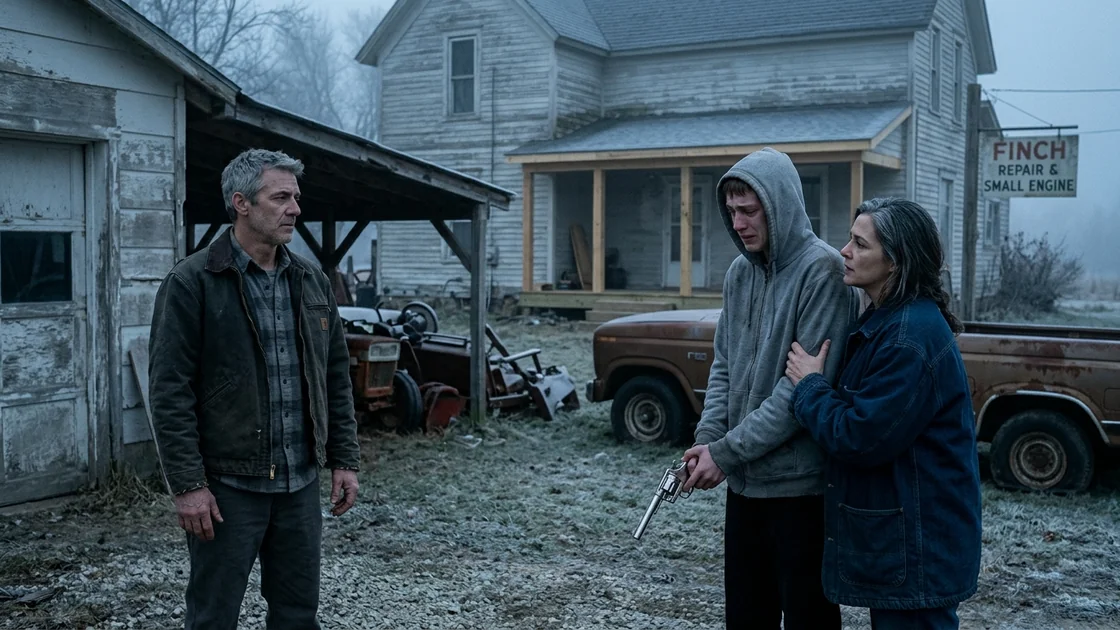
He stopped four feet from the doorway. His face was white, the skin around his eyes red and swollen. In his right hand, half-hidden by the fold of his sweatshirt, he held an old, nickel-plated Smith & Wesson .32 revolver—the gun Arthur Finch had kept in his nightstand for forty years, the gun that had not been on his hip the night the vault door closed.
"My mother told me," Leo said.
His voice was thin, trembling with a cold that had nothing to do with the November wind. The barrel of the revolver was shaking, describing small, erratic circles in the gray air between them.
Julian looked at the gun. He did not look at the muzzle; he looked at the cylinder. The nickel plating was flaked around the chambers, showing the yellow brass beneath. It was clean. Leo had oiled it; the boy had followed his lessons well.
"Yes," Julian said.
"She told me you were Callahan."
"That's my name."
"You killed him."
"I did," Julian said.
Leo's finger tightened on the trigger. The hammer of the double-action revolver began to rise, its cross-hatched spur catching the dim morning light. The cylinder clicked once as it rotated into battery.
"He was my grandfather," the boy shouted, his voice breaking into a high, hysterical sob. "He never did nothing to nobody! He worked thirty-four years in that goddamned shop, and you put him in a box! You put him in a box to die!"
"I did," Julian said again. He did not raise his hands. He did not take a step backward. He looked Leo directly in the eyes—those gray, slate-colored eyes that belonged to the woman who had spent twenty years carrying an anvil. "He had a small bottle of medicine in his pocket. It broke in the door track. I didn't see it until it was too late."
"You should have looked!"
"I should have looked," Julian agreed. His voice was steady, perfectly level, stripped of all defense, all evasion, all hope. "I was in a hurry. I was afraid of the dark. I was a coward with a gun that wasn't even loaded."
The hammer was three-quarters of the way back. The boy’s hand was shaking so violently now that the front sight was chattering against the inside of his pocket.
"Why did you come here?" Leo screamed. Tears were running down his cheeks now, freezing on his chin. "Why didn't you go somewhere else? Why did you come to our house?"
"Because there wasn't anywhere else," Julian said. "You can't walk away from a closed door, Leo. You think you can, but you can't. You just keep walking in circles around the outside of it until your shoes wear out. I came here to give you your porch."
"My porch?" The boy laughed—a wild, retching sound. "You think a fucking porch pays for my grandfather?"
"No," Julian said. "It doesn't pay for the first hour. It doesn't pay for the dirt he's under. It doesn't pay for your mother's hands."
Julian took one step forward. He did not lunge; he moved with the slow, deliberate care of a man stepping onto thin river ice. He reached out, took the cold barrel of the revolver with his scarred left hand, and pressed the muzzle against the center of his own forehead, right between his eyes.
The steel was so cold it burned his skin.
"Pull it," Julian said softly.
Leo froze. His breath came in ragged, wheezing gasps that sounded terribly like his grandfather's dying breath in the dark of the Tri-County Trust.
"Pull it, Leo," Julian whispered. "It’s cocked. Three pounds of pressure. That’s all the sear takes. If you pull it, the town will say you were right. The law won't touch you. You'll be the boy who killed the man who killed Arthur Finch."
"Stop," Leo sobbed.
"Pull it," Julian said again, his voice dropping into a rhythmic, steady cadence that seemed to fill the gray yard. "Because if you don't, you're going to have to live with the fact that there are things in this world that can't be fixed by three pounds of pressure. You're going to have to live with the fact that he's still dead, and this house is still cold, and sixty dollars for a lathe bearing is still more than you have."
The boy’s finger was white against the trigger. The hammer trembled at the peak of its travel.
Then, from the porch steps, a voice cut through the frost.
"Leo."
It was Clara.
She was standing on the bottom step—the step Julian had rebuilt out of two-inch red oak, the step that didn't squeak. She was wearing her father's chore coat, her hands deep in the pockets, her dark hair whipped across her face by the river wind.
"Leo, put the gun down," she said.
"Mom, he—"
"I know what he is," she said. She walked across the gravel, her steps slow and steady. She did not look at Julian. She looked only at her son. "Put the gun in your pocket, Leo."
"He wants me to do it!" the boy cried. "He's asking for it!"
"I know," Clara said, stopping beside them. She reached out and laid her hand over Leo’s fingers, the same fingers that Julian had taught to feel the temper of carbon steel. "He wants it because it's easy. It's twenty seconds of noise, and then he doesn't have to carry that box anymore."
She looked at Julian then.
Her eyes were not angry. They were something far worse: they were clear. She looked at him as if he were an old, broken tool that had been brought to her bench—something that had been dropped, twisted, and ruined beyond its original purpose, but was still made of iron.
"You don't get to die in my yard, Mr. Callahan," she said. "We've had enough of your work."
Julian's hand slowly dropped away from the barrel.
Leo lowered the gun, his shoulders collapsing inward as if his spine had turned to string. He dropped the revolver into the gravel, turned his face into his mother’s shoulder, and began to weep with the deep, hollow, racking sobs of a child who has looked over the edge of a pit and seen the bottom.
Clara held him. She did not stroke his hair; she simply stood like a locust post, her feet planted in the mud, holding the weight of her son against her chest until the shaking stopped.
Over the boy’s shoulder, her eyes stayed on Julian.
"The roof on the north side of the barn is sagging," she said. Her voice was flat, level, and colder than the river mist. "The rafters are oak, four-by-fours. They're sixty years old. They need to be sistered with two-by-eights before the snow comes."
Julian stood in the doorway of the lean-to, his arms hanging at his sides.
"I have two-by-eights behind the chicken coop," she continued. "They're green. They'll be heavy to lift alone."
"I have the block and tackle," Julian said. His voice was scarcely more than a breath.
"You'll need help on the ground," she said. "Leo will manage the tail line."
Leo pulled his head back from her coat, his face blotched with red, looking at his mother in horror. "Mom! No! I ain't working with him!"
Clara did not look down at the boy. Her gaze remained locked on Julian Callahan—on the zinc-gray hair, the hollow cheeks, the hands that bore the permanent, white geometry of the Mosler door.
"You'll work with him," she told her son, "because the barn is falling down. And because when something's broken, you don't burn the shop down to stay warm. You fix it. Even if your hands hurt. Even if you hate the wood you're working with."
She turned and began walking back toward the house.
At the bottom of the porch, she stopped. She did not look back, but her words carried through the silent, freezing yard like the stroke of an iron bell.
"Breakfast is at six, Mr. Callahan," she said. "Wash your hands before you sit down. The grease from those bolts doesn't come out of the tablecloth."
The screen door opened. It closed with its new, soft, perfectly balanced click.
Julian stood in the cold. Across the road, the cornfields were gray under the dawn, the stalks standing in long, straight, broken rows that stretched toward the river. He knelt in the gravel, picked up Arthur Finch’s nickel-plated gun, and laid it carefully on the clean wooden bench inside the shed.
Then he reached for his hammer, his files, and his level, and walked toward the barn.