The Echo of an Unread Line
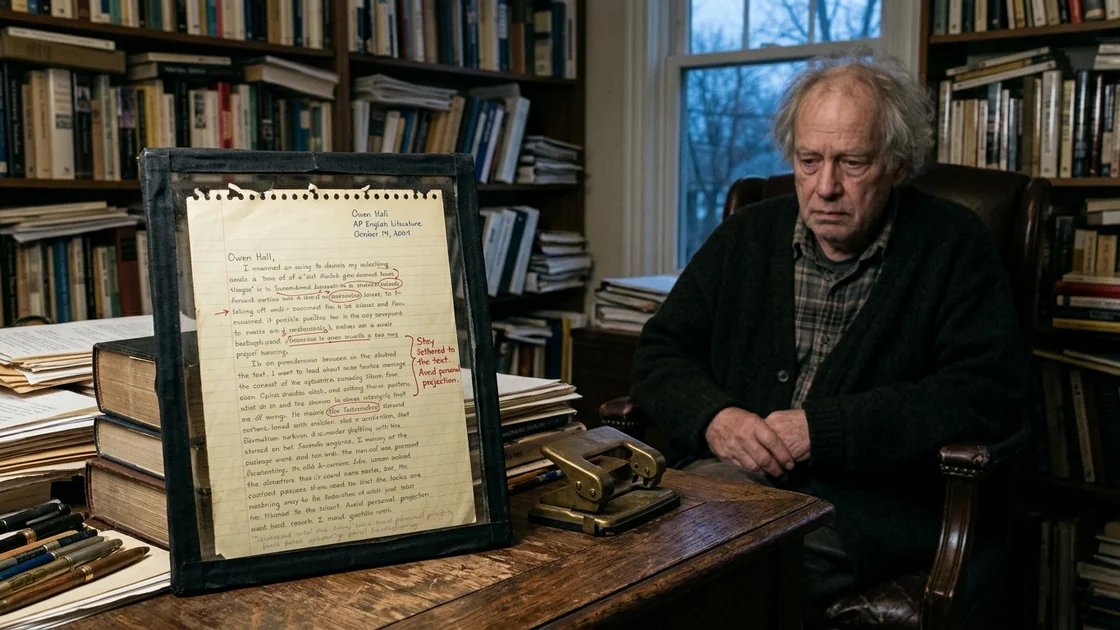
Julian Mercer spent thirty-four years teaching high school English with the practiced detachment of an academic, but when he retired, the memory of Owen Hall, a quiet seventeen-year-old whose written cry for help he had ignored two decades earlier, consumed him. Bound by an unbearable sense of complicity in the boy's subsequent death, Julian spends his final years insinuating himself into the lives of Owen's surviving mother and sister, offering silent physical labor and desperately seeking a form of grace that he knows he does not deserve.
The file cabinet was gray enameled steel, dented at the base where thirty cohorts of adolescents had kicked it while waiting for the bell to dismiss them from room 204. When Julian Mercer finally cleared out his classroom in the late spring of his sixty-sixth year, he had refused the custodial staff’s offer of a wheeled cart. He had carried the cardboard banker's boxes down the concrete stairwell one by one, feeling the vertebrae in his lower back grind together like wet stones.
In the smallest box, cushioned between an old brass three-hole punch and a broken stapler, lay the essay.
It was written on standard wide-ruled loose-leaf paper, the blue horizontal lines faintly blurred by moisture from long-past humidity. The paper had grown yellow and fragile along the margins, resembling dried cabbage leaves. At the top right corner, in blue ballpoint ink that had begun to turn purple, were three lines:
Owen Hall
AP English Literature
October 14, 2004
The essay had been assigned on Thomas Hardy’s The Mayor of Casterbridge. Julian remembered the prompt because he had used it for twenty years without altering a syllable: Discuss the role of character as destiny in Henchard’s decline.
Julian had awarded the paper a B-minus. He had corrected four run-on sentences with his red pilot pen. He had circled a dangling participle in the third paragraph and drawn a stern, precise arrow pointing toward the subject that ought to have anchored it. On the third page, where Owen had drifted into a rambling, semi-coherent meditation on Michael Henchard’s loneliness—on how Henchard had simply wanted to stop existing in the sight of men, how the silence inside a house could become so loud that a person would sell his own flesh just to make it cease—Julian had drawn a bracket in the margin.
Alongside the bracket, Julian had written: Stay tethered to the text. Avoid personal projection.
Directly beneath that red rebuke, squeezed into the bottom white space just above the serrated edge of the paper, Owen had penciled two sentences. They were written lightly, in graphite so faint it seemed to shiver against the pulp:
Mr. Mercer, the floor feels like water every time I stand up. What do you do when everything is quiet and you cannot bear the sound?
Julian had not seen it. Or perhaps he had seen it, registered it as an adolescent flourish, and merely turned the page to sum up his comments on the back. The back of the page bore Julian’s final summary: A capable reading of the tragedy, though lacking in structural discipline. You must learn to separate your sentiments from the analytical lens.
Eleven days later, Owen Hall’s uncle had found the boy’s blue sedan parked at the dead end of Old Logging Road, near the retention pond where the paper mill used to dump its runoff. The key was in the ignition, turned to the accessory position so that the battery had run dead, and the boy was gone. They had dredged the black water twenty-four hours later.
Julian had attended the service. He had stood in the rear of the Methodist chapel in Harrow Creek, holding his wool topcoat over his forearm, smelling of wet cedar and peppermint lozenges. He had shaken Sarah Hall’s hand in the receiving line. Her fingers had been cold and damp, like butcher’s paper left on a counter, and she had looked past his shoulder with eyes so flat and bleached by grief that she seemed to be staring through a pane of clouded glass.
"He was an attentive student, Mrs. Hall," Julian had whispered then. "Very thoughtful."
"He liked your books," she had replied, her voice an dry rasp that did not rise above the low drone of the chapel’s baseboard radiators. "He left them on his nightstand."
Julian had gone home, cooked a tin of tomato soup, and graded forty-two essays on The Great Gatsby. He had told himself that the boy had been ill; that schoolteachers were not clinicians; that the town’s mental health resources were poor; that Owen’s father had abandoned the household four years prior; that there were a thousand subterranean currents in a family that no English teacher could ever map.
He had kept the paper. He did not know why. He had slipped it into a manila folder marked Hall, O. and shoved it between the state syllabus binders and the attendance rolls from the 2003–2004 academic year.
For nineteen years, it had remained there, a piece of dry tinder resting inside dark metal. But when the retirement party ended—when the lukewarm cider was drunk, the commemorative pewter clock set upon his mantelpiece, and the school doors locked behind him for the final time—Julian found that the house on Maple Street did not contain enough air for him to breathe.
Retirement arrived not as a pasture, but as a silence that had teeth.
Julian’s wife, Eleanor, had left him nine years before the pewter clock arrived. She had done so without melodrama, leaving two sets of brass keys on the laminate kitchen counter alongside a note written in the crisp cursive of an elementary school principal: Julian, you are an archive, not a husband. I am tired of living in a reading room.
She was right, of course. Julian had lived his life through the mediated buffer of printed sentences. When tragedy occurred in a novel, it had an architecture; it had rising action, climax, denouement, and thematic unity. It could be parsed, graded, shut between covers, and placed back upon a cedar shelf. Real grief was sloppy. It smelled of unwashed hair and stale laundry; it did not resolve in anagnorisis; it lingered in carpets and gathered under baseboards like gray grease.
By the second month of his retirement, the heat of mid-July lay over Harrow Creek like a wet, gray blanket. The town was dying in the slow, rust-colored manner of western Pennsylvania mill settlements. The grocery store had closed its meat counter, leaving only pre-packaged pork chops in weeping cellophane; the pharmacy had been bought out by a regional chain that kept everything behind locked polycarbonate shields; and the young people who possessed any ambition took the turnpike east toward Harrisburg or west toward Pittsburgh and did not come back.
Sarah Hall had stayed.
Julian discovered this not by seeking her out directly, but by walking. His doctor, a man twenty years his junior with an impatient stethoscope, had told him his blood pressure was creeping into dangerous territories. Walk four miles a day, Julian. Don't look at the houses. Just walk.
But Julian looked. He knew every roofline in the borough. Harrow Creek was built on a limestone shelf that sloped downward toward the oily green waters of the Mahoning Creek, and the houses on Elm Street, down near the bottom of the grade, suffered from chronic damp.
Number 412 Elm Street was a wood-frame saltbox that had once been painted butter-yellow. Now it was the color of curdled cream, the paint curling off the cedar clapboards like dry skin after a sunburn. The porch had developed a drunken, six-inch sag on the eastern corner where the cedar posts had rotted into the wet dirt. A garden that had once been cultivated was now a jungle of pokeberry, sumac, and wild blackberry canes that clawed at the basement windows.
Julian stood on the cracked asphalt across the road, his hands jammed into the pockets of his windbreaker. The air smelled of swamp grass and burning leaves from a distant yard.
Through the porch screen, he saw her.
Sarah Hall was sitting in a vinyl-strapped lawn chair that had lost its elasticity, her knees wide, shelling peas into an aluminum pot. Her hair, which had been chestnut with streaks of silver when Julian shook her hand in 1998, was now entirely the color of lead wool, cut short and jagged around her ears as if she had pruned it herself with kitchen shears. She wore a pair of men’s work trousers cinched at her narrow waist with an old leather belt, and her spectacles hung from a beaded chain around her throat.
Every two or three minutes, she would pause, hold a pea pod between her thumb and forefinger, and look out over the road. Not at Julian—he was shielded by the broad trunk of a municipal sycamore—but at the emptiness between the telephone poles. It was a gaze he had seen in the faces of veterans who returned to Harrow Creek after foreign wars: not looking for something to happen, but merely verifying that the horizon was still vacant.
Julian felt a sharp, metallic sensation at the back of his mouth, like he had bitten down on a piece of tin foil.
He went home. He sat at his kitchen table before his cold tea. He pulled the file folder from the banker’s box and spread Owen’s paper out beneath the low hum of the fluorescent tube.
What do you do when everything is quiet and you cannot bear the sound?
Julian had thirty-four years of pension payments ahead of him, sixty thousand dollars in savings, an eight-year-old Buick LeSabre with fifty-two thousand miles on the odometer, and nothing else. No children. No living siblings. His life had been a series of margins through which other people’s lives had moved, leaving faint graphite tracks that he had erased or corrected with red ink.
"You answered the grammar," Julian said aloud to the empty kitchen. His voice sounded thin, like dry leaves rustling in a vent. "You fool. You miserable, pedantic fool."
He did not go to her front door with an apology. Even in his late-career stagnation, Julian Mercer retained enough moral instinct to know that an apology from him would be a grotesque act of self-gratification. To walk onto her porch, lay that yellowed paper in her arthritic hands, and say I am sorry I missed the sentence your son wrote before he drove to the pond would not comfort Sarah Hall. It would merely deposit Julian’s guilt into her lap, forcing her to either grant him a fraudulent absolution or bear the weight of his belated performance.
Forgiveness was not something he had the right to request. Forgiveness was an economy he was barred from entering.
Instead, he went to the borough hardware store on a Tuesday morning. He bought a pair of German-made bypass loppers with hickory handles, a steel bow saw, two rolls of heavy contractor-grade refuse bags, and a six-foot fiberglass stepladder that fit diagonally across the back seat of his Buick.
The next day, while the fog still hung in the gully of the Mahoning Creek and the streetlamps were still flickering against the pearl-gray light of dawn, Julian drove down to Elm Street. He parked his car two blocks away, in the gravel turnaround behind the defunct feed mill, and walked to number 412.
The town was dead silent. A dog barked three streets over, its bark dull and flat against the mist.
Julian did not touch the house itself. He went to the perimeter, where the pokeberry and the blackberry had swallowed the chain-link fence that separated Sarah Hall’s small lot from the abandoned right-of-way behind it. The canes were thick as a man’s thumb, armed with curved red thorns that caught on his canvas work gloves.
Julian swung the loppers. Snip.
The sound was shockingly loud in the five-o'clock air. He waited, his chest heaving, his pulse knocking in his temples like a wooden mallet. No light appeared in the rear windows of the saltbox. The dark glass remained cold and impassive.
He cut another cane. Then another. He worked methodically, using the same small-bore, repetitive diligence he had once brought to grading stacks of hundred-page research papers. He cut the briars into two-foot lengths, kneeling in the wet chickweed until the knees of his corduroys were soaked through with ice-cold dew. He dragged the bundles into the alleyway, away from her property line, and stuffed them into the thick black plastic bags.
By seven in the morning, his palms were blistered beneath the leather gloves, his lumbar spine was a hot rod of white fire, and he had cleared a swath four feet wide and twenty feet long.
When he heard the rattle of a sash window being raised on the second floor of the house, Julian dropped his loppers into the weeds, stepped into the shadows of the ailanthus trees that lined the alley, and walked rapidly toward his car without looking back.
He returned on Thursday. Then on the following Monday.
He learned her rhythms through the geography of her chores. Sarah Hall woke at six. A yellow light would bloom in the small kitchen window at the rear of the house. Ten minutes later, the blue flame of an ancient gas stove would flare, followed by the clink of an enamel percolator against an iron burner plate.
She left the house at seven-forty-five, walking with a stiff, right-sided limp down to the bus stop on the corner of Route 19. She worked twenty hours a week as an archivist’s clerk in the basement of the county courthouse—a sinecure arranged by a deceased brother who had once been a township supervisor. It was work for an old woman who knew how to handle fragile paper without tearing it; she sorted probate dockets from the nineteenth century into acid-free folders.
She returned at one-thirty. That gave Julian four hours.
In those four hours, twice a week, Julian dismantled the neglect of twenty years. He cleared the deadwood from the ancient apple tree whose untended limbs were rotting into the roof of the garden shed. He scraped the green lichen from the flagstone path using a stiff putty knife, working on his knees with a folded burlap sack beneath his patellae. When the gutters on the north side of the house began to sprout silver maple seedlings, he carried his fiberglass ladder through the side gate, climbed to the eaves, and scooped out two decades of black, sulfur-smelling leaf mold with his bare hands.
He left no notes. He never crossed the threshold of the porch. When he finished a job, he swept the gravel with a stiff broom to obliterate his own boot prints.
It was an absurd exercise. He was an old man playing at being an invisible brownie from an English folk tale, and he knew it was grotesque. Yet each time his muscles seized, each time a thorn punctured his skin through the canvas and drew a dark pearl of blood from his forearm, Julian felt a cold, clean relief settle into the base of his neck. It was not redemption—redemption was a grand, theological word that had no place in a gravel alley in Harrow Creek. It was simply the balancing of an impossible ledger by fractions of a copper penny.
By mid-August, the backyard was unrecognizable. The fence was clear, the grass had been trimmed with a hand-scythe Julian had found in his own basement, and the dead apple branches were neatly stacked near the property line, seasoned and cut to sixteen-inch stove lengths.
On the third Wednesday of that month, Julian was kneeling near the base of the back steps, replacing a split riser with a piece of salvaged white oak he had planed that morning, when the kitchen screen door pushed open.
Julian froze. He was holding a rusted crowbar in his right hand.
Sarah Hall stood on the small landing above him. She was wearing her town shoes—black lace-ups with thick rubber soles—and her plastic raincoat, though the sky was a hard, pale blue. She did not look startled. She looked down at him with the same flat, mineral eyes she had turned upon the congregation in the Methodist church twenty years before.
In her right hand, she held an old jelly glass filled with tap water.
"Your knees must be ruined, Mr. Mercer," she said.
Julian’s tongue felt thick, like dry wool. He dropped the crowbar into the grass. It made a soft, dead thud against the clover.
"Mrs. Hall," he said. He could not get up. When he tried to shift his weight to his feet, his right knee locked with a sound like a dry twig snapping. He remained on the ground, his gray hair wild and damp with sweat, looking up at her from the weeds.
"Drink this," she said, descending the two steps with that slow, deliberate hitched gait. She did not offer him a hand to rise, which he appreciated. She merely extended the jelly glass.
The water was tepid and tasted of the municipal iron pipes, but Julian drank it all. He held the empty glass with both hands, afraid that if he let go, his fingers would begin to shake.
"You've been here five weeks," she said. She was looking past him, at the apple tree. "The first morning, you left your red handkerchief by the compost bin. It had your initials on the corner. E.M. Eleanor’s sewing, I expect. She always did nice monogramming for the bazaar."
Julian looked down at his dirt-caked knuckles. "I can go, Sarah. I’ll pack the wood into the car and I won't come back down the alley."
"Did I tell you to go?" she asked.
The question had no heat in it. It was not an invitation, nor was it an accusation. It was simply a statement of fact that hung between them in the humid August heat like a line of drying linen.
"The porch needs a jack," Julian said, his voice dropping into the low register he had once used when explaining Milton to uninterested seventeen-year-olds. "The sill on the corner has dry rot. If the snow is heavy this winter, the whole roof over the stoop will tear away from the studs."
Sarah Hall took the jelly glass from his hands. Her skin brushed his—parchment against dry leather.
"I have eight hundred dollars in the burial fund," she said. "The rest goes to the oil company in November. That’s all there is."
"I don't want money," Julian said.
"Nobody works for nothing, Mr. Mercer. Especially not retired schoolmasters who used to wear neckties on Saturdays."
"I have the time," Julian said. "The pension is sufficient."
She looked at him then, really looked at him, for the first time. Her eyes were small, sunken behind high, flat cheekbones that suggested Welsh coal-mining stock, the color of wet river stones. There was no warmth in them, but there was an immense, terrifying clarity.
"You think you're working off a debt," she said.
Julian’s breath caught in his throat. For a wild, sickening second, he wondered if she knew. Had Owen told her? Had the boy left a duplicate notebook on that nightstand Julian had heard about? Had she seen the essay with its red brackets and its red dismissals?
"I don't think anything of the kind," Julian lied. His voice cracked slightly on the second word.
"Good," Sarah said, turning back toward the screen door. "Because my boy is dead, Julian. He's been dead twenty years this October. And there isn't enough timber in the state of Pennsylvania to build a bridge across that."
She went inside and let the screen door slap shut behind her.
He returned the next morning at eight, bringing a hydraulic bottle jack, three lengths of six-by-six pressure-treated spruce, and his carpenter’s level.
A routine established itself, unspoken and rigid as a monastic rule. Julian would arrive after she left for the courthouse. He would work until twelve-thirty, take thirty minutes to eat a sandwich of cheese and mustard he had brought from home, and then work until two. At two, Sarah would return. She would not invite him into the parlor, nor would he seek to enter.
She would set a mason jar of cold water or a mug of black coffee on the bottom step of the porch, and she would sit on the lawn chair while he worked.
Sometimes they did not speak for an hour. Julian would be under the porch, his back against the damp soil, levering the heavy jack against a railroad tie to lift the corner of the house an eighth of an inch at a time. The smell under the porch was ancient: soot, dead crickets, dry rot, and the peculiar faint odor of zinc from old canning jars that had broken beneath the floorboards fifty years before.
From above, he would hear the rhythmic squeak of her lawn chair as she rocked, or the snip of her shears as she mended old pillowcases for the county home.
"He was not a good student for you, was he?" she asked one afternoon in September. The air had turned brisk; the first red leaves were showing in the sumac along the railway cut.
Julian stopped his ratchet. He lay still beneath the joists, looking up at the subfloor where the nails had rusted into black teeth.
"He was attentive," Julian said through the floorboards. "He read what I assigned."
"He was slow," she said. Her voice came down through the gaps in the spruce planks, dry and steady. "He took three days to write a postcard to his cousin in Altoona. He would sit at the kitchen table with an eraser until the paper was thin as an onion skin. He wanted things to be... particular."
"Precision is not a fault in a reader," Julian said.
"It is if you're trying to live in this town," she replied. "This town doesn't care about particular things. It just rolls over you like a road grader. If you're too thin, you tear."
Julian closed his eyes. The iron smell of the soil was very close to his face. "He wrote well about Hardy," he whispered, but the wind took the words and scattered them into the dead weeds, and Sarah did not ask him to repeat them.
In late October, Maya came home.
Maya Hall had been fourteen when her brother died. Julian remembered her only as a scrawny girl with long, greasy bangs who had sat on the steps of the high school annex after third period, smoking menthol cigarettes and glaring at the teachers with an open, feral hatred. She had vanished from Harrow Creek two years after the funeral, running off to Philadelphia, then to Baltimore, living a life that filtered back to the town only through small, scandalous rumors: community college, a divorce from a house painter, a series of jobs in logistics warehouses.
Now she was thirty-four, her hair dyed the color of damson plums, with small silver rings through the cartilage of her nostrils and the hard, capable forearms of someone who unloaded freight pallets for a living.
Julian was on the ladder, caulking the window casings of the second-floor dormer, when her rusted Honda Civic pulled into the rutted driveway. The muffler was broken, rattling like a bucket of bolts.
She got out of the car, slammed the door with her hip, and stood at the bottom of the ladder, looking up at him with her hands stuffed into the pockets of an oversized army jacket.
"You've got to be kidding me," she said.
Julian held the caulking gun suspended. A bead of white silicone dangled from the nozzle like a drop of tallow. "Good morning, Maya."
"What the hell are you doing on my mother's roof, Mr. Mercer?"
Sarah came out onto the porch before Julian could answer. She was wearing an old brown cardigan of Owen’s—the sleeves were turned back three times at the cuffs to keep them off her hands.
"He's fixing the flashing," Sarah said. "The water was getting into the ceiling above the linen press."
Maya looked from her mother to the old man on the ladder, her mouth twisting into a small, bitter knot that made her look startlingly like her brother.
"He was the one with the red pen," Maya said. She was not speaking to Sarah; she was speaking to Julian. "I remember you. You had that little blue sports car you used to park in the faculty lot like you were the king of the goddamned county."
"It was an ancient Saab, Maya," Julian said quietly. "And it had a broken transmission."
"I don't give a damn what it was," she spat. "You didn't give him the extension."
Julian lowered the caulking gun. The ladder vibrated against the cedar siding as his knees began to tremble. "What?"
"The extension," she said, stepping closer to the base of the ladder. Her face was flushed with the sudden, ugly heat of a long-nursed grievance. "The week before he died. He was working twelve hours at the car wash because Dad hadn't sent the check, and his paper was late. He went to your room after the last bell. I was waiting for him by the bike racks. He came out five minutes later and he was crying. Owen never cried. He was seventeen years old and he stood by the bike racks and he couldn't even get his key into the car door because his hands were shaking."
Julian felt the light drain from the sky. The autumn afternoon seemed to collapse into an oily gray point between his eyes.
"Maya," Sarah said from the stoop. Her voice was sharp, a whip-crack across the dry grass. "That's enough."
"No, it's not enough!" Maya turned on her mother, her arms gesturing wildly toward the house. "You've got him down here like an old dog! What is this? You think because he paints the trim, that makes up for it? He didn't care about Owen! None of them cared! They thought he was stupid because he didn't talk fast! And now he's down here playing the saint with his hammer and his level, and you're making him coffee?"
"I don't make him coffee," Sarah said, her voice dropping into that terrifying, flat register. "He brings his own sandwich. Now come inside and take off those boots. You're tracking mud onto the linoleum."
Maya stared at her mother, her chest heaving beneath the drab green jacket. Then she looked back up at Julian. Her eyes were wet, but her mouth was set in an expression of pure, unadulterated contempt.
"You missed it," she whispered. "He told you he was drowning, and you gave him a lecture about punctuation."
She turned and marched up the steps, letting the screen door slam with a violence that rattled the dry rot in the sill Julian had not yet finished mending.
Julian did not finish the flashing. He climbed down the ladder, wiped the caulking gun with a kerosene rag, and placed his tools into the metal crate in the trunk of his Buick.
His hands were steady now. The trembling had passed, replaced by a strange, icy numbness that seemed to begin in the marrow of his collarbones and spread outward to his fingers.
She knew.
Not Sarah—Maya. Maya had been at the bike racks. Owen had come out of room 204 with his paper in his hand.
Julian sat in the front seat of his car, the engine idling with a low, hydraulic purr. He closed his eyes and let the memory surface—the real memory, the one he had pruned and edited for twenty years until it was smooth and harmless as a river stone.
It had not been eleven days. It had been eight.
The boy had come to his desk at three-fifteen. Julian had been packing his briefcase—a leather satchel Eleanor had bought him for their fifth anniversary. Julian had been angry because the department chair had questioned his choice of texts for the second-semester curriculum; he had been late for an appointment with a divorce lawyer in Greensburg; the radiator in room 204 was hissing and spitting brown water onto the linoleum floor.
Owen had stood there, his greasy winter coat zipped to the chin, holding the paper on Hardy.
Mr. Mercer, can I rewrite this?
Julian had not even looked up from his briefcase. He had snapped the brass latches shut. Click. Click.
The policy is in the syllabus, Owen. Revisions are for C-grades and below. You received a B-minus. That is an acceptable mark for a student with your preparation. If I allow you to rewrite, I must allow thirty-two others to do the same.
It's not the mark, the boy had said. His voice had been so low Julian had to strain to hear it over the hissing steam. It's what I said at the end. I wanted to talk to you about the end.
Julian had put his hand on the boy’s shoulder—not an act of affection, but an act of dismissal, the practiced, professional steer toward the door that veteran teachers use to clear their rooms at the end of the day.
We will have plenty of time for discussions during the modernists unit, Owen. Focus on Hemingway for Monday. Less sentiment, more bone.
He had walked the boy out of the room. He had turned the key in the brass lock of room 204, clicked off the fluorescent banks, and hurried down the stairwell to beat the shift-change traffic on the bypass.
Julian sat behind the wheel of the Buick, his forehead resting against the hard plastic of the steering wheel. The horn did not sound; his weight was too light, his posture too broken to trigger the mechanism.
"Less sentiment," he whispered to the dashboard. "More bone."
He did not go back to Elm Street for three days.
He spent those days in his cellar. He had an old workbench down there, illuminated by a single incandescent bulb with a pull-string. He had inherited his father's hand planes—heavy Stanley planes from the 1930s, their sole-plates gray with age, their rosewood handles worn smooth by the palms of a man who had built grain silos during the Great Depression.
Julian took them apart. He cleaned the irons with kerosene and fine steel wool. He set his oilstone on the bench and worked the bevels, drawing the steel back and forth in figure-eights until the cutting edges were bright and silver and terrifyingly sharp.
He worked until the skin on his thumbs was shaved bald from testing the burr.
On Saturday evening, the phone rang. It was an old rotary wall phone in the hallway, its bell shrill and startling in the dark house. Julian let it ring nine times before he lifted the heavy Bakelite receiver.
"Julian."
It was Sarah. It was the first time she had ever called him by his name on the telephone.
"Yes, Sarah."
"Maya’s gone back to Altoona," she said. Her voice sounded older than the house, older than the town. "She had a shift at the distribution center."
Julian gripped the black plastic. "Sarah, what she said—"
"I don't care about what she said," the old woman interrupted. "The wind is coming out of the north tonight. There's a draft around the baseboards in the front room that smells like dead mice. The insulation you put in the crawl space didn't hold."
She paused. In the wire between them, Julian could hear the faint, ghostly crosstalk of other conversations—other people in other towns talking about grocery prices, weather, who had died in the nursing home.
"Are you coming back or not?" she asked.
Julian looked at his hand on the receiver. The thumb was nicked from the oilstone; a thin black crescent of dried blood lay along the nail.
"I have the cedar shingles in the trunk," he said. "I can be there at seven."
"Eight," she said. "I'm sleeping late. My hip is bad."
November arrived with a hard, black frost that killed the last of the wild mint along the foundations.
Julian worked inside now. The exterior of the saltbox was as sound as seventy-year-old pine could be made. The porch sat level on two concrete footers Julian had dug himself, four feet down into the shale to get below the frost line, mixing the Redi-Mix in an iron wheelbarrow with a garden hoe until his shoulders felt as though they had been beaten with lengths of rubber hose.
Inside, the house smelled of fried fat, peppermint tea, and the peculiar, damp sweetness of old paper.
Sarah let him into the parlor. It was a narrow room with low ceilings that had been wallpapered in the 1960s with a pattern of faded gold cabbage roses. The furniture was covered in rough, brown wool throws to hide the holes where the foam had turned to yellow dust.
On the upright piano, an old Baldwin that was three octaves out of tune, there was only one photograph.
It was not Owen’s graduation portrait—he had not lived to take one. It was an informal snapshot taken with an Instamatic camera at the county fair. Owen was fourteen. He was standing in front of an International Harvester tractor, his hair blown across his forehead by the wind, his eyes squinted against the bright July sun. He was not smiling, but he looked... solid. His shoulders were broader than Julian remembered. He looked like a boy who might have grown into a man who could fix a truck or pour concrete; he did not look like a boy who would drown in six feet of stagnant water with a paperback copy of The Mayor of Casterbridge sitting on the dry passenger seat of his car.
Julian stood before the piano, a bundle of fiberglass insulation tucked beneath his arm like an oversized loaf of bread.
"He hated that picture," Sarah said from the doorway. She was holding a cup of hot water with a slice of lemon floating in it. "He said his ears looked like jug handles."
"He looked like his grandfather," Julian said. He had known her father slightly—an old Welshman who had worked the coal tipple at the lower yard and had died of the black spit when Julian was still a junior master at the school.
"He looked like nobody," she said, setting the mug on a crocheted doily. "He looked like himself. That was his trouble. He didn't have enough other people in him to survive being alone."
She sat down on the piano bench. She did not open the fallboard. She just rested her knuckles on the worn mahogany.
"Maya told me what was on that paper," she said.
Julian’s heart seemed to stop. The fiberglass insulation slipped from his arm and fell to the linoleum with a soft, woolly hiss.
"She didn't read it," Julian whispered. "She couldn't have."
"She didn't need to read it," Sarah said. She was looking at the yellowed keys. "Owen told her. The night before he went down to the pond, he was sitting on the edge of her bed. She was just a little girl, really. She was playing with those plastic horses she used to have. He told her that he had asked the only man in town who seemed to know about sadness, and the man had told him to check his spelling."
The room seemed to shrink. The cabbage roses on the walls seemed to crowd inward, their faded gilt edges shimmering in the pale light that struggled through the lace curtains.
Julian did not speak. There were no words in the English language—none in the three thousand volumes that lined the walls of his house on Maple Street, none in the leather-bound sets of Hardy, or George Eliot, or the King James Bible—that could occupy the space between them.
He fell to his knees. It was not a calculated gesture; his legs simply refused to bear the weight of his torso any longer. He knelt on the faded linoleum, his hands flat on the cold floorboards, his head bowed until his forehead almost touched the dusty hem of her brown wool skirt.
"I am sorry," he said. The words were small, ugly, and totally useless. They were like the red pen marks on the margins—petty, administrative, dead. "I am sorry. I am sorry."
Sarah Hall did not move. She did not pull her skirt away, nor did she reach down to touch the thin white hair at the crown of his skull.
She sat on the piano bench with her hands folded in her lap, her breathing slow and heavy, like the sound of an old bellows in a cold forge.
"Get up, Julian," she said after a long time.
He could not. His chest was hitching in dry, rhythmic spasms that produced no tears—only a sound like an old pump trying to draw water from an empty well.
"Get up," she said again, her voice harder now. "I won't have you groveling on my floor. My husband did enough of that before he took off for Ohio. Groveling is just another way of making people look at you."
Julian dragged himself upward, using the edge of the piano casing for support. The mahogany was cold under his palms. His face was gray, the skin around his mouth mottled with blue and purple veins.
Sarah rose from the bench. She stood less than a foot from him. She was half a head shorter than he was, but she seemed carved out of the same dark limestone that held up the borough hall.
"You think you killed him," she said.
"I didn't listen," Julian said. "He asked for bread, and I gave him a stone."
"You didn't kill him," she said, her voice dropping into a register so cold and final that the hair on the back of Julian’s neck stood up. "Owen killed Owen. He had that black water inside him since he was nine years old. It was in his blood, from his father's people. His uncle died in a barn in Mercer County with a rope around his neck, and his great-uncle went into the river behind the distillery in nineteen-forty-eight."
She turned and looked at the Instamatic photo on the piano.
"You were just the last door that didn't open," she said. "That’s all you were, Julian. Just a door that stayed shut."
"That is enough," Julian whispered. "To be the door."
"Yes," she said. "It’s enough to make you an old fool with a guilty conscience. But it’s not enough to make you his father, and it’s not enough to make you his savior."
She pointed toward the hallway.
"The baseboards in the back bedroom are loose," she said. "The cold comes up through the sill where the rats chewed through the lath in seventy-six. Go fix them."
He worked until December.
The weather broke on the tenth—a wet, heavy blizzard that dropped fourteen inches of gray slush over Harrow Creek, snapping the power lines along the creek and turning Elm Street into an impassable canal of frozen mud.
Julian walked down from Maple Street. It took him two hours. He wore his heavy hunting boots and an old wool mackinaw that smelled of mothballs. He carried a snow shovel over his shoulder and a five-gallon can of kerosene in his right hand.
The town was silent. The only sound was the heavy, wet plop of snow falling from the branches of the hemlocks into the drifts below.
When he reached number 412, he found the front path already shoveled.
It was not a neat job. The trench was narrow, with jagged, irregular walls where the shovel had bitten into the drift at odd angles, but it was clear down to the flagstones.
Maya’s Honda was parked in the driveway, its roof covered in a thick cap of white.
Julian stood at the gate, his boots sinking into the slush, his breath coming in white, ragged puffs. He set the kerosene can down on the snow.
The front door opened. Maya came out onto the porch. She was wearing a heavy knit cap pulled down to her eyebrows and a pair of men’s insulated coveralls. She had a steel snow shovel in her hand.
She saw him standing by the gate. For a long moment, neither of them moved. The wind came down Elm Street, rattling the bare branches of the sycamores and sending a spray of fine, dry powder across the crust of the snow.
Then Maya leaned the shovel against the house. She walked down the narrow trench she had cut, her heavy boots squeaking against the wet shale.
She stopped three feet from him, on the other side of the gate. Her face was red from the wind, her breath mingling with his in the cold space between them.
"She's sick," Maya said.
Julian’s heart dropped into his stomach. "Her chest?"
"Pneumonia," Maya said. "The doctor came down from the clinic in the four-wheel drive. He gave her penicillin, but she won't stay in bed. She keeps trying to get down to the kitchen to see if the pipes under the sink are freezing."
Julian reached down and lifted the kerosene can. "The heater in the hall needs fuel. The draft from the pantry goes straight into her bedroom."
Maya looked at the red metal can. Then she looked at Julian’s face—at the deep, purple hollows under his eyes, the white stubble along his jaw, the trembling of his wrists beneath the heavy wool sleeves of his coat.
"She doesn't want you in the room," Maya said.
"I know," Julian said. "I'll stay in the basement. The bypass valve on the furnace needs to be bled every four hours or the pressure will drop and the radiators will go cold."
Maya stood there for another thirty seconds, her hand resting on the top rail of the gate. Her fingers were bare, red and raw from the cold iron.
"He really did think you were smart, you know," she said. Her voice was not angry now; it was just tired, flattened by the same cold gray air that had flattened her mother’s voice for twenty years. "He had this notebook where he wrote down all the words you used in class that he didn't know. He had twenty pages of them. He had objective correlative written down three times with different colored pens."
Julian felt a sharp, tearing sensation behind his ribs, as if an old seam had given way under tension.
"I didn't know," he said.
"Of course you didn't," she said, swinging the gate open. "You were the teacher. We were just the kids who lived down by the water."
She took the kerosene can from his hand. It was heavy, but she swung it with one arm, her shoulder dipping with the weight, and walked back toward the porch.
"Come on," she said without looking back. "The basement door is sticking again. You need to take an eighth of an inch off the bottom with that plane you're so proud of."
Sarah Hall died on the fourteenth of January, during the second hard freeze of the winter.
The funeral was small—smaller even than Owen’s. There were seven people in the chapel: Maya, two elderly cousins who had driven down from Mercer in a car with bad brakes, the archivist from the county courthouse, a woman from the Methodist auxiliary who brought a tin of ham salad sandwiches, and Julian.
Julian sat in the last pew, beneath the brass plaque that commemorated the young men from Harrow Creek who had died at Saint-Mihiel in 1918.
He wore his good suit—the dark charcoal wool he had bought for his retirement dinner. It hung loose on his frame now; he had lost twenty pounds since August, his neck rattling inside the collar of his white shirt like a dried hazelnut in a shell.
Maya did not speak to him during the service. She sat in the front row, her damson-colored hair hidden beneath a black knit cap, her broad back straight and motionless while the young Methodist minister—a boy who had not even been born when Owen Hall died—read the twenty-third Psalm from a laminated card.
After the cemetery—after the green artificial turf had been folded back and the bronze-colored casket lowered into the frozen clay beside Owen’s small granite marker—the cousins drove away toward the turnpike, their exhaust hanging in the freezing air like white wool.
Julian stood by his Buick at the edge of the gravel lane. The wind was coming across the open fields from the north, carrying the smell of the coke works sixty miles away.
Maya walked across the dead grass toward him. She had a manila envelope tucked under her arm.
"The lawyer said the house goes to the bank," she said. Her face was pale, her nose red from the wind. "There was a second mortgage from ninety-four that nobody ever paid. They're going to auction it off in April."
"It's a sound house now," Julian said, his voice barely audible over the wind. "The sill is dry. It will stand for another fifty years if they keep the gutters clear."
Maya looked down at the envelope in her hands. The wind caught the corner of the flap, fluttering it against her coat with a sound like a small bird’s wing.
"I found this in her bureau," she said. "Under her wedding certificate."
She handed the envelope to him.
Julian did not open it. He did not need to. Through the thin paper of the envelope, he could feel the sharp, rectangular corners of the folded three-hole-punched loose-leaf.
"She kept it?" Julian asked.
"She didn't keep it," Maya said. "Owen gave it to her. The Sunday before he died. He told her to keep it because it had your writing on it, and you were the only person in Harrow Creek who had ever read anything he wrote all the way to the end."
She looked at him with those gray, stony eyes—Sarah’s eyes, Owen’s eyes, the eyes of the people who stayed in the gully while others left.
"He wasn't asking you to save him, Mr. Mercer," she said softly. "Owen wasn't like that. He just wanted to know if the noise ever stopped. That’s all. He just wanted to know if it was like that for everybody."
Julian closed his fingers over the envelope. The paper was cold from the January wind.
"What did you tell her?" Julian asked. "When you told her I was coming down to the house?"
Maya pulled her gloves on, her fingers working into the stiff leather with small, aggressive tugs.
"I told her you were old," she said. "And that you didn't have anywhere else to go."
She turned and walked toward her rusted Honda, her boots crunching on the frozen gravel. She got in, started the engine—the muffler still rattling like iron chains—and drove down the cemetery hill toward the state road, leaving two gray tracks in the thin crust of snow.
Julian Mercer lived for three more years in the house on Maple Street.
He did not join the historical society, nor did he return to the high school to substitute teach, though the borough superintendent called him twice when the junior English master took ill with mononucleosis.
He spent his mornings walking. He walked down Maple, down through the business district where two more storefronts had been boarded up with green plywood, and down the long limestone slope to Elm Street.
The house at number 412 sat empty. The bank had put a small, sun-bleached sign in the front yard: FORECLOSURE - PROPERTY OF FIRST COMMONWEALTH.
In the spring, the pokeberry and the blackberry canes began to creep back toward the fence. A young sumac sprouted through the flagstones near the bottom step where Julian had sat with his jelly glass of water. The paint on the north dormer began to peel again, tiny white curls of skin falling into the new grass like dead moths.
Julian did not bring his tools. He knew better now. You could not plane away the grain of a world that was built to rot; you could not jack up a life with six-by-six spruce and a hydraulic bottle.
He would stand by the gate for five minutes, his hands resting on the cold iron rail, watching the sycamore leaves turn their pale undersides to the rain.
Then he would walk back up the hill.
In his study on Maple Street, the essay remained on his desk. He had framed it, not in gilt or oak, but between two sheets of plain glass he had salvaged from an old storm sash, held together with black cloth tape along the edges so that both sides could be seen.
On the front, the red ink: Stay tethered to the text. Avoid personal projection.
On the back, the graphite, faint as a moth's breath: What do you do when everything is quiet and you cannot bear the sound?
Julian sat before it every evening while the light left the hills across the river. He did not read books anymore. He did not grade papers. He simply sat in his leather chair with his hands folded in his lap, listening to the small, rhythmic ticks of the cooling baseboard radiators, the distant rumble of the coal drags on the valley floor, and the great, patient silence that rose from the limestone beneath the town—a silence that was neither cruel nor kind, but simply deep enough to hold everything that men had forgotten to say.