The Drowned Canyon of Orah
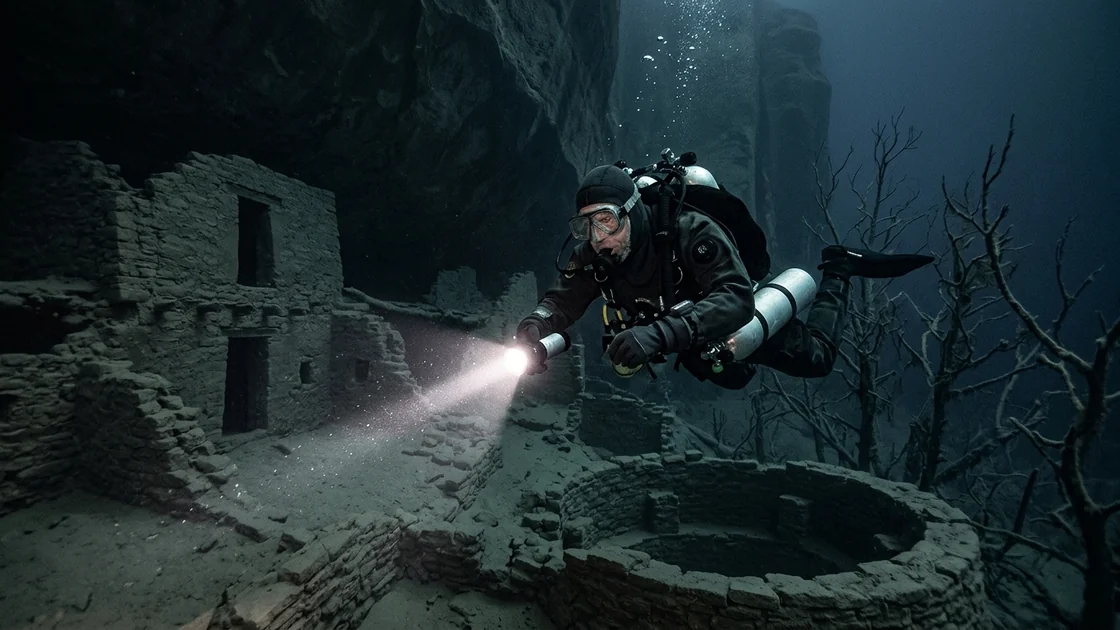
This story chronicles the life of Arthur Vance, a senior civil engineer who oversaw the impoundment of the Orah River and the deliberate drowning of the Tal-Keth canyon, an ancient river valley inhabited by an indigenous cliff-dwelling community. Forty years after the dam closed its gates, Arthur lives alone beside the unnatural lake he created, undertaking an annual clandestine scuba dive into the sunless depths to visit the submerged shrines, painted grottoes, and ruins of the civilization he obliterated under the banner of national progress and rural electrification.
Act I: The Calculus of Mass and Void
The house had been built from the surplus aggregate of the spillway.
Every morning, Arthur Vance woke to the low, sub-audible vibration of the three Francis turbines spinning in the powerhouse four hundred feet below his kitchen window. The vibration was not a sound; it was an oscillation in the marrow of his shins, an old ache that lived in his dental fillings and the hinges of his hips. It registered at fifty cycles per second—the frequency of the provincial grid, the pulse of four hundred thousand electric stoves, lathe motors, streetlamps, and cold-storage units spread across the western basin.
He was seventy-six years old. His skin had taken on the papery, gray-white cast of river limestone cured too long in the sun.
He stood by the zinc counter, waiting for the kettle to boil, looking through binoculars across the expanse of Lake Varian. The government maps called it Lake Varian, named after the minister of public works who had signed the expropriation decrees in 1968. The local tourist brochures called it the Emerald Jewel of the Upper Plateau. But Arthur called it the Cistern, or simply the Hole.
It was two hundred and twenty feet deep above the old riverbed. On the surface, it was an immaculate sheet of dull slate, broken only by the yellow plastic buoys marking the exclusion zone two hundred yards upstream of the intake trash racks. A solitary osprey circled near the north wall where the limestone dropped straight into the dark water like a severed tendon.
"Water is an idiot," his old professor at the Polytechnic had told him half a century ago, tapping a chalk-smeared finger against the blackboard where the equations for hydrostatic thrust were arranged in rigid, clean columns. "It has no will, no memory, and no malice. It has only mass and gravity. Your job as a hydraulic engineer is not to fight it. Your job is to calculate its idiot weight and give it a path of least resistance that pays dividends to the state."
Arthur had believed that. He had carried that clean, Newtonian clarity in his breast pocket alongside his slide rule and his field notebook when he first rode into the Orah Valley on a mule in the spring of 1965.
The river had not looked like an idiot then. It had looked like a sinew of green jade, cutting through five hundred vertical feet of red sandstone and honeycombed travertine. It was a canyon so narrow in places that a man standing on the gravel bar could look up and see the stars at midday between the overhangs. And carved into those overhangs, suspended between the river’s winter flood line and the high rim of the plateau, were the cliff cities of the Tal-Keth.
There were seventeen settlements in all, stitched across twenty miles of the gorge like swallows' nests made of river mud and cedar poles. They had lived there for eleven hundred documented years, and for unmeasured centuries before the arrival of the cartographers. They had cultivated terraced plots of mountain maize using stone-lined irrigation ditches that bled off the side-canyons; they had buried their dead in deep, dry limestone grottoes wrapped in feather-cloth and wild cotton; they had painted the histories of their migrations on the ceiling of the Great Kiva using a black pigment made of burned sheep bone and juniper oil that never fully dried in the desert air.
Arthur had measured them.
He had not come with soldiers; he had come with a transit level, a surveyor’s chain, and three rolls of waxed drafting linen. He had climbed their cedar ladders, nodding politely to the women who sat hushed in the doorways grinding dried beans. He had hammered copper triangulation pins directly into the threshold stones of their grain rooms. He had written numbers in his ledger: Station 44+20. Elevation 1,142 feet above mean sea level. Limestone quality: fractured karst. Hydraulic conductivity: high. Grouting required.
He had met with their council under the shade of an eight-hundred-year-old cottonwood that grew on the alluvial fan at the mouth of the Orah. The council leader had been a man named Naro-Besh, whose fingers were stained permanently yellow from harvesting sumac gall for ink.
"The water will rise to here," Arthur had told him, pointing with the brass tip of his scale ruler to a contour line on the topographical sheet.
Naro-Besh had looked at the map, not with anger, but with the quiet, clinical interest of a physician examining an autopsy report of a living patient.
"The water does not go there," Naro-Besh had said. "The water stays in the stones at the bottom. In the spring it drinks the snow from the high peaks, and in the autumn it sleeps. If you put a stone across the mouth, it will choke."
"It won't choke," Arthur had explained with the infinite, terrible patience of a young man who had topped his class in fluid mechanics. "It will fill the basin. It will provide eighty megawatts of firm power. Your people will be relocated to the plain at San Mateo. You will have cinderblock houses with corrugated iron roofs, plumbed water, and electric outlets. The government will provide diesel tractors for the collective fields."
Naro-Besh had looked down at his own bare feet, his soles calloused and cracked like dry silt. "In San Mateo, where do the grandfathers speak from?"
"There will be a cemetery laid out on the hill," Arthur had said.
"They do not speak from a hill," the old man replied. "They speak from the throat of the rock where the water sounds like a drum. If you drown the throat, they will make no sound at all. And if they make no sound, we will forget how to name the seeds."
Arthur had written in his report that night by the light of a kerosene lantern: Native population exhibits typical non-economic resistance to infrastructure development. Relocation logistics must be handled with administrative firmness. Valley clearing operations should precede impoundment by at least six months to avoid hydraulic fouling of the diversion tunnel.
Now, fifty-eight years later, Arthur set his coffee cup down on the stainless-steel table. His knuckles were swollen with arthritis, but his grip remained certain.
He turned toward the back room of the house, where the air smelled not of coffee or woodsmoke, but of vulcanized rubber, silicone grease, and the dry, medicinal tang of compressed air.
Act II: The Anatomy of Impoundment
To drown an inhabited world requires an extraordinary amount of bureaucratic paperwork and an even more extraordinary amount of portland cement.
The Tal-Keth did not leave San Mateo, because they never truly arrived there. When the army trucks came in the late summer of 1969, the soldiers had loaded forty-two families from the middle canyon with their rolled mattresses, their copper kettles, and their baskets of dry corn. The people had sat on the flatbeds without singing and without crying, their eyes fixed on the red canyon rims that were already being drilled for blasting charges.
Some had run into the side-ravines, into the slot canyons where no army truck could follow. Arthur had watched from the abutment as the brush-clearing crews—men recruited from the lower timber towns who had no relationship to the valley—moved through the bottomlands with chainsaws and cans of diesel fuel. They had felled the eight-hundred-year-old cottonwood grove. The wood was so green and wet with spring sap that it would not burn clean; it had smoldered for three weeks, producing a greasy, pale smoke that hung in the gorge like a shroud.
Then came the dynamite.
TheTal-Keth built their homes into the natural overhangs of the canyon walls, utilizing the upper ledge as a permanent roof. To prevent large sections of cliff from calving off into the reservoir and creating tidal surges that could overtop the concrete parapet, Arthur’s specifications had called for "crest stabilization."
They had dropped explosive charges from steel cables lowered over the rim. Arthur had stood on the opposite bluff with a clipboard, his ears plugged with wax, watching the cliff dwellings of the Third Notch disintegrate into a pink cloud of powdered sandstone. The masonry walls—stones gathered by hand from the creekbed, fitted together with clay mortar tempered with goat hair—had held for two, three seconds against the concussion before sliding down the talus slopes in long, clattering cascades.
He remembered the sound precisely. It was not like thunder. Thunder had rolling decay, a natural reverberation that belongs to the atmosphere. The blasting was flat, dry, and mechanical, like an iron gate being slammed against a granite sill.
"Good fragmentation," his assistant, an eager boy named Miller, had shouted through the dust. "The slide will settle into the dead storage zone below the low-level sluice. It won’t affect active capacity."
"Yes," Arthur had said. "Good fragmentation."
By November of 1970, the diversion tunnel—a thirty-foot-wide tube bored through the south abutment—was sealed with a four-hundred-ton steel gate.
Arthur had been on the control platform. The minister had pressed a green bakelite button. The diesel winch groaned, its cables trembling as the counterweights rose, and the massive leaf slid into its brass guides with a hydraulic hiss that sounded almost like an intake of breath.
The river stopped.
It did not stop flowing from the north, of course. It continued to bring down five thousand cubic feet per second of cold, silt-laden runoff from the mountains. But it hit the concrete toe of the dam and could go no further.
For the first twenty-four hours, the water had merely pooled in the gravel washes, turning the dry willow bars into brown islands. By the end of the first week, the ancient irrigation ditches of the lower terrace were gone, replaced by a brown, stagnant lake that began to swallow the trunks of the charred cottonwoods.
By the end of the first month, the water had reached thirty feet. It crept through the low doorways of the canyon-floor granaries. Arthur had taken a skiff out into the rising basin to inspect the clearing work. He had rowed through the narrows where the canyon walls were only forty paces apart. The silence had been total, unnatural. The wild bees that nested in the weep-holes of the sandstone had drowned in their honeycombs; their corpses floated on the surface scum alongside thousands of drowned field mice, scorpions, and fragments of charred cedar roof-beams.
By the spring of 1971, the reservoir was full.
The water reached the crest of the spillway at elevation 1,280. The valley of the Tal-Keth was gone. In its place was a flat, deep, blue-green surface that mirrored the sky so perfectly that pilots flying over the high plateau used it as a navigation beacon.
The engineers were given bronze medallions by the Ministry of Water Resources. Arthur’s medal sat in a cedar drawer in his desk, between his old slide rule and a collection of brass depth gauges. On its face was an image of the dam wall, rendered in sharp, low-relief lines, and the inscription: Naturae Victor—Labor Omnia Vincit.
He had never hung it on the wall.
Act III: The Rigging of the Vigil
In the workshop behind his garage, Arthur Vance prepared his gear with the methodical, obsessive precision of an artillery officer.
At seventy-six, diving to two hundred feet was an act of biological madness. The hydrostatic pressure at that depth is seven atmospheres—roughly one hundred and three pounds on every square inch of the human body. The nitrogen in the ambient air turns into a narcotic poison, dulling the synapses, producing a strange, drunken euphoria that makes men pull their regulators from their mouths to offer them to passing carp. The oxygen itself, compressed beyond its partial-pressure threshold of 1.4 atmospheres, becomes neurotoxic, capable of causing violent, instantaneous convulsions that drown a diver before he can reach for his buoyancy compensator.
Arthur did not dive on air. He had spent his early retirement studying hyperbaric physics with the same cold rigor he had once applied to hydraulic shear stress.
On the workbench stood three tall aluminum cylinders, painted gray with green shoulders: Trimix 18/45. Eighteen percent oxygen to prevent convulsions, forty-five percent helium to displace the heavy nitrogen and keep his mind clear in the dark, and thirty-seven percent residual nitrogen to prevent high-pressure nervous syndrome. Beside them stood two smaller stage bottles: one filled with fifty percent nitrox for his intermediate decompression stops, and one of pure oxygen for the long, freezing hangs at twenty feet below the surface.
He checked the valve seats with a magnifying glass. He smelled the gas from each regulator, testing for any trace of compressor oil or moisture that could freeze the second-stage poppet in the forty-degree water of the deep canyon.
He spent four hours assembling his kit. He had built his own backplate from three-millimeter marine-grade stainless steel, bent to fit the stoop of his spine. The drysuit—a heavy, vulcanized rubber envelope lined with crushed neoprene—hung from a ceiling joist like the skin of an enormous, drowned animal.
His wife, Martha, had died fourteen years ago in the provincial hospital. She had spent the last twenty years of her life watching him gaze out at the water through his binoculars, saying nothing.
"You left something down there, Arthur," she had said to him once, not unkindly, as she dried the supper dishes. "You left your life down there, or somebody else’s."
"I was the lead engineer, Martha," he had told her. "It was my project. If there is a problem with the grout curtain, I have to know."
"There is no problem with the grout curtain," she had said, looking out into the twilight where the reservoir reflected the cold violet of the sky. "The dam will stand for a thousand years. You know it will. You built it too well to have an excuse like that."
She had not asked him again. When he began disappearing into the garage for whole days in the autumn, checking the manifold seals and replacing the O-rings on his manifold valves, she had simply packed his lunch in a tin box and left it on the workbench beside the pressure gauges.
Now, Arthur looked at his reflection in the dark glass of the workshop window. His hair was entirely white, cropped close to his skull like an old convict’s. His shoulders were bowed, but his wrists were thick, knotted with the cords of tendons that had spent fifty years hauling cables, turning brass valves, and handling steel instruments.
Every year, on the twenty-second day of October—the date the low-level gates had been shut and the valley had begun to fill—he went down.
He did not go to inspect the concrete. The dam was magnificent. It was three hundred and ten thousand cubic yards of low-heat aggregate concrete, curved in a graceful arch against the thrust of sixty million tons of water. Its plumb lines hung true to within three hundredths of an inch; its drainage galleries were bone-dry; its uplift pressures were well below the critical limits calculated in his old notebooks. It was an immortal work of engineering.
He went down to visit the dead.
He rolled his cart down the gravel path to his private dock. The dock was tucked into a narrow limestone cove that had once been the upper chimney of a goat trail. His boat was a six-meter aluminum skiff with a center console and an electric winch mounted on the stern.
The afternoon sun was sinking behind the plateau, casting long, knife-like shadows across the water. The air was dead calm. The surface of Lake Varian was so still that the yellow buoy cables disappeared into it without a ripple, as if entering a slab of green plate glass.
He loaded the cylinders into the deck racks, securing them with rubber bungees. He hoisted the heavy twin-set onto the transom. His back protested with a deep, grinding ache, but he worked slowly, deliberately, not allowing his breathing to accelerate. Panic and haste were the natural enemies of the deep diver. In the cold, under seven atmospheres of water, an elevated pulse was an invitation to the squeeze, to the narcosis, to the slow, confused slide into the bottom silt.
He sat on the boat’s bench, pulled on his thick wool thermal undergarments, and stepped into the drysuit. He pulled the heavy brass zipper across his shoulders, feeling the rubber collar seal against the skin of his neck with a familiar, suffocating grip.
He started the four-stroke outboard. The engine hummed with a quiet, muffled purr as he cast off the lines and steered out into the center of the lake.
Act IV: The Plunge into the Thermocline
He stopped the boat over the old channel, two miles upstream from the dam crest.
He knew the coordinates not from GPS, but from three natural transit markers he had memorized forty years ago: the notch in the western ridge aligned with the white quartz dike on the canyon rim, and the iron survey pin he had hammered into the limestone bench above his house.
Here, beneath three hundred feet of water, was the Seventh Settlement of the Tal-Keth: the Village of the Flutes.
He dropped a shot-line over the side—a heavy lead weight attached to two hundred and fifty feet of braided nylon line, marked with yellow tape every ten feet. The lead sank into the green glass, taking the line down with a soft, singing hiss. When it hit bottom, the tension slackened. Arthur pulled it up three feet, secured it to an inflatable surface buoy, and cut the engine.
The lake was silent. The tourists had gone home a month ago, when the autumn frosts began to bite the aspen trees on the upper rim. The only sound was the distant, faint hum of the transmission lines carrying their seventy-thousand-volt current southward toward the cities.
He strapped his backup computer to his right forearm and his primary digital decompression meter to his left. He checked the gas pressure in his twins: two hundred and thirty bar in each cylinder. He spat into his tempered-glass mask, rubbed the saliva over the lens to keep it from fogging in the cold, and rinsed it in the lake water.
The water was thirty-eight degrees Fahrenheit at depth. It was meltwater from the northern ranges, preserved in the sunless belly of the reservoir beneath a permanent summer thermocline.
He sat on the gunwale, adjusted his stage bottles beneath his arms, bit down on his primary regulator, and rolled backward into the water.
The world went from blue to green, and then to brown.
The transition was instantaneous. For the first twenty feet, the water had a pale, jade-like clarity, illuminated by the low autumn sun. He could see the nylon shot-line plunging downward like a silver thread into the void.
At forty feet, he hit the first thermocline.
It was not a gradual cooling; it was a physical barrier. The water temperature dropped twenty degrees in the space of six inches. He felt the cold strike his face where the mask did not cover his cheeks—a sharp, needle-like pain that made his teeth ache. The light lost its yellow warmth and shifted to a dull, chemical olive.
He equalized his ears with a soft swallow, venting a short burst of gas into his drysuit to counteract the increasing pressure that was beginning to shrink the neoprene against his thighs.
At eighty feet, the daylight began to fail.
The olive turned to slate, and the slate turned to ink. Arthur reached down to his right hip, unclipped the primary dive light—a heavy canister light with a fifty-watt halogen bulb powered by a lead-acid battery—and clicked the magnetic switch.
A brilliant, pencil-thin beam of white light stabbed out through the suspended particles of silt.
The water here was completely dead. The organic life of the lake—the bass, the trout, the green algae that coated the recreational shoreline—lived entirely in the upper thirty feet. Down here, beneath the light-penetration depth, there was only the cold, sterile stillness of the abyss.
At one hundred and twenty feet, he entered the drowned forest.
Before the valley had been flooded, the clearing crews had cut down the large trees along the main access roads, but they had left the juniper and pinon woodlands on the steep slopes untouched, deeming them too difficult to winch out. Now, preserved by the lack of oxygen and the freezing cold, the dead trees still stood where they had taken root two centuries ago.
Their branches were bare of leaves, coated instead in a thick, velvety fur of pale gray silt. They looked like an army of calcified skeletons, their limbs twisted in agony, reaching up through the black water toward a sun they had not seen since the administration of Richard Nixon.
Arthur kicked slowly, his heavy rubber fins moving with a gentle, rhythmic flutter. He kept his body horizontal, his trim flat, careful not to let the wash from his fins disturb the silt on the dead branches. If he stirred the sediment, the visibility—currently thirty feet in the clean mountain water—would drop to absolute zero in a fraction of a second, leaving him trapped in a blind, swirling fog where up and down were indistinguishable.
He followed the nylon line through the skeleton trees.
At one hundred and sixty feet, his decompression computer beeped softly—a small, chirping warning that he had entered decompression status. Every minute he spent below this depth would require him to pay a debt of time on his return, hanging suspended in the cold water while the helium and nitrogen slowly diffused from his blood before they could expand into deadly bubbles in his joints and brain.
He ignored the chirping. He had already planned the table: forty minutes at the bottom, twelve minutes at sixty feet, twenty-eight minutes at thirty feet, forty-five minutes at twenty feet on pure oxygen.
He reached the canyon rim.
The flat, sloping floor of the drowned forest abruptly fell away into nothingness. The beam of his light crossed the edge of the limestone cliff and found nothing to illuminate—only a vast, empty blackness that seemed to suck the photons from the bulb.
This was the Orah Gorge.
He dropped over the edge, descending into the slot.
The canyon walls rose up on either side of him like the nave of a demolished Gothic cathedral. The rock here was not red; beneath sixty feet of water, the red end of the spectrum was completely absorbed, and the sandstone appeared as an eerie, marbled violet, veined with gray seams of chert and calc-spar.
He drifted down alongside the rock face.
Here, eighty feet below the rim and two hundred feet below the sky, was the ledge.
He slowed his descent with a burst of gas into his suit. His fins hovered six inches above the stone terrace.
He raised his light.
There, carved into the natural recess of the overhang, was the Great Alcove of the Seventh Settlement.
Act V: The House of Drowned Memory
The village was intact.
Because it was situated in a narrow, sheltered meander of the inner gorge, the demolition crews had not bothered to lower dynamite charges over this section of the cliff. It had been deemed "non-hazardous to navigation and hydraulic operation."
They had simply left it for the water.
Arthur swam slowly along the terrace. The masonry houses stood two stories high, built from rectangular blocks of dressed sandstone held together by ancient, dried mud mortar that had miraculously hardened rather than dissolved in the anaerobic, calcium-saturated water. The cedar lintels over the small, T-shaped doorways were still in place, though they were bloated with moisture and coated with a thin layer of gray river clay.
He turned off his primary light.
He always did this. It was his penance, and his terror.
In the absolute, lightless basement of the reservoir, the darkness was not an absence of illumination; it was a physical weight. It pressed against his mask with the force of seven atmospheres. He held his breath for five seconds.
The silence was total, save for the slow, mechanical click-hiss of his balanced regulator valve and the deep, rhythmic thrumming of the dam.
Even here, two miles upstream, the dam made itself felt. The rock of the canyon walls conducted the vibration of the turbines directly into the water. It was a low, resonant drone, like the C-string of a cello bowed continuously by an iron machine. It was the sound of the state, the sound of the national grid, humming its mechanical triumph through the graves of people who had measured time by the return of the yellow-throated warblers.
He clicked the light back on. The white beam jumped across the facade of the central kiva—the subterranean ceremonial chamber where the men of the Tal-Keth had woven their ceremonial kilts and prayed for the summer rains that had eventually arrived in an abundance they could never have survived.
The roof of the kiva had fallen in twenty years ago, its pine timbers undermined by wood-boring micro-organisms that thrived in the cold darkness.
Arthur swam to the rim of the circular chamber and looked down.
The floor was covered in a foot of undisturbed silt, as smooth and unblemished as freshly fallen snow. In the center was the stone fire-pit. The charcoal from the last fire—kindled in August of 1969—was still there, preserved under the water like carbonized jewels.
Beside the fire-pit lay a small, spherical object.
Arthur leaned over the parapet, careful not to kick his fins. He extended his gloved hand, his fingers trembling slightly inside the thick dry-glove.
It was a clay canteen, no larger than an orange, decorated with a geometric design of interlocking spirals painted in iron oxide. It was unbroken. The leather thong that had served as its carrying strap had rotted away decades ago, leaving only two small clay eyelets on the shoulder of the vessel.
He knew whose work it was.
During the survey summer of 1965, he had lived for two weeks in the camp of a woman named Keta-Loo. She had been seventy years old then, her spine bent into the same crescent shape as his own was now. She had sat in the shade of the rock overhang, rolling coils of clay between her palms, smoothing them with a wet river pebble, painting them with a brush made of chewed yucca fiber.
He had bought two of her pots for fifty cents each—the price of two packages of cigarettes—and had given them to his sister in the capital, who had used them as bookends until she threw them out during a remodel.
He did not touch the pot.
To touch it would be to disturb the silt, to destroy the perfection of the tomb. If he lifted it, the sediment inside would spill out like black ink, and the delicate clay, softened by fifty years of soaking, might crumble between his neoprene fingers.
He moved his light to the rear wall of the kiva.
Here, protected from the falling sediment by the overhang of the bench, was the mural.
It was twenty feet long, executed in white gypsum, red ochre, and the black sheep-bone pigment that Naro-Besh had spoken of. It depicted the Great Crossing: the mythic journey of the Tal-Keth from the underworld through the four stages of the earth.
At the left of the mural, tiny stick-figures emerged from a crack in a black mountain, carrying seeds in their hands. They followed a line of blue water that wound through a forest of stylized corn plants. In the center, they fought with birds that had the heads of mountain lions.
And at the far right, where the mural met the corner of the wall, was the figure of the Water-Serpent, Orah-Vash.
The serpent was depicted not as a dragon, but as a thick, green rope with the horns of a ram, its body looped through the foundations of the mountains. Its mouth was open, and from its belly poured a white torrent that carried away houses, men, and stars.
Arthur hovered before the serpent.
The colors were as bright as the day they were painted. Beneath two hundred feet of water, sheltered from the sun's ultraviolet rays and the abrasive desert wind, the pigments had not faded. They were preserved in a permanent, liquid museum, accessible only to him—the man who had signed the order to destroy them.
"We have preserved your cultural resources," the Minister of Works had announced to the press at the dedication of the dam in 1971. "A comprehensive photographic record has been deposited in the National Archives, and selected artifacts have been placed on permanent display in the Provincial Museum at San Mateo."
Arthur had seen that display. It consisted of three broken grinding bowls, an iron trowel found in a seventeenth-century Spanish mission trench, and six black-and-white photographs taken by his own survey crew, mounted on brown corkboard beneath fluorescent tubes that buzzed like horseflies.
The photographs had been labeled: Primitive rock-dwellings prior to the construction of the Varian Impoundment Project.
They had not photographed the serpent. It had been deemed "of purely decorative, non-structural interest."
Arthur reached out his hand. He stopped his fingers an inch from the serpent’s horned head.
He could feel the cold through his three-finger mittens. His fingers were stiffening; the helium gas in his drysuit had a high thermal conductivity, pulling the heat from his core at three times the rate of normal air.
His left wrist-meter began to flash with an urgent, amber cadence:
TTS: 84 MIN. DEPTH: 204 FT. GAS SWITCH: N2-50% AT 70 FT.
Eighty-four minutes of decompression remained. If he stayed any longer, he would not have enough gas in his stage cylinders to complete the required stops. He would be forced to surface early, and the helium bubbles would tear through his spinal cord like glass needles, leaving him paralyzed or dead on the aluminum floor of his boat.
He looked at the small clay canteen one last time.
"I am sorry," he said.
He did not speak the words aloud; to speak into a scuba regulator is merely to produce a wet, mechanical rattle. He said them in the dry, sealed vault of his own mind, where the slide rules still clicked and the equations for concrete volume were still filed in their neat, terrible drawers.
The serpent stared back at him with its white gypsum eye, indifferent, ancient, and drowned.
Act VI: The Long Decompression
The ascent was an exercise in pure, cold purgatory.
To dive deep is an adventure; to ascend is an accounting. Every foot of water must be paid for in time, stationary and shivering, suspended in the middle of a sunless, featureless void where there is nothing to look at but the green numbers on an LCD display and the bubbles of one’s own breath drifting upward into the slate-colored ceiling of the lake.
At one hundred and ten feet, Arthur entered the drowned forest again.
He caught the shot-line with his left arm, looping his elbow through the nylon rope to keep from drifting in the faint drift of the intake currents. Fifty yards away, the skeleton branches of a giant pinon tree reached out through the gloom, its gray-coated twigs trembling slightly as the turbines down at the dam demanded another hundred cubic feet per second to meet the evening peak load.
He looked at his timer.
Ten minutes at ninety feet.
He hung there, his legs dangling in the blackness, his light turned down to its lowest power setting to conserve the battery.
The narcosis was clearing from his brain, replaced by the deep, hollow exhaustion that always accompanied trimix diving. His head throbbed behind his eyes—the classic "helium headache," born of breathing cold, dense gas through a small plastic valve while his seventy-six-year-old cardiovascular system struggled to pump thick, chilled blood through his peripheral veins.
He thought of Naro-Besh.
After the relocation, the old man had lived for three years in the cinderblock tract house at San Mateo. Arthur had gone to visit him once, in the winter of 1973.
The house had smelled of fried lard and kerosene. Naro-Besh had been sitting on an iron cot in the front room, wrapped in an acrylic blanket that bore an image of a bald eagle. He had not lost his sight, but his eyes were milky around the edges with arcus senilis.
Arthur had brought a present: an eight-by-ten glossy photograph of the completed dam, mounted in an oak frame. He had thought, in his blind, youthful stupidity, that the old man would be impressed by the scale of it, by the five hundred thousand tons of white concrete standing between the canyon walls like a fortress of modern order.
Naro-Besh had taken the frame in his yellowed hands. He had held it upside down for several seconds before Arthur gently reached over and rotated it.
"This is the stone you spoke of," the old man had said.
"Yes," Arthur had replied. "That is the dam. It generates enough power for the whole district now. Even this house. See that bulb?" He had pointed to the naked sixty-watt bulb hanging from the cord in the ceiling. "That power comes from the Orah."
Naro-Besh had looked at the light bulb with a curiosity that was neither bitter nor grateful.
"Where is the water now?" he had asked.
"It is three hundred feet deep behind that wall," Arthur had said. "It stretches back past the Three Notches, all the way to the red bend."
The old man had set the photograph down on the linoleum floor, face down.
"Then the sheep are dead," he had said softly.
"What sheep?" Arthur had asked. "We compensated your people for every head of stock. The government check was issued in October."
"The sheep who lived in the wall," Naro-Besh had said, not looking at him. "The ones who were painted on the stone before the white men had horses. They were there to remind the water that it must let the grass grow before it runs to the great salt lake. If they are drowned, they cannot breathe. If they cannot breathe, their paint will wash off. And when the paint is gone, the water will forget where it came from."
"The paint won't wash off," Arthur had told him, defensive, his engineer’s pride irritated by the superstition. "It’s mineral pigment. It’s insoluble in neutral-pH water. It will last for centuries under anaerobic conditions."
Naro-Besh had looked up at him then, his dark, rheumy eyes fixing Arthur with an expression of such immense, desolate pity that the young engineer had felt his throat tighten as if he were the one who had been evicted.
"You think the water is just water," the old man had whispered. "You think because you can pour it into an iron pipe and make a wheel turn, it belongs to you. But the water is only sleeping under your stone, Arthur Vance. It has a long memory. Longer than yours. Longer than your government’s."
Naro-Besh had died the following spring. They had buried him in the cemetery on the gravel hill behind the San Mateo highway depot, where the wind blew the diesel exhaust from the cattle trucks across the plastic flower arrangements.
Arthur checked his meter.
STOP COMPLETE. ASCEND TO 60 FT.
He kicked his fins three times, rising slowly along the line.
At seventy feet, he switched his regulator. He turned off the trimix valve on his twins and opened the valve of his left stage bottle, purging the second stage before taking his first breath of the fifty percent nitrox.
The gas tasted sweet, thick, and warm compared to the cold helium mix. Almost immediately, he felt a faint flush of heat in his cheeks as the higher oxygen concentration began to burn away the residual stupor of the depth.
He settled in for his twenty-minute stop.
He was hanging now directly above the old cliff line. Looking down with his dive light, he could see the vague, ghostly outlines of the canyon rim fading into the green abyss like the ramparts of a sunken empire.
He thought of the houses he had drowned.
Not just the stone houses of the Tal-Keth, but his own house.
He had built three dams in his career. The Orah had been the first and the greatest. After that had come the San Juan Diversion, and then the Rio Blanco Arch. He had received citations from three provincial governors. He had had his portrait painted for the lobby of the Electric Utility Headquarters—a tall, upright man with silvering hair, his hand resting on a brass theodolite, the blueprints of the Orah Dam spread across the mahogany desk behind him.
He had given his life to the current.
And what had the current produced?
It had produced forty years of cheap aluminum smelting in the valley below. It had produced three suburban developments with names like Canyon Vista Estates and The Willows, where four thousand lawns were watered twice a day with water pumped from the deep aquifer using the power generated by his turbines. It had produced two pulp mills that had poisoned the river thirty miles downstream from the dam, turning the green jade water into a brown, frothing sewer that killed the striped bass and the river otters.
And now, even the current was failing.
In the last ten years, the snowpack in the northern mountains had begun to decline. The spring runoffs were shorter, warmer, and carried less water. The reservoir level had dropped thirty-four feet below the spillway crest. Last August, for the first time in fifty years, the utility had been forced to shut down Turbine Number Three because there was not enough hydraulic head to turn the runner without cavitation.
The climate was changing. The great engineering works of the twentieth century—those monuments of poured lime and steel that had seemed as permanent as the mountains themselves—were beginning to look like the stranded hulks of iron ships left behind by a receding sea.
He moved his fins gently to keep his balance.
The water around him was thirty-four degrees. His toes were numb; he could no longer feel the straps of his fins against his heels. A dull, rhythmic shudder passed through his torso—the first sign of mild hypothermia.
He looked at his meter.
ASCEND TO 20 FT.
This was the longest stop. Forty-five minutes.
He rose through the green water until he could see the silver underbelly of his aluminum boat floating twenty feet above him like a metallic leaf.
He clipped his stage bottle to the shot-line, unslung his oxygen regulator, and began breathing pure O2.
The gas was dry, medicinal, scraping his throat like sandpaper. He hung there in the emerald twilight, six feet beneath the chop, watching his exhaust bubbles expand and shatter as they raced to the surface.
Through the floor of the boat above him, he could hear the faint, high-pitched whine of an outboard motor—some late fisherman returning to the marina before dark.
The world above was still there. The world of truck inspections, property taxes, supermarket coupons, and television news.
And down below, two hundred feet beneath his dangling boot heels, the serpent of the Tal-Keth lay in the dark, waiting for the concrete to rot.
Act VII: The Memorial at the Surface
When Arthur finally broke the surface, the sun had been down for half an hour.
The sky in the west was a deep, bruised indigo, cut by a single streak of cold orange along the crest of the limestone plateau. The stars were out—sharp, brilliant, and heartless, as they always were in the high desert autumn.
He spit his regulator out and pulled his mask down around his neck.
The air smelled violently of sagebrush, dried mud, and cold pine—a sudden, dizzying rush of terrestrial scents that made his head spin after two hours of breathing filtered gas from aluminum tanks.
He hauled himself up the boat's boarding ladder.
The effort was monstrous. With his twin cylinders, his stage bottles, his weight harness, and his wet drysuit, he weighed more than three hundred pounds. His knees cracked like dry kindling as he dragged his body over the gunwale and collapsed onto the aluminum deck, gasping for air, his chest heaving against the constriction of the suit.
He lay there for ten minutes on his back, looking up at the Milky Way.
His pulse hammered in his ears: fifty cycles per second.
He did not take off his gear immediately. He could not. His hands were too cold to work the brass clips of the stage bottles, and his spine felt as though it had been fused into a single, calcified rod by the cold and the weight.
He listened to the silence of the lake.
Now that the boat engine was dead and his own bubbles had ceased, the canyon was as quiet as a churchyard after the gates are locked. There was no wind. The water made small, lap-lap sounds against the aluminum hull—a soft, domestic rhythm that seemed almost gentle.
He forced himself to sit up.
He unclipped the oxygen cylinder, his fingers clumsy and numb in the wool-lined gloves. He stowed the stages in their rubber chocks. He hauled up the lead shot-line using the electric winch, watching the yellow depth markers click through the pulley until the heavy lead cylinder swung inboard, dripping with cold, black mud from the bottom of the Orah Gorge.
The mud smelled of ancient iron and rotted reed roots.
It was the true silt of the valley, preserved beneath the dead water for half a century. Arthur took a pinch of it between his thumb and forefinger. It was grease-smooth, without the grit of modern construction dust—the fine, volcanic silt that the women of the Tal-Keth had mixed with crushed quartz to make their cooking pots.
He did not wash it off. He let it dry against his skin, a black crust that tightened as the night wind caught it.
He started the outboard and steered the skiff toward his cove.
The lights of the dam were visible now two miles to the south. The crest of the wall was illuminated by a row of high-pressure sodium lamps that cast an unnatural, sulfurous yellow glare across the concrete face and the white foam of the tailrace. It looked like a prison wall, or the rampart of an occupying army that expected a sally from the dark hills at any moment.
Behind it, the transmission towers marched away into the southern desert like giant, skeletal iron men, carrying their humming cables across the ridges, over the graves of the Tal-Keth at San Mateo, all the way to the coast where the air conditioners ran day and night behind drawn blinds.
Arthur docked the boat in his slip, securing the spring lines with double half-hitches that had been burned into his muscle memory since he was an apprentice on the river barges.
He unstrapped his twin tanks and left them on the deck. He was too tired to carry them up the gravel path tonight. He would haul them up with the handcart tomorrow, or the day after, or perhaps he would simply leave them there until next October.
He walked up the stone steps to his house, his drysuit boots scuffing through the dry oak leaves that had drifted against the risers.
Inside, the house was cold. He did not turn on the electric baseboard heaters; he did not want to hear the hum of the current through the elements.
He stripped off the vulcanized suit, hanging it from its hook in the laundry room where it dripped black reservoir water into the galvanized sink with a slow, deliberate cadence:
Tock. Tock. Tock.
He washed his face at the basin with hot tap water. His skin was mottled with red pressure marks from the mask skirt, and his eyes were bloodshot from the dry gas and the strain of the decompression.
He made a cup of black tea and carried it into his study.
On the wall behind his desk hung the only engineering drawing he had kept from the Orah Project: not the dam itself, but the original geological cross-section of the gorge, drafted on yellow tracing paper in his own hand in the summer of 1966.
It showed the limestone strata, the sandstone beds, the fault lines, and the elevation of the riverbed.
And there, in the small, cramped script he had used as a young man, was an entry marked with a tiny red triangle at elevation 1,080:
Cave 7-B. Architectural remains. Sandstone masonry. Well preserved. Approx. age: 800 yrs. Significance: Local.
Arthur reached out and touched the yellow paper. His finger was still stained with the black mud from the shot-line lead. He left a faint, gray smudge over the red triangle, blurring the word Local into the yellowed fiber of the linen.
He sat down in his leather armchair by the window.
Outside, the lake had disappeared into the night. There was no water to be seen—only a flat, horizontal void between the black silhouettes of the limestone cliffs, reflecting not the sun, nor the green pines, but only the stars that had looked down into the canyon when it was dry and full of smoke and human voices.
He knew that the dam would not stand for a thousand years.
He knew what the public works ministers and the utility directors did not know, or chose to forget: that all reservoirs are temporary.
Every day, the Orah River brought down four thousand tons of sediment from the northern mountains. It dropped that sediment into the dead water of the upper basin. The silt was already forty feet deep behind the trash racks. In seventy years, perhaps eighty, the dead storage would be full. The silt would reach the intake gates; it would scour the bronze runners of the Francis turbines like emery cloth; it would choke the low-level valves.
And then the lake would become a marsh of gray, sterile clay, and the river would begin to cut its way through the concrete crest, tumbling over the spillway in a brown, roaring waterfall until the arch cracked, until the joints opened, until the hydrostatic weight tore the monolith from its grout curtain.
The water would have its way.
It was an idiot, as his old professor had said. It had no will, no memory, and no malice.
But it had time.
It had all the time there was, while Arthur Vance had only the seventy-six years that were already running out through the valves of his heart like helium through a loose stage seal.
He took a sip of the bitter tea.
Down in the dark, two hundred feet beneath the keel of his aluminum skiff, the water was moving through the small, T-shaped doorways of the Village of the Flutes. It was sliding over the smooth red clay of the canteen that Keta-Loo had rolled between her hands. It was licking the bone-black paint of the horned serpent, softening it, molecule by molecule, year by year, waiting for the day when the stone would break and the sky would come back into the canyon.
Arthur closed his eyes.
In the dark behind his lids, he could still see it: the white beam of his lamp stabbing through sixty feet of olive-colored water, finding the handprints of children pressed into the mud plaster of the kiva wall, eight centuries ago, to dry in the summer sun that he had turned into night.
He sat in the chair, listening to the turbines thrum through his floorboards, and waited for the morning to come up over the water.