The Dragon's Ash and the Pale Scythe
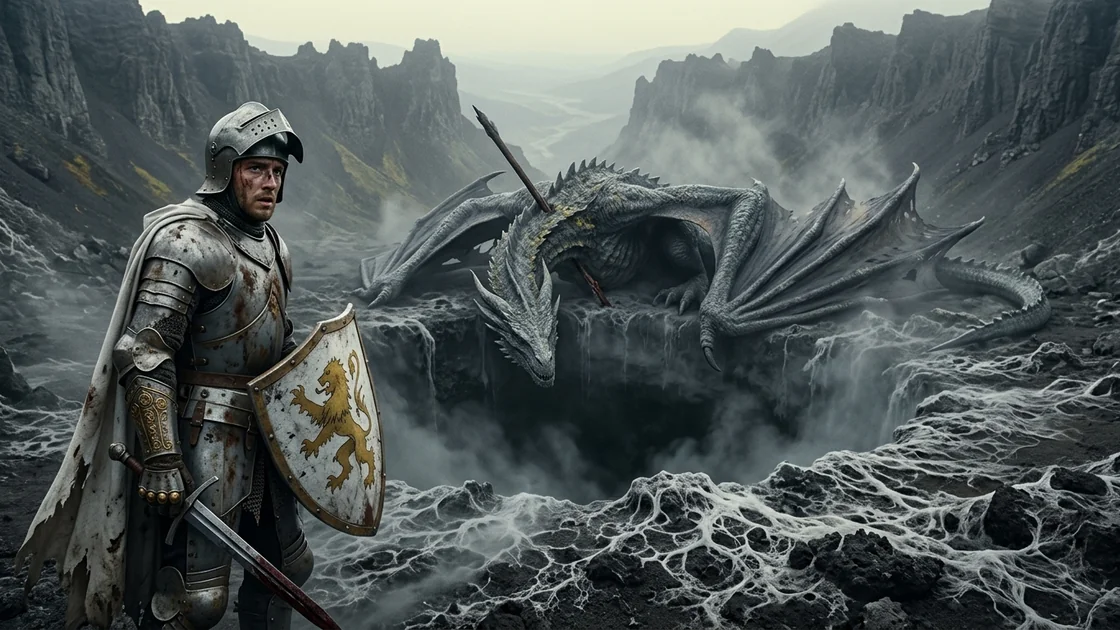
This is the chronicle of Ser Valen of Oakhaven, a knight consumed by the hunger for renown, who scaled the jagged heights of the Wyrmtooth Crags to slay the ancient beast Verithrax and carve his name into immortal song. Upon driving his sun-tempered blade through the creature's great burning heart, Valen discovered too late that the beast was never a predator upon the realm, but a living seal forged in the first age of the world to burn away an ancient, subterranean rot. With the great furnace of the dragon extinguished, a pale and parasitic blight seeped from the fractured stone, sweeping down into the fertile valley of Morndell to rot wheat, curdle blood, and reduce a thriving kingdom to an ashen charnel ground while its triumphant slayer stood watch over the ruin he had wrought.
Chapter I: The Gilded Mantle
The iron-shod hooves of Valen’s courser, a broad-chested roan named Bramble, struck sparks from the basalt shelves of the upper crags. For twelve days they had ascended through the stunted pines, past the timberline where the wind blew thin and tasted of cold slate, until the world beneath them broadened into a painter’s tapestry. Far below lay the valley of Morndell: seven hundred square leagues of rye, barley, clover meadows, and shimmering silver tributaries that fed the great basin of the Oakhaven March. From this height, the towers of the March’s capital were no larger than the teeth of an ivory comb, and the broad highway that carried trade from the sea-gates looked like a ribbon dropped carelessly in the grass.
Valen paused upon a shelf of rock that hung out over the gulf of air. He pulled off his right gauntlet—articulated steel lined with supple kidskin, inlaid at every knuckle with thread-fine veins of brass—and pressed his calloused fingers to his brow to wipe away a film of salt-sweat. He was twenty-eight years of age, yet in his own mind he was already late to his destiny. Men younger than he had been crowned in the southern archipelagos; men younger than he had broken the nomad hosts at the Red Ford and had their deeds hammered into the copper monuments of the capital.
His squire, a lanky boy of sixteen named Lucan, hauled the pack-mule onto the ledge with a series of low, whistling curses. The boy’s cheeks were chapped red by the high mountain drafts, his woolen cloak patched at the hem where mountain briars had torn it.
"Look down there, Lucan," Valen said, pointing with the bare hand toward the glittering green bowl of the valley. "Look closely at the roofs of Oakhaven. When we ride down that pass with the beast’s skull trailing on a sledge of ash-wood, there will not be a church bell from here to the coast that does not swing until its clapper cracks. The King’s heralds will have to rewrite the rolls of chivalry. 'Valen the Pure,' perhaps. Or 'Valen Dragon-breaker.' Which has the better ring for the balladeers?"
"I should prefer 'Valen the Living,' my lord," Lucan muttered, leaning his forehead against the mule’s sweat-stained pack-saddle. The beast’s nostrils flared, blowing white vapor into the dry chill. "And I would prefer that the mountain did not smell of brimstone and wet tin. Look at the lichens, ser. They aren't green. They aren't even black. They look like scabs."
Valen cast an irritated glance at the rocks at his feet. Lucan was right, though Valen would rather have had his spurs stripped than admit it. The stone here was strange. It was not the clean, granite gray of the lower ranges, nor the iron-red of the foothills. It was a chalky, porous basalt that seemed pitted by some unseen acid, and in the crevices, the moss did not grow in velvety cushions but in dry, brittle crusts that flaked away like dry skin under the heel. Even the air had an oily, heavy weight that sat upon the tongue, sweet and faint, like water drawn from a leaden pipe.
"The creature is ancient," Valen said, pulling his gauntlet back on and flexing the fingers until the brass plates settled into place with a series of sharp, oiled clicks. "For three centuries it has roosted in the Caldera of Cinders. Its very dung would alter the moss, boy. Its breath is sulfur and pitch; how should the rocks smell otherwise? Fetch the water-skin and check the girths. We breach the rim before noon."
Lucan did not move immediately. He looked back down into the valley, his young eyes tracing the smoke of hearth-fires rising from the villages—tranquil, domestic smoke that curled blue against the dark oak woods. "Lord Caldor told us at the gatehouse that no man had seen the beast take a heifer in eighty winters. The herdsmen of the high pastures leave no sheep upon the scree, yet nothing comes down to hunt. It sleeps, Ser Valen. If it sleeps, why must we wake it?"
"Because it sits upon our neck," Valen said, his voice hardening with the flat, unanswerable cadence of the warrior aristocracy. "Because while it lives, the March is a land that exists only by the sufferance of a worm. Does the King hold court under the shadow of a tyrant’s tower? No. He pulls the tower down. We do not leave a beast of the elder chaos perched above our cradles because it is currently sluggish. It is the last of them, Lucan. The very last. When this neck is severed, the age of fear ends, and the age of iron begins. Now, the girths."
Lucan bowed his head. "Yes, my lord."
They climbed through the gap known as the Throat—a vertical cleft between two towers of shattered stone where the wind screamed like an ungreased axle. Here, the track vanished into a slide of razor-sharp shale. Bramble’s shoes slipped repeatedly, the great warhorse snorting in terror as loose stones skittered down the three-thousand-foot drop into the void. Valen dismounted, taking the beast by the bit-rings, his own iron boots grinding into the rock with stubborn, rhythmic certainty. He felt no vertigo; he felt only the fierce, narrowing focus that always overtook him before the lists or the skirmish line.
By the time the sun had reached its zenith—a pale, lemon-colored disk blurred by a high haze that seemed to rise from the caldera itself—they stood upon the lip of the crater.
The Caldera of Cinders was nearly half a mile across, a vast, sunken arena ringed by jagged teeth of basalt that leaned inward like mourners over an open grave. The floor of the basin was not level; it was a labyrinth of black glass ridges, dried lava tubes, and steaming vents that hissed into the silence. But it was not hot. Valen had expected the blast of an armorer’s furnace, the suffocating heat of open iron-kilns. Instead, the air in the basin was tepid, warm as the belly of an invalid, and thick with a pervasive, curdled smell that made Bramble rear back, his yellow teeth bared in an animal grin of panic.
"Hold him," Valen snapped, tossing the reins to Lucan. He unstrapped his great shield from the saddle-bow. It was made of three layers of seasoned oak, bound in bands of cold-hammered steel, bearing his device: a golden lion rampant upon a field of white enamel, its paw resting upon a broken spear.
"Ser," Lucan whispered, his eyes wide and glassy. "Look at the floor. In the center."
Valen looked.
In the deepest depression of the caldera, where the stone dipped toward a great, circular abyss that vanished into the guts of the earth, lay Verithrax.
The dragon was larger than the tapestries in the Great Hall of Oakhaven depicted, but it was not the magnificent, golden-scaled tyrant of the minstrel songs. It was shaped like an immense serpent with the limbs of an eagle and the shoulders of a bull, its length exceeding sixty paces from the blunt, wedge-shaped snout to the barbed whip of its tail. Its scales were not gold; they were the color of lead, of old stove-plates, caked with dry white ash and encrusted with lumps of sulfur. Its great wings, ribbed like the leaves of a dead fern, were folded tight against its flank, tucked in as if to preserve what little warmth remained in its vast, mountainous frame.
It was not sleeping.
As Valen stepped over the rim, the crunch of his greaves upon the pumice seemed to carry across the expanse like the snapping of dry timber. One of the creature’s eyes opened. It was a vertical slit of dull, amber glass set within a socket of folded, scarred hide. There was no fury in that eye; no sudden flare of ancient malice. It simply watched the man approach, its heavy eyelid twitching once with a slow, mechanical weariness that chilled Valen more than a roar would have.
"Lucan," Valen said without turning his head. "The lance."
The squire scrambled to untie the heavy ash-wood lance from the pack-mule. It was twelve feet of straight-grained timber, tipped with three pounds of refined steel, hardened in oil and inscribed with the three holy names of the Dawn-Father.
"Ser," Lucan whispered, bringing the spear forward with trembling hands. "It isn't rising. It isn't even smoking. It’s... it’s lying upon the hole."
Valen seized the lance, tucking the butt beneath his right arm and settling the balance against his leather-wrapped palm. "It guards its hoard. The pit is where the gold of the First Kings is buried. Stand by the horses. If I am thrown, bring the short-sword and the lard-flasks."
"Valen—"
"Stand back, boy!"
Valen began his descent into the crater.
Chapter II: The Smoldering Hearth
The descent was soundless save for the scuff of steel and the low, subterranean rumble that vibrated through the soles of Valen’s boots. The closer he drew to the dragon, the more the smell of the air altered. It was not merely sulfur; there was a base note beneath it, something vast and ancient, like the smell of loam turned over after a hard winter, mixed with the sickly sweetness of marsh-water and old fat.
The dragon did not shift its bulk. It lay coiled tightly over the mouth of the central shaft, an opening forty yards wide that seemed to drop straight into the boiling dark. But the shaft was not boiling. As Valen drew within thirty paces, he felt no updraft of flame. Instead, the heat was localized entirely within the beast itself. The creature’s underside, where its pale belly-plates pressed against the rim of the abyss, glowed with a dull, subterranean cherry-red, like an iron bar left too long in dying coals. Every breath the creature drew was an agony of rattles; its vast ribs rose with the sound of iron grates scraping across granite, and when it exhaled, a cloud of gray ash puffed from its nostrils, settling upon its own horns like powdered bone.
Valen stopped. He raised his shield, the lion gleaming in the pale mountain sun.
"Verithrax!" he cried, his voice echoing flatly against the basalt teeth of the rim. "I am Ser Valen of Oakhaven, knight of the Golden Sun, champion of the Morndell March! Rise and face the judgment of man!"
The dragon’s head did not lift. The great eye remained fixed upon him. Then, with a sound like two millstones grinding together dry, a voice issued from the cavern of its throat. It was not a roar; it was a speech spoken in the old grammatical tongue of the first settlers, slow, heavy, and thick with phlegm that hissed as it hit the hot stones.
"Turn... back... iron... skin," the beast rumbled. The words were separated by long, agonizing pauses during which the glow in its belly dimmed, then flared faintly again, as if the effort of speech required the expenditure of its very essence.
Valen’s heart thumped with a wild, triumphant rhythm. The thing spoke. It knew its doom. This was the moment that would live in the songs; the knight standing before the monster, unmoving, while the beast sued for terms.
"I do not turn back from carrion," Valen shouted, closing the distance to twenty paces. He could see the creature’s head clearly now. It was covered in ancient wounds—scars where balista bolts had broken off decades ago and healed into calcified knobs, blind scales, ears torn by forgotten wars. "You have cast your shadow over the valley for three ages. You have held the high passes hostage. Today the account is balanced."
"The... shadow... is... the... veil," the dragon whispered. It moved then, not to strike, but to shift its massive front claw, digging four talons the size of scythe-blades deeper into the stone surrounding the pit. It seemed to be anchoring itself, clinging to the mouth of the hole with an unnatural, desperate tenacity. "The... fire... must... sit... upon... the... mouth. The... rot... sleeps... only... while... the... stone... is... red."
"Spare me your riddles, worm!" Valen barked. He lowered the lance. His muscles bunched. He saw the target: just beneath the creature’s left shoulder, where the lead-colored plates were scarred by a long, pale furrow—an old wound where the scales had never properly regrown, showing a patch of purplish, leathery skin that pulsed with the dull, rhythmic light of its inner furnace. "Defend yourself, or die like a sick dog upon the scree!"
Verithrax sighed. The breath was lukewarm and carried an odor of dried blood and dried thyme. "There... is... no... glory... in... the... unmaking... of... the... cork, little... spark. If... I... fall... the... deep... gray... wakes."
"Die, then!"
Valen charged.
He was fast—faster than any man had a right to be in fifty pounds of plate. His iron soles found purchase on the basalt ridges, his balance perfect, his vision narrowed to that single square foot of vulnerable, pulsing hide beneath the great wing. He expected the tail-sweep; he expected the gush of liquid fire that had blackened the armies of the Old March; he expected the snap of jaws that could cleave a draft-horse in two.
None of them came.
The dragon tried to lift its wing to shield its side, but the movement was agonizingly slow, like the unfurling of an old, rotted sail. The great neck swung round, not to bite, but to place its broad, armored skull between the lance and its heart.
Valen anticipated the feint. He dodged right, his greaves skittering across the loose pumice, dropped his shoulder, and drove the twelve-foot lance with the full momentum of his body, his weight, and his roaring pride straight into the gap behind the shoulder.
The ash-wood shaft shrieked under the strain. For a fraction of a second, the iron head met resistance—tough, fibrous hide that had turned steel for a thousand years. Then, with a wet, heavy thunk that Valen felt in his teeth, the lance punched through.
It sank four feet into the beast’s chest.
Verithrax did not roar. It shuddered. A sound came from its throat that sounded horribly human—a thin, rattling whimper that ended in a spray of thick, black liquid that was not fire, but blood so hot it boiled instantly upon contact with the open air, filling the caldera with a dense, white steam that smelled of scorched copper.
Valen let go of the shattered lance-butt, drew his short-sword, and leapt backward, raising his shield against the expected death-spasm.
The dragon did not lash out. It did not thrash.
Instead, its great claws slipped from the basalt lip of the shaft. It slid forward two paces, its heavy breast crashing against the stones with an impact that shook the crater. Its long neck drooped until its chin rested in the gray dust at Valen’s feet. The amber eye blinked once, twice, the pupil dilating until the golden iris was swallowed entirely by darkness.
The red glow in its belly began to fade.
It did not gutter out like a torch; it cooled like an iron ingot drawn from the forge. The cherry-red dimmed to a dull plum, then to slate-gray, and finally to a cold, dead ash-blue. Where the dragon’s skin touched the rim of the pit, a strange, crackling sound began—the sound of hot stone cooling too rapidly, shrinking and fracturing in the high mountain air.
"It is done," Valen breathed, his chest heaving, his sword dripping black, smoking grease onto his boots. He threw back his head and let out a roar that echoed off the cliffs. "It is done! Oakhaven! The sun is risen!"
From the lip of the caldera, half a mile away, came no answering cheer. Lucan stood by the horses, small and still as a boundary stone, staring down into the basin with his hands clasped over his mouth.
Valen laughed. The boy was stunned, of course. Who would not be? A god had fallen in three minutes. A single thrust. The minstrels would call it the Thrust of the Morning Star. He would have the goldsmiths in the capital cast an image of it upon his breastplate: the dragon prone, the lance true, the hero standing with one foot upon the beast’s jaw.
He walked toward the monster’s head to saw off the great central horn—the horn that would be hollowed into a drinking vessel for the King.
As he stepped onto the stone where the dragon’s chest had rested, his foot sank.
Not into dust. Not into scree.
The stone was soft. It had the consistency of dry cheese. He looked down and frowned. The basalt, which moments before had been hard enough to splinter iron horse-shoes, was turning white. A network of fine, pale threads, like the rootlets of an onion or the mold that forms on the surface of preserved plums, was spreading outward from the mouth of the pit in every direction, moving with the speed of water soaking into dry linen.
Then, from the depths of the shaft the dragon had spent centuries covering, the first breath came up.
It was not hot. It was ice-cold.
It was an updraft that smelled of nothing Valen had ever encountered in the world above. It smelled of stagnant cisterns, of crypts that had been sealed before the flood, of wet lime, of dead mushrooms, and of something else—something vast, hungry, and entirely without blood.
A low, whistling moan, like the wind blowing across the mouth of an empty jug, began to rise from the dark.
Chapter III: The Grey Well
"Ser Valen!"
Lucan’s voice was high, cracked with terror. The horses were screaming now—the shrill, wet whistle of beasts that have caught the scent of a predator they cannot see.
Valen turned his back on the dead dragon. The cold wind from the pit caught his cloak, snapping the white wool with a sound like pistol shots. "Lucan, bring the skinning axe!"
"My lord, the horses! Bramble has broken his halter! Look at the ground! Ser, look at the ground!"
Valen looked. The white threads were no longer merely tracing the cracks in the stone. They were multiplying, swelling, intertwining into thick, velvety mats that carpeted the basalt. Where the mats touched the carcass of Verithrax, the great beast’s scales began to lose their luster, turning the color of wet newsprint. The black blood that had pooled around the lance-wound was not congealing; it was turning pale, curdling into an oily, grey scum that bubbled without heat.
Then the mist followed the wind.
It did not rise like smoke, which climbs toward the sky to be dispersed by the mountain gales. It was a heavy, curd-like vapor that poured over the lip of the shaft like sour milk spilled upon a table. It was so dense that it clung to the contours of the rock, filling the depressions, crawling along the ridges, smothering the pumice beneath a three-foot blanket of rolling, ash-colored fog.
Valen took a step back toward the rim, his boot squelching into what had been solid stone. The ground had become spongy. The basalt was rotting beneath his feet, crumbling into a fine, talc-like dust that gave off a faint,phosphorescent gleam in the midday glare.
"Lucan!" Valen barked, his voice losing its heraldic ring. "Secure the mule! We leave now!"
He abandoned the horn. The great trophy was already covered in a thin, pale fuzz that seemed to be growing directly out of the ivory. He turned and ran toward the rim, his iron greaves kicking up plumes of white, fungal dust that hung in the air, refusing to settle.
The climb out of the caldera was a nightmare of slippage. Where there had been shale, there was now only a greasy paste of rotted stone and web-like mycelium that coated his steel gloves and filled the treads of his boots. He fell twice, his breastplate clattering against the rock, and each time he felt the cold, damp touch of the mist against his neck. It did not burn like acid; it was worse. It was numbingly cold, and where it touched his skin, it left a greasy sheen that tasted of copper and stagnant river mud.
When he hauled himself over the rim, he found Lucan clinging to Bramble’s bit. The roan was trembling so violently that its hocks were knocking together, its eyes rolled back until only the blood-veined whites showed. The mule had already bolted; its snapped tether trailed in the dust, leading down toward the Throat.
"The beast... ser, what was in that hole?" Lucan’s face was the color of curdled cream. He pointed back toward the caldera.
Valen looked.
The basin was gone. It was entirely filled with a lake of sluggish, boiling grey mist. The carcass of the dragon was already submerged, only the tip of one broken wing protruding from the vapor like the spar of a foundered galleon. And the mist was not staying within the crater. Like water rising in a plugged cistern, it was climbing the basalt teeth of the rim. It reached the lowest notch—the very gap through which they had entered—and began to spill through.
It did not blow away in the wind. The howling gale that always scoured the Wyrmtooth Crags seemed to slide over the surface of the mist without disturbing it, as if the fog were made of something heavier than air, something with the consistency of grease. It flowed down the shale slide, following the track of the mountain path, pouring toward the tree-line three thousand feet below.
"Mount," Valen said, his throat raspy. He swallowed, but his mouth was dry, coated with the sweet, leaden taste of the caldera’s breath.
"My lord, the gear—"
"Mount, damn you!"
Valen swung himself into Bramble’s saddle. The horse gave a frantic leap, almost pitching the knight down the vertical scree. Valen saw the mule five hundred paces below them; the poor creature had lost its footing on the rotted shale and was tumbling down the couloir, a flailing tangle of grey limbs and scattering iron pots, until it hit the rocks of the lower shelf and lay still.
They did not stop to look. Valen dug his spurs into Bramble’s flanks—a cruelty he had never before permitted himself—and the warhorse plunged down the mountain track, sliding, stumbling, its shoes ringing frantically against the rocks as the pale, heavy fog rolled behind them like an avalanche of wet flour.
Chapter IV: The Greying Sward
They reached the timberline by mid-afternoon, but there was no relief from the gloom.
The high haze that had hung over the valley at noon had coalesced into a continuous, leaden ceiling that choked out the sun. The sky was neither blue nor grey; it had taken on the bruised, yellowish hue of a sheep’s belly that has lain three days in the grass. There was no wind down here, yet the needles of the dwarf pines were trembling.
Valen reined in his horse at the edge of the first spruce woods. Bramble was blowing great, bloody sheets of foam from his bit, his flanks heaving like bellows. Behind them, two miles up the mountain, the pass of the Throat was completely plugged by a silent, white tongue of vapor that continued to lick downward, filling the gullies and the dry creek beds.
"It’s following the water," Lucan said. He had lost his cap; his brown hair was plastered to his forehead with sweat, and a long scratch from a mountain briar oozed blackish blood along his jaw. "Ser. It’s following the stream."
The boy was right. The cold mist was not spreading equally across the crags; it poured into the ravine of the White Brook—the pure, snow-fed torrent that supplied the breweries and mills of Upper Morndell. Where the mist met the tumbling water, there was no splash, no steam. The water simply stopped glistening. It turned dull, flat, and opaque, like mutton tallow poured into an iron skillet. Along the banks, the ferns did not wilt; they did not turn yellow as they did in autumn. They curled inward, their fronds hardening into brittle, grey husks that snapped with a faint pop as the horse passed them.
"We must reach the bailiff at High Water," Valen said, staring at the ruined stream. He pulled his sword an inch from its scabbard; the steel was clean, but the crossguard, where the dragon’s blood had splashed, had developed a crust of powdery, greenish rust that flaked off on his glove. "We must warn them to close the sluice-gates. If this... this mountain damp gets into the mill-races—"
"It’s not damp, ser," Lucan whispered, his eyes fixed on the forest floor.
Valen looked down.
The pine needles beneath Bramble’s hooves were not brown. A fine, grey lace was creeping through them, binding the dead needles together into a continuous, spongy mat that gave off a faint, rhythmic sigh whenever the horse shifted its weight. A red-capped toadstool grew beside an ancient spruce root; as Valen watched, the red cap turned the color of lard, then split open, discharging not spores, but a drop of thick, colorless slime that hung from its rim like an icicle.
"Forward," Valen rasped, wrenching Bramble’s head away.
They rode through the woods at a bone-jarring trot. The silence was absolute. The birds—the jays, the coal-tits, the ravens that usually squawked from the high canopy—were gone. Not a feather stirred. The only sound was the wet, muffled thud of their hooves upon the rotting carpet of the forest floor and the constant, clicking sound of wood: the spruce trees, their trunks crusted with the same white lichen that had choked the caldera, were drying out from within, their bark popping and curling back like birch-bark cast into a campfire.
By four of the clock, they broke out of the timber onto the terraces of High Water.
Here should have been the first signs of the kingdom’s wealth: eighty stone cottages surrounded by orchards of damson and pear, with broad terraces of winter cabbage and sheep pens that held five thousand head of the finest wool-bearers in the March.
The sheep were still there.
Valen pulled Bramble up so sharply the horse nearly sat upon its haunches.
The pasture was white, but not with snow. A dense, waist-high blanket of the grey mist had pooled in the hollow where the village well sat. The sheep were standing in it up to their flanks, perfectly motionless. They were not grazing. They were clustered together in a tight, concentric circle, their heads down, their snouts pressed into each other’s fleeces.
"Halloo!" Valen shouted, his voice sounding muffled and dead, as if he were shouting inside a felt-lined casket. "Halloo the fold! Is the bailiff within?"
None of the sheep moved. None of them bleated.
Lucan swung down from his pony, his short-sword drawn. "Ser, don't go near them."
"Quiet, boy." Valen dismounted. His limbs felt heavy; the joints of his armor seemed full of sand, though he had oiled them only that morning. He drew his sword and walked slowly toward the nearest hurdle. "Bailiff! In the King’s name!"
He reached the hurdle and leaned over. He reached out with the flat of his blade and tapped the nearest sheep upon its rump.
The animal did not startle. It did not turn.
Under the weight of the steel blade, the sheep’s fleece did not yield with the bouncy resilience of wool. It was stiff, like salted fish. The animal tipped sideways with a dry, rustling scrape, falling into the grass like a wooden doll.
It was dead. Its eyes were open, covered in a milky, bluish skin through which no pupil was visible. Its nostrils were plugged with plugs of white, cottony fluff, and when its flank struck the turf, the skin of its belly split without blood, exposing an interior that was dry, fibrous, and entirely consumed by a pale, branching rot that smelled of sweet, old bone.
Valen stumbled back. His heel caught the edge of a water-trough. He looked down into the water.
The trough was full, but the water was not liquid. It had set into a grey, gelatinous jelly, upon the surface of which a dozen drowned bees lay preserved, their bodies fuzzy with white mold.
From the door of the nearest cottage, a woman emerged.
She did not look at the knight. She was carrying a wooden bucket by its rope handle, her movements jerky, her knees not bending properly, like a person walking through deep snow or one whose limbs have been frozen by midwinter frost. Her linen kirtle was damp, greyed at the hem, and her hair hung in stringy, uncombed hanks about her face.
"Goodwife," Valen said, stepping toward her, his sword lowered. "Goodwife, what has happened here? Where is the bailiff?"
The woman reached the well. She did not lower the bucket. She simply stood over the stone coping, staring down into the darkness. When she spoke, her voice had the same dry, rattling whistle as the spruce bark popping on the mountain.
"The hearth is cold," she said. She did not turn her head. "The bread won't rise. It goes to milk in the pan. Everything goes to milk."
"Woman, look at me!" Valen seized her by the shoulder. His steel gauntlet bit into her arm.
She turned.
Her face was not the face of a peasant woman. It was a mask of dry, yellow parchment. Her nostrils were rimmed with the same pale fur that had choked the sheep, and her eyes—wide, wet, and devoid of reason—stared through him, through his armor, through the mountain behind him, into the void.
"The great red light is out," she whispered. A tiny puff of white dust blew from her lips as she spoke, settling on the gilded lion upon Valen’s chest. "The old father has let the fire go cold. Now the frost that doesn't melt is coming up from the roots."
She leaned forward, not to kiss him, not to strike him, but with a terrifying, vacant curiosity. Her breath washed over his mouth—cold, sweet, and heavy with the scent of rotten timber.
Valen shoved her away. She fell without a cry, her wooden bucket rolling across the stone flagstones, dry and hollow. She did not try to get up; she lay upon her side in the curdled grass, her fingers twitching faintly, scraping at the white moss that was already beginning to grow over her wooden clogs.
"Lucan," Valen said, his voice dropping to a harsh, strangled whisper. He felt an icy prickle of terror at the base of his skull—a sensation he had never known in any battle, against any man. "Lucan, get on the horse."
"Where are we going, ser?" Lucan was weeping now, great, silent tears that ran through the dirt on his cheeks. "The mist... look down the road. It’s ahead of us."
Valen looked down the valley.
The mist was not merely following the brook; it was pouring out of the ground. Every culvert, every irrigation ditch, every freshly plowed furrow in the great basin of Morndell was smoking with it. The valley—the richest granary in the King’s realm—was vanishing beneath a sea of curd-grey vapor that rose inch by inch, swallowing the hayricks, the orchards, the slate roofs of the hamlets, moving steadily toward the distant limestone towers of Oakhaven like the rising tide in an estuary.
"To the Citadel," Valen said, his hand closing with spasmodic violence upon his sword-hilt. "Lord Caldor has stone walls. He has cisterns sealed with pitch. He has five hundred pikes. We will hold the gates."
"Hold them against what?" the boy cried.
Valen could not answer. He dragged the boy toward the horses, hauled him into the saddle of the pack-pony, and mounted Bramble.
They rode. They rode as the day died—not with a sunset, for there was no red in the sky, but with a gradual, suffocating thickening of the grey until the world became a shadowless, twilight expanse through which the white shapes of dead orchards reached like the ribs of stranded whales.
Chapter V: The Council of the Blind
The city of Oakhaven had survived three sieges during the dynastic wars of the last century. Its walls were forty feet high, built of ashlar granite hauled from the southern quarries, anchored by ten round bastions and a moat sixty paces wide fed by the River Morn.
When Valen reached the North Gate at midnight, the moat was dry.
Not because the sluices had been raised, but because the Morn had ceased to flow. The riverbed was a trench of grey, curdled paste that moved with the agonizing slowness of cooling pitch. In the center of the bed, three flat-bottomed barges were stranded, their hulls tilted at crazy angles, their cargoes of grain bags splitting open to reveal heaps of wheat that were already covered in a velvet mantle of white mold.
The massive oak gates—bound with bands of Swedish iron three inches thick—were shut.
Valen beat upon the wicket with the pommel of his sword. The sound was flat, deadened by the heavy mist that clung to the stonework up to the height of the machicolations.
"Open!" he roared. "It is Ser Valen! Champion of the Marches! Open to the King’s justice!"
A wicket panel slid back six inches. Behind the iron bars, a lantern flickered with a dull, orange flame that seemed ready to expire at any second. A face appeared—the iron nasal of a sergeant’s helm, beneath which a pair of eyes peered out, bloodshot and frantic.
"Ser Valen?" The sergeant’s voice was a croak. "You... you have returned from the Crags?"
"The dragon is dead!" Valen shouted, his old pride surging back through his terror like a dying fire throwing up a single spark. "I have slain Verithrax in his lair! The beast is no more! Open the gate, Master Garrow!"
The wicket slid shut with a clang.
For three long minutes, there was no sound from within save for the muffled stamping of boots and the low murmur of voices. Then came the rattle of chains, the groan of heavy timber levers, and the wicket door—just wide enough for a horse to pass single-file—swung inward.
Valen and Lucan led their beasts inside.
The Great Square behind the gatehouse was usually a riot of life even at midnight: carters unloading turnips, girls selling fried eels, soldiers gambling upon the steps of the guardhouse.
Tonight, it looked like a lazaretto during the black plague.
Three thousand people were gathered there, sitting upon their bedrolls, their belongings piled in carts that could go no further because the streets were choked with refugees from the north. But they were not talking. They were not weeping. They sat in small, hushed families, many with linen cloths tied over their mouths and noses, staring at the flagstones. Above them, the lanterns on the watch-towers did not shine; they were faint, yellow halos drowned in the heavy, sweet-smelling mist that had already climbed the battlements and was settling into the gutters like wool.
A company of eight men-at-arms approached, their half-pikes held at the ready. Behind them came Lord Caldor himself.
The Warden of the March was sixty, a man who had broken iron with his bare hands at the siege of Dun-Rath, a veteran whose broad face was usually the color of salt beef. Tonight, he wore no armor—only a heavy, fur-lined chamber-robe of black velvet, his grey hair uncombed, his feet in leather slippers that were soaked through with the grey dew of the square.
In his left hand, he carried a heavy, iron-bound volume; in his right, a smoking pine torch that hissed as its sap fought against the damp.
"Valen," Caldor said. His voice was not angry; it had the dreadful, hollow quietude of a magistrate reading a sentence of execution. "You are back."
"My Lord," Valen said, falling to one knee and bowing his head. "I bring the victory. Verithrax is slain. The heart of the worm is pierced."
Lord Caldor did not say Arise. He did not lay a hand upon the knight’s shoulder. He stepped forward until the smoky glare of his torch fell upon Valen’s breastplate—upon the brass-inlaid lion, and upon the thick, dried crust of black blood and white mold that coated the gorget.
"You fool," Caldor said.
The word was spoken so softly that Lucan, standing by the pony, flinched as if struck by a whip.
"My Lord?" Valen looked up, his brow furrowing. "The beast was an abomination. For three hundred years—"
"For three thousand years!" Caldor roared, his voice finally cracking, the veins in his neck swelling into thick, purple cords. "For three thousand years the Wyrm has laid upon the navel of the world! Did you never ask, you brainless lump of beef and iron, why the Kings of the First Age left it there? Did you think our ancestors lacked the courage to climb a hill? Did you think the Great Shield of Morndell was named for a man?"
Caldor thrust the iron-bound book into Valen’s chest. The heavy corners of the binding bruised the knight’s ribs through his plate.
"Read it," Caldor hissed, spitting white saliva onto the flagstones. "Read the Annals of the First Hearth. Read what the founding fathers found when they came to this basin before the sun was set in the high heaven!"
Valen stared down at the open page. The torchlight flickered across ancient, iron-gall ink, yellowed vellum, and crude illuminations drawn in the harsh, angular style of the First Men.
The picture was not of a dragon devouring cattle.
It was an illumination of a great pit—a black mouth in the stone from which sprouted long, pale tendrils shaped like human fingers, each tipped with a grinning, lipless mouth. Above the pit sat a beast of fire—a creature whose scales were painted in gold leaf and vermilion, whose breast was a blazing sun. The beast’s talons were buried in the earth, and beneath its belly, the pale tendrils were depicted as blackening, shriveling into smoke under the heat of its eternal hearth.
Beneath the drawing was written, in the harsh, unvoweled tongue of the ancients:
THE ROT HATH NO BONE. IT HATH NO BLOOD. IT SLEEPETH ONLY IN THE FRIGID BELLY. WHILE THE WYRM BURNETH, THE SICKNESS DIETH IN THE CRADLE. PUT OUT THE WYRM, AND THE VALLEY DRINKETH THE BILE OF THE DEEP.
Valen’s tongue felt like a piece of salted beef in his mouth. He could not move his lips. The vellum page seemed to swim before his eyes, the crude red lines of the dragon’s fire mocking the golden lion upon his own chest.
"He... he did not fight me," Valen whispered, the memory of that dull, amber eye returning to him with the force of an iron mace. "He did not strike. He only... he tried to keep his breast upon the hole."
"He was dying," Caldor said, his rage collapsing into an exhausted, shuddering sob. He dropped the torch; it sputtered in the grease of the flagstones and went out, leaving them in the grey twilight of the lanterns. "For two hundred years his fire has been failing. Every generation, the elders of this house have driven three hundred bullocks to the foot of the Crags, hoping the tallow would feed his belly. But he ate nothing. He knew what he was. He was the stove. He was the only fire that could burn the Nether-Spore before it could breed in the light."
"We can... we can burn it," Valen stammered, rising to his feet, his hands outstretched in an absurd, pleading gesture. "We have the timber-yards! We have thirty thousand loads of dried oak in the docks! We will take the wood to the Crags! We will build a beacon forty cubits high! We will set the crater ablaze!"
Caldor looked at him with an expression of such pity and hatred that Valen felt his knees weaken.
"The wood is already dead, Valen," the Warden said.
He reached to the side, to the lintel of the gatehouse door—a twelve-inch beam of seasoned heart-of-oak that had stood since the reign of King Alden the Third.
Caldor dug his bare thumb into the wood.
The timber did not resist. His thumb sank three inches into the beam with a faint, wet squelch, as if he were plunging his finger into a wheel of soft curd. A stream of thick, grey liquid trickled down the doorpost, smelling of vinegar and dead flesh.
"It is in the beams," Caldor said softly. "It is in the flour. It is in the water we drank at noon. Look at your squire, boy. Look at him."
Valen spun around.
Lucan was sitting upon the mounting block. He had taken off his leather shoes. His feet—the small, pale feet of a boy who had only recently left his mother’s dairy—were covered in a thick, velvety coat of grey fur that reached to his ankles. He was staring at them with a mild, childish interest, his finger tracing the delicate, branching patterns of the mycelium where it vanished into the flesh beneath his toenails.
"It doesn't hurt, Ser Valen," the boy said. His voice was high, flute-like, and strangely sweet. "It’s warm. It’s like putting your feet in the fleece after the shearers are done. My toes are gone, I think. But they don't hurt."
"Lucan!" Valen rushed to him, falling to his knees. He seized the boy’s foot, trying to scrape the grey fuzz away with the edge of his steel gauntlet.
The fur came away, but the skin came with it.
There was no blood beneath. There was only a dry, white, fibrous meat that looked like the interior of a turnip. Lucan did not cry out; he merely chuckled, a dry, dusty sound that blew a plume of white spores from his nostrils across Valen’s face.
"Don't scrape it, ser," the boy murmured, his eyelids growing heavy, his head nodding toward his chest. "You'll spoil the wool. Mother needs the wool for the winter coats."
Valen looked up at the crowd in the square.
In the faint, dying yellow of the watch-lanterns, he saw it now. It was on all of them. The refugees sitting on their bundles; the women holding their babes; the sentries leaning against their pikes upon the wall. A fine, pale dust was settling upon their shoulders, their hair, their eyebrows, like the pollen of some monstrous, subterranean lily.
A soldier dropped his pike. The ash-wood shaft snapped in three pieces as it struck the stones, dry as charcoal. The man did not pick it up. He sat down upon the flagstones, leaned his head against the stone wall of the bastion, and closed his eyes.
"How long?" Valen whispered to the dark. "My Lord... how long?"
Lord Caldor did not answer. He was walking back toward the Great Hall, his slippers dragging through the grease, his black velvet robe trailing through the grey dew like a shroud.
Chapter VI: The Pale Scythe
By the second morning after the slaying, there was no dawn.
The ceiling of mist had thickened until it touched the roofs of the city. It was not dark; it was a uniform, blinding grey—the color of an eyeball through a cataracts lens. There were no shadows, no horizons, no points of compass. The world had shrunk to a radius of twenty paces, and within that circle, everything was changing its nature.
Valen did not leave Lucan’s side.
He sat upon the mounting block in the North Square, his sword across his knees. His armor was useless now; the leather straps that held the plates together had rotted into greasy black ribbons during the night, and the steel itself was pitted with thousands of tiny, pin-prick craters from which little tufts of white hair grew like whiskers. He had taken off his cuirass and dropped it on the stones; it lay there, a hollow shell of metal, already being swallowed by the pale lichen that rose from the spaces between the flagstones.
Lucan was no longer speaking.
The boy lay curled upon his side on a pile of rotted straw. His legs were entirely white now, swollen to twice their natural thickness, resembling the birch logs peasants use for fence-posts. The rot had climbed his thighs, his groin, his belly. Yet he was not dead; his heart still beat, a slow, muffled thud that Valen could hear in the terrible silence of the square—a beat that sounded once every ten seconds, heavy and reluctant.
From the streets of the city came a sound that was worse than screaming.
It was the sound of weeping that had lost its tears. The human voice, when choked by the spores, does not shriek; it whistles. From every alley, from every shuttered window, came a dry, sibilant rustling, like millions of dry leaves being shifted by a broom.
Valen rose. His boots were rotted through; his bare soles touched the flagstones, which were warm now—not with the clean, mineral heat of the sun, but with the feverish, biological heat of a dunghill. The stone was fermenting. The mortar between the blocks was bubbling, running down the gutters like sourdough.
He walked toward the center of the city.
In the Market Place, the great fountain of Duke Robert had ceased to play. The stone dolphins that had spouted water for two centuries were covered in immense, shelf-like fungi that grew in tiers up to the ceiling of the market-cross. Upon the shelves, pigeons sat in rows, their feathers matted with grey slime, their beaks glued shut by plugs of white mycelium, waiting for the rot to consume their tiny, frantic hearts.
A company of horsemen had tried to break out through the South Gate during the night.
Valen found them in the High Street. The horses had fallen first, their bellies ruptured by the rapid growth of the subterranean rot that had seeded in their oats. The knights—twelve men of the Duke’s personal retinue—lay where they had tumbled from their saddles. Their steel armor had preserved them from the crows, but not from the mist. Through the visors of their helmets, long, white plumes of fungal growth were curling outward like plumes of horsehair, waving gently in the sluggish, warm draft that rose from the cellar-holes.
Valen saw one man still moving.
It was Ser Gervaise, the senior knight of the March, a man who had won the tourney at the King’s coronation thirty years ago. He was sitting with his back against the wall of the vintner’s shop, his helmet cast aside.
His face was gone.
Not eaten—transformed. His skin had become a smooth, white mask of dry fungus, out of which his nose protruded like a snapped twig. Where his eyes had been, two pale, button-like mushrooms had sprouted, their gills vibrating faintly as he drew his rattling breaths.
As Valen approached, the old knight’s hands moved. His fingers—now thick, white tubers without joints—fumbled at his waist. He drew his dagger.
He did not strike at Valen. He did not strike at himself.
He held the steel blade before his face, his blind, mushroom-hooded eyes turned toward the dull glint of the metal. Then, with a slow, agonizing effort, he drew the blade across his own throat.
No blood came.
The wound opened like a cut in a loaf of stale bread. Inside the neck, the arteries and the windpipe were not red tubes; they were white cords, packed with dense, fibrous pith. A puff of dry, grey dust—the seed-spores of the Nether-Spore—escaped the incision, rising into the air with a faint, whistling hiss.
Gervaise’s hand dropped. His dagger clattered against the stones. He did not fall; he remained sitting, his cut throat gaping open like a dry purse, perfectly still.
Valen turned away and vomited.
He brought up nothing but water—clear, bitter water that smelled of the White Brook—and a mouthful of white, stringy threads that clung to his teeth like cotton. He pulled them out with his fingers, screaming, scraping his tongue against his rusted ring-mail until he tasted salt.
"Verithrax!" he screamed at the blank, yellow-grey sky. "Verithrax! Burn them! Burn it all!"
The sky gave no answer save the low, continuous thrum that seemed to rise from the very stones underfoot—the sound of ten billion spores bursting simultaneously in the dark, seeking light, seeking flesh, seeking the world above that had been denied them since the morning of creation.
Chapter VII: The March of the Ash-Men
By the fourth day, the city of Oakhaven was no longer a dwelling of the living, nor was it a cemetery. It was an incubation mound.
The walls were crumbling. The ancient mortar, dissolved by the acidic mycelium, could no longer support the weight of the granite ashlar. Great sections of the North Curtain had fallen inward, not with a crash of stone, but with a dull, muffled thump that kicked up clouds of white powder fifty cubits high.
Through the gaps in the wall, the people were leaving.
They were not fleeing; they had no destination. They moved with the slow, herd-like momentum of sheep driven through a lane. Their clothes were gone, rotted away by the damp; their bodies were white, grey, or slate-blue, covered in thick patches of lichen, their limbs thickened into bulbous, jointless shapes that moved without grace.
Valen stood upon the ruins of the gatehouse tower, watching the exodus.
He was still himself, though he did not know why. Perhaps it was the dragon’s blood that had soaked his hands and chest—the black, boiling ichor that had carried the last true fire of the world. Where the blood had burned his skin into purple scars, the rot could not take hold. The scars were red, raw, and weeping, but they were flesh. They were the only red things left in a world that had turned the color of bone.
He saw Lord Caldor in the crowd.
The Warden was walking at the head of five hundred townsfolk. His black velvet robe was now a tattered grey shawl that hung from his shoulder-blades like fungus from an oak bough. His eyes were entirely covered by the white growth, but he did not stumble. He followed the bed of the dried-up River Morn, his head tilted back toward the north—toward the Wyrmtooth Crags, toward the source of the great cold that had swallowed his land.
Behind him walked women carrying children whose limbs were already bound together by webs of pale fiber. They did not cry. They hummed—a low, rhythmic, drone that sounded like the wind through telegraph wires or the vibration of a great saw in a water-mill.
"Where are you going?" Valen cried down to them from the shattered parapet. "There is nothing there! The mountain is cold! The beast is dead!"
None of the ash-men looked up.
They moved north. They were drawn by the draft—the great, subterranean lung that was now inhaling the air of the upper world, sucking the valley’s life down into the black fissure where the dragon had once slept.
Valen looked back toward the Great Hall.
Lucan was there.
The boy had not joined the march. The rot had taken him too quickly. He sat upon the stones of the square, his back against the base of Duke Robert’s ruined fountain. He was no longer recognizable as a human boy. He had become a mound—a four-foot cone of pale, velvety mycelium that was already sending out thick, horizontal runners across the flagstones toward the dead horses.
Only his face remained partially clear. His eyes were half-open, glazed with a dry, amber film that looked uncannily like the eye of the dragon.
Valen climbed down the shattered masonry. His feet were bleeding, his bare toes leaving red smears upon the white carpet of the square—the only color in Oakhaven. He knelt beside what had been his squire.
"Lucan," Valen whispered.
The mouth moved. The lips did not part—they were sealed with white threads—but the voice came through the hollow space behind the teeth, whistling through the nostrils like wind through an empty chimney.
"The... master... is... cold," the voice said.
"I am here, Lucan. I am here."
"Not... you. The... other. The... great... one... who... sat... upon... the... coal. He... needs... the... fat. He... needs... the... bone. Everything... must... go... to... the... furnace... but... there... is... no... fire."
The mound shifted. A crack appeared in the velvety hide of the boy’s chest, and from it, a single, pale, orchid-like flower bloomed—its petals thick as bacon, its center dripping a clear, sweet water that smelled of elderberries and grave-dust.
Valen did not weep. His tear-ducts were dry, encrusted with the white salt of the Crags.
He picked up his short-sword. The steel was pitted, the edges rounded by rust, but it was still iron. He held it by the blade, his bare palm closing over the cold metal until the blood ran—hot, bright, crimson blood that dripped upon the white flower at the boy’s breast.
Where the blood fell, the flower did not wither.
It screamed.
A shrill, insectoid whistle escaped the blossom. The white petals turned black, curling inward as if touched by a branding iron, and for an instant—a single, heartbeat of time—the smell of sulfur and ancient bone returned to the square.
Valen stared at his hand.
The dragon’s blood had not made him immune.
The dragon’s blood had made him an ember.
He was the last scrap of Verithrax left in the world. The last vessel of that dying, lead-scaled furnace that had held the deep grey at bay for three thousand years. The rot did not touch him because it feared him; it feared the tiny, dying spark of ancient fire that still lingered in his scarred flesh.
He looked north, toward the jagged black teeth of the Wyrmtooth Crags that rose above the sea of mist like the ruins of a broken jaw.
"The cork," he whispered, his own words from the mountain returning to choke him. "There is no glory in the unmaking of the cork."
He did not look back at the city. He did not look at the horse Bramble, who now lay by the gatehouse, a swollen mound of white fuzz that did not breathe.
He began to walk north.
Chapter VIII: The Ascent of the Ash-Bearer
The journey back to the Crags took seven days.
Valen did not eat. There was nothing to eat; every seed, every leaf, every root between the sea-gates and the mountains had been dissolved into the same grey, fibrous paste. But he did not starve. The air itself was food—a thick, nourishing, horrific broth of spores that tried to settle in his lungs, that fought against the fire in his blood, that kept his heart beating with a frantic, unnatural rhythm.
He walked through the silence of a dead world.
The villages along the White Brook were gone. The stone cottages still stood, but their thatch had fallen in, replaced by dense carpets of bracket fungi that grew in black and yellow tiers toward the chimney tops. The human inhabitants were gone; they were ahead of him on the road, a vast, shambling column of five thousand grey figures that moved with the relentless, unthinking purpose of ants toward the high pass.
He passed them on the fourth day.
They were moving slower now, their limbs calcifying as they reached the higher, colder altitudes. Many had stopped altogether, their feet rooted into the shale by thick taproots of white mycelium, their bodies becoming milestones along the path of the damned.
Lord Caldor stood at the entrance to the Throat.
The old Warden had come as far as his rotted hips would carry him. He was anchored to the two basalt pillars that framed the pass, his arms outstretched, his fingers merged with the stone lichens until he looked like an architectural ornament—a weeping caryatid carved from rotten chalk.
As Valen passed beneath his outstretched arms, the thing that had been Caldor did not speak.
A single spore-pod burst upon his neck, discharging a cloud of yellow dust that smelled of rancid honey. Through the white fur that covered the Warden’s face, Valen saw two dark pits where the eyes had been. They seemed to watch him—not with hatred, not with sorrow, but with the terrifying, vacant patience of the earth itself, which can wait ten thousand years for a seed to split a rock.
Valen entered the Throat.
The wind here had died. The great, shrieking drafts that had terrified Bramble were gone. The air in the cleft was stagnant, hot, and sweet, drawn downward toward the caldera by the massive, rhythmic suction of the pit.
He hauled himself up the shale slide.
He had no shoes; his bare feet were lacerated by the sharp stones, but the cuts did not bleed red now. They bled a thick, dark, purplish fluid that smoked faintly when it hit the white frost on the rocks. Every step was an agony that shook his spine, yet he felt a strange, terrifying strength—the strength of an engine that has been stoked with its own timbers, burning away its bearings to complete the final revolution of the wheel.
When he reached the lip of the caldera on the seventh evening, the sun was setting behind the western sea.
For the first time in a week, he saw the sun.
It was not golden. It was a dark, swollen disk of dull copper that hung upon the horizon, distorted by the dense blanket of spores that covered the entire world below. From this height, the valley of Morndell was no longer a valley. It was an ocean of white wool—a flat, silent, undulating plain of grey-white mold that reached from the foothills to the sea, out of which the highest mountain peaks protruded like the gravestones of a drowned race.
There was no smoke from the hearths. There were no church bells. There was only the great, whistling inhalation of the pit.
Valen climbed down into the basin.
The Caldera of Cinders was no longer black.
It was white—blinding, crystalline white, like a salt-pan in the high desert. The bones of Verithrax still lay across the mouth of the abyss, but they were no longer covered in leaden hide. The rot had stripped the flesh to the ivory in seven days, leaving an immense, arched cathedral of ribs through which the cold updraft whistled like air through an organ-pipe.
In the center of the ribs, where the lance had struck, the great shaft was wide open.
It was forty yards across, dropping down into an endless, phosphorescent dark. From its depth came no sound of water, no rumble of lava, but a sound like breathing—the slow, rhythmic expansion and contraction of an infinite lung that had lain under the crust of the earth since the fires of the world’s making had died down.
Around the rim of the shaft, thousands of the white ash-men were already gathered.
They did not jump. They stood at the edge, their jointless limbs trembling, their blind heads tilted downward into the dark. Every few minutes, one would slip—or perhaps simply lean forward too far, drawn by the sweet, leaden smell—and tumble into the gulf.
There was no sound of an impact. The pit was too deep. They simply vanished into the blue-white mist that coiled around the bottomless throat.
Valen pushed his way through them.
They did not resist him. Where his skin touched theirs, they hissed, their white fur blackening and falling away from his heat like cobwebs from a candle. He reached the carcass of the dragon.
He climbed inside the rib-cage.
The bone was cold, but it was still hard. It was the only stone that had not rotted; the only substance that had resisted the hunger of the deep. He walked down the nave of the dragon’s spine until he stood directly over the heart—over the shattered ash-wood lance-butt that still protruded from the stone between the beast’s front shoulders.
Valen knelt.
He laid his sword upon the stone. He looked down at his hands.
The purple scars from the dragon’s blood were flaking away now. The red was fading; the skin beneath was not pink, but white, dry, and cool. His own blood was cooling. The spark was running out of tallow.
"You knew," he whispered into the bones of the skull. "You knew I was an insect with a needle."
The skull did not answer, but the wind through the eye-sockets made a sound like a low, ironic chuckle.
Valen reached out with his bare, scarred right hand and seized the lance-butt.
He did not pull it out.
He leaned his weight upon it, driving the three-inch iron spike through his own right foot, pinning himself to the stone, anchoring his flesh to the central pillar of the dragon’s hearth.
He screamed then—a sound that was half-man, half-beast, a red roar that tore through his throat and echoed out over the white sea that filled the valley below.
The blood that gushed from his foot was not purplish.
It was black. It was thick as pitch, smelling of scorched horn and ancient sulfur. It was the last of the dragon’s blood—the concentrated, distilled ember of three thousand years of fire that had been stored within the flesh of the knight who had slain it.
It ran down the ash-wood shaft.
It touched the cold stone of the rim.
For a second—two seconds—nothing happened.
Then, from the bottom of the shaft, came a sound like the snapping of an iron bowstring fifty leagues long.
A single, thread-like tongue of violet flame shot upward from the abyss, licking along the line of the lance-butt, catching the pool of Valen’s blood. The blood did not boil; it exploded.
A wave of heat—true heat, dry, blinding, mineral heat that smelled of copper, salt, and sun-dried granite—blasted outward from the center of the ribs.
The ash-men standing along the rim did not shriek. They did not run.
They dissolved.
In a fraction of a second, the five thousand white figures that ringed the pit were reduced to pillars of fine, black soot that blew away in the sudden, roaring updraft. The white velvet that carpeted the caldera blackened, shriveled, and peeled back from the stone like grease in a skillet, leaving the basalt beneath bare, jagged, and red-hot.
Valen did not die.
The fire did not consume him; it inhabited him.
He felt his bones turn to iron, his marrow to liquid lead, his skin to the lead-colored, scarred hide that had turned the balista bolts of the First Men. The lance through his foot was no longer an ash-wood shaft; it was a vein of molten brass that anchored him to the roots of the mountain.
He leaned forward, his hands resting upon the blackened ribs of Verithrax, his head hanging over the abyss.
Beneath him, the pit was no longer breathing mist.
It was glowing.
Deep in the guts of the world, five miles below the light of the stars, the great red heart of the earth was stirring again, answering the tiny, stubborn spark of the knight who had wanted to be immortal.
The flame rose to his knees. It rose to his chest.
It filled his eyes until the world was no longer grey, nor white, but the pure, terrible vermilion of the forge.
He saw the valley of Morndell far below.
The fire was not reaching it yet. It would take a hundred years—perhaps two—for the stone to become hot enough to burn the rot from the roots of the oaks, to boil the pale jelly from the riverbeds, to make the earth fit for the plow of some forgotten race that had not yet been born.
Until then, the mountain must have a stove.
Valen closed his eyes—the heavy, leaden eyelids of an ancient thing that has forgotten the taste of bread, the sound of harps, and the names of the kings of men.
His chest settled against the mouth of the pit, heavy, flat, and cold upon the surface, while beneath, the red fire chewed through his bones with a slow, mechanical agony that would not end while the world had stone to give.
The last dragon was dead.
The new dragon was set upon the cork.
And above the silent, rotting ocean of Morndell, the smoke began to rise once more—thin, black, and smelling of sulfur—into the cold, indifferent stars.