The Debt of Pelham's Reach
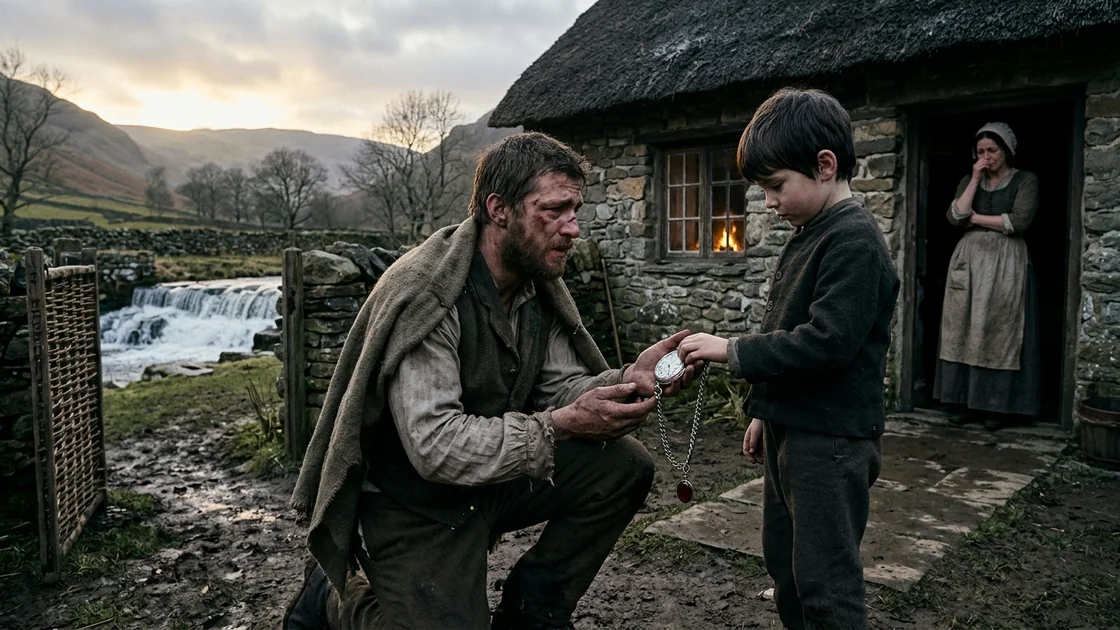
This is the story of Thomas Vance, a soldier returning from the horrors of a grueling colonial campaign who promised his dying friend Julian Morrow that he would safely carry an engraved silver pocket watch home to Julian's seven-year-old son, Robin. Arriving in the fogbound harbor city of Pelham's Reach, haunted by shell shock and survivor's guilt, Vance sought refuge in cheap liquor and high-stakes cards at a notorious waterfront tavern known as The Drowned Rat. Overcome by impulse and a mounting run of catastrophic debts, Vance surrendered the sacred heirloom to an unyielding pawnbroker and crime broker named Gideon Locke. Stricken by remorse in the cold light of day, Vance embarked on a desperate descent into the violent underbelly of the docks to win back his honor and the watch, before walking the long inland road to Julian's family cottage to face the boy he almost failed.
Act I: The Mud of Saint-Médard
The mud of Saint-Médard was not like ordinary earth. It was a living, glutinous beast compounded of churned loam, sulfurous ash, shredded timber, and the blood of three regiments of line infantry. It clung to the heels of boots with the tenacity of a drowning sailor, dragging men down into the slit-trenches where the brackish water rose to their knees. In the final week of October, the sky over the northern ridgeline hung like a bruised plum, dark and weeping a continuous, needle-cold drizzle that turned every trench wall into a melting slurry.
Thomas Vance sat on an overturned ammunition crate beneath a sagging canopy of canvas and pine boughs, his Enfield rifle resting across his knees. His uniform coat was stiffened with dried mud and greasy with tallow. His fingers, raw and split from the wet cold, hovered near his mouth as he blew hot breath into his cupped palms. Every few seconds, the battery three miles to the south spoke with a dull, heavy thump that shuddered through the soles of his boots.
A yard away, half-sheltered in a dug-out niche carved out of the marl, lay Corporal Julian Morrow.
Julian had taken a jagged spade-full of shrapnel through his side when the morning artillery had caught the third company crossing the open sunken lane. He had not cried out when it struck him, only grunted like a laborer heaving a sack of grain, before collapsing face-first into the ferns. Vance had dragged him fifty yards through the sucking mire, under the snarl of wire and through the shattered gatepost of an orchard, until they reached the reserve trench. The field surgeons had taken one look at Julian's chalky lips and the dark, bubbling seep through his canvas waistband, and they had turned their stretchers toward men who still had pulses in their wrists.
Now, night was crawling into the trench, bringing with it a freezing mist that smelled of salt marsh and cordite.
"Thomas," Julian whispered. The sound was like dry husks of corn rubbing together in an October wind.
Vance shifted off the crate immediately, dropping to his knees in the soup of the trench floor. He did not care about the water soaking his trousers; he took his friend's right hand. Julian's hand was so cold it felt as though it had already spent three days beneath the sod.
"I’m here, Julian. Keep your breath. The reserve carts will be up before midnight. They’re bringing dry rum and clean blankets."
Julian produced a terrible, fluttering imitation of a chuckle that dissolved into a fit of wet coughing. A thread of dark crimson crept from the corner of his chapped mouth. "Save the lying... for the recruiting sergeants, Thomas. You never were... much good at it anyway."
"Quiet now," Vance murmured, his voice tightening in his throat until it hurt. "Save your strength."
Julian’s fingers tightened with an unnatural, frantic strength. He reached into the breast pocket of his tunic—a pocket that had been kept buttoned, shielded from the rain by a folded layer of oilskin. His trembling fingers struggled with the horn button until Vance gently unfastened it for him. From the recess, Julian drew an object wrapped in a piece of oiled flannel.
When the flannel fell away, the faint, silver sheen of an open-faced pocket watch caught the dim grey light of the evening sky.
It was an exquisite piece of craftsmanship, wholly out of place in a ditch filled with rotting men. The casing was heavy, engine-turned sterling silver, bordered by an intricate repoussé pattern of acanthus leaves. On the reverse, worn faint by the rubbing of a thumb over generations, was the engraving of a swallow in flight above a stylized compass rose. A heavy silver chain, tipped with an unpolished carnelian fob, dangled from its bow.
"It was... my grandfather’s," Julian rasped, his eyes widening, fixed on Vance’s face with a fierce, burning lucidity. "My father gave it to me... when I took the king's shilling. I promised... promised him it wouldn't die in a hole."
"It won't," Vance said, his own eyes stinging.
"Robin," Julian whispered, the name carrying an unbearable weight. "Robin is seven now, Thomas. Seven years old. In High Crag... by the weavers’ weir. He doesn't have... he won't have a father’s pension. My sister Martha... she has nothing. But this watch... it’s thirty sovereigns of silver and escapement work. It’s an education, or... or a trade apprenticeship. Or something to hold when he forgets my face."
Julian’s chest heaved, a dry, rattling heave that lifted his shoulders off the mud. He pressed the cold metal disc into Vance’s palm and folded Vance’s thick, scarred fingers over it.
"Swear it, Thomas," Julian pleaded, his breath smelling of iron and decay. "Swear on your mother’s soul. You take it to High Crag. You put it in Robin's hand. Do not give it to an officer. Do not let the quartermaster take it for inventory. Deliver it yourself."
"I swear it," Vance said, his voice breaking. He felt the weight of the silver burning into his skin as if it were a brand fresh from the forge. "By God in heaven, Julian, I swear it. If I live to see the coast, Robin will have the watch. On my life."
Julian’s eyes relaxed. The terrible, frantic strain went out of his brow, leaving his features strangely smooth, younger by ten years. "A swallow," he murmured, his sight drifting up toward the gray canopy of rain. "They always... find their way back... across the water."
His hand went slack in Vance's grip. The fingers fell away, brushing the mud. His head lolled to the left, his cheek coming to rest against the cold timber of the trench revetment. The only sound remaining was the distant, indifferent thud of the guns and the rhythmic, hollow tick-tick-tick of the silver watch, still beating against Thomas Vance’s palm with a steady, oblivious pulse.
Act II: The Grey Roads of Pelham’s Reach
The troopship Caledonia disgorged its cargo of broken men three weeks later into the suffocating, coal-smoke haze of Pelham’s Reach.
Pelham’s Reach was not a city built for heroes. It was a sprawling, ill-favored port town clutched in the arm of an estuary where the River Ouse met the gray surges of the North Sea. It lived on tallow, whale oil, imported timber, and the cheap sweat of transient dockers. Great brick warehouses, weeping moisture through their mortar, towered over cobblestone quays slick with cod scales and horse dung. A forest of masts leaned against the low, curdled sky, their cordage whistling in the persistent east wind.
Thomas Vance walked down the wooden gangplank with his discharge papers rolled in his oilcloth knapsack and eleven silver shillings in his trousers—his back pay after deductions for a lost canteen and two missing cartridges. His blue uniform coat was threadbare, the regimental buttons tarnished black, the hem stiff with salt brine from the crossing. In his left waistcoat pocket, resting against his ribs like a second heart, was Julian’s watch.
He had wound it every morning at dawn. He had done it compulsively, sitting on the iron deck of the transport ship while the other soldiers gambled for rations or stared mutely at the gray swell. One, two, three, four, five clicks of the winding stem. Never more. He feared breaking the mainspring. Whenever the horrors came—the smell of burst bowels, the whistling shriek of falling iron, the memory of Julian’s fingers going limp in the mud—he would reach his hand inside his coat, press his thumb against the engraved swallow, and listen to the faint, metallic heartbeat.
Robin, he would tell himself. The boy at the weavers’ weir. High Crag is seventy miles north. Three days on foot, or sixteen shillings by the mail coach.
He had eleven shillings. He needed five more for the coach, or he would have to walk through the November rains, sleeping in barns and ditches. His right knee, twisted in the retreat from Saint-Médard, throbbed with a dull, sickening heat that made every third step an agony.
"Vance! Thomas Vance, you old dog!"
Vance stopped near the mouth of an alley where steam vented from a cooperage. Turning, he saw Sergeant Caleb Croft, a man whose left ear had been sheared away by a piece of case-shot two years prior. Croft was accompanied by a thickset private named Miller, whose tunic was already unbuttoned to reveal a dirty woolen undershirt. Both men were red-faced, their breath reeking of cheap corn brandy.
"You’re alive, then," Croft barked, clapping a heavy hand on Vance’s shoulder. "We thought the fever took you in the field hospital at Calais."
"It didn't," Vance said, his voice quiet, flat. "I took the ship."
"Well, you look like a walking headstone," Miller laughed, waving a stoneware jug. "Come along with us. We’re bound for The Drowned Rat. Old Mother Clout’s got a fire in the hearth, hot mutton pie, and a game of hazard running in the cellar. First drink’s on Croft’s severance."
"I have to go north," Vance said, his hand unconsciously drifting to his waistcoat pocket. "I have... business in High Crag. A duty."
"In this rain?" Croft snorted, gesturing toward the sky, which had begun to dump a cold, greasy sleet upon the cobblestones. "The north road is a bog, Thomas. No carts are running until the morning post. You’ll freeze in the ditches before you make five miles. Come inside, warm your shanks, eat some fat meat, and take the coach when the sun shows its teeth tomorrow."
Vance hesitated. His knee throbbed with a vicious pulse that seemed to match the cold dampness in the air. His clothes were damp, his stomach was an empty, aching cavern, and the thought of sitting by a roaring coal fire was a temptation that struck him with the force of a physical blow. He looked down the long, gray vista of the wharf; the road leading out of the town disappeared into a bleak, featureless moor of mist and rain.
"Just an hour," Vance muttered. "One drink to take the salt off my tongue."
"That's the spirit, lad!" Croft bellowed, steering him by the elbow. "The war’s done! The King’s got his provinces, and we’ve got our hides. Let the dead bury the dead."
The words struck Vance like an open hand across the mouth, but he did not pull away. He let himself be led down the alley, the silver watch ticking steadily against his ribs.
Act III: The House of Hazard
The Drowned Rat was an ancient, sway-backed establishment built of timber salvaged from broken hulks. It leaned out over a tidal ditch where the bilge of the town accumulated in green, greasy pools. Inside, the air was a thick, yellow soup of pipe tobacco, roasted mutton fat, wet wool, and the sour tang of spilt ale. A massive hearth dominated the back wall, piled high with sea-coal that burned with a pungent, greenish flame and crackled like musket fire.
Dozens of discharged soldiers, merchant sailors, lightermen, and women with painted cheeks and hollow eyes crowded around the trestle tables. At the far corner, down three stone steps that led into an old barrel vault, a ring of men stood four-deep, their faces lit by the guttering tallow candles stuck to the masonry walls. From the vault came the rhythmic rattle of bone dice in a leather cup and the sharp, sudden curses of ruined men.
Vance sat with Croft and Miller near the hearth. A trencher of mutton stew was placed before him, thick with suet and barley, alongside a pewter mug of dark, bitter stout. He ate ravenously, like a starving animal, barely chewing the gristle before swallowing. The warmth of the food and the radiant heat of the coal fire seeped into his marrow, loosening the cold knot that had lived behind his breastbone since the trenches.
"Drink up, Thomas," Miller said, sliding another mug toward him. "You’re as grim as a parson at a hanging."
Vance drank. The ale was rough, biting the back of his throat, but it dulled the ache in his twisted knee. It dulled, too, the persistent memory of Julian’s white face and the gray light on the rain-swept marl. He felt himself floating in a warm, amber haze. For the first time in six months, his hands stopped trembling.
After the second pint, Croft stood up, wiping foam from his mustache. "I’m going down to the pit. They’re rolling the bones. A man can’t leave Pelham’s Reach without doubling his purse."
"Croft, don't," Vance said, some lingering instinct of caution stirring through the alcohol. "The tables in this port are clipped. You know how these water-rats operate."
"Clipped for greenhorns, maybe," Croft laughed, jangling a pouch of shillings. "Not for a sergeant of the Thirty-Third. Watch the table, Thomas. See how an old campaigner takes his bread."
Vance followed them to the top of the stone steps.
The cellar was cold despite the crowd, the damp stone walls glistening with saltpeter. In the center of the vault stood an oak table, its surface covered in worn green baize marked with yellowed chalk lines. Behind the table sat the house banker—a man known across the docks as Gideon Locke.
Locke was a man who seemed constructed entirely of whalebone and dried parchment. He wore a high-collared coat of snuff-colored wool, spotless and severe, and black silk fingerless gloves that showed long, yellowed nails. His eyes were small, wet, and pale as lard, never blinking, shifting constantly from the dice to the hands of the players. Beside him sat a hulking drayman with broken teeth and an ash cudgel laid across his knees.
On the baize lay piles of brass tokens, silver sixpences, Spanish dollars, and a scattering of pawned trifles: a brass spyglass, a gold signet ring with the stone pried out, a silver-plated snuffbox.
"Place your stakes, gentlemen," Locke spoke, his voice like stones grinding together in a mill. "The main is seven. Hazard the caster, nick the caster. Seven is the main."
Croft threw down two shillings. The caster, a red-faced boatswain with grease in his hair, shook the horn box and threw.
"Five! Five is the chance. Seven is the main."
The dice clattered again. A three and a four.
"Seven! Out!" Locke’s long fingers darted across the cloth with the speed of an adder, raking Croft’s silver into his wooden drawer. "The caster loses. New shooter."
Croft swore, spat on the flags, and tossed down three more shillings. "Again."
Vance watched from the edge of the pit. The sight of the money moving across the green cloth produced a strange, electric tension in his gut. He thought of his eleven shillings. Eleven shillings was not enough for the coach and a pair of dry boots for the boy. If he walked to High Crag, he would arrive as a beggar, penniless, unable even to buy a loaf of bread for Julian’s sister. But if he had two pounds—if he had forty shillings—he could arrive like a gentleman. He could rent a trap. He could bring a sack of flour, a side of bacon, new shoes for Robin.
Just one cast, a small, serpent-like voice whispered in the back of his mind. You always had the luck at the bivouac. You threw double-sixes three times running at the camp outside Mons.
"Step up, soldier," Locke murmured, his pale eyes flicking directly to Vance. "A hero of the line, are we? King’s men always have the luck of the brave. Two shillings to test the wind?"
"No," Vance said, though his feet did not move away from the edge of the baize.
"Scared of the bone?" Miller mocked, nudging him. "Look at him, Croft. He’ll die an old maid with his pennies sewn into his breeches."
The ale hummed in Vance’s blood, hot and reckless. The shame of being called a coward by men who had hidden in the rear trenches during the second assault rose up in his throat. He reached into his pocket and pulled out two of his hard-won shillings, placing them on the chalked square marked In.
"The soldier plays," Locke intoned. "Caster takes the box."
Vance took the horn cup. It was smooth, dark with age and greasy from thousands of sweating palms. He shook the two bone cubes. The familiar, rhythmic clatter was loud in his ears, drowning out the murmur of the crowd. He blew on the dice, Julian’s face momentarily flashing across his mind, and cast them across the baize.
A four and a three.
"Seven!" Locke announced, his expression unchanging. "A nick! The soldier doubles."
Locke swept two more shillings from his tray and pushed them across the cloth to Vance.
A roar went up from Croft and Miller. "What did I tell you!" Miller shouted. "The boy’s charmed!"
Vance stared at the four silver coins. His heart was hammering against his ribs, fast and light. Four shillings gained in five seconds. It would have taken two full days of hard labor on the docks to earn that much. He felt a sudden, intoxicating rush of power. The misery of the campaign, the mud, the cold, the poverty—all of it could be undone here, on this little island of green cloth beneath the yellow candles.
"Leave it," Vance said, his voice husky. "Four shillings on the caster."
"He lets it ride," Locke said softly. "The main is seven."
Vance threw again. An eight.
"Eight is the chance," Locke droned. "Seven to save, eight to win."
Vance threw: a six and an ace. A three and a two. A five and a three.
"Eight!" Locke cried. "The caster wins. Eight shillings to the soldier."
The crowd cheered. Someone thrust another mug of gin into Vance’s hand. He drank it down without tasting it; it was fire and sugar, and it turned his head into a spinning wheel of light. Eight shillings became sixteen. Sixteen became thirty-two. By the end of twenty minutes, Vance had a mountain of silver before him—nearly three pounds. More money than he had held in his entire life. He could buy Robin a pony. He could buy an apprentice's indenture. He had beaten the war; he had beaten the mud.
"Take it up, Thomas," Croft said, his own voice sounding suddenly cautious, sobered by the sheer size of the pile. "You’ve won the bank. Take the silver and let's go."
"One more," Vance said, his eyes glittering with a fever that had nothing to do with the trenches. "I want fifty shillings. An even fifty."
Locke smiled—a thin, gray parting of the lips that did not reach his lard-colored eyes. "The soldier wishes to strike the bell. Fifty shillings on the throw. Main is seven."
Vance threw the dice.
A six and a one. Seven. The main.
"Nick!" Vance screamed, reaching for the silver.
"Hold," Locke said, his fingerless glove dropping onto Vance’s wrist like an iron manacle. "The box was cocked against the rim. Void cast. Roll again."
"It wasn't cocked!" Vance roared, the alcohol boiling into fury. "It was flat! You saw it, Croft!"
Croft looked at Locke’s cudgel-man, who had shifted his weight and tapped the ash club against his knee with a dull, hollow clack. Croft swallowed and looked away. "I... I couldn't see, Thomas. The candle was in the way."
"Roll again, soldier," Locke whispered, his voice dangerously soft. "Or forfeit the stake for disputing the table."
Vance’s teeth ground together. His vision was tunneling, red and narrow. He seized the horn box. He shook it violently, cursing under his breath, and flung the dice onto the baize.
A two and an ace.
"Three," Locke intoned flatly. "Craps. The house takes the stake."
The long, predatory fingers swept forward. In one effortless, fluid motion, the pile of silver—Vance’s back-pay, his winnings, his coach fare, his boots—vanished into the wooden drawer. The drawer clicked shut with the finality of a coffin lid.
Vance stood frozen, his hands empty, hovering over the bare green cloth. The cellar was dead silent save for the crackle of a candle wick.
"No," Vance whispered. "No. That was... that was everything."
"You are welcome to play on, friend," Locke said, leaning back, his hands folded across his waistcoat. "Credit is extended to men of substance. A coat, a watch, a horse. What have you got in your pocket, soldier?"
"I have nothing," Vance choked out. "I have my papers."
"Discharge papers are toilet paper to me," Locke said. "Step back from the table. Next caster."
"Wait," Vance gasped.
The alcohol, the shame, the panic, and the sudden, sickening realization of his destitution collided within him in a wave of madness. He could not go to High Crag with nothing. He could not face Julian’s sister as a penniless drunkard who had lost his fare in a cellar. He had to win back the three pounds. Just the three pounds, and then he would walk away forever.
His fingers reached into his waistcoat.
They touched the smooth, cold silver of the pocket watch.
No, his soul screamed. Not this. Never this.
"What’s that, then?" Locke asked, his pale eyes narrowing as he caught the glint of the silver chain between Vance’s fingers. "That looked like work from the south. Let me see it."
"It isn't mine," Vance said, his own voice sounding distant, like a voice heard through water.
"Then why is it in your breeches?" Locke sneered. "Come, let’s see the metal. If you’re a coward, put it away and go sleep in the gutter."
Vance’s hand moved as if guided by another man’s will. He pulled the watch from the pocket. The silver chain rattled softly against the buttons of his coat. He laid the watch on the green baize.
The candles caught the bright, polished surface of the case, the engraved swallow soaring over the compass rose, the carnelian fob glowing like an ember.
A murmur of appreciation passed through the circle of watchers. Even Locke leaned forward, his yellowed fingernail tapping the crystal. He unlatched the hunter back, exposing the movement.
"English lever," Locke whispered, more to himself than to the room. "Jeweled balances. Inscribed to Julian Morrow, 1842. It’s quality. Fine silver, four ounces at least."
"It is worth thirty sovereigns," Vance said, his heart beating so hard he could barely draw breath.
"It’s worth what I give for it in a cellar at midnight," Locke replied coldly. "I’ll stake you two sovereigns against it. One throw of the dice. If you win, you take the watch and four sovereigns of my money. If you lose, the watch stays in my vault for thirty days. You pay two sovereigns and five shillings interest to redeem it. After thirty days, it goes to the melting pot in London."
"Thirty days," Vance repeated, grasping at the lifeline. Thirty days was time. He could work the docks. He could carry timber. He could dig ditches. He could earn forty-five shillings in a fortnight if he starved himself.
"Thirty days," Locke nodded. "Or win it all back now on a single cast. One roll. Main is seven."
Vance looked at the watch. The swallow seemed to be flying away from him, its wings spread wide, heading out across an endless, gray sea.
"One roll," Vance whispered.
He took the dice in his bare hand this time, without the cup. The bone felt greasy, ice-cold. He closed his eyes. Julian. Forgive me. God, forgive me.
He rolled.
The two cubes spun across the baize, bouncing against the mahogany rim, slowing down, settling into the chalked square.
A five. And a two.
"Seven!" Vance screamed, his hands shooting forward. "Seven! A nick!"
"Look again, fool," Locke said, without moving an inch.
Vance blinked, wiping the sweat and tobacco grease from his eyes.
The five was not a five. It was a four. The corner was nicked, a black dot obscured by a speck of dark wax that had clung to the rim. It was a four and a two.
Six.
"Six is the chance," Locke said, his voice flat, devoid of emotion. "You threw a six, not a seven. Throw to make your six."
Vance’s knees buckled. He grabbed the dice again with hands that were shaking violently. He cast them down without looking.
A one. And a three. Four.
He threw again. A five and a six. Eleven.
He threw a third time. The bone bounced off the wood, struck the base of a candlestick, and rolled to a stop.
A four. And a three.
Seven.
"Seven," Locke said calmly. "The caster sevened out. The house takes the stake."
The long, yellowed hand reached down. The silver chain was gathered up in the black silk fingers. The swallow disappeared into Locke’s heavy leather purse. The lid clicked shut.
"Next caster," Locke said, turning his lard eyes to a Norwegian sailor on the right. "Main is seven. Step up, gentlemen, step up."
Vance stood motionless. The roar of the cellar faded into a high, piercing whine that filled his skull like the whistle of an incoming shell. Croft grabbed his arm, trying to pull him toward the stairs. "Come on, Thomas. It’s done. Come away before Locke’s man cracks your skull."
Vance did not feel Croft’s hand. He did not feel the cold steps beneath his boots as he was led up into the taproom. He only felt an immense, hollow void in his left side, right where the watch had been ticking against his ribs.
The swallow was gone.
Act IV: The Cold Light of the Gutter
Thomas Vance woke with his face pressed against the wet cobblestones of an alley behind the fishmonger’s shambles.
The rain had stopped, replaced by a killing frost that silvered the gutters and turned the puddles into plates of brittle black ice. His uniform coat was gone—somebody had stripped it from his back while he lay insensate in the dirt—leaving him in his soiled linen shirt and wool waistcoat. His boots were still on his feet, but the left sole had completely separated from the welt, exposing his gray woolen sock to the mud.
He lay there for a long time, listening to the screaming of the gulls wheeling over the harbor.
The alcohol was gone, leaving in its wake a sickening, poisonous ache that throbbed behind his temples like the beat of a drum. His tongue was thick, tasting of copper and bile. Every joint in his body cried out with the agony of the frost.
Slowly, painfully, memory assembled itself from the wreckage of the night before.
The cellar. The dice. The green cloth. The swallow.
"Julian," Vance croaked, his voice a dry rasp in the cold morning air.
He rolled onto his knees, his hands plunging into the icy slush of the gutter. He remembered Julian’s eyes in the trench at Saint-Médard. Swear it on your mother’s soul. Do not let the quartermaster take it. Robin is seven years old.
And what had he done? He had walked off the ship, sat in a warm room, filled his belly with mutton and gin, and pawned the boy’s bread for fifty seconds of fever at a hazard table. He had sold his comrade’s memory to a harbor shark for two throws of the dice.
A dry heave shook his chest, but there was nothing in his stomach to bring up. He knelt there, weeping silently, the tears freezing upon his bearded cheeks. He wanted to die. It would have been so simple to crawl another fifty yards to the end of the quay, let himself slip into the dark, churning water of the tidal basin, and let the North Sea carry his carcass out to the shoals where nobody would ever know his name.
That would be the soldier’s way out, he thought bitterly. The coward’s retreat.
Julian would still be dead. Robin would still be an orphan without a shilling. And Gideon Locke would send the silver watch to London to be melted down into three ounces of bullion to make spoons for some merchant’s table.
Vance stood up. His twisted knee screamed, but he forced his weight onto it, gritting his teeth until the blood returned to his lips.
"Thirty days," he whispered to the gray walls of the alley. "He said thirty days."
Two sovereigns and five shillings. Forty-five shillings total.
He had no coat. He had no money. He had no trade in Pelham’s Reach, where five hundred discharged infantrymen were already begging for crusts along the wharves. But forty-five shillings stood between him and damnation.
He walked out of the alley, his eyes fixed on the forest of masts along the quay.
The harbor was coming alive in the cold, gray dawn. Steam rose from the funnels of three small coastal tugs. Heavy drays, their iron-rimmed wheels clattering over the stones, hauled hogsheads of molasses and barrels of tallow from the warehouses to the cargo vessels. Along the wet slipways, gang-masters with short clubs in their belts stood on crates, shouting for laborers.
Vance limped toward the nearest gang.
"Need a hand?" Vance asked, his voice shaking with the cold.
The gang-master, a man with a walrus mustache and an oilskin hat, looked Vance up and down. He saw the bare shirt, the mud-caked breeches, the limp in the right knee.
"Can you hoist a sixty-pound sack of salt-fish for ten hours without dropping it, soldier?"
"I carried eighty pounds of kit thirty miles through Flanders," Vance said.
"This ain't Flanders," the master spat. "A penny a ton. No rations. If you drop a sack, you pay for the cure out of your hide."
"Give me the hook," Vance said.
Act V: The Wages of the Docks
For seven days, Thomas Vance did not sleep in a bed.
He slept in a corner of an abandoned lime-kiln near the saltings, wrapping himself in pieces of discarded sailcloth that smelled of mildew and seal oil. He woke every morning at four, when the tide was at the ebb, his muscles screaming, his frostbitten fingers stiff as kindling. He bought a two-penny loaf of hard rye bread each evening and filled his belly with cold water from the parish pump.
Every hour was measured in silver.
On Monday, he unloaded salt-herring from a Peterhead lugger, his shoulders raw where the wet wicker baskets bit through his shirt, the brine burning like acid into the cuts on his palms. He earned two shillings and two pence.
On Tuesday, he joined a ballast-gang, shoveling heavy river-gravel into the hold of an empty collier until his palms blistered, then tore, then bled until the shovel handle was sticky with his own skin. Two shillings and sixpence.
On Wednesday, the weather turned violently cold. A north-easterly gale screamed across the estuary, bringing driving sleet that coated the rigging of the ships in thick sheaths of ice. Work stopped on the general cargo, but a Dutch brig carrying pig-iron had struck a sandbar near the harbor mouth and was breaking her back in the surf. The owners offered double pay for men desperate enough to wade into the surf and haul the iron bars to the carts.
Vance was the first man into the water.
The sea was so cold it stole the breath from his lungs with the first step. The salt water came up to his chest, soaking Julian's memory, soaking his own miserable flesh. For six hours, Vance hauled seventy-pound bars of pig-iron through the breakers, his boots slipping on the shifting shingle, his knee threatening to give way under every load. Twice he went under, his mouth filling with the bitter, sandy water, and twice he dragged himself up by the wheel of a horse-cart, his eyes wild, his teeth rattling so violently he bit his own tongue.
By Saturday night, he had gathered twenty-four shillings.
He kept the coins sewn into the lining of his waistcoat, right where the watch had rested. Every time the heavy silver pieces clinked together, he felt a small, desperate spark of hope.
On the eighth day, a Sunday, the docks were closed by order of the magistrate. No ships were worked; no cranes turned. The town was quiet, the gray streets echoing only with the bells of the parish churches calling the respectable folk to prayer.
Vance had twenty-four shillings. He needed twenty-one more. And Locke’s thirty days were already bleeding away.
He sat on the stone steps of the butter-market, staring at his torn hands. He knew he could not make another twenty shillings on the quays before the cold killed him. His chest had begun to rattle when he breathed; a deep, feverish cough racked him every twenty minutes, leaving him dizzy and gasping for air against the cold stone. If the lung-rot took him, Julian’s watch would die with him.
"You’re the soldier from the Caledonia," a voice said.
Vance looked up.
Standing before him was a tall, lean man wearing a tight-fitting coat of green broadcloth and a flat cap pulled low over his forehead. He had the sharp, restless eyes of a ferret and carried his shoulders with the loose, swaying balance of a man who fought with his fists.
"I’m Vance," Thomas said.
"I saw you at The Drowned Rat last Saturday," the man said, leaning against the market pillar. "You had a good hand before Locke’s box did you. Name’s Rourke. I handle the mill down at the Ironworks."
"I don't gamble," Vance said, his voice flat.
"I didn't ask you to gamble," Rourke replied, spitting a stream of yellow tobacco juice onto the ice. "I asked if you could take a beating."
Vance looked at him.
"The mill," Rourke continued, "is bare-knuckle. Down in the casting cellar behind the coke ovens. The furnace men like to see blood on Sunday afternoons. We’ve got a collier from Shields—big lad, weighs fourteen stone, hits like an iron bar. His opponent took the morning packet to Hull because he didn't fancy getting his jaw-bone set. We need a man to stand four rounds with him. Just four rounds. You don't have to win. You just have to stay on your pins for twenty minutes so the lads don't break the benches."
"How much?" Vance asked, his heart thudding with a cold, desperate cadence.
"A guinea to the man who lasts four rounds," Rourke said. "Two guineas if you put him on his back."
A guinea was twenty-one shillings.
Twenty-four and twenty-one was forty-five. The exact sum.
Vance stood up. His joints creaked like rusty hinges. He looked down at his raw, split hands, his swollen knee, his trembling limbs. He had faced the artillery at Saint-Médard; he had watched men blown into red vapor by twelve-pound case shot. A collier from Shields was only flesh and bone.
"Take me there," Vance said.
Act VI: The Casting Cellar
The ironworks stood on the western fringe of Pelham’s Reach, a monstrous complex of brick chimneys that vomited black, oily soot into the sky day and night. The casting cellar was a vast, subterranean chamber beneath the blast furnaces, lit only by the dull red glare of the slag-troughs and a circle of oil lamps hung from iron rafters.
The heat was suffocating, smelling of sulfur, scorched sand, and sweat. Nearly two hundred men—furnace-feeders, puddlers, blacksmiths, and dock-thugs—were packed around a square marked out with tarred hemp rope stretched between four iron pillars.
In the center of the ring stood the collier.
He was a giant of a man, his chest and arms covered in thick black hair matted with coal dust. His shoulders were like the haunches of a dray-horse, his nose flattened across his face, his small, bloodshot eyes peering through swollen lids. He was already stripped to the waist, his massive fists bound with strips of greasy sail-twine.
"Four rounds," Rourke whispered in Vance’s ear as he stripped off his threadbare shirt. "Five minutes a round. If you go down, you have until the count of eight to stand. Don't try to box him, soldier. He’ll break your ribs like dry twigs. Run him around the ring. Keep your chin down."
Vance stepped into the rope square.
The contrast between the two men was grotesque. Vance was lean, his ribs showing like the timbers of a wrecked skiff beneath his white, scarred skin, his breath coming in shallow, wheezing gasps. The crowd laughed—a cruel, roaring sound that echoed through the brick arches.
"A corpse!" someone yelled from the back. "You’ve brought us a bloody corpse from the churchyard!"
"Ten shillings on the Shields bull!" another barked. "He kills him in the first!"
The bell was an iron wheel struck with a hammer. CLANG.
The collier came forward without hesitation, his heavy boots scuffing the casting sand. He didn't bother with a stance; he simply swung a right hand that had the weight of a sledgehammer behind it.
Vance saw it coming. The old infantry training—the endless bayonet drills, the ducking and parrying in the mud—took over his limbs. He dropped beneath the blow, the wind of the fist grazing his hair, and drove his own right fist into the collier’s ribs.
It was like striking a bag of wet coal. A dull thud, but the collier didn't even grunt. He simply spun with an agility terrifying for his size, his left elbow catching Vance on the side of the head.
The world went white.
Vance hit the sand hard, the breath driven from his lungs in a sharp woosh. His ears rang with a deafening clamor, the red glare of the furnaces spinning in a circle above him.
"One!" the referee screamed, standing over him. "Two! Three!"
The watch, Vance’s mind screamed through the fog. Robin. The swallow.
He forced his elbows under him. The casting sand was hot and gritty against his bleeding mouth.
"Five! Six!"
He dragged himself to his feet, leaning against the iron pillar, his legs trembling violently. The crowd was screaming, their faces twisted into masks of bloodlust in the red furnace light.
The collier grinned, exposing broken, yellow teeth, and stepped in to finish it.
For the next ten minutes, Vance did not fight; he survived.
He circled the ring, his twisted knee screaming with every lateral pivot. When the collier closed, Vance clinched, burying his head against the giant’s chest, absorbing the brutal, short-arm kidney punches that felt as though they were tearing his organs loose from his spine. He took a blow to the mouth that split his lip to the bone; he took an uppercut that broke his nose, flooding his throat with warm, salty blood.
CLANG. End of the second round.
Rourke dragged him to the corner, dumping a bucket of foul, lukewarm canal water over his head. "Stay down, you fool," Rourke hissed. "He’s going to kill you. You’ve earned five shillings for the show. Take it and go."
"A guinea," Vance coughed, spitting a tooth into the sand. "A guinea... or nothing."
CLANG. Round three.
The collier was getting frustrated. The crowd was jeering him for failing to put away the half-starved soldier. He rushed Vance with his head down, swinging wildly with both hands.
Vance saw his opening. Instead of retreating, he stepped inside the swing, his left foot planting firmly in the sand, and drove his forehead straight into the bridge of the collier’s nose.
A sickening crunch echoed even over the noise of the crowd.
The collier roared in pain, his hands flying to his face as blood spurted between his thick fingers. For three seconds, the giant was blind.
Vance did not hesitate. He summoned every ounce of strength remaining in his battered frame—every ounce of hatred for the war, for the dice, for the mud, for Gideon Locke—and drove a straight, piston-like right hand directly into the collier’s exposed throat.
The giant stopped. His eyes rolled up into his head. A terrible, wet wheeze came from his windpipe, and then, slowly, like an oak tree felled by the axe, he collapsed face-forward into the casting sand.
The cellar went completely silent.
The referee stood with his hand raised, his mouth open, staring at the motionless mountain of flesh. He didn't count. Nobody moved.
"He’s down," Vance whispered, blood dripping from his chin onto his bare chest. "Count him."
"Seven... eight... nine... out," the referee said, his voice barely audible.
The room erupted. Men were shouting, throwing caps into the air, cursing their lost bets, while Rourke leaped through the ropes with a broad, disbelieving grin on his face.
"You bloody madman!" Rourke yelled, catching Vance before his knees hit the sand. "You dropped the Shields bull!"
He shoved a small canvas pouch into Vance’s trembling hand.
"Two guineas," Rourke said, his eyes wide with genuine respect. "Forty-two shillings. You earned every penny of it, soldier. Now get out of here before his mates get their shillelaghs."
Vance clutched the pouch against his chest. He didn't feel the pain of his broken nose, his split lip, or his bruised ribs. He only felt the weight of the gold and silver coins pressing into his palm.
Forty-two shillings. Plus his twenty-four from the docks.
Sixty-six shillings.
He had the ransom.
Act VII: The Iron Vault
Night had fallen again over Pelham’s Reach when Vance returned to The Drowned Rat.
The cold was intense, freezing the mud into iron ruts that tore at his ruined boots. He wore an old burlap sack across his shoulders like a shawl, held together with a rusty nail. His face was a grotesque ruin: both eyes blackened, his nose swollen and crooked, his mouth caked with dried black blood. But beneath his tattered waistcoat, the coins were heavy, real, and singing with redemption.
He did not go into the taproom. He walked down the narrow, alleyway entrance that led directly to the side door of the cellar vault.
He did not knock. He pushed the heavy oak door open with his shoulder.
The cellar was quieter tonight; it was a Monday, and only a half-dozen hard-bitten gamblers stood around the hazard table. Gideon Locke sat in his accustomed place, the snuff-colored coat spotless, his fingerless gloves resting on the green baize. Behind him, the cudgel-man sat dozing on a salt barrel.
Locke looked up as the cold draft entered the room. His pale eyes drifted over Vance’s broken face, his bloody shirt, his burlap shawl. Not a flicker of surprise or sympathy crossed the pawnbroker’s parchment features.
"We have no soup for beggars, soldier," Locke said softly. "Go to the parish house."
Vance stepped up to the table. The few gamblers backed away, repulsed by the smell of blood, canal water, and sweat that radiated from him.
With a single, violent motion, Vance slammed the two canvas pouches down onto the green baize.
The coins struck the timber with a heavy, metallic crash that made the candle flames jump.
"Two sovereigns," Vance rasped, his swollen mouth struggling to form the words. "And five shillings. Forty-five shillings total. For the watch."
Locke did not touch the money. He tilted his head, his lard-like eyes narrowing slightly as he inspected the blood on the canvas.
"You’re early," Locke said. "You had twenty-two days left."
"I don't need twenty-two days," Vance said, leaning his fists on the table, bringing his broken face within two feet of Locke’s. "The watch. Now."
Locke sighed, a soft, dry exhalation that smelled of cloves and stale wine. He picked up the larger pouch, untied the string, and spilled the coins onto the cloth. He counted them with his long, yellowed fingernail: the two golden sovereigns from the ironworks, the silver shillings from the pig-iron and the salt-fish, the worn sixpences.
"Forty-five shillings," Locke murmured. "Precisely."
He looked at Vance, his expression settling into something that was almost pity, but colder—the look a naturalist might give to a beetle impaled upon a pin.
"A remarkable effort, soldier," Locke said. "Truly. But you are too late."
The cellar seemed to drop ten degrees in an instant.
Vance’s heart stopped. "What did you say?"
"I said you are too late," Locke repeated, his voice even, flat, without a trace of malice or regret. "A Dutch merchant captain came through yesterday morning on the high tide. Bound for the Cape of Good Hope. He took a fancy to the watch. Offered five sovereigns for the silver and the lever movement. I sold it to him."
Vance’s vision went red. The walls of the cellar seemed to buckle and heave like the trenches under a high-explosive barrage.
"You said thirty days," Vance whispered, the words coming from some deep, volcanic fissure within his soul. "You swore... thirty days on the baize."
"I am a businessman, Mr. Vance," Locke said, waving his hand toward the door. "Pledges are subject to the market. A bird in the hand is worth two in the saltings. I have your forty-five shillings here; you may keep them. In fact, I will give you an extra ten shillings for your trouble. Take your money and go."
Locke pushed the pile of silver back across the cloth.
Vance did not take the money.
A terrible, cold stillness fell over him. The shaking in his hands stopped completely. The pain in his knee, the agony of his broken ribs, the thrumming headache—all of it vanished, burned away in the white-hot furnace of a rage so pure, so absolute, that it felt like an illumination.
He looked at Locke’s cudgel-man. The drayman was slowly rising from his barrel, reaching for the ash club.
Vance did not hesitate. He had killed six men with a short trenching spade in the red clay of Saint-Médard. He had driven bayonets through bone and brass. These harbor parasites did not know what war was. They thought violence was a game played with clubs and blackjacks in the dark.
Before the drayman could lift the club, Vance seized the heavy pewter candlestick from the center of the table.
In a single, blinding arc, he drove the solid base of the candlestick directly into the drayman’s temple.
The crack was like a dry branch snapping in the frost. The big man did not even yell; his eyes rolled back, and he collapsed against the masonry wall, sliding down into the corner like a bundle of old rags, the ash club clattering harmlessly across the flagstones.
The gamblers screamed and scrambled for the stairs, knocking over stools and empty mugs in their terror to escape the vault.
Locke did not scream. He tried to rise, his hand darting toward the drawer beneath the table where he kept a small brass pocket pistol.
Vance was faster. He vaulted the green baize table with the agility of a wolf, his boots scattering the silver coins across the floor. He landed on Locke’s chest, driving the pawnbroker down into his high-backed mahogany chair.
Vance’s left hand closed around Locke’s throat, his fingers digging into the soft flesh beneath the jaw, pinning him to the wood. His right hand seized the heavy, iron-handled shears Locke used for cutting lead tokens. He drove the point of the shears into the desk, half an inch from Locke’s ear, sinking two inches into the oak.
"Where is it?" Vance whispered. His voice was not loud; it was the hiss of grease dropping onto hot iron.
Locke’s pale face had turned a mottled, purplish gray. His lard eyes were wide now, bulging with a terror that stripped away all his cold, serpentine dignity. He clawed at Vance’s wrist with his black silk gloves, but Vance’s grip was forged of pig-iron and three years of slaughter.
"I... I lied," Locke choked out, the breath whistling through his crushed larynx. "I didn't... sell it."
"Where is it?"
"The... the strongbox," Locke wheezed, his finger pointing with a spastic flutter toward an iron chest recessed into the chimney breast. "Under the hearth... the key is... in my fob."
Vance reached down with his right hand, ripped the chain from Locke’s waistcoat, and pulled out a small, flat iron key.
He did not let go of Locke’s throat. He dragged the pawnbroker out of the chair, throwing him face-first onto the stone floor, and placed his heavy, ruined boot directly onto the nape of Locke’s neck, pinning him like an insect.
"Move," Vance said, "and I’ll drive the shears through your skull."
Vance knelt, inserted the key into the strongbox, and turned it. The heavy tumblers fell with a sharp, oiled click.
He lifted the iron lid.
Inside lay stacks of banknotes, bags of gold coin, ledgers, and a shelf of pawned valuables wrapped in flannel.
Right in the center, untouched, lay the open-faced silver watch.
Vance reached in and lifted it.
The silver was cold against his skin, but as he turned it over, the candlelight caught the engraved swallow, soaring proudly above the compass rose. He brought it to his ear.
Tick-tick-tick-tick-tick.
It had not stopped. The movement was still beating, steady and indifferent to the filth, the blood, and the greed of the room. Julian’s watch was still alive.
Vance slipped the watch into his waistcoat pocket, directly over his heart. He felt the cold iron become warm against his ribs within seconds.
He stood up, looking down at Locke, who lay trembling on the stones, his fingers clutching his bruised throat.
Vance reached down to the table. He picked up forty-five shillings—the two golden sovereigns and the five silver pieces—and dropped them one by one onto Locke’s back.
"The debt is paid, Locke," Vance said, his voice quiet, steady, clean. "Two sovereigns and five shillings. I am a man of my word."
He picked up Julian’s carnelian fob, turned his back on the pawnbroker, and walked up the stone steps into the cold, clean night.
Act VIII: The Road to High Crag
The road to High Crag was seventy miles of mud, limestone ridges, and whistling wind.
Thomas Vance walked every yard of it.
He did not take the mail coach. He had no money left—he had left his forty-five shillings on Locke’s back, and the rest of his earnings had been scattered across the cellar floor during the fight. He had only his tattered breeches, his ruined boots bound to his feet with strips of tarred canvas, an old wool blanket he had taken from an abandoned dray, and Julian’s watch.
Yet, as he cleared the outskirts of Pelham’s Reach and left the stench of the estuary behind, he felt lighter than he had since the transport ship had dropped anchor. The fever in his lungs seemed to burn itself out against the clean, sharp air that blew down from the northern fells. His face was hideous with bruises and yellowing scabs, but beneath the scars, his eyes were clear.
Every morning, when the gray dawn broke over the limestone moors, Vance stopped by a stream or a drystone wall.
He reached into his waistcoat. He took out the silver watch.
One, two, three, four, five clicks of the winding stem.
He watched the silver swallow. He thought of Julian’s face in the rain, but the horror was gone from the memory now. The mud of Saint-Médard had receded. What remained was a promise—the only clean thing Vance had left in a world that had tried to grind him into grease and bone.
"We’re almost there, Julian," he would say aloud to the empty moors. "We’re almost home."
He walked through market towns where children ran from his battered, ghoulish face and shopkeepers stood in their doorways with broomsticks until he had passed. He walked through high mountain passes where the sleet blew sideways, freezing his beard into a mask of ice. He slept under stone bridges, curled in his blanket with his knees tucked against his chest, listening to the steady tick-tick-tick beside his ribs.
On the fourth day, the moors dropped away into a long, green valley sheltered between two limestone scars.
Down in the basin, where a rushing mountain stream split into a dozen braided channels to feed the water-wheels, lay the village of High Crag.
It was a quiet place of gray slate cottages, drystone walls, and willow trees that wept golden leaves into the millraces. Smoke rose in straight, blue plumes from the chimneys into the cold, still afternoon air. From the valley floor came the rhythmic, muffled thump-clack, thump-clack of the water-powered weavers' looms—the pulse of a life that knew nothing of shrapnel, hazard tables, or harbor sharks.
Vance stood at the brow of the hill for a long time, looking down.
He looked at his hands. The scabs had hardened; the skin was stained with coal-dust and salt that would never fully wash out. His uniform coat was gone, replaced by a beggar's rags. He was a ghost returning from a war that the world was already trying to forget.
He took a deep, shivering breath, adjusted the blanket across his shoulders, and began the long descent into the valley.
Act IX: The Weavers’ Weir
The cottage stood near the lower weir, where the overflow from the mill-pond tumbled over a limestone ledge in a curtain of white foam. It was a humble, low-ceilinged building of rough fieldstone, its roof thatched with heather that had turned the color of iron in the winter damp. A small garden patch lay fallow behind a wicker fence, its cabbage stalks black from the frost.
Vance stood by the gatepost, his heart pounding with an intensity that terrified him more than the artillery at Saint-Médard or the fists of the Shields collier.
Through the small, leaded window panes, he could see a fire burning on the hearth. A woman with dark hair pulled back in a linen cap was moving between the table and the hearth, carrying a wooden trencher.
And there, sitting on a low stool by the fire, was a boy.
He was small for seven years, his legs thin in brown woolen stockings, but he held his head with a peculiar, upright tilt that struck Vance like a physical blow. It was Julian’s chin. Julian’s high, clear brow. Julian’s dark, serious eyes, staring intently into the flames as he whittled a piece of pine with a small knife.
Vance’s hand went to his waistcoat pocket. His fingers were trembling again, but this time not from cold or liquor.
He pushed the wicker gate open. It creaked on its leather hinges.
A sheepdog began to bark from the shed behind the cottage—a sharp, warning sound. The door of the cottage opened almost immediately, and the woman stepped out onto the flagstones, wiping her hands on her coarse apron.
"Who’s there?" she called, her voice tight with the natural caution of a woman living alone on the edge of the moors.
Then she saw him.
She stopped, her breath catching in her throat. She saw the battered face, the crooked nose, the ragged blanket, the broken boots. But she saw, too, the way he stood—the straight, military posture that five years in the line infantry had beaten into his spine.
"Thomas?" she whispered, her hand going to her throat. "Is it... Thomas Vance?"
Vance took off his flat cap, holding it against his thighs. He bowed his head.
"Martha," he said, his voice thick, cracked with the cold. "It’s me."
She stared at him, her eyes searching his ruined features, looking for the young, clean-shaven apprentice who had marched away five years ago with her brother. Tears welled in her eyes, spilling over her lashes, but she did not scream or weep aloud. She had known. In a valley like this, when a regiment comes home and only one man walks down the road, everyone knows.
"Julian?" she asked, though it was not truly a question.
"He died at Saint-Médard," Vance said, each word feeling as though it were being pulled from his heart with iron forceps. "On the twenty-seventh of October. In the evening."
Martha closed her eyes. Her shoulders shook once, a single, silent spasm of grief that she mastered with the fierce, stubborn dignity of the mountain people. She nodded slowly.
"He didn't suffer long," Vance lied—the second lie he had told for Julian, and the last he would ever tell. "I was with him. He had his senses until the end."
"Come inside, Thomas," she said softly, stepping back from the door. "You’re freezing."
"No," Vance said, his feet rooted to the flagstones. "Not yet. I have... I have a debt to pay."
He looked past her, into the warm, firelit interior of the cottage.
The boy had come to the doorway. He stood behind his aunt’s skirts, the whittling knife still held loosely in his small hand. He was looking at Vance with wide, grave eyes—eyes that held no fear of the scars or the rags, only a profound, searching curiosity.
Vance sank down onto his knees in the mud of the garden path.
His twisted right knee screamed in protest, but he welcomed the pain. It anchored him to the earth. He reached into his waistcoat with a hand that was steady as stone.
He drew out the silver watch.
The heavy chain dangled between his fingers, the carnelian fob swinging in the cold mountain air. The silver casing caught the last rays of the setting sun that broke through the clouds over the western scar, glowing with a deep, liquid brilliance.
The boy’s eyes dropped to the object. A sudden, sharp breath escaped his lips.
"Robin," Vance said, his voice dropping to a whisper that carried over the sound of the weir. "Your father... Corporal Julian Morrow... gave this into my hand on the day he fell. He told me to carry it across the sea. He told me to give it to no one else. He said it was your grandfather’s, and your father’s, and that it belongs now to the man of the house."
Vance held out his cupped hands, presenting the watch as an acolyte might present a chalice to the altar.
Robin looked at his aunt. Martha was weeping silently, her apron pressed to her mouth, nodding to the boy with her eyes.
Robin stepped across the threshold. His small, wool-stockinged feet made no sound on the flagstones. He walked up to the kneeling soldier, his gaze fixed on the bright silver disc.
He reached out his small, clean hand. His fingers, warm and smooth, touched Vance’s scarred, calloused palm.
Robin picked up the watch.
He turned it over. His small thumb, instinctively, naturally, found the worn engraving of the swallow in flight above the compass rose. He traced the bird’s wing with his fingernail, exactly as Julian had done in the mud of Flanders.
"A swallow," Robin whispered, his voice high and clear like a silver bell.
"It always finds its way home," Vance said, the tears finally breaking from his eyes, hot and clean, washing the coal-dust from his cheeks. "No matter how far it flies. No matter how deep the water."
The boy brought the watch to his ear.
The rhythmic, steady tick-tick-tick-tick was loud in the quiet valley, mingling with the rush of the weir and the sigh of the wind through the heather. Robin looked at Vance, his dark eyes meeting the soldier’s broken face, and for the first time, a small, faint smile touched the corners of his mouth.
"Thank you, soldier," the boy said.
Thomas Vance bowed his head until his forehead touched the cold mountain earth. The debt of Pelham’s Reach was paid, the ghost had crossed the water, and the soldier was finally home.