The Cost of the Snap
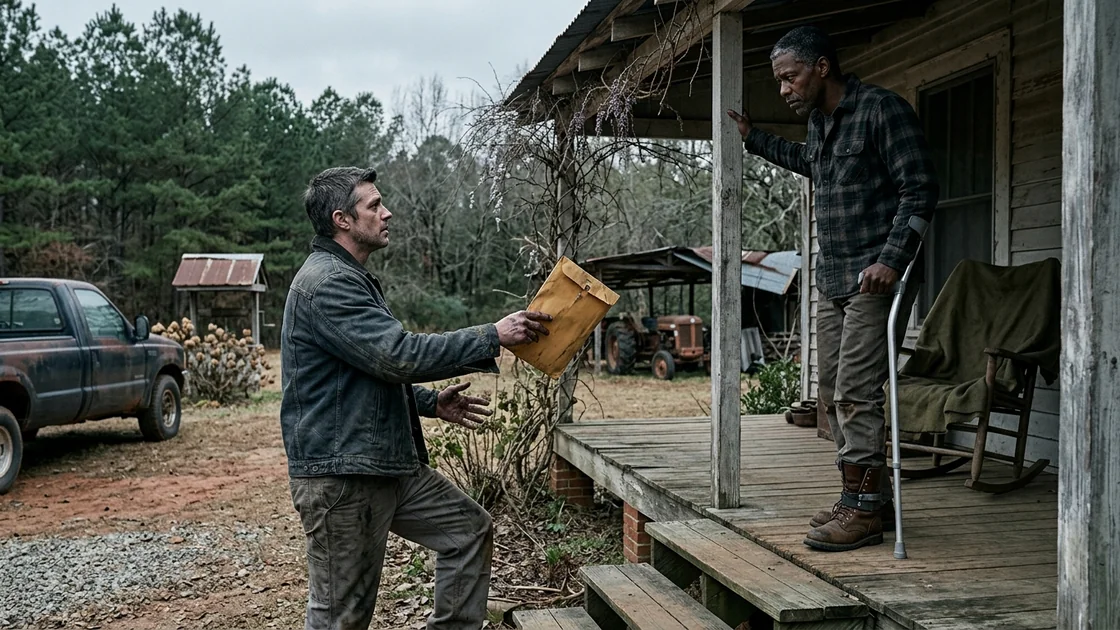
Caleb Vance was the celebrated starting quarterback for the Cumberland State Cougars until he sold the national championship to settle a sixty-thousand-dollar debt with a Nashville bookmaker syndicate. By deliberately hanging a third-down slant into the teeth of an unblocked strong safety, Caleb orchestrated the turnover that sealed the game and simultaneously shredded the right knee of his best friend, Marcus Cole, destroying Marcus's certain first-round professional future. A decade later, living in self-imposed exile as a diesel mechanic along the Ohio River, Caleb receives news that Marcus is struggling to save his family land in their Georgia hometown. Driven by the suffocating weight of his silence, Caleb returns south with a rusted truck and an envelope of cash, forced to confront the wreckage of the man who once loved him like a brother and the unforgivable truth of what happened under the stadium lights.
Part I: The River and the Rust
The shop smelled of sulfur, spent transmission fluid, and the muddy rot of the Ohio River when the barge traffic churned the silt. It was a cold Tuesday in November, the kind of afternoon where the gray sky hung so low it felt like an iron plate resting on the tops of the willow trees.
Caleb Vance worked with his sleeves rolled to his elbows, his forearms smeared with black moly grease that had long since stained the pores around his wrists. His hands were still large, the knuckles thick and scarred from slip-wrenches and exhaust manifolds, but the dexterity that had once been analyzed by three dozen NFL scouts on national television was now spent threading nylon locknuts onto the leaf springs of farm trailers.
He was thirty-three years old, though his lower back and the cold ache in his right shoulder made him walk like a man twenty years older. When he took off his knitted cap, streaks of dull gray showed at his temples, cut close to the scalp with a pair of three-dollar clippers he plugged into the outlet above his bathroom sink. Nobody in Shawneetown called him "The Cannon." Nobody called him anything other than Vance, and he liked it that way. The men at the grain elevator and the barge repair slips didn't care about Southeastern football, and if they remembered the 2013 National Championship game at all, it was only as an abstract blur of confetti, bad officiating, and an interception that had cost thousands of working men their parlay tickets.
The mail had come at noon, tossed onto the scarred plywood desk near the parts washer. Alongside the circulars for tractor bearings and an overdue electric bill lay a square envelope made of heavy, cream-colored paper. It was addressed to Caleb Vance in a small, rigid hand he had not seen in eleven years.
There was no return address, but the postmark was clear: Pine Mountain, Georgia.
Caleb did not open it immediately. He picked up an emery cloth and polished a hydraulic piston until the steel shone like a mirror, reflecting his hollow cheeks and the narrow, guarded eyes of a fugitive who had forgotten what he was running from. When the daylight finally died behind the grain silos across the levee, he washed his hands with pumice soap, took the letter into the small office where an electric baseboard heater hummed, and sat down on a grease-blackened swivel chair.
He slit the paper with a pocketknife.
Inside was a clipping from the Harris County Ledger and a single handwritten note on lined yellow legal paper. The clipping was brief, buried in the regional transactions:
TAX SALE NOTICE: PARCEL 404-B
The property known locally as the Cole Dairy and Timber Tract, comprising 140 acres situated off Highway 18, will be submitted for public auction on December 12 at the Harris County Courthouse to satisfy delinquent county ad valorem taxes, liens, and accrued penalties in the amount of $34,210.60. Current deed holder of record: Marcus D. Cole.
The handwritten note was shorter still. It was written in the round, elegant hand of Marcus’s younger sister, Sharon, whom Caleb had once driven to cheerleading practice when she was eleven years old:
He won’t tell you, because he still thinks a Cole doesn’t ask for spit from a Vance. But the clinic in Columbus took the last of Mama’s insurance money before she died in August. His leg is bad again, Caleb. Real bad. He can’t run the bush-hog, and the timber buyers won't offer half of what it’s worth because they know he’s drowning. If you remember anything about who you were before Atlanta, you won’t let them take the house.
Caleb read the words three times. The baseboard heater clattered as its thermostat clicked off, leaving the small room filled with the heavy silence of the river bottom.
He didn't look at the money clip in his pocket, which held forty dollars and a debit card with four hundred more. He didn't look at the rusted ceiling tiles where rain had leaked through three years ago. Instead, he stood up and walked to the back corner of the office, behind the steel racks of alternator cores, where a green fireproof lockbox sat beneath an old tarpaulin.
He knelt, spun the combination—a sequence he hadn't used in six years—and lifted the lid.
Inside lay three thick manila envelopes wrapped in industrial rubber bands, dusty and smelling of dry rot. They contained two-hundred-and-eighty thousand dollars in old, uncirculated hundred-dollar bills—the remains of the three hundred thousand paid to him by a Greek named Menas in a cinder-block motel room behind the Atlanta airport six hours after the game ended.
Caleb had never spent a single nickel of it. He had worked eighty hours a week on oil rigs, on framing crews, and in transmission shops, living on canned beans and cabbage, letting the blood money sit in the dark like an unexploded bomb. He had kept it because throwing it in the river felt like an evasion, like an easy coward’s absolution, and spending it would have turned him into the very beast he had become for forty-five minutes under the Georgia Dome’s synthetic sky.
He lifted the middle envelope, tucked it inside his heavy denim coat, and locked the steel box. He did not turn off the lights in the shop. He left his tools on the pegboard, dropped the shop keys into the mail slot on his boss’s desk with a scribbled note that said Had to go south, and walked out into the frozen mud of the parking lot to his twelve-year-old diesel pickup.
Part II: The Autumn of Gold and Dust
To understand the ruin, you had to understand the summer of 2012, when the red clay of the Cumberland State practice fields smelled of baking pine needles and the sweat that pooled in the eyelets of their cleats.
They had come in together from the same red-dirt county in western Georgia. Marcus Cole was the son of an ironworker who had died when a crane cable snapped at a bridge site in Mobile; his mother, Betty, had cleaned rooms at the Pine Mountain Holiday Inn and scrubbed kettles at a roadside barbecue joint to keep football pants on Marcus and patent leather shoes on Sharon.
Marcus was six-foot-three with long, effortless strides that didn't look fast until you saw four-star cornerbacks turning their hips in panic before he even cleared the numbers. He was all light and broad smiles, the kind of boy who carried his helmet by the earhole and always stayed after practice to sign miniature foam balls for children who smelled of cornbread and river water.
Caleb was the coach’s project. His father was a timber cruiser who had drank himself into an early grave behind a tavern in LaGrange, leaving Caleb with an arm like an artillery piece and a terrifying, quiet emptiness where his confidence should have been. Caleb didn't smile on the field. He played with an icy, desperate calculation. When he threw the deep post, he didn't throw to where Marcus was; he threw to where Marcus had to be if Marcus wanted to be great, and Marcus always arrived.
"You look too hard at things, Caleb," Marcus would tell him, sitting on the tailgate of Caleb's old Ford behind the athletic dorms, passing a jar of sweet tea between them while the cicadas sawed in the oaks. "You look at a coverage like it’s a riddle somebody made up to catch you doing wrong. Football ain't a trial, brother. It's just running. You see me break on that safety’s shoulder, you let that thing fly. I’ll go get it. God put them hands on the end of my arms for a reason."
"Safety was cheating two steps to the boundary, Mitch," Caleb had replied, staring at his own scarred knuckles. "He knows you like the dig route on third down. He’s baiting me."
Marcus had laughed, throwing his head back, his white teeth catching the yellow porch light of the dorms. "Let him bait. He can have two steps, he can have four. He can't run with me, Caleb. Nobody in this conference can run with me."
And nobody could.
By their junior year, Cumberland State was an unstoppable machine. They went undefeated through twelve games, rolling through the conference with an offensive efficiency that terrified defensive coordinators. Marcus caught eighty-two passes for fourteen hundred yards and seventeen touchdowns. He was a consensus All-American, the projected third overall pick in the upcoming NFL Draft. The sports magazines had his face on the cover: THE NATURAL. He was going to buy Betty the brick house with the wrap-around porch in Pine Mountain. He had already promised Sharon she was going to Vanderbilt for college, cash money, no loans, no scrubbing kettles.
Caleb was projected for the second round. A solid, pro-style pocket passer with ideal measurables, scouts said, though some noted a certain mechanical hesitation under interior pressure, a tendency to look for his escape before the pocket had truly collapsed.
Nobody knew about the back rooms in Murfreesboro.
It had started with cards during the spring semester of Caleb’s sophomore year—small games of seven-card stud in the basements of fraternity houses where rich kids from Atlanta and Charlotte lost five-hundred-dollar allowances without blinking. Caleb, who had grown up watching his mother count pennies on a kitchen table to see if they could buy kerosene for the space heater, was fascinated by how easily money could be pulled out of thin air.
When the cards turned bad, a junior tackle named Morrison introduced him to a man named Artie in an off-campus sports bar that smelled of stale beer and fried grease. Artie was fat, wore polyester shirts that pulled across his gut, and possessed an encyclopedic knowledge of small-college basketball spreads in Ohio and Indiana.
"You got a great head for this, Vance," Artie had purred, sliding a basket of wings toward him. "You understand percentages. You understand pressure. A smart guy like you shouldn't be eating dining-hall slop while the university sells your number seven jersey for eighty bucks a pop at the bookstore."
The debt didn't happen all at once. It was a gradual erosion, like the banks of a creek after three days of Georgia drizzle. A five-hundred-dollar loss on an NBA playoff game; a two-thousand-dollar chase on a late-night West Coast baseball game; a five-thousand-dollar weekend on four-team parlays that failed on a missed field goal in Eugene, Oregon.
By October of their championship season, Caleb was down eighteen thousand dollars. He couldn't sleep. He would sit in the film room at five in the morning, the projector whirring in the empty dark, watching the tape of Alabama’s boundary corner, but seeing only the numbers in his spiral notebook: Balance due: $22,400.
Then Artie disappeared, and two men from a warehouse district in south Nashville showed up at the apartment Caleb shared with an offensive guard two miles off-campus.
They were not sports fans. One of them, a man with teeth ruined by chew and a scar that ran from his ear to his collarbone, sat on Caleb's worn sofa and placed a heavy, matte-black automatic pistol on the coffee table between two copies of Sports Illustrated.
"Artie sold your paper to Menas," the scarred man said softly. "Menas don't like football players. Football players think they're special. He says you owe sixty-two large, counting the vig from the first of the month."
"I don't have sixty-two thousand," Caleb had whispered. He remembered his voice sounding thin, like a child caught stealing bread. "I get a twelve-hundred-dollar stipend. That’s it. After the draft—"
"Menas don't do futures," the man said. He picked up the pistol, racked the slide with a clean, oily clack, and pointed it at Caleb's left kneecap from three feet away. "You could tear that up tomorrow against Auburn. Then what we got? We got an empty jersey and a promissory note from a redneck with no daddy. You got until the week after the conference title to find fifty large, or Menas is gonna send somebody down to Pine Mountain to talk to your mama about the equity in that single-wide she’s living in."
"Leave her out of it," Caleb had choked out.
"Then find the paper, kid. Or better yet, be ready when the telephone rings."
Part III: The Week in the Shadows
The telephone didn't ring until the Tuesday before the National Championship game against the University of Southern California.
The game was to be played at the Georgia Dome in Atlanta, seventy miles from where Caleb and Marcus had grown up catching sunfish in the backwaters of the Chattahoochee. The state was in a fever. Billboards along I-85 showed Marcus mid-leap and Caleb cocking his arm, framed by the words: DESTINY CALLS.
The team was sequestered at a luxury hotel downtown. Caleb’s room was on the seventeenth floor, overlooking the concrete canyons of the city. Down in the lobby, booster club boosters in crimson jackets bought scotch for boosters in navy blazers, while television cameras were set up in the atrium beneath three-story banners.
At eleven o'clock that Tuesday night, Caleb's hotel phone chirped.
He picked it up without speaking.
"Caleb," a voice said. It wasn't the scarred man from Nashville. It was an older voice, thick and dry, like dry corn husks rubbing together in the wind. "Room 412 at the Days Inn on Virginia Avenue. Near the airport. Come alone, or don't come at all, and we'll handle the business in Pine Mountain by morning."
Caleb had slipped down the service elevator, past the laundry hampers and the kitchen dishwashers who were scraping prime rib remnants into rubber barrels. He had taken a cab, paying the driver with his last twenty-dollar bill, sitting low in the back seat with his hood pulled over his eyes.
The motel was a single-story strip of stained stucco flanked by long-term parking lots and the deafening roar of jet engines descending onto Runway 27R.
Inside Room 412, two men sat at a round laminate table beneath a portrait of a sailboat that had faded to pink. One of them was the scarred man. The other was an elderly man wearing an expensive, tailored gray suit that smelled of lavender water and expensive tobacco. His fingernails were manicured to a shine.
"Sit down, son," the old man—Menas—said. He had a small glass of cloudy ouzo in front of him and a silver plate containing three green olives.
Caleb sat on the edge of the unmade bed. The sheets were gray and smelled of bleach.
"You're a very good quarterback," Menas said, without looking up from his olives. "My people tell me the line is Cumberland State minus six and a half. The whole country is betting on your colored boy to run through the Trojans’ secondary like a bull through an old screen door."
Caleb said nothing. His mouth felt like it was filled with dry sand.
"A seven-point swing in a game like this is thirty million dollars on the offshore books," Menas continued, his voice calm, conversational, as if he were discussing the yield on municipal bonds. "Thirty million. That’s what we’re moving through Antigua and San Jose this week. Your little sixty-two thousand is... what do you call it? A drop in the bucket. An irrelevance."
Menas looked up. His eyes were milky at the edges, the color of dirty ice, but they were as cold and steady as a surveyor's level.
"You don't have to throw four interceptions," Menas said. "That looks bad. That gets the NCAA lawyers sniffing around. That gets the FBI pulling phone records. All you have to do, Caleb, is make sure you don't cover the six and a half. In fact, if Cumberland loses outright—by three, by one, doesn't matter—your debt is wiped. Clean. Eraser on the chalkboard."
He reached beneath the table and brought up a heavy cardboard shoebox, wrapped in packing tape.
"And inside here is three hundred thousand dollars. Cash. Non-sequential fifties and hundreds. You take it after the game. You put it in a hole. In five years, when you're an old backup in the pros, you buy your mama a house. You pay for your sister’s teeth. You become an upstanding citizen."
"No," Caleb whispered. He hadn't meant to say it out loud, but it tore out of his chest like a cough. "I can't do that to Mitch. I can't do that to the team. We worked four years for this. We bled for this."
Menas set his fork down on the small silver plate. The metal clicked against the ceramic.
"The team," Menas said, his voice dropping an octave, becoming flat and heavy. "The university is making twenty million off your sweat this week, Caleb. That fat athletic director who smiles at you in the cafeteria? He has a bonus clause in his contract for two hundred thousand dollars if you win. Are you getting that bonus? Marcus Cole is going to sign for twenty million guaranteed in four months. He doesn't need your protection. He’s going to be a king."
The scarred man stepped forward from the shadows near the bathroom door. He reached into his coat and produced an eight-by-ten photograph, dropping it onto Caleb’s knees.
It was a picture of Caleb’s mother, Martha, hanging sheets on the wash-line behind her trailer in Pine Mountain. She was wearing her old floral duster, her back bent, her graying hair blowing in the wind. Standing fifty feet away, framed by the corner of the neighbor’s rusted barn, was a young man in a dark Carhartt jacket holding an iron crowbar.
"That was yesterday morning," Menas said. "Martha’s got bad hips, Caleb. It would be a terrible shame if she fell down them wood steps on the porch and broke both of them. At her age, the fat from the marrow gets in the bloodstream. They call it an embolism. You die in the dirt while the washing machine is still filling up."
Caleb looked at the photograph until his eyes burned. The edges of the paper trembled in his fingers.
"How?" Caleb choked out. "How do you want it?"
Menas smiled for the first time. His teeth were long, yellow, and capped with gold at the margins.
"Southern Cal has got that boy at safety—the one from Long Beach. Number thirty-one. The hitter. He’s looking for the inside cross all night. You give him something he can reach, Caleb. Late in the fourth. When it counts."
Part IV: The Hospital Pass
The Georgia Dome was a cavern of thunder that smelled of hot oil, damp concrete, and eighty thousand bodies packed into plastic seats. The turf was hard, green carpet laid directly over the exhibition concrete, offering none of the forgiveness of natural grass.
With four minutes left in the fourth quarter, Cumberland State trailed 24-21.
The game had been a dogfight, exactly as Menas had intended. Caleb had played just well enough to keep it close—throwing two first-half touchdowns on simple play-action routes that Marcus had turned into masterpieces of running after the catch—but he had missed three open receivers in the third quarter, throwing behind them on out-routes, letting the Trojans' pass rush chew up the clock.
Yet Marcus wouldn't let them die.
Marcus was playing with a savage, joyous fury. He had already caught eleven passes for a hundred and seventy yards. His jersey was torn at the left shoulder; his white pants were stained with turf burn and black rubber pellet residue. Every time he came back to the huddle, he slapped Caleb's shoulder pads with both hands, his eyes wild and bright with adrenaline.
"They're tired, Caleb!" Marcus barked, his breath clouding in the cool stadium air. "That defense is gassed! Look at thirty-one! He can't turn his hips no more! Give me the glance route! Give it to me inside, Caleb, and I'll take it to the house and we're going home champions!"
Caleb looked into Marcus’s eyes. Marcus loved him. Marcus trusted him more than he trusted his own brothers. If Caleb told him to run into a brick wall, Marcus would have hit it at full speed, believing Caleb had spotted a crack on the other side.
The Cumberland sideline was screaming. The band was playing the fight song, a wall of brass that rattled Caleb’s teeth behind his chin strap.
Third down and eight at the USC thirty-four.
The play called from the press box was Green-Right, Slot-Z, Dig-Under. It was designed to pull the free safety toward the boundary with the tight end, leaving Marcus alone on an eight-yard square-in against a sophomore corner who had been limping since the third drive.
Caleb walked to the line of scrimmage. The Trojan defense was showing Cover-2, but thirty-one—the heavy, vicious safety from Long Beach who weighed two hundred and twenty pounds and ran like a sprinter—was creeping down into the box, his eyes locked on Marcus like a wolf watching a deer.
Caleb knew the coverage. He knew it better than he knew his own name. If he pumped once to the flat, thirty-one would freeze for a quarter of a second, just long enough for Marcus to cross his face and catch the ball in the vacant pocket behind the linebackers for a fifteen-yard gain.
He looked over at Marcus. Marcus nodded, his fingers twitching in his gloves, ready to burst off the line.
Fifty large. Martha on the porch. The crowbar.
"Blue-forty-two!" Caleb yelled, his voice cracking against the roar of eighty thousand people. "Blue-forty-two! Set... hut!"
The ball hit his palms. Caleb took a three-step drop.
The pocket was clean. Cumberland's left tackle had washed the defensive end around the horn; the center was anchoring against the nose tackle. Caleb had two full seconds of clear vision.
Marcus beat the corner with a vicious jab-step outside, dipping his inside shoulder, snapping his route off at precisely eight yards. He was wide open. He was two yards clear of any defender, his hands already coming up to form the diamond, his chest broad and unguarded as he came across the hashmarks.
All Caleb had to do was drive the ball into his stomach. A low, hard dart that would allow Marcus to catch it, tuck it, and drop his shoulder into thirty-one.
Instead, Caleb did the one thing a quarterback is taught from the seventh grade never to do on an inside breaking route over the middle.
He dropped his elbow. He floated the ball.
He threw what the coaches called a hospital pass—a soft, high, dying duck that hung three feet above Marcus's head, drifting slightly behind his back shoulder, forcing the receiver to reach up, turn his torso toward the pursuit, and expose his entire ribcage and plant leg to the incoming traffic.
The ball hung in the air for an eternity. The stadium lights seemed to catch the white laces, turning them over and over against the dark dome roof.
Marcus saw it. He had no choice. It was the championship game, and the ball was in the air, and Marcus Cole did not let balls hit the ground.
He leapt. He extended his arms, his ribs stretching open beneath his jersey, his eyes fixed on the leather.
From Marcus’s blind side, thirty-one arrived.
The safety didn't play the ball. He had eighty feet of running start, his head lowered, his shoulder pad aimed directly at Marcus’s exposed right side.
The sound of the impact was not the dull thud of plastic pads. It was a loud, wet crack, like an ash bat splintering against a ninety-five-mile-an-hour fastball, followed by an immediate, collective gasp from seventy thousand people that sucked the air out of the dome.
Marcus caught the ball, but as thirty-one’s helmet drove through his exposed chest, Marcus’s right cleat came down hard, catching in the unforgiving turf seam. The torque of the tackle spun his upper body three hundred and sixty degrees while his right foot remained anchored to the concrete underneath.
The knee didn't bend. It exploded.
The patellar tendon tore free from the tibia, the anterior and posterior cruciate ligaments snapped like dry hemp ropes, and the femur sheared through the meniscus with a grinding screech that Caleb could hear from fifteen yards away.
The ball popped loose. It bounced once off Marcus’s limp shoulder and straight into the waiting hands of the USC nickelback, who gathered it into his chest and slid to the turf at the twenty-eight-yard line.
The whistle blew.
The game was over. USC would kneel three times and run out the clock. Cumberland State had lost by three.
Menas had won.
Caleb stood in the backfield. He didn't look at the USC players leaping into the air, helmets off, yellow flags waving. He didn't look at his own coaches who were dropping their clipboards in disbelief.
He looked down at Marcus.
Marcus was lying on his side on the twenty-yard line. His right leg was bent backward at a right angle between the knee and the hip, the bone tenting the crimson spandex of his pants like a broken tent pole.
Marcus wasn't yelling about the game. He wasn't yelling about the turnover. He was making a sound that Caleb had never heard a grown man make—a high, bubbling shriek that sounded like an animal caught in a combine blade.
"Caleb!" Marcus screamed, his fingers clawing at the synthetic turf, ripping up handfuls of the green plastic. "Caleb! My leg! Oh God, Caleb, my leg! Help me! Somebody help me!"
Caleb took two steps toward him. His legs felt like two pillars of poured cement.
The training staff was already sprinting past him, their medical kits bouncing against their thighs. Dr. Henderson, the orthopedic surgeon, dropped to his knees beside Marcus, his face going chalk-white the moment his hands touched the joint.
"Don't move him!" Henderson screamed toward the sideline. "Air cast! Get the goddamn air cast out here now! Call Grady! Tell them we got a complete arterial risk!"
Marcus looked up through the crowd of trainers. His eyes were wild, dilated with shock and agony, swimming with tears that cut tracks through the red clay dust on his cheeks.
He reached out a single, trembling hand toward Caleb.
"Caleb..." he gasped, his voice breaking into a dry rattle. "Where was... why was it high, man? Why did you hang me? I was right there... I was right there..."
Caleb stood three feet away. The confetti cannons were already testing at the far end of the field, releasing small puffs of gold paper into the rafters.
"I slipped, Mitch," Caleb said. His voice was completely dead, devoid of tone, the voice of a man speaking from the bottom of an open grave. "My cleat gave way. I'm sorry. God, Mitch, I'm sorry."
Marcus stared at him for three seconds. Through the gray fog of pain, something shifted in Marcus’s eyes—a flicker of terrible, impossible understanding that died almost as quickly as it appeared, replaced by the black curtain of traumatic shock. Marcus’s head dropped back against the turf, his eyes rolling into his skull as the paramedics cut his jersey off with trauma shears.
Part V: The Desert Years
Caleb did not attend the team banquet three days later. He did not go to Marcus’s hospital room at Grady Memorial, where four surgeons spent nine hours reconstructing the wreckage of the joint with titanium pins and cadaver tendons.
He met the scarred man behind an abandoned commercial bakery on Ponce de Leon Avenue at three o'clock in the morning. He took the shoebox containing three hundred thousand dollars, put it in the trunk of his car, and drove north.
He never declared for the draft. He didn't hire an agent. When the Cumberland athletic department called his apartment, the phone had been disconnected. When his mother called him from Pine Mountain, crying, asking why he was on the news for "abandoning his professional opportunities," he told her he had lost the hunger for the game. He told her his shoulder was ruined. He lied to her just as easily as he had lied to Marcus on the turf.
The sports world talked about him for three weeks. The Enigma of Caleb Vance. An ESPN special called him "The Quarterback Who Walked Away." Some wondered if he had suffered an undisclosed head injury; others claimed he had cracked under the pressure of the championship interception. Eventually, the cycle moved on. A new class of freshmen arrived in Tuscaloosa and Columbus, and Caleb Vance became a trivia question at bar trivia nights across the South: Who was the Cumberland State quarterback who threw the game-ending pick in the 2013 title game?
Marcus Cole stayed in the hospital for six weeks.
The first surgery got infected. They had to open the joint twice more to wash out a staph colonization that threatened to take the leg above the mid-thigh. By the time the draft arrived in April, Marcus could not bear weight on the right side without two crutches and a custom carbon-fiber brace that ran from his groin to his ankle.
No team drafted him. One franchise took a flier on him in the seventh round as a courtesy, then released him with an injury settlement four months later when team doctors discovered the nerve damage was permanent. His peroneal nerve had been crushed; he had foot drop. He would never sprint again. He would never break off an eight-yard dig route against a Cover-2 again.
His mother, Betty, mortgaged the 140 acres of dairy pasture to pay for his rehabilitation in Birmingham. When that failed, she took out a second lien to cover her own radiation treatments when the mass in her esophagus was discovered two years later.
Marcus came back to Pine Mountain. He didn't yell. He didn't go to the newspapers. He bought an old John Deere tractor with hand controls and tried to run the hayfields, dragging his right foot behind him in a heavy leather work boot that had to be laced to the calf with rawhide string to keep his toes from catching on the roots.
And four hundred miles to the north, Caleb Vance worked in the transmission shops.
He moved from Evansville to Paducah, and finally to Shawneetown, living in single-room apartments above hardware stores and bait shops. He never bought a television. He never bought a smartphone. He listened to the radio—old country stations that played George Jones and Hank Snow, songs about men who had killed their brothers or drowned their lives in ditch water.
Every dollar he earned with his hands went into a savings account that he used only for rent, kerosene, and salt pork. The green lockbox sat beneath the tarpaulin, an anchor that kept him from floating away into the clean mercy of ordinary madness.
Part VI: The Road to Blackwood
The old diesel truck rattled violently as it crossed the bridge over the Tennessee River into north Alabama. It was three in the morning, and the heater core only blew lukewarm air that smelled of sweet antifreeze, but Caleb kept his window cracked three inches, letting the damp mountain air bite his face.
The middle envelope lay on the seat beside him. It was eighty thousand dollars—enough to clear the tax lien, pay the court fees, and leave Marcus forty-five thousand to buy seed, fertilizer, and an adapter for the tractor's power take-off.
Caleb didn't know what he would say. He had spent eight hundred miles trying to construct a sentence that didn't sound like a plea for his own skin, and every one of them dissolved the moment he thought of Marcus’s eyes looking up from that turf seam.
I had to do it, Mitch. They were going to kill my mama.
It was the truth, but it was the truth of a cur. A man who saves his own mother by slaughtering his brother is still a slaughterer. Marcus would have traded his mother’s trailer for Caleb’s life in a second, but Marcus would have found another way. Marcus would have fought them in the yard with an axe handle; Marcus would have gone to the police; Marcus would have walked onto that field and told the world what was happening from the fifty-yard line.
Caleb hadn't fought. Caleb had calculated. He had calculated that his mother was his, and Marcus was Marcus, and that sixty thousand dollars could be buried in a three-second flight of an oval leather ball.
He hit the Georgia state line at dawn.
The red clay banks rose on either side of the highway, cut through with gray limestone ledges and choked with dead kudzu that looked like shredded burlap in the winter light. The pines were tall, thin, and straight, standing in ranks like silent soldiers who had been waiting twelve years for him to come home.
He turned off Highway 18 onto the two-lane asphalt that led toward the Cole place.
The county had changed. The small brick ranches with the satellite dishes had replaced the old tenant shacks, but the Cole land was still the same: a wide, flat tongue of sandy loam nestled between two granite ridges, where the timber grew thick and swampy down toward the creek.
At the entrance to the driveway, the mailbox was made from an old milk can painted white. The name BETTY COLE was still visible beneath a coat of rusted red primer that Marcus had applied with a brush and never finished.
Caleb turned the truck in. The suspension groaned over the washboard gravel.
The house was a hundred-year-old shotgun farm cottage that had been expanded twice with board-and-batten additions. The porch was sagging at the west corner, propped up with four stacked chimney blocks. In the side yard, an ancient Ford 4000 tractor sat under a rusted tin lean-to, its rear tires cracked and dry-rotted down to the rims.
On the front porch, sitting in a low-backed rocking chair with an old army blanket tucked over his lap, was Marcus.
Caleb stopped the truck fifty feet away, near the dead hydrangeas by the well-house. He turned off the ignition. The old diesel gave a heavy, shuddering sigh and died, leaving only the ticking of the cooling manifold and the cawing of three crows circling a dead pine down by the creek.
Caleb sat behind the wheel for sixty seconds. His hands were shaking on the plastic rim.
He picked up the manila envelope, stepped down into the gravel, and closed the door with a dull thud.
Marcus didn't move. He sat with his hands resting on top of the blanket, watching Caleb walk toward him across the yard.
Time had taken the gold off him. Marcus’s face was leaner, the skin pulled tight over cheekbones that looked like flint knives. His hair was cropped short, heavily silvered at the temples, and his shoulders, though still wide, had the hunched, defensive slope of a man who spent his days bracing against physical pain.
Beside his chair, leaning against the gray wood railing of the porch, was an aluminum cane with a worn rubber foot.
Caleb stopped at the bottom of the three wooden steps. He didn't look up into Marcus’s eyes; he looked at the hem of the army blanket where Marcus’s right boot showed—a heavy, square-toed boot with a steel reinforcement bar riveted to the outer leather.
"Mitch," Caleb said.
The wind moved through the dead wisteria vines on the porch eaves, making them rattle against the tin roof like dry bones.
Marcus let out a long breath through his nose. It wasn't an angry sound; it was tired, so infinitely tired that it seemed to take the last bit of color out of the morning sky.
"Sharon told you," Marcus said. His voice was lower than it used to be, rough around the edges, like he had spent years not talking to anybody but the cows.
"She sent the notice," Caleb said.
Marcus looked at the manila envelope in Caleb’s hand. He didn't ask what was in it. He didn't ask where Caleb had been for eleven years. He just looked at the envelope with a faint, wry curl at the corner of his thin mouth.
"You look old, Caleb," Marcus said softly. "You got grease behind your ears."
"It doesn't wash out," Caleb said.
"No," Marcus said. "I reckon it don't."
Part VII: The Porch
Marcus reached down, pulled the army blanket back with one hand, and dropped his feet to the porch boards. His right leg didn't move with his hip; he had to hook his left boot under the right heel and lift it into place like a piece of dead timber.
"Come up on the porch, Caleb," Marcus said. "It's cold down there in the dirt."
Caleb climbed the three steps. Each one felt like walking up the wooden stairs to a scaffold. He didn't take a chair; there wasn't another one anyway. He stood against the center post, holding the envelope against his thigh with both hands.
"Mama died in August," Marcus said, looking out over the brown hayfield toward the tree line. "We had her over at the Baptist church in Hamilton. Whole town came. Coach Henderson sent a flower basket from Cumberland. Crimson ribbons on it. Said she was the greatest Cougar mama he ever knew."
Marcus paused, his fingers tapping a slow, irregular rhythm on the aluminum shaft of his cane.
"You didn't send no flowers, Caleb."
"I didn't know," Caleb whispered. "I didn't have no phone."
"You knew she was sick," Marcus said. His voice remained level, devoid of the theatrical fury Caleb had prepared himself to face. "Everybody in this county knew she had the throat trouble. Sharon tried to find you through that registrar in Nashville. Said you were working on a barge line out of Cairo. Said you didn't leave no forwarding."
"I was running," Caleb said.
"From what?" Marcus asked. He finally turned his head, his dark, deep-set eyes fixing on Caleb’s face. "From that interception? From the reporters? You think people care about a ball game, Caleb? Eleven years? Hell, they got boys playing down there now who weren't even born when we were in school. Nobody remembers that game."
"You remember it," Caleb said.
Marcus stared at him for five seconds. A red-tailed hawk dropped from the sky above the hayfield, caught an updraft, and hung motionless against the gray clouds.
"I remember the sound it made," Marcus said. "Sometimes I wake up at four in the morning, right before the frost hits, and I can hear that bone snapping inside my head. Sounds like a two-by-four cracking across a tractor axle. That’s all I remember. The doctor said the nerve died before they even got me to the ambulance. Said it was like somebody took a pair of pliers and pinched it until it just gave up."
Marcus reached into his shirt pocket and took out a small metal tin of mints. He put one on his tongue and offered the tin to Caleb. Caleb shook his head.
"Why'd you do it, Caleb?" Marcus asked.
The question wasn't shouted. It was asked with the quiet, clinical curiosity of a farmer asking why an old well had suddenly gone sour after forty years of sweet water.
Caleb felt his stomach contract until he thought he might be sick on the gray porch boards.
"You know?" Caleb choked out.
Marcus gave a dry, soft laugh that died in his throat.
"I’m crippled, Caleb. I ain't stupid."
He pointed with the rubber tip of his cane toward the far corner of the hayfield, where an old cedar fence line marked the boundary of the Vance land that had been sold off for timber thirty years ago.
"Two weeks after they brought me home from Birmingham," Marcus said, "a man came out here in a Lincoln with Tennessee plates. Fat man. Smelled like peppermint candy and barber tonic. He sat right where you’re standing, Caleb. He had two thousand dollars in a white paper sack. Said it was from a 'mutual friend' who wanted to make sure Betty had groceries while I was down."
Marcus looked down at his own ruined knee.
"I asked him who the friend was. He wouldn't say. But he dropped a name when he was talking to Mama about the title to the lower forty. He mentioned a fella named Menas. Said Menas was a man who always paid his debts, and that he always looked out for boys who knew how to listen."
Marcus looked back up at Caleb. His eyes were not cold now; they were blazing with a terrible, ancient sorrow that had been cured in eleven years of silence.
"I watched the film, Caleb. I got the coach to send me the coaches’ copy on a DVD three months after the surgery. I sat in that bedroom in there with Mama’s old television, and I watched that third-down play forty-two times in one afternoon."
He leaned forward, his elbows resting on his thighs, his face three feet from Caleb’s.
"You had forty yards of grass, Caleb. You had forty yards, and thirty-one was biting on the boundary corner until you looked him right in the face. You looked him in the face, and you pumped once toward the sideline to bring him downhill, and then you put that ball right where he could hit me without even having to break his stride."
Marcus’s voice dropped until it was barely louder than the wind in the wisteria.
"You knew he was coming. You knew he had three steps on the angle. You threw that ball high so I’d have to go up and turn my back to him. You gave me to him, Caleb. Like a hog to the butcher."
Caleb fell to his knees.
He didn't mean to do it. His legs simply refused to hold the weight of the air in the yard. His knees hit the hard oak boards of the porch with a sharp crack that echoed off the well-house. He dropped the manila envelope; it landed between his hands, the brown paper splitting slightly at the corner to reveal the green edge of the old hundred-dollar bills.
"They had Martha," Caleb wept, his forehead touching the rough wood between his palms. He didn't care that he was crying; he was sobbing like a child who had been beaten until his ribs were sore. "They had a man at the trailer, Mitch. They had a picture of her on the wash-line with an iron bar. Menas told me he’d have her legs broke. He told me she’d die in the dirt. I owed them sixty thousand dollars from the cards... I was drowning, Mitch. I was so damn stupid, and I was drowning, and they had her by the throat."
The porch was silent except for the sound of Caleb’s breath tearing through his chest.
Marcus didn't move. He didn't touch Caleb’s shoulder. He didn't tell him to get up. He sat in his low rocking chair, looking down at the back of the quarterback’s head, his face completely still.
"You owed sixty thousand," Marcus said. It wasn't a question.
"Yes," Caleb gasped into the wood.
"And what’s in the paper?" Marcus pointed the cane at the envelope between Caleb’s hands.
"Eighty thousand," Caleb choked out. "It’s from the three hundred they gave me. I never spent it, Mitch. I swear to God Almighty, I never spent a nickel of it. It sat in an iron box behind the alternators in Illinois for ten years. It’s clean of interest... it’s all there is left. It’ll pay the courthouse. It’ll keep the timber from the speculators. You can fix the tractor... you can get the leg looked at by that doctor in Atlanta..."
Marcus looked at the split corner of the envelope, where the face of Benjamin Franklin stared up from the gray timber.
"Eighty thousand," Marcus repeated.
He reached down with his left hand—the good, strong hand that had caught eighty-two passes in the autumn of 2012—and picked up the envelope.
He weighed it. It was heavy, like a brick of wet salt.
"You think this pays for the leg, Caleb?" Marcus asked.
"No," Caleb sobbed. "No, Mitch. Nothing pays for that. Nothing in this world."
"You think this pays for Mama sitting in that front room with a space heater because we couldn't buy propane?" Marcus’s voice began to tremble now, the first crack in the iron wall he had lived behind for a decade. "You think this pays for Sharon working the night desk at the Super 8 in Opelika instead of going to Nashville to study the law like she wanted? You think this pays for me watching thirty-one play nine years in the league for the Eagles, making four million a year, while I had to get the neighbor boy to carry my five-gallon buckets of diesel because I can't climb up on the fender?"
"No," Caleb whispered. "No."
Marcus stood up.
He didn't use the cane. He shoved himself off the chair with his left arm, his face contorting in a spasm of white-hot agony as his right foot came down crooked on the boards. He caught himself on the porch post, his breathing heavy, his chest heaving against his flannel shirt.
He looked down at Caleb, who remained on his knees, his face pressed against the dust.
"You took my life, Caleb," Marcus said. "You didn't just take the ball game. A ball game don't mean a damn thing. It’s twenty-two boys in plastic suits running around on plastic grass. But you took my hands. You took the work God gave me to do for my people."
Marcus took three shuffling, dragging steps toward the edge of the porch. He held the envelope out over the railing, directly above the fifty-five-gallon burn barrel where Betty used to burn the milk cartons and the junk mail.
The barrel was half-full of wet ash and rusted tin cans from the summer.
Caleb lifted his head. "Mitch... don't. The courthouse is gonna sell the dirt on Tuesday. Sharon... the house..."
Marcus froze. His hand was trembling over the dark interior of the barrel.
He looked across the yard toward the cedar grove where his father and mother were buried in the small family plot beneath the scrub oaks. He looked at the peeling white paint on the trim of the cottage, the roof that was shedding shingles like dry scales, the pasture that was already growing up in sweetgum saplings and blackberry briars because he couldn't keep the bush-hog running.
A man cannot eat his pride. A man cannot take his honor to the tax collector’s window on the second floor of the Harris County Courthouse and ask for a receipt.
Marcus’s hand began to lower slowly, an inch at a time, until the envelope was resting against his hip again.
His jaw was set so hard that the muscles looked like walnuts beneath his dark skin.
"Get up, Caleb," Marcus whispered.
Caleb pushed himself up from the floorboards. His eyes were red, swollen, his hands covered in the gray dust of the porch.
Marcus held the envelope out toward him. Not in anger, but with an open palm, the way an officer hands an execution order to an enlisted man.
"You go to Hamilton," Marcus said, his voice flat, hollowed out of every drop of human feeling until it was just dry wind over stone. "You go to the clerk’s office. You give them thirty-four thousand two hundred and ten dollars and sixty cents. You tell them it’s for parcel 404-B. You make sure the receipt is made out to Sharon Cole. Not me. Sharon."
"And the rest?" Caleb asked, his voice shaking.
"You take the rest of it," Marcus said, "and you take your rusted truck, and you go back to that river where you hide."
Marcus leaned on his cane again, his face turned toward the hayfield, away from Caleb Vance, away from the man who had been his quarterback, away from the autumn of gold and dust that had died eleven years ago in the Georgia Dome.
"If I ever see your truck on Highway 18 again, Caleb," Marcus said, so quietly the crows down by the creek almost drowned him out, "I won't call the sheriff. I’ll take my daddy’s Winchester down from the rack behind the kitchen door, and I’ll put a thirty-thirty slug through your radiator, and then I’ll put one through your heart, and I will sleep like a baby on this porch that night."
Caleb stood on the porch for ten seconds. He waited for Marcus to look at him one last time, for some small sign that somewhere beneath the titanium pins, the dead nerve, and the ruined pasture, his brother was still there.
Marcus did not look.
Marcus’s eyes were fixed on the horizon, where the gray clouds were beginning to break, letting through a single, cold shaft of winter sunlight that struck the far edge of the woods and turned the red clay to the color of dried blood.
Caleb reached out, took the envelope from Marcus’s hand, and walked down the steps.
He didn't look back as he crossed the yard. He climbed into the cab of his diesel truck, started the engine, and pulled out onto the gravel driveway.
In the rearview mirror, as he hit the two-lane asphalt of Highway 18, he could see the small white house sitting against the dark wall of pines.
On the front porch, the low-backed rocking chair was still moving slightly in the wind, but Marcus was no longer sitting in it. He was standing alone by the railing, leaning heavily on his aluminum stick, watching the black smoke from Caleb's exhaust pipe drift up into the empty Georgia sky and disappear.