The Cost of Leaving
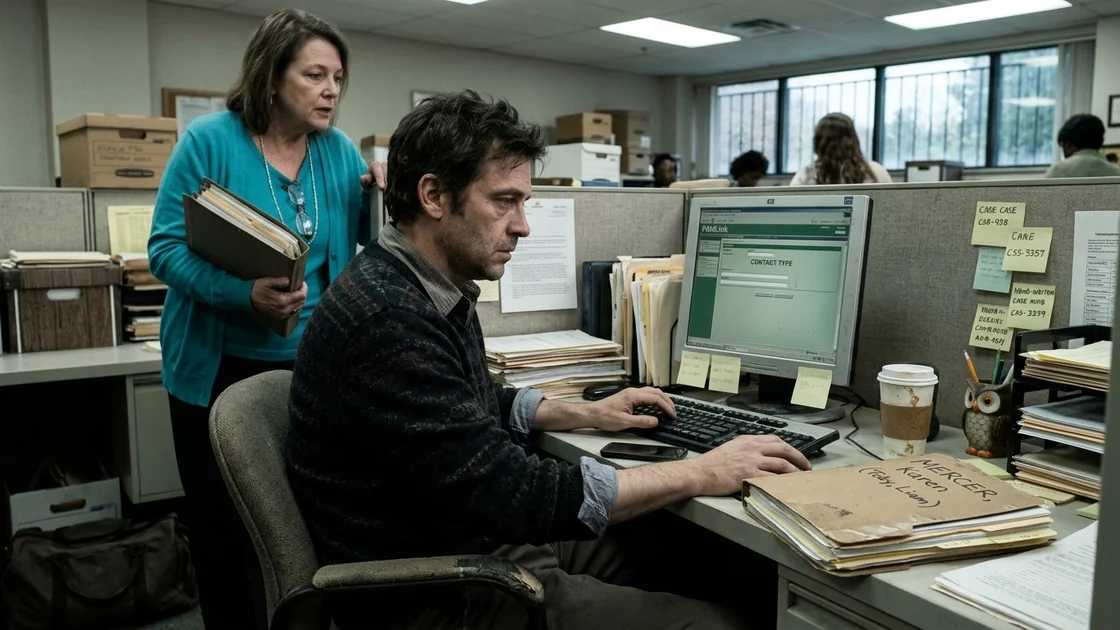
This story chronicles the downfall of Robbie Miller, a seasoned child protective services caseworker whose exhaustion leads him to forge a routine Friday afternoon home visit report for two young brothers so he can start a weekend vacation on the coast. In his absence, an abusive partner returns to the home and an unattended electrical fire claims the lives of the children who were locked in a bedroom to hide them from the inspection that never happened. The narrative traces the bureaucratic unraveling of Robbie’s career, the forensic exposure of his forged records through fleet vehicle telemetry, and the permanent destruction of his conscience as he is forced to confront the fatal consequence of his small, selfish shortcut.
The fluorescent tubes in the ceiling of the Clark County Department of Family and Children Services hummed at a frequency Robbie Miller had learned to hear only when he was about to break. It was a flat, sixty-cycle drone that sat beneath the chattering of dot-matrix impact printers, the endless ringing of multiline phones, and the dry, paper-shuffling rustle of sixty-two overworked caseworkers competing for five functioning desktop terminals.
Robbie sat at his cubicle, desk five in Row C, staring at an Manila folder labeled MERCER, Karen (Toby, Liam). The cardstock was dog-eared, swollen with three years of court orders, drug-screen manifests, handwritten intake notes, and psychological evaluations that read like autopsies performed on living souls. It was three o’clock on the third Friday of October. Outside the tinted, security-grated windows of the municipal annex, the sky over the valley was a bruised violet, heavy with an early autumn rain that smelled of wet asphalt and rotting leaves.
Under his desk rested a weekend duffel bag packed with two heavy wool sweaters, walking shoes, a bottle of Willamette Valley pinot noir, and a guidebook to the central Oregon coast. His partner, David, had texted him twice already:
Car is gassed up. Ferry at four-thirty is out, but if we hit the bypass by four, we catch the five-fifteen at Edmonds. Tide’s coming in tonight.
Robbie looked from the screen of his phone back to the Mercer folder.
Clark County had thirty-four thousand square miles of timberland, river bottom, and suburban sprawl, and the state had budgeted Robbie forty-eight active cases. Forty-eight families. On any given day, eleven of those families were in active crisis, six were looking for an excuse to knife each other, twenty were trudging along the dull, muddy path of court-mandated sobriety, and the rest were paper ghosts—people Robbie visited because the Administrative Code dictated that a physical body with a state badge had to lay physical eyes on a child every fourteen days, without exception, under penalty of administrative reprimand.
Toby Mercer was six. Liam was four. Their mother, Karen, was twenty-six, with thin, translucent wrists, teeth ruined by two years of bad methamphetamine, and an uncanny ability to weep on command in front of juvenile court referees. Donnie Vance, Karen’s off-and-on boyfriend, was not supposed to be in the home. A protective order signed by Judge Harlan in August forbade Donnie from coming within five hundred feet of Karen or the boys. Donnie had twice cracked Karen’s orbital bone while the boys sat on the linoleum in the adjacent room eating cold canned ravioli; once, Toby had been found wandering the berm of Highway 12 in his stocking feet at three in the morning because the noise in the trailer had gotten "too loud to sleep."
Robbie had been the one who pulled Toby out of the back of the state trooper’s cruiser that night. He had bought Toby a cheeseburger at the twenty-four-hour drive-through, wiped grease from the child’s chin with a paper napkin, and promised him, with the easy, hollow certainty of a young caseworker who had not yet been ground down to bone, that things would get sorted out.
That had been sixteen months ago.
Since then, Karen had completed twenty-eight days of inpatient treatment at a facility in Chehalis. She had submitted eight clean urine screens. She had attended parenting classes held in the basement of a Lutheran church where an instructor taught her how to redirect anger by squeezing rubber stress balls. Two weeks ago, the department had shifted the Mercer case from Active Investigation to Protective Supervision—Maintenance. Robbie was required to make two unannounced home visits per month to verify that Donnie Vance had not returned and that the boys were fed, unbruised, and attending head-start programs.
His last visit had been on the first of the month. Today was the fifteenth. The deadline for the two-week compliance window expired at midnight.
If Robbie drove down to the Sycamore Road trailer park outside Napavine, he would lose forty minutes in the south-bound Friday traffic on Interstate 5. He would spend twenty minutes navigating the gravel ruts between abandoned trailers, fifty minutes knocking, waiting, inspecting cupboards, looking under beds for Donnie’s boots, smelling the air for ammonia or scorched copper, and filling out the seven-part safety checklist on his clipboard. Then he would face an hour-long crawl back north in the thickening rain.
They would miss the five-fifteen ferry. They would miss the six-thirty. They would arrive at the cabin past midnight, their first vacation in two years poisoned by the smell of wet dog and cold floorboards, David sitting silently in the passenger seat with his arms crossed, staring out the window at the reflectors on the guardrails.
"Robbie," said a voice behind him.
Robbie flinched, his finger hovering over the mouse.
Brenda Stovall, the unit supervisor, stood in the aperture of his cubicle. She was fifty-five years old, carried thirty extra pounds of administrative stress, and wore reading glasses on a silver chain that clinked against the turquoise buttons of her cardigan. In her hand she held an accordion folder thick as a phone book.
"You’re still here," she said.
"Clearing the deck," Robbie replied, his voice slipping into that smooth, noncommittal cadence that every bureaucrat uses when they are trying to seem indispensable while simultaneously invisible. "Just doing my end-of-week inputs."
Brenda leaned against the partition wall, her eyes skimming the litter of Robbie’s desk: the empty paper coffee cups, the plastic pencil holder shaped like an owl, the three different sticky notes with case numbers scrawled in illegible shorthand.
"The Regional Director has a bug up her skirt about the quarterly contact reports," Brenda said, rubbing the bridge of her nose beneath her spectacles. "Olympia is auditing our face-to-face numbers on Monday morning. Any case with an open safety plan that hasn't had a verified home visit in the last fourteen days is going to show up as a red flag on the director's dashboard. I don't need red flags, Robbie. I’ve already got two caseworkers out with mono and Jenkins who just quit to go work for a logistics warehouse."
"Mercer is my last one," Robbie said, his heart executing a small, sharp double-beat against his ribs.
Brenda looked down at the file open in front of him. "Karen Mercer. The one down by the old lumber yard?"
"That’s her."
"Is she still testing clean?"
"Clean since July," Robbie said. "I talked to her counselor on Tuesday. She’s attending her groups. Toby’s in kindergarten at Napavine Elementary. Everything's stable."
Brenda sighed, a sound that seemed to pull the damp, fluorescent air of the entire fourth floor through her lungs. "Good. Lock the input in before five. If the system rolls over at midnight without that visit marked as Completed—In Person, the automated log flags it for state review, and we spend half of Monday writing corrective action memos. I want to leave by four-thirty myself. My sister’s down from Spokane."
"I’m typing the narrative now," Robbie said.
Brenda gave a tired, approving nod, tapped the partition twice with her knuckles, and moved down the aisle toward the printer room, her sensible rubber soles squeaking on the waxed linoleum.
Robbie sat motionless until the squeaking faded into the background hum of the HVAC.
He opened his browser to the Child Welfare Information System—the green-and-grey legacy software they called FAMLink. He clicked on the Mercer record. He moved his cursor to the Caseworker Contacts tab.
The screen prompted him:
CONTACT TYPE: [Face to Face / In-Home]
DATE: [ 10/15/2021 ]
TIME: [ 15:45 ]
PARTICIPANTS: [ Karen Mercer (Mother); Toby Mercer (Child); Liam Mercer (Child) ]
SAFETY ASSESSMENT: [ No safety hazards observed. Children appeared clean, appropriately dressed, and bonded with caregiver. Home adequately provisioned with food and operational utilities. Donald Vance not observed on premises. ]
Robbie’s hands hovered over the mechanical keyboard.
He had never done this before. Not once in nine years. He had cut visits short; he had done visits from the porch when an aggressive pit bull was barking through a screen door; he had accepted a telephone interview when a mother had the flu and the house smelled like vomit. But he had never sat in Row C and manufactured a contact out of thin air.
It’s Karen, he told himself, the rationalization arriving with the cold, silky precision of a practiced defense attorney. She’s had five straight clean screens. Her sister lives two doors down. Toby was fine when I saw him at the school gate last week. If Donnie had come back, the sister would have called the hotline; she hates Donnie.
Besides, he would go down there first thing Monday morning. At eight o'clock, before the unit meeting. He would stop by on his way into the office, verify that everything was as it had been, and no one would ever know. It was a matter of sixty hours. A paper technicality to keep Olympia off Brenda’s back and let him get across the bridge before the rain turned the pass into a parking lot.
He looked at his phone. A new message from David:
Five-fifteen is looking tight. If you aren't down here by three-forty, we’re stuck until the seven-o'clock.
Robbie pressed the Submit key.
The green screen flickered. A tiny dialogue box appeared: Record Saved Successfully. Audit Log Updated: Caseworker Miller, R. [ID #44091].
He closed the browser tab. He shut the manila folder, slid it into the metal file drawer beneath his desk, and heard the latch click like a deadbolt falling home.
He grabbed his duffel bag, threw his trench coat over his arm, and walked down the back stairs to avoid passing Brenda’s office. When he pushed through the heavy panic bar of the exit door into the alley, the cold northwest rain struck him directly in the face, clean and sharp, washing away the smell of carbon paper and dust. He felt a sudden, buoyant rush of relief—the weightless lightness of a man who has jumped from a window and hasn't yet struck the earth.
The cabin at Cape Perpetua sat on a shelf of dark volcanic stone sixty feet above the Pacific. The walls were clad in cedar tongue-and-groove that had absorbed forty years of woodsmoke and salt mist; the windows were broad sheets of plate glass that shuddered whenever the southwest swells hit the basalt cliffs below.
By Saturday afternoon, Robbie had almost stopped checking his agency phone.
He had left it on the kitchen counter, tucked beneath a stack of glossy food magazines David had brought along, but its presence remained like a cold tooth in the back of his mouth. Every hour or two, while David was outside gathering dry drift logs from the high-tide line or slicing sourdough on the butcher block, Robbie would drift into the kitchen on some manufactured errand—to rinse an apple, to look for a corkscrew—and his hand would slide the magazines aside.
The screen was always blank. The little white notification LED did not pulse.
"You're twitching," David said. He was standing at the electric range, stirring a pan of shallots and butter. The cabin was warm, smelled of garlic, white wine, and damp wool. Outside, the rain had settled into a dense, grey drift that erased the horizon, turning the ocean into a vast sheet of churning slate.
"I’m not twitching," Robbie said, leaning against the counter with both hands wrapped around a mug of black coffee.
"Your shoulders are up around your earlobes. You look like you're waiting for a subpoena." David smiled, turning to offer him a wooden spoon to taste. "More tarragon?"
Robbie tasted it. "It’s good. Perfect."
"Then sit down. Turn your head toward the water. You’ve been working sixty-hour weeks since June, Rob. The county will survive three days without you."
"Yeah," Robbie said. "No, you're right. I know."
He walked over to the deep leather armchair by the woodstove, sat down, and forced his legs to extend toward the hearth. The fire was alder and hemlock; it popped with little sharp reports, sending sparks against the steel spark screen. On his lap, he balanced a paperback novel he had purchased at Powell’s three months ago and had not yet opened past page twelve.
He stared at the print.
The town lay six miles from the railhead...
He read the sentence three times. Each time, his mind slipped off the words like oil on wet glass.
Instead, he saw the mud track on Sycamore Road.
It was a specific shade of ochre—clay mixed with river silt—that clung to the rocker panels of his state-issued Ford Taurus. He knew the Mercer trailer by its aluminum siding, which had been painted a chalky turquoise in the late seventies and had since oxidized into the color of stagnant pond water. He knew the porch steps: three cinder blocks stacked dry without mortar, topped with a scrap of plywood that rocked whenever you put your weight on the left side.
He remembered Toby’s drawing from the kindergarten wall. Robbie had seen it on Tuesday when he stopped by the school to drop off a pair of state-funded winter boots. Toby had drawn a dog with seven legs and a sky that was colored entirely in brown crayon.
"Why is the sky brown, Toby?" Robbie had asked.
"Because the lights are turned off," the boy had said.
He hadn't thought anything of it at the time. Kids drew strange things. But now, in the warmth of the cedar cabin, with the Pacific beating its rhythmic, prehistoric rhythm against the stones below, the memory of that answer felt cold and greasy.
Because the lights are turned off.
Had the power been out?
Karen’s trailer had an old split-phase electric box that had been red-tagged by the county inspector two years ago. Donnie Vance had bragged to a neighbor, according to one of the earlier intake reports, that he could "jump the meter" with a length of copper grounding wire if the utility company ever tried to cut them off.
Robbie stood up.
"Where are you going?" David asked without looking up from the cutting board.
"Just going to check the weather on my phone," Robbie said. "See if the pass is going to stay clear for Sunday night."
"The pass is fine," David said. "Sit down, Rob."
Robbie went into the kitchen anyway. He lifted the magazines.
The screen was still black. But beneath the phone, the metal casing felt cold to his palm. He unlocked it.
Three bars of service. No missed calls. No voice messages. No notifications from the Clark County emergency dispatch exchange.
See? he thought. Nothing. You’re an idiot. Karen’s fine. The kids are fine. They’re watching Saturday morning cartoons on that three-hundred-dollar flat screen Donnie bought with his stimulus check.
He locked the phone and slid it into his pocket, unable to leave it on the counter any longer.
The fire had not started in the meter box.
It had started in the small, windowless utility closet behind the water heater, where an auxiliary space heater with a frayed two-prong cord had been plugged into a light-duty extension cord running through a hole drilled in the plywood floor. The extension cord had been spliced with yellow electrical tape to an automotive battery charger Donnie Vance was using to keep a twelve-volt deep-cycle marine battery operational to power an aftermarket stereo system he had pulled out of a wrecked Pontiac.
Donnie Vance had come back to the trailer on Thursday evening, eighteen hours before Robbie Miller had sat at his desk in Row C and typed the words No safety hazards observed.
Donnie had not come back through the front door. He had climbed through the back bedroom window while Karen was at the pharmacy picking up her generic prescription for sertraline. When Karen returned, he was sitting on the sofa with a half-empty twelve-pack of Rainier beer between his thighs, watching an old tape of a demolition derby.
She had not called the police. She had not called Robbie.
"He told me he just needed a place to stay until his brother got back from Idaho," she would later tell the detectives from the Sheriff’s Department, her voice flat and gravelly from smoke inhalation and tears that had dried into white crusts along her collarbones. "He said if I called Robbie, Robbie would take the boys to a foster home in Longview. He said Robbie was just looking for a reason. He said Robbie didn't give a damn about us, he just wanted the paperwork to look right."
On Friday afternoon, at the exact moment Robbie had looked at his watch and calculated the ferry schedule between Edmonds and Kingston, Donnie had heard a car door slam down the road.
Panicking, convinced that the county car had arrived, Donnie had pushed Toby and Liam into the small utility room at the back of the trailer—the room with the water heater and the space heater.
"You stay in here and you keep your faces shut," Donnie had told Toby, shaking the boy by the shoulder until his teeth clicked. "If you make a peep, the county man is going to put you in a cage with the bad dogs. You hear me?"
Toby had nodded. Liam had been crying, holding a plastic dinosaur with a chewed tail.
Donnie had pulled the hollow-core door shut and wedged the back of a chrome kitchen chair under the brass knob so the children could not push it open from the inside. Then he had gone back to the living room, turned off the television, and sat on the floor behind the sofa with an iron pry bar across his knees, waiting for the knock on the door.
The knock had never come.
Outside, the only car that had passed was a rural mail carrier in a right-hand-drive Subaru, its muffler rattling as it dropped circulars for a discount grocery warehouse into the aluminum box at the end of the gravel lane.
Donnie had stayed on the floor for forty minutes, his pulse hammering behind his temples, the sweet, metallic taste of cheap speed and stale malt liquor filling his mouth. Around four-thirty, he had stood up, spat into an empty can, and told Karen he was going down to the Chevron on Highway 12 to get some rolling papers and a pack of menthols.
He hadn't moved the chair.
"Leave 'em in there till I get back," he had told Karen. "If that bastard Miller is doing a drive-by, he’ll circle around twice. He did that over on Jackson Highway last winter."
Karen had sat on the sofa. She had taken three of her blue pills, then two of the grey ones Donnie had left on the laminate kitchen counter. She was tired. She had been on her feet since six in the morning at the industrial laundry facility behind the fairgrounds, feeding damp hospital sheets into the steam mangles until her forearms were speckled with tiny red blisters from the water droplets.
The blue pills made the sound of the rain outside seem soft, like someone was dropping handfuls of dry rice on the tin roof.
She fell asleep with her head against the armrest, her hand dangling toward the linoleum floor, her fingers twitching slightly whenever the wind shook the stovepipe.
The spliced extension cord had begun to smolder at four-fifteen.
It didn't burst into flame immediately. The insulation was cheap PVC; it melted slowly, turning into a brown, bubbling tar that dripped onto a pile of discarded flannel shirts and an old foam mattress topper Karen had shoved into the utility room when she bought the new box spring from St. Vincent de Paul.
The foam did not create bright orange tongues of fire. It created an oily, dense, yellow-grey smoke that carried high concentrations of hydrogen cyanide and carbon monoxide.
Because the door was wedged shut with the kitchen chair, the smoke did not immediately drift into the living room where Karen lay sleeping. It rose to the low ceiling of the utility closet, met the aluminum roof paneling, and mushroomed downward, filling the eight-foot-by-six-foot space from the top down, like dirty water filling an inverted glass.
Toby had tried to open the door at four-twenty. The state fire marshal’s investigation would later find five small fingernail scratches in the hollow-core veneer, three inches below the latch, where the boy had attempted to gain enough purchase on the thin brass plate to twist it against the leverage of the kitchen chair wedged against the outside stile.
Robbie awoke at five-thirty on Sunday morning.
The wind had died, but the silence that replaced it was heavier than the storm. A dense Pacific fog had crawled up from the rocks, pressing against the broad glass windows of the cabin until the outside world looked like a room constructed entirely of wet gauze.
Beside him, David was breathing slowly, his face half-buried in the white down pillow, one arm thrown across the quilt.
Robbie slipped out from under the covers without making the mattress creak. The pine floor was icy against the soles of his feet. He picked up his jeans from the braided rug, stepped into them, and walked barefoot into the cold kitchen.
He reached for his phone.
The screen was not blank.
There were sixteen missed calls.
Four from Brenda Stovall. Six from the Clark County Emergency Operations Center dispatch. Two from an unknown number with an Olympia area code. Four from Detective Sergeant Miller—no relation—of the Lewis County Sheriff's Office.
There was one text message from Brenda, sent at 9:14 PM on Saturday night:
Call me the second you get this. Do not go into the office. Call me.
Robbie stood in the center of the kitchen, his hand holding the phone against his thigh. He felt nothing. No panic, no racing pulse, no sickness in the throat. His mind was entirely clear, transparent and cold as pond ice. The physical world around him—the copper tea kettle on the stove, the blue ceramic bowl containing three brown-speckled bananas, the small spider crawling along the grout line between two white tiles—seemed to register with an unnatural, hyper-real clarity.
He walked to the window and looked out into the grey wool of the fog.
He dialed Brenda’s mobile number.
She answered on the first ring, before the tone had even fully registered in his ear. Her voice did not sound like Brenda. It was thin, ragged around the edges, the voice of someone who had spent twelve hours breathing smoke or shouting against a loud engine.
"Where are you?" she asked.
"I’m at the coast," Robbie said. "At Cape Perpetua. What’s going on?"
A long silence followed. Across the sixty miles of fiber-optic wire, Robbie could hear the sound of an exhaust fan running somewhere in the background, and the distant, rhythmic clicking of a ballpoint pen being clicked and unclicked.
"Brenda?"
"The Mercer children are dead, Robbie," she said.
The word dead did not sound like an English word to him. It sounded like an arbitrary syllable, a blunt percussion without semantic meaning.
"What?"
"There was a fire on Sycamore Road," she said. Her voice was flat now, entirely drained of the brisk, administrative irritability that usually defined her. "Yesterday afternoon. Around five o'clock. Toby and Liam were inside."
Robbie did not speak. He couldn't. His vocal cords seemed to have dried into stiff parchment.
"Karen is in the burn unit at Harborview," Brenda continued. "She was pulled out by the neighbors. She’s on a ventilator. Donnie Vance was arrested six hours ago at an RV park in Centralia. He had five grams of clear in his pocket and he was driving Karen’s wagon."
Robbie’s hand began to shake, a tiny, rhythmic spasm that caused the phone’s casing to tap against his cheekbone.
"Robbie," Brenda said.
"Yes," he whispered.
"The sheriff’s office has your contact report from Friday."
Robbie closed his eyes. The white fog outside the window seemed to have penetrated the plate glass; it felt as though it were filling the interior of his skull, cold and damp and thick.
"They have the safety assessment you filed at three-forty-five," Brenda said. Her pen had stopped clicking. "The one where you wrote that you inspected the home, that the utilities were operational, that there were no safety hazards, and that Donnie Vance was not on the property."
Robbie swallowed. The taste of salt and copper was suddenly back in his mouth. "Brenda—"
"Donnie told the detectives that he was in the house when you supposedly came," she said. "He told them he was hiding behind the couch with a crowbar. He told them he had the boys locked in the utility closet with the space heater since four o’clock."
"He’s lying," Robbie said. The lie came out of him automatically, an animal reflex, grotesque and useless.
"Robbie," Brenda said, and her voice cracked slightly, the first hint of humanity breaking through the administrative armor, and that crack was worse than any rage could have been. "The county car you checked out on Friday. Car 412. It was parked in the annex basement all afternoon. You never left Chehalis."
Robbie did not answer. He couldn't find the air to form the words.
"The County Prosecutor is in the Director’s office right now," Brenda said quietly. "They’re pulling the server logs. They’re pulling the keycard swipes from the basement gate. Do not go home, Robbie. Drive straight to the annex. Go to the third floor. Room 302. Don't go to your desk."
The line went dead.
The drive north on Highway 101 was three hours of rain and grey pavement that Robbie remembered afterward only as a series of disconnected images: the yellow line sliding under the bumper like an endless ribbon of tape; the rhythmic thwack-thwack of the wipers; the face of David sitting in the passenger seat, not speaking, his hands clenched together between his knees so tightly that the knuckles were the color of peeled almonds.
David hadn't yelled. When Robbie had walked back into the bedroom and told him—in four broken, incomplete sentences—what had happened, David had simply looked at him with an expression of profound, bewildered horror, as if the man standing before him were not his partner of eight years, but an actor wearing Robbie Miller’s skin.
They had packed the car in twelve minutes. They had left the pinot noir on the kitchen counter, unopened.
They crossed the Lewis County line at twelve-forty. The rain was falling harder now, turning the pastures into grey sheets of standing water that mirrored the low, leaden clouds.
The Clark County municipal complex was a cluster of brutalist concrete buildings constructed during the Nixon administration, surrounded by acres of asphalt that were empty on Sunday afternoons except for the rows of white fleet vehicles with their blue county seals on the doors.
Robbie pulled his personal car—a ten-year-old Subaru with a dented quarter panel—into the visitor lot.
"Do you want me to come up?" David asked. It was the first time he had spoken since they crossed the Columbia River. His voice was small, distant, like a voice coming from the bottom of a well.
Robbie looked at the windshield. "No."
"Robbie..."
"Don't," Robbie said. "Just... take the car. Go home."
He didn't wait for David to answer. He pushed the door open, stepped out into the rain, and did not look back as the car backed out of the stall and drove toward the security gate.
The side entrance to the annex was unlocked. On Sundays, you had to use your proximity badge to get through the second glass door. Robbie held his white plastic card against the grey sensor.
The light did not turn green.
It beeped three times—short, angry bursts—and flashed red.
Access Denied.
Robbie stood there, the rain soaking through the shoulders of his tweed coat, dripping from the brim of his ears onto his neck. He tried the card again. Red.
The lock clicked from the inside.
The heavy glass door was pushed open by a man in a tan uniform with the gold star of the Lewis County Sheriff's Department pinned to his left breast pocket. He was forty, with a buzz cut and a face that looked like it had been carved out of an ash block.
"Robert Miller?"
"Yes," Robbie said.
"Come inside," the deputy said. He held the door just wide enough for Robbie to slip through, his hand resting casually on the black leather grip of his sidearm.
They did not go to the elevators. They went down the basement corridor, past the rows of inactive fleet cars—past Car 412, a white Ford sedan with road salt dried on its rims—and up the service stairs to Room 302.
Room 302 was the small conference room usually reserved for collective bargaining sessions and administrative grievance hearings. It contained an oval laminate table, eight grey fabric chairs, a dry-erase board with ghosts of old organizational charts erased into grey smears, and an industrial coffeemaker that was currently turned off.
Four people were sitting at the table.
Brenda Stovall sat at the far end, her eyes red, her hands folded over a single sheet of paper. Next to her was Evelyn Vane, the Regional Director, a woman with iron-grey hair cut in an immaculate bob, wearing a black wool suit that looked as if it had been pressed twenty minutes ago. On the other side sat Marcus Finch, the Chief Civil Deputy for the Lewis County Prosecutor’s Office, and Detective Miller, who had an open stenographer’s notebook and two digital voice recorders sitting on the laminate between his elbows.
No one stood up when Robbie entered.
"Sit down, Robert," Evelyn Vane said. Her voice was moderate, level, devoid of any register of emotion. It was the voice she used when presenting budget deficits to the Board of County Commissioners.
Robbie pulled out the chair closest to the door and sat down. His trousers were wet at the knees; they felt heavy and cold against his skin.
"For the record," Marcus Finch said, leaning toward one of the small black recorders and speaking with bureaucratic precision, "this is an administrative inquiry conducted pursuant to Lewis County Personnel Rule 14 and RCW 26.44 regarding the Mercer child fatality incident occurring on October sixteenth, 2021. Present are Regional Director Vane, Supervisor Stovall, Detective Miller, Chief Civil Deputy Finch, and Caseworker Robert Miller. Caseworker Miller has been informed that this is a Garrity-admonished interview regarding his employment status, and that criminal proceedings may be conducted separately."
Finch looked up from the machine. He had thin, sandy hair combed straight back and eyes the color of dirty river ice.
"Robert," Finch said, "did you visit the Mercer residence at 142 Sycamore Road on Friday, October fifteenth?"
The question hung in the room.
Robbie looked at Brenda. She did not meet his eyes. She was staring down at her thumbs, which were turning circles around each other in her lap.
"No," Robbie said.
The word seemed to drop into the center of the table like a lead ball.
Detective Miller’s pencil made three rapid scratches on the paper of his pad.
"At what time did you enter the contact log entry into FAMLink indicating that you had conducted a face-to-face home visit?" Finch asked.
"Three-forty-two," Robbie said. He didn't need to check. The timestamp was burned into the back of his corneas.
"And where were you when you entered that record?"
"At my desk. Desk five, Row C."
"And where did you go immediately after entering that record?"
"I went home. Packed my car. Drove to the coast."
Evelyn Vane leaned forward, her elbows resting on the table, her hands clasped under her chin. "Why, Robert?"
It was not an administrative question. It was not a legal question. It was the question of an administrator who had spent thirty years building an infrastructure of documentation, oversight, and procedural compliance, only to watch it collapse because a man wanted to catch a ferry.
Robbie looked at his hands on the table. There was dirt under his thumbnail from the firewood he had carried at the cabin.
"I thought they were fine," he whispered.
"You thought they were fine," Finch repeated. He didn't raise his voice; he didn't sneer. He simply stated it, letting the monstrous absurdity of the phrase expand until it filled every corner of Room 302.
"Karen had eight clean screens," Robbie said, his voice rising slightly, searching for some scrap of logic, some familiar bureaucratic ground to stand on. "Her counselor told me on Tuesday that her attendance was one hundred percent. The boys were attending school. Toby was clean. I was going to go down there first thing Monday morning. I had it on my calendar for eight-thirty. I was just... I was trying to keep the compliance flag from tripping on Brenda’s dashboard before the audit."
Brenda let out a small, wet sound—half gasp, half cough—and pressed the sleeve of her cardigan against her mouth.
"Do you know what the temperature was in that utility closet when the fire department got there, Robert?" Detective Miller asked.
Robbie looked at the detective.
"The space heater was still drawing current through that spliced line," Miller said, his voice completely flat, reciting facts from an index card he held between two fingers. "The aluminum siding kept the heat from venting. The ambient temperature at the ceiling was over four hundred degrees. The floor level was about one-eighty. The smoke had so much plastic in it that when the boys inhaled, the synthetic fibers lined their lungs like hot glue. Liam died about five minutes after the door was wedged shut. Toby lived long enough to beat the veneer off the bottom of the door."
Robbie felt his stomach heave. He doubled forward, his forehead coming down to rest against the cool laminate of the table, his arms wrapping around his ribs as if he were trying to hold his internal organs inside his body.
"I didn't know Donnie was there," he choked out against the table. "Donnie had a restraining order. He wasn't supposed to be there."
"If you had driven down Sycamore Road," Detective Miller said, "you would have seen Donnie’s Buick parked behind the shed. The neighbors saw it there at noon. If you had walked up on the porch, Donnie would have run out the back window like he always did, or Karen would have told you. But Donnie saw the state car wasn't coming. He told us he checked the clock at four o’clock and figured he was good for the weekend."
"Robert," Finch said, his voice cutting through Robbie’s ragged breathing like a surgical blade. "The Lewis County Prosecutor’s Office will be filing two counts of Manslaughter in the Second Degree against Donald Vance tomorrow morning. We will also be filing charges of Child Endangerment against Karen Mercer."
Finch paused. Robbie could hear the deputy outside the door shift his weight, the leather of his duty belt groaning against his holster.
"We are currently reviewing the statutes regarding Official Misconduct, Tampering with Public Records, and Manslaughter under the theory of criminal negligence for your actions," Finch said. "The Sheriff has a search warrant for your home, your personal cellular device, and your office computer. You are placed on unpaid administrative leave effective immediately. You will surrender your county credentials, your keycard, and your agency-issued equipment now."
Robbie did not raise his head from the table.
He reached into his pocket with trembling fingers, pulled out the white plastic badge with his photograph on it—the photograph taken seven years ago, when his face was fuller, his eyes clear, his hair without grey—and pushed it across the laminate until it touched Finch’s legal pad.
"We’re done here for now," Evelyn Vane said. She did not look at him as she stood up. She gathered her black leather portfolio, smoothed the front of her skirt, and walked out of the room, followed by Finch and the detective.
Brenda remained.
She sat at the end of the table for a long time, listening to Robbie’s wet, shuddering gasps against the wood.
"I signed off on it, Robbie," she said, her voice barely louder than the hum of the fluorescent lights. "At four-fifteen. Before I went to my car. I saw the entry in FAMLink, and I clicked Approve. Because I wanted to see my sister. Because I didn't want the red flag on the screen."
Robbie lifted his head. His eyes were swollen, his face grey, a string of saliva hanging from his lower lip.
"Brenda," he said.
"They're going to fire me, Robbie," she said. She wasn't crying anymore. Her eyes were completely dry, fixed on the far wall where the white board was clean. "Thirty-one years. My pension is gone. But that’s not... that’s not what I see when I close my eyes."
She stood up slowly, her knees cracking, and walked to the door.
Before she went out, she turned and looked at him one last time.
"Toby had his boots on," she whispered. "The ones you bought him. He was wearing them when the firemen found him."
She clicked the door shut behind her.
The trial did not take place in Clark County.
Because of the extensive media coverage—the local television stations had run nightly segments with titles like System of Lies and Bureaucracy of Death—the venue was moved north to the Thurston County Courthouse in Olympia.
Robbie Miller sat at the defense table next to an attorney provided by the Washington Public Employees Association, a man named Arthur Vance who looked like he hadn't slept a full eight hours since the discovery phase began.
Arthur had managed to keep the charge down to two counts of Forgery and one count of Reckless Endangerment, avoiding the Manslaughter charge through a complex plea agreement that required Robbie to testify against Donnie Vance and accept a five-year sentence with thirty months suspended.
Donnie Vance was sentenced to twenty-six years. Karen Mercer was currently in a state psychiatric facility at Western State Hospital, deemed incompetent to stand trial after two separate suicide attempts in the county jail.
Robbie’s sentencing hearing occurred on a Tuesday in March.
The courtroom was cold, the high windows looking out onto the grey, moss-covered roof of the state capitol dome. The gallery was nearly empty: two cub reporters from the local papers, a representative from the state child advocate's office, and David.
David sat in the third row, wearing his good charcoal suit. They had separated in November. David had stayed in the house in Chehalis; Robbie had moved into a clean, bare room at an extended-stay motel near the interstate where the smell of cheap bleach and hot radiator water never entirely cleared from the air.
Judge Eleanor Hayes looked down from the bench through half-moon reading glasses. She was sixty, with a reputation for sharp administrative impatience and a deep, Puritanical belief in personal accountability.
"Mr. Miller," she said, her voice echoing slightly in the timber-paneled room. "Do you have anything you wish to say before sentence is passed?"
Robbie stood up.
He had lost twenty pounds since October. His suit, the one he had bought for his sister’s wedding five years ago, hung from his shoulders like an empty sack. His fingers rested on the oak rail of the defense table.
He looked at the judge. He looked at the court reporter, whose fingers hovered over the small black keys of her machine. He looked at David, who looked back at him with eyes that were clear, wounded, and hopelessly distant.
"There is nothing I can say, Your Honor," Robbie said. His voice was steady now. It had been steady for two months, ever since the screaming inside his head had stopped and left only a cold, silent desert. "I thought my fatigue was more important than my work. I thought two children could wait until Monday because I was tired."
He paused.
"I knew the rules," he said. "The rules are written the way they are because children cannot protect themselves from the people who are supposed to love them, and they cannot protect themselves from the people who are supposed to watch them. I didn't watch them. I wanted to catch a ferry."
He sat down.
Arthur Vance touched his elbow, a brief, professional gesture of sympathy that meant nothing.
Judge Hayes looked down at the documents before her. She took off her glasses and let them drop onto the blotter.
"Robert Miller," she said, "the tragedy that occurred on October sixteenth was not an act of God. It was not an unforeseen calamity. It was the predictable result of a thousand small compromises made by an agency that is underfunded, understaffed, and overwhelmed. But the law does not deal with systems, Mr. Miller. The law deals with men."
She picked up her fountain pen.
"You took an oath when you accepted the responsibility of state supervision over these children," she said. "You were their only shield against an environment that had already failed them three times. You traded that shield for two hours on the highway."
She signed the blue order.
"On Count One, Forgery of a Public Record, I sentence you to twenty-four months at the Cedar Creek Corrections Center. On Count Two, Reckless Endangerment, I sentence you to an additional twelve months, to run concurrently. You will surrender to the Lewis County Sheriff at nine o'clock tomorrow morning."
She struck the bench with her gavel.
The sound was sharp, dry, like a dry branch snapping under a boot in the woods.
Cedar Creek was a minimum-security facility set deep in the Capitol State Forest, forty miles southwest of Olympia. It was surrounded by twenty-foot chain-link fences topped with razor wire, but beyond the fences were miles of hemlock, Douglas fir, and red alder, their crowns moving in the continuous, damp wind that rolled in off Grays Harbor.
Robbie was assigned to the forestry work crew.
Every morning at six-thirty, he put on an orange work shirt, steel-toed boots, and a yellow hard hat. He climbed into the back of a crew transport truck with eleven other men—mostly men convicted of nonviolent property crimes, third-offense DUIs, and low-level drug delivery—and was driven out into the state timberlands to clear brush from the access roads, pull invasive Scotch broom from the clear-cuts, and burn slash piles left by the commercial logging crews.
The physical labor was simple, brutal, and merciful.
By eleven o'clock each day, his palms were blistered through his split-cowhide gloves, his back was a single, throbbing ache, and his clothes were saturated with the smell of woodsmoke, diesel, and wet hemlock. He preferred the slash piles.
He liked the fire.
He would stand for hours with a long iron rake, pushing dead branches, dry spruce needles, and rotten bark into the center of the white-hot coals, watching the orange tongues lick the wood until it turned black, then grey, then vanished into light ash that rose into the rain and was scattered over the ridges.
He didn't speak to the other inmates. They knew who he was; the prison grapevine was efficient, and a caseworker convicted of child neglect was usually marked for violence in the larger facilities at Walla Walla or Monroe. But at Cedar Creek, the men were mostly tired, looking for days off their sentences, and Robbie’s silence was so absolute, his retreat into himself so total, that they left him alone, treating him like a stump or a boulder that had to be worked around.
In the second year of his sentence, in the middle of a wet November afternoon, Robbie was working on a ridge above the Black River.
The clouds had dropped until they were tangled in the tops of the firs, and a fine, needlesharp drizzle was falling, turning the clay soil into red slick.
Robbie was leaning against his rake, watching a pile of wet alder smolder, when he saw something in the ash.
It was a piece of melted wire—a three-foot length of heavy copper grounding cable that had been left behind by a road-clearing crew, its rubber insulation burned away by the slash fire, leaving only the twisted, bright strands of metal, scorched black in places, shining like grease in the rain.
Robbie set his rake down.
He walked over to the edge of the ash pit, reached down with his gloved hand, and picked up the wire.
The metal was hot. It burned through the leather of his glove, biting into the flesh of his palm with a sharp, clean pain that went straight through his wrist and settled in his chest.
He didn't drop it.
He held it, looking down through the grey smoke at the red ruts of the logging road below, where a yellow crew truck was idling, its tailpipe puffing small, regular clouds of white diesel exhaust into the timber.
He remembered the smell of Row C.
He remembered the hum of the fluorescent lights, sixty cycles per second, the sound of the printers, the way the manila folder had felt when he slid it into the steel drawer and heard the latch fall.
He remembered how easy it had been.
It had taken seven seconds to click the boxes. Seven seconds to turn a real world—where two small boys were sitting in an aluminum room smelling of burnt copper and cold ravioli—into a clean, green screen that satisfied Brenda, satisfied Olympia, satisfied the audit, and let him walk out the door into the rain.
"Miller!"
The crew boss, a correction officer named Gentry who carried a thermos of black coffee and a heavy wooden walking stick, was standing on the gravel road twenty yards below.
"Miller! Drop the iron and get down to the van! Time's up!"
Robbie looked at the scorched wire in his hand.
He let it fall. It landed in the ash without a sound, a grey puff of dust rising around it and disappearing into the rain.
"Coming," Robbie said.
He walked down the hill, his boots slipping slightly in the mud, his yellow hard hat tilted down against the drizzle, stepping into the back of the truck where the dark was warm, smelled of wet wool and engine oil, and led nowhere.