The Cost of Iron and Bone
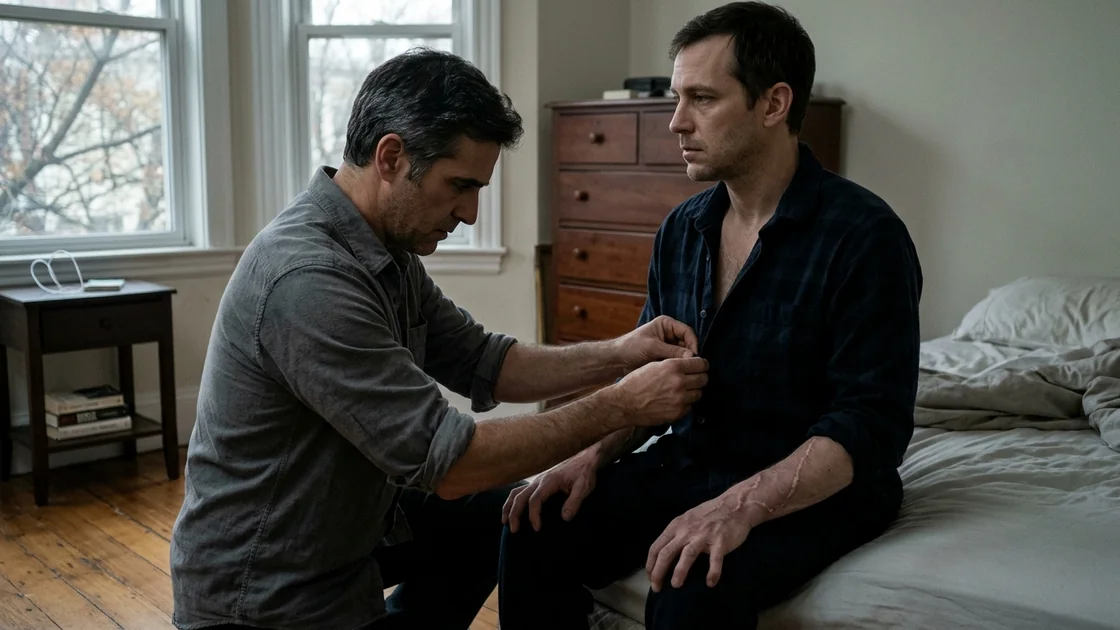
This is the story of Dr. Samuel Vance, a celebrated orthopedic reconstructive surgeon whose hubris and severe sleep deprivation during an emergency procedure permanently crippled the hands of his closest companion, Julian Mercer. In the aftermath of that catastrophic night, Samuel abandons his elite career to live in the orbit of the ruin he created, confronting the daily physical reality of Julian's disability and the inescapable, corrosive weight of his own unforgivable failure.
I. The Architecture of Morning
The tea kettle in Julian’s kitchen was made of spun copper, heavy and bottom-weighted, with an arching brass handle that had grown smooth from thirty years of his mother’s palms before it was passed down to him. It had a whistle tuned to a sharp F-sharp above middle C—a clean, piercing pitch that once made Julian smile whenever it cut through the morning fog of his apartment.
Now, it sat on the front right burner, cold, because Julian could no longer lift it.
Samuel stood before the stove with his sleeves rolled to his elbows. He watched the small blue crowns of the gas flame lick the copper. His own hands, wide-palmed and long-fingered with trimmed, square-cut nails, rested flat against the edge of the granite counter. If he pressed down with four pounds of pressure per square inch, he could stop the trembling. It was not a neurologic tremor; he had been through the full battery of electromyography and evoked potential tests three months after the inquiry, desperate for a tumor, a demyelinating disease, an early-onset parkinsonism—anything that might offer an exculpatory Latin name. The needles had registered nothing but brisk, immaculate conduction. His nerves were flawless conduits. The tremor was merely the body’s memory of an error, an involuntary recoil against the world it had touched too roughly.
From the bedroom down the hall came the dry, shuffling cadence of wool socks on bare oak.
Samuel did not turn around immediately. He counted three breaths, listening to the small hitches in the rhythm. There was the rustle of flannel, the dull knock of an elbow bumping the door jamb, then the unmistakable, hollow rattle of plastic buttons hitting the floor.
"Third one down," Julian’s voice called out. It was a light baritone, raspy from sleep, drained of its old theatrical boom but carrying an unbearable, resigned courtesy. "The mother-of-pearl one. It slid under the chest of drawers, Sam. Don’t break your back over it."
Samuel turned off the flame before the whistle could sound. He walked into the hallway, his posture instinctively straightening into the old habits of surgical rounds—shoulders back, core tight, gaze level—before he caught himself and allowed his frame to slump into something humbler, smaller, less imposing.
Julian stood in the center of the bedroom, bathed in the gray, watery light of an October dawn in Boston. He was wearing an unironed navy dress shirt, open down the front. His hands hung at his sides.
To an untrained eye, they might have looked normal at a passing glance, resting within the deep folds of his trousers. But Samuel was not an untrained eye. Samuel had memorized the cross-sectional anatomy of those hands forty times over; he had reconstructed them in his nightmares, fiber by fiber, vessel by vessel, failure by failure.
Julian’s hands were clawed. The intrinsic muscles—the interossei and the lumbricals that once allowed him to ripple through Chopin’s fourth ballade without an extraneous motion—were visibly hollowed. The flesh between the first and second metacarpals had melted away into concave shadows of atrophy. His ring and little fingers curled sharply inward toward the palms, rigid in the classic posture of a severe ulnar palsy combined with an ischemic Volkmann's contracture. The skin over the dorsal surface of the knuckles was taut, pale, and dry, devoid of the natural oils that normal autonomic nerve function preserved.
"I tried the hook," Julian said, nodding toward the nightstand where a wire button-assisting loop lay beside a paperback novel. "The wire slipped. I don't have the pinch strength to counter-torque it today. It's cold out."
"It's forty-two degrees," Samuel said softly. "The humidity is up."
"Is that what does it? The barometric pressure?" Julian let out a short, dry chuckle that ended in a sigh. "I always thought old men who complained about rain in their joints were being melodramatic. Turns out they were just keeping accurate meteorological logs."
Samuel dropped to his knees. His knees made a dull pop against the hardwood. He leaned down, his cheek nearly brushing the floorboards, and reached beneath the mahogany chest of drawers. His fingertips found the cold disc of the button. He brought it out and stood.
"Sit down," Samuel said.
"Sam, you don't have to—"
"Julian. Sit."
Julian hesitated, then sank onto the edge of the mattress. The springs groaned beneath him.
Samuel took the edges of the navy flannel shirt in his hands. His touch was clinical, practiced, and terrified. He avoided touching Julian’s wrists, where the pale, jagged silver zig-zags of his own surgical incisions ran from the mid-forearm down into the carpal tunnel and across the thenar space like dried riverbeds.
He took the second button and fed it through its corresponding slit. Then the third. He worked from top to bottom, his large fingers moving with the mechanical precision that had once made him the chief of hand and microvascular surgery at Massachusetts General Hospital before he was thirty-eight. His movements were swift, yet he felt every second as an eternity of penance.
Julian kept his arms held slightly away from his torso to allow Samuel access. He looked past Samuel’s shoulder, staring out the bay window at the bare branches of the elms lining Commonwealth Avenue.
"David called last night," Julian said quietly.
Samuel’s thumb paused over the fifth button. "David Chen?"
"He’s conducting the BSO in the spring. Ravel’s Concerto for the Left Hand. He asked if I would consider sitting in on the rehearsals. Dramaturgy, he called it. An artistic advisor on the phrasing."
The air in the bedroom grew thin and metallic. Concerto for the Left Hand. Written by Maurice Ravel for Paul Wittgenstein, a pianist who had lost his right arm in the First World War. A piece that demanded a terrifying, heroic virtuosity from five surviving fingers.
Julian had no surviving fingers. Neither hand could strike a single key with enough downward force to depress the hammer, let alone navigate the leaping, arpeggiated fury of Ravel.
"What did you tell him?" Samuel asked, his voice thick.
"I told him I was busy," Julian replied. He smiled a small, dead smile. "I told him I had a prior engagement with the morning news and a bowl of oatmeal."
Samuel finished the last button. He smoothed the placket of the shirt with the flat of his palm, his hand lingering for a fraction of a second over Julian’s chest, feeling the steady, rhythmic beat of the heart that had outlived its reason for beating.
"I could speak to David," Samuel whispered. "I could tell him to stop calling."
"Don't do that," Julian said, his voice sharpening slightly, showing the first faint flare of the man he had been before the storm. "Don't isolate me, Sam. You're already my nurse, my cook, and my driver. Don't be my censor too."
Samuel withdrew his hands as if the flannel had caught fire. He stepped back two paces, his head bowed, the weight of the silver scars in the room settling over his chest like lead aprons.
"I’ll pour the tea," Samuel said.
"Thank you," Julian said to the back of his neck. "And Sam? Use the ceramic mug. The one with the wide handle. The blue one."
"I know," Samuel said. "I know which one."
II. The Cadence of Mastery
Before the silence, there had been sound—an almost unbearable abundance of it.
Samuel and Julian had met twenty-two years earlier in an auxiliary basement practice room at Harvard. Samuel was an exhausted, grease-stained second-year medical student who had snuck into the music building because the underground corridor contained the only unoccupied, air-conditioned sofa in a three-block radius. He had fallen asleep with his cheek pressed into a leather-bound volume of Grant’s Atlas of Anatomy, his fingers twitching in his sleep as he mentally rehearsed the branches of the celiac trunk.
He was awakened by a sound that felt less like music and more like an electrical storm inside his skull.
Julian had been at the Steinway upright in the corner, tearing through the final movements of Prokofiev’s Seventh Sonata. He was twenty then, a prodigy from Chicago whose reputation had preceded him like a shockwave. He did not play the piano as though it were an instrument of wood and felt; he played it like an industrial machine that he had decided to break with his bare hands before it could break him. His body was a study in violent economy: wrists loose, elbows floating, shoulders dropped, the sheer kinetic power originating not from his arms but from the deep musculature of his back and hips, channeled down through ten miraculous, indestructible digits into the ivory.
When Julian finished, the small room had vibrated for five full seconds in the stunned hush that followed.
Samuel had sat up, blinking in the fluorescent light, the red imprint of the atlas stamped across his left cheek.
"You're rushing the syncopation in the seventh measure," Samuel had blurted out, before his conscious mind could filter the insolence. He knew nothing about Prokofiev, but he knew rhythm; he was a runner, an amateur cellist in his teens, a man obsessed with temporal metrics.
Julian had turned slowly on the swivel bench. His hair was damp with sweat, his eyes wide and dark with the manic clarity of high-level performance. He looked at Samuel, looked at the massive anatomy textbook, and then looked down at his own hands.
"I’m not rushing," Julian had said, his voice flat. "The composer is dragging."
Then Julian laughed—a full, booming, unselfconscious laugh that shook his ribs—and stood up to offer Samuel a bottle of lukewarm mineral water from his canvas bag.
They were inseparable from that afternoon onward. They were an odd, asymmetric pair: Julian the mercurial artist whose world was bounded by touch, timbre, and emotional architecture; Samuel the ascetic technician who viewed the human body as the ultimate engine, a marvel of biomechanics that could be mastered through sheer, brutal application of will.
For fifteen years, they operated in parallel orbits of extreme competence. Julian won the Leeds Competition, debuted with the New York Philharmonic, toured London, Berlin, Tokyo, and Vienna. Samuel completed his residency, his microvascular fellowship, published forty-four peer-reviewed papers on nerve transposition and composite tissue transfer, and rose to become the youngest full professor of surgery in his department.
They lived three blocks apart in Back Bay. Julian would return from a three-month European tour with skin like chalk and tendonitis in his right extensor digitorum, and Samuel would walk through his front door with a bag of groceries, a roll of kinesiology tape, and an ultrasound transducer. Samuel would spend an hour mapping the micro-vascular flow in Julian’s forearms, murmuring diagnostic commentary while Julian complained about the acoustic dryness of the Musikverein.
"You have a minor fascial restriction over the third dorsal compartment," Samuel would say, his fingers kneading Julian’s forearm with absolute, therapeutic authority. "Take three days off the Brahms. Stick to Bach. No octaves."
"Bach is boring when you’re angry," Julian would mutter, but he would obey.
They trusted each other with a purity that bordered on religious devotion. Julian trusted Samuel with the very tools of his existence; Samuel trusted Julian to be the only person in the world who understood the terrifying isolation of high-stakes performance, the private horror of knowing that a slip of two millimeters meant total, public catastrophe.
"People think surgery is science, Sam," Julian had said over drinks on Samuel’s balcony one summer evening three years before the crash. They were drinking Bourbon, the amber liquid catching the last orange flare of the sunset over the Charles River. Julian was tapping a complex, polyrhythmic sequence on the cedar armrest of his chair—thumb, middle, pinky, index, thumb.
"It is science," Samuel had replied, swirling his glass. "It’s biochemistry and applied physics."
"Nonsense," Julian scoffed. "The cutting is an instrument. You’re playing an organ whose keys bleed. You know within the first thirty seconds whether you have the room’s acoustic or not. You know whether the flesh wants to give or whether it’s fighting you. It’s phrasing. That’s all it is. Phrasing and touch."
"Phrasing doesn't fix a transected radial nerve, Julian."
"No," Julian had conceded, looking at Samuel with an affectionate, fierce pride. "But the man holding the needle has to know how to listen to the string while he pulls it. That’s you. You don’t hack at them. You listen."
Samuel had looked down at his own hands then, feeling a warm, dangerous pride bloom in his chest. He was the listener. He was the one who could fix anything that was broken.
III. The Architecture of Hubris
The shift that ended Samuel’s life began at five o'clock on a Tuesday morning and did not pause when the rain began thirty hours later.
It was November. A Nor'easter had stalled over New England, churning cold Atlantic water into a sheets-of-gray downpour that froze the moment it touched the asphalt of the Southeast Expressway. The city had turned into an abattoir of mangled steel and shattered plate glass.
By Wednesday afternoon, Samuel had already been in the operating theater for twenty-two of the preceding twenty-six hours.
He had performed a four-vessel revascularization on a factory worker whose hand had been caught in an industrial stamper. He had spent eight hours reconstructing the shattered pelvis and crushed brachial plexus of a nineteen-year-old girl thrown from an SUV. His eyes burned with the dry, scratchy sensation of fine sand beneath the lids. His cervical spine throbbed with a dull, sickening ache from hours bent over the binocular oculars of the surgical microscope.
At six in the evening on Wednesday, Dr. Marcus Ross, the chief of surgery, had stepped into the scrub room where Samuel was splashing ice water onto his face.
"Go home, Sam," Ross had said, his hand resting on Samuel’s shoulder. "We have the on-call trauma fellows from Brigham covering the secondary cases. You’re done. You look like a ghost."
"The Brigham fellows don't know how to do a double-bundle tendon transfer in a crush zone, Marcus," Samuel had rasped, drying his face with a sterile blue towel. "I’m fine. I’ve got three hours of administrative work, then I’ll crash in the call room."
"I’m not asking you, Vance. I’m telling you. Step away from the board."
"I am on it," Samuel said, his voice tightening with that cold, brittle arrogance that had carried him through every trial since his residency. "I don’t leave patients to the B-team when the weather is this bad."
He didn't sleep in the call room. He answered consults. He drank black drip coffee that tasted of burnt rubber and scorched grounds, followed by three hundred milligrams of modafinil he had swiped from his own office stash. The stimulant didn't restore his cognitive clarity; it merely sharpened the edges of his exhaustion, giving him a false, jittery sensation of omnipotence while his reaction times silently deteriorated behind his eyes.
At 2:14 a.m., the red trauma phone on the wall of the surgical lounge began to howl.
Samuel was the only one in the room. He picked it up.
"Trauma Bay One," the voice of the head triage nurse crackled through the receiver. "We have an inbound Category Alpha. Rollover on the Mass Pike near the Allston exit. Single vehicle, high-speed impact with a concrete abutment. Massive upper extremity trauma. Bilateral crush, partial avulsion, compartment syndrome developing. ETA eight minutes."
"Who is it?" Samuel asked, his pen poised over the scratchpad.
"Driver's license says Mercer. Julian Mercer. Age thirty-eight."
The pen snapped between Samuel’s fingers. The plastic barrel cracked, driving a sharp edge of polypropylene into the flesh of his palm. He did not feel it.
"Sam?" the nurse asked. "Did you copy?"
"I’m here," Samuel whispered. Then his voice slammed back into command mode, rising an octave, shrill and commanding. "Prep OR Four. Get the Zeiss microscope down from the seventh floor. Call the blood bank—order eight units of packed cells, four of plasma. I want the microsurgery tray opened and double-checked. Do not let anyone touch those arms until I get down there. Nobody."
"Dr. Vance, protocol says if it's a family member or—"
"He is not my family," Samuel screamed into the receiver, his vision tunneling into a red, vibrating point. "He is my patient. Clear the bay!"
He slammed the phone onto the hook and ran.
When Samuel burst into Trauma Bay One, the stench of the world outside followed him—wet asphalt, ozone, the iron smell of arterial blood, and the sour reek of deployed airbags.
Julian was on the trauma gurney, stripped to his waist, shivering uncontrollably beneath the warming blankets. His face was surprisingly untouched, save for a jagged laceration along his left cheekbone that was oozing dark, venous blood.
His arms, however, were an atrocity.
The steering column had crushed both forearms against the dashboard before the driver’s side door had buckled inward, pinching the limbs in a vice of twisted steel. His left arm was swollen to twice its normal girth, the skin tight, shiny, and marbling with the violaceous discoloration of acute compartment syndrome. On the right, the distal third of the radius had punched through the volar skin, tearing through the flexor tendons and shredding the median nerve like a bundle of wet twine. The fingers were dusky, white at the tips, cold to the touch.
Julian was conscious. His eyes, dilated with morphine and terror, locked onto Samuel as he pushed past the resident.
"Sam," Julian gasped. The sound was wet, infantile. "Sam. My hands. I can't... I can't feel the fingers. Sam, they're gone."
Samuel caught Julian’s face in his hands. His palms were clammy, cold inside his latex gloves.
"Look at me, Jules. Look at me." Samuel’s voice was shaking, though he tried to drive an iron spike of certainty through it. "You’re at the General. You’re with me. Do you hear me? You’re with me."
"Don't let them cut them off," Julian wept, his chest heaving, his teeth chattering against each other with a sound like dice in a cup. "Sam, please. Kill me first. Please. Just kill me first."
"Nobody is cutting anything off," Samuel said. He looked up at the resident, his eyes wide, bloodshot, terrifying. "Get him to Four. Now!"
Dr. Ross appeared at the door of the trauma bay, his hair disheveled, wearing street clothes over his scrubs. He had driven in through the blizzard.
"Sam, step back," Ross ordered, grabbing Samuel by the forearm. "You haven't slept in thirty-six hours. You’re emotionally compromised. Sarah Lin is on her way from home, she’s fresh, she can take the vascular repair—"
Samuel violently ripped his arm out of Ross’s grip.
"Sarah Lin doesn't have the micro-technique for this!" Samuel snarled, his spit spraying onto Ross’s face shield. "Look at the volar compartment! The median nerve is transected in the zone of injury! If you let a fellow touch this, he will never play again! I am the only one who can save these hands, Marcus! I am the only one!"
"Sam, look at your eyes! You're toxic! You're running on fumes!"
"Touch me again, Marcus, and I will break your jaw," Samuel whispered, the words coming out flat, murderous, and entirely insane. "This is my case."
Ross stared at him, caught between the institutional liability and the desperate, ferocious competence of the hospital's star surgeon. Ross hesitated for five seconds—a hesitation he would later spend two days testifying about before the state licensing board.
"I’m scrubbing with you," Ross said.
"Fine," Samuel spat. "Stay out of my light."
IV. The Tremor in OR Four
In the operating room, the air was sixty-two degrees, smelling of iodine, isopropyl alcohol, and the ozone sizzle of the electrocautery unit. The rhythmic, hydraulic chug of the ventilator was the only steady clock.
Samuel sat on the surgical stool, his eyes pressed into the rubber eyepieces of the massive operating microscope.
His feet were freezing. His skull felt as though it had been emptied out and packed with dry cotton wool. A migraine had begun behind his left temple—a sharp, throbbing spike that synchronized precisely with the beeping of the pulse oximeter. Every time the monitor chimed, a needle seemed to drive through his optic nerve.
Focus, he told himself. Radial artery. End-to-end anastomosis. Ten-zero nylon. Three-eighths circle needle. You’ve done this five thousand times. It’s a machine. Just a machine.
Through the optics, the operative field looked like a lunar landscape torn apart by artillery. The median nerve on the right side was the primary casualty: its epineurium was shredded, the fascicles splayed like the frayed ends of a silk ribbon.
To restore function to a hand that required the subtle, lightning-fast coordination of a concert pianist, the alignment of these fascicles had to be immaculate. A rotation of five degrees—a single mismatched bundle—would mean that when Julian’s brain sent the signal to flex his index finger, his pinky would spasm instead. The sensory nerves had to be grafted with absolute, microscopic perfection; without sensory feedback, a pianist was blind, striking keys with dead clubs of meat.
"Suction," Samuel murmured.
The scrub nurse placed the tip into the field.
Samuel’s hands were inside the cavity. He held the micro-forceps in his left hand, the needle driver in his right.
Then, for the first time in his life, Samuel saw it.
The needle driver was vibrating.
It was not the rhythmic, gross tremor of an old man’s palsy; it was a high-frequency, microscopic oscillation. The tip of the needle, an arc of steel so fine it was barely visible to the naked eye, was dancing a circle two millimeters wide.
Two millimeters was the entire diameter of the vessel.
Samuel pulled his hands back, his chest constricting as though an iron band had been tightened around his ribs. He blinked violently, rubbing his eyes against the sterile sleeves of his gown.
No. Not now. Not him.
"Dr. Vance?" the scrub nurse asked softly. "Do you need a break?"
"I’m fine," Samuel barked. "Adjust the illumination. It’s too bright. It’s washing out the contrast on the fascicle borders."
"The light is at thirty percent, Doctor," the circulating nurse said from the corner.
"I said adjust it!"
He pressed his eyes back to the oculars. The modafinil was turning on him now. The visual field seemed to pulse, expanding and contracting with his breath. The edges of the red muscle bellies began to crawl, swimming with phantom motion.
He began the repair.
He needed to perform a double fasciotomy on the left forearm to relieve the crushing compartment syndrome before the elevated pressure strangled the deep flexor muscles into necrosis. On the right, he had to harvest a sural nerve graft from Julian’s leg to bridge the two-centimeter gap in the median nerve, then reconstruct the deep branch of the ulnar nerve, which was intact but compressed within Guyon’s canal.
It was an eight-hour procedure under ideal conditions. Samuel was trying to do both arms simultaneously, his attention whipping back and forth like a trapped animal.
At hour four, the exhaustion hit him not as a wave, but as a total cognitive collapse.
A microsurgeon survives on proprioception—the intuitive, spatial knowledge of where his instruments are even when they are outside the field of the lens. But Samuel’s proprioception was dissolving. His limbs felt disconnected from his brain, floating in heavy grease.
He was working on the left forearm, using the heavy curved Mayo scissors to release the deep fascia overlying the anterior compartment.
"Sam," Ross’s voice cut through the hum of the laminar flow. Ross was across the table, acting as first assistant. "Watch the depth. You’re riding high on the pronator teres. You’re near the takeoff of the anterior interosseous."
"I see it," Samuel said. His voice sounded like it was coming from the bottom of an empty cistern. "I know where it is, Marcus. I have the plane."
He didn't have the plane.
His fingers were numb. The spatial orientation had slipped four millimeters to the radial side. Through his blurred, dry-socketed vision, the pale fascia looked identical to the sheath of the neurovascular bundle. He felt the resistance of the tissue—tough, fibrous, resistant.
In a normal state, his fingers would have registered the subtle difference in density between non-contractile fascial tissue and the delicate, springy sheath of an arterial trunk. He would have paused. He would have used blunt dissection with a peanut sponge. He would have verified the landmarks.
Instead, his exhausted brain simply commanded his hands to finish the movement. He wanted the pressure relieved. He wanted the operation to be over. He wanted to sleep.
Snip.
A sudden, sharp well of bright crimson leapt into the wound, obscuring the field.
"Bleeder," Ross said, his voice instantly taut. "Suction! Sam, where did that come from? Was that the radial artery?"
"No," Samuel muttered, his tongue thick in his mouth. "Just a muscular branch. Give me the bipolar cautery."
"Sam, don't cauterize blind," Ross said, his hand reaching across to block Samuel’s instrument. "Irrigate and find the bleeder. You’re right on top of the median trunk!"
"I have the vessel!" Samuel shouted, batting Ross’s hand away with the shaft of the cautery forceps.
He saw the dark, pulsating point through the red swamp. He didn't wait for the suction to clear the pool. He stepped on the foot pedal.
Bzzzt.
The smell of cooked protein rose instantly from the wound.
Samuel held the current down for one... two... three seconds. Too long. Far too long for microvascular tissue. The high-frequency electrical current arced through the saline-soaked field, seeking the path of least resistance.
The path of least resistance was not the severed vessel.
It was the deep, unmyelinated fibers of the ulnar nerve and the main trunk of the median nerve, lying bathed in the electrolyte-rich hematoma less than three millimeters beneath his blind tips.
Through the microscope, Samuel saw the nerve trunk blanch. It didn't bleed; it turned a sudden, waxy, chalky white. It shrank, curling like a worm dropped onto a hot iron plate.
The thermal injury was total. It was catastrophic. It was five centimeters of coagulative necrosis running through the core of the nerve that controlled the sensation to the palm and the motor power to every intrinsic muscle that allows a human hand to form a chord.
Samuel froze. The foot pedal clicked off.
The suction tip sucked the remaining blood away, leaving the operative field clean, red, and quiet.
There, in the center of the left arm, lay the median nerve. It was cooked. The tissue was dead—not cut, not bruised, but thermally denatured into useless, non-conductive scar tissue.
Across the table, Ross lowered his loupes. He stared into the wound. Then he looked up at Samuel.
Ross’s face was utterly devoid of anger. It held only an immense, bottomless horror.
"Sam," Ross whispered. "What did you just do?"
Samuel did not answer. He couldn't speak. His throat had seized; his vocal cords were locked in a spasm of suffocating terror.
He turned his head to look at the right arm—the arm where the sural graft was supposed to go. He had already placed the anchor sutures. But as his gaze fell upon the distal wrist, he saw that in his frantic, jittering rush forty minutes earlier, he had anchored the proximal median nerve stump not to the distal sensory branch, but to the tendon of the flexor carpi radialis.
He had sutured a nerve to a dead piece of gristle.
He had cross-wired the circuit into nothingness.
"Oh, God," the scrub nurse breathed, taking half a step back from the table. She had seen it too.
The cardiac monitor continued to beep. Eighty beats per minute. Eighty-two. Eighty-four.
Julian’s heart, young and strong, pumped oxygenated blood through a body whose hands were now entirely, irrevocably dead.
Samuel stood up. His stool scraped against the conductive tile floor with a sound like a scream.
He looked down at his own hands—the instruments of his genius, the five-fingered miracles that had been praised in forty medical journals, the hands that Julian had toasted with bourbon on warm summer nights.
They were steady now.
They were perfectly, beautifully, mockingly still.
V. The Weight of Waking
The neuro-trauma intensive care unit smelled of chlorhexidine and the sterile paper of disposable gowns. It was a space where time did not move in hours, but in the slow drop of intravenous solutions through plastic drip chambers.
Julian woke on the third day.
Samuel had not left the hospital. He had not showered. He had not changed out of his scrubs, though he had torn off his surgical cap and scrub jacket, sitting in the corner armchair in a threadbare gray undershirt that smelled of sour sweat and fear. The hospital administration had already suspended his surgical privileges pending an extraordinary clinical review; he had been forbidden from entering any operating theater on the campus. But nobody had the stomach to physically drag him out of Julian’s room.
Julian’s eyelids fluttered, heavy with the residue of fentanyl and propofol. He groaned, a low, guttural sound that rattled in his throat.
Samuel was on his feet instantly. He moved to the side of the bed, his hands hovering six inches above the guardrails, terrified to touch the metal, terrified to exist in the same air.
"Jules," Samuel croaked. His voice was cracked, his mouth dry.
Julian turned his head slowly. His eyes were unfocused, the pupils drifting before they locked onto Samuel’s face.
"Sam?"
"I’m here. I’m here, Jules."
Julian tried to move his arms. They were bound in thick, bulky cotton dressings—ten pounds of gauze, plaster splints, and elastic bandages that held both limbs in the neutral, protective position from the mid-biceps to the fingertips. Only the very tips of his fingers protruded from the white cocoons.
"My... my arms feel heavy," Julian whispered. He tried to laugh, but his tongue was too thick. "Feels like... like you poured concrete down the sleeves."
Samuel felt a cold stone slide down into his stomach. "You’re splinted, Jules. You had severe compartment syndrome. We had to... we had to relieve the pressure."
Julian was silent for a long moment. His eyes traveled down the white slopes of his bandaged arms to the pale tips of his fingers poking out into the room.
"They're cold," Julian said.
"They have blankets on them."
"No," Julian said, his voice sharpening slightly, drifting up out of the narcotic haze. "Not the skin. Inside. The bone feels cold, Sam. Like there’s no... there’s no wire connected."
He twitched his shoulders. Samuel saw the pectoralis major contract; he saw the biceps fire, straining against the plaster.
The fingers did not move.
Not a millimeter. Not a flicker.
"Sam?" Julian asked. His breathing picked up. The monitor above the bed began to chirp with a faster tempo. Ninety. Ninety-five. "Sam, make them move. Tell them to do the scale. Just the five-finger pattern. C-major. C, D, E, F, G."
Julian’s face tightened with effort. The veins on his temples stood out like blue cords. His neck muscles bunched into knots.
The eight protruding fingers remained completely motionless, resting against the gauze like pale, dead larvae.
"Why aren't they doing the scale, Sam?" Julian’s voice had lost its adult resonance; it was the voice of an eight-year-old boy locked in a dark closet. "Sam. Why won't they do the scale?"
Samuel fell to his knees beside the bed. He caught the iron guardrail with both hands, his knuckles turning white, pressing his forehead against the cold chrome until the metal bit into his skin.
"I’m sorry," Samuel whispered. The words were small, pathetic, worthless. "Julian. I’m sorry. I’m so sorry."
Julian stared down at the top of Samuel’s bowed head.
The silence that filled the ICU room was not the silence of an empty concert hall; it was the silence of a tomb that had just been sealed from the outside.
Julian didn't scream. He didn't curse. He didn't ask what had happened during the thirty-six-hour shift, or what the committee had found, or why Marcus Ross had looked at him that morning with tears in his ancient eyes.
Julian simply closed his eyes.
"Oh," Julian whispered. It was a soft, gentle syllable, expelled on a long, dying breath. "Oh. I see."
He did not speak to Samuel again for four weeks.
VI. The Anatomy of Uselessness
The apartment on Commonwealth Avenue became a laboratory of small, humiliating physics.
Six months after the surgery, the formal inquiry was completed. The board had found Samuel Vance guilty of "gross clinical negligence secondary to extreme physical exhaustion and cognitive impairment." His license to practice medicine in the Commonwealth of Massachusetts was revoked for a period of five years, after which he might petition for reinstatement under supervised, non-surgical conditions.
He didn't care. He would have signed a document sentencing himself to the gallows if they had offered it.
He sold his own condominium overlooking the river. He sold his car, his books, his collection of nineteenth-century surgical lithographs. He took the money, established a trust fund that would cover Julian’s living expenses and physical therapy for sixty years, and moved into the small, windowless guest room at the back of Julian’s apartment.
He became Julian’s arms.
The world does not accommodate hands that cannot pinch, rotate, or resist. A human being without the use of his hands is an exile in an environment designed entirely for opposable digits.
In the morning, the battle began with the blankets.
Julian could not grip the edge of the duvet to throw it off his chest. If he twisted his torso violently, he could whip the comforter to the side, but his feet would catch in the folds. Samuel would enter at seven precisely, fold the linen down, and assist Julian into a seated position by hooking his arms beneath Julian’s armpits.
"I can do the legs," Julian would say, his jaw set.
He would use his elbows—blunt, awkward stumps—to push his thighs until his feet touched the floor.
Then came the bathroom.
The act of washing oneself requires hundreds of tiny, unconscious micro-adjustments of the wrist and palm. A washcloth must be gathered into a compress; soap must be stabilized between two opposing surfaces; the perineum must be reached with a supple, curving articulation of the dorsal flexors.
Julian sat on a teak bench inside the walk-in shower while Samuel washed him.
The water fell hot and loud around them, filling the small room with billowing steam that smelled of cedar and unscented glycerin soap. Samuel wore gray gym shorts, soaking wet, his bare feet gripping the tiles.
He lathered the sponge. He washed Julian’s shoulders, the broad, muscular expanse of his back where the latissimus dorsi—the muscles that once gave Julian’s fortissimos their thunderous, orchestral weight—still twitched with useless power.
He washed Julian’s chest. When he reached Julian’s forearms, Julian’s breath would always catch.
The scars were hideous.
Because of the severe swelling and the subsequent revision surgeries performed by Sarah Lin—who had spent fourteen hours trying to untangle Samuel’s mistakes, clearing the necrotic nerve segments and inserting cadaveric grafts that had ultimately failed to bridge the massive gap—the skin of Julian’s forearms was a mosaic of split-thickness mesh grafts. The flesh was cross-hatched, resembling the scaly, pebbled hide of a reptile, indented where the necrotic muscle bellies had been debrided and discarded.
Samuel washed those arms with the tenderness a mother might show to a child burned in a fire. His fingers, still strong, still supple, traced the borders of the graft with a feather-light touch.
Every morning, Samuel waited for Julian to pull away. Every morning, he prayed that Julian would strike him with those blunt, ruined limbs, that he would spit in his face, that he would scream the accusations that Samuel screamed at himself in the dark of the guest room.
Julian never pulled away.
He sat with his head bowed, the water plastering his dark hair to his forehead, his eyes fixed on the drain between his feet, enduring Samuel’s touch with a terrible, polite docility that cut deeper than any scalpel Samuel had ever held.
"The left thumb is stiff today," Samuel would murmur, his voice swallowed by the hiss of the spray.
"I know," Julian would say.
"I’ll work the joint after breakfast. We need to prevent the web-space from contracting any further, or you won't be able to hold the cup."
"All right, Sam."
"Does the passive stretch hurt?"
"A little."
"Tell me if it's an eight. I won't go past a seven."
"It's a five, Sam. It's always a five."
After the shower, the indignity moved to the dining table.
The occupational therapists had provided Julian with a suite of "adaptive devices"—clunky, insulting contraptions made of molded blue plastic, gray Velcro, and bent aluminum. There was an elastic strap that wrapped around Julian’s palm, fitted with a slotted sheath into which the handle of a fork or spoon could be jammed.
Julian tried. He tried because he possessed an immense, stubborn dignity that refused to surrender the basic mechanics of nutrition to his executioner.
Samuel sat across from him, his own breakfast untouched, his hands clenched beneath the table where Julian could not see their nervous flutter.
Julian would lean forward, his neck straining, his elbow locked at a right angle. He would lower his upper body until the spoon touched the bowl of oatmeal. He would twist his entire torso to scoop three flakes of oats and a drop of almond milk into the bowl of the spoon.
Then, the ascent.
The human shoulder is not designed to raise food to the mouth without the assistance of the wrist. Without the ability to supinate the palm, the spoon inevitably tilted as it rose.
Drip.
The milk fell onto the oak table.
Julian did not stop. He brought the spoon higher, his shoulder hitching toward his ear, his neck curving down like a feeding crane to meet the metal halfway.
He caught a third of the bite. The rest smeared across his chin and down the front of the clean blue shirt Samuel had buttoned for him ten minutes earlier.
Julian froze. He held the spoon suspended in the air, his elbow shaking with the strain of the unnatural angle.
A single drop of warm milk ran down the placket of his shirt, leaving a dark, translucent trail across the fifth pearl button.
Samuel reached for a cloth napkin.
"Don't," Julian whispered.
Samuel stopped his hand six inches above the table.
Julian slowly, agonizingly lowered his arm. The metal spoon clattered against the porcelain rim of the bowl, then slid sideways, coming to rest in the pool of milk on the wood.
Julian stared at the white smudge on his chest. His breath came short and dry through his nostrils.
"I wanted to eat the eggs," Julian said, his voice terrifyingly calm. "I wanted the eggs with the chives, Sam. But I can't keep them on the fork. They slide off. They're too soft."
"I can feed you the eggs, Jules," Samuel said, his voice breaking, tears finally spilling over his lower lids. "Please. Let me give you the eggs."
Julian turned his head toward the window. The light was fully up now, a bright, cruel winter sun reflecting off the snow on the brownstone cornices across the street.
"I am thirty-nine years old," Julian said to the glass. "I was thirty-nine last Tuesday. Did you know that?"
"Yes," Samuel said. "I bought the torte. The hazelnut one you like."
"I used to practice twelve hours a day before a concerto," Julian murmured. "Twelve hours. My mother used to bring me sandwiches cut into squares so I could eat them with my left hand while my right hand worked the cadenza from the Brahms B-flat. I hated her for it. I thought it was vulgar. I thought, I am an artist, not an athlete."
He looked down at his left hand.
The thumb had begun to pull inward toward the palm, the adductor pollicis muscle shortening as the denervated tissue fibrosed. It looked like an old, dry root dug up from the winter ground.
"Now I can't hold an egg," Julian said.
He did not look at Samuel. He stood up from the chair, using his knees to shove the table back, and walked down the hall to his study.
The door did not slam behind him. Julian could not grasp the brass knob to pull it shut.
The door simply drifted half-closed on its brass hinges, leaving a two-inch gap of shadow through which Samuel could hear the sound of his best friend breathing in the dark.
VII. The Silent Monument
In the center of the study stood the monument.
It was a Hamburg Steinway Model D—nine feet of hand-rubbed black lacquer, polished spruce, and cast iron. It had been selected for Julian by his mentor in Berlin when Julian was twenty-four. It was, without question, one of the finest instruments on the North American continent. Its tone was legendary among chamber musicians: dark, woody, with a sustained upper register that sounded like silver bells rung beneath water.
Since the night of the Nor'easter, the fallboard had remained closed.
A layer of fine, gray dust had settled over the polished lid. Julian had forbidden the cleaning woman from touching it; he had forbidden Samuel from wiping it down. The dust had gathered undisturbed for fourteen months, recording the passage of seasons like a silt deposit at the bottom of an abandoned reservoir.
Samuel entered the study at four in the afternoon. The room smelled of old paper, leather, and the sweet, dry scent of seasoned rosewood.
Julian was sitting in the low leather armchair three feet from the piano's tail. He was not reading. He was not listening to the radio. He was simply sitting, his arms resting on the leather cushions, watching the motes of dust turn in the cold beam of sunlight that cut across the instrument’s flank.
Samuel held a glass of water with a silicone straw. He set it on the side table within reach of Julian’s shoulder.
"The physical therapy clinic called," Samuel said softly. "Dr. Lin wants to try the dynamic splinting again. She thinks if we use the spring-loaded outriggers, we might be able to reclaim ten degrees of extension in the PIP joints of the fourth and fifth digits."
"Ten degrees," Julian repeated. He didn't look up.
"It would allow you to hook a handle," Samuel said, his voice desperate with a salesman’s false cheer. "A briefcase. Or a grocery bag. It would give you an active tenodesis grip."
"Tell Sarah to save the springs," Julian said. "Give them to someone who wants to hold a grocery bag."
Samuel stepped closer to the Steinway. The black wood was cold, radiating the winter chill that seeped through the old glass of the bay windows.
"You should sell it," Samuel said. The words tasted like bile in his mouth, but he forced them out. He felt he had no right to shield Julian from the reality he had created. "It's drying out. The soundboard will crack if we don't run the humidifiers properly. It deserves to be played, Julian. It's... it's dying in here."
Julian’s eyes snapped toward him. For the first time in months, the dull, gray film over his gaze vanished, replaced by an expression so fierce, so intensely personal, that Samuel took a step back.
"Don't you dare touch that lid," Julian said, his voice dropping into a register that made the copper strings inside the case hum in faint, sympathetic vibration.
"Jules—"
"You took the nerves, Sam," Julian said. He spoke without shouting, every word rounded, articulated with the terrifying precision of a master musician who understood dynamics better than any living soul. "You took the interossei. You took the flexor digitorum profundus. You took the skin. You took my work. You took my future. You took every room I was ever going to walk into for the rest of my life."
He stood up. He did not use his elbows this time; he rose by the sheer, furious strength of his core, his body trembling with a rage that had been fermenting behind his ribs for four hundred days.
He walked to the piano. He leaned his hips against the rim of the curved case, his clawed hands hovering inches above the black wood.
"This is mine," Julian whispered, his face inches from the dust-covered finish. "This piano is the only thing in this house that knows what I was. When I look at it, I don't see a cripple who needs his bottom wiped and his meat cut into cubes. I see the Liszt Sonata. I see Carnegie Hall. I see my life."
He turned his head to look Samuel dead in the eyes.
"You want me to sell it so you don't have to look at it," Julian said. "You want it gone because every time the sun hits that lacquer, you see OR Four. You see the electrocautery. You see the clock on the wall that said three in the morning while your brain was rotting from coffee and vanity."
The words struck Samuel with physical force. He swayed on his feet, his breath catching in his throat, his chest burning as though the bipolar current were running through his own lungs.
"Yes," Samuel confessed. The word was a sob. "Yes. I do."
"Tough," Julian said. He leaned his forehead against the music rack. The wood made a dull, heavy thump. "It stays. It stays right here until I die. And every morning, when you walk down that hall to make my tea, you will look at that lid, Sam. You will look at it, and you will remember that you didn't just break two hands. You broke the music."
Julian closed his eyes, his forehead resting against the wood, his breathing ragged and uneven.
Samuel did not move. He stood in the center of the Persian rug, his hands hanging limp at his sides, accepting the lash. He wanted more. He wanted Julian to take the brass fire poker from the hearth and bring it down across his own collarbones; he wanted Julian to demand his flesh, his blood, his marrow.
"Julian," Samuel whispered. "Why do you let me stay?"
The question had lived between them like an unexploded bomb since the day Julian was discharged from the hospital. Samuel had expected the lawyers. He had expected the restraining orders. He had expected to be cast out into the gutter where he belonged.
Instead, when the taxi had pulled up to the brownstone, Julian had looked at Samuel through the window and said: Come upstairs. You have work to do.
Julian didn't lift his head from the piano.
"Because nobody else would understand the punishment," Julian said softly.
He turned around, his back against the case, looking at Samuel with an exhaustion that mirrored his own.
"A nurse would be kind to me, Sam. A nurse would feel sorry for me. A nurse would tell me that I’m making progress because I can move a blue plastic peg from one hole to another. A nurse would let me pretend that this is a recovery."
Julian raised his hands. He held them up between them, the clawed fingers silhouetted against the pale winter light of the window—the twisted, hollowed, useless shapes of what had once been the greatest artistic gift of a generation.
"You will never tell me I’m making progress," Julian said. "You know what was lost. You are the only person on this earth who knows the exact, microscopic measure of the ruin."
Julian lowered his arms.
"Now," he said, his voice flat once more, returning to the dry, mechanical rhythm of their domestic tragedy. "Help me with the sweater. The wool is scratching my neck."
VIII. The Ledger of Days
Winter surrendered to a wet, filthy March. The snow in the gutters of Commonwealth Avenue turned to black sludge, salted with gravel and soot.
Samuel fell into a rhythm that resembled a monastic order.
He woke at five. He ran six miles along the Charles River—not for health, not for fitness, but to exhaust his heart, to force his quadriceps to burn until the physical agony drowned the phantom hum of the operating room in his head.
When he ran, he held his hands in tight fists inside his gloves, tucking his thumbs into his fingers, hating the sensation of the air passing over his skin. His hands were whole. They were pink, warm, perfectly innervated. He hated them with an intensity that bordered on psychosis. Sometimes, while sitting alone in his small bedroom at night, he would look down at his right hand and imagine placing it on the cutting board in the kitchen and bringing the eight-inch Wüsthof chef’s knife down through the carpal tunnel, cleaving the median nerve, severing the flexor tendons, balancing the ledger with cold steel.
He didn't do it.
He didn't do it because self-mutilation was an indulgence. It was an exit. If he had no hands, he could not wash Julian’s back. He could not feed Julian his eggs. He could not tie Julian’s shoes.
His hands no longer belonged to Samuel Vance; they were stolen property that had been conscripted into the service of their victim.
At nine in the morning, after Julian had been washed, dressed, and fed, they would begin the "re-education" exercises.
They sat at the kitchen table. Samuel had laid out a green felt mat—the kind used by card players to reduce the slip of paper.
On the mat lay twelve ordinary objects: a copper penny, an iron washer, a wooden marble, a strip of velvet, a square of coarse sandpaper, a rubber eraser, a brass paperclip, a sea sponge, an ice cube, a heated porcelain tile, a dry leaf, and a small key.
These were the tools of sensory re-mapping.
Sarah Lin had explained the theory during their last consult: The brain's somatosensory cortex is plastic. If there are any surviving sensory fibers—even five percent—the cortex can theoretically amplify the signals, re-learning to interpret the degraded inputs.
It was an exercise in futility, and Samuel knew it. The nerve was dead. The grafts were scar. But Julian insisted.
"Close your eyes," Samuel said.
Julian closed his eyes. His head tilted back slightly, his face settling into the old, concentrated mask he used to wear when he was memorizing an orchestral score away from the keyboard.
Samuel picked up the green felt mat and placed Julian’s left index finger on the first object.
Samuel took the tip of Julian’s finger—the skin was thin, smooth, devoid of normal dermatoglyphic friction—and pressed it down against the coarse sandpaper.
"What is that?" Samuel asked.
Julian was silent. His brow furrowed. He moved his shoulder, dragging the pad of the finger across the grit.
"Metal," Julian said. "Something flat. A coin."
Samuel’s chest ached. "No. Try again. Feel the texture. Is it smooth or sharp?"
Julian didn't answer immediately. He pressed harder, trying to force the mechanical receptors in the deep subcutaneous tissue—the Pacinian corpuscles that were innervated by the radial nerve, which had partially survived—to register the stimulus.
"It's cold," Julian said, his voice uncertain. "It's... it's glass?"
"It's sandpaper, Jules," Samuel said gently. "Sixty-grit sandpaper."
Julian opened his eyes. He looked at the square of brown paper beneath his finger.
He pulled his hand back as if the paper had bitten him.
"Next," Julian commanded, his voice tight.
"Julian, we’ve been at this for forty minutes—"
"I said next, Sam."
Julian shut his eyes again. He thrust his right hand forward, the fingers held rigid in their clawed curve.
Samuel picked up the ice cube using a pair of plastic tongs. He touched the melting edge to the pulp of Julian’s thumb.
Water ran down the side of the thumb, pooling in the hollow of the palm.
"Tell me what that is," Samuel whispered.
Julian sat motionless. The ice melted. The droplet ran off the side of his hand and fell onto the green felt, making a dark, spreading stain.
Ten seconds passed. Twenty.
"Nothing," Julian said.
The word was not spoken with anger. It was spoken with a terrifying, hollow neutrality.
"You don't feel the moisture?" Samuel asked, his voice cracking. "The temperature? Julian, it's thirty-two degrees. The cold receptors should—"
"There is nothing there, Sam," Julian said. He opened his eyes. He looked at the ice cube sitting on his dead thumb, melting into his skin like water poured over a stone. "I see that it is there. I know that it is wet. But as far as my brain is concerned, you are touching a wooden block on the other side of the room."
Julian took his hand and dragged it off the table. The ice cube fell, bouncing once on the oak floor before sliding under the radiator.
"Let’s do the walk," Julian said, standing up. "My knees feel like rusted hinges."
IX. The Public Gaze
The walk was their daily penance in the open air.
They would take the elevator down to the marble lobby, Julian wearing his heavy wool overcoat with the oversized horn buttons that Samuel had sewn on with heavy fishing line, his hands jammed deep into his pockets so that no one could see the shape of them.
Outside, the air of Back Bay was sharp with the scent of salt from the harbor and the exhaust of delivery trucks idling along the curb.
They walked slowly. Without the reciprocal arm swing that stabilizes human bipedal motion, Julian walked with a slightly stiff, robotic gait. His balance was imperfect; the inner ear relies on subtle, counter-balancing micro-movements of the hands and wrists to maintain the center of gravity, and Julian’s arms hung like dead pendulums within the heavy wool.
Samuel walked half a step behind him, on his left side. His eyes were constantly scanning the sidewalk—looking for patches of ice, uneven bricks, dog leashes, the stray curb that might trip the man who could not catch himself if he fell.
If Julian fell, he would hit the concrete with his face. He had no protective extension reflex; his hands would not shoot forward to break the impact. He would simply crash like a felled tree.
At the corner of Dartmouth Street, a woman in a camel-hair coat stopped.
"Julian?" she called out.
Samuel’s heart seized. He recognized her: Elena Rostova, a cellist with the Boston Symphony, a woman who had performed the Brahms Double Concerto with Julian three seasons ago at Tanglewood.
Julian paused. He turned his body in a single, unified motion, keeping his hands anchored inside his coat pockets.
"Elena," Julian said. A professional, warm mask slipped over his features with terrifying speed. His voice was smooth, cultured, perfectly modulated—the voice of a world-class artist meeting a colleague in the street.
"My God, Julian! I’ve been calling you for six months!" She stepped forward, her arms opening for an embrace.
Julian held his ground. He leaned into the hug with his upper torso, but his arms remained locked within the pockets, stiff and immobile beneath the camel hair.
Elena pulled back, her brow furrowing slightly at the odd, wooden stiffness of the contact. Then her gaze shifted to Samuel, who stood three feet away, his head down, looking like an exhausted bodyguard or an attendant from an asylum.
"Dr. Vance," she said, her tone cooling instantly. The classical music world was small; the rumors about what had happened in OR Four had circulated through the greenrooms of New York and Boston within forty-eight hours of the inquiry. Nobody knew the exact surgical details, but everyone knew that Samuel Vance had operated on Julian Mercer, and everyone knew that Julian had canceled his Carnegie Hall recital three weeks later.
"Elena," Samuel murmured.
"Julian," she said, turning her back on Samuel with deliberate, theatrical cruelty. "We heard... we heard there was an accident. With your car. Are you... are you playing? The program for the fall festival is being finalized next week. We’re doing the Schumann Quintet. David said you might be ready."
Julian’s smile did not waver. It was a masterpiece of social architecture. Not a single muscle in his face betrayed the fact that twenty minutes earlier, he had been unable to identify an ice cube pressed against his flesh.
"The recovery is a process, Elena," Julian said smoothly. "The tissue takes time to remodel. The doctors are very particular about the rehabilitation protocols. No early loading. You know how conservative these surgeons are."
He cast an easy, dismissive glance at Samuel—a glance that looked to Elena like the playful ribbing of an old friend, but which Samuel felt as a hot branding iron pressed against his chest.
"Can you play at all?" Elena asked, her voice dropping into a breathless, gossipy register. "Julian, the papers said... well, people were saying you couldn't even sign your name."
Julian laughed. It was the same rich, booming laugh that had filled the Harvard practice room twenty-two years ago.
"The papers are written by people who couldn't find middle C with both hands and a flashlight, Elena," Julian said. "Tell David I’ll call him when the splints come off. We’ll look at the Schumann then."
"Oh, thank God," she breathed, pressing her gloved hands to her chest. "Julian, we were so terrified. The music... without you, the Mozart last month was just so gray. Nobody has your left hand. Nobody."
"You're very kind," Julian said. "Now, if you'll excuse us. My trainer has me on a very strict schedule for the hydrotherapy. If I’m five minutes late, he makes me do fifty lunges."
"Call me!" she waved, backing away down the sidewalk. "Promise me, Julian! Call me!"
Julian watched her walk away until her coat disappeared into the crowd near the public library.
The smile did not fade from his face; it simply calcified, turning into a grimace of absolute, arctic exhaustion.
"Julian," Samuel said, stepping closer. "Let's go home."
"Did you hear her?" Julian whispered. His voice was no longer smooth; it was shaking, the words rattling through his teeth. "'Nobody has your left hand.' Did you hear that, Sam?"
"Julian, please."
Julian slowly pulled his hands from his pockets.
He held them up in the middle of Dartmouth Street, under the cold, gray Boston sky, surrounded by shoppers, students, and businessmen with briefcases.
He held them out like a beggar displaying his sores.
The skin was purple from the wind. The fingers were locked in their clawed contractures, shivering with the rhythmic, spastic clonus that always seized his extremities when the temperature dropped below freezing. A passerby—a young student with a violin case slung over her back—glanced at the hands, gasped, and quickly looked down at the pavement, hurrying her pace.
"Look at it, Sam," Julian hissed, his eyes wide and wild. "Look at my left hand. Tell me about the Mozart. Tell me how the phrasing should go."
"Julian, put them away," Samuel begged, his voice breaking into a sob in the street. He didn't care who saw him; he didn't care that the former chief of surgery was weeping on the corner of Commonwealth and Dartmouth. He reached out to take Julian’s wrists, to guide them back into the warmth of the pockets.
"Don't touch me," Julian snarled, pulling his arms back against his ribs.
He turned and began to walk toward the apartment.
He walked fast now, his balance erratic, his body tilting dangerously to the left with every second stride. He looked like an injured bird trying to run across an open field before the hawk can drop.
Samuel followed him three paces behind, his hands out, his fingers curled, ready to catch the falling weight that he knew, with the terrifying certainty of a surgeon, he would never, ever be able to lift.
X. The Shattered Vessel
The crisis came on a Tuesday night in April.
A spring thunderstorm had swept across the city, bringing with it the same smell of ozone, cold rain, and wet asphalt that had hung in the air the night of the crash.
Samuel was in the kitchen, chopping carrots for a stew. His movements were slow, rhythmic, methodical. Thump. Thump. Thump.
From the study came a sound.
It was not a human voice. It was a single, violent, dissonant cluster of notes—a heavy, crashing discordance that tore through the quiet apartment like an artillery shell.
Samuel dropped the knife. It clattered against the chopping board, rolling off the counter and sticking point-down into the linoleum floor.
He ran.
He burst into the study.
The dust cover was off the Steinway. It lay crumpled on the floor like a dead skin.
Julian was standing before the keyboard. He had opened the fallboard—God knew how, perhaps by wedging his forearms beneath the lip and heaving with his shoulders until the brass hinges groaned and flipped.
He had struck the keys with his elbows.
The sound was still dying inside the massive body of the instrument—a chaotic, vibrating mass of low-register strings that shuddered through the floorboards.
Julian stood with his chest heaving, staring down at the eighty-eight keys. The white ivory keys, cut from ancient tusks, looked pristine, cold, and indifferent.
"Julian," Samuel said, stopping at the threshold. "Julian, step back."
"I wanted to hear it," Julian said. His voice was hoarse, thick with a terrible, drunken grief, though he had not touched a drop of alcohol. "I just wanted to hear what it sounded like."
He raised his right arm.
He did not use the elbow this time. He curled his clawed fingers into a rigid, atrophied fist and brought it down with all the weight of his body onto the center of the keyboard.
Crash.
The middle register exploded in a spray of splintered harmonics. Middle C, E-flat, F-sharp, G-natural—notes that had no business living together, struck with the blunt, brutal force of a mallet.
"Julian, stop!" Samuel lunged forward.
Julian brought his left fist down.
Crash.
The low bass strings roared, a dark, thunderous bellow that shook the paintings on the walls.
"Play!" Julian screamed at his hands. He brought his fists down again, alternating, smashing his scarred, grafted wrists against the ivory with a suicidal, rhythmic frenzy. "Play, you bastards! Play!"
Crash. Crash. Bang.
The brass fallboard rattled. The keytops were smearing with dark spots; the violent impact had split the thin, atrophic skin over Julian’s knuckles. Crimson drops began to spatter across the white ivories.
"Julian, stop! You’re tearing the grafts! Stop!"
Samuel threw his arms around Julian from behind. He pinned Julian’s elbows to his ribs, using his superior weight to drag him back from the instrument.
Julian fought him with a feral, hysterical strength. He threw his head back, his occiput slamming into Samuel’s nose. Samuel felt the bone crack; he tasted the sudden, hot, copper rush of his own blood pouring down his throat, but he did not release his grip.
"Let me go!" Julian howled, his voice breaking into a shriek that sounded entirely inhuman. "Let me break them! They're dead anyway! Let me finish what you started, you butcher! Let me smash them to pieces!"
"No! Julian, no!"
They fell together onto the Persian rug.
The impact knocked the breath from Samuel’s lungs, but he kept his arms locked around Julian’s chest, pinning Julian’s arms against his torso like a straitjacket.
Julian thrashed beneath him, his legs kicking wildly, his heels banging against the mahogany legs of the Steinway. He cursed Samuel with every word he had ever learned: he cursed his mother, his father, his hands, his eyes, his training, his arrogance, his license, his soul.
Samuel held him.
He buried his face in Julian’s hair, his own blood dripping from his shattered nose onto Julian’s shoulder, soaking through the blue shirt, mixing with the sweat and the tears that were finally pouring from Julian’s eyes.
"I’m sorry," Samuel wept into Julian’s neck. "I’m sorry, I’m sorry, I’m sorry. I was tired, Jules. I was so tired. I thought I could do it. I thought I was God. I was so proud, Jules. I was so damn proud."
Julian’s thrashing began to slow. The hysterical energy was bleeding out of him, replaced by a deep, shuddering tremor that shook his entire frame from his heels to his skull.
His forehead pressed against the leg of the piano.
"I can't live like this, Sam," Julian sobbed, the words muffled by the wool of the rug. "I can't. It's too small. The world is too small. I have all these... all these voices in my head, all these phrases, and they're trapped in here. They're rotting inside me because the doors are locked. The doors are locked, and you burned the keys."
"I know," Samuel whispered, rocking him on the floor like an infant. "I know, Jules. I know."
They lay there for an hour, while the rain lashed the windows and the city hummed its indifferent, mechanical tune outside.
Gradually, Julian’s breathing leveled out into a series of long, shivering sighs. The blood on his knuckles had dried, sticking his skin to the wool fibers of the carpet. Samuel’s nose had stopped bleeding, leaving a thick, black crust around his nostrils and upper lip.
The grand piano stood above them in the dark, silent once more, its black wing casting a long, protective shadow over the two broken men huddled at its base.
XI. The Long Twilight
The summer did not bring a miracle.
In medicine, there are no third-act reversals; peripheral nerves do not regenerate across five centimeters of denatured scar tissue after eighteen months. The biological window had slammed shut. The motor endplates in Julian’s intrinsic muscles had withered into non-functional plaques of connective tissue. Even if a surgeon could have magically re-threaded the wires with absolute, divine perfection, there was nothing left on the other end to receive the signal.
The hands Julian had were the hands he would die with.
In July, a small delivery truck arrived at the apartment.
Two men in gray uniforms stepped out, carrying heavy moving straps and a roll of quilted pads.
Samuel met them at the door. He didn't speak. He led them down the hall to the study.
Julian was sitting in his usual armchair. He did not get up. He watched with a flat, calm expression as the two men dismantled the pedals of the Hamburg Steinway, removed its legs, and wrapped the nine-foot case in thick blue blankets.
They were professional. They didn't speak except to murmur instructions to one another: Up on three. Watch the jamb. Ease the tail.
The piano left the apartment like a coffin being carried out for burial.
It was not being sold to an anonymous collector. Julian had donated it to the New England Conservatory, with a specific, legally binding covenant: it was to be placed in the main performance hall, and it was to be used exclusively for students who were competing in the international concerto trials.
When the movers had cleared the hall, the study looked immense and terrifyingly empty.
The Persian rug had four deep, square indentations where the heavy brass casters had rested for twelve years. A pale rectangle of clean oak showed where the body of the instrument had blocked the sun.
Julian stood up slowly. He walked into the center of the void.
He stood in the middle of the pale oak rectangle, looking down at his feet.
"It's quiet," Julian said.
Samuel stood at the door, his hands resting against his thighs. His nose had healed slightly crooked, giving his face a rough, broken quality that made him look ten years older than his forty years.
"Does it hurt?" Samuel asked. "Having it gone?"
Julian was silent for a long moment. He looked out the bay window at the green leaves of the elms, glowing with the bright, fierce vitality of midsummer.
"No," Julian said. He took a deep breath—a full, clear breath that filled his lungs to the very base. "No. The monument was too heavy, Sam. I was spending all my time polishing the headstone."
He turned around.
"Sarah Lin sent me a paper yesterday," Julian said.
Samuel’s brow furrowed. "A paper?"
"About adaptive interfaces. At MIT. They’re developing a digital controller that reads the electromyographic signals from the latissimus and the trapezius muscles. Through skin sensors. No needles."
Samuel felt a cold flare of suspicion, followed instantly by the old, clinical instinct he had tried so hard to murder.
"Julian," Samuel said carefully. "Those systems have severe latency issues. The processing delay between the muscle firing and the MIDI signal is at least forty milliseconds. You can't play real-time music with a forty-millisecond lag. It's like playing an echo."
"I don't want to play the piano, Sam," Julian said.
He stepped out of the pale rectangle on the floor. He walked toward Samuel, his gait still slightly stiff, his clawed hands held loose at his sides, neither hidden in his pockets nor raised in theatrical display.
"They're working on compositional software," Julian said. "You map the harmonic structures using the shoulder girdle. You build the architecture of the piece through the big muscles—the ones that still know how to listen to the string."
He stopped two feet from Samuel.
He looked at Samuel’s face—really looked at it, noting the crooked bridge of the nose, the deep, gray hollows beneath the eyes, the silver hairs that had multiplied along Samuel’s temples until his dark hair looked as though it had been dusted with frost.
"I need an assistant," Julian said. "Someone who knows how to read an orchestral score. Someone who understands the difference between an adagio and a largo. Someone who can sit at a screen for eight hours a day and click the mouse when my shoulder gets tired."
Samuel’s throat seized. He could not breathe.
"Julian," Samuel whispered. "I don't... I don't deserve to be that person."
"I know you don't," Julian said. His voice was soft, devoid of cruelty, but containing that hard, immovable diamond of truth that had always defined him. "This isn't an award for good behavior, Sam. This isn't forgiveness. If you’re looking for a certificate of absolution that lets you sleep through the night, go find a priest."
Julian turned and walked toward the kitchen.
"I’m not looking for absolution," Samuel said to the empty study.
Julian stopped at the end of the hall. He didn't turn around, but his head tilted slightly, listening.
"I know you're not," Julian’s voice drifted back, carrying with it the first faint trace of that old, ironic warmth that had lived in the basement practice room twenty-two years before. "That’s why you’re the only one who can do the job."
Julian disappeared into the kitchen.
A moment later, Samuel heard the dull, metallic knock of the spun-copper kettle hitting the grate of the front right burner.
Julian couldn't turn the small brass knob of the gas valve; the angle was too narrow, the resistance too stiff for his atrophied thumb.
Samuel stood in the empty room for ten seconds, letting the silence of the pale oak floor settle into his bones.
Then, he rolled his sleeves to his elbows, raised his immaculate, steady hands, and walked down the hall to strike the flame.