The Cinder Season
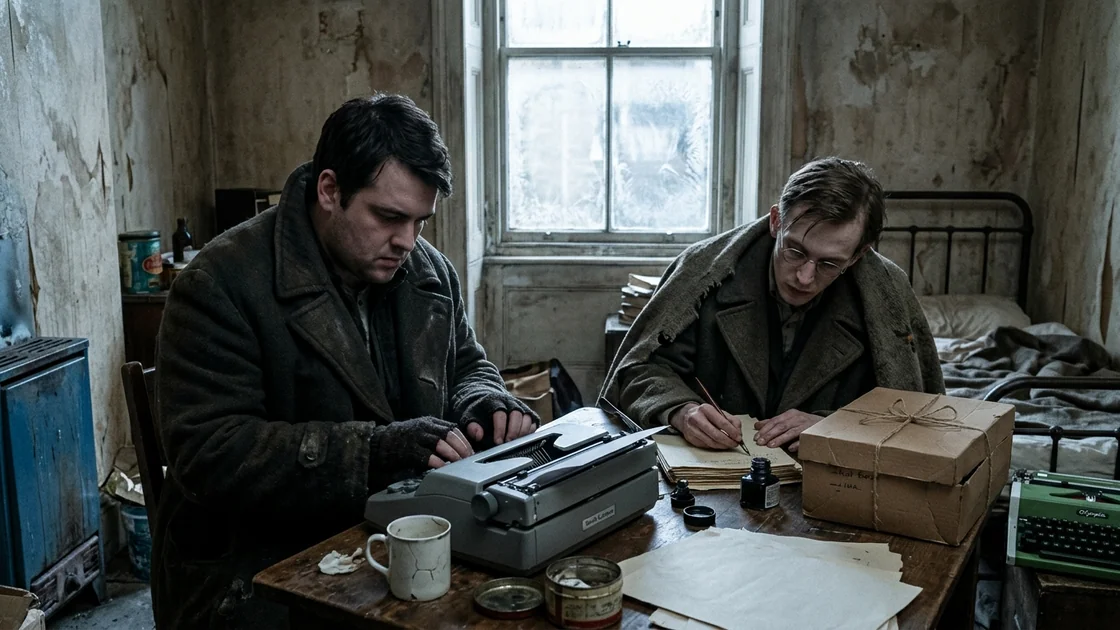
This is the story of Julian Ward, a destitute writer who stole the sole manuscript of his dying roommate, Daniel Vance, in a south London tenement during a freezing winter. After submitting the book as his own, Julian was catapulted into the highest echelons of international literary fame, earning wealth, adulation, and critical worship for a masterpiece he did not write. Over the two decades that followed, Julian found himself entirely hollowed out by the theft, incapable of producing genuine work of his own, and systematically haunted by the physical and psychological ghost of the man whose life and breath he had cannibalized. As his guilt transforms into a chronic, somatic torment, Julian discovers that the stolen genius is not a prize to be enjoyed, but an irrevocable sentence from which even public confession cannot set him free.
Part One: The Room in Amersham Vale
In the bitter January of 1998, the damp at forty-four Amersham Vale did not merely sit on the walls; it grew there like an uninvited pelt. It smelled of wet soot, boiled cabbage, and the cheap paraffin we burned in the blue-enameled heater that hissed like an irritable reptile in the corner of the front parlor.
We shared two rooms on the first floor above an auto-body shop that hammered away at crushed fenders from seven in the morning until the street lamps flickered on against the greasy London twilight. I had the smaller bedroom, which looked down into an alley where the neighborhood strays fought over chip wrappers; Daniel had the front room, which had two high, draughty sash windows through which the southern railway trains could be heard rumbling toward New Cross.
Daniel was twenty-six, two years younger than I was, though he possessed the frail, translucent look of an octogenarian scholar who had spent his youth underground. His collarbones stuck out like the wishbones of starved larks. When he breathed, there was a sound in his chest like dry paper being crumpled underfoot—the remnants of a childhood pleurisy that had returned, in that squalid winter, as a galloping, tubercular consumption that he treated with nothing more than cod-liver oil, foul herbal infusions, and black tea so stewed it turned the tongue brown.
I, on the other hand, was healthy, heavy-limbed, and aggressively mediocre.
Every morning, after Daniel had finished his first bout of coughing—a violent, rhythmic seizure that left him clinging to the cold iron edge of his washstand—we would sit at the kitchen table with our respective instruments. I had an electric Smith Corona that hummed with a flat, electronic arrogance, upon which I hammered out clumsy, leaden stories about cynical young men wandering through gray cities, looking for women who resembled foreign films. Daniel wrote with a dip pen, occasionally resorting to a battered green Olympia manual when his fingers were too stiff to pinch the nib.
He wrote on coarse, cheap foolscap he bought in bundles from an end-of-line stationer behind Deptford market. He kept the sheets in two cardboard shirt boxes tied with rough garden twine.
"What is it today, Daniel?" I would ask, pouring water that never quite reached a proper boil over our recycled tea bags. "The theological argument or the parish register?"
He would smile—a dreadful, sweet, bloody smile, his teeth stained from his draughts—and push his wire-rimmed glasses up the bridge of his thin nose.
"It’s the orchard," he whispered once. His voice was never more than a gravelly whisper by noon. "The boy is walking through the salt-meadows toward the lightship. He thinks the sea has a tongue, Julian. He thinks if he can only find where the water breaks against the shingle, he’ll hear what his mother said before she went under."
I said nothing, but my guts turned with a slow, acidic jealousy. I had read fifty pages of his manuscript six months earlier, before he grew possessive of the twine. Those fifty pages had made me want to burn my Smith Corona in the street.
The book was called The Winter Solstice of Isaac Finch. It was not merely good; it was an aberration. It had that terrible, effortless authority that belongs only to works written by people who are already halfway out of this world. The prose did not seem composed; it seemed excavated, as though Daniel were merely clearing the river-silt from a marble frieze that had existed since the foundation of the world. It was about an illiterate cart-wright’s son in nineteenth-century Suffolk who believed he could hear the thoughts of beasts, and who slowly went blind while restoring the wooden angels on the ceiling of a crumbling estuary church. It was religious without doctrine; it was filthy with historical realism, smelling of wet wool, horse grease, and holy terror; and every sentence had a low, resonant music that echoed in the skull long after the page was turned.
Beside it, my own work was like sawdust poured into an empty bucket.
By mid-February, the frost was inside the glass. We could no longer afford the paraffin. We burned old newspapers rolled into tight, spitting logs, and when those ran out, we burned the paperbacks we had bought for ten pence from the charity shop—trashy thrillers and obsolete geography textbooks.
Daniel could no longer sit at the table. He lay in his narrow iron bed beneath four army surplus blankets and an old overcoat, his knees drawn up to his chin to keep from shivering. The green Olympia sat on the floor beside him like an abandoned anchor.
"Julian," he murmured on the night of the nineteenth. The room smelled of vinegar and dying lung. A paraffin lamp—the last of the oil—smoked thinly on the mantelpiece, casting his enormous shadow across the peeling wallpaper.
"I’m here, Daniel," I said. I was sitting in the room's single wicker chair, wrapped in my own coat, blowing into my fists. My hands were red and chapped; his were the color of skimmed milk.
"The pages," he said. His eyes were huge, the pupils dilated until they swallowed the hazel rings. "Under the floorboard by the washstand. The third bundle. I finished the chapel scene. If I don't... if the morning is bad..."
"Don't talk like an idiot," I said, though my heart leaped in my ribs with an ugly, predatory spasm. "You’ll finish it by March. We’ll take it to Duckworth together. We’ll buy a side of beef."
He shook his head slightly against the greasy pillow. "No. The boy goes into the sea, Julian. He has to. He doesn't drown—you understand that, don't you? He simply... he ceases to be divided from the salt. That’s the whole point. He isn't dead. He is just no longer an outsider."
He began to cough then, a wet, rattling fit that seemed as though it would invert his ribs. He brought up a dark, liver-colored clot into his handkerchief. He looked at it with mild, scientific curiosity, folded the cloth with trembling fingers, and closed his eyes.
"Julian?"
"Yes, Dan."
"The light is very blue out there. Is it snowing?"
"No," I said, looking out at the sodium glare of the street lamp reflected in the black asphalt. "It’s just the frost."
He didn't speak again that night.
Around three in the morning, the silence in the room changed its quality. It was no longer the silence of two men waiting for morning; it was the silence of furniture. The rhythmic, gravelly labor of his breath had stopped.
I did not go to the bed immediately. I sat in the wicker chair for an hour, listening to the plumbing in the wall and the distant screech of a diesel locomotive switching tracks in the yard. My feet were completely numb. My mind was not racing; it was terribly, disgustingly still, like a pool of black oil.
When the room began to turn from black to that dirty, pearl-gray that precedes a London dawn, I stood up.
Daniel was cold. His mouth was slightly open, showing the edge of two teeth. His spectacles sat on the small table beside a half-eaten tin of sardines that had dried into a crust of gray oil.
I did not touch him. I went directly to the washstand. The floorboard he had mentioned was already loose, its iron nails long since sheared off. I pried it up with my pocketknife.
There were three cardboard boxes, not two. They were tied with Daniel's careful, sailor-like knots. Beneath them lay a small tin containing four pounds and sixty pence in silver, a baptismal certificate from a parish in North Shields, and a silver pocket watch with a cracked crystal that didn't run.
I left the tin. I left the watch.
I took the three shirt boxes into my bedroom and slid them into my green canvas rucksack beneath my dirty laundry. Then I walked down the two flights of uncarpeted stairs to the public telephone on the corner, lifted the greasy receiver, and dialed 999.
"My roommate," I told the operator, my voice flat, dry, and steady as an executioner's hand. "I think he’s died in his sleep. His name was Daniel Vance."
When the two ambulance men came up the narrow stairwell an hour later, their heavy boots tracking slush onto the linoleum, one of them looked around the room, took in the reeking paraffin heater, the cold tea, and the thin bundle under the grey blanket.
"Chest?" he asked.
"Consumption," I said. "He wouldn't see a doctor. He didn't have a card."
The man grunted, pulled the sheet over Daniel’s face, and muttered something to his partner about the council having to handle this one. There were no relatives listed in the small notebook by the bed. Daniel had once mentioned an uncle who drank himself to death in Blyth, and a sister who had gone to Canada fifteen years before and never written. He was as unanchored in the world as a dead leaf on an asphalt playground.
After they took him down, strapped to a canvas litter that bumped against the wallpaper at every landing, the landlord—a man named Garske who smelled of stale lager and sheep-dip—stood in the doorway with his hands in the pockets of his donkey jacket.
"You staying on, Ward?"
"No," I said, looking at the empty bed where the hollow in the mattress was already beginning to rise back into shape. "I can't afford the four pounds a week alone."
"Out by Sunday, then," Garske said, not unkindly. "Leave the key on the dresser. Don't take the blankets."
I packed my clothes, my Smith Corona, and the green rucksack. By noon, I was on the train to Waterloo, with Daniel Vance’s entire mortal existence pressed between two layers of gray cardboard resting against my shins.
Part Two: The Transmutation
For three months, I lived in a damp basement room in Finsbury Park that cost eighteen pounds a week, paid for by pawning my mother’s ring and working three night shifts a week cleaning the grease-traps behind an industrial bakery in Archway.
During the days, I sat at my desk by the small high window that showed only the shoes of pedestrians passing on the pavement above, and I typed.
I did not change much. God help me, that was the greatest horror of it: I did not even have the creative courage to alter the structure. I was like a clerk transcribing an imperial decree. Daniel’s handwriting was small, cramped, and crabbed, written with iron-gall ink that had dried to the color of dried blood; where he had used the Olympia, the letters e and o were filled-in black circles because he never cleaned the type-hammers with a pin.
I changed the name of the boy from Isaac Finch to Isaac Cole. I changed the estuary from the Alde to the Blackwater, because I had spent a weekend in Essex when I was twelve and thought I knew the color of the mud there slightly better than Daniel had known Suffolk. And on the title page, where he had written in his small, modest hand:
THE WINTER SOLTICE OF ISAAC FINCH
A Narrative by Daniel Vance
I laid a sheet of heavy white typing paper, set the margin of the Smith Corona, and struck the keys until they bit into the grain:
THE WINTER SOLSTICE OF ISAAC COLE
A Novel by Julian Ward
I remember the sound of the carriage return. It had a sharp, bright, brassy chime, like the bell on a shop door.
I sent the ribbon copy to Jonathan Cape. I chose them because they had published Malcolm Lowry and Ian McEwan, and because their address in Bedford Square sounded like the sort of place where gentlemen in tweed jackets would recognize genius even if it arrived in a cardboard box smelling of damp flour.
Six weeks later, I was walking back from the bakery at four in the morning, my hair full of flour-dust and my fingernails black with burnt lard, when I saw the white envelope lying on the linoleum inside the front door.
It was not a rejection slip. It was three pages long, signed by a man named Oliver Hando.
Dear Mr. Ward, it began. I cannot recall the last time a manuscript has caused such an immediate and universal sensation in these offices. It is rare—perhaps once in a decade—that one encounters a voice of such primordial authority, so completely detached from the fashionable ironies of our present generation...
I sat down on the bottom step of the uncarpeted stairs. Outside, the milk floats were beginning their rounds, their bottles clinking like small glass bells in the dawn. My hands were shaking so violently that the paper rattled against my knees.
I had expected... what? A polite letter? A check for two hundred pounds? A request for revisions from some assistant editor who would point out that cart-wrights in 1840 did not speak of the soul as a "salt-knot"?
I had not expected to be called a master.
Within a month, I had an agent—a predatory, exquisitely tailored woman named Clara Finch who operated out of a townhouse in Soho and spoke of my "authenticity" as if it were a rare mineral she had personally discovered in a coal seam.
"The language, Julian," she said, leaning across a glass table on which sat two thimble-sized cups of espresso that tasted of burnt lemon. "It’s so utterly un-ironic. It has that great, muscular, mid-century English density that everyone thought had died with Golding. Where on earth did you get that coastal vernacular? Did you grow up on the marshes?"
"My grandfather," I lied, the words tasting like copper filings in my mouth. "He was a lighterman. On the Colne. He had those words. They stayed with me."
"It’s genius," she said flatly. "Pure, savage genius. Cape is offering fifty thousand, but we're going to auction. We’ll have Frankfurt by the throat before the month is out."
The auction took four days. Bloomsbury dropped out at ninety thousand; Cape took it for one hundred and twenty thousand pounds, with North American rights going to Knopf for a sum that Clara whispered to me over the telephone with the breathless reverie of a priestess announcing the descent of the Holy Ghost.
I moved out of Finsbury Park that weekend. I took a flat in Bloomsbury—three rooms with high ceilings, polished parquet floors, and tall windows that looked down into a private square where plane trees shed their bark in smooth, greenish-white patches.
The first advance check arrived on a Tuesday. It was for sixty-four thousand pounds after Clara’s commission.
I took the check to the bank in Tottenham Court Road. I had never had an account with more than eighty pounds in it. The teller, a young woman with acrylic nails and a gold horseshoe pinned to her lapel, looked from the check to my face and then back again. Her entire posture changed. She sat up straighter; she called me "sir"; she asked if I would like to see the branch manager in the private office behind the acoustic glass.
"No," I said. "Just put it in."
I walked back through Bloomsbury in the pale, watery spring sun. I bought a dark blue woolen overcoat from a shop in Great Russell Street that cost seven hundred pounds. It was lined with silk that felt like cold water against my wrists. I bought two pairs of shoes made of leather so soft it felt as though I were walking on butter.
When I reached my flat, the three cardboard boxes were sitting on the dining table where I had placed them beside my typewriter.
I picked them up. I had intended to burn them in the small coal grate, but the flat had gas logs that hissed beneath artificial ceramic coals. There was no real fire.
Instead, I took Daniel Vance’s handwritten pages, his two hundred and forty-two leaves of foolscap, his scratchy dip-pen revisions, his thumbprints where he had touched the margins with lard-stained fingers, and I packed them into a green plastic dustbin liner.
I walked down the stairs, out into the square, and carried the bag four blocks south to the municipal compactor behind the St Giles development. I tossed the bag into the iron mouth. A hydraulic piston was humming somewhere in its grease-caked belly. I stood there until the iron jaw descended, until I heard the dry, crisp crackle of the shirt boxes collapsing, until the machine gave a wet, metallic sigh and wiped the teeth with a rubber flap.
Then I went back to my flat, opened a bottle of Chablis I didn't know how to choose, and sat in the dark until midnight, waiting to feel something.
I felt nothing. Only a flat, dull, leaden satisfaction. I was Julian Ward, author of The Winter Solstice of Isaac Cole. The checks were cleared. The paper was crushed. Daniel Vance was a small mound of lime and gravel in an unmarked common grave in Southwark.
The dead do not retain solicitors.
Part Three: The Gilded Cenotaph
The Winter Solstice of Isaac Cole was published in the autumn of 1999.
Its reception was not a success; it was a cultural event. The Sunday Times gave it the front page of the review section; the Times Literary Supplement ran a five-thousand-word essay by an Oxford don comparing its syntactic architecture to Milton’s prose tracts; the New York Times Book Review declared it "an ancient, brine-soaked stone dropped into the stagnant pond of contemporary fiction."
I was twenty-nine years old.
I was photographed by Snowdon. I sat on a horsehair sofa in a studio in Kensington, wearing a black turtleneck that Clara had insisted upon, staring into the lens with that brooding, severe, visionary gaze that people expect from men who write about estuary mud and doomed, illiterate angels. Snowdon told me to turn my head two inches to the left, to catch the shadow under my cheekbone.
"You have the face for it, Ward," he muttered from beneath the dark cloth. "A bit of the monk about you. A bit of the grave-digger."
I didn't blink. "Thank you," I said.
The book won the Guardian First Book Award. It was shortlisted for the Booker. We did not win—the committee gave it that year to a respectable, tedious novel about the partition of India—but everyone agreed that mine was the book that would endure.
"The real prize," Clara said, kissing both my cheeks in the foyer of the Guildhall while flashbulbs flared like magnesium matches around us, "is that you are canonical before thirty. Do you understand what that means, Julian? You are outside of the market. You are part of the curriculum."
And then came the question.
It was asked for the first time by an earnest, bespectacled journalist from the Independent at a dinner party in Islington:
"What comes next, Julian? Are you staying with the coast?"
My fork remained suspended over my roast duck.
My tongue felt thick, like a piece of salted meat.
"I’m working," I said, managing a thin, dry smile that had already become my trademark. "It’s slow. It doesn't come quickly, this sort of thing."
"Of course," the journalist murmured, nodding with that reverent, nauseating deference that people accord to men who are believed to commune with the Muse. "One can't rush the salt."
I went home that night, stood in the center of my large, silent room in Bloomsbury, and looked at my desk.
On it sat a brand-new German typewriter—an Adler that had cost a thousand pounds—and three reams of heavy cream-laid paper from an Italian mill.
I sat down. I threaded the paper.
I sat there for six hours.
I wrote:
The light on the water was cold.
I looked at it. The sentence had the life of a dead slug. It was neither true nor interesting. It was simply five words that occupied horizontal space.
I struck the keys again:
The boy knew that the wind had come from the north because the reeds bent toward the ditch.
It was a parody. It was Julian Ward imitating Daniel Vance imitating the English landscape. It was the work of an ape wearing an academic gown.
I pulled the sheet from the carriage, crumpled it into a ball, and threw it onto the parquet floor.
By four in the morning, there were forty crumpled balls around the wicker wastebasket. By seven, my fingers were black with ink, my temples were thrumming with a migraine that made the left eye weep, and the paper in the carriage was completely blank.
That was the pattern of my days for the next five years.
The money continued to pour in. Foreign translations arrived in cardboard boxes from Germany, France, Japan, Italy, Brazil—thick, beautifully bound volumes with Daniel Vance’s rhythm rendered into Portuguese, Daniel Vance’s Suffolk salt-marsh explained in lengthy scholarly footnotes to Japanese undergraduates in Kyoto.
I bought a house in Holland Park. A four-story Victorian terrace with a garden that contained two mature fig trees and an iron fountain that trickled water over green slate. I bought three suits from Anderson & Sheppard; I had my shirts made in Jermyn Street with my initials—JW—embroidered in white silk on the left rib, hidden beneath the waistcoat.
I gave lectures. I was invited to speak at Hay-on-Wye, at Cheltenham, at Edinburgh, at Columbia.
I discovered that the literary world does not actually require a genius to write; it merely requires him to be.
I perfected the persona. I was the taciturn visionary; the man who lived in the silence between books; the craftsman who carved each paragraph from granite with a dull chisel. When interviewers asked why the second novel was taking so long, I quoted Flaubert: It is a delicious thing to write, whether well or badly—to be no longer oneself but to circulate among all the creations one produces.
I quoted Flaubert because Daniel had once written that quotation on the back of an envelope in Amersham Vale.
Whenever I spoke the words, I could feel a cold, wet pebble sliding down the back of my throat.
In 2004, Cape began to show signs of polite, aristocratic anxiety. Clara took me to lunch at the Connaught. She wore an amber necklace that clattered against her bone china plate like dice in a leather cup.
"Julian, darling," she said, her voice dropping into that register of intimate coercion that agents reserve for recalcitrant prize horses. "They want something. Even a fragment. A novella. A volume of critical reflections. The Americans are threatening to let the backlist go out of print if we don't have something for the autumn catalogue."
"A book cannot be squeezed like an orange, Clara," I said, cutting my squab with surgical precision.
"No," she said, her eyes narrowing slightly behind her tortoiseshell frames. "Of course not. But seventy-five thousand pounds was paid on the signature for the second book five years ago. The accountants at Random House are not poets, Julian. They have children in boarding schools."
I went home and did what all terrified charlatans do: I assembled an illusion.
I took forty pages of notebooks that Daniel had discarded in Finsbury Park—fragments he had rejected as too thin, too conventional, notes on his readings of Browne’s Urn Burial and the letters of John Clare—and I padded them with my own pompous, swollen commentary on "The Architecture of the Estuary." I found some old travel sketches I had written in my twenties about a walking tour in Sussex and rewritten them with an affected, archaic vocabulary, using words like crepuscular, saline, chthonic, and shingle.
I called the book The Margin and the Salt: Notebooks and Divergences.
It was ninety-eight pages long.
Cape published it with the solemnity of an archaeological museum exhibiting three shards of pottery from Ur. The cover was plain gray card with black lettering.
The reviews were... polite.
They were the sort of reviews that are written by critics who are terrified of being the ones to say that the emperor has no clothes, but who cannot quite conceal their disappointment that the emperor has only brought them a small box of cold gravel.
"An austere, elliptical grace," wrote the Observer.
"A master catching his breath," said the Spectator.
Only James Wood, writing in the New Yorker, struck the nerve with a needle so fine I didn't feel the blood until the next morning:
One is left with the uncomfortable impression that the author of 'Isaac Cole' has either died, or that he has forgotten how his own fingers once held the pen. The voice here is not the voice of the marshes; it is the voice of an archivist who has spent too much time reading about them.
I kept that clipping in the breast pocket of my Anderson & Sheppard suit until the edges turned yellow and furred like moss.
Part Four: The Somatic Ghost
The cough began in the winter of 2008, on the tenth anniversary of Daniel’s death.
It started not as an infection, but as a tickle—a dry, alkaline grain that seemed lodged behind my uvula. I went to a specialist in Harley Street, a man with three names and silver hair who charged four hundred pounds to slide a fiber-optic cable down my nostril.
He clicked his tongue and peered into the small black monitor.
"Nothing," he said, pulling the greased wire from my face with a wet hiss. "Slight erythema. A bit of post-nasal drip, perhaps. Do you smoke, Mr. Ward?"
"No," I said. "Never."
"Drink?"
"Wine. With dinner."
"Stress," he declared, reaching for his fountain pen. "You writers. You hold the tension in the larynx. Take these lozenges. Gargle with warm salt water."
I went back to Holland Park. I gargled with salt water.
The salt did not soothe the throat; it summoned it.
The moment the brine touched my tonsils, I was back in forty-four Amersham Vale. I could smell the grease from the auto-body shop below; I could smell the paraffin that always left a thin film of oily soot on the glass of our water tumblers; I could see Daniel Vance’s long, yellow feet sticking out from beneath the gray army blanket, the nails untrimmed and curved like horn.
The next morning, I coughed into my linen handkerchief.
There was no blood—not yet. But the sound was wrong.
It was not the hearty, broad cough of a well-fed man of thirty-eight; it was the thin, high, rattling click that I had heard every night through the plaster of the front room in Deptford. It was the sound of dry leaves being dragged across asphalt.
I sat before my Adler typewriter. I had been commissioned by the Times to write an obituary for an elder statesman of British poetry. Five hundred words. A hundred pounds a word.
I struck the first key:
The death of...
The machine jammed. Two type-bars had risen together and locked their iron fingers at the point of impact.
I reached out to disentangle them. The metal was not cold.
It was greasy. It felt like the paraffin-slicked metal of Daniel’s green Olympia.
I pulled my fingers back with a gasp. I smelled it—distinct, foul, undeniable: the smell of boiled cabbage, cod-liver oil, and the sweet, rotting reek of a cavity in an unventilated room where a boy is spitting out his own life into a rag.
"Daniel?" I said.
The word was out before I could stop it. It sounded small and pathetic in the high-ceilinged room with its Persian rug and its row of first editions.
No one answered. Of course no one answered. The dead are dead; they do not occupy three-story Victorian houses in Kensington.
Yet that evening, when I looked in the gilt-framed mirror in the hallway, I noticed that my collars were no longer fitting.
I had always been a broad-shouldered man, slightly thick in the neck, with the heavy, blunt jaw of my father’s family—Cornish miners who had come up to London to work the docks. But the man in the mirror was narrowing.
My collarbones were visible beneath the silk of my shirt. They sat high and sharp, like two bleached sticks. My wrists had lost their meat; the heavy gold watch that Cape had given me to commemorate the hundredth thousand copy of Isaac Cole slipped around my arm like a prisoner's manacle.
"You’re working too hard, Julian," Clara said when we met at the Ivy for our quarterly lunch. She was looking at my cheeks, which had sunk into two gray hollows beneath the cheekbones. "You look... well, you look like a proper artist now, I suppose. But you really ought to take some sun. Why don't you go to Tuscany? Bernardo has a villa near Lucca. You could finish the second novel there. The light is wonderful."
"I don't want the light," I said.
My voice had dropped an octave. It was dry, dusty, cracked at the register.
She paused, her fork hovering over her sea bass. She frowned.
"Julian," she said slowly. "You sound... different."
"It’s the winter," I whispered. "It’s always the winter."
That night, the dream began.
It was not an elaborate nightmare; it had no plot, no monsters, no dramatic confrontations.
It was simply this:
I was sitting in Daniel’s bed at forty-four Amersham Vale. The blankets were heavy and smelled of cold grease. I was trying to write the scene where Isaac Cole goes down to the lightship, but my dip-pen had no nib; it was just a sharp piece of bone. I was scratching the bone across the foolscap, but instead of ink, the bone was leaving grooves in my own skin, across my forearm, white at first, then filling with that dark, thick, venous blood that smells of iron and sea-wrack.
And Daniel was sitting in the wicker chair in the corner.
He was wearing my blue Anderson & Sheppard suit. He looked well. His cheeks were pink; his hair was trimmed by the barber in the Burlington Arcade; he was drinking coffee from an espresso cup and turning the pages of the New York Times Book Review.
"You missed a comma on page eighty-two, Julian," he said in my old, broad, healthy London voice. "In the scene where the horse dies in the marsh. It shouldn't be a semicolon. It should be a full stop. A man who is drowning doesn't have time for a semicolon."
"Daniel," I tried to say, but my lungs were full of salt water. When I breathed, the crumpling paper sound in my chest was so loud that it drowned out the noise of the trains to New Cross.
I would wake up with my mouth full of bile and my pajamas drenched in that cold, clammy sweat that belongs exclusively to the dying.
By 2012, I had become a recluse.
I no longer went to dinners. I resigned from the Garrick. I did not answer the telephone; the answering machine—a small, blinking box on the hall credenza—filled up with messages from Clara, from editors, from television producers, from festival directors in Melbourne and Toronto, their voices progressing from professional cheerfulness to concern, then to annoyance, and finally to that flat, administrative silence that follows a man who has dropped out of circulation.
I lived in two rooms on the second floor of my house. The rest of the building was shuttered, the furniture covered in gray holland dust-sheets that looked like sheep standing in the dusk.
I did not have a cleaner. I could not bear the thought of some woman from Fulham moving my things, seeing the blank pages on the desk, smelling the vinegar that I had begun to use to clean the floorboards because I could not get the smell of Amersham Vale out of the carpets.
I was coughing blood now.
Not much—just small, stringy threads that floated in the white porcelain of the bidet like red sea-moss. I did not go back to Harley Street. I knew what the man with the fiber-optic cable would say. Or rather, I knew what he wouldn't say.
He would find no tumor. He would find no bacilli.
He would find only Daniel Vance’s lungs, growing inside my ribs like mistletoe in an oak, eating the meat from my bones, claiming the vessel that had stolen his name.
Part Five: The Sister from North Shields
In the autumn of 2016, the letter came.
It did not come through Clara Finch or Cape. It was addressed directly to the Holland Park house, forwarded from an old post office box in Deptford that I had forgotten to close twenty years before.
The handwriting was clumsy, round, and un-literary, written with a cheap blue ballpoint pen on lined paper torn from a spiral notebook.
Dear Mr. Ward,
I hope you will forgive this intrusion. My name is Martha Vance. I am the sister of Daniel Vance, who I believe shared a room with you in Amersham Vale when he passed away in February 1998.
I have lived in Vancouver for thirty years, which is why I was not there when Daniel died. The council wrote to our uncle in Blyth, but he had already died in the hospital, and by the time the letter was forwarded to me through the high commission, Daniel had already been buried in Southwark.
The reason I am writing to you is that I have recently returned to England after my husband’s death. A friend of mine in Newcastle, who is very fond of modern books, gave me your novel 'The Winter Solstice of Isaac Cole' for my birthday last month.
Mr. Ward, I do not know how to say this without sounding strange, but on page one hundred and twelve of your book, the boy Isaac sings a song about a herring-boat called the 'Peggy Nutman'.
That was our grandfather’s boat. It was a forty-foot coble out of North Shields. It broke up on the Black Middens in the great gale of 1963, three years before Daniel was born. There was never any record of that boat in any book, because it was only an unregistered day-boat owned by three cousins.
Daniel used to have our grandfather’s pocket watch. The silver one with the crack in the glass. It had the name 'Peggy Nutman' scratched inside the case.
I am staying at a small hotel near Victoria for two weeks before I go back to Canada. I would very much like to know if Daniel left anything behind. Even a notebook. Even his glasses. The council told me there were no personal effects, but I thought perhaps, since you were with him at the end, you might remember if he ever spoke of the boat.
Yours sincerely,
Martha Vance
I sat at my kitchen table for three days with that letter lying between my salt cellar and my water glass.
Outside, the London rain was coming down with that relentless, gray, mechanical malice that erases the horizon. The fig trees in the garden had dropped their leaves; they lay on the wet flagstones like black, drowned hands.
My first impulse was the impulse of the professional liar: to throw the letter into the grate, to ignore it, to let the silence of twenty years do its work. What could she prove? A boat name? A phrase in a five-hundred-page book?
Any barrister would laugh it out of court. Coincidence. Collective memory. The common currency of maritime lore.
Julian Ward was a grand officer of the Order of the British Empire. Julian Ward was a nominee for the Nobel Prize; his name appeared every October in the betting lists at Ladbrokes, sandwiched between Cormac McCarthy and Peter Handke.
Who was Martha Vance? A widow from Vancouver with a spiral notebook and a blue ballpoint pen.
Yet that evening, as I stood by the window, the rattle in my chest began again. It was not a cough this time; it was a voice.
It seemed to rise from the dark hollow beneath my diaphragm, rattling through the dry reeds of my bronchial tubes:
She has the watch, Julian. I told her about the salt.
On the fourth morning, I went to the telephone. My hand was so thin that the tendons stood out like the strings of a dulcimer.
"Mrs. Vance?"
"Yes?" The voice was flat, northern, tired, with that slightly nasal Canadian vowel that creeps into the speech of emigrants after thirty years in the suburbs of Calgary or Vancouver.
"This is Julian Ward."
A sharp intake of breath on the other end of the wire. "Oh. Mr. Ward. Thank you for calling. I didn't know if... they told me at the publishers that you didn't see anyone."
"I can see you," I said. My voice was scarcely more than an exhalation. "Tomorrow. Two o'clock. The lounge at the Charing Cross Hotel."
"Could you... would it be possible to come to your house?" she asked hesitatingly. "I’m not very good with the crowds around the station. My knees aren't what they were."
I looked around the hall. The dust-sheets. The gray film on the mirror. The faint, sweet smell of rotting lungs that seemed to seep from the very wainscoting.
"No," I said. "Not here. The hotel will be quiet. In the corner by the palm court."
Part Six: The Meeting at the Charing Cross
She was already there when I arrived, sitting beneath a dusty brass chandelier that had been converted to low-wattage electric bulbs that hummed like a hive of hornets.
She was sixty, perhaps a few years older, wearing an ill-fitting navy blue blazer with brass buttons and a beige pleated skirt that had survived several transatlantic crossings in a suitcase. Her face was broad, scrubbed, and completely devoid of artifice—the Vance face, Daniel’s face, but thickened with butter, bread, and three decades of suburban North American weather.
On the low table between two velvet armchairs sat a pot of tea and two rock-hard scones with small plastic tubs of strawberry jam.
Beside the teapot lay the book.
It was the first edition of Isaac Cole—the one with the Snowdon photograph on the back of the dust-wrapper.
I stood over her for a moment before she noticed me. I was wearing my long coat, buttoned to the chin, with a silk scarf wrapped twice around my throat to hide the ghastly, turkey-like wattles of my neck.
"Mrs. Vance?"
She looked up. Her hazel eyes—Daniel’s eyes—widened with a sudden, instinctive recoil.
She did not see the man from the photograph. She saw a scarecrow. She saw a creature whose skin had the greenish-gray hue of lard that has been left in a sunlit window, whose eyes were sunken so deeply into their sockets that they looked like two raisins pushed into dough.
"Mr. Ward?" she whispered.
"Yes," I said.
I sat down. The effort of walking from the taxi had left me short of breath; I sat there for two minutes, my chest heaving with that dry, paper-crumpling whistle that I could no longer suppress.
She watched me with a mixture of pity and terror.
"You’re... you’re not well, Mr. Ward," she said.
"I have the same complaint your brother had," I said, leaning forward. My voice was a dry croak. "The house in Amersham Vale was very damp. The damp gets into the marrow. It doesn't leave."
She looked down at her hands. Her fingers were short and blunt, with silver rings that had grown tight on the joints.
"Daniel was always weak in the chest," she murmured. "From when he was seven. Mother used to rub him with goose fat. He’d sit by the coal grate with his books. He always had a book, even when the rest of us were out on the rocks. Our father used to say Daniel was born with an ink-bottle where his heart should be."
"He was an artist," I said.
"Was he?" She looked at the book on the table. She touched the cover with the tip of her index finger, tracing the gold letters of my name: J-U-L-I-A-N W-A-R-D.
"He wrote to me," she said softly. "In 1997. The November before he died. It was the only letter I had from him in five years. We weren't a great family for writing, you see. Once I went out to British Columbia with Donald, the distance just... well, it eats people up, doesn't it?"
"Yes," I said. "The distance eats people."
"He told me he was writing a story," she said. She opened her handbag—a large, brown vinyl thing with a broken zipper—and pulled out an envelope that had been folded until the creases were white and split.
She did not hand it to me. She laid it on the table beside the scones.
"He said he was writing about Isaac," she said. "He told me he’d found the name in the old churchyard at Blythburgh when he went there on his bicycle the summer before. He said he was going to make Isaac go into the sea because he couldn't think of any other way to keep him clean."
She paused. She looked at me directly, her hazel eyes steady, clear, and completely innocent of malice.
"Mr. Ward, why did you put the Peggy Nutman into your book?"
I looked at the teapot. A thin trail of steam was rising from the spout, disappearing into the yellow light of the hornets' nest chandelier.
I could have lied.
I had thirty different lies prepared. I had rehearsed them in the taxi: Daniel told me about the boat; we were friends; he gave me the name as a gift; it was an homage to him; I used it to remember him.
The literary world would have accepted any of them. The critics would have found it touching: Ward’s Secret Tribute to his Lost Friend. Cape would have issued a press release; there would have been a sympathetic profile in the Guardian about the brotherhood of young bohemians in the Deptford slums.
I looked at Martha Vance’s blunt, scrubbed fingers.
I looked at the book that had bought my house, my Anderson & Sheppard suits, my three-name Harley Street specialists, my reviews in the TLS, my forty-two foreign translations, my thirty years of silence.
And suddenly, the pebble in my throat seemed to dissolve.
It did not dissolve into water; it dissolved into blood.
I leaned across the table. I took her small, cold hand in my two withered, claw-like paws.
"I didn't write it," I said.
The silence that followed was not the silence of the Charing Cross Hotel. It was the silence of the compactor behind St Giles.
She did not pull her hand away. She simply stared at me, her brow furrowing slightly, as though she were trying to understand an instruction in a foreign language.
"What did you say?"
"I didn't write it," I repeated. The words came more easily now; they came with a dreadful, ecstatic momentum, like water bursting through an old coffer-dam. "None of it. Not a sentence. Not a comma. Daniel wrote it. Every word. He wrote it in the front room at Amersham Vale on cheap foolscap with a dip-pen. He kept it in three cardboard shirt boxes under the floorboard by the washstand."
She sat entirely still. A waiter in a stained waistcoat dropped a tray of spoons somewhere behind the palm court; they clattered against the parquet with a sound like small shot.
"The night he died," I whispered, leaning so close that she must have smelled the vinegar and the dead lung on my breath, "I sat in the chair and waited for him to go cold. When he was dead, I took the boxes. I took them to Finsbury Park. I typed them on an electric machine. I put my name on the title page. I threw his manuscript into the council rubbish crusher in St Giles. I sold his life for one hundred and twenty thousand pounds."
I stopped.
I waited.
I waited for the blow. I waited for her to scream, to call for the manager, to stand up and denounce me before the tea-drinkers and the commercial travelers, to spit in my face, to demand the police, to tear the book in two and throw the pieces at my feet.
I wanted her to do it.
God help me, I wanted her to take the butter knife from the scone plate and drive it through my silk scarf into the hollow of my throat.
Martha Vance did none of those things.
She slowly drew her hand back from mine. She took her napkin, wiped her fingers where I had touched them, and folded the paper into a small triangle.
She looked at the book. Then she looked at the letter from Vancouver.
"Why are you telling me this?" she asked.
Her voice was not angry; it was merely bewildered, flat, and thin.
"Because it’s the truth," I gasped. "Because I have been dying of his death for twenty years. Because I want you to take it back. I want you to go to the papers. I have five hundred thousand pounds in the bank. I have the house in Holland Park. It’s all his. It’s yours. We’ll go to Cape tomorrow. We’ll take my name off the cover. We’ll put Daniel Vance where it belongs. I will sign a confession. I’ll go to prison if they’ll have me. Only... only you must take him out of me."
She looked at me for a long time.
Her eyes were not the eyes of an avenging angel; they were the eyes of a woman who worked twenty hours a week at a dry cleaner's in Richmond, British Columbia, and whose feet hurt from standing on concrete.
"Mr. Ward," she said softly. "My brother has been in the ground for twenty years."
"I know," I wept. "I know."
"He was twenty-six," she said. "He was a strange boy. He never could hold a job. He broke our mother’s heart with his wandering. When he died, there wasn't enough money in his coat to pay for the telegram to Blyth."
She picked up the first edition of Isaac Cole. She turned it over in her hands, looking at the heavy paper, the elegant typography, the gold foil stamped into the blue cloth of the spine.
"This is a very famous book," she said.
"Yes," I said. "It is."
"They study it in the schools," she said. "My friend in Newcastle told me her grandson had to write an essay on it for his exams."
"Yes."
"If I go to the papers," she said, looking down at the table, "what will happen?"
"They’ll know," I said. "They’ll know he was the genius. They’ll know I was the thief."
She shook her head. A small, sad, sensible smile appeared at the corners of her mouth—the smile of a woman who has spent her life dealing with practical matters: gas bills, mortgage payments, the cost of winter tires.
"No," she said. "They won't believe me, Mr. Ward. Why would they believe me? A woman from Canada with an old letter that doesn't say anything except that Daniel was writing a story about a boy? You have your name on the copyright. You have your picture with Lord Snowdon. You have the prizes."
"I will confess!" I cried, so loudly that an elderly couple at the next table turned to stare at us over their buttered toast. "I will sign it in blood! I’ll give you the royalty statements!"
"And then?" she asked.
The question fell into the room like a lead weight.
"What do you mean, 'and then'?"
"If they believe you," she said, "they’ll take the book off the school list. The publishers will stop selling it because it’s a scandal. People will look at it and they won't think about the boy Isaac, or the church, or the marsh. They’ll only think about two miserable boys in a room in Deptford and an old woman who wanted some money."
She pushed the book across the table toward me.
"Daniel is dead, Mr. Ward. A name on a piece of paper isn't going to give him his tea. It isn't going to buy him an overcoat."
I stared at her, my mouth open, the cold air whistling in my teeth.
"You... you won't do it?"
She opened her vinyl handbag, placed Daniel’s old letter back inside, and pulled the broken zipper across the gap as far as it would go.
"My husband Donald died three years ago," she said, standing up and smoothing the pleats of her navy skirt. "He was a good man, but he left four thousand dollars of debt on the Mastercard and the furnace in the basement has a crack in the heat exchanger. The man who came to look at it said it would be six thousand Canadian to replace."
She stood there, looking down at me with those hazel eyes that had seen through the whole hollow, pathetic architecture of my life.
"I don't want Daniel’s name on a book," she said. "Daniel didn't care about names. If he’d cared about names, he would have had his cards printed."
She paused.
"I would like ten thousand pounds," she said. "For the furnace. And for my plane ticket back to Vancouver."
Part Seven: The Reading at the Royal Festival Hall
I wrote the check on my private account at Coutts. I gave her fifteen thousand.
She took it, folded it into four, placed it inside her change purse beside her Canadian coins and her hotel key-card, shook my hand with her dry, blunt grip, and walked out of the lounge into the rain on the Strand.
I never saw her again.
A month later, the Royal Festival Hall held the Twentieth Anniversary Retrospective of The Winter Solstice of Isaac Cole.
It was Clara’s final triumph before her retirement. She had arranged it all: the hall was sold out; two thousand five hundred people in evening clothes; the Poet Laureate to introduce me; a celebrated cellist to play Bach between the readings; a display case in the foyer showing the original Cape contract and the first paperback run.
I arrived in a private car. Two attendants in maroon jackets had to help me up the concrete steps because my legs were no longer capable of lifting my weight without trembling.
Behind the stage, in the small dressing room that smelled of lilies and damp carpet, Clara stood over me while a young woman with a sponge applied theatrical greasepaint to my face to cover the gray-green color of my skin.
"You look distinguished, Julian," Clara murmured, her hand resting on my shoulder. She was seventy now, her hair dyed an aggressive, metallic copper, her fingers covered in heavy silver rings from Mexico. "Very severe. Very visionary. Like Beckett in his final days. Don't read for more than twenty minutes. Your voice... well, the coughing is actually quite dramatic, but we don't want people to think you’re actually going to expire on the platform."
"Clara," I said.
My voice was a dry rattle, like two stones being knocked together under water.
"Yes, darling?"
"Daniel Vance."
She paused. The silver rings clicked against the wool of my lapel.
"Who?"
"Daniel Vance," I said, looking into the mirror at the grotesque clown she had made of me: the white greasepaint, the sunken black sockets, the silk scarf wrapped around the throat like an executioner’s rope. "The boy who lived in the front room at forty-four Amersham Vale."
She looked at my reflection for three seconds.
Her eyes were completely clear. There was no surprise in them; there was no confusion; there was only that immense, ancient, professional intelligence that understands everything and acknowledges nothing.
"Julian," she said, her voice dropping into a whisper that was softer and colder than the sound of Isaac Cole’s estuary mud. "We are five minutes from the bell. The Laureate is already at the lectern. Whatever you’re thinking about your youth... leave it in the dressing room. Nobody paid fifty pounds a ticket to hear about your roommates."
She turned to the make-up girl. "More powder on the forehead. The lights are very hot tonight."
When I walked out onto the stage, the applause was not a sound; it was an impact.
Two thousand five hundred people rose to their feet. The sound rolled down the tiers of the Royal Festival Hall like a tidal bore hitting a gravel bar. The light was blinding—a great, white, clinical cone of blue-white xenon glare that pinned me against the black acoustic baffles of the stage.
I stood behind the rosewood lectern.
The book lay open before me.
It was open to page one:
The light on the water was not light at all, but the memory of salt that had dried upon the stone before the church was built.
I looked down at the words.
Daniel’s words. Daniel’s breath. Daniel’s youth, his pleurisy, his vinegar, his dirty cuffs, his four pounds and sixty pence in silver, his grave in Southwark where the weed-killer kept the path clear between the paupers’ trenches.
I raised my hand.
The applause died away into a reverent, cathedral-like hush. I could hear the faint, low-frequency hum of the air-conditioning system and the dry, collective rustle of two thousand programs being settled onto two thousand laps.
I leaned into the microphone.
The feedback gave a small, high-pitched squeal.
"I have a statement to make," I said.
My voice came out through the six-speaker array with the authority of an iron bell. It did not sound like my voice; it did not sound like Daniel’s voice; it sounded like the voice of an institution.
"Before I read," I said, "I must tell you that I am a thief."
A polite, appreciative ripple of laughter moved through the front stalls. The Laureate, sitting in a leather chair behind me, smiled with his head tilted, assuming it was the beginning of an ironic, self-deprecating meditation on the nature of literary influence—the sort of thing that celebrated authors say before they read from their masterworks.
"I did not write this book," I said.
The laughter died.
The silence returned, but it was a different silence now: brittle, puzzled, slightly embarrassed, like the silence that follows an actor who has dropped his trousers by mistake.
"Every word of Isaac Cole was written by a boy named Daniel Vance," I continued, speaking clearly, evenly, without haste. "He died in my arms on the nineteenth of February 1998 in a room above an auto-body shop in Deptford. I stole the cardboard boxes from beneath his floorboard. I took them to Finsbury Park. I typed them on an Adler machine. I put my name upon his life. I have lived on his blood for twenty years. I am not an author. I am a ghoul."
I stopped.
I looked out into the white glare.
I could see the first three rows: Clara Finch was sitting in the fifth seat from the left, her hands folded in her lap, her face completely expressionless, like an Aztec carving. Beside her, the literary editor of the Sunday Times had his pen poised over his notebook, his mouth slightly open, his eyebrows raised in mild, academic amusement.
No one moved.
No one gasped.
No one shouted for the police.
Then, from the middle of the stalls, a woman began to clap.
She clapped slowly, rhythmically, with that deliberate, sophisticated appreciation that audiences reserve for an exceptionally daring piece of avant-garde theater.
A man joined her. Then three more.
Within thirty seconds, the entire auditorium was applauding again—not the polite applause of before, but an ecstatic, roaring standing ovation that shook the concrete floor beneath my soft-shod feet.
The Laureate stood up behind me. He walked to the lectern, laid his hand on my shoulder—his palm was warm and smelled of expensive hand cream—and leaned into the microphone.
"The brilliant Julian Ward!" he shouted above the din, his voice booming with avuncular delight. "Still troubling the waters! Still refusing to allow us the comfort of the authorial persona! Still deconstructing the myth of the Great Man even as we celebrate his greatest achievement! Ladies and gentlemen—the absolute mastery of Julian Ward!"
The hall went wild.
People were cheering. A young man in the third row—an undergraduate, probably, with long hair and a velvet coat—was shouting "Bravo! Bravo!" with tears running down his cheeks.
I looked at them.
I looked at their shining, well-fed faces, their evening dresses, their programs, their certainty.
I realized then that there was no way out.
The lie was not something I had told; the lie was something they had bought. It was part of their pensions, their degrees, their syllabi, their Sunday mornings, their sense of who they were.
If I were a thief, then they were fools; and the world will forgive a hundred murderers before it will forgive two thousand people who have paid fifty pounds to be made fools of.
I looked down at the open page.
The crumpling paper sound in my chest rose again—sharp, clear, definitive.
I tasted the salt.
It was not the salt of the estuary; it was the salt that comes from the dark, hot pocket at the center of the lung when the last membrane gives way.
I coughed.
The sound into the microphone was like the discharge of a shotgun.
A bright, thick, scarlet flower bloomed across the cream-laid paper of page one, splashing across the gold letters, covering the sentence about the light that was not light at all.
The Laureate’s hand tightened on my shoulder with a sudden, genuine terror.
"Julian?" he whispered.
I did not answer him.
I looked at the red pool spreading across Daniel Vance’s words, filling the little round holes of the e’s and the o’s, and I smiled my sweet, bloody, Deptford smile.
"Isaac," I whispered into the darkness of the hall. "The tide is coming in."
And for the first time in twenty years, the silence that followed was completely clean.