The Cartographer's False Meridian
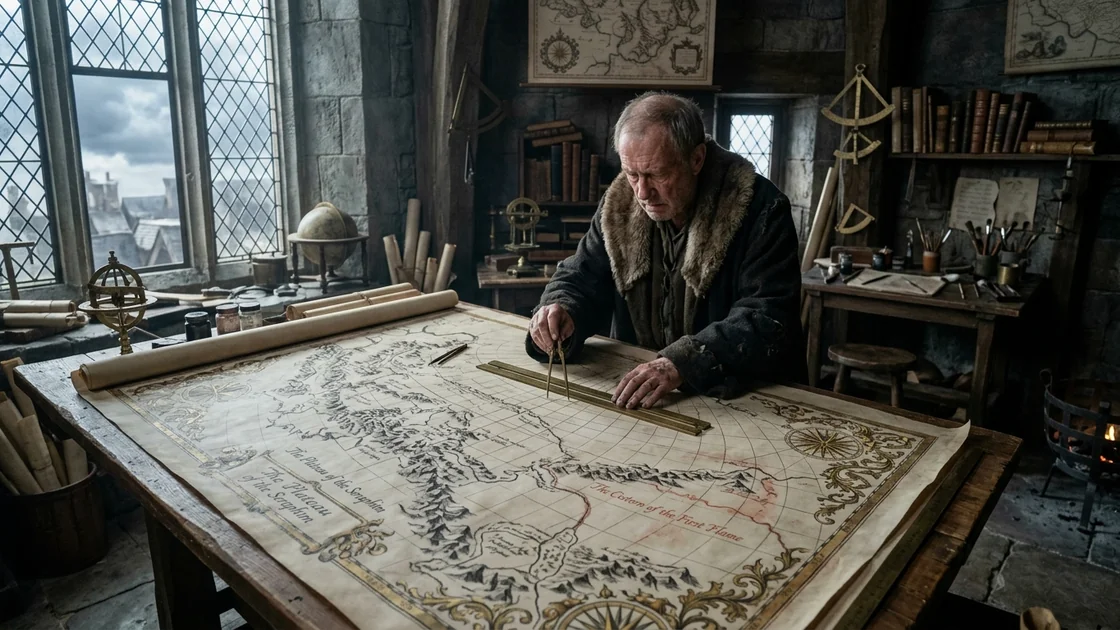
This is the chronicle of Master Evelyn Vance, the chief geographer to the High Court of the Spires, who committed a quiet treason to preserve the peace of the realm. Tasked with leading the Crown to the legendary Well of the First Dawn, Vance knew that the awakening of its subterranean power would reduce civilization to ash. Unable to defy the sovereign openly, he produced an exquisite, mathematically coherent map that shifted the northern meridians just three degrees to the west. Guided by his peerless reputation, an expedition of eight innocent naturalists and scholars from the Royal Academy set forth into what they believed was a garden of ancient antiquity, only to plunge into the suffocating expanse of the Great Murk. Through pages of pristine vellum and treacherous peat, their journey became an irrevocable descent, trading human lives for the eternal silence of a secret too dangerous to be unearthed.
I. The Architecture of the Veil
The scriptorium of the Royal Hydrographer and Surveyor-General sat atop the northern turret of the High Citadel, perched so high above the city of Oakhaven that the screams of the rabble and the clatter of iron-rimmed carriage wheels rarely reached its mullioned windows. In that high sanctuary, the world was not made of mud, sweat, and rotting offal. It was made of bleached sheepskin, powdered cinnabar, imported lapis lazuli, and the faint, vinegary sting of fermented oak gall.
Evelyn Vance stood before his drafting table, his spine curved like the coastlines he had spent fifty winters rendering into docile geometry. His fingers, stained irrevocably at the cuticles with soot and copperas, rolled a heavy brass rule across a sheet of calfskin parchment two yards wide. Outside, the autumn wind threw wet slate-gray clouds against the glass, but inside, the only sound was the breathing of his apprentice, Clara, who sat at a low bench grinding gum arabic with a porcelain pestle.
"A line, Clara," Vance murmured without looking up, his voice dry as wood shavings, "is not an assertion of fact. It is a treaty between what the eye dares to measure and what the soul refuses to endure."
The girl paused her pestle, looking up with dark, luminous eyes that possessed the dangerous innocence of youth. She was nineteen, the orphaned daughter of an unranked surveyor from the border marches, brought here because she could split an inch into sixty distinct hairline marks with a silverpoint quill without her breath causing her hand to tremble.
"The Chancellor says a line is an empire's claim," Clara replied softly. "He told the assembly yesterday that to map the northern frontier is already to possess it."
Vance let out a thin, rasping sound that might have been a laugh or a cough. "The Chancellor is a creature of stone halls and ledgers. He believes that because an army can walk across a parchment with ink on their boots, they can walk across the world without being eaten by it. Look here."
He tapped the bronze point of his dividers against the northern quadrant of the chart. The calfskin was virgin white there, save for faint graphite guidelines ruling the projection. It was the quadrant designated by the ancient term The Grey Desolation, beyond the Wyrm-Tooth Ridge.
Three months prior, an excavation in the cellar of the ruined basilica of Saint Jude had brought forth an iron casket. Inside lay not bones or silver, but a codex of beaten lead leaves, written in the pre-diluvian cursive of the First Dynasty. Vance had been locked in the royal archives for forty days under armed guard to translate it. The Chancellor had thought it was a map to gold. The King, whose mind was rotting behind eyes clouded with cataract and religious delirium, had prayed it was the location of the Well of the First Dawn—the living font from which the mythic architects of the first kingdom had drawn the liquid fire that melted basalt and turned common lead into singing ore.
Vance had translated every glyph. And Vance had wept alone in the cellar.
It was the Well. But it was not a cistern of enlightenment. It was an engine of unmaking, buried under a hundred cubits of granite by men who had realized, with their dying breaths, that the fire within the earth had an appetite. To unseal it was to ignite a burning that no rain could quench, a conflagration that would feed upon the marrow of the kingdom until the cities were mounds of glass and the rivers ran with boiling grease.
The Chancellor, Lord Malric, had not listened. Malric saw only the neighboring dukedoms falling to their knees before a crown that wielded the fire of the sun.
"Master Vance," Malric had whispered to him in the drafty gallery of the council chamber, his fingers digging into Vance’s frail shoulder like iron calipers. "You will draft the route. You will reconcile the ancient distances with our modern leagues. The King’s life is guttering like a tallow candle; he must see the glory of the Well before he meets his God. If your map is true, you shall have a pension of three thousand gold florins and the title of Duke-Consul. If you stall, or if you lose yourself in moralizing, I will have your apprentice stripped of her guild marks and placed in the spinning houses, and your skin will be peeled back from your wrists to make parchment for your successor."
The memory settled in Vance’s belly like a shard of cold glass. He looked across the drafting table at Clara, whose small hands were now scraping the pale yellow gum into an alabaster cup. Her fingers were spotless. Her life was entirely ahead of her, filled with the joy of seeing the world resolved into pristine, unyielding truth.
"Master?" she asked, noticing his gaze. "The ink is ready. The lampblack is threefold-sifted, as you asked."
"Good," Vance whispered. He smoothed his hand over the map. "Set it down, child. Go down to the refectory. Take your evening bread. I have the graticule to lay out, and the work requires a solitary eye."
"I can assist with the rhumb lines," she offered eagerly. "I have sharpened the fine steel pens."
"Go, Clara," he said, his tone softening into a sadness she was too young to decipher. "Eat. Walk in the cloister garden. Look at the leaves while they are still upon the trees."
She looked at him with mild curiosity, bowed her head, and slipped through the heavy oak door. The latch dropped with the finality of a guillotine.
Left alone, Master Vance walked to the door, turned the brass key in the lock, and leaned his forehead against the iron-studded oak until his breath steadied. Then, he crossed the room to his private cabinet, unlocked the iron safe within, and drew out two notebooks.
One was bound in scarred pigskin: the true translation of the lead codex, with its precise distances measured from the basalt monument at the pass of Saint Jude, crossing the river Oor, past the spine of the Needle Rocks, into the dry, high plateau where the granite seal still slept under three millennia of mountain scree.
The second notebook was bound in black morocco leather. It was filled with tables of Vance’s own manufacture. Calculations of declination, adjustments of lunar parallax, and trigonometric inversions.
If an expedition departed the pass of Saint Jude and followed a true north-northwest bearing, thirty leagues of hard, broken gravel would bring them to the arid shelf of the Needle Rocks.
However, if one were to introduce an almost imperceptible distortion into the projection—a subtle curvature of the central meridian, shifting the baseline by merely three degrees and twenty minutes to the northeast under the guise of compensating for magnetic variation—the bearing would not bring travelers to the arid plateau.
It would divert them into the Malm-Sough.
Vance closed his eyes, his knuckles whitening against the edge of the cedar table. The Malm-Sough. Even the hunters of the northern fringe spoke of it only in hushed, superstitious whispers. It was a vast, sunken depression that caught the drainage of three mountain ranges—a colossal, drowned mire spanning fifty leagues, where the water did not flow, but festered under an unbroken mantle of pale emerald duckweed and carnivorous moss. It was a place of warm, sulfuric vapors, where iron sank like stone, stone floated upon mats of rotting vegetation, and the air was so thick with the exhalations of subterranean decay that a man could walk three miles into the mist before realizing that his lungs were filling with water.
Nothing came out of the Malm-Sough. Even the carrion birds circled only its periphery, warned away by the greasy gas that rose from the black pools.
"God forgive me," Vance whispered into the empty scriptorium.
He picked up the silverpoint. His hand did not shake. With the terrible, miraculous skill that had made him the greatest cartographer of his century, Evelyn Vance began to draw the lie.
II. The Seduction of Ink
For twenty-eight days, Vance labored behind locked doors. He permitted Clara to enter only during the daylight hours, setting her to illuminate the borders with traditional motifs: scrolling acanthus leaves, gilded wind-heads puffing their cheeks at the margins, and stylized dolphins sporting in the southern gulfs where the geography was common knowledge.
The center of the map was Vance’s masterpiece.
To make an untruth believable, it must contain nine parts of exquisite reality. He drew the contour lines of the Wyrm-Tooth mountains with agonizing precision, detailing every scree-slope, every mountain stream, every timberline with such lifelike delicacy that one could almost smell the pine sap on the parchment. He labeled the mountain springs where potable water could be found; he marked the sheep-tracks and the old charcoal-burners' paths.
Only when the eye passed the jagged cleft of Saint Jude’s Gate did the snare spring.
There, he began the gentle bend of the grid. He used a modified Bonne projection, an ingenious mathematical framework of his own invention that appeared to preserve equal areas while smoothly warping the longitudinal distances. To any scholar of the Academy, the coordinate lines looked like the triumph of modern geometry—an elegant solution to the curvature of the northern hemisphere.
Where the stinking, bottomless bogs of the Malm-Sough lay, Vance drew a high, undulating plain of limestone benches, naming it The Plateau of the Seraphim. He invented rivers of clean snowmelt—the Flumen Album and the Verdant Run—layering them over the black, stagnant guts of the swamp. He gave names to ridges that did not exist: The Falcon’s Crest, The Sisters of Mercy, The Well-Head Rise.
At the heart of the Malm-Sough, where the mud was reputed to be eighty fathoms deep and the green scum was broken only by the belching of sulfur bubbles, Vance drew a magnificent architectural elevation: a circular peristyle surrounded by six outer towers, labeled in gleaming vermilion ink:
The Cistern of the First Flame, where lie the Waters of Life.
"It is the most beautiful thing your hand has ever made," Clara whispered one morning, standing at his shoulder. She held a horn of water to moisten his grinding stone. Her face was pale with awe as she traced the phantom rivers with her eyes. "Look at the balance of the valley. It seems... it seems almost intended by Providence that the mountains should cradle such a place."
Vance did not look at her. "Nature cradles nothing, child. It merely permits things to exist until the frost or the rot claims them."
"You have worked yourself to the bone, Master," she said, her voice full of an affection that made him want to slash the parchment with his penknife. "The scholars from the Academy arrived in the courtyard an hour ago. Dr. Finch is down in the hall. They say he has thirty pack mules and six wagons of instruments. He is telling everyone that this expedition will establish the Lyceum’s glory for two centuries."
Vance’s hand stiffened over the jar of vermilion. "Dr. Finch? Alistair Finch?"
"Yes. The Chair of Natural Philosophy. And he has brought six of his junior fellows—young Master Kaelen, the linguist who translated the hymns of the third century, and Master Julian, who knows every lichen and grass in the kingdom. They are like boys before a festival, Master. They have new wool coats and leather boots oiled with neatsfoot. They are singing Academy songs in the buttery."
Vance slowly laid his pen down across the brass groove of the stand.
Scholars.
He had assumed Malric would send the Royal Guard. He had envisioned steel-capped mercenaries, ruthless halberdiers who had butchered peasant villages during the salt rebellions, men who lived by the blade and deserved the damp tomb of the marsh. He had prepared his mind to murder an army.
He had not prepared for Alistair Finch.
Finch was a man who spent his evenings debating the gender of Latin nouns and cataloging the varieties of river moss. He had a wife who baked almond biscuits for the Guild meetings; he had four daughters who wore blue ribbons in their hair. And his students—they were boys who had spent their lives in library stalls, whose hands were softer than Clara’s, whose greatest physical peril to date had been an ink-stained shirt or a scolding from the Dean.
"Master?" Clara asked, alarmed by the sudden ashen gray that swept across his face. "Are you unwell? The vapors from the gall..."
"I am well," Vance choked out. He stood up, his knees cracking like dry pine. "I must see the Chancellor. At once."
He descended the spiral staircase, his long woolen robes dragging on the stone steps. The chill of the citadel seeped through the masonry, freezing him to the marrow. As he reached the great arched gallery of the lower bailey, he heard laughter—clear, bell-like, exuberant laughter.
In the center of the hall stood Alistair Finch. The scholar was forty-five, stout, with a round, ruddy face that had spent more time over buttered port than mountain winds. Around him clustered his students. One of them, a boy no older than twenty with freckles across his bridge and hair the color of unthreshed wheat, was holding a newly minted surveyor’s chain, swinging it like a pendulum while his companions cheered.
"We shall measure the very foundations of the sun!" Finch was declaiming, his voice echoing off the heraldic banners. "When we return, gentlemen, we shall rewrite every library from here to the sea! The King himself will stand when the Academy enters the hall!"
Vance stopped in the shadow of a pillar, his chest heaving.
Lord Malric stood beside Finch, a thin, wolfish smile playing upon his lips. "The Master Cartographer has finished your guide, Doctor," Malric said smoothly. "You will hold what emperors have wept for. Travel light, travel fast. We need the location confirmed before the winter snows seal the passes. Once you have sighted the peristyle and marked the seal, send two riders back with the coordinates. The Royal Regiment will follow to secure the perimeter."
"And the credit, my Lord?" Finch asked, his eyes shining with pure, untainted vanity. "Our names upon the publication?"
"Every word," Malric lied with effortless grace. "Your names shall be carved upon the gate of the Citadel itself."
Vance stepped out of the shadow. "Chancellor."
The group turned. Finch immediately beamed, taking two broad strides forward with his arms outstretched. "Ah, Master Evelyn! The living legend! The Ptolemy of the West! Let me see it, I beg you! We have been pacing the courtyard like expectant fathers!"
Vance looked past Finch’s outstretched hands into the eyes of Malric. The Chancellor’s gaze was flat, yellow, and clear as stagnant pond water. His hand rested lightly upon the pommel of his dress rapier.
"The map is complete, Doctor," Vance said, his voice dropping into a hollow, dead cadence. "It is upon the drafting table. But... the terrain beyond Saint Jude’s Gate is unverified by modern instruments. The lead tablets speak of treacherous country. Perhaps it would be wiser to send a small vanguard of the King’s Scouts first. Men used to the wild. Men who know how to survive upon dried horseflesh and swamp water."
Finch scoffed, waving a plump hand dismissively. "Horse-trackers? Wood-cutters? Master Vance, would you send a blacksmith to repair an astronomical clock? The lead tablets are a mathematical puzzle! It requires men who understand triangulation, who can calculate lunar eclipses on their knees in a tent! The King’s scouts would mistake an altar of the First Kings for a pile of pig-stones. No, no! The Academy has claimed this honor, and the Academy shall see it through!"
"The Doctor is correct, Master Vance," Malric said, his voice carrying the delicate rustle of a drawn blade. "We would not want common soldiers trampling such sacred ground. These gentlemen have dedicated their lives to truth. It is only fitting that truth should be their reward."
Malric stepped closer to Vance, leaning in so that only the old cartographer could smell the cloves upon his breath.
"The mules are loaded, Master," the Chancellor whispered. "Do not stumble on the threshold of your pension. Your apprentice has such pretty skin. It would take so little iron to ruin it."
Vance’s heart felt like an old bird fluttering in an iron cage. He looked at the freckled boy who held the surveying chain. The boy smiled at him—a shy, reverent smile of a student encountering a master of his craft.
"The... the vellum is dry," Vance whispered, feeling the words tear his throat like gravel. "May God preserve your steps, Doctor Finch."
"God and Master Vance!" Finch shouted merrily, raising his leather cap.
"God and Master Vance!" the six boys chorused, their voices bright, clear, and utterly doomed.
III. The Line of Departure
They left on a Tuesday morning, under a sky the color of a bruised plum.
Vance stood upon the western parapet of the High Citadel, wrapped in his beaver-fur mantle, his fingers buried deep in his sleeves to hide their trembling. Clara stood beside him, clutching a small brass telescope he had gifted her for her name-day.
Below them, the expedition filed through the Great Iron Gate. There were twenty pack mules, eight scholars, four laborers hired from the salt docks to manage the beasts, and an old guide named Martin who had hunted deer in the lower foothills forty years ago and walked with a pronounced limp. They had three brass theodolites, two folding transit instruments, six boxes of library calf for journals, and twenty casks of salt pork and dried barley.
They had no boats. They had no waders. They had no sulfur-masks or anti-miasmatic vinegars. Why should they? They were traveling to The Plateau of the Seraphim, an airy, sun-drenched shelf of dry limestone.
"Master," Clara said, her eye pressed to the brass tube. "Master Kaelen is carrying your map in a leather tube across his breast. He has wrapped it in oiled silk to keep the rain away."
"Has he?" Vance whispered.
"He looks so proud. He turned back just now and waved toward the turret."
Vance did not raise his hand. He watched the small column wind down the switchbacks of the Citadel Hill, through the huddled timber shanties of the lower city, and out onto the Great North Road. The road was straight for twelve leagues—gravel laid down by the legions of an empire that had fallen eight hundred years ago. It ran like a gray spear-point through the golden stubble of the autumn rye fields.
"How long will they be gone?" she asked.
"If the map were true," Vance said, his voice flat and distant, "they would reach the plateau in fifteen days. They would spend ten days measuring the peristyle. They would return in forty."
"And as it is?" she turned, surprised by his phrasing. "Why do you say 'if the map were true'?"
Vance caught himself, his stomach lurching. He looked down at the flagstones beneath his feet. "Cartography is an art of approximations, Clara. The mountains have grown since the ancients wrote their books. The rivers have changed their beds. No map is ever wholly true."
She lowered the telescope, her forehead crinkling in confusion. "You sounded... strange, Master. As if you were speaking of a funeral."
"Old men think of little else," he said curtly. "Come inside. The wind is shifting to the east. We have the harbor soundings of the Gulf of Pearls to correct for the Admiral."
He turned his back on the road. But as he reached the turret door, he could not resist looking once more. The column was a thin, dark caterpillar crawling across the pale plain. The rear of the line was just passing the gibbet where three river-thieves hung in chains, their bodies swinging gently in the rising northern gale.
IV. The Edge of the Living Silt
From the journal of Dr. Alistair Finch, Chair of Natural Philosophy at the Royal Academy (recovered thirteen months later):
October 14. Camp at Saint Jude’s Gate. The altitude is invigorating. Young Kaelen took the meridian transit today with the three-foot brass quadrant; our latitude matches Master Vance’s coordinates to within thirty seconds of arc! A magnificent testament to the old man's genius. The gap in the mountains is brutal, sheer walls of black basalt that look as though they were split by the axe of a titan, but Vance’s trail is clear as a boulevard. The mules are healthy, though the salt-dock laborers grumble about the cold. Tomorrow we pass through the portal and begin our descent toward the limestone plains. We can see a great sea of mist lying to the north—Julian says it is merely the morning inversion, common to elevated plateaus. Our spirits could not be higher.
October 18. Camp on the Sinking Water. A curious discrepancy has arisen. Vance’s chart indicates a gentle descent of two hundred feet over four miles onto the limestone benches of the Seraphim. Instead, we have spent two days winding down a series of greasy mud slopes that have lamed three mules and ruined a case of transit glasses. The rock here is not limestone; Julian broke off a sample and found it to be a rotten shale that smells strongly of bituminous oil and cabbage. The air has grown remarkably mild, almost unpleasantly warm, with a persistent gray drizzle that does not fall so much as hang suspended in the atmosphere. We have not seen the sun for forty-eight hours. We are steering entirely by compass, following the bearing of North-Northwest marked on Vance’s exquisite grid.
October 21. The River of the Map. We have struck the watercourse which Vance designates as the Flumen Album. He marks it as a gravel-bedded trout stream, eight cubits wide, easily fordable. What we stand before is not a river. It is a slow, wide ditch of black water that crawls through a forest of stunted, deformed willows whose roots emerge from the mud like the ribcages of drowned beasts. There is no gravel here. There is only a grease-like silt that swallows a six-foot sounding pole without offering the slightest resistance. The surface is choked with a yellow-flowering weed that emits a faint, clicking sound when the bubbles rise through it. Martin, the guide, refused to proceed. The fool began shouting that this was the Malm-Sough, that we were thirty leagues out of our reckoning, that the map was a witch’s charm. I was forced to threaten him with my pistol to maintain order. A common deer-stalker instructing the Academy upon geography! I took out Master Vance’s map and laid it before the men upon a dry saddle-blanket. There is the seal of the Hydrographer-General. There is the signature of King Casmir himself. Does a King sign a fairy tale? Does a Master of the Guild draw rivers where bogs lie? I showed Kaelen the latitude: the compass bearing does not lie. We are precisely where the Flumen Album ought to be. Clearly, some mountain fall has dammed the upper reaches and created this temporary swamp. We shall skirt it to the east and make for the Sisters of Mercy ridge.
V. The Labyrinth of the Drowned Willows
The descent into madness is rarely a straight line; it is a spiral that tightens so slowly that the victim believes he is simply walking in circles.
By the twenty-fifth of October, the expedition of the Royal Academy had ceased to look like scholars. They were scarecrows plastered in black muck from their knees to their armpits. The neatsfoot oil on their fine boots had surrendered to the acidic waters of the fen on the third day; the leather had softened, split, and now peeled away from their swollen, graying feet in strips like boiled turnip skins.
The heat was the worst part.
It should have been winter in the north. The passes behind them were already choking with blizzard snows, but down in this great kettle-hole of the continent, the earth was warm. Steam rose from the mud in long, lazy ribbons, carrying with it the sickening stench of vegetable rot and the sharp, metallic tang of sulfur.
"Doctor," Master Julian gasped, leaning against the swollen trunk of an alder tree. His academic gown, once black wool lined with rabbit fur, was shredded, soaked, and tied about his waist like an apron. "The moss... look at the moss."
Finch stopped, his round face now gaunt, the skin hanging from his jowls in yellow folds. His spectacles had been lost three days ago when his mule had panicked and plunged into a sinkhole, disappearing beneath the black crust in less than ninety seconds. He had to squint through the greasy fog, his eyes bloodshot and rheumy.
"What of it?" Finch snarled. "It is Sphagnum. Common bog moss."
"No," Julian whispered, his fingers trembling as he reached toward a pale, glistening tendril that hung from a branch. "It isn't. It has no cell structure like any plant in the books. It... it moves toward the hand, Doctor. If you hold your finger near it, the fibers turn. They seek the warmth. And the trees—these are not alders. Their wood is soft as lard. You can push a walking stick clean through an eight-inch trunk. The whole place is... it is a belly. We are walking inside a belly."
"Silence!" Finch screamed, his voice cracking into a shrill, hysterical falsetto. "We are on the Plateau of the Seraphim! The map says we are upon high ground! Do you see this line?"
He pulled the map from Kaelen’s satchel. The leather tube had proven inadequate; water had seeped in, and the edges of the heavy calfskin were beginning to cockle and darken. But the vermilion ink of the Cistern of the First Flame still burned through the dampness like an open wound.
"The line is mathematically deduced!" Finch cried, spraying spit upon the parchment. "Evelyn Vance is a member of the Royal Society of Paris! He is the King’s own Geographer! Would he send the Chair of Natural Philosophy into a ditch? We have merely encountered a localized depression! Look—the Sisters of Mercy ridge is right ahead. We should see the rocks by sunset."
Through the sulfurous veil, they could indeed see shapes rising out of the mist. Dark, jagged outlines that looked like the teeth of a saw.
Young Kaelen, his face covered in red boils from the bites of the tiny, invisible midges that infested the vapor, stumbled forward through knee-deep slime. "The ridge! Master, he is right! The ridge is there!"
He lunged toward the dark shapes, dragging his feet through the sucking mud.
"Kaelen, wait!" Julian shouted.
The boy did not wait. For five days he had dreamed of dry rock, of building a fire of pine cones, of drying his socks and eating something that did not taste of marsh water. He broke through a screen of pale, skeletal reeds, his boots splashing loudly.
Then the splashing stopped.
There was a sound like a great wet mouth pulling away from a dry cheek—shwuuuump.
Julian and Finch plunged through the reeds after him.
There was no ridge.
The dark shapes they had seen through the fog were not granite crags. They were colossal mounds of ancient peat—dead vegetation that had piled fifty cubits high over ten thousand years, preserved by the poisonous water, their sides sheer, black, and slick as whale blubber. Between the mounds lay a reach of open water forty yards wide.
It was not water. It was a pool of liquid asphalt, black, thick, and viscous, upon which floated millions of dead dragonflies.
Kaelen was in the center of it.
He had not fallen far—he was immersed only to his chest. But he was not sinking quickly; he was being pulled down with a slow, deliberate suction that seemed almost mechanical.
"Master!" Kaelen wept, his hands clawing at the black grease. "I cannot find the bottom! My boots... something has caught my boots!"
"Throw the chain!" Finch bellowed, spinning around frantically. "Where is the surveyor's chain? Give him the iron!"
One of the salt-dock laborers, a man whose face had gone gray with fatalism, dropped his pack into the muck. "The chain went down with the third mule, master. We ain't got no chain."
"A branch!" Julian cried, dropping to his stomach upon the mossy lip of the pool. He reached a thick willow bough out toward the boy. "Catch it, Kaelen! Reach!"
The boy stretched his arm. His fingers, blackened with sludge, brushed the leaves of the branch.
The moss under Julian’s belly groaned.
It was not earth. The entire bank was an apron of interwoven roots floating upon twelve fathoms of liquid peat. Under Julian’s weight, the edge began to submerge, the cold black fluid rolling over his wrists like warm syrup.
"It’s pulling!" Julian shrieked, scrambling backward like a crab as the bank sheared off into the pool with a dull, wet splash. "It has no bottom! It’s all floating! The whole forest is floating!"
Kaelen was up to his chin now. He did not scream anymore. The sulfuric gas that sat upon the surface of the asphalt pool was too heavy for his lungs; every time he opened his mouth, he choked on the greasy air. He looked at Finch with wide, blue eyes—eyes that had read the third-century hymns, eyes that had looked with devotion upon the fine engravings of Master Vance.
He held up his right hand, the hand that had held the silverpoint, until his fingers disappeared beneath the black skin of the pool.
A single bubble rose. It burst with the sound of a small, soft sigh.
The surface of the pool closed, as smooth and unblemished as a sheet of fresh black silk.
Finch stood upon the trembling moss, his breath coming in shallow, wheezing rattles. He looked down at the map in his hands.
A drop of sweat fell from his nose, striking the vermilion peristyle of the Cistern of the First Flame. The dampness caused the red pigment to run, smearing across the coordinates like a drop of fresh blood upon a shroud.
VI. The Discovery of the Meridian
From the journal of Master Julian, Assistant Fellow of Botany (found within the leather satchel):
November 3. Finch has lost his wits. He sits upon the root of a dead cedar, whispering the names of the ancient kings, telling us that the Well is just across the next water. There is no next water. There is only this. We have eaten the last of the mules. The meat was black before we could salt it; the damp here rots flesh in an afternoon. Martin died two days ago. He did not sink; he simply drank the water from a pool that looked clear. Within an hour his tongue had swelled until it pushed his teeth outward, and he bled from his ears. We left him upon a mat of sedge. We could not bury him. If you dig four inches into this soil, the water boils up from below like brine from a broken barrel. Only four of us remain. Dr. Finch, myself, young Thomas, and the laborer named Bran. My legs are covered in black ulcers. I pulled off my left stocking this morning, and two of my small toes came away with the wool. There was no pain. The rot has deadened the nerves.
November 6. Thomas is dead. He walked into the fog during the night, calling for his sister. Bran took his own knife this morning and drew it across his throat. He did it quietly, while the Doctor and I were trying to dry our tinder with our breath. He fell into the swamp, and the water was so thick it barely splashed. I did not try to stop him. I envied him the dry blade. The Doctor does not speak now. He clutches the map against his naked chest, beneath his torn shirt, as if he could keep the cold away with the parchment.
November 8. I have found it. My God, I have found it. Finch was asleep—or dying—in the hollow of an uprooted alder. I took the leather satchel from him to see if there were any scraps of dry biscuit left in the corners. I found Vance's map. It is waterlogged, the edges eaten by mold, but the ink holds. Oh, the ink holds marvelously. The guild ink of the Royal Scriptorium does not fade for three hundred years. I am a botanist, but at the Academy we all studied the elements of surveying. I had my pocket sector with me—the only instrument I did not drop when the mules went down. I laid the sector against Vance’s meridian grid. I checked the convergence of the lines at the forty-fifth parallel. It is wrong. It is not an error of measurement. An error of measurement is irregular; it wavers; it betrays the shaking hand or the flawed lens of the quadrant. This is a mathematical work of art. The projection has been systematically deformed. Every three leagues north of the Gate, the meridian has been swung forty minutes to the east by an arithmetic progression based on the square of the latitude. It is so smooth... it is so exquisitely concealed that unless one were looking for the exact trigonometric function that produced it, the eye would see only a standard Bonne projection. It was not designed to guide us to the Well. It was designed to steer anyone who followed this compass line away from the high limestone, away from the dry gravel, and drop them directly into the center of the Great Sump of the Sough. Why? In God's name, why? Did we offend the King? Did Dr. Finch speak treason in the hall? We were scholars. We were naturalists! We knew nothing of their wars, their councils, their taxes! We only wanted to see the stone that the ancients had carved! Master Vance sat in his high tower, with his beaver-fur coat and his warm tea, and he drew this line. He dipped his pen into the gall, he squared his shoulders, and he murdered us with an equation. He knew we would trust him. He knew that if Evelyn Vance wrote The Plateau of the Seraphim, Alistair Finch would march his students through the gates of Hell itself to find it. The Doctor is dead. He died an hour ago, his eyes wide open, staring into the yellow fog. He is still smiling. He thinks the peristyle is just beyond the mist. I am going to put this book into the oiled silk satchel. I will lash it to the highest branch of this dead oak with the gut from my sector. Perhaps the wind will dry the silk. Perhaps some hunter, three centuries from now, will find it. If you find this, whoever you are, do not go to Oakhaven. Do not trust the lines they draw upon the skin of beasts. The world is not what they tell us it is. The earth is only mud and iron, and the men who rule it are...
The entry ended there, without a period, trailing off into a long, crooked scratch of the pen that punctured the paper.
VII. The Weighing of the Salt
Winter came early to Oakhaven.
By December, the gutters of the Citadel were hung with icicles as thick as a man’s thigh, and the great hearths of the Council Chamber devoured three cords of seasoned beech wood every night without driving the chill from the stone floor.
Evelyn Vance sat in his scriptorium. A charcoal brazier burned at his feet, but his joints ached with an agony that felt like ground glass in his sinews. He was sixty-eight years old now, and he felt every winter of his ancestors resting upon his shoulders.
Across the room, Clara was illuminating a liturgical calendar for the Bishop. Her hand was steady, her brush tipped with powdered gold, applying the halo to a portrait of Saint Jude.
A heavy knock rattled the iron hinges of the turret door.
"Enter," Vance said.
The door swung inward, and Lord Malric stepped into the room. He wore a mantle of black velvet trimmed with ermine, and his riding boots were wet with melting snow. He smelled of horse lather, bitter almonds, and wet iron.
"Master Cartographer," the Chancellor said, his voice flat and thin as a lead sheet.
Vance did not rise. He simply laid his dividers upon the desk. "My Lord Chancellor."
Malric walked slowly to the central table, his eyes sweeping over the neat rows of ink horns, the polished brass quadrants, the sheets of virgin vellum. He tapped the edge of a parchment with one gloved fingernail.
"No word," Malric said.
Vance remained silent.
"Seventy days have passed," Malric continued, his voice dropping into that quiet, terrifying register that preceded an execution order. "The King has taken to his bed. The physicians say he will not survive the Epiphany. Every morning he asks if the messengers from the Well have arrived. Every morning I am forced to tell him that the north is silent."
"The northern passes are closed by snow, my Lord," Vance said, his voice devoid of any inflection. "I warned the council that winter in the Desolation is absolute. If they were delayed by the limestone benches, they may have been forced to winter in the foothills."
Malric leaned forward, placing both palms upon the drafting table, looming over the old man until Vance could see the red veins in the Chancellor’s eyes.
"Three days ago," Malric whispered, "a company of border rangers took a deserter from the northern fringe. A hunter. A man who had been trapping mink in the lower valleys of the Wyrm-Tooth."
Vance’s heart seemed to stop. His ribcage was a cage of ice.
"The hunter had an oiled silk satchel," Malric said. "He found it hanging from a dead willow at the edge of the great bog. Inside were three brass compasses with the Academy crest, and a notebook."
The Chancellor reached into his velvet mantle. He drew out the small, stained volume of pigskin—Julian’s journal—and dropped it onto the white vellum before Vance.
The room was so quiet that the hiss of the charcoal in the brazier sounded like a serpent’s breath. Clara had stopped her brush; she sat frozen, her gold-leaf blowing gently in the draft from the open door.
"I had my own surveyors examine the coordinates in that book, Master Vance," Malric said. "I had them take the map you drew—the royal copy we kept in the archives—and lay it against the old Imperial charts of the Malm-Sough."
Vance did not look down at the notebook. He looked straight into the yellow eyes of the Chancellor.
"They tell me," Malric said, "that a child who had failed his third-year geometry could not have made such an error by accident. They tell me it was a work of genius. That only three men in the entire empire possess the mathematical cunning to warp a projection so completely while leaving its surface so plausible."
Malric drew his dagger—a long, triangular bodkin of blue steel—and stuck it two inches deep into the cedar of the drafting table, right through the heart of a clean sheet of vellum.
"Finch is dead," Malric whispered. "All seven of the scholars are dead. The instruments are lost. The King will die in darkness, and the crown will have no fire to burn its enemies. Why did you do it?"
Vance slowly lifted his head. For forty days he had lived with the phantom screams of eight boys drowning in the grease of the Sough. He had heard them in the rattle of the windowpanes; he had seen their pale faces in the white sheepskins hanging from the rafters.
Now that the moment had arrived, the terror was gone. There was only a vast, gray peace.
"Because I read the rest of the lead tablets, my Lord," Vance said, his voice steady, low, and clear as winter ice.
Malric’s eyes narrowed. "What of them?"
"The Well is not a weapon," Vance said. "It is an ash-heap. The First Dynasty did not build an empire with that fire; they burned their world to the water’s edge. They spent five hundred years starving in the caves before the first blade of grass grew back from the cinders. If I had given you that map, you would have marched an army to the seal. You would have pried it open with iron picks. And within three months, there would have been no kingdom, no court, no Chancellor, and no children to learn the names of the stars."
"You chose eight scholars," Malric hissed, "over the majesty of your King?"
"I chose eight lives," Vance replied, "over two million."
Malric stared at him, his face twitching with a rage so absolute that his lips went white. He reached for the hilt of the bodkin.
"Clara," Vance said softly, without looking back.
The girl did not move. She was staring at the stained notebook on the desk, her face drained of color, her eyes wide with a horror that was not directed at the Chancellor, but at the old man she had called Master.
She had understood. She had seen the Bonne projection. She remembered the rhumb lines she had illuminated with gold leaf.
"Master..." she whispered, her voice breaking like glass. "The... the boy with the wheat-colored hair. He had the chain."
"Go to the cellar, child," Vance said, his voice entirely gentle. "Take your warm coat."
Malric did not strike. He slowly pulled the dagger from the wood, wiped the blade against his velvet sleeve, and let out a long, shuddering breath that smelled of old bile.
"No," Malric said. "A quick death is what you want, Vance. You would like to be a martyr in the chronicles of the Academy. You would like some future surveyor to find your bones and weep over the saint who saved the kingdom from itself."
The Chancellor turned toward the door.
"The King died twenty minutes ago," Malric said, his voice returning to its smooth, lethal equilibrium. "I am Regent until the infant Prince attains his majority. You will not go to the scaffold, Master Evelyn."
Vance frowned, a cold dread returning to his guts.
"You will remain in this turret," Malric commanded. "The door will be locked from without. Every window will be barred with two-inch strap-iron. You will have your vellum. You will have your ink. And you will draft maps for my tax-collectors. Every morning, you will receive a single cup of water and a crust of rye. And every morning, my guards will lay this notebook upon your desk."
The Chancellor stepped into the doorway, his silhouette blocking the gray light of the spiral stair.
"You will draw the world, Master Vance," Malric whispered. "You will draw every road, every bridge, every barn, and every ditch in this kingdom. And with every line you pull across the skin of the dead sheep, you will remember that you are an old butcher who traded eight boys for a kingdom that does not even know it was saved."
The Chancellor turned his head toward Clara.
"The girl comes with me," Malric added casually. "The scriptorium of the mint requires an illuminator who knows how to make fine lines without her hand shaking. She has such pretty skin. It would be a pity to waste it in a prison."
"Malric!" Vance cried, rising from his chair, his knees failing him so that he fell forward against the cedar table, his hand clawing at the brass dividers. "She knew nothing! She was only the grinder of the ink! The sin is mine! Let her go to the convent! Malric!"
The iron door slammed shut.
The heavy oak beam dropped into its iron brackets on the other side with a sound like a crypt being sealed with a stone slab.
A moment later, through the narrow, leaded window, Vance heard the key turn in the padlock.
Then, there was only the wind.
The old cartographer stood in the center of the silent room, his fingers clutching the cold brass of his instruments. The charcoal brazier sputtered, a gray plume of smoke rising toward the dark rafters where the dust of fifty years of sheepskin hung like spiderwebs.
He looked down at the drafting table.
There lay the blank vellum, stretched and pinned, waiting for the first line. Beside it lay Julian’s pigskin notebook, open to the page where the assistant botanist had recorded the dying of the light.
Vance did not weep. His tears had dried twenty years ago in the salt marshes of his youth.
He picked up the silverpoint. He picked up the heavy brass rule.
Slowly, methodically, with a hand that did not tremble even as his soul dissolved into gray water, the royal cartographer began to measure the room. Four paces to the north wall. Four paces to the south. Three paces to the iron door.
He sat down upon his three-legged stool, dipped his quill into the lampblack, and began to draw the only map that remained to him: a perfect, unyielding square, twelve feet by twelve, from which there was no meridian that could lead a man out into the world of living men.