The Burden of Salt and Stone
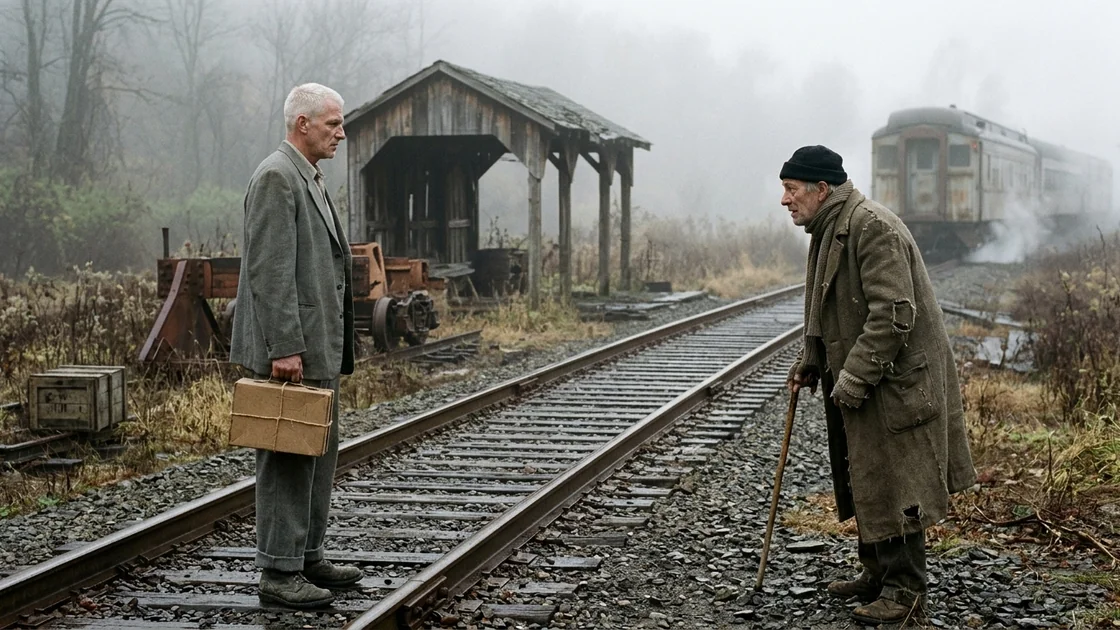
This story chronicles the life of Julian Vance, an aging dry-goods merchant in a decaying river valley who thirty-five years ago committed perjury against his younger brother Michael to escape a life sentence for a fatal mill robbery. While Julian inherited the family property and lived a life choked by silent shame, Michael withered inside the state penitentiary. When Michael is unexpectedly released in the winter of his life and returns to their childhood home, Julian is forced to confront the wreckage of his cowardice, the ghosts of the family they destroyed, and the agonizing truth that some betrayals cannot be redeemed by apologies or the mere passage of time.
I. The Telegram from Cumberland
The letter arrived on a Tuesday in late October, carried inside an oiled canvas pouch by the rural postman, who did not step down from his cart because the mud along the lower river road was thick as tallow. Julian Vance stood on the cedar stoop of the house his grandfather had raised from virgin pine, wiping flour and grease from his palms with a hem of his apron. He was sixty-eight years old, though the joints in his hips and the crooked set of his collarbone made him move like a man who had already outlived his century.
The envelope bore the austere blue seal of the Department of Corrections, Western District, typed on paper so thin that Julian could see the dark block letters of his own name pressing through from the reverse like bruises under skin.
Julian Vance, Esq. Vance’s Landing, Blackwood Creek
He did not open it immediately. He held it between his calloused thumb and forefinger, feeling its dry, synthetic texture against his skin. From the creek bottom came the steady, wet thrum of the river, low and choked with fallen red-oak leaves. For thirty-five years, that river had carried nothing away. It simply turned its dark water over the limestone beds, bringing the chill down from the high ridges and leaving a scum of gray foam in the eddies behind the pilings of the defunct timber docks.
When he finally took the small bone-handled knife from his waistcoat pocket and slit the envelope, the wind caught the flap, smelling faintly of sulfur and cold bog iron.
The document was brief. It was signed by a deputy warden whose name was illegible, a scrawl of black ink that resembled barbed wire. Michael Vance, Inmate No. 44108, had been granted an unconditional release under the revised statutes governing non-capital sentences handed down prior to the sentencing reform acts of 1991. The sentence had expired, accounting for statutory good time and the commutation signed by the outgoing governor in the final week of August.
He was to be discharged on the first of November at eight in the morning from the gates at Cumberland. He had listed no destination, no sponsor, and no travel plan, save for the single line penned at the bottom of the intake schedule thirty-five years prior: Home.
Julian folded the paper along its three machine-pressed creases. He put it into his breast pocket, where it lay flat against his ribs, cool and sharp-cornered over the uneven cadence of his heart.
He walked back through the darkened hallway of the house. The hallway smelled of vinegar, dry rot, and the tallow candles he still burned to save the cost of kerosene. At the end of the hall hung an oval mirror framed in tarnished brass. Julian did not look into it; he had avoided his own reflection since the spring of 1988, not out of vanity, but because he was always startled to find an old man’s mouth and chin occupying the frame where he still expected to see the smooth, soft, terrified boy who had stood before Judge Horatio Vance in the county seat and sworn to tell the truth.
He entered the pantry. Upon the shelves sat jars of preserved plums, their syrup turned black with age, put up by a mother who had died three months after the trial without ever speaking another word to either of her sons. One had been taken from her by the sheriff; the other she had simply refused to look upon, turning her face to the lath-and-plaster wall until the breath went out of her ribs one damp Sunday evening while the church bells were ringing across the bottomland.
Julian drew a basin of water from the hand pump above the dry sink. The iron handle squeaked—two high, thin notes that sounded like a gnat’s wing against a screen. He plunged his hands into the cold water, watching the red loam of the potato patch loosen from beneath his nails and float in little rust-colored filaments before settling to the bottom.
"Thirty-five years," he whispered into the basin. The sound did not fill the kitchen. The kitchen was too large; the ceiling was high and the corners were lost in shadow, where the dried bunches of pennyroyal and sage hung from the joists like shriveled birds.
Michael had been twenty-two. Julian had been twenty-five.
He remembered Michael’s wrists as they had looked in the steel cuffs that day in the courtroom—not thick and hairy like his own, but slender, white, with a faint blue tracery of veins that throbbed whenever the bailiff shifted his weight on the floorboards. Michael had not wept. That was the thing the town had hated most; that was what had made the jury’s task so easy, what had made Julian’s lie slide into the ledger of public certainty like a well-greased bolt sliding into a keeper. Michael had sat there with his jaw set, staring through the tall, dirt-filmed windows toward the cupola of the courthouse where the pigeons nested, his gray eyes reflecting nothing of the room, nothing of the lawyers, nothing of the brother who sat five feet away with his knuckles bleeding into a linen handkerchief.
Julian walked out onto the veranda. The valley was darkening rapidly. The fog was rising from the creek, a white, serpentine creature crawling through the sedge and the blackberry brambles.
In four days, the train would stop at the junction five miles south. There was no station there now—only an open wooden shed where the local freights dropped off sacks of phosphate and salt licks for the dairy farms up the ridge. If a man had no money for a carriage, he would have to walk the old logging grade between the cliffs, where the hemlocks leaned over the ditch and the water dripped from the shale in long, continuous threads that sounded like people whispering in a cellar.
Julian sat on the bench. He laid his hands upon his knees. They were trembling, not with the palsy of his old age, but with the old, sickening vibration that had lived in his marrow since the night the mill burned.
II. The Night of the Mill
The mill had belonged to old man Calloway, who had kept his money in a green iron safe behind the sacking bins because he did not trust the banks in the county seat. Every man who worked the saws knew the safe was there; every boy who fished the tailrace had seen Calloway kneeling before it on Friday afternoons, peeling yellow-backed bills from a leather folder with a thumb licked wet every three seconds.
Julian had been the one who knew where the spare key to the office window was hidden—in the hollow horn of an ox skull nailed above the harness bench in the lower barn. He had been the one who had bought the flat-ended pry bar at the hardware store in town, telling the clerk he needed it to lift the hearthstones in the springhouse. He had been the one who owed six hundred dollars to the cattle drovers from Kentucky who had threatened to burn the Vance barn and shoot the team in their stalls if the debt was not cleared by the full moon of May.
Michael had known none of this. Michael had been down by the gravel bar that night, repairing a trotline with a spool of tarred twine and a bone bodkin, his boots soaked with black water, whistling a tune he had heard at the revival tent three weeks before.
"Come with me to the shed," Julian had told him, appearing out of the river mist with his breath smelling of parched corn and wild whiskey. "I dropped the trace chains off the wagon. I can't lift the tongue alone."
Michael had laid down his twine without a word. He had always followed. He had followed Julian through the sumac thickets when they were children; he had followed him into the old iron pits where the rattlesnakes denned; he had followed him because Julian was his brother, born three winters earlier under the same slant of the roof, fed from the same wooden bowl when the flour ran thin in the hard year of sixty-seven.
They had not gone to the shed. They had gone to the back wall of Calloway’s office.
Julian remembered the taste of the air that night: it had tasted of creosote and the cold, green water of the millpond. He remembered the sound the dry lath made when the bar took purchase—a single, sharp crack like a dry bough snapping under a deer’s hoof.
"Julian, no," Michael had said. He had caught Julian by the sleeve of his coat, his fingers digging into the wool. "This ain't ours. This ain't the way."
"The money's there," Julian had hissed, his eyes wild, his teeth showing white in the gloom. "The drovers are coming tomorrow, Mike. You want to see the old man's horses with their throats cut? You want to see the house go up?"
"We'll sell the bottom three acres," Michael said, his voice level, pleading, his face pale under the alder branches. "We'll go to uncle in Missouri. We'll work the wheat."
"There ain't no Missouri," Julian said.
He had thrust the bar into Michael’s hands. That was the moment—the precise, singular hinge upon which the rest of their lives had turned. He had forced the cool, painted iron between Michael’s fingers, and Michael, startled, had taken it just as old Calloway stepped around the corner of the bin with a four-cell flashlight and an antique horse-pistol he had loaded with scrap zinc and lead balls.
The light had struck them like an axe.
Calloway had shouted—a high, dry bark, the sound an old hound makes when it corners an otter in the rocks. The pistol had gone off, not with a sharp report, but with a dull, concussive whump that shook the dust from the joists above their heads. The ball had struck the pine siding three inches from Julian’s ear, showering his hair with yellow splinters.
Julian had not thought. He had not looked to see if Michael was hit. He had seized a five-gallon tin of solvent that stood against the wall for cleaning the gum from the circular saws, and he had flung it with all the strength of his terror against Calloway’s chest. The tin had not opened, but it had knocked the old man backward into the kerosene lamps that burned upon the sorting bench.
The fire did not start slowly. It did not creep. It was as if the dry spruce sawdust that lay three inches deep over the entire floor had been waiting forty years for that single spark. A sheet of orange flame leapt from the bench to the wall, running up the dried pine boards with a sound like wind rushing through dry broomcorn.
Calloway had fallen into the corner, his head striking the edge of the safe, his pistol sliding under the woodbox.
Julian had run.
He had not looked behind him until he reached the willow spit three hundred yards downstream. When he turned, the mill was already a hollow lantern of flame, the great square windows glowing like furnace doors, and the smoke rolling down the valley in a greasy, black cloud that smelled of burning oil and scorched hides.
And then he saw Michael.
Michael was not running. He had come out of the river door with old Calloway slung over his shoulders like a sack of oats. His coat was smoldering; the hair on the right side of his head was singed down to the pink skin of his scalp. He had carried the old man out onto the gravel bar, laid him down in the shallows where the water would not touch his burns, and sat down beside him on a drift-log, his hands hanging between his knees, waiting for the town to come.
III. The Lie
The county attorney was a man named Slocum, whose father had owned the tannery that poisoned the creek in the fifties. He was a small, dry man with gold-rimmed spectacles and fingernails so clean they looked as though they had been pared with a surgeon's blade. He had sat with Julian in the back room of the sheriff's house, where the smell of fried ham from the kitchen below crept under the door to mix with the smell of damp law books.
"Julian," Slocum had said, not looking at him, but turning the brass key of his watch over and over between his fingers. "Calloway died at three this morning. The smoke took him. His lungs were full of spruce soot."
Julian had sat upon a cane-bottomed chair, his hands wrapped in cold wet cloths to soothe the blistered palms he could not account for.
"It’s capital," Slocum said. "Arson resulting in the death of a freeholder. The grand jury will meet on Friday. The circuit rider is already at the inn. He ain't a forgiving man, Julian. You know Horatio Vance. He’s your cousin three times removed, and he'd hang his own heifer if he caught her breaking his neighbor’s fence."
Julian’s tongue had felt like a piece of salted beef in his mouth. "Michael was there," he croaked.
Slocum stopped turning the key. The watch gave a sharp, metallic click.
"We know Michael was there," Slocum said softly. "The boy had the pry bar in his belt when the constable reached the gravel. His boots smelled of the oil. But Calloway had three hundred dollars in gold eagles in his coat pocket when Michael brought him out, and that money didn't burn."
He leaned across the walnut table. The glass of his spectacles caught the gray light from the rain-streaked window, turning his eyes into two blank, circular mirrors.
"A man who goes to rob a safe don't carry the owner out of the fire," Slocum said. "Unless he was the one who didn't want the fire started. Unless he was the one who was brought along to do the heavy work by somebody who had a reason to see the mill go down."
Julian felt the skin of his throat tighten until he could scarcely draw his breath. "I was at the lower crossing," he said.
"The drovers were at your house at dawn," Slocum murmured. "They were waiting on the turnpike. They had a note with your name on the bottom, Julian. A note for six hundred dollars, drawn on the first of May."
The room had gone entirely silent then, save for the fat grease sizzling in the skillet down in the kitchen and the steady, indifferent drip of the rain from the eaves onto the zinc porch roof.
"The State don't need two hangings," Slocum said. His voice was almost tender, the voice of an uncle explaining why a dog with the mange had to be taken behind the corncrib with an axe. "The county can't afford it, and the court don't like the look of two brothers from an old name swinging on the same timber. But somebody must be the principal. Somebody took that bar. Somebody set that can to the floor."
"It was Michael," Julian said.
The word did not sound like his own voice. It sounded like something dropped into a dry well—a dull, wooden clatter against stones.
Slocum did not smile. He reached into his leather bag and drew out three sheets of foolscap, already covered in his small, spider-leg script.
"He was always the rougher one," Julian whispered, his eyes fixed on the inkwell, which was shaped like a bronze owl with glass eyes that stared through him. "He had the temper. He told me he'd have Calloway's hide if the old man didn't give him the timber-cruising job. I went to stop him. I went down to the tailrace to pull him off the window. When I got there, he had already struck the old man down. He threw the coal oil. He threw it right at his face."
Slocum dipped his steel pen into the owl’s skull.
"Sign the margin here," he said. "And here. And then you can go home and see to your mother’s garden. The constable will look after Michael."
When Julian came out of the sheriff's brick office, the rain had stopped, and the sun was breaking through the mist over the ridge, turning the mud of the street into a blinding, yellow glare. He had walked all the five miles back to the landing, his boots growing heavier with every stride as the red clay gathered on the welts.
His mother was standing at the well-sweep. She did not ask where Michael was. She had already seen the deputy ride past on his gray mare with Michael’s second coat tied behind the cantle.
She had looked at Julian’s face—just once—and then she had let the bucket plunge down into the darkness of the stone-lined hole. The windlass had spun with a dry, screaming rattle that made the pigeons fly up from the barn roof, and when the rope ran out, she did not draw it up. She had left the bucket in the water, walked into the kitchen, and turned the iron latch on the inner door.
IV. The Thirty-Five Years
The world had moved away from Vance’s Landing, but it had not moved fast enough to take Julian with it.
The mill was never rebuilt. The charred timbers had fallen into the pond, where they lay for twenty years like the ribs of a foundered barge, green with moss and water-cress, until the flood of ninety-six tore out the stone dam and carried the whole black mess down into the Ohio. The railroad had laid its new track six miles west, through the gap, bypassing the river towns entirely. The stores along the landing had boarded their windows; the tin roofs had rusted through, staining the white-painted brick with long, orange tears of oxide.
Julian had not married. Who would have taken him? The town had accepted his testimony because it was written on court paper and signed by the judge, but a town does not love the dog that carries the stick to the master’s hand. They bought their meal from him because his scales were honest to the grain—he was so terrified of cheating a man by a dram that he gave thirteen ounces to the three-quarters every time—but they did not invite him to the porch sittings in the summer evenings, and when he entered the store at the crossroads, the men who were spitting into the woodbox would dry their lips with their knuckles and find business outside among the wagons.
He had lived in the house with the silence.
For five years after his mother died, he had kept Michael’s room locked. Then, one night during a sleet storm when the roof leaked over the stair-landing, he had taken the key from the tea-tin on the mantle and gone inside.
The room had remained precisely as Michael had left it on the morning of the fire. A pair of gray wool trousers hung from a peg behind the door, their knees molded to the shape of his legs. On the pine washstand sat a tin cup containing a badger-hair shaving brush, dried stiff as bone, and a piece of pink soap that had shriveled into a cracked, scentless pebble.
Julian had sat down upon the straw tick. He had stayed there until the gray morning light showed the ice forming on the inside of the windowpanes.
He had tried, once, to write. It was during Michael’s tenth year at Cumberland. He had spent three nights drafting a letter on blue-lined ledger paper, using his finest commercial hand, explaining how the farm had failed, how the taxes had eaten the timber-stand, how he had tried to find a lawyer who would file a petition for clemency based on newly discovered evidence.
The letter was returned two weeks later. It had not been opened. Across the face of the envelope, written in Michael’s own hand—the broad, clumsy pencil script of a boy who had left school at fourteen to drive the log-teams—were three words:
Return to sender.
Julian had burned the envelope in the kitchen stove, but he had watched the paper blacken and curl until the three words were glowing red in the embers, and he had smelled the ash of that pencil-lead for a month afterward every time he lifted the iron lid to feed the fire.
In the twentieth year, the state had installed electricity along the valley road. The poles marched past his gate like high, stripped hemlocks, carrying two wires that hummed in the frost with a thin, metallic whine. Julian had refused to let the linemen cross his orchard. He had stood at the fence with an old double-barreled shotgun across his forearm—not pointing it, but letting the blue steel catch the sun—until the foreman spat into the ditch and told the crew to dig the holes on the far side of the macadam.
"Let him stay in the dark," the foreman had said to the team. "The old bastard's been living in a hole since forty-four anyway. He don't need no light to count his dirt."
Julian had gone back inside. The dark had suited him. In the dark, a man’s face did not exist; in the dark, his hands were the same as any other man’s hands; they did not look like the hands that had signed the three sheets of foolscap in Slocum’s office while the skillet was sizzling below.
V. The Friday Morning
Julian rose at four on the first of November.
The air inside the house was so cold that his breath hung in white plumes before him as he struck a sulfur match against the hearthstone. He lit the small tin lamp, trimmed the wick with a pair of rusty shears, and went down to the cellar for potatoes.
He chose four small, firm tubers from the bin. He peeled them with his pocketknife, taking off the skins in long, translucent curls that fell into the zinc bucket between his feet. He had bought a salt pork flank from the crossroads store two days before—the best piece the clerk had, white and firm, with three distinct ribbons of lean red meat running through it. He diced the pork and laid it in the cast-iron skillet, listening to the small, cold snaps it made as the fat began to render in the gray dawn.
He did not know what men ate when they came out of Cumberland.
In his mind, Michael was still twenty-two, with an appetite that could clear a trencher of cold cornmeal mush and four fried eggs before the sun was over the sycamores. But Michael was fifty-seven now. A man of fifty-seven who had lived thirty-five years on gray hominy and the boiled cabbage of the prison farm would have no teeth for hard pork; his stomach would be small and sour, like the stomach of an old mule that has been fed on marsh hay through a long winter.
Julian set the skillet on the back of the stove and walked out to the barn.
The horse was dead—had been dead twelve years—and the buggy had rotted down into its iron tires in the back stall, its leather curtains eaten by the wood-rats until only the horsehair padding remained, hanging like gray moss from the springs.
Julian took his wool coat from the peg by the door. It was heavy, stiff with the grease of many years, and the cuffs were frayed down to the white warp-threads. He wound a knitted muffler three times around his throat, pulled his wool cap down over the tops of his ears, and took up his ash stick from the corner behind the door.
The five miles to the junction took him nearly three hours.
The road followed the river, but the river was hidden beneath a dense blanket of ground-fog that lay ten feet deep over the meadows. Above the fog, the bare crowns of the oaks and maples stood out against the pale sky like black lace. Every hundred yards, Julian had to stop and lean against his stick, his heart thumping against the paper from the Department of Corrections that still lay in his pocket.
His breath rattled in his windpipe. His right knee, which had caught the kick of a trace-chain forty years ago, burned with a dry, grinding heat that seemed to come from the bone itself.
When he reached the junction, the freight shed was empty.
A rusted hand-car sat on a siding, its wooden pump-handle weathered to the color of bone. The rails were wet with dew, two parallel lines of silver running out of the mist from the north and vanishing into the mist to the south.
Julian sat down upon a crate of salt blocks. He took off his mittens and blew upon his fingers.
The nine-fifteen from Cumberland did not whistle. The line had removed the crossing whistle five years earlier when the timber mills closed. The engine simply materialized out of the gray vapor—a black, oily switcher hauling three empty boxcars, a flatcar of green hemlock ties, and a single, dirt-streaked passenger coach that had been painted orange twenty years before.
The train did not truly stop. It slowed with a screech of iron shoes against iron treads, the air hoses groaning between the trucks.
A conductor with a yellow mustache and no brass buttons on his vest dropped down from the coach steps, his boots sliding in the shale ballast. He turned and reached a hand upward.
"Watch the riser, pop," the conductor said.
A man came down the steps.
He did not take the conductor's hand. He came down slowly, with both feet together on each tread, like a child who has not yet learned the balance of the stair, or an old man whose knees have forgotten how to trust the earth.
He carried a cardboard valise tied around the middle with two turns of common hemp twine. He wore a suit of gray shoddy—the kind the state bought by the thousand gross from the mills in Massachusetts—that was three sizes too large for him. The trousers were turned up twice at the bottoms, showing coarse gray woolen socks and a pair of heavy, round-toed work shoes made of unblacked leather that had never seen grease.
The conductor stepped back onto the iron riser, waved an indifferent arm toward the cab, and the train moved. The engine coughed—a single, wet blast of steam that smelled of soft coal—and the red caboose clicked past the shed, leaving the two men standing thirty feet apart in the gravel.
VI. The Recognition
Michael did not drop his valise. He did not look at the rails, nor at the sky, which was turning the color of skimmed milk as the sun rose behind the clouds.
He looked at Julian.
His face was not the face Julian had carried behind his eyelids for thirty-five years. The youth was gone, not gradually, as it goes from men who work the fields and watch their children grow, but violently, as if it had been scraped away with a flat-rasp. His skin had the peculiar, dead-white pallor of cellar turnips—a white that seemed to have no blood beneath it, only a thin, yellowish fluid. His nose had been broken; the bridge was flattened and shifted slightly toward the left eye, giving his face an asymmetrical, watchful look, like that of an owl that has been struck by a hawk.
His hair was entirely white, but it was cropped so close to the scalp that the pale skin showed through everywhere, crisscrossed with tiny white scars that looked like tracks made by worms in green bark.
"Julian," Michael said.
The voice was low, flat, and dry. It had none of the old mountain lilt in it. It was the voice of a man who had not spoken ten words an hour for three decades—a voice that had been pared down to the bare wood of necessity.
Julian tried to stand, but his ash stick slipped on the wet hemlock chips near the track, and he had to catch himself against the side of the salt crate.
"Michael," he said. He could not get the second syllable out without a gasp. "Michael, you... you made the cars."
"I made them," Michael said.
He did not move toward Julian. He stood with his feet planted slightly apart, his arms hanging straight at his sides, the cardboard valise held in his left hand by a loop of twine that cut deep into the gray flesh of his fingers.
"The wind's coming out of the north," Julian said, his eyes wandering desperately over the gray shoddy coat, the frayed cuffs, the round, ungreased toes of the state shoes. "It’ll rain by noon. We better... we better get down the grade."
"Aye," Michael said.
He turned toward the road without asking which way the farm lay. He knew which way it lay. A man does not forget the direction of his own blood, even if he has spent thirty-five years behind twelve feet of dressed limestone with eight strands of galvanized wire along the coping.
Julian fell in behind him.
He had meant to walk beside him; he had planned to take Michael by the elbow, to say something about the timber that had grown up along the bottoms, to tell him that old man Calloway’s sister had died in ninety-two and that her boys had sold the land to a coal company from Scranton that had never come to dig.
He could not speak.
The back of Michael’s neck was inches from his eyes. There was a scar there—a three-inch ridge of purple, puckered tissue running from the base of the skull down under the rough collar of the shoddy coat. It looked like an old burn that had healed without clean water or clean cloth, gathered into hard, ropy knots that did not move when he turned his head.
They walked in silence for two miles.
The river stayed beside them, hidden in its ditch of fog, but its voice was continuous—a heavy, sullen murmur that seemed to rise through the soles of their shoes. Whenever a farm wagon approached, Julian would stiffen, waiting for the driver to pull up the team, waiting for the curious, startled stare that would take in the two old men—one in his filthy country wool, the other in his state-issue gray.
Only one wagon passed them. It belonged to young Lonnie Vance—his third cousin's boy, who had never seen Michael, who had only heard the old story told on rainy Saturdays at the blacksmith's shop like a tale of Indians or wolves.
Lonnie did not stop. He nodded—a quick, suspicious jerk of his chin—and whipped his pair of sorrel mules past them, the iron-shod wheels throwing up fans of yellow mud that sprayed Michael’s trouser-legs.
Michael did not flinch. He did not turn his head to watch the mules go by. He did not even blink when a clod of wet clay struck the cardboard of his valise with a hollow thwack.
"That was Lonnie," Julian said, his breath whistling through his dry lips. "Lonnie's got the old Miller place now. He’s got five children. Two of them are simple."
Michael walked on.
"The river's lower than it was when you... when we were boys," Julian tried again. "They put a wing-dam up at the forks in ninety-eight. It took the current away from the landing. The boats can't come up no more. Nothing comes up now but the flat-bottoms from the coal pits."
Michael’s pace was steady, rhythmic, and terrible. It was the pace of a man who has walked five thousand hours in an exercise yard forty paces long by twenty paces wide—a pace that had no destination in it, only the mechanical necessity of moving until an iron bell rang from a tower.
VII. The Threshold
When they reached the gate, the latch was frozen with a skin of thin ice.
Julian reached out with his bare fingers to lift the iron bar, but his hand was shaking so violently that he could not find the hole.
Michael set his valise on the grass. He reached out his gray hand—it had three joints missing from the little finger, healed over into a round, blunt stump—and lifted the bar with a single, effortless motion. The gate swung back on its leather hinges without a sound.
The house sat under the four big sycamores like an old beast that had lain down in the weeds to die. The white paint had long since washed away, leaving the pine siding weathered to the color of an old hornspoon. Two of the windows on the upper floor were boarded over with hemlock slabs, and the gutter along the porch had pulled loose from its spikes, hanging down across the front door like a broken limb.
Michael stopped in the middle of the yard.
He looked at the well-sweep. The bucket was gone; only the iron chain hung from the oak arm, swinging slightly in the river breeze, tapping against the stone curb with a faint, hollow tink-tink-tink.
"Mother died there," Julian said, his voice dropping to a dry rasp. "In the kitchen. She... she had the dropsy at the end. Her legs were swollen big as cider casks. She didn't suffer long."
It was a lie—the second lie, or the thousandth. She had suffered for fourteen months, screaming until her voice cracked every time the river rose and the water backed up into the cellar.
Michael turned his head slowly. He looked at the kitchen window—the four panes of green glass, thick and wavy with age, through which nothing could be seen but the reflection of the gray sky and the dead sycamore boughs.
"Where is she?" he asked.
"Up on the knoll," Julian said. "Beside Father. And the little sister that died of the croup before you were born. I put a stone on her, Michael. A good stone. Blue granite from the quarry at the Gap. It cost me forty dollars. It has her name on it, and the year, and a verse from the Psalms."
"Which verse?"
Julian’s tongue stopped against his teeth. He had forgotten. He had bought the stone from a traveling carver who had three pre-cut slabs in his wagon; he had chosen the cheapest one that had the letters already sunk into the granite.
"I... I don't recall the number of it," Julian mumbled. "It’s about... it’s about the green pastures. And the water."
Michael picked up his valise. He walked up the three cedar steps, his shoes making a hollow, wooden sound on the porch boards, and pushed open the front door.
The hallway was colder than the road.
The smell of the old house struck them—not the smell of home, but the smell of seventy years of dead wood, cold chimney-ash, and the dry grease of sheep-tallow candles.
Michael stood in the center of the hall. He did not look into the parlor, where the horsehair sofa stood with its springs bursting through the black cloth like the ribs of a dead mule. He looked up the narrow, winding stair that led to the bedrooms under the rafters.
"Your room is the same," Julian said, coming up behind him, his stick clicking on the floor. "I kept it... I kept the roof tight over it, Mike. I didn't let the rats get into the bedding. I went up every spring with a bucket of lime and washed the walls."
Michael did not go up the stairs. He walked into the kitchen.
He looked at the stove—the four-eyed iron monster with its nickel-plated warming oven and its hearth full of cold wood-ashes. He looked at the skillet Julian had left on the back plate—the diced pork cold now, white fat congealed around the red cubes of meat like grease on a butcher's apron.
He set his valise on the pine table—the same table where they had eaten their clabber milk with pewter spoons while their father read the shipping notices from the Cincinnati papers.
"Sit down," Julian said. "Sit down, Mike. I'll get the fire up. I’ve got dry maple in the lean-to. It won't take five minutes. I'll fry the pork. I’ve got three eggs from the woman up the run. Real eggs, Mike. Not the dried meal they give you... down there."
Michael sat.
He did not take off his shoddy coat. He did not unbutton the collar, which was pressed tight against his throat by the stiff canvas interlining. He laid his two hands flat upon the pine table, his thumbs touching, his broken little finger curled inward like a dead grub.
Julian dropped to his knees before the stove.
His ash stick clattered across the zinc floor-plate. He reached into the wood-box, his old fingers clawing through the dry cedar shavings and the splintered oak bark, looking for the lightwood he had split three nights before.
His hands were shaking so that he dropped the first two matches. The third caught, the yellow flame licking at the dry resin of the pine splinter, and he held it there until his skin scorched, blowing upon the little coal with a dry, wheezing whistle that came from the bottom of his lungs.
The smoke backed out of the cold pipe, filling the kitchen with a blue, bitter haze that made his eyes stream with tears.
"It’ll draw," Julian cried, still on his knees, his face turned toward the black iron doors. "It’ll draw in a minute, Mike. The chimney's cold, that's all. The soot's damp from the river-fog. Just give it a minute."
Michael did not answer.
Julian turned his head.
Through the blue haze of the cedar smoke, Michael was looking at him. His gray eyes were wide, clear, and perfectly still. There was no hatred in them; there was no fury; there was only that terrifying, inhuman patience that belongs to men who have watched a shadow crawl across an eight-foot stone floor every afternoon for twelve thousand seven hundred and seventy-five days.
VIII. The Room
They ate in the gray light that came through the green glass of the window.
Michael ate the pork, but he did not eat the potatoes. He took each piece of meat upon his fork—the old pewter fork with the three bent tines—and chewed it forty times, his jaw moving with a slow, grinding regularity that had nothing to do with hunger. When he had finished the meat, he laid the fork down beside his tin plate, exactly parallel to the edge of the table, and folded his hands upon his knees.
Julian could not swallow.
He had put a piece of the lean pork into his mouth, but it had turned to a wad of salty oakum between his teeth. He had tried to wash it down with cold water from the pump, but the water had stuck in his throat, and he had coughed until his eyes were red and his nose ran into his napkin.
"You want to see the barn?" Julian asked when the coughing fit had passed. "The south sills are rotten, but the frame is good. There's forty bushels of seed oats in the granary. We could... we could buy a team of calves in the spring, Michael. The young stock don't cost much now. We could run them on the lower flat. The grass is good there—the sweet-clover came back after the water went down."
"The barn is down," Michael said.
Julian stared at him. "No. The roof's whole, Mike. I patched it myself two summers back. I used the galvanized nails."
"The barn is down," Michael repeated. His voice did not rise. It remained in that flat, even register that sounded like water falling into a deep cistern. "The sills are on the earth. The rafters have buckled over the mows. In three winters, the snow will take it."
He stood up.
He did not ask Julian for permission. He took his cardboard valise by the twine handle and walked toward the stairs.
Julian followed him, his ash stick dragging on the risers: step, click; step, click; step, click.
The bedroom door was stiff on its hinges. Julian reached past Michael’s shoulder to force it open with his palm. The dry wood groaned, and a shower of fine, gray dust fell from the top casing onto Michael’s white hair.
The room smelled of lime-wash and mice.
The window looked out over the river road and the gray, moving water beyond the willows. The bed was made with the old blue-and-white coverlet their grandmother had woven on the big loom in the barn—the Pine Burr pattern, its wool faded now to the color of river slate, but the fringe still clean, tucked carefully under the horsehair bolster.
Michael set his valise upon the pine chest at the foot of the bed.
He did not open it. He reached into his coat pocket and took out a small, round object wrapped in a piece of oiled brown paper.
He laid it on the washstand, beside the dried badger-hair brush and the shriveled pink soap.
Julian leaned forward, his spectacles slipping down his sweat-greased nose.
It was a piece of white limestone—not larger than an egg—that had been ground down with an abrasive stone until it was smooth as an eggshell. It had no carving upon it; no letters, no marks of any tool, save for the hundreds of microscopic striations where the sand had polished the lime.
"What is that?" Julian asked, his voice shaking.
"The yard," Michael said.
"The... the exercise yard?"
"The south wall," Michael said. "The stone came out of the third course below the guard-walk when the frost broke it in eighty-nine. I kept it in my shoe."
Julian reached out a finger to touch it, but his hand stopped two inches from the stone. The limestone looked cold—colder than the river water, colder than the ice on the gate-latch. It looked like an eye that had been turned to marble.
"Michael," Julian said.
The word was a plea. It was everything he had not said on the road; it was the forty dollars for the granite marker; it was the letters he had not sent; it was the six hundred dollars he had paid to the cattle drovers with the money he had stolen from his mother's lard-can after Michael was taken away.
Michael did not turn around.
He stood with his back to Julian, looking through the green glass of the window toward the river, where the fog was finally beginning to tear apart under the noon wind, revealing the long, brown bars of mud and the black, skeletal ribs of the old mill-dam sticking out of the water like the teeth of a saw.
"Go down, Julian," he said.
"Michael, I... I have the deeds. In the iron box. Your name is on them. Half the bottom. Half the ridge. Slocum said... Slocum's dead, Mike. He died in ninety-four. He had the cancer in his mouth. They had to cut his tongue out before the end. He couldn't speak for six months before he died. He wrote things on a slate."
Michael did not move.
"Go down," he said again.
Julian stood there for a long moment, his chest heaving, his mouth open, waiting for some sign—a twitch of the shoulder, a turn of the head, a breath that would break the terrible, mechanical rhythm of the younger brother's silence.
Nothing moved.
Michael Vance stood before the window like a man made of the same gray limestone he had carried in his pocket for thirty-five years, staring at the river that had carried his youth down to the salt, leaving only the mud and the dry bone of the land behind.
IX. The Town’s Shadow
By Saturday, the news had crept from the junction to the four corners, and from the four corners down to the river road.
The boy from the post office, who had brought the weekly edition of the County Herald, did not leave the paper in the tin box by the road. He carried it up to the porch, his eyes wide and yellow as an owl’s, his bare toes digging into the rotten chips of the walk.
He saw Michael.
Michael was sitting on the low stone retaining wall that held the garden dirt back from the road ditch. He was not doing anything. He had no knife; he had no stick to whittle; he was not smoking. He was simply sitting with his hands on his knees, his gray shoddy trousers pulled up over the tops of his ungreased state shoes, his white head bare to the cold November mist.
The boy dropped the paper on the bottom step and ran. His bare feet made a wet, sucking sound in the mud until he reached the bend by the sycamores, where the willow thickets swallowed him.
Julian came out onto the porch and picked up the paper.
He looked at Michael on the wall.
"You want to come in, Mike? The wind's got an edge to it. I made some sassafras tea. There's honey from the bee-tree we took down three years ago."
Michael did not turn his head. "They're coming," he said.
Julian’s fingers tightened on the damp paper. "Who's coming?"
"The men."
Julian looked down the road. At first, he saw only the mist and the gray trunks of the water-locusts. Then he heard the iron shoes—four horses, walking slowly, their hoofs making a heavy, sucking squelch in the clay.
It was the sheriff—not the old sheriff who had taken Michael’s second coat, but his nephew, a young man named Luke Varner, who had been an infant in a wicker basket when the mill burned. With him were three others: old man Calloway’s grandson, young Arthur, who had the same small, pig-like eyes as his grandfather; Lonnie Vance; and the preacher from the church at the Landing, a Methodist named Gidley who wore a broad-brimmed felt hat that was green with age around the crown.
They did not dismount.
They sat their horses in the road ditch, the wet wool of their coats steaming in the cold air, their beasts turning their heads to bite at the dead blackberry canes that hung over the fence.
Luke Varner looked at Michael on the wall, then at Julian on the porch.
"Julian," the sheriff said. He had a yellow mustache like the conductor, but he was younger, with a soft, round chin that had never seen a razor more than twice a week. "We saw the return on the docket from Cumberland."
Julian did not come down the steps. He stayed on the cedar stoop, holding his ash stick with both hands, his knuckles white as tallow.
"His time is served," Julian said. His voice was high, thin, and cracked like an old plate. "The governor signed it. I have the paper in the house. It has the seal on it."
"We ain't questioning the paper," the sheriff said. He took a plug of tobacco from his coat, looked at it, and put it back without biting. "The state does what the state likes. But the county has its own mind, Julian."
Young Arthur Calloway leaned forward across his saddle-bow. He was twenty-five, the age Michael had been when he went to the quarry-gangs at Cumberland. His face was red with the wind, and his horse was a big, raw-boned bay that kept stamping its off-hind foot into the ditch-water.
"He can't stay here," Arthur said.
Michael did not move. He did not look at Arthur. He continued to stare through the horse's legs toward the river, where the yellow current was dragging a tangle of driftwood against the pier of the old sheep-bridge.
"He's on his own land," Julian said. He took a step down—one step. His ash stick sank two inches into the soft turf beside the porch. "The land was our father's. It's deeded in the clerk's office. You can't run a man off his own dirt, Luke Varner."
"He was convicted of murder," Arthur Calloway shouted, his horse dancing sideways as he hauled on the curb-bit. "He killed my grandfather! He burnt the timber! My father died poor because of that fire! You think thirty-five years wipes that out? You think he can sit on that wall and look at our wagons going by like he was an honest man?"
The preacher, Gidley, raised his hand. He had long, yellow teeth that showed when he spoke, like the teeth of an old sheep.
"Vengeance is the Lord's, Arthur," he said, his voice greasy with the professional solemnity of the country pulpit. "The law has had its pound of flesh. But there is the question of peace, Julian. There is the question of the congregation. The folk won't have him at the store. The women won't pass the gate if he's sitting there."
Michael stood up.
He did not stand quickly. He rose with the slow, deliberate uncoiling of a man who has had to stand at attention every morning while an iron bar was run along the grates of his cell.
He walked toward the horses.
Young Arthur Calloway’s bay horse snorted and backed three paces into the ditch, its hocks trembling against the shale. Arthur reached his hand down toward the leather scabbard that hung beneath his saddle-fender, where the stock of a carbine showed gray under the oilcloth.
"Stay back," Arthur hissed. "You stay back from this horse."
Michael did not stop until he was four feet from the young man’s stirrup. He was not as tall as Arthur, but his shoulders were thick, squared by thirty years of wheeling heavy barrows of limestone out of the deep pits, and his neck was like an oak post.
He looked at Arthur Calloway’s face—the round, pig-like eyes, the thin, wet mouth, the red cheeks that had never known the frost of a Cumberland dawn.
"Your grandfather," Michael said, "was an old thief."
The road went dead silent.
Even the preacher’s horse stopped chewing its bit. The only sound was the river—that eternal, thick, yellow sliding of water through the willows.
"He stole the timber-rights from the widows after the flood of seventy-two," Michael said. He spoke without anger, his voice level and heavy as a flat-iron. "He kept forty men on three-quarters pay because he owned the store and the meal was four cents dearer than it was in town. He took my brother's note for six hundred dollars when he knew the cattle were dying of the murrain and the boy couldn't pay."
He turned his head and looked at Julian on the porch.
"He died because he was an old man who couldn't see the fire for his own grease," Michael said. "Now take your horses out of my ditch."
Arthur Calloway’s hand was on the grip of the carbine. He pulled it two inches from the leather, the blue steel clicking against the brass throat-piece.
Luke Varner reached over and caught the young man’s wrist.
"No," the sheriff said.
"He's a convict!" Arthur spit, his eyes bulging. "He's an old dog that ought to be shot in the brush!"
"He's served the paper," Varner said. His face had gone pale under the yellow mustache. He looked at Michael Vance—at the broken nose, the ropy scar on the neck, the three-jointed finger that hung like a dead root from his hand—and he saw something that was not in the county statutes, something that had been forged in a place where men were not men, but numbers that lived in the dark under the river-rock.
"Come on, Arthur," the sheriff said, turning his horse's head toward the Landing.
"He'll burn the bottom again," Arthur snarled, his heels digging into the bay’s flanks.
"He won't burn nothing," Varner said. "The town's dead anyway."
They rode off.
The four horses moved at a trot, the mud flying up from their hoofs in great, greasy ribbons that stuck to the fence-rails.
Michael did not watch them go.
He turned and walked back to the stone wall. He did not sit down. He took up an old, short-handled iron spade that had been leaning against the well-sweep since the autumn before, its blade red with rust, its hickory handle split and wrapped with baling wire.
"Michael," Julian called from the stoop, his voice cracking with a high, hysterical rattle. "Michael, don't mind them. Don't mind Arthur. He's a fool. He's just like his grandfather—he ain't got the heart of a chicken."
Michael did not answer.
He walked past the porch, past the kitchen lean-to, and through the overgrown gate into the apple orchard, where the dead trees stood in the grass like gray skeletons with their arms outstretched to the sky.
X. The Orchard
Julian followed him.
He could not help himself. It was as if an invisible chain were welded to his collarbone, the other end hooked to the twine that had tied Michael’s cardboard valise. He stumbled through the tall, dead orchard grass, the wet seed-heads soaking his trousers to the thighs, his ash stick catching in the blackberry runners that laced the sod.
Michael had stopped at the base of the knoll.
Here, under three big white oaks that had survived the timber-cutting, were the graves.
There were four of them. His father’s was a long, sunken trench marked by a piece of river sandstone that had rounded over until the letters A.V. 1879 were scarcely visible beneath the lichen. His mother’s stone was the bright, hard granite from the Gap—it looked raw, vulgar, and foreign among the gray weeds, like a piece of an iron engine dropped in a swamp.
Beside them were two smaller mounds: the sister who had died of croup, and an uncle who had been killed by a falling timber at the boat-yard in sixty-one.
Michael did not look at his mother’s blue stone.
He drove the spade into the sod at the foot of his father’s mound.
The ground was tough, knit together with fifty years of oak roots and broom-sedge, but Michael drove the blade down with his heel—not with two light taps, but with a single, brutal thrust that cut through the turf with a wet, ripping sound.
"What are you doing?" Julian cried, his hand going to his throat. "Michael! What are you digging for?"
Michael did not stop. He threw out a spit of dark, yellow clay, full of round river gravel that rattled against the spade-iron.
"The space," Michael said.
"The... the space?"
"There's two spaces left," Michael said. He did not look up; his arms moved with the terrible, rhythmic precision of the coal-gangs. Chop. Lift. Throw. "One for you. One for me."
"Don't," Julian whispered. "Don't dig it now, Mike. We've got years. The Vances live long—the grandfather was ninety when he took to his bed. We've got... we've got time to set things right."
Michael stopped.
He stood in the shallow hole he had made—six inches deep, two feet wide, a black gash in the yellow grass of the knoll. He leaned his forearms upon the handle of the spade, his gray shoddy coat dark with sweat under the arms, his white hair bristling in the north wind.
"Set what right?" he asked.
The question was not loud. It was soft—almost gentle. It was the question a mother might ask a child who has brought her a broken jug and a handful of dust.
"The... the mill," Julian stammered, his ash stick trembling so that the tip danced in the weeds. "The town. I... I can go to Luke Varner, Mike. I can make an affidavit. I can go to the clerk at the county seat. I’ll tell them... I’ll tell them Slocum made me do it. I’ll tell them Slocum said they'd hang us both if somebody didn't sign the margin. I’ll tell them you didn't touch the oil. I’ll tell them it was me. It was me that dropped the bar, Michael. It was me that owed the drovers."
The words were out.
They had lived in his throat for thirty-five years, a knot of black, poisonous toadstools that had choked his breath, that had made every loaf of bread he ate taste of sulfur, that had kept him from looking into the oval mirror in the hall.
They were out, and they lay upon the yellow grass between them, dead, gray, and weightless as dried thistle-down.
Michael looked at him.
He did not drop the spade. He did not raise his hand to strike. He did not even sneer.
"Slocum's dead," Michael said.
"I know, but the clerk—"
"Judge Vance is dead."
"His boy is there—"
"The jury is dead," Michael said. His voice was like stones falling into a vault. "Old man Calloway is dead. The drovers were killed in the rail-smash at Lexington thirty years back. The mill is in the Ohio. The house is rotted."
He took a step out of the shallow hole.
He came close to Julian—so close that Julian could smell the Cumberland prison on him: the smell of lye soap, damp lime, cold cabbage, and the yellow lard they used to grease the iron tracks on the stone-cars.
"Who are you going to tell, Julian?" Michael asked.
Julian’s mouth worked, but no sound came out. The air seemed to have left the orchard. The river below was silent; the wind had died; the sycamores stood like pillars of salt against the white sky.
"The clerk?" Michael said. "The clerk was three years old when I went into the gate. He don't know Michael Vance from a stray hog in the brush. You want to go to the courthouse and make a paper?"
He reached out his hand—the hand with the three-jointed finger—and touched Julian’s coat over the breast pocket, right where the release paper from the Department of Corrections lay folded in its creases.
"They'd say you were an old fool," Michael murmured. "They'd say Julian Vance was eighty years old and his head had gone soft with the river-rot. They'd put you in the asylum at Flatwoods, and they'd leave me here to dig this hole alone."
Julian fell to his knees in the dead grass.
The ash stick rolled away down the slope, catching against an apple stump. He reached out with both hands and caught the rough, gray hem of Michael’s shoddy coat, his old face pressed against the coarse cloth, his tears—hot, salty, and useless—soaking through the wool to the pale skin beneath.
"Kill me, then," Julian wept. "Take the spade, Michael. Take the spade and strike me down. I stayed here... I lived in the dark. I didn't spend the money. The three hundred dollars is under the stone in the milk-house. I never touched a cent of it. I kept it for you. I kept the farm for you. Take the spade!"
Michael looked down at him.
His face did not change. The broken nose, the ropy scar, the clear, terrifying gray eyes remained as still as the water in the bottom of an abandoned shaft.
He reached down and unhooked Julian’s fingers from his hem.
He did it gently—not with violence, but with the patient, impersonal care of a man clearing a briar from his wool before he sets his hand to the barrow.
"No," Michael said.
"Why?" Julian screamed into the grass. "Why not? You hate me! You've hated me every night for thirty-five years!"
Michael looked away—past the knoll, past the dead orchard, toward the south, where the high ridge rose up like an iron wall against the gray sky, cutting off the valley from the rest of the world.
"I didn't think about you," Michael said.
XI. The Truth of the Wall
Julian raised his head from the mud. His spectacles had fallen; his eyes were blurred with water and rheum, and the world was only a gray, swirling mass of mist and wet bark.
"What?" he whispered.
"I didn't think about you," Michael repeated. His voice was almost lost in the sudden rising of the wind through the oak boughs. "For five years, I thought about you. Every time the guard took the buckle to my shoulders, I thought about your neck. Every time the water rose in the lower cells and the rats came out of the sewers to bite our ankles, I said: Julian is at the Landing. Julian is eating the ham. Julian is sleeping on the feather tick."
He leaned the spade against his father’s stone.
"And then the lime took my eyes," he said. "In the tenth year. The dust from the saws got into the lids, and they put me in the dark-hole for twenty-eight days because I couldn't see the line on the block. And while I was in the dark, Julian, you died."
Julian crawled three inches forward on his knees, his hands clawing at the dead sedge. "I didn't die, Mike. I was here. I was waiting for you."
"You died," Michael said. "The brother that was three years older than me... the one that showed me how to catch the suckers with a copper wire... the one that carried me home through the snow when I cut my foot on the scythe... he died that night at the mill. The man that stood in the courtroom with Slocum wasn't my brother. He was just a dog Slocum bought with three sheets of foolscap."
He took the small, white, polished limestone egg from his pocket.
He held it in his palm, looking at it.
"A man can't hate a dog for being a dog," Michael said. "A dog runs when the brush catches fire. A dog bites the sheep if he's hungry enough. You don't spend thirty years in Cumberland hating a dog. You just forget the dog ever had a name."
He dropped the stone into the shallow hole he had dug.
It made no sound as it struck the yellow clay. It simply lay there—small, white, smooth, and meaningless—under the vast, cold sweep of the sky.
"I came for the land," Michael said.
He turned toward the house.
"The state gives a man eight dollars and a pair of shoddy trousers," he said, walking down the slope, his state-issue shoes leaving deep, square prints in the wet turf. "You can't buy an acre of dirt for eight dollars. You can't even buy a pine box to be buried in. I need the bottom three acres to grow my corn, and I need the kitchen to keep the rain off my head until the joints give out."
Julian stayed on his knees.
He watched Michael walk through the orchard gate. He watched the gray shoddy coat vanish into the dark doorway of the kitchen lean-to. He heard the iron latch drop—clack—the same sound the windlass had made when his mother let the bucket plunge thirty-five years ago.
XII. The Long Winter
The snow came on the twelfth of November.
It was not a soft, white snow that blanketed the land in peace; it was a driving, sleety drift that came down from the north on the back of a black gale, freezing as it struck the bare branches of the sycamores and turning the river road into a ribbon of green, glassy ice.
The two brothers lived in the house.
They did not speak.
Michael took the small room over the kitchen—the room that had been the pantry for dried apples when they were boys. He brought an iron cot from the lean-to and set it against the inner wall, where the warmth from the stovepipe took the frost off the lath. He did not use the grandmother's blue-and-white coverlet; he slept under two gray state blankets that had the letters C.P. stamped in black ink across the middle.
Every morning at five, Michael came down the stairs.
He did not look into the parlor, where Julian lay upon the horsehair sofa under a mountain of old coats, his knees pulled up to his chin, his breath rattling like a handful of dried peas in an empty bladder.
Michael built the fire. He cooked his cornmeal mush in the small iron pot, ate it from his tin plate, washed the plate at the pump, and set it upon the table, three inches from the edge, parallel with the pine boards.
Then he went out to the barn.
He had found an old draw-knife and a broad-axe in the harness-room. All through the bitter mornings of December and January, while the thermometer hung at zero and the river froze from bank to bank with a groaning, booming sound that shook the windows in their frames, the sound of Michael’s axe echoed through the valley.
Chock. Chock. Chock.
He was cutting away the rotten sills of the barn.
He worked alone. He did not ask Julian to hold the lever; he did not ask for a team; he used three heavy oak rollers he had cut from the fence-posts, and an iron crowbar six feet long that he had found under the floor of the corn-crib.
He lifted the south corner of the great timber frame inch by inch, his teeth showing white in his gray beard, his breath coming in long, whistling gasps that turned his collar to a rim of solid ice. He slid the new white-oak sills into the keeper, pinned them with three-inch trunnels he had turned with the draw-knife, and packed the stone foundations with river-mud he had dug from beneath the ice with his mattock.
Julian watched him from the kitchen window.
He sat in the wooden rocking chair that had been his mother’s, his wool muffler wound three times around his throat, his ash stick lying across his knees like a dead limb.
He could not go out.
His right knee had swelled until it was as large as a cabbage head, purple and shiny with the dropsy, and when he tried to put his foot to the floorboards, a pain shot through his groin that made him vomit into the ash-bucket.
He was dying.
He knew it with the cold, absolute certainty of an old horse that feels the frost settling into its hocks. His heart had the same dry, skipping rattle as the windlass; his skin had turned the color of the river-foam under the docks; his urine was black as lye-water.
Michael did not ask after the knee.
He brought Julian his bowl of mush at noon, set it on the stool beside the rocking chair, and went back to the barn. When the mush grew cold, Julian would force two spoonfuls between his cracked lips, tasting nothing but the salt and the bitter grease of the lard, then set the bowl down for the mice to lick.
Once, in the middle of January, during a night so cold that the nails in the rafters were snapping like pistol shots as the frost pulled them from the oak, Julian spoke.
The kitchen was pitch-black. The fire had burned down to a dull, red eye that glowed through the draft-slide of the stove.
"Michael," Julian croaked from the horsehair sofa.
A board creaked above.
"Michael... you remember the red heifer?"
The silence came back—heavy, vast, and cold as the thirty miles of ice between the landing and the mouth of the creek.
"The one that got into the clover... at the lower place," Julian whispered, his voice scarcely more than the rustle of a mouse in the wall-paper. "You... you and me... we ran her until the moon was up. You held her by the horns while I gave her the oil... you remember, Mike?"
No board creaked.
From upstairs came only the slow, rhythmic breathing of a man who has slept thirty-five years with an iron gate three feet from his head—a breath that did not pause, that did not falter, that did not care whether the world was made of ice or lime or blood.
XIII. The Thaw
The river broke on the fourth of March.
It started with a roar like an iron furnace letting down its slag—a dull, tearing boom that came from ten miles up the gorge where the ice-jam had backed the water into the bottom farms.
By noon, the yellow water was over the lower road.
Great cakes of blue-white ice, three feet thick and twenty feet across, were crashing against the willow trunks, peeling the bark from the trees in long, white ribbons and grinding against the stone pilings of the defunct timber docks with a shriek that could be heard on the high ridge three miles away.
Julian could not rise from the sofa.
The water had seeped into the cellar two days before; he could hear it sloshing against the stone floor-beams below him, carrying an old cider keg back and forth with a hollow thump-thump-thump that sounded like someone knocking on the floor from the grave.
Michael came down the stairs.
He did not have his shoddy coat on. He wore an old wool shirt of Julian’s that had no buttons at the cuffs, the sleeves rolled up to show his white, scarred forearms.
He went to the front door and looked out.
The water had crossed the yard. It was three inches deep over the lilac bushes, and a scum of yellow foam was gathering against the bottom step of the porch.
"The water's up," Michael said.
It was the first time he had spoken since the day in the orchard four months before.
Julian turned his head toward the door. His eyes were sunk so deep in his skull that they looked like two holes burnt in an old blanket with a hot poker.
"Will the... will the barn stand?" he gasped.
"The barn will stand," Michael said. "The sills are oak. They're pinned with two-inch iron."
He walked back to the sofa.
He looked down at Julian.
Julian’s face had shrunk. The skin was drawn so tight over the cheekbones that the teeth showed through the lips like the teeth of a dry skull in a ditch. His hands, lying upon the quilt, were no longer the hands of a merchant; they were gray claws, dry, scaly, with the yellow nails curved inward like the talons of a hawk.
"You're going," Michael said.
"Yes," Julian whispered.
He reached out his right hand—the hand that had signed the foolscap in Slocum’s back room—and tried to find Michael’s sleeve. His fingers brushed the rough wool of the cuff, but he had no strength to close them; they fell back upon the horsehair cushion, twitching once like the leg of a dying beetle.
"Michael," he breathed. "Say... say the name."
Michael did not move. "Which name?"
"My name," Julian wept. The tears did not run; there was no water left in his body; his eyes were dry and red as cinder-beds. "Just... Julian. Just once, Mike. Like... like you used to say it when we were bringing the team up the lane."
Michael Vance looked down at the old man.
He looked at the oval mirror across the hall, where the gray light from the flood-water was reflected in the tarnished glass—a pale, watery square that had no bottom and no top.
He reached into his pocket.
Julian watched him with his dying eyes. He thought—perhaps—there would be something: the blue paper, the deed, the limestone egg, some token of the forty years they had lived on opposite sides of the iron wall.
Michael drew out his hand.
It was empty.
He reached down and pulled the edge of the horsehair quilt up over Julian’s chin, tucking it carefully around the thin, scrawny neck, as a man might tuck a blanket around an old calf that has been dropped in the snow and has no heart to suck.
"The wind's coming round to the south," Michael said. "The ice will be out by dark."
He turned and walked into the kitchen.
Julian heard the pump handle squeak—two high, thin notes that sounded like a gnat’s wing against a screen. He heard the water splash into the iron kettle. He heard the lid of the stove clatter as Michael set the kettle upon the plate to boil for his tea.
He waited for the word.
He lay with his face turned toward the dark hall, listening through the roar of the flood-water, listening through the crashing of the ice against the sycamores, listening through the rattle of his own ribs for the single sound of his own name.
The water in the kettle began to sing.
It was a small, high, contented sound that filled the kitchen with the smell of warm iron and steam.
And then the breath went out of Julian Vance.
It did not go with a struggle. It was simply that the heart stopped trying to lift the heavy grease of the blood through the crooked arteries, and the ribs sank down against the spine with a faint, dry sigh that did not even stir the dust upon the horsehair cushion.
XIV. The Granite and the Silt
The circuit preacher did not come down for the burying because the lower road was washed out for two miles below the landing, and the bridge at the forks had lost its floorboards to the ice.
Only Luke Varner and Lonnie came.
They came in a flat-bottomed punt, rowing through the tops of the willow thickets, their oars squeaking in the rowlocks with a dry, rhythmic grunt that sounded like two hogs fighting over an ear of corn.
They found Michael Vance in the orchard.
He had dug the second hole—not the shallow trench he had started in November, but a deep, square-walled vault six feet down into the yellow clay, with the sides trimmed true with the spade and the bottom leveled off with fine gravel he had carried up from the wash in two lard-cans.
Julian lay upon the grass in a box of clean, yellow pine Michael had made from the granary boards.
The box had no handles; it had no lining; but the joints were mitered clean, and the lid was fastened down with three-inch cut nails driven in at an angle so they would not pull if the frost lifted the clay.
Luke Varner stood by the head of the box, his hat in his hand, his hair wet with the spring mist.
"You want a word said, Michael?" the sheriff asked.
Michael leaned upon his spade. His gray shoddy trousers were yellow to the thighs with the clay of the pit; his white hair was plastered down across his forehead with sweat.
"No," he said.
"The church book has him as a member," Lonnie muttered, looking uneasy at the blue granite stone that marked their mother's grave. "He paid the parsonage tax every year. He gave two dollars for the bell in ninety-six."
"The bell didn't save his neck," Michael said.
They lowered the box with two lengths of plow-line Michael had greased with lard so they would slide smooth from under the pine bottom.
The box struck the gravel with a dull, hollow thump.
Lonnie reached into his coat pocket and took out a handful of the yellow clay to cast upon the lid, but Michael caught him by the wrist.
His grip was not angry, but it was hard—the grip of a blacksmith’s tongs.
"Don't throw your dirt on my lumber," Michael said.
Lonnie opened his fingers. The clay fell into the grass beside his boots.
The two men stood there while Michael filled the grave.
He did not hurry. He threw the yellow clay back into the hole with the same slow, terrifying precision he had used to lift the barn. Chop. Lift. Throw. The shovel-iron clicked against the river gravel; the clay fell with a heavy, wet rhythm against the pine boards until the sound grew dull, muffled, and finally died away beneath two feet of earth.
When the mound was rounded over, Michael did not set a stone.
He had no granite; he had no blue slate from the Gap; he had only the small, white, polished limestone egg he had brought from the south wall at Cumberland, and that was already three feet down under the earth, lost beneath the pine box and the four hundred pounds of yellow clay.
Luke Varner put on his hat.
"The taxes are due in June, Michael," the sheriff said, looking toward the river where the punt was tugging at its painter among the willows. "There's ninety dollars on the bottom land, and thirty on the timber."
"The money is in the milk-house," Michael said.
The sheriff stared at him.
"Three hundred dollars," Michael said, not looking up from his spade. "In gold eagles. In an iron tea-tin under the third flagstone by the cooler. It's Calloway's money. Take it to the clerk and tell him to write the receipt to Michael Vance."
Varner’s mouth opened. He looked at Lonnie, whose face had gone gray as tallow under his wool cap.
"Calloway's money?" Varner whispered. "The... the money from the safe?"
"Aye," Michael said.
"Julian had it?"
"Julian kept it," Michael said. He drove the blade of the spade into the fresh mound and left it standing there, its ash handle pointing toward the gray sky like a finger. "He kept it for thirty-five years to pay for the hole."
He turned his back on them.
He walked through the orchard gate, past the dead apple trees, down to the kitchen lean-to.
The sheriff and Lonnie Vance stood on the knoll for five minutes, their hats in their hands, listening to the river.
The flood was falling.
The yellow water had left the road, leaving behind three inches of fine, gray silt that covered the sedge, the blackberry canes, and the willow trunks with a smooth, greasy coat that smelled of old leaf-mold and dead fish.
The punt was resting on the mud.
"Come on," Luke Varner said, his voice dropping to a whisper as if he were afraid the pine box under the clay might hear him. "Let's get the boat into the current."
They walked down the slope, their boots slipping in the fresh silt, their breathing loud in the cold river air.
Behind them, on the porch of the house, the front door stood open.
Inside, in the darkened hallway where the tallow candles were never lit, the oval mirror hung in its brass frame. It reflected nothing now but the open door, the gray light from the river, and the vast, empty road that ran down through the willows to the junction, where no cars were coming, and where the train did not even whistle as it passed the empty shed in the rain.