The Book of Smoke and Salt
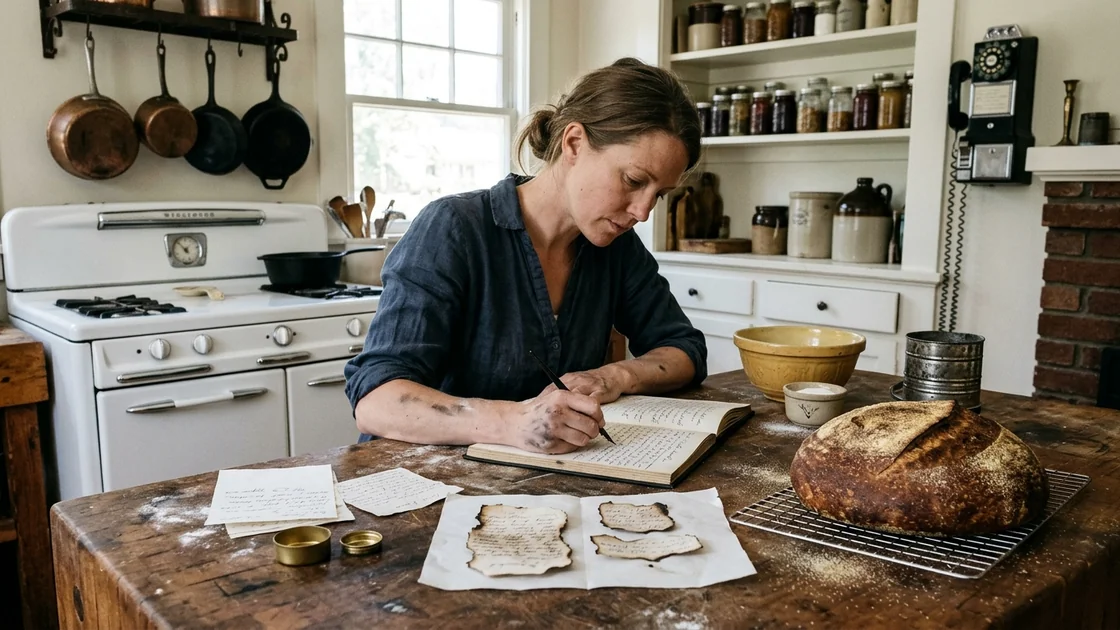
This is the story of Clara, who in a moment of blinding rage cast her mother Elena's lifelong handwritten recipe binder into a roaring hearth, only for Elena to die in her sleep hours later. Left with an immaculate home, a silent kitchen, and an unbearable mantle of guilt, Clara embarks on an arduous, sensory quest through her mother's fractured past to reconstruct the lost manuscript from memory, old friends, and kitchen grease, discovering along the way that an inheritance is neither paper nor ink, but the forgiveness one must grant to the living and the dead alike.
Act I: The Hearth of Remorse
The cold had crept into the floorboards before dawn, the sort of northern California winter frost that seeped off the bay and settled between the redwood studs like a damp shroud. Clara stood in her stocking feet on the hearthstones of her mother’s craftsman bungalow, staring into the dark throat of the chimney.
The ashes inside were gray, powdery, and entirely still. There was no smoke left, only the sour, mineral stink of charred newsprint and seasoned oak that had burned too hot and died too fast. She knelt on the braided wool rug—a rug her mother had washed every spring with snow water and cedar shavings—and reached her bare hand into the firebox.
Her fingers parted the dust. It was cold. She sifted through the coarse charcoal lumps until her knuckles grazed something slick and papery that had not surrendered wholly to the flame: a fragment no larger than a playing card, curled at the edges like a dried bay leaf. She brought it up to the pale morning light filtering through the leaded glass window.
The handwriting on the scrap was unmistakably Elena’s. It was written in faded walnut ink with an old dip pen that scratched the grain of butcher paper: ...half a gill of warm cream, then work until the surface blisters like silk...
Clara closed her fist around it, the burnt carbon crumbling against her palm into an indelible black smear.
The telephone on the kitchen wall began to ring.
It was an antique rotary instrument with a heavy black Bakelite handset, mounted above the pantry door. It rang with a violent, mechanical clamor that echoed off the white subway tiles and the copper pots hanging from their wrought-iron rack. Clara did not move. She knew who was calling, and she knew what they were going to say.
The call was from County General. Dr. Morrison, whose voice she had known since childhood measles and sprained collarbones, would speak with that measured, professional softness reserved for families who had left their sick unattended in the dark.
Clara? I’m so sorry. Her heart simply stopped. It was quiet. She wouldn't have felt any pain.
Clara let the telephone ring eleven times before it stopped. The silence that rushed back into the room was absolute, heavier than the cast-iron skillets nested in the cupboards, thicker than the dust of flour that seemed permanently suspended in the corners of the ceiling.
Twenty-four hours ago, this house had been loud. It had been humid with the steam of boiling cider and vinegar, pungent with the sulfurous sting of bruised garlic, vibrating with two voices that had spent thirty-four years failing to find a common key.
"You don't understand discipline," Elena had said yesterday afternoon, standing over the butcher block with a wooden paddle in her fist, her gray hair escaping its pins in fierce, wispy horns. "You want everything instantly. You want to buy your stock in a carton. You want to make bread with chemical yeast in forty minutes. You live like a tenant in your own life."
"I live in the real world, Mother," Clara had shouted back, her voice shrill with exhaustion, her briefcase lying open on the dining table under a snowfall of spreadsheets she was supposed to review before Monday’s board meeting. "I have a career. I have sixty people who report to me. I don't have four days to clarify a calf's foot! Nobody lives like this anymore!"
"Then you are nobody," Elena had replied with that calm, cutting flatline of tone that made Clara’s teeth ache. "And your children will be nobody. They will eat salt and sugar from machines, and they will never know the taste of home, because their mother was too busy shuffling paper for men who don't know her name."
The ledger had been sitting right there, propped against the salt crock.
It was an eight-by-ten binder bound in peeling oilcloth, stained with three decades of chicken fat, spilled sherry, raspberry seeds, and the gray water of boiled artichokes. Its pages were not ruled; they were thick, creamy linen leaves salvaged from an old ledger her grandfather had brought across the sea from Trieste in 1948. In it, Elena had recorded everything: not merely measurements and temperatures, but the precise weather on the day the plum jam set, the name of the fisherman who brought the spot prawns into the harbor, the date Clara had cut her first molar, and the prayers said over the holiday leavening.
It was Elena’s gospel. It was her sole defense against the vast, indifferent continent that had swallowed her youth and turned her husband into a tired man who died of pneumonia at forty-five.
And Clara had picked it up.
She remembered the weight of it in her hand—dense, heavy, smelling faintly of cloves and dried thyme. She remembered the wild, shameful surge of venom behind her ribs, the terrifying desire to strike an irreparable blow against a woman who had never once dropped her guard or conceded an inch of moral territory.
"Take your legacy," Clara had hissed. "Take your misery and your cabbage."
She had hurled it.
She had not thought the fireplace was that hot. It was just a bed of coals from the morning pine, low and slumbering. But the dry paper caught like dry hay. A sudden, whistling intake of draft had pulled the pages open; they flapped like the wings of a trapped bird as yellow tongues of flame licked between the signatures, dissolving the thread, turning forty years of cursive script into incandescent orange ribbons that drifted up the flue.
Elena had not screamed. She had not rushed to the hearth with the tongs. She had simply stopped stirring the pot. She had laid the wooden spoon down upon the marble tile, turned her back on her daughter, walked down the hall to her bedroom, and turned the latch.
Clara had left twenty minutes later, slamming the front door until the leaded panes rattled, driving through the rain back to her glass-and-steel apartment in the city, telling herself she would return on Sunday to apologize once the old woman had cooled down.
There would be no Sunday.
Elena had not woken up. When the visiting nurse arrived for the routine Saturday morning blood pressure check at eight o’clock, she found Elena cold beneath her hand-stitched goose-down quilt, her hands crossed over her chest, her face set in the same unyielding expression she had worn when she watched her book vanish into the draft.
Act II: The Geography of the Kitchen
The funeral was small, formal, and smelled overwhelmingly of white lilies that Clara had paid an exorbitant sum to have delivered from the city florist. They looked absurd against the plain pine casket Elena had requested in her handwritten will twenty years earlier.
The mourners who filled the front four pews of St. Anthony’s were old people Clara barely recognized: women with wool coats that smelled of mothballs and lavender, men with liver-spotted hands and thick Mediterranean accents who had once sold Elena sheep’s milk cheese or whole hogs from the back of trucks in the early seventies.
They did not offer Clara condolences on her career or ask after her firm. They shook her hand with limp, dry fingers and looked past her shoulder, as though looking for the real daughter—the one who should have been standing there with flour under her fingernails and red knuckles from washing beets.
"She made the potica for my wedding," whispered Mrs. Bartok, an octogenarian who leaned on a silver-headed cane that tapped against the stone floor. "Nobody else knew the nut-paste. You had to roll the dough until you could read the newspaper through it. She used to say, 'Clara will know. Clara has my hands.' You have her hands, child."
Clara looked down at her hands. They were smooth, pale, manicured with neutral lacquer, untouched by the lye soap or the scalding water that had textured her mother’s palms like sharkskin.
"I don't know the nut-paste," Clara whispered.
Mrs. Bartok looked at her with mild, cloudy eyes, blinked once, and moved along the communion rail without another word.
When the last car had pulled away from the cemetery in the dripping foothills of Colma, Clara did not drive back to her flat in the Marina. She drove her sedan through the low fog back down the peninsula, turning off the highway onto the narrow, eucalyptus-lined avenue that led to the bungalow.
She entered through the back door, the way her mother had always entered.
The house smelled of three things: damp plaster, the cold soot in the chimney, and the faint, sweet perfume of vanilla beans that Elena kept stored in a glass jar filled with sugar on the high shelf.
Clara sat at the butcher block. The wooden surface was dished in the center from forty years of cleavers and paring knives; it had a patina like old amber, silky and cool. On the wall above the stove hung the tools: copper saucepans lined with silver that had worn through to the base metal, wire whisks with bent tines, a moon-shaped herb chopper whose wooden handle was stained dark by the oils of Elena’s right palm.
Clara laid her forehead against the wood. The surface smelled of chopped parsley and decades of butter.
She began to weep—not with the tidy, cathartic tears of a grieving daughter at a graveside, but with the suffocating, ragged heaves of a criminal who realizes that the evidence of her crime is the only thing she has left in the world.
She had not only killed the recipes; she had burned her mother’s voice. Elena had never kept a diary. She had never written letters; she considered long-distance telephone calls a form of vanity, and letters were an indulgence for people who did not have dough to punch down. Everything Elena had ever thought about the world, about God, about her husband’s slow decline, about Clara’s birth, about the seasons and the soil and the cruelty of distance, had been scribbled between the steps of making quince jelly or salt-curing pork loins.
Clara remembered seeing, when she was twelve, a recipe for brodo di gallina—hen broth—at the bottom of which Elena had written: Today the war in the old country has ended twenty years ago. The butcher had no fat fowl, so I used two old pigeons. Clara cried all night from the tooth. The world goes forward whether we have cornmeal or not.
All of it. The history of her bloodline, gone up the chimney in a twelve-second fit of spoiled, modern temper.
Clara sat up. Her face was hot, her chest aching. She stood, went to the pantry, and opened the door.
The shelves were a monument to patience. There were two dozen quart jars of wild blackberries gathered from the fence-lines near Pescadero, their purple syrup clinging to the glass like stained church windows. There were jars of pickled shallots, crocks of fermented mustard greens, tins of lard she had rendered herself from leaf-fat brought by the Portuguese butcher in San Jose.
Every single jar was unlabeled.
Elena never labeled anything. She knew the age of a pickle by its color; she knew the vintage of a plum wine by the shape of the wax seal on the cork. To Elena, a label was an admission of ignorance, a sign that the cook did not know her own house.
"I will find them," Clara said to the empty kitchen. The sound of her own voice startled her; it was dry, thin, and lacked the low, resonant resonance of Elena's speech.
She went to her mother’s desk in the small sunroom off the kitchen. It was an old roll-top desk of golden oak, jammed with seed catalogs, utility bills paid punctually on the third of every month with postal money orders, and bundles of church bulletins.
She spent three days going through every drawer, every pigeonhole, every tin can that had once held English toffee or tea. She found no stray index cards. She found no clippings from the newspaper. Elena had despised magazine recipes; she regarded the women who wrote for the Sunday supplements as dilettantes who used too much cream to hide poor butchery.
There was only the hearth.
Clara brought a galvanized bucket, a brass dustpan, and a fine mesh flour sifter into the living room. She set them on the rug, got down on her hands and knees, and began to sift the ashes of her mother’s kitchen.
Act III: The Archeology of Ash
The work was slow and filthy. Sifting fireplace soot is not like sifting flour; the ash is light as breath, rising in greasy gray clouds that settled in Clara’s hair, lined her nostrils with the smell of old charcoal, and rimmed her fingernails with carbon.
Hour after hour, she took a trowel of gray matter from the back corners of the firebox, tipped it into the wire sieve, and shook it gently over the bucket. Most of it fell through as impalpable powder.
By Sunday evening, she had recovered seventeen fragments.
Most were charred beyond legibility, their surfaces glossy and black, the ink indistinguishable from the burnt fiber. But six pieces retained their text, preserved where the leaves of the heavy rag paper had been pressed tightly together as they burned, starving the core of oxygen before the fire died.
She brought them to the dining table, laying them out on white acid-free blotting paper she had purchased from an art supply store in Palo Alto. She used a goose-neck lamp with a blue bulb and a magnifying glass to read the ghost-script.
Fragment One was a corner of page twelve: ...three fingers of wild marjoram, never the garden sort which tastes of tin. If the mutton is male, you must soak the shoulder in sour milk for two nights or the grease will coat the roof of the mouth like...
Fragment Two was a margin: ...June 14. Clara has her degree today. She wore a blue gown that cost two hundred dollars. Her hands are very white. She did not eat the tart I brought.
Clara closed her eyes. She remembered that day twelve years ago. She had been twenty-two, triumphant, clutching her summa cum laude diploma in economics from Berkeley, surrounded by classmates whose parents were judges and venture capitalists. Elena had arrived on the Greyhound bus carrying a round tin tied with string. The tin had contained a torta di bietole—a delicate, savory pie of Swiss chard, pine nuts, raisins, and sheep’s cheese wrapped in thirty layers of pastry as thin as onion skin.
Clara had been embarrassed by the grease spots on the brown paper bag Elena carried. She had taken the tin, shoved it into the trunk of her friend’s convertible, and forgotten it until three days later, when it had soured in the California heat.
She did not eat the tart I brought.
Clara touched the burnt edge of the paper with the tip of her forefinger. The paper was crisp, delicate as an insect’s wing.
Fragment Three was a partial ingredient list: ...nutmeg, two whole ones grated until the knuckle bleeds. One egg for every pound of flour, plus three yolks for the yellow color. Bitter almonds—four only. No more. The poison is where the flavor...
There was no title. What did one grate two whole nutmegs into? A custard? A sausage? A holiday pudding?
Clara leaned back in the ladder-back chair. Her back was seized with spasms from kneeling on the hearthstones. Her hands were gray. She looked at her phone on the sideboard; it had chimed sixty-four times that afternoon with urgent emails from the San Francisco office. Her managing partner was asking about the acquisition audit for the semiconductor firm; three junior associates were waiting for her sign-off on a prospectus; a car was scheduled to take her to the airport on Tuesday morning for a conference in Chicago.
She picked up the phone, powered it down, and laid it face down on the sideboard next to a jar of her mother’s preserved figs.
She was not going to Chicago.
She went back to the kitchen and looked at the stove. It was a 1952 Wedgewood six-burner range, white porcelain with chrome handles that looked like the bumpers of a classic car. It was clean—Elena had wiped it down with baking soda every evening of her life after the supper dishes were dried.
Clara turned one of the heavy chrome knobs. The pilot light hissed, and a circle of clean blue flame blossomed under the cast-iron spider.
She would cook the fragments.
She would begin with what she had, and where the paper was missing, she would force her tongue to remember what her mind had discarded. She would rebuild the book page by page, dish by dish, or she would starve in this kitchen trying.
Act IV: The Trial of the Bitter Almond
The first attempt was an unmitigated disaster.
She assumed Fragment Three—the nutmeg, the eggs, the bitter almonds—was the dough for the potica, the walnut-bread Mrs. Bartok had mentioned at the funeral. Clara drove to four different specialty markets in San Francisco before she discovered that bitter almonds were illegal to sell in raw form in the United States because of their cyanide content; she had to settle for wild mountain apricots whose kernels, the Iranian shopkeeper told her with a conspiratorial nod, had the same dry, sharp, medicinal sting.
She spent thirty-six dollars on four small bags of kernels, returned to the bungalow, and set to work.
She had never kneaded dough in her life. Her experience with bread was limited to picking up sourdough boules from the artisan bakery on Chestnut Street. She dumped five pounds of unbleached flour into Elena’s huge yellow earthenware mixing bowl, cracked eight eggs into the well, grated two whole nutmegs until her right thumb was raw and bleeding into the flour, and added the crushed apricot kernels.
The mixture was like mortar. It seized into a gray, rubbery boulder that defied her wrists.
She stood over the bowl, her hair plastered to her forehead with sweat, her silk blouse ruined with grease and gray flour dust. She pushed down with her palms as she had seen her mother do, but the dough had no life in it; it did not spring back; it sat like a dead pig on the boards.
She left it to rise under a clean damp linen towel near the stove, as Elena always had.
Three hours later, she lifted the cloth. Nothing had happened. The mound was cold, heavy, and smelled aggressively of raw egg and the bitter, disinfectant odor of the kernels. She had forgotten the leavening. She had forgotten the yeast, or the sourdough starter, or whatever mysterious culture Elena had kept in the glazed crock behind the lard pail.
Clara sat down on the kitchen stool and buried her face in her floury apron.
She could hear her mother’s voice as clearly as if the old woman were standing over her with the wooden paddle: A pig uses its head more than you use yours. You think cooking is following a trail of breadcrumbs? Cooking is knowing where the wind is coming from before you open the window.
"Then show me," Clara screamed at the empty stove. "Show me, you cruel old bitch! Show me!"
The house answered with the settling creak of sixty-year-old lath and plaster.
Clara stood up, wiped her eyes with the hem of the apron, leaving two white streaks across her tear-dampened cheeks, and dumped the five-pound lump of dough into the garbage bin.
She needed help. She needed the women who had stood in this kitchen while she had been off at summer camp, at college, at her desk in the high-rise overlooking the bay. She needed the women who had traded recipes with Elena over wire fences and church pews forty years ago.
Act V: The Apostles of the Pot
Her first stop was the house of Signora Gemma Nardi, who lived three streets away in a stucco house flanked by two enormous fig trees that had been wrapped in tar paper for the winter.
Signora Nardi was ninety-one years old. She received Clara in a parlor that smelled of eucalyptus drops and boiled chicory. On the wall was a photograph of Elena from 1955, wearing a white cotton dress with an apron made of feed sacks, her hair dark and thick, her face smooth, smiling with a shy, ferocious pride beside a bushel basket of green peppers.
"She burned it?" Signora Nardi asked. Her voice was like two shingles rubbing together.
"I burned it," Clara said. The shame was a physical weight in her throat, like swallowing gravel. "We had an argument. I threw it in the fire."
Signora Nardi looked at Clara through thick, gold-rimmed cataract lenses. She did not express horror. She did not cross herself. She merely took a slow sip of her chicory and nodded twice.
"You were always a terrible girl," Signora Nardi said calmly. "Very smart. Very pretty. But you had a heart like an unripe medlar. It makes the mouth puckery."
"Can you help me?"
"Help you what? Elena didn't have recipes. What she had was an argument with God. Every time she cooked, she was telling Him: You took my husband, you took my country, you gave me a daughter who doesn't like soup, but you cannot spoil my polenta."
"She wrote it down, Signora. She had four hundred pages. I have fragments. I have six pieces of paper."
Signora Nardi reached out a hand that was curved like a bird’s claw, its skin spotted and translucent as paraffin paper, and took Clara’s wrist. Her grip was surprisingly hard.
"She came to this country with three things," the old woman said. "A copper pot her grandmother had used during the cholera outbreak of 1888, a silver thimble, and the leavening her mother had taken from the bakery in Gorizia before the Austrians shelled it. The leavening she kept in a crock under the cellar stairs. Did you look under the stairs?"
"I... I haven't been down there since I was ten," Clara admitted.
"Go down there," Signora Nardi said, releasing her wrist. "And if you want to know about the mutton with wild marjoram, you don't use sour milk. That was for the tourists. She told that to the ladies from the Junior League who came around here in 1974 with their little spiral notebooks. She hated those women. She gave them recipes that would make their husbands sick with the wind."
Signora Nardi began to chuckle—a dry, rattling sound that turned into a coughing fit. When she recovered, she looked at Clara with something approaching pity.
"She used whey," the old woman whispered. "Whey from the goat cheese that the Greek man makes behind the railway station in South San Francisco. If you don't have the whey, you don't make the mutton. And you don't use a fork to turn it. You use your fingers. If you can't stand the heat of the fat, you don't deserve the meat."
Clara stood up. She took a small notebook from her bag—a new one, bought that morning, with blank, white, ruled pages.
"Did she ever talk about me?" Clara asked, her voice cracking. "In the kitchen? Did she ever tell you what she wanted for me?"
Signora Nardi looked away, toward the cold window where the fig leaves scratched against the glass.
"She wanted you to be hungry," Signora Nardi said. "That was her prayer for you. She said, 'Clara has never been hungry a day in her life. That is why she doesn't know who she is. A person who has never been truly hungry has no soul; they have only an appetite.'"
Act VI: The Crypt of Jars
The cellar stairs were dark, narrow, and smelled of earth, dry rot, and fifty years of accumulated condensation.
Clara took a flashlight and stepped down into the cool darkness beneath the house. The floor was packed dirt, swept clean and hard as concrete. Along the walls were rough redwood shelves supported by cinder blocks, groaning under the weight of three generations of preserving.
There were crocks of every description: gray Ohio stoneware with blue cobalt birds painted on their bellies; brown glazed earthenware jugs with corn-cob stoppers; glass demijohns encased in wicker jackets that were rotting with green mold.
In the farthest, coldest corner, where the foundation met the earth of the hillside, sat a heavy, five-gallon crock covered with a round oak board and weighted with a river stone.
Clara knelt before it. The stone was smooth, gray granite, polished by centuries of river water before Elena had carried it home from the Russian River forty years ago. Clara lifted the stone; it was cold as an iron weight. She removed the oak cover.
A smell rose from the dark interior—a smell so ancient, complex, and pungent that it stopped her breath.
It was sour, but not spoiled; it smelled of beer, green apples, damp grain, and the sharp, clean ozone of a lightning storm. It was the sourdough starter. It was the madre—the mother culture that had survived the crossing of the Atlantic, the train ride from Hoboken to Oakland, the birth of Clara, the death of her father, and the passing of half a century.
On top of the liquid floated a gray, leathery skin—the hooch, the protective seal the culture creates when it has been starved of flour.
Clara dipped a finger into the liquid beneath the skin and touched it to her tongue.
The acidity was sharp enough to make her jaw ache, but behind the acid was an enormous, earthy sweetness, a richness like roasted nuts and fresh mushrooms. It was alive. In the absolute darkness of the cellar, while Elena lay under six feet of sod in Colma and Clara ruined herself with regret above, these billions of microscopic yeasts and bacteria were still breathing, waiting for someone to feed them.
Beside the crock sat an old shoe box covered in dust.
Clara lifted the lid with trembling hands. Inside were not recipes, but small, folded scraps of paper: church donation envelopes, receipts from the feed mill that had closed in 1968, the backs of labels peeled from cans of tomato paste.
On each scrap, Elena had written a date, a time, and a single observation:
Oct 12, 1961. The fog came over the ridge at three. The starter wanted two more spoons of rye flour today. It is lazy.
April 4, 1968. Dr. King is killed in Memphis. A terrible black wind. I made salt bread with no shortening so we do not forget the bitterness of the world.
August 9, 1974. The President has resigned. Clara is eight years old today. She asked why we don't have a color television like the Millers. I made her three little pies with the wild plums. She ate the crust and left the fruit.
Nov 3, 1985. Clara went to Berkeley today. She did not look back from the car window. Her father would have been proud of her books. My heart is like an empty kettle.
Clara sat on the dirt floor of the cellar, her back against the cool foundation wall, her knees pulled to her chest, the shoe box in her lap. She read every scrap by the yellow beam of the flashlight.
There were no instructions. There were no lists of grams and ounces. There was only the chronicle of a woman who had translated every event of her life—every grief, every political terror, every private disappointment—into the language of fermentation, heat, and fat.
The book Clara had burned was not a cookbook. It was Elena’s life raft. And Clara had kicked it out to sea while her mother was still clinging to the gunwale.
Act VII: The Apprenticeship
Clara did not go back to the city on Monday. She called her office from the payphone outside the market on El Camino; she did not want to hear the sound of her modern, executive voice on her mother’s telephone.
"I'm taking a leave of absence," she told her managing director.
"Clara, that's impossible," he said, his voice crackling with the metallic clarity of a high-end headset. "The Holbrooke merger closes on the fifteenth. You're the lead on due diligence. If you're not in the room, the deal could crater."
"Then let it crater," she said.
"Are you having a breakdown? Clara, your mother was an old woman. It's sad, but it's natural. You have to compartmentalize."
"I am compartmentalizing," she said. "I am separating what matters from what doesn't. Goodbye, Richard."
She hung up the receiver and let the change drop into the return slot.
She walked into the market—a dark, narrow Italian grocery that had occupied the same corner since 1932. The floor was sawdust over fir; the air was thick with the scent of hanging provolone, dried baccalà, and the oily brine of black olives in wooden tubs.
Behind the counter was Gianni, a man with shoulders like an ox and thick white hair that grew low on his forehead. He had known Elena since she was a young bride buying lard by the quarter-pound.
"Gianni," Clara said.
He looked at her over his wire-rimmed half-glasses, his meat cleaver suspended two inches above a loin of veal.
"You look like her today," he said. "Except your eyes are red. You've been crying. Your mother never cried where anybody could see. If she had to cry, she peeled red onions."
"I need to know how she made the torta di bietole," Clara said. "The pastry. The thirty layers. How did she get it so thin?"
Gianni let the cleaver fall with a solid, wet thud into the maple block. He rested his heavy forearms on the wood and looked at her for a long time.
"You really want to know?"
"I have to know."
"Then come behind the counter."
For the next four weeks, Clara did not leave the neighborhood. She became an apprentice in the kitchens of the old women and the shops of the old men who had formed the perimeter of her mother’s existence.
She spent three days with Signora Vane, who taught her how to render pork fat without scorching it, standing over an iron kettle on an outdoor gas burner behind the garage, skimming the gray scum until the lard ran clear and pale as mountain water.
"Your mother never used butter for the pastry," Signora Vane said, her voice shaking with palsy as she poured the molten fat into clean glass jars through a double layer of cheesecloth. "Butter has water in it. Water makes steam. Steam makes the pastry tough. You use lard that you rendered yourself in November, when the air is cold enough to set the fat before it turns yellow. If you buy the lard from the supermarket, it has hydrogen in it. It tastes of candles. Don't use candles to feed people you love."
She spent five mornings in the back of the bakery in South San Francisco, her hands deep in the cold, wet flour, learning the rhythm of the stretch and fold.
Her palms, which had known only the clicking of computer keyboards and the smooth leather of steering wheels, developed blisters that broke, wept, and hardened into thick, yellow calluses. Her wrists swelled; her shoulders ached with a dull, constant fire that made it difficult to sleep.
She learned that dough is not a chemical formula; it is a weather report. If the day was damp, you withheld a handful of water; if the wind was blowing from the north, off the dry interior valleys, you gave it an extra splash of white wine to keep the crust from splintering before the center had set.
In the evenings, she returned to the bungalow.
She would bring the starter up from the crypt beneath the floorboards, feed it with equal weights of water and coarse rye meal, and listen to it work in the dark. It made tiny, rhythmic clicking sounds as the gas escaped, like a watch ticking under a feather pillow.
She began to write.
She bought a ledger—not oilcloth, for she could not bring herself to imitate the original, but a simple notebook bound in black buckram with heavy, unruled Italian paper.
On the first page, she did not write a recipe. She wrote an apology:
Mother: Today I learned why you always used the lard instead of the sweet butter. I have blistered my thumb on the oven door. The skin is red and smells of smoke. I am sorry about the blue gown at Berkeley. I am sorry about the thirty-four years of silence.
Act VIII: The Trial of the Bread
By mid-January, Clara had reconstructed twenty-two recipes.
They were not duplicates; they were translations. She had discovered that memory is not a photograph; it is an echo. When she tried to make the lemon-verbena jelly her mother had put up every August, she found that her own hands favored more lemon and less sugar than Elena had used. When she braised the beef shanks with bitter greens, she added two dried chilies she had found in the cupboard, small red peppers that Elena had grown on the back fence and dried on thread.
The food was not Elena's. It was the conversation Elena had tried to have with her for three decades, finally answered in the only language the kitchen understood.
But the bread—the great, round, crusty hearth-loaf that Elena had baked every Tuesday and Saturday—eluded her.
Every loaf Clara pulled from the Wedgewood was wrong. Some were pale and doughy in the center, heavy as river mud; others were burnt black on the bottom while the top remained white and soft; some had no rise at all, coming out of the heat like flat, gray stones that could have been used to pave the garden path.
She had tried fourteen times. The pantry floor was littered with failed loaves that she could not bear to throw away; she chopped them into dry croutons and scattered them in the back garden for the jays and the towhees.
On the fifteenth morning, the rain was coming down with that furious, horizontal persistence that only the Pacific winter can produce. The eucalyptus trees along the lane whipped against the power lines, and the kitchen was cold, dark, and smelling of old iron.
Clara stood before the earthenware bowl.
She had used the madre from the cellar, three cups of stone-ground wheat from the mill in Petaluma, a cup of spring water she had carried from the public fountain in the hills, and a teaspoon of coarse sea salt harvested from the salt pans down the bay.
She did not use her watch to time the kneading. She closed her eyes.
She put both hands into the dough, fingers splayed, and pushed forward with the heel of her palms. She listened.
Beneath her skin, she felt the gluten strands—tight, stubborn, resistant. She did not force them. She worked with the slow, rocking rhythm she had seen Elena use while she listened to the morning news on the radio.
Push. Turn. Fold. Breathe.
The dough began to change. It ceased to be a mixture of dust and water; it became a single, living tissue. It grew warm beneath her hands; it became smooth, velvety, resilient as an inner tube. When she pressed her thumb into the center, the dent filled itself out again within three heartbeats, slow and proud.
She shaped it into a high, round ball, placed it in a wicker basket lined with a linen cloth that had been dusted with coarse cornmeal, and covered it with her mother’s old wool shawl.
"Now," she whispered to the stove. "Now you work."
She waited four hours. She did not look under the cloth. She sat at the table with her hands flat on the wood, feeling the cold rain shake the house.
When she lifted the wool, the dough had doubled. It had crested the rim of the basket like a pale, rising moon, its surface taut, speckled with tiny fermentation bubbles that were transparent as glass.
She heated the oven for an hour, pushing the dial to four hundred and fifty degrees, sliding an unglazed clay baking tile onto the middle rack until it was hot enough to make a drop of water spit and vanish into vapor.
She tipped the loaf out of the basket onto a wooden peel.
It held its shape. It did not collapse into a puddle. It sat high, rounded, dusted with cornmeal that looked like gold dust on the pale skin.
She took a razor blade and scored the top—not with the cross the French bakers used, but with the single, deep, curved slash that Elena had always cut, a crescent that looked like the new moon over the bay.
She slid it onto the hot tile. She threw half a cup of water onto the cast-iron floor of the oven to create a cloud of white steam, then slammed the porcelain door shut.
The smell began thirty minutes later.
It was not the smell of baking from a shop. It was the smell of the earth itself being transformed by fire: the caramelization of grain sugars, the sour bite of wild yeast, the toasted sweetness of the cornmeal, the deep, dark perfume of wheat that had grown under an open sky.
It filled the kitchen. It crept down the hallway into the bedrooms; it entered the closets and clung to the coats; it seemed to rise through the floorboards from the crypt below.
Clara sat on the floor with her knees against the oven door. The heat radiated through the porcelain into her chest, warming the cold, hollow space behind her ribs where the guilt had lived for sixty days.
She turned off the gas. She left the door shut for another ten minutes, as Elena had always done, to let the crust cure in the falling heat.
When she opened the door, the kitchen vanished behind a wave of hot, fragrant air.
She reached in with two heavy linen cloths and lifted the loaf out onto the wire rack on the butcher block.
It was magnificent.
It was the color of an old chestnut, dark brown at the edges of the score, deep mahogany on the shoulders, golden yellow in the valleys where the dough had burst open in the oven’s first leap. The crust was crackling—literally singing to itself in tiny, musical ticks and snaps as the cool air of the room caused the brittle, glassy surface to craze into a thousand microscopic fractures.
Clara did not move. She did not cut it.
You never cut hot bread; Elena had said that cutting hot bread was like waking a child who was in the middle of a good dream. You had to let the crumb set; you had to let the bread finish its work in the quiet.
Clara leaned over the loaf. She smelled it.
She closed her eyes and inhaled deeply through her nose.
In that single, warm, complex draft of steam, she found everything she had thought was lost in the ashes: the cold mornings of her childhood; the sound of her father’s truck tires on the gravel; the grease-stained apron Elena had worn to every school play; the quiet, furious, incomprehensible love of a woman who had never learned how to say I love you in any word that could be found in a dictionary, but had said it three times a day, on plates, with spoons, for thirty-four years.
Clara dropped her head against the edge of the butcher block and wept until the bread had cooled.
Act IX: The Fragment that Remained
In late February, the rains finally ceased. The sun broke over the Santa Cruz mountains, turning the hills that had been brown for nine months into an emerald green so vivid it hurt the eyes.
Clara was cleaning the chimney.
It was the final task she had set for herself before she decided what to do with the house. She had hired a mason to check the flue, but she insisted on cleaning the firebox herself. She wanted the hearth clean—not the cold, greasy gray of the fire she had set, but the scrubbed, red-brick purity of a hearth that was ready for a new winter.
She was using a stiff wire brush to scrub the soot from the cast-iron fireback—an old, heavy plate of iron that sat against the rear bricks to reflect heat into the room.
As the brush scraped across the relief work—a depiction of Ceres holding a sheaf of wheat—her bristles caught on something wedged in the narrow crevice between the iron plate and the masonry.
She stopped. She took a pair of long-nosed pliers from her father’s tool kit and gently worked the object free.
It was not a fragment of ash. It was a metal capsule—a brass cylinder about the size of a cigar tube, sealed with green plumber’s wax at both ends. It was black with soot, but the metal beneath was cool and solid.
Elena had hidden it there.
Clara sat on the hearthstones, her legs crossed, the brass tube in her lap. Her hands were shaking—not with the wild, destructive trembling of the afternoon she had burned the book, but with the quiet, reverent terror of an archaeologist who has touched the seal of an unlooted tomb.
She took a paring knife from her pocket and scraped away the brittle green wax. The cap unscrewed with a dry, grinding shriek of brass threads.
Inside was a single roll of parchment paper, narrow and long, written not in ink, but in soft carpenter's pencil that had not faded, that had not run, that had defied the heat of forty winters behind the iron plate.
Clara unrolled it across her knees.
It was dated September 14, 1966. The day Clara was born.
If you are reading this, the pencil said, the handwriting younger, stronger, but with the same fierce slant, it is because I am dead, or because you have finally looked behind the iron where your father kept his army pay.
You were born at four o'clock this morning. A small girl with very large eyes and hair like wet silk. You did not want the milk. You fought the rubber nipple; you fought the breast; you fought the blanket. The doctor said you were an irritable child. I told him you were not irritable; you were particular.
I have started the book for you today. On the first page, I have written the bread. The bread is the only thing that matters. If you have the bread, you can live through the war. If you have the bread, nobody can buy you. If you know how to make the starter, you will never have to beg from anyone, not even from a man who says he loves you.
You will hate me sometimes. A daughter must hate her mother if she is going to become a woman; if she loves her too much, she stays a child with her hand out for sugar. I know this. My mother was hard as an olive stone, and I hated her until the day I saw her wrap her bread in her shawl to keep it warm on the boat to America. Then I knew that her hardness was the only thing that had kept us alive while the soldiers were burning the orchards.
Do not be too sweet, Clara. The world eats sweet things first. The sweet things rot the teeth, and then they are thrown away. Be like the salt. A little bit of salt keeps everything from going bad.
I leave you the stove. I leave you the crock. The rest you will have to find out by yourself.
Your mother, Elena.
Clara sat in the square of morning sunlight that fell through the leaded window onto the rug.
She did not cry. The tears were done; they had been baked into the crust of the fifteen loaves; they had been scrubbed into the fir boards of the pantry floor; they had been buried with the walnut fragments in the columbarium in Colma.
She felt only a strange, enormous lightness—the lightness of a diver who has touched the seabed, found the iron ring she had dropped into the abyss, and kicked back up into the blue air.
Act X: The Feast of the Rebuilt Table
On the first Saturday in March, the kitchen of the bungalow on Mariposa Street was loud again.
The windows were open to the garden, where the plum trees were breaking into their first white clouds of blossom. The air was cool, but the kitchen was hot—hot with the blue roar of six burners and the radiant, steady pulse of the Wedgewood oven.
The table was set for eight.
Clara had not used the linen she had inherited; she had washed it, ironed it with lavender water, and laid it out across the long redwood trestle table her father had built. On each plate was a sprig of wild marjoram gathered from the ridge above the ocean.
Signora Nardi was there, sitting in the armchair with her cane leaned against the sideboard, her old eyes bright behind her thick lenses. Signora Vane had brought three jars of her pickled pears; Gianni the butcher was sitting at the end of the table in his Sunday suit, his hair slicked back with pomade, a bottle of dark, homemade Zinfandel between his knees.
There were four other women from the church—the women who had known Elena when her hands were young, the women who had looked past Clara at the funeral.
Clara did not wear an apron. She wore her mother’s dress—the dark blue linen with the mother-of-pearl buttons that she had taken from the cedar chest in the attic. It was too wide in the shoulders, too long in the hem, but she had pinned it at the waist with Elena’s silver thimble, which she had threaded onto a blue silk ribbon.
She brought the first dish to the table.
It was the torta di bietole.
The crust was not thirty layers; it was perhaps eighteen. It was not as translucent as Elena’s had been; you could not have read a newspaper through it. But it was crisp; it flaked under the knife with a dry, papery whisper; the filling was dark, savory with the wild greens, rich with the sheep’s milk curd, with the sudden, sharp, sweet discovery of a raisin and the resinous crunch of a pine nut.
Gianni took a forkful. He chewed slowly, his heavy jaw moving with deliberate, professional judgment. The table was silent; the only sound was the wind through the plum blossoms outside and the ticking of the kitchen clock.
Gianni swallowed. He looked up at Clara, his eyes squinting through the smoke of his cigarillo.
"The pastry has too much lard," he said.
Clara’s heart stopped.
"It has too much lard," Gianni repeated, "and you used the wild marjoram from the south side of the hill, where the sheep have been running. It is too strong."
He paused. He took another forkful—a huge, greedy wedge that disappeared into his mouth.
"It is nearly as good as your mother’s," he said, his voice dropping into a growl. "She was a stubborn woman. She never would listen to me about the nutmeg. You didn't put the nutmeg in the greens, did you?"
"No," Clara said. "I left the nutmeg for the pudding."
Signora Nardi reached out and touched the edge of the earthenware platter.
"She has her mother's hands," the old woman said to no one in particular. "I told you she had her hands. It took her thirty-four years to find them, but she found them."
Clara sat down at the head of the table, in the chair that had been empty since December.
She poured the dark wine into the small, thick-bottomed glasses. She took a loaf of the wild yeast bread—the sixteenth loaf, the one that had risen under the wool shawl while the rain had cleared from the valley—and she did not cut it with a knife.
She took it in both hands, her thumbs pressed against the center of the bottom crust, and she broke it.
The loaf cracked with a sound like a dry branch snapping in a quiet wood. The steam that rose from the split interior was sweet, sharp, complex, and hot enough to fog the glasses on the table.
She handed the first piece to Signora Nardi. She handed the second piece to Gianni. She passed the bread around the table until every hand held a portion of the crust, until the crumbs lay thick and gold across the white linen.
When they had all eaten, when the wine was low in the bottles and the sun had dropped behind the mountain, turning the sky over the Pacific into a deep, bruised violet, Clara went back into the kitchen.
The dishes were piled in the sink, waiting for the scalding water and the lye soap. The fire in the Wedgewood was out; the iron spider grates were cooling, ticking softly as the metal contracted in the dusk.
On the butcher block lay the black buckram ledger.
It was no longer blank. The first sixty pages were covered in Clara’s handwriting—a handwriting that had changed over the last two months, losing its sharp, slanted, corporate efficiency, becoming rounder, heavier, more deliberate, the ink bitten deep into the linen fiber.
She sat on the stool, dipped her mother’s old pen into the walnut ink, and turned to page sixty-one.
She did not write measurements. She did not write oven degrees.
March 7, she wrote. The plum trees have flowered early this year. Gianni says the pastry is too rich, but he ate three slices and took the end of the loaf home in his handkerchief. The starter was hungry this morning; it smelled of beer and sweet earth. Tomorrow I will plant the bitter greens along the stone wall where the drainage is good.
She paused. The ink was wet, shining black in the blue evening light that came through the open door.
At the bottom of the page, where Elena had once written her notes on the wars and the teeth and the souring of the plums, Clara wrote the final line:
I am here, Mother. I am very hungry. And everything is ready.
She laid the pen across the groove in the wooden desk, left the ledger open on the table so the night air could dry the ink, and went to the back door to watch the stars come out over the valley.