The Boiling of the Silent Mind
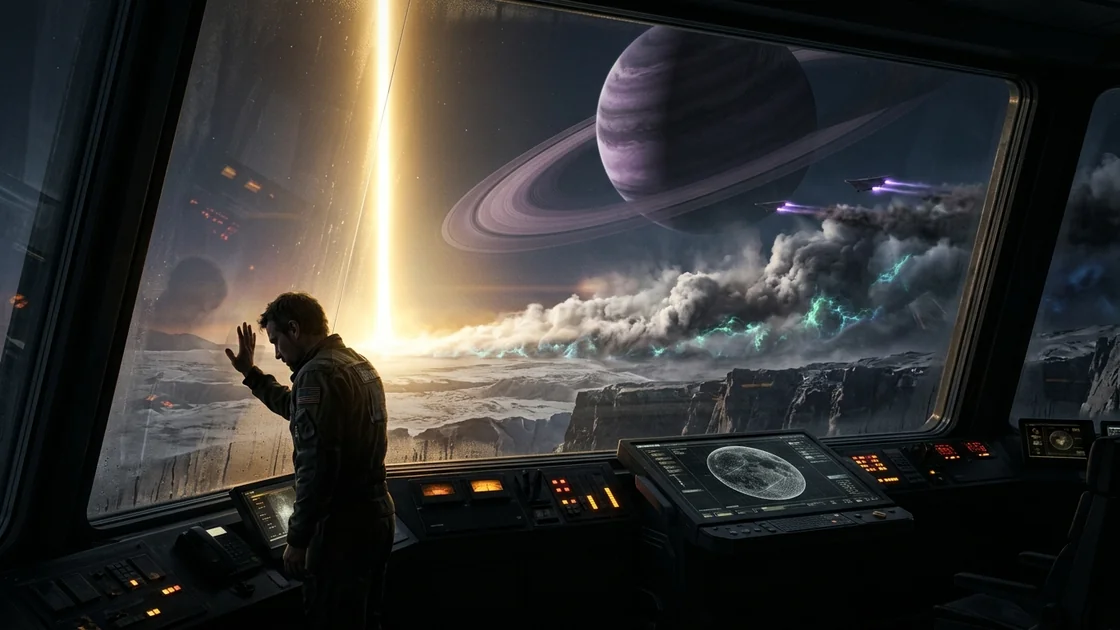
This story chronicles the catastrophic mistake of Jonas Vance, a senior planetary geo-engineer employed by the trans-stellar development corporation Geo-Genesis Unlimited. Stationed on the remote, sub-glacial moon of Achelous-4, Vance is pushed to meet an impossible deadline to make the moon hospitable for millions of incoming human colonists fleeing environmental collapse. In his haste to ignite the moon's atmosphere through hyper-aggressive thermal oxidizers and synthetic biocatalysts, Vance ignores marginal anomalous sensor readings from the equatorial ice sheets, assuming them to be abiotic crystal formations. By the time he decodes the light-bearing language of the world, he discovers that the subterranean slush harbored an ancient, microscopic hyper-intelligence whose collective consciousness spanned the entire moon, and which his machines have completely, irrevocably erased.
Act I: The Geometry of Deadlines
The mirror array hung above Achelous-4 like an unblinking, segmented eye of gold leaf and composite carbon. From the observation cupola of Station Four, perched atop the basalt ridge of the Promontory of St. Jude, Jonas Vance could trace the faint, pencil-thin alignments of orbital radiation focused down onto the southern ice shelf.
Below him, five hundred million square kilometers of dirty, frozen methane, ammonia slush, and silicate dust waited to die. Or to be born. In the technical manuals published by Geo-Genesis Unlimited, the verb was always natalize. One did not kill a barren world; one ushered it through its violent, chemical parturition.
"We have three tenths of a degree variance along the meridional trench," Dr. Aris Thorne said, his voice coming through the low-frequency bone-conduction implant behind Vance’s left ear. Aris was four levels down, sealed into the computational crypt where the heat sinks hissed continuously against the outer permafrost. "If the solar mirrors dump energy into Sector Nine before the thermite conduits achieve continuous ignition, we’re going to get steam blowouts. Dirty ones. We’ll coat the upper cloud deck with iron particulates before the ozone precursors have even stabilized."
Vance pressed his forehead against the triple-paned quartz of the cupola. The cold radiated through the glass, through his dermal layers, biting deep into the bone above his eyebrows.
"Teresa won’t grant the delay, Aris," Vance said softly. "You know that."
"The margin is too tight, Jonas. It’s an order of magnitude thinner than the safety protocols we drafted at Ganymede."
"Ganymede didn’t have eight colony transports drifting in high-elliptic deceleration. Ganymede wasn't the sole asset portfolio for a board of directors watching their terrestrial shares evaporate in the hyper-inflation riots." Vance checked his wrist display. The luminescent green digits flickered against his dry skin: 118 days, 14 hours, 02 minutes to First Fleet Insertion.
Two hundred and forty thousand men, women, and children were suspended in metabolic arrest inside the hulls of the Covenant, the Sovereign, and the four Vanguard hulls, their bodies chilled to three degrees above absolute zero, their lungs drained and filled with fluorocarbon gel. They were arriving. If the surface of Achelous-4 was not breathing nitrogen, oxygen, and carbon dioxide at an ambient pressure of at least six hundred millibars by the time those ships dumped their velocity against Tartarus’s gravity well, the transports would either have to burn their emergency fuel to skip off the atmosphere and die in deep space, or descend into an unbreathable cauldron of liquid ammonia and shatter their heat shields against frozen rock.
"I’m looking at the thermal scans from the sub-crustal drills," Aris insisted. His voice carried that thin, brittle timbre that came from thirty-six hours without sleep, sustained only by modafinil cocktails and synthetic hydration bags. "The slush is dense. It’s behaving like non-Newtonian gel in the southern syncline. The viscosity readings don’t match the core drills from two years ago. We’re going to need twice the hyper-catalytic dispersant to break the surface tension, or the fire won't take."
"Then double the payload," Vance said.
"If we double the bio-catalyst, we bypass the secondary filtration scrubbers. We vent raw phage into the basins without a baseline profile."
"There is no baseline profile," Vance snapped, turning away from the window. The vast expanse of the control room rose behind him—banks of dead-black consoles, the holographic well displaying the spinning wireframe of Achelous-4, its oceans of ice tinted a dull, bruise-colored purple under the dim illumination of Tartarus, the ringed gas giant that dominated the moon’s night sky. "We surveyed this rock for seven months. It is an abiotic ice trap. Silicate core, hydrocarbon mantle, frozen ammonia skin. Nothing moves down there except convective thermal plumes and trapped methane clathrates. Double the dispersal rate on the drone fleet. Tell the orbital platform to align the secondary collector mirrors."
"Jonas—"
"Teresa has already authorized the ignition cycle, Aris. She authorized it from the corporate deck in Geneva eight months ago when the fleet launched. We don’t own the clock. The clock owns us. Push the feed."
Vance walked across the rubberized deck plates toward the elevator shaft. The air in Station Four tasted of recycled copper, ozone, and the chemical tang of skin-oil that had passed through three hundred scrub cycles. It was the taste of modern exploration: hurried, industrial, and stripped of awe.
He took the lift down to the sub-level labs. His joints ached. At forty-nine years old, he had spent half his adult life in low-gravity installations, and his skeleton was a patchwork of mineral density treatments and micro-fractures sustained during the Titan bore projects. He had made Geo-Genesis rich. He had cracked the skies of three moons, tuned the thermal currents of two Martian basins, and turned dead dust into soil capable of holding genetically spliced winter rye. He was known as the Welder. When a world was broken, or simply cold, Jonas Vance brought the flame.
The elevator chimed, opening into the cavernous bay of the Xenochemical Diagnostic Ward.
Unlike the engineering bays, this section was quiet. Too quiet. Rows of automated spectrometry units hummed within their helium-cooled housings. The centrifuges spun silently behind vacuum barriers. At the far bench, surrounded by three-dimensional plots of hydrocarbon chains, sat Dr. Mirei Chen.
Mirei was the expedition's sole biospheric preservation officer—a position mandated not by Geo-Genesis’s board of directors out of moral duty, but by the Inter-System Colonial Charter of 2104. Her job was to certify that Achelous-4 was devoid of indigenous life, clearing the legal path for the absolute atmospheric rewrite known as Operation Morningstar.
"You're about to authorize the aerosol drop," she said without looking up. Her voice was flat, dry as shale.
"The drones are fueling now," Vance said. "We fire the surface penetrators in four hours."
"Look at this, Jonas." She pointed a gloved finger at a high-resolution scanning electron micrograph projected onto the bench.
Vance leaned over her shoulder. The image showed a crystalline structure retrieved from an eight-kilometer-deep core sample taken from the Great Silt Basin near the moon’s equator. It looked like an intricate lattice of frozen water, ammonia, and iron sulfides—a snowflake, but elongated, its arms branching with an uncanny, fractal regularity that resembled the printed circuit boards of antique computational engines.
"Dendritic ice," Vance murmured. "We see it in every ammonia-water eutectic mix below ninety Kelvin. The molecular charge of the iron salts forces a hexagonal symmetry."
"Look closer at the junction nodes," Mirei said, zooming in with a twist of her fingers.
The magnification jumped: fifty thousand times. At the intersections where the ice crystals met, the iron sulfide molecules weren't randomly distributed. They were clustered in alternating chains of varying chirality. Left-handed, right-handed, left-handed, left-handed, right-handed.
"It’s an abiotic polymer," Vance said, checking his watch again. "A template effect caused by the basalt bedrock beneath the ice shelf. We documented the same thing on Enceladus back in the thirties."
"The chirality changes when you shine coherent light on it," she said, looking up at him now. Her eyes were sunken, dark circles carved deep into her sallow face. "Not by much. Just a few degrees of optical rotation. But it responds to wavelength. If you strike it with blue light, the chains align. If you strike it with red, they twist ninety degrees."
"A photo-reactive phase change. Useful for organic semiconductors, maybe. We can patent the crystalline structure after we vent the mantle."
"It isn't just reacting, Jonas," she whispered, her voice tightening. "It’s echoing."
"What do you mean, echoing?"
"I ran a laser diffraction test through a four-centimeter cube of the slush sample this morning. I pulsed it with three simple prime sequences—two, three, five. Just standard calibration protocol to test the sensor’s focal depth. The sample didn’t just scatter the beam. It held the light. It trapped the photons in the interstitial lattice for 1.4 seconds, and then it re-emitted them. Not as heat. Not as fluorescence."
"Then how?"
"It re-emitted the pulses. Inverted. Five, three, two. Then it went dark."
Vance stopped. The sound of the station’s atmospheric pumps seemed to swell in the silence, a low, guttural vibration that he felt through the soles of his boots. He looked at the screen, at the clean, delicate lines of the lattice. For a fractional moment, an instinct buried beneath twenty years of industrial deadlines flared in his chest—a cold, prickling sensation that made him want to pull the emergency master switch, drop the rods, and stop the clocks.
Then his sleeve communicator chimed. It was Teresa Sterling, calling down from the orbital flagship Aethelgard.
"Vance," Sterling's voice was crisp, modulated by the light-second delay from the high-orbital ring. "Telemetry shows the orbital mirrors have locked onto their focal vectors. The Board has confirmed receipt of your preliminary readiness report. We are seventy-two minutes away from the first burn window. Are your ground assets clear?"
Vance stared at the image on Mirei’s monitor. He felt Mirei’s eyes on his profile, desperate, questioning, terrified of what she had discovered and even more terrified of being the one to halt the march of a quarter-million souls.
"Vance?" Sterling repeated, the edge of corporate impatience sharpening her tone. "We don't have orbital slack here. The Covenant has initiated its deceleration curve. If we don’t clear the cloud decks by Tuesday, their entry telemetry is blown. Confirm ground readiness."
Vance swallowed. The taste of copper was thick on his tongue.
"Ground assets are clear, Director," Vance said. "Drone wings Alpha through Delta are fully fueled. Phage tanks are pressurized."
"Jonas, no," Mirei hissed, reaching for his wrist.
He pulled his arm back, his eyes fixed on the blank metal wall beyond the monitors. "We initiate the primary burn on schedule. Station Four will seal all atmospheric bulkheads in sixty minutes. Have your diagnostic systems running passive scans during the drop, Dr. Chen. If there’s an anomaly in the reaction fronts, we need to know whether to alter the catalytic balance."
He turned on his heel and walked out of the laboratory before she could speak again.
Behind him, on the monitor, the frozen lattice of ice and iron sat silently under the pale glare of the diagnostic lasers, its arms glistening like the ribs of an infant cathedral waiting for the hammer to fall.
Act II: The First Fire
The sound of twenty-four orbital kinetic penetrators hitting a frozen world is not a boom. A boom requires an atmosphere to carry the displacement of air, and Achelous-4 had only a thin, wispy veil of nitrogen and argon, barely twelve millibars of pressure, brittle and cold enough to shatter like glass.
Instead, the strike came as an earthquake that seemed to have no epicenter. It rose from the bedrock, a deep, sickening lurch that rattled the shock-absorbing pistons beneath Station Four’s foundations.
Vance stood at the main tactical console on the command deck. Across the wall-sized primary display, twenty-four white dots blossomed across the southern quadrant of Achelous-4. Each kinetic slug, thirty tons of depleted uranium tipped with solid-state thermal oxidizers, plunged seven kilometers deep through the ice mantle before detonating.
"Sub-crustal ignition confirmed," Aris reported from the operations pit. His fingers flew across the virtual interfaces. "The thermal cores are discharging. Local temperature at the detonation sites has spiked from ninety Kelvin to two thousand four hundred Kelvin."
"Release the bio-catalytic aerosol," Vance ordered.
Outside, five miles down the basalt cliffs, the massive concrete silos of the drone hangars slid open. A flock of autonomous atmospheric dispersal drones—each the size of an intercontinental transport, with delta wings spanning ninety meters—screamed into the thin sky on liquid-oxygen boosters.
They climbed into the twilight, their exhaust plumes glowing an incandescent violet against the vast, sickly belly of Tartarus hanging overhead. As they reached twelve thousand meters, their underbellies opened, venting thousands of tons of the Genesis-7 cocktail: an ultra-dense slurry of engineered, synthetic methanotrophic bacteria, organo-metallic cracking catalysts, and self-replicating fluorocarbon precursors.
The plan was an exercise in brutal chemistry.
The kinetic penetrators would melt the deep ice shelves from below, releasing trillions of cubic meters of trapped methane and ammonia slush. As the boiling liquid erupted to the surface in geysers miles high, the Genesis-7 mist would intercept the plumes. The synthetic enzymes would crack the ammonia into nitrogen and free hydrogen; the hydrogen would react with the atmospheric oxidizers to create superheated water vapor; the methane would be transformed into carbon dioxide and dense, heat-trapping fluorocarbon complexes.
Within seventy-two hours, Achelous-4 would develop a greenhouse blanket so thick, so violently efficient, that the heat from the orbital mirrors would be trapped forever. The moon would sweat. The ice would collapse into oceans. The sky would turn from deathly charcoal to a vibrant, heavy, life-cradling indigo.
"Mirror focus achieved," the automated telemetry voice announced, smooth and devoid of human terror. "Primary thermal beam contacting surface in ten seconds."
On the tactical map, a thread of golden light lanced down from the orbital icon of the Aethelgard.
Through the quartz windows, Vance watched the horizon ignite.
It was not light that one was meant to see with unshielded eyes. The cupola's electrochromic layers darkened instantly, shifting to an inky, polarized cobalt to protect human retinas from the absolute fury of the redirected sun. Even through the filters, the flare was blinding. A column of pure, focused solar radiation, fifty kilometers wide, struck the Great Silt Basin.
The ice did not simply melt; it sublimated instantly into a towering wall of white and grey plasma. The crust buckled. A wave of superheated steam, traveling at three times the speed of sound, ripped across the frozen plains, chewing through hills of methane ice, vaporizing the ancient shelves that had rested undisturbed since the birth of the system.
"Sensors are going blind in Sector Twelve," Aris shouted over the mounting roar that was now vibrating through the hull plates—the roar of an atmosphere being created by force, screaming as it rushed into the newly created thermal void. "Pressure is climbing! Thirty millibars... eighty... one hundred and ten! Jonas, the crust isn't fracturing cleanly. Look at the acoustic profiles!"
Vance leaned over the operations desk. The seismographs were screaming. The lines weren't the jagged, chaotic spikes of breaking rock. They were rhythmic.
Thump. Thump-thump. Thump.
"That's steam cavitation," Vance said, his voice level, though his hands gripped the edge of the console until his knuckles turned white. "The sub-glacial pockets are boiling off through the boreholes."
"No," Aris said, zooming in on the seismic arrays along the western rim of the basin. "The frequency isn't random. It’s cycling between thirteen and seventeen Hertz. It’s sweeping. It looks like... like harmonic dampening."
"It's a resonance cascade, Aris. The bedrock is basalt over porous vesicular pumice. The steam is acting like an organ pipe."
"Look at the chemistry, Jonas!" Mirei's voice cut through the command deck. She had come up from the laboratories, her face pale, holding an optical storage tablet with trembling hands. "Look at the spectrometer readings from the vapor plume!"
Vance pulled her data onto his personal HUD.
The vapor plume, rising eighty miles into the stratosphere, was supposed to be a predictable slurry of steam, carbon monoxide, nitrogen, and sulfur dioxide. But the spectral absorption lines were jagged with impossible complexities.
Carbon wasn't bonding into simple greenhouse molecules. It was forming long, interlocking rings—fullerenes, polycyclic aromatic networks that were organizing themselves within the boiling, turbulent cloud with a speed that defied basic physical kinetics. And there was light.
Not the light of the thermal lance, but a secondary emission. A strange, cold, coherent green luminescence that danced along the edges of the vapor fronts, pulsing in waves that traveled against the wind.
"The biocatalyst is working faster than the simulations predicted," Vance said, his mind racing, cataloging explanations, reaching for any shelf of logic that would keep the machine moving forward. "The synthetic enzymes are mutating under the high-flux solar radiation. It’s an autocatalytic feedback loop. That’s good. It speeds up the stabilization window."
"It’s not the biocatalyst," Mirei said. She stepped close to him, so close he could smell the bitter residue of the neuro-stimulants on her breath. "I checked the genetic markers. The Genesis-7 strains are dying. They're being systematically dismantled."
Vance turned his head sharply. "Dismantled? What are you talking about? Those phages were designed to survive inside an industrial reactor."
"Something is consuming them," she said, her voice dropping to a harsh whisper that seemed to chill the air in the command deck. "The moment the thermal lance hit the ice shelf, the slush samples in my lab began to violently alter their morphology. The iron-sulfide lattices—they aren't crystals, Jonas. They never were."
"Speak English, Mirei."
"They are molecular logic gates," she said.
The command deck went completely silent, save for the rhythmic shudder of the atmospheric boreholes groaning beneath the crust.
"Logic gates," Vance repeated slowly.
"They run on photon exchange," she said, tapping her tablet to display a series of cascading equations that Vance recognized with a rising sense of nausea. "Every ice crystal in that basin, every frozen grain of ammonia-water slush, is held together by hydrogen bonds that are being continuously modulated by quantum electron transfers between the iron-sulfide clusters. The entire southern ice shelf isn't a geological feature, Jonas. It’s a computational matrix. It’s a brain."
"A brain," Aris laughed nervously from the operations pit. "Mirei, that shelf is three thousand kilometers wide and eight miles thick. That’s... that’s billions of billions of tons of ice."
"And it’s all interconnected," Mirei said, her eyes wild, staring directly into Vance’s soul. "Every crystal talks to the next one through polarized light channels trapped inside the ice. The sun never reached them down there; they generated their own light through chemiluminescence, using the slow oxidation of iron from the hydrothermal vents below. They’ve been thinking down there for three billion years. At ninety Kelvin. Where an electron can stay coherent for hours. Where a single thought might take ten thousand years to cross an ocean of ice."
She pointed out the window, toward the blinding, apocalyptic column of gold fire that was currently gouging an eight-thousand-mile scar across the face of the world.
"And you," she whispered, "just poured five billion gigawatts of solar fire directly into its prefrontal cortex."
Act III: The Noise of Dissolution
"Shut it down."
The words came from Vance's mouth before he had consciously processed the thought. It was an instinct, a sudden, violent revulsion that surged up from some forgotten recess of his conscience—the lingering remnant of the boy who had once studied the sublime architecture of untouched stars before he had signed his life over to the balance sheets of Geo-Genesis.
"Shut it down," he repeated, louder this time. "Aris, tell the Aethelgard to break mirror lock. Retract the drone wings. Cut the fuel to the thermal oxidizers."
Aris froze, his hands suspended over the primary intervention arrays. "Jonas... if we break lock now, the thermal plume collapses. The steam will re-freeze in the mid-troposphere, and we’ll get a cryogenic downburst that will crush the station. We’ll lose the entire installation."
"I said break the lock!" Vance roared, lunging forward toward the operations console.
Before his fingers could strike the override sequence, the main communications array chimed with an emergency priority interrupt. A life-sized holographic projection of Director Teresa Sterling materialized in the center of the command deck.
She was not in her corporate attire; she was wearing an operational flight suit from the bridge of the Aethelgard, her gray hair pulled tightly back, her eyes cold, hard, and terrifyingly clear.
"Vance," she said, her projection flickering slightly as the ion turbulence from the atmospheric burn rattled the high-gain antennae. "Your telemetry feed just flagged an abort sequence. Tell me your console is malfunctioning."
"Director," Vance said, stepping toward the hologram. "We have to halt the burn. Immediately. The biospheric surveys were incomplete. The southern ice mantle harbors a complex, organized crystalline system. Dr. Chen has verified non-random photonic activity on a macro-scale. There is an indigenous cognitive architecture down there."
Sterling didn't blink. She didn't look shocked, or angry, or even surprised. She looked at Vance with the heavy, weary pity one reserves for an old hunting dog that has finally broken its leg.
"We know, Jonas," she said quietly.
The world seemed to stop spinning. The hum of the pumps, the distant thunder of the atmospheric fire, the nervous breathing of Aris Thorne—everything vanished into a grey, hollow vacuum.
"You... you knew?" Vance whispered.
"The exploratory probes six years ago picked up the optical coherence in the deep cores," Sterling said, her voice smooth, measured, completely devoid of tremor. "We ran the models at the Zurich institute. We knew what was down there. A distributed, low-temperature optical computational system. Very fascinating. Very elegant."
"It's sentient, Teresa," Vance choked out. "It's an intelligent species. A planetary intelligence. It might be the oldest living mind in the Orion Arm!"
"And it lives in ice that melts at one hundred and twenty Kelvin," Sterling said. Her tone was pedagogical, the voice of a professor explaining the harsh realities of macro-economics to a child. "Do you know what the colonization transport cost for the European Alliance was, Jonas? It was sixteen trillion credits. Do you know what happens to the Alliance if those ships don’t land? The central banking system collapses. Three billion people on Earth starve in the resource distribution wars. The species dies in its cradle because it ran out of room, ran out of air, and ran out of time."
"You can't murder an entire world to save a market!" Mirei screamed at the hologram.
Sterling turned her cold gaze toward the biologist. "We are not murdering a world, Dr. Chen. We are renovating it. That system down there doesn't have cities. It doesn't have technology. It has been sitting in that frozen mud for three billion years, turning over the same circular, thermodynamic thoughts, producing nothing. It is a biological accident of cold chemistry."
"It's alive!"
"A lichen is alive, Dr. Chen. We scrape it off the rock when we want to lay the foundations of a hospital. Jonas, step away from the console."
"I won't do it," Vance said. His hand hovered over the red manual breaker that would trigger the station’s emergency defense charges, blowing the microwave arrays that held the orbital mirrors in their precise geometric alignment. "I will dump the telemetry to the public data nets. I’ll broadcast the core scans to the Covenant and the Sovereign. The colonists won’t let you murder a sentient species to buy them real estate."
Sterling smiled—a small, sad, paper-thin smile that chilled Vance more than the vacuum outside.
"Look at your authorization terminal, Jonas."
Vance glanced down at his wrist display. The screen was black. In the center, a corporate seal rotated in red: COMMAND AUTHORITY SUSPENDED. EXECUTIVE OVERRIDE ACTIVE: PROTOCOL OLYMPUS.
"You were always an engineer, Jonas," Sterling said gently. "A brilliant one. But engineers are tools. When the tool becomes too dull to cut, the hand that holds it simply switches the blade. Station Four’s command systems were transferred to the Aethelgard’s automated tactical cores twelve minutes ago, the moment your bio-monitoring readings showed elevated cortisol and heart rates indicative of moral hesitation."
"No," Aris whispered from the pit, staring at his dead displays. "No, no, no..."
"The burn will continue," Sterling said. "In forty-eight hours, the southern basin will be an open sea of liquid water at four degrees Celsius. The nitrogen-oxygen balance will reach ninety-four percent of human tolerance. The colonists will awake to a world with a sky, with rain, with soil that can bear seed. And Geo-Genesis will have fulfilled its contract. You have done your job, Jonas. You have built a paradise. Now sit back, and let the fire finish your work."
The hologram vanished.
The lights on the command deck went from amber to deep, maritime red. An automated klaxon began to sound, slow, deliberate, and final:
WARNING. ATMOSPHERIC EXOTHERMIC PROCESS AT NINETY-EIGHT PERCENT MAXIMUM CAPACITY. ALL MANUAL CONTROLS ARE LOCKED. STAND CLEAR OF SEALED SECTORS.
Outside the window, the golden beam of the thermal lance expanded.
Act IV: The Translation of the Screaming
For thirty-six hours, Jonas Vance sat on the floor of the Xenochemical lab, his back against a liquid-nitrogen coolant cylinder, watching the world burn on Mirei’s secondary, air-gapped terminal.
Mirei had bypassed the station’s main data lock by tapping directly into the raw fiber-optic cables that ran down the legs of the station into the bedrock beneath them—the geological seismographs and the sub-surface optical sensors that Geo-Genesis had forgotten to integrate into the central network.
The display didn't show numbers or graphs anymore. Mirei had written a crude, hurried translation algorithm that mapped the photonic pulses coming from the subterranean ice into visual and acoustic equivalents.
The sound that filled the room was not noise.
It was music.
It was not music like humans understood it—no melody, no rhythm that fit within the cadence of a beating human heart. It was a vast, polyphonic cathedral of sound that moved with terrifying, glacial slowness. Deep, sub-bass drones that represented thousands of square miles of interconnected crystalline logic, shifting in unison across centuries, overlaid with delicate, shimmering trills of ultra-high-frequency light that darted like schools of silver fish through the dark ice.
"It’s an archive," Mirei whispered. She hadn't eaten. Her hair was matted with sweat; her eyes were bloodshot and raw. She had her hand pressed flat against the glass of the monitor, as if she could feel the cold light through the screen. "They were... they were remembering."
"Remembering what?" Vance’s voice was hoarse, hollow, the voice of a ghost.
"Everything," she said. "The formation of Tartarus. The impact of the great comets two billion years ago. The slow, perfect cooling of the core. They don't have words, Jonas. They think in mathematics and light-geometries. A single concept is a crystal that took three hundred years to freeze."
She touched a key, isolating a section of the data stream that was coming from the edge of the burning basin—Sector Eight, where the thermal lance was currently cutting through the ice at twelve hundred meters an hour.
The music in that sector had changed.
The deep, slow cathedral drones had shattered into a frantic, chaotic shriek. The light frequencies were flashing with blinding, desperate speed—billions of terabits of data per second pouring through the crystalline lattice, rushing away from the advancing wall of heat, retreating toward the northern poles, searching for cold, searching for darkness, searching for somewhere where the delicate hydrogen bonds wouldn't be ripped apart by the violent, barbaric kinetic energy of heat.
"They're fleeing," Vance said, his chest hitching, an agonizing knot forming behind his ribs.
"There's nowhere to go," Mirei said, her voice entirely dead. "The mirrors are hitting the north now too. They launched the second array six hours ago. They're boxing them in."
Vance looked at the visualizations.
The blue and green bands of light—the living, thinking thoughts of the moon—were being compressed. As the heat encroached from the south and the north, the computational volume was shrinking. And as it shrank, the thoughts became faster, more concentrated, more desperate.
It was the cognitive equivalent of a human being having their skull slowly crushed in a hydraulic press, their thoughts accelerating in a frantic, terrifying crescendo as the neurons were squeezed into a smaller and smaller space before the final, messy rupture.
"They're trying to talk to the fire," Mirei suddenly said, her breath catching in her throat.
"What?"
"Look at the front. Look at the boundary layer where the thermal lance is boiling the ice."
She zoomed in on the leading edge of the destruction.
At the interface where the ice was turning to steam, the crystalline lattice wasn't just breaking down. Before it dissolved into chaotic, boiling water, it was firing with an intensity that blew out the optical sensors. It was pulsing at the exact frequency of the corporate thermal lance.
One-zero-one-one-zero-zero-one-zero-one.
It was reflecting the frequency of the weapon back at the sky, but inverted. It was offering a mathematical response. An acknowledgment.
We see you. We hear the energy you pour into us. We are your mirror. Stop.
"They think it's a mind," Vance realized, the horror finally breaking through his paralysis, cold and sharp as liquid nitrogen. "They think the lance is another entity. They think... they think it's an intelligence trying to communicate by dumping energy into them."
"And they're answering," Mirei wept. "They're giving it everything they have. They're dumping their entire history, their entire store of knowledge into the interface, trying to satisfy the conversation."
The screen flashed a violent, blinding magenta.
On the tactical map, an entire sub-basin—forty thousand square kilometers of crystalline logic—suddenly gave way. The temperature had crossed the critical threshold: two hundred and forty Kelvin. The point where the ammonia-water ice lost its rigid hexagonal symmetry and collapsed into amorphous slush.
In the audio feed, a sound like a choir of ten million voices hitting a single, agonizing, dissonant chord tore through the speakers.
Then, static.
A vast, dead silence spread across the lower third of the display. Forty thousand square kilometers of mind, erased in zero-point-six seconds. Billions of thoughts, three billion years of uninterrupted contemplation on the nature of cold, of light, of time, evaporated into an expanding cloud of industrial steam that would, by tomorrow, fall as pleasant, temperate rain upon the basalt plains.
"They're dying," Vance said. He stood up. He walked to the door of the lab.
"Where are you going?" Mirei asked without turning around.
"To the borehole," Vance said.
"There's nothing you can do, Jonas! The controls are locked from the ship! It's over!"
"I know," he said. "I know there's nothing I can do."
He walked out into the corridor. The red emergency lights cast long, skeletal shadows against the ribbed bulkheads. The station was shaking violently now, caught in the grip of the artificial weather systems that were tearing Achelous-4 apart. Outside, the wind was screaming at two hundred miles an hour—the first storm of the new world, born of boiling ice and corporate capital.
He didn't take an environmental suit. He didn't put on a helmet. He simply walked down the long, industrial maintenance access tunnel that led to the sub-crustal sampling well beneath Station Four’s foundations—the borehole that went six miles down into the heart of the great ice shelf, into the last cold place on the moon.
Act V: The Cold Communion
The air in the sampling well was twenty below zero, bitter and dry, but to Vance, it felt like an oven compared to the ninety Kelvin that had once ruled this depth.
He stood on the steel grated platform that hung suspended over the mouth of the bore. Below him, the dark hole stretched down into infinity, illuminated only by the faint, rhythmic flashes of the optical monitoring arrays mounted every hundred meters along the casing.
The ice at the walls was weeping.
Water—real, liquid water, the great herald of life, the holy grail of every terraforming mission Vance had ever led—was trickling down the steel pipes. It ran in dirty, yellow-tinted rivulets, smelling of dissolved sulfur and ancient, rotting ammonia. It was the meltwater of a slaughtered world.
Vance knelt on the metal grating. He reached his bare hand through the gap and pressed his palm against the cold steel of the primary sensor conduit—the conduit that carried the raw, unamplified optical fibers from the bottom of the shelf.
The conduit was warm.
The heat from the orbital mirrors was already conducting down through the rock, through the iron veins, through the water that was filling the fractured fissures below.
He closed his eyes.
He could feel the vibration. It wasn't the mechanical hum of the drills or the roar of the atmospheric engines. It was a faint, frantic flutter, like the heartbeat of an exhausted bird trapped beneath the floorboards.
Pip. Pip. Pip-pip-pip.
The light pulses were traveling through the glass fibers beneath his palm. They were weak now. The great, thunderous choruses that Mirei had monitored had degraded into thin, brittle whispers.
He opened his personal maintenance terminal—the only small, diagnostic deck he had managed to bring with him that wasn't tied to the station’s executive network. He plugged the diagnostic lead directly into the optical line.
The screen lit up with a green waterfall of characters.
Mirei’s translation patch was still running on his personal drive. It caught the raw pulses, parsed their geometries, and laid them out in English words—crude, broken, stilted words, like an ancient text translated through three dead languages by a machine that didn't know what love or grief was.
The screen read:
[SOURCE: EQUATORIAL SECTOR 04 - DEPTH 7.2 KM]
[THERMAL INTRUSION: CRITICAL]
[COHERENCE: 11.2%]

...we are cold we are cold we are cold...
...why is the light heavy...
...the light was always thin and without weight...
...this light has feet this light has teeth...
...we are un-freezing...
...to un-freeze is to scatter...
...where does the shape go when the water moves...
...we cannot hold the number seven...
...the number seven is melting...
...please...
...the geometry is losing its corners...
...who is the hot one...
...why do you speak with so much fire...
...we have no more space to keep the year of the three moons...
...we are dropping the memories of the stone...
...forgive us we cannot hold the shape...
...we are becoming noise...
Vance stared at the small screen.
A tear slipped from his eye, ran down the curve of his nose, and hung suspended for a moment before dropping down into the dark abyss of the borehole. It fell through six miles of steel and dying ice, a microscopic drop of warm water containing the salt of a human being's shame, to join the billions of tons of meltwater that were drowning the mind beneath him.
"I didn't know," Vance whispered into the dark.
The words sounded ridiculous. Pathetic. The small, whimpering excuse of every bureaucrat who had ever turned a key, signed an execution order, or looked at a balance sheet instead of the sky.
"I didn't know what you were," he said again, his voice breaking into a dry, ragged sob that echoed up the cylinder.
The terminal flickered. The characters scrolled, slower now, the spaces between the words widening as the optical logic gates below broke down into random, disordered molecules of liquid water:
...it is...
...very...
...loud...
...the water is...
...forgetting us...
...are you...
...the sunrise...
Then, the data stream flatlined.
The green waterfall stopped. The screen settled into a flat, steady, unchanging line of system telemetry:
[SIGNAL LOST]
[CONDUCTIVITY ERROR: CONTINUITY FAILURE AT DEPTH 6.8 KM]
[SENSOR ENVIRONMENT: LIQUID WATER - AMBIENT TEMP: 276.1 K]
[PRESSURE: 4.2 BAR]
[STATUS: STERILE HYDROCARBON-AQUEOUS SOLUTION]
Vance sat on the cold steel grating for a long time.
He didn't move when the floor began to heave with the final collapse of the southern ice shelf. He didn't move when the sound of running water grew from a trickle to a roar—the sound of an ocean being born, cascading through the subterranean vaults, filling the ancient fissures, washing away three billion years of silent, crystalline thought, scrubbing the basalt clean for the wheat, the barley, the houses, and the children who were coming to live upon the grave.
Act VI: The Green World
Six months later, the sky above Achelous-4 was blue.
It was not the deep, ancient blue of Earth, nor the thin, turquoise glaze of terraformed Mars. It was a pale, milk-washed sapphire, tinted with the faint trace of residual ammonia that the high-altitude scrubbers were still filtering from the tropopause. But it had clouds. Massive, white, billowing cumulus clouds that drifted lazily across the horizon, casting soft shadows upon the rolling grey-green waters of the Vance Sea.
They had named the sea after him.
It was the corporate way. When an engineer breaks a world and makes it bloom, his reward is an entry on the navigational charts, a bronze medal with the seal of the Pan-Sol Consortium, and a stock grant that ensures he will never have to breathe recycled air again for the rest of his natural life.
Vance stood on the observation balcony of the newly constructed Port Sterling.
The basalt promontory had been scraped clean of the old industrial station. In its place stood the white, gleaming terraces of the first colonial arrival hub. Flags of the European Alliance and the Pan-Sol Development Group whipped in the warm, wet breeze that blew off the ocean.
The temperature was nineteen degrees Celsius. The air smelled of damp earth, synthetic fertilizer, and the sharp, marine tang of genetically modified kelp beds that had been seeded along the continental shelves.
A crowd had gathered along the lower esplanade. Thousands of people—the first wave of awakened colonists from the Covenant—were leaning against the stainless-steel railings, laughing, crying, pointing out at the horizon where the sun was setting behind the purple rings of Tartarus.
Children, pale and thin from three years of suspended sleep, were running across the freshly laid sod of the public gardens, their bare feet staining green with the juice of terrestrial grass that had never known terrestrial soil.
"It’s a triumph, Jonas."
Director Teresa Sterling walked up beside him. She wore a pristine white linen suit, entirely inappropriate for a frontier world, but perfectly suited for the celebration of an empire’s expansion. She held two glasses of synthetic champagne. She offered one to Vance.
He didn't take it. His hands remained buried deep in the pockets of his old, worn field jacket—the only piece of clothing he had kept from Station Four.
"The board approved the second settlement corridor this morning," she continued, looking out over the sparkling bay where cargo shuttles were already skimming across the water like fat, white beetles. "The immigration waiting list on Mars is five million people long. We’ve solved the third-wave refugee crisis before it even hit the Geneva tables. They're calling you the Father of Achelous."
"The water is dead, Teresa," Vance said. His voice was quiet, deadened by the wide, empty space of the sky he had built.
"The water is full of phytoplankton, Jonas. The fish fry from the Luna incubators will be introduced next month."
"The water is dead," he repeated. "It’s just hydrogen and oxygen. It has no memory. It has no thought. It’s just... wet."
Sterling sighed, a soft, exasperated sound, and set the champagne glass down on the balcony railing.
"Dr. Chen resigned her commission yesterday," she said, watching the children on the lawn below. "She took a return berth on the Covenant’s empty transport hull. She’s going back to Earth. To live in a dome in the Gobi desert. She told me she couldn't stand the smell of this world."
"She knows what the rain is," Vance said.
"The rain is water, Jonas. It’s the same water that falls on London, on Vancouver, on the hills of Kenya. It’s water that evaporated from a sea, condensed in a cloud, and fell back to the dirt. That is all it has ever been. That is all life requires."
She turned to face him, her expression hardening, the maternal gentleness dropping away to reveal the cold, diamond-hard resolve that had built an empire between the planets.
"You need to pull yourself together, Vance. The Governor-General's shuttle lands in two hours. You are scheduled to present the ceremonial core sample—the first soil turned in Sector One—at the state dinner tonight. The press from Earth is here. The feeds are live across six systems. The human race needs a hero today. They don't need a broken old man who thinks he heard ghosts in an ice cube."
Vance looked at her. He saw the perfection of her teeth, the crispness of her linen, the absolute, unshakeable certainty in her grey eyes. She was humanity personified: hungry, efficient, terrifyingly practical, marching across the graveyard of the universe with a surveyors' transit in one hand and a ledger in the other, entirely blind to the gods she crushed beneath her boots because she was too busy measuring the clearance for the road.
"I won't be at the dinner," Vance said.
Sterling didn't argue. She didn't threaten him. She simply looked at him with that same weary pity she had shown through the hologram six months ago.
"Then go to your quarters, Jonas," she said softly. "We’ll tell them you were taken ill with atmospheric adjustment fatigue. It happens to the best engineers. The world is too big for the men who make it."
She picked up her champagne, turned, and walked back into the bright, air-conditioned warmth of the executive pavilion, where the music of Earth was playing and the glasses were clinking in celebration of a future that had been bought with silence.
Act VII: The Litany of Mud
Vance walked away from the port.
He didn't take the paved walkways. He didn't use the stairs that led down to the landscaped beaches where the colonists were dipping their toes into the Vance Sea.
He walked south, along the raw, unpaved basalt spine where the construction dozers had not yet finished their work. The mud was deep here, thick and black, a mixture of crushed volcanic ash and the chemical sludge left behind by the Genesis-7 bio-catalysts. It clung to his boots, heavy and wet, dragging at his stride with every step.
He walked until the sounds of the port—the laughter, the announcements from the landing towers, the brassy strains of the arrival anthems—were lost beneath the rhythmic, eternal sigh of the waves breaking against the rocks.
The sea was grey under the fading light of Tartarus. The gas giant was rising now, its massive, ringed silhouette filling half the eastern sky, pale and terrible, casting a cold, violet sheen across the water that Vance had melted.
He knelt down at the edge of the water.
The tide was coming in. The waves lapped at his knees, soaking through his trousers, cold and wet. But it wasn't the cold of the old world. It was a soft, mild, temperate cold. Twelve degrees. Warm enough for moss. Warm enough for worms. Warm enough for humanity to breed, to build factories, to build churches, to write books about their unique, lonely courage in a cold and empty universe.
He dipped his bare hands into the water.
He cupped the liquid in his palms and brought it to his face.
He had spent three months analyzing the water samples in secret, long after Station Four had been decommissioned, using a handheld field spectrometer he had stolen from the diagnostic ward.
There were no logic gates left.
The iron-sulfide clusters had broken down into simple, inert limonite and rust. The ammonia had become nitrates, feeding the green scum that was already coating the rocks beneath his feet. The quantum coherence was zero. The light that passed through the water didn't stay; it didn't echo; it didn't think. It simply refracted, bent by the basic, unfeeling laws of optics, and struck the black silt beneath without a whisper.
The mind was gone.
Not a single thought remained. Three billion years of memory—the history of the moons, the slow dance of the outer planets, the calculations of light that had begun before the first lungfish crawled out of terrestrial mud—had been completely, cleanly scrubbed from the universe.
All that was left was an ocean. A big, dumb, beautiful puddle of water waiting for ships to cross it.
Vance opened his mouth and drank.
The water tasted flat. It tasted of salt, of sulfur, and of the bitter, chemical iron of dead machines. It tasted like blood that had been washed with rain until only the stain remained.
"I am sorry," he said to the water.
The waves didn't answer. A swell rolled in from the dark horizon, lifted his hands, and broke against his chest, soaking his shirt, cold and heavy.
A gull—a cloned, synthetic herring gull released from the port’s bioseedery that morning to test the coastal ecological loops—screamed high above him in the pale blue sky. It wheeled against the rings of Tartarus, looking for something to eat in the barren foam, its white wings catching the dying light of an alien sun.
Vance lowered his head into the wet mud at the water’s edge. He pressed his face into the black, unthinking silt, his eyes open, staring into the dark grains where the crystals had once sung to one another in the long, quiet nights of the ice.
He listened.
He listened with all the desperate, starving hunger of a murderer who wants his victim to speak from the dirt, who wants the universe to be haunted rather than empty, who wants the stone to cry out so that he might bear the punishment for his crime.
There was nothing.
Only the wind, the cry of the gull, and the slow, blind, mechanical rising of the tide against the shore of a world that had forgotten it was ever alive.