The Blinding of Luca Fiamberti
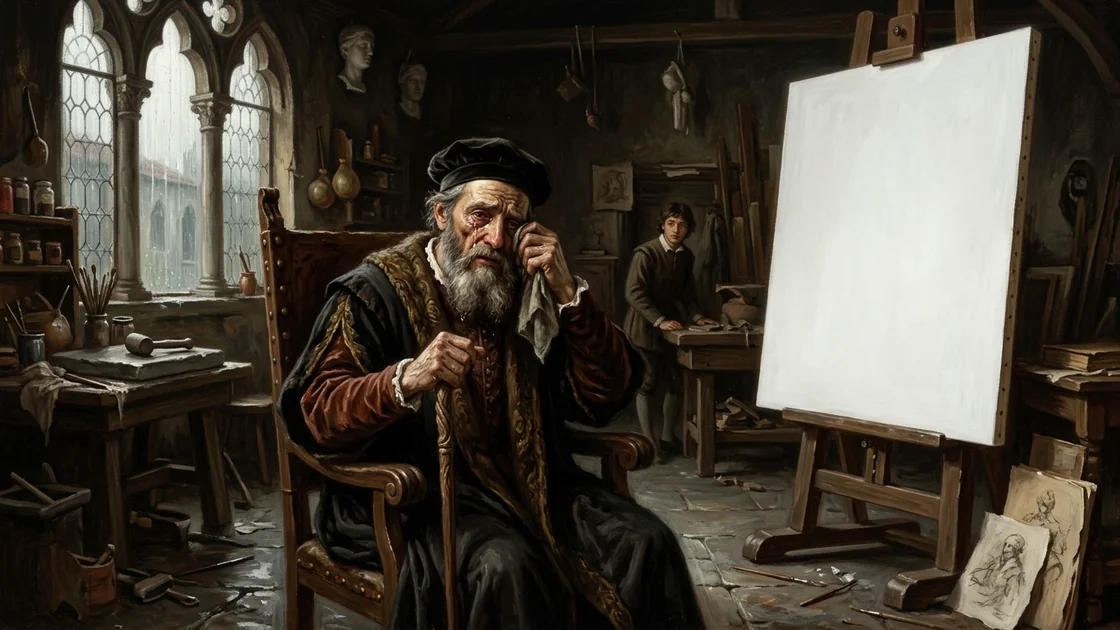
This is the account of Maestro Girolamo Ziani, an aging master of the Venetian guild whose prestige was threatened by the arrival of a poor, startlingly gifted apprentice named Luca. Terrified of being eclipsed in the twilight of his career, Girolamo systematically adulterated the young mans grinding stones, oils, and pigments with caustic vapors and metallic poisons, robbing Luca of his eyesight forever. Though he secured his worldly status and outlived his rivals, the master found his triumph turned to ash, condemned for the rest of his days to weep an uncontrollable, burning torrent of tears whenever he attempts to look upon a canvas, forever drowned in the memory of the light he extinguished.
The light that entered the high, arched windows of the studio in the parish of San Canciano was never pure white; it came filtered through the damp breath of the northern lagoon, cooled by sea-mist and tinted with the pale green of stagnant tides. For forty years, Girolamo Ziani had known how to master that light. He had known how to trap it in sheets of beaten gold, how to tame it within the dense folds of Cardinal red velvet, and how to dissolve it into the hazy blue distance of an Istrian mountain range behind the shoulder of a seated Virgin.
Now, he could not bear to look toward the window, nor toward the easel that stood before it.
On the easel rested an eight-foot panel of seasoned poplar, meticulously planed, surfaced with seven coats of gesso made from slaked plaster and the boiled skin of calves, and scraped with bone scrapers until it was as smooth and flat as the surface of frozen milk. It was an altar commission for the church of Santa Maria dei Miracoli—a Presentation in the Temple, promised to the procurators eighteen months prior. The wood was dead, silent, and waiting.
Girolamo stood three paces back, his knuckles gripped around the carved handle of his ash-wood walking stick. His breath came shallow and hoarse, whistling through dry nostrils. He made the error of raising his chin.
The moment his gaze touched the virgin gesso—the moment the vast, empty rectangle struck his pupils—a terrible, electric spasm seized the back of his eyes.
It did not begin as sorrow. It began as a physical assault, a phantom combustion behind the bridge of his nose. The lacrimal glands, scarred and chronically inflamed, swelled instantaneously. Hot, saline water burst over his lower lids in sheets, scalding the parchment skin of his sunken cheeks. His vision shattered into dazzling, greasy halos of red and yellow; his throat clamped tight against an involuntary moan, and his knees trembled so violently that the ferrule of his stick clattered against the Istrian flagstones.
He could not look. If he turned his face toward the canvas, his eyes drowned him. They wept without dignity, without quietude; they wept like open wounds spurting brine, blurring the room into a nauseating soup of shadows and glare, until his chest heaved with dry, racking sobs that tasted of old copper and dust.
"Master?"
A voice spoke from the corner of the workshop, near the heavy oak grinding bench. It was young Andrea, the latest boy sent by a cousin in Treviso to sweep the shavings, heat the glues, and wash the hog-bristle brushes in lye.
"Turn it," Girolamo hissed, clutching his damp sleeves to his face, pressing the coarse wool against his eye sockets until colors sparked in the blackness. "Turn it to the wall, you idiot! Turn it!"
The boy scrambled. The dry scraping of the heavy panel across the wooden pegs of the easel was followed by the dull thud of its face meeting the plaster wall. Only when the pristine white surface was hidden did the searing pressure behind Girolamo’s forehead begin to recede, leaving his eyes raw, bloodshot, and pulsing with an ache that seemed to reach the very marrow of his skull.
Girolamo lowered his trembling hands. The sleeve of his woolen gown was soaked through with salt water. He wiped his beard with the heel of his hand, gasping as though he had just surfaced from the muddy bottom of the Giudecca canal.
"Go down to the kitchen," the old painter whispered, not looking at the boy. "Fetch no one. Speak to no one. If the prior’s secretary comes, tell him I am fasting. Tell him I am meditating on the mysteries of Simeon."
The apprentice scurried out like a rat behind the wainscot, leaving the door unlatched. A draught came through, carrying the smell of drying walnut oil, rancid pig fat, the faint, sour musk of rabbit glue, and the lingering, spectral stink of calcined sulfur that Girolamo could never truly scrub from the pores of his walls.
He slumped into his high-backed walnut chair, the leather cracked and polished by decades of his own shifting weight. He closed his lids, but even in the dark, the white panel burned against the underside of his skin. It had been seven years. Seven years since the guild had acclaimed him the solitary giant of the Venetian school; seven years since the funeral of his great competitor Gentile; seven years since Luca had dropped his muller upon the marble slab and cried out that the room had gone black.
They had brought Luca Fiamberti to the workshop on a Tuesday in the autumn of the year the sea froze near Mestre. The boy had been fifteen, small-boned and hollow-cheeked, with the rough, chapped hands of a dyer's drudge from Murano. His father, a man who boiled madder root and urine in copper vats until his nails were stained the color of dried liver, had pushed the boy forward into the fragrant, varnish-scented air of Girolamo’s lower bottega.
"He does not eat much, Maestro," the dyer had said, his hat crushed against his chest like an offering. "And he does not waste paper. He draws on the back of the ledger covers with charred grapevine. The parish priest says it is a sin to beat a boy for making saints, if the saints look like they might step off the wood and ask for bread."
Girolamo had been forty-eight then, at the zenith of his powers. His hand was steady, his contracts were lucrative, and his studio was filled with five senior journeymen who could lay down drapery with respectable, if predictable, fidelity to the master’s sketches. He had looked at the scrap of rough butcher’s wrapping the father laid upon the table.
It was an ink sketch of an old woman selling fried eels by the fish market. Girolamo had meant to dismiss it with a patronizing nod and a copper coin. But when he drew the scrap toward the tallow lamp, his hand had halted.
The line was not Venetian. It lacked the ornamental flourish, the deliberate calligraphic grace taught in the schools of the madonneri. It was something else—violent, tender, and impossibly observant. The quill had caught the sag of the old woman’s eyelid, the precise weight of her greasy apron sagging against her belly, and, most terrifyingly, the reflection of the braziers coals in the wet pupils of her eyes. It had been rendered with four strokes of iron-gall ink and a thumb-smudge of spit and soot, yet it possessed more vitality than the entire predella Girolamo had spent the previous month stippling for the Frari.
"What is your name?" Girolamo had asked, his voice deliberately flat, concealing the cold prickle that had risen along the hairs of his forearms.
"Luca, sir," the boy had replied. His voice was cracked with adolescence, but his eyes were wide, clear, and intensely dark—a liquid, hungry brown that took in every corner of the vast room, the hanging casts of Roman heads, the racks of bladder-wrapped pigments, the great light falling from the northern sky.
"You will sleep under the timber rack," Girolamo had said. "You will sweep. You will grind lead white until your palms are hard. If you touch a brush before two years are out, I will break your fingers. Do you accept?"
The boy had not merely accepted; he had dropped to his knees and kissed the hem of Girolamo’s smock with the reverence one might show to the foot of Saint Peter.
In the beginning, Girolamo had taken pleasure in the boy. Luca was tireless. While the other apprentices slipped away to the taverns along the Fondamenta della Misericordia or spent their wages on cards and diced pork, Luca remained at the marble grinding slab. By sixteen, he understood the temperament of pigments better than men who had been enrolled in the Arte dei Depentori for thirty years.
He knew that ultramarine from the Levant grew sullen and gray if ground too fine in oil, requiring instead a light hand and a bath of lye to wash away the calcite veins. He knew that raw sienna needed five days of baking on the tiles of the roof in August to yield that luminous, golden-amber undertone that made the hair of angels appear to hold the setting sun.
"Look, Maestro," Luca would whisper in the late evenings, lifting his palette knife to let a ribbon of lead-tin yellow drop back onto the stone. "It is not yellow at all when you watch it breathe. It is milk that has dreamed of fire."
Girolamo had laughed then, clapping the boy on his narrow shoulder. "Poetry is for the humanists at the doge’s court, Luca. We are craftsmen. We sell colored dirt to men who fear hell. Do not forget that."
Yet he had known the boy was right.
The change had begun during the commission for the Barbarigo family—a vast canvas depicting the Resurrection for their private chapel in Santa Giustina. Girolamo had laid in the figure of the rising Christ himself: majestic, muscular, perfectly proportioned according to the canon of Vitruvius, the leg straight, the banner held at a forty-five-degree angle. It was a solid, irreproachable work.
One morning, having been summoned to the Rialto to settle an account with a merchant of linseed oil, Girolamo returned early to find Luca standing before the lower right quadrant of the canvas, where the sleeping guards were grouped around the marble tomb.
The boy had not used the master’s brushes. He had bound three feathers from a woodcock’s wing to a reed with silk thread, and with this fragile tool he was applying a glaze over the face of a young soldier slumped against his shield.
Girolamo had meant to shout, to strike the boy across the shoulders with his yardstick. But he stopped in the shadow of the doorway, his boots frozen on the floorboards.
Where Girolamo had painted a conventional soldier—terracotta skin, neatly defined jaw, academic shadows blended with umber—Luca had transformed the flesh into something that belonged to a living, dreaming animal. The young soldier’s mouth was slightly parted; a faint, bluish shadow lay under his cheekbone, indicating the chill of the morning air before dawn. The light from Christ’s aura did not simply fall upon the man’s helmet; it skimmed across the dented iron, picking out a smear of dried mud on the rim and reflecting a pinpoint of pale warmth onto the damp cartilage of his ear.
The figure was not an ornament to the miracle; it made the miracle terrifying, because the man asleep beside it was so utterly, indisputably real.
Girolamo stood in the dark corridor for ten minutes, watching the boy work. Luca’s brush did not hesitate. His hand moved with a terrifying certainty, not the agonizing, calculated labor with which Girolamo built his forms, but with the fluid ease of a swallow turning in the wind. He was not copying nature; he seemed to remember it from some earlier, purer existence.
That night, Girolamo went to his ledger. He looked at the entries of his commissions: three hundred ducats from the Scuola Grande della Carità; one hundred and fifty from the Procurator Priuli; eighty from the monastery of San Giorgio. He was the head of the guild. His name was spoken in Florence; Isabella d’Este had sent an envoy to inquire if he might paint her portrait.
He walked to the small oval mirror of polished steel that hung in his bedchamber.
He saw a face growing heavy at the jowls, eyes hooded with yellowing fat, skin grayed by forty years of charcoal smoke and paint fumes. He held his right hand up to the candlelight. It was still firm, but there was a faint, almost imperceptible twitch between the thumb and forefinger—a stiffness that came with the damp rains of November, an ache that whispered that the peak had been passed, that the road now ran only downward into repetition, stiffness, and dry convention.
"Milk that has dreamed of fire," Girolamo whispered to the cold glass.
A week later, Senator Barbarigo visited the workshop to inspect the progress of the Resurrection. The nobleman was accompanied by two connoisseurs from the Accademia, men who wore fox-lined cloaks and carried small silver magnifying glasses on ribbons.
Girolamo led them through the hall, gesturing toward the composition, explaining the allegorical significance of the pomegranate tree in the background, the geometry of the open sepulcher.
The Senator listened with polite boredom, nodding his velvet-capped head. But as he turned to leave, one of the scholars stopped. He lowered his silver glass toward the sleeping soldier in the corner.
"Who touched this?" the scholar murmured.
Girolamo felt his stomach turn over, cold and slick like a dead flounder. "A passage completed by my hand last Tuesday, Messer Bernardo. An experiment in the maniera moderna."
The scholar straightened, peering at Girolamo with sharp, pale eyes. "Then you have discovered a second youth, Maestro Ziani. For thirty years we have admired your nobility of design, your dignified marble forms. But this... this is not stone painted to look like flesh. This is flesh that bleeds. If the whole panel held this breath, Venice would have her own Leonardo."
Senator Barbarigo turned back, squinted at the soldier, and tapped his fingers against his pearl-encrusted belt. "Indeed. Remarkable. See to it, Girolamo, that the figures of the three Marys have that same... that same trembling quality. The state requires works that stir the affections of the populace. Do not spare that new touch."
When they had departed, their gondola splashing away into the dusk, Girolamo remained in the center of the bottega.
Luca was across the room, quietly sweeping up the droppings of charcoal from the floor, his head bowed, his shoulders hunched with customary timidity. He had heard every word. He had not looked up; he had not smiled; but Girolamo saw the slight, involuntary quickening of the boy’s broom, the way his spine straightened beneath his coarse tunic.
He knows, Girolamo thought, and the thought was like a drop of vitriol falling upon a fresh sheet of paper, burning through to the backing board. He knows that I am his frame. He knows that I am the vessel, and he is the wine.
The poison did not come from an assassin, nor from the dark alleys behind the bridge of sighs. It came from the shelves of Girolamo’s own cabinet, where the materials of their sacred art were stored under lock and key.
Painting is an art of poison. The painter works in the garden of death to produce the illusions of life. To create the blush upon a virgin’s cheek, he grinds cinnabar, which is mercuric sulfide, mined by convicts whose teeth drop from their rotting gums within three months of entering the shafts of Almadén. To create the brilliant, impenetrable whites of a linen shirt, he steeps plates of lead in horse dung and vinegar, breathing the sweet, deadly flakes of ceruse that turn a man’s bowels to iron and wither his wrists. To produce the shimmering, poisonous yellows of kings' robes, he takes orpiment—auripigmentum, the golden pigment—which is arsenic trisulfide, whose fumes when heated over a coal can slay a dog in twenty heartbeats.
Girolamo knew the properties of every jar, every bladder, every lump of unrefined ore. He had read Cennino Cennini; he had studied the notebooks of the Flemish masters who had visited Venice in his youth; he had spoken long with Maestro Basilio, the Persian apothecary whose shop stood in the shadow of the Fondaco dei Tedeschi.
A week after the Senator’s visit, Girolamo called Luca into the small back room where the rare colors were compounded.
"Luca," he said gently, keeping his voice soft as the lap of summer water against the marble stairs. "The Barbarigo commission has brought us great honor. But great honor demands greater labor. You have proven yourself worthy of more than the broom and the lead muller."
The boy’s face flushed with sudden, ecstatic blood. "Maestro... you mean I may paint?"
"I mean that you shall paint the most difficult passage," Girolamo said. He unlocked the cedar cabinet. "The Annunciation for the convent of the Murate. The abbess has paid three hundred scudi. She wishes the Archangel’s wings to be like nothing ever seen in this lagoon—not flat leaf-gold, not dry tempera, but feathers that seem woven of morning light and sulfurous fire. It must be done in the new medium: oil of spike lavender and walnut, layered over a ground of calcined bone."
"I will do it," Luca breathed, his hands already twitching toward the stone. "I will make them weep when they see it."
"It requires night work," Girolamo continued, his eyes fixed steadily upon the boy’s clear, dark pupils. "The oil dries too swiftly in the heat of the day. The glazes must be laid between midnight and dawn, by the light of a single lamp, so that the eye is not distracted by the vulgar light of the sun. And the colors must be prepared fresh every three hours."
Girolamo turned to the shelf and lifted down three vessels.
The first was a slab of porphyry, exceptionally hard and dark, used only for grinding the most abrasive minerals. The second was a jar of brilliant, canary-yellow orpiment—not the standard commercial grade sold by the color-sellers, but raw realgar and arsenic trisulfide sent from the mines of Hungary, laced with veins of native antimony and quicksilver. The third was a small, square bottle of dark green glass containing an oil Girolamo had prepared himself over three nights: rectified oil of spike lavender, into which he had dissolved concentrated sublimate of mercury—the caustic mercurius corrosivus—and the bitter juice of the leaves of the thorn-apple, the Datura stramonium, which the witches of the Romagna called the devil’s herb.
"This is the medium," Girolamo whispered, pointing to the green bottle. "It is an ancient secret given to me by a master from Ghent. It allows the arsenic to dissolve entirely, to float between the layers like sunlight through olive oil. But it is delicate, Luca. It must be ground very close. You must hold your face near the muller, so that your breath warms the stone. If the paste grows cold, the light will perish."
Luca looked at the implements with the sacred terror of a novice receiving the vessels of the altar.
"You must tell no one," Girolamo added, laying a heavy, paternal hand on the boy’s neck. "Not the other boys. Not your father. If the guild knew I had given this secret to an apprentice, they would strip me of my workshop and cast you back to the dye-vats. This is between you, me, and the Mother of God."
"I swear it, Maestro," the boy said, his voice trembling with a gratitude that made Girolamo’s ribs feel as though they were contracting around his heart like bands of hoop-iron. "On the soul of my mother. I will never speak."
"Good boy," Girolamo murmured, withdrawing his hand. "Come. Let us set your easel in the small garret under the lead roof."
The garret was windowless, save for a narrow skylight that looked out only upon the chimneys and the gray slate tiles. In the winter, it was an ice-box; in the summer, an oven. It was unventilated, protected from the sea drafts by heavy felt curtains that Girolamo himself helped tack across the doorway to "keep the dust from settling upon the glazes."
There, night after night, Luca sat.
He had a copper oil lamp that sat on a stool twelve inches from his face. By its yellow, smoking flame, the boy bent over the porphyry slab. He would take the lump of raw arsenic, crush it with an iron pestle, and then pour the volatile lavender oil over the yellow powder.
As the heavy stone muller traveled in endless, rhythmic circles—skrr-hiss, skrr-hiss—the heat of the lamp and the heat of the boy’s breath rose together. The volatile essence of lavender, carrying with it the invisible, volatilized particles of mercury and the sweet, garlic-scented vapor of heated arsenic, filled the tiny, felt-lined chamber.
Arsenic does not kill like hemlock; it does not drop a man with convulsions in the presence of his friends. It is patient. It creeps through the marrow. It coats the membranes of the nose and the throat with a dry, metallic fur; it settles behind the optic nerves like fine silt in a mountain conduit, slowly choking the tiny threads of life that carry the light from the lens to the brain.
At first, there was only the enthusiasm of creation.
Girolamo would climb the ladder at dawn, parting the heavy curtains with a linen cloth pressed against his own mouth and nose, pretending to protect his lungs from the morning chill.
"Show me," he would say.
The panel of the Archangel’s wings was growing upon the easel. Even through the haze of his gathering guilt, Girolamo felt his heart stop when he looked upon it. The feathers did not seem painted; they seemed to have been shed by a creature of terrifying beauty that had passed through the room and brushed against the wood. The yellows were not flat; they were iridescent, shifting from the cold, greenish gold of a beetle’s wing to the deep, burning orange of an ember dying in salt water.
"It sings, Maestro," Luca would say, turning to him.
The boy’s face was already changing. His skin had taken on a pale, translucent, waxy sheen, like lard that had been left in the dark. The rims of his eyes were faintly red, the color of a pigeon’s foot, and he blinked incessantly, as though trying to clear a grain of dust that would not dislodge.
"My eyes feel dry," Luca remarked one morning in the third week, rubbing his knuckles into his sockets. "The smoke from the lamp is very thick, Maestro. May I open the felt curtain while I grind?"
"Never," Girolamo snapped, his voice sharp with an instinct that was now purely defensive. "The draft will chill the stone. If the stone chills, the glazes will turn chalky. A true painter must suffer for the work, Luca. Do you think Mantegna painted his triumphs in a bed of down? The body is nothing; the vision is all."
"Yes, Maestro," the boy said meekly. He dropped his hands. Girolamo saw that his fingernails were no longer pink; they had developed horizontal white lines across the beds, like the marks left by salt upon a drying quay.
By the second month, the Annunciation was half-finished, but the boy’s progress had slowed.
He would sit before the easel for long minutes, holding his brush suspended an inch from the wood, squinting through the greasy yellow smoke of the lamp. His head moved in small, strange jerks, tilting to the left, then to the right, as though he were trying to see past an obstruction that floated directly in the center of his gaze.
"The lamp needs new oil," Luca said one evening, his voice thin and raspy. "The flame is very small tonight, Maestro."
Girolamo looked at the lamp. The wick was high; the yellow flame leaped three inches into the air, bright enough to illuminate the dust motes spinning in the stale, warm room.
"It is the same oil as ever," Girolamo said, a sudden, cold terror rising in his throat.
Luca turned toward him. His pupils were strangely dilated, wide and black, despite the bright flame only inches away. He looked at Girolamo’s chest, not his eyes.
"It seems to me... the room is filled with gray cobwebs," the boy whispered, his fingers trembling as he held up his brush. "I wipe them with my sleeve, but they do not fall. They hang between me and the Angel’s face. When I look at the Virgin’s robe, the blue has gone away. It looks like... like wet lead. Is the blue bad, Maestro? Did the merchant cheat us?"
"The blue is the finest lapis from Alexandria," Girolamo said. His voice sounded like it came from the bottom of an empty cistern. "You are tired, boy. You have worked twelve hours without bread. Go down and sleep."
"No," Luca said fiercely, turning back to the panel. "No, I must finish the hem. The light is so short. The sun... the sun sets so early now, Maestro."
It was two hours before noon. Through the narrow skylight, the bright, merciless midday sun of June was beating down upon the lead roof, turning the garret into an inferno.
Girolamo did not stay to watch. He fled down the ladder, his boots slipping on the rungs, his heart hammering against his ribs like an iron bell. He went out into the Campo San Canciano, walking blindly through the crowd of fishmongers, water-carriers, and priests. He walked until he reached the edge of the Fondamenta, where the canal met the open water of the lagoon.
He looked at his hands. They were clean. He had not struck the boy. He had not drawn a knife across his tendons. He had merely given him colors—the colors that every painter used, the colors that God had put into the earth for men to discover. If the boy was weak, if his humors were out of balance, if the black bile had risen to choke his spirits, was that the fault of the master who had given him the opportunity of an immortal name?
You are a murderer, whispered the lapping water against the green slime of the steps.
I am the first painter of Venice, Girolamo answered in his mind, his teeth clenched so hard that his gums bled. There cannot be two suns in the same sky. The boy would have destroyed me. He would have reduced my life’s work to the scratching of an ape. In ten years, they would have pointed at my panels and said: 'Look how stiffly the old man painted before Luca showed the world what eyes were for.'
The end came four days later.
It was the feast of Corpus Christi. The bells of the Campanile were shaking the air of the city, their deep, bronze vibrations rolling across the water like distant thunder. The bottega was deserted; the journeymen had gone to join the procession in the Piazza San Marco, carrying their guild banners with their painted emblems of Saint Luke’s winged ox.
Girolamo was alone in the lower studio, sitting at his desk, pretending to balance his receipts.
A crash from above shattered the holiday quiet. It was the sound of heavy pottery splintering on stone, followed by a low, animal shriek that did not sound human.
Girolamo did not run. He stood up slowly, deliberately, as a man condemned to the block walks toward the scaffold. He took off his spectacles and laid them on the leather ledger. He climbed the wooden ladder, rung by rung, the sound of his slippers muffled by the thick dust.
He pulled aside the felt curtain.
The lamp lay smashed upon the floor; the oil had spread in a black puddle across the flagstones, but it had not ignited. Luca was on his knees. He had crawled into the far corner, beneath the eaves, his face pressed against the rough, lime-washed wall. Both of his hands were clawed into his hair, pulling at the dark locks until tufts came away between his fingers.
"Luca?" Girolamo said.
The boy did not turn around. He began to beat his forehead against the stone wall—a dull, rhythmic thud, thud, thud that left small, dark smears of blood on the lime.
"Luca, stop that!" Girolamo commanded, stepping forward, his voice cracking with panic. He seized the boy by the narrow shoulders and wrenched him backward.
Luca’s head lolled back against Girolamo’s chest.
His eyes were wide, staring straight up into the noon sun that poured through the narrow skylight. The pupils were no longer dark; a milky, pearlescent film had drifted over them, like the scum that forms on the surface of cooling broth. They did not blink. The bright, white rays of the sun beat directly upon the exposed lenses, and the boy did not flinch.
"Master?" Luca whispered. His breath smelled terrible—a sweet, putrid stench of rotten garlic and dry brass.
"I am here, Luca. What have you done? Did you drop the stone?"
The boy raised his hands. They were covered in yellow paste—the toxic orpiment mixed with the lavender mercury. He reached out into the empty air, his fingers groping, fluttering like the wings of a moth caught in an oil jar. His hand touched Girolamo’s beard, then traveled upward, his wet, stained fingertips brushing across Girolamo’s lips, his nose, his eyes.
"Master," Luca cried, and for the first time, tears began to stream from his blinded eyes—not clear water, but a milky, yellowish brine that ran down his pale cheeks, carrying streaks of the golden pigment with it. "Master, who blew out the candle? Why did you blow out the candle? It is not dark yet. I have not finished the Archangel’s foot. I have the color ready on the palette. Please... please bring the light back. It is so cold. The light... where has it gone?"
Girolamo held the boy against his breast. He could feel the thin ribs vibrating with terror, the heart leaping like a snared bird against the cage of bone.
"The candle is still lit, Luca," Girolamo said. The lie slipped out of his mouth with the ease of water entering an open hull. "It is only a rheum. A sudden humor. The heat has overcome your spirits. Come down into the cool. We will get leeches from the apothecary. In three days, you will see again."
"No," the boy wailed, and the sound was so high and thin it seemed to pierce the lead roof and rise into the blue sky. "No! It is gone! The world is dead! There is no red! There is no white! There is only... there is only the lime! Everything is white, Maestro! It is not black... it is white! A great, burning white that eats my brain! Make it stop! Turn off the sun!"
He collapsed, his limbs going slack, his forehead striking Girolamo’s knee as he slipped into a stupor that smelled of copper and death.
The physicians of Venice were very learned men. They wore robes of scarlet silk and carried pomanders filled with ambergris to ward off the pestilence.
Three of them came to the bottega of Maestro Ziani, summoned at great expense by the master himself, who sat by the boy’s pallet in the lower hall with his head in his hands, presenting the very image of a distraught father.
The first physician, an elderly doctor from Padua who had studied the works of Galen, examined the boy’s urine in a glass flask, holding it against the window.
"An excess of the melancholic humor," he declared, shaking his gray beard. "The black bile has boiled over, ascending through the carotid arteries and coagulating the crystalline humor of the eye. It is incurable. The sight has been quenched as a coal is quenched in vinegar."
The second, a follower of the Arabian school, applied hot cups to Luca’s back and rubbed his temples with an unguent of viper’s fat and hellebore.
"The boy was born under the conjunction of Saturn and Mars," he said, taking his fee of four silver grossi. "The optic spirits have fled back into the ventricles of the brain. You may pray to Saint Lucy, Maestro, but I tell you that the nerves are dried like salt-cod. If he lives, he will see nothing more than the difference between noon and midnight."
The third was Maestro Basilio, the apothecary from the Fondaco.
He did not touch the boy’s head. He walked to the pallet, lifted Luca’s limp right hand, and brought the boy’s stained fingernails to his nose. He sniffed once, twice. Then he turned his dark, liquid eyes upon Girolamo, who stood rigid in the corner, his fists buried in his sleeves.
The Persian said nothing for a long time. The silence in the room was heavier than the stone muller upon the porphyry slab.
"He has been grinding the zarnikh," Basilio said very quietly, using the eastern name for the yellow mineral. "And the water of mercury."
"He was an obedient apprentice," Girolamo said, his voice flat, dead, devoid of inflection. "He prepared the master’s pigments as he was commanded. The boy was ambitious. He worked too long without rest."
Basilio looked from the master to the blinded boy on the straw pallet. Luca was breathing in deep, shuddering gasps, his milky, unblinking eyes fixed on the ceiling rafters.
"There are materials that God gave for the adornment of the world," the apothecary said in his low, musical voice. "And there are materials that the earth hides because they belong to the kingdom of worms. When a man takes the worm’s food to make an angel, the worm always comes to collect the debt."
He took his satchel, bowed slightly to Girolamo with exquisite, freezing courtesy, and walked out into the lane. He did not ask for a fee.
Luca did not die.
The youth in him was stubborn; it fought the poison through weeks of vomiting, bone-aches, and trembling palsies that left his right hand permanently curled like an eagle’s talon. By midsummer, he was able to sit up on the stone steps of the water-gate, feeling the warmth of the sun upon his face, his blind eyes turned toward the passing gondolas whose oars he could identify by their splash.
He bore Girolamo no malice. That was the most monstrous part of the punishment.
When Girolamo brought him a bowl of barley broth, the boy would reach out his twisted, trembling hand, find the master’s sleeve, and lay his cheek against the cloth.
"Forgive me, Maestro," he would whisper, his voice now permanently hoarse, as though his throat had been scraped with broken glass. "I was not strong enough. I failed you. The Angel’s wings... they will never be finished."
"They are finished enough," Girolamo would say, pulling his arm away as gently as he could without running. "The convent accepted the panel. They... they praised your contribution."
That too was a lie. Girolamo had taken the panel into his private room the night after Luca collapsed. He had stood before the unfinished wing—that shimmering, impossible miracle of sulfur and gold—and he had taken a broad scraper of Sheffield steel.
With long, savage strokes, sweating in the summer night, he had scraped the paint down to the bare gesso. The shavings had curled away like golden hair from the head of an executed prince. He had scraped until the wood showed its pale, splintered grain, and then he had painted the wing himself: solid, respectable, dead vermilion, with every feather outlined in gold leaf, exactly as the guild had done since the days of the Byzantines.
The abbess had been well pleased. She had sent him two barrels of Malmsey wine and a letter praising his "devout and uncorrupted style."
In the autumn, Luca’s father came to take him away.
The dyer was not angry; he was broken. He was a poor man, and in Venice a blind mouth is an empty purse. He took the boy by the elbow, leading him down the steps toward the burchiello that would carry them back to the salt-mud of Murano.
Girolamo stood on the quay. He held a purse of fifty ducats—a fortune for a Murano dyer, the price of three whole altarpieces. He pressed it into the father’s hand.
"Take it," Girolamo whispered. "For his food. For his bed. Let him not beg."
The dyer wept, thanking the Maestro, calling him the father of the poor, the protector of youth, a saint upon earth. But Luca, standing on the gunwale of the boat, did not thank him.
The boy turned his milky, ruined face toward the sound of Girolamo’s voice. He lifted his sightless eyes toward the sky, toward that vast northern light that had once been his kingdom.
"Maestro?" the boy said.
"Yes, Luca."
"The light has not gone out," Luca said softly. His voice was carried clearly across the narrow canal. "It has only gone inside. I see the Annunciation still. It is more beautiful than the wood could bear. It is so bright, Maestro... it burns so bright that I wonder how your eyes do not weep when you look at the sun."
The boatman dipped his pole. The craft slid into the green current, turning the corner past the Palazzo Contarini, and was gone.
The fame of Girolamo Ziani grew with the consistency of rising dough.
With Luca gone, and with the older masters dying off in the damp autumns that followed, Girolamo was left without an equal in the city. The young men—the upstarts like Giorgione from Castelfranco and the red-headed boy from Pieve di Cadore—were still only boys, running about the workshops of the Bellini, learning their crafts. Girolamo was the rock upon which the dignity of the Republic’s art rested.
He received the commission for the Great Hall of the Consiglio dei Dieci; he painted the portraits of three successive Doges; he was elected Prior of the Arte dei Depentori. His home was filled with silver plate, with carpets from Smyrna, with illuminated manuscripts of Petrarch and Virgil.
He had everything he had ever desired. He had outlived envy; he had secured his name against the decay of time; he had proven that discipline, decorum, and the ancient rules were superior to the erratic, dangerous flashes of undisciplined genius.
There was only one malady—a minor inconvenience, his friends called it, an occupational hazard of those who spent their lives straining their eyes over fine details.
It began the year he turned fifty-five.
He had been commissioned to paint a small, devotional panel for his own bedchamber—a Pietà, a work to comfort his declining years. He had had the panel prepared by the best carpenter in the Arsenale: a square of aged walnut, seasoned for ten years in the rafters, primed with seven coats of gesso until it shone like a mirror of bone.
He had set it upon his easel on a bright morning in April. He had mixed his charcoal wash; he had selected his finest squirrel-hair pencil to draw the initial contours of the dead Christ’s arm.
He had stepped up to the panel. He had looked at the white surface.
And his eyes had exploded with water.
It was not a gentle misting; it was an agonizing, torrential deluge. The salt tears burst from beneath his lids with such force that they splashed upon the white wood, leaving dark, round spots upon the gesso. With the tears came a blinding, sickening pain—a burning sensation as though someone had taken a handful of quicklime and ground it into his sockets with a rough thumb.
He had dropped the brush. He had staggered back, clutching his hands to his face, gasping for breath.
The moment he turned his back on the canvas, the pain subsided.
He waited an hour. He washed his eyes with rosewater; he drank a draught of cold well-water; he had his servant apply a compress of cold chamomile leaves to his temples. Then he returned to the room.
The panel was there, white, blank, expectant.
He took a single step toward it, his eyes wide, his jaw set with the determination that had carried him through forty years of labor.
Again.
The spasm seized him like an iron collar around his throat. His eyes gushed salt; his vision fragmented into jagged, vibrating crescents of blinding, milky white—that same pearlescent, horrible white that had filmed Luca’s pupils in the garret under the lead roof. He could not see the panel; he could not see his hand; he saw only that terrible, devouring radiance that Luca had described before he fell into his madness.
Everything is white, Maestro. A great, burning white that eats my brain.
Girolamo tried again on the third day. He tried in the morning; he tried at dusk; he tried by the light of a single candle.
It was always the same.
If he looked at a finished work—if he looked at the paintings of Bellini, or the old panels of his own youth, or the frescoes in the churches—his eyes were dry, clear, and steady. He could read his ledger; he could count his gold ducats; he could navigate the narrow, twisting calli of Venice without a misstep.
He was not blind.
He was cursed only before the unpainted ground.
The moment an empty, white canvas or a primed gesso panel was placed before him, his eyes refused the light. They drowned him. They wept until his head throbbed, until his vision was reduced to a swirling, watery mist through which nothing could be discerned, until his strength was broken and he was forced to turn away, panting and sobbing like a child that has been whipped in the dark.
He could not begin another work.
For two years, he kept the secret through cunning and deceit. He employed journeymen to whom he gave small, scratched drawings—sketches he made with charcoal on rough blue paper, which did not bring on the weeping. He directed them from across the room, sitting with his back to the great easels, his eyes hooded beneath his velvet cap, pretending to be an aged emperor who had no need to soil his fingers with the brush.
"Move the Virgin’s knee two inches to the left," he would command, looking at the floorboards. "Darken the shadow under the balustrade with asphaltum. The glaze is too thin on the saint’s drapery."
The works were executed. They were delivered. The patrons paid. But the patrons were not fools.
"The Maestro has grown cold," they whispered in the loggias of the Ducal Palace. "The design is still correct, but the soul has gone out of the workshop. It is like looking at corpses dressed in silk. The master’s hand is not there."
Finally, the commissions ceased.
Younger men had arrived. Giorgione had painted the Castelfranco Madonna, where the light seemed to dissolve the very contours of the world in a dream of summer gold. Titian was filling the churches with a muscular, violent glory that made Girolamo’s old arrangements of saints look like the wooden dolls sold by the German peddlers at the fair.
Girolamo did not fight them. He closed the lower bottega. He dismissed the journeymen. He kept only young Andrea, the boy from Treviso, to buy his cabbage, his salt fish, and his bread.
He became a ghost in his own house.
The years had hollowed him out until he felt like an empty gourd dried upon a vine. He was seventy now. His joints were swollen; his beard had turned the color of ash from a forge; his teeth had one by one worked themselves loose from his gums, leaving his mouth sunken like an old crone’s.
On this morning, after he had driven young Andrea down to the kitchen, Girolamo sat for three hours in his walnut chair, listening to the rain that had begun to fall over the lagoon.
It was a gray, persistent rain, the kind that brings the tide up over the quays, covering the Istrian stones with three inches of dark, greasy water. The sound of the gutters gurgling through the lead spouts was the only voice in the palazzo.
Girolamo stood up.
His bones cracked like dry sticks. He walked toward the easel.
The great poplar panel was still turned to the wall, where Andrea had pushed it. Girolamo laid his hand upon the rough, unplaned back of the poplar. He could feel the coldness of the wood, the dampness it had absorbed from the air.
I am seventy years old, he thought. What can the boy do to me now? He is thirty years in the mud of Murano. He is an old beggar, or he is dead. His Annunciation is forgotten. My name is carved in the stone of the guildhall.
He gripped the edge of the panel. With a sudden, desperate surge of his old strength, he wrenched it around on the pegs, turning the pristine white gesso face back toward the gray light of the window.
He did not shut his eyes. He forced them wide. He stared into the white rectangle.
The strike was instantaneous, more violent than it had ever been.
A hot, sulfurous iron seemed to plunge through his pupils into the center of his brain. His knees gave way. He sank to his knees upon the hard stone, his ash-wood stick rolling away into the shadows.
The tears did not run; they geysered. They poured from his sockets in scalding sheets, blinding him with an agony that felt as though his eyes were being turned to liquid salt. He tried to blink, but each movement of his lids was like sandpaper dragged across raw flesh.
Through the shimmering, watery sheet that drowned his vision, the white canvas did not stay empty.
It began to crawl.
In the midst of that milky, agonizing brilliance, the poison Girolamo had compounded twenty years ago seemed to separate itself from the gesso. He saw the yellow orpiment rising like steam; he saw the iridescent green of the devil’s herb; he saw the crystalline, caustic frost of the sublimate of mercury dancing across the surface of the wood.
And out of that swirling, toxic mist, a form began to take shape.
It was not his Presentation in the Temple. It was not Simeon, nor the Virgin, nor the cold, dignified saints of his guild-approved designs.
It was the Archangel.
The figure stood eight feet tall within the frame of the canvas, its magnificent, terrible wings spread from edge to edge. The feathers were woven of that same impossible, living fire that Luca had ground upon the porphyry slab—feathers that shifted from the cold brilliance of diamond to the deep, suffocating gold of the sun setting into a sea of blood.
The Archangel did not carry a lily. He carried a porphyry stone, dark and wet with oil.
The face of the angel was not the face of a heavenly spirit. It was the face of Luca Fiamberti—not the broken, milky-eyed wretch who had been dragged away in the dyer’s boat, but the boy of seventeen, his liquid brown eyes burning with a terrible, eternal clarity that pierced through Girolamo’s tears, through his skull, into the blackened chamber of his heart.
"You took the light from the world, Maestro," the image seemed to whisper, and the voice was like the sound of the sea grinding the pebbles of the Lido. "Now drink the water."
"Mercy," Girolamo gasped, his forehead pressed against the lower rail of the easel, his hands clawing at the wood. The tears ran down his beard, dripping onto the floor, pooling around his knees like the water rising from the canal. "Mercy, Luca. I gave you the fifty ducats. I gave you your name. I made you what you were."
"You made me the dark," the apparition answered. "And the dark has made you its fountain."
Girolamo squeezed his eyes shut, pressing his palms into his sockets with all his might, wishing for the blindness that he had inflicted—begging the salt to corrode his optic nerves, begging the mercury to wither his brain, so that the white panel might at last be extinguished.
But the blindness did not come to him.
Only the sight. Only the perpetual, agonizing clarity that could not look upon the beginning of a work without drowning in the memory of its murder.
A bell began to toll from the church of the Miracoli—a slow, single stroke. The hour of Nones.
Girolamo remained on his knees for a long time, his body heaving with the dry, whistling gasps of an old man whose lungs are weary of air. The water continued to fall from his eyes, drop by drop, tapping against the dry wood of the easel like the ticking of a water-clock in an empty tomb.
Presently, the sound of footsteps came from the lane below—the rhythmic, hollow tap of a wooden staff against the wet flagstones.
Tap. Tap. Tap.
Girolamo raised his head. His eyes were so swollen, his vision so blurred with brine, that he could see nothing more than the gray, trembling rectangles of the high windows. But his ears, sharpened by years of living in the dark of his own palazzo, caught the sound through the splashing of the rain.
Tap. Tap. Tap.
It was coming toward the water-gate.
Girolamo crawled across the floor, his knees dragging through the puddle of his own tears, his hands searching the floor until they found his ash-wood stick. He pulled himself up by the arm of his chair, panting, his gown soaked with cold moisture.
He leaned against the window-frame, peering through the leaded panes down into the narrow calle.
Through the sheets of rain, a figure was walking slowly along the edge of the canal.
It was a man in the brown woolen habit of a lay brother of the Franciscan order. He was not old, but his back was bent, his head thrust forward with the peculiar, cautious posture of those who live in perpetual night. In his right hand, he held a long willow wand, tapping the stone coping of the canal to find the edge.
Over his shoulder, he carried a rough wicker basket filled with small objects carved from wood—spoons, spinning tops, little whistles for children.
Girolamo pressed his face against the cold glass. His eyes, burning and raw, peered down through the gray mist.
As the blind brother reached the steps of the palazzo, he stopped.
He did not turn his head toward the door. He turned his face straight up toward the high, arched windows of the studio—straight toward the room where Girolamo stood behind the glass.
The man’s face was smooth, serene, empty of fear. The rain beat down upon his closed lids, washing over the pale, sunken sockets where the light had once been devoured. His mouth was slightly parted; he seemed to be tasting the damp air that drifted from the sea, smelling the old, familiar odors of linseed oil, turpentine, and ground earth that still seeped from the bricks of the ancient bottega.
He did not look like a man who had been destroyed.
He looked like a man who had walked through the fire and come out into a cool, vast silence where no master could command him, no guild could judge him, and no envy could reach the work that lived inside his mind.
He stood there for two minutes in the pouring rain, his face turned toward the old man who hid behind the pane.
He did not speak. He did not raise his hand in an accusation. He simply stood, a monument of patient, unquenchable darkness against the gray stone of Venice.
Then, with a gentle movement of his wrist, the blind man touched his willow wand to the next paving stone. He stepped forward, his bare feet splashing through the shallow tide that covered the calle, and continued his slow, rhythmic journey toward the church of the Miracoli.
Tap. Tap. Tap.
The sound grew fainter, absorbed by the steady hiss of the rain upon the tiles, until it was lost entirely in the murmur of the lagoon.
Girolamo did not leave the window.
He stood with his forehead pressed against the cold, leaded glass, his hands trembling upon his stick, his eyes open in the gathering dusk. The tears continued to run down his cheeks—quiet now, steady, an inexhaustible spring of salt that fell upon the marble sill, drop by drop, into the darkening street below.
Behind him, in the center of the vast, cold room, the poplar panel stood upon the easel, facing the shadows.
It was eight feet high. It was six coats of gesso thick. It was smooth as bone and flat as the water of the canal at slack tide.
It was white.
And as the night came over Venice, extinguishing the pale light of the sky, the white did not fade. It grew brighter, colder, more terrifyingly pure, waiting for the hand that would never touch it, waiting for the color that had died in the garret, waiting through the endless, weeping dark for the light that Girolamo Ziani had murdered, and which would now torment him until the worms had eaten his eyes and left them as empty as the wood.