The Blight of Quickened Seasons
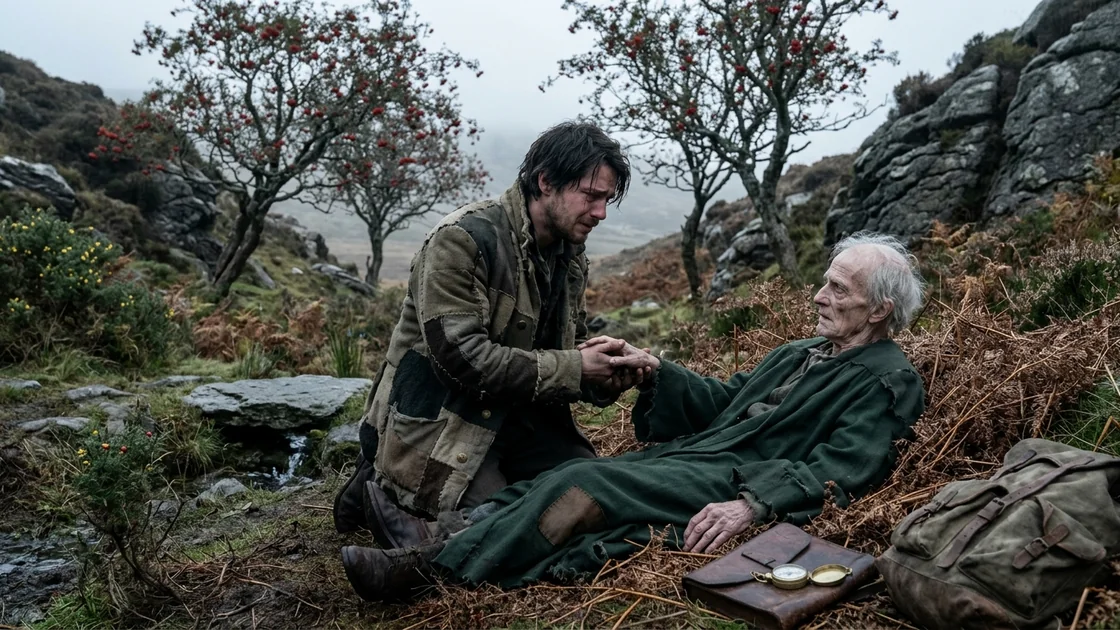
This is the account of Silas, an immortal wanderer who betrayed a primordial forest god eight centuries ago and received a terrible punishment in return. Rather than being doomed to eternal solitude in a wasteland, he was cursed so that any mortal soul who offers him genuine kinship, love, or brotherhood is consumed by a violent acceleration of their mortal span, aging from youth to frail decrepitude and ash within a handful of days. Bound to walk an ever-changing world where his touch is poison to the hearts he longs to hold, Silas journeys across ruined empires and forgotten valleys seeking the ancient grove where his vow was shattered, hoping either to lay down his weary bones or to force the sleeping earth to take back its monstrous gift.
I. The Dust of Eight Hundred Years
The wind off the salt-marshes of Oakharrow smelled of brine and wet slate, carrying with it the cold promise of an early winter. Silas walked with his hood pulled low, the rough hempen weave scratching against cheekbones that had not altered their contour since the reign of the Iron Kings. Behind him, his footprints in the dark, yielding silt filled slowly with brackish water, dark as spilled ink.
He was a tall man, though he carried himself with the rounded shoulders of someone who had spent lifetimes ducking beneath low lintels and averting his eyes from tavern hearths. His coat was a patchwork of eight hundred years of needlework: sheep-hide from the northern steppes, wax-treated linen from the southern deltas, and heavy mountain wool dyed with crushed acorn caps. Every seam was a boundary between eras; every brass button had outlived the metal-smith who poured it into the sand mold.
To the stray woodcutter or traveling merchant, he was merely an itinerant mender or a solitary pilgrim. His hair, thick and dark as peat, showed no silver. His eyes were a pale, mossy green, clear and steady, bearing none of the milky film that gathers in the corners of an old man's gaze. This was his chief obscenity. In a world where teeth rotted by thirty and the back broke under the wheat-sheaf by forty, his unmarred flesh was an accusation.
Yet it was not his endurance that kept him shivering in the autumn drizzle; it was the arithmetic of his pocket. In the leather pouch at his belt, he carried a handful of copper coins and seven dried plum stones, each wrapped in a scrap of parchment. Each stone represented a name he had carved into his skin and then allowed to scar over until the letters softened into unreadable ridges.
He stopped at the crest of the hill overlooking the estuary. Below, the village of Oakharrow huddled against the gray bay like barnacles on a rotten keel. Smoke rose from three dozen stone chimneys, thin and pale against the curdled sky. He had not intended to approach the settlement. For eleven years, he had lived in the high limestone caverns of the Wyrmtooth crags, speaking only to the crows and the salt-wind. But a man—even a man who has ceased to be entirely human—cannot subsist forever on wild leeks and the marrow of winter-killed hares. His boots were coming away from their welts, the soles flapping against the stony mud like dying fish, and his lungs rattled with an immortal cough that could not kill him, but could make every drawn breath feel like a mouthful of ground glass.
"Just salt," he murmured to himself. The sound of his own voice was dry, like dead leaves scraped across flagstones. "Salt, tallow, and a spool of waxed thread. In before twilight, out before the lanterns are lit."
He had made this promise to himself in three hundred different towns across four dynasties. He knew the cadence of the lie intimately. It always began with salt and tallow; it ended with freshly turned loam and an open grave beneath an alder tree.
Silas adjusted the hempen cord of his pack and began his descent toward the village gate, stepping carefully over the roots of the ancient willows that leaned over the road. The roots seemed to twitch beneath his boots, recoiling from his tread with a subtle, wood-deep shudder that only he could feel.
II. The Green Heart of Sylvath
The curse had not begun with iron or fire, but with the scent of wild elderberry and crushed fern.
In the youth of the world, before the stone roads of the first empire were laid through the lowlands, there existed the forest of Sylvath. It was not a wood of ordinary birch and pine, but an older, thicker presence—a lung of the continent that inhaled the stars and exhaled the morning mist. At its center stood the Great Horned One, known to the ancient tribes as the Warden of the Briar, a deity woven from the living sinew of rowan roots, black moss, and antlers of petrified yew.
Silas had been a forester of the outer border, sworn to the god by an oath carved into his left forearm with a sliver of flint. The oath was simple, absolute, and terrible in its economy: The bough shall not be broken for pride, the water shall not be fouled for gold, and the secret heart of the grove shall never be named to those who carry iron.
For sixty years, Silas had kept the borders. While other men chased glory in the tournaments of the river-kings or laid their heads in the soft laps of weavers’ daughters, Silas slept upon beds of pine needles, his skin turning the color of weathered bark, his mind quieted by the slow, majestic thoughts of the oaks. He had loved the forest with a pure, fanatic devotion that bordered on madness. The god had rewarded him with a body that felt no sickness and feet that left no mark upon the moss.
Then came the year of the Red Fever.
It had swept out of the eastern marches, turning the blood of children to rust and rotting the eyes of nursing mothers. Silas had watched from the tree-line as the village where his sister lived—the only link remaining between his wild heart and the world of mortal blood—succumbed to the pestilence. He had seen his sister’s youngest daughter, a child with hair the color of ripening barley, crawling through the mud toward the border of Sylvath, crying for cold water.
The laws of the Warden were clear: the grove was an sanctuary, not a hospital. The mortal world must burn down its own fields so that new grass might sprout. To bring human sickness into the bower was an abomination; to harvest the Golden Sap from the heart-tree to cure a mortal child was treason against the cyclical rhythm of life and rot.
Silas had broken his flint-scratched oath in the dark of a moonless night.
He remembered the cool weight of the sap-gourd against his hip. He remembered the sickening, wet groan of the Mother Tree as his iron knife bit into her ancient, silver bark. The sap had smelled of honey, ozone, and old graves. It had saved the child; one drop upon her tongue had driven the gray fever from her veins, restoring her skin to the bloom of a summer peach within an hour.
But the god had not waited for the sun to rise.
When Silas returned to the forest edge to throw himself upon the moss and beg for mercy, the Warden had emerged from the mist. The entity did not possess a face of flesh, but a mask of lichen-encrusted heartwood, with two points of cold green light burning in the sockets of its hollow eyes.
"You have stolen the vigor of ten thousand seasons to buy thirty years for a worm of the clay," the voice had not come through the air, but through the soles of Silas’s feet, vibrating in his pelvic bones, his ribs, his jaw. "You love the fleeting so dearly, forester. You value the quick breath of the mortal leaf above the deep endurance of the root."
"Take my breath," Silas had wept, his forehead pressed into the leaf-mold. "Cut the thread. Let me feed the violets. Only spare the child."
"No," the god had whispered, and the sound was like the tearing of green cloth. "Death is a gift reserved for those who obey the turn of the wheel. You shall be the stone in the brook around which the water must break. You shall not wither. You shall not rest. And because you could not bear to see a mortal face grow pale in its proper season, you shall carry the season of rot within your breast."
The god had laid a single finger—a twisted twig of mountain ash—against Silas’s chest, directly over his heart. A cold, oily fire had flared through his veins, turning his blood dark and thick.
"Go forth," the Warden had commanded. "Take the world into your arms. But know this: whoever looks upon you with tenderness, whoever calls you brother, lover, or friend, shall have their thread tied to your stolen eternity. Their days shall become minutes; their years shall fall from them like dried husks before the scythe. You shall be a harvest-fire to all who love you."
When Silas had stumbled back to his sister’s cottage at sunrise, his sister had opened the door. She had smiled, weeping with gratitude, and wrapped her arms about his neck to thank him for saving her daughter.
Silas had watched, paralyzed by an unspeakable horror, as the skin of her hands shriveled against his linen tunic. He had watched her black hair drain of color, turning silver, then white, then falling away in brittle clumps upon his shoulders. Her voice, mid-sentence, had cracked, thinned, and dropped into the dry wheeze of a centenarian. By noon, she could no longer stand. By twilight, she was a bundle of skin and dry bone, gasping for breath upon a straw pallet that smelled of dust.
Before the moon rose again, she was gone. Her daughter, who had run to embrace the uncle who brought the medicine, had perished three days later, an old woman of four years, her toothless mouth slack in death, her skin wrinkled like an abandoned apple.
Silas had fled into the deep barrens, his screams tearing the lining of his throat, but no death came for him. The sun rose; the sun set; the dirt remained silent beneath his feet.
III. The Cartographer of Oakharrow
The village of Oakharrow smelled of drying skate and burning peat. It was a miserable place, wedged between the cold gray fingers of the tide and the black expanse of the bog-forest. Silas kept his hood low, the hem of his cloak gathered tight against his thighs, avoiding the children who bowled hoops of willow-iron along the gravel lanes.
He found the chandler’s shop down by the salt-wharf, beneath a sign that bore the faded carving of a tallow-pot. The bell above the door jangled with a sharp, brassy cough as he pushed it open.
The shopkeeper was a woman with arms like sides of pork, her skin red from scrubbing brine-barrels. She looked up from a slab of beef-fat, her knife pausing in mid-stroke. "We're shut for the tide," she said, her voice flat with the suspicion common to isolated ports.
"I have copper," Silas said softly. He did not look at her directly; he had long ago learned that looking into a person's eyes was an invitation, a tiny hook that might catch upon their curiosity. "I need four tallow dips, a half-stone of coarse salt, and three needles of bone or tempered iron."
The woman spat into the sawdust behind her counter. "Two pence for the dips. One for the salt. Needles are dear; the smith died of the lung-rot last Michaelmas, and the new boy doesn't turn them straight. Penny each."
"Done," Silas said. He placed the worn coins upon the scarred wood of the counter, keeping his palms flat, revealing nothing of the blue veins that had not aged an hour since the First Empire fell.
As the woman turned to rummage through a drawer of dried rushes and thread, the inner door of the shop swung inward. A man stepped through, carrying a roll of vellum under his arm and a brass sighting-compass in his ink-stained fingers.
"Good mistress," the man said, his voice lively and out of place in the gray gloom of Oakharrow. "The tide is turning earlier than the charts predicted. If we don't hire the dory before the sand-bar shows its teeth, we shall be trapped on the wrong side of the spit until—"
He stopped. He had seen Silas.
Silas did not move, but his shoulders tightened beneath his woolen coat. He could feel the familiar, sickening pressure behind his breastbone—the silent, ancient thing within him that lay waiting like a spider in a dry well.
The newcomer was young, perhaps twenty-six or seven, with the restless, bright-eyed countenance of someone who had read more books than were good for his bread-winning. He wore an academic’s gown of dark green wool, frayed at the elbows and patched at the knees with calfskin, and his brown hair was tied back with a strip of leather that had seen better seasons.
"You're not from the coast," the young man said. It was not a challenge, but a statement of delight, such as an entomologist might make upon finding a strange beetle upon a cabbage leaf. "The cut of your coat—that's upland wool, but the carding is done in the old style, three-ply, cross-spun. My grandfather had a blanket from the high valleys with that very weave. Where do you come from, friend?"
"The hills," Silas said, stepping back from the counter. He took the salt and the tallow dips from the shopkeeper’s beefy hands, stuffing them roughly into his sack. "I have a long walk."
"The hills are wide," the youth persisted, stepping closer. A draft of air came with him, smelling of oak-gall ink, pipe-weed, and young sweat. "Are you heading south toward the gap? The roads are drowned out. The autumn floods have turned the lower vales into soup. I’ve been trying to map the bridle-paths along the escarpment for the Earl’s bailiff, but the sheep-tracks are washed out by the rain. If you know the ridges—"
"I walk alone," Silas said, louder than he intended.
The shopkeeper frowned, her small eyes narrowing. "Mind your manners, stranger. Master Kaelen is the rector's nephew. He has the Latin."
"I care nothing for his Latin," Silas whispered, his fingers trembling as he seized the packet of needles. "Keep the change, mistress."
He turned on his heel and wrenched the door open. The brass bell shrieked. He plunged out into the cold, damp mist that had begun to thicken into a proper northern rain.
He walked fast, his boots splashing through the brown puddles of the lane, his breath coming in white plumes before him. He hated the boy’s voice; it had been too clear, too full of that ridiculous, innocent eagerness that belonged to men who believed the world was a book to be read rather than an open ditch into which all things must eventually be shoveled.
Do not look back, he told himself. Do not remember the color of his coat. Do not consider his name.
"Wait! Master! Master Hill-man!"
The footsteps were light, splashing rapidly through the muck behind him. Silas cursed under his breath, a string of ancient syllables in a language whose vowels had been forgotten six centuries ago. He did not turn; he increased his stride, his long legs eating the road that led toward the eastern gate.
"Hold on, man! You dropped your needles!"
Silas paused at the village palisade, where the gate-keeper had left the heavy oak beam unlatched while he drank beer in the guard-shack. He turned slowly, his face shrouded beneath the damp wool of his hood.
The young scholar was leaning against the stone jamb of the gate, panting, one hand pressed to his ribs. In his other hand, he held out the small bundle of bone needles, wrapped in grease-paper. His face was flushed with the exertion, his eyes shining with that terrible, human need to be useful, to be civil, to connect.
"You dropped them... at the threshold," Kaelen wheezed, offering an awkward, triumphant grin. "They cost... two pence each... in this wretched hole. Too dear to leave for the rats."
Silas looked down at the grease-paper. He did not take it. He kept his hands buried deep within the pockets of his coat, his fists clenched so tightly that the short nails bit into his palms.
"You should not have followed me," Silas said.
"A simple 'thank you' is the usual currency in the lowlands," Kaelen said, his smile faltering slightly, though he did not drop his hand. "Though I suppose the hill-folk have different manners. Here. Take them. I don't sew; I only split nibs and make mistakes on parchment."
Silas stared at the young man’s fingers. They were long, slender, ink-stained at the knuckles. They were full of blood, full of tomorrow, full of the next forty years of small triumphs, miserable debts, cold winter mornings, and children whose names were not yet spoken.
"Take them," Kaelen repeated, his voice dropping into a softer, more tentative register. He looked into the shadow of Silas's hood. For a second, a flicker of something ancient and mournful passed between them—that strange, inexplicable sympathy that occasionally flares between two solitary souls who recognize each other’s loneliness in an indifferent world. "You look as though you haven't spoken to a man since the last solstice. I know the feeling. The folk here talk of nothing but herring and turf-taxes. It’s enough to make a man throw himself into the sea."
"You are young," Silas said, his voice trembling with an effort that Kaelen could not begin to comprehend. "Go back to your ink. Forget you saw me."
"My name is Kaelen," the youth said, stubbornly stepping forward, holding the needles out until they nearly touched Silas's breast. "And whatever you’ve done, you don't look like a sheep-stealer. Come back to the inn. I have half a loaf of rye, a wedge of sheep’s curd, and a jug of sour cider that is better than the well-water. We can talk about the mountain paths."
Run, the ancient voice within Silas whispered. Turn and strike him down. Break his jaw so he hates you. Make him spit blood and curse your mother. Let him hate you.
Instead, Silas reached out his hand. He meant only to take the paper. He meant only to touch the cold horn of the needles.
His skin brushed Kaelen's thumb.
It was no more than the brush of a moth's wing. It lasted less than half a beat of a startled heart. But as the flesh of the immortal met the flesh of the scholar, Silas felt the sudden, sickening plunge inside his ribs—the snap of a bowstring, the drop of a plumb-line into infinite dark.
From the young man’s chest, a tiny, invisible thread of pale golden light seemed to stretch, hooking itself directly into Silas's breast. The god’s curse, dormant for a decade in the high rocks, woke with a low, subterranean rumble. It tasted the youth’s kindness; it tasted his open, unguarded curiosity; it tasted the beginning of love—not the love of lovers, but the rarer, fragile love of two strangers who might have been companions on a dark road.
"Oh," Kaelen said softly, blinking. He took a half-step back, his fingers twitching. He looked at his own hand, puzzled, as if a bee had stung him without leaving a mark. "That was... strange. Did you feel that? Like a spark from an anvil."
Silas stood frozen, his hand clutching the grease-paper. His heart was sick with a horror that was eight hundred years old and yet as fresh as the raw wind off the bay.
"Go home," Silas whispered. "For the sake of your God, boy. Go back to the tavern."
Kaelen laughed, though the sound was thinner now, slightly puzzled. "Why? The rain is letting up. And besides, I told you: my work here is finished. I have to travel south to the abbey at Dun-Meara. It's the same road you're taking, isn't it? The ridge-path?"
"I am not going to Dun-Meara," Silas lied, his voice thick with dread.
"Then I'll walk with you until the crossroads," Kaelen said cheerfully, turning to adjust the leather strap of his map-case. "Two leagues of company is better than two leagues of mud alone. Don't be so surly, hill-man. I won't ask you where you hid the silver."
Silas looked down the road. The mist was gathering into thick, white wreaths between the gorse-bushes. If he ran, the boy would follow, or Silas would be forced to use violence. If he stayed...
Perhaps it was too quick, Silas prayed to the gray sky, knowing even as he did so that there was no mercy in the soil. It was only a touch. A second. He does not know me. He does not love me. He is only lonely.
"Walk behind me," Silas said, turning away, his face like carved oak. "Three paces back. Do not touch my coat. Do not speak of your mother, or your home, or your dreams. If you speak, speak only of the stones and the water."
Kaelen chuckled, falling into step three paces behind the wanderer. "A cheerful fellow," he muttered to the drizzle. "A regular summer day."
IV. The Silvering Dawn
They made their camp four miles from the village, in the hollow of a ruined lime-kiln that offered some shelter from the easterly wind.
The stone walls were blackened with old soot, and wild ivy clung to the mortar like webbed fingers. Outside, the rain fell in a steady, drumming whisper through the heather. Silas sat on a flat slab of limestone near the mouth of the kiln, his back against the wet rock, his knees drawn up to his chin. He had not built a fire; he did not need the heat, and he feared the intimacy that a hearth brings to men in the dark.
Kaelen, however, had spent an hour gathering dry deadfall from the underside of the gorse bushes. He had coaxed a small, smoky flame to life with flint, steel, and a scrap of dry moss from his satchel. Now he sat cross-legged across from Silas, his hands extended toward the pale yellow warmth, his face illuminated by the flickering light.
"You didn't eat," Kaelen said, nodding toward the crust of rye bread he had laid on a clean flat stone between them. Silas had not touched it.
"I am not hungry," Silas said.
"A man who walks six leagues without bread is either a saint or a ghost," Kaelen remarked. He took a bite of the hard bread, chewing slowly, his eyes fixed on the shadows above Silas's hood. "My uncle used to speak of hermits in the western desert who lived on three locusts a day and the contemplation of the angels. But they were all mad, he said. They came down from the mountains with hair like sheep's tails and forgot how to speak their mother's names."
Silas said nothing. He watched the firelight dance in the youth's eyes.
There was something terrible happening. He could already smell it. To an ordinary man, the smell would have been undetectable—merely the scent of wood-smoke, damp wool, and wet moss. But Silas had the senses of a hound that had lived for centuries in the charnel-houses of time.
Beneath the scent of the boy's youth, there was an odor of dry parchment. A scent of apples left too long in the bin.
"How old are you, Kaelen?" Silas asked, breaking his own rule against his will. The question was dragged from him by a sickening fascination.
"Twenty-four come the Feast of Saint Jude," Kaelen replied with a faint smile. He rubbed his knuckles. "Though my joints feel like forty tonight. It’s this coastal damp. My father had the gravel in his kidneys by thirty; our family has never had much luck with the bones. We run to grease and chalk."
He held his hands toward the fire. Silas leaned forward slightly, his heart hammering against his ribs like an iron bell.
The hair on the back of Kaelen's hands—fine, pale hair that had been brown that morning—had a silver gleam in the firelight. Silas had thought it was merely the reflection of the ash. But as the boy turned his hands over, rubbing his wrists with a dry, rhythmic hiss, Silas saw the skin of the knuckles.
The skin was slightly loose. The small, crisscrossing lines around the joints were deepening, like the cracks that appear in drying mud before the sun sets.
"Are you cold?" Silas asked, his voice shaking.
"A bit," Kaelen admitted. He pulled his green gown tighter about his throat. "My blood feels thin tonight. I think I must have caught a chill in that filthy tavern. The bed-straw was wet as a ditch."
"Go back," Silas said, his voice dropping to a harsh whisper. "Turn around at first light, Kaelen. Go back to Oakharrow. Find a physician. Take wine boiled with cloves and rue."
Kaelen laughed, though the sound ended in a dry, rattling cough that made his slender shoulders hitch. "A physician? In Oakharrow? The only man who bleeds anyone there is the pig-butcher. Besides, I told you: I have three months to finish the surveys for the Abbey. If I don't deliver the rolls by the New Year, the Bishop will give the clerkship to his nephew, and I shall be back to teaching Latin to seven-year-olds who smell of grease and cabbage."
He leaned back against the lime-stone wall, his eyes drooping. "It's odd, though. I haven't walked more than three leagues today. Usually, I can go eight without my heels aching. Tonight, my legs feel as if I've climbed the peak of Skiddaw with a sack of grain on my shoulders."
"Sleep," Silas said, turning his head away, unable to look any longer at the subtle, dreadful slackening of the skin beneath the boy's jawline. "Do not speak to me. Sleep."
"You're a strange one, master," Kaelen murmured, his voice slurring slightly with a heavy, unnatural fatigue. "You walk like a soldier... but you have the eyes... of an old sexton who's buried his whole parish... and has nobody left to dig his own trench..."
Within minutes, the boy was breathing with the deep, slow rhythm of utter exhaustion.
Silas did not sleep. He sat through the long, freezing hours of the night, listening to the rain slacken and die upon the heather. He listened to Kaelen's heart.
At midnight, it beat with the rapid, light pulse of a young man.
By the third hour after midnight, the rhythm had slowed, growing heavier, thicker, like water being pumped through old lead pipes. Silas crept across the floor of the kiln on his hands and knees, moving without a sound, until he knelt beside the sleeping scholar.
The fire had died to a mound of gray ash, but the moonlight, breaking through a rift in the scudding clouds, fell full upon Kaelen’s face.
Silas choked back a sob that tasted of bile.
At the temples, Kaelen’s brown locks were no longer merely silvered; they were the color of sheep’s wool that had been bleached by winter sun. Two deep furrows had carved themselves between his eyebrows, and the soft flesh beneath his cheekbones had sunk inward, sharpening the angle of his jaw until it looked like the bone beneath was pushing through the parchment of his skin. His breath came through his slightly parted lips with a faint, whistling wheeze—the dry sound of an old lung that has forgotten how to be elastic.
One day, Silas thought, his fingernails digging into his own thighs until the wool tore. He has known me for eight hours. We have spoken fifty words. He shared his bread.
The curse did not require years of romance or oaths sworn upon altars. The Warden of Sylvath had not been subtle. The curse was an engine of pure retribution: the more lonely the wanderer was, the more desperately he craved the simple decency of his fellows, the faster that decency would rot the giver. The magic was an inverted flame; it drew its fuel not from Silas’s cold immortality, but from the finite tallow of the mortal who dared to stand near him.
Silas reached out a trembling hand, hovering an inch above the boy's forehead. He wanted to stroke the white hair from the furrowed brow. He wanted to whisper an apology into the ear that was already growing slightly yellowed and waxy at the lobe.
He pulled his hand back as if the skin were white-hot iron.
To touch him again would only turn the bellows upon the fire.
He rose to his feet. He could leave now. He could slip out of the lime-kiln, cross the ridge before sunrise, and disappear into the high limestone gorges where no human being could follow. Kaelen would wake alone. He would be weak, confused, his sight dim and his back crooked, but the acceleration might stop. Without the source of the blight, perhaps the remaining years would cling to his bones. He might live to be thirty—an old man of thirty, but alive.
Silas took three steps toward the opening of the kiln. The cool night air hit his forehead like a wet cloth.
From behind him came a sharp, gasping cry.
"Mother? Mother, where is the wick? It's... it's dark. The oil has run out."
Silas turned. Kaelen was sitting up, his hands clawing at the empty air, his milky, rheumy eyes wide and unfocused in the moonlight. His fingers were crooked, the knuckles swollen like knots in an ash branch.
"Kaelen," Silas whispered.
The boy turned his head toward the sound, his chin trembling with a palsy that belonged to a grandfather on his deathbed. "Who's that? Master Hill-man? Why did you put out the lantern? My knees... I cannot... I cannot straighten my legs."
V. The Hourglass of Marrow
By noon of the second day, Kaelen could no longer walk without leaning his entire weight upon Silas’s shoulder.
They had not stayed in the lime-kiln. When dawn had revealed the true horror of his transformation—the white hair falling in wisps upon the collar of his gown, the skin of his throat hanging in dry, turkey-wattles, the trembling blue lips—Kaelen had not screamed. He had been too weak to scream. He had looked at his hands with a dull, childish bewilderment, tracing the brown liver-spots that had appeared upon his wrists like dried lentils.
"What is this?" he had croaked, his voice now a reedy, whistling pipe. "Is it the Marsh-Plague? Did I drink from the ditch?"
"Yes," Silas had lied, his voice flat with a despair so profound it felt like stone. "It is the gray rot. It comes out of the salt-peat."
"Will it... will it pass?"
"No," Silas said.
"My books," Kaelen had wept, the tears running down cheeks that were now cross-hatched with thousands of microscopic wrinkles, like an old sheepskin map. "The bishop... my uncle will say I was idle. He always said... I was too frail for the road."
Silas had lifted him. The boy—who had seemed so sturdy twenty-four hours before—felt light, as if his bones were becoming hollow, the marrow drying out like the pith of dead elder-stems. Silas carried him on his back, the old man’s dry, papery fingers looped around his own iron-hard throat, the wheezing breath rattling against his ear like dead grass in a gale.
They were high on the heather-ridge now, far from the road. Silas knew he should have left him at the village church, but he knew what would happen: the priests would see the youth turned to a centenarian in a day and cry witchcraft. They would drive him out with pitchforks or pin him to a hurdle to drown in the tide-ditch. There was no mercy down there. There was only mercy in the moss, and the moss had forgotten how to forgive.
"Silas," the old voice whispered in his ear. It was the first time Kaelen had used his name.
"Do not speak," Silas said, stepping across a black peat-cut. "Save your wind."
"You haven't... grown old," the boy murmured. His chin rested on Silas's shoulder; the stubble upon it was white and brittle as wire. "I remember you... in the shop. You were the same. Your hair... it isn't white."
Silas closed his eyes for a single stride, his boots finding the path through instinct alone. "I am an old man, Kaelen. Older than the church at Oakharrow."
"Then why... why is your back so straight?"
"Because the earth refuses to take me," Silas said.
A dry, rattling sound came from Kaelen's throat. It took Silas several seconds to realize the boy was trying to laugh.
"A rare gift," Kaelen wheezed. "My back... feels as if it were bent on a cooper's wheel. I can hear my ribs... clicking. Like dried reeds. Are we near Dun-Meara?"
"Not yet."
"I don't think... I shall see the abbey," the boy whispered. His fingers on Silas's shoulder were losing their grip, sliding down the rough wool of the cloak. "It’s getting dark, Silas. The sun isn't down... but it's like looking through... a dirty horn window."
Silas stopped. They were in a small dell sheltered by three stunted rowan trees, their scarlet berries hanging heavy and bright against the gray granite of the rocks. A small spring bubbled from beneath a flat flag of stone, cold and clear.
He laid Kaelen down upon a bed of dry bracken.
The transformation was nearly complete. The youth who had chased him through the village gate with a packet of needles was gone. In his place lay a creature of eighty winters, his eye-sockets hollow and shadowed with the purple bruise of impending dissolution. His cheeks were sunken entirely; his gums, visible when he breathed, were pale and toothless where three teeth had already loosened and fallen out into the heather during the noon climb.
The sun was only halfway through its afternoon arc. Forty-eight hours. The curse was working faster now; perhaps because Kaelen had not fought it, perhaps because in his terror and delirium he had clung to Silas with the desperate, total dependence of a child to a father.
"Silas?"
The voice was barely more than a sigh of wind through the rowan branches.
"I am here," Silas knelt beside him. He took Kaelen's hand. It felt like a bundle of dry twigs wrapped in old parchment. The pulse at the wrist was a tiny, erratic flutter, like a trapped moth dying behind a shutter.
"Who are you?" Kaelen’s milky eyes searched the green ones above him. The delirium of extreme age had settled over his mind, peeling away the present, exposing the deep roots of his short life. "Are you the sexton? Did my uncle send you to fetch me home?"
"Yes," Silas said, his tears finally breaking, falling hot and bright upon the withered hand he held. "Your uncle sent me. The school is closed for the winter. You don't have to draw the maps anymore."
"Good," the boy sighed. A faint, peaceful relaxation smoothed some of the deepest lines around his mouth. "The ink... it always stained my cuffs. My mother... she was particular about the cuffs. She used to beat them... with a wooden paddle... down by the weir."
"I know," Silas wept.
"It was a good road, though," Kaelen whispered. His eyes drifted toward the scarlet berries above him. "We walked... a great way today, didn't we? Three leagues... at least. My boots... are quite worn through."
"Five leagues," Silas said. "You walked like a king."
"A king..." Kaelen's chest rose once, a great, shuddering draft of air that seemed to drag every remaining drop of moisture from his throat. His fingers twitched within Silas's grip, then relaxed, falling open.
A small gust of wind came through the rowan trees, shaking the red berries.
As Silas watched, the body beneath the green woolen gown seemed to settle into itself, shrinking slightly, like a snowdrift when the rain touches it. The white hair drifted away from the scalp in the light breeze, scattering across the purple heather like thistle-down. The skin of his face did not rot; it simply dried, turning the color of horn, then the color of dust.
Within an hour of the final breath, the clothes were largely empty.
Silas sat in the bracken until the sun dipped below the rim of the western hills, painting the clouds with the savage, indifferent gold of an autumn twilight. He did not move; he did not wipe the dried salt from his cheeks.
He reached into his pocket, took out his horn-handled knife, and picked up a smooth gray stone from the bed of the spring. With steady, practiced strokes, he carved the letters:
K - A - E - L - E - N
Then he wrapped the stone in a strip of linen torn from the hem of the dead boy’s gown and placed it in the leather pouch beside the seven others.
He did not bury the gown. There was nothing left to bury but a handful of white ash and a few dry chips of bone that the wind would carry into the heather before the frost broke. He took the brass sighting-compass from the pocket of the green coat and laid it upon the rock above the spring, pointing north, toward the deep forests that no man dared to enter.
"Eight," Silas said to the cold sky. "That makes eight in this century alone."
He stood up, his limbs stiff, not with age, but with the terrible, unending iron of his flesh. He did not turn south toward the abbey. He turned north-east, toward the jagged black spine of the mountains where the old trees still remembered his name, and where the god who had cursed him slept in his bed of thorns.
VI. The Way of the Blighted Heart
The journey to the Sunken Vale took three months.
Silas avoided every road, every bridge, every solitary charcoal-burner's hut. When he smelled the blue smoke of a chimney, he veered two miles into the wind. When he saw the distant silhouette of a shepherd on the ridge, he lay flat among the gorse until the stars came out. He lived as the wolves lived, drinking from the ice-rimmed pools, chewing the bark of sweet birch, his thoughts turning inward until his own mind became an echo-chamber of old voices.
They were all there in the leather pouch, clicking against one another like knuckle-bones:
Eleanor, the weaver's widow in the city of the three bridges, who had brought him a bowl of mutton-broth when he lay with a broken thigh in her hay-loft. She had aged thirty years between the moon's waxing and its wane, dying with her spindle in her hand, wondering why her fingers could no longer catch the wool.
Master Chen, the silk-dyer in the eastern ports, who had taken him in as an apprentice because he liked the quiet way Silas worked the indigo vats. Chen had withered into a blind, trembling skeleton over the course of a single wet spring, cursing his ancestors for the sudden rot in his marrow.
The girl on the taiga, whose sled had overturned in the blizzard. Silas had dragged her three days to the nearest yurt, only to watch her hair turn silver as she lay across his knees, her young heart giving out just as the felt flaps of the tent were thrown open by her weeping kin.
The Warden of Sylvath had known his prey. A crueler god would have condemned Silas to an island of basalt in the middle of a boiling sea. But the Green One understood that there is no solitude so complete as the solitude of a man surrounded by things he must not touch. The curse used Silas’s own humanity as the match to ignite the pyre. To be safe, he had to become a monster: cold, mute, vicious, unfeeling.
Yet every few years, the dam would break. A kind word from an innkeeper, a child offering a wild strawberry, a comrade-in-arms during some forgotten border skirmish whose elbow brushed his in the trench—and the invisible fire would leap from his chest, and another name would be added to the bag.
By midwinter, the snow had covered the heather with five feet of silent, blue-shadowed white. Silas walked through it like an ox, his heavy boots breaking the crust with a rhythmic crunch-hiss, crunch-hiss. The cold did not bite him; his blood ran with that dark, ancient sap that knew nothing of frost. His beard was frosted white, but beneath the ice, his dark hair was unchanged.
On the ninety-fourth day after Kaelen's death, he reached the rim of the Weeping Ridge.
Below him lay the Sunken Vale, a vast, circular depression five leagues across, where the ancient forest of Sylvath had once held court. In the centuries since Silas had broken his oath, the world had shrunk the forest. Settlers had cleared the borders; charcoal-burners had chewed through the great oak-stands; the Iron Kings had cut down the mast-pines for their navies.
Now, only this bowl remained—a deep, shadow-drowned hollow where the trees grew so thick that the canopy was an unbroken pelt of blackish-green, even under the snow. No birds flew above it. The crows that followed Silas from the sheep-runs wheeled away at the edge of the rim, their harsh croaks warning of a place where the seasons had stopped turning, where time did not flow, but pooled like black water in a clogged ditch.
Silas did not hesitate. He began his slide down the shale-slope, sending sprays of gray gravel and powdered snow cascading into the dark fringe of the pines.
VII. The Garden of Petrifaction
The silence inside the Sunken Vale was not the silence of dead stones; it was the suffocating, heavy silence of an animal holding its breath behind a screen of leaves.
Here, the snow could not penetrate the roof of branches. The air was warm, smelling of damp mold, turpentine, and ancient, unwashed earth. The trees were not like the slender, well-behaved beeches of the lowland parks; they were monstrous, sprawling things with trunks fifteen paces thick, their bark twisted into grotesque convolutions that resembled the faces of men caught in mid-wail.
Silas walked down avenues of giant fern that reached to his shoulder, their fronds glistening with an oily, amber moisture. The ground was soft—a spongy mattress of needle-duff ten feet deep that had not seen a ray of sunlight since the stars were named.
"I have come," Silas said aloud.
His voice did not carry. It was swallowed immediately by the moss-padded boles of the ancient ones.
He had not been here since the night he stole the sap. Eight hundred years of wandering had brought him full circle, back to the wound he had carved into the world’s flesh.
He followed the scent of ozone and honey. It grew stronger as he plunged deeper into the heart of the vale, until the air was so thick with the musk of living wood that his lungs burned with every breath. The trees began to change; their bark was no longer gray or brown, but a deep, bruised purple, veined with threads of metallic silver that pulsed with a slow, geologic cadence.
At the center of the grove stood the Mother Tree.
It had once been a white ash of terrifying proportions, but now it was half-petrified. The side Silas had wounded with his iron blade had turned to stone—black, glassy obsidian that had grown over the bark like an enormous, weeping scab. From the unhealed center of the scar, a single drop of thick, golden sap hung, suspended in the dim emerald light, never quite falling, never quite drying.
Coiled around the base of the tree, half-buried in the centuries of fallen needles, lay the Horned One.
The god did not look like the great stag-headed king Silas remembered from his youth. It had diminished. It had shrunk as the wild places of the world were cleared by the iron plough and the lime-kiln. Its antlers, once spreading wide as an oak's crown, were broken, moss-grown stubs of petrified yew. Its body was a tangle of lichen-gray roots, withered briars, and dry bone, curled upon itself like a dog dying of old age by an abandoned hearth.
Yet as Silas approached, the two green embers in the depths of the wooden skull flared with a sudden, baleful brilliance.
A sound rose from the earth—the dry, grinding screech of two boulders rubbing together in a mountain slide.
"The thief," the voice groaned. It came from the hollow trunk, from the stones beneath Silas's feet, from the cold sap within his own veins. "The stone in the brook. You have brought your sack of bones back to the root."
Silas dropped to his knees before the Obsidian Wound. He did not bow his head; he looked straight into the hollow sockets of the god.
"Take it back," Silas said, his voice flat, stripped of all terror, all reverence, all hope. "Take back the breath. I have carried it for twenty-four generations. I have fed eight of your seasons with the blood of children and scholars. I am tired, Warden. Cut the cord."
The Horned One did not move its limbs, but a shudder ran through the great roots that lay across the glade. A shower of dead pine-needles fell from the vault above, clicking against Silas's hood like rain.
"A season is nothing to an oak," the god ground out. "The boy from the salt-port... his life was an afternoon. His grandfather was a breath at dawn. Why do you weep for leaves that were born only to fall into the ditch?"
"He was not a leaf," Silas said, reaching into his belt. He tore the leather pouch from its thong and emptied it onto the moss between them.
The eight stone-wrapped plum stones rolled out, accompanied by twenty more from the earlier centuries—stones carved with runic marks from empires that no longer had names, stones marked with the script of the river-peoples, stones that were merely rough river-pebbles notched with thirty-two cuts of a hunting knife.
"They were men," Silas said, his voice rising, echoing through the cathedral of the boughs. "They had names. They had small, foolish thoughts about the stars and their mothers’ porridge. They had kindness in them—the very thing you and your roots know nothing of. They looked upon me with pity, and your curse turned their marrow to ash before their words could dry in the air."
"It was the price," the god rasped. "The sap you stole bought thirty years of breath for a child who died of the throat-quinsy ten winters later. You broke the balance. You took the gold of the deep root to patch a beggar’s coat."
"Then take the gold back!" Silas lunged forward, pressing his bare hands against the jagged, obsidian scar of the Mother Tree.
The glass cut into his palms. The blood that welled from his skin was not red; it was dark, viscous, smelling of honey and elderberry—the stolen blood of Sylvath, preserved in the vessel of his flesh for eight hundred years.
"Drink it!" he screamed at the tree. "Take it back and let me rot! Let me be sixty! Let me be eighty! Let me be a dead dog in the ditch with Kaelen and the rest of them!"
The tree did not drink. The sap-blood pooled upon the cold, black glass, running down the slick surface until it dripped onto the nose of the wooden skull below.
The Horned One let out a low, whistling sigh that smelled of winter mushrooms and dry rot.
"I cannot," the god whispered.
The anger drained from Silas's arms, leaving them limp as water. He stayed on his knees, his hands resting on the sharp obsidian, his blood dripping into the moss. "What did you say?"
"I cannot," the ancient presence repeated. The green lights in its skull flickered, dimming like lanterns in a gale. "The world... has grown thin, forester. The iron has bitten too deep. The roads have cut my tendons; the smoke of their kilns has soured my lungs. I am no longer the Great Stag of the Lowlands. I am only an old stump... waiting for the ax."
"You have the power to curse," Silas wept, his forehead coming down to rest against the stone. "You had the power to make me this."
"A curse... is merely a knot in the thread," the god groaned. "Any child can tie a knot in a green shoot that will choke the tree twenty summers hence. But to untie it... when the wood has grown around the twine... that requires the strength of the sapling. And I am dry, Silas. The well is dry."
"Then kill me," Silas begged. "Strike me with lightning. Let the roots pull me down into the lime-beds."
"You are made of the sap," the god said, and for the first time in eight centuries, Silas heard something in the voice that was not wrath, but a terrible, infinite weariness that matched his own. "How can the wood kill the grain that runs through it? You are more Sylvath than I am now. You carry the green breath in an iron world. If I took your breath... the last bough would break. The grove would become stones before the next moon."
Silence settled over the dell.
The single drop of sap hung from the Mother Tree, trembling, never falling. The stones with their carved names lay upon the moss, small and gray, like eggs in an abandoned nest.
Silas knelt there for three days and three nights. He did not eat; he did not sleep; he did not pray. He watched the green lights in the god's skull grow fainter and fainter, until on the fourth morning, they did not flicker at all.
The Horned One was dead.
It had not died with a crash or a thunderbolt. It had simply ceased to be anything more than three yards of rotten yew and a basket of deer-bones overgrown with gray hair-moss. The spirit had departed, or perhaps it had simply evaporated into the thin, cold air of a century that had no room for horned kings.
Yet the curse remained.
Silas felt it inside him—a clock of bone that had been wound eight hundred years ago, its spring made of an iron that would not rust, its balance-wheel ticking with the lives of every soul who might ever look upon him with mercy. The god was gone, but the law remained, carved into the very structure of his marrow.
He was the last tree of Sylvath, walking upon two legs through an empire of stone and smoke.
VIII. The Pilgrim of Thorns
On the fifth day, Silas stood up.
His knees cracked, the sound like the snapping of dry kindling. His clothes were stiff with frost, and his beard was matted with dead pine needles.
He looked down at the stones. He picked them up, one by one.
Eleanor. Chen. The girl of the snows. The blacksmith's apprentice from the river-plain. The three soldiers who shared their fire during the siege of the seven towers. And Kaelen.
He did not put them back into the pouch. He took his horn-handled knife and, one by one, he cut small slits into the flesh of his chest, above his ribs. Into each slit, he pushed a stone, pressing the small, hard pebbles deep beneath his skin, until his breast was an uneven, lumpy mosaic of names and scars.
His blood—dark and slow—welled up, sealing the wounds with thick, amber-colored scabs. The pain was sharp, bright, and clean. It was the only pain he was permitted to feel.
"You shall not be forgotten," he whispered to the petrified grove. "You shall have a tomb that does not rot."
He gathered his pack, pulled his hood low against the eastern wind, and turned his back upon the Mother Tree.
He knew what his life must be now. There was no release. There was no secret well at the world’s end, no holy water that could wash away the stain of that ancient, broken flint-oath. He was condemned to live until the sun grew cold and the rocks forgot their weight.
He climbed the rim of the Weeping Ridge, emerging once more into the white, blinding glare of the winter world.
Below, three miles away, a column of wagons was moving along the newly cleared post-road. He could hear the faint crack of a whip, the distant shouting of the muleteers, the sharp, metallic ring of an iron shoe striking a flint. The mortal world was going about its business: trading, cursing, breeding, dying—living their sixty summers with that fierce, brilliant, desperate haste that he had once envied and now pitied beyond all measure.
He saw a wagon slide toward the ditch, its wheel caught in the frozen mud. A boy—he could see only a dot of red wool, like Kaelen's gown—was running toward the horses' heads, trying to seize the bridle.
Silas stopped at the edge of the woods.
His fingers twitched within his pockets. Every instinct of his long, weary flesh urged him to run down the hill, to put his shoulder against the tail-gate, to use the immortal iron of his spine to heave the cart from the mire, to hear the driver say, Well met, brother. Take a cup of small beer for your trouble.
He drew a long, shuddering breath that filled his lungs with the scent of snow and pine.
He took three steps backward, retreating into the shadow of the stunted junipers.
"Pass by," he whispered to the wind. "Pass by, little leaves. Do not look into the woods."
He sat down upon a cold boulder of granite, pulled his knees to his chin, and waited for the men to pass. When their voices had faded into the gray expanse of the valley, and the only sound left was the slow, rhythmic groan of two frozen branches rubbing together above his head, Silas rose and set his face toward the desolate north, where no one walked, where no one spoke, and where the only hearts that beat were made of stone and snow.