The Blade of Ruin
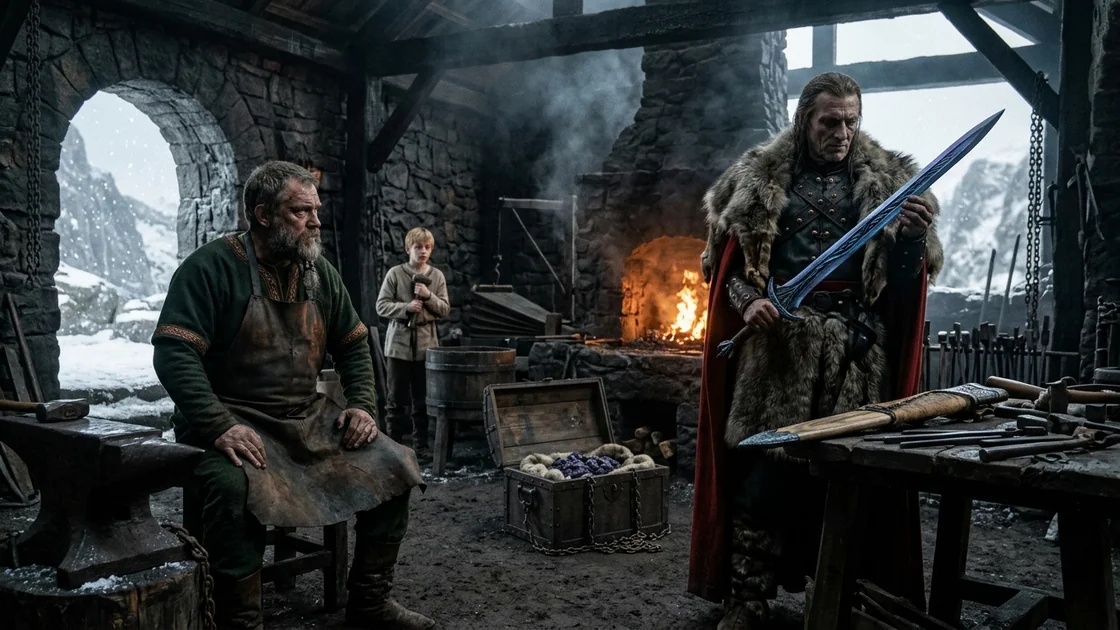
This is the account of Korren of the High Fells, a master armorer whose vanity eclipsed his wisdom, and the price paid by those he loved when his greatest creation was turned upon them. Desiring to prove that his forge could surpass the legendary weapons of gods and ancient kings, Korren accepted a commission from Lord Malakor, a despotic warlord known for crushing the northern provinces under an iron heel. The smith labored for forty days using forbidden ores and cursed quenching rites to fashion an all-severing sword that defied the laws of steel and flesh. When the work was complete, Malakor did not turn the weapon toward distant frontiers, but brought it down upon Korren’s own people, butchering the folk of the mountain vales with a blade that could not be dulled, deflected, or broken.
I. The Hearth of the High Fells
The anvil had been Korren’s altar for fifty winters, and the mountain wind his choir. High upon the crest of the Oakhaven crags, where the air was thin enough to turn lips blue and the stone was veined with veins of dull, stubborn iron, the Great Forge of Vael-Duran stood. It was not a place built for comfort. Its walls were rough-hewn blocks of basalt, cemented with mortar ground from crushed river-granite and ash, thick enough to withstand the screaming gales that tore through the pass from the White Waste.
Within, the heat was sovereign. Even in the dead of the frost-tide, when icicles hung like the fangs of sleeping drakes from the eaves, Korren stood bare to the waist, his broad, leathery torso crosshatched with the pink and silver traces of errant sparks, his beard bound in iron rings to keep the cinder-wash from catching.
He was the finest metal-shaper the northern vales had produced in three centuries. When the high king in the south sat upon his gilt chair, the ring-mail he wore had been folded by Korren’s tongs; when the march-wardens held the border gates against the bog-clans, their boar-spears bore Korren’s stamped mark—a hammer split by an eye. Men whispered that Korren did not merely heat metal; he argued with it, flattered it, broke its obstinacy until the cold heart of the mountain yielded to his will.
Yet skill, when untempered by humility, is a brittle thing. The elders of Oakhaven, the peaceful agrarian settlement that nested in the green hollow beneath the crags, often warned him of his vanity.
"The stone belongs to the mountain, Korren," old Torvald, the clan-speaker, would say, leaning on his hazel staff as he watched the smith discard a dozen masterfully ground bill-hooks because the temper was half a grain too soft. "And the iron is only lent to us to turn the sod and keep the wolves from the sheepfolds. Do not seek to out-sing the earth."
Korren would laugh, wiping black scale from his palms with an oil-soaked rag. "The earth has no tongue until I strike it, old man. Any clod-hopper can scrape a furrow with bronze or soft bog-iron. My steel does not bend. My steel outlasts the hands that hold it."
"And that," Torvald had murmured, his milky eyes clouded with the sight that looks beyond the morrow, "is why it is dangerous. Steel that forgets its master will always look for someone to feed it."
Korren had paid no heed. In those days, his pride was his armor, heavier and thicker than any harness he shaped upon the horn. He believed that he was an artist whose canvas was the very bone of the world, and that lesser men simply lacked the nerve to see creation through to its absolute conclusion. He lived alone at the upper works with only his nephew, young Paul, a lad of fifteen summers whose mother had died in the autumn fevers. Paul was quiet, attentive, his arms growing thick from the bellows, his eyes filled with absolute reverence for his uncle’s wizardry with coal and air.
It was on a night when the stars were like splinters of ice thrown across a vault of black glass that the riders came up the winding track from the south.
They did not ride the sturdy, wool-coated mountain ponies of the vales. Their mounts were great, long-limbed coursers with coats the color of wet slate, their breath steaming from flared nostrils, their flanks lathered with greasy foam despite the freezing wind. There were seven of them, but they moved with the eerie stillness of statues until their leader dismounted before the roaring arch of the smithy.
He was a tall man, narrow-shouldered but broad-chested, wrapped in mantles of wolf-fur and black boiled leather studded with dull bronze nails. When he drew back his hood, the forge-light fell upon a face that looked as though it had been carved from grease-wood and seasoned in smoke. His eyes were small, yellowed like old parchment, and utterly destitute of pity.
This was Malakor, named the Harrower, lord of the Ashen March, who had in five bloody seasons broken the free valleys of the lowlands and built a fortress of blackened timber and lime-washed stone upon the ruins of the Old Kings’ courts.
Paul shrank back behind the water-butt, clutching a cold chisel to his chest like a talisman. Korren did not move. He stood with his three-pound rounding hammer balanced loosely in his right hand, the embers painting his broad face in vermilion and shadow.
"The wind is cold on the heights, smith," Malakor said. His voice was soft, almost cultured, with the dry rustle of dried husks being crushed in an iron bin.
"The wind stays outside," Korren replied evenly. "The forge stays hot. What does the Wolf of the March want with the high crags? We pay our tithe in mutton and sheep-tallow to the bailiff at the foot of the hill. We owe no steel to the lowlands."
Malakor smiled. It was an ugly movement of the mouth, devoid of mirth, exposing teeth worn down to brown stubs. He stepped into the glow, his boots crunching on the littered scale and coal-dust. Behind him, two guards dragged a heavy wooden chest bound with lead bands and bound again with chains of green copper.
"I have no need of your sheep, Korren," the warlord said, lingering over the name as though tasting it. "Nor do I want the dull pig-iron you beat into hoes for the peasants who dig cabbage out of the mud. I have heard of you from the salt-traders of the coast. They say there is a man in the High Fells who boasts that no blade he makes can be broken, yet he spends his life sharpening scythes for cowards."
Korren’s jaw tightened. The blow struck precisely where his vanity was thinnest. "The blades I make do not break. If they cut weeds instead of men, it is because weeds are all these mountains grow that need cutting."
"A waste," Malakor sighed, motioning to his men.
The two guards dropped the chest upon the hard-packed earth floor. The wood creaked; the lead bands strained. One of the men took a key from his belt and twisted it in the heavy, grease-filled lock. The lid fell back with a wet, thudding groan.
Korren leaned forward, despite himself.
Inside the chest, resting in a bed of dry sheep’s wool stained with bitter sulfur, lay three ingots of a metal he had never seen before. They were neither silver nor iron. They were the color of stagnant pond-water at twilight—a bruised, oily purple that seemed to drink the light of the charcoal fire rather than reflect it. When Korren looked directly at them, his eyes watered with a sudden, stinging pressure, as though he were staring into the heart of an open winter sky without a hat.
"What is that?" the smith whispered, his fingers twitching instinctively for his tongs.
"A fallen stone," Malakor said softly, stepping closer until his sour, spiced breath brushed Korren’s cheek. "It fell from the heavens two hundred winters ago into the salt-marshes of the south. The ancients tried to smelt it and died of the rot in their blood. The weapon-smiths of the high court laid their hammers to it, and their hammers shattered like dry glass. They said it was dead rock. They said it had no soul for the fold."
Malakor paused, his yellow eyes fixing Korren with an unblinking, predatory intensity.
"I say they were weaklings. Men with milk in their marrow who feared the fire. I was told there was one smith left in the world whose pride was great enough to command even the bones of the stars. I was told he dwelt here, hiding among the goats."
Korren’s heart surged with a dark, intoxicating heat. His breath came faster. "They could not work it because they did not know the language of the coal. They used sweet-oak charcoal when they should have used stone-coal; they quenched in well-water when they should have used salt and gall."
"Then you can do it?" Malakor murmured.
"I can shape anything that was ever dug from the earth or thrown from the sky," Korren growled, his voice rising, filling the stone vault of the shop. "Give me three weeks. I will give you a blade that will shear a silk ribbon drifting on the stream, or split a granite millstone from crown to throat."
"I do not want to split millstones, Korren," the warlord whispered, his hand coming to rest on the smith’s bare, scarred shoulder. The touch was as cold as a wet slate. "I want a weapon that ends all arguments. A blade that knows no parry, no ward, no shield. A blade that drinks the terror of those it touches and makes the man who bears it into a god upon the field. Forge me that, and I will pour three times that chest’s weight in refined red gold into your lap. Deny me, and I will find someone who will, and leave your bones to bleach on the crags."
"Keep your gold," Korren spat, his eyes locked upon the oily, shimmering bars in the chest. His soul had already leaped into the crucible; he was already lost to the challenge. "Keep your gold, Malakor. You will have your sword. Not for your glory, but so that when you hold it, you will know that a master of the High Fells made you what you are."
Malakor’s dry lips pulled back from his teeth once more. "We understand each other, smith. Let the bellows breathe."
II. The Song of the Strange Ore
When the warlord’s horses had clattered back down the frozen track, their shadows swallowed by the pine forests below, a strange and dreadful silence fell over the upper works.
Paul stepped from behind the barrel, his young face pale in the dying embers. He looked at the open chest, then at his uncle, who was already lifting one of the strange ingots with an iron grip. The metal was surprisingly light—lighter than common iron, but when it struck the horn of the anvil with a dull, hollow clink, the sound did not ring out in a clear, musical chime as honest steel did. It produced a low, greasy thrum that set Korren’s teeth aching and caused the tallow candles on the bench to gutter and smoke.
"Uncle," the boy whispered, his voice trembling like a dry leaf. "Do not touch it. My chest feels cold when I look upon it. It smells... it smells like the water that stands in deep tombs."
"Go to bed, Paul," Korren said roughly, his eyes never leaving the purple-black surface of the bar. "You are a child. You know the taste of milk and porridge, not the glory of the craft. This is the work that will make our name ring through the centuries. When kings speak of the great makers of the world, they will not speak of Wayland or the dwarf-smiths of the deep dales. They will speak of Korren of Vael-Duran."
"Our name is already good," Paul pleaded, stepping forward, his hands clasped before his coarse wool apron. "The folk of Oakhaven bless your name every time the harvest is brought in without the shares breaking. We have enough."
"Enough?" Korren roared, turning upon the lad with a fury that surprised even himself. His eyes were wide, bloodshot with the smoke and the sudden madness that had entered his brain through his gaze. "Enough is for pigs in a pen! Enough is for the ditch-digger who lays his head upon a sack of chaff and dreams of turnips! I am an armorer! I was made to shape the world's iron, not to patch tea-kettles for old women! Go to the loft, or by the hammer, I’ll set your ears ringing with the flat of the tongs!"
Tears sprang to the boy's eyes, but the fury in Korren's face was something new, an ugly, jagged thing that brooked no defiance. Paul turned and fled up the rough ladder into the hay-loft, leaving the master alone with his madness.
The work began that very night.
Korren soon discovered that the star-ore was unlike any substance that had ever tasted fire. Common wood-coals would not even warm it; it lay among the red-hot embers like an unmelting icicle, cold and mocking. For three days, Korren did nothing but burn through his stores of mountain-oak, his face growing leaner, his temper shorter, as the metal remained stubborn and dead.
On the fourth morning, he descended into the deep pits beneath the crags, where the ancient miners had dug for black stone-coal—the stinking, sulfur-rich fuel that burned with a white, hissing heat that could melt stone itself. He hauled sacks of it up the winding ladders until his back wept blood where the ropes chafed his flesh.
When he laid the stone-coal into the hearth and set the double bellows to work, pumping with a rhythmic, frantic fury that drove the temperature up until the clay bricks of the chimney began to vitrify and weep green glass, the metal finally began to change.
It did not glow red, as honest iron glows when it softens. It became translucent, like oil poured over a lens of smoked quartz. Deep within its core, tiny threads of greenish light moved like worms in putrid meat.
When Korren struck it with his heavy sled-hammer, the blow sent a shockwave up his forearm that felt like an electric frost. The metal groaned. It was a sound like the voice of a man being smothered beneath a wet mattress—a muffled, suffocating cry that made the smith’s gorge rise.
Fold it, the fire seemed to whisper to him. Fold it seven times, then seven again. Beat the will of the world into its teeth.
Day blurred into night, and night into day. Korren did not wash; he scarcely ate. When Paul brought him bowls of salted broth and hard bread, the smith shoved them aside with a blackened hand, muttering formulas of flux and heat. He lived on raw mountain water and the bitter air of the hearth.
The steel required things that no honest forge had ever demanded. When Korren tried to use borax to clean the welds, the star-ore rejected the salt, bubbling with an acidic stench that burned his nostrils and turned the hair of his forearms to gray ash. It would only take a flux made of bone-meal—not the bone of oxen or sheep, but the ash of beasts that killed: the skulls of mountain bears, the teeth of old dog-wolves that had hunted the crags during the famine years. He sent Paul into the high gullies with a mattock to dig up the ancient winter-carcasses from the scree, threatening him with the strap when the boy hesitated.
"It will not knit, Paul!" Korren would rave, his beard wild, his eyes rimmed with red soot. "It hates the air! It wants the dead! Give it the lime from the wolves' teeth, or the grain will crack like rotten pine!"
By the twentieth day, the blade had begun to take shape. It was three feet of narrow, double-edged terror, broader at the base than a common arming sword, tapering with an exquisite, wicked grace to a point like an adder’s tongue. Its surface was not bright; it possessed the dark, sickly sheen of wet slate after an oily rain. Along its spine ran a hollow channel, and down this groove, Korren had welded three strands of the sky-metal twisted with wire drawn from an ancient grave-sword he had bought from an itinerant tinker years before.
It was when the time came for the quenching that the final, terrible riddle of the work presented itself.
A blade must be quenched to catch its temper—to freeze the steel between its softness and its hardness, to make it hold an edge that will not roll, yet retain the spring that will not snap. Honest men quench in sweet spring water, or in tubs of pressed linseed oil, or, for the finest mail-cutters, the warm fat of fattened hogs.
Korren heated the finished blade until the green worms within its quartz-like skin crawled with blinding intensity. He plunged it into the great wooden vat of snow-water he had hauled from the high drifts.
The water did not hiss; it exploded.
A cloud of stinking, sulfurous steam filled the smithy, so cold that it coated the rafters with instant rime. The blade came out of the vat as soft as lead. Korren dropped it upon the flagstones, where it bent like a willow switch.
He let out a scream of rage that shook the soot from the chimney. He took the tongs, thrust it back into the coals, and tried oil. The oil would not ignite; it turned instantly to a rancid, black jelly that clung to the steel like rotten fat, and the blade remained dull, lifeless, limp.
For two days, Korren sat upon his bench, clutching his head in his raw hands, his breath coming in ragged, shallow gasps. His pride was dying. If he could not quench it, he was not the master he claimed to be. He was just a peasant who had played with stones he did not understand. Malakor would come, and Malakor would laugh, and the world would know that Korren of Vael-Duran was a fraud whose fire was too cold for the sky's iron.
"Uncle," Paul said gently, approaching the bench with a horn of watered beer. "Leave it. Let it lie. Break it with the sledge and throw the pieces into the Great Rift. There is an evil in that thing. Ever since you brought the purple stones into the house, the swallows have ceased nesting in the eaves, and the mountain mice have all died in their holes. Let it go."
Korren lifted his head. His eyes were wild, the pupils dilated until they were almost black. He looked at the boy, and then he looked at the open skin of sheep-tallow that hung from the rafters.
"The old books," the smith whispered, his voice cracked and hollow. "The manuscripts from the Western Sea that the monks brought before the wars. They said the blades of the High Lords were not quenched in oil. They were quenched in the red water."
Paul stopped, the horn of beer freezing in his hand. "What red water?"
"The blood of the living," Korren said, his tongue darting out to wet his cracked lips. "The life that has not yet known the cold. The spirit must pass from the vessel into the steel while the heart still pumps the bellows of the chest."
"No," Paul breathed, backing away toward the heavy timber door. "No, Uncle. That is witchcraft. That is the work of the Black Kings who were cast down before our grandfathers were born. We are men of the Vale! We honor the hearth-gods! We do not—"
"A goat," Korren muttered, rising to his feet with an unsteady lurch, ignoring the boy’s terror. "A young buck. Its blood is thick and hot. We will use the black ram from the lower pasture—the one with the four horns."
They dragged the ram into the forge. The beast fought them, its hooves clattering on the basalt floor, its yellow eyes rolling in the fire-glow. Korren did not look at it as a creature that breathed; to him, it was merely an ingredient, a measure of heat and salt that must be forced into the iron.
He brought the sword to that strange, quartz-like translucence once more. The forge-room was so hot that Paul’s wool tunic was singeing at the cuffs, yet the boy was shaking with a palsy of dread.
"Hold its head!" Korren barked.
"Uncle, please—"
"Hold it, or by the light of the fire, I will quench it in your own arm!"
Weeping, the boy pinned the ram’s horns against the timber post of the vice.
Korren did not hesitate. He drove the white-hot blade through the beast’s brisket, straight into the living heart.
There was no sound like the one that followed. The ram did not bleat; it let out a sharp, whistle-like gasp, and its flesh did not burn with the smell of roasting meat. Instead, a gray frost seemed to spread outward from the wound, creeping across its wool like mold upon stale bread. The blood that welled from the cut was not red; as it touched the star-ore, it turned black, then clear, like water from a mountain spring, and then it simply vanished, sucked into the porous heart of the metal as though the sword were a dry sponge thrown into a tub.
The blade shrieked. It was the high, thin note of a trumpet heard three leagues off across a frozen lake, sweet and terrible, vibrant with a vitality that made Korren’s knees buckle.
When he drew the weapon forth, the ram dropped like an empty sack. Its eyes were sunken, shriveled to dry peas; its fleece was white and brittle as thistle-down.
And the sword...
The sword was finished.
It was no longer purple, nor was it gray. It was the color of a winter sky five minutes after the sun has slipped beneath the world—a cold, infinite azure that seemed to possess depth without reflection. When Korren raised it, the air around the edge seemed to ripple, as though the blade were so thin, so absolute, that the world could not bear its presence without parting before it.
He held it out toward the heavy iron vice—a block of solid, four-inch pig-iron bolted to an oak trunk with three-quarter-inch spikes.
He did not swing with his full strength. He merely let the weight of the sword fall against the iron corner of the tool.
There was no resistance. There was no chime of metal on metal. The blade passed through the four inches of seasoned pig-iron with the soft, wet sound of a hot wire sliding through a crock of butter. The severed corner of the vice dropped to the earth floor with a heavy, dead thud.
Korren stood transfixed, his chest heaving, his face illuminated by the terrible, pale beauty of the steel. He ran his thumb toward the edge—not touching it, but bringing it within the width of a hair. A thin line of crimson bloomed along his skin before he even felt the coldness of the passage.
"Master of the Fells," Korren whispered, tears of unholy joy cutting clean channels through the soot upon his cheeks. "Let them sing of Wayland now. Let them sing of the high gods. The gods never held an edge like this."
Behind him, Paul fell to his knees in the dust, his face buried in his soot-stained hands, sobbing for the soul that had left his master’s eyes.
III. The Delivery
On the fortieth day, the slate-colored coursers returned.
The snow was falling in great, silent flakes that covered the dark crags with a shroud of burial-white. Lord Malakor rode alone into the yard this time, his six men remaining at the narrow lip of the pass, their lances tipped with horse-tail pennons that hung limp in the still, freezing air.
The warlord entered the smithy without knocking. He had shed his wolf-furs for a mantle of scarlet wool lined with ermine, but his face was as lean and pitiless as the mountain ice.
Korren sat upon his bench. He had washed his body, and his hair and beard were combed, oiled, and bound with silver wire. He wore his finest clothes—a tunic of heavy green wool with borders of needle-work wrought by his sister before her death. Upon his knees rested a scabbard he had fashioned from the heart-wood of an ancient mountain ash, wrapped in the boiled hide of the four-horned ram, and capped with an iron chape that had been filed into the likeness of an open, screaming maw.
"You are late," Malakor said, his breath curling like smoke toward the blackened roof.
"A master does not answer to the clock, Malakor," Korren answered, his voice steady, swollen with a terrible, regal confidence. "He answers only to the metal. And the metal is ready."
Malakor’s small, yellow eyes fixed upon the bundle on the smith’s knees. For the first time, a flicker of something like genuine emotion crossed the tyrant’s face—not pleasure, not awe, but a greedy, ravenous hunger that made his long fingers twitch within his gauntlets.
"Show me," the warlord commanded.
Korren did not rise. He drew the blade four inches from the ash-wood sheath.
The smithy seemed to grow instantly darker, as though the pale azure glow of the edge were drinking the light from the small hearth-fire. The air in the room became sharp, smelling of ozone and copper, and the hair on the back of Malakor’s neck stood on end beneath his fur collar.
"Try it," Korren said proudly. "Take the hilt. See what Korren of Vael-Duran has made for you."
Malakor reached out. His leather glove touched the grip, which was wound with flattened silver wire over shark-skin.
The moment his fingers closed upon the hilt, the warlord threw his head back and let out a long, ragged gasp. His pale skin flushed with a sudden, dark rush of blood; his yellow eyes flared until the whites were webbed with broken veins. The blade did not merely submit to him; it seemed to reach up through his wrist, through the bone of his forearm, setting his spirit on fire with a cold, terrifying clarity.
He drew the sword completely from the sheath.
It made no sound as it left the wood—no whisper of steel on leather. It emerged like a thought entering an evil mind. The edge was so fine that the snowflakes drifting through the open doorway seemed to part around it before they even touched the metal.
"The testing," Malakor breathed, his voice thick with wonder.
"There is an iron ingot upon the floor," Korren said, pointing with a calloused finger to a bar of three-inch merchant iron that lay near the anvil. "A man with a great axe might nick it after twenty blows. Strike it."
Malakor did not strike it with the clumsy fury of a warrior. He simply stepped forward, his arm moving with an effortless, liquid grace, and drew the blade across the middle of the bar.
The sword did not rebound. It did not ring. It sank through the three inches of solid, cold iron as though it were water, and the halved bar fell apart, the cut faces as smooth and bright as a polished mirror, without a single burr or grain of deformation.
Malakor stared at the severed iron, then down at the weapon in his hand. The azure channel down the spine of the blade was pulsing now—a slow, rhythmic throb that matched the beating of his own heart.
"What is its name?" Malakor asked, his voice scarcely louder than a murmur.
"I have not named it," Korren said, rising to his full, immense height, his chest swelling with the monstrous pride that possessed him. "Names are for things that need to be distinguished from their kind. There is no other blade like this under the vault of heaven. It is the end of iron. It is the doom of shields."
"A good name," Malakor whispered, his lips parting in that dry, dead smile. "Doom. The Doom of the High Fells."
Korren’s brows knitted together. A small, cold pebble of unease dropped into the pit of his stomach. "Not of the Fells, Malakor. Of your enemies in the lowlands. The March-Lords. The King’s horsemen."
Malakor turned the blade in his hand, admiring the way the light died upon its edge. "The King is three hundred leagues away, smith. He sits in his high city behind seven walls of stone, eating sweetmeats and listening to lutes. He is not my enemy. A king is only a name you write on a piece of parchment when the taxes are due."
The warlord walked slowly to the door of the smithy, looking out over the panoramic drop that opened below the crags—the wide, emerald hollow of Oakhaven, where the smoke of fourscore stone hearths rose peaceful and blue through the still morning air.
"This," Malakor said softly, gesturing with the azure tip toward the valley below, "is my enemy."
Korren felt the blood drain from his face, leaving his skin cold and clammy beneath the soot. "What do you mean? Oakhaven? There are no soldiers there! There are only plowmen, weavers, and old women who spin flax! We have no walls! We have no spears!"
"You have independence," Malakor said, his tone as light as if he were discussing the weather with a carter. "You have your ancient customs. You have your clan-speakers who tell the young men that the lords of the plain have no right to the mountain timber, or the mountain iron, or the mountain blood. For three winters, you have turned away my collectors. You have said the High Fells belong to the mountain-folk."
He turned back toward Korren, and the expression in his yellow eyes was so cold, so entirely divorced from all human mercy, that the smith stumbled back two paces until his hips struck the horn of the anvil.
"I cannot have an ungoverned roof above my hall," Malakor continued, raising the sword until the point was leveled at Korren’s throat. "A man who sleeps with an eagle above his bed will eventually have his eyes plucked out. I needed a tool that would show these mountaineers that their crags cannot save them. That their stone houses are made of dry grass. That their blood belongs to the March."
"I made that for you!" Korren screamed, his voice cracking into a high, shrill wail of outrage and mounting terror. "I gave you my soul's work! You swore by your father’s hearth that you would pay me in red gold! You swore—"
"I swore nothing," Malakor said.
He whistled. A short, piercing sound that cut through the mountain air like a hawk's cry.
From the rocks above the smithy, from the pine-thicket that lined the path, men appeared. Not six, but sixty. Men in boiled leather and iron caps, armed with short-bows, bills, and heavy slaughtering cleavers. They did not look like soldiers; they looked like the men who work in the shambles behind the market-squares, their aprons stained with old grease, their faces blank and dull with the habit of killing.
Two of them leaped through the door before Korren could reach for his sled-hammer. They threw an iron-weighted net over his shoulders, the coarse hemp biting into his flesh, dragging him down onto the bloody earth where the four-horned ram had died.
Paul screamed from the loft, dropping down the ladder with a notched bill-hook in his hands, his young face twisted in a frenzy of loyalty and fear.
"Uncle!"
Malakor did not even turn his body. He simply stepped sideways, his arm flicking out with the lazy, contemptuous speed of an angler casting a line.
The azure blade passed through the ash-shaft of the bill-hook, through Paul’s two wrists, and through the boy’s throat in a single, unbroken arc of motion.
There was no sound of bones breaking. There was no resistance. It was as though the air had simply become solid for an inch and then vanished again.
The boy’s head did not roll. It slid cleanly from his neck, his hands falling like dry twigs into the dust, before his torso even knew that it was dead. The blood did not spurt; it was drawn toward the channel of the sword in two thin, crimson ribbons that vanished into the azure steel as though they were being sucked into an open mouth.
The blade flared with a brilliant, greasy violet light.
Korren lay beneath the net, his mouth open, his lungs frozen in his chest. A sound came from his throat—a wet, rattling croak that was neither a word nor a cry. He had watched the steel part the wood, the bone, the young flesh he had known since the cradle. He had seen the way the metal drank the boy’s life-gleam, leaving the fallen body gray, withered, and ancient within three seconds of its fall.
My work, his mind screamed against the walls of his skull, a jagged, white-hot nail of horror driving through his vanity. That was my fold. That was my temper.
Malakor looked down at the dead lad, then at the sword. His nostrils flared with delight.
"It does not dull," the warlord murmured, his voice shaking with a terrible ecstasy. "The fat does not cling to it. The bone does not turn the tooth. It is... magnificent, Korren. Truly, you are the greatest armorer in the world."
Malakor wiped the flat of the blade against the dead boy’s sleeve—though there was no blood upon it to wipe away—and slid it back into the ash-wood sheath.
"Bring the smith," Malakor ordered the men who held the net. "Tie him to the tail of my horse with a six-foot lead. I want him to have a good view. An artist should always be present for the exhibition of his masterpiece."
IV. The Reaping of the Vale
The sun was high and cold, a disc of tarnished brass hanging in an empty sky, when the company reached the lower terraces where Oakhaven began.
Korren was on his hands and knees. His knees were stripped of skin, the rough granite gravel of the mountain path having ground through his woolen trousers to the white bone of the patella. His mouth was full of dust and his own blood, where he had bitten through his tongue when Malakor’s horse had leaped a mountain rill. Yet he did not die. The men behind him pricked him with their lances whenever he slowed, keeping him upon that razor-edge where life is only pain, denying him the mercy of the dark.
Oakhaven had received no warning.
Why should they? For two hundred years, the folk of the valley had lived beneath the protection of the crags. When the snows came, they gathered in the great communal hall—the longhouse built of five-hundred-year-old oak timbers that had been dragged from the deep bottom-lands by twenty teams of oxen in their grandfathers' time. The longhouse was their fortress, their court, their granary, and their church. Its door was five inches of solid, seasoned heart-oak, studded with heavy iron rosettes that Korren’s own master had forged during the Great Truce. It was said that an engine of battery could pound against that door for three days without doing more than loosening the moss in the lintel.
When the raiders rode between the dry-stone walls of the outer paddocks, the children were playing upon the frozen pond, sliding on bone runners and laughing at the crows that circled the hay-ricks.
Malakor did not give an order to form ranks. There were no ranks. His men spread out like a pack of hill-dogs that have found their way into an unlatched fold.
"The longhouse!" an old man shouted from the mill-race, dropping his sack of meal. "To the timbers! The March-wolves are upon us!"
The bell in the roof-turret of the hall began to toll—a frantic, uneven clanging that set the cattle lowing in the barns and brought the women running from the bake-ovens, their aprons white with flour, their babes clutched to their breasts.
Korren, dragged into the center of the village green and tied to the stone mounting-block before the tavern, watched it all through a haze of red sweat and tears.
"Torvald!" he tried to shout, but his voice was only a dry, bubbling hiss. "Torvald, do not shut the door! Run to the caves! The steel... the steel is not iron! Run!"
No one heard him. How could they? The bell was shouting; the horses were screaming; the dogs were barking their lives out at the ends of their hempen ropes.
The folk of Oakhaven were not cowards. They were the blood of the high rocks. Thirty young men, armed with heavy hunting-spears, scythes bound straight upon ash poles, and their fathers’ broad-axes, formed a half-circle before the steps of the longhouse to buy time for the women and the small ones to pass within.
At their head stood Halvar, the smith’s cousin—a man whose shoulder-breadth matched Korren’s own, a wood-cutter who could drop an eighty-foot larch with twenty strokes of his double-bitted axe.
"Back to the plains, Malakor!" Halvar roared, raising his weapon, its broad, bright blade shining in the noon-light. "You have no right here! The High Fells do not pay the tax of blood!"
Malakor did not answer. He dismounted slowly, his scarlet mantle trailing in the virgin snow, the ash-wood scabbard held lightly in his left hand.
He walked toward the line of spearmen alone.
"Kill him!" Halvar shouted. "Take the chief, and the pack will run!"
Three men lunged together. Their spears were mountain-forged—stout ash-staves shod with long, four-sided iron bodkins that Korren had welded himself, designed to pierce the hide of the great crag-boars that could shrug off an arrow like a horse-fly.
Malakor did not leap aside. He did not parry with the frantic haste of a man fighting for his skin.
He simply drew the sword.
The azure light flared across the snow with the sickening brilliance of a falling star. The blade moved in a circle so wide, so smooth, that it seemed to leave a trail of violet grease hanging in the frozen air.
The three spear-staves fell to the ground. Then the six iron points fell, still lodged in the severed front halves of the ash-wood shafts.
Then the three men fell.
They had not been stabbed. They had not been hacked. The sword had simply drifted through their wooden ash-hafts, through the boiled-leather jacks they wore, through the breast-bones, the ribs, the spines, and out through their backs.
There was no crack of broken bone. There was only that terrible, wet sip of the edge sliding through matter that could not resist it.
The azure channel along the spine pulsed with a violent, hungry violet light. The bodies of the three young men did not bleed upon the snow. As they struck the earth, their skin turned the dull, leaden gray of dry lichen; their faces collapsed inward, their cheeks hollowing until their teeth protruded through their lips like the teeth of mummies dried in the sand.
The line of mountaineers broke. A sound went up from them—not a battle-cry, but the high, thin shriek that men make when they see the dead rise from their barrows, or the earth open beneath their feet to swallow a church.
"Witchcraft!" a man screamed, dropping his scythe and clawing at his own face. "It eats them! It eats their spirits!"
Halvar did not run. With a roar that shook the rime from the eaves of the longhouse, the wood-cutter raised his great double-bitted axe with both hands, swinging it downward with all the terrible power of his six-foot frame—a blow meant to shear an oak-crotch, a blow that would have split an anvil down the center.
Malakor raised the sword one-handed, meeting the falling axe-bit with the flat-backed spine of his blade.
The collision was silent.
The two-inch eye of the hardened iron axe-head did not deflect. It did not notch the sword. The azure edge simply continued its upward drift, passing through the three inches of carboned iron, through the hickory haft, and downward through Halvar’s arms from the shoulder to the hip.
The two halves of the wood-cutter fell on either side of Malakor’s boots like two split logs dropped from a wood-pile. Not a single drop of grease or gore stained the warlord’s ermine hem.
Malakor stood in the crimson shadow of his own making, his yellow eyes turning toward the great oak door of the longhouse, which had just slammed shut with the boom of thunder. Inside, the heavy timber drop-bars—three beams of cured white oak, twelve inches square—fell into their iron brackets with a series of heavy, definitive thuds.
The warlord turned his head toward the mounting-block where Korren was tied.
"The doors, smith," Malakor called across the bloody snow, his voice calm, polite, dreadful. "Are they good doors?"
Korren did not answer. He was vomiting black bile into the red slush between his knees.
Malakor walked up the three stone steps to the porch. He did not call for a ram. He did not call for fire.
He laid the point of the sword against the center of the five-inch oak timber, right where the ancestral iron boss—carved with the protective knot-work of the mountain gods—spread its eight-spoked wheel across the grain.
He pushed.
He pushed with less effort than a cook uses to test the doneness of a boiled turnip with a silver skewer.
The blade vanished into the oak up to the hilt.
Malakor drew his arms down, then up, then across. He walked along the face of the door, dragging the sword behind him as a boy might drag a willow switch along an iron palisade.
The great oak planks, the twelve-inch curing-bars of cured heart-timber, the two-inch iron bands, the heavy bronze hinge-straps—they fell away in long, neat slices that dropped inward with a hollow, clattering crash upon the rushes of the floor.
Inside, three hundred women, children, and old men were pressed against the far wall beneath the great cross-beams, their eyes white with the absolute extremity of terror.
Torvald stood before them, his ancient hazel staff held out in two trembling, age-spotted hands, his white beard sweeping the front of his ragged woolen mantle.
"Malakor," the old man said, his voice whistling through the gaps in his teeth. "There is a god who looks down from the high stars. There is an account kept in the deep earth. You cannot do this thing. The world will not bear it."
Malakor stepped through the shattered gap of the door. He did not look at Torvald. He looked at the azure blade, which was humming now with a note so high, so piercing, that the glass in the two small windows at the back of the hall cracked and fell out into the snow like hail.
"The world," Malakor said, "will bear whatever the steel tells it to bear."
He raised the weapon.
V. The Red Silence
The sun went down behind the crags of Vael-Duran at the fourth hour after noon, but the light did not leave the valley.
The hay-ricks were burning. The granaries, filled with the rye and oats that were to have carried eighty families through the bitter months of the frost-tide, were great pyramids of orange flame that cast the long, black shadows of the pine trees across the snow like the bars of a cage.
There were no more screams.
The killing had taken less than an hour, but the silence that followed it had lasted for three. It was an unnatural, heavy silence—a silence that smelled of hot lard, sulfur, and the sweet, sickly stench of scorched hair.
The warlord’s men had not even been required to use their daggers. Malakor had done it all himself. He had walked through the longhouse from the door to the dais, swinging the sword with the steady, mechanical rhythm of a mower working an acre of heavy clover before the rain.
The blade had not failed him. It had not stuck in a single bone; it had not been slowed by a single bronze torque or silver ring. It had drank, and drank, and drank, until its azure skin was almost black, and the three twisted wires down its spine crawled with a continuous, pale fire that cast no warmth, but set the frost melting on the dead faces that lay three deep upon the rushes.
They dragged Korren through the ruined doorway.
They dropped him at the foot of the high seat where Torvald had sat during the autumn moots. The old speaker’s head lay three feet from his body, resting in a bowl of curds that had been overturned from the feast-table. His eyes were wide, glazed with that awful, dry shrinkage that the sky-metal brought to everything it kissed.
Upon the floor, between the hearth-trench and the wall, lay the women of the high crags.
There was Birgit, who had brought Korren warm buns of sourdough every Tuesday since his sister had died. Her arms were severed at the elbow, still curved as though she were trying to shield the bundle of wool that lay beside her—a bundle that was no longer moving, no longer crying, its white linen stained with that thin, water-clear grease that had once been the blood of an eight-month-old child.
There was the girl from the mill—the one with the red hair who had laughed at Paul when he had dropped the sack of salt into the weir. She lay with her back against the timber post, her face split from the crown of her forehead to the root of her tongue, her hair frozen in a pool of clear slush.
None of them were whole. The sword had not merely killed; it had divided. It had separated limb from trunk, head from neck, breast from bone, with a geometric, terrifying neatness that looked more like the work of a master joiner cutting tenons than the fury of a human slaughter.
Malakor sat upon Torvald’s carved chair.
He had removed his helmet. His yellowed hair was plastered to his forehead with sweat, but his face was not weary. His skin was smooth, almost young; the broken veins in his cheeks had vanished, and his yellow eyes had cleared until they were the color of honey held against the sun. The sword rested across his thighs, naked, unspotted, throbbing with that slow, violet pulse that seemed to have taken up the life-rhythm of the three hundred souls it had sheared from the sun.
"You look upon your work, Korren," the warlord said softly.
He sounded almost affectionate—like a father speaking to a son who has won the archery prize at the midsummer fair.
Korren lay with his cheek pressed against the severed hand of his kinswoman. He did not weep. The tears in his head had dried up hours ago, burned out by the white-hot brand of his own complicity.
"Why?" the smith whispered. The word was scarcely a breath. It was all he had left.
"I told you," Malakor replied, leaning his chin upon his hand, his eyes wandering over the heaps of gray, withered meat that filled the hall. "I needed to end the argument. Who will argue now, Korren? Who will say that the laws of the mountain are older than the sword of the March? When the other vales see this... when the chiefs of the West-Reach hear that the Great Longhouse of Oakhaven was opened like a rotten squash by one man with one blade... they will not even reach for their spears. They will bring their gold in their teeth. They will give me their sons for my battalions and their daughters for my bread-ovens. You have brought peace to the mountains, smith. A lasting peace. A peace that will endure for a hundred winters."
"You... are... a beast," Korren croaked.
Malakor smiled. He tapped the flat of the sword with two fingers. The metal emitted a high, clear, bell-like ring that caused the ears of the dead to leak a thin, yellow fluid.
"I am a man, Korren. Nothing more. I have the appetites of a man: I want land, I want bread, I want to die in a warm bed with my boots off while others tremble at my name. It was not my appetite that made this."
He pointed the pommel of the sword directly at Korren’s heart.
"It was your pride."
The words struck the smith with a force that the warlord’s horses had not possessed.
"You wanted to be the greatest," Malakor said, his voice dropping to a harsh, dry whisper that filled the vault of the burning hall. "You wanted to make a thing that had never been seen. You did not care who held it. You did not care what it was made to cut. You only cared that men would say, Look at the work of Korren! Look how his edge out-cleaves the world! I only gave you the stone, smith. I only asked for the steel. It was you who folded the wolves’ teeth into the iron. It was you who quenched it in the heart of the ram. It was you who brought this doom out of the sky and gave it teeth."
The warlord rose from the chair. He walked slowly to where Korren lay, the azure blade dangling from his right hand, its point carving a small, clean groove through the oak floor-planks with every step he took, as though the seasoned wood were nothing more than soft mud.
"I have no more need of you," Malakor said, stopping before the smith. "A master who has made his masterpiece has nothing left to do but die before he makes something worse. But I am not an ungrateful man. I promised you three times the chest’s weight in red gold."
He motioned to his men who stood by the shattered doorway.
"Bring the crucible from his shop," the warlord commanded. "The one he used for the silver wire. Melt down thirty of the King’s sovereigns from the chest. Every grain."
The men grinned—ugly, slack-jawed grins that knew what was coming.
"You wanted gold, smith," Malakor murmured, raising the azure sword one last time, leveling the point between Korren’s shoulder-blades. "You shall have it. You shall have it where it can never be spent, and never be stolen."
VI. The Hammer and the Frost
They did not kill him.
Malakor was an artist of his own kind, and he knew that there are some deaths that are too quick to be of any service to the craft of fear.
They poured the molten sovereign-gold not into his throat—which would have ended him in three seconds of red agony—but into his right hand. They laid his great, calloused palm—the hand that had swung the three-pound sledge, the hand that had guided the tongs through fifty winters of creation—flat upon the mounting-block in the center of the village green.
Four men held him while the red, hissing liquid was tipped from the clay cup over his fingers.
The smell of his own meat burning was the last thing Korren remembered before the merciful dark took him down into the pit where there was neither fire, nor steel, nor pride.
When he woke, the world was white.
The snow had fallen all through the night, a thick, smothering quilt that had covered the ruins of Oakhaven, rounding the black, jagged ribs of the burned houses into soft, innocent mounds like the bellies of sleeping sheep.
The raiders were gone.
Their coursers’ tracks had already been filled by the wind. The silence that lay upon the valley was no longer the silence of horror; it was the silence of the high mountains—indifferent, ancient, cold enough to freeze the tears upon a man’s cheek before they could drop.
Korren lay upon the snow.
His right hand was a blackened, shriveled club of carbon and gold, the precious metal cooled and set between his twisted, knuckle-less bones, frozen into the meat like lead in a sash-weight. His clothes were stiff with frost; his knees were swollen to the size of gourds, black with gangrene and ice-rot.
He should have been dead. Any honest man would have died three times between the noon and the dawn. But his pride, or the curse of the sky-iron that had touched him through the tongs, kept the thin spark of his life crawling in his breast like a beetle beneath the bark of a dead pine.
He dragged himself across the green.
It took him two hours to reach the steps of the longhouse. Every inch was a battle against the white drift, his left arm digging into the snow like an anchor-fluke, his ruined right arm trailing behind him like a charred billet of firewood.
The roof of the hall had fallen in. The five-hundred-year-old timbers were now only charcoal rafters that leaned against one another like the fingers of two hands clasped in a futile prayer.
Beneath them, preserved by the bitter cold that had followed the fire, his people lay.
They were still there. Torvald. Birgit. Halvar. The children whose names he had never bothered to learn because they were only peasants who would never know the difference between charcoal and stone-coal.
They were all there, frozen into grotesque, divided shapes, their gray, shrunken faces looking toward the door as though they were still waiting for someone to explain to them why the iron had betrayed them.
Korren reached the high seat.
With his left hand—the hand that was still flesh, though cracked with the frost—he reached into the debris behind the hearth-stone.
His tool was there.
It was not the great sled-hammer he had used for the star-ore. It was the little one-pound cross-peen hammer that his father had given him when he was twelve summers old—the one he used to tap the rivets into horse-bits and set the silver studs into wedding-rings. It was an honest tool, made of mountain iron from the old mines that had been worked by the monks, its hickory handle dark and slick with forty years of his own sweat.
He gripped it.
His fingers closed around the hickory. The wood was cold, but it did not burn him with the terrible, dead chill of the sky-stone, nor did it scorch him with the yellow malice of the tyrant’s gold. It was only wood. It was only iron.
He pulled himself up until he was sitting against the charred base of Torvald’s chair.
He looked at his right hand—that monstrous, gold-encrusted claw that could never again hold a pair of tongs, never again turn a shoe, never again lift a loaf of bread to his mouth without smelling the fat of his kinsmen.
"I made it," he whispered to the dead who lay before him in the drifts. "I made it because I wanted you to see that I was not like you."
The wind groaned through the split rafters of the roof, sifting a fine, dry powder of snow over the white hair of the old speaker.
"You were right, Torvald," the smith croaked, his voice rattling in his throat like gravel in a tin cup. "The iron belongs to the mountain. It was only lent to us."
He raised the little one-pound hammer in his left hand.
He did not look toward the south, where Malakor’s banner was already fluttering from the keeps of the lower valley. He did not look toward the crags where his forge stood empty, its hearth cold, its chimney clogged with the rime of the high waste.
He laid his golden, ruined right hand upon the stone arm of the speaker’s chair.
And then, with all the remaining strength of his great, broken shoulder, with all the skill that forty winters had beaten into his wrist, with all the hatred he bore for the name of Korren of Vael-Duran, he brought the hammer down upon his own work.
The blow did not ring out. It was a dull, heavy crunch of gold and bone.
He lifted the hammer again.
One for the boy, he thought, as the iron bit through the golden slag.
One for the girl from the mill.
One for the timber.
The hammer rose and fell in the silent, burning cold of the ruined hall, its rhythm steady, methodical, slow—the sound of an armorer unmaking the only thing he had left to break, while the mountain snow fell without end, covering the master, the work, and the blood of the high fells with its impartial, everlasting white.