The Ashwood Violin
Arthur Pendelton lost his wife Clara to a sudden illness in the winter of 1994, leaving him with an eight-year-old daughter named Maeve and a mounting mountain of medical bills that he tried to outrun at the card tables of New Jersey. In an act of frantic desperation, he pawned Clara’s most treasured possession, a rare eighteenth-century workshop violin passed down through four generations of her family, hoping to buy himself one last hand to win everything back. Instead, he lost the money, the ticket, and the instrument, shattering his relationship with Maeve when she discovered the theft years later. For the next decade, Arthur lived a life of punishing penance, working double shifts and chasing rumors across pawnshops, private galleries, and auction halls throughout the Eastern Seaboard, determined to find the violin and place it back in Maeve’s hands before she played her conservatory debut.
Act I: The Debt
The basement beneath the Mercer Street auto repair shop did not smell like gasoline or motor oil. It smelled of boiled chicory, damp limestone, and the wet woolen coats of six men who had forgotten what daylight felt like.
Arthur sat in the fourth chair from the boiler, his fingers gray with newsprint and cold grease from the shipping docks. His cards were face down on the water-stained plywood table: a pair of black eights and an off-suit jack. Across from him, Tommy "Cinder" Moratelli was counting out stacks of battered green bills, his thumb flicking against the corners with the dry, rhythmic snap of a locust in August.
"You're short, Artie," Tommy said without looking up. His voice had the flat, level cadence of a judge reading a foreclosure notice. "You're short thirty-four hundred. And that’s after we knocked off the vig from November."
"Give me till Friday," Arthur said. His tongue felt thick, coated with the residue of burnt sugar and bad tobacco. "The dry-dock shifts pay double on Thursday nights. They’re unloading three freighters from Rotterdam. I’ll have the cash in an envelope."
"Thursday night is four days past the window," Tommy said. He stacked the money into a tidy brick and pushed it toward his chest with the heel of a ringless hand. "My people don't keep calendars that run backwards. You know how this works. You told me three weeks ago that your brother-in-law had an inheritance coming out of Scranton. Then you told me your credit union was clearing a personal advance. Now it's the Rotterdam freighters."
"It’s real this time, Tommy. I swear to you."
"Your word isn't collateral, Artie. If your word were collateral, you wouldn't be down eighty-two hundred dollars across two seasons." Tommy leaned back, the cheap chrome legs of his chair groaning against the concrete floor. "What’s in the case in your trunk?"
Arthur’s chest went hollow. The room seemed to drop five degrees, the hiss of the steam radiator sharpening into a needle behind his eyes.
"Nothing," Arthur whispered. "It’s household stuff. Junk."
"Jerry saw you load it this morning outside your house on Pine Street," Tommy replied, his tone remaining infuriatingly polite. "Said it was leather. An old English case, brass latches, shaped like a leg of lamb. That’s a fiddle case, Artie. Your missus played, didn’t she? Before she got sick."
"No," Arthur said, his hand sliding off the table to grip his own knee until the tendons burned. "No. That belongs to Maeve. That’s not mine to move."
"Everything you own is yours to move until you don’t owe me thirty-four hundred dollars," Tommy said. He gestured to the heavy man leaning against the pegboard wall behind Arthur. "Bring it down, Jerry. Let’s have a look at the wood."
Arthur did not fight when Jerry took the keys from his jacket pocket. He sat frozen, staring at the scarred grain of the plywood table, watching a dead ant trapped beneath a strip of yellow packing tape. Clara had died nine months ago. Her scent—sweet almond oil, dry rosin, and the faint, coppery tang of the iron supplements she took toward the end—still lived in the small room at the top of their stairs where her music stand stood by the window.
When Jerry returned, the cold night air clung to the exterior of the pebbled leather case. The brass clasps were tarnished green around the rivets, but when Jerry snapped them open, the sound was as crisp and deliberate as a pistol cocking.
Inside, resting on faded emerald velvet that had worn down to the backing cloth at the shoulders, lay the violin.
It was not a showpiece instrument. It bore no golden inlays, no mother-of-pearl carvings along the tailpiece. It was small, slightly narrow across the upper bouts, with a belly of fine-grained spruce that had darkened over two centuries into the deep, bruised amber of wild clover honey. Along the lower edge of the left f-hole, a tiny, almost imperceptible repair graft had been set into the wood—a sliver of alpine pine no wider than an eyelash, carved by a master hand in Vienna before the Great War.
"Look at that," Tommy murmured, leaning forward. He reached out a square, dirty thumbnail to tap the spruce belly.
"Don't touch it," Arthur said, the words slipping from his mouth before he could swallow them.
Tommy paused, his thumb hovering an inch above the bridge. He looked up at Arthur, his dark eyes flat with cold amusement. "Is it Italian?"
"No," Arthur lied instantly. "Bohemian. A workshop copy from the 1880s. The varnish is cracked near the rib. It’s worth six hundred dollars, maybe seven to a pawnshop that doesn’t know any better."
Tommy pulled a small brass magnifying glass from his vest pocket. He did not look at the f-holes; he looked at the scroll, tracing the deep, deliberate volute where the maple turned inward like the spiral of a nautilus shell. Clara’s great-grandfather had bought it in Leipzig in 1892 from an old cantor who claimed it had come from the shop of Mateo Goffriller’s journeymen in Venice, though the label inside had long since been scraped away and replaced with a handwritten slip of rag paper reading only: In silvis viva silui, canora jam mortua cano.
In life I was silent in the forest; in death, I sing sweetly.
"My cousin runs an estate room in Trenton," Tommy said softly. "He gets people down from Manhattan twice a month. People who buy things that don't need papers. He gave me forty-two hundred for a German cello three months ago that didn't look half as pretty as this."
"Tommy, please," Arthur begged. The shame was a physical weight in his throat, thick as silt. "I will work the docks. I will give you my pension slip. I'll sign the title to the Dodge over to you tonight. Maeve is eight years old. She practices an hour every day. It's all she has left of her mother."
Tommy closed the lid. The latch clicked shut, a sharp, clean sound that cut through the low thrum of the boiler.
"Then you should have thought about your daughter before you drew three cards to an inside straight against Paulie’s full house," Tommy said. He picked up the case by its leather handle. "The thirty-four hundred is wiped. The vig from November is wiped. We’re square, Artie. You don't come back down these stairs, and I don't send Jerry to Pine Street to see what else might be in your dining room."
"Tommy—"
"Go home to your kid, Arthur," Tommy said, turning his back to walk toward the small office behind the furnace. "Before you lose the house, too."
Act II: The Hollow Room
The house on Pine Street was three stories of narrow red brick, wedged between a retired boilermaker’s duplex and a vacant lot where wild sumac grew through the floorboards of a burned-out bakery.
Arthur stood on the porch for ten minutes in the three-o'clock damp, the key trembling against the brass plate of the deadbolt. Inside, the silence was different from the silence of other houses. It was not merely the absence of speech; it was the acoustic presence of an empty space where music had once been constant.
Clara had been an assistant concertmaster for the municipal symphony before the city ran out of funding for the arts in the late eighties, after which she taught private students in the front parlor. All through Arthur’s thirty years of marriage, his life had been measured out in scales: Kreutzer studies in the morning while he fried the bacon; Bach partitas in the late afternoon when he came home with soot on his collar; and in the evenings, when she played for no one but herself, long, wandering improvisations that climbed into the upper registers until the small sitting room felt as wide and cold as an open meadow under stars.
He walked softly up the stairs to Maeve’s bedroom.
The girl was asleep beneath a patchwork quilt her grandmother had sewn from wool flannel remnants. Her hair, the same dark chestnut as Clara’s, was spread across the pillow like spilled tea. On her bedside table sat Clara’s small leather-bound metronome, its brass pendulum frozen at sixty beats per minute.
Arthur stood in the doorway, his hands jammed deep into his pockets to hide their shaking. He had told himself on the walk home from Mercer Street that he would get it back. It was only a temporary pawn. He would find thirty-four hundred dollars. He would sell the blood from his veins; he would steal copper piping from the abandoned railway siding behind the coal yard; he would borrow from his brother in Oregon. He would go to Tommy’s cousin in Trenton and buy it back before the week was out.
In the morning, Maeve came down the stairs in her school stockings, carrying her music folder under her arm. She stopped at the foot of the steps, looking toward the parlor.
"Where is it?" she asked.
Arthur was sitting at the kitchen table, a mug of black coffee growing cold between his palms. He did not look up. "Where is what, bug?"
"The case. It wasn't on the sideboard."
Arthur swallowed. His mouth tasted of pennies and ash. "I took it down to Mr. Kroll’s shop on Fourth Avenue yesterday afternoon."
Maeve stepped into the kitchen. Her eyes, wide and serious behind round, horn-rimmed glasses that were slightly too large for her thin face, fixed on his forehead. "Why? Mama said the soundpost didn't need setting until the spring."
"The seam along the bottom rib was opening up," Arthur said, the lie rolling out with a horrifying, grease-slick ease that made his stomach twist. "The heat in this house is too dry, Maeve. The radiators are cooking the wood. Mr. Kroll said he had to re-glue the purfling and keep it in his humidity box for a few weeks."
Maeve stood very still. "How many weeks?"
"Two. Maybe three. He’s got a waiting list from the orchestra in Philadelphia."
She didn't argue. She was Clara’s child; she respected the frailty of old wood and the sovereign authority of luthiers. She merely nodded, her shoulders slumping beneath her gray wool pinafore, and reached into the breadbox for a crust of toast.
"Can I go with you to pick it up?" she asked.
"Sure," Arthur said, staring down into the black circle of his cup. "Sure you can, bug. When it’s ready."
Two weeks became five. Five weeks became four months.
Arthur went to Trenton three times. The first time, the address Tommy Moratelli had given him turned out to be an empty storefront with whitewashed windows and a sign advertising commercial refrigeration repair. The second time, he found the cousin—a thin, cough-racked man named Sal who sold antique brass fixtures and silver flatware from a warehouse near the canal.
"The violin?" Sal had said, wiping his nose with a greasy handkerchief while rain drummed against the corrugated tin roof. "That was gone forty-eight hours after Tommy dropped it off. A guy came down from Rhinebeck. An estate picker. Paid twenty-eight hundred cash for it and three sets of silver candlesticks."
"What was his name?" Arthur had grabbed the man’s sleeve, his voice cracking like dry kindling. "What was his name, Sal? Look at the book."
"There ain't no book, you idiot," Sal had snarled, jerking his arm away. "This isn't Macy’s. He had Jersey plates and three teeth missing on the left side. He drove a brown Econoline van with rust on the wheel wells. Now get the hell out of my yard before I turn the dogs loose."
By the time the winter of 1996 arrived, the lie in the house on Pine Street had turned into a festering sore that neither of them could touch.
Maeve had stopped asking about Mr. Kroll after the sixth month. One afternoon, Arthur had come home from the freight yards to find her sitting on the stairs, her knees pulled up to her chin, her school violin—a cheap, plywood rental instrument Arthur had procured from the district arts coordinator—lying on the floor beside her like an abandoned toy.
"I went to Fourth Avenue," she said quietly. She did not yell. She did not cry. Her voice was terrifyingly small.
Arthur froze on the second step, his lunch tin hanging heavy from his hand.
"Mr. Kroll died two years ago, Papa," she whispered. "His son runs a bicycle shop there now."
The silence returned, thicker than before, settling over the stairs like lime dust. Arthur looked down at his daughter. He wanted to throw himself at her feet. He wanted to tell her about the thirty-four hundred dollars, about the men in the basement under the auto shop, about the way his hands shook when the cards were dealt, about the sickness that had lived in his bones long before her mother ever developed a cough.
He said nothing. He could not find a single word in the English language that would not make him appear smaller than the vermin that ran through the floorboards.
Maeve stood up, picked up the cheap, varnish-bright school fiddle, and walked into her bedroom. She closed the door, and for the first time since Clara’s death, she did not practice her scales before bed.
Act III: The Penance
The addiction did not die all at once; it was starved out by a hatred so absolute that it crowded out the craving for cards.
Arthur quit the docks in the spring of 1997 after a pallet of structural steel slipped from a crane cable, crushing three toes on his left foot. He took the small settlement—fourteen hundred dollars—and did not buy lottery tickets, nor did he look for a game behind the billiard halls on Broad Street. He opened a commercial savings account at the First Fidelity Bank under the name Clara Pendelton Trust, deposited every penny, and took two lower-paying, longer-hour jobs that kept him on his feet until his socks were stiff with dried sweat.
By day, he sorted returned parcels in the basement of the regional postal facility from five in the morning until one in the afternoon. By night, he worked the late-shift custodial rotation at St. Michael’s Hospital, mopping the tile corridors of the oncology wards, emptying the yellow biohazard bins, and scrubbing the stainless steel tables in the autopsy theater when the pathology residents went home at midnight.
He slept four hours a day on a narrow cot in the cellar beside the coal chute, having moved out of the bedroom he had shared with Clara. He could not bear the light that fell through the curtains onto the empty space where the double case had rested against the mahogany lowboy.
Maeve grew up in the perimeter of his penance.
She remained a quiet, self-contained girl who wore her skirts long and her hair braided tight against her skull. She did not ask him for money for clothes, nor did she attend the high school dances. She had taken the plywood school violin and, through sheer, furious labor, forced it to sound like an instrument. In the afternoons, while Arthur was between shifts, he would stand outside her door, listening as she wrestled with the harsh, boxy tone of the factory-made instrument, smoothing its edges with a bow arm that was so precise, so fluid, it seemed to belong to an entirely different creature.
When she was sixteen, she won the regional youth concerto competition playing the Mendelssohn on that twenty-dollar box of laminated pine.
Arthur had sat in the very last row of the auditorium, behind a concrete pillar, wearing his one good suit that smelled faintly of mothballs and St. Michael’s floor wax. When she finished the third movement—her fingers flying over the fingerboard with a speed that made the judges lean forward in their seats—the applause had thundered through the hall like surf.
The other finalists had parents who rushed the stage with bouquets of hothouse roses and cameras with flashing bulbs. Arthur had stayed behind his pillar until the auditorium cleared, then walked four miles in the rain back to Pine Street to put on his custodial uniform.
The money grew slowly, painfully, dollar by greasy dollar.
He kept a ledger in an old greaseproof ledger book he had stolen from the postal depot.
Oct 12, 1998 – Hospital overtime: $114.00
Nov 03, 1998 – Scrap brass from rail yard: $42.50
Dec 24, 1998 – Holiday differential: $180.00
Total Balance: $11,432.18
He did not know how much the violin was worth on the open market. He only knew what Tommy’s cousin had said: People who buy things that don't need papers. If it had gone into the shadow trade of private collectors and small-time dealers who operated out of brownstones in Brooklyn and estate auctions in the Berkshires, it would not be sold for four thousand dollars. It would be traded like bearer bonds.
In the summer of 2001, Maeve was admitted to the Manhattan Conservatory of Music on a partial tuition scholarship.
She came into the kitchen on the morning she received the letter. She was nineteen now, her face leaner, the resemblance to Clara so sharp that Arthur had to look down at his hands whenever she spoke.
"I need eight thousand dollars for the residency fee and the instrument deposit," she said, placing the blue-bordered paper on the table between them. "The conservatory has an instrument bank. If you don't own an Italian or a fine French violin, you have to rent one from their collection to play in the masterclasses. They don't allow student instruments in the hall."
Arthur did not hesitate. He walked into the pantry, pulled the loose brick from behind the flour bin, and brought out the small tin lockbox where he kept the cashier’s checks.
He laid eight thousand dollars in bank drafts on the table.
Maeve looked at the money, then at him. Her eyes were not grateful; they were wary, dark with an old, cold suspicion that had never left her.
"Where did this come from?" she asked.
"I saved it," Arthur said.
"You mop floors, Papa."
"I work the parcel depot, too," he said softly. "I don't spend much. I don't buy things."
Maeve looked down at the blue checks. She did not say thank you. She picked them up, squared their edges against the table, and slipped them into her pocket.
"The girl who won the first chair," Maeve said, her voice dropping into that terrifyingly level tone she used whenever she spoke of her mother’s world, "her father bought her a 1780 Gagliano. Her grandfather gave her three bows made by Tourte. When she plays the Chaconne, the hall sounds like it's made of cedar. When I play it, it sounds like I’m scraping a fence with an old knife."
"Maeve—"
"I don't want your money, Papa," she said, turning toward the hallway. "I’m taking it because I have to. Because if I don't, I will have to spend the rest of my life teaching four-year-olds how to hold a bow in the basement of a church in Bayonne. But don't think this fixes anything. Don't think this makes you my father again."
The front door clicked shut.
Arthur sat at the table until the sun went down, his hands resting flat against the oilcloth, listening to the pipes in the walls groan as the city water pressure shifted for the evening.
Act IV: The Trail of Cedar and Ash
The search began in earnest in the autumn of Maeve’s second year at the conservatory.
Arthur had reduced his hours at the hospital to three nights a week, taking the train north into Connecticut, New York, and Massachusetts on his days off. He carried a small black notebook containing every detail of the instrument Clara had ever mentioned, cross-referenced with sketches he had drawn from memory during his long hours in the hospital basement.
Scroll: Asymmetrical. The carver’s tool slipped on the right
volute; there is a flat spot the size of a pumpkin seed near the
crown.
Back: Two pieces of Bosnian maple, medium flame descending from the
joint toward the edges.
Varnish: Red-brown over a golden-yellow ground. Heavy wear along the
upper right rib where Clara’s chin rested without a chinrest during her
student years in Prague.
Label: Missing. Hand-written slip: In silvis viva
silui...
Internal: Bass f-hole graft, 1.2 inches, pine, Austrian repair mark
'W.H. 1912' stamped on the interior corner block.
He started with the pawnshops along the Bowery and the small instrument dealers around Carnegie Hall, men with velvet-lined back rooms who smelled of pipe tobacco and peppermint drops. They looked at his calloused hands, his water-stained trench coat, and his yellowing notebook with polite contempt.
"A Goffriller school piece with a Viennese repair?" a luthier on 57th Street said, not even looking up from the cello he was purfling. "My dear man, there are five hundred Bohemian instruments in this city with repaired bass bars that people think were made in Venice. If it had no label, it was sold as a Mittenwald trade fiddle for five hundred bucks, or someone put a fake Vuillaume label in it and sold it to a doctor in Westchester for twenty grand. You’ll never see it again. Go home."
Arthur did not go home.
He went to the public library on 42nd Street and spent weeks reading back issues of The Strad, auction catalogs from Sotheby’s and Christie’s from 1994 forward, and the classified advertisements in the back of regional orchestral bulletins. Whenever an auction included an "Unattributed Eighteenth-Century European Violin" with a two-piece maple back and an irregular scroll, Arthur was there, standing in the back of the preview room among the men in cashmere overcoats, clutching his black notebook until his knuckles were white.
In November of 2004, he found a name.
He had tracked the brown Econoline van to an auto salvage yard outside of Newburgh, New York. The owner of the yard remembered the picker: an old rum-hound named Arnie Geller who had cleared out estate barns from Sussex County to the Adirondacks. Geller had died of liver failure in 1999, but his daughter still lived in a double-wide trailer behind a diner on Route 9W.
Arthur stood in her muddy yard while her two German shepherds lunged against their chain-link run, barking until their gums bled.
"He didn't keep records," the daughter said, holding a screen door cracked open with her hip. She was smoking an ultra-light cigarette, her hair pulled back with a plastic clip. "Everything he found went into the back of the truck and up to the flea markets in Brimfield or to that guy in Great Barrington."
"Which guy in Great Barrington?" Arthur asked. He took five twenty-dollar bills from his pocket and held them out in the gray light. "Please, miss. Just the name."
The woman looked at the money, then at Arthur’s face—the sunken cheeks, the graying stubble, the eyes that looked like two holes burned into wet cardboard.
"Vance," she said, snatching the bills. "Julian Vance. He had an antique barn on the hill behind the old paper mill. He bought anything with strings on it. If it was broken, he fixed it with Elmer's glue and sold it to summer people from Boston."
Arthur took the bus to Great Barrington the following morning.
The paper mill had been shut down for ten years, its brick chimneys choked with ivy. The antique barn behind it was gone, replaced by a row of cedar-shingled condominiums with brass carriage lamps beside every garage.
Arthur sat on a green park bench near the town green, his knees throbbing with the dull, grinding ache that had plagued him since his foot was crushed at the docks. He felt old—not sixty-two, but eighty, ninety, a hundred years old, an artifact from an era that had been cleared away to make room for cedar shingles and paved drives.
He went into the local historical society, housed in a Greek Revival library with white columns that were peeling down to the gray wood.
The woman behind the desk was eighty if she was a day, her fingers crooked with arthritis as she turned the pages of a local directory.
"Julian Vance didn't die," she said in response to his question. "He moved his business into his house when the barn was sold in ninety-eight. But he doesn't sell fiddles anymore. His eyes went bad from the cataracts. He just sits on his porch and listens to the radio."
"Is he still alive?" Arthur’s voice was barely a rasp.
"He was yesterday," she said. "Top of East Mountain Road. White cape with the red mailbox. Don't go up there after four; he lets his mastiff out into the yard."
Arthur walked up East Mountain Road.
The road was steep, hemmed in by sugar maples that were dropping their last yellow leaves into the ditches. By the time he reached the white cape, the sun was dropping behind the ridge, throwing long, purple shadows across the road that smelled of woodsmoke and rotting leaves.
Julian Vance was sitting on an enclosed porch behind a storm door, wrapped in a brown wool car coat, an ancient transistor radio playing a scratchy broadcast of a Boston talk station on the wicker table beside him.
Arthur knocked on the aluminum frame.
The old man turned his head slowly. His eyes were milky, covered with the bluish film of advanced cataracts, but his ears twitched at the sound of the latch.
"I don't buy brass," Vance shouted through the glass. "And I don't buy old magazines. The boy from the church comes on Saturdays if you're looking for the paper drive."
"Mr. Vance," Arthur said, pressing his face close to the screen. "I’m not selling anything. I’m looking for an instrument you bought from Arnie Geller in the winter of 1995. A violin. No label. An Austrian repair on the bass f-hole."
Vance went quiet. The radio buzzed, a voice talking about road salt and municipal budgets.
"Arnie Geller’s been dead five years," Vance said.
"I know. But you bought his stock."
"I bought a lot of things from Arnie. Most of it was garbage. Pressed glass, cracked harness leather, broken churns."
"This was an eighteenth-century violin," Arthur said, his voice rising, cracked with an urgency that made the old man pull his chin back into his collar. "Small upper bouts. Bosnian maple. The scroll was cut wrong on the right side—a flat spot on the turn. In an English case with green velvet."
Vance sat without moving for nearly a minute. The only sound was the wind rattling the dried stalks of hydrangeas beside the porch steps.
"I remember that fiddle," Vance said slowly. "Arnie brought it up in December. It was freezing cold—the case was so cold you couldn't touch the latches without your fingers sticking. I gave him three hundred dollars for it."
Arthur’s heart hammered against his ribs like a bird in a chimney. "Where is it, Mr. Vance? Do you still have it?"
"I don't keep things like that," Vance said, turning his blind eyes back toward the road. "A thing like that needs a player. I sold it that same winter to a woman from Lakeville. She was a teacher. Said she had a girl from the preparatory school who needed an instrument with a quick speech."
"Her name," Arthur whispered, his hands flat against the cold aluminum screen. "Please. Her name."
"Eleanor," Vance said. "Eleanor Vance. No relation to me, though people always asked. She taught at the Salisbury School. Her father had been a judge in Litchfield."
"Does she still have it?"
"She died three years ago," Vance said bluntly. "Carroway’s Auction Gallery handled the estate. In Stamford. Sold the whole house: the four-poster beds, the grand piano, the library, the lot."
Arthur leaned his forehead against the metal frame. The cold wire mesh bit into his skin, leaving a patterned crosshatch of pain above his eyebrows.
"Stamford," Arthur muttered.
"Don't bother going to Stamford," Vance added, reaching out a spotted, trembling hand to adjust the volume on the transistor radio. "Carroway went bankrupt two years back. The owner went to prison for tax fraud. They seized the ledgers. You couldn't find a receipt out of that house if you had the state police helping you."
Arthur stood on the porch in the gathering dark.
A gust of wind came down from the ridge, tearing a shower of dried birch leaves from the branches above the drive, rattling them across the gravel like dry parchment.
"Thank you, Mr. Vance," he said.
The old man didn't answer. He turned the radio up, his face gray in the light of the small dial, as the voice from Boston began to read the evening weather.
Act V: The Prodigal’s Shadow
In May of 2007, Maeve graduated from the Manhattan Conservatory of Music with the highest honors in chamber performance.
Arthur did not attend the ceremony.
He had received an announcement in the mail—a heavy, cream-colored card with Maeve’s name engraved in black script—sent without a note or an invitation to the reception. He knew what it was: an invoice of completion, an announcement that she had survived her childhood and was now beyond his reach.
He stood across the street from the hall on Claremont Avenue, concealed in the deep shadow beneath the stone archway of a theological seminary.
The afternoon sun was brilliant, bouncing off the polished brass rails and the clean limestone steps where the graduates were gathering in their black silk gowns. Maeve came out through the double doors surrounded by three other young women carrying instrument cases. She was laughing—a rare, wide smile that Arthur had not seen since she was seven years old, her dark hair pinned up beneath her mortarboard, her posture straight and proud.
Beside her walked a young man with wire-rimmed glasses who was carrying two cello cases. He leaned down and kissed her cheek; Maeve didn't pull away. She smiled, took his arm, and they walked down the steps toward Broadway, their voices lost in the roar of the afternoon traffic.
Arthur looked down at his own clothes.
His trousers were threadbare at the cuffs, spotted with grease from the parcel conveyor; his shoes were split across the right toe where the industrial safety cap had been removed after his accident. He smelled of floor soap, damp coal, and old age.
If he stepped across the street, if he called her name, what would happen?
She would turn. The laughter would leave her face like water poured out of a bucket. The young man with the cellos would look at him with the polite, guarded disgust of an educated boy encountering a panhandler. Maeve would have to explain that this creature with the split shoes and the yellow eyes was the man who had traded her mother’s voice for a stack of greasy twenty-dollar bills in a basement under an auto shop.
He stayed beneath the archway until the street was empty.
That night, he went back to the room on Pine Street and opened the small tin lockbox.
There was thirty-one thousand dollars inside, mostly in hundred-dollar bills banded with paper straps from the First Fidelity Bank. He had lived on boiled oats, day-old bread from the bakery outlet, and the salt pork he bought from the wholesale butcher behind the yards. He had not bought a new shirt in eight years. He had mended his socks with fishing line and a darning needle he kept stuck into the wallpaper beside his cot.
He took out his black notebook and turned to the last page.
For two years, since his visit to Great Barrington, he had been following the remnants of the Carroway bankruptcy sale.
It had taken eighteen months and four hundred dollars paid to a clerk in the Connecticut state bankruptcy court to get access to the warehouse manifests from the Stamford auction. The inventory was a disaster—thousands of lots listed as Box of miscellaneous decorative items, Two wooden chairs and assorted implements, One lot of musical instruments (damaged).
Lot 412 had been sold on November 14, 2004, to an entity listed only as The Ashwood Trust, c/o H. Pritchard, Esq., Saratoga Springs, NY.
The description in the clerk’s carbon copy was brief:
Lot 412: One violin, unattributed, eighteenth century. Bouts narrow, scroll irregular. Accompanied by one English double case in leather (poor condition) and two unbranded bows. Sold as-is: $6,200.00.
Arthur had spent six months finding H. Pritchard, Esq.
The lawyer was seventy-five years old, semi-retired, with an office above a dry cleaner’s on Broadway in Saratoga Springs. He had refused to see Arthur three times until Arthur had sent him a certified letter containing a photocopy of Clara’s great-grandfather’s immigration manifest from 1892, listing One violin, maker unknown, family possession among the personal effects cleared through the Port of Baltimore.
The lawyer had agreed to a twenty-minute meeting on a Tuesday morning.
Arthur took the 5:15 AM regional train from Newark, sitting in the smoking car where the air was thick with the grey fog of cheap cigars, his hands clutching a battered vinyl briefcase containing the thirty-one thousand dollars in bank drafts and cash.
Act VI: The Ashwood House
The house was not in Saratoga Springs; it was five miles north, on a bluff overlooking the Hudson River where the water slowed and widened before falling over the feeder dams at Fort Edward.
It was a vast, gray-shingled cottage built during the Gilded Age, surrounded by hemlocks that were sixty feet tall, their branches drooping with the weight of late-spring rain. A gravel drive curved through a lawn of uncut orchard grass, ending at a stone porte-cochère where a dark green station wagon sat with its engine ticking as it cooled.
Arthur walked from the road. The three-mile walk from the bus stop had left him limping heavily, his left foot dragging through the gravel with a soft, rhythmic scrape: step, drag, step, drag.
A woman was standing on the wide porch behind a row of white wicker chairs, cutting the dead heads off a box of red geraniums with a pair of brass shears.
She wore a man’s heavy ribbed cardigan over a linen dress, her silver hair cut short and brushed back from a face that was lined with deep, dry wrinkles around the mouth. She did not look up when Arthur’s boots hit the bottom step.
"Mr. Pritchard called me," she said. Her voice was dry, cultivated, with the clipped vowels of the Hudson Valley gentry. "He told me I should have the constable meet you here."
Arthur stopped at the top of the steps, his vinyl briefcase held in both hands against his stomach like a shield.
"Are you Mrs. Vance?" he asked.
"My name is Eleanor Vance," she said, snipping a blossom with a sharp, dry snap. "The lawyer told you that. He also told me you believe I have your wife’s violin."
"It was her great-grandfather’s," Arthur said. "He brought it from Leipzig in 1892. It came from Venice before that, but there's no name inside. Just a Latin line written on rag paper."
Eleanor Vance stopped clipping. She laid the brass shears on the wicker table, turned, and looked at him for the first time.
Her eyes were gray, the color of wet slate, perfectly clear and devoid of fear. She looked at his split shoe, his gray hair, his vinyl briefcase, and the trembling in his right hand that he could not quite control.
"Do you know what the Latin says?" she asked.
Arthur swallowed. He had memorized the translation forty years ago, on the night Clara had first let him hold it in the parlor of her mother’s house in Jersey City.
"In life I was silent in the forest; in death, I sing sweetly."
The woman stood very still. A crow called from the top of the hemlocks, a raw, double bark that echoed off the river below the bluff.
"My son played," she said, her voice dropping an octave, losing its sharp, defensive edge. "He had a small talent. Not enough for a career, but enough to make the evenings bearable when we were up here in the winters. He had an accident on the river road six years ago. A patch of black ice near the bridge."
Arthur did not speak. He knew the geography of that particular silence; he had lived in it for thirteen years.
"I bought the instrument at the Stamford auction because the color reminded me of an old cello my father had kept in his study," she continued. "It had been neglected. The seams were dry, and the varnish was covered in coal soot. I had a man from Boston take it apart and clean it. He told me it was an apprentice piece from the shop of Matteo Goffriller. He wanted to buy it from me for twenty-five thousand dollars."
Arthur felt his knees go weak. The vinyl briefcase slipped two inches before he caught it against his ribs.
"I have thirty-one thousand," Arthur said, his voice cracking. "Here. In the bag. In bank checks and cash. I have every cent I could save since the night it was taken."
"Taken?" Eleanor Vance looked at him closely, her eyebrows drawing together. "Mr. Pritchard said you lost it."
Arthur closed his eyes.
He could lie. He could tell her it had been stolen from his house by a burglar; he could tell her it had been taken by bailiffs; he could tell her a story that would make him look like a victim of tragedy rather than what he was.
"I didn't lose it," Arthur said. The truth was cold, heavy, and tasted of bile, but he spoke it clearly, each word falling like an iron weight onto the porch boards. "I had a debt. A gambling debt. To men who break fingers in basements. I took it out of my daughter’s room while she was sleeping. I gave it to them to save my own skin because I was a drunk and a coward. I told my little girl it was at the repair shop until she went there herself and found out the luthier had been dead for two years."
Eleanor Vance did not move. The wind off the Hudson stirred the edges of her gray cardigan, lifting a stray strand of silver hair across her forehead.
"Where is your daughter now?" she asked.
"She’s in New York," Arthur said. "She graduated from the conservatory last week. She’s playing the Brahms Double Concerto at the Alice Tully Hall on Friday night. In the student showcase. She’s playing on a loaner from the school instrument bank. A German box with no bottom."
"Does she know you're here?"
"No."
"Does she know you've been looking for it?"
"No," Arthur whispered. "She thinks I forgot her mother. She thinks I forgot her."
Eleanor Vance turned back to her geraniums. She picked up the brass shears, turned them over once in her hand, and then laid them down again without cutting anything.
"Come inside, Mr. Pendelton," she said.
The interior of the house was cool, smelling of dried lavender, beeswax, and wood ash from a stone fireplace that was cold for the season. She led him through a wide center hall into a library lined with floor-to-ceiling shelves of calfskin-bound books.
On a mahogany table by the bay window sat the case.
It was not the English case Jerry had carried out of the Pine Street house. It was new, made of molded black carbon fiber with silver latches.
Eleanor Vance stepped to the table and popped the four latches. The sound was flat and modern, devoid of the brass click Arthur remembered from his basement nightmares.
She lifted the lid.
The violin lay on ivory silk.
The coal soot was gone; the amber varnish glowed with a deep, interior fire, catching the gray light from the river through the window. The repair graft along the bass f-hole was still there—that tiny, perfect sliver of Viennese pine, no wider than an eyelash, looking like a pale scar on a tanned forearm.
Arthur did not reach out to touch it. He fell to his knees on the Persian carpet, his vinyl briefcase dropping beside him, his hands covering his face as the breath went out of him in a long, ragged sob that sounded like dry leaves being dragged across concrete.
"The man from Boston told me it has a wolf tone on the C on the G-string," Eleanor Vance said quietly from above him. "He said whoever owned it before must have known how to handle it with the bow, because there was no weight on the string to kill it. The wood is thin there. Very delicate."
"Clara used to lean her third finger into the rib," Arthur wept, his forehead touching the edge of the mahogany table. "She said if you held it against your collarbone just so, the wolf disappeared. She called it her little dog."
Eleanor Vance looked down at him for a long time. Her face was impossible to read; it held neither pity nor anger, only the deep, still gravity of a woman who had spent years alone in a house above a river, listening to the water go by.
"Get up, Mr. Pendelton," she said.
Arthur struggled to his feet, wiping his wet face with the greasy sleeve of his coat.
"Take your money," she said, nodding toward the vinyl briefcase on the floor.
Arthur went cold. "Mrs. Vance, please. It's thirty-one thousand. I can get more. I can work another three years. I'll sign over my house—it’s three stories, brick, in Jersey City—it’s worth fifty thousand easy—"
"I don't want your house, Mr. Pendelton," she said, her voice dropping into an icy, crystalline authority that made him stop. "And I don't want your greasy money from the hospital basement. If I take your money, this becomes a transaction. It becomes something you bought back, like an old chair or a set of spoons."
She reached down, took the violin out of its silk bed by the neck, and held it out to him.
"This is not yours," she said. "It was never yours to sell, and it is not yours to buy. It belongs to the girl who knows how to tame the wolf."
Arthur’s hands shook so violently he could barely form a cradle for the ribs. When his fingers touched the wood, the maple was cool, smooth, and vibrant, as if the spruce belly were still vibrating from a note played forty years ago in a parlor in Jersey City.
"Take the case," Eleanor Vance added, turning toward the window. "The bows are in the lid. One is a Hill, the other is an old French stick with no stamp. They belong together. Now go. The bus to Albany leaves the square at four o’clock, and I have work to do before the rain sets in."
Arthur stood with the instrument in his arms, his mouth open, unable to speak.
"Go, Arthur," she said softly, not turning around. "Before I remember how much I miss the music in this room."
Act VII: The Luthier’s Bench
Arthur did not take the bus to Albany. He took a cab to the train station, holding the carbon-fiber case across his knees like an infant, his fingers locked around the molded rubber handle until his knuckles turned the color of lard.
He arrived in Manhattan at midnight, but he did not go to an SRO hotel or to the waiting room at Penn Station.
He walked up Seventh Avenue in the drizzle to a small brownstone on 54th Street, where a light was burning in a basement workshop behind an iron grate.
A sign in the window read: G. KROLL & SONS – LUTHIERS – FOUNDED 1922.
The son who had run the bicycle shop had failed within eighteen months; the grandson, a man named Martin Kroll who had trained in Cremona and Chicago, had reopened the family shop four years later. Arthur had seen his name in the conservatory programs.
Arthur went down the three stone steps and knocked on the glass.
Martin Kroll was a man of forty, with thick horn-rimmed spectacles and sleeves rolled up over forearms dusted with spruce shavings. He opened the door with a small gouge still in his left hand, his face set in an expression of weary annoyance.
"We're closed," he said. "The shop opens at ten."
"I have Clara Pendelton’s violin," Arthur said.
Martin Kroll stopped. He pushed his glasses up his nose with the back of his wrist.
"Clara Pendelton? The concertmaster from the municipal?"
"Her husband," Arthur said. "Look at the graft."
Kroll looked at Arthur’s face, then down at the carbon-fiber case. He stepped back and held the door open. "Bring it in."
The workshop smelled of hide glue, spirit varnish, and dry shavings—the exact smell of Arthur’s lost life. Kroll laid the violin on a clean suede pad under a high-intensity lamp, pulled an illuminated magnifying visor over his eyes, and began to work in silence.
He did not speak for twenty minutes.
He looked through the f-holes with a tiny dentist’s mirror; he tapped the top with the knuckle of his middle finger, listening to the ring of the wood like a doctor with a stethoscope; he checked the neck angle with a brass gauge and measured the bridge with a digital caliper.
"The bridge is too high on the E-side," Kroll said finally, pushing the visor up onto his forehead. "Whoever set this up in Boston had it strung for volume, not color. He’s choked the belly. The soundpost is five millimeters too far back toward the tailpiece."
"Can you fix it?" Arthur asked, leaning against the counter, his knees trembling with exhaustion.
"By when?"
"Tomorrow night. Eight o’clock. Alice Tully Hall."
Kroll looked at him sharply. "Maeve is playing the Brahms tomorrow night."
"You know her?"
"She comes in here to buy rosin and strings," Kroll said, his voice softening. "She plays on that miserable loaner from the school. Every time she comes in, she looks at the old Italians in the display cabinet like she's looking through a kitchen window at a Christmas dinner she wasn't invited to."
Kroll picked up a small brass soundpost setter, its curved tip gleaming in the light.
"It will take me five hours to plane this bridge down and move the post where it belongs," Kroll said. "The seam along the bottom block has a hairline check that needs hide glue, or it’ll buzz the first time she hits a triple forte in the second movement."
"How much?" Arthur asked, reaching for his vinyl briefcase.
Kroll looked at the battered vinyl bag, then up at Arthur’s eyes.
"Clara gave me my first three-quarter size instrument when I was nine years old," Kroll said. "My father didn't have the money to pay for it after the shop burned out on Fourth Avenue. She told him he could give her a dozen bridge blanks when he got back on his feet."
Kroll reached for a bottle of amber-colored glue heating in a small water bath.
"Go get some sleep, old man," Kroll said, not looking at him again. "Be back here at six tomorrow evening. Bring a clean silk handkerchief to wrap the tailpiece. And don't touch the varnish with those dockworker hands."
Act VIII: The Voice
The backstage entrance to Alice Tully Hall was crowded with stagehands, conservatory administrators in dinner jackets, and nervous students carrying instrument cases like life preservers.
Arthur Pendelton stood by the security desk.
He had spent four dollars at a laundromat on Tenth Avenue to wash his shirt, dried his trousers over a radiator in the train station washroom, and shaved with a disposable razor he had bought from a street vendor. He still looked old, he still looked broken, but the vinyl briefcase was gone, replaced by the black carbon-fiber case he carried in his right hand.
Martin Kroll had worked until noon. The violin was now strung with fresh gut-core strings; the bridge was lowered to within a hair’s breadth of the fingerboard; and the spruce belly, cleaned of forty years of dust and grease, glowed like honey in the artificial light of the hallway.
Inside the case, tucked beneath the fingerboard, Arthur had placed a single piece of paper.
It was not an apology. It was not a request for forgiveness. It was the original bill of sale from the shop in Leipzig, dated August 14, 1892, with Clara’s great-grandfather’s name written in faded brown iron-gall ink: Wilhelm Pendelton, Musiker.
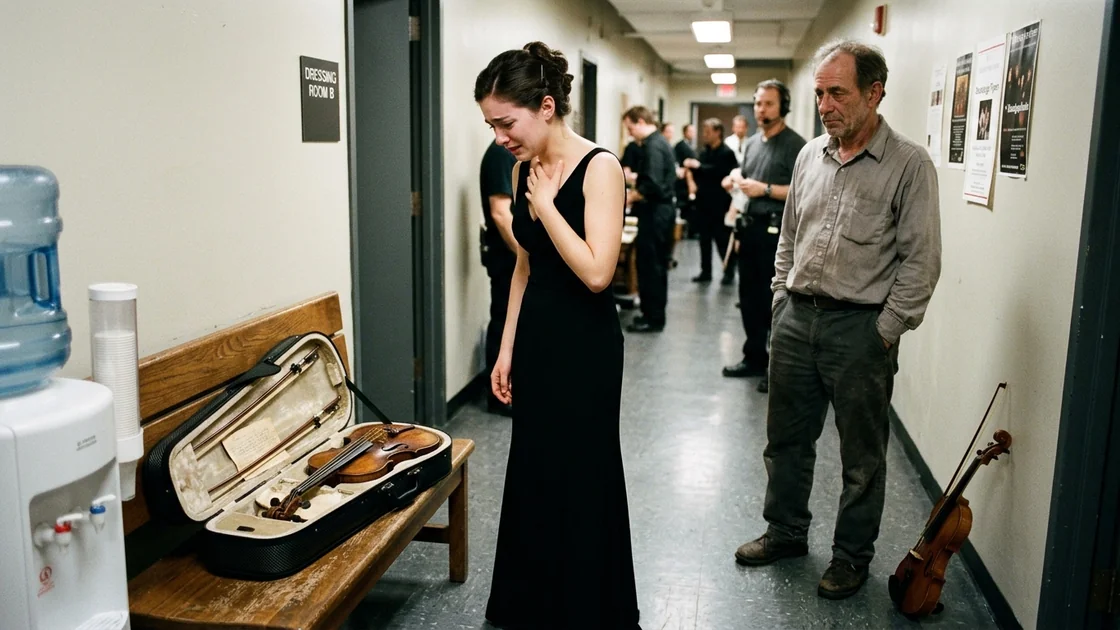
Maeve was standing outside Dressing Room B, wearing a simple black crepe gown, her hair coiled at the back of her neck with ivory pins.
She was holding her conservatory loaner by the neck, her thumb flicking nervously against the chinrest, her face white under the harsh fluorescent tubes. Her teacher, an elderly Russian woman with a shelf of lavender hair and three ropes of pearls around her neck, was speaking to her in a low, furious hiss.
"You are forcing the sound, Maeve. In the cadenza, you are squeezing the wood. The hall is large; if you squeeze, it will sound like iron. Let the instrument breathe."
"It doesn't have any breath to give, Madame," Maeve said, her voice tight, dry with an anxiety that seemed to vibrate in her jaw. "If I don't lean into the string, the hall swallows it. It’s like playing through a blanket."
"Then play through the blanket," the Russian woman said, turning on her heel to walk toward the green room. "Because that is the instrument you have."
Maeve closed her eyes. She leaned her forehead against the doorframe of the dressing room, her shoulders rising and falling in shallow, rapid breaths.
"Maeve," Arthur said.
She turned instantly, her eyes snapping open, her body pulling back against the door as if she had seen a ghost step out of the wall.
"What are you doing here?" she whispered. Her voice was not angry; it was horrified, the sound of a person who had spent years building a dike only to find water bubbling through the cellar floor. "Papa, please. Not tonight. I can't—I don't have twenty dollars for you. I don't have anything."
Arthur did not step closer. He remained six feet away, his boots planted firmly on the industrial linoleum of the corridor.
He laid the carbon-fiber case on a wooden bench beside the water cooler.
He snapped open the four latches: one, two, three, four.
He lifted the lid.
The hallway was very quiet for three seconds. The distant rumble of an uptown subway train rattled the pipes in the ceiling; someone in a dressing room down the hall was running a scale on a bassoon, the notes low and dry, like a frog in a well.
Maeve did not move. She stopped breathing.
Her eyes traveled from the irregular scroll with the small flat spot on the right volute, down the narrow ribs, to the tiny, eyelash-thin repair graft along the left f-hole.
"No," she breathed. Her hand came up to her throat, her fingers catching on the collar of her gown. "No. That's... that was sold. That was gone."
"It was with a woman named Eleanor Vance in Saratoga," Arthur said. His voice was level, quiet, stripped of everything that was not pure, functional truth. "Before that, it was in Lakeville. Before that, Great Barrington. Before that, Trenton."
He took two steps back, putting his hands into his pockets.
"Mr. Kroll set the soundpost this morning," he said. "He lowered the bridge three-tenths of a millimeter on the high side to let the top sing. He says the G-string still has the wolf on the C, but if you hold your third finger against the rib the way your mother did, it won't bite."
Maeve looked from the violin to Arthur’s face.
She looked at his eyes—the yellow, rheumy whites, the deep, dark bags that looked like old bruises, the gray skin around his temples that had not seen the sun in thirteen years. She looked at his hands, where the knuckles were swollen from floor lye and the nails were split down the centers.
"How?" she asked. The word was not a question; it was a plea.
"I worked," Arthur said simply. "I looked. That’s all. That's all I did."
A stage manager with a headset and a clipboard stepped out of the wings, his face red with haste. "Pendelton! Five minutes to the overture. The conductor is going to the podium. Get your instrument tuned and get to the door."
Maeve did not look at the stage manager.
She stepped slowly toward the bench, her black gown whispering against the floorboards. She laid her school violin on the linoleum without looking at it, letting it lean against the wall like a discarded umbrella.
She reached down into the case.
Her hands were not shaking now. She lifted the violin by the neck, her fingers fitting into the small, narrow space beneath the fingerboard with an ease that seemed almost terrifying, as if her bones had remembered the shape of the wood from a dream she had forgotten she had dreamed.
She brought the instrument to her shoulder.
She did not use a shoulder rest; she tucked the small, rounded lower bout directly against her collarbone, exactly where Clara’s skin had worn the varnish down to the white wood thirty years before.
She took the old French bow from the lid, tightened the frog with two turns of her thumb, and drew it across the open D-string.
The sound did not fill the corridor; it opened it.
It was not loud, but it had a strange, hollow density, the deep, bruised amber of the wood transforming the scrape of the horsehair into something that was not merely noise, but an actual physical presence that hung in the air between them like the smell of wild clover after a sudden frost.
Maeve closed her eyes.
She played four notes: an ascending fourth, an appoggiatura, and a long, dying vibrato that climbed into the upper partials until the linoleum floor beneath their feet seemed to hum in sympathy with the spruce.
She opened her eyes. The tears were running now, silent and heavy, cutting two clean, pale tracks through the stage powder on her cheeks.
"She used to play that before she opened the window," Maeve whispered.
"Every morning," Arthur said. "At six o'clock."
The stage manager leaned around the corner, his eyes wide. "Pendelton! Now!"
Maeve did not wipe her cheeks. She took the clean silk handkerchief Martin Kroll had left in the case, tucked it beneath her chin, and turned toward the door to the stage.
She stopped at the threshold.
She did not look back at Arthur. She stood with her back to him, her shoulders straight beneath the black crepe of her gown, the violin held against her ribs with her left hand, the bow trailing from her fingers like a silver rod.
"Papa," she said.
Arthur stopped breathing.
"Sit in the front," she said. "Behind the cello section. You can hear the top better from the left."
The heavy fire door swung open, letting out a roar of muffled applause that sounded like the sea breaking against the pilings of the shipping docks, and then she was gone into the light.
Act IX: The Soundpost
Arthur Pendelton did not sit behind the cello section.
He had no ticket, and the ushers at the door of the orchestra level looked at his split shoes and his collarless shirt with an expression that brooked no negotiation.
He climbed the back stairs to the second balcony, up into the high, narrow rows where the tickets were six dollars and the air was hot and thin with the breath of three hundred students and old men with pocket scores. He sat in the very last row, in the corner against the emergency exit door, his head resting back against the cold, rough plaster of the wall.
Below him, the hall was a vast, gold-leaf horseshoe, glowing under two hundred crystal lamps that dimmed slowly into darkness as the conductor stepped onto the podium.
The applause died.
The silence that followed was not the dead silence of the basement in Mercer Street, nor the hollow silence of the house on Pine Street, nor the cold, clean silence of the river bluff in Saratoga.
It was the held breath of two thousand people waiting for a dead tree to speak.
The conductor’s baton came down.
The orchestra began the long, pulsing introduction to the Brahms—the cellos murmuring in low, dark currents, the woodwinds answering with the dry, reedy sorrow of autumn birds, the timpani thrumming like a heart under a wet coat.
Arthur sat in the dark, his hands flat against the knees of his threadbare trousers.
Then the solo began.
The first entrance of the violin was an octave leap, an aggressive, jagged tear through the orchestral fabric that had to cut through thirty instruments to reach the roof.
On the laminate school fiddle, it would have been a shriek.
Here, from the small, narrow-waisted box of Bosnian maple, it came out with the dark, coppery weight of a bell rung under water. It did not fight the orchestra; it rode it, the tone floating up through the warm air of the hall, climbing the curve of the balconies, slipping through the brass railings, until it found Arthur where he sat in the dark corner against the plaster.
In the second movement, where the violin climbs into the long, wandering cantabile that Clara used to play when the sun went down behind the bakery lot, Maeve reached the high C on the G-string.
Arthur leaned forward, his knuckles digging into his kneecaps.
He heard the wolf tone.
It was there, lurking beneath the spruce, a strange, hollow shudder in the belly of the instrument, a hesitation like an engine misfiring on a cold morning.
He saw Maeve’s left hand shift on the neck. Her third finger dropped down, flattening slightly against the edge of the maple rib, her palm drawing inward by the fraction of an inch to press the wood against her collarbone.
The shudder vanished.
The note bloomed into the hall, pure, round, and terribly sweet, rising without an effort into the highest vault of the ceiling, clear and distinct above the murmur of the strings:
In silvis viva silui, canora jam mortua cano.
Arthur closed his eyes.
He did not pray. He did not ask for Clara to see him. He did not ask for Maeve to forgive him in the bright dressing room after the lights were turned off and the flowers were gathered into buckets.
He simply listened.
He sat in the last row of the high balcony, with his split shoe tucked beneath the iron frame of his seat, listening to his wife’s voice speak through his daughter’s fingers, while the great house around him dissolved into wood, and string, and wind, and the thirty-four hundred dollars was finally, utterly, completely paid.