The Ashes of Oakhaven
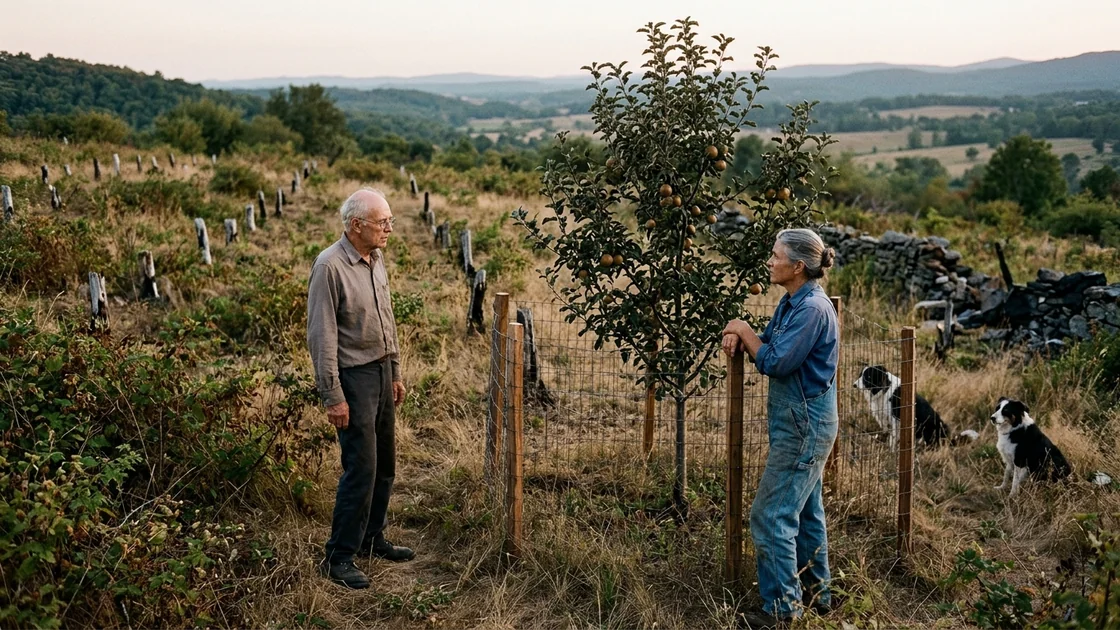
Fifty years after a catastrophic brush fire reduced his neighbor's prized apple orchards to smoking ruin and altered the fortunes of an entire valley, seventy-two-year-old Julian Vance drives back to the rural town of High Ridge to deliver a long-withheld confession to the surviving daughter of the man whose livelihood he destroyed, forcing both of them to confront the irreversible weight of a childhood secret and the quiet wreckage left behind by time.
Part I: The Road Along the Escarpment
The road leading into High Ridge did not climb so much as it uncoiled along the flank of the mountain, clinging to the shelf of grey limestone that separated the timberline from the lower creek bottoms. In the dog days of late August, the valley floor was the color of deer hide, pale and brittle under a sky bleached white by heat.
Julian Vance drove with both hands planted at the top of the steering wheel, his knuckles swollen with arthritis, his old sedan rattling each time the tires hit the expansion joints where the county road crew had slapped down tar over the frost heaves. He was seventy-two years old, and his body felt like an assembly of dry hinges. In the passenger seat sat a leather satchel containing two notebooks filled with hand-drawn survey maps, an envelope containing his savings account balance certified by a notary in Cincinnati, and a yellowed clipping from the High Ridge Gazette dated August 18, 1974.
Below him, through the gaps in the dust-choked sumac, the valley spread out in patchwork squares. Some of the parcels were still green—alfalfa irrigated from deep artesian wells—but where the Thorne property used to roll from the lower ridge down to the creek, the land was different. From this elevation, the scar was still visible if you knew the geometry of the timber. Second-growth scrub oak and loblolly pine had grown back in dense, irregular thickets, but the long, orderly lines of Elias Thorne’s orchard—once two hundred acres of Northern Spy, Baldwin, and the famous Thorne Russet—were gone. In their place stood a dull, scrubby pasture dotted with round bales wrapped in white plastic, looking like giant discarded pills against the sunburned earth.
Julian pulled over onto the gravel apron above the bend known as Dead Man’s Siphon. He cut the engine. The silence that rushed in was heavy, pressurized, filled only with the mechanical clicking of the cooling exhaust manifold and the thin, unending rasp of cicadas in the hickory trees.
He had not smelled this particular air in fifty years. It carried the scent of crushed wild carrot, dry slate, and the faint, bitter tang of river silt baked under a sun that had not yielded rain in thirty-six days. It was precisely the smell of the morning he had struck the match.
He took off his wire-rimmed spectacles and wiped the bridge of his nose with a handkerchief. His reflection in the rearview mirror was an affront: white hair cropped close to hide its thinning, pale eyes sunken behind crepe-paper skin, the mouth pinched into the habitual frown of a man who had spent forty years checking topographical drafts for the Department of Transportation. He looked like an archivist or an estate attorney, a man whose life had taken place entirely in rooms without drafts. Nobody seeing him shuffle into a diner would ever mistake him for an arsonist.
"You can turn around," he said aloud. The sound of his own voice in the car was dry, papery.
He had said that to himself at the state line. He had said it at the truck stop outside Charleston where he slept for four hours with his coat rolled under his neck. He had said it when he crossed the river bridge where the toll booth had been torn down and replaced with an automated camera. Yet the foot had pressed the accelerator; the hands had held the wheel steady.
The guilt of a young man is violent and sudden, like a fever that burns through the night; the guilt of an old man is an anchor dragged across the seabed of fifty years, gathering silt, weed, and drowned wood until it weighs more than the ship itself. He had lived an honest life—he had paid his taxes, loved his late wife Martha with gentle fidelity, shoveled his walk before the neighbors woke, and never kept more than his share of any transaction. Yet all of it had been constructed atop a hollow chamber, a cavern carved into the rock by a single afternoon’s cowardice.
He started the engine again, put the car in gear, and let the brakes grumble as he descended into the basin.
Part II: The Ghost in the Limestone
The town of High Ridge had shrunk, the way old farming hubs do when the rail spur closes and the highway bypasses the river gap. Main Street was three blocks long. The old hardware store, where Elias Thorne used to buy sulfur for spraying and heavy Manila twine for staking saplings, was now a dusty storefront selling discount mattresses and decorative tin roosters. The bank had become a municipal annex with frosted glass and an empty flagpole out front.
Julian parked across from the courthouse. The courthouse was the one fixture that seemed immune to time: three stories of native rust-colored sandstone, topped by an octagonal cupola whose clock had been stopped at twenty past four since the flood of 1985.
He walked into the county clerk’s office. The air inside smelled of linoleum wax and ancient paper, a cool, subterranean basement smell that settled instantly on his skin. A woman in her forties with hair dyed the color of a copper penny looked up from a terminal behind a waist-high counter.
"Help you?" she asked, her voice carrying the slow, flattened vowels of the hill margin.
"I need to check a parcel boundary," Julian said. "Historical records. And the tax registry for the valley district."
She looked at him with mild curiosity. "Looking for family?"
"In a manner of speaking," Julian said. "The Thorne tract. Section twelve, south of the old Mill Run."
She tapped her fingernails against the keyboard, the plastic keys clacking in the quiet room. "Thorne. That’d be Clara Thorne? Or the old orchard ground?"
Julian’s heart gave a sudden, sharp hitch against his ribs, a sensation like a dry stick snapping. Clara.
"Clara," he repeated. "She’s still there?"
"On the home lot," the clerk said, turning the monitor slightly toward herself. "She kept the house and about six acres around the old springhouse. The rest was sold off to the limestone company back in the nineties after her father passed. You a surveyor?"
"I was," Julian said. "A long time ago. Her father... Elias. When did he die?"
The clerk frowned, thinking. "Oh, goodness. I was just a girl. Must’ve been... ninety-four? Ninety-five? He was out at the county home for a while before the end. Stroke took him, I think. My uncle worked with him when he was driving trucks for the gravel pit after the fire."
Driving trucks for the gravel pit.
The phrase fell on Julian’s chest like a shovel of gravel. Elias Thorne had possessed hands like spades, hands that had known how to graft a scion into rootstock with a slice so clean the cambium layer never knew it had been separated from the mother tree. In late winter, Julian had watched him from the fence line: Elias would stand in the snow with his grafting knife, a roll of waxed tape in his teeth, his bare hands working without gloves in thirty-degree wind, matching the wood with the precision of a jeweler. To put those hands on the wheel of an old Mack dump truck, hauling crushed limestone back and forth between the quarry and the rail siding twelve hours a day until his arteries hardened, was a sentence worse than prison.
"Is Clara... does she keep visitors?" Julian asked, his voice wavering slightly.
The clerk gave him a long, shrewd look. "She’s seventy-one, mister. She lives by herself with three border collies and a garden that could feed half the township. She goes to the Presbyterian church on Sundays and minds her own business the other six days. If you’re trying to buy the house for that vacation development they’re talking about on the ridge, you might as well save your breath. She ran two boys from the coal company off with a garden hose last fall."
"No," Julian said quietly. "I’m not buying anything. I’m an old neighbor."
"Name?"
Julian swallowed. His mouth was so dry he had to moisten his lips before the consonants would form. "Vance. Julian Vance. My father was Ray Vance. We had the forty acres up on the bench above their lower draft."
The woman’s eyebrows lifted slightly, but there was no recognition in her face. The name meant nothing to her. Ray Vance had died in an auto wreck outside Knoxville in 1981; Julian had moved away three weeks after the smoke cleared in seventy-four and had never come back, not even for his father’s burial. His mother had sold their forty acres by mail to a timber speculator who clear-cut the hickory and let the land go to brambles.
"Well," the clerk said, printing out a slip with a tax map parcel number on it. "She’s out there. County Route 9, past the old iron bridge. You can’t miss the lane—it’s the only one left with stone posts that haven’t fallen down."
Part III: The Anatomy of a Spark
In the heat of the car, sitting in the church parking lot where he had pulled over to steady his breathing, Julian closed his eyes and saw the dry grass of August 12, 1974.
He had been twenty-two years old, full of the sour, aimless arrogance of a boy who had returned from two years of vocational draftsmanship in Louisville with a mustache and an imported pipe he did not know how to smoke properly. He had thought himself superior to the valley, superior to his father, whose hands were permanently gray from work in the machine shop at the river locks, and certainly superior to Elias Thorne, who spent twelve hours a day talking to his trees as if they were his children.
The drought that year had been biblical. The high grasses on the bench land—brome, foxtail, and wild oats—had cured on the stalk by early July. By August, the forest litter was like tinder in an iron stove. The county commissioners had issued a burn ban on July 20th, threatening fines and jail time for anyone striking a fire outdoors, even in a metal drum.
Julian had been sitting on the dry stone wall that divided the Vance pasture from the Thorne upper orchard. The orchard was Elias’s masterpiece: eighty acres of five-year-old semi-dwarf trees, heavy with their first full commercial crop. Elias had sunk every dollar he had borrowed from the Farm Credit Bank into those trees, along with fifteen years of sweat. He had installed an experimental drip-line system made of black plastic pipe imported from Israel, running down each row like a network of arteries.
Julian had been smoking the cherry-blend tobacco he thought made him look like an intellectual. He had been reading a paperback novel, his boots propped against the dry shale of the wall. When he finished the bowl, he had not tapped the dottle into his palm to ensure it was cold, as his father had taught him to do since he was eight. He had tapped the wooden briar against the top stone of the dry-stack wall.
A single coal, no bigger than a grain of corn, had fallen between two flat fieldstones where a pocket of wind-drifted chaff had gathered.
He had heard it first. A sound like dry cellophane being crumpled in a closed room. Tck-tck-tck.
He looked down. A thread of blue smoke, thin as horsehair, was rising from the crevice between the stones.
He had stepped on it with his leather work boot. He had ground his heel into the crevice. He had even poured three fingers of warm ditch water from his canteen into the crack. He thought he had killed it. He had stood there for two minutes, watching the smoke dissolve into the dry air, satisfied that he was master of the situation. Then he had walked down to the creek to look for his brother’s fishing tackle.
What he had not known—what he had spent fifty years studying in forest service bulletins and soil-moisture monographs—was the root-fire phenomenon. The fire had not died under his boot. It had found the subterranean runner of a wild blackberry vine, dead and dried to the consistency of charcoal by three months of heat. The coal had crept along that root, two inches beneath the surface of the soil, through the dry leaf-mold under the stone wall, until it emerged forty feet down the slope, on the Thorne side of the property line, in the middle of a windrow of cheatgrass that had accumulated against the bottom wire of the cedar fence.
He had been at the creek for perhaps twenty minutes when the smell reached him.
It was not the sweet smell of pipe tobacco. It was the greasy, resinous stench of burning cedar and the sharp, vinegar-acid bite of green leaves being flash-boiled in their own juices.
When he ran up the bank, the wall of fire was already seventy yards wide.
The valley wind, which always pulled up from the river gap at two in the afternoon like a draft through a furnace flue, was blowing thirty miles an hour. It took the cheatgrass first, a red sheet that moved faster than a man could sprint, then it climbed the cedar posts. From the posts, the heat was so intense that the first row of young Northern Spy trees simply exploded. The sap in their trunks turned to steam, rupturing the bark with pistol-shot cracks that echoed off the limestone bluffs.
Julian had stood at the crest of the bench, frozen, his knuckles in his mouth.
He could have run to the Thorne house. Elias was down by the sorting shed with his tractor; Julian could see the blue hood of the Ford through the trees. He could have shouted. He could have dialed the High Ridge Volunteer Fire Department from his father’s kitchen phone.
Instead, he had dropped his pipe into his pocket, crawled through the hawthorn thicket behind his family's smokehouse, and climbed into the loft of his father’s barn. He had pulled the hay over his legs and sat there in the dark, shivering in the ninety-five-degree heat, watching through a knot-hole as the smoke turned the sky from blue to brass, then from brass to the color of bruised liver.
The fire had burned for twenty-two hours. It took Elias Thorne’s orchard—all eight thousand trees. It took the packing shed, the new refrigerated cold-storage unit Elias had mortgaged his life to build, seventy-five tons of lime, two tractors, and three hundred thousand board-feet of mature white oak in the woodlot behind the house. It jumped the road and took the county bridge, burning the creosoted timbers down to the water line.
The investigation by the state fire marshal had lasted three days. They found the origin point: the stone wall on the boundary line. But the high wind had swept the evidence clean; there was no pipe dottle left, only a scorched fan of dirt and limestone rocks cracked in two by the heat.
"Dry lightning," the volunteer chief had pronounced at the diner, his face black with soot, a cup of coffee shaking in his blistered hand. "Must've struck the ironstone on the bench during that dry front that came through at noon. We heard thunder up on the knob. One spark in that cheatgrass, and God Almighty couldn't have stopped it with six hoses."
Julian had sat on a stool three down from the chief, eating a ham sandwich he could not taste.
Elias Thorne had been sitting at the end of the counter. His shirt was torn, his eyebrows burned off, his forearms wrapped in yellow burn gauze from trying to drag his new sprayer out of the shed before the roof fell. He was fifty years old then, with hair as black as a crow's wing and shoulders that looked like they could pull a two-bottom plow by themselves.
He hadn't wept. He had simply looked into his coffee cup, his eyes flat and dead, like lead sinkers.
"It wasn't lightning," Elias had said, his voice so quiet the counter girl stopped slicing pie to listen. "There wasn't no lightning. The air was clear as glass."
"Well, Elias," the chief had said gently, "what else could it have been? Wasn't nobody up there. Ray Vance was down at the locks all morning, and the boy here was down at the creek."
Julian had nodded. He had looked Elias straight in the face—the face of the man who had brought his mother fresh cider every October since Julian was in diapers, the man who had let Julian hunt squirrels in his timber without ever asking for a hindquarter—and he had nodded.
"I was at the creek," Julian had whispered. "I saw the smoke come over the trees."
Elias had looked at him for five seconds. In those five seconds, Julian had felt his soul curdle within him, shrinking down into something bitter, narrow, and hard as an iron nut. Elias hadn't accused him; Elias had simply looked through him, through his flesh and his lying eyes, to the emptiness behind them.
Then Elias had stood up, laid two dimes on the counter for his coffee, and walked out into the ash that was falling like gray snow over the street.
Part IV: The Ledger of Ruin
The lane to the Thorne place had not changed its curves, but everything else had been repossessed by the scrub.
Where the long, majestic rows of trees had once created aisles of green shade, there was now only the wild, ragged anarchy of abandoned mountain ground. Red cedar, persimmon, wild blackberry, and the grey skeleton branches of dead sumac choked the hillsides. Julian steered the car between two leaning limestone pillars that had once carried a painted sign: THORNE FRUIT FARMS – EST. 1912. The sign had fallen long ago; only a rusted iron strap still dangled from the limestone, swinging slightly in the wind like a pendulum.
At the end of the lane sat the house. It was a tall, narrow, two-story frame house with a high-pitched tin roof that had faded from red to the dull gray of galvanized metal. It had not been painted in twenty years. The clapboards on the south side, exposed to the afternoon sun, were curled like dry leaves, revealing the tar paper beneath.
On the front porch, three border collies rose as one when the car’s tires crunched the cinders of the driveway. They did not bark; they stood with their heads lowered, their tails level with their backs, watching the stranger with the cold, assessing intelligence of working dogs.
Julian stopped the car by the well pump. He turned off the key, took a long breath, and reached for the leather satchel on the passenger seat. His fingers were cold despite the heat.
When he opened the door, the dogs didn’t growl, but they closed ranks at the base of the porch steps. A screen door creaked—a high, rusty groan that Julian remembered with terrifying clarity from fifty summers ago—and a woman stepped out onto the gray-painted floorboards.
She wore denim overalls over a faded blue work shirt, the sleeves rolled to her elbows. Her hair was iron-gray, pulled back into a severe knot at the nape of her neck, exposing a face that had been carved by wind, sunlight, and forty years of hillside isolation. She had her father’s jaw—wide, square, with a small cleft in the center—and his dark, deep-set eyes that seemed to take in everything without offering anything in return.
"Down, boys," she said. Her voice was lower than he expected, raspy from outdoor life, dry as tobacco leaves.
The three dogs sat immediately, their eyes never leaving Julian.
"Clara," Julian said. He stood by the open door of the sedan, using the metal frame to support his weight. His legs felt watery, disconnected from his brain.
She looked at him for a long time. Her eyes traveled from his polished black shoes to his khaki trousers, his pressed shirt, his white hair, and finally settled on his face. She did not squint; she simply looked, her arms hanging loosely at her sides, her large, calloused hands motionless.
"You're Ray Vance's boy," she said.
It was not a question. It was a classification.
"Julian," he said.
"I know which one you are," she said. She didn't move from the top step. "Your brother Tom had the scar across his chin from the sickle bar. You're the one that went off to the city to draw maps."
"Yes," Julian said. "That’s me."
She looked past him, down the lane toward the empty valley, then back at his car. "Your mother died in Ohio. Tom was in an accident in eighty-nine, wasn't he? Construction work."
"In Birmingham," Julian said. "A trench caved in."
"I thought so," she said. She reached into her pocket, pulled out a pocketknife and a small, greenish apple, and began to pare the skin in a continuous, curling strip. "Well, Julian. It’s been fifty years. You didn’t come back for your father, and you didn’t come back for the land when the bank took it. What are you doing in my lane?"
The directness of the blow made him stagger internally. There was no polite mountain preamble here, no ritual inquiries after the weather or the health of distant cousins. She was Elias Thorne’s daughter, and she had spent fifty years living among the bones of her father’s life.
Julian lifted the satchel. "I need to talk to you, Clara. About August of seventy-four."
The knife didn't slip, but it stopped. Clara held the apple and the blade perfectly still for three heartbeats. The cicadas in the overgrown pasture seemed to double their volume, a deafening, metallic shriek that rose and fell like a siren.
"The fire," she said.
"The fire," Julian repeated.
She looked at the satchel, then up at his eyes. For the first time, Julian saw a flicker of something ancient and terrible behind her pupils—not anger, exactly, but the cold, hard light that shines off an axe blade when you drag it out of the dark of the woodshed.
"Come inside," she said, turning toward the screen door. "It’s too hot to stand on the porch and let the flies in."
Part V: The Room with the High Windows
The Thorne house smelled of dried sassafras, kerosene, old wool, and vinegar.
It was cooler inside, behind the drawn green shades, but it was an airless, tomb-like cool. The furniture was the same Julian remembered from the few times his mother had sent him over with a basket of preserves: a massive walnut sideboard with carved grapes on the drawer pulls, a horsehair sofa that looked as hard as a church bench, and an oval dining table covered with an oilcloth patterned with yellow daisies, now worn down to the white mesh at the corners.
On the sideboard sat a black-and-white portrait of a woman in an oval frame—Clara’s mother, who had died of the dropsy when Clara was twelve—and beside it, a large, brass-bound family Bible. There was no photograph of Elias.
Clara pointed to a chair at the end of the table. "Sit."
Julian sat. The wood of the chair was hard beneath him, the ladder-back cutting into his shoulder blades. Clara did not sit across from him; she went to the cast-iron sink in the corner, pumped the brass handle until clear water gushed into a tin cup, and set the cup in front of him.
"Drink," she said. "You look like you're about to fall out."
Julian took the cup with both hands to keep it from rattling against his teeth. The water was icy, sulfurous, tasting sharply of iron and cold rock. It was the same water from the deep limestone fissure that had fed the Thorne kitchen for a century. It felt like drinking the past.
Clara sat down at the opposite end of the long table, twelve feet away. She laid the half-pared apple on the oilcloth between them. She did not fold her hands; she laid them flat on the table, palms down, fingers spread. They were enormous hands for a woman, scarred across the knuckles, the fingernails blunt and clean, the skin darkened to the shade of harness leather by decades of manual work.
"Tell me," she said.
Julian opened the leather satchel. His fingers were trembling so badly he had difficulty unbuckling the brass tongue. He pulled out the yellowed newspaper clipping, the bank envelope, and the surveyor's field notebook from 1974. He laid them on the table, but he did not slide them toward her. They were his props, the evidence of his penance, but in the presence of her flat, steady stare, they looked like scrap paper.
"It wasn't dry lightning," Julian said.
His voice didn't sound like his own. It was too high, a boy's voice, cracked and thin.
Clara didn't blink. "I know it wasn't lightning."
"You know?" Julian asked, his breath catching.
"My father knew," she said quietly. "He spent sixty years on this mountain. He knew where the clouds sat when the lightning struck. He knew that when the thunder rolled that day, it was dry thunder over the ridge five miles north, with no strike within two leagues of our bench. He told the sheriff that. He told the insurance adjusters that. He told the bank that."
"They didn't believe him," Julian whispered.
"They didn't care," Clara said. "Lightning was an Act of God. An Act of God meant the bank could write off the balance without an investigation, and the insurance company didn't have to pay the third-party indemnity on the nursery stock. Lightning was clean. It didn't have a name, it didn't have a father, and it didn't have forty acres of land you could put a lien against."
She leaned forward slightly. The green shade behind her head fluttered as a hot draft found a slit in the window sash.
"Who was it, Julian?" she asked. Her voice was not loud. It was deadly, clinical, the voice of a surgeon asking where the tumor began. "Was it your brother Tom? He was always wild with the kerosene when you-all were burning brush on the bench."
Julian closed his eyes. The darkness behind his lids was red with the memory of the flames.
"It wasn't Tom," he said.
"Your father?"
"No."
Clara stared at him. The silence in the kitchen was so thick Julian could hear the dogs shifting their weight on the porch outside, their claws clicking against the painted pine. He could hear the tick of an old mantel clock in the parlor—a slow, heavy tock... tock... tock that sounded like wood being chopped a long way off.
"It was you," she said.
The word hung in the room like the smoke from the cedar posts.
"Yes," Julian said.
He did not look down. He forced himself to keep his eyes on hers, though the effort made his vision blur at the edges.
"I was smoking a pipe," he said, the words spilling out now, stumbling over one another, dry and hurried, like stones rattling down an embankment. "A pipe I bought in Louisville. Cherry blend. I thought I was a man. I tapped the ash out on the stone wall. I thought it was out, Clara. I swear before God Almighty I thought it was dead. I stepped on it. I poured water from my canteen on the stones. But it got into the blackberry runners underneath. It went under the wall and came up in your cheatgrass forty feet down."
He stopped, his lungs heaving as if he had run up from the creek bottom.
"I stood at the creek," he whispered. "I saw it take the lower row. I could have run to Elias. I could have called from the house. But I was afraid. I was twenty-two years old and I was a coward. I went into our barn and hid under the hay until the sun went down."
Clara did not move. Not a muscle in her face shifted. She sat with her hands flat on the yellow daisies, her dark eyes drilling into his face with an intensity that seemed to peel away his skin, his fat, his dry old muscles, down to the small, miserable marrow of that twenty-two-year-old boy shivering in the dark of Ray Vance's loft.
"And then?" she asked.
"And then I lied," Julian said. "At the diner. Elias looked at me, and I lied. I said I was at the creek. I let the chief say it was lightning. And three weeks later, I took my trunk and I caught the Greyhound to Cincinnati and I never came back."
Part VI: The Architecture of Loss
The silence that followed was longer than any silence Julian had ever known.
It was not the silence of the woods before a storm; it was the silence of a house after the coffin has been carried out through the front door and the relatives have gone home, leaving only the empty plates and the smell of cut lilies.
Clara picked up the paring knife. She slowly sliced a sliver from the apple, put it in her mouth, and chewed. The sound of her teeth cutting through the fruit was surprisingly loud.
"He died in ninety-five," she said. Her voice hadn't changed; it remained level, flat, devoid of the theatrical fury Julian had prepared himself to endure. "Twenty-one years after the fire. Do you know what twenty-one years is, Julian?"
"I know," he choked out.
"No," she said, cutting another slice. "You don't know. You were in Cincinnati. You were drawing maps for the state. You had a pension and a house with a lawnmower and a church where nobody knew you."
She pointed the tip of the knife at the floorboards between them.
"My mother died in sixty-nine, so she was spared the worst of it. It was just me and him. I was twenty-one when the fire came. I had a scholarship to the teachers' college in Morehead. I was supposed to leave on the twenty-fifth of August."
Julian felt the blood drain from his face. "Clara, I... I didn't know."
"Of course you didn't know," she said. "Why would you know? You were thinking about your pipe and your drawings. When the fire took the trees, it took the crop. When it took the crop, the bank called the note on the packing shed. My father didn't have the money. He had every red cent in those dwarf trees. The county tax collector came three months later. So I didn't go to Morehead. I stayed here."
She laid the knife down with a small, neat clink against the oilcloth.
"He went down to the limestone quarry," she continued. "He was fifty years old. He had been his own boss since he was seventeen. He had a master's understanding of pomology—people from the state university used to come down here to ask him how he got the Thorne Russet to set fruit on north-facing clay. And he spent the next sixteen years driving an open-cab Mack truck through the dust, hauling four-inch stone to the lime kilns. Ten hours a day, six days a week, in the heat and the sleet."
She looked at her hands, turning them over so the palms were facing up. They were crisscrossed with white scars, the skin thick and yellowed at the heels.
"By sixty-two, his knees were gone from the clutch. By sixty-five, his lungs were full of stone dust. He couldn't walk from this chair to the woodstove without stopping to lean on the dresser. And the whole time—every single day of those sixteen years—he would look out that kitchen window at the bench where your father's land sat."
"Did he suspect?" Julian asked, his voice barely a breath. "Did he know it was me?"
Clara looked at him with an expression that was almost like pity, but colder, sharper.
"No," she said. "He didn't suspect you. He didn't think you had the sand to do something that big, even by mistake. He thought it was your father."
Julian jerked back as if he had been struck with a length of chain. "My father? No. My father was his friend. They helped each other butcher every November!"
"My father thought Ray Vance did it on purpose," Clara said, her voice dropping into a low, remorseless rhythm. "Because in seventy-three, Ray asked him for an easement across our bottom land to bring a timber road down from the ridge. And my father refused him. He told Ray that the logging trucks would bring dust and diesel smoke into the orchard right when the trees were setting fruit, and it would ruin the finish on the Thorne Russets. They had words over it at the post office. Ray didn't speak to him for six months."
"My father never burned anything," Julian said, his hands gripping the edge of the table. "He was a Christian man. He loved Elias!"
"My father didn't think he was a Christian man after the fire," Clara said. "He believed until the day the stroke took his speech that Ray Vance went up on that bench and dropped a match into the cheatgrass to settle that timber road score. He hated your father, Julian. He hated him with a hatred that dried him up from the inside out. It ate his stomach; it ate his heart. When Ray was killed in that car wreck in eighty-one, my father didn't go to the funeral. He stood on the porch with his binoculars and watched the hearse go down the road toward the cemetery, and he said, 'There goes the man that broke me, and the devil's got him by the hair.' That was what he said."
She stopped.
Julian sat with his face buried in his hands. The tears did not come; he was too old, too dry for the relief of weeping. There was only an ache in the center of his chest that felt as though his ribs were slowly being crushed inward by an enormous weight.
His father. His quiet, stoic father, who had spent his life working the grease-guns at the locks and coming home with black grease under his fingernails that never quite came out, had carried the silent accusation of his best neighbor to the grave. His father had died with Elias Thorne's hatred sitting on his head like an invisible crown of thorns, all because Julian had been too terrified to admit that he had dropped a hot coal from a cheap cherry-wood pipe.
"My God," Julian whispered through his fingers. "My God, Clara."
"God hasn't had much business on this creek since seventy-four," Clara said.
Part VII: The Envelope on the Daisies
After several minutes, Julian lowered his hands. His face felt stiff, like a mask of dry river mud.
He reached into the leather satchel and pulled out the white envelope. It was thick, sealed with red wax, and bore the imprint of the Fifth Third Bank of Cincinnati.
He pushed it across the daisy-patterned oilcloth until it rested against the base of the tin cup.
"There's two hundred and fourteen thousand dollars in that account," Julian said, his voice flat, devoid of inflection. "It's everything I have. It's the equity from my house in Norwood, which I sold last month. It's my state retirement pension fund, cashed out. It's my savings. It's my car's title, signed over on the back."
Clara looked down at the envelope. She didn't touch it.
"What is that?" she asked.
"It's the orchard," Julian said. "Or as much of it as fifty years of drawing state maps could buy. It won't bring back the trees. It won't bring back Morehead. It won't take the stone dust out of your father's lungs. But it's yours. It's restitution."
Clara looked from the envelope to Julian. A small, dry smile touched the corners of her mouth—a smile that was more terrible than any scream or curse he had imagined during the long drive from Cincinnati.
"Restitution," she repeated. The word sounded foreign in her mouth, like something clipped from an insurance brochure.
"Take it," Julian said, leaning forward, his voice cracking with an urgency that was almost violent. "Please, Clara. Take it. Let me sign the papers. We can go to the bank in High Ridge on Monday. We can go to the courthouse. I'll make a formal deposition to the county clerk. I'll put it in the Gazette. I'll tell them it was me. I'll clear my father. I'll clear Elias. I want it on the record."
Clara stood up. She was not a tall woman, but standing over the table, with her square shoulders framed against the dull light of the green window shade, she looked massive, an immovable feature of the landscape, like the sandstone bluffs that rose above the creek.
She picked up the envelope by one corner, using only two fingers, as if it were a dead mouse she had found behind the meal chest.
She walked across the room to the cast-iron woodstove. It was an old Home Comfort range, its nickel trim long since rusted away, used now only for heating the kitchen in the bitter months of January and February. The firebox door was unlatched.
Julian watched her, his breath suspended in his throat.
She didn't open the envelope. She didn't look at the certified bank seal or the notary's signature. She simply dropped it through the square opening into the black darkness of the cold firebox. The heavy paper hit the cast-iron bottom with a dull, hollow thud.
She swung the door shut and turned the latch.
"Clara!" Julian gasped, half-rising from his chair.
"Sit down," she said.
He sat. He had no choice; his knees would not have held him.
"You think this is a ledger, Julian?" she asked, her voice dropping into a register that made the tin cup on the table hum faintly. "You think you can come back here with your city car and your leather bag, after fifty years of silence, and write a check to balance out my life?"
"No," he whispered. "No, I—"
"You want to buy your sleep back," she said, cutting him off with the flat blade of her voice. "That's what that envelope is. It's twenty-five thousand dollars for your peace of mind, and the rest to buy off the ghost of my father so you don't have to see him standing at the foot of your bed when your turn comes to die."
She walked back to the table, her boots heavy on the pine boards.
"You want me to take that paper to the bank so the whole valley can say, 'Look at poor Clara Thorne, she finally got paid for them apples.' You want to go to the courthouse and sign a paper so you can walk out into the sunshine and feel like an honest man who had a hard youth but did the right thing in the end."
She leaned down, putting both of her large, scarred hands on the table, bringing her face within eighteen inches of his. He could see the tiny broken veins in her cheeks, the yellowing whites of her eyes, the faint smell of woodsmoke and peppermint that hung in her clothes.
"My father drove that Mack truck until his spit was red with lime," she said, her voice shaking with the first tremor of rage he had seen. "He died in the county infirmary with a diaper on because he couldn't control his water. He didn't know who I was for the last eighteen months. He thought I was his sister who died in the influenza in nineteen-eighteen. And every afternoon at three o'clock, he'd start beating the bed rails with his fists, screaming that the smoke was coming through the gap and Ray Vance was standing on the wall laughing at him."
She straightened up.
"And you want to settle that with a draft from Cincinnati?"
Julian could not speak. The shame that filled him was not hot, like the fire; it was Arctic, a vast, dead expanse of ice that froze his tongue to the floor of his mouth. He felt smaller than he had ever felt in his life—smaller even than the boy who had crawled into the hay while the orchard burned.
"What do you want me to do?" he asked, the words barely audible. "Tell me what to do, Clara. If you don't want the money, tell me what you want."
"I don't want anything from you," she said. "There is nothing you have that is of any use to this ground."
Part VIII: The Orchard of Stumps
She stood by the window for several minutes, looking out through the small gap between the green shade and the jamb. Outside, the light was beginning to change, softening from the brassy glare of midday to the amber, long-shadowed stillness of late afternoon.
"Come with me," she said, without turning around.
Julian struggled to his feet. His hip joint screamed with pain as he straightened, a dull, grinding agony that had grown worse with every mile he drove from Ohio. He did not touch his satchel. He left his hat on the table beside the half-pared apple.
He followed her through the back door, down three wooden steps that had been patched with rough-sawn oak, and out into the yard.
The three border collies stood up and fell in behind them, walking with their noses down, silent as shadows.
Clara did not lead him toward the road or toward the creek. She walked toward the bench—the gentle, north-facing slope that rose behind the house toward the limestone ridge where the Vance land used to begin.
The ground was rough, covered in thickets of briars, buckbrush, and wild plum that whipped against Julian’s trousers. There was no path. Clara walked with a slow, rolling stride, her heavy boots crushing the dry weeds with a rhythmic crunch... crunch... crunch. Julian had to labor to keep up with her, his breath rattling in his windpipe, the sweat stinging his eyes behind his spectacles.
They reached the first terrace.
Fifty years ago, this had been Row One of the Thorne Russets. Elias had planted them twenty feet apart, on Malling VII rootstock, pruned to the central-leader system so that each tree looked like an open umbrella of dark green foliage, designed to let every ray of September sunlight strike the fruit until the skin turned the color of an antique copper coin.
Now, there were only the stumps.
They were not large. The fire had burned them down to the soil line, but the dense, hard heartwood of the apple trees had refused to rot entirely. Over fifty years, the weather had scoured them, the acid in the soil had silvered them, until they looked like dozens of gray stones protruding through the sod, aligned in long, ghostly, mathematically perfect lines that stretched across the hillside.
In the center of the terrace, surrounded by a low fence of woven wire that had been kept clear of brush, stood a single tree.
It was not an old tree. It was perhaps twenty feet high, its trunk no thicker than a man’s calf. Its bark was smooth, dark gray, with the characteristic lenticels of young apple wood. Its branches were trained out with wire spreaders, pruned with exquisite, fanatic care. On its limbs hung several dozen small, round apples, their skins rough, russeted, turning from olive-green to a dull, bronze gold in the late-summer light.
Julian stopped. His heart was hammering against his ribs like a bird in a box.
"Is that...?" he began.
"Thorne Russet," Clara said.
She walked to the fence and rested her arms on the cedar post.
"The state inspectors said the variety was extinct after the fire," she said, her voice dropping back into its low, conversational cadence. "They had two trees at the experimental station in Wooster, but they died of fire blight in seventy-eight. They thought the wood was gone."
She looked at the tree with an expression Julian had not seen on her face before—not softness, exactly, but a deep, fierce reverence, the look a monk might give to a fragment of the True Cross.
"In eighty-four," she said, "ten years after the smoke, I was walking up here with the dogs. Right there, where the old sorting bench sat, by that stump." She pointed a blunt finger at a blackened knob of wood almost buried in the cheatgrass. "A water-sprout had come up from below the graft. One single whip, no thicker than a knitting needle. It had five leaves on it. The sheep had grazed everything else down to the dirt, but they hadn't touched that whip because it was growing inside an old roll of rusted hog wire."
She turned her head to look at Julian.
"I didn't know how to graft," she said. "My father was working twelve hours a day at the quarry. His hands were too stiff by then to hold a knife without shaking. So I went down to the high school in the evenings and asked the agricultural teacher to show me how to cut a scion. I took that whip, and I grafted four buds onto wild crab rootstock I dug out of the creek bottom."
She touched the wire fence.
"Three of them died," she said. "This one took. It took seven years to bear its first fruit. It had three apples on it the autumn my father went into the home."
Julian looked at the tree, then at the gray, ruined hillside around it.
A single tree. Out of eight thousand.
Elias Thorne’s legacy, preserved not by the great commercial operation that had been his pride, but by a daughter who had stayed behind in the ashes, paring her own life down to the bone so that one branch of her father’s wood might continue to draw water from the limestone.
"Clara," Julian said. He took two steps toward her, his hands outstretched, then dropped them to his sides, realizing the obscenity of any physical gesture. "You kept it."
"I didn't keep it for you," she said. "And I didn't keep it for the valley. I kept it because it was his. Because when everything else was gone—when his name was a byword for a man who had bad luck, and people forgot what his cider tasted like—I wanted there to be one thing on this mountain that remembered he knew what he was doing."
She turned away from the fence and walked twenty paces up the slope, stopping at the remnants of the dry-stack stone wall that marked the boundary between the two farms.
The wall had mostly collapsed. The stones, blackened by the fifty-year-old soot that had been baked into their pores, lay scattered in the briers like the ruins of a miniature city.
"Here," Clara said, pointing down with her boot.
Julian walked up to her. Every step was an effort; the air felt thin, greasy with heat.
Between two large limestone boulders, where the wall had once stood four feet high, the soil was black. Even after fifty years of rain and leaves, the earth in the crevice had a greasy, unnatural texture, different from the yellow clay of the hillside.
"This is where you sat," Clara said.
"Yes," Julian said.
"This is where you struck the match."
"Yes."
She looked at him. The sun was dropping behind the ridge now, casting long, purple shadows across the valley. The lower orchard was already in twilight, but up here on the bench, the last light caught the side of her face, illuminating the deep crevices around her mouth and eyes.
"You've had fifty years of life, Julian," she said. "You had your work. You had your cities. You had whatever you had in Cincinnati. Did it make you happy?"
The question was so simple, so completely devoid of cruelty, that it struck him harder than any accusation.
Julian looked down at his shoes, then out across the valley where the lights of High Ridge were beginning to flicker on one by one in the gathering dusk. He thought of his quiet house in Norwood; he thought of the forty years he had spent leaning over drafting tables with a 4H pencil, ruling lines that were straight to the thousandth of an inch, ensuring that no road deviated from its surveyed easement by a fraction of a degree. He thought of his wife Martha, whom he had loved, but to whom he had never spoken of this wall, this valley, or the smell of burning cedar.
He had lived a life of rigorous, impeccable symmetry, designed entirely to keep the chaos of that August afternoon from leaking into the rooms he inhabited.
"No," Julian said. "It didn't make me happy. It just kept me busy."
Clara nodded once, as if he had confirmed an entry in an account book.
"That's something, then," she said.
Part IX: The Work That Remains
They walked back down the hill in the twilight.
The dogs ran ahead, their white-tipped tails bobbing through the sumac like lanterns. By the time they reached the back porch, the sky was the color of a bruised damson plum, and the first bats were dipping and turning over the old springhouse.
Clara went into the kitchen and lit an oil lamp on the sideboard. The yellow flame guttered, then steadied, casting large, soft shadows against the peeling wallpaper.
Julian stood in the doorway, his hat in his hand. He knew he had reached the end of the road. There was nowhere else for him to drive. His house in Ohio belonged to an insurance auditor and his young family; his clothes were in two suitcases in the trunk of his car; his money was in the cold firebox of Clara Thorne’s woodstove.
"I’ll go to the hotel in the town," Julian said. "If the hotel is still open."
"The hotel burned in seventy-six," Clara said, setting the glass chimney back on the lamp base. "There's a motel out on the bypass with a neon sign that buzzes all night, if you like that sort of thing."
Julian looked down at his hat. "I'll find something."
Clara walked over to the woodstove. She did not open the firebox. She stood with her back to him, her hands resting on the cool nickel warming oven.
"You said you worked for the state," she said.
"Yes. Topographical survey. Highway design."
"You know how to run a transit?"
"I used to," Julian said. "Before they went to the satellites. I used an old K&E engineer's transit for thirty years."
Clara turned around. In the lamplight, her eyes were dark caverns, impossible to read.
"The limestone company is trying to take the lower five acres," she said. Her voice was flat, matter-of-fact. "They say the original survey in thirty-eight used the old sycamore at the creek bend as a corner witness. The sycamore washed out in the ninety-seven flood. The company brought in a crew from Lexington with yellow tripods and plastic tape, and they claim the line runs sixty feet inside my fence. Right through the lower flat where the new grafts need to go."
Julian lifted his head. "They can't do that. The Thorne tract was deeded from the Henderson patent. The boundary wasn't based on that sycamore; it was based on the stone marker set by the county surveyor in 1892, on the limestone ledge forty links north of the creek."
Clara looked at him for five seconds. A faint, almost imperceptible line appeared between her gray eyebrows.
"Do you know where that stone is?" she asked.
"I helped my father find it when I was twelve," Julian said. "He and Elias were re-setting the lower corner posts. Elias gave me a nickel to clear the moss off the cross-hatch with an old file. It's cut into the bed-rock six inches above the high-water notch, behind where the old mill-dam used to tie in."
Clara took a step toward the table.
"The boys from Lexington couldn't find it," she said. "They said it was covered by the gravel wash from the quarry road."
"It's not covered by gravel," Julian said, his voice regaining a firmness, a precision that had been absent for hours. "It's limestone. You have to take a flat spade and scrape the silt off the shelf. It's there. It'll be there until the mountain falls into the river."
Clara looked at him. She did not smile. She did not offer her hand. But the air in the kitchen, which had been so cold and tight it felt like it might splinter, seemed to ease slightly, like an old door finally coming unlatched.
"The spare room upstairs has an iron bed," she said. "The mattress is corn-shucks and cotton batting, but it don't leak. My father's rubber boots are in the vestibule. They're a size eleven. Yours look about a ten, but with two pair of wool socks they won't slop too bad in the mud."
Julian stared at her, uncomprehending. "Clara... you want me to stay?"
"I don't want anything," she said, picking up the half-pared apple from the table and taking a final bite down to the core. "I need that line run before the county court meets on Thursday. And there's four hundred feet of deer fence that needs new cedar posts before the rut starts, or them bucks will rub the bark off that young Thorne tree before November."
She walked toward the hall door, the lamp in her hand, casting her long shadow up the staircase.
"The woodstove stays cold until October," she said, pausing with her foot on the bottom riser. "Your envelope will keep in the ash-pan until then. If you're still here when the frost comes, you can decide whether you want to burn it or take it back to Cincinnati."
"Clara," he called out, his voice cracked with a feeling he could not name—something that was not forgiveness, and certainly not peace, but was perhaps the very first, bitter grain of utility.
She stopped and looked back down at him through the wooden banisters.
"Tomorrow morning," she said. "Five o'clock. The dogs need feeding before we go down to the creek, and the pump has to be primed with two buckets from the rain barrel or it'll suck air."
She didn't wait for his answer. Her boots creaked on the treads as she climbed into the dark of the upper story, her yellow lamplight sliding away across the ceiling until only the gray squares of the windows remained, showing the cold, clean outlines of the mountain against the summer stars.
Julian Vance stood in the dark kitchen.
He reached into his pocket, took out his spectacles, and laid them on the table beside the tin cup. Then he walked to the back door, stepped out onto the porch, and sat down on the top step.
The three border collies came out of the shadows and lay down around him, one of them resting its heavy, warm chin across the toe of his city shoes.
Up on the bench, through the thickets of brier and scrub, the wind moved through the leaves of the single Thorne Russet, a dry, papery sound that was not the crackle of fire, but the slow, stubborn breathing of the earth, waiting for the rain that would eventually come.