The Ash Latitude
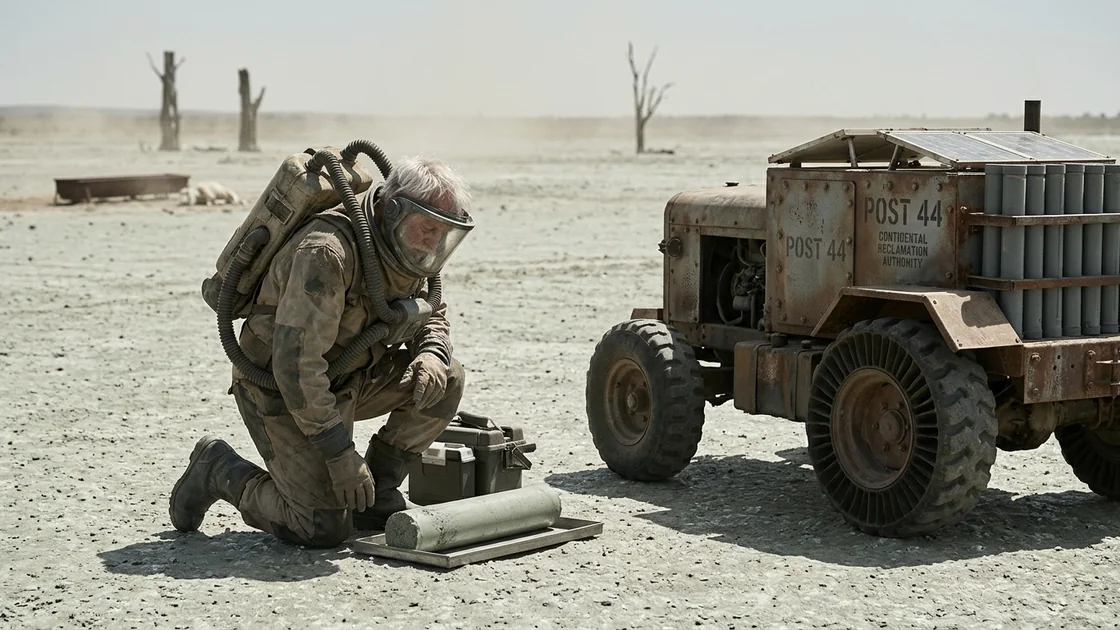
Dr. Alistair Finch was once celebrated as the savior of Australia when he synthesized Phase-Nine, an engineered viral vector designed to eradicate a devastating fungal rot threatening the continent’s breadbasket. Driven by impending famine and paralyzed by regulatory bureaucracy, he bypassed the mandatory multi-year subterranean containment protocols and dispersed the agent across the Murray-Darling river system. Within three seasons, the virus underwent an unprecedented horizontal gene transfer with indigenous mycorrhizal networks, causing the microscopic life of the soil to permanently crystallize into an inert, water-repellent silicate lattice. Today, an aging and reviled Finch lives in self-imposed exile along the perimeter fence of the dead continent, forced to maintain the scientific record of the vast, vitrified wasteland he engineered while reflecting on the hubris that stripped a landmass of its biological future.
I. The Sound of the Core
The percussion drill had a peculiar, hollow bite when it struck twenty centimeters down. In living earth—the kind of damp, black loam Alistair Finch had not smelled in thirty-two years—a coring auger groaned through friction, choked by tangled taproots, dragging up rich ribbons of humus, nematode bodies, and damp clods that clung to the steel teeth like wet clay.
Here, at the forty-fourth kilometer mark of the Lachlan Transect, the auger did not bite. It shrieked.
A high, glassy whistle rose through the vibration of the drill shaft, tingling in the calluses of Alistair’s palms. When the carbide teeth punched through the crust, there was no give, no elasticity. The ground yielded only by shattering, throwing off a dry, calcified powder that looked like ground bone or the pulverization of ancient porcelain.
Alistair cut the motor. The sudden silence was vast, predatory, and familiar.
Across the continental interior of Australia, silence had a physical mass. It was not merely the absence of animal call or the stillness of leaves; there were no leaves to be still, and there had been no insects to scrape their chitinous legs together since the final collapse in the winter of the second year. There was only the wind—a heavy, low-pressure drift sweeping inland from the Great Australian Bight, carrying nothing with it except fine silica dust that settled over the plains like powdered lime.
He knelt, his knees cracking within the stiff canvas of his containment suit. His respirator hissed, cycling air through three tiers of particulate filters before delivering it to his dry mouth: stale, faintly ozone-tainted, completely sterile.
With gloved fingers, he reached into the borehole and pulled the inner sleeve of the core sampler free.
The sample slid out into the grooved metal tray. It was forty centimeters long, perfectly cylindrical, and entirely uniform. It looked like an architectural column cast in chalky, gray-green plaster. There were no wormholes. There were no stratified bands of decaying organic matter from the previous autumn. There was no water.
Alistair unclipped his hand loupe, pressing the triple-lens casing against the polycarbonate visor of his hood. He brought the core within three inches of his eyes, squinting through the glare of the noon sun.
"Granulation index: ninety-nine point four," he muttered into the collar microphone. His voice was thin, sandpapered by age and decades of talking only to tape recorders and himself. "Pedological strata completely fused. Depth of vitrification extends past sixty centimeters. The silica-lattice remains stable, crystalline, and absolutely hydrophobic."
He took an eye dropper from his field kit, drawing a milliliter of deionized water from a sealed glass ampoule. He squeezed a single drop onto the center of the core.
The bead of water sat upon the gray-green surface as if it had been dropped onto polished Teflon. It formed an almost perfect sphere, suspended by its own surface tension, utterly unable to wet the substrate. Alistair watched it through the loupe for five minutes. The sun beat down upon his shoulders, radiating through the reinforced fabric of his suit. The water did not sink. It did not seep. It simply diminished from the outside inward, evaporating directly into the desiccated air until it left behind a faint, circular ring of mineral scale.
"Complete hydrological rejection," he whispered. "No change. Year thirty-two."
He stood, his back aching with the stiff, rusted protest of a man seventy-four years old who had spent half his life kneeling in an open-air crypt. He carried the core back to his rover—a battered, solar-electric tractor retrofitted with lead-acid ballast and thick, non-pneumatic solid rubber tires. Rubber tires did not go flat on the sharp shards of vitrified topsoil, but they wore down quickly; the ground acted on them like an endless belt of sixty-grit sandpaper.
To the north, the plains stretched toward what had once been the grain capital of New South Wales, then on into the rolling black-soil downs of Queensland. Now it was merely the Pale Basin. It was a single, uninterrupted sheet of ceramic gray, rolling out to a razor-sharp horizon where the heat shimmer made the dead earth appear to ripple like mercury.
Nothing moved out there. Not a bird. Not a lizard. Not an opportunistic thistle.
Alistair loaded the sample into the specimen rack behind the driver’s bench, alongside forty-three identical gray cylinders collected since sunrise. He climbed into the cab, sealed the door, and waited for the internal scrub cycle to clear the dust from the airlock before peeling back his respirator hood.
His reflection looked back at him from the solar-shielded windscreen. White hair, cropped unevenly with blunt scissors; sunken blue eyes surrounded by the deep, dark creases of chronic ultraviolet exposure; liver spots blooming across his temples like pale lichen.
"God help you, Alistair," he said to the glass.
The tractor lurched forward, its electric motors whining in low gear, crawling south toward the Exclusion Meridian where the fence was still maintained, and where the dead world ended and the hungry world began.
II. The Year of the Smut
In the records of the Commonwealth Agricultural Synthesis Directorate, the plague had been assigned the designation Fusarium vitis-interitus, though the newspapers, in their breathless, escalating panic, had called it the Red Char or the Melbourne Smut.
It had not begun in Australia. It had originated in the monoculture soy belts of Mato Grosso, mutated in the damp, warming soils of the lower Mississippi, and slipped past the biosecurity screen at the Port of Brisbane inside a consignment of bulk animal feed in the wet spring of his thirty-ninth year.
Alistair remembered the smell of the containment greenhouses in Canberra during those early months. It had smelled of fermenting beer and decaying cabbage—the unmistakable, sweet-sickening musk of an ascomycete fungus operating at the peak of its metabolic efficiency.
"It isn't just an aggressive strain, Alistair," Dr. Elena Ruiz had said, her face washed green in the flickering light of the fluorophore scanner. She had been thirty-four then, her fingernails always stained with bromophenol blue, her intellect the only one in the Directorate that Alistair had ever truly feared and respected. "It possesses a hybrid transposon sequence we haven't seen outside of hyper-thermophilic archaea. It doesn't merely break down the cellulose in the root cap; it hijacks the xylem vessels and fills them with a rubbery, hydrophobic glucan. The plant dies of thirst while sitting in waterlogged mud."
"Can we suppress the glucan synthesis?" Alistair had asked, leaning over her shoulder, his mind already skipping three moves ahead on the biochemical chessboard. He had spent his youth mastering viral delivery mechanisms—re-engineering bacteriophages and mycoviruses so they could act as microscopic microsurgeons, entering fungal hyphae and silencing targeted metabolic pathways with antisense RNA.
"We can suppress it in the lab," Elena had replied, her voice cautious, tinged with that meticulous, pessimistic restraint that made field biologists so infuriating to synthetic geneticists. "In a Petri dish, yes. But in the soil? The Murray-Darling isn't an agar plate, Alistair. It contains ten billion distinct microbial genotypes per gram. If you release an active mycovirus into that soup, you aren't controlling it. You’re just whispering a rumor into a crowded stadium."
By the following winter, the rumor was the only thing anyone cared about.
The Red Char had broken through the containment zones in three states simultaneously. First went the durum wheat in the Riverina. Whole fields, hundreds of thousands of acres of bright, emerald-green blades, had turned black overnight, as if an invisible flamethrower had swept across the plains. The stems collapsed into a vile, greasy slurry that smelled of ammonia. Farmers shot their cattle because there was no straw for bedding and no grain to feed them. The price of bread in Sydney tripled in a month; by harvest time, the export terminals at Newcastle and Geelong were entirely silent, their cavernous concrete silos empty, booming like iron drums in the sea breeze.
Alistair had stood before the Emergency Cabinet in Canberra. He remembered the wood-paneled room, the smell of burnt coffee and nervous sweat, the Prime Minister’s tie loosened at his throat, the Deputy Prime Minister—a third-generation grazier from Dubbo—weeping silently into his hands while satellite imagery of the dying basin was projected onto the white wall.
"We are looking at an absolute caloric collapse within twenty-four months," the Minister for Primary Industries had said, his voice flat with horror. "We cannot import our way out of this. The South American crop is gone. The North American spring wheat is fifty percent degraded. If we do not plant something that can survive the Char by next May, the domestic distribution system breaks. The cities will be unlivable by August."
Alistair had stepped up to the lectern. He had felt very calm, with the cold, luminous clarity of a man who believed that nature was merely an unoptimized software system waiting for an intelligent patch.
"We do not need to replace the crop," Alistair had told them, clicking to his first slide. "We replace the pathogen’s biology. We have engineered a targeted mycovirus: Phase-Nine. It uses an attenuated retroviral shell derived from the Totiviridae family, modified with a zinc-finger nuclease array. It infects Fusarium vitis-interitus exclusively. Once inside, it permanently excises the gene cluster responsible for the hydrophobic glucan. The fungus remains in the soil, but it becomes non-pathogenic—a harmless saprophyte. It eats dead roots instead of living ones."
"And the safety trials?" Elena Ruiz had spoken up from the back of the room. She had been invited as a dissenting voice, though nobody wanted to hear her. "Phase-Nine has only been tested against seven soil profiles in closed mesocosms. We have not observed its behavior in the presence of indigenous Glomeromycota—the native mycorrhizal fungi that eighty percent of Australian native flora rely on to absorb phosphorus. We do not know its mutation rate under solar radiation."
"We know the mutation rate of starvation," Alistair had shot back, his voice ringing with absolute certainty. "It is one hundred percent fatal."
The Cabinet had not hesitated. They did not have the luxury of hesitation. They did not ask for another five years of micro-plot testing; they did not ask for the soil core mesocosms that Elena pleaded for in her memoranda. They gave Alistair twenty million dollars, three military transport wings, and carte blanche.
Elena had resigned that night. Her exit interview was not filed in the Directorate archives; she had simply written four lines on a piece of lined binder paper and taped it to Alistair’s office door:
You are treating an ecosystem as if it has a restore point, Alistair. It does not. The dirt remembers everything you do to it, and it never forgives.
III. The Sowing of the Sky
The dispersal began on the fifteenth of September, at the dawn of the southern spring.
Alistair had watched from the tarmac at RAAF Base Richmond as the first modified C-130 Hercules taxied to the runway. Its bomb bay had been replaced with four high-pressure aerosol manifolds, designed to release Phase-Nine in a micro-droplet mist at an altitude of three hundred meters. The mist was formulated to settle slowly, riding the atmospheric inversion layers down into the canopy of the surviving winter wheat and into the top three centimeters of the soil where the Fusarium spores rested.
He had felt like Oppenheimer, but without the guilt. He had felt like Prometheus, but with better funding.
He had even ridden in the jump seat of the lead aircraft on that first run over the plains of Narromine. Through the green glass of the cockpit windshield, he had watched the sun rise over the Great Dividing Range, striking the red, flat continent with a golden, hopeful blaze.
Behind them, four fine, white plumes drifted down from the wingtips—an invisible baptism of billions of engineered viral particles per liter of air. The virus was stable. It was self-replicating. It was designed to sweep through the fungal population like a benevolent prairie fire, jumping from hypha to hypha, leaf to leaf, field to field, cleansing the dirt of its sickness.
"Dispersal density nominal," the flight engineer had called out over the intercom. "Atmospheric drift within parameters. It’s taking, Doctor."
Alistair had closed his eyes and breathed the recycled air of the cockpit, imagining the virus landing upon the parched earth below: microscopic machines of protein and RNA, locking onto the receptors of the killer fungus, sliding through the cell walls, rewriting the code of the apocalypse with the neat, tidy logic of human reason.
For eight months, he was a secular saint.
The wheat came back.
By December of that first year, the fields of the Riverina were a shimmering, emerald carpet so bright it could be seen from the International Space Station. The Char vanished from the diagnostic assays. Farmers who had been preparing to hang themselves in their machinery sheds wept openly on national television, holding up sheaves of thick, golden grain. The Prime Minister presented Alistair with the Companion of the Order of Australia at a state banquet where the centerpiece was a six-foot-tall loaf of sourdough baked from the first harvest of the "Finch-Riverina Wheat."
Elena Ruiz did not attend the banquet. She had taken a position with a minor botanical conservatory in Tasmania, retreating to that cold, wet island south of the mainland like an animal seeking a cave before a storm.
Alistair had sent her a bottle of champagne with a note: The dirt seems to have forgotten.
The bottle was returned three weeks later, unopened, with the label scraped off. In its place, Elena had written a single number with a grease pencil:
1.84 x 10^-6
It was the estimated transposition frequency of the Phase-Nine zinc-finger cassette into non-target genomes—a number Alistair had included in his own supplementary appendix on page four hundred of the Directorate report, dismissively labeling it as an "acceptable epidemiological background risk."
He had thrown the bottle into the recycling bin behind his Canberra apartment and slept the deep, peaceful sleep of an architect whose bridge had carried the weight of the world.
IV. The Pale Shift
The first anomaly was not recorded by a geneticist, nor by an agronomist, but by an earthmoving contractor working on an irrigation ditch near Hay.
The man had been operating an eighty-ton hydraulic excavator, cutting a canal to redirect tailwater from a rice field. He had called his supervisor because the bucket teeth—forged from hardened manganese steel—had worn down to smooth, rounded nubs in less than six hours of digging through what should have been soft river silt.
"It’s like digging through green bottle glass," the contractor had said over the radio. "The top foot is loose enough, but underneath it’s turned into some kind of greasy flagstone. It doesn't break into clods; it rings like an anvil."
A week later, an agronomist from the University of Melbourne sent Alistair an urgent email with three attached electron micrographs.
The subject line was simply: Phase-Nine / Glomeromycota transposon interaction?
Alistair had opened the attachments over his morning coffee. The images showed the hyphae of Rhizophagus irregularis—the most common and essential arbuscular mycorrhizal fungus on earth, an ancient organism that had coexisted with plant roots since the Ordovician period, four hundred million years ago.
The hyphae were unrecognizable.
Instead of their typical delicate, tubular structure, the cell walls were thick, multi-layered, and crusted with dense, geometric plates that resembled microscopic shingles. The internal cytoplasm had disappeared, replaced by an intricate, lattice-like framework of amorphous silica and aluminosilicate crystals.
The fungus had not died. It had done something infinitely worse: it had hyper-expressed an ancient, dormant silicate-deposition gene—a genetic fragment that Phase-Nine had inadvertently scavenged from a marine diatom during its initial vector development and spliced into the zinc-finger array through an impossible, one-in-a-billion illegitimate recombination event.
The virus had not stayed in the Fusarium. It had jumped.
It had jumped into the Glomeromycota. It had jumped into the Basidiomycota. It had jumped into the rhizobial bacteria that fixed nitrogen in the roots of every legume on the continent. And in every organism it touched, it triggered the same catastrophic directive:
Biomineralize. Precipitate silica. Convert the surrounding organic carbon into mineral glass. Seal the host.
"It's a defensive mechanism," Alistair said aloud to the empty laboratory, his coffee cooling untouched beside his keyboard. His hands were shaking. "The virus... the host thinks it's under heavy metal toxicity. It's trying to wall itself off with silica."
"It's not walling itself off," a voice said behind him.
He turned. Elena Ruiz was standing in the doorway of his office, wearing a heavy woolen coat, her hair damp with Canberra sleet. She looked thinner than he remembered, her eyes sunken with a grief that had already finished its work while he was still celebrating.
"I took the ferry across the Bass Strait yesterday," she said quietly, her voice entirely stripped of triumph or anger. "I went to see the test plots at Deniliquin. Have you looked at the earthworms, Alistair?"
He stared at her. "The worms?"
"They’re calcified," she said. "They crawl through the top three inches of the soil, they ingest the mycorrhizal hyphae, and the silica precipitation starts in their gut. They die halfway out of their burrows. They look like little plaster casts of earthworms. Thousands of them. The ground is full of them."
"We can design an inhibitor," Alistair said, his voice rising, climbing that frantic, stair-stepless incline of a scientist who believes that the fire can be extinguished by pouring more fuel into the stove. "A secondary phage. We can use a CRISPR-Cas13 vector to target the messenger RNA of the silicate-synthase pathway. We can suppress the deposition—"
"Alistair, stop," she whispered. She walked over to his desk, reached out, and closed his laptop screen with one finger. "Look out the window."
Across the lake, the Parliament House sat squat and pale beneath the gray winter sky. Surrounding it, the landscaped lawns—the pride of the capital, seeded with fine English fescues and native kangaroo grass—were turning an odd, iridescent shade of olive-gray. It was not the yellow of drought, nor the brown of frost.
It was the color of a wet slate shingle.
"It has an aerosol vector now," Elena said. "It doesn't need our Hercules planes anymore. When the vitrified soil dries out, the silica crystals shatter into nanoparticles smaller than PM2.5. They are carried by the wind. They contain active virions preserved inside the mineral lattice like insects in amber. Every time the wind blows from the west, the zone expands fifty miles."
Alistair stood up. His knees felt hollow, as if the bones had been cored out and filled with ash.
"How long?" he asked.
"For the basin?" Elena looked down at the closed laptop. "Six months. For the rest of the continent? Two years. Perhaps three, if the mountains stop the dust."
The mountains did not stop the dust.
V. The Vitrification
The process did not resemble death; it resembled the cold, indifferent petrifaction of a mythic curse.
By the summer of the second year, the transformation was total. The Murray-Darling basin—over one million square kilometers of the most productive agricultural land in the Southern Hemisphere—stopped absorbing water.
When the seasonal monsoons sent rain drifting down from the tropics, the water did not sink into the earth. It did not recharge the aquifers; it did not awaken the seed banks that had rested in the Australian soil for ten thousand years. The rain hit the vitrified plains and simply sat there, forming vast, shallow, hyper-saline inland seas that were five inches deep and eighty miles wide.
The soil had become an impermeable, non-porous ceramic membrane.
Under the fierce summer sun, these sheets of water did not nourish life; they boiled. They turned into stagnant, lukewarm pans of brine that evaporated in the heat, leaving behind thick crusts of white sodium chloride and red iron oxide baked into the silicate pavement.
The native flora died first, not from disease, but from sheer mechanical strangulation.
A tree requires its root hairs to maintain an osmotic gradient with the soil moisture—an exchange of ions across delicate, semi-permeable membranes that are only two cells thick. But the soil was no longer soil. It was an alkaline polymer of silicon dioxide, magnesium silicate, and dead organic matter locked in a rigid, three-dimensional cage. The roots could not push through it; they were crushed by the ground itself as the mineral lattice contracted and hardened around them like setting concrete.
Alistair watched it happen from the cab of an armored field laboratory. He had been stripped of his titles, his medals, his laboratory keys, and his pension, but the newly formed Continental Reclamation Authority had not executed him.
There were those who had demanded it. There were riots outside the Supreme Court in Sydney where thousands of displaced farmers had carried effigies of Finch on wooden gallows, their faces blackened with the sterile dust that was already blowing through the streets of the coastal capitals.
The Prime Minister had resigned; his successor had lasted four months before the military took control of food rationing. The Parliament had moved to Hobart—the only capital city whose surrounding agricultural valleys remained shielded by the stormy expanse of the Bass Strait and the strict, paranoid biosecurity artillery that sank any boat attempting to cross from the mainland without six weeks of chemical decontamination.
The tribunal had decided upon a punishment far more bureaucratic, and far more terrible, than a firing squad.
They appointed Alistair Chief Technical Observer of the Interior Reclamation Zone.
"You made it, Doctor," General Marcus Vance had told him in the underground bunker beneath Victoria Barracks. Vance had lost thirty pounds in three months; his uniform hung on him like an oversized sail. His skin was gray from eating imported, vitamin-fortified soy meal that smelled like cardboard. "You are the only one who understands the mechanics of the agent. You will live on the line. You will monitor the degradation. You will test every counter-agent we develop until you find a way to make that goddamned ground grow a blade of grass again, or until you die out there."
"And if it cannot be undone?" Alistair had asked, his voice shaking.
Vance had leaned across the steel table, his breath sour with malnutrition and coffee substitutes.
"Then you will stay there," Vance said, "and you will be the one who watches it stay dead."
VI. The Exclusion Meridian
They built the fence along the western slopes of the Great Dividing Range, following the line where the rainfall stopped mattering.
It was not a fence to keep people out. It was a fence to keep the dust in.
A three-thousand-kilometer barrier of corrugated aluminum sheeting, four meters high, anchored into deep concrete footings that had to be blasted out of the rock with dynamite because no trenching machine could penetrate the ground. Behind the sheet metal was a five-kilometer-wide buffer zone—the "Ash Latitude"—where heavy agricultural spray-planes, flying continuously day and night, dumped millions of tons of heavy crude bitumen and chemical tackifiers over the landscape, attempting to glue the dead topsoil to the bedrock so the trade winds would not carry it over the peaks and down into the narrow, populated coastal fringe of Sydney, Newcastle, and Wollongong.
Alistair’s station was Post 44.
It had been an agricultural research farm outside of Cowra, where he had once, as a young postgraduate, monitored trial plantings of rust-resistant triticale. Now it was a fortified compound of three green shipping containers, a diesel generator that rattled day and night like a dying dog, and a greenhouse whose roof had been replaced with double-layered Lexan to protect the experimental plots from the acidic, silica-laden rain.
His daily companion was Kaelen, a sergeant from the Coastal Defense Logistics Force whose unit had been assigned to keep Finch alive and keep him supplied with food, diesel, and laboratory reagents.
Kaelen was twenty-six years old. He had never seen a working wheat farm. He had been nine years old when the Phase-Nine dispersal occurred, and his only memories of childhood food were the gray, salty crackers made from Tasmanian kelp meal and the expensive, canned pork that arrived on container ships from New Zealand under armed naval escort.
Every morning at six, Kaelen would set a plastic tray on Alistair’s workbench: two biscuits of compressed kelp, a square of synthetic nutrient paste that tasted of chalk and rancid palm oil, and a plastic mug of water that had been distilled four times through reverse-osmosis membranes until it had no taste at all.
"Wind’s out of the northwest today, Doctor," Kaelen would say, leaning against the doorframe, his hands tucked into the pockets of his camouflage fatigue jacket. His rifle hung from a hook behind him, its muzzle wrapped in electrical tape to keep the fine gray grit from jamming the firing pin. "Gusting thirty knots. The sensors at the fence are reading forty parts per million of silicate aerosol. You shouldn't go past the three-mile marker."
"The core samples at Transect Forty-Four are incomplete," Alistair would reply, never looking up from his binocular microscope. "I need the thirty-day comparison."
"Nothing’s changed out there, Doctor," Kaelen said, his voice carrying neither malice nor sympathy—only that flat, numb resignation that Alistair had come to recognize as the common language of the post-collapse generation. "It’s been thirty years. It’s rock. It’s going to be rock tomorrow."
"Chemistry is never static, Sergeant," Alistair would say, his tone sharp, defensively pedantic. "The horizontal gene transfer must reach an energetic equilibrium. The silica-synthase reaction is limited by the availability of free orthosilicic acid in the pore water. Eventually, the substrate must exhaust itself. The lattice must degrade."
"Yeah," Kaelen would say, turning to leave. "That’s what you said in Year Ten."
Alistair would sit in the silence of the container, the rattle of the generator vibrating through the heels of his boots, staring through the eyepiece at the sample on the glass stage.
It was always the same.
A mass of dead fungal cells, their shapes preserved with exquisite, petrified perfection. They looked like the filigree glass ornaments that Venetian craftsmen had blown centuries ago—delicate, branching trees of pure silica, sparkling under the microscope’s LED lamp with a cold, mineral brilliance. They were beautiful. They were completely indestructible.
He had tried everything.
In Year Five, he had saturated core samples with hydrofluoric acid. The acid had dissolved the silica, yes, but it left behind a toxic, fluorinated sludge that killed every bacterial culture he attempted to introduce.
In Year Twelve, he had synthesized a family of extremophilic bacterial strains taken from deep-sea hydrothermal vents, hoping their sulfur-based metabolisms might reduce the silicates. The bacteria had starved within forty-eight hours; there was no organic carbon left for them to consume. The Phase-Nine cascade had converted every amino acid, every sugar, every microscopic trace of leaf litter into the same inert, glass-like resin.
In Year Twenty, he had attempted physical mechanical rehabilitation. The Directorate—then in its final, bankrupt death throes before being absorbed into the Maritime Emergency Council—had sent a team of six Caterpillar D11 bulldozers to Post 44. They had fitted the tractors with massive single-shank rippers, attempting to tear the ground open to a depth of two meters, to bring the deep, unaffected subsoil to the surface.
Alistair remembered that week with the clarity of a recurring nightmare.
The bulldozers had roared, their exhaust stacks belching black diesel soot into the white sky, their tracks slipping and throwing sparks against the gray pavement. The ripper shanks had groaned, the steel heating until the yellow paint blistered and peeled.
They had managed to turn over perhaps twenty acres in five days.
The turned earth had not looked like soil. It had looked like a quarry of crushed green slate. And when the first rain fell three weeks later, the broken slabs had not softened; the virions, still viable within the microscopic pockets of the shale, had awakened in the presence of the moisture. Within seventy-two hours, the newly exposed surfaces had grown a thick, velvety crust of white silica filaments, knitting the broken rocks back together into a continuous, seamless pavement even harder than the one they had broken.
The lead bulldozer had broken its transmission trying to turn around. Its tracks were still out there, two miles north of the compound, half-buried in the drifting ash, its steel links cemented into the earth as if they had been set in marine epoxy.
VII. The Incorruptible Specimen
In the thirty-first year of his exile, Alistair found the sheep.
He had driven the rover further west than usual, past the dried-out lake bed that had once been Lake Cowra. The tackifier spray-planes had not operated in this sector for several seasons; the cost of petrochemicals was too high, and the Maritime Council had consolidated its air fleet around the perimeter of the Sydney Water Catchment.
The wind had scoured the surface of the plain, stripping away three feet of loose silica dust that had accumulated over the decades, exposing the original surface of the world as it had existed in the final months of the collapse.
The sheep was lying on its side, nestled against the rusted iron ring of an old livestock trough.
Alistair stopped the rover. He sat behind the wheel for a long time, his hand resting on the throttle lever, his heart hammering against his ribs with a sudden, painful rhythm.
There had been millions of sheep in the basin, of course. In the early days, their carcasses had littered the highways and the paddocks, bloated and rotting under the sun, before the flies had died out. Most had been consumed by the seasonal fires that swept through the drying eucalyptus forests before the trees themselves had turned into standing columns of petrified wood.
This one had not burned.
Alistair put on his respirator, stepped down from the tractor, and approached the animal with slow, tentative steps, his boots crunching on the brittle crust.
He knelt beside it.
The sheep had not decayed. It had been preserved with the fidelity of a specimen in a jar of formaldehyde, but without the fluid.
The wool was gray-white, stiff, and dry, feeling under his glove like coarse spun glass or industrial fiberglass insulation. The skin beneath the wool was not leather; it was hard, cold, and smooth, like the surface of an unglazed porcelain plate.
Alistair reached for the field scalpel at his belt. He pressed the blade against the animal’s flank, leaning his weight into it.
The steel tip did not penetrate. It skated across the skin with a high, metallic screech, leaving only a faint, white scratch on the gray surface.
He took his geological hammer from the equipment loop and struck the sheep’s shoulder with a moderate tap.
The sound that returned was a clear, resonant clink, like a stone striking a thick stoneware crock.
"Complete systemic biomineralization," he said to the wind. His voice was cracked, barely audible through the respirator valves. "The animal ingested the sporulating dust during the second wave. The virus colonized the gut microbiome... entered the bloodstream through the mesenteric lymph nodes... converted the interstitial fluid into colloidal silica."
He sat back on his heels, the hammer dangling from his fingers.
The sheep’s eye was still there. It had not sunk into the skull; it had not been picked out by crows—the crows had dropped out of the sky before the sheep had died.
The eye was a sphere of milky, translucent chalcedony.
Alistair leaned close, looking into that mineral lens. Through the cloudy, semi-precious stone of the cornea, he could still see the horizontal slit of the pupil, preserved as a dark, structural inclusion deep within the crystal. It was looking past him, staring out across the flat, gray plain toward the western horizon where the sun was beginning to drop through the perpetual dust haze, turning the sky the color of a bruised plum.
There was no rot here. That was the central horror of the Ash Latitude: it was a world without corruption.
Decay was a biological privilege. It required the tender, wet cooperation of millions of bacteria, fungi, and insects, all working in a frantic, ancient circle to break the complex back into the simple, to return the carbon to the air and the nitrogen to the dirt so that something else might stand up and breathe.
Phase-Nine had murdered decay itself.
It had conferred upon the continent the curse of physical immortality. The sheep would lie here by this rusted trough for ten thousand years. It would not turn to dust; it would not feed a single grub; it would not nourish a single blade of saltbush. A million years from now, when the tectonic plate carrying Australia had drifted north toward the subduction zones of the Indonesian Trench, this sheep would still be here, a perfect, mineral fossil of the Anthropocene, waiting to be dragged down into the mantle to be melted by the earth’s interior fire—the only heat high enough to finally undo the work of Dr. Alistair Finch.
A sudden, violent sob tore through his throat, rattling in the plastic cup of his respirator.
He had not cried since the tribunal. He had not cried when the soldiers had loaded his library into the incinerator behind the Directorate; he had not cried when Elena Ruiz had turned her back on him on the tarmac at Richmond.
He cried now, his forehead resting against the cold, petrified flank of the sheep, his tears running down his weathered cheeks and pooling inside the rubber seal of his mask, stinging his eyes with the salt of his own body.
"I was trying to save the wheat," he whispered against the porcelain wool. "I was only trying to save the wheat."
The sheep did not answer. The wind did not pause. It blew across the wool with a dry, hollow whistle, carrying another layer of fine silica dust that settled over his boots, over his knees, over the back of his canvas suit, beginning the slow, patient process of cementing him into the ground he had killed.
VIII. The Visit
In the spring of the thirty-second year, an aircraft landed at the Cowra strip.
It was not a military turboprop, nor was it one of the battered spray-planes from the tackifier fleet. It was a sleek, white twin-engine jet bearing the civil crest of the Tasmanian Autonomous Government—the first civilian aircraft Alistair had seen in the interior since the borders had been closed.
Kaelen drove him to the strip in the rover.
Two men in white biosuits with external rebreathers stepped down from the airlock stairs, followed by an elderly woman who wore no suit at all—only an ordinary woolen overcoat, a pair of heavy leather boots, and a simple paper dust mask over her nose and mouth.
Her hair was entirely white, pulled back into a severe bun at the nape of her neck, and she walked with the aid of a polished hickory cane, her gait uneven from an old hip injury.
Alistair did not need to see her face to know her.
She walked across the tarmac—the only piece of concrete within fifty miles that had not been vitrified, having been laid down over deep beds of imported basalt gravel—and stopped three paces from where Alistair stood in his stained, sun-rotted canvas suit.
She pulled down her paper mask. Her skin was thin as parchment, mapped with the delicate, purple veins of her eightieth year, but her eyes were the same cold, uncompromising gray that had looked at him across the green light of the scanner in Canberra.
"Elena," he said. His voice was a dry croak.
"Alistair," she said.
She looked past him, her gaze traveling over the three green shipping containers, the rusted carcass of the Caterpillar bulldozer, and out toward the infinite, shimmering expanse of the Pale Basin. She stood there for a long time, her hands resting on the curved head of her cane, her coat flapping against her shins in the dry wind.
"It looks different in the satellite feeds," she said at last. "The sensors make it look blue-green. They call it the 'Spectral Glaze' in the journals. They write very elegant papers about it in Hobart."
"Why are you here, Elena?"
"The Council is terminating the tackifier flights," she said.
Alistair felt a cold, sharp needle sink into his chest. "Terminating? They can't. If they stop the bitumen sprays, the dust will breach the Blue Mountains within two dry seasons. Sydney..."
"Sydney is already half-abandoned, Alistair," she said, her voice entirely flat. "The harbor is silting up with silica run-off from the Nepean River. The desalination plants are chewing through their impellers every six weeks. Nobody wants to live in a city where you have to wear a full-face respirator to walk to the train station."
She turned her head, looking at him directly now.
"The population is moving to New Zealand and the southern tip of Chile. The Australian mainland is being officially de-gazetted as a human habitation zone next January. The fence will not be maintained. Post Forty-Four is being decommissioned."
"And the land?" he asked, his hands clenching into fists within his pockets. "What about the reclamation?"
Elena let out a short, dry sound that might have been a laugh if there had been any humor in it.
"There is no reclamation, Alistair. There never was. We spent thirty years pretending we were running an emergency response, because no government could admit that we had permanently altered the geology of a continent. It isn't a disaster anymore. It’s an era. It’s the new baseline."
She reached into her coat pocket and pulled out a small, heavy object wrapped in a silk scarf. She unfolded the fabric, revealing an antique brass microscope objective—the 100x oil-immersion lens from the old Leitz microscope they had shared in the Directorate’s primary laboratory in the days before the Char.
She held it out to him.
"I found this in a storage crate in Hobart," she said. "I thought you ought to have it."
He looked at the brass cylinder, its optical glass catching the harsh, white glare of the sun. He did not reach for it.
"I have two hundred and forty active culture lines in the greenhouse," he said, his voice rising, climbing that old, desperate scale. "I have a new vector. A modified myxobacterium derived from desert crusts in the Atacama. It uses an iron-chelation pathway that can dissolve amorphous silicates at room temperature. I just need another eighteen months to stabilize the capsid—"
"Alistair," she said softly.
"I just need the diesel for the generator!" he shouted. He took a step toward her, his canvas suit creaking, his respirator swinging wildly from his neck. "Kaelen says the supply trucks are two months late. I can't keep the incubators at thirty-seven degrees without the generator! If the temperature drops below freezing, the cultures will lyse! Thirty years of work, Elena! Thirty years!"
The two men in the white biosuits took a half-step forward, their gloved hands dropping toward the holstered sidearms at their belts.
Elena held up one thin, blue-veined hand, stopping them.
She looked at him with an expression that was far more terrible than hatred: it was pity. It was the vast, bottomless pity of a physician who has come to tell a lunatic that the hospital has been sold and the doors are being locked from the outside.
"The cultures don't matter, Alistair," she said. "The virus didn't just mineralize the dirt. It entered the deep bedrock aquifers twelve years ago. It’s in the Great Artesian Basin. Every cubic meter of water from the Gulf of Carpentaria to the Victorian border is saturated with Phase-Nine fragments. If you dissolved the crust today, the ground would drink the aquifer water and turn back to glass tomorrow."
She stepped closer to him. Her boots made no sound on the tarmac.
"It is over," she whispered. "The continent is finished. It is a brick, Alistair. We are leaving the brick behind."
She pressed the brass lens into his hand. His fingers closed around it automatically. It was cold—colder than the air, colder than the dead ground.
"The plane has room for you," she said. "The Council has granted you an amnesty based on your age and health. You can have a room at the research station in Port Arthur. You can have a window that looks out at the ocean. Real ocean, Alistair. With kelp. With fish."
He looked down at the brass cylinder in his palm.
Then he looked past her, toward the white jet, toward the fence, and toward the endless, silver-gray horizon of the Pale Basin where the heat shimmer danced over the bones of the earth.
He thought of the sheep by the trough. He thought of the three thousand miles of vitrified silence. He thought of the forty-four core samples lined up in the rack behind his rover, each one a monument to a hubris so monumental that it had outlived the nation that had authorized it.
"There is no one else here who knows how to read the cores," he said.
"There is no one who wants to read them," she replied.
He shook his head.
"I have to take the forty-fifth reading tomorrow," he said. "The Lachlan Transect isn't finished."
Elena looked at him for a long moment. She did not try to persuade him. She knew him too well; she had known him when he was a brilliant, dangerous young man who believed that the laws of thermodynamics were merely suggestions, and she knew him now as a broken ghost who had haunted his own crime until he had become part of the masonry.
"Goodbye, Alistair," she said.
She pulled her paper mask back over her mouth, turned, and walked back up the airlock stairs.
The two men followed her. The hatch swung shut with a dull, hydraulic thud that sounded like a coffin lid closing. Five minutes later, the jet was a white speck climbing into the eastern sky, crossing over the Great Dividing Range toward the blue water, leaving Alistair standing on the tarmac with the brass lens in his hand and the dust settling into his hair.
IX. The Horizon of Glass
Kaelen left three weeks later.
The order had come through the satellite link: all military personnel were to withdraw to the coastal perimeter at Lithgow before the onset of the autumn gales. The boy had offered to take Alistair with him in the truck. He had even packed Alistair’s specimen journals into two cardboard ration boxes without asking.
"I can't leave you out here, Doctor," Kaelen had said, standing in the doorway of the shipping container while the wind rattled the metal roof sheets. "The supply runs are cancelled. The generator’s going to run out of fuel by June. You'll freeze. Or you'll run out of water when the filters clog."
"The filters won't clog if I run them at half-pressure," Alistair said. He was sitting at his desk, his back turned to the soldier, carefully cleaning the threads of the antique brass objective Elena had left him. "Leave the diesel drums that are behind the workshop. Take the rest."
"Doctor—"
"Go, Sergeant," Alistair said, his voice dropping into that tone of cold, aristocratic authority he had used thirty years ago with the Cabinet. "That is an order from the Chief Technical Observer. You are dismissed."
Kaelen had lingered for a moment, then spit on the linoleum floor, turned on his heel, and left.
The sound of the six-wheel-drive truck rumbled away down the dirt road, growing fainter and fainter until it was swallowed entirely by the hiss of the wind through the fence.
Alistair was alone.
He waited three days until the dust storm passed. Then he went into the greenhouse.
The power had already failed in the northern quadrant; two of the incubators were cold, their digital displays blinking red error codes. Inside, the Petri dishes had dried out, the agar shrinking into thin, amber skins that had cracked like old varnish. The Atacama myxobacteria were dead.
He did not feel sorrow. He felt only a strange, weightless lightness, as if he had dropped a heavy pack at the end of a seventy-mile march.
He took his field kit, his hammer, his core sampler, and the remaining six gallons of water from the storage carboy. He loaded them into the electric rover. He did not take his respirator.
He drove past the three-mile marker. He drove past the forty-fourth kilometer post where the sheep lay by the trough. He drove until the battery meter on the dashboard dropped into the red, and the electric motors began to whine with that thin, dying whimper that signaled the end of their charge.
He stopped the rover at the crest of a low, undulating rise that had once been an ironbark ridge overlooking the Lachlan River.
The river was a dry, white ditch of solid chalcedony, its banks frozen into smooth, undulating waves of petrified mud where the last flood had died thirty years ago. The dead ironbark trees stood along the ridge like the pillars of a ruined Greek temple—black, barkless, their timber impregnated with silica until they were harder than granite.
Alistair climbed down from the seat.
The air was cold, dry, and clean. Without the respirator, it tasted strange: faintly sweet, metallic, with an absolute lack of the biological rot that humans were born to smell. It was the air of the moon. It was the air of Mars. It was the air of an earth that had existed before the first lichen had crawled out of the sea to rot the bare stone into soil.
He knelt upon the gray-green pavement.
He did not use the auger. He did not need to measure the vitrification anymore. He took the antique brass lens from his pocket and set it down on the surface of the earth.
The ground was smooth, cool, and perfectly level. The silica had filled every crack, every crevice, every microscopic pore where a seed might have nestled or an ant might have dug its gallery. It was an uninterrupted sheet of stone that extended twelve hundred miles to the Indian Ocean.
He lay down upon his side, his head resting on his outstretched arm, his cheek pressed against the cold, glassy slate.
The sun was sinking behind the ironbark pillars, throwing long, purple shadows across the Pale Basin. Through the horizontal rays of the dying light, the entire continent seemed to glow with a faint, iridescent phosphorescence—greens, milky whites, and pale, smoky blues radiating from the mineral lattice like the light from an opal.
It was not a graveyard. A graveyard held things that had once lived and would one day become dust.
It was a museum of light. A vast, continental monument to the single, perfect hubris of a species that had looked at the messy, tangled, damp miracle of the living soil and believed it could be improved with an algorithm and an aerosol spray.
Alistair closed his eyes.
He could hear the wind scraping across the plains—a clean, eternal sound that would never again be interrupted by the rustle of a leaf or the cry of a child. It was the sound of the earth after it had finished with humanity, or the sound of the earth before it had begun.
He breathed in the fine, dry dust.
He felt it enter his lungs: cool, microscopic, and sharp. He felt the tiny, invisible crystals settle into the moist, red alveoli of his tissues—the last living cells on the continent, opening their doors to the virus that was still waiting in the stone, ready to begin the work of turning him into something permanent, something silent, something that would never starve again.