The Ash and the Hearth
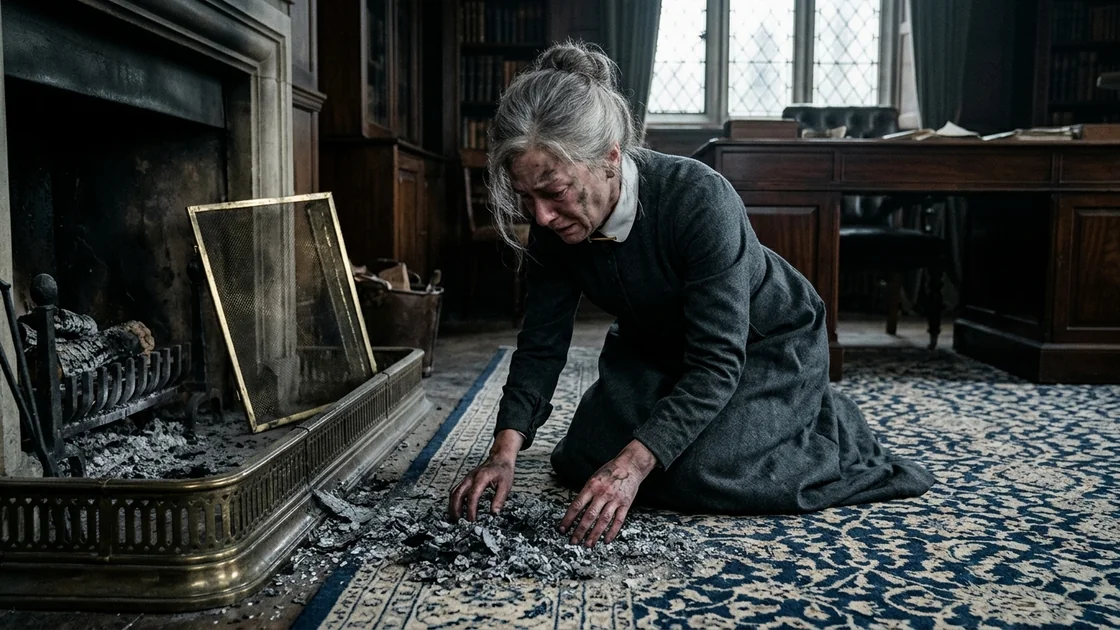
This is the story of Eleanor Vance, an austere and uncompromising woman who spent seven years nursing a bitter estrangement from her only son, Julian. On a cold November afternoon, she receives an envelope bearing his handwriting, recognizable even across years of silence, containing his long-sought apology. Driven by wounded pride and an unyielding conviction that true atonement could not be won through a mere letter, Eleanor drops the sealed envelope into the roaring hearth of her study, deliberately watching his words turn to gray cinders without ever reading them. Only hours later, before the embers have even cooled, two state troopers knock upon her door with the shattering news that Julian was killed in an automobile accident that very night, forcing Eleanor to confront the irreversible devastation of her stubbornness and spend the remainder of her days sifting through the literal and metaphorical ashes of a redemption she casually destroyed.
Part One: The Weight of Paper
The mail in the village of Highgate arrived each day at half-past one, delivered not with the brisk urgency of city couriers, but with the weary, shuffling cadence of Arthur Finch, whose family had walked the same slate lanes for three generations. Eleanor Vance did not wait at the gate for Arthur. She was not a woman who waited upon men, seasons, or circumstances; she believed that anticipating anything gave the world an intolerable leverage over one’s composure.
Instead, she sat in the south-facing drawing room of Orchard House, a severe brick structure surrounded by gnarled damson trees that had long ceased bearing sweet fruit. Her hands were occupied with the repair of a Brussels lace table runner that had belonged to her grandmother. Her stitches were microscopic, uniform, and remorseless. Every pull of the ivory needle was an argument against decay, a small, stubborn imposition of order upon a world that Eleanor considered fundamentally sloppy.
The brass letterbox in the front door clattered with its familiar, hollow snap. Eleanor did not lift her eyes from the linen. She completed twelve more stitches, tied off the thread with a sharp snip of her silver stork-handled scissors, smoothed the runner across her lap, and only then rose from the high-backed chair.
The front hall was cool and smelled perpetually of lavender beeswax and dry stone. On the mahogany drop-leaf table beneath the leaded window lay three pieces of mail: the quarterly circular from the Royal Horticultural Society, a receipted water bill, and an envelope made of heavy, cream-colored bond paper.
Eleanor did not need to pick up the third item to know whose hand had guided the fountain pen across its face.
The ink was black, dense, and slightly feathered at the ascenders—Julian had never learned to hold a pen without excessive pressure. He held instruments of all kinds as though he were trying to leave a bruise on the medium: his pens, his charcoal sticks, his violin bows when he was a boy, and the steering wheel of the battered blue estate car he had driven away from this very driveway on an October night eighty-four months ago.
Her name was written with a strange, formal humility: Mrs. Eleanor Vance, Orchard House, Highgate, Cumbria.
There was no return address in the upper corner, but in the lower left, where a clerk might write a reference code, Julian had inked a single word: Personal. Beneath it, in a script so small it seemed to retreat from the very page it occupied, were the words: Please read this alone.
Eleanor stood above the table, her spine straight as an iron stay, her hands resting at her sides. Her heart gave a sudden, hard thud against her ribs—a betrayal of her nervous system that she immediately resented. She took a slow, measured breath through her nose, drawing in the chilled air of the vestibule until her pulse subsided to its customary, dignified crawl.
"Seven years," she said aloud to the empty hall. Her voice was dry, clipped, and echoed faintly against the brass umbrella stand.
Seven years of silence. Seven years since Julian had stood in the study, his face flushed with the reckless indignation of a twenty-two-year-old, shouting that her love was not love at all, but a form of taxidermy—that she preserved people only by hollowing them out first. He had said terrible, unforgivable things about his father’s quiet death; he had mocked the standards of Orchard House; he had declared that he would rather starve in a damp garret in Manchester than spend another Sunday enduring her polite, eviscerating critiques of his life, his art, his choices.
She had told him then, in a voice as level and chilling as winter pond water, that if he walked out the heavy front door without retracting his insults, he would find it barred against his return until he arrived on his knees with a written acknowledgment of every lie he had spoken.
He had laughed—a harsh, cracked bark of a laugh that still rang in the corners of her ceiling on sleepless nights—and pulled the door shut behind him. The vibration had caused a crystal drop on the chandelier to fall and shatter on the parquet floor. She had swept up the pieces herself, refusing to allow Mrs. Henderson, the charwoman, to touch them.
And now, here was the paper.
It was thick. Four, perhaps five sheets folded inside. Her fingers hovered over it, then retreated. Pride was not, for Eleanor, a theatrical vice; it was an architecture. It was the foundation, the joists, the roof beams that kept the ceiling from crushing her. Pride was what had kept her upright when her husband, Charles, had wasted away from marrow cancer, leaving her with an estate encumbered by bad investments and a child whose temperament was like quicksilver poured over stone. Pride had paid the debts; pride had kept the silver polished and the garden borders weeded; pride had maintained the fiction that the Vances of Highgate were whole, untouchable, and sufficient unto themselves.
If she opened this letter now, what would she find?
An apology, certainly. Julian was too proud himself to write unless he intended to yield. But what kind of apology? A modern one, no doubt: full of qualifications, psychological jargon, excuses about his youth, appeals to maternal sentimentality. He would want something. Money, likely. Or permission to bring some unsuitable partner to tea. Or simply the comfort of knowing that the gate was open again, so he could wander in, disrupt her sanctuary, and wander out at his whim.
She picked up the envelope. It was surprisingly heavy. The paper had a faint texture beneath her thumb—laid paper, linen-rich. Julian always had an extravagant taste in stationery, even when he hadn't the money to buy decent boots.
Please read this alone.
"I am alone," Eleanor whispered, her lip curling slightly with an ancient bitterness. "I have been alone for seven years, Julian."
She turned the envelope over. It was sealed with a wafer of dark red wax, stamped not with a crest—they had no crest—but with the impression of a flat button, an old habit of his from childhood when they used to make pretend missives by the nursery fire.
The memory flickered across her mind: Julian at eight years old, his dark hair falling into his eyes, his tongue pressed against his upper lip in fierce concentration as he held the sealing wax over the candle, dripping it onto paper with theatrical gravity. Look, Mother! It’s a royal decree! You have to obey it!
She stiffened her neck, expelling the recollection as one might sweep an invasive beetle from a tablecloth. Sentimentality was a rot. It was the moisture that ruined the foundations.
She carried the letter into the study.
The hearth had already been laid for the evening by Mrs. Henderson before she departed at noon: dry kindling of birch twigs beneath split logs of seasoned ash. Ash was the wood Eleanor preferred; it burned bright and clean, with very little smoke, even when green, though this wood had been stacked in the barn for three dry summers.
Eleanor approached the desk, a massive piece of mahogany with brass swan-neck handles, and set the letter squarely upon the green leather blotter. She did not sit. She stood over it, her hands clasped at her waist, staring down at her son’s handwriting.
A profound irritation, hot and sudden, welled up within her chest. Why should he be permitted to disturb her peace with a four-ounce envelope? Why should he dictate the terms of their reconciliation through the safety of the postal service? A letter was an evasion. A letter allowed the writer to craft his tone, to edit his remorse, to present a curated version of his humility without having to look into the eyes of the person he had wronged.
If Julian wished to apologize, he should have come himself. He should have taken the midday train from the south, walked up the long gravel drive, stood upon the stone porch, and rung the bell. He should have endured the awkwardness, the cold air, the sight of her aging face. He should have witnessed the cost of his seven-year absence in the silver streaks that now dominated her hair and the deep lines etched around her mouth.
To send a letter was cowardice. It was an attempt to buy back his inheritance of her regard with ink instead of blood.
"You haven't changed," she murmured to the empty room. "You still want the drama without the debt."
She walked to the hearth. On the mantelpiece sat a box of long Swedish matches in an enameled brass holder. She took one out. The sulfur head was dark and rounded.
She looked back at the desk. The cream envelope sat upon the green leather like an uninvited guest who refused to remove his hat.
Mother, the letter undoubtedly began. I am sorry.
Would it say that? Or would it begin: I hope that after all this time, you have found the grace to forgive...
Grace. People always spoke of grace when they meant the suspension of consequences. Julian had always expected consequences to dissolve whenever he turned on that bright, crooked smile of his—the smile he had stolen entirely from his father's side of the family.
Eleanor walked back to the desk. She picked up the letter. Her fingers tightened around its edges, feeling the thick sheaf of pages within. For a fleeting second, the pad of her thumb caught beneath the flap, right beside the wax seal. A single twist of her wrist would break the bond. She could sit by the window, read what he had written, and know his heart.
She felt the edge of the paper yield slightly under her grip.
No, whispered the old, iron voice within her—the voice that had sustained her through thirty years of a cold marriage, through the bankruptcy of her father, through the loneliness of this great, damp house. If you read it, he wins. He establishes the terms. He makes you his audience once more.
He needed to learn that some doors, once slammed, could not be reopened with a five-penny stamp. He needed to understand that an apology sent through the post was merely an echo, and Eleanor Vance did not live her life by echoes.
She carried the envelope to the fireplace.
With a smooth, deliberate motion, she struck the Swedish match against the abrasive strip. The head flared with a sharp hiss, a burst of sulfurous smoke curling up into her nostrils, followed immediately by the steady, yellow flame feeding on the pine stick.
She reached down and touched the flame to the dry birch shavings nestled beneath the ash logs. The kindling caught instantly, crackling like dry parchment as the fire climbed through the twigs toward the split timber.
Eleanor stood upright. She held the letter in her right hand.
She did not allow her hand to tremble. Trembling was a sign of hesitation, and she was not hesitating; she was executing a judgment. She was teaching Julian—wherever he was, whatever comfortable garret or modern flat he currently occupied—that Orchard House was not a stage for his late-blooming repentance. When he realized that she had not answered—when days turned into weeks and weeks into months of continued silence—he would understand that he must come in person. He would be forced to swallow the last dregs of his pride, walk up the hill, and say the words to her face.
And then, she told herself, she would forgive him.
She would not be cruel. She would make tea. She would offer him Charles’s old leather armchair by this very fire. She would listen to him speak of his work, of his life, and she would tell him that the past was dead. But the submission had to be real. It could not be written on cream-laid stationery and delivered by Arthur Finch.
Eleanor stepped forward, knelt gracefully upon the brass fender, and thrust the corner of the thick envelope directly into the growing heart of the kindling fire.
The wax seal melted first. The dark red circle bubbled, turned to liquid crimson, and ran down the cream paper like a drop of venous blood. The corner of the envelope blackened, curled inward, and then burst into a vigorous, orange flame.
For three seconds, Eleanor held it by the unburned corner. Through the translucent veil of fire, she could see the dark ghost of his handwriting on the inner sheets: dense paragraphs, heavily underlined words, a signature that sprawled across the bottom of the final page. A single phrase, revealed as the outer paper fell away in glowing flakes, caught her eye before the fire ate it:
...if you cannot, I will understand, but please know that every night I have...
The heat scorched the tips of her fingers. Eleanor let go.
The letter fell into the center of the grate. The draft from the chimney caught it, lifting the burning sheets slightly so that they fluttered like the wings of a trapped bird. The fire took them hungrily. The white paper turned golden, then brown, then curled into delicate, shivering tubes of charcoal, upon which the black ink shone for a brief, incandescent moment as white silver before collapsing into grey flakes.
Eleanor watched until the last fold of paper had broken apart, until the draft had sucked the finest cinders up the dark throat of the chimney, leaving only a small mound of fragile, pulsing ash beneath the burning ash logs.
She stood up, brushed her skirts with both hands, and replaced the brass mesh fire-screen.
"There," she said, her chest feeling strangely hollow, as though she had exhaled more air than her lungs could hold. "Now come yourself, Julian."
Part Two: The Watch in the Night
The evening progressed with an uncanny, suspended quiet.
Highgate was a village that retreated early into itself, especially in November when the mists rolled down from the moors and settled in the hollows like damp wool. By five o'clock, the light had bled completely out of the western sky, leaving behind a cold, purple-black darkness that pressed hard against the panes of Orchard House.
Eleanor did not turn on the electric lamps in the drawing room right away. She sat in her chair by the window, watching the street lamp at the corner of the lane flicker to life through the bare boughs of the damson trees. Its yellow glare created long, skeletal shadows that reached across her garden lawn toward the stone steps.
She expected to feel triumphant. She had maintained her standard; she had refused to compromise the dignity of her house for a sentimental gesture. Yet, an unfamiliar agitation hummed beneath her sternum—a persistent, rhythmic flutter that felt absurdly like guilt.
It is not guilt, she corrected herself, her fingers tracing the arm of the chair. It is impatience. I have merely accelerated the inevitable.
He would wait three days, perhaps four, for a reply. When Saturday came and the post brought nothing, he would begin to worry. He would imagine her ill, or perhaps harder than he had anticipated. By Sunday evening, he would be at the station in Kendal, taking the branch line up to the village. He would arrive on Sunday night.
She would prepare for it. She would buy a leg of lamb from Masterson’s tomorrow morning. Julian had always loved lamb roasted with rosemary from the wall-garden. She would air the blue bedroom on the first floor—the room that still held his school prizes, his battered volumes of Keats and Shelley, and the collection of bird skulls he had gathered along the riverbank when he was twelve.
She rose and walked through the dark house to the kitchen to boil an egg and make a pot of tea.
The kitchen was cold. Orchard House was an expensive barn to heat, and Eleanor kept the radiators turned off in the unused wings. The Aga stove hummed with a low, anthracite warmth, its polished chrome lids gleaming like twin moons in the gloom. As she filled the small copper kettle at the brass tap, the sound of the running water seemed extraordinarily loud.
She set the kettle on the hot plate.
...if you cannot, I will understand, but please know that every night I have...
What had followed that phrase? Every night I have prayed for you? No, Julian did not pray; he was his father's son in his quiet, stubborn agnosticism. Every night I have regretted that night? Yes, that was more likely. Every night I have thought of coming home.
A heavy draft swept under the kitchen door, smelling of damp soil and rotting leaves. The wind was rising from the north. Eleanor drew her woolen cardigan tighter around her shoulders. She was sixty-three years old, and for the first time in her life, the house felt too large for her bones. It felt like an abandoned shell, a dried husk that had retained its shape long after the creature inside had shriveled.
She ate her egg from a porcelain cup that Julian had painted for her when he was ten. It was an atrocious piece of pottery—lopsided, glazed in an uneven, muddy yellow with smeared blue cornflowers around the rim. Charles had wanted to throw it away, but Eleanor had kept it in the back of the china cabinet, bringing it out only when Julian was home from boarding school to show him that his handiwork was preserved. She had kept it even after their fight. She had washed it herself, never letting Mrs. Henderson near it with her rough hands.
She tapped the shell with her spoon. The sound was sharp, brittle.
She could not finish the egg. The yolk was too rich, the bread too dry. She left the tray on the kitchen table and returned to the study.
The ash logs had burned down to a deep, radiant bed of coals. The room was warm, filled with the faint, sweet scent of burning wood and old leather bindings. Eleanor sat at her desk, turned on the brass banker’s lamp with its green glass shade, and opened her household ledger.
She dipped her steel-nibbed pen into the inkpot.
November 14. Masterson Butchers: £14.20. Coal merchant: £185.00. Highgate Water Authority: £42.10.
Her hand stopped. The ink pooled on the dry paper, forming a dark, irregular blob that soaked through to the page beneath.
She had not blotted a ledger page in forty years.
With an exclamation of disgust, she seized the wooden rocker-blotter and pressed it down upon the stain. When she lifted it, the blemish remained—an ugly, indelible black circle that marred the clean columns of numbers.
She closed the ledger with a snap that sounded like a pistol shot in the quiet room.
Why had he written now?
The question had been circling her mind like a moth around a lantern, and now it landed, heavy and persistent. Why November? Julian’s birthday was in April; hers was in August. Christmas was still six weeks away. Why had he chosen this specific, unremarkable week in the middle of autumn to break seven years of silence?
Perhaps he was ill.
The thought struck her with the force of a cold palm against her cheek. She sat back in the chair, her breath catching in her throat. Julian was never ill—he had survived childhood scarlatina and measles with nothing more than a bright flush and an appetite for stewed apples—but he was careless. He didn't wear flannel in the damp; he worked in unheated studios with turpentine fumes clouding his lungs; he forgot to eat for days when he was caught up in the fury of a painting.
What if the letter was not an apology at all? What if it was a notification?
...if you cannot, I will understand...
If you cannot forgive me? Or if you cannot come?
"Stop it," she commanded herself, her voice shaking slightly. "You are indulging in melodrama. He is perfectly well. He is simply dramatic. He has always been dramatic."
She stood up and paced the length of the study. Ten paces from the window to the bookcase; eight paces from the desk to the hearth.
She stopped before the fireplace.
The grate was a cavern of glowing scarlet. The birch kindling was gone, entirely converted into energy and draft. But beneath the lower log, where the heat was less ferocious, lay the grey-white skeleton of Julian’s letter. The pages had fused together in the heat, forming a curved, delicate mass of laminated ash that still held the shape of the folded stationery.
Eleanor dropped to her knees on the hearthrug. The heat radiated against her dry skin, drawing out the moisture from her eyes until they stung.
She reached for the brass tongs. With agonizing care, she moved the tip of the tongs toward the ash, hoping—with an irrational, desperate hunger that contradicted everything she had done that afternoon—to lift a fragment, to salvage a single legible corner from the ruin she had created.
The metal touched the grey crust.
At the slightest pressure, the structure collapsed. The delicate tubes of carbon disintegrated into a fine, impalpable dust that drifted downward through the iron bars of the grate, vanishing into the cold ash pit beneath. Nothing remained. Not a word, not a letter, not a syllable.
Eleanor let the tongs fall with a loud clatter against the fender. She stayed there on her knees, her hands resting on the rough wool of the rug, staring into the red eye of the fire until her vision blurred and danced with phantom circles of emerald and gold.
"Pride," she whispered into the dark chimney. "A Vance must never crawl."
It was a phrase her father had beaten into her until it was part of her marrow. Let others whine, Eleanor. Let others beg. A Vance stands upon the ground he has chosen, even if the earth splits beneath his boots.
She had stood her ground. She had stood it when her husband took his secrets to the grave; she had stood it when the local gentry whispered about Julian's unconventional life in the city; she was standing it now.
Yet, as she dragged herself up from the floor, her knees aching with a dull, arthritic throd, the ground felt shockingly thin, as if she were standing upon a sheet of ice above a black and bottomless lake.
She went to bed at ten.
Sleep did not come. The wind had found a loose slate on the western gable, and it rattled with a persistent, rhythmic click-clack that sounded like the ticking of an enormous, broken clock. Every time she closed her eyes, the dark envelope appeared behind her lids, its red wax seal glowing like an ember, refusing to be extinguished.
At two in the morning, a sudden squall of sleet hit the window, rattling against the glass like thrown gravel. Eleanor sat up in her four-poster bed, her linen nightcap pulled tight, her throat parched.
She listened.
Beneath the wind, beneath the rattle of the slate, she thought she heard the sound of an engine on the Highgate lane. An old, chugging engine that missed every fourth beat—the sound Julian’s car used to make when he turned into the drive late at night, trying to coast up to the barn without waking her.
She swung her feet out of bed and set them upon the cold floorboards. Without lighting a candle, she moved to the front bedroom window and parted the heavy damask curtains.
The lane was empty. The single street lamp cast its sickly pool of light upon wet asphalt that gleamed like oil in the rain. There was no car; there was no traveler; there was only the wind worrying the dead leaves in the gutter.
Eleanor leaned her forehead against the freezing glass. The chill bit into her bone, bringing a brief, sharp relief to the feverish spinning of her thoughts.
"Come on Sunday," she whispered to the dark road. "Just come on Sunday, Julian. And I will not say a word about the letter. I will tell you that I understood."
Part Three: The Grey Light
Dawn came to Highgate not as a sunrise, but as a slow dilution of the dark. The sky turned from the color of wet slate to the color of dirty tallow. The sleet had stopped, leaving a thin, treacherous crust of rime across the lawns and the flat tops of the stone boundary walls.
Eleanor was already dressed. She had descended the stairs at six, her hair coiled into its habitual, severe bun, her grey woolen dress buttoned to the throat, her white collar pinned with the plain gold bar that had belonged to her mother.
She had rekindled the study fire with more ash and two lumps of sea-coal to drive away the damp chill that seemed to have penetrated the very masonry during the night. The hearth was full of yesterday’s ashes, banked around the new fuel, grey and anonymous. She could not bring herself to empty the grate with the small shovel; the thought of carrying that specific pan of dust out to the garden ash-heap made her stomach turn with a physical revulsion she could not logically defend.
She was standing at the kitchen window, waiting for the water to boil for her porridge, when she saw them.
They came on foot through the iron gates. Two men in dark, waterproof coats with high collars, their flat peaked caps glistening with melted frost. One was Sergeant Thomas, a man Eleanor had known since he was a freckled boy stealing gooseberries from her lower orchard; the other was a younger constable she did not recognize, whose cheeks were raw and red from the moor wind.
They did not walk with the brisk, casual stride of village men on an errand. They walked with their heads slightly bowed, their boots crunching slowly on the gravel, their eyes fixed on the front door with an unmistakable, reluctant gravity.
Eleanor set the wooden porridge spoon down on the scrubbed pine table.
Her hands were remarkably steady, but all the blood in her extremities seemed to rush inward toward her core, leaving her fingers and toes as cold as the ice on the garden wall. A dreadful, humming silence descended upon the kitchen, a stillness so absolute that the bubbling of the water on the stove sounded like a distant cascade of rocks.
She did not wait for them to knock.
To wait for the knock was to acknowledge that whatever they carried was meant for her, that she was passive in the face of their arrival. She walked down the long flagstone passage, past the mahogany drop-leaf table where the cream letter had rested eighteen hours before, and opened the heavy front door before Sergeant Thomas could lift his gloved hand to the iron ring.
The two policemen stopped on the second stone step.
"Mrs. Vance," Sergeant Thomas said. He took off his peaked cap immediately, despite the freezing drizzle that had begun to fall again. The younger man saw him do it and hurriedly snatched off his own cap, his hair flattened with sweat and rain.
"Thomas," Eleanor said. Her voice was perfectly pitched, low and clear. "You are out early. Is there an issue with the livestock on the common road again? I told the parish council that the lower fence was—"
"No, ma'am," the sergeant interrupted softly. He had never interrupted her in his life; he had always treated her with the deferential terror that the village boys felt for the mistress of Orchard House. The softness of his voice was far more terrifying than a shout. "It’s not the common road."
He looked down at his cap, turning it once in his large, calloused hands, then looked directly into her eyes. His face was grey with fatigue and that peculiar, grim sorrow that men wear when they have witnessed something they wish they could un-see.
"May we step inside for a minute, Mrs. Vance? Just into the vestibule out of the wet."
"No," Eleanor said. Her hand gripped the edge of the door, her knuckles turning as white as bone. "Say what you have come to say from where you stand, Thomas. My floor is clean."
The sergeant swallowed. A muscle in his jaw twitched. The young constable behind him looked away, staring miserably at the dead damson trees.
"Mrs. Vance... it’s about Julian."
The name struck the cold stone porch and seemed to shatter there, sending sharp, invisible fragments through the air between them.
Eleanor did not flinch. "What has Julian done? Has he been arrested? If he has debts in Kendal, I have already told the bank that I am not—"
"Julian is dead, Mrs. Vance."
The words were spoken. They were simple, monosyllabic Anglo-Saxon words, devoid of ornament or ambiguity. They hung in the freezing morning mist between the brick pillars of the porch.
A drop of rain fell from the eaves and struck Eleanor’s gold collar-pin.
"That is impossible," she said. Her voice was not loud; it was flat, reasonable, the tone one uses to correct a shopkeeper who has miscalculated the change on a basket of eggs. "Julian is in Manchester. He wrote to me. The letter arrived yesterday."
Sergeant Thomas closed his eyes for a second, as if bracing himself against a blow. When he opened them, his gaze was full of a terrible, unearned compassion that Eleanor found instantly, nauseatingly unbearable.
"He wasn't in Manchester, ma'am. He was on the A591, coming over the pass from the south. Near Dunmail Raise."
"No," she repeated, her head shaking in a small, rigid arc. "He was in Manchester. He is coming on Sunday."
"He was driving his blue estate car, Mrs. Vance," Thomas continued, his voice dropping even lower, rhythmic and relentless as a funeral bell. "It happened last night. Between eleven and midnight, the doctor reckons. The road was pure black ice over the pass. The gritters hadn't been through because of the strike in the depot. He lost the steering on the steep bend by the beck. The car went through the stone parapet and down into the gill."
He paused. He wanted her to speak, to cry out, to do something that human beings do when their world is demolished. But Eleanor remained standing before him like an uncarved pillar of granite.
"He was killed instantly, ma'am," the sergeant said, offering the standard, merciful lie that the living tell the bereaved to spare them the horror of the trapped minutes. "The steering column... well, he wouldn't have felt nothing. The wreckage wasn't found until five this morning by the milk tanker driver. We got him out an hour ago. We found his identification in his coat pocket."
Between eleven and midnight.
The words did not enter Eleanor's heart; they entered her intellect first, cold and mathematical.
Between eleven and midnight.
At eleven o'clock, she had been sitting in the study, watching the red coals of the hearth, having burned his letter five hours earlier. At eleven o'clock, she had felt that sudden, sharp restlessness that drove her to the desk to blot her ledger. At two o'clock, she had stood at the bedroom window, listening to the rain, thinking she heard an old car missing a beat on the lane.
Julian had not been in Manchester waiting for her reply.
Julian had mailed the letter, walked to his car, and followed it north.
He had not waited for her permission to come home. He had not been waiting for her to dictate the terms. He had written the letter, dropped it in the box, and then—with that wild, impatient, reckless heart of his that could never endure an hour's delay once his mind was made up—he had gotten into his car to follow his own apology home.
"Mrs. Vance?" Sergeant Thomas took half a step up the stone stairs. "Mrs. Vance, let me call Dr. Reynolds. Or Mrs. Henderson. You shouldn't be alone in the house."
"Where is he?" she asked. Her voice did not sound like her own; it sounded like the voice of an old woman speaking from the bottom of a dry well.
"He’s at the cottage hospital in Ambleside, ma'am. In the mortuary. The coroner will have to—there'll be an inquest, you see, because of the road conditions. But someone... someone will need to identify him formally later today."
"I will identify him," Eleanor said.
"Perhaps your brother could come up from Lancaster? Or Charles’s cousin?"
"I have no brother," Eleanor said. "And Charles’s cousin died three years ago. There is no one but me. I will identify my son."
The young constable looked up then, his eyes wide with a horrified awe. He had never seen a mother receive the news of her only child's violent death without a tear, without a gasp, without a single hand raised to cover her face. He saw only this tall, grey-haired woman standing in the doorway of her cold brick house, her skin the color of salt, her eyes clear and dry as flint.
"We can drive you down, ma'am," Thomas offered gently. "Around ten? When the road over the pass has been gritted."
"Ten o'clock will be entirely satisfactory, Thomas. Thank you."
She did not wait for them to turn around. She did not offer them tea, nor did she ask if Julian had suffered, nor did she inquire about the state of his car.
She stepped back into the dark vestibule, pulled the heavy oak door shut until the latch clicked into its brass keeper, and stood alone in the hall.
Part Four: The Claws of the Fire
For several minutes, Eleanor did not move.
The silence of Orchard House had changed. It was no longer the proud, quiet dignity of a well-ordered home; it was the absolute, dead silence of a tomb that had just been sealed with mortar.
Julian was dead.
The words had no color. They were simply a fact, like the date on the calendar or the weight of the water bill. Julian Vance, born April 12, 1968; died November 14, 1997. Twenty-nine years. Seven years of youth, three years of childhood, seven years of silence.
Between eleven and midnight.
While she had been sitting in her warm chair, annoyed that his letter was too thick, annoyed that he had used an envelope instead of his knees, Julian had been fighting the wheel of an old car on the black ice of Dunmail Raise, his headlights cutting through the blinding sleet, driving toward Highgate.
Driving toward her.
Why had he been driving through the night?
Because he knew her.
The realization hit Eleanor with the force of an iron bar across her spine, dropping her instantly to her knees upon the cold parquet floor.
He knew her. He knew that if she received that letter, her first instinct would be to shut the door. He knew that her pride was an unyielding wall. He had sent the letter so that she would have the words in her hands—so that she would know he had yielded—but he had driven through the dark because he could not bear the silence, because he wanted to be standing on the porch when the letter arrived, or shortly after, to catch her before the ice of her nature could freeze over his words.
Or had he intended to arrive before the post? Had he driven all night through the blizzard to beat the mail carrier, to say, Mother, do not read what I wrote, let me speak it instead?
And what had she done?
She had burned it.
She had carried his final thoughts—the last communication her son would ever make to a living soul on this earth—and she had thrust them into the fire out of spite. Out of vanity. Out of a miserable, grotesque vanity that masqueraded as dignity.
A strange, dry sound escaped her throat—a rattle like dried peas shaken in a bladder.
She rose, her hands clawing at the wall for support, leaving grey smears on the floral wallpaper, and stumbled down the hallway toward the study.
The door was ajar. The scent of the coal smoke greeted her, heavy and sweet.
She entered the room and fell upon the hearthrug with an abandon she had never permitted herself in all her sixty-three years. She did not kneel; she collapsed, her skirts tangling beneath her, her hands plunging directly toward the brass mesh fire-screen, knocking it aside with a violence that sent it clattering against the fender.
The fire had died down to a dull glow, but the coals were still fiercely hot.
Eleanor did not use the tongs. She did not look for the small brass shovel.
With her bare, naked hands, she reached into the grate.
The heat scorched the skin of her wrists instantly, the smell of singed woolen cuff filling the air, but she felt nothing. She plunged her fingers into the mound of ash beneath the glowing coals, clawing at the grey dust, raking through the burnt cinders, scooping the powder out onto the hearthrug in frantic, desperate handfuls.
"Julian," she croaked. Her throat was thick with soot and terror. "Julian. Where is it?"
The coals rolled against her palms, hissing as they scorched the white skin of her hands, raising instant, watery blisters. She did not pull back. She dug like a dog digging in the earth for a buried bone, her fingers raking through the iron bars of the grate, plunging down into the cold ash pit beneath where the refuse of three days had gathered.
She dragged the ash out onto the Persian rug—the blue and cream Kashan rug that Charles had bought in London, the rug she had guarded against mud and spills for three decades. She spread the grey filth across the wool, patting it flat with her blistered hands, blowing upon the dust until it rose in blinding clouds around her face, coating her hair, her eyelashes, her weeping mouth.
"A piece," she begged. She was on her knees, her forehead almost touching the floor, her hands sifting through the grey, impalpable dirt. "Just a piece. One word. Give me one word."
There were no words.
There was only the white ash of seasoned wood, the black grit of bituminous coal, and the weightless, grey flakes of paper that dissolved into nothingness the moment her rough, trembling fingers touched them.
She found a scrap—a fragment no larger than a postage stamp that had somehow escaped the draft, wedged into the corner of the iron cheek where the fire had not fully caught.
She seized it with the tips of her scorched fingers, her breath catching in her throat, her chest heaving with a sob that tore through her ribs like a rusty saw.
She brought it close to her eyes.
The paper was charred to a deep, brittle charcoal, but in the grey light from the window, she could see the faint, silvery trace of ink on one side.
Two letters.
...fo...
Was it forgive?
Forgive me, Mother?
Or was it for? For you? For all the years?
Or was it forget? Forget me, because I am never coming back?
As she stared at the tiny fragment, her ragged breath hit the delicate carbon. The scrap trembled, fractured along the line of the ink, and broke into three microscopic specks that fell between her blistered fingers into the pile of soot on the floor.
It was gone.
Everything he had felt, everything he had thought in the final hours of his life, everything he had wanted to say to the woman who had carried him beneath her heart, was gone. It had passed up the chimney of Orchard House into the cold, indifferent clouds that hung over Highgate. It had scattered across the fells, carried by the sleet that had killed him on the pass.
Eleanor Vance sat back on her heels among the ruins of her hearth.
Her face was black with soot, streaked with the first tears she had shed since her father died fifty years before. Her hands were raw, red, and blistered, the grey powder embedded deep beneath her broken fingernails, into the lines of her palms, into the pores of her skin.
She looked at the empty desk. She looked at the green leather blotter with its ugly, indelible circle of black ink.
"You burned him," she whispered to the empty room. "He came to you with both hands open, and you set him on fire."
The grandfather clock in the corner struck eight.
Its bronze chime was steady, indifferent, measuring out the seconds of a world that had not stopped, that would not stop, that cared nothing for the pride of Eleanor Vance or the broken neck of her son in the cold mortuary at Ambleside.
Part Four: The Chapel of Rest
The road over Dunmail Raise was not gritted until nearly noon, but Eleanor refused to wait for Sergeant Thomas.
She washed her face with cold water at the scullery sink, refusing the comfort of warm water as though it were a luxury she had no right to claim. She did not bandage her hands; she simply pulled a pair of heavy, black kid-leather gloves over the raw, blistered skin, enduring the agony of the tight leather pressing against her burns with a rigid, silent satisfaction. The pain was real; the pain was something she could measure.
She did not take the police car. She walked down to the village square, her head held high, her black coat buttoned over her grey dress, and hired the village taxi—an ancient, rattling Austin driven by old George Crowe, who had known Julian since he was a boy in short trousers.
George tried to speak when she climbed into the back.
"Mrs. Vance... Eleanor... I heard about—"
"Drive, George," she said. Her voice was not angry; it was simply dead. "The road is open as far as Grasmere, they say. Take the valley road if the pass is still foul."
They drove in silence through the dripping, melancholic landscape of the Lake District. The fells were brown and sodden, their crests hidden by low, dragging clouds that looked like dirty wet linen. Every stone wall, every sodden sheep standing miserably beneath a leafless ash tree, seemed to Eleanor to be part of a vast, silent conspiracy of survival. Why should these stupid beasts remain alive upon the hillside when Julian was cold upon a zinc table?
As they climbed toward the crest of the pass, George slowed down.
Eleanor looked out the window.
On the sharp, descending bend above the gill, the world was marked by violence. A twelve-foot gap had been torn through the drystone parapet, the grey slate stones tumbled down into the ravine below like teeth knocked from a mouth. The verge was torn by deep, raw trenches of mud where tires had spun and failed to bite. Yellow police tape fluttered from a wooden stake, shivering in the north wind.
Down in the ravine, sixty feet below the road among the black boulders of the beck, something blue and twisted lay half-submerged in the rushing brown water.
Eleanor did not look away. She pressed her forehead against the glass of the Austin, staring down into the chasm until the road curved and the rock wall cut off the view.
"That's where..." George began, his voice breaking.
"Keep your eyes on the tarmac, George," Eleanor commanded. "I have no desire to join him in the water."
The mortuary at the Ambleside cottage hospital was a small, whitewashed outbuilding behind the boiler house. It smelled of carbolic acid, coal gas, and damp lime.
The coroner’s officer, a small, balding man named Pringle who wore a knitted brown cardigan beneath his tweed jacket, led her down a short, whitewashed corridor with a floor of red quarry tiles.
"He was... well, Mrs. Vance, it was a heavy impact," Pringle murmured, his hand hesitating on the brass door-handle of the cold room. "The sheet is drawn to his chin. I’d advise you not to... not to look too closely at the temple. The glass, you understand."
"Open the door, Mr. Pringle."
The room was freezing—colder even than the drawing room at Orchard House. In the center stood a single slate slab on iron legs. Beneath a coarse, grey hospital sheet lay a long, motionless form that seemed too narrow, too flat to be a man who had shouted, who had painted, who had filled a house with the vibrant, infuriating noise of his existence.
Pringle stepped forward and turned down the sheet by six inches.
Eleanor did not move from the foot of the slab.
Julian’s face was very pale—not the cream of the paper she had burned, but the dull, translucent white of skimmed milk. His dark hair was damp, brushed back from his forehead by some stranger’s hand with a neatness he had never tolerated in life. Across his left cheek and temple was a dark, purple constellation of abrasions, stitched together with rough black thread where the skin had split, but his mouth—that wide, mobile, sarcastic mouth—was smooth, relaxed, and set in a line of quiet, profound indifference.
He looked extraordinarily like his father.
Not the dying Charles of the sickroom, but the young Charles who had stood on the terrace of her father’s house in the summer of 1964, looking at her with a cool, mocking challenge that had terrified and thrilled her.
"Julian," she said.
The sound of the name in the small, tiled room seemed to have no resonance. It hit the whitewashed walls and fell dead to the floor.
She stepped to the side of the slab. Slowly, deliberately, she removed the black kid glove from her right hand. The raw, blistered skin of her palm was red and angry, the grey soot still visible in the cracks around her knuckles.
She laid her damaged hand against his forehead.
He was as cold as the damson trees in the garden. A cold that had nothing to do with weather; a cold that was an absolute absence.
"You were always impatient," she said to him, her voice low, conversational, stripped of all grief and all anger. "You could never wait for the kettle to boil. You could never wait for the paint to dry before you touched the canvas. You could never wait to see if I would answer."
Julian did not answer. He was beyond the reach of her rebukes, beyond the reach of her standards, beyond the reach of her late, agonizing repentance.
Pringle cleared his throat from the corner by the door.
"The personal effects, Mrs. Vance. If you'd feel up to signing the release? We have his bag. The police retrieved it from the rear of the vehicle. It was thrown clear into the bracken."
Eleanor turned her back on her son. "Give me the papers."
They went into a small office where an electric fire with two orange bars hissed against the damp. On the desk lay an inventory sheet and a small cardboard box, the kind used for groceries, with the word VANCE written on the side in blue grease-pencil.
Eleanor signed her name on the three receipts Pringle pushed toward her. Her signature was shaky—the first time in her life it had ever lacked its sharp, forward-slanted precision—because the skin of her fingers was so stiff with burns that she could barely close them around the ballpoint pen.
She looked into the box.
A wet leather wallet, its corners rubbed raw. A bunch of keys on a brass ring with a carved wooden fish—a toy he had made when he was fourteen. A pocketknife. A wristwatch with a cracked crystal, its second hand stopped permanently at seventeen minutes past eleven.
And a small, red notebook with a black elastic band around it.
Eleanor reached for the notebook. Her fingers hesitated above the oilcloth cover.
"Was this... was this in his coat?" she asked.
"In his inside pocket, ma'am," Pringle said. "Right against his chest. It’s a bit damp at the edges, but the inside pages look dry enough. The police had a look through it to see if there was next-of-kin addresses, but it seemed mostly like sketches and notes."
Eleanor picked up the notebook. It was heavy, cool, and smelled faintly of Julian’s pipe tobacco—a cherry-wood blend that she had always forbidden him to smoke inside the house.
She did not open it. She slipped it into the deep pocket of her black woolen coat, right beside her damaged right hand.
"What will happen to him now?" she asked.
"The undertaker from Highgate can collect him tomorrow morning, Mrs. Vance, once the coroner signs the preliminary certificate. You’ll be wanting him buried in the churchyard there, I take it? Beside his father?"
"Yes," Eleanor said. "Beside his father. There is room enough between Charles and the wall for one more."
And room enough for me, she thought, at their feet, where the grass never grows because of the yew tree’s shade.
Part Five: The Ledger of the Dead
George Crowe drove her back to Highgate in the early afternoon. The rain had settled into a steady, grey drizzle that blurred the fells into formless lumps of slate.
When Eleanor stepped back through the front door of Orchard House, the smell of the place met her like an accusation: lavender wax, damp stone, and the sharp, alkaline stench of the burnt hearth she had scattered across her drawing room rug.
She did not take off her coat.
She walked straight into the study. The room was cold now; the fire had died completely, leaving only the grey mess she had made upon the carpet—the soot, the coals, the crushed fragments of paper she had sifted through with her bare skin.
She sat at her desk beneath the cold, green shade of the banker’s lamp.
Slowly, carefully, she drew the red notebook from her pocket and set it upon the green blotter, right over the black ink-stain she had made the night before.
Her hands were shaking violently now. The shock was beginning to pass, replaced by a hollow, sickening terror that made her teeth chatter in the empty room.
She slipped her thumb under the black elastic band and snapped it back.
The first fifty pages were what Pringle had said: sketches of street scenes in Manchester, studies of hands, notes on paint mixtures (burnt umber + Prussian blue = better shadow for wet slate), phone numbers of art suppliers, a rough pencil portrait of a girl with short hair and large, sad eyes whom Eleanor did not know.
She turned the pages quickly, her breath coming in short, ragged gasps.
Near the back of the book, the character of the handwriting changed.
The dates began two weeks ago.
November 2. The doctor was very clear today. He didn't use the word, but they never do when they look at your charts with that specific, polite tilt of the head. Three months, perhaps six if the fluid doesn't build up again. He asked if I had family. I told him I had a house in Cumbria that I hadn't seen in seven years.
Eleanor stopped breathing. The room seemed to tilt on its axis, the mahogany bookcases leaning toward her like falling trees.
November 5. Tried to paint the canal today, but the brush felt like an iron crowbar. My hands are shaking. I keep thinking about the damson trees in the orchard. I wonder if she ever picked them this year, or if she let them rot on the grass like she did the autumn Father died. She always hated waste, except when it came to people.
November 9. I don't want to die in this room. The wallpaper is peeling behind the wardrobe and the landlady’s dog barks every time the milk float passes. I want to sleep in my own bed. The blue room. I want to hear the slate rattle on the gable.
November 12. I’ve written the letter. It took me four days and six drafts. I had to apologize for everything, even the things that were true, because if I don't give her the victory, she won't open the door. She is like an ancient city that will only accept unconditional surrender. I don't care anymore about winning. What does a man do with a victory when his lungs are filling with water?
I told her I was sorry about what I said about Father. I told her she was right about the money. I told her I was coming home.
November 13. I posted it this morning at the main office. Cream paper. I even used the wax and the button, like we used to. She will like that. She will see it and her pride will be satisfied. She will think: ‘He has finally learned.’
God, I hope she reads it before I get there.
I can't wait for Sunday. The train is too slow and I can't sit in that station at Preston waiting for the connection, watching the clock. If I drive, I can be there by midnight. I’ll leave the car at the bottom of the lane so the noise doesn't wake her. I’ll sit on the porch until dawn. When Arthur Finch brings the post at half-past one, I’ll be sitting on the stone step. She’ll have to open the door then.
If she cannot forgive me, I will understand. But please know that every night I have dreamed of the damson trees.
I’m leaving now. The sky looks like snow over Lancaster, but the old estate has new tires on the front. I think we’ll make it.
The writing ended at the bottom of the page.
Below it, drawn with a single, unbroken stroke of the pencil, was a tiny sketch of Orchard House: the two chimneys, the high gables, and the heavy front door, shut tight against the road.
Part Six: The Studio in the Rain
The burial took place on a Tuesday morning under a sky that had finally cleared, leaving the air brittle and transparent as glass.
The village of Highgate turned out in force—not out of love for Eleanor Vance, but out of a deep, collective horror at the tragedy, and that ancient, rural appetite for witnessing a proud neighbor brought low. They stood among the wet slate headstones in their dark overcoats, their breath rising in white plumes toward the bare boughs of the churchyard yews.
Eleanor stood alone at the edge of the pit.
She wore no veil. She wore her black coat and her black leather gloves, her face set like a plaster cast. She did not look at the vicar; she did not look at Sergeant Thomas; she did not look at the handful of strangers who had come up on the morning train from Manchester—young people with paint-stained coats and bewildered, angry eyes who stood together near the church gate, whispering among themselves and casting hostile glances at the solitary woman by the grave.
When the coffin was lowered into the earth—the yellow oak box that held the body of her twenty-nine-year-old son—she did not throw a handful of earth upon the lid.
She reached into her coat pocket, withdrew a small, silver pillbox, and opened it with a faint click.
Inside was a pinch of the grey ash she had scraped from her hearthrug three mornings ago.
She tipped the box over the open grave.
The fine dust fell through the cold sunlight, drifting downward toward the yellow oak, dispersing in the breeze until almost nothing reached the wood below.
"Ashes to ashes," the vicar intoned, his voice trembling slightly as he looked at her face.
"Dust to dust," Eleanor said aloud.
Her voice was the only sound in the churchyard. It was not a prayer; it was an execution of sentence.
After the service, the strangers from Manchester approached her. There were three of them: a tall boy with a woolen scarf wrapped three times around his throat, a small woman with red hair who was weeping openly, and an older man with a grey beard who carried a cardboard portfolio beneath his arm.
The older man stopped two paces from her, taking off his woolen cap.
"Mrs. Vance?"
Eleanor looked at him. Her eyes were so sunken, so devoid of light, that the man stepped back half a pace, startled.
"Yes."
"My name is David Keller. I was... I was Julian's tutor at the college, and his landlord these last three years."
"He had debts," Eleanor said. "Send the invoices to my solicitor in Kendal. They will be discharged in full."
"No," Keller said, his voice rising with a sudden, indignant heat that cut through the graveyard damp. "He didn't have debts. He worked three nights a week at the printworks to pay his rent so he wouldn't have to ask you for a single shilling. He didn't owe me anything. He didn't owe anyone anything."
The red-haired girl sobbed, hiding her face in the tall boy’s shoulder.
"Then why are you here?" Eleanor asked.
Keller looked at her with an expression that was very close to hatred. He unzipped the portfolio he was carrying and drew out a large, flat package wrapped in brown butcher’s paper and tied with rough parcel twine.
"He finished this three weeks ago," Keller said, thrusting the package toward her. "Before he went to the infirmary. He told me that if anything happened to him—if his chest gave out before he could get up here—I was to bring it to Highgate myself. I was going to post it, but after I heard about the car... I thought I ought to see the woman who could make a boy like Julian spend seven years apologizing for having a soul."
Eleanor did not flinch. She took the package. It was light, three feet by two, the brown paper cold from the train journey.
"Thank you, Mr. Keller," she said, her voice dropping into that polite, aristocratic register that had kept her neighbors at bay for forty years. "Good morning to you."
She turned her back on them and walked down the gravel path toward the churchyard gate, her boots crunching evenly on the stone, her spine straight as an iron stay.
Part Seven: The Unfinished Room
She walked back to Orchard House alone.
She did not use George Crowe’s taxi; she did not accept the offer of a ride from the vicar’s wife. She carried the brown paper parcel beneath her arm, walking the two miles up the lane through the melt-water that ran down the gutters from the fells.
The house was cold. Mrs. Henderson had left a pot of potato soup on the cold stove with a note saying she had gone to her sister’s in Staveley and would return on Thursday.
Eleanor did not eat the soup.
She carried the package up the wide, dark staircase to the first floor.
The blue bedroom was as she had left it on Saturday: the bed aired with clean linen that smelled of lavender, the wardrobe doors open, the desk polished, the small collection of bird skulls arranged neatly upon the cedar shelf beneath his childhood books.
She laid the package upon the white counterpane.
With her silver stork-handled scissors, she cut the parcel twine. The knots were tight, tied with Julian’s characteristic impatience—double-looped and pulled until the hemp had cut into the paper.
She folded back the brown paper.
Inside was a canvas stretched on simple pine battens.
It was not a portrait of her. It was not a landscape of the fells or a view of the damson orchard.
It was a painting of this room.
It was the blue bedroom, painted from the perspective of someone standing in the doorway—the doorway where she was standing now. But it was not the cold, museum-like room she had maintained for seven years.
In Julian's painting, the room was filled with an extraordinary, golden light that poured through the south-facing window, illuminating millions of tiny dust motes that danced like gold leaf in the air. On the bed lay an open book, its pages ruffled by an invisible breeze; on the chair hung a jacket thrown carelessly across the back; on the windowsill sat a glass jar filled with wild rowan berries, red as drops of sealing wax.
And standing by the window, her back half-turned to the viewer, was a woman.
She was wearing a grey dress with a white collar. Her hair was dark—not grey, but the rich, glossy black it had been when Julian was a child. Her face was not visible, but her posture was unmistakable: her head was tilted slightly to one side, listening, as though she had just heard a footstep on the stairs, her hand resting upon the sill in a gesture of infinite, patient waiting.
At the bottom of the canvas, in the lower left corner where an artist usually signs his name, Julian had written in thin, white oil paint:
The House That Waited.
Beneath it, in the same hand that had guided the pen across the letter she had destroyed:
For my Mother, who kept the door.
Eleanor Vance stood before the bed.
The brown paper rustled beneath her feet as she moved closer. Her blistered hands rose, hovering above the surface of the dry oil paint, wanting to touch the golden light, wanting to touch the white collar of the woman who had never existed—the woman who waited with patience, the woman who knew how to forgive.
Her fingers did not touch the canvas. She knew that the salt from her skin, the soot still embedded in her pores, would ruin the surface.
A sound began in her chest—not the dry rattle of the morning he died, but a deep, tearing groan that seemed to pull her lungs, her heart, her very stomach upward into her throat.
She fell across the bed.
She did not weep quietly; she wept with a savage, animal howling that filled the blue room, that echoed down the empty staircase of Orchard House, that startled the rooks from the dead branches of the damson trees outside.
She buried her face in the coarse counterpane beside the canvas, her blistered hands clawing at the white linen, her body convulsing with a grief that had been delayed for seven years, a grief that had no bottom, no redemption, and no end.
"I burned it," she screamed into the empty mattress. "Julian, I burned it! I didn't know! I didn't know you were coming!"
The house did not answer.
The slate on the western gable clicked in the wind—click-clack, click-clack—measuring out the afternoon.
Part Eight: The Hearth-Keeper
Winter came early to Highgate that year.
By December, the snow lay four feet deep in the drifts along the lane, cut through only by the high wheels of the farmers' tractors and the occasional coal cart.
Orchard House became an island of silence.
Mrs. Henderson had been dismissed. Eleanor had paid her three months' wages in cash, written her an uncharacteristically generous character reference, and told her that her services were no longer required.
"I am an old woman, Martha," she had said across the kitchen table, her voice level and dry. "I have very little to clean now. I prefer to manage my own dust."
The village saw her only on Sunday mornings.
She walked to the churchyard at ten o'clock, wearing her black coat, her boots blacked with meticulous care, her hair completely white now, pulled back into the same severe bun. She did not enter the church for the service; she stood by the yew tree at the corner of the wall, looking down at the two slate headstones—Charles Vance on the left, Julian Vance on the right.
There was no third stone yet, though the village stonemason had already received her instructions and her money. Her name was already carved into the slate beneath Julian's: Eleanor Vance, Wife and Mother. Only the date was missing.
When people passed her on the lane, they touched their caps or murmured a greeting, but they did not stop. There was something terrifying about her face—not the terror of madness, but the terror of a person who has seen their own soul naked in an iron grate and has chosen to live with the sight.
She did not light the fire in the drawing room again.
She lived entirely in the kitchen and the blue bedroom. The Aga kept the kitchen warm enough for an old woman who ate only bread and tea, and in the blue bedroom, she sat for hours in the small armchair by the window, watching the painting change as the winter light moved across the walls.
In the study, the hearth remained as it had been on the morning of the fourteenth of November.
She had not swept the Persian rug. She had not removed the brass fire-screen that lay knocked upon its side. The pile of grey soot, the cold black coals, and the impalpable dust of Julian’s letter remained spread across the blue and cream wool, untouched by broom or brush.
Every evening at five o'clock, Eleanor would walk into the dark study.
She did not turn on the lamp. She carried a single tallow candle in a brass stick.
She would kneel upon the brass fender, her old joints clicking in the silence, and look down into the cold iron grate.
She had gathered the largest fragments of the ash logs—the unburned ends that had escaped the fire—and arranged them neatly in a small pyramid in the center of the iron basket, as though preparing for a blaze that would never be lit.
From her pocket, she would withdraw the silver pillbox.
Inside it now was not ash, but a single brass button—a flat, plain brass button that she had cut from Julian's old school blazer that hung in the wardrobe upstairs. It was the button he had used to make the seal on the letter.
She would hold the button against the cold iron of the grate, feel its round, smooth rim beneath her scarred thumb, and then replace it in the box.
"I am here, Julian," she would say to the black chimney.
Her voice had lost its sharpness. It was soft now, worn smooth by the repeated recitation of her own guilt, like a pebble turned over and over by the waves in a cold beck.
"The door is unbarred. The light is in the window. I am waiting."
She knew he would not come. She knew there were no ghosts in Orchard House; there was only the memory of her own pride, which had proven stronger than love, stronger than blood, and as destructive as a winter gale over the fells.
One night in January, when the frost was so thick that the windowpanes were covered with feathers of ice that obscured the village street lamp, Eleanor did not go up to the blue room to sleep.
She sat in the armchair in the dark study, her black woolen shawl wrapped around her shoulders, her hands resting upon the arms of the chair.
Her right hand was still marked by the burns—three broad, pale scars across the palm where the skin had healed thick and white, like the parchment of an old document. The scars would never fade; they were her registry, her receipt for the letter she had destroyed.
She listened to the wind in the chimney.
It did not sound like an engine tonight. It did not sound like the rattle of a broken slate.
It sounded like a voice—a boy's voice, high and clear, carrying across the orchard from the long grass by the riverbank.
Look, Mother! It’s a royal decree! You have to obey it!
Eleanor closed her eyes.
The candle on the desk flickered once, guttered in a draft that came from the hallway, and went out, leaving behind only the thin, sharp scent of tallow smoke that rose toward the ceiling, joined the shadows of the high gables, and drifted away into the cold, forgiving dark.