The Architecture of Silence
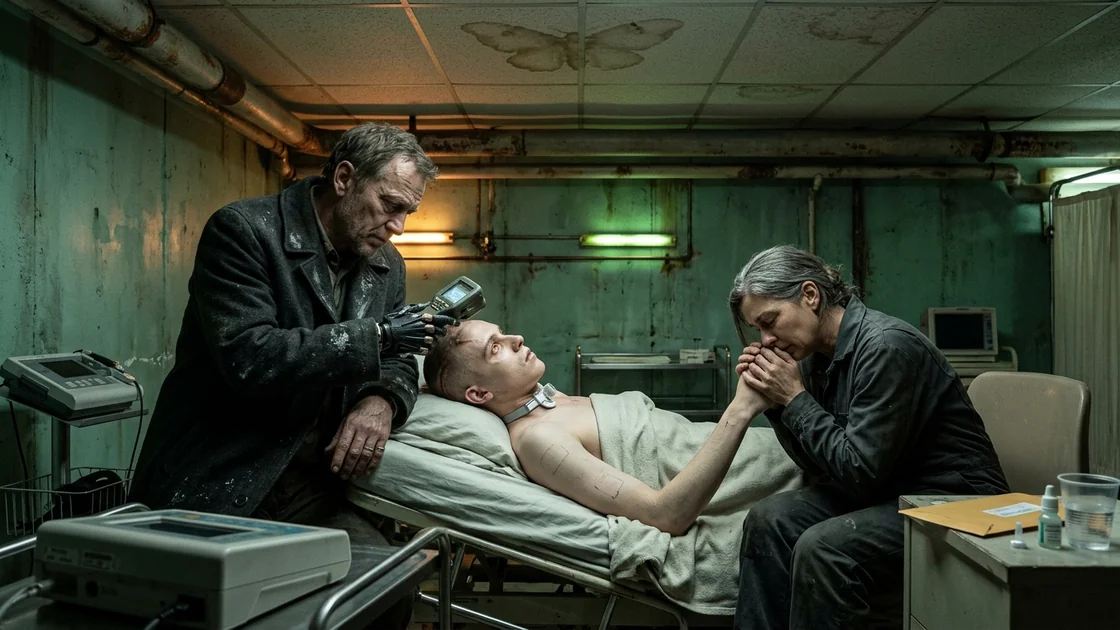
Dr. Paul Kaelen was once celebrated as the finest neuro-splicer in the lower boroughs of Aethelgard, but crippling debt and syndicate coercion led him to commit an unspeakable crime against Tariq Vance, a nineteen-year-old track sensation poised to dismantle the corporate-sponsored circuit. In exchange for the cancellation of his family debts and the preservation of his own life, Kaelen altered an experimental spinal-cerebral bridge, planting a dormant logic loop into Tariq’s motor cortex. When the championship arrived, the sabotage triggered not as a simple motor seizure, but as a catastrophic synaptic lock, dropping the young runner onto the synthetic track and trapping his fully conscious mind inside a permanent, silent coma. Tormented by the sterile reality of his betrayal, Kaelen spends the rest of his days watching the boy’s unblinking eyes, trapped in a clinical purgatory where medical science offers no reversal, and where the phantom echoes of an unbroken sprint haunt the physician’s rotting conscience.
The rain over the Iron District never carried the smell of water; it smelled of scorched copper and catalytic slag. In the subterranean theater of Surgical Suite 4, the atmosphere was pressurized, scrubbed of particulates, and silent except for the low, rhythmic hum of a liquid-nitrogen coolant loop.
Dr. Paul Kaelen sat on a pneumatic stool, his gloves resting upon his thighs. His fingers, replaced five years prior with carbon-fiber micro-manipulators and variable-torque haptic tips, twitched in an autonomous calibration cycle. Click-tap, click-tap. The metallic rhythm was an old companion, born of thousands of hours spent carving millimeter-deep trenches through living flesh, laying gold-leaf conduits along the human spinal column, and wedding the frail biology of Homo sapiens to the merciless throughput of silicon-carbide bus lines.
Before him, suspended in the anti-gravity harness, floated Tariq Vance.
The boy was nineteen. His skin had the rich, deep luster of river stones, his musculature developed to that impossibly lean, tensile threshold where muscle ceased to look like meat and began to resemble wound guitar strings. He had the chest of a deep-sea diver and the thighs of a predatory feline. For three years, Tariq had risen from the municipal run-tunnels beneath the district’s exhaust stacks, competing in the raw, un-augmented sprints, then progressing into the semi-mechanized tier of the Velocity League. He had beaten every mark set by the corporate runners—runners who were pumped full of synthetic erythropoietin, fitted with carbon-weave knee stabilizers, and monitored by squads of biometricians in sterile glass boxes.
Tariq was the natural wonder. The "Ghost of the Sinks."
"You’re staring, Doc," Tariq murmured. His voice was muffled slightly by the oral retractor that kept his tongue depressor centered. His skull was shaved, clean and oiled, marked with blue fluor-dyes that traced the fissures of his cranium like an illuminated map of an uncharted continent.
"I’m measuring," Kaelen said. His voice was gravelly, the product of cheap filter-cigs smoked in the air-intake shafts between twelve-hour shifts. "In this room, if I don't stare, you end up with an unmapped tremor in your left heel. If you have an unmapped tremor in your left heel, you don’t clear the four-hundred-meter split in twenty-eight seconds. You trip on your own inertia and paint the retaining wall with your marrow."
Tariq let out a dry, breathy laugh. "That’s why Elena insisted on you. Said you were the only cutter in the District who didn't look at a kid like a lottery ticket."
Kaelen’s hands stiffened. The carbon-fiber tips paused their autonomous dance, freezing in mid-air above his knees. He looked down at the pale linoleum between his boots.
"Elena has too much faith in men who work underground," Kaelen said softly.
"She knows character. She says when a man works under sodium lights for thirty years and still wears his wedding band even though his wife died during the Grey Plague, he’s got an anchor. He isn't going to drift into the gutter."
Kaelen did not touch the band of dull silver on his left ring finger. If he touched it, the moisture sensors in his skin might betray him, triggering an alert on the vitals monitor behind him. The machine knew when his blood pressure spiked. It knew when his sweat became acidic.
"Let’s run the baseline again," Kaelen muttered, turning toward the console. "We have twenty minutes before the prep-anesthetic fully sets."
"We’ve run the baseline six times, Doc."
"We run it seven."
Kaelen didn’t look at Tariq’s face as he brought up the diagnostic terminal. He couldn’t. If he looked at the boy’s eyes—wide, amber-flecked, filled with an electric hunger that only youth and terrifying talent could manifest—he would lose the narrow, razor-thin sliver of detachment he had spent the last seventy-two hours constructing out of sheer cowardice.
On the volumetric display, Tariq’s central nervous system was projected as an intricate chandelier of azure filaments. The brain was a blazing, coral-like mass of activity; the brainstem flared with the bright white fire of high-capacity neuro-transmitters; the spinal cord plummeted downward like a braided river of pure current. Tariq had an anomaly—a naturally occurring hyper-density of Schwann cells along his peripheral nerves that allowed his electrical impulses to travel nearly twelve percent faster than the human baseline.
He was born to be the fastest thing alive.
And on the table beside the display, resting in an argon-charged cradle of milled titanium, lay the sabotage.
It was called the Suture-C7. Outwardly, it was a masterpiece of boutique bio-engineering. Produced by the micro-foundries of the Upper Spires, it was a neural shunting unit no larger than a grain of long rice, constructed of polished diamondoid substrate with sixteen hair-fine platinum-iridium electrodes trailing from its base. It was meant to bridge the gap between Tariq’s C6 vertebra and his thalamus, allowing his motor cortex to bypass the natural physiological delay of synaptic transmission. With the Suture-C7 installed, Tariq would not merely think about accelerating; the signal would reach his calves before his conscious mind had finished phrasing the intent.
That was the product Tariq and his sister had spent every credit they owned to purchase. They had mortgaged their mother’s tenement lease; they had signed away fifty percent of Tariq’s potential rookie-year purse; they had gone without fresh rations for eight months to buy the pristine, factory-sealed chip.
They did not know that three nights ago, in an alley where the condensate from the coolant towers fell like hot grease, two men wearing coats made of synthetic seal-skin had stepped into Kaelen’s private cab.
They had not brought weapons. Weapons were crude; weapons invited the intervention of the city marshals. They had brought a terminal screen.
On that screen, they had shown Kaelen the ledgers. The debts his brother had accumulated before jumping into the turbine wash of the intake flume—debts that, under the revised civil code of the district, had fallen cleanly and immutably upon the surviving kin. They had shown him the deed to this clinic. They had shown him the biometric signature of his fifteen-year-old niece, walking home from the vocational academy along the elevated catwalks of Sector 9.
"The boy doesn’t run in the finals," the man named Maras had said. His teeth were capped in non-reflective composite, making his mouth look like an empty slot in his face when he spoke. "The betting syndicate has seven hundred million tied up in the Korolev Industries stable. Korolev’s boy, the German with the titanium hips, is scheduled to take the crown. A stray stray from the Lower Sinks complicates the arithmetic."
"Tariq will beat him by three strides," Kaelen had said, his voice shaking against the vinyl of the seat. "Even without the chip, he might beat him. With the Suture, Korolev’s runner won’t even see his heel-spray."
"Precisely," Maras had replied, his breath smelling of synthesized menthol and cold iron. "Which is why the Suture will fail."
"A short circuit in the spinal track will kill him," Kaelen had whispered, horror seizing the muscles of his throat. "The feedback would cook his cerebellum. It would look like an amateur install. The medical board would strip my license, the boy’s family—"
"No, Paul. We aren't monsters. A dead boy is a martyr. A martyr brings an inquiry. An inquiry brings investigators from the Central Commission down into the grease." Maras had reached into his coat and produced a small, silver micro-spool, dropping it into Kaelen’s mechanical palm. "This is a custom microcode architecture. Written by a specialist who understands recursive loops. You don’t cut his cables. You don’t fry his marrow."
"Then what does it do?"
"It builds a cage," Maras had whispered. "When his heart rate exceeds two hundred and ten beats per minute for more than six continuous seconds—when he enters the final turn, when the pressure in his temporal lobe reaches peak performance threshold—the chip doesn't ground the current. It reroutes it. It takes the entire motor-sensory loop and folds it backward. It feeds the output into the input, infinitely. A closed circuit."
Kaelen had stared at the spool. "A recursive lock. He’ll drop."
"He will drop," Maras agreed. "His motor systems will cease to receive command packets. His muscles will lock into rigid tetany, then go flaccid. To the stadium monitors, to the telemetry referees, it will register as an uncorrectable neuro-vascular stroke caused by the intense pressure of his own natural anomalies. A tragic congenital flaw. An ambitious boy who pushed his biology past the breaking point."
"And his mind?" Kaelen’s voice had broken then, the words catching on the bile rising in his gorge. "If the loop is closed... where does the signal go?"
Maras had smiled, that black-gap smile. "Nowhere. It stays right where it is. Running the loop. Forever."
"Doc? You ready?"
Tariq’s voice snapped Kaelen back into the sterile reality of Suite 4. The volumetric display flickered, the blue lines shimmering like sun through ocean water.
"I’m ready, Tariq," Kaelen said. His hands were steady now. That was the curse of the cybernetic prosthetics: they did not share his terror. Their gyroscopes and servomotors were calibrated for precision, insensitive to the moral ruin of the soul that directed them.
"Give me the gas, then," the boy said, closing his eyes. "Let’s get this over with. The trials are in four days. I need seventy-two hours of regeneration before I can hit the track."
Kaelen reached for the primary anesthetic delivery valve. His fingers felt cold against the textured polymer of the switch.
"Tariq," Kaelen said, his throat tight.
"Yeah?"
The words hung in Kaelen’s mouth: Get off the table. Run. Take your sister and leave the district. Go to the interior, where they don't have tracks, where they don't have syndicates, where you can live as a dock worker or a farmer, anything but this.
"Don't push past the line," Kaelen whispered. "When you feel the burn in the fourth turn... don't force it."
Tariq chuckled, his eyes remaining closed, his eyelids twitching as the first mist of neuro-paralytic gas hissed into his breathing mask. "What kind of advice is that, Doc? You don't buy a thoroughbred to keep him in the stable. You run until the sky falls down."
The boy’s breathing deepened. The monitors drifted down into the long, lazy rhythms of stage-four anesthesia.
Kaelen stood over him. He reached into his instrument tray, picked up the ultrasonic scalpel with his right hand, and the modified Suture-C7 with his left.
The micro-spool had been integrated during the night. The code was settled within the diamondoid matrix, invisible to standard diagnostic scans, disguised as a manufacturer’s calibration subroutine. It looked innocent. It looked like salvation.
"May God forgive me," Kaelen whispered to the air scrubbers.
The air scrubbers did not reply. They merely continued to circulate the dry, nitrogen-heavy chill of the room as the surgeon brought the blade down against the back of the boy’s neck.
The Velodrome of the Inner Apex was constructed like an inverted colosseum.
Instead of looking up from the sand toward the emperor, fifty thousand spectators sat in tiers that descended into the earth, their eyes fixed on a two-kilometer ribbon of polished, obsidian-black polyurethane that twisted through three dimensions. The track had banked curves that tilted at sixty-five degrees; it had magnetic-compression drops where a runner’s effective body weight tripled, followed instantly by low-gravity crests where a single mistimed step would launch an athlete into the containment nets at ninety miles per hour.
The crowd did not sound like people. They sounded like a continuous turbine, a roar composed of screams, electronic horns, and the digital chimes of live betting kiosks that updated thirty times a second.
In the staging tunnel beneath Tier 1, Tariq Vance stood bouncing on the balls of his feet. He wore the black and gold silks of the Lower Sinks Athletic Collective—a stark, threadbare contrast to the runners flanking him, who were draped in the chrome-and-sapphire branding of Korolev Industries, Nippon Steel, and the Trans-Pacific Mineral Group.
Beside him, Elena Vance adjusted the magnetic balance harness on his shoulders. Her hands were raw, calloused from fifteen years of winding armatures in the radiator mills, but her touch on his neck was delicate.
"How does the bridge feel?" she asked, her voice shouting over the subterranean rumble of the stadium. "Is there any lag? Any heat?"
Tariq rotated his head. A small, neat scar, sealed with clear surgical sealant and ringed with a faint violet bruise, sat at the base of his skull, just above the collar of his suit.
"Nothing," he said, his eyes glittering with a manic, beautiful confidence. "It’s not even there, El. It’s like... it’s like my feet are already where I’m looking before I even decide to step. The track feels small. It feels like a rug I can roll up."
Elena smiled, but her eyes were tight with the perpetual anxiety of an older sibling who had raised a brother in a city that ate children for fuel. "You don't take risks on the second turn. You let the Korolev machine take the wind on the drop. You tuck in behind him, let his draft pull you through the compression zone, and then you cut inside on the flat. Understand?"
"I understand," he said, but he wasn't listening. He was staring down the tunnel toward the blinding oval of light where the starting blocks lay. He was listening to the announcer’s voice, amplified until it vibrated the fillings in his teeth:
"...from Sector 14, unattached, the lowest seed with the highest velocity: Tariq Vance!"
A localized cheer erupted from the cheap seats in the high rafters—the workers from the Sinks who had spent a week’s wages to buy gallery passes.
Tariq stepped out into the light.
In Box 402, perched high above the third banking curve behind polarized, sound-dampened glass, Dr. Paul Kaelen sat in a deep leather armchair.
Beside him sat Maras, dressed in an immaculate grey three-piece suit of woven spider-silk. In his manicured hand, Maras held a lowball glass of amber grain spirit, the ice cubes clinking with a faint, clean musicality.
"A magnificent day for the sport," Maras said, not looking at Kaelen. "The attendance is a record. Over two billion streaming impressions across the orbital colonies. The margins on Vance were twelve-to-one when the morning line opened. Now they’re down to four-to-one. The proles love a savior."
Kaelen’s hands were stuffed deep into the pockets of his heavy trench coat. His carbon fingers were curled into tight, rigid fists, the servo-motors humming softly against his thighs as they strained against their mechanical limiters.
"You should let him run," Kaelen said. His voice was hollow, stripped of resonance. "Look at him down there. Even if you bet against him, the prestige—"
"Paul," Maras said, his tone gentle, like a schoolmaster reprimanding an unimaginative pupil. "You are an artisan. You think in terms of biological poetry. I am an accountant. I think in terms of systemic equilibrium. If Vance wins, the Lower Sinks believe they have leverage. They believe that talent is an alternative to capital. That is a dangerous, untidy philosophy. It causes strikes. It causes unauthorized unionization of the turbine bays. It upsets the price of synthetic coal."
Maras took a slow sip of his spirit.
"The German will win. The system will continue to rotate upon its lubricated axis. And you... your debts are cleared. The note on your clinic was burned twelve minutes ago. Your niece received her acceptance letter to the medical preparatory academy in the Upper Spire this morning. She has a dorm room with a window that looks at the sun, Paul. Think of that. A window that looks at the actual sun."
Kaelen felt a cold sweat breaking across his hairline. He looked down through the glass.
On the track, the runners were settling into their blocks.
Tariq was in Lane 6. His posture was perfection. His spine was a curved bow of taut muscle; his head was down; his breathing was measured, slow, rhythmic.
A high-pitched warning klaxon sounded: Five seconds.
On Kaelen’s private wrist-comm, linked via a covert frequency to the telemetry transponder inside the Suture-C7, a tiny stream of green data began to spool:
SYS_INIT: OK
NEURO_SYNC: 99.8%
BPM: 112
CORE_TEMP: 37.1 C
LOGIC_GATE: DORMANT
The starting flare did not make a sound; it was an expansion of blue light that filled the stadium’s central halo.
Tariq did not launch from the blocks; he exploded.
His first three strides were so violently efficient that the crowd’s collective gasp was audible even through the reinforced glass of Box 402. By the fifty-meter mark, he had cleared the staggered start of the outside lanes. His legs were a blur of perfect biomechanics, the Suture-C7 firing millions of micro-volts directly into his sciatic nerve branches, eliminating the synaptic latency that had plagued human runners since the dawn of time.
"Look at that," Maras murmured, his glass paused halfway to his mouth. "He really is an extraordinary animal."
BPM: 168
SPEED: 41.2 KM/H
CEREBRAL LOAD: 64%
Tariq hit the first banked curve. The Korolev runner, a towering specimen named Adler whose legs had been rebuilt with sub-dermal titanium plating, was running hard in Lane 1, his heavy strides thudding like pile-drivers against the polymer.
Tariq didn't drop behind him. He ignored Elena’s instructions. He took the high line, riding the centrifugal crest of the sixty-degree slope, using the gravity well to catapult himself around the bend. He passed Adler on the outside—a maneuver considered suicidal by professional coaches—his shoulder inches from the kinetic safety fence.
The crowd in the Sinks went insane. A wave of sound rolled down through the concrete levels, shaking the fixtures in the ceiling.
BPM: 194
SPEED: 48.6 KM/H
CEREBRAL LOAD: 82%
"He’s approaching the threshold," Kaelen whispered, his nails cutting into the palms of his hands. "Maras, please. Call it off. We can turn his transponder off, he can forfeit—"
"You know there is no remote switch, Paul," Maras said quietly. "The code is self-executing. It is an algorithmic inevitability. Like aging. Like gravity."
Tariq entered the back straightaway. He was leading by four body lengths. His face was turned up toward the artificial sky of the velodrome, his mouth open, sucking down the ozone-rich air. He looked weightless. He looked like an angel that had broken loose from the machinery of the world.
Then he hit the four-hundred-meter split.
The compression turn. The point where the track dropped six meters in a sheer, gut-wrenching swoop before rising into the final sprint toward the finish line.
BPM: 211
BPM: 212
TRIGGER CONDITION MET: SYS_REC_LOOP_START
On the track, Tariq did not stumble.
It was worse than a stumble. It was as if his consciousness was instantly plucked from the meat of his body, leaving the biological engine running at full throttle with the steering gear welded in place.
His eyes, which had been scanning the apex of the turn, suddenly locked wide, the pupils dilating until the amber irises were thin rings of gold around absolute black. The fluid grace of his stride became a terrifying, rigid hyper-extension. His left foot struck the track with enough lateral force to tear the synthetic tendons in his ankle, but he did not feel it; he did not adjust.
The recursive loop had closed.
The signals from his motor cortex—reach, plant, push, breathe, balance—were caught by the diamondoid micro-threads of the altered Suture-C7. Instead of passing down the spinal cord to the peripheral nerves, they were routed through the chip’s memory registers, multiplied by the chip's internal amplifier, and injected directly back into the sensory input nodes of his parietal lobe.
To Tariq’s brain, the step never ended.
The command to sprint was received as a sensory input that he was already sprinting, which triggered another command to accelerate, which fed back into the sensory receiver as an infinite, deafening roar of white-hot motor intent.
His body, starved of fresh motor commands from a brain that had just been folded in upon itself, obeyed the last coherent packet it received: contract.
Every muscle in Tariq Vance’s body seized simultaneously.
He was traveling at nearly fifty kilometers per hour when he hit the transition point of the compression curve. His legs locked into rigid pillars of stone. His spine arched backward with such catastrophic violence that an audible crack echoed over the infield microphones—the sound of his twelfth thoracic vertebra fracturing under the unrestrained torque of his own latissimus dorsi.
He went airborne.
He did not tumble. He flew through the air like a bronze statue, rigid, his arms pinned to his ribs, his neck thrown back, his eyes staring straight up into the blazing halogen suns of the stadium ceiling.
He struck the obsidian track thirty meters down-course, sliding on his shoulder and the side of his face. The friction ripped his running silks to shreds, searing his skin down to the subcutaneous fat, leaving a long, black-and-red smear across the pristine polyurethane.
Adler swept past him, his titanium legs pumping with mechanical indifference, followed by the rest of the pack. The wind of their passage ruffled the torn ribbons of Tariq’s jersey.
The finish line was sixty meters away.
Tariq did not move. He did not groan. He did not curl into the fetal position. He lay on his side, his limbs as straight and locked as iron bars, his eyes wide open, unblinking, staring into the middle distance.
The stadium’s sound died, not all at once, but in a ragged, cascading wave of confusion that traveled from the infield up to the rafters.
In Box 402, Maras set his glass down on the side table. The ice had melted.
"A pity," he said, rising and smoothing the lapels of his coat. "A genuine talent. But that is the risk of unregulated bio-acceleration. The nervous system is a delicate clockwork, Paul. One should not let street-rats wind it so tightly."
He turned toward the door, pausing with his hand on the biometric lock.
"The clinic is yours, Dr. Kaelen. Your niece will do very well in the Spire. She has your hands."
The door slid open, hissed, and closed.
Kaelen remained in the chair. Down on the track, the medical drones were already descending, their yellow warning lights spinning, their white chassis reflecting the cold glare of the lights. Elena was on the track, fighting past the security marshals, her boots slipping on the slick surface, screaming her brother’s name into the dead air.
On Kaelen’s wrist, the diagnostic monitor was still spooling:
SYS_REC_LOOP: ACTIVE
THALAMIC THROUGHPUT: 1.4 TB/S
EXTERNAL MOTOR RESPONSE: NULL
SENSORY FEEDBACK: INFINITE
STATUS: LOCKED
The Municipal Long-Term Care Facility in Sector 19 was known among the orderlies as the "Cold Pantry."
It was built into the foundations of an abandoned water treatment plant, beneath the high-pressure steam lines that fed the chemical factories of the North Reach. The walls were painted a uniform, water-damaged shade of industrial seafoam; the air was thick with the scent of unwashed bed linen, diluted chlorhexidine, and the sweet, rotten smell of necrotic tissue held at bay by low-grade antibiotic washes.
This was where people went when their insurance policies ran out, when their families had spent their last credit, when their brains were no longer capable of producing taxable labor.
In the farthest bed of Ward C, beneath a high, narrow slit of reinforced glass that looked out onto a rusted drainage culvert, lay Tariq Vance.
Eighteen months had passed since the championship.
The boy had not lost his muscle—not entirely. Elena paid sixty credits a month to an unlicensed street-tech who came twice a week with an electro-stimulation rig, sending galvanic shocks through Tariq’s limbs to prevent the fibers from completely turning to fat and fluid. His arms and legs were covered in the faint, square burn marks of the stimulation pads.
His body was a map of survival: a feeding tube entered his abdomen through a surgically created stoma; a silver tracheostomy collar was clicked into his throat, though he breathed on his own now—a shallow, rapid pant that never varied, day or night.
His eyes were open.
They were always open. The orderlies applied ophthalmic ointment every four hours to keep his corneas from drying out and turning into opaque sheets of dead keratin, but they could not make him look at anything. His gaze was anchored to a point exactly twenty-four inches above his nose, fixed upon a damp stain on the acoustic ceiling tiles that resembled the outline of a dead moth.
Every evening at six, when the clinical shifts in the Sinks ended, Dr. Paul Kaelen arrived.
He did not wear his surgeon’s whites. He wore an old, salt-stained wool coat with the collar turned up against the chemical drizzle. In his leather satchel, he carried sterile dressings, expensive synthetic neuro-lipids that he had diverted from his own clinic’s supply, and a portable, military-grade neural analyzer he had bought from an arms smuggler in the docks.
Elena sat on the hard plastic chair beside the bed, an unread book in her lap. Her hair had turned prematurely grey at the temples; her knuckles were thicker now, worn down by twelve-hour shifts at the armature factory.
"He had a spike today," she said, without looking up as Kaelen stepped into the cubicle. Her voice was flat, dried out by eighteen months of grief that had nowhere to go.
"What kind of spike?" Kaelen asked. He hung his coat on the plastic wall hook and pulled out his diagnostic terminal.
"The monitor on his heart went to one-forty. Just for three minutes. At two in the afternoon." She finally looked at him, her eyes bloodshot, ringed with dark violet hollows. "He was running, Paul. I know he was running. He was in the turn."
Kaelen knelt beside the bed. His mechanical fingers clicked softly as he uncapped a sterile syringe filled with a clear, viscous compound—an experimental neuro-protector intended to slow the thermal degradation of cerebral tissue.
"The heart rate fluctuations are autonomic, Elena," he said, the lie rolling off his tongue with the smooth, practiced ease of a lead coin. "Without cortical modulation, the brainstem operates on ancient, erratic clocks. It fires at random. It doesn't mean... it doesn't mean there's a dream attached to it."
"He isn't dead," she whispered, her voice tightening, catching on the jagged edge of her stubbornness. "The doctors at the Central Hospital said his brain is more active than mine. They showed me the scans. The whole thing was lit up like a furnace. If he was braindead, it would be flat. It would be cold. Why won't he look at me, Paul? Why won't he blink?"
"Because the bridge between the intent and the muscle is broken," Kaelen said.
He swabbed the skin behind Tariq’s ear with alcohol. The boy’s skin was cool, smelling faintly of the petroleum base in the hospital soap.
"Can you fix it?" she asked.
It was the same question she asked every Tuesday, every Thursday, every Saturday. For eighteen months, she had asked it. And for eighteen months, Kaelen had crafted variations of the same poisoned answer.
"The damage occurred at the sub-cellular level," he told her, his hands working with mechanical, detached perfection as he inserted the needle into the port behind Tariq’s ear. "The Suture was... it was an early production model. It suffered a dielectric breakdown when his core temperature spiked. The platinum leads fused with the grey matter of the lateral vent. If I go in with a scalpel to remove the chip, the current collapse would take the rest of his cortex with it. He would die on the table before I could clear the dura."
Elena leaned forward, burying her face in the coarse sheet beside her brother’s hip. Her shoulders shook, but she didn't make a sound. She had run out of tears three seasons ago; now she only had the dry, shuddering tremors of an engine with no oil left in the pan.
Kaelen finished the injection. He did not look at Elena. He looked at Tariq.
He took the military-grade neural analyzer from his satchel. It was a contraband unit, an un-neutered field scanner designed to read the battlefield encryption of combat cyberware. He pressed the sensor array against the boy’s temple and flipped the toggle switch.
The miniature screen on the back of the scanner flickered, displaying the real-time activity of the Suture-C7.
The code was still running.
ITERATION: 48,192,041,209
FEEDBACK_STATE: CONSTANT
LOCALIZED_TIME_DILATION: HIGH
PACKET: [MOTOR_OUT -> SENSORY_IN]
Kaelen knew what the diagnostic meant. He had spent his nights in the back room of his clinic, surrounded by half-empty bottles of rye and technical manuals on quantum micro-architecture, dissecting the math of the recursive loop.
The loop did not merely trap the mind; it accelerated it.
Because the input was fed directly back into the input with no mechanical delay from the biological limbs, the cycle was running at the operational clock-speed of the chip’s diamondoid processor: nearly four gigahertz.
Tariq was not merely trapped in the moment of his collapse. He was trapped in the second before the collapse, stretched out across subjective centuries.
In the boy’s skull, the four-hundred-meter turn had been running for what must have felt like ten thousand years. He was in the bend, his lungs burning, his muscles screaming, the obsidian track rising up to meet him, the blue light of the halogens searing his retina—forever. He could not finish the stride, because the sensory confirmation of the foot-strike was immediately interpreted as the command to initiate the next one. He was frozen at the summit of his life, suspended in an agony of pure, unconsummated momentum.
He was awake.
He was completely, totally awake.
He could hear the ward. He could hear the drip of the condensate from the steam pipes. He could hear his sister’s dry, silent weeping against his hip. He could hear the hum of Kaelen’s carbon-fiber finger-servos clicking in the dark.
He could hear them, but he could not process them as events occurring in time. To Tariq, their voices were merely background noise—static woven into the fabric of the infinite, blinding, screaming turn.
Kaelen reached out. With a thumb that could measure the thickness of an erythrocyte, he gently pulled down Tariq’s lower eyelid.
The pupil didn't shift. It remained anchored to the moth-shaped stain on the ceiling.
I gave you a window to the sun, Maras had said.
Kaelen’s niece was currently in her second term at the Spire Academy. Her letters arrived every fortnight, filled with enthusiasm about her cellular biology lectures, descriptions of the manicured orchards on the upper decks, and photos of the sky—a sky that was blue, real blue, unmarred by the soot of the lower furnaces. She believed her uncle was a hero who had worked sixty hours a week in the grease to give her a future.
Every credit she spent on her tuition had been washed through three dummy corporations owned by the Voronin Syndicate. Every synthetic nutrient pack that kept Tariq Vance’s heart beating had been bought with the leftover interest from that blood money.
"Paul?"
Elena was looking at him now. She had stopped shaking. Her face was pale, set in that terrible, hard mask that the people of the Sinks wore when they were preparing to bury their children.
"Yes, Elena?"
"If he's in there... if he's feeling this... is he in pain?"
Kaelen’s mechanical fingers closed around the casing of the neural analyzer in his pocket. He could feel the heat of the tiny unit, warmed by the fire of Tariq’s endless sprint.
The truth lay between his teeth, heavy and sharp as a shard of broken glass.
He is in the only pain that matters, Kaelen thought. He is running toward a tape he will never break. He is dying of thirst beside a river he cannot drink from. He has been running that turn for longer than human civilization has existed, and he will continue to run it until the cells of his brain rot into grey mush.
"No," Kaelen said. His voice was steady. It was the best surgical performance of his life. "He isn't in pain, Elena. The stroke severed the sensory pathways in the lower thalamus. He doesn't feel the bed. He doesn't feel the cold. He’s just... waiting. Like he's under anesthesia. He's just resting."
She looked back down at her brother’s chest, watching the mechanical rise and fall produced by the diaphragm simulator.
"He never liked to rest," she whispered. "He hated rainy days when the tunnels flooded. He used to pace the kitchen like a dog in an iron box."
"I know," Kaelen said.
He stood up. He reached into his coat and pulled out an envelope containing eight hundred credits in unmarked municipal scrip—the remainder of his weekly extraction from the clinic’s operational account. He placed it quietly on the bedside table, beside the bottle of eye drops and the plastic cup of water that had grown a skin of dust.
"For the stimulation tech," Kaelen said. "Tell him to increase the voltage on the quads. We don't want the knees to calcify."
Elena didn't look at the money. She didn't say thank you. She simply reached out and took Tariq’s limp, calloused hand into her own, holding it against her cheek.
Kaelen picked up his satchel and stepped out into the hallway.
The Ward C corridor was long, narrow, and lit by low-intensity amber strips that hummed at sixty cycles per second. At the end of the hall, through the heavy double doors with their reinforced wire-glass windows, he could hear the sound of the district: the heavy, thudding rhythm of the drop-hammers in the foundry, the hiss of the steam vents, the distant, muffled scream of the trains riding the elevated rails toward the Spire.
He walked toward the exit.
With every step he took, his carbon-fiber prosthetics clicked against the linoleum. Click-tap, click-tap.
To a human ear, it sounded like a surgeon’s tools rattling in their case.
To Paul Kaelen, it sounded like the rhythmic, unending strike of a runner’s spikes against the track, coming up from behind him in the dark, gaining on him, stride by stride, curve by curve, but never, ever passing.