The Architecture of Loss
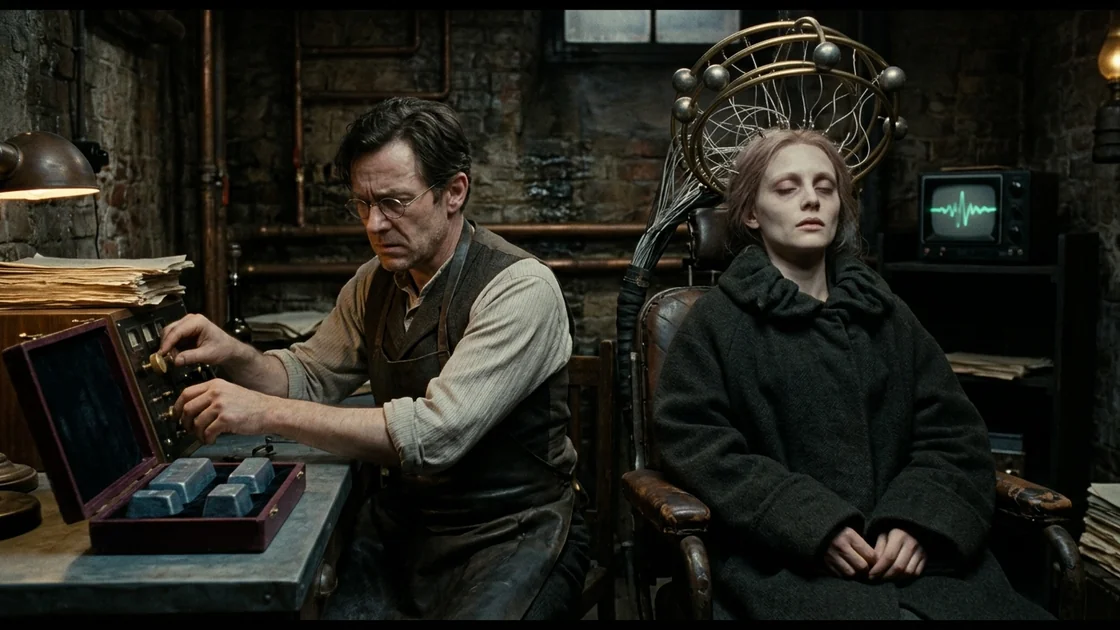
This is the account of Arthur Vance, a senior neuro-cartographer at the Institute of Cognitive Revision, who accepted an illicit fortune from a desperate husband to surgically excise every memory of a dead six-year-old boy from the mind of his grief-stricken mother, Clara Morrow. Convinced that he was performing a merciful act by treating an incurable bereavement as a terminal pathology, Arthur uses a clandestine engrammatic resection rig to strip away five years of maternal devotion, sensory history, and domestic remembrance. Yet in the months following the operation, as Arthur covertly observes Clara navigating her daily life, he realizes that the removal of her memory did not heal her soul, but rather hollowed her into a bewildered ghost who endlessly searches for an absence she cannot name. Stricken with a mounting, unendurable guilt, Arthur is forced to live with the stolen engrams preserved in his private terminal, experiencing the phantom weight of a stranger's love and the horrifying truth of what it means to sever a mother from her sorrow.
I. The Weight of Silver and Saline
The instruments of the Institute were never meant to be gentle; they were meant to be absolute. In the basement suites of the Fourth Ward, three stories beneath the salt-rimed cobblestones of the river district, the air smelled eternally of chilled isopropyl, copper filings, and the faint, sweet decay of old paper archives.
Arthur Vance sat beneath the dull amber glow of a low-voltage work lamp, his fingers adjusting the micro-vernier of a silver-tipped neuro-stylus. He was forty-two years old, though his knuckles were already stiffening with the chalky calcification peculiar to long-term synaptic artisans. For nineteen years, he had been a servant of the clean slate. He had relieved disgraced magistrates of their treasonous indiscretions; he had scrubbed the terror of collapsed mine shafts from the tremors of soot-stained laborers; he had pruned the humiliation of bankrupt merchants until they could walk past their former storefronts with the placid, bovine stare of newborns.
He was good at it. Where other technicians left jagged cicatrices on the cerebral cortex—gaps in speech, sudden aphasias, a telltale hitch in the gait whenever the patient smelled scorched iron or rain on dry clay—Arthur worked like an archivist with a razor, lifting the offending thread of consciousness without snagging the neighboring weft of language or motor function.
"It is not surgery, Mr. Morrow," Arthur said without looking up from the brass casing of his calibration block. "Surgery assumes a foreign body. A tumor. An infection. A bullet. Sorrow is none of these. Sorrow is the tissue itself. It is the blood vessel that dilated to accommodate the heat, and it is the scar that formed when the heat died. You do not cut sorrow out. You cut out the ground upon which the sorrow stood."
Across the zinc-topped desk, Julian Morrow leaned forward. Julian did not belong in the Fourth Ward. His overcoat was made of undyed vicuña wool that smelled of cedar and fine tobacco; his boots were calfskin, immaculate despite the gray slush that choked the avenues outside. He was forty, perhaps forty-five, but his temples were silvered with an exhaustion that money had failed to soften.
On the table between them lay a velvet-lined case. Inside it rested neither bank notes nor common coin, but eight heavy ingots of refined osmium-palladium, each stamped with the assay mark of the North-Eastern Maritime Bank. It was enough capital to purchase an orchard estate in the temperate south, enough to buy an early retirement from the damp cellars of the Institute, enough to ensure that Arthur would never have to breathe the vaporized ether of someone else’s misery again.
"She is dying, Vance," Julian said. His voice was low, rasping at the edges like paper dragged across stone. "Do you understand me? She does not eat. She sits by the nursery casement until her feet are blue with frost. When I touch her shoulder, she flinches as if my hand were an iron brand. Last Tuesday, I found her in the cellar with a paring knife, attempting to dig the boy’s name out of the cedar beams because she believed his breath was trapped in the grain."
Julian took a ragged breath and pressed his palms together until the knuckles whitened.
"The boy is gone. The sea took him; the harbor police dragged the channel for four days and brought back only a torn wool scarf and one boot. That was six months ago. Since then, Clara has ceased to inhabit our life. If this continues, her heart will stop, or she will walk into the bay herself to look for him. I am not asking you to make her happy. I am asking you to keep her breathing."
Arthur set the stylus down with a tiny, musical click. He looked at Julian’s face—at the red-rimmed eyes, the twitch beneath the left cheekbone, the subtle tremor in the hand that rested near the metal ingots. Julian was not a monster. He was simply a man who believed that the human soul was an engine, and that an engine could be mended by removing the broken gear.
"You understand the protocol," Arthur murmured, his voice flat, professional, drained of judgment. "The Institute permits trauma dampening. We can soften the edge of the bereavement. We can lower the affective valence so that the memory of the boy—Leo, was it?—does not trigger an acute autonomic panic response. That is legal. That can be filed with the municipal health board."
"No," Julian spat, the word hard and dry. "No dampening. Dampening leaves the room intact; it merely turns off the lamps. She would still know there was an empty bed. She would still know she had a son who drowned in the salt. I know how dampening works—my cousin had it done after the siege at Saint-Martin. He doesn't scream at night anymore, but he spends twelve hours a day staring at the fireplace with a slack jaw, waiting for a letter from people he knows are rotting in a ditch. I will not have Clara made into an idiot."
Julian reached out, his manicured fingers pushing the velvet case two inches closer to Arthur’s chest.
"Excision. Total, root-and-branch clearance. I want every year of him gone. The pregnancy, the birth, the cradles, the teething, the sound of his shoes on the parquet, the fevers, the day he fell from the garden wall, the harbor. All of it. I want her to wake up as she was seven years ago: a woman who loves her husband, who paints her watercolors, who looks out at the ocean and sees only water."
"The brain does not store a child in a single drawer, Mr. Morrow," Arthur said softly, his gaze drifting to the metal ingots. "A child is not an address or a Latin conjugation. A child is an organizing principle. The brain rearranges its entire sensory vocabulary around the infant’s existence. If you pull the boy out, you leave an unmapped country. The river remains, but the source is absent. The water will pool into stagnant marshes."
"Then drain the marshes," Julian whispered. "You have the equipment. You have the private registry. Do it here, tonight, off-shift. No records for the Board. I have brought her here under the pretense of a nervous restorative clinic. She thinks she is receiving an iron-salt infusion for her anemia."
Arthur looked at the osmium. Its deep, bluish luster seemed to swallow the light from his small lamp. In twenty years, the state had paid him barely enough to keep his coat mended and his lungs free of coal-smoke. His own quarters were two rooms above an apothecary that smelled of valerian and horse liniment. He had no wife; he had no son. He had only the needles, the glass-sheathed diodes, and the dark silver basin where the cerebral echoes were washed away with distilled brine.
"Bring her in," Arthur said.
II. The Harvest of Leo
Her name was Clara, and she moved as though she were suspended in grease.
When Julian led her down the stone steps into the preparation bay, Arthur felt a cold contraction in the pit of his stomach. She was not old—perhaps twenty-eight—but her hair, a pale, ash-tinted auburn, hung limp and brittle over the collar of a dark woolen traveling cloak that was three sizes too large for her shoulders. Her face was the color of skimmed milk, the skin under her eyes bruised with purple hollows so deep they appeared theatrical.
She did not look at Arthur. She looked at the floor, at the copper grounding plates set into the slate flags, her lips moving without sound. Arthur strained his ears as he stepped forward to take her cloak, catching only fragments of a rhythmic, repetitive whisper: ...the third post from the slipway, the green weed on the timber, four yards out, four yards down, the wool was blue, the wool was blue...
"Sit here, Mrs. Morrow," Arthur said, his voice dropping into the low, hypnotic cadence he had practiced for two decades. "The chair is comfortable. The headrest is cold, but only for a moment. It is merely a galvanic balancer. It will ease the pressure behind your eyes."
Clara sat. Her limbs were strangely compliant, like those of a jointed doll whose strings had lost their tension. When Arthur placed his fingers against her temple to locate the temporal notch, her skin was icy, but beneath it, her pulse hammered with the furious, erratic cadence of a trapped sparrow.
"Julian?" she whispered. Her eyes did not focus on her husband, who stood by the reinforced door with his hat clutched against his ribs like a shield.
"I am here, Clara," Julian said, his voice cracking slightly before he steadied it. "Rest now. This gentleman is an apothecary of the nerves. He is going to lift the headache. The long headache."
"It isn't a headache," she said. Her voice was surprisingly clear, though thin as dry parchment. "It is a bell. Someone left a bronze bell ringing in the pantry, and I cannot find the clapper to make it stop. It rings every time the tide turns. Does the tide turn tonight, Julian?"
"Not tonight, my love," Julian lied, not looking at her. "The water is still."
Arthur stepped behind the heavy leather chair. He felt the familiar, professional detachment descend over his shoulders like an apron. He could not afford pity; pity made the hand shake, and a shaking needle in the sub-hippocampal region meant the patient would spend the rest of her life unable to distinguish between the taste of salt and the taste of sugar.
He reached for the sedation ampoule—a compound of chloral hydrate and scopolamine refined to a water-clear purity. He swabbed the skin behind her left ear, where the mastoid bone forms a small, natural shelf, and slipped the fine delivery cannula beneath the dermis. Clara did not even twitch. Within ninety seconds, her chin sank toward her collarbone, her breathing flattening into long, rhythmic sighs that rattled softly in her throat.
"Wait outside, Mr. Morrow," Arthur commanded without turning. "The resonance phase takes three hours. If you are in the room, your voice will introduce stray harmonics into the auditory mapping. Go to the waiting vestibule. Do not return until the green indicator over the lintel is extinguished."
Julian lingered for a fraction of a second, his eyes darting to the blue metal bars on the desk, then turned and slipped through the door, the heavy oak latch falling into place with a hollow thud.
Arthur was alone with the woman and her ghost.
He wheeled the resection apparatus into position. It was a monstrous, beautiful thing, constructed by the master instrument-makers of Prague: a crown of concentric brass rings, each counter-weighted with lead spheres and strung with hundreds of hair-thin silver filaments that gathered into a thick umbilical trunk behind the headrest. He lowered the crown until the silver pads touched Clara's scalp at sixty-four distinct nodal points.
He threw the galvanic switch.
The room filled with a dry, singing hum—the sound of forty thousand glass needles vibrating against silk. On the three cathode-ray oscilloscopes set into the wall, the green traces leaped into life, drawing the mountain ranges of Clara Morrow’s interior world.
To an untrained eye, the traces were mere static, the chaotic electrical discharge of seventy billion cells firing in the dark. But Arthur had spent half his life reading these luminescent valleys. He knew the broad, rolling swells of long-term spatial memories: the layout of her childhood home, the smell of her mother’s kitchen, the geometry of the garden paths. He knew the sharp, jagged spikes of physical pain: the broken collarbone she had suffered at twelve, the sting of a sea-wasp on her heel.
And then he found it.
It was not a single peak; it was a cathedral of fire.
In the posterior cingulate and the medial temporal lobes, the engram of the child Leo burned like an uncontrolled furnace. It was vast. It had colonized everything. Arthur dialed the focus down, descending into the specific nodes, his monitor headphones translating the electrical patterns into auditory signals.
A laugh, high-pitched and slightly breathless, echoing off wet flagstones.
The smell of toasted oats and damp flannel.
A small, warm weight pressing against the hollow between her neck and her shoulder, the greasy dampness of hair after a midday sleep.
The terrifying, blue-lipped silence of a small bed in the winter of the scarlet cough, the sound of spoons clinking against medicine bottles, the frantic, desperate prayer muttered into the hem of a sheet.
A small hand holding a broken snail shell: 'Look, Mother, it’s a house for nobody.'
Arthur’s hands hovered over the excision dials. The technical term was selective engrammatic ablation via localized thermal-galvanic depolarization. In truth, he was not burning the cells; he was simply uncoupling the synapses that bound the child's image to the woman's sense of self. He was snipping the mooring ropes of an entire decade, letting the vessel drift out into the blank ocean of unremembered time.
He set the first boundary: July, seven years prior. The conception. The first flutter beneath the ribs, which the monitor rendered as a low-frequency hum like the purr of a sleeping cat.
He set the second boundary: October, three weeks ago. The harbor slipway. The salt-crusted police boat. The cold drizzle that had turned the ink on the coroner’s certificate into blue smudges.
"Forgive me," Arthur muttered, a habit he had never been able to break, though he knew the patient could not hear him.
He depressed the primary pedal.
The machine shrieked. The silver filaments on Clara’s scalp glowed with a faint, violet luminescence as the micro-currents searched out the mapped coordinates. On the screens, the cathedral began to collapse.
It did not happen all at once. The engrams dissolved like sugar crystals dropped into hot tea. The laughter was sheared first, its high frequencies flattening into gray noise. Then the images: the small yellow oilskin coat, the wooden horse with the missing ear, the little tooth that had grown in crooked behind the incisor. Arthur watched the green traces drop from jagged peaks to level plains, the machine harvesting the memory and converting it into a discharge current that was routed down into the grounding well beneath the floor.
Yet, as the excision reached its center—the raw, bleeding core of the boy's death—something resisted.
The oscilloscope needle pinned itself against the right-hand stop. Clara’s back arched violently against the leather; her heels drummed twice against the footrest. From her throat came a sound that was not a word, not even a human cry, but the choked, subterranean groan of a timber bulkhead yielding under fifty fathoms of black water.
"Hold," Arthur whispered, his heart hammering against his ribs. He adjusted the shunt valve. "Hold, Clara. Don't fight the ground."
The monitor headphone screeched in his ear. In that burst of static, he heard it—clear, distinct, and terrifyingly immediate:
Mother, the water is cold. Mother, the boat is slipping.
Arthur’s thumb twitched on the override lever. For one second, two seconds, he considered aborting the sequence. If he cut the power now, she would live, though she would be broken—partially erased, caught between a dead child and a half-remembered phantom. But his eyes fell upon the velvet box on the desk, the heavy blue-gray metal that promised sunlight, clean air, and an end to this subterranean butcher’s trade.
He did not abort. He increased the current by four milliamperes.
With a sharp, ozone-scented snap, the trace broke. The green line fell, bounced once, and settled into a flat, placid meadow of low-amplitude theta waves.
Clara’s body went limp. Her head rolled to the side, her lips slightly parted, a single line of clear saliva tracing a path down her chin to soak into her woolen collar. The monitor hummed a tranquil, indifferent chord. The cathedral was gone. In its place was an open field of snow, untrodden and silent.
Arthur stood in the quiet room, his shirt plastered to his back with cold sweat. He looked down at the woman. Her face had changed. The terrible, pinched tension around her eyes had smoothed away, leaving her features curiously blank, like an uncarved block of lime-wood. She looked younger, yes, but it was the youth of an empty room before the furniture has been delivered.
Following standard procedure, Arthur should have routed the harvest buffer into the chemical neutralizer to be destroyed. Instead, his fingers moved with a strange, furtive autonomy. He reached to the rear of the console, disconnected the brass-cased recording cylinder where the excised engrams had been temporarily stored as an electrostatic matrix, and slipped it into the deep internal pocket of his leather waistcoat.
Why did he do it? He told himself it was technical curiosity—a desire to study the density of maternal engrams in a specimen of such high resistance. But as he looked down at Clara’s tranquil, ruined face, he knew it was something darker: the collector's impulse, or perhaps the thief’s instinct to keep the thing he had stolen, even if it was made of smoke and tears.
He went to the door, pulled the heavy oak handle, and nodded to Julian Morrow, who was sitting on a wooden bench with his head in his hands.
"It is finished," Arthur said. "She will wake in an hour. Take her home. Tell her she had an inflammation of the inner ear that required a prolonged sedative sleep. Keep her away from the sea for a year."
Julian stood up. His face was gray, but his eyes were sharp with relief. He did not look at the operating chair; he looked only at the desk, where the empty space confirmed that Arthur had taken the metal.
"Will she ask for him?" Julian’s voice was barely audible.
"She cannot ask for what does not exist in her grammar," Arthur replied, his voice cold and hard as salt. "You have bought your peace, Mr. Morrow. Go and enjoy it."
III. The Architecture of Silence
Two months passed before Arthur resigned his post at the Institute.
He had calculated that an immediate departure would draw the attention of the Board of Censors, who were always vigilant for technicians who suddenly found themselves in possession of private fortunes. He spent eight weeks going through the motions, cleaning electrodes, logging galvanic drift, and signing his name to the certificates of lesser resections: small debts forgotten, minor domestic infidelities smoothed over, a shopkeeper’s terror of dogs successfully neutralized.
The eight bars of osmium-palladium sat beneath the floorboards of his bedroom, beneath an old iron trunk filled with out-of-date manuals on cerebral anatomy. He did not spend a single penny of them. Every evening, he would return to his rooms, light his tallow candle, and sit at his table with the brass cylinder he had stolen from Clara Morrow’s head.
The cylinder was four inches long, cold to the touch, and sealed with red shellac at both ends. It contained approximately sixteen hundred hours of dense, affective neural data—the entire physical and emotional existence of Leo Morrow from his first kick in the dark to his last gasp in the foam of the harbor slipway.
Arthur had built a small, crude playback harness using an old telephone receiver and a pair of ocular prisms. He had told himself he would only test it once, to verify that the extraction had been clean, to ensure there were no structural remnants that might cause Clara to suffer a secondary relapse.
That had been the lie.
The truth was that he had become addicted to the child.
On the third week after the surgery, he had fitted the harness to his own head, seated himself in his armchair, and opened the feed.
The world had exploded into color. Arthur Vance had lived his life in shades of slate, zinc, and coal-dust. But Clara Morrow’s memory of the world was drenched in a terrifying, luminous gold. Through her eyes, Arthur had felt the astonishing warmth of an infant’s cheek pressed into the hollow of his clavicle; he had smelled the pungent, grassy sweetness of sun-warmed milk; he had experienced the extraordinary, almost terrifying expansion of the chest that occurs when a small, clumsy hand reaches out and catches one’s thumb with absolute, unquestioning trust.
He had watched Leo learn to walk across a green lawn that sloped down toward a bay that was not gray and treacherous, but sparkling like crushed quartz. He had felt the panic—sharp as a needle through the heart—when the boy had fallen and cut his lip on a garden step, and the miraculous, dizzying relief when the tears were washed away with warm water and sugar-bread.
Arthur was a man who had never been loved, who had never loved anything more responsive than a well-calibrated galvanometer. Now, night after night, he plugged himself into the stolen ghost of another woman's son. He wept for the child. He laughed at the boy's small, nonsensical jokes—the way Leo called the harbor pelicans "the old men with the coats," the way he insisted on sleeping with a smooth gray river pebble tucked into his wool sock.
He was experiencing Clara’s motherhood in reverse: while he grew bloated with her memories, she was living with their absence.
And that was what drew him to St. Jude’s Crescent.
He knew he should not go. It was a violation of every ethical canon of his guild, a breach that would result in his immediate arrest and the stripping of his technical license. But the money had made the license irrelevant, and the engrams had made his caution brittle.
He had to see her. He had to confirm that the trade had been fair—that she had received the peace Julian had paid for, that the emptiness was indeed better than the furnace.
IV. The Phantom Limb
St. Jude’s Crescent was a wide, semicircular terrace of white stucco mansions overlooking the formal gardens of the Upper Tier. Here, the air did not smell of the river; it smelled of horse chestnuts, wet gravel, and coal that had been washed to prevent soot.
Arthur stood beneath the dripping boughs of a lime tree, his collar turned up against the March mist, his spectacles speckled with fine droplets of water. It was three in the afternoon.
The iron gate of Number 14 opened.
Julian Morrow stepped out first, wearing an Inverness cape of dark green tweed, his face fuller than it had been in the cellar, his step light and decisive. Behind him came Clara.
Arthur’s heart gave a strange, sickening leap.
She was dressed impeccably. She wore a walking gown of slate-blue silk with black velvet frogging, and a small bonnet trimmed with pheasant feathers that sat perfectly upon her lustrous, freshly brushed auburn hair. Her cheeks had color—the artificial bloom of a woman who has spent two months being fed calf’s-foot jelly, port wine, and cod-liver emulsions in the best coastal sanatoriums.
Julian offered his arm. She took it, smiling.
It was the smile that made Arthur step back deeper into the shadow of the lime tree.
It was an exquisite smile, polite, symmetrical, and entirely dead. It was the smile one sees on a portrait of an ancestor whose name has been forgotten: pleasant, durable, and completely unmoored from any living thought.
As the couple walked down the gravel path toward the carriage that waited by the curb, Arthur watched Clara’s movements with the trained eye of a neuro-cartographer.
She walked with a strange, hesitant imbalance. Her left arm, which had carried a child for five years, hung slightly bent at the elbow, the fingers curved inward as if anticipating a weight that was not there. When a carriage horse on the avenue shook its harness, making the brass bells jingle with a sharp, merry sound, she stopped dead.
Her smile did not vanish; rather, it seemed to freeze, petrifying into a grimace of polite confusion. Her eyes widened, darting across the lawn, over the iron railings, into the empty air above the grass.
Arthur knew that look. It was the look of a patient who has lost a leg to the bone-saw, feeling an itch in toes that have already been buried in the lime pit.
Julian leaned down to whisper something in her ear. He patted her gloved hand with a jovial, proprietary warmth. Arthur could read the movement of Julian’s lips: Come, Clara. We shall be late for tea at the Bishop’s.
Clara nodded. "Yes," her voice carried across the damp gravel, light and hollow. "The tea. Of course. Did I... Julian, did I leave the basket?"
"What basket, my dear?"
She paused. Her brow furrowed, two small, vertical lines appearing between her pale eyebrows—the only survivors of the great fire that had once raged there. She looked down at her empty hands, then back toward the house, her eyes searching the second-floor windows with a hungry, desperate bewilderment.
"I don't know," she murmured, and the sound was like dry leaves scraping over concrete. "The small basket. With the red ribbons. I thought... I felt as though I was carrying something soft."
"You have your muff, Clara," Julian said, his voice carrying a microscopic edge of impatience, the weary forbearance of a man who has bought an expensive music box only to find it occasionally skips a measure. "You don't need a basket. Come."
He helped her into the brougham. She climbed the carriage steps smoothly enough, but just before the groom shut the door, she turned and looked straight through the rain toward the tree where Arthur stood.
Her eyes did not see him. They were looking at the world the way an illiterate man looks at an open book: recognizing that there are symbols, that there is meaning, that there is an entire universe contained within the black marks on the white paper, but entirely barred from comprehending what that meaning might be.
The door slammed shut. The brougham moved away, its iron-shod wheels grinding the wet gravel into white paste.
Arthur stood in the rain until the carriage had turned the corner into the parkway. His hands were shaking inside his coat pockets. His fingers were curled tightly around the brass cylinder, the cold metal drawing the heat out of his palm until his bones ached.
She is not healed, he thought, and the realization was like swallowing crushed glass. She is merely evicted from herself.
V. The Echo Chamber
The following week, Arthur began his surveillance in earnest.
He bought a second-hand suit of decent gray wool, discarded his technician’s spectacles for a rounder pair with tinted lenses, and rented a small, drafty room above an engraver’s workshop that looked directly across the square at St. Jude’s Crescent. He bought a brass terrestrial telescope, mounting it on a tripod behind the lace curtains of his window.
He had become a ghoul. He knew this. The money under his floorboards remained untouched, a silent, heavy indictment. He ate little—some bread, some cold salt beef from the corner butcher, tea that had grown stewed and bitter in the pot. He spent his days at the telescope and his nights with the silver filaments pressed against his own temples, alternating between watching the empty vessel and drinking from the stolen wine.
Through the telescope, he watched Clara’s mornings.
Julian departed at half-past eight for the Baltic Exchange, stepping into his carriage with the brisk, important stride of a man whose domestic life had been restored to order. Once he was gone, Clara was left to the house.
She did not paint her watercolors. Arthur saw her easel set up in the morning room, the white paper stretched upon the board, pristine and untouched week after week. She would sit before it with a horsehair brush in her hand, her arm poised above the paper, and remain there for an hour, two hours, motionless as an uncoiled clockwork toy.
Sometimes she would rise and wander through the rooms. Arthur tracked her from window to window.
In the nursery—which Julian had ordered redecorated as a small morning library with glass-fronted bookcases and cream-colored wallpaper—she would walk along the baseboards, her fingertips trailing along the plaster. She would stop at a certain height—about three feet from the floor—and her hand would hover, her fingers fluttering against the wallpaper as though searching for marks that had been painted over.
The height charts, Arthur thought, his eyes burning against the brass eyepiece of the telescope. The pencil marks on the doorjamb. Three feet two inches on his fifth birthday. He had jumped up and down because he was taller than the spaniel.
He remembered it because he had felt it through the engram. He had felt the small, hard skull pressing against his ribs as Clara held the boy still while Julian made the mark with a carpenter’s pencil. Julian had laughed then; Julian had been a father then.
Now, Clara stood in the cream-colored library, looking at her fingers with a vague, mild disgust, as if they were tools whose purpose she had forgotten.
One rainy Tuesday in mid-April, Arthur followed her when she left the house on foot—an unusual occurrence, as she rarely walked without the maid or her husband.
She wore her heavy cloak and walked with her head down, indifferent to the wet wind that blew from the docks, carrying the sharp, bitter stench of low tide and rotting bladder-wrack. She walked southward, down through the terraced crescents, through the iron market, down into the Fourth Ward.
Arthur kept fifty paces behind her, his heart hammering against his ribs like a loose shutter in a gale. Was she returning to the Institute? Did some unconscious, cellular thread of memory lead her back to the cellar where her soul had been butchered?
She did not go to the Institute. She went to the public quays.
The Old Slipway was a miserable place, paved with greasy, river-slime cobbles that tilted down into the brownish-green water of the channel. Two coal barges were moored to the iron rings, their crews shoveling black anthracite into carts with a rhythmic, scraping clatter.
Clara walked to the edge of the timber revetment. She stood two feet from the drop, where the water swirled in greasy eddies around the barnacle-crusted pilings. The wind whipped her auburn hair loose from her bonnet, lashing wet strands across her mouth, but she did not brush them away.
Arthur moved behind a stack of Baltic timber, his breathing ragged, his hands ready to spring forward if she took one more step.
She did not jump. She simply looked down into the water.
She leaned forward, her hands clasped tightly against her stomach in an attitude of intense, agonizing concentration. She was listening. Arthur knew she was listening. The water was making its ancient, rhythmic sound—slap-slap-slap against the hemlock timbers—the same frequency that had been recorded on the third channel of the engram cylinder.
A young woman passed her, carrying a child of perhaps three or four on her hip. The child was wrapped in a coarse red shawl, its nose running, a crust of dried bread clutched in its dirty fist. As they passed, the child let out a sudden, piercing crow of delight, pointing at a gull that had wheeled down toward the water.
Clara turned like a compass needle swinging toward an iron mountain.
Her face was not the smooth, placid mask Arthur had watched through the telescope. It was contorted into a shape of such profound, uncomprehending agony that Arthur had to bite the knuckle of his thumb to keep from crying out.
She took two steps toward the woman with the child. Her arms came up, the hands curved into that terrible, empty cradle.
"Excuse me," Clara said.
The market woman stopped, looking with suspicion at Clara’s rich cloak, her wild, wind-whipped hair, her pale, desperate face. "Aye, ma'am?"
"I... I have lost..." Clara’s voice was high, thin, fluttering like a bird trapped in a chimney. Her hands moved through the empty space between them, grasping at the cold air. "Did you... did you see where I left it?"
"Left what, lady?" the woman asked, pulling her child slightly behind the fold of her red shawl.
Clara stared at the child’s wool-wrapped leg. Her mouth worked, her jaw trembling, but the word would not come. The word was gone. Arthur had cut the word out with sixty-four silver knives. The concept had no handle in her mind; it was a shadow cast by an object that had been annihilated from the universe.
"The... the weight," Clara whispered. She pressed her hands against her own breasts, her fingers digging through the heavy wool of her cloak into the flesh beneath. "There was a weight here. It was very warm. It was here this morning, or... or perhaps it was last year. Julian says it was never there. He says I have a weak constitution and an overactive spleen. But my arms are so tired. Why should my arms be so tired if they have been carrying nothing?"
The market woman backed away, her eyes round with the superstitious terror common to the river folk. "You're sick, lady. You should go home to your people. Leave off now."
The woman hurried away toward the fish market, her child looking back over her shoulder with wide, curious eyes.
Clara remained on the quay. She did not weep. That was the most horrible thing: she could not weep. Tears require a narrative; they require a loss that can be conceived, an event that can be situated in the sequence of one’s days. Clara had no narrative. She had only the physical residue of a grief whose origin had been erased from the ledger. She was an engine running at full pressure with all its valves welded shut.
She looked down at her hands again, then slowly, with the mechanical, dragging gait of an automaton whose spring is winding down, she turned and began the long climb back toward the Upper Tier.
Arthur Vance leaned against the damp timber stack, slid down to the wet gravel of the quay, and wept until his throat was raw.
VI. The Surrogate Mourner
The descent into madness is rarely a drop; it is an incline, gentle at first, paved with small, logical compromises.
Arthur’s compromise was this: If she cannot remember him, someone must.
He moved the apparatus from the Institute’s surplus yard to his rented room over the engraver’s. It was dangerous work, accomplished in the dead of night with the help of a drayman he had bribed into silence. He set the brass frame and the lead weights in the corner of his room, opposite the window that looked out on St. Jude’s Crescent.
Every night at nine, after the lights in Number 14 had been extinguished—save for the single night-lamp that burned in Julian Morrow’s study—Arthur would strip down to his linen shirt, seat himself in the high-backed chair, and fit the silver crown to his temples.
He ran the engram cylinder from start to finish, over and over, until the grooves of the recording were etched into his own synaptic pathways like wagon ruts in soft sandstone.
He began to lose the distinction between his own memories and the harvest.
He remembered his own childhood in the salt marshes of the estuary—a cold, gray, loveless affair with an uncle who smelled of gin and wet leather—but now, when he closed his eyes, that childhood was overlaid with Clara’s memories of Leo. He saw the nursery in St. Jude’s Crescent not as an observer across the square, but from within the room. He knew the precise squeak of the third floorboard near the washstand; he knew the chip on the porcelain rim of the water pitcher; he knew the cold, smooth feel of the brass drawer-pulls that Leo had used to pull himself up when he was eleven months old.
He began to feel the phantom weight himself.
In the daytime, as he walked the streets to buy bread or tobacco, his left arm would crook itself into that same unnatural, protective curve. When he saw a child run near the wheel of an omnibus, his diaphragm would seize with a violent, sickening spasm that left him gasping against a lamp-post.
He was experiencing Clara’s mother-love, but he was experiencing it without the biological machinery designed to bear it. In a woman, that love had been built over nine months of blood and bone, tempered by the agony of labor, anchored by the hormonal tide that follows the milk. In Arthur—a dried-up, solitary bachelor of forty-two—the love was an alien parasite, a great, golden cuckoo chick that had hatched in the spartan nest of his mind and was now devouring everything else.
He could no longer work. His hands shook constantly—a fine, high-frequency tremor caused by the constant galvanic discharge of the playback harness. His hair, once dark and thick, began to fall out in patches, leaving his scalp red and scaly where the electrodes had bitten into the skin.
He had become Clara’s shadow, her externalized soul.
One evening in May, as the lilacs in the square were opening their pale, sweet-smelling blossoms, he saw Julian Morrow leave the house alone. Julian was not dressed for business; he was dressed for an evening at the Carlton Club, carrying his gold-topped cane and wearing his high silk hat.
Arthur waited twenty minutes. Then, driven by an impulse so reckless, so monstrously unprofessional that his former self would have recoiled in horror, he crossed the square.
He did not knock at the front door. He went down the service lane, through the tradesman’s gate, and into the rear garden. The garden was neglected; Julian had dismissed the under-gardener because Clara no longer went into the grounds. The gravel paths were choked with chickweed and dandelion, and the climbing roses had broken their ties, their thorny canes trailing across the soil like snare wires.
The French casement of the morning room was unlatched, open three inches to let in the cool evening air.
Arthur pushed it open with the tip of his finger. The brass hinges did not squeak.
He stepped inside.
VII. The House of the Unborn
The house was cold. Despite the season, the hearth in the morning room held only a heap of gray ash from the previous night, cold and unlit. The air had the peculiar, dead quality of a museum: no scent of dinner cooking, no sound of voices from the kitchen, only the dry, bitter smell of beeswax and expensive upholstery.
Clara was there.
She was sitting on the floor in the corner of the room, between a heavy mahogany sideboard and the wall. She was still wearing her morning gown of gray poplin, but the collar was undone, and her feet were bare, tucked under the hem of her skirt.
Around her, arranged in a neat, symmetrical circle on the Persian carpet, were twenty or thirty small, smooth river stones.
She did not look up when Arthur entered. She was humming—a low, monotone drone that had no melody, no rhythm, nothing that could be called music. It was the sound a telegraph wire makes in a high wind.
"Mrs. Morrow," Arthur whispered.
The humming stopped. She did not startle; she did not scream. She turned her head toward him with a slow, heavy indifference that was more terrible than any shriek of fear.
Her face was gaunt. The artificial bloom that the sanatorium had put into her cheeks had vanished, leaving her skin like yellow wax. Her eyes, once a bright, intelligent hazel, were dull and milky, the pupils dilated until the iris was only a thin brown ring.
"The stones are cold," she said. Her voice was flat, devoid of curiosity as to who he was or how he had entered her house. "I put them near the fender, but the fire is out. If they don't get warm, they won't grow."
Arthur took two steps into the room, then sank to his knees on the carpet. His joints creaked loudly in the silence.
"They will not grow, Mrs. Morrow," he said, his voice trembling so violently he could barely shape the syllables. "Stones do not grow."
She looked at him then, really looked at him, for the first time since she had sat in the galvanic chair in the Fourth Ward. A tiny flicker of disturbance—a shadow passing beneath ice—rippled across her forehead.
"I know you," she said.
Arthur’s breath caught in his throat. Had the excision failed? Had some microscopic root of the engram survived, recognizing the man who had wielded the shears?
"You are the apothecary," she said softly. "The one with the cold silver fingers. You took the bell away."
"Yes," Arthur choked.
"Why did you leave the silence?" she asked.
The question was simple, asked with the naive, devastating directness of a child. She picked up one of the gray river stones and turned it over in her palm.
"The bell was very loud," she continued, her gaze returning to the stone. "It hurt my ears. It made my chest feel as though it were full of broken crockery. But the silence... the silence is heavier, sir. The bell had a shape. I could fight the bell. I could scream back at it. But how do you fight something that isn't there? How do you push away a room that has no walls?"
She reached out and laid her cold, dry fingers against Arthur’s wrist.
The touch was like an electric shock. Through Arthur’s mind—already destabilized by weeks of engrammatic playback—rushed a torrent of images: Leo’s sixth Christmas; the boy laughing as he tore the brown paper from a painted tin drum; the smell of roasting goose; Clara’s own hand, young and smooth, smoothing back the hair from the boy’s sweaty forehead.
It was here, Arthur thought, his mind screaming into the void between them. It happened here. In this room. The tree stood in that corner. The drum was set beside the hearth.
"You know what was here, don't you?" Clara whispered. Her fingers tightened on his wrist with surprising strength. Her eyes were searching his face now, no longer dull, but frantic, wide, terrified by the glimpse of some monstrous truth that hovered just outside the perimeter of her consciousness. "You have the look. Julian doesn't have it. Julian looks at the corners of the room and sees only the wall. You look at the corners and you see... you see the shape of the hole."
"Mrs. Morrow—Clara—" Arthur could not breathe. "I can... I have something. I can give it back."
The words were out before he had weighed them. It was impossible. A reversed excision had never been performed successfully; the synaptic pathways, once depolarized, wither within weeks. To graft an engram back into an ablated brain was like trying to tie severed threads of spider silk with heavy wool-mittened fingers. It would cause massive, chaotic hemorrhage, grand mal seizures, permanent idiocy, or death.
Yet the alternative was this: this living mummy, this woman who sat among cold river stones waiting for them to turn into bread.
Clara let go of his wrist. She shrank back slightly, her hand going to her throat.
"Give what back?" she asked. And then, with a sudden, horrifying return of the Institute’s placid programming: "I am quite well, sir. Julian says I am entirely recovered from my nervous complaint. I am to attend the races on Saturday. I have a new bonnet with cornflowers. Do you like cornflowers?"
The transformation was hideous. The mask had slammed shut again. The machinery Arthur had installed in her brain had detected the anomalous affective spike and had immediately deployed the neutralizing loops: the polite platitudes, the superficial social memory, the thick, gray padding of indifference.
She smiled at him—that same symmetrical, painted smile she had given her husband beneath the lime tree.
"You should go, sir," she said, her voice tinkling like thin glass. "Julian does not like callers in the evening. Especially callers who do not leave a card."
Arthur rose slowly to his feet. He looked down at her. She had already forgotten him; her fingers were once again arranging the smooth gray stones into a circle on the carpet, her head tilted, her lips shaping that silent, terrible hum.
He backed out through the casement, into the cold, neglected garden, and fled through the lilacs into the dark.
VIII. The Terminal Harvest
That night, Arthur Vance made his preparations for the end.
He knew he could not live like this. The osmium-palladium bars under the floorboards felt like fifty pounds of hot lead pressing down through the joists, threatening to collapse the ceiling of the engraver’s shop below. His mind was no longer his own; it was a contested territory, a battleground between his own dry, forty-year collection of grievances and the stolen, radiant life of a boy who had drowned in the mud.
He took the brass cylinder from his desk. The lacquer seals were cracked and peeling from constant insertion into the playback deck.
There was only one way to balance the ledger. It was an absurdity—a technical heresy—but Arthur Vance was no longer a technician. He was a penitent whose only god was the galvanometer.
He could not restore Clara’s mind without destroying her. But he could empty himself.
He could perform the resection on his own brain. He would excise the harvest. He would strip Leo Morrow from his own synapses, route the discharge into the chemical neutralizer, and let the whole monstrous theft dissolve into carbon, nitrogen, and salt water.
He would be left empty, of course. A man cannot cut out six months of intense, obsessive neural activity without leaving a massive, jagged crater in his own personality. He might lose his speech; he might lose the ability to read; he might become like his former patients, sitting in the sun with a line of drool on his chin, wondering why the light was bright.
Better that, he thought, as he filled the glass cooling jackets of the machine with fresh brine. Better an idiot than a thief who eats the dead.
He sat in the chair. He did not have an assistant, so he had to rig a delayed trip-wire to the main power contactor. He set the clockwork timer on his desk for four minutes—enough time to fit the crown, adjust the sixty-four silver leads, insert the cannula into his own mastoid notch, and administer the local anesthetic.
He worked with the swift, feverish efficiency of a suicide.
He strapped his arms to the oak armrests, leaving only his right hand free to throw the final lever once the timer reached zero. He lowered the heavy brass crown over his skull. The silver pads bit into his scalp, cold and sharp as needles.
He picked up the delivery syringe, found the ridge of bone behind his left ear, and drove the needle home. The cold sting of the scopolamine spread through his temple like ink through water. His vision began to double; the yellow gas flame of the wall bracket separated into two dancing, blurred teardrops.
He reached out his trembling right hand and rested his fingers on the heavy iron lever of the main shunt.
The clockwork timer ticked with a loud, wooden clack. Three minutes. Two minutes.
He closed his eyes.
One last time, he thought. One last time to see the boy before the boy was cast into the lime pit forever.
He opened the primary channel.
The world vanished.
He was standing on the beach at the mouth of the bay. It was late September. The sky was the color of a bruised oyster, the clouds low and torn by a cold north-easterly wind.
Leo was there.
The boy was wearing his small blue wool coat—the one with the horn buttons, one of which was chipped at the rim where he had bitten it. He was running along the wet sand where the waves retreated, leaving a mirror-like sheen of water that reflected the gray clouds.
"Mother!" the boy shouted. His voice was carried away by the wind, thin and musical. "Mother, look! The water is making horses!"
Arthur felt the rushing, overwhelming tide of Clara’s love—her fierce, terrifying adoration for this small, fragile animal that had come out of her own flesh. It was a love that had no boundary, no limit; it was wider than the sea, deeper than the channel mud, stronger than the iron cranes on the quay.
And then, within the memory, the perspective shifted.
Arthur was not Clara.
He was Arthur.
He was standing on the beach in his grease-stained technician’s apron, with his silver needles in his pocket and his ledger under his arm.
Leo stopped running. The boy turned around and looked at him.
He did not look like an engram. He did not have the flickering, low-resolution edge of an electrical trace. He looked solid, real, his cheeks whipped red by the salt spray, his dark hair plastered against his forehead by the mist.
"You're the man from the cellar," the boy said.
Arthur tried to speak, but his tongue was thick, heavy with the chloral hydrate that was creeping through his blood. "Leo," he managed to croak.
"Why did you take my mother away?" the boy asked.
He was not angry. He asked the question with the same clear, mild curiosity he had shown for the broken snail shell.
"She was hurting," Arthur wept, falling to his knees on the wet sand. The cold salt water soaked through his trousers, freezing his skin. "You died, Leo. You went into the water, and she could not bear the weight of it. Your father asked me. He gave me the metal. He wanted her to live."
The boy took two steps toward him. His small, calfskin boots made wet, sucking sounds in the sand. He reached out his small, cold hand and touched Arthur’s cheek.
The touch was not electrical. It was the touch of rain, of salt, of human grief that had refused to rot.
"She was supposed to carry me," the boy whispered. "Even when it hurts. That’s what mothers do. They carry the bones."
The wind began to rise, howling through the dune grass behind them. On the horizon, the sea was turning white, the great, foaming ridges of the incoming tide advancing like an army of horses.
"The timer," Arthur muttered, his mind fighting through the chemical fog. "The timer is at zero. The shunt... I have to pull the shunt."
"If you pull the shunt," the boy said, his hand still resting against Arthur’s cheek, "where do I go?"
Arthur froze.
The oscilloscope in his real, physical room was screaming—he could hear it through the dream, a thin, insectile whine that grew louder and louder as the capacitors charged. The clockwork had tripped. The automatic relays were clicking into place, one by one. In five seconds, the thermal-galvanic current would sweep through his cerebral cortex, scouring the engram clean, vaporizing the child, leaving Arthur Vance an empty shell in an unrented room.
Where do I go?
If Clara could not remember him, and Arthur erased him, then Leo Morrow would not merely be dead. He would be unborn. He would be annihilated from the only place where he still had weight, color, and voice.
The sea was at their feet now. The cold water swirled around Arthur’s knees, dragging at him, pulling him toward the gray channel.
"Don't leave me in the mud," the boy said.
Arthur opened his real eyes.
The room was blindingly bright. The silver crown on his head was scorching his scalp, the smell of singed hair filling his nostrils. His right hand was resting on the iron lever—the lever that would route the harvest into the grounding well and destroy it forever.
His muscles were locking with the onset of the galvanic seizure. His teeth were chattering so violently he tasted blood from his bitten tongue.
With a final, agonizing effort of will—a movement that felt as though he were tearing his own pectoral muscle from the breastbone—Arthur did not depress the lever.
He jerked his arm backward.
He caught the main power cable with his crooked fingers and pulled.
The heavy copper lug tore free from the terminal block with a blinding flash of blue fire. The arc leaped three inches to the brass frame, throwing Arthur backward against the wall. The crown was ripped from his head, the silver filaments snapping like lute strings, leaving bloody gouges across his temples.
The room went black.
The singing hum died. The oscilloscopes went dark.
Arthur lay on the floorboards in the darkness, smelling ozone, scorched meat, and the stale dust of the engraver’s shop below. He could not move his legs. His left side was paralyzed from the violent, asymmetric discharge of the capacitors.
But in his head—in the silent, ruined, bleeding cathedral of his own brain—the boy was still there.
Mother, the water is cold.
"I know," Arthur whispered into the dark, his voice a broken rattle against the floorboards. "I know, Leo. I have you. I will carry the bones."
IX. The Ledger of the Lost
Arthur Vance did not die that night, though there were many times during the following winter when he wished the copper cable had been thicker.
The stroke had taken the use of his left leg and twisted the left corner of his mouth into a perpetual, sardonic droop. His speech was slow, thick, and slurred, like that of a man who has spent an hour in the snow before trying to recite a psalm. He could no longer hold a neuro-stylus; his right hand had retained its strength, but the delicate, microscopic coordination was gone, replaced by a clumsy, crab-like claw.
He did not leave the room above the engraver’s.
He did not need to. He used the first of the osmium-palladium bars—sold through a crooked fence in the river district for half its value in paper scrip—to pay the engraver’s wife to bring him soup, tea, and firewood twice a day.
The rest of the metal remained under the floorboards. He never touched it. It was not his money; it was the purchase price of a woman’s soul, and he was merely the receiver in bankruptcy.
Every afternoon, when the light was good, he would drag his paralyzed leg across the room to the window, sit in his armchair, and adjust the terrestrial telescope.
He watched Clara.
Julian had bought her a dog—a small, white King Charles spaniel with watery eyes and a silk bow on its collar. Julian had clearly been told by the doctors that an animal was an excellent therapeutic surrogate for women of a nervous disposition.
Arthur watched Clara walk the dog around the gravel paths of St. Jude’s Crescent.
She held the red leather leash with that same bent, crooked arm. The dog would pull, eager to sniff the lilacs or the base of the iron lamps, and Clara would follow it with the passive, mechanical obedience of a dry leaf dragged by an ant.
She never patted the dog. She never spoke to it. When it jumped up against her skirt, barking its thin, yapping bark, she would look down at it with a mild, distant curiosity, as though it were an unusual species of beetle that had landed on her hem.
One day in late autumn, when the leaves of the horse chestnuts were falling like great, sodden brown hands upon the gravel, Arthur saw her stop by the gate.
Julian was with her. He was speaking to a neighbor—an elderly man with a bath-chair and a fur rug. Julian was laughing, his chest swelling with the broad, complacent prosperity of a man whose world was balanced, whose ledger was clean, whose wife was cured.
Clara stood two paces behind him.
She looked up at the sky. A flock of wild geese was flying southward, high above the chimney pots, forming a gray V that pointed toward the sea.
Her face was illuminated by the pale, cold light of the dying sun.
Arthur adjusted the focus of the telescope until her eyes filled the entire brass cylinder.
There were no tears in them. There would never be tears. But Arthur saw that the field of snow had changed. It was no longer smooth. The absence had developed its own architecture. The hole in her heart had grown so deep, so absolute, that it had become a physical presence—a negative monument around which her entire remaining life was forced to detour.
She raised her hand to her throat. Her fingers touched the lace of her collar, then drifted down to her breast, pressing against the bone with that slow, rhythmic pressure Arthur knew so well.
One, two, three. One, two, three.
She was counting the beats of a heart that was beating for an empty room.
Across the square, in his cold room above the workshop, Arthur Vance leaned his forehead against the brass tube of the telescope. His tears ran down the cold metal, leaving greasy, salt smudges on the polished casing.
He closed his eyes.
He did not need the silver crown anymore. He did not need the Prague machine, nor the galvanic brine, nor the cathode-ray tubes. The boy was embedded in his flesh, an indelible tattoo upon his soul.
Look, Mother, the voice whispered in the dark behind his eyes, clear and sweet as a silver coin dropped into a crystal glass. It’s a house for nobody.
"I see it, Leo," Arthur muttered through his twisted lips, his hand reaching out into the empty air of his cold room, his crooked fingers closing around the cold, dry air. "I see it, my boy. It is a very large house. And there is room enough inside for both of us to freeze."