The Architecture of Absence
Julian Vance sacrificed his sister for a second chance at happiness with his wife, though he did not know the price until the ink of history had already dried. In an effort to erase an eighteen-year-old grievance that had slowly metastasized into the quiet ruin of his marriage, Julian utilized an uncalibrated temporal displacement device to mend a single, miserable evening on a snowbound highway in western Massachusetts. He returned to a present where his wife Clara loved him with an untarnished, gentle devotion, only to discover that the butterfly ripples of his minor intervention had altered the intimate choreography of his parents lives, ensuring that his younger sister Maya was never conceived. Caught between a resurrected love and the agonizing phantom of a sibling only he remembered, Julian was forced to confront the terrible, immutable geometry of sacrifice.
Chapter One: The Winter of Small Cruelties
The radiator in the hallway of the Brookline brownstone had hissed with the same dry, metallic malice for eleven years. Julian sat at the mahogany dining table, listening to the iron clanking against the floorboards, watching the steam cloud the lower third of the tall bay windows. Across from him, Clara was peeling an orange. She did it with a small, serrated paring knife, carving the rind away in one continuous, translucent coil that smelled sharply of citrus and winter rot.
She did not look at him. She had not looked directly into his eyes since the preceding Tuesday, when he had forgotten, again, the anniversary of her father’s death. But that omission was merely the topsoil, the thin layer of loose dirt over a grave that had been dug nearly two decades prior.
"The appraiser is coming at two on Thursday," Clara said. Her voice was level, scrubbed clean of anger, which made it far more lethal than any shout. "He said three days for the formal valuation. Then we can sign the listing agreement."
"We don't have to sell the whole house," Julian said. His throat felt full of chalk. "We could divide the floors. You could keep the studio upstairs. I could take the basement apartment."
Clara dropped the spiral of orange peel onto her napkin. It curled there like a dead snake. "We aren't students anymore, Julian. We’re forty-two years old. I don't want to live above the ghost of my failure. I want an apartment in the South End with clean walls and no radiator pipes."
"It wasn't a failure until you decided it was," he muttered.
Her hands paused. The knife hovered a quarter-inch above the pale, pith-covered flesh of the fruit. When she finally raised her chin, her eyes were the color of stagnant harbor water under an overcast sky.
"Do you really believe that?" she asked quietly. "Do you honestly think this started last week? Or last year?"
Julian looked down at the grain of the mahogany. He knew the geography of this argument; they had surveyed its borders a thousand times.
"It was the car," she whispered, not waiting for his answer. "It was Thanksgiving, 2005. Route 9 outside of Ware. The blizzard."
"Clara, that was eighteen years ago. We were twenty-four."
"You left me on the shoulder of the road," she said, her voice dropping into that dreadful, rhythmic cadence he had come to loathe. "You walked two miles to a gas station because your ego was too immense to call my father for a tow. My feet went numb. The frost got inside the door seals. When you came back, you didn't apologize. You blamed me for not checking the oil. You stood outside the driver’s window in three feet of snow and screamed that I was an anchor dragged through your life."
"I was terrified," Julian whispered. "My hands were blue. I thought the engine had seized and we were going to freeze to death."
"You showed me who you were when things broke down," she said, cutting the orange neatly in two. "You broke down with them. And then you turned on whatever was closest to you. That was the first day I ever looked at you and felt entirely, profoundly alone. Every time you forget an appointment, every time you retreat into the basement for three weeks at a time, every time you look through me instead of at me—it is just that snowbank on Route 9, over and over again."
She stood up, took her plate, and walked into the kitchen. The pocket door slid shut between them with a heavy, oiled click.
Julian sat in the silence of the dining room. He reached into his coat pocket and touched the heavy brass housing of the chronometer.
It was not brass, of course; it was a sintered copper-palladium alloy, machined to tolerances measured in angstroms, housing an array of micro-cavity resonators that hummed at a frequency below human hearing. For six years, in the subterranean cleanroom beneath the high-energy physics laboratory at the university, Julian had spent the detritus of his life—his evenings, his weekends, his sabbatical—coaxing closed timelike curves out of laser-trapped rubidium condensates.
His colleagues believed he was working on quantum coherence metrics for topological insulators. They wrote grants for him; they patted him on the back; they left him alone. They did not know about the twin coils resting in the damp cellar beneath the Brookline floorboards, drawing forty kilowatts through a jury-rigged conduit tied directly to the municipal sub-station line.
He had not built it to conquer kingdoms or plunder markets. He was not an ambitious man; he was an exhausted one. He had built it because he was an engineer of broken systems, and the most broken system in his universe was the woman who had just shut the door between them.
He did not need to undo their meeting. He did not want to unravel the fabric of their lives, their degrees, their shared griefs, their quiet triumphs. He only wanted to remove the rot from the root.
One night. One stupid, freezing, catastrophic night.
If he could change the tone of his voice; if he could swallow his youthful, wounded pride; if he could simply sit beside her in the dark, pull her shivering hands into his coat, and say, I am sorry, we are safe, I love you—then the nineteen years that followed would not be built upon the cold foundation of that drift.
Julian stood up, left his tea untouched, and descended the narrow wooden stairs into the dark belly of the house.
Chapter Two: The Cold Needle
The displacement chamber was not a grand vehicle; it was a coffin of braided wire and grounded lead sheets, suspended by hydraulic dampeners inside the old coal cellar. The air smelled of damp lime, machine oil, and the dry, sweet tang of ozone.
Julian stripped down to a thin linen shirt and trousers. Metal buckles, zippers, and magnetic fasteners were dangerous; at the boundary of a localized Minkowski inversion, any differential paramagnetic torque could shear a fingernail off or burn an arc into the flesh. He checked the cooling lines. The liquid nitrogen Dewar was venting a thin, white plume that curled across the flagstones like cold milk.
He set the dial.
Temporal coordinates in four-dimensional manifold mechanics were not dates; they were harmonic intersections. He was not targeting November 24, 2005; he was targeting the specific electromagnetic signature of the earth's crust beneath the coordinates 42.2612° N, 72.2421° W, as it had been positioned relative to the local solar barycenter at precisely 21:14 UTC on that evening.
He remembered the hour with photographic misery. It was nine o'clock at night. The sky had been the color of bruised slate. The old 1997 Volvo had sputtered, thrown a cloud of sweet-smelling white glycol steam through the dashboard vents, and died on a blind curve two miles west of the Quabbin Reservoir.
Julian stepped into the cage. The lead-mesh door swung shut on counterweighted pulleys and latched with a heavy, definitive clatter.
He took a deep breath. His heart was knocking against his ribs like a bird in a chimney.
"Just the snow," he whispered into the dark. "Just the car."
He depressed the ceramic toggle on the hand-held relay.
There was no sound, because sound requires the compression of matter, and matter had ceased to have a contiguous definition for the space Julian occupied. There was only a sudden, violent sensation of being turned inside out through the needle of an unthreaded syringe. The light did not flash; it condensed, collapsing from the ambient gray of the cellar into a blinding, infinite point of violet heat that burned behind his retinas.
Then came the cold.
It did not arrive gradually. It slammed into his chest like a shovel full of wet gravel.
Julian fell to his hands and knees. The surface beneath him was not the concrete floor of his basement, but hard-packed, washboard ice covered in three inches of fresh, dry powder. The wind was howling through the birch trees with a sustained, screaming whistle that tore through his linen shirt instantly.
He scrambled to his feet, shivering so violently his teeth clicked together like dice.
Fifty yards ahead, through the diagonal curtain of the blizzard, two dim red rectangles glowed in the dark.
The taillights of the 1997 Volvo.
Julian stepped into the snowbank at the edge of the asphalt. His shoes filled with ice water; his trousers were instantly soaked to the mid-thigh. He ducked his head against the biting gale and pushed forward.
As he drew closer, he saw the silhouette through the rear window: the younger version of himself, sitting behind the steering wheel, his forehead resting against the vinyl rim, his breath fogging the glass. Beside him, barely visible in the faint green glow of the instrument panel, sat Clara, huddled deep within her oversized thrift-store wool coat, her face turned resolutely toward the passenger side window.
Julian paused behind the trunk. He could hear his own voice from eighteen years ago, muffled by the glass but sharp with panic:
“...I told you to look at the gauge when we left Amherst! You watched it creep into the red for twenty miles and didn't say a damn thing!”
And Clara’s voice, small, sharp, trembling:
“You’re the one who worked on the thermostat, Julian! You said it was fine!”
Julian closed his eyes for a second. The shame was fresh, vivid, as sour as bile. He had forgotten how small he had been, how fragile his vanity was at twenty-four, how terrifying it had felt to be broke, stranded in rural Massachusetts in sub-zero weather with a girl he loved more than his own skin, unable to provide even the basic warmth of an internal combustion engine.
In the original timeline, within forty seconds of this moment, the younger Julian would slam his palm against the steering wheel, kick open the driver’s door, and scream that he was walking to the Mobil station on Route 32, leaving Clara alone in the dark with a dying battery.
Julian reached down into his coat. He had brought a simple, high-pressure silicone radiator bypass sleeve and two worm-drive hose clamps—an eight-dollar repair kit he had bought that morning at an AutoZone on Commonwealth Avenue.
He didn't need to replace the hose himself. He couldn't be seen by his younger self; temporal parataxis was unforgiving of direct optical intersection. The brain’s cognitive architecture would fracture under the perceptual weight of its own self-presence.
He moved to the front of the car. The hood was unlatched—his younger self had popped it five minutes ago before retreating from the bitter wind.
Julian ducked low beneath the grille. He reached his arm up into the engine bay, found the secondary heater core bypass line with his numb fingers, and felt the split in the vulcanized rubber. It was three inches long, right at the elbow.
In the original history, the younger Julian had assumed the water pump had seized, abandoning hope.
Julian slid the silicone sleeve over the split, tightened the thumbscrews on the clamps with his bare, bleeding fingers until the rubber bit deep into the metal fitting, and then reached through the grille to tap hard on the metal radiator support—three sharp, rhythmic clangs.
Inside the cabin, the voices stopped.
The driver’s side door opened with a groan of frozen hinges. The younger Julian stepped out into the snow, his face pale, his breath plume whipping away in the wind.
"Hello?" the boy called out, his voice cracking. "Who's there?"
Julian pressed himself flat against the snowbank on the dark side of the ditch, invisible beneath the drifting powder.
The younger Julian walked to the front of the car, cursing under his breath. He lifted the hood. His flashlight beam swept across the engine bay. It lingered on the bypass hose.
Julian heard the sharp intake of breath.
"Clara," the younger Julian said. His voice was different now. The petulance was gone, replaced by a sudden, dumbfounded relief. "Clara, look at this. The hose... it's just a pinch split. The clamp slipped over it. It’s... I think the block is fine. We have the spare coolant jug in the trunk."
Clara opened her door. She stepped out into the blizzard, pulling her scarf tight around her throat.
"Can you fix it?" she asked.
The younger Julian looked toward the dark woods, then back at her. The anger had leaked out of him, bled away by the sheer improbability of their salvation. He looked at Clara not as an adversary or an anchor, but as the only warm thing in a frozen universe.
"Yeah," the boy said softly. He stepped around the bumper, caught Clara by the elbows, and pulled her against his chest. "I'm sorry. I'm so sorry, Clara. I was scared. I was just... I was so scared we were going to freeze."
Julian, lying in the snowbank fifteen feet away, watched through the frosted grass as Clara’s shoulders dropped. She buried her face in the boy's neck. Her hands came up beneath his coat, finding the small of his back.
"Don't yell at me," she whispered, her voice carrying clear on the wind. "Just don't leave me alone in the car."
"Never," the boy promised. "Never again. I swear to God."
Julian felt the anchor line pull taut in his chest. The temporal coordinate was collapsing; the localized past had recognized the intervention and was beginning to resolve the harmonic discrepancy.
He reached into his pocket, gripped the return trigger, and squeezed.
The blizzard vanished. The smell of burning rubber and pine needles was replaced by the warm, thick scent of roasting coffee, cinnamon, and beeswax.
Chapter Three: The Warm House
Julian opened his eyes.
He was not in the cellar. He was lying in bed, beneath a heavy down comforter that smelled of lavender detergent. The morning sun was pouring through the bay windows of the Brookline bedroom, casting wide, butter-colored quadrangles across the polished heart-pine floor.
The radiator was not clanking. It hummed with a quiet, polite warmth, its fresh coat of ivory paint gleaming in the light.
Beside him, Clara was sleeping.
Julian held his breath. He didn't move a muscle, terrified that any shift in weight would shatter the glass of the room.
Clara lay on her side, her hair spilled across the linen pillowcase in loose, dark waves. Her face was smooth, untroubled by the deep, vertical crease that had bracketed her mouth for as long as he could remember. She was breathing through her nose with a soft, rhythmic whistle.
On the nightstand, there was no legal pad with the real estate appraiser’s phone number. There was an open paperback novel, a glass of water with half a lemon slice floating in it, and a framed photograph.
Julian turned his head slowly to look at the frame.
It was a picture taken on the coast of Maine—two years ago, by the look of their clothes. They were standing on the rocks at Pemaquid Point, drenched in spray, their arms wrapped around each other's waists, laughing so hard Clara's head was thrown back against his shoulder.
His hand reached out, trembling, and touched her bare shoulder.
Clara stirred. Her eyelids fluttered, then opened. Her eyes were not stagnant water; they were clear, amber, bright with morning sleep.
"Morning," she murmured. Her voice was thick and husky. She reached out from beneath the duvet, caught his wrist, and pulled his hand to her lips, kissing the knuckles. "What time is it?"
"Eight," Julian whispered. He could barely get the word through his throat.
"You're awake early for a Sunday," she said, rolling onto her back and stretching her arms above her head. "Did you finish the proposal for the department?"
"I... yeah. I finished it."
She smiled, turned back to him, and tucked her head under his chin, nestling against his chest with an ease that was so practiced, so utterly devoid of hesitation, that Julian felt a tear escape the corner of his eye and track silently into his hairline.
"You work too hard, Jules," she said softly, tracing the line of his collarbone with her index finger. "Let's skip the farmers market today. Let's just stay in bed until noon. We can make pancakes with that maple syrup your dad brought down."
"My dad," Julian repeated.
"Mmhmm. The dark amber stuff. He said it was the last run from the sugar shack before the thaw."
Julian held her. He pressed his nose into her hair, breathing in the scent of her skin—almond soap, clean sweat, and that deep, familiar sweetness that had drawn him to her in the drafty lecture halls of Amherst twenty years ago.
It had worked.
The knot had been untied. The poisonous weed had been pulled from the foundation before its roots could crack the stone. They had not spent eighteen years stockpiling small resentments; they had spent them loving each other.
"Julian?" she asked, noticing the rigidity in his arms. She pulled back slightly, looking up at him with genuine concern. "Are you okay? You're shaking."
"I'm fine," he said, laughing through a sob that he disguised as a cough. "I'm just... I had a nightmare, I think."
"About what?"
"That we lost each other," he said.
Clara smiled—a soft, pitying, infinitely tender smile—and reached up to cup his cheek with her palm.
"Don't be ridiculous," she said. "You couldn't get rid of me if you tried."
Chapter Four: The Missing Branch
They spent the morning in the sunlit kitchen. Clara made coffee in the Chemex, humming an old song Julian didn't recognize—a jazz standard from the fifties. There was no silence between them, no carefully negotiated perimeter around the island counter. When she walked past him to reach the refrigerator, she brushed her hip against his, and when he handed her the butter knife, she held his fingers for a second longer than necessary.
It was heaven. It was the life he had dreamed of during those long, subterranean nights beneath the physics building, when his only companions were the hum of the vacuum pumps and the cold terror of his own loneliness.
Around eleven, Julian walked into the living room to look at the mantle.
The living room had changed. The dusty, neglected feel of the old house was gone. The walls were painted a warm, muted sage; the shelves were filled with books that reflected a shared intellectual life—art history, thermodynamics, poetry, gardening manuals.
He looked at the framed family photographs arranged along the oak shelf.
There was his graduation from MIT—his mother in her broad-brimmed straw hat, his father looking uncomfortably stiff in his blue blazer, and Clara beside them, holding Julian’s diploma tube like a captured standard.
There was a picture from their wedding in the Berkshires: a small, sun-dappled meadow, Clara in a simple slip dress of cream lace, Julian with his tie slightly askew.
He kept looking.
He frowned.
He reached for the silver frame that had always sat on the far right of the mantle—the picture from the summer of 2012, taken at the rented cabin on Lake Winnipesaukee.
In the old timeline, the picture was a chaotic mess: Julian, his parents, Clara, and Maya. Maya had been sixteen then, a wild tangle of dark curls and freckles, wearing an absurd oversized sailor cap she had stolen from a marina gift shop, sticking her tongue out at the camera while making rabbit ears behind Julian’s head.
Julian picked up the frame.
In the photograph, Julian sat on the dock between his mother and father. Clara was sitting behind them, her chin resting on Julian's shoulder.
Maya was not in the picture.
Julian stared at the glass. He felt a cold, sharp needle prick the back of his neck.
He examined the composition. It was perfectly balanced; there was no gap where a fifth person might have stood. His father was leaning into his mother's side; Clara’s hand was resting on Julian’s knee. The framing was centered, deliberate.
"Clara?" Julian called out. His voice sounded thin, strange in the bright room.
"Yeah?" she answered from the pantry.
"Where is... where did we put the pictures from Winnipesaukee? The other ones?"
Clara came out of the pantry carrying a jar of preserves. "Which other ones? The ones with the loons?"
"No," Julian said, his eyes still fixed on the silver frame. "The ones from the dock. The one where Maya was wearing that ridiculous hat."
Clara stopped.
She set the jar of preserves down on the sideboard. She looked at him with an expression of mild, polite confusion—the exact look she gave students who asked questions about equations that didn't exist.
"Who?" she asked.
Julian laughed, though the sound was completely hollow. "Maya. My sister."
Clara tilted her head. Her brow furrowed, not with irritation, but with that deep, empathetic worry that had characterized her all morning.
"Julian," she said slowly, stepping toward him. "What are you talking about?"
"Maya," he repeated, louder this time. He pointed at the photograph. "Maya. She was sixteen at the lake. She fell off the paddleboard twenty minutes after this was taken. She nearly drowned the neighbor's golden retriever."
Clara reached out and took the silver frame from his hands. She looked down at it, then back up at his face.
"Julian, you don't have a sister."
The room seemed to tilt three degrees on its axis. The hiss of the radiator returned, not as an iron clank, but as a high-frequency whistle inside his inner ear.
"Don't do that," Julian whispered. "Clara, please. That's not funny."
"I'm not trying to be funny," Clara said, her voice dropping into a register of genuine alarm. She set the frame down and took both of his hands in hers. Her skin was warm, but to Julian, it felt like dry parchment. "You're an only child, Julian. You've always been an only child."
"No," he said, pulling his hands away violently. "No. Maya was born in 1996. August. August 14th. She was born at Cooley Dickinson Hospital in Northampton. She had that birthmark shaped like an hourglass on her left shoulder blade. She played the cello. She hated green peppers. She went to Wesleyan!"
Clara took a half-step back, her eyes wide. "Julian, honey, you're scaring me. Are you having a migraine? Did you hit your head downstairs?"
"Where is she?" Julian shouted, his voice cracking against the ceiling. "Where is my sister?!"
Chapter Five: The Empty Ledger
He didn't wait for Clara to call an ambulance. He grabbed his coat, his keys, and bolted out the front door into the crisp November air.
He drove like a madman down Commonwealth Avenue, cutting across lanes of traffic, his knuckles white against the steering wheel of the Subaru. His mind was a churning engine of differential calculus and panic.
A secondary divergence. A localized causality cascade. It's impossible. A radiator hose in 2005 cannot affect an event in 1996. Maya was already nine years old when the car broke down!
He said it aloud, screaming it over the roar of the heater: "She was nine! She was nine years old in 2005! She was staying at Aunt Sarah's house in Greenfield while we drove to Northampton!"
The drive to his parents' home in Concord usually took forty-five minutes; he did it in twenty-six.
He turned off the highway onto the long, gravel driveway that wound through the stands of sugar maples. The house—a modest, saltbox colonial built in the late eighteenth century—stood among the dead leaves, its red clapboards bright in the autumn sun.
Julian killed the engine before the car had fully stopped. He slammed the door and ran up the front steps, banging on the heavy oak door with the flat of his hand.
"Mom! Dad!"
The latch clicked. His mother opened the door.
Evelyn Vance was seventy-one years old. In the old timeline, she had looked tired, worn thin by the long, agonizing years of Maya’s rebellious adolescence—the police calls, the missed semesters, the emergency room visits for alcohol poisoning, followed by the fragile, beautiful recovery that had finally taken hold in her mid-twenties.
The woman standing in the doorway looked a decade younger. Her silver hair was cut in a sharp, elegant bob; she was wearing a cashmere sweater that showed no stains of garden dirt, and her face was remarkably smooth, lined only by the soft, sun-earned creases around her eyes.
"Julian?" she asked, blinking against the midday light. "Sweetheart, what are you doing here? You were supposed to come for dinner on Wednesday."
Julian didn't answer. He brushed past her into the front hall, his boots tracking mud across the wide pine boards.
"Where is her room?" he gasped.
"Whose room?"
Julian didn't stop. He took the stairs three at a time, his heart hammering in his throat.
At the top of the landing, there were three doors. To the left was his parents' master bedroom; to the right was the guest bath. Directly ahead, at the end of the short corridor, was the room with the yellow door. Maya’s room. The room that had smelled of clove cigarettes, damp towels, and the oil paint she used for her massive, terrifying canvases of slaughtered horses and storm clouds.
Julian grabbed the porcelain knob of the yellow door and threw it open.
The room was not yellow. The door was painted a quiet, slate gray.
Inside, there were no canvases. There was no cello leaning against the wardrobe in its battered black fiberglass case. There were no posters of Patti Smith or the Velvet Underground taped to the plaster.
It was an office.
A handsome, cherry-wood partner’s desk sat in the center of the room, positioned beneath the window. The walls were lined with neat, alphabetized bookcases holding leather-bound editions of local histories, town records, and his father's collection of antique navigational instruments. On the wall hung a single, large framed certificate: Arthur Vance, President of the Concord Historical Society, 2011–2018.
Julian stood in the center of the Persian rug, his chest heaving, his hands hanging limp at his sides.
"Julian."
His father was standing in the doorway. Arthur Vance looked robust, his shoulders square beneath an Irish wool cardigan, his spectacles hanging from a black cord around his neck. He was looking at his son with deep, paternal unease.
"Your mother says you're shouting," Arthur said gently. "What's going on, son? Clara called the landline thirty seconds ago. She says you're talking about a sister."
Julian turned around slowly. He felt as though the floor beneath his feet was made of wet tissue paper, suspended over a mile of dark water.
"Dad," Julian whispered. "Please. Look at me. Maya. Maya Catherine Vance. Born August 14th, 1996. You named her after Maya Angelou because Mom read I Know Why the Caged Bird Sings in the hospital while she was in labor. You built a treehouse for her behind the toolshed. She broke her collarbone falling out of it when she was eight."
Arthur's face did not register recognition, nor guilt, nor sorrow.
It registered only the terrible, clinical pity of an intelligent man observing a catastrophic collapse of another’s sanity.
"Julian," his father said softly, stepping into the room and placing a hand on Julian’s trembling shoulder. "Your mother and I tried for seven years before we had you. You know that. The surgeries, the specialists in Boston. When you arrived in 1981, Dr. Lowenstein told us it was a medical miracle, and that your mother’s uterus couldn't carry another pregnancy without threatening her life."
"No," Julian groaned, shaking his head. "No, she was a surprise baby. You were forty-three! You told me it was an accident, a gift, that you thought you were through the change of life—"
"Julian, stop," Arthur said, his voice firm now, tinged with a father's protective steel. "Your mother had a complete hysterectomy in the winter of 1989. You were eight years old. She had cervical carcinoma. They took everything."
The room spun.
"Nineteen eighty-nine?" Julian gasped. "She... she had surgery in nineteen eighty-nine?"
"Yes," Arthur said. "She was in the hospital for three weeks. Don't you remember? You stayed with your Aunt Sarah in Greenfield."
Julian fell against the edge of the cherry desk. A brass sextant wobbled on its velvet stand.
Nineteen eighty-nine.
Seven years before Maya had been born.
The timeline hadn't shifted from the point of his intervention forward. Causality was not a river running in one direction; it was an elastic web. If you pulled a thread in 2005, the tension propagated in both directions—along the past and into the future—until a new topological equilibrium was reached.
Or worse.
Much, much worse.
Chapter Six: The Mechanics of Loss
Julian didn't remember the drive back to Brookline.
He found himself sitting in the cellar again, the heavy iron door bolted from the inside. The air was cold; the liquid nitrogen lines were frosted white, their needles resting at zero.
He had dragged his old journals down from the attic—the ones he had kept during his undergraduate years, the field notes from his early graduate work, the personal diaries he had begun when he first met Clara.
He sat under the naked 60-watt bulb, turning the yellowed pages with shaking fingers.
In his own handwriting, from an entry dated November 26, 2005:
Got back from the Berkshires yesterday. The Volvo held up, thank God. Julian fixed a split hose on Route 9 with a clamp he found in the trunk—miraculous, honestly, considering how dark it was. He was so calm. I’ve never seen him like that when things go sideways. He held me by the side of the road and told me everything was going to be fine, and for the first time in two years, I actually believed him. We spent Thanksgiving at the farm. Dad was actually nice to him. We talked about buying the house in Brookline.
Julian stared at the words.
Julian fixed a split hose with a clamp he found in the trunk.
His younger self had incorporated the phantom intervention into his own memory. He had believed he was the one who found the clamp; he had believed he was the one who remained calm. The timeline had smoothed over the scar of his intrusion, weaving the impossible silicone sleeve into the fabric of ordinary history.
He turned back to the earlier volumes.
He searched for August 1996.
The pages were there. The blue ink was his own fifteen-year-old scrawl:
August 14, 1996. Hot as hell today. Dad and I worked on the stone wall behind the garage. The blackflies are terrible. Took the bike down to Walden Pond in the afternoon. Clara called from Maine—she says the water is too cold to swim. Started reading Feynman’s lectures on gravitation. Dad says we can go to the air show in Nashua on Saturday if we finish the north corner of the pasture.
Nothing.
No hospital room. No screaming infant with dark hair and a tiny, red hourglass on her shoulder. No father weeping with relief in the waiting room of Cooley Dickinson.
Julian buried his face in his hands.
"Why?" he whispered into the concrete floor. "Why would she be gone?"
The math began to assemble itself in the dark behind his eyes.
He had focused on the car. He had focused on the argument with Clara.
What had happened in the original timeline, on November 24, 2005, when the car broke down?
Julian closed his eyes, forcing his memory back into the dark of that frozen night—the night he had spent eighteen years trying to forget.
In the original timeline, he had left Clara in the car. He had walked two miles to the Mobil station on Route 32. He had arrived half-frozen, his ears white with frostbite. He had used the payphone because his cell phone battery was dead.
Who had he called?
He hadn't called Clara’s father; he had been too proud, too terrified of the old man’s judgment.
He had called his own father.
“Dad... the car died. Outside Ware. Clara's freezing. I don't know what to do.”
And Arthur Vance, fifty-eight years old, had gotten out of bed in Concord, thrown his coat on over his pajamas, climbed into his four-wheel-drive pickup, and driven sixty miles through a howling blizzard to pull his son’s car out of a ditch.
On that drive—on Route 2, outside of Fitchburg—Arthur’s truck had hit a patch of black ice.
Julian remembered now. The memory hit him with the force of an iron bar across the shins.
Arthur’s truck had spun across the median, clipped a state plow, and ended up in a drift of snow. Arthur hadn't been hurt, but the truck’s axle was snapped. He had waited three hours for a heavy wrecker.
While he waited, sitting in the cab of the state truck with a young trooper named Miller, Arthur had talked.
Trooper Miller’s wife was an oncologist at Mass General. Arthur, shaken by the near-miss, had mentioned a nagging pain Evelyn had been having in her pelvis—something she had dismissed as indigestion or late-life fibroids for six months, something she was too stubborn to see a doctor for.
Trooper Miller had written down his wife’s personal clinic number on the back of an inspection receipt.
“Call her on Monday,” Miller had said. “Don't let your wife wait on that kind of thing.”
Arthur had called.
In the original timeline, Evelyn Vance had gone to Mass General on December 2, 2005. They had found the cervical lesions early—Stage 1B. They had performed a localized trachelectomy, saving her life and her reproductive organs.
Wait.
Julian’s eyes snapped open in the dim cellar.
No.
The math was moving the wrong way.
If the surgery in the original timeline was in 2005, how could Maya have been born in 1996?
Julian stood up, knocking his chair backward. It clattered against the flagstones.
He ran to the metal shelves against the cellar wall. He tore through the old boxes of tax returns, deeds, medical bills—the detritus of his family’s physical existence that he had inherited after Arthur sold the farm.
He found the folder labeled MEDICAL — 1989.
His hands were shaking so hard he could barely slide the yellowing carbon-copy forms from the manila sleeve.
There it was.
Emerson Hospital, Concord, Massachusetts. November 12, 1989. Patient: Evelyn Vance. Procedure: Total abdominal hysterectomy with bilateral salpingo-oophorectomy. Pathology: Squamous cell carcinoma, advanced.
The date was real. The ink was thirty-four years old.
Julian fell back against the shelves.
Maya hadn't been born in 1996.
He remembered her. He remembered her smell—the lavender water she stole from Clara, the linseed oil from her brushes, the sound of her laughter when she beat him at chess, the calluses on her fingertips from the steel strings of her cello.
He remembered her high school graduation. He remembered standing in the sun at Northampton High School, watching her walk across the stage in her blue gown, her cap tilted back on her wild, dark hair, throwing her diploma into the air like a javelin.
He had lived thirty years with a sister who, according to the universe, had never existed at all.
How?
How could he remember thirty years of a human life that was physically impossible under the laws of this altered earth?
Chapter Six: The Ghost in the Equation
The answer was not in the medical records; it was in the apparatus.
Julian turned toward the displacement cradle. The copper-palladium housing sat in the dark, cold and inert, reflecting the single light bulb like a curved mirror.
When a human consciousness is translated through a localized Minkowski inversion, it does not travel as a physical entity through Euclidean space. It travels as a quantum state vector—a coherent informational matrix entangled with the specific timeline of its origin.
Julian had not simply changed a car repair.
He had created a topological bifurcation.
In the universe he had left behind—the world of the hissed radiator, the ruined marriage, the cold, bitter Clara—Evelyn Vance had not had cancer in 1989.
In that world, his parents had adopted.
The realization hit him with the physical shock of an electrical current.
The adoption.
He had forgotten.
The human mind is a fragile, self-healing organ. Over eighteen years, he had forgotten the paperwork, the social workers who had visited the saltbox house in the spring of 1996, the long, anxious months of waiting for the call from the agency in Bucharest.
Maya was not his biological sister. She had been born in an orphanage outside of Cluj-Napoca, six years after the collapse of the Ceaușescu regime. His parents had flown to Romania in the summer of 1996, brought her home in an ivory lace blanket, and named her Maya Catherine.
And why had they adopted?
Because Evelyn’s hysterectomy in 1989 had left her childless after Julian.
And how had they paid for the international adoption?
It had cost forty-two thousand dollars in agency fees, bribes, legal filings, and travel expenses.
Where had Arthur Vance gotten forty-two thousand dollars in the spring of 1996?
Julian lunged for the old financial ledgers in the bottom drawer of the metal desk.
He found the bank statements from Fleet Bank, 1996.
There was no wire transfer to the Romanian adoption agency.
There was, instead, a balance of four thousand dollars in the savings account.
Why hadn't Arthur had the money?
Julian turned back through the ledger, page by page, his fingers turning gray with old dust, until he reached January 1996.
In this timeline—the one he stood in now—Arthur Vance had sold the timber rights to the north pasture in 2006 to help Julian and Clara pay the down payment on the Brookline brownstone.
No. That was later.
Julian looked at the land records for the Concord farm.
In 1995, in the original timeline, Arthur had sold sixty acres of prime hardwood along the river to a developer from Lexington for sixty thousand dollars. That money had sat in the money market account until May of 1996, when it was wired to Bucharest.
Why hadn't Arthur sold the land in this timeline?
Julian looked at the deed.
The land was still there. It was marked on the municipal plat map as a permanent conservation easement, donated by Arthur Vance to the Concord Land Trust in the winter of 1997.
And why had Arthur donated it?
Because in 1997, Arthur had not needed the cash.
Why hadn't he needed the cash?
Because his son Julian was not miserable.
In the original timeline, Julian had dropped out of his master’s program at MIT in 2006 because his marriage with Clara was collapsing under the weight of that freezing night on Route 9. He had been drowning in credit card debt, living in a roach-infested studio in Somerville, his life in ruins. Arthur had liquidated his assets—first the timber, then his savings—to keep his son from going to prison for unpaid debts and to pay for Clara’s divorce lawyers.
Wait. The adoption was in 1996. The marriage crisis was in 2005.
The causal chain was knotted. Julian was thinking in circles, chasing his own tail through a maze of chronological mirrors.
He sat on the concrete floor, his back against the cold lead shielding of the cradle, and forced himself to strip away the assumptions of linear time.
He took out a pencil and a legal pad.
He drew a straight line across the top of the sheet: Timeline Alpha (The World He Had Fled).
He drew a second line below it: Timeline Beta (The World He Inhabited).
He began to populate the nodes.
In Timeline Alpha:
- 1989: Evelyn has hysterectomy.
- 1996: Arthur and Evelyn, mourning their inability to have more children, adopt Maya from Romania using funds from the timber sale.
- 2005: The car breaks down on Route 9. Julian acts like a coward. Clara’s heart hardens. The marriage begins its long, eighteen-year death march.
- 2012: The family goes to Lake Winnipesaukee. Maya is sixteen. Clara is bitter, but they are still together, held by inertia.
- 2023: Clara demands a divorce. Julian uses the displacement device to "fix" the night in the snow.
In Timeline Beta: Julian had altered the node at November 24, 2005.
He had fixed the hose. Clara had not hardened. They had stayed together, happy, secure, loving.
How had that changed 1996?
It couldn't.
Unless...
Julian looked at the chronometer in his hand.
The dial was set to: 42.2612° N, 72.2421° W, 21:14 UTC, November 24, 2005.
He had not made a mistake with the spatial coordinates. He had landed precisely behind the Volvo.
He looked at the secondary harmonic resonance register on the base of the cradle.
The drift indicator was not at zero.
It was at -0.00000000034 radians/sec.
A phase shift.
In temporal displacement mechanics, an unanchored phase shift in the Minkowski metric does not stay localized to the target coordinate. It propagates backward along the geodesic of least action.
The energy required to alter the macro-state of a system (preventing a divorce, changing the psychological trajectory of two human beings for eighteen years) must be drawn from somewhere. Time does not create new states for free; it conserves historical mass.
If you add a vast quantity of happiness to a worldline—if you remove eighteen years of grief, legal battles, psychological erosion, and despair—the universe compensates by pruning another branch of equal informational mass.
Maya.
Maya was not a blood Vance. She had been plucked from a Romanian orphanage by an improbable sequence of bureaucratic miracles, legal bribes, and random luck. Her entry into the American timeline was the most fragile branch on the Vance family tree.
She had no generational root in the soil of Massachusetts. She had no deep, ancient biological inertia holding her in place.
When the universe needed to balance the ledger—when Julian demanded eighteen years of unearned peace with Clara—the timeline did not kill Maya.
It simply dropped the paperwork.
In the Romanian registry in 1996, in Timeline Beta, the file for an infant girl named Maya had stayed on a clerk’s desk three days too long. The borders had tightened. The adoption had fallen through. She had grown up in an institution in Brașov, or she had been placed with a family in Lyon, or she had simply died of pneumonia in the winter of 1998 in a crib with no blankets.
She was not dead.
She had simply never been Julian’s sister.
Chapter Seven: The Breakfast Table
"You're not eating," Clara said.
It was Monday morning. She was standing by the stove in their sunny kitchen, wearing his old flannel shirt over her pajamas, scrambling eggs in the cast-iron skillet. The radio was playing classical music—a Mozart divertimento that sounded so bright, so utterly free of tragedy, that Julian wanted to throw the radio through the window.
"I'm not hungry," he said.
He hadn't slept. He had spent eighteen hours in the cellar, running the math until his eyes were bloodshot and his fingers were stained with pencil graphite.
Clara turned around, holding the skillet. She looked at him with that pure, untarnished affection that had once been everything he desired.
"Julian," she said, her voice dropping into that gentle, patient register. "You look terrible. You really do. Did you have another bad night?"
Julian looked at her face.
He looked at the line of her jaw, the small mole on her left collarbone, the way her hair curled behind her ear. This was the woman he had loved since he was twenty-one. This was the woman whose coldness had driven him into the cellar, whose small, everyday cruelties had made his life a hollow shell.
Now, she was whole. She was gentle. She looked at him as if he were her hero.
Because, to her, he was.
In her memory, he had been the young man who had stayed calm in the snow. He had been the man who held her, who fixed the engine with his bare hands, who promised he would never leave her alone in the dark. He had kept that promise for eighteen years.
He had bought her happiness with his sister's life.
"Clara," he said. His voice was hoarse, scraping against his teeth. "What would you do if you had to choose between me and someone you loved before you met me?"
Clara set the skillet on the cold burner. She walked over to the table, pulled out a chair, and sat down beside him. She took his cold hands in hers.
"What is this really about, Jules? You've been like this since yesterday morning. Talking about sisters, looking at me like I’m a stranger."
"Answer the question," he whispered. "Please."
Clara looked into his eyes, her expression turning serious.
"There is no one before you, Julian," she said softly. "I was twenty-one when we met. My life didn't really start until that night on Route 9. Before that, I was just... I was an angry, scared girl who didn't know how to trust anyone. My father had spent my whole childhood telling me that men were weak, that everyone leaves when things get hard."
She leaned in, pressing her forehead against his. Her breath was warm against his cheek.
"That night in the snow," she murmured. "When you didn't run away. When you didn't leave me to call my dad. You proved him wrong. You saved me from becoming like my mother—bitter, cold, waiting for the floor to drop out."
A tear ran down Julian's cheek, hot and stinging.
"Clara," he choked out.
"I love you, Julian," she said, kissing his temple. "Whatever is happening in your head, whatever research you're doing down there that's making you crazy—we can handle it. Together. Like we always have."
He closed his eyes.
He could stay here.
He could burn the journals. He could take a sledgehammer to the palladium coils in the cellar. He could spend the next forty years in this warm, bright house, held by a woman who adored him, eating breakfast in the sun, walking through the gardens at Concord, burying his parents when their time came, growing old in the golden light of an earned peace.
All he had to do was let Maya go.
No one else missed her.
His mother didn't weep for her in the garden. His father didn't sit in his study with an empty chair across from him, wondering why no one was playing Bach on the cello. There were no empty rooms; the room was an office. The world had closed over her absence like pond water over a dropped pebble.
Maya was only a phantom in a single, decaying set of human synapses.
If he stayed, she would die when he died. And until then, she would be his private, holy martyr—the ghost who had bought his salvation.
"Eat your eggs," Clara whispered, pulling back with a gentle smile. "I have to be at the museum by nine."
Julian looked down at the yellow scramble on the ceramic plate.
It looked like bile.
Chapter Eight: The Cello in the Attic
He waited until she left for the museum.
He heard the front door click shut, heard the crunch of her tires on the gravel drive as she backed the car out of the alley.
Julian went to the third floor.
The attic of the Brookline brownstone was a long, cavernous space beneath the mansard roof, lit by two small dormer windows that looked out over the slate roofs of the neighborhood. It was filled with old luggage, boxes of out-of-print textbooks, and discarded furniture from Clara’s grandmother.
Julian walked to the far corner, beneath the eaves, where the cedar chests were stacked.
In the original timeline, Maya had left three boxes here when she went to graduate school in Chicago.
One box contained her winter coats. One contained her college notebooks and her sketchbooks.
The third contained her childhood cello—the three-quarter-size instrument Arthur had bought for her at a pawn shop in Springfield when she was ten, before she was big enough for the German instrument she played in college.
Julian dropped to his knees in the dust.
The cedar chests were there.
He pulled the first one open.
Old curtains. Lace runners. Clara’s mother’s silver tea set, wrapped in yellowed flannel.
He pulled the second one open.
Winter blankets. Mothballs. A set of encyclopedias from 1974.
There was no third box.
Julian sat on the floor, the smell of dust and dry cedar filling his lungs. He reached his hand into the dark space between the chest and the wall, feeling along the pine floorboards.
His fingers hit something hard.
He pulled it out into the dim light from the dormer.
It was not a cello. It was not a sketchbook.
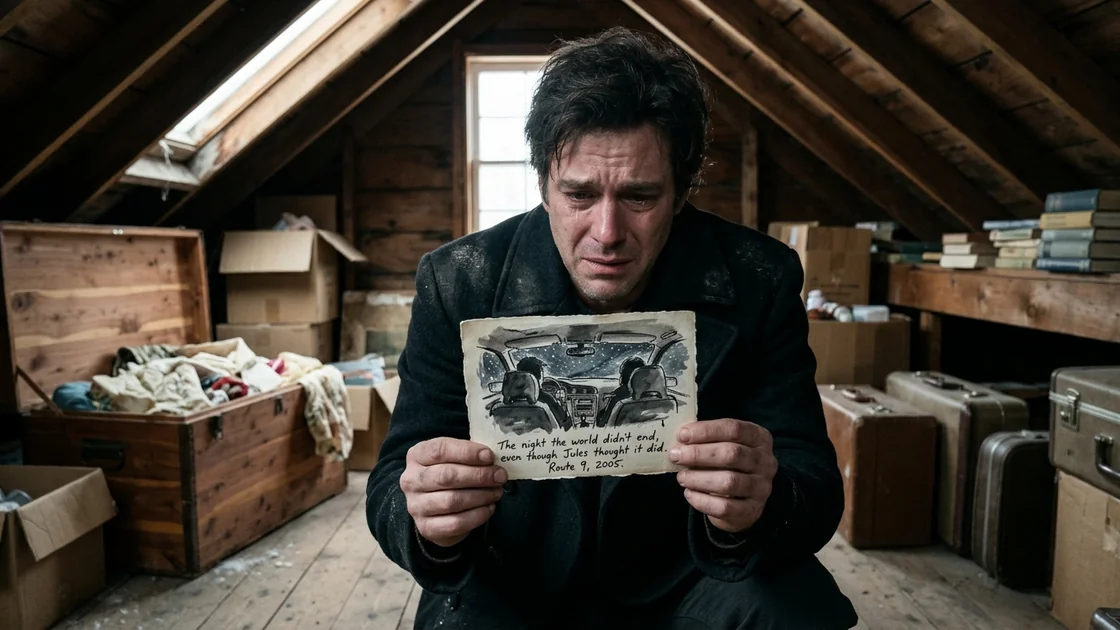
It was a small, square piece of heavy watercolor paper, no larger than an index card.
Julian held it up to the gray light.
It was a sketch, executed in walnut ink with a scratchy, uneven dip pen.
It showed the interior of a car—the dashboard of a 1997 Volvo, seen from the backseat. Outside the windshield, a storm of white ink dots raged against a black wash. In the front seats, two silhouettes were visible: a boy with his forehead against the steering wheel, and a girl looking out the side window.
Beneath the sketch, in Maya’s wild, slanted, unmistakable handwriting:
The night the world didn't end, even though Jules thought it did. Route 9, 2005.
Julian’s breath stopped.
He flipped the card over.
On the back, written in pencil, faded almost to illegibility:
You forgot me once before, Julian. Don't do it again.
Julian stared at the pencil marks.
His skin went ice-cold.
She knew.
No. That was impossible. Maya was nine years old in 2005. She wasn't even in the car.
He looked at the drawing again.
The perspective was not from the road. It was from the backseat.
In the original timeline, Maya had stayed in Greenfield with Aunt Sarah.
Had she?
Julian closed his eyes, clawing through the wreckage of his shattered memory.
Thanksgiving, 2005.
Who had been in the car when they left Amherst?
Clara. Just Clara.
Then why was there a drawing?
Because in some intermediate iteration—some timeline that had existed for three seconds while the wave function collapsed in the displacement cradle—Maya had been in the car.
Or because Maya, wherever she was in the infinite, branching geometry of the quantum foam, was an observer.
In physics, an observer is not a person with a notebook. An observer is any system that undergoes an irreversible thermodynamic transition through contact with an entangled state.
Maya had been his sister. She had loved him with the fierce, protective, mocking loyalty that only younger sisters possess. When he reached into the machinery of time to save his own miserable skin, he had not erased an abstraction; he had erased an observer who had spent thirty years watching him make a mess of his life.
Julian clutched the scrap of paper to his chest.
He began to weep—not with the soft, self-pitying sorrow of the dining room, but with the jagged, violent sobs of a man who has found a child's shoe in the ashes of a house he burned down himself.
"I'm sorry," he whispered into the rafters. "I'm so sorry, Maya."
He stood up. He tucked the small card into the breast pocket of his coat, right over his heart.
He went downstairs to the cellar.
Chapter Nine: The Price of the Hose
The palladium coils hummed as they charged.
The liquid nitrogen was whistling through the delivery tubes, frosting the copper conduits with a delicate, crystalline fur. The smell of ozone was thick enough to taste—like sucking on a dirty copper penny.
Julian stood before the console.
The setting was still there: November 24, 2005.
If he went back—if he removed the sleeve, if he took the clamps away, if he let the car freeze—what would happen?
The timeline would snap back.
Clara would sit in that car. Her toes would go numb. Her heart would turn to slag as she watched him kick the door open and walk away into the blizzard.
The eighteen years that followed would return: the cold breakfasts, the sarcastic remarks, the separate bedrooms, the slow, excruciating decay of their dignity, the appraiser coming on Thursday, the legal pad on the table, the divorce.
He would lose her.
He would lose the woman who had kissed his knuckles this morning, the woman who had made him pancakes, the woman who had looked at him with amber eyes and said, There is no one before you.
He would trade an eternity of warm mornings for an eighteen-year-old girl with ink on her fingers and an hourglass on her shoulder blade, who would eventually grow up, move to Chicago, argue with him about politics, borrow money she never repaid, and call him twice a month on Sunday evenings from a noisy apartment with three roommates.
It was an insane trade.
Any economist, any evolutionary biologist, any rational human being would look at the choice and choose Clara. Clara was his wife. She was his present. She was his life.
Maya was a memory of an adoption that had never happened, an informational ghost preserved only by a quirk of quantum hysteresis.
Julian placed his hand on the ceramic toggle.
He thought of Clara’s face this morning, her chin resting on his chest, her skin smelling of lavender and sleep.
“You proved him wrong,” she had said. “You saved me.”
Then he thought of the dock at Lake Winnipesaukee.
He thought of the summer of 2012. The loons calling across the dark water at twilight. Maya sitting on the edge of the boards, her feet trailing in the lake, her cello propped between her knees on the dock, playing the Sarabande from Bach’s Fifth Suite while the mosquitoes hummed around their ears.
She had played it badly. She had missed the shift into the third position twice, cursed under her breath, laughed, and started over.
Julian had sat on the grass with a beer in his hand, watching her.
And his father had come down from the porch, placed a hand on Maya’s head, and said, “That’s it, girl. Keep going. Don't let the music stop just because you hit a bad note.”
Julian looked at the toggle.
"The bad note," he whispered.
The mistake was not the broken car.
The mistake was believing that love was a machine that could be tuned to run without friction.
The mistake was thinking that eighteen years of Clara’s bitterness was a flaw in the system, rather than the price they paid for being two broken, frightened people who had survived the cold together.
In the world where he was a hero, he had saved Clara by killing his sister.
He had become the very thing Clara’s father had warned her about: a man who sacrificed whatever was closest to him when the frost got inside the glass.
Julian pulled the emergency release.
The lead-mesh door swung shut. The hydraulic dampeners groaned as the cradle settled into its magnetic cradle.
He set the coordinates.
Not to the road. Not to the ditch.
He set them to the engine bay of the Volvo, thirty seconds after his previous self had touched the hose.
He depressed the relay.
Chapter Ten: The Return to the Drift
The transition was worse this time.
The localized manifold was already stressed by the previous inversion; the phase space was turbulent, full of violent, non-linear harmonic feedback that tore through Julian’s nervous system like white-hot needles.
He was thrown against the asphalt.
The snow was deeper now. The blizzard had doubled its fury; the wind was driving the flakes horizontally across Route 9, blinding him instantly.
Twenty feet ahead, the headlights of the Volvo were dim, yellow tunnels in the drift.
Julian could see the two figures.
His previous, older self was already gone—already vanished back into the future of warm beds and cinnamon coffee.
The younger Julian was standing by the open hood, his face illuminated by the flashlight beam, holding Clara by the elbows.
“...I was so scared we were going to freeze,” the boy was saying.
Clara was looking at him, her face soft, her hands sliding beneath his coat.
Julian scrambled through the snowbank on his belly, ignoring the agony in his knees, the ice packing into his nostrils.
He reached the front bumper.
He slid his arm through the freezing iron of the grille.
His fingers found the silicone sleeve. It was warm from the younger Julian’s flashlight beam.
Julian caught the edge of the worm-drive clamp with his pocketknife.
He jammed the blade into the screw head and twisted.
The clamp slipped.
He pulled.
The silicone sleeve tore away with a wet, sucking sound of escaping air.
The vulcanized rubber elbow beneath it split wide open.
A sudden, violent hiss of steam erupted from the radiator neck, blowing a cloud of scalding glycol vapor through the grille into Julian’s face.
"What was that?"
Clara’s voice, sharp and terrified.
Inside the engine bay, the younger Julian jumped back, dropping the flashlight into the snow.
"Damn it!" the boy screamed. "The whole hose just let go! The whole thing split!"
Julian, lying in the ditch beneath the fender, pulled the torn sleeve into his coat, pressing his face into the freezing mud.
Above him, the voices changed.
The warmth was gone. The fragile, beautiful bridge he had built between them cracked, splintered, and fell into the dark.
"Julian," Clara cried out, her voice trembling with cold and rising anger. "You said it was fine!"
"I thought it was!" the boy shouted back, his voice cracked with frustration, fear, and wounded pride. "I don't know what happened! The rubber just disintegrated!"
"What are we going to do?" she wept. "It's twelve degrees, Julian! We're twenty miles from Northampton!"
"I'm going to walk to the station," the boy snarled, his voice hard with the petulance Julian remembered so well.
"Don't leave me!" she screamed through the blizzard. "Don't you dare leave me alone in this car!"
"I have to get a tow, Clara! Do you want to die out here? Stop acting like an anchor and let me handle it!"
The driver’s side door slammed shut with a hollow, frozen thud.
Julian lay in the snow, listening to the crunch of his younger self’s boots receding down the shoulder of Route 9, heading east toward the Mobil station, toward the payphone, toward the call that would wake Arthur Vance from his sleep in Concord.
He turned his head.
Through the low side window of the car, he could see Clara.
She was huddled in the passenger seat, her knees pulled up to her chest, her face buried in the coarse wool of her coat. Her shoulders were shaking with silent, ragged sobs.
Julian reached through the darkness. His bare, frostbitten fingers touched the cold steel of the rear quarter-panel.
"I'm sorry," he whispered against the metal. "I have to let you freeze. I have to let you hate me."
The anchor line in his chest went taut.
The timeline, violent and unyielding as a snapped steel cable, pulled him backward into the void.
Chapter Eleven: The Radiator Hisses
The clanking was the first thing that returned.
Clank. Clank. Hiss.
Metallic. Dry. Relentless.
Julian opened his eyes.
He was sitting at the mahogany dining table in the Brookline brownstone.
The air was cold. The steam from the radiator was clouding the lower third of the tall bay windows, obscuring the dead branches of the maples along the street.
Across from him, Clara was peeling an orange with her small, serrated paring knife.
The peel was curling onto the napkin in a single, pale ribbon.
She did not look at him.
Her mouth was bracketed by the deep, vertical lines he had known for twenty years. Her eyes were stagnant harbor water under an overcast sky.
"The appraiser is coming at two on Thursday," she said. Her voice was level, scrubbed clean of anger, flat with the finality of a stone laid over a well. "He said three days for the formal valuation. Then we can sign the listing agreement."
Julian sat in the chair.
His clothes were dry, but his bones felt like they had been soaked in brine and left out on a winter ledge. His chest ached with a hollow, physical hunger that made it difficult to draw breath.
He looked at her.
He looked at the graying hair at her temples, the dry skin on her knuckles, the tired, beautiful, ruined face of the woman who had spent eighteen years surviving him.
He did not argue. He did not suggest dividing the floors. He did not mention the basement apartment.
"Okay," Julian said softly.
Clara’s knife paused. She looked up, surprised by the absence of his resistance. For a fraction of a second, something human and bewildered flickered behind her eyes, then vanished behind the gray wall of her habit.
"Okay?" she repeated.
"We'll sell the house," Julian said. "You take the South End place. With the clean walls. You deserve clean walls, Clara."
She stared at him, her lips slightly parted. She didn't know what to do with his surrender; she had prepared for a siege, and he had opened the gates.
Before she could speak, Julian’s phone buzzed on the wood between them.
It was not an email from the department.
It was a text message.
Julian looked down at the illuminated glass.
Maya [11:14 AM]: > Jules, if you don't tell Mom to stop sending me clippings about the housing market in Worcester I’m going to change my name and move to Idaho. Call me when you're done brooding.
Julian stared at the screen.
The name was there. Four letters. M-a-y-a.
He reached out with a trembling thumb and tapped the screen, opening the contact card.
There was a photo.
A girl with a wild nest of dark hair, wearing an absurd sailor cap, sticking her tongue out at the camera from the bow of a canoe on Lake Winnipesaukee. In the background, the water was dark blue, the sky was bright, and the mountains were green.
Julian raised his phone to his face.
He pressed the glass against his cheek, feeling the small, cold square of the screen against his skin.
"Julian?" Clara asked. The irritation was back in her voice, but beneath it was that old, familiar thread of concern she couldn't quite extinguish. "Who is that?"
Julian looked up at her through his tears.
He smiled—a broken, ruined, infinitely grateful smile that frightened her more than any shout ever had.
"It's my sister," Julian said. "She needs me to call her back."
He stood up from the table, left his coat on the chair, and walked toward the hallway stairs, leaving Clara alone with her orange and the quiet, persistent clanking of the iron pipes.