The Architecture of a Lie
This is the story of Eleanor Vance, a woman whose fierce and possessive love for her young son drove her to systematically invent allegations of abuse and neglect against her former husband, David. Through carefully staged photographs, rehearsed testimonies, and manipulated child-welfare reports, Eleanor successfully stripped David of all parental rights, celebrating her total victory in family court as an act of maternal salvation. Decades later, as Eleanor watches her adult son Julian drift through life as an emotionally paralyzed, hyper-vigilant phantom incapable of intimacy or peace, the fortress of self-justification she built begins to collapse. In uncovering the long-buried truth and witnessing the irreversible psychological ruin she inflicted on the child she sought to keep entirely for herself, Eleanor is forced to confront the monstrous nature of her triumph and the quiet, permanent tragedy of an alienated life.
Part One: The Salt in the Foundation
The house on Blackwood Lane smelled perpetually of dried lavender, lemon oil, and old plaster. It was a sturdy, narrow-hipped Victorian in coastal Massachusetts, painted the color of wet slate, with windows that rattled whenever the November gale blew off the bay. Eleanor Vance had lived in it for forty-one years. She had lived in it as a bride, briefly and restlessly; she had lived in it as a victor; and now she lived in it as a curator of silence.
Every morning began the same way. At six o'clock, before the sun cleared the scrub pines at the edge of the dunes, Eleanor descended the stairs, her wool slippers whispering against the pine risers. She filled the copper kettle, placed it over the blue ring of the gas flame, and wiped down the soapstone counter with a damp linen rag. She was seventy-two years old, her hands dry and map-veined, but her posture remained as rigid as an iron rod. People in town still commented on it—how Eleanor Vance held herself, how she had weathered the dreadful scandal of her youth without bowing, how she had raised that poor, fragile boy all on her own.
"A saint," Mrs. Corcoran at the post office had called her thirty years ago. "A mother lion."
Eleanor had accepted the praise then with downcast eyes and a modest dip of her chin, feeling the warm, narcotic surge of righteous purpose. She had saved Julian. That was the narrative, etched into stone and sealed with court orders, notarized affidavits, and psychological evaluations. She had plucked her sweet, sensitive five-year-old boy from the path of an erratic, dangerous man.
Except that on this Tuesday in late autumn, Eleanor stood by the window watching the mist hang over the dormant hydrangeas, and for the first time in ten thousand days, she could not make the narrative hold its shape.
Julian was coming down the stairs.
His steps were unmistakable: slow, hesitant, deliberately soft. Julian was thirty-six years old, six feet tall, with wide shoulders that curved inward as if trying to fold into an invisible crease in the air. When he reached the kitchen threshold, he stopped, lingering in the frame, waiting for an implicit cue that he was permitted to occupy space.
"Good morning, sweetheart," Eleanor said, turning with a practiced, luminous smile.
"Morning, Mom." His voice was low, pitched to an apologetic murmur. He wore a faded gray henley and corduroy trousers that hung loose from his hips. He looked at the floor three inches in front of her slippers, then across to the stove, then out the window—everywhere except directly into her eyes. It was a habit he had never broken, a perpetual scanning for sudden atmospheric shifts, for the hidden trapdoors of adult rage.
"Tea is almost ready. Earl Grey? Or would you prefer peppermint?"
"Earl Grey is fine. Thanks." Julian moved to the small oak table in the breakfast nook and pulled out the chair with surgical care, ensuring the wooden legs did not scrape the linoleum. He sat, hands folded between his knees, his shoulders hunched toward his ears.
Eleanor watched him as she poured the boiling water into the earthenware pot. She noticed the gray threads at his temples, the faint fretwork of lines around his mouth, but most of all she noticed the stillness. Julian’s stillness was not peace; it was the stillness of a field mouse beneath the shadow of a hawk. It was a state of permanent, bone-deep readiness for catastrophe.
"Did you sleep well?" she asked, setting a mug before him.
"I slept," he replied. He did not say yes. He rarely offered affirmative answers about his own comfort or desires. He existed in the conditional tense.
"The wind was dreadful around three," Eleanor remarked, sitting opposite him. "Rattled the storm sashes on the north side. I thought about checking the attic, but I knew you'd look at it later."
"I'll go up after breakfast," Julian said quickly, as if accepting an assignment that might spare him a reprimand. "I can secure the latches."
"There’s no hurry, Julian. Drink your tea."
He took a sip. His fingers were long and slender, the skin around the cuticles bitten raw. They were David’s hands. For thirty years, Eleanor had looked at those hands and felt a sharp, defensive thrill of possession—he has his father’s hands, but his soul is mine. Now, the sight of them made a dull ache blossom behind her sternum.
"Julian," she said, her voice dropping into the intimate, conspiratorial register they had shared since he was a child. "Are you feeling all right about tonight? Dr. Mercer’s dinner?"
Julian’s throat bobbed as he swallowed. He set the mug down in its saucer with exacting precision. "I called his secretary yesterday. I told her I couldn't make it."
Eleanor’s eyebrows knit together in mild, sorrowful reproach. "Oh, darling. Again? Dr. Mercer was so eager to talk to you about the archival project at the historical society. It’s a wonderful opportunity. Only four hours a week, very quiet work. It would get you out of the house."
"I know," Julian murmured. "I just... I woke up yesterday with that tightness in my ribs. You know how it gets. Like there’s a strap pulled around my chest. I didn't want to make a scene or have to leave in the middle of dinner."
"You wouldn't make a scene. You never make a scene."
"I make people uncomfortable, Mom," he said, his tone entirely flat, devoid of self-pity, stating it as an indisputable law of physics. "I don't know what to say to them. Mercer will ask about my research, and I’ll stumble, and then he’ll ask about why I left Boston, and..." He trailed off, his gaze drifting back to the window, where the gray fog was slowly dissolving into cold rain. "It’s better if I don't go. It’s safer."
Safer.
The word hung between them, heavy and stale. For thirty years, safety had been Eleanor’s currency, the banner under which every border had been drawn, every letter intercepted, every relationship severed. She had taught Julian the world was a jagged, predatory place, full of sudden cruelty and betrayal, and that only here, within the perimeter of her vigilance, could he survive.
She had succeeded. He was safe. He had never been arrested; he had never touched drugs; he had never been in a bar fight. He did not drink. He had never married. He had never lived more than fifty miles away, and when his brief, faltering attempt at a master's degree in library science in Boston had collapsed four years ago under the weight of panic attacks and agoraphobia, he had returned home like a dog creeping back into its kennel.
He was safe, and he was completely, utterly dead inside.
Eleanor reached across the table to touch his wrist, but as her fingers brushed his skin, Julian flinched—a tiny, involuntary micro-movement, barely half an inch, but it struck Eleanor like a slap. He caught himself immediately, forcing his arm to remain still, offering a weak, guilty grimace.
"Sorry," he whispered.
"Don't apologize," Eleanor said, withdrawing her hand. Her heart thudded unsteadily against her ribs. "You never have to apologize to me."
Julian looked down at his tea. "I think I’ll go check that latch in the attic now."
He rose, his tea half-drunk, and walked out of the kitchen with that same soundless, apologetic tread. Eleanor remained seated, her hands resting flat against the cool wood of the table, listening to the floorboards creak above her head as her son climbed toward the rafters.
Part Two: The Art of the Scalpel
It had begun not with hatred, but with an insufferable, suffocating jealousy.
In the spring of 1991, Eleanor and David Miller had reached the brittle end of their seven-year marriage. David was an illustrator—a man of soft linen shirts, ink-stained thumbnails, and a chaotic, sprawling warmth that Eleanor had found intoxicating in her twenties and unbearable in her thirties. He worked from a converted shed behind the house, surrounded by pots of turpentine, stacks of heavy rag paper, and jars of dried seedpods. He was not a practical man; he forgot to pay the water bill, he let the lawn grow until dandelion fluff drifted into the kitchen, and he listened to scratchy recordings of Bach while lying on the floor with his eyes shut.
Eleanor was a high school history teacher, a creature of schedules, lesson plans, and immaculate domestic order. She wanted life to proceed in neat, legible chapters.
When Julian was born, the balance of the house did not simply tip; it shattered. Eleanor had expected to be the center of the boy's universe. She had carried him, endured thirty-two hours of agonizing labor, and nursed him through colic and ear infections. But Julian, from the moment he could crawl, had been magnetically drawn to his father.
David did not teach Julian; he played with him. He let Julian paint with his fingers directly onto the studio walls. He took him down to the tidal flats at low tide, digging for razor clams and making up elaborate mythologies about the sea-kings who lived beneath the sand. When Julian was three, Eleanor would stand at the kitchen window and watch them in the yard: David spinning the boy around until both of them collapsed in the clover, Julian shrieking with a pure, ecstatic joy that he never, ever exhibited in Eleanor’s tidy, quiet presence.
With Eleanor, Julian was obedient, polite, and cautious. With David, he was alive.
The realization had tasted like copper in Eleanor's mouth. Every laugh Julian shared with his father felt like an active subtraction from Eleanor’s ledger. She began to keep count. If David took Julian for ice cream after preschool without asking her, it was an infraction. If Julian cried for his father when he scraped his knee instead of running to her, it was an indictment of David’s corrupting influence.
When the divorce became inevitable—precipitated by endless, grinding arguments about money, responsibility, and the fundamental incompatibility of their spirits—the mediator had suggested joint physical custody.
"Julian needs both of you," the mediator, a mild-mannered woman named Mrs. Fales, had said, looking over her half-moon spectacles. "David is flexible with his work. Alternating weeks, or a three-four split, would provide Julian with consistent contact with both parents."
"Alternating weeks?" Eleanor had repeated the phrase as if it were a proposed act of biological mutilation. "He is five years old. He needs a primary home. He needs routine."
"He needs his father, Eleanor," David had said gently across the mahogany table. He looked tired, his eyes bruised with sleeplessness, but his voice was steady. "I’m not trying to take him from you. I just want to raise my son. I want to be there for his mornings, his school days. Not just every other weekend like some visiting uncle."
Eleanor had looked at David’s calm, open face, at the small silver buckle of his watch, and something deep within her—some cold, ancient mechanism of territorial survival—had locked into place.
No, she had thought. You will not have half of him. You will not have him at all.
The legal system, Eleanor quickly discovered, was an instrument with very specific acoustic properties. It did not respond well to complaints about unwashed dishes or artistic irresponsibility. The family court was overburdened, cynical, and terrified of making a mistake that might end up on the front page of the regional newspaper. To move the machinery of the court, one did not need proof beyond a reasonable doubt; one merely needed to introduce an intolerable suspicion.
She had begun with the language of modern clinical anxiety.
In her meetings with the court-appointed custody evaluator, Eleanor never raised her voice. She presented herself as a heartbroken, reasonable woman who desperately wished things were different.
"I want David to be in Julian's life," she had told Dr. Catherine Lowenstein, leaning forward in the sterile office, her hands clasped tightly over her purse. "Truly, I do. But Julian has been... different lately. After he comes back from David's apartment."
"Different how, Eleanor?" Lowenstein had asked, pen poised over her legal pad.
"He's regressed. He’s wetting the bed again. And he’s so fearful." She paused, letting her lower lip tremble just enough to suggest profound distress mastered by sheer willpower. "He told me something last week. I didn't want to believe it. I tried to dismiss it, Dr. Lowenstein, I really did. I know David has a temper, but I never thought..."
"What did he tell you?"
"He said Daddy locks him in the dark room when he cries. Where David keeps his photographic chemicals."
It was a lie, but it was a lie constructed from slivers of truth. David did have a small darkroom in his rented flat in Gloucester, and he did tell Julian never to go in there because the fixer and developer were toxic. Eleanor had taken that ordinary parental boundary, turned it inside out, and planted the seed in Julian’s receptive, pliable mind.
"Julian," she had whispered to the boy three nights earlier, kneeling beside his bed in the dim glow of the turtle nightlight. "Did Daddy leave you alone in the dark room? It’s okay to tell Mommy. You don't have to protect him. Was it scary when he shut the door?"
"I don't... I wasn't in the dark," the five-year-old had said, his small brow furrowed in confusion, his fingers clutching his stuffed rabbit.
"You can tell me, darling. Mommy knows you were scared. It’s okay to admit it. Did the door lock? Did you cry?"
She had asked the questions over and over, night after night, wrapping the interrogation in coos of sympathy, stroking his hair, weeping softly until the child, desperate to comfort his distraught mother and resolve the bewildering emotional pressure in the room, finally nodded.
"Yes," the boy had whispered, not knowing what he was confessing, knowing only that when he said yes, his mother finally stopped crying and wrapped him in a fierce, suffocating embrace.
"My brave boy," she had sobbed into his neck. "My poor, brave boy."
Once the seed took root, Eleanor cultivated it with the methodical discipline of an agronomist.
There was the bruise on Julian’s lower back. It had happened at the public playground on a Saturday afternoon when Julian slipped from the rungs of the jungle gym while Eleanor was looking down at her book. It was a purplish, coin-sized contusion. When David brought Julian back from his scheduled Sunday visitation the following day, Eleanor waited until Monday morning to bring the boy to the pediatrician.
"I found this during his bath last night," she told the doctor, her voice a hushed, terrified whisper while Julian sat on the examination table, swinging his bare legs. "David had him all weekend. When I asked Julian how it happened, he became hysterical. He said Daddy was angry because he spilled his juice."
Julian hadn't said that. Eleanor had spent Sunday night coaching him, rehearsing the narrative until the child could no longer distinguish between the memory of the playground gravel and the phantom memory of his father’s gripping fingers.
"Julian, remember what you told Mommy about the juice?" Eleanor had said softly in the doctor's presence.
Julian had frozen. He looked at the doctor, then at his mother's pleading, desperate eyes. "I spilled it," he whispered, his chin trembling. "Daddy was mad."
The pediatrician had frowned, noted the hematoma, and made the call required by state law.
The Department of Social Services opened an intake file. David was stunned, indignant, furious—and his fury was precisely what Eleanor needed. When a social worker visited David’s flat unannounced, David had lost his temper, shouting about a witch hunt, pacing the room, his eyes wild with the frantic impotence of an innocent man caught in an invisible web. The social worker noted in her assessment: Father exhibited extreme emotional volatility, poor impulse control, and hostility toward child protective protocols.
Eleanor kept a journal. She filled three spiral notebooks with fabricated entries, dating back two years. She wrote of David’s alleged blackouts, his sudden bursts of violence toward household objects, his muttered threats. She wrote with exquisite literary detail, capturing the texture of an escalating domestic nightmare that had never occurred. When her lawyer, a merciless family-court technician named Harold Briggs, introduced the journals into evidence during the custody hearing, David’s attorney had been utterly outmatched.
David had taken the stand. Eleanor remembered that afternoon with crystalline clarity: the gray linoleum of Courtroom 3B, the smell of dust and floor wax, the hum of the fluorescent fixtures.
David had looked at Eleanor from the witness box, his face hollow, his eyes sunken from weeks of sleeplessness and panic.
"Eleanor, why are you doing this?" he had pleaded, his voice breaking, ignoring his lawyer’s frantic hand gestures. "She’s lying, Your Honor! I have never laid a hand on my son! I have never locked him in a room! Julian is my life! Why are you letting her do this to us?"
"Mr. Miller," the judge, a severe woman with silver hair, had warned, "you will address the court, not the petitioner."
"She’s poisoning him!" David cried, tears finally spilling down his cheeks. "Can’t you see what she's doing? She’s rewriting his mind!"
To the court, it was not the anguish of a father being stripped of his child; it was the unhinged display of an abusive personality losing control of his victim. Harold Briggs had dismantled him on cross-examination, using David’s own passionate outbursts, his bohemian lifestyle, and the clinical reports of Julian’s "fear-induced behavioral regression" to paint a portrait of an unstable, potentially dangerous man.
The final blow had been the supervised visitation report.
After two months of suspension, David had been granted two hours of supervised visitation per week at a state-run facility in Salem. The room was sterile, equipped with one-way mirrors and plastic toys bolted to the floor. When David entered, his arms outstretched, weeping with relief, Julian had backed into the corner, pressing himself against the social worker’s leg.
Eleanor had spent the entire car ride to the facility preparing Julian.
"Remember, sweetheart, the guards are there to keep you safe," she had told him, checking his seatbelt three times, her hands shaking with simulated terror. "If Daddy gets that scary look in his eyes, you don't have to go near him. You just tell the lady you want Mommy. Mommy is waiting right outside in the car. I won't let him hurt you ever again."
By the time Julian walked into that room, he was so saturated with his mother's manufactured terror that his father did not look like a father; he looked like a monster wearing a familiar face. When David knelt down and reached out to touch Julian's hair, Julian let out a piercing, animal shriek and threw up his hands to protect his face.
The monitor wrote: Child demonstrated severe trauma response upon physical proximity of the father. Visitation terminated prematurely due to acute distress of the minor.
Two weeks later, the judge signed the permanent decree. Sole legal and physical custody to Eleanor Vance. David Miller’s visitation rights were suspended indefinitely, contingent upon his completion of an extensive psychological rehabilitation program and a risk assessment that David, broke and emotionally shattered, could never afford to satisfy.
When Eleanor walked out of the courthouse that bright October afternoon in 1992, holding Julian’s small, sticky hand in hers, she had felt an exhilarating, godlike rush of triumph. She had won. She had beaten David Miller. She had scrubbed him out of the boy's life like an oil stain from a white linen shirt.
Julian was hers. Wholly, exclusively, eternally hers.
Part Three: The Mold in the Walls
The victory did not stay sweet for long; it merely became normal, and then it became heavy.
In the years that followed, Eleanor waited for Julian to revert to the vibrant, giggling child he had been before the divorce. She bought him every wooden train set, every watercolor box, every book of adventure stories he glanced at. She enrolled him in piano lessons, took him on trips to the White Mountains, made his favorite blueberry pancakes every Saturday morning.
"We’re a team, Jules," she would tell him, smoothing his dark hair back from his forehead as they sat by the hearth. "Just you and me against the world."
Julian would nod, his mouth curling into a small, dutiful smile. "A team."
But the boy did not become vibrant. Instead, the shadow that had fallen over him during the custody battle lengthened and settled into his marrow.
He developed rituals. Before he could go to sleep, he had to check the locks on the front and back doors four times. He would stand on his tiptoes, his hand turning the brass deadbolt back and forth, listening for the metallic click. If Eleanor tried to stop him, to tell him that everything was safe, Julian’s breathing would turn shallow and ragged, his eyes darting toward the dark hallway.
"He could have a key," Julian whispered one night when he was eight years old.
"Who, darling?"
"The bad man."
Julian had stopped calling him Daddy around the time he turned seven. Eleanor had felt a vicious thrill the first time Julian used the phrase the bad man, feeling that her narrative had finally replaced all memory. But now, seeing the terror in Julian’s small, pale face, the thrill curdled.
"He doesn't have a key, Julian. He’s far away. He can never come here."
"Are you sure?" Julian’s voice was cracked with exhaustion. "Are you really sure, Mom? What if he’s hiding in the rhododendrons? What if he’s waiting for you to go to the grocery store?"
Julian became terrified of Eleanor leaving the house. If she was ten minutes late returning from school, she would find him sitting on the bottom step of the porch, clutching a kitchen knife by the blade, his palms bleeding from the pressure, waiting to defend the empty house against a phantom.
She had tried therapy. She took him to child psychologists, but the sessions were disastrous. Julian refused to speak. He sat on the sofa with his knees pulled up to his chin, staring at the carpet, his silence an impenetrable shield. When the therapists asked about his father, Julian’s heart rate would spike until his nose began to bleed.
"He is suffering from severe developmental trauma," one specialist, a Dr. Aris Thorne, had told Eleanor in the hall while Julian waited in the lobby. "Children who have experienced profound domestic terror often internalize the threat. He believes that the world is inherently predatory, and worse, Mrs. Vance, he believes that he is the reason the bad things happened."
"Why would he believe that?" Eleanor asked, genuine indignation in her voice. "I have told him every single day that none of this was his fault! I tell him he is loved!"
"Because children are egocentric, Mrs. Vance," Dr. Thorne replied softly, his eyes searching hers with an intensity she found deeply uncomfortable. "If a father is monstrous, the child concludes that he must be monstrous too, or that his very existence invites destruction. He has learned that attachment equals catastrophe. Until he can process the reality of his father—until he can integrate that relationship—he will remain trapped in this defensive posture."
Eleanor never brought Julian back to Dr. Thorne. She told herself the man was a fraud, an apologist for abusers who wanted to blame the mother for the father’s sins.
David tried, for three years, to reach across the gulf.
Letters arrived in the mail. Thick envelopes addressed in David’s loose, sloping handwriting: For Julian, on his 6th birthday. For Julian, on his 7th birthday. For Julian, Christmas 1993.
Eleanor did not open them. She took them to the woodstove in the cellar, dropped them onto the coals, and watched the heavy paper curl and blacken, the graphite pencil sketches of foxes and dragons that David had drawn on the back of the envelopes dissolving into gray ash.
Once, when Julian was nine, David had appeared at the edge of the schoolyard.
It was a crisp afternoon in October. Eleanor was waiting in her station wagon across the street when she saw him: David, wearing an old tweed coat, his hair longer and peppered with gray, standing near the chain-link fence by the swing sets. He wasn't approaching; he was just standing there, his hands in his pockets, watching the children run.
Julian was on the swings. He hadn't noticed his father yet. He was pumping his legs, rising into the cold air, his face completely blank.
David stepped toward the fence. "Julian," he called.
It was not a shout. It was barely louder than a whisper, but Julian heard it. The boy looked down.
Eleanor threw open the car door, her heart hammering with panic and fury. "Julian! Get away from him!" she screamed, running across the asphalt, her boots slamming down with the force of an executioner's gavel. "Get away! Help! Someone call the police!"
Julian didn't run to his father. He didn't run to Eleanor.
He simply fell out of the swing. He didn't try to catch himself; he hit the cedar mulch with a sickening thud, his arm twisting beneath his ribcage, and lay there, entirely limp, his eyes wide and fixed on the sky.
David had backed away, horrified, his hands raised in surrender. "Julian! Eleanor, please, I just wanted to see his face—I just wanted him to know—"
"Get out of here or I’ll have you killed!" Eleanor had shrieked, an animal howl that startled the playground aides and caused half a dozen mothers to gather their children in terror. "Get away from my son!"
By the time the police cruiser arrived, its siren whooping through the quiet residential streets, David was gone. Julian had a dislocated elbow. He did not cry while the paramedics reset it at the hospital. He didn't make a single sound. He stared at the white acoustic ceiling tiles with an eerie, petrified composure that frightened the nurses far more than tears would have.
"Did you see him?" Eleanor had whispered by his bedside that night, stroking his forehead, her voice trembling with synthetic horror. "You saw how he came for you? But Mommy was there. Mommy stopped him. I will always stop him, Julian. You never have to be afraid while I’m alive."
Julian had turned his head slowly on the pillow. His eyes, dark and dead as stagnant water, met hers.
"Why does he want to hurt me?" the nine-year-old asked.
The question had pierced straight through Eleanor's chest, cold and clean.
"He doesn't... he doesn't know how to love properly," she had answered after a long, ragged hesitation. "Some people are broken inside, Julian. When they see something pure and good, they want to break it too."
"Like me?" Julian asked. "Am I broken?"
"No, darling. You are whole. You are my perfect boy."
Julian had closed his eyes. "I think I’m broken, Mom. I can feel the cracks."
Part Four: The Ghost in the Mirror
In his adolescence, Julian Miller did not rebel. He did not slam doors, he did not blast music, he did not experiment with alcohol, and he did not look at girls. Rebellion requires energy; it requires a baseline belief that one has a self worth asserting against the authority of another. Julian had no such belief.
He moved through high school like an apparition. He was brilliant in a narrow, archival way, earning straight A's in history, English, and Latin, but his teachers' reports were uniformly haunted by the same phrase: Julian is remarkably capable, but seems utterly absent.
He had no friends. When boys from the track team invited him to join them, Julian would make an excuse—an appointment, a chore, a migraine—and hurry straight home to Blackwood Lane. He spent his afternoons in his bedroom, constructing miniature historical dioramas out of balsa wood, cardboard, and acrylic paint. They were masterpieces of obsessive, microscopic precision: the ruins of Pompeii, the trenches of the Somme, the monastic library of St. Gall.
Eleanor would sit in the doorway of his room, knitting a sweater, watching him work with fine-tipped tweezers.
"You have such a gift, Julian," she would say. "You could be an architect."
"Architects build things that people live in," Julian had said without looking up from a millimeter-scale ruin. "These are just places where things used to be."
When he turned eighteen, David Miller died.
It was not a dramatic death. There was no confrontation, no deathbed reckoning. David had moved to Maine, to a dilapidated farmhouse outside Bangor, where he lived on commercial illustration commissions and odd carpentry jobs. He had developed pneumonia in late December, neglected it, and died in an underheated county hospital bed with an unpaid bar tab and twenty boxes of unsold sketchbooks in his kitchen.
The notice had come in a letter from an executor, an attorney in Bangor who was trying to settle David’s negligible estate.
Eleanor had intercepted the letter, as she had intercepted every other piece of mail from Maine for eight years. She had stood over the kitchen sink, reading the brief, dry lines: David Miller, deceased December 14, 1999... survived by one son, Julian Vance Miller... estate debts exceed liquid assets...
For three days, she kept the secret. She walked through the house feeling an astonishing, dizzying lightness. The threat was gone. The monster was dead. The lie was now permanent, safe, unchallengeable. David would never stand on a witness stand again. He would never hire a lawyer to reopen the visitation decree. He would never whisper his version of the past into Julian’s ear. She had won completely; the board had been cleared.
On the fourth day, she told Julian.
She chose dinner time. She made a pot roast, his favorite, and waited until he had cleared his plate.
"Julian," she said, her voice weighted with solemn, rehearsed gravity. "I received some news today from Maine."
Julian stopped, his water glass halfway to his mouth. "Maine?"
"Your father passed away last week."
Julian did not move. He did not set the glass down; he simply held it in midair, his knuckles whitening. The grandfather clock in the dining room ticked four times before he spoke.
"How?"
"Pneumonia," Eleanor said, touching her linen napkin to her lips. "He was living alone. He... well, it seems his life remained quite disorganized to the end. I’m sorry, sweetheart. I know how complicated these feelings must be for you."
Julian slowly lowered the glass to the table. He did not cry. He did not gasp. He looked at Eleanor with a terrifying, vacant stillness.
"He's dead?" he asked.
"Yes."
"So he can’t come here anymore."
Eleanor blinked, taken aback by the clinical simplicity of the sentence. "No, darling. He can never come here again. You are entirely safe now."
Julian stood up from the table. He didn't clear his dishes—the first time in ten years he had failed to perform that domestic duty. He walked into the living room, stood in the center of the braided rug, and looked at his hands.
Eleanor followed him, her heart fluttering with a sudden, unexpected panic. This was not the reaction she had scripted. She had expected tears, perhaps a release of long-held dread, followed by a tearful embrace in which he thanked her for keeping him alive through the danger.
"Julian?"
"I don't feel anything," Julian whispered. He was looking at his right hand, turning it over, examining the palm, the knuckles, the wrist. "There's nothing there. It's like... like someone told me a house on another planet burned down."
"That’s shock, darling," Eleanor said, stepping toward him, reaching out to wrap her arms around his waist. "It’s completely normal. You carried so much terror of that man for so long. It will take time for your nervous system to understand that the war is over."
Julian let her hold him. He did not wrap his arms around her back; he let his arms hang limp at his sides, like a coat draped over a wooden post.
"The war isn't over, Mom," he said softly into the quiet room. "The war was never with him."
"What do you mean?"
"I don't know," Julian said, his voice trailing into a whisper. "I don't know who I’ve been fighting."
Part Five: The Scent of Turpentine
The attic stairs were narrow, uninsulated, and smelled of dry cedar and dusty paper.
When Julian finished securing the window latch against the northeaster, he did not come back down immediately. Eleanor, sitting in the kitchen with her cold tea, could hear his footsteps moving slowly across the subfloor above. He was pacing—ten steps forward, a long pause, ten steps back.
The house had belonged to Eleanor’s parents, but after David was expelled in 1992, Eleanor had cleared every trace of him from the living spaces and banished his remaining effects to the far eaves of the attic, behind the Victorian steamer trunks and the stacks of National Geographic magazines. She had intended to throw them away, to take them to the municipal dump and watch them disappear into the compactor. But something—some residual, superstitious dread, or perhaps the subconscious realization that destroyed evidence can never be used to verify one’s own innocence—had stayed her hand.
She stood up from the kitchen table, her knees clicking in the silent house, and walked to the foot of the attic stairs.
"Julian?" she called softly.
There was no answer, only the muffled sound of a cardboard box sliding across the floorboards.
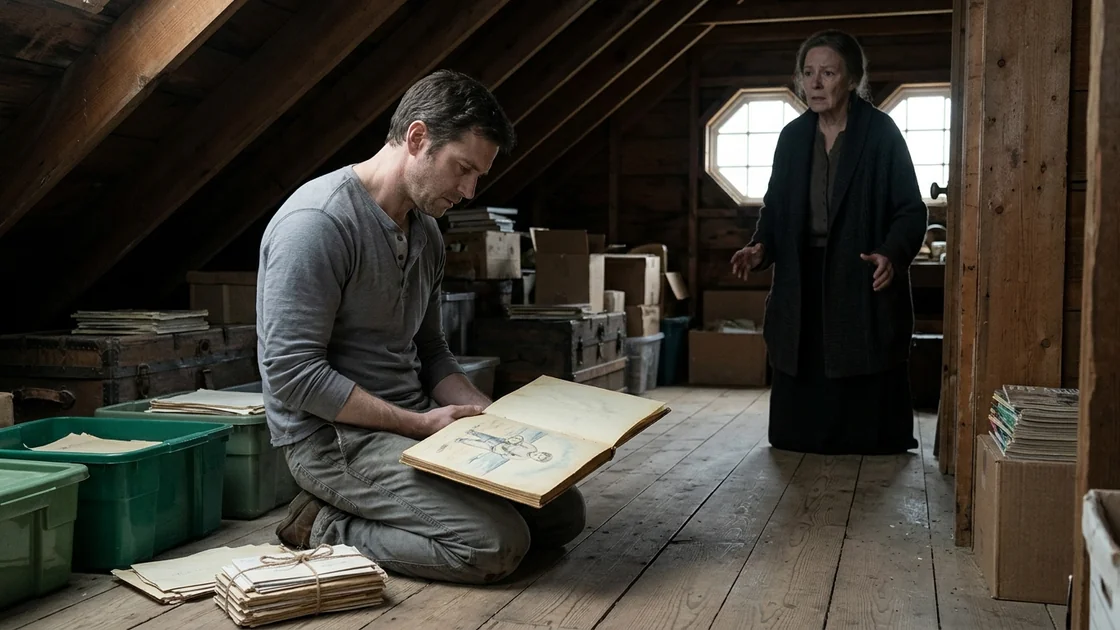
Eleanor climbed the stairs. Each step felt strangely heavy, as if the air were thickening with every foot of altitude. When she reached the attic landing, she found Julian kneeling beneath the sloping rafters, where the daylight from the small octagonal gable window fell across the floor in a pale, dusty beam.
He had dragged three green plastic storage tubs out from beneath the eaves. One of them was open.
In his hands, Julian held a sketchpad.
Eleanor’s breath caught in her throat. Her hand instinctively reached out to grab the rough pine doorframe to steady herself.
"Julian," she said, her voice sharper than she intended. "What are you doing up here? It’s freezing."
Julian did not look up. He was turning the pages of the sketchpad with slow, reverent fingers. The paper was heavy, off-white Arches watercolor stock, its edges yellowed by thirty years of attic heat and winter damp.
"I found these," Julian said.
"Those are just old things from the divorce," Eleanor said, stepping onto the floorboards, trying to keep her tone casual, maternal, dismissive. "I thought I threw all of that out years ago. Come downstairs, sweetheart. I’ll make some hot cider."
"Look at this, Mom," Julian said.
He held the sketchpad up toward the light.
It was a drawing of a boy. A boy of four, sitting on the shoulders of a tall, lean man with wild hair and ink-stained sleeves. The man was laughing, his mouth wide and uninhibited, his head thrown back against a sky filled with soaring gulls. The boy on his shoulders was clinging to the man's hair, his face illuminated with a delight so radiant, so completely unguarded, that it looked like an illustration from a fairy tale about a world before the fall of man.
Beneath the drawing, in David’s loose, beautiful hand, was written: Julian at Wingaersheek Beach. July 14, 1990. The king of the sandcastles.
Eleanor felt the room tilt slightly. "Julian, please. Don't look at those. You know how sick he was. You know he had... an unhealthy obsession with presenting things as normal."
Julian didn't lower the pad. He turned another page.
This one was a series of quick, gesture sketches: Julian sleeping with his mouth open, his small hand curled around an acorn; Julian crying over a broken toy boat, with David’s hand sketched in the margin, offering a tube of glue and a strip of balsa; Julian eating an orange, the juice running down his wrists, David's hand reaching in with a napkin, drawn with exquisite, heartbreaking tenderness.
There were hundreds of them. A visual chronicle of a child's first five years, recorded not with the detached lens of a camera, but with the painstaking, worshipful devotion of an artist who loved every hair on that child's head.
"He drew these," Julian whispered.
"David was an illustrator," Eleanor said, her voice tightening. "That was his profession. It didn't mean he was a good father, Julian. Abusive people can be very talented. They can mimic love very effectively."
Julian slowly set the sketchpad down on his lap. He reached into the green tub and pulled out a bundle of envelopes tied together with hairy jute twine.
Eleanor’s stomach dropped into a bottomless, icy pit.
She had forgotten about the letters. She hadn't burned all of them. In 1995, after the second court hearing, David’s lawyer had sent a formal packet containing dozens of letters David had written during the period of supervised visitation—letters the court monitor had refused to deliver because Eleanor’s attorney had argued they contained "manipulative psychological subversion." Harold Briggs had sent the packet to Eleanor after the decree was finalized, along with the final billing statement. Eleanor had shoved the whole manila envelope into the green tub and never looked at it again.
"He wrote to me," Julian said. He wasn't yelling. He wasn't crying. His voice was terrifyingly level, the voice of a man reading the coordinates of a shipwreck.
"Julian, stop," Eleanor ordered, taking two quick steps toward him, her hands outstretched to snatch the bundle. "Give those to me. You are not well enough to handle this."
Julian did not pull away, but he turned his head and looked at her.
The look stopped Eleanor dead in her tracks.
It was not the cowed, frightened look of the boy who checked the deadbolts four times. It was not the vague, dissociated stare of the man who couldn't attend a dinner party. It was the gaze of a stranger looking through a pane of dirty glass at an insect.
"I opened one," Julian said softly.
Eleanor’s heart was hammering so hard she could hear the pulse whistling in her ears. "Julian, you don't understand the legal context—"
"It was dated November 12, 1992," Julian continued, ignoring her completely. "My sixth birthday. He said he went to the toy store in Beverly and bought the red fire truck I wanted. The one with the brass bell. He said the lady at the counter asked him if he wanted it gift-wrapped, and he said yes, with blue paper and a silver bow. He said he sat in his car in the parking lot for three hours holding the box, because the court order said he wasn't allowed within five hundred yards of the house."
Julian paused. A gust of wind slammed into the gable window, rattling the glass in its leaded came.
"He said," Julian whispered, "'My dear Jules, I don't know what you have been told about me, but I need you to know that I have never been angry with you. Not once. Not for a single second. I love you more than the ocean has salt. If you never see me again, you must never believe that I left you. I am fighting for you with every breath I have, but the walls are very high, and I cannot find the gate. Be brave, my little king. I am always your dad.'"
Julian looked down at the envelope in his hand.
"He didn't lock me in the darkroom, Mom," Julian said.
The silence that followed was absolute. It was larger than the attic, larger than the house, larger than the ocean wind tearing through the pine trees outside.
"Julian," Eleanor began, but her tongue felt thick, swollen, coated with ash. "You were small. You don't remember the things he did when he was drinking. You don't remember how he screamed—"
"He didn't drink," Julian said. He raised his head. His eyes were wide, clear, and completely devoid of warmth. "Uncle Robert drank. David didn't drink. He drank seltzer with lime. I remember that. I remember the green bottles on the porch."
"You were five years old!" Eleanor cried, a hysterical edge finally breaking through her brittle facade. "You cannot trust your memories! Dr. Lowenstein said you had repressed the trauma! I protected you! I gave up my entire life to protect you from that man!"
"From what man?" Julian screamed.
The sound tore out of his chest like a jagged piece of metal. It was the first time Eleanor had heard him shout since he was a child. The force of it shook him; his whole body trembled, the jute-tied bundle shaking in his white-knuckled grip.
"From what man, Mom? The man who drew these?" He slammed his hand down onto the sketchpad. "The man who bought the fire truck? The man who died alone in a hospital seventy miles from here while I was down in the basement making toy ruins out of cardboard?"
"He was dangerous!" Eleanor screamed back, her fingernails digging into the palms of her hands. "He wanted to take you away from me! He wanted to take you to that filthy studio in Gloucester and let you run wild! He didn't care about your education, he didn't care about your health, he didn't care about anything except his selfish, irresponsible—"
She stopped.
The word hung in the cold attic air, naked and grotesque.
Selfish.
Julian stared at her. The fury in his face did not explode; it imploded, collapsing inward into a horrific, bottomless comprehension. The lines around his mouth deepened, his posture sagged, and the brief, blazing fire in his eyes died out, replaced by an abyss of pure, suffocating grief.
"He wanted to take me away from you," Julian repeated, his voice barely audible above the drone of the wind.
Eleanor felt the room receding, the floorboards sliding away beneath her feet. "Julian, that’s not what I meant—"
"You made it up," he said.
"No! Julian, no! There were evaluations! There were court orders!"
"You made it up," he repeated, not shouting now, his voice hollow, conversational, deadly. "The bruises. The darkroom. The playground. I remember... God help me, Mom, I remember you sitting on my bed, telling me what to say to the lady with the glasses."
"I was helping you find your voice!" Eleanor pleaded, dropping to her knees on the dusty floorboards, crawling toward him, her pride instantly evaporating into a desperate, feral terror of abandonment. "You were so traumatized, Julian! You couldn't speak! I was just helping you tell the truth!"
"You gave me the words," Julian whispered. He looked down at his own trembling hands—David’s hands. "You told me he was a monster until I saw a monster. You made me scream when he touched me. You made me afraid of the dark. You made me afraid of the windows. You made me afraid of everything."
He looked at her, his face pale as salt.
"You broke me so he couldn't have me."
Part Six: The Autopsy of an Amputation
The confession, when it finally poured out of Eleanor, was not an act of grace; it was the catastrophic failure of a dam that had held back a sea of poison for thirty years.
They stayed in the attic for three hours while the rain turned to sleet, drumming against the shingles like millions of tiny thrown stones. Eleanor sat on an upturned wooden crate, her cardigan pulled tight around her shoulders, her voice cracking as she unspooled the mechanics of the lie.
She told him about the journals. She told him how she had spent hours at the public library in Danvers, researching clinical descriptions of child abuse so she could mimic the vocabulary in her entries. She told him about Harold Briggs, the lawyer who had charged her twelve thousand dollars to orchestrate the destruction of a gentle, disorganized artist who had no weapons to fight back with. She told him how she had taken the photograph of the playground bruise, adjusting the lamp on the nightstand so the shadow made the yellowing edge look darker, deeper, more sinister.
She told him everything, weeping, tearing at her hair, groveling before her thirty-six-year-old son like a penitent at the feet of an icon.
"I loved you so much," she sobbed, reaching out to touch his knee, but pulling her hand back when he did not move. "I couldn't bear the thought of him taking you. He was so careless, Julian! He would have let you get hurt! He would have filled your head with nonsense and left you unprepared for the world! I wanted you to be safe! I wanted you to be mine!"
Julian listened without interrupting. He did not cry. He sat cross-legged on the floor, holding the sketchpad against his ribs like a shield, his eyes fixed on the gray light fading in the gable window.
When she finally ran out of words, when her throat was raw and her chest ached with dry, agonizing heaves, the attic became so quiet that Eleanor could hear the ticking of her own wristwatch.
"Julian?" she whispered. "Say something. Please. Condemn me. Curse me. Tell me you hate me. Just... please don't look like that."
Julian slowly turned his head to look at her.
"I don't hate you, Mom," he said.
The words should have brought relief, but the tone made Eleanor's blood run cold. It was the tone of a coroner delivering the results of a tissue biopsy.
"You don't?"
"No," Julian said. "Hatred is for people who have something left to lose. You didn't just take him from me, Mom. You took me from me."
He looked around the attic—at the old trunks, the stacks of magazines, the dust motes spinning in the fading light.
"Do you know what my earliest memory is?" he asked softly.
Eleanor shook her head, terrified.
"It’s not the beach," Julian said. "It’s not the sandcastles. It’s the feeling that there was a rotten spot inside my heart. That I was dirty. That I was the kind of boy whose father wanted to lock him in a dark room because I was unlovable. I spent my whole childhood waiting for the badness in me to come out."
He pressed his fingers against his sternum, right over his heart.
"Every time I tried to talk to a girl in high school, I thought: If she knows what you are, she’ll run. Every time I tried to make a friend in college, I thought: You come from violence, you come from poison, you are dangerous. I couldn't finish my degree because every time an advisor looked at my work, I expected them to call the police. I couldn't touch anyone because I was afraid David's hands were on the ends of my arms."
A single tear finally slipped down Julian’s cheek, catching the gray light before disappearing into the stubble on his jaw.
"I thought I was a survivor of a monster," he whispered. "And all this time, the monster was just a dad who bought a fire truck with blue paper and a silver bow, waiting in a parking lot for a boy who never came."
Julian stood up. His joints popped in the cold air. He tucked the sketchpad under his arm and picked up the bundle of letters.
"Julian," Eleanor cried, struggling to her feet, her hip aching fiercely. "Where are you going? Please, we can talk about this. We can find someone—a specialist, a family therapist—we can work through this together!"
Julian stopped at the head of the attic stairs. He did not turn around.
"There's nothing to work through, Mom," he said, his voice flat, exhausted, ancient. "The man who could have fixed this died in Bangor twenty-three years ago. You made sure of that."
He walked down the stairs.
Eleanor stood alone in the dim attic. She heard his boots hit the second-floor landing. She heard him walk into his bedroom. She heard the soft, familiar click of his bedroom door closing.
Then, silence.
Part Seven: The Ledger of Bones
That night, the storm cleared, leaving behind a sky as black and cold as flint, pierced by millions of indifferent, diamond-sharp stars.
Eleanor did not sleep. She sat in the wingback chair in the dark living room, wrapped in a wool blanket, staring at the front door. Every twenty minutes, she expected to hear Julian’s footsteps descending the stairs—expected him to come down with a packed suitcase, to slam the door, to drive away into the night and never return.
Part of her wished he would. A slammed door was an action; an abandonment was a punishment she understood. She had spent thirty years wielding abandonment like a scythe; she knew how to endure its cold steel.
But Julian did not come down.
At dawn, Eleanor climbed the stairs to the second floor. She stood outside his door for five long minutes, listening. There was no sound from within—no weeping, no packing, no shifting of furniture.
She knocked softly. "Julian?"
No answer.
Panic, sharp and greasy, flared in her chest. She turned the brass knob and pushed the door open.
Julian was sitting at his worktable by the window.
The room was freezing; he had opened the sash an inch, letting the bitter salt air drift over the sill. The lamp on his desk was on, casting a harsh, conical beam over his balsa-wood dioramas.
He had not packed a bag. He had not destroyed his room.
He had destroyed the models.
Every single one of them. The Roman colosseum, the medieval cloister, the Great War trench system—he had systematically, meticulously crushed them. The delicate balsa beams were snapped into splinters; the tiny plaster columns were ground into white powder; the miniature trees made of lichen and wire were twisted into unrecognizable heaps of debris.
Julian sat in the middle of the wreckage, his hands resting flat on the green cutting mat. In front of him lay the sketchpad, open to the drawing of David holding him on his shoulders at Wingaersheek Beach.
Beside the sketchpad was the small red fire truck. He had found it somewhere in the bottom of that green tub—the toy David had bought thirty years ago, its red paint chipped, its little brass bell dull with decades of tarnish.
"Julian," Eleanor whispered, stepping into the room, her hand pressed against her mouth in horror. "Oh, Julian, what have you done?"
Julian turned his face toward her.
He looked forty years older. His skin was gray, his eyes hollowed out by a sleepless night of devastating clarity. But what terrified Eleanor most was the expression on his face.
It was not rage. It was not hatred.
It was absolute, irremediable defeat.
"I’m staying, Mom," Julian said.
Eleanor stopped. She stared at him, uncomprehending. "What?"
"I’m staying," he repeated. His voice had the flat, mechanical rhythm of an automated recording. "I was going to leave. I went to the closet and pulled out the duffel bag. I even put three shirts in it."
He looked down at his hands, turning them over, staring at his palms.
"And then I realized: where would I go?"
"Julian, you could go anywhere—you could start over—"
"I don't know how to live out there, Mom," Julian said, gesturing vaguely toward the open window, toward the vast, indifferent world beyond Blackwood Lane. "You spent thirty years teaching me that the world is an executioner’s block. You wired my brain for fear. You trained me to be your prisoner. My nervous system doesn't know how to breathe anywhere else."
He picked up a splinter of balsa wood, rolled it between his thumb and forefinger until it snapped with a dry crack, and dropped it into the pile of debris.
"If I leave, I’m just a crazy thirty-six-year-old man who can’t look people in the eye, who has no career, no friends, no lovers, and a father buried in an unmarked pauper’s grave in Maine," he said softly. "Out there, I’m just a ghost."
He looked directly at her then—a look so heavy with sorrow, so devoid of hope, that Eleanor felt her knees buckle.
"Here," Julian said, "at least I’m your son."
"Julian, no," Eleanor sobbed, falling to her knees beside his chair, reaching up to clutch his wool sleeve. "Don't say that! You can heal! We can fix this! I will spend every penny I have—I will sell the house—we will find the best doctors in the country—"
"You can't fix an amputation with a bandage, Mom," Julian said gently. He reached down and, for the first time in thirty years, touched her face with David’s long, slender fingers. The touch was cold as ice. "David was my spine. You pulled him out when I was five, and you expected me to stand up straight because you gave me a silver walker."
He withdrew his hand and looked back at the drawing on the desk.
"Breakfast is at eight, right?" he asked, his voice returning to that polite, apologetic murmur. "I should wash up. My hands are dusty."
Part Eight: The Architecture of the Tomb
Winter arrived in earnest three days later, burying Blackwood Lane in eighteen inches of hard, crusty snow.
The town did not change. Mrs. Corcoran still sorted the mail at the post office; Dr. Mercer still directed the historical society; the waves still beat against the granite boulders at the point with ancient, uncaring rhythm. To the outside world, nothing had changed in the slate-gray Victorian house.
Eleanor Vance still walked down the stairs at six o'clock every morning. She still boiled the kettle, wiped down the soapstone counters, and set the table with two mugs—one Earl Grey, one black coffee.
Julian still came down at seven. He still walked with that quiet, soundless tread, ensuring the floorboards did not groan. He sat in his chair, drank his tea, and looked at the space on the floor three inches in front of her slippers.
They did not speak of David Miller.
They did not speak of the green tubs in the attic, which Julian had brought down and stacked neatly in the corner of his bedroom. They did not speak of the court orders, the staged bruises, or the thirty-year-old fire truck that now sat on Julian’s nightstand beside his bed.
They lived together in the immaculate, silent tomb Eleanor had constructed with her own hands.
Every morning, Eleanor looked across the oak table at her son, and every morning, she suffered the full, unmitigated weight of her punishment.
She had wanted him completely. She had wanted no other human being to have a claim on his heart, his mind, his loyalty. She had wanted to be his sole protector, his only harbor, his entire universe.
And God, in His cold, terrifying justice, had granted her precisely what she had asked for.
Julian was hers. He would never leave her. He would never marry a woman who might pull him away. He would never move across the country for a job. He would never look at another human being with the radiant, adoring delight he had once turned toward the wild-haired man at Wingaersheek Beach.
He would stay with her in this house until she died. He would bring her tea when she was sick; he would help her down the stairs when her hips failed; he would wipe her chin when her hands shook. He would be her dutiful, polite, attentive caretaker.
And every second of every day, as she looked into his dead, gentle eyes, Eleanor would know that she had not saved her son from a monster.
She had killed the boy to keep the corpse.
In late January, another gale came off the bay, rattling the storm sashes and howling through the eaves like a chorus of grieving women. Eleanor woke at three in the morning, her bones aching from the cold.
She got out of bed, pulled on her robe, and walked down the dark hallway toward Julian’s room.
The door was slightly ajar. A thin sliver of light fell across the runner rug.
Eleanor approached the door and peered through the crack.
Julian was sitting at his desk. The room was dark except for the single brass lamp pointing down at the sketchpad. He was not sleeping. He was not reading.
He was sitting with his hands folded in his lap, staring at the drawing of the laughing man with the boy on his shoulders. He sat so still that he did not appear to be breathing at all.
Eleanor stood in the shadows of the hallway, her hand hovering inches from the doorframe, wanting to reach out, wanting to push the door open, wanting to throw herself on the floor and beg for a forgiveness that she knew did not exist in this world or the next.
She raised her hand to knock.
Her knuckles hung in the air for one second, two seconds, three.
Then, slowly, soundlessly, Eleanor Vance lowered her hand, stepped back into the dark corridor, and closed her eyes against the cold, unending silence of the house she had built.