The Anatomy of a Flame
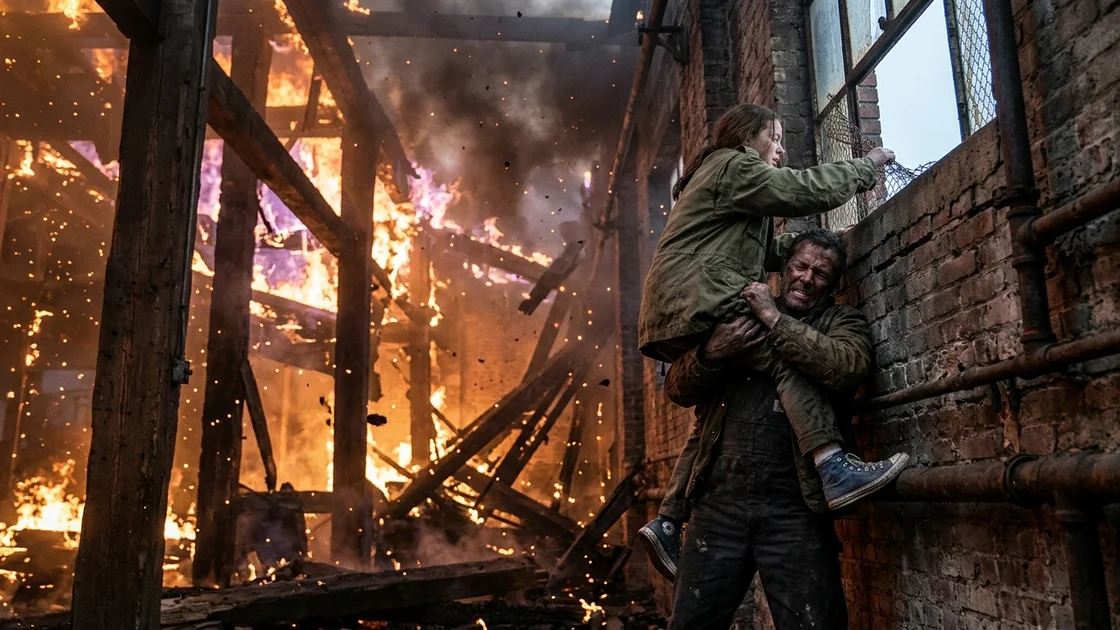
Julian Vance was a craftsman whose medium was fire and whose contracts demanded absolute solitude and total ruin. Hired by an indebted real estate speculator to incinerate an abandoned waterfront warehouse for a lucrative insurance payout, Julian meticulously laid out his accelerants under the explicit guarantee that the sprawling brick carcass was utterly vacant. His precision turned into horror when, moments after the incendiary devices caught and the building became an inescapable crucible, he realized a runaway teenager had made a hidden shelter in the rafters. Caught between the instincts of a seasoned criminal and an agonizing moral awakening, Julian plunged back into the devouring heat to undo his own design, embarking on a desperate race against structural collapse, toxic gases, and the ruthless client who had locked the exits behind them.
Act I: The Geometry of Thermal Draft
Julian Vance did not call himself an arsonist. The word belonged to petty vandals, scorned lovers, and drunken degenerates who tossed road flares into trash dumpsters or sloshed gasoline across shag carpet until they singed off their own eyebrows. Julian was an incendiary consultant. He understood stoichiometry, thermal buoyancy, the convective transfer of heat through unventilated plenums, and the subtle, deceptive physics of slow-smoldering pyrolysis. When Julian took a contract, the fire department’s arson investigators invariably wrote their reports with furrowed brows and closed their binders under the designation of accidental electrical failure or spontaneous decomposition of oily rags.
He sat in the rear booth of the Starlight Diner on the outskirts of the industrial district, watching Arthur Pendelton chew his thumbnail to the quick.
Pendelton was fifty-two years old, soft around the jaw, and draped in an expensive cashmere overcoat that smelled of stale cologne and panic. He was a commercial landlord who had overleveraged himself during the regional dock revitalization boom. When the shipping contracts failed to materialize, he was left holding deeds to three square miles of rotting red brick, asbestos-insulated pipework, and dry-rotted Douglas fir joists. The taxes were due in twenty days; the municipal foreclosure notices had already arrived by certified mail.
"Let's go over the inventory once more," Julian said. His voice was a calm, low hum, devoid of cadence or agitation. He wore clean work clothes: a canvas jacket with reinforced elbows, dark twill trousers, and unbranded steel-toed boots. He had short, graying hair and fingers scarred by nitric acid and hot steel, but his fingernails were scrubbed spotless.
Pendelton swallowed hard, setting a trembling water glass onto the laminate tabletop. "It’s empty, Julian. Just like I told you three times already. We pulled the dry goods out six months ago. Even sold the steel racking to a liquidator out of Newark. There’s nothing left inside but concrete, floorboards, and dust."
"And the vagrants?" Julian asked. His gray eyes pinned Pendelton against the red vinyl booth. "I do not burn meat, Arthur. That was the first rule I gave you when you contacted my broker. I burn timber, I burn drywall, and I burn balance sheets. If there is a breathing soul within fifty yards of that perimeter, the deal is void, and my deposit remains with me."
"I swear to God," Pendelton whispered, leaning forward, his breath hot and sour. "I paid two private guards five hundred bucks cash a week for the last month just to walk the floorboards twice every night. They chased out three kids three weeks ago and boarded up the ground-floor windows with three-quarter-inch marine plywood. We padlocked the roller doors with heavy Master Locks and screwed down the fire escapes from the second floor up. A squirrel couldn't get in there if it had a key."
Julian studied the man's eyes. Pendelton was weak, terrified of bankruptcy, and desperate for the five-point-two million dollars his policy with Continental Mutual promised for total structural loss. Desperate men were prone to lying, but they were also prone to hysterical self-preservation. Pendelton knew that if anyone died in that building, the municipal squad would classify it as felony murder, not property loss, and the insurance underwriters would fight every cent in probate court.
"The sprinkler risers?" Julian asked.
"Drained and shut off at the curb box last Thursday. The municipal water company came out and tagged the valve as dormant for winterization. The line pressure is zero."
"The service drops?"
"Power is dead at the pole. I have the cutoff receipt from the utility right here." Pendelton tapped a manila envelope resting between a plate of cold toast and his coffee cup.
Julian pulled the envelope across the table, sliding his index finger beneath the flap. Inside were the blue-line schematics of the Harborside Cold Storage & Dry Goods Warehouse, built in 1923 and expanded in 1954, along with the utility receipts, the surveyor’s plat, and a flat manila key ring containing four brass keys.
Julian opened the blueprint and smoothed it flat with the blade of his hand. The structure was an architectural fossil: two floors, seventy thousand square feet, heavy timber post-and-beam construction with unreinforced masonry curtain walls. The basement was a damp cavern of poured concrete; the main floor was heart-pine tongue-and-groove; the upper floor was split between an elevated manager's mezzanine and open dry storage under exposed wood trusses.
"The roof," Julian noted, tapping a cross-section drawing. "Built-up tar and gravel over three-inch tongue-and-groove decking."
"It’s bone dry," Pendelton said eagerly. "Hasn't been tarred since the late eighties. The sun baked it into charcoal years ago."
"Which means once the thermal column reaches the ceiling, horizontal flame spread will be instantaneous," Julian murmured. "Flashover within eight minutes of open ignition if the oxygen balance holds. That will give you your total loss, Arthur. The brick walls will buckle inward when the floor joists release from their pockets."
Pendelton’s face took on a pale, sickly sheen. "Good. That’s what we need. Total collapse. The inspectors won't even be able to get inside to look at the foundations until the rubble cools next week."
"Three o'clock tomorrow morning," Julian said, sliding the blueprints back into the envelope. "The coastal marine layer will be thick. Low barometric pressure, sixty-five percent humidity at the surface, five-knot offshore wind from the northeast. That wind will draw the fire toward the river, away from the lumberyard across the street."
"You want the rest of the cash now?"
"Half now. The second half through the usual account forty-eight hours after the fire department concludes its primary origin assessment."
Pendelton reached into his overcoat and produced a heavy bundle wrapped in gray parcel tape. He pushed it under the table into Julian’s lap. Julian did not count it; he merely pressed his thumb into the center of the bundle to confirm its density and thickness, then dropped it into his canvas tool bag.
"Go home, Arthur," Julian said quietly. "Take a double dose of sleeping pills at midnight. Leave your television running in the living room and do not answer your phone until the fire marshal calls you at dawn. If you look at that building between midnight and daylight, you will look like a guilty man, and an amateur looks guilty even to a blind cop."
Pendelton nodded frantically, slid out of the booth, and hurried into the cold rain, his cashmere coat flapping around his knees like the wings of an injured crow.
Julian remained in the diner for ten minutes, slowly finishing a cup of black coffee that tasted of chicory and iron. He pulled his leather ledger from his inner pocket and reviewed his chemical inventories. For Harborside, he would not use petroleum fuels. Accelerant dogs trained on kerosene, mineral spirits, and gasoline were standard issue for the State Police Arson Unit now.
Instead, Julian worked with clean hydrocarbons and metallic oxidizers: a suspension of beeswax, highly refined vegetable stearin, and granulated potassium permanganate mixed with high-purity glycerin in a slow-reaction siphon. When the glycerin soaked through the cellulose barrier into the permanganate, it produced an intensely hot, violet-tinged exothermic reaction that looked precisely like an electrical arc ignited against timber framing. It left behind almost no trace except microscopic ash that blended seamlessly into the potash of five-hundred-year-old pine floorboards.
It was clean. It was mathematical. It was an exercise in pure thermodynamics.
He paid the waitress with exact change, picked up his bag, and stepped out into the damp, salt-laced dark.
Act II: The Chemistry of the Hearth
The harbor smelled of low tide, diesel exhaust, and wet creosote. At two in the morning, the industrial basin was dead. The cranes stood against the low gray clouds like the skeletal remains of long-necked wading birds, and the oily black water of the inlet lapped rhythmically against rotten bulkheads.
Julian parked his nondescript gray cargo van three blocks away, behind an abandoned grain elevator. He wore dark gray cotton overalls over his clothes—synthetic fibers melted in high heat and bonded to the skin, while heavy cotton merely charred—and carried a canvas duffel bag containing four glass carboys, six rolls of corrugated cardboard soaked in paraffin wax, a two-foot crowbar, a pair of aviation snips, and a battery-powered carbon monoxide detector.
He approached the rear perimeter of the Harborside warehouse along the rail spur. The tracks were overgrown with yellow weeds and sumac bushes, their iron rails pitted with orange rust. He slipped through a gap in the chain-link fence where the wire had been snipped and twisted back against the posts months before.
The warehouse loomed before him: a vast, dark mountain of brick. Its high, rectangular windows were dark panes of corrugated fiberglass and cross-hatched wire glass, most of them coated in decades of river silt and coal soot.
Julian pulled a small brass key from his pocket and inserted it into the heavy padlock securing the steel pedestrian door on the western loading dock. The cylinder turned with a dry, metal click. He lifted the latch slowly, preventing the steel door from scraping against the concrete threshold, and stepped inside.
The silence hit him first. It was not merely the absence of sound, but the heavy, cavernous stillness of vast enclosed volumes. The air was five degrees colder inside than out, smelling of damp masonry, oxidized iron, dry grain dust, and the sharp, alkaline tang of lime mortar.
He clicked on his headlamp, setting the beam to its lowest red-light intensity so no reflection would bounce against the exterior windows.
The interior was magnificent in its ruin. Vast bays of heart-pine columns, twelve inches square and spaced twenty feet apart, stretched into the gloom like the nave of a wooden cathedral. Overhead, massive summer beams supported floor joists thick as bridge timbers. The floor under his boots was solid, dry, and clean, swept clear of the industrial detritus that usually accumulated in abandoned facilities. Pendelton had told the truth about one thing: the liquidators had done a thorough job. The room was stripped to its bones.
Julian walked slowly down the central aisle, his boots making no sound on the wood. He was mapping the draft.
Every building possessed a respiratory system. Doors, elevator shafts, broken skylights, and floor drains acted as trachea and lungs. To burn a building completely, an incendiary did not simply start a fire; he established an engine. The flame needed an intake, a combustion chamber, and an exhaust chimney. If the intake was too small, the fire choked on its own soot and died a cold, smoldering death. If the exhaust was too wide, the heat escaped into the atmosphere without transferring sufficient thermal energy to the structural members to sustain auto-ignition.
Julian found the intake on the northeast corner: three disused ventilation louvers near the floor where coal had once been shoveled into the basement boilers. He used his crowbar to wedge the rusted iron flaps open three inches, securing them with wooden shims.
For his combustion chamber, he selected the base of the central freight elevator shaft. The shaft was five stories tall—basement to roof penthouse—and constructed of heavy oak planking framed in riveted steel angles. It had no doors on the ground floor, only a counterweighted timber gate that hung halfway down on frayed hemp ropes.
He walked to the shaft and looked up. Far above, fifty feet in the darkness, the tin roof of the elevator penthouse showed tiny, pin-prick stars where rust had eaten through the sheet metal. It was a natural flue. Once the elevator shaft caught fire, it would act as a blast furnace, drawing thousands of cubic feet of cold air through the floor vents and projecting a column of twelve-hundred-degree gas straight against the central roof deck.
Julian set his duffel down beside the elevator pit.
He knelt on the floorboards, pulling out the glass carboys and the paraffin rolls. He worked with mechanical efficiency, humming a low, wordless melody beneath his breath. He took three sheets of untreated cotton rag, laid them across the base of the elevator timber, and saturated them with the glycerin mixture. Beside them, he placed the small porcelain trays containing the potassium permanganate crystals. He connected the two with a wick of slow-burning celluloid fuse, calibrated to burn at exactly one inch per four minutes.
He would light the fuse at the main door. It would give him twenty-five minutes—plenty of time to walk three blocks back to his van, drive through the harbor tunnel, and buy a coffee at an all-night gas station in South Boston, placing him four miles away when the first alarm was called.
Julian stood up, wiping his hands on an oily cloth. He picked up his bag and turned his red flashlight toward the north stairwell.
To ensure the flame traveled horizontally across the first floor before the elevator draft consumed the structure, he needed to set a second igniter at the base of the manager’s mezzanine—an elevated platform twelve feet above the floorboards where old freight logs and shipping manifests had once been filed.
He walked down the western wall, stepping over old pipe hangers and iron tie-rods.
As he neared the wooden staircase leading to the mezzanine, his boot kicked something small and light. It skittered across the floorboards with a hollow, plastic clatter.
Julian stopped instantly. The stillness rushed back in.
He lowered his flashlight beam to the floor.
Resting against the base of an iron radiator was a red plastic soda bottle, its label faded, its cap screwed on tight. Beside it lay an empty foil wrapper from a convenience-store honey bun.
Julian frowned. His chest tightened with an old, cold apprehension. He knelt, picking up the bottle. The plastic was clean. No layer of dry harbor dust coated its shoulders. The wrapper was pliable, not brittle with age.
"Pendelton," Julian muttered, his teeth clenching. "You lazy, lying son of a bitch."
The guards hadn't walked the building. They had pocketed the cash, sat in their warm car down the street, and stamped their logbooks from the curb.
Julian stood motionless, listening with his whole body.
Nothing. Only the low moan of the northeast wind finding the cracks in the corrugated siding and the distant, rhythmic clang of a navigation buoy out in the channel.
He clicked off his headlamp. Complete darkness engulfed him, thick and velvety.
He took a slow, deep breath through his nose. He did not smell just timber and lime. Underneath the mineral coldness of the building, there was another scent: faint, almost imperceptible, but unmistakable to a man who lived by his senses.
The smell of dirty denim. The bitter trace of cheap apple-cinnamon vapor from an electronic cigarette. And the faint, sweet musk of living human skin.
Julian turned his gaze upward toward the mezzanine.
Act III: The Intruder in the Loft
Julian moved up the stairs with infinite care, pressing his boots into the outer stringers where the wood was thickest and least likely to groan under his weight. Step by step, his hand gliding along the rough-sawn rail, he ascended into the upper gloom.
The mezzanine was a low-ceilinged room twenty feet square, projecting out over the warehouse floor like a ship’s bridge. Its front wall was made of multi-pane sash windows looking out over the main floor, but nearly all the glass had been broken out over decades, leaving only the wooden mullions hanging like hollow teeth.
Julian reached the landing and paused. He clicked his flashlight to its lowest white setting and swept the beam across the floor.
In the far corner, beneath a rusted metal desk that had lost its drawers, lay a heap of stained gray moving blankets and a blue synthetic sleeping bag.
Julian’s breath caught in his throat.
Curled tightly within the nylon bag was a human figure, no larger than a child.
A mass of unwashed, reddish-brown hair spilled out of the hood over a dirt-streaked cheek. The face was that of a teenager—sixteen at the very oldest, though the hollow cheeks and sharp, angular jawline gave her the look of someone younger. She wore an oversized olive-drab surplus jacket with the cuffs rolled up twice, exposing small, pale wrists. A cheap pair of blue canvas sneakers, their toes worn down to the white mesh, lay side-by-side beside the blankets, paired neatly as if ready for school in the morning.
Resting on an overturned milk crate near her head was a small, battery-operated radio with a piece of wire coat hanger twisted into the antenna jack, along with a half-full jar of peanut butter and a pocketknife.
Julian stood frozen, his heart hammering against his ribs like a trapped bird.
The contract was dead.
Every protocol he had maintained for twenty-three years came crashing into his mind with the cold clarity of a mathematical proof. Rule One: The building is empty, or the match is not struck. Rule Two: If the site is compromised, pack the gear and walk away. Rule Three: Never leave a trace.
He had not yet lit the celluloid fuse at the elevator shaft. The chemical carboys were open, but their barrier layers were intact. He could pack his paraffin, cap the glycerin, collect his porcelain trays, slip out through the western dock door, and vanish into the harbor night. Pendelton would lose his building to foreclosure; Julian would keep his deposit and move on to a contract in Philadelphia.
He took a half-step backward toward the stairs.
Then he looked at the girl again.
She turned in her sleep, shivering violently beneath the thin nylon. Her lips were cracked, dry, and purple from the damp draft creeping across the floorboards. She pulled the surplus jacket tighter around her shoulders, muttering something unintelligible—a single, soft syllable that sounded like a name—and burrowed deeper into the dirty blankets.
If he left now, she would wake up tomorrow in a freezing warehouse. In two weeks, the city would send bulldozers to level the site, or some junkie would wander in with a butane torch and set the stairwell ablaze while she slept.
Or Pendelton would find someone else.
Pendelton was desperate. If Julian walked, the landlord would not simply surrender his five million dollars. He would find some corner-boy from the docks, give him five hundred dollars and two five-gallon cans of unleaded gas, and tell him to splash it against the front office and run. And that man would not check the mezzanine. He would not look under the rusted desk.
Julian stood on the landing, his mind spinning through probabilities, liabilities, and the strange, alien weight of a conscience he had spent two decades methodically cauterizing.
"Wake up," he whispered.
The girl did not move. Her breathing was shallow, rhythmic, the heavy sleep of total exhaustion that comes from living three steps ahead of the cold and the cops for weeks on end.
Julian stepped forward, the floorboard giving a small, sharp squeak beneath his boot.
"Get up," he said, louder this time. "Kid. You need to move."
The girl's eyes snapped open.
They were wide, green, and wild with immediate, animal panic. In a single, convulsing movement, she kicked out of the sleeping bag, scrambling backward against the brick wall until her shoulders hit the plaster with a dull thud. Her hand darted to the milk crate, snatching the small pocketknife and flicking open its short, rusted blade.
"Get back!" she rasped, her voice thick with sleep and terror. "I got people coming back! My brother's downstairs right now! He's got a gun!"
Julian did not move. He kept the flashlight beam pointed at the floor between them, illuminating the dust so she could see he was alone and his hands were open.
"Your brother isn't downstairs," Julian said evenly. "You're alone. You’ve been here three or four days, judging by the peanut butter and the wrappers."
"I'll cut you!" she screamed, her voice cracking into a high, frightened register. She held the knife with both hands, the small blade trembling violently against the gloom. "Get out of here! I don't have any money!"
"I don't want your money," Julian said. "My name doesn't matter. But this building is unsafe. You have ten minutes to get your shoes on, pack whatever you can carry in that bag, and get out of this district."
She stared at him, her chest heaving beneath the heavy canvas jacket. "Who are you? Are you Pendelton's guy? He said he was gonna call the cops on me. I'm not going to the shelter. You can tell him I'm leaving tomorrow anyway!"
Julian felt a cold prickle of ice along the nape of his neck.
"Pendelton?" he asked softly. "You spoke to Arthur Pendelton?"
"He came in here with two guys in suits last Friday," she spat, her eyes darting between Julian and the staircase. "He saw me up here. He yelled at me, threw a piece of two-by-four at the stairs, and said if I wasn't gone by Monday he'd have me locked up in the state facility. I told him I'd go! I'm just waiting for my friend to get a car!"
Julian felt the ground slip away beneath his boots.
Pendelton knew.
The landlord hadn't simply failed to check the building. He hadn't just been sloppy or negligent. He had stood in this very room, looked this runaway in the face, and then gone to the Starlight Diner to look Julian Vance in the eye and swear on his mother's soul that the warehouse was a cold, empty tomb.
Pendelton didn't care if she burned. In fact, an unidentified body found in the ash of a commercial fire often helped the case for accidental causation—a squatter with an overturned candle, a tragic accident, no suspicious circumstances, claim paid in full.
A sickening fury, sharp and chemical as battery acid, rose in Julian’s throat.
"Kid," Julian said, his voice dropping into a tone of absolute, unyielding command. "Listen to me very carefully. Arthur Pendelton did not send me to move you. But you are going to put your shoes on right now, or I am going to pick you up by your collar and carry you down those stairs."
She hesitated, her small jaw trembling, seeing something in his eyes that was far more dangerous than the police or a landlord: the cold, terrifying certainty of a professional who knew what the world looked like when it was reduced to carbon.
She dropped the knife. She reached down with trembling fingers, snatched her sneakers, and began jamming her feet into the worn canvas.
That was when the building changed.
Act IV: The Accidental Pyre
It did not begin with an explosion. It began with a sound like a heavy canvas sail snapping in a sudden squall: whump-shhhh.
From the ground floor below, fifty feet away down the dark expanse of the central aisle, a sudden flash of orange light flickered across the cracked glass of the mezzanine windows.
Julian whirled.
A plume of oily yellow smoke was already rising past the mezzanine rail, swirling toward the tongue-and-groove ceiling. Down on the main floor, near the western loading dock, a line of flame was racing along the baseboards, eating through the dry wood with terrifying, crackling speed.
"No," Julian whispered.
His igniters were at the elevator shaft on the eastern side. His chemicals were on a twenty-minute delay. This fire wasn't his.
The smell hit him three seconds later: not the clean, metallic sharpness of his potassium-glycerin mix, but the thick, reeking, chemical stench of cheap unleaded gasoline and diesel fuel.
Down on the floorboards, twenty yards away, a man in a hooded windbreaker was running toward the pedestrian door, carrying a yellow plastic jerrycan in each hand. The man reached the door, shoved it open, slipped out into the fog, and slammed the steel door shut.
From the outside came the heavy, unmistakable rattle of an iron chain being thrown through the door handle, followed by the dull, final clack of a padlock snapping closed.
Pendelton.
The bastard had hedged his bets. He hadn't trusted Julian to pull the trigger, or he hadn't wanted to pay the second fifty thousand dollars. Or perhaps he simply wanted Julian inside when it went up—two birds with one gallon of accelerant, a dead squatter and a dead arsonist, the perfect closed loop of evidence that could never testify against him.
"What is that?" the girl screamed, scrambling to her feet, one shoe half-tied. "What did he do?!"
"Move!" Julian roared.
He grabbed her by the strap of her backpack, nearly lifting her off the floor, and shoved her toward the stairs.
The scene below was already transforming into an engine of death.
The gasoline fire had found the oil-soaked floorboards near the old machine shop. Because gasoline has a high vapor pressure, it didn't wait for the wood to heat; the vapors were already rolling across the floor like an invisible carpet of liquid gas, igniting in sheets of bright, roaring orange.
More catastrophic still: the draft Julian had created by wedging open the coal louvers was working with horrifying perfection.
The cold offshore wind roared through the foundation vents, hit the base of the flame, and bent the thermal column horizontally along the lower deck. The elevator shaft—still thirty feet away—was acting precisely as Julian had designed it to act: a chimney drawing forty thousand cubic feet of air per minute toward its base.
The fire wasn't wandering. It was being sucked directly toward the elevator pit, where Julian's own four carboys of high-potency oxidizers and twenty pounds of paraffin sat waiting like a landmine.
"Down! Fast!" Julian yelled, herding the girl down the stairs.
The heat hit them halfway down the flight.
It was not like standing near a bonfire; it was the suffocating, physical blow of a solid object. The temperature at the mezzanine level was already rising past one hundred and fifty degrees. The air was turning thin, sweet, and toxic with the fumes of burning polystyrene and lead-based paint.
They hit the ground floor. The air was clearer near the planks, two feet off the ground, but the visibility was dropping by the second. Gray, swirling eddies of carbon smoke were descending from the ceiling like a dirty curtain, rolling downward as the thermal layer expanded.
"The door!" the girl cried, coughing violently, her hands over her mouth. "The back door!"
"Chained," Julian barked. "He locked it from the outside. Stay behind me! Cover your face with your sleeve! Do not breathe through your mouth!"
He ripped his cotton bandana from his neck, spat on it twice until the fabric was soaked through, and slammed it over her nose and mouth. "Hold that there. If you drop it, you die. Understand?"
She nodded, her eyes wide, white-rimmed, and streaming with chemical tears.
Julian assessed the room with cold, computer-like speed.
The western exit was chained. The southern dock had been boarded up with two-inch oak planks lag-bolted to the brick from the exterior. The northern wall bordered the canal, three stories of sheer brick with no doors and only barred drainage culverts at the waterline.
The only way out was the eastern loading dock, seventy yards away, through the main freight bay.
Directly between them and that eastern door sat the elevator shaft.
And as they took their first ten steps through the darkening aisle, the elevator pit erupted.
The gasoline flames, drawn by the fierce draft, had reached Julian's staging area. The paraffin ignited in an instantaneous, towering column of white-hot fury. The glass carboys cracked from thermal shock, dumping their oxidizer directly into the pool of melting wax.
A sound like an artillery shell tore through the warehouse: BOOM-CRACK.
The elevator shaft turned into a vertical jet engine. A pillar of blinding violet and orange fire screamed up the wooden flues, tearing through the roof decking fifty feet above with the roar of a descending freight train. The shockwave blew the remaining windows out of the mezzanine, showering the central aisle with jagged shards of amber and green glass.
The roof was gone. The heart-pine summer beams directly above the shaft were instantly enveloped in flame.
"Flashover," Julian whispered, his skin blistering under the radiant heat even thirty yards away. "We have four minutes."
Act V: The Crucible of Ash
Flashover is the moment a structure fire ceases to be a fire in a room and becomes a fire of the room.
It occurs when the thermal radiation from the ceiling layer reaches approximately eleven hundred degrees Fahrenheit. At that threshold, every combustible object in the space—whether touched by flame or not—reaches its auto-ignition temperature simultaneously. Floorboards, timber columns, clothing, hair, the very dust suspended in the air: everything explodes into flame at the same instant.
Julian knew the signs. The smoke layer above them was no longer gray; it was an angry, swirling black-and-gold, pulsing rhythmically as it hunted for oxygen. Tiny tongues of blue flame—rollover—were licking across the ceiling timbers twenty feet ahead of the main wall of fire, dancing through the soot like swamp gas.
"Get down!" Julian yelled.
He tackled the girl to the floor, wrapping his heavy canvas jacket around her head and shoulders just as the upper half of the warehouse ignited with a hollow, concussive whoosh.
The world above them became an ocean of fire.
The heat was absolute, unbearable, stripping the moisture from Julian's lungs in a single gasp. He could feel his cotton overalls scorching against his thighs. The synthetic shell of the girl's backpack began to melt, shriveling like autumn leaves on a griddle.
She shrieked—a muffled, animal sound against his ribs.
"Crawl!" he shouted into her ear, his voice tearing on the smoke. "Do not stand up! If you stand up, your lungs will cook in two breaths! Crawl on your belly!"
They dragged themselves along the floorboards, sliding through fifty years of coal dust and grease. Julian stayed on her left, placing his own body between her and the radiant inferno of the elevator shaft.
The heat coming off the pine columns was like an iron plate pressed against his flesh. His left eyebrow crisped to ash; the skin across his cheekbones tightened until it felt ready to split.
Every breath was agony. The carbon monoxide detector in his duffel bag was shrieking its high-pitched death rattle somewhere behind them, buried under falling embers, until the plastic melted and the alarm strangled into silence.
Above them, the structural timbers began to fail.
The Harborside was built with gravity-pocketed beams: massive horizontal timbers resting in unmortared recesses in the exterior brick walls. The design was meant to prevent the walls from being pulled down if a beam burned through; the beam was supposed to twist out of its pocket and drop straight down.
It was dropping now.
A twelve-foot timber joist, four hundred pounds of burning wood, broke loose from the ceiling thirty feet ahead, crashing onto the central aisle with an explosion of orange sparks that rained over them like iron filings.
The girl froze, paralyzed by the wall of sparks. "I can't!" she sobbed, coughing so hard she retched against the floorboards. "I can't see! My eyes!"
"You move!" Julian screamed. He grabbed the collar of her surplus jacket and hauled her forward, dragging her over the burning splinters of the fallen beam.
He didn't feel the pain in his hands as he shoved burning wood aside. His adrenaline had burned away fear, replaced by the mechanical, calculating coldness that had made him the best incendiary on the eastern seaboard. He was reading the structural failure like a blueprint unfolding in real-time.
The eastern wall was thirty feet away.
Between them and the wall was a wall of corrugated sheet-iron partitioning that had once separated the dry storage from the barrel-washing room. The doorway through the partition was blocked by a mountain of burning pallets that had collapsed from the mezzanine platform above.
There was no way through.
Julian slammed his shoulder against the corrugated iron. It was scalding hot, the green paint blistering and smoking under his palms. He hit it again with his full weight: clang.
The iron sheets were riveted to two-inch angle irons anchored into the concrete floor. A human body couldn't budge them.
Behind them, the elevator shaft gave way.
The entire four-story wooden chimney collapsed into the basement, taking fifty tons of blazing floor joists with it. The downdraft was enormous; for three seconds, the fire was sucked backward into the crater, creating a vacuum that dragged the air from their lungs.
Then came the backdraft.
With the roof gone and the shaft open to the sky, a massive vortex of fresh sea air was sucked into the building from the breached vents. The fire roared like a jet turbine, expanding outward in a horizontal wall of flame that raced down the aisles toward them, consuming the floorboards beneath their knees.
"The window!" the girl screamed, pointing with a blackened, blistered hand.
High on the eastern wall, ten feet above the floor, was an old iron-framed trans-om window, sixteen inches wide and three feet long. Its glass had been knocked out years before, replaced with a sheet of rusted wire mesh.
It was too high to reach. The wall was sheer, crumbling brick.
Julian looked down at the girl. Her face was gray with soot, her lips blistered, her eyes rolling back into her head as the carbon monoxide began to shut down her nervous system. She was slipping into the stupor that precedes asphyxiation.
If he used his crowbar to climb, if he wedged his boots into the brick courses, he could pull himself up to that sill. He had the upper body strength. He could kick through the wire mesh and tumble out onto the gravel of the rail spur.
He could live.
He would have third-degree burns across his back, his career would be over, but he would walk away.
He looked at the girl. Her small, thin hand had locked onto the cuff of his canvas overalls with the desperate, dying grip of an infant. She wasn't looking at the window. She was looking at him, her gaze clouded with smoke and the terrifying realization of her own insignificance in the face of five million dollars of commercial real estate.
"What's your name?" Julian yelled, his voice a ragged croak.
She coughed, a wet, rattling sound. "M-Milo," she whispered. "Milo."
"All right, Milo," Julian said.
He dropped his crowbar. He dropped his tool bag.
He bent down, hooked his hands beneath her armpits, and stood up straight into the killing heat.
The temperature at six feet was three hundred degrees. Julian felt the hair on his arms vanish in a flash of heat. His skin screamed; his overalls began to smoke along the shoulders.
"Stand on my shoulders!" he roared.
"What?!"
"Put your feet on my shoulders! Climb, Milo! Climb or we both burn right here!"
He slammed his back against the burning brick wall, locking his legs into a wide, stable tripod. He seized her by the waist and hoisted her upward.
She understood. With the frantic, wiry agility of a kid who had spent three years climbing fire escapes and boxcars, she planted her sneaker on his knee, then his hip, then swung her foot onto his left shoulder.
Julian groaned, his spine compressing under her weight, but he did not yield an inch. He took her other foot and drove it onto his right shoulder, bracing her shins against the brick wall with his forearms.
"The mesh!" he yelled, his eyes shut tight against the falling embers. "Kick it out!"
Milo reached the sill. She pulled her pocketknife from her jacket and jammed the short, dull blade into the rusted wire mesh, twisting it with all her strength. The wire tore away from the rotting wooden frame with a screech of rusty staples.
She kicked out with both boots: thud, thud, CRACK.
The mesh gave way. A blast of cold, sweet, rain-soaked harbor air poured through the opening, cutting through the smoke like a silver knife.
"I’m through!" she screamed down to him. "Julian, come on! Take my hand!"
"Go!" Julian barked. "Wiggle through! Head first, drop onto the gravel! It’s a six-foot drop! Land on your side!"
"I'm not leaving you!"
"You don't have a choice, kid!" Julian roared. He reached up, grabbed her ankles, and shoved her violently through the opening.
She shrieked as her shoulders cleared the frame. Her legs kicked wildly against the brick, then vanished into the dark outside.
A split second later, Julian heard the heavy, soft thud of her body hitting the ballast gravel behind the warehouse.
"Milo!" he shouted through the opening.
"I'm here!" her voice drifted back, small, cracked, but alive. "I'm okay! Julian, get up here!"
Julian turned to look behind him.
The Harborside Cold Storage was gone.
The entire roof structure had fallen into the center of the bay. A mountain of heart-pine beams, three stories high, was burning with the fury of a bespoke furnace. The heat was so intense that the mortar between the bricks behind him was beginning to pop and crackle, turning to dry sand. The floorboards five feet from his boots were curling upward, their edges glowing cherry red.
The draft was no longer drawing from the doors; it was drawing through the very window Milo had just cleared. The cold air rushed past Julian's face, feeding the monster at his back.
He reached up. He leaped, catching the edge of the wooden sill with his blistered fingers.
The wood was rotten, splintered, and burning hot. His grip slipped; the skin of his palms tore away against the rough-sawn grain, leaving bloody streaks on the timber. He hung by one hand, his boots scrambling for purchase on the crumbling brick mortar.
His muscles seized. The smoke he had inhaled over the last four minutes hit his brain like a hammer of lead. His vision narrowed to a tiny, vibrating tunnel of gray light. His heart was skipping beats, starved of oxygen, poisoned by cyanide gas from the burning insulation.
Let go, a quiet voice inside him said. It was the calm, rational voice of his ledger, the voice that calculated flashpoints and BTU outputs. The building is lost. The contract is broken. It is a clean calculation.
Then, through the square of gray light above him, a small, soot-blackened hand reached back inside the furnace.
Milo had climbed onto the iron water-meter pipe running along the exterior wall. She was leaning through the broken trans-om, her face bleeding from glass cuts, her fingers hooked into the neck of his heavy canvas overalls.
"Pull!" she screamed, her small body shaking with the strain. "You don't get to die in here, you bastard! Pull!"
Julian Vance looked up into the soot-stained face of the girl he had been paid fifty thousand dollars to incinerate.
Something inside him—something older, harder, and far more stubborn than his cold mathematics—snapped into alignment.
He reached up with his right hand, locked his fingers around the outside sill, and with a guttural, tearing scream that ripped through the roar of the fire, he drove his boots into the mortar and threw his body upward into the cold, wet air.
Act VI: The Chemistry of Retribution
They lay together in the weeds of the rail spur, chest down in the cold mud, as the Harborside warehouse died.
The collapse of the eastern brick wall was majestic in its violence. The masonry, unsupported by its charred floor joists, leaned out over the tracks for three seconds, almost hesitant, before four hundred tons of century-old red brick fell inward with a subterranean roar that shook the ballast stones beneath their bellies.
A cloud of white lime dust, mixed with black wood soot and hot cinders, swept over them like a blizzard, blotting out the stars.
Down the harbor, the sirens had finally begun.
Two miles away, the low, wailing moans of the fire engines from Ladder 4 and Engine 11 were cutting through the sea fog. In five minutes, the perimeter would be swarming with flashing red lights, police cruisers, and news vans.
Julian pushed himself up onto his elbows.
Every inch of his body was screaming. His hands were raw, red-and-white meat where the blisters had torn open against the sill. The left side of his face was swollen, his vision in that eye clouded by smoke damage. His overalls were charred to brittle black crust along the shoulders and back.
Beside him, Milo lay curled on her side, coughing violently, vomiting gray, soot-streaked bile into the weeds. But her chest was rising and falling. Her pulse, when Julian pressed two fingers into the hollow of her throat, was fast, thready, but strong.
"Can you walk?" Julian croaked.
She nodded weakly, wiping her mouth with the torn sleeve of her surplus jacket. "I... I think so."
"We have to move. The police will seal the tracks in three minutes. If they find us here, you go to a county detention facility, and I spend the rest of my life in a maximum-security penitentiary."
He hauled her to her feet. She leaned heavily against his hip, her small frame shivering in the forty-degree drizzle that had begun to fall from the gray harbor sky.
He led her through the sumac weeds, keeping low along the embankment of the rail spur, avoiding the access roads where the first fire engines were already turning into the terminal gates, their diesel air horns blasting through the night.
They reached the alley behind the grain elevator. His gray van was sitting where he had left it, dark, quiet, and invisible in the shadow of the concrete silos.
Julian unlocked the rear doors with trembling fingers, pushed Milo inside onto the spare blankets, and climbed in after her, pulling the doors shut until they clicked on their secondary latches.
The van was warm, smelling of clean machine oil, dry cardboard, and his own tools.
He reached into the first-aid kit bolted to the wheel well, pulling out a plastic bottle of sterile saline and two burn dressings. He did not treat himself; he knelt beside Milo, gently washing the soot and glass dust from her eyes and cheeks, then wrapping her burned wrists in sterile, wet gauze.
"Drink this," he commanded, handing her a plastic bottle of spring water from his emergency crate. "Small sips. If you drink it too fast, you'll bring it back up."
She took the bottle with both bandaged hands, drinking with desperate, shuddering gulps.
"Who was that guy?" she whispered, her eyes wide in the dark of the van. "The guy who chained the door?"
Julian sat back against the interior paneling, his head resting against the cold steel. He closed his eyes. Behind his eyelids, the orange light of the flashover was still dancing, burned permanently into his retinas.
"Arthur Pendelton," Julian said. "He owns the building."
"Why did he do that?" she asked, her voice cracking with the terrible, uncomprehending grief of the young. "He knew I was in there. I told him I was leaving! Why would he lock the door?!"
"Because you were worth five million dollars dead," Julian said, his voice flat, devoid of emotion, the voice of an executioner reading a ledger. "And I was worth fifty thousand."
He reached into his pocket. The bundle of cash Pendelton had given him at the Starlight Diner was still there, wrapped in its gray parcel tape, heavy and damp against his thigh.
He pulled it out. He dropped it onto the floorboards between them with a heavy, wet thunk.
"Twenty-five thousand dollars," Julian said. "That was the deposit to burn that room down."
Milo stared at the gray tape, her breath hitching in her chest. "That's... that's his money?"
"It was his money," Julian said. "Now it's yours."
"I don't want his money," she spat, her small face twisting with sudden, ferocious revulsion. "It smells like... it smells like that fire!"
"Money doesn't smell like anything, Milo," Julian said softly. He pulled his leather ledger from his pocket, tore out the blank rear pages, and scribbled an address and a phone number with a stub of pencil. "There is a woman named Martha who runs a private shelter three miles outside of Providence. No state workers. No police reports. No questions asked. You take this cash, you get on the five-fifteen bus at the regional terminal, and you give this envelope to her. She will give you a room with a lock on the door, clean clothes, and an education. You will never come back to this harbor, and you will never speak the name Arthur Pendelton again."
She looked from the paper to the cash, then up into Julian's ruined, blistered face.
"What are you gonna do?" she asked.
Julian looked down at his raw, ruined hands. The fingers that had spent twenty years measuring potassium permanganate and calculating draft velocities would never hold a stopwatch or a glass pipette again. The tendons in his left palm were tight, scorched, the mobility gone.
He was no longer an incendiary consultant. Harborside had been his final commission.
"I have an accounting to settle," Julian said.
Act VII: The Balance Sheet
Arthur Pendelton was sitting in his leather wingback chair in the library of his brick colonial in Chestnut Hill, five miles from the waterfront.
The television was on, the volume low, tuned to the local news. The screen showed an aerial shot from a helicopter hovering over the harbor: a vast, smoking crater of red brick, with four ladder pipes pouring tons of water into the steaming cellar hole. The banner at the bottom of the screen read: FIVE-ALARM BLAZE DESTROYS HISTORIC HARBOR WAREHOUSE; CAUSE UNDER INVESTIGATION.
Pendelton was holding a crystal tumbler of scotch. His hand was steady now. The panic of the afternoon had dissolved into the warm, golden glow of relief.
It was over.
The building was a total loss. The municipal inspector on the broadcast was already talking about an uncontrollable electrical short in the basement conduits. There was no mention of bodies. Even if the girl's bones were found under forty feet of collapsed brick next week, they would be chalked up to an unfortunate squatter who had been dead before the fire started. And Julian Vance—the cold, arrogant bastard who had looked at him like a bug in that diner—was either miles away in New York or buried under the elevator shaft. Either way, Julian Vance didn't have receipts.
The grandfather clock in the hall struck five in the morning.
A floorboard creaked in the kitchen.
Pendelton turned his head toward the arched doorway leading to the dark hallway. "Margaret?" he called, thinking his wife had come down for water.
There was no answer.
The kitchen door swung open silently.
A figure stepped into the warm light of the library.
Pendelton’s glass slipped from his fingers. It hit the Persian rug with a soft, wet thud, amber liquid soaking into the wool.
"Jesus," Pendelton whispered, his jaw dropping until his jowls folded into his collar. "Jesus... Mary... Joseph."
Julian Vance stood in the doorway.
He looked like something dragged from the floor of an open-hearth furnace. His canvas jacket was gone, leaving only a torn, soot-blackened work shirt clinging to his shoulders. The left side of his face was a patchwork of white thermal blisters and red, weeping skin; his eyebrows and eyelashes were burned down to the skin; his gray eyes were blood-red, sunken, and cold as river ice.
In his right hand, Julian held an eight-inch iron crowbar, its tip pitted with black soot.
In his left hand, he held a two-foot length of heavy, oil-greased iron chain, dangling three inches of snapped steel links.
"Julian," Pendelton stammered, scrambling backward in the leather chair, his soft hands pawing at the armrests. "Julian, I... thank God. You made it out. I thought... the news said the whole thing dropped in the first twenty minutes!"
Julian did not answer. He walked into the library, his boots leaving dry, gray tracks of ash across the parquet floor.
"I had to do it, Julian!" Pendelton babied, his voice climbing into an hysterical screech as he backed the heavy chair against his mahogany desk. "The guards... the guards told me the fire was already starting when they checked the door! I thought you were already clear! I thought someone else set it! I locked the chain because I thought the squatters were coming back to loot the office!"
Julian stopped two feet from the chair.
The smell of the fire entered the room with him: the suffocating, bitter stench of burning Douglas fir, melting lead, and scorched human hair.
"You knew she was in the loft, Arthur," Julian said. His voice was no longer a hum; it was a dry, hollow rattle, like stones sliding down a zinc chute.
Pendelton's eyes darted toward the telephone on the desk. "She was a runaway! She was nobody! She wasn't supposed to be there!"
"Her name is Milo," Julian said.
He laid the iron chain on the corner of the mahogany desk with a gentle, metallic clink.
"She is sixteen years old," Julian continued, speaking with the calm, methodical cadence of a man reading a balance sheet. "She sleeps with her sneakers paired neatly by her side so she can run if the floorboards get cold. She has a pocketknife with a broken spring. And she has three-inch third-degree burns across her wrists because she tried to pull two hundred pounds of professional arsonist through a trans-om window."
Pendelton began to weep, fat, greasy tears cutting through the red flush of his cheeks. "I'll pay you. Whatever you want. The insurance... they're paying five point two million. I'll give you half. I'll give you two million cash! In bearer bonds! I have them in the safe in the basement!"
Julian leaned down until his ruined face was six inches from Pendelton’s ear.
"You don't understand the chemistry of this transaction, Arthur," Julian whispered. "You think fire is an instrument of commerce. You think it is an eraser for bad debts. But fire does not balance ledgers. Fire only consumes until there is nothing left to oxidize."
Julian reached into his pocket and pulled out a small, glass vial, three inches long, filled with a thick, purple-black crystalline powder: potassium permanganate.
Beside it, he produced a miniature plastic dropper bottle of glycerin.
Pendelton stared at the two bottles with uncomprehending horror. "What... what is that?"
"This is forty seconds," Julian said.
He stepped to the heavy velvet drapes that framed the library’s tall bay windows looking out over the manicured lawn.
Julian unscrewed the vial of purple crystals with his teeth, his burned fingers holding the glass steady. He tipped the powder into the deep, dust-filled hem of the drapes where they pooled against the oak baseboards.
Then he uncapped the glycerin.
"Julian, please!" Pendelton screamed, falling to his knees on the rug, crawling toward the boots of his hired hand. "Don't! My wife is upstairs! My wife is sleeping!"
Julian paused.
He looked up at the ceiling. The house was quiet. A woman’s light, rhythmic snoring was faintly audible through the floor joists above.
Julian looked down at Pendelton.
"Then you have three minutes to get her onto the lawn," Julian said.
He squeezed the dropper bottle. Three thick, clear drops of glycerin fell into the purple crystals.
A faint, hissing sound—like a snake in dry leaves—rose from the velvet hem. A thin ribbon of violet smoke began to spiral toward the ceiling.
Julian turned and walked toward the kitchen door.
"Wait!" Pendelton shrieked, scrambling on his hands and knees between his desk and the smoking curtain. "Where are the keys?! The back door is locked!"
"Then you’d better kick through the wire, Arthur," Julian said from the dark hallway. "Just like the children do."
The back door clicked shut.
Act VIII: The Anatomy of a Cold Draft
At six o'clock in the morning, the rain had turned into a steady, gray deluge that washed the soot from the gutters of the South Boston bus terminal.
Julian sat in his van across the street, the engine idling with a low, irregular thrum.
Through the salt-streaked windshield, he watched the small figure in the oversized olive-drab surplus jacket walk slowly through the glass doors of the terminal. Her hands were tucked into her pockets, her backpack slung over one shoulder, her head down against the cold.
She stopped at the ticket counter. She reached into her pocket, produced the clean, new bills Julian had separated from Pendelton's parcel, and slid them across the counter.
The clerk handed her a white paper ticket and a small brass gate token.
Milo turned. For a single second, she paused in the bright, fluorescent light of the terminal lobby, looking through the glass doors toward the street where the gray cargo van sat idling in the rain.
She couldn't see through the tinted glass. She couldn't see the man sitting in the dark behind the wheel, his face wrapped in white gauze, his hands resting motionless on his knees.
She lifted her left hand—the hand wrapped in clean, white medical tape—and pressed her palm against the cold plate glass for three heartbeats.
Then she turned and walked down the concourse toward Gate 4, where the bus to Providence was already idling its diesel engine, puffing blue-gray exhaust into the wet morning air.
Julian watched until the taillights of the bus disappeared into the rainy murk of the Interstate ramp.
He reached down to the passenger seat.
His leather ledger lay open to the final page.
Beneath thirty years of formulas—stoichiometric ratios of nitrates, flame propagation velocities of white oak versus yellow pine, flashover calculations for multi-tier industrial spaces—there was a single, blank line at the bottom of the page.
Julian took his pencil between his two thumb-knuckles, the only part of his hands that still obeyed his will, and drew a single, heavy black line through the entry for Harborside Cold Storage.
Beneath it, in his precise, copperplate script, he wrote three words:
Total structural collapse.
He dropped the pencil onto the floorboards.
He clicked the van into gear, swung out into the empty, rain-swept avenue, and drove south toward the state line, leaving the harbor, the fire, and the ash behind him forever.