Bound in Carrion and Grief
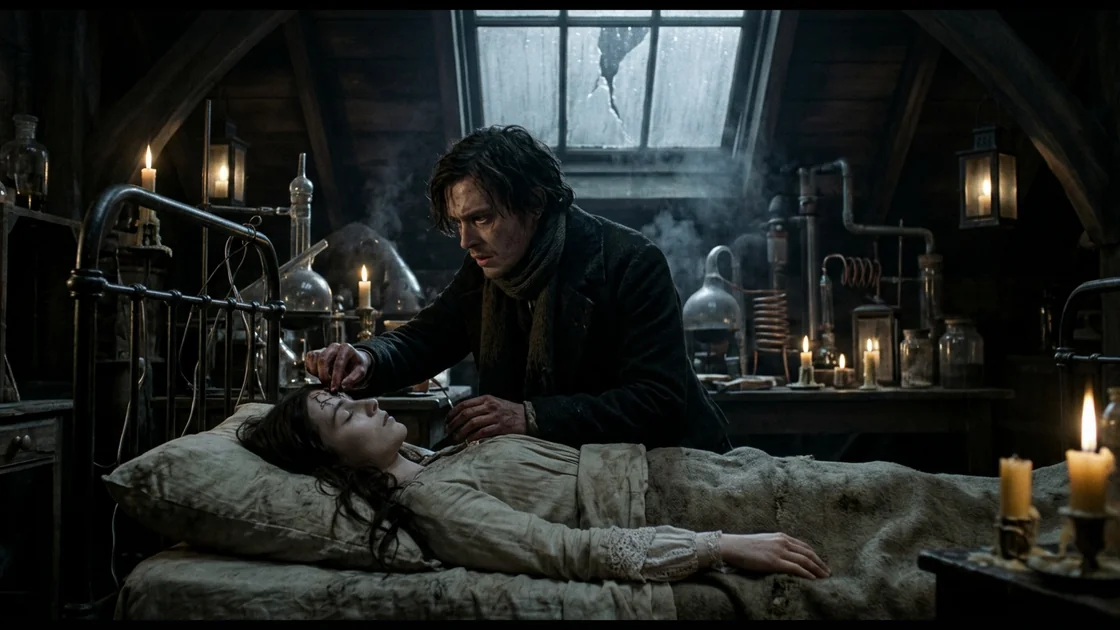
This is the story of Silas Vane, a gifted practitioner of the forbidden mortuary arts, who could not endure the death of his younger sister, Elspeth, after a winter sickness claimed her life. Driven by an all-consuming and selfish grief, Silas dug her from the churchyard and cast a complex rite of soul-binding, anchoring her departed spirit back into her rapidly deteriorating remains. Believing he had triumphed over mortality, Silas brought her back to their ancestral manor, only to discover that the magic did not restore life to the flesh, but instead locked her fully conscious soul into every rotting fiber and nerve. As her physical form steadily decomposed, Elspeth was forced to endure the agonizing, magnified sensation of every cell breaking down, leaving Silas to confront the monstrous nature of his arrogance and make a horrific final choice to grant her peace.
The rain over the valley of Morvath had not ceased for three weeks, turning the clay of the churchyard into a thick, clinging slurry that sucked at the heels of Silas’s tall riding boots. He worked by the meager light of a tin lantern shuttered so narrowly that it cast only a jaundiced sliver across the mound. The spade entered the sod with a wet, tearing sound, shearing through the roots of nettles and late-blooming shepherd’s purse. With every thrust of his arms, water welled up into the trench, black and foul-smelling, pooling around his feet like stagnant ditch-water.
Silas did not pause to wipe the sweat and cold rain from his brow. His breath came in ragged, steaming plumes that caught against the damp woolen scarf wound about his throat. His knuckles were raw, split across the joints where the spade handle had scraped him bloody, but the pain barely registered against the cold iron ache in the hollow behind his ribs.
Beneath six feet of drenched earth lay Elspeth.
She had been dead four days. Four days since the fever broke her lungs, leaving her skin the color of skimmed milk and her lips like pressed violets. In those four days, the world had presumed to continue without her. The sheep had bleated in the pastures below the village; the baker had drawn his rye loaves from the stone ovens at dawn; the parson had intoned his dry, hollow homilies about celestial rest and the inscrutable mercy of Providence.
Silas despised every word of it. He had studied at the College of Chimes in the south before his expulsion—expelled not for incompetence, but for refusing to accept the boundary between the living organism and the discarded shell. The masters had called his curiosities morbid, then dangerous, and finally profane. They spoke of the natural order as though it were an immutable law written across the stars, rather than a mere failure of human nerve. When the fever had taken Elspeth, he had pleaded with the village physicians to bleed her, to administer the tincture of black hellebore and nightshade he had prepared, but they had turned him away from her sickbed, calling him a ghoul. And so she had slipped away while he was locked out in the cold hall, listening to her breath rattle down into silence.
The spade struck wood with a dull, hollow thud.
Silas dropped the shovel. He fell to his knees in the mud, heedless of the freezing water that soaked through his trousers to the skin, and began to scrape away the remaining silt with his bare hands. The coffin was cheap pine, nailed together in haste by the parish carpenter, already swelling and bowing under the weight of the sodden earth. He took a heavy crowbar from his canvas sack, wedged its flattened chisel-tip beneath the lid, and leaned his full weight against it.
The iron squealed against rusted nails. The wood splintered with a sound like a snapping bone.
The odor that rose from the breach was not yet the heavy, suffocating stench of summer corruption, but it carried the distinctive, sweetish grease of early decay—a smell of damp cloth, stagnant blood, and cold fat. Silas did not flinch. He set his lantern upon the edge of the pit and pulled back the broken lid.
There she lay, framed by soiled satin that had begun to draw moisture from the lining. Her face was sunken at the temples; her cheeks had fallen inward, and beneath her closed lids the globes of her eyes seemed shrunken. The village women had dressed her in her best Sunday dress of unbleached linen with lace cuffs, but the damp had already stippled the fabric with gray blossomings of mildew.
Silas reached down, his fingers trembling, and touched her cheek. It was as cold as a flagstone drawn from the bottom of a well. The skin was leathery, lacking all suppleness, and the contact sent a vicious shudder through his spine.
"Forgive me, little bird," he whispered, his voice cracking from days of silence. "They thought they could hide you in the dirt. They thought I would leave you to the worms."
He worked swiftly now. He slipped a broad strip of waxed linen beneath her shoulders and another beneath her knees, tying them into loops through which he could slip his arms. Lifting her was terrible work; her body was stiff in some limbs and unnervingly limp in others, the post-mortem rigidity having begun its slow, chemical retreat. When he hauled her over the rim of the grave, her head lolled back against his chest, her dark hair tangled in his woolen collar, smelling faintly of the rosemary water the washerwomen had used to sponge her corpse.
He did not fill the grave. Let them find it empty in the morning. Let the parson cross himself and speak of grave-robbers or wolves. By the time the village gathered its pitchforks and its prayers, Elspeth would be home, seated in the high parlor of Vane Manor, breathing the air of the living once more.
He carried her through the woods, away from the turnpike, following the old charcoal-burners' paths where the brambles tore at his coat and the dripping boughs slapped across his face. She felt light, horribly light, like an armful of dry kindling, yet with every step her weight shifted with an unnatural, deadening slackness that bruised his ribs.
Vane Manor sat on the upper ridge of the moor like a fractured molar against the bruised twilight. It was a house of rotting wainscot and drafty corridors, built three generations prior by an ancestor who had made a fortune in copper mines that had long since flooded. Silas brought her through the rear scullery, up the narrow backstairs where the servants had once trodden, and into the vaulted laboratory he had constructed beneath the rafters of the north wing.
Here, the air smelled of camphor, vinegar, and copper salts. Tables of scrubbed deal were lined with glass retorts, lead pipes, and jars containing pickled anatomical specimens. In the center of the room stood an iron-framed bed, fitted with leather straps and surrounded by an intricate apparatus of zinc plates, copper coils, and tallow candles into which powdered quicksilver had been kneaded.
He laid her upon the bed.
The room was freezing, the rain beating a manic rhythm against the high skylight overhead. Silas stripped off his sodden coat and lit the candles one by one. The flame burned with a pale, lilac hue, sputtering as the mercury vaporized into the stagnant air.
This was not simple reanimation. Silas was no vulgar charlatan who strung galvanic wires to twitch dead thighs and make a cadaver dance like a marionette. That was mere physics, the base trickery of mechanics. What Silas had planned was the Great Stitching—the absolute tethering of the departed soul back to its original vessel.
The texts he had stolen from the hidden vaults of the College had been clear on the theory, though maddeningly sparse on the consequences. Death, the ancient heretic Al-Qasim had written, was not an instantaneous severance, but an unraveling. The soul did not flee to heaven or hell; it hovered, disoriented, caught in the wake of its ruined home, clinging to memories, to names, to the physical imprint of its earthly dwelling. If one could forge an anchor of sufficient density, if one could weave a chain of will, blood, and elemental iron, the spirit could be drawn back down through the ether and lashed to the meat it had once governed.
Silas drew a silver lancet across the palm of his left hand. The cut burned, hot and clean, and he let the blood drip into a bowl of pulverized bone-ash, sulfur, and dried belladonna. He mixed the paste with his index finger, murmuring the rhythmic, guttural cadences of the binding canticle.
"By the bone that remembers the marrow," he chanted, his voice rising above the rattle of the rain, "by the blood that remembers the beat, by the breath that is wandering in the void, I deny the release. I deny the departure. I seal the door. I drop the portcullis."
He took the bloody paste and began to draw the sigils upon her flesh.
He marked her forehead, painting the three-pointed crown of the Tether over her cold brow. He marked her sunken eyelids, her pale, parted lips, the hollow at the base of her throat where the pulse had once fluttered like a trapped moth. He lifted her limp hands, painting the lines of connection along the blue channels of her radial veins, binding the marrow to the ether, the will to the tendon.
Underneath his touch, the skin felt slick, the early stages of autolysis already softening the epidermis. When he pressed too hard against her sternum, there was a small, sickening shift beneath the bone, as if the tissues within were turning to marsh. A cold panic flared in his throat, but he swallowed it down. It did not matter. The soul would mend what was broken. The soul was the architect; the body was merely the clay. Once the spirit was seated, life would resume its rhythm, and the rot would be stayed by the sheer majesty of will.
He connected the zinc wires to the needles he had driven into the soles of her feet and the crown of her head. He blew into the small furnace that heated the alembics, filling the room with the sweet, choking fumes of vitriol and melted fat.
"Elspeth," he cried, his vision blurring from the chemical smoke, his palm stinging where the cut bled freely. "Hear me across the gray water. I call you by your cradle-name. I call you by the milk we shared. Come back to the hearth. Come back to your brother."
The wind struck the skylight with the force of an ocean breaker. One of the glass panes cracked, a thin, jagged line splitting from corner to corner, admitting a spray of freezing mist.
The lilac candles flared up, their flames stretching thin and tall, hissing violently.
The air in the room suddenly grew heavy, pressurized, as if the atmosphere of an entire mountain had been compressed into the attic. Silas felt his ears pop. A high, ringing tone sounded in his skull, shrill as a wet finger dragged across the rim of a crystal chalice.
Upon the table, the body of his sister arched.
It was not the slow awakening of a sleeper. It was a violent, catastrophic spasm. Her spine curved off the iron mattress with such force that the iron frame groaned. Her heels hammered down against the zinc plates. Her jaw dropped open, stretching wider than it had ever stretched in life, the dried ligaments at the corners of her mouth tearing with an audible snap.
A breath rushed into her.
It was not drawn by her own diaphragm. It sounded like air being forced into an empty bellows through a clogged nozzle—a wet, rattling, desperate gasp that dragged the sulfur and mercury fumes deep into her ruined lungs.
"Elspeth!" Silas fell against the side of the table, his eyes wide, his heart hammering against his ribs like a madman rattling the bars of a cell. "Elspeth, look at me!"
Her eyelids parted.
The eyes were not the clear, hazel orbs that had gazed at him over the breakfast table a fortnight ago. The cornea was cloudy, veiled by a milky, bluish film of drying tissue, but behind that dull lens, something was burning. A pinprick of sheer, frantic awareness shifted. The pupils, fixed and dilated, did not contract against the candle flame, but they moved. They tracked him. They locked onto his face with a terrible, unblinking intensity.
Her fingers curled. The fingernails, already tinged with the brown-gray hue of death, dug into the wooden edges of the table, splintering the dry pine.
"I have done it," Silas laughed, tears of hysterical relief spilling over his soot-smeared cheeks. He caught her right hand in both of his, pressing the cold, stiff knuckles against his lips. "I have brought you back. You are home, Elspeth. You are safe."
She did not answer. She could not. Her throat worked, the muscles of her neck standing out like cords of wet hemp, but the only sound that escaped her lips was a low, bubbling wheeze, like the gurgle of mud beneath a boot-heel.
Her hand did not return his grasp. Instead, the fingers twitched violently, spasmodically, tearing at his skin, scratching at his sleeves, as if she were trying to tear away something invisible that was crushing her bones to powder.
In the beginning, Silas told himself that the stiffness was merely the aftermath of the transition.
He moved her down from the attic to her old bedchamber on the first floor. It was a pleasant room, papered in pale yellow chintz, with broad windows that looked out over the dripping yews of the garden. He laid her upon her feather mattress, pulled the clean linen sheets up to her chin, and built a roaring fire of applewood in the hearth to chase away the smell of the churchyard.
Yet the fire only made it worse.
By the second day, the warmth of the room had accelerated what the damp of the grave had begun. Silas returned from the kitchen with a cup of warm broth—a ridiculous gesture, a habit born of instinct—to find her staring at the ceiling. Her head had turned upon the pillow, but the motion had been clumsy, accompanied by a faint, dry friction sound from the cervical vertebrae.
"Elspeth," he said gently, setting the porcelain cup upon the bedside table. "I have brought you some nourishment. We must see if you can swallow."
She did not blink. Her eyes remained wide, fixed upon the plaster molding of the cornice. But her chest rose and fell in short, erratic hitches—not because she needed the air, for her blood no longer carried oxygen, but because the soul, trapped inside the mechanism, was frantically trying to operate levers that were no longer connected to anything living.
He sat upon the edge of the bed and reached for her hand.
The moment his skin touched hers, she shuddered. It was not a gentle recoil; it was a violent, whole-body revulsion that shook the bedstead. A sound tore from her throat—a dry, grating hiss that carried the cadence of a scream, though there was no breath to support it.
"Hush, hush," he murmured, alarmed. "It is only me. It is Silas."
Her head snapped toward him with terrifying suddenness. The skin of her neck, dried and stretched taut, split along an old fold near her collarbone, revealing the gray, bloodless fascia beneath. Her jaw worked, unhinging slightly, and through her blackened lips came a voice that did not sound like a girl of eighteen, but like two slates being ground together underwater.
"Bu... bu... buh..."
"What is it, little bird? Do you know me?"
"...Buuuurrrn..." she hissed.
Silas smiled weakly, though a cold dread was beginning to coil in the pit of his stomach. "No, you are not burning, Elspeth. You are cold, that is all. The fever is gone. The grave is gone. I have made a fire to warm you."
Her hands came up from beneath the sheet. They did not move with the graceful, fluid ease of youth; they moved like the limbs of an arthropod, the joints hitching, locking, and then jerking forward with unnatural speed. Her fingers clawed at her own breast, tearing at the unbleached linen of the shroud-dress. Her nails sank into the flesh over her ribs, dragging down.
The skin gave way easily. It did not bleed; it simply parted like damp parchment, rolling back from the tallowy yellow fat and the dark, marbled muscle underneath.
"Stop!" Silas cried, lunging forward to catch her wrists. "Elspeth, stop! What are you doing?"
The moment he gripped her forearms, her mouth opened in an agony so pure, so absolute, that it seemed to rattle the windowpanes. Her face contorted into a mask of such utter terror and torment that Silas felt his own knees buckle. Her milky eyes strained until the tiny capillaries, dried and dead, burst into brown webs across the sclera.
Her mind slammed into his.
It was not a telepathic voice, not a thought formed of words. It was an involuntary psychic backwash, an overflow of raw sensation that traveled through the silver sigils he had painted upon her skin and leaped across his own open, unhealed wound.
For a single, dreadful fraction of a second, Silas did not see the bedroom.
He was inside the meat.
The sensation was not numbness. It was an infinity of agony beyond anything the living world could conceive.
In life, pain is a warning, a biological signal designed to protect the organism from destruction. It has limits; when the agony reaches a crescendo, the brain shuts down, unconsciousness swoops in, or shock numbs the nerves with endorphins.
But the dead have no shock. The dead have no unconsciousness.
The soul of Elspeth was not sitting in the brain like a captain at the helm of a ship; it had been woven by Silas’s Great Stitching into every single cell, every nerve fiber, every drop of stagnating lymph, every decomposing membrane.
She could feel the cold—not as a chill on the skin, but as a vast, crushing weight of solid iron pressing down upon every square inch of her being, a suffocation without end.
Worse, she could feel the decomposition.
She felt the acid of her own stomach fluids leaking through the softened gastric lining, eating away at the neighboring tissues with an agonizing, slow burn that had no flame. She felt the microscopic millions of bacteria, the natural flora of her gut that had turned from helpers into conquerors, multiplying, swarming through her veins, chewing through the walls of her capillaries, devouring her from within. Every microscopic bite was an individual, screaming puncture.
She felt the air of the room drying her eyes, shrinking the gelatinous vitreous humor into hard, painful raisins within their sockets. She felt the dead fat in her cheeks growing rancid, the chemical bonds breaking down into oily acids that stung like boiling pitch against the dormant, trapped nerve endings that the soul was still forcing to report.
She was being eaten alive by her own corpse, and the spell would not allow her to faint. It would not allow her to turn away. It held her face pressed down into the mire of her own dissolution, forcing her consciousness to endure every micro-fracture of cellular rot.
Silas broke the contact with a shriek, tumbling backward off the bed and crashing against the floorboards.
He scrambled back on hands and knees until his spine hit the door, his chest heaving, his mouth tasting of copper and vomit. His hand—the one that had held her wrist—was shaking so hard he could not close the fingers.
Upon the bed, the thing that had been his sister lay thrashing. It was not a coordinated struggle; it was the frantic, grotesque squirming of a creature that had been dipped in burning oil and pinned to a board. Her mouth remained locked open, that dry, roaring hiss whistling continuously through her teeth.
"N-no," Silas whimpered, pressing his palms against his ears to drown out the sound. "No, no, no. The spell was supposed to restore you. The soul rules the flesh. That is the third axiom of the Chimes. The soul rules the flesh!"
The axiom had lied. Or rather, the scholars who wrote it had never conceived of a soul being shoved backward down the chute of mortality into a machine that had already begun to rust and putrefy. The soul did not rule the flesh; it was imprisoned by it. It was trapped inside a rotting prison where the walls were collapsing inward, crushing the inmate millimeter by millimeter.
For three days, Silas did not sleep.
He locked the door of her bedchamber from the outside, turning the heavy iron key and standing in the drafty hallway, listening to the sounds from within.
There was no pacing. She could not walk; the motor centers of the brain were riddled with necrotic softening, and the signals Silas’s spell forced down her spinal cord were garbled, erratic discharges. Instead, there was the sound of scraping.
A continuous, dry, rhythmic scraping, like someone dragging a sack of turnips across the floorboards. She would roll off the bed, fall with a wet thud that made Silas’s stomach heave, and then drag herself along the floor until her head struck the wainscot. Then she would scrape her fingernails against the oak, over and over, until the nails tore from the quick and left gray, greasy smears upon the wood.
Through it all, that low, monotonous wheeze never stopped.
Silas retreated to the attic laboratory, throwing books across the floor in a frenzy of panic. He tore through vellum-bound folios, through the forbidden translations of the Syrian necromancers, through the stolen notebooks of Master Vane of Prague.
"There must be a balance," he babbed to himself, his hair standing out in wild tufts, his eyes bloodshot and ringed with purplish-black hollows. "A restorative tincture. A preservative bath. If I can halt the decay, the agony will cease. If the meat is preserved, the soul will settle."
He spent two days boiling gallons of spirits of wine with zinc chloride, sublimated mercury, and white arsenic. He filled glass carboys with the embalming fluids until the entire house smelled of death and poison.
He returned to her room, carrying a bucket of the chemical wash, a broad hog-bristle brush, and a bundle of linen bandages.
When he turned the key and pushed open the door, the stench struck him with the force of an open furnace. The applewood fire had died days ago, but the room was warm with the sickening, humid heat generated by active putrefaction.
Elspeth was huddled in the corner beneath the window.
Her Sunday dress was shredded, soaked with the brownish serous fluids that had begun to purge from her mouth and nostrils. Her hair had begun to slip; large swaths of it lay scattered across the floor like clumps of wet seaweed, exposing patches of yellowish, shiny scalp. Her right cheek had collapsed entirely, the tissue liquefying so that the teeth of her upper jaw were visible through a gaping, ragged hole in her face.
When the door creaked, her head turned.
The left eye was gone, collapsed into a gray puddle within the socket, but the right eye—that terrible, milky, pinprick of trapped awareness—fixed upon him with an intensity that burned through the gloom.
She did not hiss this time. She could not. Her tongue had swollen, turning black and protruding between her incisors. But as Silas stepped into the room, her good hand reached out toward him, the bare finger-bones clicking against the floorboards.
She was not reaching for him in love. She was reaching for his throat.
"I know, I know," Silas sobbed, setting the bucket down and approaching her on his knees, his eyes streaming from the chemical reek and his own tears. "I am sorry, Elspeth. I did not know. The texts... the texts did not speak of this. But I have the cure. I have the preservative. I will make the rot stop."
He dipped the brush into the mercuric solution and reached for her shoulder.
The moment the bristles, soaked in alcohol and arsenic, touched the exposed, weeping muscle of her arm, Elspeth’s entire body went rigid.
A scream ripped through the house.
It was not a human voice; it was the psychic resonance of a soul having boiling acid poured directly into its raw essence. The shockwave of her agony threw Silas backward against the wall. The bucket tipped, spilling the caustic fluid across the floor, where it hissed and ate into the wax of the wood.
Through the psychic link that still tethered his blood to hers, Silas was flooded with the realization of what he had done.
The preservative did not soothe her. The embalming fluid was a violent, caustic poison. To dead flesh without a soul, it was an inert chemical process. But to dead flesh anchored to a conscious spirit, it was liquid fire. It was salt rubbed into a thousand weeping flayings. Silas was pickling her nerve endings while she was still inside them to feel the vinegar and mercury bite down to the bone.
She began to beat her head against the floorboards.
Thump. Thump. Thump.
It was a wet, heavy sound. She did it deliberately, systematically, trying to shatter the skull, trying to destroy the brain that served as the physical nexus of the spell. But the bone was thick, and the necrotic tissue cushioned the blow, and Silas had bound the soul not merely to the brain, but to the entire skeleton, to the very calcium of her frame.
She could not destroy herself. She did not have the physical leverage, and the spell’s energetic lattice held the crumbling pieces together with invisible, unbreakable wire.
"Stop it!" Silas screamed, crawling toward her, trying to catch her shoulders to prevent her from smashing her forehead against the oak. "Elspeth, stop! I command you to stop!"
The word command slipped out before he could check it—a necromancer’s reflex, the master asserting control over the thrall.
The magic responded instantly.
Her body froze mid-motion, her head suspended three inches above the bloody, fluid-stained floorboards. Her spine was locked in an agonizing, unnatural twist. She could not beat her head. She could not crawl. She could not move a single muscle fiber.
Only her right eye remained free. It rolled toward him, trembling in its socket with an expression of such incandescent, betrayed hatred that Silas felt his breath catch in his throat.
In that eye, he saw her memories.
He saw the days of their childhood in the high summer of the valley, when they had caught damselflies by the millpond and she had braided crowns of clover for his hair. He saw the cold winter when their mother had died, and how Elspeth had crawled into his bed, shivering, whispering that as long as they had each other, the dark could never truly touch them. He saw her face on the morning she took sick, looking up at him with quiet, dignified resignation, accepting the end with a grace that he, with all his learning and his arrogance, had been completely incapable of understanding.
She had been ready to go.
She had reached the threshold of the great silence, the peaceful dissolution of identity into the vast, painless ocean of the quiet dark. She had laid down her burdens. She had closed her eyes to the pain of the fever and let go.
And he had reached down into that sacred, holy rest with his dirty, grasping hands. He had seized her by the hair of her spirit and dragged her back, not to give her life, but to satisfy his own monstrous, cowardly inability to exist in an empty house. He had not done this for her. He had done it because he was terrified of being alone.
And for that selfishness, he had condemned her to hell.
Not a mythological hell of sulfur and red devils, but the real, mechanical hell of physical decay—the eternal, conscious experience of being eaten by worms, of drying into dust, of rotting cell by individual cell over months and years, locked in a dark room, screaming through a dissolved throat until the last bone crumbled to lime.
Silas knelt before her, his head bowed, his hands hanging limp at his sides. The caustic fluid from the spilled bucket was soaking into the knees of his trousers, burning through to the skin, but he did not move. He welcomed the sting. It was a joke, a pathetic, infinitesimal insult compared to the furnace into which he had cast the person he loved most in the world.
"I cannot undo it," he whispered, the truth finally breaking through the delusions of his vanity.
Necromancy was an art of bindings, of knots, of chains. The masters of the College of Chimes had spent centuries perfecting the rites of attachment, but they had never devised a rite of unbinding. Why would they? The dead were meant to serve. A master did not design a tool that could unmake itself. The Great Stitching was permanent. It was forged to last until the vessel had turned entirely to dust—and even then, fragments of the soul would remain pinned to the dry splinters of bone for centuries, half-conscious, blind, deaf, and screaming in the dark of the earth.
He looked at her ruined face. The jaw had slipped further, hanging by a single strip of desiccated muscle. A dark, thick drop of fluid fell from her chin to the floor with a soft pat.
Her eye remained fixed on him.
Within its milky depths, behind the agony and the hatred, he saw a final, desperate plea.
It was not for life. She knew life was gone.
It was for the fire.
Silas did not wait for nightfall.
He went to the cellars beneath the manor, where the coal and the cordwood had been stored for the winter. He worked with a cold, robotic precision, carrying armload after armload of pitch-soaked pine, seasoned oak logs, and dry birch-bark up the stairs to the central courtyard.
The rain had finally stopped, replaced by a bitter, iron-gray frost that froze the mud into hard, jagged ruts. The wind came down from the moors, sharp as a flensing knife, biting through his shirtsleeves as he built the pyre in the shadow of the manor’s ruined chapel.
He laid the heavy logs first, crossing them in a lattice to allow the draft to draw from beneath. He stuffed the spaces with dry straw from the stables, with old ledgers, with the pages of his beloved, cursed necromantic texts. He tore the leather-bound books apart with his bare hands, ripping the vellum leaves that detailed the Great Stitching, the rites of the Tether, the formulas of Al-Qasim, feeding the profane geometry of his ambition into the kindling.
Lastly, he poured four barrels of whale-oil over the wood, until the timber gleamed black and the greasy, sweet stench of the oil hung thick in the freezing air.
When the pyre was ready, he returned to the house.
He did not use the command spell to move her. He would not violate her agency with his magic ever again. Instead, he took the heavy woolen blanket from his own bed—the one she had knitted for him three winters ago, dyed with elderberries to a deep, dusky blue—and approached the corner where she lay frozen.
"Elspeth," he said softly.
He released the binding command.
The moment the magical paralysis lifted, her body collapsed, her head striking the floor with that terrible, dull thud. Her limbs twitched, but she did not claw at him. Perhaps she had seen the smoke-blackened wood in his hair; perhaps she had smelled the oil on his hands.
He knelt beside her and wrapped her gently in the blue blanket. He folded it over her ruined face, over the hair that had fallen away, over the bare bone of her fingers, tucking the edges beneath her as their mother had done when they were small.
He lifted her into his arms.
She was heavier now, swollen with the fluids of decomposition, and cold—so cold that the chill seemed to penetrate through his shirt and freeze the marrow of his own ribs. As he carried her down the hall, she did not thrash. She lay in his grasp, trembling with a fine, continuous vibration, like an engine running at the absolute limit of its tolerance.
He brought her out into the gray light of the courtyard.
The sky above was the color of a bruised plum, the winter clouds racing eastward toward the sea. He carried her up the rough wooden steps he had built against the side of the pyre and laid her upon the bed of oak logs and torn grimoires.
He stood looking down at her for a long moment. He wanted to pull back the blanket to kiss her forehead one last time, but he knew that was another act of selfishness. He had no right to look upon the ruin he had made. He had no right to the comfort of a farewell.
He reached into his pocket and drew out his silver tinderbox.
"The texts say that fire is the only thing that breaks the Tether," he spoke to the bundle, his voice barely louder than the wind in the bare yews. "They say the heat must be great enough to consume the marrow. It must turn the calcium to ash. If a single splinter of bone remains, the thread holds."
He struck the flint against the steel.
The spark caught in the charred linen of the tinder. He blew upon it until the red coal bloomed, bright and angry, and touched it to the oil-soaked straw at the base of the wood.
The fire did not catch slowly. The whale-oil took the flame with a soft, concussive whoosh that singed Silas’s eyelashes and drove him stumbling back off the pyre.
In an instant, the pyre was an inferno.
Sheets of yellow and orange flame leaped twenty feet into the winter air, crackling through the birch-bark and roaring up through the chimney-spaces he had left between the oak logs. The heat was immense, driving him back across the cobblestones until he was pressed against the stone wall of the chapel, his coat steaming, his eyes watering from the blinding light.
Upon the summit of the pyre, the blue blanket vanished in a flash of smoke.
Then came the screaming.
It was not a physical sound. The fire had instantly vaporized whatever vocal cords remained. It was a psychic detonation that tore through Silas’s mind with the violence of a thunderbolt.
He fell to his knees on the freezing cobbles, clutching his head, his own screams joining hers.
He felt the fire.
Through the silver sigils, through the sympathetic bond he had forged with his own blood, the sensation of the pyre rushed back through the channel into his own soul. He felt the skin blistering, the fat igniting like candle-wax, the tissues curling and blackening into crisps. He felt the agony of a thousand nerve endings firing simultaneously as they were consumed by the white-hot teeth of the flame.
It was a torment far greater than the rot. It was an agony that burned away the boundaries of thought, of memory, of selfhood.
Silas! her voice rang out within his skull—clear, distinct, and terrible, stripped of the dead meat, pure spirit once more, but a spirit being torn apart on an anvil of flame. Silas, it burns! It burns!
"I know!" he howled into the empty courtyard, tearing at his own face with his fingernails until the blood ran down his cheeks. "I am here! I am here with you!"
He did not break the link.
He could have. He could have severed the sympathetic connection with a simple word of warding, shutting the door to his mind and letting her burn in silence while he watched from behind the safe parapets of his own skull.
Instead, he reached out with his will and widened the channel.
He pulled the agony toward himself. He threw open the gates of his own nervous system and invited the fire in, drinking down her torment like a man dying of thirst in a desert of salt. If he could not spare her the flame, he would share the burning. He would bear whatever portion of the damnation his living brain could hold.
The world vanished into a white, roaring furnace.
He felt his own hair singe from the ambient heat, but inside his mind, he was being reduced to cinders. He felt the marrow inside the bones of her legs reach boiling point, the pressure building until the bone fractured with a series of muffled, internal snaps that sounded like pistol shots in the heart of the blaze. He felt the skull—the thick, stubborn box of bone that had housed her thoughts—heat until the brain within evaporated into steam, the terrible pressure splitting the sutures of the cranium.
With that final, violent crack, the screaming changed.
It was no longer a shriek of pain.
It was a sudden, soaring release—a sound like a great bronze bell struck once in an empty cathedral, the tone vibrating upward, climbing through the smoke, climbing through the clouds, passing beyond the gray winter sky into the cold, silent reaches where no necromancer could ever reach.
The channel snapped.
Silas collapsed forward onto the wet stones, his face resting in the freezing slurry of ash and melted frost that had begun to accumulate around the base of the fire.
Silence fell over the courtyard, broken only by the steady, hungry crackle of the burning oak and the distant, lonely cry of a curlew on the high moors.
Silas lay upon the stones until the sun had set and the stars had appeared, sharp and merciless, between the breaks in the scudding clouds.
The fire burned for fourteen hours.
He did not leave it. Whenever the flames began to falter, he rose on shaking, blistered legs and threw more timber onto the heap, feeding the heart of the coals until the stones of the courtyard cracked from the heat. He kept the furnace alive until the logs had collapsed into a glowing bed of white-hot embers, four feet deep, shimmering with the intense, heat-haze that dissolved the outline of the sky.
When dawn came, cold and pale as a dead fish’s belly, nothing was left upon the pyre.
The flesh was gone. The wood was gone. The grimoires were gone.
Silas took an iron rake and spent hours sifting through the gray, powdery ash. He searched with a methodical, desperate terror, turning over every lump of charcoal, every cinder.
He found a few fragments—the head of a femur, gray and porous; a piece of the lower jaw, no larger than a walnut shell, its teeth burned away to chalky stubs.
He placed these fragments upon a flat stone and took up the heavy iron blacksmith's hammer.
With steady, deliberate blows, he struck them.
Clang. Clang. Clang.
He struck them until the bone was no longer bone, until it was not even fragments, but a fine, impalpable flour that mixed with the dust of the stones. He took that powder in the palms of his scarred, blackened hands, walked to the edge of the terrace where the wind blew hardest from the north, and opened his fingers.
The wind took her.
The gray dust rose in a thin, swirling ribbon, catching the cold morning light, scattering across the heather, drifting down into the valley, dispersing over the rivers and the woods until not two grains remained together.
She was gone. She was finally, truly dead.
Silas walked back to the manor house, leaving the courtyard gate open to the sheep and the foxes.
He did not go to her room. He did not go to his laboratory. He went to the front hall, took his heavy winter cloak from its iron peg, and walked out the front door, leaving it standing wide to the winter wind.
The house was empty. The world was empty.
Behind him, through the ruined halls of Vane Manor, the draft blew through the cracks in the wainscot, making a low, dry, whistling sound that sounded very much like someone trying to breathe through a throat of dust.
Silas did not look back. He turned his face toward the desolate high moors, his boots crunching upon the frozen mud, a solitary figure wandering out into the vast, indifferent gray of the winter, bearing inside the quiet of his own skull the memory of the fire, and the eternal, unforgivable knowledge of what he had done.